Odd report, at odds with most labour economists in terms of impact on per capita GDP:
At a time when skeptics are questioning Canada’s plan to ramp up immigration, a new report argues the country needs to welcome a lot more newcomers to counter-balance its aging demographic.
A Desjardins report released Monday analyzes how much population growth among working-age Canadians is necessary to maintain the old-age dependency ratio, which refers to the ratio between 15 to 64-year-olds and those aged 65 and older.
It finds that the working-age population would have to grow by 2.2 per cent per year through 2040 to maintain the same ratio that existed in 2022.
And if the country wanted to go back to the average old-age dependency ratio it had between 1990 and 2015, that group of Canadians would have to grow by 4.5 per cent annually.
“I feel like the discussion around immigration levels in Canada, by and large, focuses on the immediate impact on the Canadian housing market,” said Randall Bartlett, Desjardins’ senior director of Canadian economics.
“And so what I wanted to do was sort of zoom out and provide some broader economic context around immigration and why immigration to Canada is important.”
The prospective ramp-up of immigration levels has sparked debate on whether the country can handle higher flows of newcomers amid a housing crisis, and what the total economic impact of having more people in the country would be.
Canada’s population grew by more than one million people last year, a record for the country. Its total population grew by 2.7 per cent, the fastest rate since 1957.
The strong population growth comes as the Liberal government eyes higher annual immigration targets, which would see the country welcome 500,000 immigrants per year by 2025.
Proponents of higher immigration argue that the labour market is able to absorb more workers, and the country needs more working-age Canadians to support the tax base as more people retire.
“We need immigration at a relatively high rate, actually, in order to offset the economic impacts of aging — to be able to pay for the health care that Canadian seniors are going to need,” Bartlett said.
A recent Desjardins analysis finds Canada’s plan to increase immigration could boost gross domestic product per capita if newcomers continue to have the same success getting work that they’ve enjoyed recently.
GDP per capita is the size of a country’s economy divided by its population. Many consider it to be a better measure of a country’s living standards than the overall GDP figure.
The employment outcomes of recent immigrants, particularly those brought in through the economic stream, have improved compared to those of previous cohorts. That’s in part because of changes to federal immigration policy.
In 2018, the median wage of economic immigrant principal applicants surpassed that of the Canadian population by the time they had been in the country for one year, according to Statistics Canada.
“We’re bringing in very, very talented people,” Bartlett said. They are able to find jobs and “generate earnings very quickly that are outpacing the Canadian average,” he added.
But critics argue that relying on immigration to supply workers for the economy can also serve as a disincentive for businesses to invest in technology that would boost labour productivity and reduce dependency on workers.
Bartlett said the federal government could modulate the flow of temporary foreign workers so as to encourage such investments.
But he conceded that housing serves as a major hurdle.
Desjardins estimates the country would need to build 100,000 more units every year to offset upward price pressures caused by having a higher number of permanent residents in the country.
A recent analysis by BMO found that for every one per cent of population growth, housing prices typically increase by three per cent.
The influx of newcomers into the country is already having an effect on the housing market, which rebounded this year despite interest rates being at their highest level in decades.
At its last interest rate decision, the Bank of Canada flagged population growth’s effect on housing prices as one of the factors feeding into inflation.
“Strong population growth from immigration is adding both demand and supply to the economy: newcomers are helping to ease the shortage of workers while also boosting consumer spending and adding to demand for housing,” the central bank said in a press release on its latest rate hike.
Bartlett warned the erosion of housing affordability amid record population growth could damage public support for immigration and warrants swift action from government.
“There’s a risk Canadians could become less open and less positive… toward immigration,” Bartlett said.
“If that leads to scaling back immigration in a meaningful way, then that means Canadians are gonna be facing a significant bill going forward to meet the the aging costs of older Canadians.”
The plight of the “Two Michaels” might seem a distant memory for most Canadians.
Yet barely two years after China released these two high-profile hostages from prison, Canadians have reason to fear a repetition of Beijing’s strong-arm tactics — through the heavy hand of Hong Kong.
Where once Canadian citizens on the mainland were considered fair game for domestic hostage-taking — notably Michael Kovrig and Michael Spavor — now it is Hong Kong dissidents seeking sanctuary in Canada who are being targeted for bounties both exorbitant and extraterritorial.
For a reward of $1 million in local currency (about $170,000 in Canadian funds), Hong Kong has put a rapacious price on the heads of those who dare to defy its will — and that of its mainland masters. Once a colonial outpost of the British crown, handed back to Beijing in 1997 with a promise of autonomy and democratization, this port city has since reincarnated itself as a vassal of the old Middle Kingdom.
Hong Kong’s chief executive, John Lee, boasted that these activists will be “pursued for life,” presumably to the death. In Beijing, where the draconian and anti-democratic National Security Law was first conceived and imposed from a distance, spokesperson Mao Ning accused Canada and other Western nations of “meddling” by “providing a safe haven for fugitives.”
Beijing once protested bitterly over the arrest of accused Huawei executive Meng Wanzhou at the Vancouver airport, per the terms of an extradition treaty with the U.S. Back then, China lambasted the arrest as an exercise in extraterritoriality, only to use its own territory for the incarceration of our two citizens as leverage for Meng’s eventual release.
Ottawa has already repudiated Hong Kong’s hostile act, saying it was “gravely concerned.” But there is more Canada can do.
And there is even more that one especially high-profile Canadian should do to help.
As a former chief justice of the Supreme Court of Canada, Beverley McLachlin is known as the “Right Honourable” — an honorific reserved for those who serve at the very highest levels. Upon her retirement in 2017 from Canada’s highest court, she leapfrogged across the Pacific to an appointment to Hong Kong’s highest court, the Court of Final Appeal.
Even at the time, it struck me as a curious cross-pollination of Canadian jurisprudence with Hong Kong’s intolerance. When I spoke briefly with McLachlin — after she accepted one of the innumerable awards conferred upon her for a distinguished career on the bench — she seemed unfazed by my prediction that she would soon find herself in an impossible position.
I told her I had covered Hong Kong’s struggling democracy movement for seven years, and later watched the narrowing margin of manoeuvre as Beijing went back on its written promises. Did she know what she was getting into?
McLachlin gave me a polite hearing, but she had already reached a career decision. Her verdict was not open to appeal.
The subsequent unravelling of Hong Kong’s system of law could not have been worse. What began as a crackdown followed by a suffocation has become an eradication of democracy.
Yet all these years later, McLachlin serves indefatigably — if not faithfully — on Hong Kong’s highest court, insisting that she is doing her duty to law and order even after the law has been weaponized and distorted into a tool of disorder and repression. Our retired chief justice argues she is a bulwark against arbitrary rule, yet in reality she is a fig leaf for autocracy.
Two other foreign judges recruited to a similar role on the high court have long since bailed out, concluding that the system was broken beyond repair. The two British judges resigned in early 2022 when the writing was on the wall.
McLachlin resisted, persisting in her view that “The court is completely independent and functioning in the way I am used (to) in Canada the courts functioning.”
That seems an awfully obtuse, legalistic and sophistic view of the reality of democracy inside and outside the courtroom. McLachlin seems oblivious to the way in which China and Hong Kong use the prestige of her position to camouflage their malfeasance on the streets of their territory — while imposing extraterritoriality on her home country of Canada.
Ottawa has traditionally opposed foreign overreach on our soil, and should single out this brazen overreach — which encourages bounty hunters to apprehend people on our territory. Other Western nations went further by singling out the “transnational” abuse of authority.
A more fitting riposte to such extraterritoriality would be to renounce extradition to Hong Kong once and for all. Canada suspended its extradition treaty when the national security crackdown began, but it should go further by abolishing it entirely.
There cannot be any pretence of legal co-operation with Hong Kong when there are such flagrant abuses of legal norms at home and abroad. Not when there is a lifetime bounty on Hong Kong’s expatriate democracy dissidents if they can be caught here, so soon after the “Two Michaels” were incarcerated by those who call the shots in Beijing.
That conclusion should be self-evident to Canada’s foreign ministry. That reality should also provoke self-reflection by Canada’s freelancing former chief justice.
Star coverage of the petition opposing self-administration of the citizenship oath:
Andrew Griffith says he used to drop by a citizenship ceremony whenever he felt depressed or frustrated at work.
The former director general at the federal immigration department says seeing new citizens walking the stage, being greeted by a uniformed RCMP officer and congratulated by a citizenship judge, reminded him of the importance of his work at the citizenship and multiculturalism branch.
“This is the one time that you actually get recognition for all that hard work and all that patience. Most people remember their citizenship ceremony,” he said.
“It’s like graduating from high school or university or other such moments. I think it really helps people have a sense of belonging and attachment to Canada.”
It said the online self-administration of the oath is expected to reduce the current citizenship processing time by three months and make it more accessible, because ceremonies are currently scheduled mainly on weekdays during working hours. According to the immigration department website, there are currently 308,000 citizenship applications in the system and the processing time stands at 19 months.
A chorus of prominent Canadian leaders, including former governor general Adrienne Clarkson, former Liberal immigration minister Sergio Marchi and former Calgary mayor Naheed Nenshi have voiced their opposition to the plan.
It has also prompted Griffith to start a petition to the Parliament, sponsored by Conservative immigration critic Tom Kmiec, demanding the government abandon the proposed change permitting what he calls “citizenship on a click.”
“There’s something meaningful about becoming a citizen. Citizenship is more than just sort of the paper process of having a Canadian passport and all the rights and responsibilities of Canadians,” he said. “It actually matters to the country. It matters to social inclusion, and I think it matters to all immigrants.”
Since then, more than 15,290 of the ceremonies have been held online in front of an authorized official, generally a citizenship judge.
Kmiec, MP for the Calgary Shepard riding, said the government is trying to eliminate the backlog, but doing it at all costs.
“You click a button and you click your terms of reference the way you do it on your iPhone or on your Samsung. There’ll be no application that would be delayed, right? That’s why they’re doing it,” said Kmiec, who came to Canada from Poland with his family in 1985 and became a Canadian citizen in 1989.
“Why should these new citizens who pass their test and have all the time be robbed of having a special symbolic ceremony that’s required under the Citizenship Act?”
If the goal of the change is really to improve flexibility and accessibility for new citizens, Kmiec said, immigration officials should consider holding more citizenship ceremonies after hours or on weekends. An in-person ceremony should be made the default option, and virtual ceremonies are used only as a last resort, he added.
“You only get to swear an oath once in your life to Canada. That should be done in person. It should be a special ceremony. The government should honour you in this way,” said Kmiec. “I’ve never had anyone complain to me that they had to appear at a citizenship ceremony to become a citizen of Canada. Never.”
More than 700 comments were left on the notice of the citizenship change published in the Canada Gazette during the consultation period that ended in March.
Jenny Kwan, immigration critic for the NDP, says she, too, recognizes the significance of the in-person ceremonies but said people should have the option to do it online and that the proposed change would strike a balance.
An immigrant from Hong Kong, Kwan came to Canada with her family in the 1970s when she was nine. While she recalled the family’s excitement at their citizenship ceremony, she also saw the stresses her working-class parents experienced to make it to the event.
“They had to take time off work and we were a low-income family. For them to have missed work, it meant that they lost a day of income. And for a family of eight who’s struggling to survive, and for my parents to put food on the table, that was a big deal,” said Kwan, whose mother worked as a dishwasher and father did multiple part-time shift jobs to support the family.
“In offering alternatives for people to have their citizenship oath taken, I think this is an important consideration. I think that should be offered for new Canadians so that they can choose what is the best option for them.”
However, both Griffith and Kmiec say they fear many new citizens would simply opt for the self-attestation option given the convenience to do so.
“Of course, that’s the easiest thing to do. If they told you you’re going to have to wait maybe a few weeks and we’ll send you a paper copy, before you accept it, you’d say, ‘No, give me the digital,’” said Kmiec.
“You’re not going to pay much attention to it. You’ll just click the button and you’ll carry on.”
The online petition is open until Oct. 10 and must collect at least 500 signatures during that period. The Clerk of Petition would then validate the signatures and issue a certificate so it can be presented in the House. The government must then respond to the demand within 45 days.
“Depending on the quality of the response, I’m going to follow up with the minister. I’m not going to let this go,” Kmiec said.
Meanwhile, the Conservative focus solely on Canadian gatekeepers:
We are living through an information revolution. The traditional gatekeepers of knowledge — librarians, journalists and government officials — have largely been replaced by technological gatekeepers — search engines, artificial intelligence chatbots and social media feeds.
Whatever their flaws, the old gatekeepers were, at least on paper, beholden to the public. The new gatekeepers are fundamentally beholden only to profit and to their shareholders.
That is about to change, thanks to a bold experiment by the European Union.
With key provisions going into effect on Aug. 25, an ambitious package of E.U. rules, the Digital Services Act and Digital Markets Act, is the most extensive effort toward checking the power of Big Tech (beyond the outright bans in places like China and India). For the first time, tech platforms will have to be responsive to the public in myriad ways, including giving users the right to appeal when their content is removed, providing a choice of algorithms and banning the microtargeting of children and of adults based upon sensitive data such as religion, ethnicity and sexual orientation. The reforms also require large tech platforms to audit their algorithms to determine how they affect democracy, human rights and the physical and mental health of minors and other users.
This will be the first time that companies will be required to identify and address the harms that their platforms enable. To hold them accountable, the law also requires large tech platforms like Facebook and Twitter to provide researchers with access to real-time data from their platforms. But there is a crucial element that has yet to be decided by the European Union: whether journalists will get access to any of that data.
Journalists have traditionally been at the front lines of enforcement, pointing out harms that researchers can expand on and regulators can act upon. The Cambridge Analytica scandal, in which we learned how consultants for Donald Trump’s presidential campaign exploited the Facebook data of millions of users without their permission, was revealed by The New York Times and The Observer of London. BuzzFeed News reported on the offensive posts that detailed Facebook’s role in enabling the massacre of Rohingyas. My team when I worked at ProPublica uncovered how Facebook allows advertisers to discriminate in employment andhousing ads.
But getting data from platforms is becoming harder and harder. Facebook has been particularly aggressive, shutting down the accounts of researchers at New York University in 2021 for “unauthorized means” of accessing Facebook ads. That year, it also legally threatened a European research group, AlgorithmWatch, forcing it to shut down its Instagram monitoring project. And earlier this month, Twitter began limiting all its users’ ability to view tweets in what the company described as an attempt to blockautomated collection of information from Twitter’s website by A.I. chatbots as well as bots, spammers and other “bad actors.”
Meanwhile, the tech companies have also been shutting down authorized access to their platforms. In 2021, Facebook disbanded the team that oversaw the analytics tool CrowdTangle, which many researchers used to analyze trends. This year, Twitter replaced its free researcher tools with a paid version that is prohibitively expensive and unreliable. As a result, the public has less visibility than ever into how our global information gatekeepers are behaving.
Last month, the U.S. senator Chris Coons introduced the Platform Accountability and Transparency Act, legislation that would require social media companies to share more data with researchers and provide immunity to journalists collecting data in the public interest with reasonable privacy protections.
But as it stands, the European Union’s transparency efforts rest on European academics who will apply to a regulatory body for access to data from the platforms and then, hopefully, issue research reports.
That is not enough. To truly hold the platforms accountable, we must support the journalists who are on the front lines of chronicling how despots, trolls, spies, marketers and hate mobs are weaponizing tech platforms or being enabled by them.
The Nobel Peace Prize winner Maria Ressa runs Rappler, a news outlet in the Philippines that has been at the forefront of analyzing how Filipino leaders have used social media to spread disinformation, hijack social media hashtags, manipulate public opinion and attack independent journalism.
Last year, for instance, Rappler revealed that the majority of Twitter accounts using certain hashtags in support of Ferdinand Marcos Jr., who was then a presidential candidate, had been created in a one-month period, making it likely that many of them were fake accounts. With the Twitter research feed that Rappler used now shuttered, and the platforms cracking down on data access, it’s not clear how Ms. Ressa and her colleagues can keep doing this type of important accountability journalism.
Ms. Ressa asked the European Commission, in public comments filed in May, to provide journalists with “access to real-time data” so they can provide “a macro view of patterns and trends that these technology companies create and the real-world harms they enable.” (I also filed comments to the European Commission, along with more than a dozen journalists, asking the commission to support access to platform data for journalists.)
As Daphne Keller, the director of the program on platform regulation at Stanford’s Cyber Policy Center, argues in her comments to the European Union, allowing journalists and researchers to use automated tools to collect publicly available data from platforms is one of the best ways to ensure transparency because it “is a rare form of transparency that does not depend on the very platforms who are being studied to generate information or act as gatekeepers.”
Of course, the tech platforms often push back against transparency requests by claiming that they must protect the privacy of their users. Which is hilarious, given that their business models are based on mining and monetizing their users’ personal data. But putting that aside, the privacy interests of users are not being implicated here: The data that journalists need is already public for anyone who has an account on these services.
What journalists lack is access to large quantities of public data from tech platforms in order to understand whether an event is an anomaly or representative of a larger trend. Without that access, we will continue to have what we have now: a lot of anecdotes about this piece of content or that user being banned, but no real sense of whether these stories are statistically significant.
Journalists write the first draft of history. If we can’t see what is happening on the biggest speech platforms in the globe, that history will be written for the benefit of platforms — not the public.
Interesting take and further illustration of dysfunction (which largely works to Canada’s advantage):
To attract talented tech workers, Canada will soon offer 10,000 work permits to foreigners who are now in the United States on H-1B visas. This might be the first time any country has created an immigration program that hinges entirely on another country’s system.
This suggests that the Canadian government holds two opinions of U.S. H-1B visas: That they are good at attracting the world’s most talented immigrants. And that the ultimate value proposition to prospective immigrants is so weak long-term, that, given the option, many H-1B visa holders will head north to Canada.
The H-1B visa’s weakness lies in the way it is tied to employment. When jobs disappear, the workers have no path toward permanent residency. If they cannot find another H-1B job within 60 days, they have to leave the country.
Finding a job that can sponsor an H-1B visa within 60 days is not easy, even under normal circumstances. When U.S. companies laid off more than 310,000 workers in 2022 and 2023, it became harder still, especially for tech workers. Last November, Meta alone laid off 11,000 workers. More than 15 percent of Meta’s workers have H-1B visas.
About 50,000 people had their H-1B visas revoked due to loss of employmentbetween October 2022 and April 2023, according to the U.S. Citizenship and Immigration Services (USCIS), and, among them, about 12,500 did not transfer their visas to some other legal status. In other words, they either left the United States or remained without documents.
This is a population of immigrants that the United States should want to keep. Most work in computer-related jobs. Others work in jobs that require specialized skills, such as doctors, professors, accountants and managers.
A bachelor’s degree or its equivalent is required to get an H-1B visa, making visa workers more educated than the U.S. population in general.
The exodus of H-1B workers did not start with the recent layoffs. Living as an H-1B worker has long been unstable and risky, especially for those born in India, who make up more than 70 percent of H-1B visa recipients everyyear. Because of America’s country-based green card quota system, Indians on H-1B visas have almostno path to permanent residency even after years of studying and workingin the United States. A change of president, an economic slowdown, or sudden layoffs can push them to abandon lives they have been building for years.
Both U.S. political parties have tried and failed to remove the country-based green card quota. As a short-term fix, many lawmakers and industry advocateshave urged the USCIS to extend the 60-day grace period after loss of employment to 120 days. But the agency says it would take more than a year to go through the required rulemaking process — too long to benefit immigrants who are already at risk of losing their legal status.
The Canadian government has been able to act faster. Indeed, it is already benefiting from U.S. visa restrictions. Since 2020, Vancouver and Toronto have seen the largest high-tech job growth in North America, outpacing Austin, Seattle and every other U.S. city. H-1B holders who move to Canada will receive open work permits for three years, allowing adequate time to find jobs without deportation worries. And rather than wait decades for a U.S. green card, skilled workers can get permanent residency in Canada in less than a year. Canada will also issue open work permits to spouses of H-1B workers; in the United States, only spouses of those who have an approved green card application are allowed to work.
The Biden administration launched a directive last year aimed at attracting immigrants trained in STEM fields: science, technology, engineering and mathematics. But the H-1B system is holding the United States back. The loss of H-1B workers to Canada this year might not hurt the U.S. economy too much on its own, but if the immigration system for skilled workers is not fixed, the damage will accumulate and set back U.S. innovation for years to come.
Longer-term perspective given effects of climate change and increased migration pressures, with need for more analysis and preparation:
IIs étaient cinq cents, désespérés de rejoindre un monde meilleur par quelque moyen que ce soit. Mais le bateau qui devait les y transporter a sombré le mois dernier dans la mer Méditerranée, comme de trop nombreux autres avant lui, les laissant tous présumés disparus, possiblement par la faute de la garde côtière grecque, qui ne voulait pas d’eux, est venu révéler le Guardian. De telles tragédies se multiplient. Le taux de migration mondiale est voué à s’accroître lui aussi. Au même moment, de plus en plus de pays, voyant arriver ce flux migratoire, resserrent leurs frontières. L’incohérence est intenable et elle le demeurera.
Les dernières années ont été celles de tous les records. Plus de 108 millions de déplacés dans le monde, ce qui correspond à la plus forte hausse annuelle jamais enregistrée, nous dit le Haut-Commissariat des Nations unies pour les réfugiés. La guerre en Ukraine y a contribué (de l’ordre du tiers des 19 millions de déplacés de plus qu’en 2021), mais pas que. Les catastrophes naturelles — celles-là mêmes qui ne feront que s’amplifier — ont été responsables de plus de la moitié des déplacements internes au sein des pays frappés.
Le monde a également été le théâtre d’un nombre exceptionnel de conflits (56 en 2020), du jamais vu depuis le début des années 1990. Il ne faut pas se leurrer, ces multiples causes de migration ne feront que se perpétuer.
À ces migrants qui fuient la guerre, la persécution ou les bouleversements de la crise climatique s’ajoutent ceux qui partent en quête de perspectives économiques. Tant que des pays en manque de main-d’oeuvre leur offriront des emplois dont leurs natifs ne veulent pas (en agriculture, en restauration, en soins de santé — on peut penser aux « anges gardiens » de la pandémie), ces migrants continueront de prendre la route. Qu’on tente de la leur barrer ou non.
En Europe comme en Amérique du Nord, la tendance est à la sécurisation de la migration, et ce, par la voie d’une militarisation des interventions, du recours à la détention, de la construction de clôtures sur terre ou en mer. Les budgets de sécurité ont explosé, sans que cela freine les arrivées. Au contraire, les migrants prennent simplement des routes plus dangereuses, comme en témoignent les tragiques naufrages à répétition en Méditerranée ou la mort effroyable de migrants en pleine forêt le long de la frontière canado-américaine. Ce qui « subventionne » au passage une industrie criminelle de trafic de personnes chiffrée à 13 milliards de dollars américains l’an dernier, selon la professeure et chercheuse de l’Université de Montréal Luna Vives Gonzales.
Les déplacements ne sont bien sûr pas tous internationaux. Bien des gens tentent de trouver une vie meilleure dans une ville de proximité. Ainsi, 76 % des déplacés se sont réinstallés dans des pays à faibles ou moyens revenus l’an dernier. Des États qui n’ont souvent pas les infrastructures ni les services nécessaires pour gérer cette explosion imprévue de leur population, ce qui vient exacerber les tensions. L’iniquité avec les pays riches, qui, eux, en auraient davantage les moyens, est frappante.
L’immigration toujours croissante puise toutefois elle aussi dans ces pays des ressources, des logements ou des services, éléments qui pourraient ainsi ne pas suffire à la demande, préviennent des projections démographiques.
Ce qui inquiète les gouvernements. Et la réticence de la population locale à l’accueil d’un nombre plus généreux de migrants vient conforter ces dirigeants. Ce repli sur soi se voit surtout à droite, voire à l’extrême droite, mais la gauche est elle aussi divisée, comme en témoignent les débats internes au sein du Parti démocrate américain. Le climat actuel n’est donc pas passager. La vague migratoire ne l’est cependant pas elle non plus.
L’année 2022 devrait servir autant d’avertissement que d’exemple aux pays de la planète. Aux records migratoires s’adjoint celui des enveloppes internationales d’aide au développement, qui ont également atteint des sommets (204 milliards de dollars américains à l’échelle mondiale, une hausse de 14 %, et la quatrième d’affilée). Là encore, le soutien de nombreux pays à l’Ukraine est venu gonfler les chiffres.
La guerre dans ce pays aura montré que les pays riches sont en mesure d’adapter en temps de crise leurs seuils d’accueil et leurs budgets d’aide aux États moins nantis. Qu’est-ce qui les empêche de récidiver ? Car la solution, pour la suite, devra passer par l’un ou par l’autre.
Les migrants de demain ne se résigneront pas à rester, faute d’invitation à trouver refuge ailleurs, dans une zone de conflit ou sur une terre asséchée. Les pays de la planète (les plus riches, avant tout) devront les accueillir ou alors investir dans l’adaptation climatique, la gouvernance et la stabilité économique afin de les aider à demeurer chez eux ou non loin de leur région.
Le statu quo est impossible et nous mène droit vers un mur. Seule une migration ordonnée permettra à ces déplacés de trouver une vie meilleure en toute sécurité, mais aussi, et surtout, aux gouvernements qui les accueillent de mieux gérer leur intégration et leur arrivée.
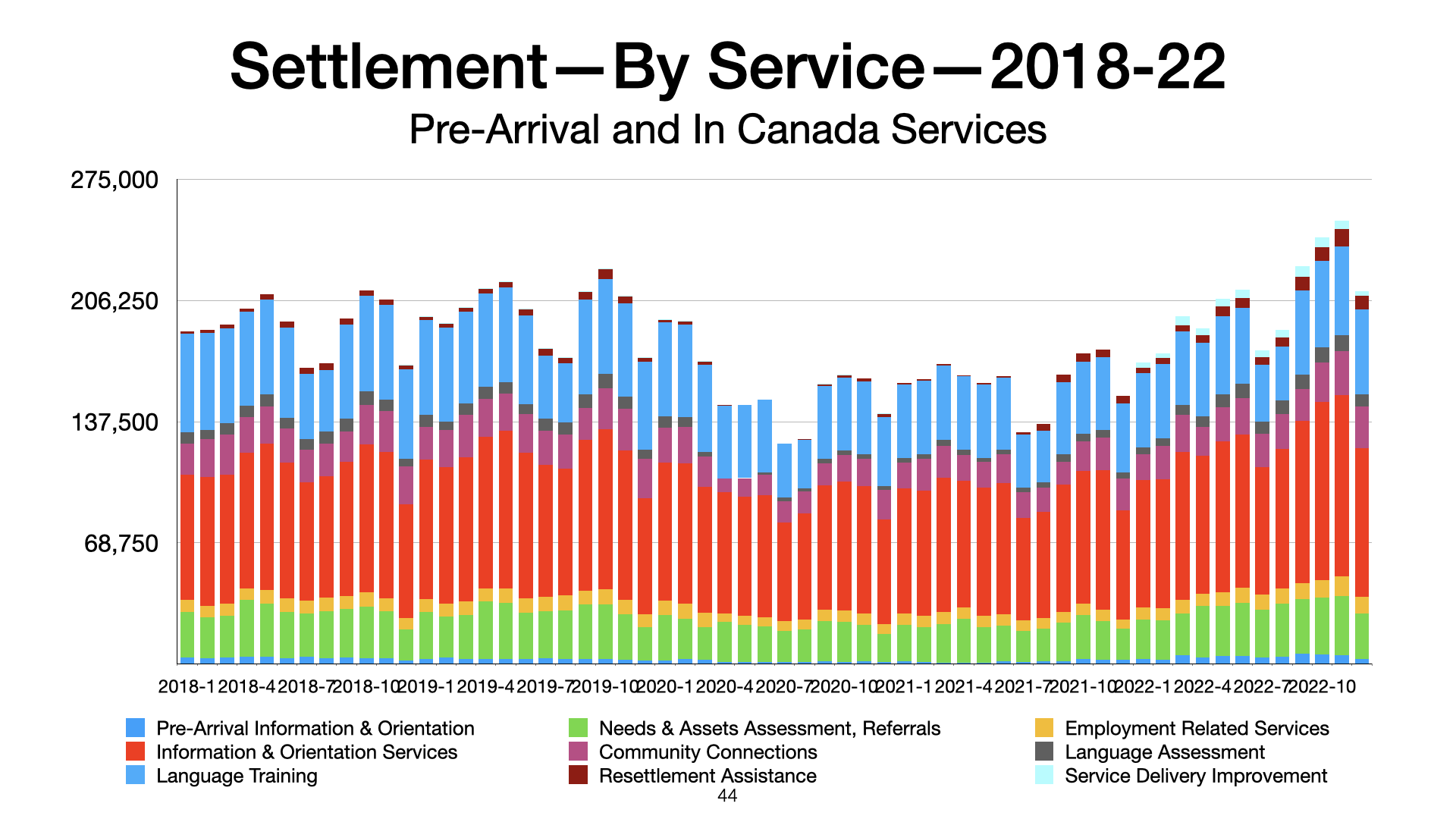
Over focus on the challenge to settlement agencies compared to the real physical and workforce challenges in housing, healthcare and infrastructure. Settlement service stats have been largely flat compared to the pre-pandemic period, suggesting less demand than stated:
There’s a long list of reasons for Canada to open its arms to newcomers from around the world – but when you invite half a million new people to the country every year, you better be prepared. And it’s looking more and more like we’re not.
It goes beyond the affordable-housing crunch and whether everyone will have access to primary health care. Now, some of the Calgary agencies that help people get settled in the country say uncertainty about funding from the federal government is leading to long waiting lists and layoffs.
“It’s always been a challenge, but I’ve never seen it like this. Never,” said Shirley Philips, interim chief executive at Immigrant Services Calgary, who has decades of experience in the sector.
ISC said they will receive less money from Ottawa – which makes up the majority of their funding – this fiscal year than last year. Contract updates from the federal government don’t reflect increased demand even as Alberta’s largest city grows by leaps and bounds, and so job vacancies won’t be filled.
Newcomers are already facing a 55-day wait to get a language proficiency assessment done, Ms. Philips said. And then four to six months to get into English classes after that. As demand continues to grow, she fears those wait times will stretch longer.
“You’ve got this talent pool that Canada says they want in their country, but we’re doing very little even at the basic level of language, employment services and housing.”
Another agency, the Centre for Newcomers, has laid off about 65 people – almost a quarter of its staff – in recent weeks. Chief program officer Kelly Ernst said the issue is a delay in contract updates with the federal government, which would provide a flow of money based on higher demand. He’s worried about some people falling through the cracks, as was the case for a newly arrived Ukrainian family he said his agency found living on the streets of Calgary last week.
“We served over 35,000 people last year, and if this continues, we’re going to break that record again this year,” Mr. Ernst said.
For its part, Immigration, Refugees and Citizenship Canada said planned investment for settlement services in Alberta is increasing by 6 per cent this year, to nearly $133-million.
“These investments align with Alberta’s proportion of all permanent resident landings,” the federal department said in a statement to The Globe and Mail.
IRCC did not comment on the situation for individual agencies, but added it has “in the past, adjusted investments over the course of the year to respond to pressures, such as an influx of newcomers, and when additional funding becomes available.”
Overall, the department’s budget is being reduced beginning this fiscal year. Temporary programs are being wound down, including the commitment to resettle at least 40,000 Afghans by the end of this year, and provisions for Ukrainians making their way to Canada.
The problem is, settlement agencies say, Afghans and Ukrainians are still coming and they still need help getting acclimatized in Canada – as do many more from all around the world.
The numbers are huge. The federal government is aiming to welcome between 410,000 and 505,000 new permanent residents this year, between 430,000 and 542,500 in 2024, and between 442,500 and 550,000 in 2025. Canada is well on its way to reaching – or exceeding – those ambitious goals, with Statistics Canada saying the country welcomed 145,417 immigrants in the first quarter of 2023, the highest number for any quarter on record. (There was also a net gain of 155,300 non-permanent residents in the first quarter.)
It’s unclear whether Calgary immigration agencies are alone in their struggle for federal funding. Edmonton MP and cabinet minister Randy Boissonnault said he’s not hearing the same concerns in Alberta’s capital.
On a percentage basis, the Alberta population is growing at a rate not seen for more than a century – back to a time when prairie sod houses were a perfectly acceptable form of housing. The provincial population has increased by 200,000 in the past 12 months, standing at more than 4.7 million. The numbers are surging in part because of interprovincial migration, but mostly as a result of new arrivals from outside of Canada.
Another factor that might not be fully quantified is that many immigrants land in Ontario or Quebec, and then make their way to Alberta – often Calgary – when they find out housing is less expensive and there’s plentiful work. This “secondary migration” might not be reflected in federal funding to settlement agencies, their leaders say.
Canada is built on immigration. There is a moral imperative for the country to help those whose lives have been torn apart by war or deeply regressive governments. Climate change is likely to force the movement of millions more.
There are also economic reasons to welcome immigrants. The country badly needs workers – everyone from medical professionals to home builders to child care providers. Canada also needs younger workers, as the country’s population grows greyer.
“We actually need a million people a year. But that would definitely crack the system,” Mr. Boissonnault said.
Calgary immigration agencies are looking to increase their budgets through private donations. And the Alberta government said in its budget that it would provide an extra $7-million over three years for settlement and language supports, on top of some regular funding. That money will start to flow by year’s end.
It all might not be fast enough. It’s already a struggle to provide affordable housing for everyone. The Bank of Canada acknowledged this as it hiked interest rates again this week, in part in another desperate attempt to dampen what appears insatiable demand for real estate in the country.
And beyond finding everyone a place to live, not having basic settlement services in place to help people as they arrive on this scale is indefensible. The soaring political messaging from Ottawa on immigration needs to come with solid support for the agencies doing the on-the-ground work.
Starting with the overall picture and good commentary on the negative impact on productivity by Rupa Banergee:
Canadian companies are ramping up their recruitment of foreign workers to fill a variety of low-wage roles in the service sector, including cooks, cleaners and retail clerks.
In the first quarter, employers were approved to fill about 22,000 positions through the low-wage stream of the Temporary Foreign Worker (TFW) program, an increase of roughly 275 per cent from four years earlier, according to figures recently published by Employment and Social Development Canada (ESDC).
From January through March, employers were approved to hire more than 2,800 cooks, making it the most sought-after role in the low-wage stream. Companies were seeking thousands of other workers for the food-service sector, such as cashiers. Construction labourers and nurse aides were also in high demand.
To hire a TFW, companies must submit a Labour Market Impact Assessment to the government, showing they can’t find local workers to fill vacant positions. If those roles are approved, foreign workers must obtain the appropriate permits to begin their employment. The ESDC numbers reflect the first part of this hiring process.
The figures are even higher than presented: ESDC excludes some employers – such as business names that include personal names – from its data set of approvals by company.
Regardless, the figures show a dramatic rise in demand for TFWs.
Not only have employers faced historically tight labour markets in recent years, but the federal government has made it easier to hire through the program. Ottawa overhauled the TFW program last year, with some moves allowing employers to hire a greater proportion of their staff through the low-wage stream.
While these changes were cheered by business lobby groups, they were also criticized by migration experts.
The TFW program “disincentivizes employers from making the effort to reach out to underutilized segments of the labour market, and also to improve wages and working conditions,” said Rupa Banerjee, a Canada Research Chair in immigration and economics at Toronto Metropolitan University.
Instead, the TFW program provides employers with a “cheap, flexible and frankly vulnerable source of labour to fill gaps in the labour market,” she said.
Recent program announcements highlight the difficulties for the government in having coherent immigration policies. The recent removal of education requirements for Hong Kongers undermines skill levels and productivity, along with demographics given that the change will result in a shift towards older immigrants.
This is not to discount the very real humanitarian objectives behind these two programs, or the political pressure behind most, but to note the overall incoherence:
Vancouver resident Calvin Wong says he can finally start picturing a future in Canada after the federal government announced it was dropping educational requirements for Hong Kongers seeking permanent residency in the wake of the Chinese city’s crackdown on dissent.
Wong, 28, had graduated from the Hong Kong University of Science and Technology with a computer science degree in 2017 before moving to Canada on a work permit in 2021, looking for a life where he could enjoy “political freedom.”
But immigration pathways for Hong Kong residents that have allowed thousands to settle permanently in Canada excluded Wong because it has been more than five years since he graduated.
That will change from August 15, after Ottawa announced on Tuesday it would remove all educational requirements for people with at least a year of work experience in Canada.
Immigration consultants say the move effectively opens pathways for Hong Kongers of all ages, instead of the current focus on students and recent graduates. They said they had been flooded with inquiries since the announcement.
“It’s a very great move by the Canadian government and I can eventually get permanent residence here, contribute and live in Canada safely,” said Wong, his voice breaking with emotion.
The store clerk said the chance to secure permanent residency came as a “huge relief,” and his decision to move to Canada was something he would “never regret.”
In 2021, the federal government created two immigration pathways for Hong Kong residents who had either worked or studied in Canada.
The pathways were in response to a crackdown on political dissent after protests drew millions onto Hong Kong’s streets in 2019, followed by the introduction of a harsh new national security law in 2020.
Stream A applies to former Hong Kong residents who graduated from a post-secondary institution in Canada within three years. People with at least one year of work experience in Canada who graduated from a foreign or Canadian institution within five years could apply for Stream B.
The changes open up Stream B to anyone with a year of work experience in Canada, regardless of education.
Sean Fraser, minister of immigration, refugees and citizenship, said the change was a “win-win situation.”
“(It) means that we can welcome more Hong Kongers to Canada who need our support, while simultaneously helping Canadian businesses fill labour gaps with workers who already have work experience here,” he said in a statement.
The announcement by Fraser’s ministry said Canada “continues to stand by Hong Kong residents, and supports their freedom and democracy.”
Canada has welcomed 3,122 permanent residents under the two pathways as of April 30, 2023.
Wong said that being excluded under the current rules had left him depressed.
“I felt it was really difficult to plan my future at that time. I was thinking: where should I go? Should I try my best to stay in Canada or go to the United Kingdom?” said Wong.
Wong said he can now make plans for the future and would submit his immigration application as soon as he completes his one year of work experience in Canada.
Vancouver-based Immigration consultant Peter Pang said the move is a “huge change,” opening up more opportunities to Hong Kongers to contribute to Canada.
Richmond, B.C., immigration consultant Ken Tin Lok Wong said that while the current rules do not ban older people, the time limits since graduation had effectively set a bar.
To have graduated in the past five years generally meant applicants to Stream B were not particularly old, and were “of working age,” he said.
Wong said he had some clients who were ready to pack their bags and leave Canada. But they now felt like they had “hit the jackpot.”“The announcement feels like Canada is helping to retain Hong Kongers regardless of their education,” he said.
“So, if you happen to be a legal worker in Canada, if you happen to obtain one year of work experience, then you are through.”
Similarly, hard to see how the new pathway for Ukrainians will contribute to productivity or demographics:
The federal government has launched a new immigration program for Ukrainians fleeing their embattled country, allowing those in Canada with family to receive permanent resident status.
“We continue to extend unwavering support and a lifeline to families separated by this conflict, including through this family reunification pathway that will help Ukrainian families stay together as they rebuild their lives in their new communities in Canada,” said Immigration Minister Sean Fraser in a statement released Saturday.
Eligibility will be extended to Ukrainians living in Canada with temporary status and with one or more family members in Canada.
The government said more details will be released closer to when the program launches on Oct. 23, 2023. The program will have no cost attached to it and will be in place for one year.
The announcement Saturday comes on the day the government’s initial emergency immigration program was set to expire.
Under the Canada-Ukraine authorization for emergency travel (CUAET), launched in March 2022, Ukrainians were able to come to Canada and live and work for up to three years. They benefited from a variety of measures meant to speed up the visa process, including prioritized processing and waived fees.
Roughly 166,000 Ukrainians have come to Canada through the special visa program. That’s about 21 per cent of the 800,000 emergency visas granted, from around 1.1 million applications, according to the government.
‘We’re just asking for lots of flexibility’
In an interview Saturday, the head of the Ukrainian Canadian Congress said the details to come would be key to their response to the program. But in general, he said his organization is pushing for more options for Ukrainians coming to Canada.
“We’re just asking for lots of flexibility on the pathways for people as they make their way through what is a very uncertain situation,” said Ihor Michalchyshyn, the UCC’s CEO.
“The war has not ended, we have to keep options open for people.”
One key unknown was what set of questions the government would be using to determine eligibility and approvals throughout the process, he noted.
Ukrainians approved under the CUAET will still be able to travel to Canada up until March 31 of next year. Afterward, they will be subject to the standard immigration measures available to others around the world.
“Once in Canada, temporary residents will be eligible to apply for an extended stay of up to three years through study permits and open work permits, all of which will be prioritized. They will also have access to settlement services, such as language training and employment services. These measures will help them thrive in communities across the country,” the government release said.
Canada has the largest diaspora of Ukrainians outside of Ukraine and Russia, with over 1.4 million people of Ukrainian descent living here, according to government statistics.
Michalchyshyn said while immigration programs and settlement services are important for people coming to this country, the priority push from his organization is still aid to Ukraine itself.
“The sooner that Ukraine wins the war, the sooner peace and normality can resume and this massive refugee crisis will come to an end.”
“I want to always err on the side of life,” Pence told AP News. “I would hold that view in these matters because … I honestly believe that we got this extraordinary opportunity in the country today to restore the sanctity of life to the center of American law.”
It seems illogical, not to mention inhumane, to outlaw abortion when there is no chance a fetus can be born alive. One is not saving a life, because that life will end before it comes to term. And one may be taking a life: a non-viable pregnancy can kill the woman carrying it, as evidenced in a recent lawsuit challenging an abortion ban in the state of Texas.
Forcing a woman to carry a fetus fated to die is also psychological torture of the highest order. Every time a stranger asks about her pregnancy, every time she catches a glimpse of her swollen abdomen in the mirror, every time she thinks of the child she wanted but who is not to be, she is made to suffer. There’s nothing Christian about that.
But that does not matter to Pence. He needs to mobilize the votes of the religious right to win the GOP nomination. He has the pedigree: he championed their issues in the White House during the Trump administration and since then only hardened his stance. “I am pro-life and I don’t apologize for it,” Pence told Face the Nation in April. He argued this week that restricting abortion is “more important than politics” and calls it the “cause of our time.”
That’s where the clothes come off the emperor. Pence is no defender of the American Constitution, nor is he a conservative. He is a religious autocrat. Founding father Thomas Jefferson famously declared that when the American people adopted the First Amendment, they built a “wall of separation between the church and state.” Christian autocracy flies in the face of this dictate, basing policy not on evidence, reason, or debate, but on the tenets of a specific faith. It violates the United States Supreme Court’s neutrality test that requires that government be neither the ally nor the adversary of religion.
But the American religious right isn’t concerned about this. It has friends in high places. Domestically, it now has the Supreme Court on its side, as evidenced by its overturning of Roe v. Wade. And internationally, it has a lot of disturbing company.
One of those is Hungary’s Fidesz Party, that came to power in 2010 under Viktor Orban. In 2022, the European Union Parliament condemned Orban for creating an “electoral autocracy” that restricts the rights of the judiciary, LGBT individuals, the press and ethnic minorities. That same year, Orban set his sights on Hungary’s abortion law. It currently permits terminations up to twelve weeks in cases of rape, risks to the mother’s health, serious personal crisis, or a severe foetal disability. But by decree, the Hungarian government now requires that pregnant women must listen to the foetal heartbeat prior to making their decision, similar to laws enacted in Texas and Kentucky.
Iran’s Islamic theocracy is another regime infamously hostile to human rights, including those of women. In September 2022, 22-year-old student Jina Masa Amini was killed while in police custody. Her “crime” was not wearing her hijab tightly enough, in contravention of Iran’s strict religious dress codes. Amini’s death sparked nationwide and then worldwide demonstrations under the motto “Woman, Life, Freedom”. In her home country, more than 500 Iranians were killed in the protests and five sentenced to death between September 2022 and April 2023.
As for abortion, it is illegal in Iran unless a fetus is diagnosed with a genetic disorder or the mother’s life is endangered. But the government has now upped the ante. In May 2023, Iran’s Center for Population Rejuvenation created a volunteer militia called Nafs (life) to identify doctors and clinics performing abortions, and shut them down. Iranian media have dubbed the group the “[Anti] Abortion patrols analogous to the same type of hijab enforcement units that arrested Amini.
Then, there’s China. In 1980, faced with a rising birth rate, China imposed a one-child policy. Millions of women were forced to terminate additional pregnancies, and due to a cultural preference for male children, hundreds of thousands of girls were aborted, abandoned or killed. In 2016, China repealed the policy due to an imbalance of the sexes and low birth rate, resulting in an aging population and demographic decline.
At first glance, China’s policy appears to be the polar opposite of religious pro-life policies that restrict abortion, but it’s driven by the same principle: removing bodily autonomy from women in the name of the state. China’s goal isn’t religious, but secular: the manipulation of the birth rate to ensure a steady supply of workers and soldiers to carry out the nation’s ambitions. And to ensure that the “right” children are conceived, namely, ethnic Han Chinese.
What all three nations have in common is not piety, but ethnic nationalism. The real drivers for their abortion and fertility policies are low birth rates among “desired” groups, coupled with aging populations.
Iran’s Supreme Leader Ali Khameni has described population growth as one of the “most urgent duties and essential policies of the Islamic Republic as the leading Shia country in the Muslim world.” Pregnancies are being documented to prevent abortion “so that the population of the country could grow.” Hungary is not only making access to abortion more difficult, but decreeing that women with four children will be exempt from paying income tax for life. In China, whose population shrank this year and was surpassed by that of India, companies are paying employees to have children. But according to an Associated Press investigation,China continues to limit births – including by forced sterilizations — among ethnic minorities including the Muslim Uyghur population of Xinjiang. It further seeks to assimilate these cultures to achieve its policy of “ethnic fusion”.
Theocracies are not pluralist. They favour believers and condemn those who dissent to second class status, or worse. If Americans think Pence would stop at abortion, they are deluded. Any minority – defined by race, belief, gender or country of origin – would be in his administration’s sights.
If the Republican party is to truly preserve the Constitution, if it is to offer a truly conservative political option, it must reject authoritarianism, including Pence’s Christian autocracy. Otherwise, it will become just as statist as the Left that it condemns.
The federal government has revoked a controversial policy that required immigration applicants or refugees to disclose an HIV diagnosis to the person who was sponsoring them to Canada.
The immigration department’s move to put an end to the automatic partner notification policy was hailed by advocates who have criticized the rule, saying it discriminated against people living with HIV and failed to reflect medical advancements in treating the once-deadly virus.
All permanent resident applicants are still required to undergo an HIV test as part of their medical screening. Being HIV positive does not make someone inadmissible due to a formal public health concern, but it can still lead to inadmissibility if the person’s anticipated health care exceeds a set threshold.
The notification policy has been in place since 2003 as a public health measure to stop the spread of HIV, which, if untreated, can lead to acquired immunodeficiency syndrome or AIDS, a disease that has killed millions.
Modern medical treatment has transformed the virus into a manageable condition, and advocates say that, after two decades, the “out-of-date and discriminatory” policy needed to go.
This policy was unique to HIV-positive applicants; there was no similar requirement for other health conditions. The rule also only applied to sponsored family members and refugees, not to visitors, international students, temporary foreign workers or those applying for permanent residence under the economic class.
“Congratulations to the Immigration Minister for doing the right thing,” said lawyer Michael Battista, who had represented immigration applicants caught in this situation, which further caused delays in processing their applications due to the long wait for a in-person interview that was subsequently required.
“The swift termination of this policy has been a tremendous relief for our clients. The policy added to their stress and sense of being stigmatized. It also achieved no purpose, because most sponsors were fully aware of their partners’ HIV status.”
In June, three groups wrote to Immigration Minister Sean Fraser and Marci Ien, the minister for women and gender equality and youth, demanding the policy be reconsidered. The signatories to the letter included the HIV & AIDS Legal Clinic of Ontario (HALCO), the HIV Legal Network and the Coalition des organismes communautaires québécois de lutte contre le sida (COCQ-SIDA).
“Canada has long claimed to be a leader on the world stage when it comes to both HIV and human rights. This is certainly a positive step in that direction,” said the HIV Legal Network in a statement to the Star.
The network, however, said the medical inadmissibility provision will continue to be a barrier for applicants with medical needs by reducing them to the cost of their health care.

 Multicultural Meanderings