U.S. maternal deaths keep rising. Here’s who is most at risk

Likely similar variations in Canada although hopefully there has not been a comparable increase:

The number of people dying in the U.S. from pregnancy-related causes has more than doubled in the last 20 years, according to a new study, published in JAMA, the Journal of the American Medical Association.

And while the study found mortality rates remain “unacceptably high among all racial and ethnic groups across the U.S.,” the worst outcomes were among Black women, Native American and Alaska Native people.

The study looks at state-by-state data from 2009 to 2019. Co-author Dr. Allison Bryant, an obstetrician at Massachusetts General Hospital in Boston, says maternal death rates in the U.S. just keep getting worse.

“And that is exacerbated in populations that have been historically underserved or for whom structural racism affects them greatly,” she says.

Maternal death rates have consistently been the highest among Black women, and those high rates more than doubled over the last twenty years. For Native American and Alaska Native people, the rates have tripled.

Dr. Gregory Roth, at the University of Washington, also co-authored the paper. He says efforts to stop pregnancy deaths have not only stalled in areas like the South, where the rates have typically been high. “We’re showing that they are worsening in places that are thought of as having better health,” he says.

Places like New York and New Jersey saw an increase in deaths among Black and Latina mothers. Wyoming and Montana saw more Asian mothers die. And while maternal mortality is lower for white women, it is also increasing in some parts of the country.

“We see that for white women, maternal mortality is also increasing throughout the South, in parts of New England and throughout parts of the Midwest and Northern Mountain States,” he says.

The steady increase in maternal mortality in the U.S. is in contrast to other high-income countries which have seen their much lower rates decline even further.

“There’s this crystal clear graph that’s been out there that’s very striking,” Bryant says. With countries like the Netherlands, Austria and Japan with a clear decrease. “And then there is the U.S. that is far above all of them and going in the opposite direction,” she says.

Most maternal deaths are deemed preventable by state review committees. Dr. Catherine Spong, at the University of Texas Southwestern Medical Center, says pregnancy-related deaths can be caused by different things. The biggest risk factors are conditions like cardiovascular disease, severe pre-eclampsia, maternal cardiac disease and hemorrhage, she says.

Continuing heart problems and mental health conditions can also contribute to the death of a new mother.

The researchers say doctors would have a better chance of dealing with these health conditions, if more women had access to healthcare after their babies were born.

About half the births in the U.S. are paid for by Medicaid and “the majority of the deaths are in the immediate postpartum period,” Roth says. “If you don’t have easy access to health care in this period, you’re at very high risk.”

For those who get their healthcare through Medicaid, medical coverage lasts at least two months after the birth of a child. Since 2021, states have had the option to extend that coverage for a year. So far, 36 states and Washington D.C. have done so. States like Alabama and Mississippi, which saw some of the highest maternal death increases, did not.

Source: U.S. maternal deaths keep rising. Here’s who is most at risk

Matas: Canada urgently needs to release its Holocaust-related records 

Agree:

The Canadian Access to Information system has broken down. The dysfunctional nature of the system is highlighted by the difficulty in accessing Holocaust records.

The Holocaust ended in 1945, more than 78 years ago. The Commission of Inquiry on War Criminals, headed by Justice Jules Deschênes, completed its work in 1986, almost 37 years ago. The Canadian effort to bring Nazi war criminals to justice has ended. The survivors are fast disappearing.

Though the records in Canada of the Holocaust and its perpetrators are old, their release is urgent. We will soon no longer be able to keep the memory of the Holocaust alive through the testimony of survivors – we will have to rely on the records. Yet, efforts to get the release of Holocaust-related records have gone nowhere.

Remembering the Holocaust means not just remembering the victims. It means also remembering their murderers. We need access to the report written by Alti Rodal for the Deschênes Commission, titled Nazi War Criminals in Canada: The Historical and Policy Setting from the 1940s to the Present. It was written to be public in its entirety, but has been released subject only to inexplicable extensive deletions. Part II of the Deschênes Commission report, addressing individual cases, has not been made public. And the hundreds of Nazi war crimes files originally held by the Department of Justice and Royal Canadian Mounted Police are inaccessible.

Canada is a member of the International Holocaust Remembrance Alliance. The Alliance’s 2000 Stockholm Declaration commits the signatories to “take all necessary steps to facilitate the opening of archives in order to ensure that all documents bearing on the Holocaust are available to researchers.” The Alliance’s Monitoring Access to Archives Project recommended in 2017 that governmental archival institutions “release Holocaust related records, irrespective of any personal identifying information or national security classifications.” Yet, Canada is not respecting these commitments.

B’nai Brith Canada filed a request for Nazi war crimes related records in January, 2022, to Library and Archives Canada. A year and a half later, the institution has yet to provide a date by which the request would be processed.

In February, 2022, B’nai Brith Canada asked the Department of Justice for the files of all Nazi war crimes relating to people who died more than 20 years ago, the period after which privacy protection expires. The department replied that “it does not have the capabilities” to respond to the request.

B’nai Brith Canada then modified its request to ask for only those Nazi war crimes files of the people named by the Deschênes Commission, excluding cases that went to court, and persons not yet dead for 20 years. The Department of Justice responded in July, 2022, that it would take 1,285 days, that is to say more than three-and-a-half years, to answer the request

The House of Commons Standing Committee on Access to Information, in its report dated June 20, made a number of welcome recommendations, one of which was the automatic release of historical documents that are more than 25 years old. The federal government has so many documents and so little staff and budget allocated to deal with them that the only way to make the access to information system work is to automatically release whole categories of records. Requiring consideration of each and every document to determine whether any one of a long list of exemptions to disclosure applies is a recipe for inaction.

Philosopher George Santayana wrote: “Those who cannot remember the past are condemned to repeat it.” Yet, we cannot remember a past that remains hidden from us. To remember the past, we have to know the past.

Only through public access to Holocaust archives can we learn lessons from those archives. Learning lessons from the Holocaust is a legacy we can create for the victims, giving meaning to the senseless death of innocents. To learn those lessons, we need access to the archives.

David Matas is senior counsel to B’nai Brith Canada. He is a member of the International Holocaust Remembrance Alliance Monitoring Access to Archives Project.

Source: Canada urgently needs to release its Holocaust-related records

Being HIV positive is no longer a death sentence. So why does Canada insist on sharing immigration applicants’ HIV status with their sponsors?

Of note:

When they found love in Mexico 10 years ago, one of the first things the Canadian man’s boyfriend confided in him was that he was HIV-positive.

But the medical condition was no longer seen as the health threat it had once been, and it wasn’t going to stop their budding relationship.

The couple maintained a long-distance romance for four years before the Mexican partner moved to Toronto in 2017 on a work permit.

It was when they started their spousal sponsorship application in 2020 that the couple learned of Canada’s automatic HIV-partner-disclosure policy.

It’s a policy that mandates an immigration applicant or refugee prove they have disclosed their medical condition to the person who is sponsoring them to Canada.

The couple say they found the formal process not only offensive but frustrating, as it delayed the processing of their file for an additional 18 months.

Finally, they were scheduled for the long-awaited brief interview in April to confirm, in person, that the sponsored partner’s HIV status had been disclosed.

“It’s not just a privacy issue. I also just feel incredibly stigmatized,” said the 55-year-old Canadian fashion designer, who asked not to be identified to protect his partner’s privacy.

“I don’t feel it’s anybody’s business, and I don’t feel it’s something that needs to be addressed for my partner.”

The so-called “automatic partner notification policy” has been in place since 2003 as a public health measure to stop the spread of the HIV virus, which, if untreated, can lead to acquired immunodeficiency syndrome or AIDS, a disease that has killed millions.

However, modern medical treatment has transformed the virus into a manageable medical condition, and advocates say that, after two decades, the immigration department’s “out-of-date and discriminatory” policy should go.

In mid-June, three organizations wrote to Immigration Minister Sean Fraser and Marci Ien, the minister for women and gender equality and youth, demanding the policy be revoked and saying that it was discriminating against people with HIV and violating their right to equal treatment under the Canadian Charter.

“Not only does the Policy significantly extend the length of processing of immigration applications for people living with HIV, it also perpetuates myths and stereotypes that people with HIV are deceptive and are less worthy of intimate relationships,” the letter noted.

The signatories of the letter include the HIV & AIDS Legal Clinic of Ontario (HALCO), the HIV Legal Network, and the Coalition des organismes communautaires québécois de lutte contre le sida (COCQ-SIDA).

Michael Battista, their counsel, said the policy is discriminatory because only those applicants sponsored under the family and refugee classes are subject to the disclosure to partner policy.

Temporary residence visa applicants — visitors, international students, temporary foreign workers — and those applying for permanent residence under economic class are not under the same scrutiny even though they, too, could potentially be HIV positive.

“We let in HIV-positive foreign students, foreign workers. We don’t ever force them to reveal to their intimate partners that they’re HIV positive. Why are we singling out the family class and dependent refugees?” asked Battista.

“It’s not even serving the ends of its public health concern.”

The policy is unique to HIV-positive applicants. There is no similar mechanism for other health conditions.

Immigration applicants with active pulmonary tuberculosis (TB) and untreated syphilis can be found inadmissible to Canada, unless they are treated, on the grounds that their condition is a danger to public safety, according to the standards laid down by Health Canada.

However, unlike TB and untreated syphilis, immigration officials do not consider HIV a danger to public health.

When the original policy was implemented, it required consent of the HIV-positive applicant for immigration officials to contact their sponsor in Canada about their HIV status and assess whether the sponsor would withdraw their application.

To avoid the impression that the policy was prompting sponsors to withdraw their applications, the updated policy has, since 2016, given the HIV-positive applicant 60 days to provide proof they have informed their sponsor of their diagnosis or to withdraw their application. If the applicant takes no action, immigration officials will then inform the sponsor about their HIV status after 60 days have elapsed.

HIV-positive sponsorship applicants must also attend a compulsory interview that is not required of other sponsorship applicants.

Battista said immigration officials had not strictly adhered to the policy until about 18 months ago, when he started to see the processing times of the HIV positive clients’ cases “inexplicably lengthened.”

“The explanation we got was they were being put into the interview stream automatically. We tried to be proactive and provide evidence that the sponsor was advised of the HIV-positive health condition of the person being sponsored,” said Battista. “But they just didn’t budge.”

He said the policy perpetuates a stereotype that people with HIV are morally blameworthy and irresponsible in taking precautions to prevent the transmission of HIV.

On its website, the immigration department said the policy does not intend to “inflict unnecessary hardship” on applicants or sponsors.

“Rather, it is a measure that will protect the health and safety of the spouses and partners (residing in Canada) of applicants in the family and dependent refugee classes who test positive for HIV,” it noted.

While the change of language in the 2016 policy was an improvement, Avineet Cheema, staff lawyer at HALCO, said it still doesn’t reflect modern science.

“This is a policy that was implemented at a time when there wasn’t as much modern science advancements when it comes to HIV and suppressing viral loads and things like that,” said Cheema, who has seen cases in which an officer asked the sponsor why they’re comfortable marrying an HIV carrier.

“Being diagnosed with HIV is in no way a death sentence at this time. And it is very manageable with medications to the point that there isn’t even a real decrease in life expectancy.”

There are other sexually transmitted infections, said Cheema, and singling out HIV further stigmatizes those living with the virus.

“That really targets the dignity of people who are living with HIV, because the Canadian government is essentially telling them, ‘You’re different. You are dangerous. Your health condition makes it so.’”

The policy, she added, disproportionately affects gay, trans, Black and other racialized people, due to the heightened impact of the HIV stigma.

The Canadian sponsor of the Mexican partner said they are committed and responsible adults, but were uncomfortable at their April interview at the immigration office in Niagara Falls.

“I felt there was homophobia hidden behind a mask of protocol,” he said. “I don’t think it’s fair that they single out people with HIV. It’s not fair for my partner to have to go through that.”

In an email to the Star, the immigration department said it doesn’t collect data on the notifications issued, interviews conducted and sponsorship withdrawals recorded under the policy.

A department spokesperson said the policy is currently under review and that any modifications will be made to the public when it is completed.

Source: Being HIV positive is no longer a death sentence. So why does Canada insist on sharing immigration applicants’ HIV status with their sponsors?

US citizenship test changes are coming, raising concerns for those with low English skills

Similar debates when Canada changed the citizenship test in 2009. The initial drop in pass rates from about 95 percent to 85 percent eventually resulted in changes that resulted in a more reasonable pass rate of 91-92 percent more recently. But literacy, education and the related familiarity with tests all played a role:

The U.S. citizenship test is being updated, and some immigrants and advocates worry the changes will hurt test-takers with lower levels of English proficiency.

The naturalization test is one of the final steps toward citizenship — a monthslong process that requires legal permanent residency for years before applying.

Many are still shaken after former Republican President Donald Trump’s administration changed the test in 2020, making it longer and more difficult to pass. Within months, Democratic President Joe Biden took office and signed an executive order aimed at eliminating barriers to citizenship. In that spirit, the citizenship test was changed back to its previous version, which was last updated in 2008.

In December, U.S. authorities said the test was due for an update after 15 years. The new version is expected late next year.

U.S. Citizenship and Immigration Services proposes that the new test adds a speaking section to assess English skills. An officer would show photos of ordinary scenarios – like daily activities, weather or food – and ask the applicant to verbally describe the photos.

In the current test, an officer evaluates speaking ability during the naturalization interview by asking personal questions the applicant has already answered in the naturalization paperwork.

“For me, I think it would be harder to look at pictures and explain them,” said Heaven Mehreta, who immigrated from Ethiopia 10 years ago, passed the naturalization test in May and became a U.S. citizen in Minnesota in June.

Mehreta, 32, said she learned English as an adult after moving to the U.S. and found pronunciation to be very difficult. She worries that adding a new speaking section based on photos, rather than personal questions, will make the test harder for others like her.

Shai Avny, who immigrated from Israel five years ago and became a U.S. citizen last year, said the new speaking section could also increase the stress applicants already feel during the test.

“Sitting next to someone from the federal government, it can be intimidating to talk and speak with them. Some people have this fear anyway. When it’s not your first language, it can be even more difficult. Maybe you will be nervous and you won’t find the words to tell them what you need to describe,” Avny said. “It’s a test that will determine if you are going to be a citizen. So there is a lot to lose.”

Another proposed change would make the civics section on U.S. history and government multiple-choice instead of the current oral short-answer format.

Bill Bliss, a citizenship textbook author in Massachusetts, gave an example in a blog post of how the test would become more difficult because it would require a larger base of knowledge.

A current civics question has an officer asking the applicant to name a war fought by the U.S. in the 1900s. The applicant only needs to say one out of five acceptable answers – World War I, World War II, Korean War, Vietnam War or Gulf War – to get the question right.

But in the proposed multiple-choice format, the applicant would read that question and select the correct answer from the following choices: A. Civil War B. Mexican-American War C. Korean War D. Spanish-American War

The applicant must know all five of the wars fought by the U.S. in the 1900s in order to select the one correct answer, Bliss said, and that requires a “significantly higher level of language proficiency and test-taking skill.”

Currently, the applicant must answer six out of 10 civics questions correctly to pass. Those 10 questions are selected from a bank of 100 civics questions. The applicant is not told which questions will be selected but can see and study the 100 questions before taking the test.

Lynne Weintraub, a citizenship coordinator at Jones Library’s English as a Second Language Center in Massachusetts, said the proposed format for the civics section could make the citizenship test harder for people who struggle with English literacy. That includes refugees, elderly immigrants and people with disabilities that interfere with their test performance.

“We have a lot of students that are refugees, and they’re coming from war-torn countries where maybe they didn’t have a chance to complete school or even go to school,” said Mechelle Perrott, a citizenship coordinator at San Diego Community College District’s College of Continuing Education in California.

“It’s more difficult learning to read and write if you don’t know how to do that in your first language. That’s my main concern about the multiple-choice test; it’s a lot of reading,” Perrott said.

U.S. Citizenship and Immigration Services said in a December announcement that the proposed changes “reflect current best practices in test design” and would help standardize the citizenship test.

Under federal law, most applicants seeking citizenship must demonstrate an understanding of the English language – including an ability to speak, read and write words in ordinary usage – and demonstrate knowledge of U.S. history and government.

The agency said it will conduct a nationwide trial of the proposed changes in 2023 with opportunities for public feedback. Then, an external group of experts — in the fields of language acquisition, civics and test development — will review the results of the trial and recommend ways to best implement the proposed changes, which could take effect late next year.

The U.S. currently has the easiest citizenship test compared to other Western countries — including Germany, Canada and the United Kingdom — according to Sara Goodman, a political science professor at the University of California, Irvine.

Goodman said she uses the following metrics to determine the difficulty of a test: the number of questions required to pass and the number of questions overall, the percentage of applicants who pass the test, the language level of the test, and whether or not questions with answers are made available to study before taking the test.

In the U.S. test, applicants must answer six out of 10 questions correctly to pass. About 96% of applicants pass the test, according to recent estimates. The test is at a “high beginner” level of English, Goodman said, and a question bank with answers is made available to study beforehand.

But in the German test, Goodman said applicants must answer 17 out of 33 questions correctly to pass. About 90% of applicants pass the test, according to recent estimates. The test is at an “intermediate” level of German, according to Goodman. And a question bank with answers is made available.

The Canada and United Kingdom tests are even harder, and a question bank is not provided in the latter, Goodman said.

Elizabeth Jacobs, director of regulatory affairs and policy at the Center for Immigration Studies – a nonprofit research organization that advocates for less immigration – said the proposed changes would make the U.S. citizenship test even easier for many people.

“We think that’s in the wrong direction,” Jacobs said on behalf of the organization.

The proposed multiple-choice format for the civics section would put the answer to each question in front of applicants, Jacobs said, and would get rid of the memory challenge that’s in the current test.

Jacobs said her organization would prefer a test that includes more material and emphasizes American values, such as religious freedom and freedom of speech, more.

She added that most people who naturalize in the U.S. are not in the country because of merit or refugee status, but because of family sponsorship, where someone in their family became a U.S. citizen before them and petitioned for them to naturalize.

Jacobs said having a stricter test would help ensure that new citizens integrate into American society – and the economy – with sufficient English language skills, as well as promote a healthy democracy with civics knowledge and engagement.

Not everyone agrees.

“Is it important for us to even have a civics test in the first place? I don’t know the answer to that question,” said Corleen Smith, director of immigration services at the International Institute of Minnesota, a nonprofit that connects immigrants to resources.

Smith said USCIS already evaluates whether applicants have past criminal histories, pay taxes and support their children financially.

“They’re already evaluating that portion of your background. Is it also important to know this information about history and government and be able to memorize it?” Smith said, adding: “People that were born in the U.S. and are natural-born citizens — a lot of those folks don’t know many of these answers to the history of government questions.”

More than 1 million people became U.S. citizens in fiscal year 2022 — one of the highest numbers on record since 1907, the earliest year with available data — and USCIS reduced the huge backlog of naturalization applications by over 60% compared to the year before, according to a USCIS report also released in December

Source: US citizenship test changes are coming, raising concerns for those with low English skills

Should we replace some public servants with computerized agents?

Yes, as a means to improve citizen service and reduce wait times for routine applications and services. But prior to doing so, do the hard work of reviewing programs and opportunities for simplificant and streamlining rather than assuming tech is a solution to address program complexity, duplication and incoherence between programs.

Most of us have experience with chatbots, who are likely to become more effective given advances in large language models such as ChatGBT:

Take a moment to imagine your next application for passport renewal. Rather than heading to a passport office, the government now allows you to apply online. If the passport office wants to follow up, instead of inviting you to visit in person, they send you a text, asking you to call a number.

Your call is connected immediately, and the agent is pleasant, speaking your language fluently with a slightly hard-to-identify accent. She asks you benign but interesting questions about your upcoming trip. At the end of the conversation, she lets you know that your application will be approved. You thank her enthusiastically, and she wishes you a safe journey.

This scenario is the kind of ideal government interaction that Canadians dream of. But what if that pleasant person who helped you was in fact a highly intelligent computer? Would it change our feelings about the level of service?

What if, instead of a passport application, you were interacting over a medical need; a question of a child support payment; or a request for employment insurance after a job loss? What if you were trying to speak to your local member of Parliament, asking them for assistance in a public matter or to express your opinion on an issue

The reality is that governments are not far from having access to such services. Large language models – made famous by OpenAI’s ChatGPT – are improving at a breathtaking pace. Speech technology and voice recognition are developing at a similar rate. When the linguistic fluency of a language generator is combined with speech technology, the capacity exists to have a conversation with a computer that differs undetectably from one with a human. These digital agents can seamlessly incorporate the information they are receiving in real-time to make judgments that their owners – in this case, the government – program them to make. A world of digital agents who can replace public servants is closer than we think.

Should we help that world develop or hold it back? Of course, we would all rather deal with a real human who behaves like our imaginary artificial agent – quickly, empathetically and accurately. But for many users of government services, that’s not the right comparison case. Which would you prefer: The scenario we described above with an intelligent chatbot? Or the scenario in which you get a notification that you have to head to the passport office (which involves finding it and either securing an appointment or waiting in line) to talk to someone? Or the alternative – to wade through phone trees and hold music to talk to someone who may be at the end of a difficult day and not all that interested in solving your problem, not able to speak your language idiomatically, or unable to explain things in terms you understand?

In the passport example, the constraint on providing better services with an intelligent chatbot would not be the availability of workers to process passport decisions, but the capacity of this technology to scale up. Marginal costs are low here.

To be sure, there are challenges in using these technologies. Their advantages are only realized when more discretion is given to the digital agent. We would have to allow it to make decisions. How do we audit the decisions of robots? And who is accountable for the decisions which they make? What is the recourse when they make the wrong calls, or even do harm through their choices?

These are the kinds of choices governments will need to make about how they are willing to deploy digital agents to deliver services. There will come a moment in the future, perhaps the near future, where the cost of such agents will be low enough and the need for more government services will be high enough, that saying no to such machines will be impossible. Before that time comes, governments ought to decide what principles will guide their use.

There are multiple ways to achieve this. Governments could engage in substantial public consultations and hearings, with both experts and regular citizens. They could convene groups of citizens to deliberate over the principles and rules for the deployment of digital agents. They could run small, open trials, where citizen use of these technologies is entirely voluntary and the results of decisions are open to public scrutiny.

However governments decide to tackle these future choices, the decision must be made a priority now. The aspiration of democracies has long been a government for the people, but also by the people. And it’s up to democracies to decide if the same rule should apply to public services.

Peter Loewen is the director of the Munk School of Global Affairs & Public Policy. Gillian Hadfield is the director of the Schwartz Reisman Institute for Technology and Society.

Source: Should we replace some public servants with computerized agents?

Maximum Canada is happening

Rather naive in terms of minimizing the practicalities of ensuring adequate housing, healthcare and infrastructure, one of the key points that Saunders needed to be addressed in Maximum Canada. And the nation-building aspect overstated, given this gap and persistent low productivity that current policies, with few exceptions, are not addressing. Same large population fallacies:

A lot of people — at least, a lot of people who read this blog — know of Matt Yglesias’ book One Billion Americans. It’s good, you should read it. But not as many seem to know that it’s actually a riff on a book that came out three years earlier called Maximum Canada: Why 35 Million Canadians Are Not Enough, by Doug Saunders. In fact, the books are pretty different; Saunders spends most of his time justifying the idea of a bigger Canada with appeals to the country’s history, culture, and politics, where Yglesias mostly discusses the practical details of how we’d fit the newcomers into the country. 

But what these two books share is that they’re both advocating a certain type of nation-building strategy — the idea of deliberately promoting large-scale immigration in order to expand a country’s population toward a numerical target. This isn’t something the U.S. has really done in the past. We enacted laws to make immigration more or less restrictive, but this was typically done either as an ad-hoc reaction to a wave of immigration pressure from abroad (e.g. in 1924), or out of moral and ideological concerns (e.g. in 1965). To a large extent, we didn’t really have to do this; people were almost always beating down our door to get here, and all we had to do was sit back and decide who to let in. (In the two decades after the Civil War, there was some talk of recruiting immigrants from abroad to populate the Midwest and West, but this was shelved when it turned out lots of people wanted to come of their own accord.) 

Canada, for much of its own history, was similar. But in recent years, the Canadian government has begun to set hard targets for immigration, such as last year’s target of 1.5 million more by 2025. And the country is deliberately encouraging more people to come, with one of the world’s most aggressive recruitment strategies. 

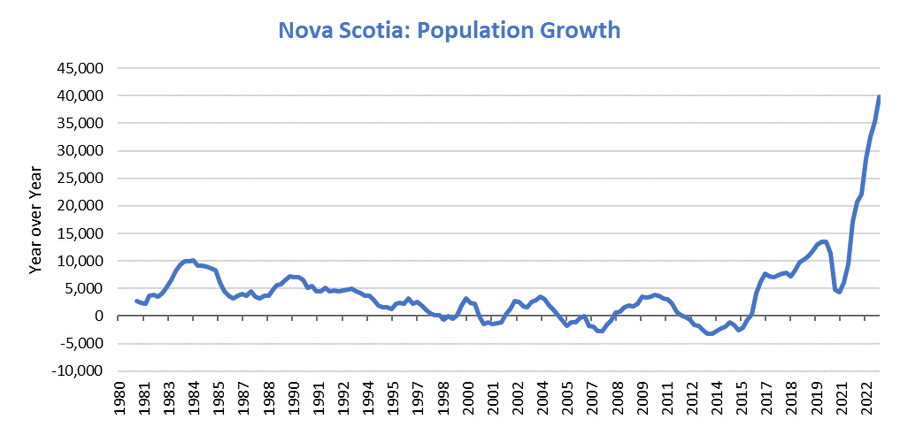
First, let’s just take a look at the results Canada is achieving. The country’s population has just passed 40 million — a 14% increase from when Doug Saunders published Maximum Canada. The national statistics agency loudly celebrated the achievement. And the country’s population growth rate has just shot up to over 3.5%, which is among the world’s fastest:

Source: Brent Donnelly

Here’s another fun graph, just from Nova Scotia:

Source: Deny Sullivan

And this is all from immigration. The country’s total fertility rate is 1.4, far below the replacement rate. Yet population is booming because Canada is recruiting from abroad.

This isn’t quite Maximum Canada yet, but it’s clearly headed in that direction. 

And Canada’s zeal for greater population inflows is matched by its determination to recruit the best and the brightest en masse. The country’s points-based immigration system, the Federal Skilled Worker Program, is well-known, as is the Provincial Nominee Program that allows individual Canadian provinces to recruit immigrant workers to specific locations. But the country keeps adding more programs for grabbing talent. Its latest idea includes an offer of permanent residency to people working in the United States on H-1B visas — basically, poaching America’s own skilled immigrants! Here are some excerpts from the announcement:

As part of Canada’s first-ever Tech Talent Strategy, Minister Fraser announced the following aggressive attraction measures:

  • the creation of an open work permit stream for H-1B specialty occupation visa holders in the US to apply for a Canadian work permit, and study or work permit options for their accompanying family members
  • the development of an Innovation Stream under to the International Mobility Program to attract highly talented individuals…
  • the promotion of Canada as a destination for digital nomads
  • the creation of a STEM-specific draw…under the Express Entry program…
  • improvements to the Start-up Visa Program

Canada also has family-based and humanitarian immigration programs like the U.S. does, but the big difference here is that they take absolutely massive numbers of skilled immigrants from all over the world.

All of this adds up to what looks to me like a nation-building strategy. Canada has a clear vision for itself as a multicultural mecca for all of the world’s smart and hard-working people. It’s a bit like Singapore, except more democratic, and without that country’s emphasis on preserving a single ethnicity’s demographic dominance. If you’re smart and you want to work and you like Canadian culture, it doesn’t matter what you look like; you’re in the club. 

What’s amazing is that the vast majority of the country’s populace appears to have signed onto this strategy. As Derek Thompson writes, immigration has not produced a big backlash in Canada, outside of some highly localized concerns (like Chinese capital flight buying up property in Vancouver). A little of this might be from the Anglophone majority’s desire to reduce the political influence of Quebec, but much of it is just that multiculturalism and immigration are deeply rooted in the country’s self-defined national identity. And on top of that, the fact that so much of Canada’s immigration is based on employment prospects and skills probably reduces social friction; immigrants are likely to make a lot of money and not commit much crime. 

There’s also one additional factor that no one talks about, but which would definitely be on my mind if I were Canadian: national security. Canada has a very large, very powerful, and occasionally politically unstable neighbor to its south. It has already defeated one invasion from that southern neighbor, and while more recently relations between the two countries have been friendlier, you never know when attitudes might shift. A country of 100 million would be a lot more capable of resisting the U.S. than a country of 40 million. 

Of course, there are major challenges for Canada’s nation-building strategy. Chief among these is NIMBYism; Canada is huge, but you can’t just scatter your population randomly across the plain (I mean, you can try, but the results are comedic). Modern knowledge-based economies harness clustering and agglomeration effects, which means Canada needs to fit those new millions into its cities. And despite very low crime rates, Canada is having a bit of trouble doing this. Unlike Japan, Canada does not have simple national zoning laws administered by a competent technocratic bureaucracy; instead, local municipalities are free to block housing as they choose. 

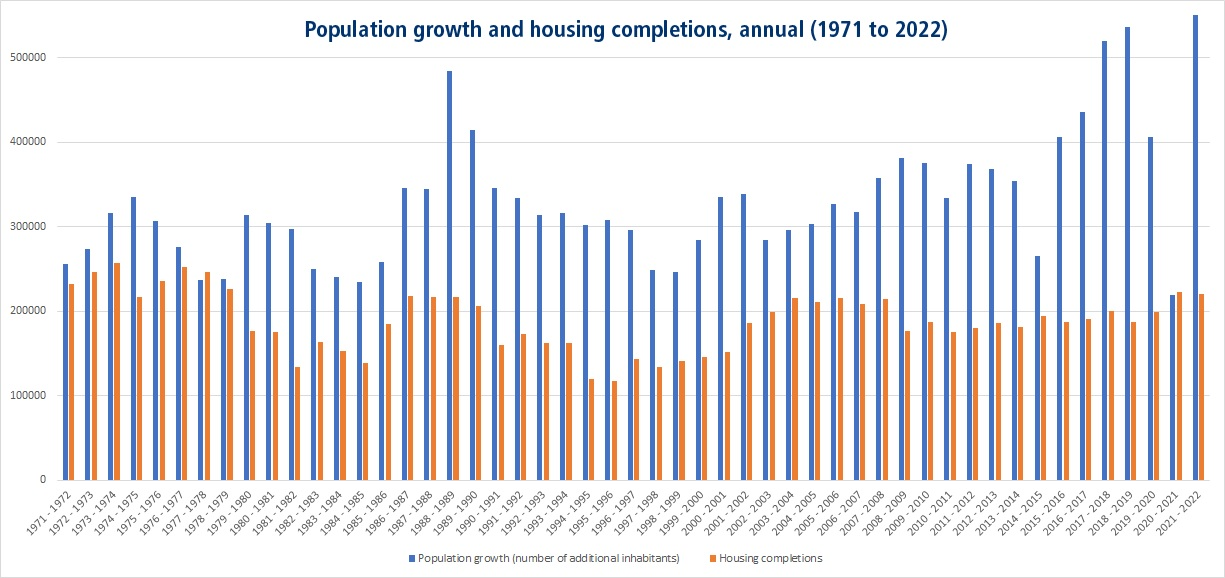
And block it they do. The Fraser Institute notes that Canada is not building nearly enough housing to house its massive population inflows:

And the mismatch has been getting worse over time:

Source: Fraser Institute

Jean-François Perrault of Scotiabank notes that Canada has fewer housing units per 1000 people than France, Germany, Japan, the UK, or even the United States. He writes:

A key challenge is finding an approach that can overcome the political obstacles to a better supply response. Very often within city limits, measures to increase density pit current owners versus prospective residents. Municipal councillors are politically responsive to their voters given the nature of the democratic process. What may be great policy from a national perspective, like high immigration, runs into obstacles when it means finding practical solutions at the local level to increase the housing stock…

To get a sense of the main obstacles to a more elastic supply response, we have polled several of our clients in real estate and development across the country to find the cross-cutting factors they see as most limiting supply growth. To no surprise, the key impediments are in the planning and approval process. In many major cities, the entitlement process is very lengthy and unduly political. Many processes can delay or derail development applications and this can be exacerbated by under-resourced planning departments within cities.

Hmm, where have I heard this story before??

Even Canada’s commitment to multiculturalism is starting to come into conflict with its anti-housing NIMBY instincts. The government returned a plot of land in the middle of downtown Vancouver to the Squamish Nation, which promptly planned a very cool dense housing development with solarpunk aesthetics. The project is still going ahead, but urban planners are now starting to complain about the density, and local residents are trying to stop an access road to the development.

This will simply not do. If you let in tens of millions of people, you must house them; there is simply no other option, other than to let rents continue to skyrocket until the people revolt. Canadian leaders would do well to supplement Doug Saunders’ book with Matt Yglesias’ pragmatic tome. If Canada can’t figure out how to beat its entrenched NIMBY instincts and replace its old ideal of quiet pastoral low-rise cities with one of dense, bustling, efficiently functioning metropolises, it will never achieve Maximum Canada. 

In the meantime, though, we Americans to the south need to take a hard look at what Canada is doing, and ask ourselves why we can’t do something similar. Like Canada, the U.S. is a highly diverse nation of immigrants. Like Canada, our fertility is below replacement (though not quite as bad), and we rely on immigration for population growth. Like Canada, we face the inherent economic disadvantage of being located far from the world population supercluster in Asia, and thus we will always be fighting an uphill battle to get high-value industries to want to locate here. So like Canada, we should be importing huge numbers of skilled immigrants — especially because our software and finance and biotech industry clusters, and our world-beating research universities, make it easier for us to attract skilled immigrants in the first place. We should be playing to our strengths. 

And yet in the U.S., immigration of any kind is now at the center of a vicious culture war. The political right may occasionally claim that they only oppose illegal immigration, or that they want skilled immigration, but when it comes time for actual policy proposals, what they want is just to decrease all types of immigration. The days of pro-immigration Republicans like George W. Bush are gone. In fact, various hard-right figures have specifically railed against immigration from India, which is America’s most important source of skilled immigrants. 

Meanwhile, American progressives, unlike their Canadian counterparts, seem generally unenthusiastic about the idea of mass recruitment of high-skilled foreign workers; my suspicion is that they fear the competition the children of these immigrants will provide for their own children in the academic system. Instead, in recent years, some progressives have begun to lean toward the idea that immigration should be viewed as a form of reparations for colonialism, rather than a strategy for nation-building. Naturally, that absurd idea just triggers the right even more. 

This is a terrible political equilibrium. Survey after survey finds that Americans very strongly support high-skilled immigration, but because it’s a political football, only centrists like Biden seem interested in doing anything about it. Without a popular political mandate, any nation-building strategy like Canada’s is doomed. 

I wish Americans could tell themselves a positive narrative like Canada’s — of immigration as the way to build a multicultural nation. Many of us have tried to tell that narrative, and have foundered on the rocks of America’s age of division. As John Higham wrote, when America is underconfident — when we start to doubt who we are as a people and a nation — we instinctively think about closing the door. Right now, America definitely doesn’t know who we are, as a people and as a nation. Maybe next decade we’ll remember.

Canada, however, does know who they are. And good for them. Now all they have to do is build a bunch of housing, and they’ll be golden. 

Source: Maximum Canada is happening

Many Finns Party ministers have pointed to replacement theory

Of note:

A HANDFUL of the Finns Party’s ministers have made overt and less overt references to the predominantly white far-right conspiracy theory known as the great replacement or replacement theory.

Helsingin Sanomat on Monday reported that Minister for Foreign Trade and Development Ville Tavio (PS) has pointed to the conspiracy theory in a number of statements in the session hall of the Finnish Parliament.

The theory alleges that left-leaning domestic or international elites are trying to replace the white population with non-white immigrants, enabling non-white majorities to take control of key institutions, destroy cultures and traditions, and ultimately eliminate white populations. The theory has also found its way into, for example, the rhetoric of the Republican Party in the US.The Finnish name for the theory is ‘väestönvaihto,’ which translates directly into population replacement.

Tavio has spoken about “population replacement,” a “population change process,” “foreignisation of the population” and “artificial” population growth through immigration, listed Helsingin Sanomat.

In 2021, he linked the conspiracy theory to the government’s policy toward the EU: “The Finnish population won’t get back its own free land because it has been handed over as a playground for the EU. We’re being depleted and the basis of our population is being changed supposedly in the name of wonderful multiculturalism.”

“The socialist government is advocating its own agendas with no regard for the means and won’t stop until our country has been depleted in the name of climate change and our population has been replaced in line with multicultural ideals,” he stated later during the same session.

Tavio viewed a year earlier that immigration is on track to result in a demographic change that can be likened to population replacement.

“Population growth rests on immigration and the birth rate among immigrants. If this continues, the outcome is a change in demographics. You could also talk about the so-called population replacement,” he remarked according to the newspaper.

Minister of the Interior Mari Rantanen (PS) in February used a hashtag related to the replacement theory when sharing a tweet concerning demographic changes in Espoo, Southern Finland, according to YLE.

Two years earlier she appeared to nod at the theory when commenting on a newspaper article about population growth in Africa: “At this rate, Europe will become part of Africa unless the tone and politics change. But some may genuinely want that.”

YLE also reported that her website was recently updated to remove a sentence that played on the Finnish word ‘sinisilmäinen,’ which translates literally to blue-eyed and figuratively to gullible and naive.

“We mustn’t be so blue-eyed that soon we won’t be blue-eyed,” the removed part read according to the public broadcaster.

Minister of Justice Leena Meri (PS) in February stated on YLE A-studio that the National Coalition’s readiness to double the number of work permits granted to non-EU citizens indicates a readiness to replace the population.

Minister of Finance Riikka Purra (PS) argued on Facebook in 2019 that talk about population replacement is not an exaggeration, pointing to a projection about the share of native-born population in Finland, Denmark, Norway and Sweden.

“I haven’t acquainted myself with conspiracy theories of the far right that deal with population replacement, and I’m not planning on doing so,” she wrote. “When I talk about an increase in the number of immigrants and foreigners, about population change, turnover, replacement, variation and the kind, I’m referring to a fact depicted in this graph, for example.”

Purra was at the time the first deputy chairperson of the Finns Party.

Meri, Purra and Rantanen on Sunday all tweeted that they do not believe in conspiracy theories. “I’ll state this to be clear: I don’t believe in conspiracy theories. I also don’t believe in the replacement theory,” wrote Rantanen.

Her response seemed to leave it open to interpretation whether she believes the replacement theory to be a conspiracy theory.

Niko Pyrhönen, a researcher who has specialised in populism and conspiracy theories at the University of Helsinki, on Sunday told YLE that Rantanen has probably employed the term deliberately.

“She chooses and specifically employs the term ‘väestönvaihto,’ which is one of the few that are linked to conspiracy theories and serve as a dog whistle,” he stated.

The Finnish Security Intelligence Service (Supo) has noted that the great replacement is associated with ethnic nationalism, an ideology rooted in the notion of preserving the ethnic uniformity of society. Supo highlighted in its yearbook for 2020 that the theory has been one of the most noteworthy ideological drivers of far-right terrorists.

“This conspiracy theory framework rests on the idea that immigration and multiculturalism pose a fundamental threat to the western white population,” it wrote.

Source: Many Finns Party ministers have pointed to replacement theory

She came to Canada for an education. Desperate for a place to live, she had to rent a room with no door

Housing example of lack of planning for impact of immigration:

Parul Yadav saw Canada as a pathway to her future.

The 23-year-old, who arrived in Toronto alone but bright-eyed in late 2021, had pored over post-secondary programs around the world from her home in Delhi, India, carefully selecting a public relations course at Humber College for its hands-on learning opportunities. Toronto, she was told, was a multicultural city — one where newcomers like her would be welcomed.

What she didn’t expect was a housing crisis, one that would become an ever-present stressor as she began her studies.

She struggled, during those first days in a Mississauga hotel, to even book an apartment viewing without local references who could vouch for her. Even studio apartments were too expensive. Feeling desperate as the first day of classes approached, she signed on for several months of renting a den without a door in a shared apartment.

Today, she has a single room in a basement where two other students rent rooms on the same floor, while their landlord lives upstairs. She counts herself lucky, given how many other international students she’s met who’ve fared worse in Toronto’s housing market.

“I know so may international students who are living in miserable, miserable conditions,” Yadav said, describing groups of two or even three students who she’s known to split single rented bedrooms.

It’s a problem she believes the country needs to reckon with — especially as it aims to boost immigration rates. If Canada and its post-secondary schools are attracting promising young learners, especially to campuses in major cities such as Toronto that are facing rental crunches, how can officials ensure the kind of housing opportunities students need to thrive?

The question of whether Toronto has adequate housing for its international students is, of course, a microcosm of an even broader question: Are we prepared to house all the new immigrants that officials see as vital for Canada’s future? A report from Desjardins Securities recently suggested the answer is no — noting that homebuilding will have to increase by at least 50 per cent nationally through 2024, or a difference of about 100,000 more units starting construction in each of the two years, to keep pace with the expected rate of population growth.

Just weeks ago, the country’s population hit 40 million people for the first time. In Toronto, the provincial Ministry of Finance has forecast the population will surpass 3.3 million people by 2031 and 3.6 million by 2041. International migration is the primary driver of net population gains, city hall housing secretariat director Valesa Faria wrote in a statement to the Star — though city reports have also noted Toronto’s rapidly aging population as a key demographic shift in the years to come.

The federal government hopes to bring in 465,000 permanent residents this year, Faria said, rising to 485,000 in 2024 and 500,000 in 2025. International student study permits were also on the rise, she said, adding that the 550,150 permits issued last year represented a 75 per cent jump from five years earlier. These newcomers will bring skills and abilities that Toronto needs to sustain its “economic and social vibrancy,” she wrote. But it’s a reality that demands more housing.

“Toronto looks forward to supporting federal targets, however, it is imperative that these go hand-in-hand with new investments in affordable housing so that newcomers can find safe, secure and affordable homes to live successfully,” she wrote.

While being accepted for study in Canada does not guarantee a pathway to permanent residency, it is a common trajectory taken. The prospect of life in this country is a key lure of Canada’s international education strategy — which has uplifted the economy, created a steady immigration pipeline and offered a boost to the country’s colleges and universities amid declining public funding and domestic enrolment.

While schools have eyed increased enrolment in recent years, Faria sees student housing creation as failing to keep pace. Now, institutions such as Toronto Metropolitan University are putting new residence plans on ice, she said, directing blame on rising construction costs.

Student residences did not qualify for affordable housing funds, Faria added, and were therefore offered at market rent rates — which could be prohibitive for cash-strapped students. (Yadav, too, noted the cost of purpose-built residences often ruled them out as an option for her.)

The challenges of home affordability aren’t limited to international students, as students of all origins, in Toronto and beyond, often scramble to find affordable homes — like so many individuals and families with limited incomes. But city hall staff have noted newcomers at its colleges and universities are often making do with the lousiest living conditions, attributed in a recent city housing plan to “significantly” higher tuition and limits on their ability to work.

For Yadav, the doorless den she leased in late 2021 — after days of fruitlessly scouring Kijiji and messaging landlords — made her feel like she was walking on eggshells, with virtually zero privacy between her and her roommate. She tried to be out of the apartment as much as possible, and it wore on her mental health. “I remember I was always so stressed and always so low on energy that my friends would say, ‘Hey, is anything wrong with you?’” she recalled.

“It really does affect the relationships around you, the way you work, the way you study.”

After five months, she decided to test her luck again, with a budget that topped out at $1,500 per month, though she was hoping to keep closer to $1,000. But in Toronto, even studio units were going for higher rates. In the end, she found her single room in the basement of a house, which came with a $700 price tag and two other tenants sharing the floor. Yadav is grateful to have it — she said her landlord upstairs was kind, and really tried to offer students who’d newly arrived in Canada a “homey family environment.”

Many others she knew weren’t so fortunate.

Faria, the housing secretariat director, said international students, especially, can often be in the dark about their rights as a tenant — citing the findings of an ongoing working group tasked with probing student housing problems. “This presents a safety concern, as international students may be more vulnerable to predatory landlords and poor living conditions.”

One particular housing arrangement that has worried Toronto colleges and universities is the unregulated rooming house sector — an area where major changes are looming.

In December, council voted — after many years of debate — to legalize and license rooming houses citywide as of March 2024. This kind of rental, where tenants lease single bedrooms with shared kitchens and washrooms, often come with lower price tags than any other private market option and have long existed across the city. But they were illegal in Scarborough, East York and North York, and could be unlicensed in the old Metro Toronto and Etobicoke.

The idea of legalization, as staff proposed it, was to ensure rooming houses were safer and more regulated. In reports, staff pointed to devastating outcomes in the unlicensed market, with roughly 10 per cent of Toronto’s residential fire deaths from 2010 to 2020 in rooming houses — a grim count that would include the death of 18-year-old Helen Guo, an international student who’d just finished her first year of business management at the University of Toronto’s Scarborough campus. Of the 18 rooming houses where fires caused death or serious injury, 16 were unlicensed. And along with seniors on fixed incomes and low-income households, immigrants and students were seen as the most likely rooming house tenants.

“Students, post-secondary institutions and community members all expressed safety concerns for students living in overcrowded and unsafe living conditions,” the staff report recommending cross-city legalization and licensing read, while also noting that some areas of Toronto located near college and university campuses had seen a particular concentration of student-aimed rooming houses “due to the lack of alternative affordable rental housing options.”

Faria, in her statement, noted that city staff have been asked to develop a post-secondary-specific housing strategy alongside academic institutions. The vision had to go beyond residences, she suggested, noting the city hoped to convince schools to plan new affordable housing for students, staff and faculty on land they own. “It is critical that the post-secondary institutions themselves commit to building new housing as part of their long-term strategic plans in order to attract top students and faculty, and to maintain a global advantage,” she wrote.

Looking back to when she first arrived, Yadav said she wished there was more transparency from schools in their recruitment materials for international students, making sure they knew not only what kind of rental market they would face, but potential traps and pitfalls to look out for when searching for a place to stay. She’d seen people fall for rental scams, having sent money from overseas for a house or room that didn’t exist.

That same openness about the housing reality could apply to officials in Canada’s immigration process, she suggested. “Just be more open and clearer about the crisis that’s going on.”

Yadav is now nearing the end of her two-year program at Humber — a time in which she immersed herself in a student union and found a part-time job with a PR agency that excites her about her future. She hopes to make the jump to a full-time role, and carve out a life for herself in the city. “I’m hoping my salary will be increased enough to sustain myself renting a studio. I’m not even thinking about a one-bedroom right now,” she told the Star one recent afternoon.

She’s seen too many of her fellow international students pack up and leave, not simply because they struggled to find their footing right away, but because — like so many other individuals and families citywide — they felt their long-term housing hopes were simply unattainable in Toronto.

“I know so many people that are moving out of Toronto or Ontario after living here for five, six years because they cannot afford a house. They’re going to Calgary, they’re going to places like Saskatchewan,” Yadav said. “So many people are moving out — even out of Canada and going back home to their countries. Everything comes down to the housing conditions.”

It’s the kind of conclusion she hopes officials take heed of as immigration continues to flow.

“They’re just inviting people in — and they don’t have the right resources to support them.”

Source: She came to Canada for an education. Desperate for a place to live, she had to rent a room with no door

Laying down routes: Here’s what transit in the GTA needs to keep up with Canada’s population boom

Another example of the disfunctionality in immigration, not planning and implementing for the effects of the large number of immigrants and temporary residents:

Like most immigrants to Canada, when Srikeit Tadepalli first came to Toronto from Mumbai, India, in February, he had a laundry list of things to do to get settled: get his social insurance number and his permanent residency card, apply for OHIP, look for a job and a place to live, and get to know the city.

Arriving in Toronto in the middle of winter without a car, Tadepalli was grateful for Toronto’s well-connected and accessible transit system. But particularly in the beginning, he had trouble navigating it.

“For such a developed transit system, there is very little communication directed towards newcomers about how to get around using transit in the city,” Tadepalli said. “Basic stuff, like: What is a PRESTO card? Where do I get a PRESTO card? … Even to this day, I sometimes struggle with it.”

Tadepalli is just one of hundreds of thousands of immigrants who come to Canada each year, a number that continues to grow, with the federal government pledging last year to welcome 1.5 million more people by 2025. If trends continue, most of these people will settle in Toronto and surrounding municipalities, where immigrants already make up around half of the population.

Even with all of its challenges, Toronto’s transit system is among the best in the world, with several big projects underway promising to make the GTA even more connected. Still, new immigrants and transportation experts say there is more the city can be doing to help newcomers get around: from small tweaks, like better communication targeted at newcomers, to expanding surface transit with a focus on the suburbs. Also crucial to support a growing population will be shoring up the TTC’s finances, with current shortfalls threatening the transit system’s ability to operate with adequate service and maintain a state of good repair.

Tadepalli said basic instructional videos targeted at newcomers about how to use the TTC would have gone a long way when he first arrived. In his first few days in the city, Tadepalli said he got on the streetcar assuming he could pay for his fare on board, then was told he had to come back with exact change or a loaded PRESTO card. He ended up relying on independent YouTubers to show him the ropes.

The TTC is always looking to improve, spokesperson Stuart Green said in a statement, adding the transit agency is creating an “enhanced wayfinding strategy” to make navigating the system simpler. On maps and signage, the TTC uses words, symbols, colours and numbers to help all customers, Green added. The TTC’s website also has a Google translate function which can translate to over 100 languages.

Transportation is one of the most critical aspects of Canada’s infrastructure for newcomers. It serves as a gateway for economic participation, getting people to school or work, gives immigrants access to important services such as health care and language lessons, and allows people to travel to enjoy different aspects of city life.

Already people in Canada’s densest city are finding it harder than ever to get around, especially in a downtown core paralyzed by construction. Toronto’s traffic congestion ranks among the worst in the world. It’s taking almost as long to travel by car as it did before the pandemic, even with fewer vehicles on the road, according to city data.

Meanwhile, the city cut TTC service and hiked fares this year to make up for lagging ridership on the transit system, which faces a $366-million operating shortfall this year. Unless the provincial and federal governments step up, the TTC will not have enough money to run the system at current levels or replace aging trains and buses.

When newcomers first come to Canada, they are more likely to rely on public transit, cycling and walking than established immigrants and Canadian-born people, said Valerie Preston, professor of urban social geography at York University. That means that expanding and investing in the TTC and regional transit, as well as building walkable, mixed-use neighbourhoods, will be essential for supporting more immigration.

“If we’re going to have half a million people arrive every year, and we’re also trying to meet our climate goals, those people need to be able to live in places where they can either use transit, and it’s efficient to use transit, or they can walk to and from work,” Preston said.

It’s not all bad. Toronto is beginning to invest in public transit after several decades of neglect. The 15.5-kilometre Ontario Line subway, when complete in about a decade, will run from Exhibition Place to the Ontario Science Centre through the heart of downtown, bringing 227,500 more people within walking distance to transit, according to Metrolinx, the provincial agency overseeing the project.

While locals are quick to complain about the TTC, which can be unreliable and crowded, many who come here marvel at the efficiency of the system.

“The connection, from buses, to GO trains, to trams, everything is very, I would say, flawless,” said Akbar Siddiqui, who came to the city one month ago from Mumbai and lives with his wife in Etobicoke. “I come from a country where the transportation network is a little flawed. There are a lot of delays. Everything is very congested primarily because in India, back in Mumbai, there are a lot of people, in a relatively small area.”

Still, Toronto is not where it needs to be to move a growing population, said longtime transit watcher and blogger Steve Munro.

“We have to stop assuming that building a couple of subway lines will solve our transportation problems.” As the city becomes more populated, and living downtown becomes less affordable, people are increasingly being pushed further from the city, meaning the demand for transit is becoming more diffuse, Munro said.

In 2021, the distant suburbs (30 minutes or more from downtown) of Canada’s three biggest cities — Toronto, Vancouver and Montreal — grew at a faster rate than the urban fringe or suburbs closer to the core, according to StatCan.

Newly elected mayor Olivia Chow has promised to invest in transit and active transportation, including by reversing recent TTC cuts and creating a dedicated busway in Scarborough. But the TTC is facing a significant money crunch that cannot be solved at the city level alone. The TTC relies on the farebox to fund about two-thirds of its operating costs, and ridership is currently just 74 per cent of what it was before the pandemic. On top of this year’s $366-million deficit, the transit agency anticipates an “operating pressure” next year as high as $600 million, according to a recent CEO report to city council.

The TTC is also short on money to maintain, and invest in, capital. The TTC recently cancelled a Request for Proposals for new subway trains because it did not get the funding it needed from the provincial and federal governments. The trains it had intended to replace are currently between 24 and 27 years old, with an intended life of 30 years.

“The combined operating and capital investments required to sustain the level and quality of transit service required to support Canada’s largest city cannot be supported solely through expenditure reductions, or revenue streams currently available to the TTC,” the recent CEO report warned. Ottawa announced in April that it would chip in $349 million to help the TTC buy more electric buses, but no new money to help run them.

“We need to really think about how we’re going to move hundreds of thousands more people with the same amount of road space,” said Steve Farber, transportation geographer and spatial analyst at the University of Toronto. Farber and Munro agree that the best way to accommodate a growing population over the short term is to invest in the city’s bus network, and to give those buses the right of way, so that more people can move more efficiently.

“We have to think about making transit a more desirable option for a much larger number of potential trips,” Farber said. “So, in the short run, get buses moving faster and more frequent everywhere. I think that will move the needle quite a lot.”

Tadepalli said even with its shortcomings, the TTC has been a lifeline for him since he got to the city, and continuing to invest in it will be crucial for future immigrants to thrive.

“Without affordable, accessible and clear information about transit, a lot of immigrants tend to not engage with the city and to stay home.”

Source: Laying down routes: Here’s what transit in the GTA needs to keep up with Canada’s population boom

How we can right-size Canada’s health system as the population grows

Good illustration of the impact of current and planned high levels of permanent and temporary immigration, offering little hope in the near and medium-term:

Last year, while knocking on doors during her campaign to be mayor of Whitby, Elizabeth Roy got a firsthand feel for the community’s top concerns.

The town of 150,000, on the shore of Lake Ontario about 50 kilometres east of Toronto, is among the fastest-growing communities in the country.

As she fielded questions about building new roads, preserving green space and upgrading infrastructure, Roy also heard resident after resident describe how difficult it was to get much-needed medical care, with many saying they feared the situation would get even worse amid Whitby’s population boom.

“Whether it was a young family needing a doctor for their newborn or a senior who just had their doctor retire and was left stranded, about one out of every five residents expressed concern about some type of medical care that they required,” says Roy, who is serving her first term as mayor after 17 years as a member of council.

“It’s clear we have gaps in our health-care system, and they need to be dealt with now, today. We need to start being proactive.”

The population of Durham Region, which includes Oshawa, Ajax and Pickering as well as Whitby, is likewise swelling rapidly. It’s expected to almost double over the next 20 years, surging from about 697,000 in 2021 to 1.2 million by 2041.

Municipal and health-care leaders worry its health system, straining to meet the community’s needs even now, won’t be able to cope with the influx of new residents.

Already, Durham faces an escalating family doctor shortage. Figures from the Ontario College of Family Physicians reveal more than 44,000 Durham residents don’t have a family doctor, though a recent report from the Town of Whitby puts the number much higher, citing estimates that suggest a third of the region’s population — some 230,000 residents — lack a family physician who practises in Durham.

Lakeridge Health, the region’s medical network, is unable to keep up with demand. Its four acute-care hospitals typically operate above capacity and wait times in its ERs continue to be “higher than usual,” according to a June alert to the community. The hospital system, Roy notes, will need 1,793 beds by 2041 — more than double its current count.

Noting that it’s primarily a provincial responsibility, Roy says “One would think that at the municipal level health care wouldn’t be a concern for us to be advocating for. It’s actually far from that. It’s actually the reverse. Daily, I hear about the health care needs in our community.”

With Canada’s population recently hitting 40 million — a milestone that arrived faster than expected — and the country set to welcome 500,000 people a year by 2025, health policy experts are warning that bolstering our fragile system, still recovering from years of pandemic pressures, has never been more important.

Across Ontario, where the head count is racing toward 16 million, communities face struggles similar to Whitby’s. More than 2.2 million people do not have access to a family doctor or a nurse practitioner, which puts their long-term health at risk and makes them more likely to visit the ER, placing further strain on the system.

Hospital emergency departments continue to overflow; the most-recent data from Ontario Health shows that patients admitted to the hospital from the ER wait an average of 19 hours before getting a bed.

And despite efforts to strengthen the health-care workforce, ongoing shortages are triggering temporary closures — and in a recent case in Minden, the permanent shuttering — of some of the province’s hospital emergency departments. 

“We are in an extremely difficult moment in our health system in Ontario,” says Dr. Jane Philpott, former politician and dean of Queen’s Health Sciences and director of its medical school.

“It’s probably in a more critical state than at any other point in the four decades that I’ve been involved in health care. The only thing that makes me hopeful is that it’s reached such a state of crisis that there is a broad public and political imperative to find solutions and to do the things that we should have done long ago.”

Among the first steps to propping up the system in the near term — and preparing it for future demand — is to ensure everyone in the province is connected to a family doctor or nurse practitioner.

“It’s the only way we’re going to be able to cope,” Philpott says. “We need to get a very firm commitment from all orders of government to establish a primary-care-for-all system.”

Across the country, calls are growing for targeted reforms to primary care, including the expansion of team-based care, which connects patients to interdisciplinary groups made up of pharmacists, social workers, dietitians and other health-care professionals, in addition to nurses and physicians. Evidence suggests such teams improve patient outcomes.

Health leaders also want to see primary care shift to a geographic model to ensure every resident has access to a family doctor within a 30-minute drive of where they live or work. As well, there is a push to allow patients in a team-based environment have a non-physician health professional co-ordinate their care. 

Such reforms are necessary given the scale of primary-care needs in the province, says Dr. Rick Glazier, scientific director of the Canadian Institutes of Health Research’s Institute of Health Services and Policy Research. 

Even as the need grows for more family doctors to fill the gaps, research shows about 17 per cent of Ontarians are attached to a physician over the age of 65 who is nearing retirement. Glazier says there aren’t enough MDs graduating medical school to replace the aging workforce.

“We don’t have the generation coming behind those people who are retiring,” says Glazier, a family doctor at St. Michael’s Hospital, a part of Unity Health Toronto.

“We will need these interprofessional teams for primary care. We will not be able to do this with doctors alone.”

Dr. Andrew Boozary, a primary-care physician and founding executive director of the Gattuso Centre for Social Medicine at Toronto’s University Health Network, agrees governments must firmly commit to primary-care expansion and reform.

Finding new ways to connect people to a family doctor or nurse practitioner will be key, not only in anticipation of the growing population but also because of the country’s aging demographics, as older patients typically have greater health care needs.

Boozary sees an expanded role for community health workers in primary care, noting that they played a crucial part during the pandemic by bringing health services including COVID-19 vaccines into neighbourhoods, building trust with residents who wouldn’t otherwise have easy access to health care.

“Through the pandemic, community health workers supported people in apartment buildings, in parks and basketball courts, in religious settings,” Boozary says. “They brokered the trust. They had the lived experience and understanding of the needs of their communities.”

Including such workers in primary-care delivery would lead to more equitable access and could mean helping patients connect with social supports, accompanying them to medical appointments, helping with medication (including adherence to prescription renewals), and working closely with a nurse practitioner. 

This kind of model could be especially important in marginalized communities, Boozary says, including refugee and newcomer populations.

“We can’t say we have a universal health-care system when millions of people don’t have access to primary care,” Boozary says. “This mirage of universality was exposed during the pandemic and has been further eroded.”

In his role at CIHR, Glazier is leading an initiative that’s mobilizing research teams to better understand the country’s health-care workforce. That data, he says, will be used for “evidence-based planning” to help Canada meet its future health-care needs.

Ivy Bourgeault, a professor of sociology at the University of Ottawa and lead of the Canadian Health Workforce Network, says when political and health leaders talk about capacity within the health system, they are primarily talking about its workers.

“This is a labour-intensive industry,” she says. “Three-quarters of the costs of the health system are related to the workforce, which means that health system responsiveness — in wait times, in backlogs — it’s the workforce that’s the rate-limiting factor.

“Primary care issues. Long-term-care issues. These are workforce issues.”

Boosting nursing numbers is among the top priorities, Bourgeault says. This includes finding ways to retain nurses working in the system, bring back those who left (through retirement or a profession change or dropping to part-time), and strategically recruit new nurses to fill gaps in the system.

All of this, though, is to only solve the crisis at hand, she says. Preparing for the more-populous future will require understanding the gaps in the system, collecting and analyzing workforce data and studying and evaluating new models of care.

“We need to build a culture of planning,” Bourgeault says. “The most expensive situation is continuing to do what we do now: Not plan. Not retain. Just constantly trying to recruit to fill a system that is like a sieve.”

Sara Allin, an associate professor at the University of Toronto’s Institute for Health Policy, Management and Evaluation, says Canada doesn’t track health-workforce numbers thoroughly enough. Data that is available is often fragmented, inconsistent between regions and not easily available to policymakers.

And while having a view of regional and professional gaps in the workforce is key, Allin says it’s also imperative to collect data on patients’ medical needs to help inform planning. For example, she says, an aging population, the rise in chronic disease, such as diabetes, and social risk factors, including food insecurity and unsafe housing, all play into population health. 

“We need to project and model our future medical needs and map those against future capacity,” Allin says, adding that there is currently a “mismatch” between the two. “Good data is fundamental to both exercises. And we’re not able to accurately and effectively measure these things right now.”

Given the health system’s current “precarious” state it will be difficult to meet the needs of the growing population, she says. This sentiment is shared by Farah Ahmad, an associate professor in York University’s School of Health Policy and Management, who agrees solutions must be found to the workforce challenges ahead of the country’s projected population growth. 

“We are going to have a lot of newcomers, which is great for our overall economic development,” she says. “But if we are not preparing our health system, who will take care of them?”

Ahmad points to the most recent figures from the Paris-based Organization for Economic Cooperation and Development that show Canada has only 2.8 physicians for every 1,000 residents, a rate well below other countries. In the 2021 OECD data, Canada also graduates far fewer physicians than other countries, ranking 33rd out of 36.

While Canada’s immigration goals provide a partial solution to the country’s worker shortage by bringing in internationally trained professionals, Ahmed worries too much burden is being placed on newcomers. “The answers, they cannot all come from new immigrants.”

Philpott, a family physician and a former federal health minister, says the country should be able to build and train its own health-care workforce even as it removes barriers to let internationally educated professionals work here, also an important strategy.

She points to a unique initiative from Queen’s University and Lakeridge Health, designed to train and graduate family physicians, as one type of solution. In September this program will see 20 medical students interested in family medicine train in Durham, with the goal of having them graduate and set up their practice in the region. 

Eight months into her term as mayor, Roy says advocating for more health-care services gets pushed higher and higher on Whitby Council’s list of priorities.

Last month, council approved funding to help support the Queen’s-Lakeridge Health MD Family Physician Training Program as well as a plan to establish an incentive program to recruit and retain family doctors to the region. And Roy herself is advocating for the province to approve a $3-million planning grant for a new hospital in Whitby, the location recommended by an independent task force. 

She notes a provincial task force in 2015 recommended a new acute-care hospital for somewhere in Durham. Eight years later, and with the region’s population ballooning faster than ever, that plan remains stalled.

“This crisis is one that’s here today,” says Roy. “Lakeridge Health Oshawa is operating at one and a half times what it was first built for, and it will take at least 10 years after approval for that hospital — anywhere in Durham — to open its doors.”

Roy fears that as time passes, and the population grows, the health-care gap in the community, already stark, will continue to widen, putting residents health even further at risk.

“I’m really concerned,” she says. “We have to have a community that provides all the health-care supports. But if we don’t have them in place, we may end up having residents whose ailments are further along, their cancer diagnosis not diagnosed at an earlier stage, that it takes longer for treatments or medications to be prescribed.

“We know early intervention is key. And that may be at risk.”
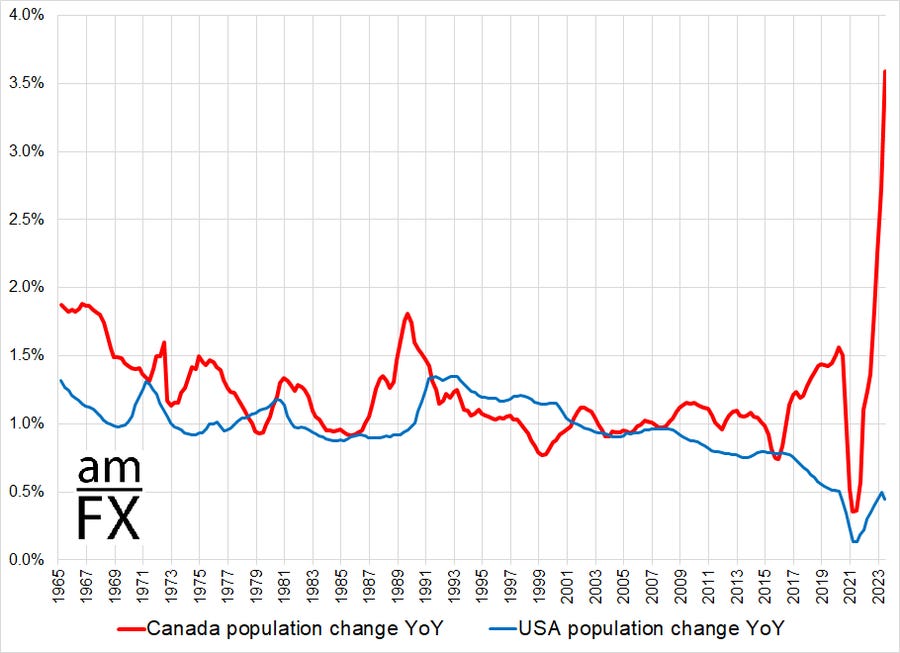
Source: How we can right-size Canada’s health system as the population grows