Why equity, diversity and inclusion offices are failing us

I likely have a lack of innovation but hard to avoid the bureaucratic approach in large organizations as they grapple how to manage and implement policy and programs:

I have been writing and researching about Canada’s history of Blackface for over a decade. This work requires me to travel through history to a time when Black people were not seen as human and we had few rights. Because I do this work, I have a deep understanding of the development of human rights procedures and equity, diversity, and inclusion (EDI) offices.

I am a knowledge expert. And I unequivocally believe that EDI offices are failing us. Not because of a lack of talented or well-intentioned people, but because of a lack of courage to imagine new ways of problem solving that centre people, not procedures, processes, and paper trails.

By insisting on bureaucratic solutions to execute strategic plans and prioritizing institutional value statements, with well-thought-out bullet-point “action items” these offices take what Benjamin Ginsberg, author of “The Fall of the Faculty” has called, “the neo-liberal all-administrative university” approach.

This model of education privileges economic-based relationships, it treats students as customers — who are always right — and faculty, who are cast in the role of service providers rather than knowledge experts, as failed subjects when students file complaints against them to human rights services embedded within EDI offices.

There is little room, in the current system, for decision-making at the point of intake. Instead, every complaint is treated as a potential threat to the institution’s reputation and as a result, faculty suffer collateral damage in this process.

The ever-expanding “regime of bureaucratization,” as Amna Khalid described in an article for the Chronicle of Higher Education, has taken as its mission the fulfilment of student EDI demands at all costs, while weakening and undermining more meaningful EDI efforts, such as ongoing community engagement and knowledge-expert-driven ideation and collaboration.

Human rights services at Ontario universities have publicly available statements about their policies and procedures, which are informed and guided by the Ontario Human Rights Code. Created in 1961, Ontario was the first province to create a human rights code and a Human Rights Commission to enforce it.

Daniel G. Hill, a Black American who moved to Canada in the 1950s and who wrote a landmark dissertation, “Negroes In Toronto; A Sociological Study Of A Minority Group,” was the first chairman of the Ontario Human Rights Commission. Hill often tackled racism head-on, in public forums, with Black community and the public present to bear witness to what discrimination actually looked like. In doing that, he transformed the human rights process into a community event, rather than a backroom investigation to serve measurable outcomes.

We live in different times. But EDI offices are taking the joy out of education because they resist collaborative, restorative approaches to conflict and instead cling to approaches that are too bureaucratic, dehumanizing, and almost solely focused on the document trail.

Inside these institutions there is a culture of fear and silence among faculty, staff and even decision makers, who are rendered powerless by procedures and policies that are just not working.

At the same time faculty are invaluable to the institution as knowledge experts, once they become embroiled in a complaint process, which can go on for an unspecified number of years, they become voiceless, powerless, and invisible.

I agree with blogger Jodre Datu, who in 2022 declared, “if EDI isn’t igniting joy, we’re doing it wrong.” In that post, they called for an overhaul of EDI that would not create environments in which people are afraid to say the wrong thing but instead EDI work would involve an entire restructuring of our workplaces and a reorganization of power.

I know I don’t speak for all academics and there are EDI people who will disagree with me. But good people are leaving universities — something I have even contemplated — because of the “business as usual” approach to conflict taken by EDI offices. No one wins with this approach. It ultimately feeds into the hands of racists, homophobic and transphobic hate, and in the long run, is harming our institutions.

Cheryl Thompson is an associate professor in Performance at The Creative School. She is also director and creative lead, The Laboratory for Black Creativity. Twitter @DrCherylT

Source: Why equity, diversity and inclusion offices are failing us

A new look at immigrants’ outsize contribution to innovation in the US

Yet another study:

The United States has long touted itself as a nation built by immigrants. Yet there has never been a precise measure of immigrants’ contribution to the country’s economic and technological progress. Around the time that President Donald Trump was moving to curb employment visas for skilled foreigners, economist Rebecca Diamond and a team of researchers set out to examine this unresolved question.

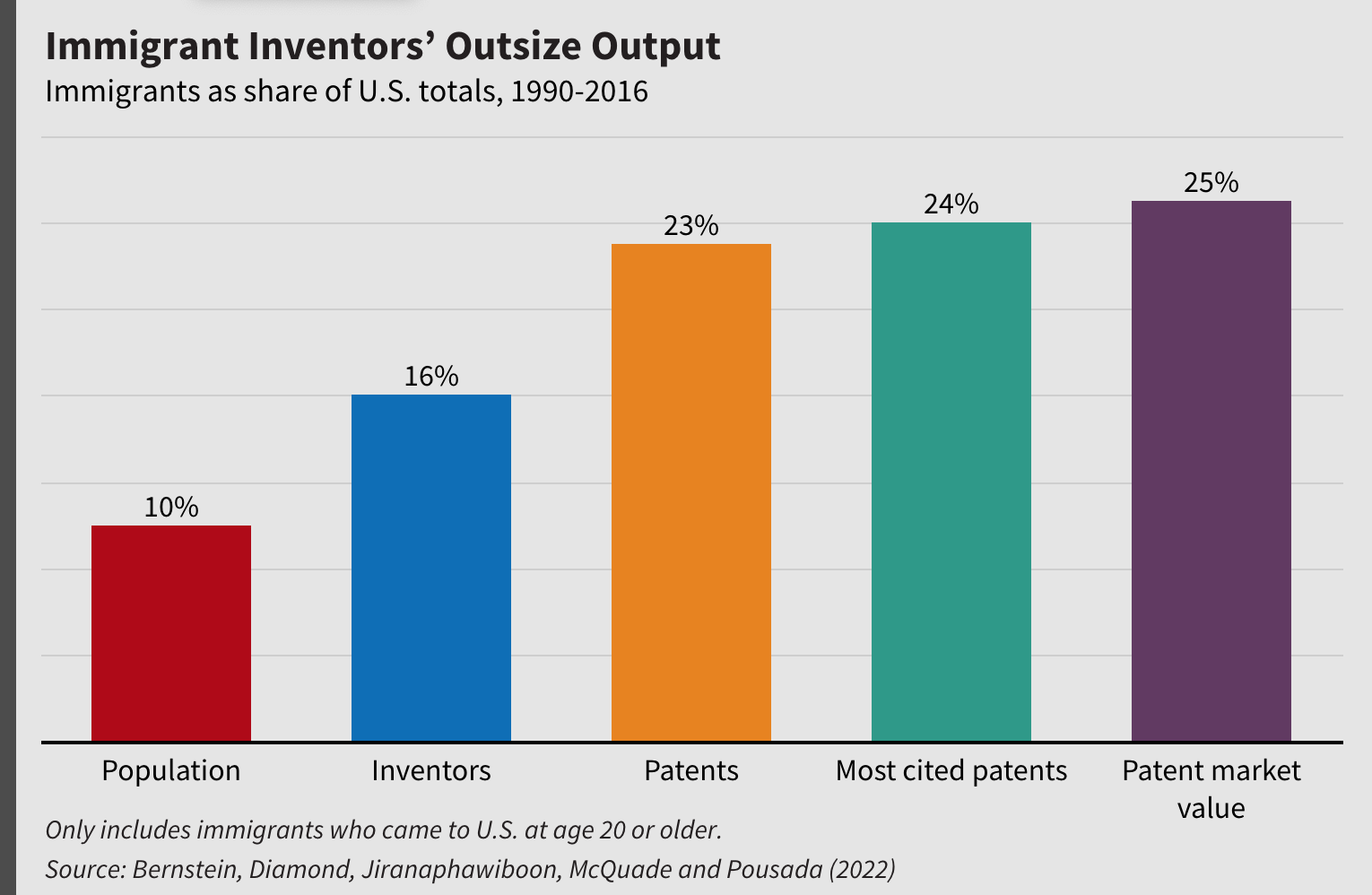
To find the answer, the researchers looked at the output of nearly 880,000 Americans who patented inventions between 1990 and 2016. They found that immigrants made an outsize contribution to innovation in the U.S. While they comprised 16 percent of inventors, immigrants were behind 23 percent of the patents issued over these years.

It wasn’t just a matter of quantity: The share of patents immigrants produced was slightly higher when weighted by the number of citations each patent received over the next three years, a key measure of their quality and utility. Moreover, immigrants were responsible for a quarter of the total economic value of patents granted in that period, as measured by the stock market’s reaction to new patents.

“The high-skilled immigrants we have in the U.S. are incredibly productive and innovative, and they’re disproportionately contributing to innovation in our society,” says Diamond, a professor of economics at Stanford Graduate School of Business and senior fellow at the Stanford Institute for Economic Policy Research (SIEPR).

Past research has indirectly pointed to the sizable role immigrants play in American innovation. Studies have shown that immigrants represent nearly a quarter of the U.S. workforce in science, technology, engineering, and mathematics and more than a quarter of the nation’s Nobel Prize winners. But this study, described in a recent working paper, is the first time economists have used patents to directly measure the output of foreign-born innovators living in the U.S.

The data was clear: “The average immigrant is substantially more productive than the average U.S.-born inventor,” write Diamond and her colleagues, Shai Bernstein of Harvard Business School; Timothy McQuade of UC Berkeley’s Haas School of Business; Abhisit Jiranaphawiboon, a former predoctoral fellow at SIEPR and now a Stanford PhD student; and Beatriz Pousada, a PhD student at Stanford and SIEPR Dissertation Fellowship recipient in 2022-23.

The researchers took a unique approach to their work. They started with a database of 300 million adults who had lived in the country between 1990 and 2016 and then used Social Security numbers to identify those who had immigrated after age 19. (The first five digits of a Social Security number encode the date it was issued; U.S.-born citizens typically receive their numbers at birth or in childhood.) Using names and address history, they matched individuals in the database to those listed as inventors with the United States Patent and Trademark Office. (When patents had multiple authors, each got credit for a proportional share.)

The researchers found that immigrants generate patents across a broad swath of sectors, including computers, electronics, chemicals, and medicine. They also discovered that, while all inventors reach peak productivity in their late 30s and early 40s, immigrants decline from that peak at a slower rate than U.S.-born inventors over the rest of their careers, a disparity that remains unexplained.

The immigrant innovation gap

Diamond believes there are several potential reasons for the innovation gap between immigrant and native-born inventors. One is brain drain: “There’s likely a pretty strong positive selection in terms of the types of people from every country that end up as high-skilled professionals with U.S. visas,” she says.

Another factor is cross-border collaboration: The researchers observed that foreign-born inventors are more likely to work with inventors based in other countries and cite foreign technologies in their patents. “Different pools of knowledge get imported by immigration, and diversity in background is good for innovation,” Diamond says.

Diamond and her team also found evidence that immigrant inventors are more likely to live in innovation hubs, such as Silicon Valley or Boston, and to work on patents in cutting-edge technology sectors. Still, the researchers estimate that these two factors explain just 30 percent of the gap in patent output.

Immigrant inventors’ contributions go beyond their own work — they also make their native-born collaborators more productive, the researchers discovered. To arrive at this finding, Diamond and her team identified inventors who died before they turned 60 and examined the output of people who had co-authored a patent with that individual before their early death. Compared to a control group of inventors that did not lose a collaborator, surviving inventors produced 10 percent fewer patents after the death of their co-author. The effect was larger for inventors whose deceased co-author was an immigrant — their productivity declined by 17 percent. This gap persisted even after the researchers controlled for a number of factors, such as the productivity of the deceased inventors.

“At the end of the day, we weren’t really able to explain the gap,” Diamond says. “It seems there’s something special about being an immigrant. Their knowledge has these huge external effects on who they work with, and what they know impacts what their collaborators can produce in the future.”

Diamond believes these findings have direct implications for policymakers who want to maintain the nation’s role as a technological trailblazer. “Understanding the forces that make the U.S. one of the most innovative and productive countries in the world is important,” she says. “The U.S. has done an amazing job of attracting the best and the brightest immigrants. Any policy that would revamp the visa process might want to consider how big a deal immigrants are in our innovation output.”

Source: A new look at immigrants’ outsize contribution to innovation in the US

Adolf Eichmann Was Ready for His Close-Up. My Father Gave It to Him.

Interesting reflections:

I was 14 the first time I saw Adolf Eichmann in person. He wore an ill-fitting suit and had tortoise shell glasses, with the bearing of a nervous accountant. He did not seem at all like someone who had engineered the deaths of millions of people, except of course that I was at his trial for genocide.


My father, Leo Hurwitz, directed the television coverage of the Eichmann trial, which was held in Jerusalem and broadcast all over the world in 1961. My dad was chosen for the position after the producer convinced both Capital Cities Broadcasting, then a small network that organized the pool coverage, and David Ben-Gurion, the prime minister of Israel, that the trial needed to be seen live. In the 1930s, my father had been one of the pioneers of the American social documentary film. In later years, he had directed two films on the Holocaust and had helped to invent many of the techniques of live television while director of production in the early days of the CBS network. Also, as a socialist, he had been blacklisted from all work in television for the previous decade, so he came cheap.


My mother and I joined my father in Jerusalem. Each day I stood in the control room and watched my father call the coverage — “Ready camera 2, take 2!” For perhaps the first time in history, a trial was being recorded, not as in the style of a newsreel, with its neutrally positioned single camera, but more like a feature film, with concealed cameras placed to cover several points of view — the witnesses’, the judges’, the attorneys’, the public’s, and of course, Eichmann’s. These were cut, one against the other, often in close-up, so that the drama became vastly more personal. The style of my father’s work would come to define this trial, and its place in historical memory, even more than Eichmann’s confession.

The prosecutor confronted Eichmann with his own words: “The fact that I have the death of 5,000,000 Jews on my conscience gives me extraordinary satisfaction.” The writer and Holocaust survivor Yehiel Di-nur testified from the witness box about the lines of people selected for death in the different “planet” of Auschwitz. Suddenly, Di-nur collapsed with a stroke. Through it all, Eichmann’s face, as revealed in my father’s close-ups, showed no feeling except the occasional tic.

Each night my father’s work was air-shipped, on 2-inch videotape, to be broadcast in Europe and the United States. It sharpened the way the world saw the anti-Semitic depredations of the Nazis. Meanwhile, my father was plagued by the question of how fascism had risen in the first place, how educated and progressive working classes had left their unions to fall into the lock step of a militarized, authoritarian regime.


It was a question that the West all but ignored. With the end of World War II, the prospect of justice for war criminals quickly dissolved, replaced by the need to build the postwar alliance against Communism. Leaders and thinkers were occupied with rearming for a nuclear future and rooting out leftists, the trend that had made my father unemployable.


He thought that he might use the trial to gather social scientists for a discussion of how fascism took root. During preproduction for the broadcast, he began to cast around for an Israeli institution that could host it. He said he asked a former classmate who was editor of a major Israeli newspaper, but they were not interested. Another outlet, the Israeli equivalent of the BBC, said they were not the place for it. A prestigious university couldn’t see the relevance. As the trial began and his production ramped up, he had to let the idea drop.


Though he did not know it at the time, these institutions showed no interest in the sources of fascism because the trial was not a trial of fascism. Instead, it was an opportunity for Ben-Gurion and the Jewish Agency to rebrand the Zionist movement. While the early days of Zionism extolled muscular, self-sufficient pioneers in a new, empty and promised land, that image had not aged well in the postwar world. In addition, many Israeli Jews looked down on the Jews of “old Europe,” whom they saw as trembling in their shtetls and walking helplessly to their deaths. Of course, they grieved the Holocaust, and their diplomats used its memory to convince the United Nations to recognize the State of Israel. Still, the ring of shame had settled around the survivors, many of whom had been traumatized to the point of dysfunction.

As witnesses at the trial spoke of crimes and suffering that had never been heard before, Israeli attitudes changed. The survivors of the Nazis — once seen as tattooed strangers, muttering to themselves on street corners in Tel Aviv — now began to be looked upon with more compassion. Their deaths and suffering, the crimes of the Shoah, were moved to the heart of Zionism. It helped point to Israel as the safe haven for the persecuted, with “never again!” as their rallying cry.

As Hannah Arendt famously pointed out, the aim of the prosecutor was to frame the trial as justice for crimes against Jews. The slaughter of Roma, Gays, labor leaders, Socialists, Communists, the disabled, and any opposition was hardly mentioned.

Without meaning to, my father helped to reinforce the emotional aspect of the trial and in so doing weaken its political implications. Though his previous films included a fuller view of the crimes and victims of Nazism, the way he shot the trial did the opposite: His brilliant coverage individualized Eichmann and steered viewers away from a more historical view. The work of studying fascism could not compete with the satisfaction of blaming a villain and imagining that the problems could be solved with his sentencing.

My father helped to make this Nazi into a character in a drama of cinematic confrontation, not of real understanding. It was now the Jewish state against the murderer of Jews. Crimes against other groups were not germane to the purpose to which the State of Israel and its head prosecutor, Gideon Hausner, sought to turn the trial.

The question of how fascism gains power is no less urgent today. As nationalisms multiply around the globe, lies gain supremacy as political weapons and scapegoating minorities proves itself a powerful mobilizing force, danger is burgeoning, here and in Israel itself. What I witnessed as a 14-year-old in that control room, I am witnessing again. The fascination with individual people’s guilt or innocence is obscuring the society-wide re-emergence of fascism. And we appear to be no more interested in viewing the full picture.

Source: Adolf Eichmann Was Ready for His Close-Up. My Father Gave It to Him.

Why a debate over how to define anti-Semitism has reached the United Nations

Good overview:

An international debate over what should be considered anti-Semitism — centred around a controversial definition that critics say chills legitimate criticism of Israel — has reached the United Nations.

Last week, a group of 60 human rights and civil society organizations wrote to the leadership of the UN, urging it not to adopt the International Holocaust Remembrance Association (IHRA) definition of anti-Semitism.

They say the IHRA framework “has often been used to wrongly label criticism of Israel as antisemitic, and thus chill and sometimes suppress, non-violent protest, activism and speech critical of Israel and/or Zionism.”

Among the letter’s signatories are three Canadian organizations: Independent Jewish Voices Canada, Canadians for Justice and Peace in the Middle East and United Jewish People’s Order of Canada.

The high-profile appeal is just the latest twist in a now-years-long debate around the definition.

Mainstream Jewish groups and governments have urged the UN to officially adopt the IHRA’s working definition. To this point, the international body has insisted it has no plans to do so.

It has been adopted, meanwhile, in other jurisdictions around the world, including several in Canada.

Here’s a look at how the issue has become such a heated topic of debate.

Source: Why a debate over how to define anti-Semitism has reached the United Nations

Shunned in India, shunned in Canada. What it’s really like to face casteism

Of note:

Segregated. Landless. Unpaid. Shunned. Shamed. Bonded in perpetuity. While these conditions may well describe the enslaved people of the Antebellum South, they are but some of the markers of another brutal system that is the world’s oldest surviving structure of discrimination.

A Canadian scholar argues in an upcoming book that the caste system of the Indian subcontinent, which established Brahminical supremacy there, was a template for the racial caste system that established white supremacy here.

“Caste is a template for race,” says Chinnaiah Jangam, a historian at Carleton University.

One week after the Toronto District School Board’s historic vote in March that marked the first time that caste as a basis of discrimination was formally recognized in Canada, a human rights tribunal awarded a B.C. man more than $9,000 after finding that he had been a victim of casteism. 

Meanwhile, Seattle became the first U.S. city to ban casteism by incorporating caste into its anti-discrimination laws in February. In the two years prior, Harvard University added caste as a category to its anti-bias policies. The California State University System has joined it in making caste a protected status in its anti-discrimination policy.

Casteism, vaguely understood in the West as a backward South Asian cultural phenomenon, is finally beginning to be reckoned with in Canada, thanks to decades of advocacy by caste-oppressed people. But caste-based discrimination, which manifests in myriad ways, should not be understood or dismissed as an internal South Asian matter. 

Oppressions such as casteism and racism “need to be seen as interconnected, as part of the global empire,” says Jangam, who is one of the first Dalit scholars in the country.

“To put it simply, caste equity is a human rights issue,” says Anita Lal, a B.C. Dalit activist and founder of the advocacy group Poetic Justice Foundation.

What is caste?

Some 3,000 years ago, a system named “Chaturvarna,” or four occupation-based categories, came into being in Hinduism. It would morph into a caste system laced with harmful associations of spiritual purity and pollution. As with chattel slavery, the system decreed that the caste one was born into was fixed and passed on through family in perpetuity.

https://misc.thestar.com/interactivegraphic/2023/04-april/03-caste/index.html

The “highest” in this caste order was the Brahmin, or the priestly class; the “lowest” was the Shudra, tasked with doing menial work. 

Outside of this four-class social framework existed humans deemed beneath even being categorized. They were the Dalits, formerly “untouchables,” and Adivasis, literally meaning Original Inhabitants, the Indigenous forest dwellers on traditional lands.

“Dalit,” or “broken but resilient,” is the cultural and political identity adopted by people from more than 1,000 oppressed castes, many of whom prefer it to the legal category of “Scheduled Caste.”

The term rose in popularity in the 1970s alongside the Dalit Panthers, who fashioned themselves after the Black Panthers. “They adopted the same form of radical protest, rejecting Brahminism, talking about abolition of caste, abolition of class and working-class solidarity,” says Jangam.

But unlike Black resistance heroes such as Malcolm X, they rejected all forms of religion, he says.

This is not surprising. Hinduism is not a centralized religion and caste as a concept seeped across the Indian subcontinent and beyond, crossing religious lines and shape-shifting to fit regional traditions.

Yalini Rajakulasingam, the TDSB trustee who brought forward the motion to ban caste discrimination, says, “If food and culture and language can travel through diasporas, of course, privileges and power can as well. No one’s going to want to let go of something that gives them privilege.”

The origins of caste may be ancient but the discriminatory effects in Canada, where the Dalit population is loosely estimated to comprise about 15 per cent of South Asians, are contemporary.

“There are many narratives within the community that have been silenced,” says Lal.

“It’s time to give voice to those stories.” 

The story of Vijay Puli 

GTA resident Vijay Puli was born to a Mala Dalit community in the southern Indian state of Andhra Pradesh in the 1970s. 

“I don’t say I was born in the village,” he says. “I was born in the Dalit ghetto.” 

His community was segregated from the nearby village by dominant castes who practised the crime of untouchability. Dalits were forced to walk on separate paths. They were not allowed to drink water from the village well, not allowed to enter temples. Dalits were considered so polluted that the slightest touch, even being touched by a shadow cast by a Dalit, was considered to defile an “upper caste” person.

While India banned untouchability in 1950, stories of exclusions, beatings, assaults, rapes and lynchings of people from the “Scheduled Caste” form part of its daily news landscape. According to its National Crime Records Bureau, more than 180,000 criminal cases targeting Dalit communities were registered in the four-year period from 2018 to 2021.

When Rajakulasingam, the Toronto school board trustee, who identifies as a caste-oppressed Tamil, visited India in 2010, she says, “There were times when I would go to people’s homes and they would give me different (separate) utensils to use.”

Puli went to a dilapidated school in his colony in the 1970s. (Years later, Human Rights Watch researchers who visited schools in Dalit neighbourhoods in 2014 found they still lacked clean drinking water, toilets and adequate classrooms or teachers.)

Then it came time in the 1980s to go to a high school that was located in the village. 

Puli says he and his friends were very nervous about being around dominant-caste students and staff, and they sat at the back of the class. Teachers mocked them with casteist slurs if they didn’t answer questions correctly. Puli would hear slurs during playground fights, even when they were between dominant-caste kids. “Forgive me for using words like these,” he says, “but they would say ‘your mom should be f—ed by a Mala person.’ That means it’s very, very dirty.” Sometimes he would get into fights over this, he says.

This manifestation of casteism in the form of contemptuously flinging the name of a Dalit caste as a slur is a common experience in Canada. In the case that was brought forward to the B.C. tribunal, complainant Manoj Bhangu was able to prove the slur, Chamaar — the name of his Dalit caste, which is historically associated with leatherwork — was uttered by Inderjit and Avninder Dhillon during a brawl in 2018.

When Puli went to a small town for his undergraduate degree, it offered segregated hostels for students. Rather than staying in the “backward caste” hostel, his father got a room in one for the dominant castes, thinking he might learn to fit in better that way.

Fitting in or trying to “pass” as non-Dalit is a common coping strategy. In “Coming Out as Dalit,” the award-winning journalist Yashica Dutt writes how her Dalitness weighed heavily on her as she worked hard to hide it. “I dragged its carcass behind me through my childhood and adulthood,” she writes.

Cows, considered holy for Hindus, and beef — considered taboo — are an unholy symbol of caste injustice. If a cow died, it would be the job of a Dalit to carry the cow off and skin it for leather, the products of which the dominant castes had no problem using. Given that the Dalits lived in grinding poverty, the meat of the cow represented survival, and they ate it.

While Dalits remained historically downtrodden under governments led by all Indian political parties, in the current reign of Hindutva-fuelled governance, even the mere accusation of slaughtering a cow risks mob violence for Dalits (and Muslims).

Puli’s parents had stopped the family practice of eating beef when he was young as it would have marked Puli as Dalit. But his attempt to “pass” at the hostel ended quickly. When his roommate — a young man Puli considered a friend — found out Puli was Dalit, he changed rooms right away.

When Puli went to the state capital, Hyderabad, for his post-graduation, he had to switch from learning in his native Telugu language to English. “On the first day they (students) started laughing at me,” he says. They jeered at his English-language skills and treated him like he was the village idiot.

Whether in a village, a town or a city, casteism manifested as denigration and mocking, Puli said. No amount of education or worldliness changed those attitudes. 

Decades later, after the birth of his first child, Puli decided to move to Canada to escape from the relentless casteist violence. He assumed the lack of casteism in the founding of institutions here would mean there would be no casteism here.

“I knew that there is this racial discrimination here, and definitely, we are ready to face it like other South Asians, you know?”

He says he thought the South Asians, having faced discrimination, would stick together as a minority community. “Once I came here, it was completely opposite.”

Casteism in Canada

While casteist practices may not be as brutally explicit in Canada, anti-caste abolitionists and grassroots activists say this predatory system stigmatizes and profoundly affects people’s livelihoods, romantic lives, education and social self-worth. People of privileged castes who dominate the diasporic culture influence language, music, films and daily practices.

For instance, the larger-than-life Bollywood-influenced Indian weddings where a flower-bedecked groom shows up on a horse is a popular cultural image. But it is an “upper caste” symbol of revelry. A Dalit groom who gets on a horse in India may be stoned or otherwise humiliated and forced down.

Similarly, the practice of yoga is deeply linked to “upper caste” practices of vegetarianism (associated with spiritual purity), use of Sanskrit (language of the gods, not taught to “lower castes”) and the concept of karma (paying for — balancing out — sins of past lives). Karma enforced caste; according to this philosophy, “lower castes,” as sinners in past lives, had only themselves to blame for their plight.

In language, the commonly used word “pariah,” for instance, is a casteist slur. “Pariyar” is a Tamil Dalit caste. During British colonization, the word was anglicized to pariah — and its meaning expanded to include all oppressed castes to mean “outcaste.”

When Puli arrived in Canada, he lived in a Mississauga basement. In his first month, a Sikh neighbour, assuming he was of dominant caste, conversationally pointed to another family in the neighbourhood saying, they were from the Chamaar caste.

“She said that they are lower-caste people. ‘We don’t go to them and we don’t associate with them. They don’t come to our temple. We don’t go to their temple. We never go to their house.’ So, yeah, that was the first incident me and my wife encountered in Canada. We thought that, wow, it is here, too.”

Although caste hierarchy does not exist in Sikh religion and scriptures, the practice of untouchability and discrimination still exists, says Lal, the B.C. activist, who identifies as a Punjabi Sikh Canadian born into a Dalit family. She is of the Chamaar caste.

Caste among Sikhs does not rely on a purity-pollution binary. Rather, power rests on ownership of land, Lal and co-author Sasha Sabherwal write in a chapter in “A Social History of South Asians in British Columbia.” This makes Jats a large and powerful caste group in Punjab and the diaspora.

“In Canada, for instance, it is predominantly Jats who step into organized state and federal politics,” they write.

It’s common to see images of men on Tinder or other dating apps with handles including caste names such as Jat. Inter-caste marriages with an oppressed-caste member remain highly stigmatized in Canada among diasporic communities, including those from the Caribbean and Africa.

Lal’s own family is inextricably linked to the history of caste-based oppression in Canada.

Her great-grandfather, Maiya Ram Mahmi, who came to Canada in 1906, is considered one of the first Dalits to come to North America. “It’s understandable that the first story of caste discrimination would be his, because caste, a system of exclusion based on purity, follows you wherever you go,” she writes in an email.

Mahmi worked in a sawmill in Paldi, B.C., where men worked during the day and ate in the cookhouses in the evening. Mahmi, “along with one other fellow Chamaar, were not allowed to eat in the cookhouse with the rest of the workers and were forced to eat their meals in their rooms,” Lal says. Only after an “upper caste” supervisor intervened and threatened the other workers with job loss did they relent.

“At a time when they were facing harsh racism from the white man, learning to live in a whole new country which was so different than their own, without their family and loved ones, building community with the other South Asians, they still practised untouchability and continued to exclude and do more harm,” Lal says.

More recently, in Toronto, Puli co-founded the South Asian Dalit Adivasi Network Canada with fellow caste-oppressed people. They mark April as Dalit History Month to honour the births and deaths of Dalit rights leaders that fall this month, including B.R. Ambedkar, the principal architect of the Indian constitution, a renowned visionary and intellectual, who is revered as an icon of resistance.

When Puli’s own daughter was cruelly subjugated to casteism by fellow students, he had had enough. He went about mobilizing support to get the Toronto school board to recognize caste as a basis of discrimination. He got in touch with Rajakulasingam, who he says “got it” at once, and the rest is — historic.

The deep roots and widespread reach of casteism in Canada make it imperative for social and political organizations to create tools to address caste-based discrimination in their own spaces. 

When organizations such as the TDSB take this step, “it allows people who face casteist discrimination to come forward, and with some legal protection in place, to feel safe to do so,” says Jangam, the Carleton historian. “This is one of the ways that Canada as a liberal society makes a path for people to be who they are.

“No human being deserves to live in fear.”

Source: Shunned in India, shunned in Canada. What it’s really like to face casteism

Minority status biases evaluation of both women and men professors

Of interest:

Both men and women professors in the United States may receive lower course evaluation scores in departments where the majority of professors are of the other gender. However, because women are more often in the minority, they receive a disproportionate share of lower scores.

Further, since course evaluation scores are a significant factor in promotion and tenure decisions, this disparity negatively affects women professors’ career trajectories, hampering efforts to achieve equity and gender parity in the upper levels of the professoriate, says a new study published in the journal PNAS – Proceedings of the National Academy of Sciences.

“Our key finding is that regardless of which gender is in the minority, that gender receives lower course evaluation scores than does the dominant gender. We saw the same effects for men working in female-dominated departments and women working in male-dominated departments,” says Professor Oriana R Aragón, who teaches in the department of marketing at the Carl H Lindner College of Business of the University of Cincinnati.

She is lead author of the study published in PNAS earlier this year and titled “Gender bias in teaching evaluations: the causal role of department gender composition”.

“These findings are consistent with role congruity theory, which, in the context of academe, says that when a department is majority male or female, members of the opposite gender who teach in it are not deemed to be ‘authentic’ or as not being a bona fide expert.

“Students have a sense of, ‘It’s not quite right. I didn’t get the teacher that I should have had.’ This leads them to rate the professor lower, especially in upper-level courses; this negatively affects women professors because they are more often in the minority.”

The study and some findings

There are two parts to the study conducted by Aragón; Evava S Pietri, professor of psychology and neuroscience at the University of Colorado Boulder; and Brian A Powell, Fjeld professor in nuclear environmental engineering and science at Clemson University in South Carolina.

The first part utilised course evaluations from courses in which 115,647 students were enrolled in all of Clemson University’s 51 departments. These evaluations covered 1,885 educators who taught 4,700 courses during the 2018-19 academic year.

The evaluations utilised a Likert-type scale ranging from one (strongly disagree) to five (strongly agree). Since introductory courses have much larger enrolments, more than 72% of the courses were upper level, that is, years three and four.

These archived evaluations revealed that in departments with gender parity, students rated male and female educators almost equally in both the lower- and upper-level courses.

By contrast, in those departments that were majority male, female educators teaching lower-level courses were rated almost 0.1 point higher than were male teachers: 4.24 to 4.15. In upper-level courses, the relative position of the genders flipped, with women scoring 4.28 and men just under 4.37.

In the lower-level courses, in departments in which women made up the majority of the instructors, female educators actually scored 0.1 points lower than do males: 4.33 to 4.43. In upper-level courses in which the teaching staff is majority female, female educators are rated 4.48 while male teachers were rated more than a tenth of a point lower (4.36), a significant difference in scores.

Interpreting some findings

Central to understanding the results found in the evaluations from 2018-19, Aragón explained, is role congruity theory.

Female professors are rated more highly by both male and female students in lower-level courses, she says, partially because students value the interpersonal nurturing role that female instructors either provide or are seen to provide at that level of the university.

“Role congruity theory tells us that women are seen as more communal. Women are seen as caretakers of the home and of the sick, for example. In male dominated departments, at least at the lower level, it’s consistent with stereotypes to see women in these roles and that translates into rating them more highly on evaluations.”

The lower course evaluation scores that male instructors receive when they teach lower-level courses in male dominated departments can be understood as the flipside of why male professors are rated so much higher than are female professors in the upper-level courses in these same departments.

The expectation, according to role congruity theory, is that upper-level courses will be taught by experts in their fields. Since 72.6% (or 37) of Clemson University’s programmes have majority male staff, simple maths dictates that the cadre teaching the upper-level courses will be majority male.

Male educators in the lower-level courses pay a price of approximately 2/10ths of a point on their course evaluation scores because, Aragón and her co-authors aver, they are seen as fulfilling supporting (that is, stereotypically female) and not essential or agentic roles in their department’s educational and research ecosphere.

Women teachers in upper-level courses in female dominated departments are rated more highly than are those who teach lower-level courses (4.28 to 4.49). They also received higher course evaluation scores than men teachers who teach in departments in which female instructors dominate, such as nursing.

“Because upper-level courses signal high status and require expertise, broader gender stereotypes [that is, those beyond the university itself] would imply that men should teach upper-level courses,” Aragón et alwrite.

“However,” Aragón further explained to University World News, “the broader stereotype is overridden in female dominated departments, such as nursing or education where women may be considered bona fide members in those fields. And, so follows too, women’s higher evaluation scores, relative to men, when teaching these upper-level courses in female-dominated departments.”

The course evaluation scores for male teachers who teach lower-level courses in majority female departments is not only approximately 0.2 points higher than their male colleagues who teach in majority male departments, it is more than a point higher than the course evaluation scores of women professors who teach in male dominated departments.

Aragón and her co-authors explain why we see these biases against those in the gender minority in upper-level courses but not in lower-level courses by pointing to a societal paradox identified by role congruity theory.

“In the female-dominated domain of the family caregiver, men are evaluated negatively for filling the essential care-giver role of stay-at-home fathers or for taking extended family leave, which signals a primary caretaking position,” they write.

“Yet, men are viewed more positively than are women when they fill supportive roles in female domains, such as reducing work hours to help with the family’s needs or taking shorter leaves from work for supportive or interim caretaking. It seems that those in the gender minority are not penalised for entering gender incongruent domains when they are simply facilitating the more supposedly genuine measures of that domain.”

Shifting gender-based expectations

The second part of the “Gender bias” article reports on an experiment Aragón et al used to see if they could shift students’ gender-based expectations about professors and their ‘fit’.

In the research, 803 students were randomly assigned to departments, the descriptions of which were vague enough so that the students could not make stereotypical assumptions about whether the department was male- or female-dominated.

The students were then shown ‘faculty’ webpages that were manipulated to show male- or female-dominated departments and asked to evaluate the professors.

In the absence of classroom experience with professors the course evaluation scores were more stratified by gender. For example, female teachers in majority male departments who teach lower-level courses received course evaluation scores 0.17 higher than male teachers in the experimental group, while in the archived group the difference was 0.08.

“Our manipulation via a few moments with a faculty webpage,” writes Aragón, “was most likely not powerful enough to override broader gender stereotypes, particularly because the fields of study were not specified. Thus, the gender stereotypes appeared to play a larger part in shaping biases in the experimental than in the archival study” and significantly disadvantaged women.

Some conclusions

Aragón and her co-authors conclude the “Gender bias” article with two arguments.

The first addresses the question of whether, as departments become more balanced in terms of gender, existing stereotypes go by the wayside. While they answer yes, their example, computer programming, points to the paucity of examples of fields where the achievement of gender parity has improved the perception of women.

In the 1960s, computer programming, which involved preparing computer punch cards and, thus, was not seen as being far removed from bookkeeping or secretarial work, was a majority female job classification and was seen as a being supportive role. “Once the field became male dominated” – in the mid-1970s – they write, “the characterisation of the field changed to one of cerebral analysis”.

Secondly, the authors indicate strategies that departments and universities can use until various fields reach gender parity, so that women professors are not systematically disadvantaged by the bias in course evaluation scores.

Among these strategies is one they dub “fake it until you make it”, which would de-emphasise course evaluation scores and emphasise the achievements of both men and women in their departments. To try to neutralise gender expectations and course levels, they propose that “both male and female educators should teach lower- and upper-level courses”.

Finally, they call on tenure and promotion committees to make themselves aware of the bias inherent in course evaluation scores which, their study shows, have more to do with students’ sense of ‘fit’ than with performance in the classroom.

“Promotion and tenure decisions are made,” Aragón told University World News, “on very small differences. If the department average for a certain item on the questionnaire is 4.6 and you have a 4.55, you better believe I have gotten letters from the tenure promotion review committee that say, ‘You really need to get that score up a little bit’.

“That little fraction of a point can make a huge difference. It can decide who gets promoted, who gets tenure and who doesn’t. At present, the bias in these numbers disproportionately negatively affects the trajectory of women educators in colleges and universities.”
Source: Minority status biases evaluation of both women and men professors

Report finds democracy for Black Americans is under attack

Of note:

Extreme views adopted by some local, state and federal political leaders who try to limit what history can be taught in schools and seek to undermine how Black officials perform their jobs are among the top threats to democracy for Black Americans, the National Urban League says.

Marc Morial, the former New Orleans mayor who leads the civil rights and urban advocacy organization, cited the most recent example: the vote this month by the Republican-controlled Tennessee House to oust two Black representatives for violating a legislative rule. The pair had participated in a gun control protest inside the chamber after the shooting that killed three students and three staff members at a Nashville school.

“We have censorship and Black history suppression, and now this,” Morial said in an interview. “It’s another piece of fruit of the same poisonous tree, the effort to suppress and contain.”

Both Tennessee lawmakers were quickly reinstated by leaders in their districts and were back at work in the House after an uproar that spread well beyond the state.

The Urban League’s annual State of Black America report being released Saturday draws on data and surveys from a number of organizations, including the UCLA Law School, the Southern Poverty Law Center and the Anti-Defamation League. The collective findings reveal an increase in recent years in hate crimes and efforts to change classroom curriculums, attempts to make voting more difficult and extremist views being normalized in politics, the military and law enforcement.

One of the most prominent areas examined is so-called critical race theory. Scholars developed it as an academic framework during the 1970s and 1980s in response to what they viewed as a lack of racial progress following the civil rights legislation of the 1960s. The theory centers on the idea that racism is systemic in the nation’s institutions and that they function to maintain the dominance of white people in society.

Director Taifha Alexander said the Forward Tracking Project, part of the UCLA Law School, began in response to the backlash that followed the protests of the George Floyd killing in 2020 and an executive order that year from then-President Donald Trump restricting diversity training.

The project’s website shows that 209 local, state and federal government entities have introduced more than 670 bills, resolutions, executive orders, opinion letters, statements and other measures against critical race theory since September 2020.

Anti-critical race theory is “a living organism in and of itself. It’s always evolving. There are always new targets of attack,” Alexander said.

She said the expanded scope of some of those laws, which are having a chilling effect on teaching certain aspects of the country’s racial conflicts, will lead to major gaps in understanding history and social justice.

“This anti-CRT campaign is going to frustrate our ability to reach our full potential as a multiracial democracy” because future leaders will be missing information they could use to tackle problems, Alexander said.

She said one example is the rewriting of Florida elementary school material about civil rights figure Rosa Parks and her refusal to give up her seat to a white rider on a Montgomery, Alabama, bus in 1955 — an incident that sparked the bus boycott there. Mention of race was omitted entirely in one revision, a change first reported by The New York Times.

Florida has been the epicenter of many of the steps, including opposing AP African American studies, but it’s not alone.

“The things that have been happening in Florida have been replicated, or governors in similarly situated states have claimed they will do the same thing,” Alexander said.

In Alabama, a proposal to ban “divisive” concepts passed out of legislative committee this past week. Last year, the administration of Virginia Gov. Glenn Youngkin, a Republican, rescinded a series of policies, memos and other resources related to diversity, equity and inclusion that it characterized as “discriminatory and divisive concepts” in the state’s public education system.

Oklahoma public school teachers are prohibited from teaching certain concepts of race and racism under a bill Republican Gov. Kevin Stitt signed into law in 2021.

On Thursday, the Llano County Commissioners Court in Texas held a special meeting to consider shutting down the entire public library system rather than follow a federal judge’s order to return a slate of books to the shelves on topics ranging from teenage sexuality to bigotry.

After listening to public comments in favor and against the shutdown, the commissioners decided to remove the item from the agenda.

“We will suppress your books. We will suppress the conversation about race and racism, and we will suppress your history, your AP course,” Morial said. “It is singular in its effort to suppress Blacks.”

Other issues in his group’s report address extremism in the military and law enforcement, energy and climate change, and how current attitudes can affect public policy. Predominantly white legislatures in Missouri and Mississippi have proposals that would shift certain government authority from some majority Black cities to the states.

In many ways, the report mirrors concerns evident in recent years in a country deeply divided over everything from how much K-12 students should be taught about racism and sexuality to the legitimacy of the 2020 election.

Forty percent of voters in last year’s elections said their local K-12 public schools were not teaching enough about racism in the United States, while 34% said it already was too much, according to AP VoteCast, an expansive survey of the American electorate. Twenty-three percent said the current curriculum was about right.

About two-thirds of Black voters said more should be taught on the subject, compared with about half of Latino voters and about one-third of white voters.

Violence is one of the major areas of concern covered in the Urban League report, especially in light of the 2022 mass shooting at a grocery store in Buffalo, New York. The accused shooter left a manifesto raising the “great replacement theory ” as a motive in the killings.

Data released this year by the FBI indicated that hate crimes rose between 2020 and 2021. African Americans were disproportionately represented, accounting for 30% of the incidents in which the bias was known.

By comparison, the second largest racial group targeted in the single incident category was white victims, who made up 10%.

Rachel Carroll Rivas, deputy director of research with the Southern Poverty Law Center’s Intelligence Project, said when all the activities are tabulated, including hate crimes, rhetoric, incidents of discrimination and online disinformation, “we see a very clear and concerning threat to America and a disproportionate impact on Black Americans.” 

Source: Report finds democracy for Black Americans is under attack

Scholastic wanted to license her children’s book — if she cut a part about ‘racism’

Yet another sad tale from the publishing world:

Maggie Tokuda-Hall was thrilled when she first saw the offer from the publishing giant.

Scholastic wanted to license her 2022 children’s book Love in the Library. The deal would draw a wider audience to her book — a love story set in a World War II incarceration camp for Japanese Americans and inspired by her grandparents, about the improbable joy found “in a place built to make people feel like they weren’t human.”

Then she read Scholastic’s suggested revisions to her book, included in the same email as the offer news. Her excitement at the opportunity was almost immediately tempered.

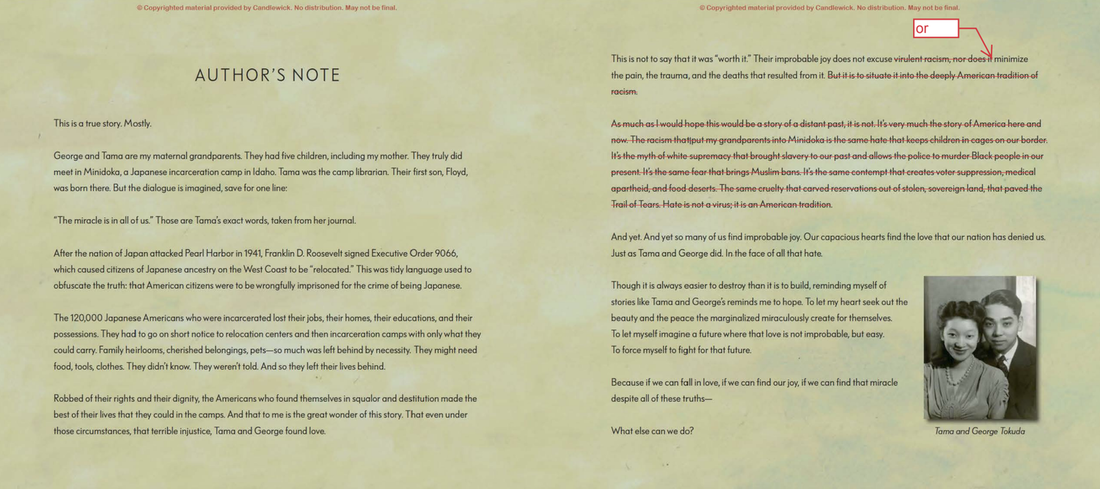
The publishers only suggested edit was to the author’s note: Scholastic had crossed out a key section that references “the deeply American tradition of racism” to describe the tale’s real-life historical backdrop — a time when the U.S. government forcibly relocated more than 120,000 Japanese Americans to dozens of internment sites from 1942-1945.

Scholastic gave its reasons for the suggested change in an email to the author and her original publisher, Candlewick Press, citing a “politically sensitive” moment for its market and a worry that the section “goes beyond what some teachers are willing to cover with the kids in their elementary classrooms.”

“This could lead to teachers declining to use the book, which would be a shame,” Scholastic’s email said.

The deal with Scholastic was contingent on not only nixing that section, according to the author, but removing the word “racism” from the author’s note entirely.

Scholastic made the suggested revisions above to Tokuda-Hall’s book in an attachment it sent to her original publisher. “They wanted to take this book and repackage it so that it was just a simple love story,” the author wrote on her blog.

Infuriated by what she called a “horrific demand for censorship,” Tokuda-Hall gave Scholastic a hard no.

The author called the offer deeply offensive in an email to Candlewick Press, which passed along Scholastic’s proposal, a response she posted publicly to her website on Tuesday.

“I’m typically a very compromising person,” the Oakland, Calif.-based author, who is Asian American, told NPR. “But when you omit the word racism from a story about the mass incarceration of a single group of people based on their race, there’s no compromise to be had with that if you can’t agree on basic facts.”

Maggie Tokuda-Hall, a children’s author based in Oakland, Calif., rejected an offer from Scholastic to license her book after the publisher proposed an edit that would cut a section referencing “racism.”

Without its proper context, she said, the story “runs the risk of just being like a lovely little love story. And that’s not what it is. To pretend otherwise would do a disservice not just to [my grandparents], but also to the 120,000 other people who were incarcerated at the time.”

Scholastic issues an apology

Two days after the author first spoke out about the offer, Scholastic said it had apologized to Tokuda-Hall for its editing approach, in a statement sent to NPR on Thursday night.

“In our initial outreach we suggested edits to Ms. Tokuda-Hall’s author’s note,” the company’s CEO Peter Warwick wrote in a statement. “This approach was wrong and not in keeping with Scholastic’s values. We don’t want to diminish or in any way minimize the racism that tragically persists against Asian-Americans.”

Scholastic said that during the process it had failed to consult its “mentors” for the Rising Voices collection — authors and educators from Asian American, Native Hawaiian and Pacific Islander communities — and has since reached out to them to hear their concerns. “We must never do this again,” Warwick wrote

Scholastic, which had planned to feature Love in the Library as part of its “Rising Voices Library” collection highlighting AANHPI voices, said it hopes to restart the conversation with Tokuda-Hall with the aim of sharing the book with the author’s note unchanged.

It’s not yet clear whether Tokuda-Hall will consider their revised offer.

“That conversation is not concluded and so I do not have any comment yet,” she told NPR in an email.

The author says publishers are silencing marginalized voices

To Tokuda-Hall, her experience with Scholastic is another instance in which publishers are yielding to conservative advocacy groups in the face of recent battles over book bans and author censorship.

In one case, a Florida textbook publisher removed all explicit references to race from its lesson materials about civil rights icon Rosa Parks in order to win approval from Florida’s Department of Education, The New York Times reported last month.

Publishers, she wrote on her website before the Scholastic apology, “want to sell our suffering, smoothed down and made palatable to the white readers they prioritize. … Our voices are the first sacrifice at the altar of marketability.”

It’s impossible to put a price on what Tokuda-Hall may sacrifice from rejecting the deal with Scholastic, a trusted, powerhouse publisher in the children’s market that affords authors exposure. She feared that speaking publicly about the offer could harm her reputation and career.

“Children’s book authors — we’re fighting over nickels. It’s not exactly gangbusters, this industry,” she said. “So, when you’re presented with any opportunity to get your story, and particularly a story that you deeply believe in, in front of more eyes, it’s a huge opportunity.”

But she thinks kids and their families have the most to lose from situations like this.

“I think they’re losing the opportunity to talk about the truth, to learn the truth, to discuss it,” she said. “No substantive change for the better can be made without reconciliation with the truth.”

Since going public with her experience, the author says, she’s heard from other marginalized writers and people in the publishing industry — largely people of color and queer people, she says — who have also had to make difficult choices about their work and how its presented.

“My DMs have been absolutely full,” she said. “People sharing pretty horrific stories that they’re just too afraid to share in public.”

Some authors and others in the publishing world responded publicly in support of Tokuda-Hall.

“By refusing to let this story be situated in context of government oppression and enslavement of other marginalized groups, past and present, It makes it safe for them to say ‘historically, mistakes were made, but look at how successful Japanese American communities are now,’ ” literary agent DongWon Song tweeted. “This is white supremacy. This is how it operates.”

Author Martha Brockenbrough has collected close to 400 signatures on a letter to Scholastic calling on the publisher to feature Love in the Library without edits.

Before she received Scholastic’s apology, Tokuda-Hall said that, whether or not the publisher apologizes, her “greatest fear is that this is a momentary flurry of outrage, but nothing changes. And other creators are asked to make horrible choices like this going forward in the dark.”

Source: Scholastic wanted to license her children’s book — if she cut a part about ‘racism’

The new Canada-U.S. border deal will cost Canadian taxpayers at least this much

The formal analysis (more solid than the one on self-administered citizenship oaths):

Closing the Canada-U.S. border to asylum seekers is projected to cost Canadian taxpayers at least $60 million over 10 years. But that analysis doesn’t include costs for the Mounties to beef up “challenging” enforcement efforts.

In March, Ottawa and Washington expanded a bilateral agreement to turn back irregular migrants trying to cross into the other country for protection, but a cost-benefit analysis has only been recently published in the Canada Gazette.

“It will be challenging for the RCMP to consistently enforce the Regulations given the size and terrain of Canada’s landscape, challenges posed by Indigenous and private lands, as well as the limitations of existing border technology (e.g. sensors, cameras),” said the public notice about the amended Safe Third Country Agreement (STCA).

“Responding to reports of border crossings and intercepting irregular migrants between the ports is resource intensive and risks diverting policing resources.”

The RCMP is responsible for patrolling unofficial border crossings. It will be funded for broader initiatives to replace and modernize ISR equipment (Intelligence, Surveillance, Reconnaissance) and to form a new project team to determine technological and other needs.

But the notice said these expenditures are not treated as incremental, hence not included in the analysis.

“It is acknowledged that investment in these new resources will likely help support … the broader objective of a reduction in irregular migration following implementation of the regulatory amendments,” it said.

The estimated $61.5-million cost in today’s dollar value only covers transition costs, upfront capital costs, and ongoing processing, operations and enforcement costs for the immigration department and Canada Border Service Agency. It includes:

  • $560,000 this year only for communications products, IT costs, updates to program delivery instructions, other administrative materials, and training costs;
  • $1.28 million over the next decade to purchase vehicles to transport migrants, and for acquisition and installation costs for office equipment and renovations to create additional processing spaces such as interview rooms due to more dispersed arrival points for asylum claimants across the border; and
  • $59.61 million over 10 years for ongoing processing, operations and enforcement costs for tasks such as eligibility determinations, investigations, intelligence, reviews, infrastructure oversight, litigation and vehicle maintenance.

As a result of evolving migration routes, officials say there will be additional policing costs in border communities and in popular destination cities to respond to calls, conduct investigations related to irregular migration, and to respond to suspected cases of human smuggling.

The public notice says there will also be potential costs or risks for asylum claimants who choose to game the system.

“Claimants may face increased danger, such as involvement with human smugglers and may be at risk for physical, mental or financial abuse. They may also face risks from exposure to extreme weather conditions if they cross at remote locations or fail to secure access to shelter,” it said.

“This could increase the health and security risks of living in dangerous natural habitats, as well as a possible lack of access to food, water, health care and other basic services.”

Since 2017, Canada has seen a surge of irregular migrants via the U.S., which reached almost 40,000 asylum seekers last year. More than 90 per cent of them came through the world-famous Roxham Road in Quebec, which put pressure on the country’s asylum system and local housing and community services.

Restricting access to asylum throughout the entire border will improve border integrity and support the standardized treatment of all arrivals, regardless of where migrants cross, said the notice, which also cautions against any promised outcomes on the level of irregular migration.

“The impact on asylum volumes is dependent on many factors, including the ability to effectively address border crossings as new irregular routes emerge and the risk that individuals will continue to evade application of the STCA,” it said.

“As such, the extent to which volumes may be reduced is largely unknown and the magnitude of this impact cannot be estimated; therefore, for cost-benefit analysis purposes, the benefits of a reduction in asylum claimants are not quantified or monetized.”

It also noted that no public consultations were undertaken for the changes to the bilateral pact because it would have created a surge of migrants trying to sneak into the country before the new rule took effect.

Source: The new Canada-U.S. border deal will cost Canadian taxpayers at least this much

Paradkar: Dear immigrants: Coming to Canada? Here’s what you’re really in for

While a bit overboard, all too accurate given the various changes to ease business restrictions on temporary worker permits and limits on employment time for international students:

Hello, new immigrants. Most of you are likely coming to Canada in search of a better life and better opportunities than in the lands you leave behind. The good news is that many of you will find a job. Some of you will even be well-paid. But more than a few will find your dreams of stability and comfort seriously challenged.

For those who take on the vast majority of jobs Ontario is looking to fill — in restaurants and in bars, in truck transportation, construction, nursing homes — you’ll first have to survive the savageries of capitalism and xenophobia.

As Canada opens its doors to half a million immigrants annually — about half of whom will land in Ontario — we say welcome, today’s newcomers. But do you know what you’re in for?

Canada has historically benefitted from immigration. Many immigrants, particularly higher skilled ones, have also benefitted by coming here. But this round of gate-opening reveals the truth about Canada’s economic immigration policy. It’s designed in the interest of a stronger economy, which serves, first and foremost, not the majority of immigrants, who will be channelled into unskilled, often temporary jobs, but those at the top.

What Canada wants, but is not saying out loud, is a servant class; a vast army of workers prepared to accept the low-paid jobs no one else wants. And given how the economy is structured along with our poor preparedness to receive these newcomers, it’s clear we want to keep them in that position.

The current immigration push continues a centuries-old tradition of worker exploitation in the Americas. When European settler attempts to enslave Indigenous populations failed for various reasons, indentured servants arrived in the 1600s to care for the vast lands the earliest settlers had got, bought or stole.

Then came chattel slavery, itself created because the elite capitalists realized free labour by commodifying humans kidnapped from afar was more profitable than cheap wage labour.

When, some 200 years later, Britain abolished slavery in most of its colonies in the 1830s, this continent experienced a “labour shortage,” like the one today. That led to Britain importing indentured or bonded labour from colonies such as India, particularly on its plantation islands.

Then, as today, “labour shortage” didn’t mean there was a lack of human bodies to do jobs that build societies. Nor did it mean there was a lack of skills to do them. Then, as today, it meant something about the shifting dynamics of demand and supply.

A higher demand for labour shifts power toward workers, who agitate for better wages and working conditions. Flooding the market with a supply of workers swings that shift in power back to the owning class.

Today’s immigration push comes with baked-in economic disenfranchisement. Temporary work in precarious jobs leaves workers vulnerable to abusive working conditions.

Much like the West Indian Domestic Scheme of the 1950s and ’60s, when Canada sought Black Caribbeans to be domestic workers, the floodgates are opening today through initiatives such as the Temporary Youth Worker Program and the Federal Skilled Trades program, and via colleges and universities, which are taking increasing numbers of international students.

According to Statistics Canada, a vast majority of Ontario’s job vacancies right now — 60 per cent — require a high school graduation or less, many needing less than one year of experience.

The Federal Skilled Trades program doesn’t require candidates to have secondary education but it will prioritize those with a certificate or diploma or degree. That means many economic migrants will be overqualified for the jobs being asked of them, but they will come, perhaps hoping they’re at least getting a foot in the door.

Once in, however, these immigrants will have been slotted into the jobs Canadians won’t do for the wages being offered.

The overt racists and xenophobes also grease the wheels of this exploitative system.

If employers see labour as robotic capital-making units, xenophobes, easily made insecure by “outsiders,” keep immigrants bracing for attacks on their very existence, leaving them grateful for the crumbs, told their deplorable circumstances are a result of their not working hard enough or their supposed inferiority.

The economy is structurally built to see full employment — everyone having a job — as a problem.

A seventh straight month of job gains and near-record-low unemployment of five per cent is leading economists to predict that the Bank of Canada might well raise already high interest rates in coming months to “cool the economy” and inflation.

In this way of thinking, rising wages for, say, an average grocery worker in Canada, who earned $18.97 per hour in 2022 is a threat to the economy. But grocery magnate Galen Weston earning $5,679 an hour is not.

This thinking is why employers freely blamed programs such as Canada Emergency Response Benefit — that offered about $500 a week to those who lost income due to COVID — for “spoiling” workers.

Far better to call a person earning $500 a week, and not wanting to work for less than that bare minimum, lazy than pay them higher wages.

Perhaps the new immigrants coming in to rescue our economy, including those who have to remain jobless in service of this country, might be thanked in other ways? Maybe they’ll be housed relatively easily? Not have to worry about finding good schools for their children? Or have a safety net should they fall ill?

No such luck. Provincial parsimoniousness has already extended to defunding education, defunding health care and not building enough or affordable houses on land already earmarked for homes.

Politicians and their owning class friends are eyeing for-profit education and for-profit health care once the current systems are squeezed to the point of hopelessness. Large developers, quite coincidentally, bought precisely those thousands of acres of environmentally sensitive and protected Greenbelt land that Ontario’s premier opened up to build housing.

Yes, developers will need construction workers willing to work for less than a decent wage, if they hope to pad their profits. Instability in foreign lands fostering desperation can be a wonderful boon.The very rich benefit mightily from boosted immigration in other ways, too. More people means more consumers and buying food is non-negotiable. Ka-ching, that sound of cascading coins, is an inadequate metaphor to capture the surge in sums of money for people like Weston, whose family’s net worth is about $8 billion US.

We — as a nation — either need to be better prepared to receive newcomers or, failing that, be honest and say: Welcome, newcomers — welcome to your new life of multi-dimensional suffering.

Source: Dear immigrants: Coming to Canada? Here’s what you’re really in for