La lutte contre l’islamophobie est un écran de fumée

Extreme take IMO but valid critique of the some of the polemic around CRA audits and reflects the tensions between the more and less secular:

Lors de l’annonce du poste de représentant canadien à la lutte contre l’islamophobie, nous avons été nombreux à souligner l’utilisation abusive et militante de ce terme qui confond dans son usage le respect de la personne de conviction musulmane avec le respect absolu des préceptes de l’islam.

Le dernier sondage Angus Reid illustre bien notre propos en reconduisant une telle confusion. Selon ce sondage, les Québécois auraient une opinion plus négative de l’islam que la moyenne canadienne et seraient davantage favorables à la loi 21.

On le sait, le Québec a une vision plus négative que le reste du Canada de toutes les religions et une plus grande aspiration à la laïcité. Cela découle de son parcours historique et de son attachement à un modèle de vivre ensemble basé sur des valeurs citoyennes communes. Or, la firme Angus Reid ne manque pas de conclure que les Québécois seraient plus islamophobes, au sens de racistes, que le reste du Canada. La lutte contre l’islamophobie consisterait-elle, au nom d’un antiracisme dévoyé, à inculquer une vision positive de l’islam ? Faudrait-il en faire autant pour toutes les religions ?

Ce que cache la lutte contre l’islamophobie

Plus concrètement, on vient d’apprendre que la Division de la revue et de l’examen (DRE) de l’Agence du revenu du Canada, chargée de veiller à ce que les organisations caritatives ne soient pas utilisées pour financer le terrorisme, fait l’objet d’une enquête en raison d’allégations d’islamophobie. Les plaignants font notamment valoir que 75 % des organismes dont le statut d’organisme de bienfaisance a été révoqué sont musulmans. Il appartiendra à l’Office de surveillance des activités en matière de sécurité nationale et de renseignement de trancher après enquête, mais soulignons d’emblée qu’un tel écart statistique ne présume aucunement d’une injustice.

Parmi les organisations révoquées, les médias ont déjà rapporté le cas du Centre islamique d’Ottawa pour promotion de la haine et de l’intolérance, de l’IRFAN-Canada pour financement du Hamas ou de l’ISNA pour financement de Jamaat-e-Islami, tous deux inscrits sur la liste des entités terroristes du Canada. Un simple parcours de cette liste permet d’ailleurs de constater qu’elle est constituée dans sa grande majorité de groupes islamistes. Du reste, un document sur la stratégie antiterroriste du Canada tire la même conclusion : « L’extrémisme islamique violent est la principale menace pour la sécurité nationale du Canada ».

En fait, suspendre les travaux de la DRE était l’une des recommandations du Conseil national des musulmans canadiens (CNMC) lors du sommet national sur l’islamophobie de 2021 ayant mené à la création du poste de représentant canadien à la lutte contre l’islamophobie. Parmi ses autres recommandations, le CNMC appelle le gouvernement à interrompre sa stratégie nationale de lutte contre l’extrémisme violent et la radicalisation, ainsi qu’à surveiller les organismes de sécurité nationale, dont le Service canadien du renseignement de sécurité et l’Agence des services frontaliers du Canada. Pourquoi ? Le CNMC les soupçonne de racisme, d’islamophobie et exige même une étude sur « la pénétration de la suprématie blanche » en leur sein.

Faire cesser la surveillance des organisations susceptibles de financer le terrorisme et mettre sous contrôle les organismes de sécurité nationale sous prétexte de racisme, est-ce à cela que contribuera le poste de représentant canadien à la lutte contre l’islamophobie ? Les Canadiens prennent-ils la pleine mesure de ce que tout ceci implique ?

La laïcité comme arme de diabolisation massive

À la suite du sondage Angus Reid, les médias ont relayé des propos outranciers sur la supposée « islamophobie » rampante au Québec, le CNMC allant même jusqu’à parler de danger de mort pour les musulmans.

À ce propos, Fatima Aboubakr a apporté un témoignage éclairant sur la façon dont la loi 21 était utilisée, quitte à exagérer son champ d’application, pour diaboliser le Québec et faire avancer des objectifs islamistes. Témoin de la radicalisation de jeunes de son entourage, Mme Aboubakr a participé à la fondation d’une association arabo-musulmane à vocation humaniste et laïque pour aider ces jeunes. Or, cette vocation humaniste a rapidement été mise à mal par des pressions interdisant tout propos favorable à la laïcité. Elle témoigne aussi de l’état de dépendance dans lequel se trouvent de nombreux immigrants embrigadés par des intervenants associatifs en rupture avec leur société d’accueil.

Ce n’est pas la première fois qu’un tel constat est brossé. En 2016, dans le cadre du départ d’une dizaine de jeunes du cégep Maisonneuve vers la Syrie, un rapport du Centre de prévention de la radicalisation menant à la violence faisait état d’un climat polarisant entretenu par des « agents de radicalisation » manipulant le sentiment de victimisation des jeunes en instrumentalisant le projet de Charte de la laïcité. Ces agents de radicalisation auraient considérablement contribué « à semer la haine chez les jeunes, en insistant sur le rejet collectif des musulmans et de l’islam de la part de la société québécoise ».

La lutte contre l’islamophobie est un écran de fumée permettant à des individus peu scrupuleux ou radicalisés de maintenir leurs concitoyens dans un état d’enfermement communautaire les isolant du reste du Québec, sans parler d’OBNL à vocation religieuse profitant de l’impunité qui en découle pour servir de courroie de transmission au financement du terrorisme international.

Si le gouvernement canadien doit assurément lutter contre la haine, il ne doit pas se laisser berner par l’usage volontairement confus du terme « islamophobie » au point d’entraver le bon fonctionnement des organismes de sécurité nationale. Son rôle premier est d’assurer la sécurité de ses citoyens tout en préservant sa crédibilité à l’étranger.

Source: La lutte contre l’islamophobie est un écran de fumée

The Liberal Maverick Fighting Race-Based Affirmative Action

Of interest and agree on need for more focus on class issues rather than conflating them with race:

For the college class he teaches on inequality, Richard D. Kahlenberg likes to ask his students about a popular yard sign.

“In This House We Believe: Black Lives Matter, Women’s Rights Are Human Rights, No Human Is Illegal, Science Is Real,” it says.

His students usually dismiss the sign as performative. But what bothers Mr. Kahlenberg is not the virtue signaling.

“It says nothing about class,” he tells them. “Nothing about labor rights. Nothing about housing. Nothing that would actually cost upper-middle-class white liberals a dime.”

Since picking up a memoir of Robert F. Kennedy at a garage sale his senior year of high school, Mr. Kahlenberg, 59, has cast himself as a liberal champion of the working class. ‌ For three decades, his work, largely at a progressive think tank, has used empirical research and historical narrative to argue that the working class has been left behind.

That same research led him to a conclusion that has proved highly unpopular within his political circle: that affirmative action is best framed not as a race issue, but as a class issue.

In books, ‌articles and academic papers, Mr. Kahlenberg has spent decades‌ ‌arguing for a different vision of diversity, one based in his 1960s idealism. He believes that had they lived, Kennedy and the Rev. Dr. Martin Luther King Jr. would have pursued a multiracial coalition of poor and working class people, a Poor People’s ‌Campaign that worked together toward the same goal of economic advancement in education, employment and housing. ‌ ‌

Race-conscious affirmative action, while it may be well intentioned,‌ ‌does just the opposite, he says — aligning with the interests of wealthy students‌ and creating racial ‌animosity.

With class-conscious affirmative action, “Will there be people in Scarsdale who are annoyed that working-class people are getting a break? Probably,” he said in an interview. “But the vast majority of Americans support the idea, and you see it across the political spectrum.”

His advocacy has brought him to an uncomfortable place. The Supreme Court is widely expected to strike down race-conscious affirmative action this year in cases against Harvard and the University of North Carolina. He has joined forces with the plaintiff, Students for Fair Admissions, run by a conservative activist; the group has paid him as an expert witness and relied on his research to support the idea that there is a constitutional “race-neutral alternative” to the status quo.

That alliance has cost him his position as a senior fellow at the Century Foundation, the liberal-leaning think tank where he had found a home for 24 years, according to friends and colleagues. (Mr. Kahlenberg and the Century Foundation said he left to pursue new opportunities and would not elaborate.)

Critics‌ ‌dispute everything from his statistics to his rosy outlook on politics. They say that the concept of race-neutral diversity underestimates how racism is embedded in American life. They say that class‌-conscious affirmative action will bring its own set of problems as universities try to maintain high academic standards. ‌

And they argue that his class-based solution could backfire.

“It may well be where we wake up,” said Douglas Laycock, a law professor at the University of Virginia who has been involved in litigation on the side of universities. “But if you get rid of affirmative action, then you create racial hostility in the other direction.”

Mr. Kahlenberg is unfazed.

“I think people will have to come around,” he said, “because class will be the only game in town.”

The Harvard Legacy

Mr. Kahlenberg’s own life shows the complicated calculus of college admissions.

He grew up in White Bear Lake, Minn., a suburb of St. Paul, where his father was a liberal Presbyterian minister and his mother was on the school board. His father had gone to Harvard, and when he came of age, so did Mr. Kahlenberg. His grandfather paid for his college tuition.

Decades later, he seemed a little defensive about possibly having benefited from the “tip” that Harvard gives to the children of alumni.

“This will sound incredibly insecure or something, but I was gratified that I got into Yale and Princeton, because it made me feel like, OK, it wasn’t just legacy, hopefully,” he said.

Around the time he was accepted to Harvard, he was smitten by a memoir of R.F.K. by the Village Voice journalist Jack Newfield. Mr. Kahlenberg wrote his senior thesis on Kennedy’s campaign for president. And today, a nicked and scratched poster of his idol hangs in his study at home.

At Harvard, Mr. Kahlenberg was surrounded by “immense wealth,” he recalled. “I didn’t feel like an outsider. I was second-generation Harvard, I was upper middle class and a lot of my friends went to boarding school.”

But his roommate, who came from more modest circumstances, “helped educate me on the idea that working-class white people had a raw deal in this country, too,” he said.

Mr. Kahlenberg studied government and went on to Harvard Law School, where he wrote a paper about class-based affirmative action, advised by Alan Dershowitz, his professor, known for defending unpopular causes and clients.

The paper inspired him to write his influential 1996 book, “The Remedy,” which developed his theory that affirmative action had set back race relations by becoming a source of racial antagonism.

“If you want working-class white people to vote their race, there’s probably no better way to do it than to give explicitly racial preferences in deciding who gets ahead in life,” he said. “If you want working-class whites to vote their class, you would try to remind them that they have a lot in common with working-class Black and Hispanic people.”

The book caused a stir, in part because of the timing. California voters adopted a ban on affirmative action in public colleges and universities the same year. Such bans have since spread to eight other states, and California voters reaffirmed it in 2020.

Today, as in the mid-1990s, polls show that a majority of people oppose race-conscious college admissions, even as they support racial diversity. Public opinion may not always be right, Mr. Kahlenberg said, but surely it should be considered when developing public policy.

What has changed, he said, is the political environment. Universities and politicians and activists have hardened their positions on affirmative action.

And the Supreme Court supported them, at least until now.

A Different Measure of Diversity

If Mr. Kahlenberg had his way, college admissions would be upended.

His basic recipe: Get rid of preferences for alumni children, as well as children of faculty, staff and big donors. Say goodbye to recruited athletes in boutique sports like fencing. Increase community college transfers. Give a break to students who have excelled in struggling schools, who have grown up in neighborhoods of concentrated poverty, in families with low income, or better yet, low net worth. Pump up financial aid. Look for applicants in towns that do not normally send students to highly selective colleges.

It’s an expensive punch list and requires more financial aid for working class and poor students, which is the main reason, he believes, that universities have not rushed to embrace it.

Meanwhile, elite colleges have become fortresses for the rich, he said. Harvard had “23 times as many rich kids as poor kids,” Mr. Kahlenberg testified in 2018 at the federal court trial in the Harvard case, referring to a 2017 paper by Raj Chetty, then a Stanford economist, and colleagues. 

Mr. Kahlenberg said the civil rights movement has made strides, while overall, poor people have been left further behind. He points to studies that found that the achievement gap in standardized test scores between rich and poor children is now roughly twice the size of the gap between Black and white children, the opposite of 60 years ago.

He said his theories are working in states with affirmative action bans, pointing to his 2012 study that found seven of 10 leading universities were able to return to previous levels of diversity through race-neutral means.

Even the University of California, Berkeley, which was having trouble achieving its pre-ban levels of diversity, has made progress, he said. In 2020, Berkeley boasted that it had admitted its most diverse class in 30 years, with offers to African American and Latino students rising to the highest numbers since at least the late-1980s, without sacrificing academic standards. 

Mr. Kahlenberg’s analysis of Harvard’s outlook is also optimistic.

In a simulation of the class of 2019, he found that the share of Black students at Harvard would drop to 10 percent from 14 percent, but the share of white students would also drop, to 33 percent from percent from 40 percent, mainly because of the elimination of legacy and other preferences. The share of Hispanic students would rise to 19 percent from 14 percent and the Asian American share would rise to 31 percent from 24 percent.

The share of “advantaged” students (parents with a bachelor’s degree, family income over $80,000, living in a neighborhood not burdened by concentrated poverty) would make up about half of the class, from 82 percent. SAT scores would drop to the 98th percentile from the 99th.

Because he is focused on class-based diversity, Mr. Kahlenberg is satisfied with these results, but for many educators, the rise in low-income students does not make up for a drop in Black students.

Harvard, for instance, says it crafts every class carefully, looking for diversity of life experiences, interests and new ideas — and to cultivate potential leaders of society. Fewer Black students make that mission harder.

In the affirmative action trial, Harvard said that Mr. Kahlenberg’s model would produce too little diversity, and water down academic quality. Its actual class of 2026 is 15.2 percent African American, 12.6 percent Hispanic and 27.9 percent Asian American.

Universities should not turn to class-conscious admissions, “under the illusion that it will automatically produce high levels of racial diversity,” said Sean Reardon, an empirical sociologist at Stanford.

“It’s just sort of the math of it,” Dr. Reardon said. “Even though the poverty rates are higher among Blacks and Hispanics, there are still more poor whites in the country.”

Dr. Reardon does not dispute that society should provide more educational opportunity for low-income students. But, he said, “I think in recent years, there’s been much more of a perspective that there’s structural racism in America society. The idea that race and racial differences are sort of explainable by class differences is no longer the dominant idea.”

An Uneasy Alliance

Edward Blum, the conservative activist behind the lawsuits against Harvard and U.N.C., said Mr. Kahlenberg came to his attention when “The Remedy” was published. The focus on class seemed like a powerful bridge between the left and the right, Mr. Blum said.

“If we’re going to agree on one thing,” he said, “it is that colleges and universities should consider lowering the bar a little bit for kids from disadvantaged backgrounds, who are maybe the first in their family to attend college, who come from very modest if not low-income households.”

“I don’t know who could be against that,” he said. “That’s the unifying theme that Rick Kahlenberg — he’s the godfather of it.”

Although the two men have had a long correspondence, Mr. Kahlenberg said they are more strange bedfellows than ideological soul mates, and that his views have been unfairly conflated with Mr. Blum’s.

“If the choice were race-based preferences or nothing, I would be for race-based preferences,” Mr. Kahlenberg said, his delivery more emotional than usual. “For those who think in terms of guilt by association, that point is lost.”

There are those who think that Mr. Kahlenberg is being used by Mr. Blum, who has made a specialty of challenging laws that he believes confer advantages or disadvantages by race. He  orchestrated a lawsuit that led to the Supreme Court gutting a key section of the Voting Rights Act, and was responsible for litigation against the University of Texas, charging discrimination against a white applicant, which failed.

Dr. Laycock, of the University of Virginia, expects that once the Supreme Court rules, conservative groups that are now promoting race-neutral alternatives will claim they are racial proxies and turn against them. “Everybody knows that’s why it’s being used,” he said. (Mr. Blum said his group will not, though other conservative groups could do so.)

In other words, that Kennedy- and King-style multiracial coalition may not come easily.

Since leaving the Century Foundation, Mr. Kahlenberg still consults for the organization on housing. He has a few unpaid gigs at the Progressive Policy Institute and at Georgetown. 

He recently moved from Bethesda, Md., to a modest house in Rockville, now strewn with baby toys from a visiting daughter and grandchild. Mr. Kahlenberg’s wife, Rebecca, works with homeless people.

There is no “We Believe” sign in the yard. But on the living room wall, a sign says, “Live simply, dream big, be grateful, give love, laugh lots.”

In that spirit, his stubborn campaign might be traced to being the son of a pastor whose family could afford to make him a Harvard graduate, twice over. “I do have some measure of class guilt,” he said. “I wish people who are far richer than I am had more class guilt.”

Source: The Liberal Maverick Fighting Race-Based Affirmative Action
Canada hired more female police officers in 2022, while the number of racialized officers remained unchanged

Of note:

The representation of women in police departments across Canada continued to increase in 2022, according to a new report by Statistics Canada, while the number of racialized officers remained largely the same.

More than 2,000 police officers and nearly 1,900 recruits were hired in 2021/2022, an increase of about 900 between the categories compared to the year before, the report says.

That year, 15 per cent more female officers were hired than the year before and 16 per cent more female recruits were hired. Recruits are people training to be police officers.

Overall, women represented 23 per cent of police officers in 2022, while just eight per cent of the police force comprised racialized officers, the report says.

Number of women officers continues to increase steadily

Police services in the country have been hiring more and more women since 1986, the report notes, when data on gender was first collected. At the time, women represented less than 4 per cent of all officers in Canada.

As of May 2022, there are more than 16,000 women working in Canadian police departments, up by more than 270 compared to 2021.

Most women on the force last year held positions as constables, making up about 24 per cent of all such positions in the country.

While women still represent a slightly smaller portion of senior and nonsenior ranks (commissioned and non-commissioned), the number of officers is rising on both fronts.

In 2022, 18 per cent of senior officers were women — the highest number recorded to date.

Racialized officers continue to represent less than 10 per cent of the force

While 26.5 per cent of Canada’s population was racialized in 2021, according to census data, only eight per cent of all police officers were racialized in 2022, the report found.

The figure did not change from 2021.

The report notes efforts are underway to boost diversity and inclusion among the ranks, highlighting the importance of representing the diversity of the population among police.

Racialized recruits, training to be police officers, did increase by three percentage points compared to 2021. That year, 11 per cent of recruits were people of colour, while the same was true for 14 per cent of recruits in 2022.

In the RCMP, racialized officers made up 13 per cent of personnel. In municipal services, they made up seven per cent.

Indigenous populations, meanwhile, made up five per cent of people in Canada in 2021, and four per cent of police in 2022.

In First Nations police services, more than half of officers identified as Indigenous.

They comprised 7 per cent of the RCMP, one per cent of officers in municipal police and two per cent of those in the Sûreté du Québec and Ontario Provincial Police, the report says.

Police operating expenditures increased by 12 per cent

Across the country, police services spent $18.5 billion in 2021/2022 on operating budgets.

After factoring in inflation, operating expenditures increased by eight per cent. That amounts to $342 per person for the 2021/2022 year, the report adds.

Salaries and wages accounted for 67 per cent of expenses, benefits were 17 per cent and other operating expenditures accounted for 16 per cent of the money.

The report credits the implementation of the first collective agreement for RCMPmembers and reservists, in part, for the increase.

Since a reckoning hit police services across the country in 2020, many anti-racism advocates have called for police funding to decrease or for services to be abolished altogether.

Others have made the case for initiatives such as new body cameras, that have added funding to police, and some have called for more police in the face of growing violence, as has sometimes been the case in Toronto.

‘Police strength’ decreases despite an increase in number of officers

The number of police officers compared to the Canadian population had been relatively stable for two years, but that rate decreased in 2022, the report says.

In 2022, the rate of “police strength” was 181 officers per 100,000 population, down one per cent from 2021.

This rate decreased despite there being about 70,560 police officers in 2022 — 400 more than the year before — due to the growth in the Canadian population.

This occurred as police calls increased by 2.7 per cent, which the report points out happened as pandemic restrictions eased and fewer people stayed at home.

The report also notes that civilian employees — clerks, communications staff, managers and other administrative professionals — are making up more police employees.

Source: Canada hired more female police officers in 2022, while the number of racialized officers remained unchanged

Germany to change immigration laws to attract skilled labor

Legislation moving through the system:

Germany’s dearth of skilled laborers has forced Berlin to look hard at existing immigration policies, and the government’s new plan designed to attract more with greater easek put forth jointly by the Interior and Labor Ministries cleared the Cabinet on Wednesday. It will still need to go through both houses of parliament.

The new bill is part of a comprehensive migration package the ruling coalition says will modernize the country’s immigration, residency and citizenship laws. Existing skilled labor immigration rules were established in March 2020, when Germany was governed by the so-called grand coalition headed by Angela Merkel.

The draft law estimates that it could increase skilled labor migration from non-EU countries by around 60,000 per year, roughly doubling the pre-COVID pandemic figures of 2019.

The policy would be based on a new points system that considers attributes in five categories.

These are qualifications, German language skills, career experience, connections to Germany (for instance relatives already living in the country), and age.

Labor Minister Hubertus Heil said in December when first unveiling the plans that people deemed to meet three or more of these criteria would be eligible for closer consideration.

Changes include a lowering of various hurdles that have made it difficult for the country to attract workers from abroad, something Germany must do if it is to fill the historically high number of job openings in its labor market. Berlin said the number of vacant jobs reached 1.98 million in the fourth quarter of 2022, the highest ever recorded.

What are the most important changes?

The bill was presented to the Cabinet by Labor Minister Hubertus Heil and Interior Minister Nancy Faeser.

Asked to describe the nature of the changes to the immigration rules, Heil said there were “three pillars” to the new system.

The first was to ensure “that people with a qualification and a job offfer — including those who qualified on the job [not at university] — can come to Germany more easily,” he told DW.

The next, he said, was that “qualifications are important, but a qualification that applies in your native country plus a job offer should be enough” to come to Germany, and then to square any issues with paper qualifications later. Famously, Germany is often reticent to recognize international qualifications, for instance university degrees, as comparable to its own.

“And the third pillar is, we also want to give people the chance to seek work in Germany,” Heil said.

This third option would operate on a points-based system, with people scoring well in categories like work experience, qualifications, German language skills, age and ties to Germany being more likely to qualify for consideration.

As before, those individuals who have a recognized diploma and a job contract will be given an EU Blue Card that will allow them to remain in the European Union for up to four years. The annual income required to qualify for this will also be lowered from its current levels.

Immigration: Can Germany’s new ‘green card’ deliver?

New rules aim to make it easier for workers to bring their families to Germany as well as attaining permanent residency status.

IT specialists with pertinent job experience will receive EU Blue Cards even if they do not possess an university degree.

Those specialists possessing recognized academic diplomas or trade certification will also be allowed to work in sectors other than those for which they have degrees.

Foreigners with adequate job experience and qualifications from their country of origin will be allowed to work in Germany even if those vocational degrees are not recognized in Germany. However, those individuals will be required to show proof of proper salary levels as a means to combat wage dumping.

Moreover, individuals will be allowed to work up to 20 hours a week while looking for long term employment.

Lastly, it will now be possible for individuals in possession of academic degrees or vocational certificates to remain in Germany for up to one year while looking for employment.

Source: Germany to change immigration laws to attract skilled labor

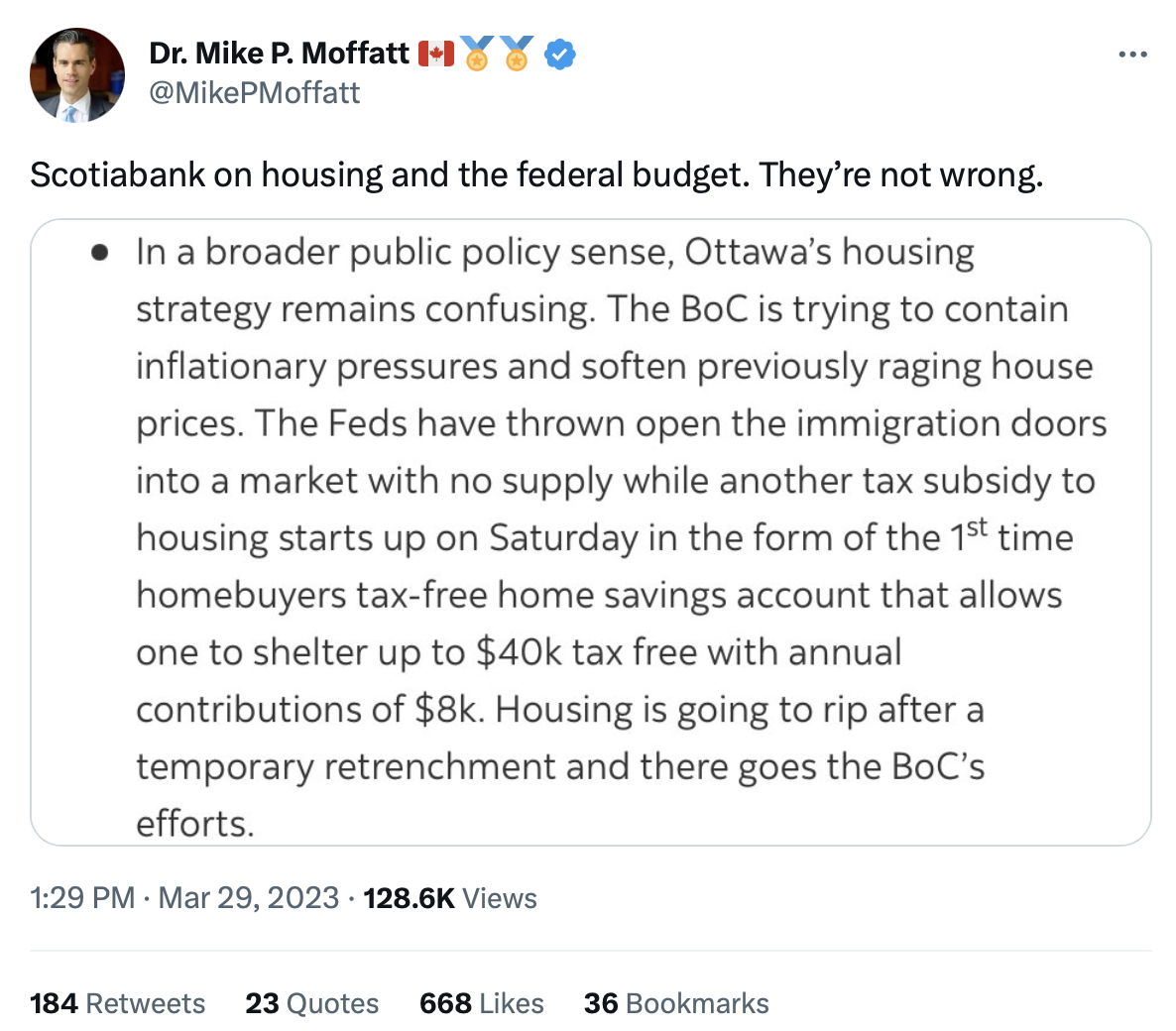
Moffat on disconnect between immigration policy and housing:

Captures the contradiction and policies working at cross-purposes:

Source: https://twitter.com/MikePMoffatt/status/1641130382425833632?s=20

Don Wright: Will Trudeau make it impossible for Eby to succeed?

Another “pointing out” the contradictions between immigration policy, levels set by the federal government, and housing, healthcare, infrastructure etc, largely under provincial jurisdictions:

It is three-and-a-half months since David Eby took the reins of power in B.C. There is no denying the energy and ambition he has brought to the role. Announcement after announcement has rolled out of the Premier’s Office since December 8 across a broad spectrum of initiatives in health care, housing, energy, infrastructure, increases in affordability tax credits and family benefits, and many, many more.

This column isn’t going to analyze the pluses and minuses of this ambition. Instead, I will argue that Premier Eby’s success on the big questions that will ultimately determine his political success may well be largely out of his control.

The most recent polling in B.C. shows that the most important issues are housing affordability, inflation/rising interest rates, and health care. Inflation and rising interest rates are overwhelmingly determined by federal monetary and fiscal policy, so largely outside the control of Premier Eby.  What about the other two big issues – health care and housing affordability?  While these two areas look to be within the domain of the provincial government, B.C.’s success in addressing the public’s concerns here will be largely hostage to the federal government’s immigration policy.  Let me explain.

Since it came to office, the current federal government has increased the level of immigration into Canada significantly.  Most of the attention has been focused on the increase in new permanent residents.  Last year, 438,000 people were granted permanent resident status, a 60% increase over 2015.  The federal government plans to raise this to 500,000 by 2025.

What receives less attention is another category of people coming to Canada – “non-permanent residents.”  This category includes Temporary Foreign Workers, International Students, and the International Mobility Program, which provides multi-year permits to live and work in Canada.  This category has been growing as well.  In fact, this category has been growing at a faster rate than permanent residents.  Last year there was a net increase of 608,000 in non-permanent residents. 

So, in total, the federal immigration policy resulted in an additional 1.045 million people coming to Canada – far and away the largest number of newcomers to Canada in one year ever.  Last year 160,000 of the 1.045 million came to B.C.

The rationale for these unprecedented numbers is that Canada has a “worker shortage.”  This rationale is almost entirely fallacious, but that is a subject for another column.  Let’s focus here on what this means to Premier Eby.

What is the basic problem in health care?  An inability to meet the public’s demands for medical services.  One million British Columbians don’t have a family doctor.  Waiting lists to get to see specialists and to get necessary surgery continue to get longer.  No doubt part of the problem is a result of the Covid pandemic.  But that rationalization is buying less and less forbearance by the public as we get further and further away from those dire days in 2020 and 2021.

The federal government’s prescription for this?  A rapid increase in the number of people who will need services from our health care system!

A story is spun is that the government will use the higher immigration numbers to bring in more health care professionals.  But this would only work if the proportion of qualified doctors, nurses and allied health workers in the more than one million new Canadians is significantly larger than the existing proportion of those professionals in the current Canadian population, and that they could get licenced immediately to practice in Canada.  Neither of these conditions will be met. 

The net result of this?  Premier Eby is going to have even more difficulty in delivering improved health care accessibility to British Columbians.

And then there is housing.  Almost all of the narrative around the shortage of affordable housing focuses on the supply side.  If only we could force municipalities to make permitting easier and faster, and to zone more density, our housing affordability would be solved.  The fact is, we build a lot of homes in B.C.  In Greater Vancouver – ground zero in our housing affordability problem – 365,000 homes were built in the 20 years between 2001 and 2021.  And there has been ample densification, as a walk through any of the redeveloped neighbourhoods in Vancouver shows. 

But supply is only half of the equation. Demand matters too.  And as quickly as we have built new homes, the population in our major urban centres rises as well. 

The Federal Government’s prescription for this?  Ramp up immigration numbers!

Again, a story is spun that this will actually increase housing supply because we are going to bring in more trades workers to build the houses we need.  Suffice it to say there are some pretty heroic assumptions here.  It is not going to work.

Of the 160,000 new British Columbians last year, more than 95% settled in the Lower Mainland, Southern Vancouver Island, and the Okanagan – where affordable housing was already acutely unavailable.

The net result?  Premier Eby is going to have even more difficulty in delivering more affordable housing.

This is all good for one group of British Columbians – those that are fortunate enough to already own a home.  So, thank you, Mr. Trudeau for making me wealthier and my fellow boomers wealthier. 

But if I were Premier Eby, I don’t think I would be quite as grateful.

Don Wright was the former deputy minister to the B.C. Premier, Cabinet Secretary and former head of the B.C. Public Service until late 2020. He now is senior counsel at Global Public Affairs.

Source: Don Wright: Will Trudeau make it impossible for Eby to succeed?

Douglas Todd: 10 ways Ottawa diminishes Canadian citizenship [my comments embedded]

Not all of these are on the same level and have embedded comments. Needless to say, agree on the oath:

Last week, the House of Commons debated the Liberal move to play down the in-person citizenship ceremony and allow more newcomers to become Canadians by the click of a laptop key.

This technological technique for fulfilling a solemn oath is startling to many, even past governor general Adrienne Clarkson, who is long associated with liberal-left values. She is among those saying the ceremony is essential to building healthy pride in Canada.

We shouldn’t, though, be surprised by Ottawa’s latest diminishment of citizenship.

Even while many joke about Prime Minister Justin Trudeau’s 2016 musings to the New York Times that Canada is the world’s first “post-national state,” he keeps finding ways to convince the world he actually means it.

Trudeau and his backers often reveal their support for almost an open-border policy, as would fit with someone who believes, as he does, that there truly is ‘‘no core identity, no mainstream in Canada.’’

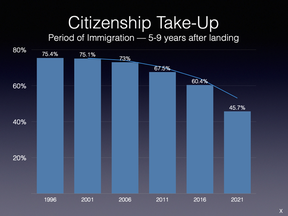
By his fruits shall you know him. The most recent sign is the 15-percentage point drop, since Trudeau was elected, in new arrivals taking Canada’s oath of citizenship.

More people in the immigration process are not bothering with Canadian passports. They’re hanging in on work or study visas or going no further than permanent resident status, which provides full social services and economic advantages.

Fewer are choosing to take the oath of Canadian citizenship

It was announced Thursday that Canada accepted a record one million new immigrants in 2022, the kind of milestone that can bring out Trudeau’s often-confusing rhetoric about pride in being Canadian. But what values does he expect Canadians, native-born and naturalized, to uphold?

As a former immigration department director, Andrew Griffith, notes, one quarter of young adults who immigrated tell pollsters they will probably leave Canada in two years. Like Canadian-born people, they’re frustrated by the cost of living and home ownership, which Liberal policies have worsened.

In addition to the Liberal effort to make optional Canada’s identity-affirming citizenship ceremony, here are nine further developments that, in different ways, undermine the value of citizenship:

Urging non-residents to vote

[Agree, although important to note while the number tripled once the change was implemented, only a total of about 30,000 expatriates voted in 2019 and 2021]

: few did so in One early indicator the Liberals were reducing the meaning of citizenship occurred in 2018, when Bill C-76 allowed any passport holder who doesn’t live in the country to vote federally. While most countries that accept immigrants expect them to maintain a meaningful relationship to their new nation, Senator Linda Frum criticizes the push for non-resident citizens to vote regardless of how long they’ve been away or whether they ever intend to return.

Buying citizenship

[Don’t have the sense that the Quebec program is that active recently.]

The Conservatives in 2014 cancelled the national immigrant investor program, by which rich offshore nationals could, in effect, buy Canadian citizenship. But the Liberals basically allow it to continue, including through provinces’ nominee programs and especially Quebec’s investor scheme, which former Quebec immigration director Anne Michèle Meggs said last year admitted 5,000 multimillionaires.

Foreign nationals can vote for political candidates

[Two schools of thought here, one that it is part of the integration process, the other that it provides more opportunities for foreign interference.]

is ripe for abuseIt’s telling the Liberals and NDP allow not only non-citizens — but non-permanent residents — to become party members and vote in nomination battles. Sources told Global News recently that CSIS investigators alleged international students from China, who are on study visas, were bused in to support one Liberal candidates’ nomination.

Pushing for permanent residents to vote

[Agree, given that Canadian citizenship relatively easy (if costly) to acquire.]

Many Liberal and NDP politicians, as well as Vancouver city council in 2018, have pushed to give permanent residents the privilege to vote in elections, especially municipal. That is arguably the only significant right permanent residents do not have.

Reduced immigration requirements

[Largely just a reversal of Conservative changes in 2014 and reversion to previous requirements.]

The Liberals have lowered the bar for citizenship, by cutting expectations on how much time would-be immigrants need to spend in the country, and by reducing requirements for skills in an official language.

Don’t have to pay foreign-buyers tax

[Haven’t seen evidence of that being a major factor.]

Mortgage brokers are quick to tell newcomers to Canada they only need to be permanent residents to avoid paying provincial and federal taxes on foreign buyers of Canadian land. Immigration specialists say it’s leading to shrinking interest in citizenship.

Dual citizenship remains

[Largely a practical measure, as some countries require immigrants to use their country of origin passport when visiting. The dual citizenship ban of China affects Canadian naturalization more than that of India.]

Ottawa continues to celebrate dual (or multiple) citizenship. Despite few Canadians calling for the policy to be changed, it’s the opposite of China and India, which do not recognize dual citizenship. One reason arrivals from those countries are shunning Canadian citizenship, say specialists, is to avoid giving up their original passports.

Permanent residents can become Canadian soldiers

[This change essentially adopted a long-standing USA policy.]

Last year, says Meggs, the Liberals made it OK for those with only permanent resident status to serve in the Canadian military.

CBC plays down Canadian identity

[Sigh…]

It should be no surprise that the CBC, the public broadcaster led by Liberal-friendly Catherine Tait, is behind a strange campaign pronouncing: “It’s not about how Canadian you are, it’s about who you are in Canada.”

The slogan sends a “mixed message” about whether to commit to hard-won common Canadian values or to highlight differences, says Meggs. It mostly seems like in-vogue identity politics, which declares the most crucial thing about any Canadian is their gender, ethnicity, religion or sexual orientation.

While some can claim there are benefits to these 10 actions, it’s more than fair to also question whether they diminish citizenship.

Source: Douglas Todd: 10 ways Ottawa diminishes Canadian citizenship

Manley: Canada’s empathy for refugees isn’t limitless, so securing our border is key

Sensible and realistic, and useful reminder of the reasons behind the STCA. The right-leaning Liberal in contrast to the op-ed Here’s a better fix for Roxham Road by his left-leaning former Cabinet colleagues Lloyd Axworthy and Allan Rock:

Twenty-one years after I negotiated the Safe Third Country Agreement in 2002 as part of the post-9/11 Smart Border Declaration, I applaud the changes made to that agreement this past week by Prime Minister Justin Trudeau and President Joe Biden.

The 2002 agreement enabled Canada to return to the United States individuals claiming refugee status who entered Canada from that country at designated, regular border crossings.

The new agreement simply extends that policy to individuals attempting to enter Canada through so-called “informal” border crossings like Roxham Road.

Canada sought the agreement in 2002 for reasons that seem all too familiar today. Refugee claimants found their way in huge numbers to legal border crossing areas such as Windsor, Ont., Fort Erie, Ont., and Niagara Falls, Ont.

In those days, the available support systems were overwhelmed by the large number of claimants. The refugee determination process became backlogged, often taking two years or more to reach a decision on the validity of a claim of refugee status. The number of refugee claimants were inflated by efforts of profiteers in the U.S. who collected and delivered these people to the Canadian border, often by bus from Buffalo or other central points.

In more recent years, the situation at Roxham Road developed because of a loophole in the agreement: It became a magnet simply because it, and other areas at which illegal crossings could be attempted, were not specifically included in the original agreement.

Canada’s position was, and remains, that refugee claimants, having somehow made their way to the U.S., should make their claim there. Those who choose to attempt to enter at “informal” crossings are in effect displacing or queue-jumping other claimants.

For context, it is important to remember that, in the aftermath of 9/11, many Americans falsely tried to portray Canada as a safe haven for terrorists intent on attacking the U.S. At the time, both then-senator Hillary Clinton and former House speaker Newt Gingrich, who agreed on very little else, were reported to have falsely claimed that the 9/11 terrorists had entered the U.S. from Canada. Our openness as a society was being turned against us, putting at risk our commercial interests. As Ms. Clinton once said to me: “Security trumps trade.”

Since then, the world’s refugee problem has only worsened: The United Nations Refugee Agency (UNHCR) estimates that, in 2022, there were 103 million forcibly displaced persons worldwide. The enormous scale of this human tragedy is difficult to comprehend: If all these people were situated in one country, it would be the 14th most populous in the world. Most of those 103 million are in much greater danger of harm than those who have already found their way into the U.S., some of whom seek to enter Canada.

There is no question that Canada should continue to help house this burden of displaced humanity. But Canada also has a duty to its own citizens to enforce its laws and manage its territorial borders as part of its system of rule of law, both national and international, for the safety and well-being of its citizens.

Canada, in recent years, has taken in more refugees in absolute numbers than some Western countries our size or bigger. Refugees all around the world wait, often for years, in camps from which there is no escape. Canada has historically been a lifeline for many of these individuals. We can more than meet our global responsibility without taking in persons fleeing the United States.

Canadians have proven themselves to be open to immigration, demonstrating a willingness to pitch in to assist refugees, be they from African countries, Ukraine, Syria, Vietnam, or any other of the many venues of war, famine and persecution.

But Canadian goodwill is not bottomless and could be put at risk if some newcomers are perceived to be queue-jumpers, attempting to gain unfair advantage.

Past prime ministers and, no doubt, our current Prime Minister, feel and understand the burden of Canadian responsibility to the world’s victims of hunger, conflict and persecution, while also recognizing that Canadians’ generosity and sense of fair play must not be stretched beyond their limits.

John Manley is the former deputy prime minister and a current senior adviser with Bennett Jones LLP.

Source: Manley: Canada’s empathy for refugees isn’t limitless, so securing our border is key

Axworthy and Rock: Here’s a better fix for Roxham Road

Predictable, and only workable in the context of the excessively high and increasing immigration levels. But not necessarily in the context of an immigration policy that takes into the account of the impact on housing, healthcare and infrastructure:

Ottawa pundits say that Prime Minister Justin Trudeau scored a political win by securing President Joe Biden’s agreement to renegotiate the Safe Third Country Agreement (STCA). Henceforth, it will apply across the entire Canada-U.S. border, and asylum seekers can be turned away at any crossing point. Ottawa has thereby responded adroitly to Quebec Premier François Legault’s complaints about the flow of migrants entering Quebec at the infamous Roxham Road border crossing.

But there is something that neither the Prime Minister nor the President mentioned in their announcement: the impact of their decision on the men, women and children fleeing violence and persecution who had hoped to cross the Canadian border after feeling anything but safe in the United States. The vast majority are not in any way a threat to our security. They are ordinary people searching for sanctuary by putting themselves and their families at grave risk on a perilous journey, one they’d hoped would end with a Canadian border crossing.

We are left to imagine the bitter disappointment they will feel when instead of a portal to Canada they are met with a locked gate, a warning sign and no choice but to face the notoriously hostile American border security officials. As we have learned by watching the Mediterranean, some, in their desperation, will look for other points of entry to Canada by taking greater risks and putting their lives in danger. One “loophole” may have been closed, but others will no doubt appear.

“It’s what they deserve,” some will say. “Play by the rules! Don’t jump the queue!” But almost all of them are vulnerable survivors who escaped persecution and oppression simply to assert an ancient right – the right to asylum.

The right to seek asylum is codified in the United Nations’ 1951 Refugee Convention. Before the STCA came into effect in 2002, under international law the convention obligated Canada to allow refugees to enter and remain here until the validity of their claim for asylum could be determined by a tribunal. Under the STCA, Canada effectively subcontracted this obligation to the United States.

There was another matter that neither our Prime Minister nor the President mentioned last week: the constitutional validity of the STCA is to be considered by the Supreme Court of Canada in the coming months. Depending on what the court decides, our government could end up not with a political win, but instead a major loss of credibility. The court could send Parliament back to the drawing board to legislate a new migration policy based on the paramountcy of human rights, instead of expediency.

It is fitting that the issue will hinge on the Charter of Rights and Freedoms, which has had a major influence on Canadian attitudes toward migration. Polls have consistently shown that Canadians have a strong attachment to an open system of immigration. While Mr. Biden and Mr. Trudeau spoke of shared values, there is one major exception: Canadians differ from Americans in our commitment to pluralism and welcoming newcomers. Why, then, are we doubling down on a policy so inconsistent with that distinctive characteristic?

There is a better way. As Minister of Immigration, Sean Fraser demonstrated Canada’s openness by setting a target to welcome half a million newcomers to Canada in 2025. However, he also announced that the number of refugees admitted would be reduced from 76,000 in 2023, to 73,000 in 2025. It is not clear whether the 73,000-person figure will now include the 15,000 Central American migrants Canada promised it would assist the U.S. in resettling during President Biden’s visit last week. In any case, we should strive to dedicate 20 per cent of our 2025 immigration goal to the resettlement of forcibly displaced people, taking in at least 100,000 in 2025. We can work to build up the capacity of our U.S. diplomatic posts, and our U.S.-Canada border crossing points, to receive, process and settle those with legitimate asylum claims.

Let’s take on the diplomatic task of building a collaborative, hemispheric migration network and devote the necessary resources to make it work. We can draw on our ability to convene, and our talent for negotiation, by inviting a group of like-minded governments, civil society groups, and international organizations to a summit aimed at reviving and strengthening the imperilled right to asylum. Migration is increasing, driven by climate change and conflict. We have to get things right at our border – politically and morally.

A border that assures security while respecting asylum seekers and welcoming migrants? Now that would be a real win for Canada.

Lloyd Axworthy is a former foreign minister and current chair of the World Refugee and Migration Council. Allan Rock is a former attorney-general and minister of justice, and a member of the World Refugee and Migration Council.

Source: Here’s a better fix for Roxham Road

Unions call on Ottawa to drop challenge of Black public servants’ planned discrimination lawsuit

Predictable call:

Unions representing more than three million workers are urging the federal government to drop its challenge of a proposed class-action lawsuit brought by Black federal public servants alleging racial discrimination in the federal public service.

The Canadian Labour Congress, the Public Service Alliance of Canada and the Professional Institute of the Public Service of Canada told a joint news conference on Monday that the federal government doesn’t have grounds to continue its court challenge.

“Now is the time for the federal government to step up and do the right thing,” said Larry Rousseau, executive vice-president of the Canadian Labour Congress, the country’s largest labour organization.

The proposed lawsuit — launched in 2020 — alleges Black public servants have endured decades of systemic racism and discrimination. The lawsuit alleges that since the 1970s, roughly 30,000 Black employees have lost out on opportunities and benefits afforded to others because of their race.

It seeks $2.5 billion in compensation for economic hardship and a mental health plan for employees’ pain and trauma. Plaintiffs also want a plan to diversify the federal labour pool.

The need for the federal government to withdraw its challenge became more urgent, the unions argue, after it concluded recently that the Canadian Human Rights Commission had discriminated against its Black and racialized employees.

The Canadian government’s human resources arm, the Treasury Board of Canada Secretariat, came to that conclusion after nine employees filed a policy grievance through their unions in October 2020.

Their grievance alleged that “Black and racialized employees at the CHRC (Canadian Human Rights Commission) face systemic anti-Black racism, sexism and systemic discrimination.”

“This ruling by the government confirms that workers cannot turn to the commission for redress, and it is harming its workers,” said Nicholas Marcus Thompson, executive director of the Black Class Action Secretariat.

“As a matter of fact, its workers have told Canadians not to turn to the commission because it is a toxic workplace. And their race-based complaint is likely to be rejected.”

A group of current and former commission employees who spoke to CBC News said they’d noticed all-white investigative teams at the Canadian Human Rights Commission were dismissing complaints from Black and other racialized Canadians at a higher rate.

Canada’s human rights commission admits it has dismissed a large number of complaints about racism, with numbers showing the commission dismissed a higher percentage of race-based claims than it did others between 2018 and 2021.

Numbers the commission provided to the CBC back up the argument that the commission has a high dismissal rate for human rights complaints based on race.

CBC has requested interviews with the CHRC’s executive director, Ian Fine, and interim chief commissioner, Charlotte-Anne Malischewski. The commission has declined those requests because it says the matter is in mediation. CBC also reached out to Justice Minister David Lametti’s office for comment.

Grievance process won’t address the problem: unions

At Monday’s press conference, the unions acknowledged that the labour grievance and appeals process isn’t the place for Black civil servants to seek justice.

The union heads said the process can’t settle claims for Black employees who have left the public service. The grievance system also can’t address claims about stalled career paths, they said.

One union head added that the body that adjudicates grievances, the Federal Public Sector Labour Relations and Employment Board, could take five to six years to make a decision.

The board also offers solutions to individual complaints — it can’t address systemic discrimination affecting the entire public service, said Jennifer Carr, the national president of the Professional Institute of the Public Service of Canada.

“That’s why the class action is important because it’s going to force the government to do those systemic changes that we can’t get through any other means,” Carr said.

Source: Unions call on Ottawa to drop challenge of Black public servants’ planned discrimination lawsuit