ICYMI – Douglas Todd: Canada’s thirst for foreign-trained doctors leads to brain drain from poorer countries

Important consideration and a reminder of our largely self-interested immigration program:

It’s frustrating for many Canadians to lack access to a family physician.

And politicians understand the discontent.

That’s why B.C. Premier David Eby, Ontario Premier Doug Ford and others have been announcing they want to address the national health-care “crisis” by smoothing the way for potentially thousands of foreign-trained physicians to work in Canada.

However, while such a push will create some winners in Canada, there will be some losers: The people in countries that the physicians leave behind. Those who end up having to saying goodbye to the homegrown physicians their tax dollars paid to train tend to be in low- and moderate-income countries.

It’s an ethical dilemma, inherent in globalization, that virtually never gets mentioned in Canada.

The self-interest shown by Canadian politicians, and much of the public, in wooing offshore-trained physicians overrides the needs of the citizens of countries that produce them, which tend to have a far lower supply of doctors.

Of course, many internationally trained physicians are hungry for the chance to practise in Canada. One study showed 60 per cent of physicians taught in Pakistan, for instance, want to use their skills in another nation, with most citing how it would be more satisfying and lucrative.

The World Health Organization is trying to address the “geographic maldistribution” of health care workers.

It has developed a global protocol for the international recruiting of health personnel, which attempts to limit the often-detrimental effects of the brain drain. But while the WHO “strongly encourages” all nations to follow the code, it’s voluntary.

In effect, say some, needy countries that lose their health-care workers to places like Canada are providing an inadvertent aid program to richer nations.

It’s a poignant problem, including at a personal level. One of my friends, raised in Zimbabwe, trained as a physician in Africa, immigrated to Canada and had his abilities validated here. He rose high in medical ranks, offering his exceptional care to thousands of Canadians.

Recognizing his good fortune, he frequently returned to Africa to temporarily provide medical aid. Despite that, he was painfully aware he had, in effect, won the immigration lottery, which countless other Africans without adequate health care had not.

A major Canadian study of hundreds of foreign-trained physicians bluntly concludes: The “brain drain has obvious negative consequences” on low-income and middle-income countries.

The often-struggling nations not only lose crucial health-care workers, many of the migrating physicians themselves end up victims of so-called “brain waste,” according to the report led by the University of Toronto’s Aisha Lofters and others.

Since many foreign-trained doctors have run into far more barriers to actually practising medicine in Canada than they expected, they began to lose their skills and, when they returned to their homelands, were not as effective in providing health care.

While the survey was conducted before B.C. and Ontario promised this year to streamline the approval protocol, they authors of it warned “high-income countries like Canada need to ensure that the immigration process clearly outlines the relatively low likelihood of obtaining a career in medicine after immigration.”

The ideal, according to the World Health Organization, would be for all countries, rich and poor, to educate their own physicians and medical workers to meet their nation’s own needs. While the WHO doesn’t call for a ban on recruiting foreign-trained doctors, at the least it wants the process to be less misleading.

The issue of foreign-trained physicians ties into the larger challenge of the brain drain, which University of Oxford economist Paul Collier spells out in his book, Exodus: How Migration is Changing Our World.

A specialist on Africa and other developing regions, Collier understands the complexities involved when rich nations welcome the most-educated inhabitants of poorer countries.

He starts with some upsides. One is that people who emigrate to a richer country often send money back home. Their remittances can be a huge benefit to left-behind families. That’s the case despite studies showing the wealthiest emigrants send home the least money.

In addition, says Collier, successful emigrants “become role models to emulate.” They encourage more people in their country of origin to aspire to an education. Since some of those newly educated people don’t end up departing their homelands, it can improve local economies.

A disturbing side-effect, however, is that when too many trained people leave poorer countries, it can cause governments to put less money into public schooling, Collier says. In an extreme case, Haiti, 85 per cent of the educated class have already departed, many for Quebec and Ontario.

Overall, the brain drain from poorer countries causes Collier to conclude the global case for compassion does not lean so much to Canadian citizens ending up, in large part because of population growth, without a family physician

The strongest moral onus, in many cases, is on rich countries to do more to educate people in poor countries who will stay home.

There are ways that could be done, separate from countries restricting how many people can leave. Delanyo Dovlo, the WHO’s representative to Rwanda, suggests all countries contribute to incentives, such as improved working conditions, to encourage health-care workers to practise in their home countries.

The WHO also emphasizes training more people to provide health care in rural areas, because they are less likely to migrate away. Lisa Nguyen, of the University of Washington’s medical school, maintains financial encouragement should be offered to expatriate physicians to return home.

In general, WHO offers the common sense advice that nations, including the likes of Canada, should “strive to meet their health personnel needs with their own human resources, as far as possible.”

Such national self-reliance might not be the cheapest route for governments, which will have to educate more doctors, but it points to a long-term solution.

Source: Douglas Todd: Canada’s thirst for foreign-trained doctors leads to brain drain from poorer countries

ICYMI: Quebec suspends Entrepreneur and Self-Employed Immigration programs for non-Francophones

Of note. Unclear whether many who entered under these programs remained in Quebec or, like the investor program, ended up elsewhere:

Some entrepreneurs who are hoping to immigrate to the province by way of the Quebec Entrepreneur Program (QEP) and the Quebec Self-Employed Program (QSP) will have to change their plans.

As of December 28 the programs are no longer available to immigrants who speak English.

In a press release announcing the decision last week, Immigration minister, Christine Fréchette called it the first step in strengthening the permanent immigration of francophones to Quebec.

“To say that this will be yet another measure that would help protect the French language in the province is greatly disappointing and frankly shocking,” said immigration lawyer Marc-Andrée Séguin.

Only 75 non-French speaking applicants per year were selected. There is no such quota for francophones.

Winston Chen –who spearheaded the entrepreneur programs in 2018– was disappointed to hear the news.

“We are just cutting off the pool of talent of entrepreneurs and potential entrepreneurs,” Chen said. “Now is not the time. We also have a shortage of entrepreneurs and shortage of new companies.”

Immigration experts argue the decision will only hurt Quebec.

“What we want is to make sure that Quebec is at the top,” said Christine Poulin, an immigration consultant. “We need people, we want to attract people who work with the top.”

Susan Harris, an artist from New York, was planning to move to Montreal and eventually open her own gallery.

“This summer I bought a place in Montreal and started to know some of the people in the arts and go to the galleries and to the museums,” said Harris. “Every trip made me more happy and more excited about doing this.”

But Harris received a letter in the mail last week notifying her that her application would not be processed.

“I don’t see where my application for residency as a technically non-French speaking person is jeopardizing to anybody or certainly to the French culture,” said Harris who says she has been making every effort to learn and speak French.

Immigration experts fear people like Harris will settle in other provinces and say the immigration ministry could have gone about it differently.

“They could have absolutely made the certificate of selection conditional on these applicants actually demonstrating a proficiency in French,” said Séguin. “But they could make that requirement at the end of the process rather than at the beginning.”

Premier François Legault made it clear during his speech at the opening of the 43rd session of the National Assembly that stopping the decline of French in the province is one of his top priorities.

According to Legault, Francophone immigration will be vital to achieving that goal.

Source: Quebec suspends Entrepreneur and Self-Employed Immigration …

ICYMI – Green: No, immigration is not some magic pill for saving the economy

Useful reminder…:

“When all you have is a hammer, all the world’s a nail.” This saying isn’t usually seen as a complimentary description of any policy approach but it appears to capture Canada’s immigration policy.

Immigration, undoubtedly, touches on nearly every aspect of our economy – from employment to output growth to health care to housing. And to hear the government speak, you would think it’s the right tool for the job in every one of them. The problem is, it’s at best an ineffective hammer for every one of them, and using it more will cause more problems than it will solve.

The size of the hammer is big and getting bigger. At the start of November, the federal immigration minister announced the new levels plan, taking Canada from receiving 405,000 permanent immigrants last year to 500,000 in 2025. Matching that is an expansion of the number of temporary foreign workers, to more than 770,000 in 2021 – almost double the high levels under the Harper government 10 years ago.

I am in favour of immigration at the levels of the recent past. But now the main argument made to ramp up immigration is that it will spur economic growth, and this is a tantalizing promise that turns out not to be true. Study after study after study shows that sudden expansions in immigration increase the size of the economy (the GDP) but don’t change GDP per person or the average wage – how well off people are. The research shows that immigration tends to lower wages for people who compete directly with the new immigrants (often previously arrived immigrants and low-skilled workers) and improves incomes for the higher skilled and business owners who get labour at lower wages. That is, it can be an inequality-increasing policy.

But isn’t this time different? Don’t we have such a high number of unfilled jobs that the economic machine is threatening to break down? First, the employment rate is now much higher than in the past and GDP per capita growth is strong. There is no evidence the machine is breaking down from lack of workers.

Second, the economy is not a machine that breaks down when parts are missing. It is an organic being that flows, guided by prices. If we didn’t bring in immigrants to match the vacancies, that does not necessarily lead to catastrophe.

When that happens, wages would have to increase to attract domestic workers. Some firms would not be able to pay the higher wages and might shut down or not undertake some projects. But those would be the least productive projects – the ones that don’t warrant the market wage. There’s nothing wrong with that. It’s the way markets work.

Immigration thus keeps wages down in occupations in high demand, and that reduces incentives for firms and workers already here to invest in the skills needed to fill those positions, reducing opportunities, missing an opportunity to increase the skill level of the work force and getting in the way of training and education policies intended to help workers with those opportunities.

Using immigration to solve the labour crunch therefore has the potential to weaken productivity and lower wages.

Linked to the argument about labour shortages is the aging of our population. The retirement of the baby boom will lead to substantial increases in the ratio of non-workers to workers over the next decade. Surely, bringing in more immigrants is the right solution to this? The answer is that it will help a little bit but immigrants aren’t that much younger than the people already living here, and adding 100,000 more immigrants a year won’t move the age dial enough to seriously alter the dependency ratio.

And while it’s not solving these problems, a jump in immigration will put strains on other parts of our economy and society. Adding 100,000 more immigrants a year will mean a big increase in people looking for housing in our cities each year, where the housing markets are already at the breaking point.

The government’s response to this most obvious of problems is that immigrant trades workers will fill shortages in construction trades, increasing housing production. But the construction sector isn’t grinding to a halt because of lack of workers – employment in the sector is already above 2019 levels and there is plenty of activity. The problem in housing supply is rooted in municipal regulations around density and offshore buyers treating our housing as an investment. Immigration won’t hit those nails. It will make problems worse. And when it does, it will put a strain on Canadians’ much vaunted immigration-welcoming attitudes.

Further strains on the health care system are also concerning. A case might be made for bringing in the front-line health workers our system needs now. But the current system underutilizes foreign-trained immigrants, and the problem lies with rigid professional associations, not with the federal government. Bringing in more health workers without solving this problem is unfair to the people we are bringing in, adding them to the large number of frustrated foreign-trained health workers already here. Again, increasing the numbers is not the solution to the problem.

Immigration is both necessary and positive. Immigrants make our society more vibrant. And the evidence is they don’t lower standards of living. But neither do they raise them. Labour markets are finally poised to give workers the wage gains they have been waiting for. Housing markets are straining. Blocking the first and worsening the second in pursuit of pounding nails that immigration doesn’t even hit well isn’t wise policy. A sudden jump without better preparing housing markets and creating mechanisms to integrate the new immigrants is irresponsible.

David Green is a professor in the Vancouver School of Economics at the University of British Columbia and an international fellow at the Institute for Fiscal Studies in London.

Source: No, immigration is not some magic pill for saving the economy

Adams and Parkin: Canadians aren’t just adapting to diversity – there’s data to show we’re embracing it

Of note, the general consensus with relatively few exceptions (CPC views on CBC and official bilingualism, Quebec differences):

This past year offered Canadians plenty of reasons to question their national identity. The angry occupation of Ottawa last winter, on the edge of Parliament Hill, clashed with our stereotype of Canadians as polite compromisers. Day-long emergency room wait times quashed any urge we might once have had to brag to Americans about our public health care system. Provincial governments started behavinglike our beloved Charter of Rights and Freedoms was merely a suggestion, not a set of binding rules. Even the death of Queen Elizabeth II had a disruptive effect, as some of us balked at swearing allegiance to a new heir.

Other signs of change came from the steady stream of new census numbers published over the course of 2022 by Statistics Canada. We learned that a greater proportion of our population than ever before (23 per cent) is made up of immigrants – people who are increasingly from Asia and Africa rather than Europe. More than one in four of us are now racialized, and one in 20 is Muslim. Our Indigenous population is growing almost twice as fast as the non-Indigenous population and will soon surpass two million.

It would be reasonable to assume that the combination of change, anxiety and conflict we have experienced in the past year is straining the common bonds that have previously held us together. Our research shows some evidence of this, if we look at the popular appeal of the traditional symbols of the Canadian state, such as our flag or national anthem. Both are a little less likely than they were 20 years ago to be seen as very important to the Canadian identity.

Other iconic institutions, such as the RCMP and the CBC, have also lost some of their appeal as symbols of a shared identity. Even the game of hockey has been declining in its importance to the Canadian sense of self since it hit a peak in 2010, the year of the Vancouver Winter Olympics.

But in actuality, the Canadian identity is not weakening – it is shifting. The Charter of Rights and Freedoms now appeals to more Canadians than any other symbol or institution. The concept of multiculturalism has become more popular than ever: Almost two in three Canadians now say this uniquely Canadian concept is very important to our identity (30 years ago, it was closer to one in three). And in just the past decade, there has been a striking increase in the extent to which Canadians see Indigenous peoples as being very important to the country’s self-image.

This last finding may stir controversy. Some Indigenous peoples may object to their being positioned as a symbol of the country whose existence their own nations predate by many thousands of years. And framing our relationship with Indigenous peoples in terms of Canadian identity might strike some as papering over the long list of injustices that remain to be addressed.

But it is also possible to interpret the survey in a more positive light. The events of recent years – from the disruption of the railways in early 2020 in support of the land claims of the Wet’suwet’en First Nation, to the discovery of unmarked graves on the sites of former residential schools, to the prevalence of violence inflicted upon Indigenous women and girls – have not prompted Canadians either to turn their backs or cover their ears. They have led instead to a concept of what it means to live in a country that puts learning from our mistakes ahead of tradition, and that is thereby becoming more inclusive than ever before.

Significantly, these shifts in the Canadian identity are most pronounced among younger generations. But older Canadians themselves are hardly clinging to an image of the country that their children or grandchildren find outdated. The fact is that Canadians in all age groups are increasingly framing their sense of national identity in terms of diversity. The proportion of Canadians over the age of 60 who say that multiculturalism is very important to the Canadian identity has never been higher than it is today; the proportion in the older age group who say the same of the Canadian flag has never been lower.

Other historic cleavages, however, remain. Almost all the traditional symbols of the Canadian identity have far less appeal to Quebeckers than to Canadians living in the rest of the country (the main exception being bilingualism, which naturally is much more popular among francophones). It is no surprise that the monarch and O Canada, for instance, stir fewer hearts in Quebec than elsewhere.

The fact that a growing proportion of Quebeckers – about twice as many as 25 years ago – recognize multiculturalism as very important to the Canadian identity, may be more of a surprise (it might certainly be news to the province’s Premier). The Charter of Rights and Freedoms, and Indigenous peoples, are also at the top of the list in Quebec in terms of importance to identity, just as they are in the rest of Canada.

There are also gaps between the views of new Canadians, and those who were born in this country. Predictably, immigrants are more likely to value multiculturalism as part of their new country’s identity. But notably, almost everything associated with Canada has more appeal to immigrants than to “old stock” Canadians, including the flag, the national anthem, the monarchy – and even hockey. What distinguishes immigrants from other Canadians is not so much the appeal of the value of diversity. Rather, it is their level of enthusiasm for the country that has welcomed them.

It would also be a mistake to attribute the growing popularity of multiculturalism in Canada to the growth in the country’s immigrant population. Regardless of whether they were born here or abroad, Canadians are increasingly likely to see multiculturalism as an important part of their shared identity.

The one divide that is more jarring is between supporters of different political parties. There is no doubt that the more traditional symbols of Canadian identity, such as the flag and the national anthem, have more appeal to Conservatives than to Liberal and NDP supporters (which has some irony, as the flag was procured by a Liberal government over Conservative opposition in the 1960s). Importantly, this is not because Conservatives are reverting toward tradition or turning away from diversity; it is rather because the attitudes of non-Conservatives are evolving more quickly. Today’s NDP supporters, in particular, embrace a very different image of the country than they did 20 years ago.

What is revealing, though, is the comparison between those who back today’s unified Conservative Party, with those who backed either of its preunification parties in the 1990s. The views of today’s Conservatives on multiculturalism and the Charter of Rights and Freedoms are closer to those of yesterday’s Progressive Conservatives (that is to say, today’s Conservatives hold what would have been considered somewhat progressive views on these matters a few decades ago). But on two other symbols – the CBC and bilingualism – the conservative movement’s 1990s Reform Party heritage shines through. In fact, today’s Conservatives are even less likely than past Reform Party supporters to say that the CBC is very important to the Canadian identity – something which bodes well for the Conservative Party’s new Leader, Pierre Poilievre, and his promise to defund the public broadcaster.

The fact that the base of the united federal Conservative Party looks a little more like the old Reform Party on official bilingualism, however, presents a bit of a problem. Mr. Poilievre speaks French well, but today’s Conservatives are less likely than their Brian Mulroney-era predecessors to see bilingualism as important. This could make it difficult for Mr. Poilievre to make a breakthrough with voters in Quebec should francophones sense that the Conservative Party doesn’t see official bilingualism as an important part of the Canadian bargain.

These differences notwithstanding, we are emerging from a period of unparalleled, pandemic-induced strain with a sense of Canada that is much more unifying than divisive. Nine in 10 of us express at least some pride in being a Canadian. The strength of this pride is weaker in Quebec, but it is not absent. There are pockets of anger: Among those who are dissatisfied with the way the country is going, the proportion who are not proud of being a Canadian reaches 16 per cent; among supporters of the Bloc Québécois, who dream of living in a different country, it reaches 20 per cent. That still leaves most of us feeling that there is a lot to celebrate.

What is most important about these trends, though, is that our image of the country, and its demographic reality, are evolving in the same direction. Diversity has become more important to us as we have become more diverse. Canadians are not only adapting to change, they are embracing it.

As we look to the new year, Canadians can prepare to engage in arguments over very Canadian things, such as the appropriate size of the Canada Health Transfer. And there will be clashes over serious problems that affect people’s livelihoods, such as interest rates and carbon taxes. But most of us won’t be arguing about who belongs here. We will leave xenophobia to others. In Canada, we will be feeling our way forward toward xenophilia.

Michael Adams is the founder of the Environics Institute and the author of Unlikely Utopia: The Surprising Triumph of Canadian Multiculturalism. Andrew Parkin is the institute’s executive director.

ICYMI: Is the Art World Entering the Age of ‘Anti-Woke’ Backlash? Here’s …

Of interest, particularly in the context of the National Gallery of Canada controversy:

We are in a backlash period—or, at least, the early stages of it, with new consensus about the “excesses” of the social justice movements of the past few years percolating through the discourse. Whether this backlash will look like previous ones is what I have been asked to comment on in this article.

The nostalgia cycle is about 30 years—long enough for the past to feel fresh again as a new generation ages (hence: That ‘90s Show). There is also an edgier kind of political nostalgia cycle. Contemporary debates about representation in the museum are experienced as a repeat of debates over “multiculturalism” from the 1990s, themselves experienced as a return to the combative confrontations of the 1960s. Indeed, so much of the politics of the present feels like a kind of replay of the ‘90s—alt-right “culture wars” as an even darker reboot of Pat Buchanan’s classic ‘90s version; the debates over “wokeness” replaying early-‘90s panics over “political correctness,” etc.

The Trump administration touched off dramatic debates, changing the texture of the conversation within the U.S. art world. Blue-chip galleries added Black artists to their programs, important overlooked female artists have been rediscovered at a brisk clip, museums shook up their schedules, and biennials reversed polarities so that the once-drastically overrepresented white Euro-American male demographic has been rendered a near non-presence in almost every such recent survey, from New York to New Orleans, and from Arkansas to Italy.

Video by Dawoud Bey at the Historic New Orleans Collection. Photo by Ben Davis.

Video by Dawoud Bey at the Historic New Orleans Collection during Prospect New Orleans. Photo by Ben Davis.

Yet from the beginning, all this has been haunted by an awareness that backlash is incoming. For art observers looking at the intense focus on identity in recent biennials, the obvious reference is the 1993 Whitney Biennial, the so-called “identity politics biennial” (in fact, the recent 2022 Whitney Biennial self-consciously returned to many of the artists from 1993). This event remains a touchstone, having surfaced a large number of non-white, queer, and feminist voices. The ’93 biennial caught the angry zeitgeist of a liberal art world at the end of 12 years of Reaganite rule, in the wake of the most intense period of the AIDS crisis and the ‘92 conflagration in L.A. (VHS footage of Rodney King being beaten by the LAPD was included in the show.)

It was a watershed. But it was also a high-water mark, signaling the inflection point after which backlash officially took the wheel.

The ’93 biennial was panned by critics. Conceptual artist Daniel J. Martinez produced a series of pins given to Whitney visitors that read “I Can’t Imagine Ever Wanting to Be White.” In Who We Be, Jeff Chang’s history of the rise and cooption of multiculturalism, he quotes Martinez on what came next: “’93 was the last shot of the war. We lost right at the moment we thought we were winning.” Coco Fusco, another star of that show, remembered recently the shift that marked the second half of the decade: “In the art world of the late ‘90s and early ‘00s there was a shift away from the moral argument about empowerment and civil rights, which was widespread in the 1980s and early ‘90s, to an emphasis on visual talent and success.”

Daniel Joseph Martinez created these entry badges for the Whitney Museum of American Art's 1993 biennial exhibition.

Daniel Joseph Martinez created these entry badges for the Whitney Museum of American Art’s 1993 biennial exhibition.
Photo courtesy the artist and Simon Preston Gallery, New York.

What can we learn from this moment? How is today different or the same?

An uncomfortable fact is that periods of advance tend to coincide with moments when the kinds of cultural liberals who make up the base of the art world feel that they are in crisis, politically. The spectacle of conservatives in power puts more pressure on culture, as rage at political disempowerment is channeled into gestures of cultural activism and symbolic atonement. The ’90s wave came out of the anger with Reagan and Bush, just as the recent climate grew out of reaction to Trump’s election. (There was some of this vibe under Bush II, but 9/11 and the Iraq War really defined the politics of that period in a different way.)

Conversely, while it flatters the liberal art world to focus on right-wing culture warriors as the driver of regression, it was actually Bill Clinton’s ascent to power in 1992 that was the harbinger of the quietist turn in 1990s cultural discourse. He and the Democratic Leadership Council had made it their mission to represent the Democratic party as pro-business, distancing it from unions and social movements. Toni Morrison may have quipped that Clinton was “the first Black president” in the New Yorker, but during the campaign, Clinton staged his own version of the “culture wars” on Democratic party terrain, deliberately baiting Jesse Jackson into a battle over rapper Sister Souljah and making a big show of condemning “anti-white” rhetoric to prove that he was the safe hand for mainstream (read: white, pro-business, and business-as-usual) America.

As a parallel, more recent talk of a “vibe shift” in culture following the #Resistance moment coincides with the election of Joe Biden, who literally promised on the campaign trail that, were you to elect him, you wouldn’t have to think about politics too much anymore. “The 2010s were such a politicized decade that I think the desire people have to be less constrained by political considerations makes a lot of sense,” Sean Monahan, whose blog 8Ball touched off the “vibe shift” talk, told New York Magazine.
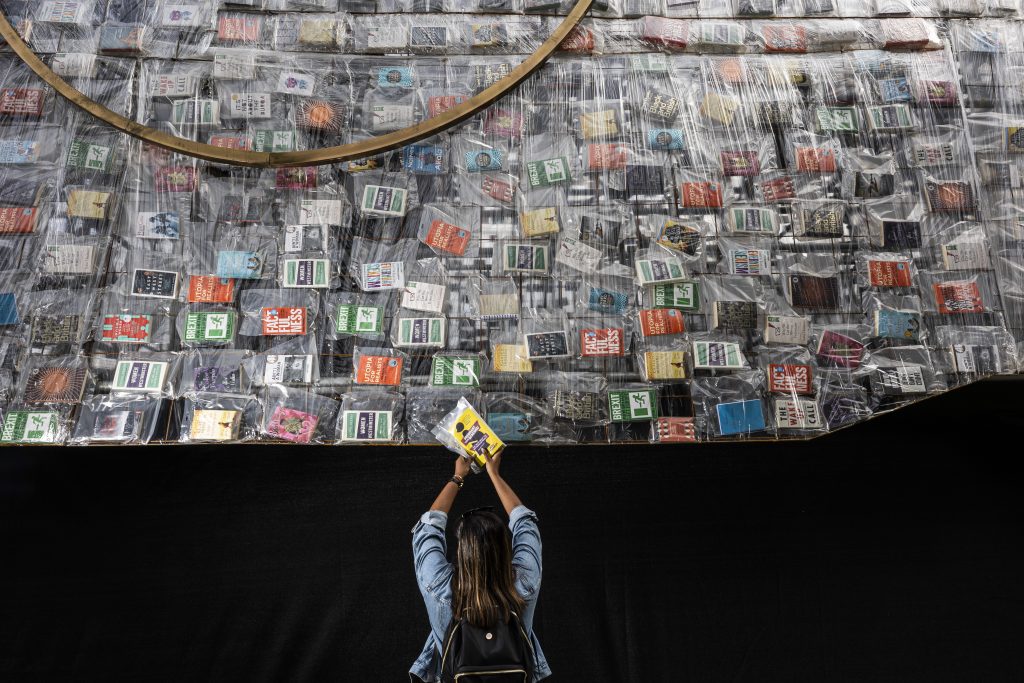
Claire Govender adds the 20,000th book to "Ben Ben Lying Down with Political Books" by Marta Minujin, Photo: Fabio De Paola/PA Wire.

Claire Govender adds the 20,000th book to “Ben Ben Lying Down with Political Books” by Marta Minujin, Photo: Fabio De Paola/PA Wire.

The Burns Halperin Report shows just how vulnerable to rollback recent advances in representation may be. Permanent collections, they show, are not so deeply affected by the social justice zeitgeist—indeed, they are little affected (although contemporary museums seem to be making solid progress towards gender parity in collecting, at least). As one mechanism for this inertia, the report points to the fact that 60 percent of the objects that enter museum collections come from gifts or bequests; these, in turn, presumably form the basis of exhibition programs. Among other things, the blockage thereby represents the embedded malaise and biases of wealth, and its accumulated power (a point theorist Nizan Shaked also argues in her important treatise from this year, Museums and Wealth).

Researching the 1990s backlash, I found this quote from David Lang, the cofounder of the Bang on a Can festival: “If you’re giving an organization $10,000, you can say, ‘In return to that we expect you to have a social face.’ If you’re cutting them from $10,000 to $1,000, you can’t say, ‘Oh by the way for this $1,000 we’d like you to change your organization.’” Lang was speaking about how arts funding cuts took the wind out of the sails of diversification efforts in the mid-‘90s, but the line could also apply to the contemporary challenge of turning arts institutions around despite the considerable reputational and commercial incentives to do so. Compared to the 1990s, even big museums today are actually much more crisis-ridden, symbolized by the last year of protests and strikes over barely livable conditions for ordinary staff.

Without money behind social justice demands, you are left with fleeting gestures and moralistic browbeating, ultimately preparing the ground for cynicism and backlash.

The United States is much less white than it was in 1990s, meaning there is more of a self-interested business case for institutions to change. But on the other hand, inequality is much worse than in the 1990s. Private wealth has today accumulated much more power and is thus even more arrogantly disconnected from the experiences of ordinary people and convinced of its own rightness. How these two dynamics interact is going to shape what the future of what museums look like. My feeling is that they point to an intensified fragmentation of the arts rather than a return to the ideological status quo.

The long-term movement towards a more diverse country is a fact. Even if you are very cynical, it is not impossible to think that bequest patterns will evolve, with a time lag to account for changing generational sensibilities. Since the huge Black Lives Matter protests of 2020, it does feel as if diverse cultural consumption has been firmly established as a virtue for high-status individuals (whether it is embedded remains to be seen).

Last year’s strange, guilt-ridden Sex in the City reboot, And Just Like That…, had the merit of unintentionally underlining this newly mainstream mindset for premium cable consumers. Erstwhile gallery owner Charlotte proves her good ally status—and relieves the anxiety she and her husband Harry feel at a dinner where they are the only white people—when she explains to her friend’s critical mom that the Black artists her daughter collects are truly investment quality (including “an early Derrick Adams!”)

Still, there is a very real limit to guilting patrons into “Doing Better” on voluntaristic moral grounds. It alienates as many would-be patrons as it moves.

Burns and Halperin write, “At the current rate of change, it may be a simpler task to build entirely new museums and market structures than to create the necessary change within the existing systems.” Melissa Smith has reported on one of the most intriguing developments of the past years: Black artists, experiencing an unprecedented market windfall, are putting funds into building up their own alternative institutions, from Titus Kaphar’s NXTHVN to residencies from Derrick Adamsand Mcarthur Binion.

But alternative institution-building is also happening on a much bigger scale—and it is not necessarily progressive. As Georgina Adam writes in her recent book The Rise and Rise of the Private Art Museum, the major trend of the past decade around the world has been stagnation in public museums, and the parallel creation of new personal founder-driven museums (the so-called “ego-seum”), born out of “a distrust of public institutions, and in some cases more problematic aims: self-aggrandizement, hyping the value of their collection, getting better access to desirable art and getting whopping tax breaks.”

Here’s a case study for the limits of the moral appeal to patrons in an age of runaway inequality. Back in 2008, billionaire Eli Broad first backed L.A. MOCA when it needed a bailout, prompting fears, from New York Timescritic Roberta Smith, that he would merge “the museum’s exemplary collection of art with his own, more predictable, market-driven one.” That turned out not to be what happened at all. After debates over the museum’s direction, Broad simply withdrew from supporting L.A. MOCA to build his own glitzy Broad Museum across the street—with free admission and Jeff Koonses galore.
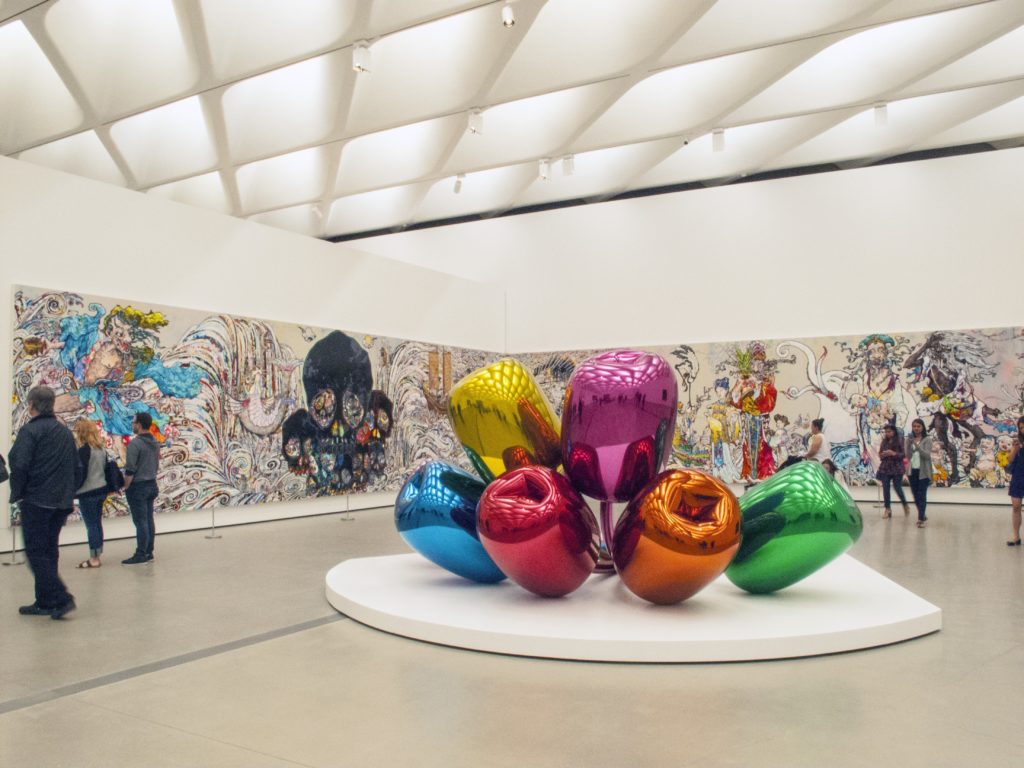
Jeff Koons’s tulips sculpture at the Broad. Photo by Santi Visalli/Getty Images.

The new political demands on culture from one direction are likely to produce new cultural moves that are equally unprecedented in the other. Until very recently, you used to be able to assume that Silicon Valley was a lock for liberals. But the kinds of new tech fortunes that the art industry has been unsuccessfully courting for over a decade—the bulk of new wealth creation, before the recent tech downturn—now seem to be flirting with reaction. In opposition to the Bernie Sanders-style social-democratic wave, Black Lives Matter, and #MeToo, techie libertarianism seems to be mutating into a turbo-charged Nietzschean neo-monarchism, militantly hostile to traditional liberal institutions, creating a new political bloc with the alt-right trolls.

Contemporary cultural backlash may not look like a return to a cozy, oblivious cultural center. It may take its cues more from Elon Musk buying Twitter to “defeat the woke mind virus” or Peter Thiel funding an “anti-woke” downtown film festival out of his pocket change.

When art observers think of backlash in the 1990s, they often think of the 1995 Whitney Biennial. It is often considered a “return to beauty” biennial, where representation snapped back towards the historical norms after the aberration of ‘93. The Guerrilla Girls printed fliers and posters summing up the feeling, declaring ironically, “Traditional Values and Quality Return to the Whitey [sic] Museum.”

A translation of the Guerrilla Girls’ banner. Photo: Courtesy Guerrilla Girls.

But the more relevant example of culture-wars backlash for today possibly came one year later: the 1996 founding of Fox News. Its boss Roger Ailes had served as a media guru to George H.W. Bush in the period of the infamous, race-baiting Willie Horton ad. He officially ejected himself from politics after Bush’s defeat in the 1992 election. And yet, all that reactionary political energy, instead of being neutralized, deflected into the cultural sphere. In Fox News, Ailes masterminded the creation of a free-standing ideological universe, one that openly challenged the idea that you could assume a mainstream “liberal media bias.” We know what its effects have been.

Given this potential shape of backlash and the structural flaws at the heart of the traditional art system, where to look for hope for real progress? I’ll give the last word to Cornell West. In his 1990 essay on “The New Cultural Politics of Difference,” West described the “double bind” of cultural producers within academia and museums, critical of institutions that they were nevertheless materially dependent on.

I think invoking it here is the opposite of nostalgia—it may be even more apt in the 2020s than it was in 1990s:

Without social movement or political pressure from outside these institutions… transformation degenerates into mere accommodation or sheer stagnation, and the role of the “coopted progressive”—no matter how fervent one’s subversive rhetoric—is rendered more difficult. In this sense there can be no artistic breakthrough or social progress without some form of crisis in civilization—a crisis usually generated by organizations or collectivities that convince ordinary people to put their bodies and lives on the line. There is, of course, no guarantee that such pressure will yield the result one wants, but there is a guarantee that the status quo will remain or regress if no pressure is applied at all.

Source: Is the Art World Entering the Age of ‘Anti-Woke’ Backlash? Here’s …

ICYMI: Biden outpacing Trump, Obama with diverse judicial nominees

Of note.

In Canada, the Trudeau appointments 2016-22 are (2016 baseline in parentheses): 56 percent women (36 percent), 10 percent visible minorities (2 percent), and 3 percent Indigenous peoples (1 percent):

For the Biden White House, a quartet of four female judges in Colorado encapsulates its mission when it comes to the federal judiciary.

One of the judges, Charlotte Sweeney, is an openly gay woman with a background in workers’ rights. Nina Wang, an immigrant from Taiwan, is the first magistrate judge in the state to be elevated to a federal district seat. Regina Rodriguez, who is Latina and Asian American, served in a U.S. attorney’s office.

Veronica Rossman, who came from the former Soviet Union with her family as refugees, is the first former federal public defender to be a judge on the 10th U.S. Circuit Court of Appeals.

With these four women, who were confirmed during the first two years of President Joe Biden’s term, there is a breadth of personal and professional diversity that the White House and Democratic senators have promoted in their push to transform the judiciary.

“The nominations send a powerful message to the legal community that this kind of public service is open to a lot of people it wasn’t open to before,” Ron Klain, the White House chief of staff, told The Associated Press. “What it says to the public at large is that if you wind up in federal court for whatever reason, you’re much more likely to have a judge who understands where you came from, who you are, and what you’ve been through.”

The White House and Democratic senators are closing out the first two years of Biden’s presidency having installed more federal judges than Biden’s two immediate predecessors. The rapid clip reflects a zeal to offset Donald Trump’s legacy of stacking the judiciary with young conservatives who often lacked in racial diversity.

So far, 97 lifetime federal judges have been confirmed under Biden, a figure that outpaces both Trump (85) and Barack Obama (62) at this point in their presidencies, according to the White House and the office of Senate Majority Leader Chuck Schumer, D-N.Y. Among them: Supreme Court Justice Ketanji Brown Jackson, that court’s first Black woman, 28 circuit court judges and 68 district court judges.

Three out of every four judges tapped by Biden and confirmed by the Senate in the past two years were women. About two-thirds were people of color. The Biden list includes 11 Black women to the powerful circuit courts, more than those installed under all previous presidents combined.

“It’s a story of writing a new chapter for the federal judiciary,” said Paige Herwig, a senior White House counsel.

The White House prioritized judicial nominations from the start and Democratic leaders in the Senate moved quickly on them. Particular focus was placed on nominees for the appellate courts, where the vast majority of federal cases end, and those coming from states with two Democratic senators, who could find easier consensus in a process where there’s still significant deference given to home-state officials.

Democrats hope to speed up confirmations next year, a goal more easily accomplished by a 51-49 Senate that will give them a slim majority on committees. In the past two years, votes on some of Biden’s more contested judicial nominees would deadlock in committee votes.

Schumer said he also hopes to install more judges in appeals courts that shifted rightward under Trump, an effort that the majority leader described as rebalancing those courts.

“Trump loaded up the bench with hard right ‘MAGA’ type judges who are not only out of step with the American people, they were even out of step with the Republican Party,” Schumer said in an interview, using shorthand for Trump’s 2016 campaign slogan, “Make America Great Again.”

Despite their limited power to derail Biden’s judicial picks, some Republicans have fought ferociously against many of them, arguing that their views were out of the legal mainstream. The precarious 50-50 Senate meant several Biden nominees languished for months and were never confirmed before the Senate wrapped up its work this year.

Democrats also say certain judicial nominees, particularly women of color, were unfairly made into lightning rods by their GOP critics.

“The Republicans have just got a problem with this,” Sen. Dick Durbin, D-Ill., chairman of the Judiciary Committee, told the AP. “Not all of them, some do.”

Sen. Josh Hawley, R-Mo., a committee member, said Biden’s picks were “very, very left, but unapologetically so” and that his colleague’s assertions about Republicans were “absurd.”

Despite the strengthened Democratic majority. the White House could nonetheless struggle to seat some judges over the next two years.

For instance, Biden has made barely a dent in the number of vacancies for district court judges in states that have two Republican senators, confirming just one such person: Stephen Locher, now a judge in the Southern District of Iowa. Home-state senators still get virtual veto power over district picks. Advocates want Democrats to discard that tradition, arguing it only allows for Republican obstructionism.

Durbin has said he would reconsider the practice if he sees systematic abuse of it. But such roadblocks have been rare, he said, and influential Republicans give some deference to Biden on judges.

One matter Biden has not been willing to address: the structure of the Supreme Court.

Any push to reshape the high court has found little footing at the White House despite its the court’s tilt farther right under Trump.

In June, the 6-3 conservative majority overturned the landmark decision Roe v. Wade, eliminating the constitutional protections for abortion that had existed for nearly 50 years. In the same term, it also weakened gun control and curbed the U.S. Environmental Protection Agency’s ability to manage climate change.

Biden has argued the court is more of an “advocacy group these days.” But he has not embraced calls to expand the court, impose term limits or mandatory retirement, or subject justices to a code of conduct that binds other federal judges.

“I wouldn’t, in any way minimize the progress and the importance of what President Biden is doing on the lower courts,” said Chris Kang of Demand Justice, an advocacy group leading the push to expand the court. But “we need to look at the core problem, which is the Supreme Court.”

Source: Biden outpacing Trump, Obama with diverse judicial nominees

ICYMI: How Canada’s foreign-student boom is creating a host of problems

Good comments by Alex Usher of HESA, with money quote being “It’s untenable:”

Deepali Verma is nearing the end of her studies at Cape Breton University. She has taken just one class on campus.

Instead of going to lecture halls, she and hundreds of her peers in the university’s post-baccalaureate diploma programs have attended classes at a Cineplex movie theatre, before nightly showings of Top Gun: Maverick and Black Panther: Wakanda Forever.

The university has increased its intake of foreign students – so much, and so quickly, that it has run out of space on campus. During the recent fall semester, 90 courses in the post-baccalaureate programs were held at Cineplex, compared with 56 on campus and 20 online. About 2,680 students were enrolled in those programs. All but two were international students, and the vast majority – 86 per cent – came from India.

Ms. Verma, who is from New Delhi, is paying more than $27,000 in tuition and fees for her two-year education in business analytics. She isn’t pleased with the Cineplex arrangement. “I would say it’s disgusting,” she said.

That’s not the extent of students’ frustrations. Every day on social media, there are desperate pleas for housing in Sydney, N.S., a sleepy town of 31,000 that is trying to absorb a spike of newcomers caused by the university’s increased admissions. Quite often, incoming students days away from arriving in Canada still don’t know where they’ll live. Others complain about a public transit system that is buckling under rapid growth in ridership.

And these troubles are not unique to this corner of the Maritimes. Across the country, postsecondary schools have dramatically ramped up their admissions of foreign students, creating knock-on effects for their communities.

This has led to accusations that colleges and universities are gorging on international student fees while turning a blind eye to local challenges. Some critics are saying schools need to be reined in.

“You’re getting a lot of localized stresses that come from the fact that institutions don’t seem to care where their students live,” said Alex Usher, president of Higher Education Strategy Associates, a consulting firm. “They don’t care about the housing problems faced by the local community. They’re acting like bad neighbours.”

Colleges and universities control a major chunk of population growth. At the end of 2021, there were more than 620,000 study permit holders in Canada from abroad. Before the pandemic, which led to temporary border restrictions, their ranks jumped by 434,000 people over the course of a decade. That’s about the population of Halifax.

There is a simple explanation for the explosion: money.

Government funding of postsecondary schools has not increased in inflation-adjusted terms in nearly 15 years, while domestic enrolments have peaked, according to a recent report from Higher Education Strategy Associates. That has turned international students into a crucial, and expanding, source of revenue.

The average undergraduate tuition for international students at Canadian universities has nearly doubled over the past 15 years, after adjustments for inflation. Foreign students now pay five times more than their domestic peers; it used to be three times more.

“There is no sign yet that Canadian institutions are pricing themselves out of the market,” the report says.

It helps that colleges and universities are an integral part of the immigration pipeline. After graduation, foreign students can get multiyear work permits, which help them acquire Canadian job experience that is valuable in Canada’s points-based system for economic immigrants.

The eventual goal, for many students, is to gain permanent residency. And the federal government wants a lot more immigrants. Its goal is to admit 500,000 permanent residents annually by 2025. The country brought in slightly more than 400,000 last year. Around 150,000 of them had started their journeys in Canada as international students.

However, unlike the permanent residency program, there are no targets for study permit holders. Postsecondary schools can admit as many foreign students as they wish. Ontario colleges are notable for jacking up admissions numbers, Mr. Usher said.

“Can this be done better? Yes,” he said. “But it means actually not letting every institution decide for itself, whenever it wants to increase these numbers. It’s untenable.”

Around 21,000 beds will be added to student residences in the 24 largest domestic markets by 2025, according to a report from real estate consultants Cushman & Wakefield, published earlier this year. At recent rates of admissions growth, that would cover just a portion of the incoming wave of students.

This pushes more students into the private rental market, where they compete with other residents for a limited number of housing units in supply-starved cities.

“It’s not just international students having trouble finding housing. That has an effect on the local market,” Mr. Usher said. “And it’s a tax that institutions are placing specifically on low-income families in those communities.”

Ms. Verma moved from Sydney to Halifax in the fall semester, as part of a required co-op term. Now she can’t find a room back in Sydney. She may commute – a one-way drive of five hours or so – to her final two classes.

“There is literally no space out there. I can’t even express how we are feeling. It’s really terrible,” she said.

Gurwinder Singh, who has also taken the bulk of his recent classes at Cineplex, likens the situation to paying for an iPhone but getting a knock-off. “It just felt like discrimination against the international students,” he said.

Mr. Singh will be making the same journey as Ms. Verma for his final class. He is moving to Halifax with his wife, who can’t find a job in Sydney. He also hopes to find a job in Halifax, and wants to limit his time away. “I’m not going to lose extra dollars” by staying overnight near the university, he said.

Sara Asalya, founder of the Newcomer Students’ Association, said “the burden of high tuition fees” is the number-one concern she hears about from international students. They often work multiple jobs to make ends meet.

The federal government is making it easier for them to work. This fall, it temporarily removed a limit on their job hours. Now international students enrolled in full-time studies can work more than 20 hours a week off campus. The government has said the change will help employers, who have complained about a lack of workers.

“These government decisions are really coming at a time when the government is pressured to look at the labour shortage, more than looking at the actual experience of these students,” Ms. Asalya said.

“I don’t think we can continue to increase the intake, and lift the limit of hours, without building a proper infrastructure to support these students.”

Gordon MacInnis, Cape Breton University’s vice-president of finance and operations, said the school is dealing with a sudden rush of students, because many had to postpone their studies owing to pandemic-related border restrictions. The university had nearly 4,000 international students in the fall semester, an increase of roughly 1,600 (or 68 per cent) from the previous year, according to preliminary survey data from the Association of Atlantic Universities. Foreign students accounted for 72 per cent of CBU’s full-time enrolments, and their ranks have grown by more than 3,000 (or 343 per cent) in five years.

Even so, the fall spike caught the university off guard. “They all showed up more than we were anticipating,” Mr. MacInnis said. “This bubble will be with us for about two years,” he added, because foreign students are mostly enrolled in two-year programs.

Mr. MacInnis said CBU is not the first university to rent out movie theatres for lectures. It has spent money to retrofit those spaces for classes, he noted, and a shuttle bus will run between Cineplex and campus, starting in January.

Still, these are “stopgap measures,” he said. The goal is to invest in school infrastructure and eventually “repatriate” its staff and students to the main campus.

Starting in May, CBU will be limiting its intake of students in the post-baccalaureate programs to ease some of the pressures caused by the recent uptick in enrolments.

Nova Scotia recently announced it is investing $5-million in a CBU project to build hundreds of housing units in Sydney, although the development is years away from completion. In the interim, many students are feeling conflicted about their choice of university. Ms. Verma was initially smitten with the school and Sydney, which was so peaceful compared to her native New Delhi.

But her recent struggles – in particular, with finding a home – have left a bitter taste.

“I won’t recommend anybody to come to CBU right now, because I don’t want people to suffer or go through the same things that we are going through,” she said. “It’s really hard here.”

Source: How Canada’s foreign-student boom is creating a host of problems