B.C. ending immigration detention arrangement with CBSA, citing human rights

Will be interesting too see if Quebec and Nova Scotia follow suit:

British Columbia is ending an agreement with Canada Border Services Agency to hold immigration detainees in provincial correctional centres, saying the arrangement doesn’t align with its stance on human rights.

Public Safety Minister Mike Farnworth said in a statement Thursday the province conducted a review that analyzed its contract with the agency, including public safety, and consulted with advocacy groups.

“The review brought to light that aspects of the arrangement do not align with our government’s commitment to upholding human rights standards or our dedication to pursuing social justice and equity for everyone,” he said.

The report said the number of immigration detainees in provincial custody is declining but provincial jails are used to holding “high risk detainees.” It also noted that while CBSA compensates BC Corrections to hold detainees, it does not cover the total cost.

“This is a trend that is likely to continue given the overall reduction in the number of detainees in provincial custody. If the arrangement ended, these are resources that could be used to support BC Corrections’ clients, including individuals in custody with complex needs and behaviours,” it said.

The move comes following calls from the groups Human Rights Watch and Amnesty International for B.C. to terminate its immigration detention contract with the federal government.

The groups released a report in June 2021 saying immigrants with no criminal charges against them are detained in holding centres, federal prisons or provincial jails for “indeterminate amounts of time.” They launched a campaign calling on B.C. to end its contract last October, and later expanded their push to Quebec and Nova Scotia.

“Canada is among the few countries in the global north with no legal limit on the duration of immigration detention, meaning people can be detained for months or years with no end in sight,” the groups said in a joint news release following the announcement. “British Columbia’s decision is a major milestone on the path to ending immigration detention in provincial jails in Canada.”

Ketty Nivyabandi, secretary-general of Amnesty International Canada, said in the statement that she commends B.C. on being the first province to make the decision, calling ita “momentous step.”

“This is a true human rights victory, one which upholds the dignity and rights of people who come to Canada in search of safety or a better life,” she said.

Farnworth said BC Corrections will be providing CBSA with 12 months’ notice as is required under its current contract.

The human rights groups said BC Corrections has told them the province will give the agency official written notice to terminate the contract next week.

Source: B.C. ending immigration detention arrangement with CBSA, citing human rights

Canada’s immigration backlog has never been worse

The ever increasing backlogs understandably continue to attract attention. However, apart from CILA and a few individuals, haven’t seen any call for a pause in applications or heaven forbid, reduced levels, to address the backlogs:

In tandem with the increasing backlog has also been a precipitous rise in Federal Court cases from frustrated applicants demanding a reply from the IRCC.

They’re called “mandamus cases,” and it’s essentially an application for the court to order a response from IRCC. Before the pandemic there were only a few dozen mandamus cases per year. Last year, there were more than 400.

In prior statements, the federal government has largely attributed the crushing IRCC delays to the COVID-19 pandemic and the avalanche of refugee applications from Afghanistan and Ukraine. Last month, Prime Minister Justin Trudeau announced the formation of a special committee to figure out how to reduce wait times.

Amid history-making line-ups at Canadian airports and passport offices, an absolutely crushing backlog at Immigration, Refugees and Citizenship Canada is putting them all to shame.

According to numbers obtained from the IRCC by the immigration-focused publication CIC News, there are now 2.7 million people waiting for Ottawa to process their immigration application.

The backlog encompasses every application filed to IRCC, from citizenship to visas to requests for permanent residency. The backlog of citizenship applications alone stands at 444,792, while most of the list (1.7 million) is applications for temporary residence.

Not only is it the worst immigration backlog of all time, but it is growing exponentially with each passing week. This time last year, the backlog was just 1.5 million names, according to CIC News. In just the last 30 days, the list has grown by 300,000 — an increase of roughly 1,000 new applicants per day.

All told, there are now more people awaiting a reply from the IRCC than there are residents of Atlantic Canada. As of press time, the population of all four Atlantic provinces (including Newfoundland and Labrador) is roughly 2.5 million.

If the backlog continues to grow at the current rate, it will only be another four months until the number of applicants awaiting processing by the IRCC is equivalent to 10 per cent of the Canadian population of 38 million.

This has thrown immigration wait times into complete disarray at the precise time that Canada is touting itself as a haven for refugees, most notably from Afghanistan and Ukraine.

Many of those 2.7 million represent foreign nationals dwelling in a kind of awkward limbo as they spend years awaiting updates from the IRCC.

Last month, Pakistani man Kazim Ali told CTV he applied for Canada’s Express Entry program in 2020, when the estimated wait for a reply was six months. Two years later, he hasn’t heard a thing, bringing the life of he and his wife “to a screeching halt” as they delay career choices and even children until they can hear back.

An increasingly overwhelmed IRCC is also making it difficult to reliably schedule any event in Canada that involves foreign nationals. Last month, both a Montreal AIDS symposium and a major Toronto tech conference saw dozens of invitees unable to attend because of difficulties in obtaining Canadian visas.

In a recent report by the Business Council of Canada, Canadian employers cited “processing delays” as the top barrier to recruiting international talent.

“Frustrated by application processing delays, complex rules, and the cost of navigating the system, fewer than a quarter (of survey respondents) say the immigration system currently serves their business needs well,” it read.

In tandem with the increasing backlog has also been a precipitous rise in Federal Court cases from frustrated applicants demanding a reply from the IRCC.

They’re called “mandamus cases,” and it’s essentially an application for the court to order a response from IRCC. Before the pandemic there were only a few dozen mandamus cases per year. Last year, there were more than 400.

In prior statements, the federal government has largely attributed the crushing IRCC delays to the COVID-19 pandemic and the avalanche of refugee applications from Afghanistan and Ukraine. Last month, Prime Minister Justin Trudeau announced the formation of a special committee to figure out how to reduce wait times.

Source: Canada’s immigration backlog has never been worse 

Brian Lilley on Roxham Road (usual hyperbole about Trudeau’s tweet):

In the first six months of this year, more people crossed illegally into Canada at Roxham Road in Quebec than in all of 2019. The asylum seekers fast-track route may have all but shut down for much of the pandemic, but now it’s back in business with gusto.

According to the latest federal figures, 16,319 people entered Canada at “irregular” border crossings in Quebec between Jan. 1, 2022, and June 30, 2022. That includes 3,449 in May and 3,066 in June.

Those are the second- and third-highest months on record, surpassed only by August 2017.

By comparison, in 2019 a total of 16,136 people crossed at Roxham Road, and there were 18,518 illegal crossers in 2018 and 18,836 in 2017. The advent of COVID-19 saw the flow of asylum seekers at the Quebec-New York border slow to a trickle with just over 3,000 in 2020 and just over 4,000 in 2021, with most of them coming in December of that year.

This whole thing started when Justin Trudeau put out a tweet welcoming the world to Canada as then newly elected president Donald Trump threatened to deport people back to Haiti from the United States. What was lost on most is that Trump was ending a program that allowed people to stay in the U.S. if they were displaced by the earthquake or at risk following Haiti’s 2004 coup. Canada had ended a similar program years earlier under the Harper government and Trudeau had kept the policy in place and was removing people even as he criticized Trump.

With Trump threatening to do what Canada had already done, many looked north, and Trudeau welcomed them with open arms.

“To those fleeing persecution, terror & war, Canadians will welcome you, regardless of your faith. Diversity is our strength #WelcomeToCanada” Trudeau tweeted on January 28, 2017.

Days later, embassy staff from Mexico were writing to officials at Global Affairs seeking advice on how to handle people looking to declare refugee status in Canada.

“We are receiving an increasing number of enquiries from the public about requesting refugee status in Canada, and a number clearly having links with our Prime Minister’s tweet this weekend,” one email read.

It wasn’t just staff in Mexico. Word spread that Canada would take anyone as a refugee and many decided to use the illegal border crossing to skip dealing with the system.

Since then, more than 77,000 people — that’s more than the population of Belleville, Ont. or Chateauguay, Que. — have crossed at Roxham alone. The government has built special processing facilities there, establishing posts for immigration and RCMP officers to process people.

This is nothing short of the Liberals attempting to import another American political issue into Canada to wedge the Conservatives. In Canada, Conservatives support high numbers for legal immigration, something we saw throughout the Harper years.

What Conservatives don’t support is people who break the law.

This is where we get into word games. The Liberals claim no one is breaking the law, that these are asylum seekers and under Canadian — and international — law it is legal for them to seek asylum. The reality is, the government has giant signs warning people that it is illegal to cross at Roxham and the RCMP give verbal warnings that anyone doing so will be arrested for breaking the law.

They only claim asylum once arrested.

Nigeria is the biggest source of people crossing at Roxham and just 30% of the more than 16,000 who crossed there between February 2017 and March 2022 were accepted as valid refugees. For the more than 10,000 Haitians who crossed — the second-largest source country, just 23% were accepted.

Roxham Road has become a way for those looking to skip the long delays in legal, economic migration to get into Canada.

This isn’t how a properly functioning immigration and refugee system should work, but very little of what the Trudeau government is doing these days is working properly.

Source: LILLEY: Trudeau continues immigration games as Roxham Road sees record numbers

May: Top bureaucrat urges summer test drive of hybrid public service workforce

Will be interesting to see how this works out and how departments develop and implement guidelines and requirements:

Canada’s top bureaucrat wants public servants back in the office part-time this summer to test drive running federal departments with a hybrid workforce.

Privy Council Clerk Janice Charette recently wrote to deputy ministers calling on them to use the summer to experiment with hybrid work so their departments are ready for a full implementation by the fall.

“My expectation is that departments are actively testing hybrid work models,” Charette wrote.

“Encouraging broad employee participation in experimentation, particularly with onsite presence, is key to working through the challenges and making the most of the opportunities to shift toward a new way of working.”

The clerk is the top boss, but can’t issue directives to the public service. That authority rests with Treasury Board as the employer. However, the clerk’s power over deputy ministers, who serve at the pleasure of the prime minister, comes from her recommendations on the hiring, firing and performance pay of deputy ministers.

Treasury Board approved the move to a hybrid workforce, but took a hands-off approach and left it up to departments to decide how to make the shift and how to bring workers back to the office. This sparked complaints about inconsistency and indecision that fed the notion among public servants that they can work anywhere.

Many office workers – about half of the public service – don’t want to  come back to the office as they did before COVID. Surveys show 85 per cent want a hybrid approach, working at home and at the office. The rest – from border and prison guards to nurses, scientists and spies – are not able to work from home.

After more than two years working from home, many public servants feel successfully delivered the government’s pandemic response.

They’ve adapted their lives but now a new more contagious Omicron subvariant is making public servants even more resistant to spending time in the office or riding transit. High gasoline prices make it even more difficult to convince people to commute.

Several senior bureaucrats who are not authorized to speak publicly said hybrid work is a new ballgame that departments haven’t figured out yet – partly because they can’t get enough people in the office to test it. They hope Charette’s letter will help bring more structure or guidelines on how to do it.

“What was happening is that everybody thought ‘yippee’ we can do whatever,” said one senior bureaucrat. “People’s idea of flexibility is that every single day they can work from home; not show up at the office or work from anywhere in the country or the world.”

“We can’t be driven by people’s emotions, preferences and opinions. Let’s be driven by experimentation and get the facts and data on what works and what doesn’t.”

Another said something had to give “because we seemed to be the only employer in the country that thinks it’s outrageous to ask people back to work.”

The move to hybrid is a massive shift for the public service. It will change everything about work and how it’s done. The need for security, technology, bandwidth, office space and design will change, as will labour agreements and the way services are delivered and policies are executed.

Meredith Thatcher, co-founder and workplace strategist at Agile Work Evolutions,  said the current version of hybrid is not the same as it was working in an emergency during the pandemic when rules and processes were streamlined, bent or even discarded.

“It’s going to be new. Sometimes you just have to live it in order to figure out how to make it work, and they haven’t had the opportunity to live it. So that’s what the clerk is saying is, ‘Please let’s start living this because we can learn only if we start living it.’”

In her letter, Charette said the “one-size fits all approach” has limits for an organization as large and complex as government, but employees deserve “coherence in how hybrid approaches are applied across the enterprise.”

She reminded deputy ministers they have two responsibilities – the management of their departments and being stewards of the public service as an institution.

“You are collectively responsible for the development of the federal public service of today and tomorrow. I urge you to keep in mind this dual responsibility as you test new ways of working,” she told deputies.

Many say departments dragged their feet because they didn’t have central direction; or were scared of setting guidelines that might not work or backfire; or waited to see what others did. A big worry now, for example, is that workers will pick up and move to the departments that offer the most flexibility to work remotely.

Thatcher said another problem is understanding what people do, when and how they perform the tasks of the job. That’s more than figuring out what tasks need to be done in the office.

A public servant could do all the tasks of their jobs at home, but what about the benefits of working in the presence of others? Departments have to figure out how, when and where to do that. In-person meetings – whether for camaraderie or collaboration – leads to brainstorming that generates new ideas or innovations.

That’s all part of what Charette wants deputy ministers to figure out.

“Now is the time for us to test new models with a view to full implementation in the fall, subject to public health conditions,” she wrote.

But Charette noted this call back to the office is not signalling a return of the old ways of working pre-pandemic. Working from home offers employees flexibility and a way for managers to recruit a more diverse workforce outside of Ottawa and across the country.

She said bringing people together in the office means opportunities for “enhanced idea generation and knowledge transfer, and building a strong public service culture.”  She said the hybrid workplace should “blend” the best of the traditional and new ways of working.

For unions, the ideal is finding the balance between where employees prefer to work and the operational requirements of the jobs.

Dany Richard, co-chair of the joint union and management National Joint Council, said the clerk’s letter is a “gamechanger” which is reverberating across departments. He said the big takeaway is no one can “predominantly work remotely.”

Richard, who is also head of the Association of Canadian Financial Officers, said members who previously had the go-ahead to mostly work remotely are now being told they may have to come into the office for a day or two every week.

“Before that letter, no one was in a rush. Everyone was saying, ‘Okay, let’s work out our plans, our office designs, let’s get ready, and then slowly start bringing people back.’”

Jennifer Carr, president of the Professional Institute of the Public Service of Canada, said Treasury Boards guidelines were too wishy-washy and never really defined hybrid work.

This left departments all over the map, she said.  Some allowed remote work while others arbitrarily demanded workers return to the office – one, two or three days a week.

She said employees are already shopping for jobs, looking to move to departments that offer the most flexibility. Public servants have created Facebook pages to advertise remote jobs and some unions are ranking which departments are the most open to remote work.
Source: Top bureaucrat urges summer test drive of hybrid public service workforce

New evidence disputes Trump administration’s citizenship question rationale

No suprise:

Previously unreleased internal communications indicate the Trump administration tried to add a citizenship question to the census with the goal of affecting congressional apportionment, according to a report issued Wednesday by the House Committee on Oversight and Reform.

The documents appear to contradict statements made under oath by then-Secretary of Commerce Wilbur Ross, who told the committee that the push for a citizenship question was unrelated to apportionment and the reason for adding it was to help enforce the Voting Rights Act.

The nearly 500 documents include several drafts of an August 2017 memorandum prepared by a Commerce Department lawyer and political appointee, James Uthmeier, in which he initially warned that using a citizenship question for apportionment would probably be illegal and violate the constitution, the report said.

Source: New evidence disputes Trump administration’s citizenship question rationale

Munro and Lamb: The pandemic forced Canadian business out of a tech lethargy. What happens next?

A reminder that the government’s strategy of relying on immigration to address labour shortages neglects the role that technology can and does play.

The government’s focus on addressing business demands for more immigration reduces incentives for businesses to adapt new technology and improve productivity.

This analysis by Munro and Lamb should be a wake-up call to governments:

Canadians tend to think that innovation is mainly about inventing, producing and selling new technologies and products. Largely neglected in the discourse about innovation in Canada is the critical role of technology adoption or tech-taking. Technology adoption is often viewed as a lesser form of innovation, if it is viewed as innovation at all. Yet, adopting technologies that range from data analytics software to communication and collaboration tools, e-commerce platforms, and design technologies can enhance productivity and growth. It can also generate more and better employment opportunities, and enable new and different kinds of innovation.

Why are so many Canadian firms technology adoption laggards? Why are they content with low-tech business strategies? The short answer, borrowing an observation from Peter Nicholson, is that Canadian business has been “only as innovative as it has needed to be” – and, we might add, can be. Firms across a range of sectors have been able to maintain above-average profits for decades with low-wage strategies and minimal innovation and technology adoption. Among those that have seen the need to change, many face resource, knowledge and skills constraints that prevent them from doing so.

But our longstanding low-tech, low-innovation equilibrium may be changing, as we reveal in a new report on Canada’s technology trajectories.

Not only has the pandemic forced firms in key sectors to adopt new technologies to sustain operations, but recent changes in the ways technologies are packaged and sold have improved the cost-benefit analysis facing firms. For example, the increasing adoption of cloud solutions has meant that instead of making large upfront investments in hardware or software, firms can now purchase subscriptions that are easily administered, can be scaled up or down, canceled or customized and often have readily accessible education and consulting services. Are we in the midst of a fundamental shift in Canadian firms’ attitudes about the benefits and feasibility of adopting new technologies? Or will pre-pandemic lethargy return?

Canada’s pre-pandemic tech lethargy

Prior to the pandemic, Canada was a laggard on business investments in information and communications technologies (ICT). ICT investment per job in Canada, for example, has ranged from just 54 per cent to 68 per cent of U.S. levels since the late 1990s – largely due to lower investment in software and databases and contributing to our weak productivity relative to the U.S.

On another measure of ICT investment, Canada’s performance has deteriorated absolutely and relative to peers. In 2000, ICT investment as a share of total gross fixed capital formation (GFCF) in Canada was roughly 16 per cent. By 2019, this had declined to 11 per cent – roughly six percentage points lower than investment levels in France and the U.S. Since 1995 – when Canada trailed only the U.K. and the U.S. among G7 countries for whom data were available – we have been overtaken by France and Italy and now trail four of the six countries with available data (figure 1).

https://e.infogram.com/73dbc808-5a0a-40f3-8115-62fa231a83f4?parent_url=https%3A%2F%2Fpolicyoptions.irpp.org%2Fmagazines%2Fapril-2022%2Fthe-pandemic-forced-canadian-business-out-of-a-tech-lethargy-what-happens-next%2F&src=embed#async_embed

Canadian firms often cite weak incentives to explain why they do not adopt technology, with many firms saying that investment is “not necessary for continued operations” or that they were “not convinced of the economic benefit” of candidate technologies. Other data aligns with this explanation. Notably, Canadian firms’ profitability has been rising over the past two decades, reducing incentives to adopt technologies to sustain revenue. Between 1997 and 2017, average annual growth of after-tax profits rose 7.6 per cent over the period. Profits as a share of GDP rose from 8.4 per cent in 1997 to 15.2 per cent by 2017, and since 2000 have exceeded that of the U.S. both before and after tax (figure 2).

At the same time, many firms recognize how technology adoption could help maintain or improve competitiveness, but they lack the capacity to make the change. This includes financial resources to purchase new technologies or technology service subscriptions; access to skills to implement, use, and maintain technologies; organizational and management cultures equipped to embrace and effectively use new technologies; and other factors. Given these weak incentives and substantial barriers, it is easy to see why business leaders might stick with existing low-tech strategies rather than shifting to an alternative.

https://e.infogram.com/83d94599-1f7a-4a06-9ea8-76bd46969275?parent_url=https%3A%2F%2Fpolicyoptions.irpp.org%2Fmagazines%2Fapril-2022%2Fthe-pandemic-forced-canadian-business-out-of-a-tech-lethargy-what-happens-next%2F&src=embed#async_embed

The pandemic tech shock

The pandemic and associated restrictions sent shockwaves through Canada’s low-tech equilibrium. Key sectors recognized that lagging technology adoption was no longer an option. Implementing a range of communications, e-commerce, logistics and other technologies would be necessary for survival. 

Retail firms, for example, realized that they had to find ways to reach customers virtually or go out of business. Turn-key online sales platforms, like Canada’s own Shopify, along with government- and industry-supported digital adoption support programs, like Digital Main Street, helped move many businesses’ retail operations online. The result? From February 2020 to May 2021 retail e-commerce sales in Canada increased by over $2 billion, reaching an all-time high of more than $4.1 billion – an increase of 127 per cent relative to May 2019 (figure 3).

Similarly, non-retail firms that depend on the efforts of people to provide services, collaborate, and interact with clients and colleagues to generate value have adopted virtual platforms to enable interaction. Platforms like Google Meets, Microsoft Teams, Zoom, and myriad collaboration software. In the first quarter of 2021, when businesses were asked what technologies they adopted due to the pandemic, collaboration tools and cloud solutions were the most frequently cited.

This rose to over 50 per cent of businesses in information and cultural industries and professional, scientific, and technical services, two highly knowledge-intensive sectors. What began as a necessary change to maintain operations and sales has the potential to become a new, higher technology equilibrium for Canada.

The intangible shift

Much of the accelerated tech adoption amidst the pandemic has been facilitated by a trend that was gathering momentum before the pandemic – a shift away from more tangible kinds of technology investment, like hardware and IT systems, and toward more intangible, ICT-as-a-service investments, like cloud solutions and ready-made software. More intangible technology options help address some of the historical barriers to technology adoption, such as high cost, high skills needs, and integration with existing systems.

Cloud computing services offer a useful illustration. Instead of making large upfront investments in physical software and/or hardware, firms are now able to purchase ongoing subscriptions for services, which are easily administered and can be scaled up or down, canceled or customized depending on the effectiveness of the services and firms’ changing needs. Cloud services help de-risk and ease the purchase and use of digital technologies, overcoming one of the key barriers to technology adoption and use that have long faced Canadian firms.

And the shift is striking: Canadian firms spent $420 million on cloud services in 2006 and nearly $2.6 billion in 2014 – an annual growth rate of more than 25 per cent over the period. Contrast that to the 20 per cent annual growth in cloud service spending among firms in the U.S. over the same period. By 2017, 29 per cent of small and medium-sized enterprises (SMEs) reported using cloud computing technologies over the previous three years, which was the most frequently selected technology, above data analytics, customer relationship management software, and enterprise resource planning software, to name a few.

The embrace of cloud services prior to and during the pandemic suggests that current data and measurement probably underestimate the extent to which Canadian firms are investing in and using technology because subscription cloud services are not always reported by firms as technology investments. By how much, exactly, is not clear, though there are some signals.

Moreover, while we expect that, over time, these investments will begin to have an effect on, and show up in measurements of, productivity and growth, we are not yet seeing the results. Still, given what we know about the relationships among technology adoption, productivity and growth, it is encouraging to see technology adoption strategies emerging in the face of new constellations of incentives and capabilities.

What’s next for technology diffusion in Canada? 

What does the future hold for technology adoption in Canada? Early indicators suggest that many Canadian firms may stick with the technologies they adopted during the pandemic and add more. Retail firms have learned that e-commerce can complement and expand in-person sales, and many employers have seen how remote work and collaboration can improve talent recruitment and retention. Moreover, the intangible shift has reduced the cost of technologies, making long-term technology adoption options more feasible.

Still, old habits die hard. A number of managers still prefer to have their employees interact in-person and many retail firms will welcome the return to in-person, albeit smaller, markets. Those firms that try to maintain higher technology adoption patterns will need people with technical skills to implement and use new kinds of technologies – and these skills may be scarce in the years ahead. Access to digital infrastructure (such as sufficient broadband) remains spotty in rural and remote areas, and cybersecurity continues to be a challenge for many firms. Even with new incentives to maintain or increase technology adoption, barriers will remain.

If governments and large anchor firms can find ways to help small and medium firms overcome labour and infrastructure challenges, Canada might shift to a higher technology adoption trajectory and reap the innovation and productivity benefits it generates. The financial, technical, and infrastructure support provided by programs like Digital Main Street, the Canada Digital Adoption Program, and the Universal Broadband Fund are promising signs that governments are willing to do their part. What remains to be seen is whether Canadian businesses are ready to leave behind the low-wage, low-technology equilibrium and embrace a higher technology, higher productivity, and higher wage and well-being future.

Source: The pandemic forced Canadian business out of a tech lethargy. What happens next?

Canada’s immigration backlog grows to 2.7 million people

As always, canadavisa.com provides a valuable service sharing the detailed numbers one backlogs (it appears I was too charitable with respect to citizenship in my May update):

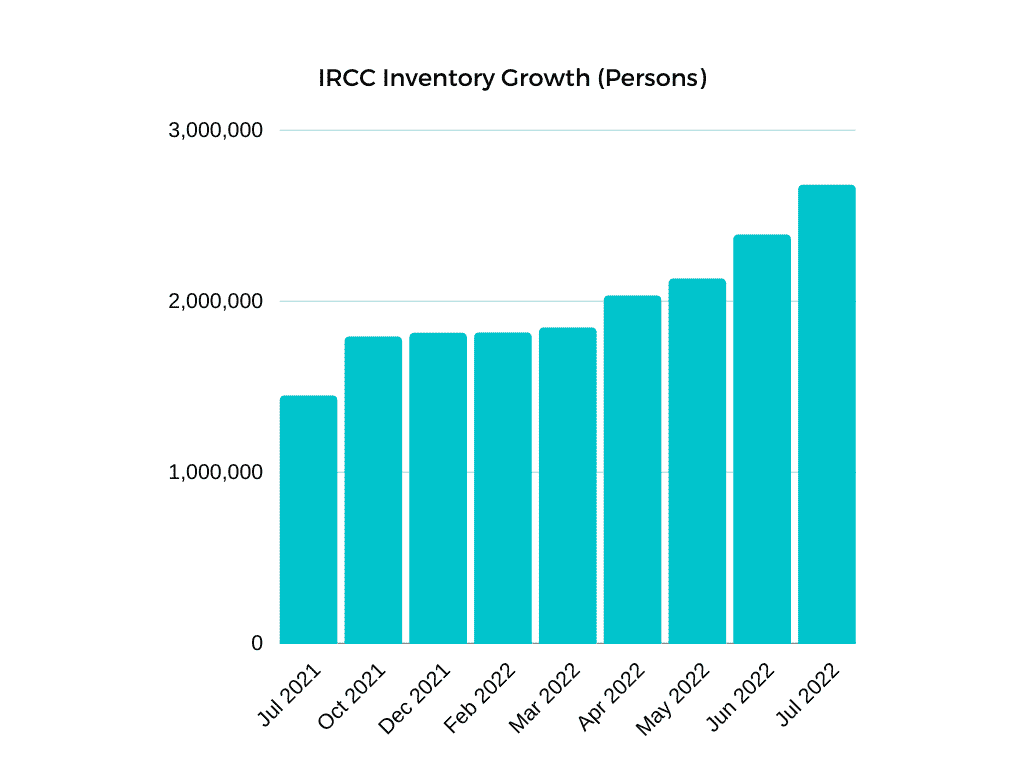
Canada continues to struggle with its immigration applications as its inventory now stands at some 2.7 million people.

This represents a growth of nearly 300,000 people over the past six weeks.

The backlog has nearly doubled over the past year and nearly tripled since the start of the pandemic.

It has progressed as follows since last July:

The citizenship inventory stands at 444,792 applicants as of July 15, compared to 394,664 on June 1.

The permanent residence inventory stands at 514,116 people as of July 17, compared to 522,047 as of June 6.

On July 17, the temporary residence inventory stood at 1,720,123 people, compared to 1,471,173 persons, also as of June 6.

CIC News made this data request to Immigration, Refugees and Citizenship Canada(IRCC) on June 30 and received the data on July 18.

Express Entry draws resume due to backlog reduction

A total of 51,616 Express Entry applicants are waiting on decisions as of July 17, a significant reduction from the 88,903 reported when comparable was available on March 15.

The reduction in Express Entry backlogs means IRCC can once again hold all program draws, and processing times for new Express Entry applicants are back to the six-month standard. On July 6, IRCC held its first all-program draw since December 2020.

Family class inventory is up slightly

The overall inventory of family class applicants is up to 118,251 persons compared to 112,837 persons on June 6.

The Spouses, Partners and Children Program inventory has increased compared to early June. It stands at 68,159 persons compared to 67,929 persons last month. The figure for July was found by adding Spouses and Partners to Children and Other Family Class for the purpose of comparison.

The Parents and Grandparents Program (PGP) has seen another increase. It is now at 47,025 persons compared to 41,802 persons. IRCC has yet to announce details on its plans for the PGP 2022.

Discover if You Are Eligible for Canadian Immigration

Summer backlog growth is normal, to an extent

The temporary residence inventory has increased by nearly 250,000 persons compared to June 6.

Increases were observed in the number of applicants for study permits, temporary resident visas, visitor records, work permits, and work permit extensions.

The growth of IRCC’s backlog is normal to an extent over the summer months. More people look to obtain temporary resident visas to visit family and friends during the warmest time of the year in Canada.

In addition, many international students who complete their studies in the spring go on to apply for Post-Graduation Work Permits (PGWP), which is Canada’s largest work permit category.

Most international students also submit their study permit applications in the months leading up to the start of Canada’s academic calendar. This results in Canada usually welcoming over 200,000 new international students leading into September each year.

The main exception is the Canada-Ukraine Authorization for Emergency Travel(CUAET), which Canada introduced in March to provide Ukrainians with the opportunity to relocate following Russia’s invasion. Since March 17, IRCC has received 362,664 CUAET applications, causing its backlog to swell.

However, the overall growth of the backlog, a nearly three-fold increase since the start of the pandemic in March 2020, highlights ongoing challenges with Canada’s immigration system. It is a function of IRCC continuing to welcome new applications throughout the pandemic even though its processing capacity was limited for large stretches of 2020 and 2021.

The department is now playing catch-up and is taking steps such as hiring additional processing staff and looking to invest in technological upgrades.

Meanwhile, other arms of the federal government have taken notice of Canada’s immigration application challenges.

In May, the Canadian Parliament’s Standing Committee on Citizenship and Immigration (CIMM) began a study on the backlogs. It will result in a public study containing recommendations for improvement.

In June, Prime Minister Justin Trudeau created a federal task force to address backlog challenges. It is made up of a group of federal ministers, who will make recommendations to address issues that are causing the delay in application processing. The goal is to create both long-term and short-term solutions that will clear the backlogs and improve the quality and speed of services.

Inventory in tables

The following tables show more details on IRCC’s inventory.

Citizenship Inventory

Application type Persons as of July 15, 2022
Grant 387,368
Proof 57,424
Total Citizenship Inventory 444,792

Immigration Inventory

Immigration Category Persons as of July 17
Economic Class 211,903
Family Class 118,251
Humanitarian & Compassionate / Public Policy 29,848
Permit Holders Class 16
Protected Persons 154,098
Total Immigration Inventory 514,116

Express Entry Inventory

Immigration Category Persons as of July 17
Canadian Experience Class (EE) 5,195
Federal Skilled Workers (EE) 18,127
Skilled Trades (EE) 369
Provincial/Territorial Nominees (EE) 27,925
Total Immigration Inventory 51,616

Family Class Inventory

Immigration Category Persons as of July 17, 2022
Children & Other Family Class 9,147
FCH-Family relations – H&C 3,067
Parents and Grandparents 47,025
Spouses & Partners 59,012
Total Family Class Inventory 118,251

Economic Class Inventory

Immigration category Persons as of July 17, 2022
Agri-Food Pilot Program 765
Atlantic Immigration Pilot Programs 2,380
Atlantic Immigration Program 33
Canadian Experience Class (EE) 5,195
Canadian Experience Class (No EE) 109
Caring for Children 60
Federal Entrepreneur 4
Federal Self Employed 4,502
Federal Skilled Workers (C-50) 123
Federal Skilled Workers (EE) 18,127
Federal Skilled Workers (Pre C-50) 23
High Medical Needs 7
Home Child Care Pilot 18,191
Home Support Worker Pilot 6,912
Interim Pathway Measure 767
Live-in Caregiver 931
Provincial/Territorial Nominees (EE) 27,925
Provincial/Territorial Nominees (No EE) 35,599
Quebec Entrepreneur 281
Quebec Investor 11,115
Quebec Self Employed 94
Quebec Skilled Workers 24,570
Rural and Northern Immigration Pilot 1,118
Skilled Trades (EE) 369
Skilled Trades (No EE) 2
Start-up Business 1,309
TR to PR 51,392
Total Economic Class Inventory 211,903

Humanitarian and Compassionate Inventory

Immigration Category Persons as of July 17, 2022
HC & PH class-ADM Dependant Person Overseas 44
Humanitarian & Compassionate Straight 3,067
Humanitarian & Compassionate with Risk or Discrimination 47,025
Public Policy With RAP 59,012
Public Policy Without RAP 118,251
Total H&C Inventory 5,341

Permit Holders Inventory

Immigration Category Persons as of July 17, 2022
Permit Holders Class 16
Total Permit Holders Inventory 16

Protected Persons Inventory

Immigration Category Persons as of July 17, 2022
Blended Visa Office-Referred 150
Dependants Abroad of Protected Persons 26,628
Federal Government-assisted Refugees 33,531
Privately Sponsored Refugees 71,076
Protected Persons Landed In Canada 21,770
Quebec Government-assisted Refugees 943
Total Protected Persons Inventory 154,098

Temporary Residence Inventory

Application type Persons as of July 17, 2022
Study Permit 196,729
Study Permit Extension 35,482
Temporary Resident Visa 903,971
Visitor Record 90,195
Work Permit 313,710
Work Permit – Extension 180,036
Total Temporary Residence Inventory 1,720,123

Source: Canada’s immigration backlog grows to 2.7 million people

Mukakayumba: Le mot en n vu de l’intérieur

More good commentary on the Radio Canada/CRTC controversy over the use of the N word. Context matters:

Je tiens, d’abord, à joindre ma voix à toutes celles et à tous ceux qui ont protesté contre la décision du CRTC relativement à la plainte déposée par Ricardo Lamour à propos de l’utilisation du mot en n à quatre reprises dans un segment de l’émission Le 15-18 animée par Annie Desrochers sur ICI Radio-Canada Première dans le Grand Montréal, le 17 août 2020. De mon point de vue, Radio-Canada n’aurait pas dû s’excuser. C’est donc avec tristesse que j’apprends qu’elle a fini par céder. Je me réjouis naturellement de sa décision de porter la cause en appel. D’ici là, j’ose espérer qu’une tribune sera offerte aux voix dissidentes, le plaignant ne représentant, à mon avis, que lui-même.

Depuis l’éclatement de la première crise autour du mot en n, je me demande pourquoi le mot lui-même n’est pas nommé. Qu’y a-t-il de mal à utiliser le mot « nègre » ? Originaire de l’Afrique noire, plus exactement du Rwanda, je vis au Québec depuis 1974 ; cela fera donc 50 ans en 2024. Il va de soi qu’à ce titre, il m’est arrivé d’avoir été traitée de négresse. Je n’y ai rien vu de grave, sinon de la méconnaissance ou de la mauvaise foi, à l’occasion, dans le ton. Du racisme, j’en ai vécu pourtant. Reste que le mot en n, que certains jugent si blessant qu’ils veulent le faire disparaître, n’a jamais été prononcé durant le pire épisode que j’ai connu, à compter de 2005, à l’UQAC (Université du Québec à Chicoutimi). Une descente aux enfers que je raconte dans La géographie en question (Armand Colin, 2012).

J’estime, pourtant, moi, une femme noire, que Radio-Canada n’avait aucune raison de s’excuser, auprès de qui que ce soit, pour avoir cité à quatre reprises le titre du livre de Pierre Vallières Nègres blancs d’Amérique. Ce propos s’appuie sur deux points en particulier.

Premièrement, je trouve excellents les propos tenus par Simon Jodoin à cette émission. Changer le mot « nègres » du titre pour le « mot en n » aurait eu pour effet d’induire les lecteurs et les auditeurs en erreur. Deuxièmement, je souscris entièrement aux raisons invoquées par l’ensemble des protestataires pour critiquer la décision absurde du CRTC, plus spécialement à celles formulées dans la lettre signée par l’ex-ombudsman de Radio-Canada Guy Gendron et 13 autres personnes qui sont des têtes d’affiche de la SRC.

Outre « l’indépendance du diffuseur public en ce qui a trait à [une] liberté d’expression » à préserver, je soutiens l’observation énoncée ci-après : « le fait que le CRTC, par sa décision, nie l’histoire du Québec et, dans ce cas particulier, un épisode où des penseurs francophones du Canada et des Noirs américains se rapprochaient au nom d’une discrimination que l’on dirait aujourd’hui “systémique” et qu’ils estimaient partagée ».

La preuve par trois

Il est important de se rappeler qu’au-delà de l’histoire du Québec, la décision du CRTC nie des pans importants de l’histoire universelle, plus particulièrement de celle qui se rapporte aux peuples noirs. Comme en témoignent les trois cas suivants, choisis parmi tant d’autres, une partie de cette histoire a été marquée par la réappropriation du mot « nègre » et de son féminin, le mot « négresse », par les personnes identifiées aux Noirs, qui les ont utilisés dans différents combats visant leur affranchissement.

Le premier cas qui me touche, en tant que Québécoise francophone d’origine africaine, se rapporte à la publication, en 1978, du livre La parole aux négresses par la Sénégalaise Awa Thiam aux Éditions Denoël. Préfacé par Benoite Groulx et considéré comme le livre fondateur du féminisme africain francophone, ce livre n’est-il pas un exemple éloquent du rapprochement des peuples — sous le leadership d’une femme noire et d’une femme blanche — pour exprimer leur combat commun contre différentes formes de domination, celle basée sur le genre n’étant qu’une parmi d’autres ? Qu’adviendrait-il de cette partie de l’histoire du féminisme si le terme « négresse » devait être banni du langage des médias et, corrélativement, des salles de cours, ou de n’importe quel autre espace public ?

Le deuxième cas concerne le mouvement de la négritude, fondé à Paris à compter des années 1930 par des écrivains africains et antillais. Les plus connus de ces derniers, le Martiniquais Aimé Césaire, le Guyanais Léon-Gontran Damas et le Sénégalais Léopold Sédar Senghor, ont lancé un mouvement littéraire et politique d’affirmation de l’identité et de la culture des peuples noirs de leur temps. L’expansion de ce mouvement à l’ensemble des luttes des Noirs — des mondes francophones, voire des mondes anglophones (surtout aux États-Unis) — en a fait un mouvement général de lutte de libération de ces derniers contre toutes les formes de domination, y compris la colonisation et l’esclavage.

Lorsqu’on se donne la peine de bien écouter le « segment coupable » du 15-18, on ne peut que remercier Simon Jodoin pour les liens qu’il établit entre l’ensemble des peuples opprimés.

Le troisième cas, plus près de nous, est en lien avec le roman Comment faire l’amour avec un nègre sans se fatiguer publié par Dany Laferrière en 1985. Réédité et porté au cinéma en 1989, cet ouvrage est considéré comme un classique de la littérature québécoise. Quant à son auteur, élu membre de l’Académie française en 2013, il est reconnu comme un écrivain majeur de la littérature d’expression française.

Alimenter la confusion

Au regard de ces trois exemples, la question qui se pose face aux exigences de certains de nos concitoyens qui ne voudraient pas entendre parler du mot « nègre » est la suivante : qu’adviendrait-il de ces pans de l’histoire de l’humanité si les institutions comme le CRTC leur donnaient chaque fois raison ? Serions-nous prêts, collectivement, à sacrifier notre capacité d’apprendre et de comprendre les enjeux, passés et actuels, de notre société, allant du local au planétaire, parce que quelques personnes montent au créneau chaque fois que le mot en n est prononcé ?

Le plus troublant dans cette histoire est le racisme à l’envers qu’il suppose. Selon ce prisme, l’oeuvre de Vallières devrait être bannie, et du langage et de l’espace public, et ce, en dépit de sa valeur historique reconnue. Devrait-on réserver le même sort au roman de Dany Laferrière ? La question mérite d’être débattue.

En fin de compte, bien que je sois une femme noire, je ne me sens pas représentée par les quelques personnes qui cherchent à faire disparaître ce mot sans raison valable. Toute l’agitation autour de ce sujet depuis le début de 2022 ne fait que créer de la confusion et masquer les problèmes réels.

Je ne voudrais pas terminer ce texte sans dire au peuple québécois, qui m’a accueillie et m’a choyée depuis bientôt 50 ans, que je l’aime de tout mon coeur et qu’il est le meilleur au monde. Mais surtout, je tiens à l’inviter à faire attention aux racistes de tous acabits. Ce ne sont pas toujours ceux qu’on croit.

Source: Le mot en n vu de l’intérieur

Cardozo: Ontario needs a serious multiculturalism policy and minister

Answer: All of them.

In terms of the specific recommendations, some are more concrete and likely to have an impact, some less so. And a number are already happening to a certain extent:

Is the role of the Minister of Multiculturalism a throw-away gig or an entry-level job? Is it primarily to help the party in power recruit ethnocultural voters for the next election?

Or is it a portfolio that can address important and complex societal issues that are becoming increasingly critical in Ontario, Canada, and elsewhere?

I am going to argue the last option. That is what Ontario needs today.

Over the last 50 years, various ministers have been responsible for multiculturalism, usually under another guise such as citizenship or anti-racism.

In 2022, here are 10 clear steps that the minister and ministry should be taking.

The minister should promote a general policy of respect for the cultural, racial and religious diversity that is the reality of Ontario, especially in its cities, big and small.

The minister should develop an anti-racism policy to help Ontarians address discrimination and inequality. (This policy existed under the previous Liberal government but was cancelled by the Ford Progressive Conservatives.) It must address rapidly increasing online hate and polarization, plus bullying, violence and overt hate groups. Anti-Semitism has reached new depths where Jews avoid wearing a kippah on the subway. Anti-Black racism is only too evident in policing and elsewhere. Islamophobia is on the rise.

Generally, the minister should work with many other ministries to ensure they all do their bit to advance equality and inclusiveness and eliminate polarization and hate.

The minister should lead a cabinet committee of key minsters to address the issues across government. Members could include the attorney general and solicitor general, plus the ministers of education, colleges and universities, health, social services and environment.

The minister should expanding the number of minorities appointed to boards and commissions.

The minister should include reconciliation with Indigenous peoples as a key part of diversity, addressing historical wrongs and ongoing discrimination.

The minister should address challenges faced by women from various minority communities.

The minister should work with TVO and TFO, the province’s educational networks in English and French, to ensure they broadcast diversity in meaningful ways

The ministry should work with cultural agencies such as the Ontario Arts Council, the Ontario Art Gallery, the Royal Ontario Museum and the Ontario Trillium Foundation to ensure they reflect and fund the diverse reality of Ontarians and create dialogues on diversity.

The ministry should working with the business community, labour and NGOs to advance a better understanding of diversity and a sustained campaign against racism.

Let’s have legislation that codifies what provincial ministries should be doing: an Ontario Multiculturalism Act. Make it the law.

And now we see the new minister is the rookie MPP, the Premier’s nephew, Michael Ford. Oy vey!

These are complex and sensitive issues that require listening, building, funding, explaining and encouraging. The post requires a strong seasoned leader who can engage Canadians of all backgrounds in a serious dialogue. This is not about sending the kid out to the festivals to keep the ethnics happy!

Whether he is up to the sensitive and courageous job is the second issue though. The first is whether his uncle wants to get serious about what a good multiculturalism policy has to offer Ontario.

Note to the mainstream media corps at Queens Park: Please, please, please don’t write this off as the minister for recruiting ethnic voters to the PC Party (and I’m not sure Michael Ford the needed charisma or experience for that role).

Rather, please report on the issues that are tearing our society apart as well as the many attempts to make things better.

Ironically, as a right-of-centre semi-populist white guy, Doug Ford may have the unique ability at this time in our history to address these issues and convince everyday folks that diversity can be beneficial to all, that getting along may be better than the culture wars of fear and excluding the other. He managed to avoid the anti-vaxxers’ rancor. Maybe he can do it here too.

Andrew Cardozo is president of the Pearson Centre and co-editor of The Battle over Multiculturalism.

Source: Cardozo: Ontario needs a serious multiculturalism policy and minister

New Zealand launches new immigration visa category, opens from September | Mint

Higher threshold than most, along with focus on active not passive investment:

To attract experienced, high-value investors to invest in domestic businesses, the New Zealand government has created a new investor migrant visa category. The new Active Investor Plus visa category will replace the existing Investor 1 and Investor 2 visa categories. Eligibility criteria for New Zealand’s Active Investor Plus visa category includes a minimum $5 million investment and only 50% of that can be invested in listed equities.

“We have so many fantastic businesses in New Zealand that are making a real name for themselves in the global marketplace. Our Government has a goal to support these businesses to grow into even more successful global brands, and updating our investor visa settings is a key part of our strategy to attract high-value investors,” Economic and Regional Development Minister Stuart Nash said.

Source: New Zealand launches new immigration visa category, opens from September | Mint

Lynch: Federal government must better deliver core services [more interesting would be his reflections on how Service Canada didn’t live up to its promise]

Hard to disagree with Kevin’s arguments about what is ailing the federal government nor his prescriptions to address these issues, which reflect a reasonable and, more debatable given the need for political buy-in, approach to addressing these.

However, what he leaves out is any reflection on the creation of Service Canada and how the government and the bureaucracy pulled back on Service Canada’s potential to develop and implement citizen-centred service and reverse, or at least rebalance, towards service delivery compared to policy and program development.

He was the Clerk at the time and his insights on the reasons for the pullback would be more insightful than the more general points he makes.

When Clerk, the aggressive and innovative (but certainly not risk free) Deputy was replaced by a much more cautious Deputy, likely chosen deliberately to engineer the pull-back.

More generally, he is silent on the bias within the public service culture for policy and program development, rather than service delivery. He, of course, as one of the most brilliant policy minds of that period, exemplifies that bias:

What is going on with the delivery of government services?

What do the provision of passports, airport security screening, immigration processing, dealing with refugee claims, military procurement, public service payroll systems, keeping border crossings open, preserving public order in the nation’s capital, handling harassment in the military, responding to the mass casualties in Nova Scotia and enforcing anti-money laundering have in common?

All are core government services and they are not being delivered well at all.

Canadians certainly differ in what they think of the government’s proposed policy initiatives. But the unasked question is, can the government actually deliver on them while maintaining the core public services Canadians expect? Indeed, critics accuse this government of being more about announcements than implementation, that it is not focussed on, or good at, delivery.

Delivering requires complex, exhausting, and time-consuming work by a highly capable and empowered workforce of public servants. That it’s not being done well suggests that the delivery issue is not solely the fault of the politicians, that it also lies in the hands of the public service.

If you believe what government does and how it does it matter, then less-than-quality delivery of public services neither serves the public interest nor bolsters the public’s trust in our institutions of government.

The questions are why is this happening, and what can be done? As with any complex problem, there are multiple reasons, but four stand out.

The first is that the sheer volume of new policy initiatives of the Trudeau government is a major impediment to implementation. In either the private or public sector, there is only a limited number of priorities you can manage well, and it’s often said that a government with too many priorities is a government with none. Efficient and timely implementation of policy promises and effective oversight of core government services is the unintended casualty of over-crowded policy agendas.

The second is excessive centralization of power and control in the Prime Minister’s Office. As more and more decision making, on more and more aspects of both policy and operations, as well as communications, is centralized in the PMO, the consequences for effective cabinet governance, ministerial accountability and the role of a professional public service are profound.

The third reason is a compliance regime run amok. In government today there are too many layers of checking, too much reporting and too many different central agencies involved in oversight, all in the name of compliance. This consumes a ridiculous amount of a department’s time and resources, and encourages excessive process, paper work and caution. The end result is risk aversion, not effective risk management.

And fourth is a bureaucracy that spends too much time in reactive mode, too little time on professional advice and getting things done, and is burdened by a proliferation of self-inflicted red tape. The public service has under-invested in hiring the new skills it needs, such as digital operations, data analytics, and project management. Its advice to ministers is too often vetted in advance by political staff rather than discussed when received by ministers. These practices influence public service culture, where today there is reduced emphasis on “speaking truth to power” and taking initiative to “get things done.”

What can be done?

The start would be for the government, and Parliament, to recognize that there is a real and present problem with policy and program delivery. Time will tell whether the Prime Minister’s recent creation of a special ministers’ task force on service delivery will actually move beyond the announcement phase.

The fixing of the problem will take pragmatism, determination, common sense and non-partisanship. Here are some ingredients of a solution.

First, back to basics for ministerial mandate letters. No more lists of 40 to 50 priorities. Instead, focus on the key priorities for ministers and their departments and the expected outcomes and delivery milestones, and abolish the endless reporting back to the PMO. This would re-establish clear accountability for policy and program execution by ministers and departmental officials.

Second, let ministers be Ministers again. Implement the Prime Minister’s promise when he took office in 2015 to move away from excessive centralization of control in the PMO. This is necessary for better governance as well as improved policy and program execution. Ministerial accountability and collective cabinet decision making, not the PMO, are central to our Westminster system of government. Ministers should select their own staff, be responsible for their communications and stand accountable for departmental activities and outcomes.

Third, tackle the compliance morass. This will require eliminating overlap in oversight mechanisms, reducing controls, cutting red tape, stopping needless reporting, and chopping the number of people on the compliance side of government. To do this well, and enhance public trust, an independent external group composed of experts in compliance should provide a clear, focussed and expedited roadmap for reform. In so doing, they could also advise on whether changes to the 15-year-old Accountability Act are needed as well. A further step would be to reform procurement, which has grown complex, risk-averse, and so prone to administrative challenge that it serves no one well.

Fourth, stop the slide toward a reactive “administrative service.” This requires a clear undertaking by the Clerk of the Privy Council to reinforce the core tenets and key capabilities of a proactive, independent public service. Restore the non-partisan voice of the public service to provide frank, unvetted, professional advice to ministers.

And fifth, do something now. What is essential for the credibility of the government is to show it is serious about improving the delivery of core government services and programs. Canadians would prefer better government to bigger government. Fixing the unacceptable problems with passport renewals, airport screening and immigration processing would be good places to start.

Good government is about more than lofty rhetoric. It’s about turning worthy intentions into reality for Canadians through effective and efficient delivery of government programs and services. Canadians invest great responsibility and power in their elected governments; in return, they rightly expect peace, order, and good government.

Source: Lynch: Federal government must better deliver core services