Lange, Skuterud and Worswick: The economic case against low-wage temporary foreign workers

Good and needed commentary:

Canada is unique in its broad public support for high immigration levels, and for good reason. A world with fewer migration barriers can boost living standards in all countries by moving workers where they are most productive. But easing employer access to low-wage temporary foreign workers, a key piece of the federal government’s recently announced Workforce Solutions Road Map, risks undermining real wage growth and increasing income inequality.

Proponents of increased immigration levels argue that immigration is essential to grow the economy. But what matters is not the total size of the economic pie but the size of the average slice and how it is divided. Increasing low-skilled immigration to increase the overall size of the economy risks driving down average living standards in Canada. The economic growth literature is clear: raising GDP per capita through immigration requires prioritizing skilled immigrants to raise the average skill level of the labour force and harness capital investments, especially in new technologies.

The high-skill streams of Canada’s temporary foreign worker programs, such as the global skills strategy, have much potential to strengthen Canada’s position in the global war for talent. These programs allow employers to identify foreign talent and provide growing businesses with a fast and responsive system for recruiting foreign workers. By temporarily binding temporary foreign workers to employers, businesses are ensured that they will retain this talent over a period of time, thereby incentivizing them to invest in talent search, while migrants are assured fast and seamless transitions to permanent residency through the express entry system. The benefits to Canada’s economy have the potential to be broad.

The same benefits do not arise from low-wage temporary foreign worker streams. Published lists of employer approvals in the low-wage stream of Canada’s temporary foreign worker program reveal that these are overwhelmingly jobs requiring no more than short periods of on-the-job training. Low-wage temporary foreign workers are therefore not filling skill gaps and they compete for jobs with Canada’s most vulnerable workers, especially recent immigrants, including refugees. Evidenceshows that binding temporary workers with limited marketable skills to specific employers creates a power imbalance, which opens the door to abuse.

For these reasons, Canada’s low-wage temporary foreign worker program has been controversial. Media coverage in 2013-2014 documented reports of employer program misuse, including by Tim Hortons and McDonald’s franchises in areas with high unemployment rates. The federal government’s response in 2014 to this controversy was twofold. First, it curtailed growth by imposing a fee on the labour market impact assessments businesses are required to undergo to ensure adequate efforts have been made to fill jobs domestically. It also limited the share of temporary foreign workers to 10 per cent of employers’ workforces, and it restricted hiring of temporary foreign workers in areas where the local unemployment rate exceeded six per cent. Second, it broke off the component of the program not requiring labour market impact assessments and renamed it the international mobility program.

Figure 1 provides our best estimates of how employer reliance on temporary foreign workers has become entrenched in Canada’s labour markets. After briefly declining following the 2014 reforms, the program has continued to grow, which almost entirely reflects growth under the less-scrutinized international mobility program. This persistent growth is evidence that the program has grown beyond its objective of being a temporary measure for businesses to fill temporary labour shortages to becoming a permanent business strategy to minimize labour costs.

The true temporary foreign worker employment share is no doubt bigger as the data does not include foreign students, who have the right to work in Canada and have increased five-fold since 2000. However, neither the government nor Statistics Canada tracks the employment of foreign students. The simple and troubling reality is that we don’t know what percentage of Canada’s low-wage jobs are currently being done by foreign students, but an analysis of census data performed by one of us suggests it has increased. It is likely that the imperative for foreign students to work has increased along with the tuition fee premiums they are required to pay.

https://e.infogram.com/c9836419-12a3-42db-b709-31ecff53aced?parent_url=https%3A%2F%2Fpolicyoptions.irpp.org%2Fmagazines%2Fapril-2022%2Ftemporary-foreign-workers-wages%2F%3Futm_source%3DPolicy%2BOptions%2BNewsletter%26utm_campaign%3Db44c7a5941-EMAIL_CAMPAIGN_2022_02_14_05_26_COPY_01%26utm_medium%3Demail%26utm_term%3D0_26f66e24ce-b44c7a5941-104024581%26mc_cid%3Db44c7a5941%26mc_eid%3D86cabdc518&src=embed#async_embed

A recent study of a policy change in the United Arab Emirates shows that allowing temporary foreign workers to move to other firms when their initial contracts expire improves their initial wage outcomes.  Migrants’ willingness to accept substandard wages and working conditions is further exacerbated by the dream of obtaining permanent residency status. Despite much rhetoric about lessons learned during the pandemic and the need for expanded permanent residency pathways for temporary foreign workers, evidence reveals that low-skill temporary foreign workers have always been, and continue to be, more likely than higher skilled temporary foreign workers to obtain permanent residency status because they are more likely to seek it. Of course, when temporary foreign workers make the transition to permanent residency and their job opportunities open up, they are likely to be just as unwilling as other Canadians to accept the low wages and unappealing working conditions of these jobs, leading to continuous pressure to bring in more temporary foreign workers to replace the prior group.

There is no question that Canada’s low-wage labour markets are now exceptionally tight. Figure 2 shows that the number of vacancies per job seeker in late 2021 and early 2022 far exceeds the level seen prior to the COVID recession. In January 2022, there were  7.1 job vacancies for every 10 job seekers (0.83 million job vacancies and 1.16 million job seekers) down from a peak of  8.4 in December 2021 (see figure 2). Increases in job vacancies requiring a high school diploma or less have been especially acute – 74-per-cent increase between the fourth quarter of 2020 and 2021 compared to a 63-per-cent increase overall.

https://e.infogram.com/86433bd6-0a98-494d-a4b5-bdd82fb62520?parent_url=https%3A%2F%2Fpolicyoptions.irpp.org%2Fmagazines%2Fapril-2022%2Ftemporary-foreign-workers-wages%2F%3Futm_source%3DPolicy%2BOptions%2BNewsletter%26utm_campaign%3Db44c7a5941-EMAIL_CAMPAIGN_2022_02_14_05_26_COPY_01%26utm_medium%3Demail%26utm_term%3D0_26f66e24ce-b44c7a5941-104024581%26mc_cid%3Db44c7a5941%26mc_eid%3D86cabdc518&src=embed#async_embed

Strong demand for low-wage workers has led Canada’s business lobby to push for eased access to temporary foreign workers, to which the government responded on April 11 by announcing its Workforce Solutions Road Map, which will see a reversal of the 2014 temporary foreign worker program restrictions. Most notable, as of April 30 this year, the workforce cap on low-wage temporary foreign workers will increase from 10 per cent to 30 per cent in seven sectors: food manufacturing; wood product manufacturing; furniture and related manufacturing; accommodation and food services; construction; hospitals, nursing and residential care facilities. Positions in on-farm agriculture, caregiving, and fish and seafood processing will have no limit on the number of temporary foreign workers employed, making permanent an exemption introduced in 2015. For all remaining sectors of the economy, the cap will increase to 20 per cent.

In addition, the maximum permit duration will increase from 180 to 270 days for these low-wage positions. Labour market impact assessments will be valid for 18 months, up from nine months during the pandemic, and six months before the pandemic. Finally, the government will end the moratorium on the hiring of temporary foreign workers in regions where the unemployment rate exceeds six per cent.

For economists, labour shortages are an opportunity to be embraced. Competition for scarce workers forces employers to use existing workers more efficiently, by, for example, offering longer hours for those willing, introducing new technologies that may be complementary to the tasks of workers, and investing in employee training, thereby raising skills and labour productivity. To compete for workers, employers will be pressured to enhance their wages, benefits, and working conditions, thereby making the least desirable jobs less odious.

Increased competition also compels employers to be less selective in their recruitment efforts and to offer opportunities to job seekers who would otherwise have difficulties getting a toehold in the labour market, such as recent immigrants and workers with disabilities.

Finally, the combination of a tight labour market and pandemic interruptions appears to be increasing worker mobility out of low-wage sectors, such as from the retail and food-accommodations industries toward sectors with better pay and more opportunities for career advancement.

No doubt some low-margin employers will be unable to compete, but business failures are a necessary reality of a healthy well-functioning economy. Thirty-seven per cent of Canadian businesses fail within the first five years, and 57 per cent by 10 years, according to a recent Industry Canada analysis. In the food and accommodations industry, only 31 per cent survive 10 years. This continuous flow of business creation and destruction ensures all production inputs, including workers and capital, are employed where they are most efficient and contribute most to the economy. There is good reason to believe that Canada’s $100-billion public expenditure for the Canada emergency wage subsidy has interrupted this competitive process. Allowing it to return is an important step in easing the current labour crunch.

Despite exceptionally tight labour markets, Canadian wage growth remains lethargic. Statistics Canada’s most recent estimate suggests a 3.4-per-cent year-over-year increase in average wages over all employees, less than the 4.3-per-cent average increase recorded in the second half of 2019. In the seven sectors targeted for enhanced temporary foreign worker expansions in the Workforce Solutions Road Map, job vacancies increased 89 per cent between the fourth quarter of 2020 and 2021 but the average wage being offered to fill these vacancies increased by only 3.6 per cent (holding the sector mix of the vacancies constant). Over the same period, consumer prices in Canada increased 4.7 per cent, suggesting declining real wages, which, of course, is entirely at odds with labour shortages.

Does relying on foreign guest workers to fill low-wage job vacancies make sense in this environment? Is a justifiable rationale for the low-wage stream of Canada’s temporary foreign worker program to support businesses that fail in the absence of a ready source of cheap labour that is contractually tied to them?

What is the solution?

Optimal policy in high-wage labour markets is not optimal policy in low-wage markets. We need to think more clearly about what economic objectives we are seeking to achieve when easing access to low-wage temporary foreign workers.

Abruptly ending the low-wage temporary foreign workers stream might unduly disrupt businesses that have become reliant on this program. An alternative proposal, which deserves more consideration, is a “cap and trade” system in which Immigration, Refugees and Citizenship Canada issues a fixed number of permits to satisfy current demand, but gradually lowers the number of permits issued in subsequent years. Employers may respond to this rationing of permits by trading unused permits to other employers whose willingness to pay for permits is higher. The cap ensures certainty in the number of permits issued, while the market for temporary foreign workers is left to determine the competitive market price for permits. In this way, temporary foreign workers will be employed by firms where they are the most productive, thereby improving the economic efficiency of the system and the wages and working conditions of Canada’s lowest-wage workers.

Source: The economic case against low-wage temporary foreign workers

#COVID-19: Comparing provinces with other countries 4 May Update and end of this series

As this note from the Globe notes:

“Due to changes in the prevalence of testing, case counts alone are no longer a reliable indicator of the spread of COVID-19. In part due to this, recovery data is no longer available from all provinces and territories. Some provinces have also shifted to weekly or irregular updates, which impacts the timeliness of data shown below.With some provinces and countries no longer reporting on the number of infections, comparisons between provinces and countries on the omicron variant are imprecise.”

In addition, the data from many of the countries surveyed has remained largely static over the past month, with some revisions downwards. This data has served its purpose in in helping me analyze the effect of COVID on immigration (see my How the government used the pandemic to sharply increase immigration).

One other note, visiting Switzerland, Holland and Germany to visit friends and family, it was striking the differences in COVID restrictions, with Holland the most relaxed (no required masking on planes and transit) and Germany the most strict. Nice to have a sense of normality but disconcerting at the same time (we wore our masks).

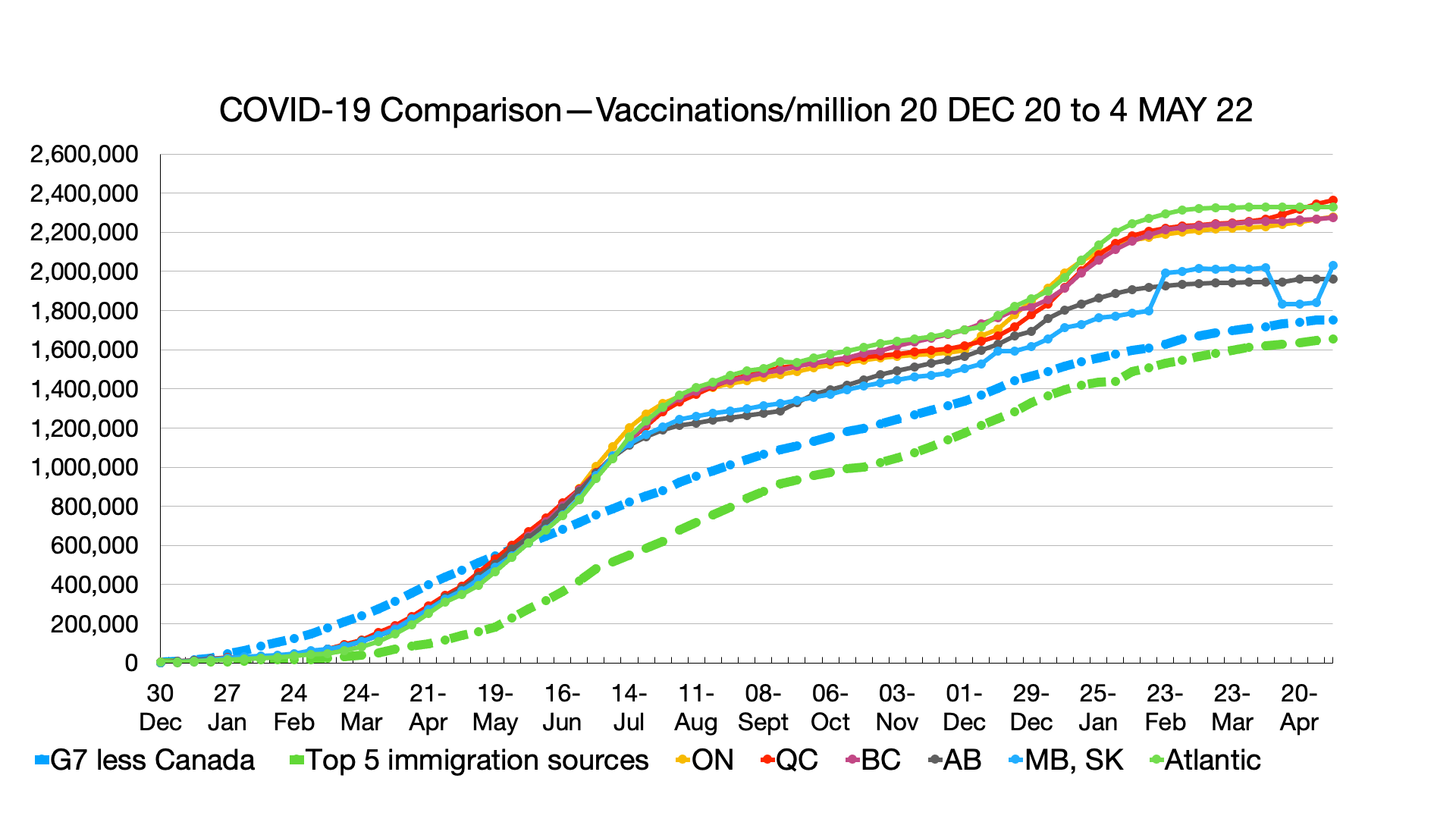
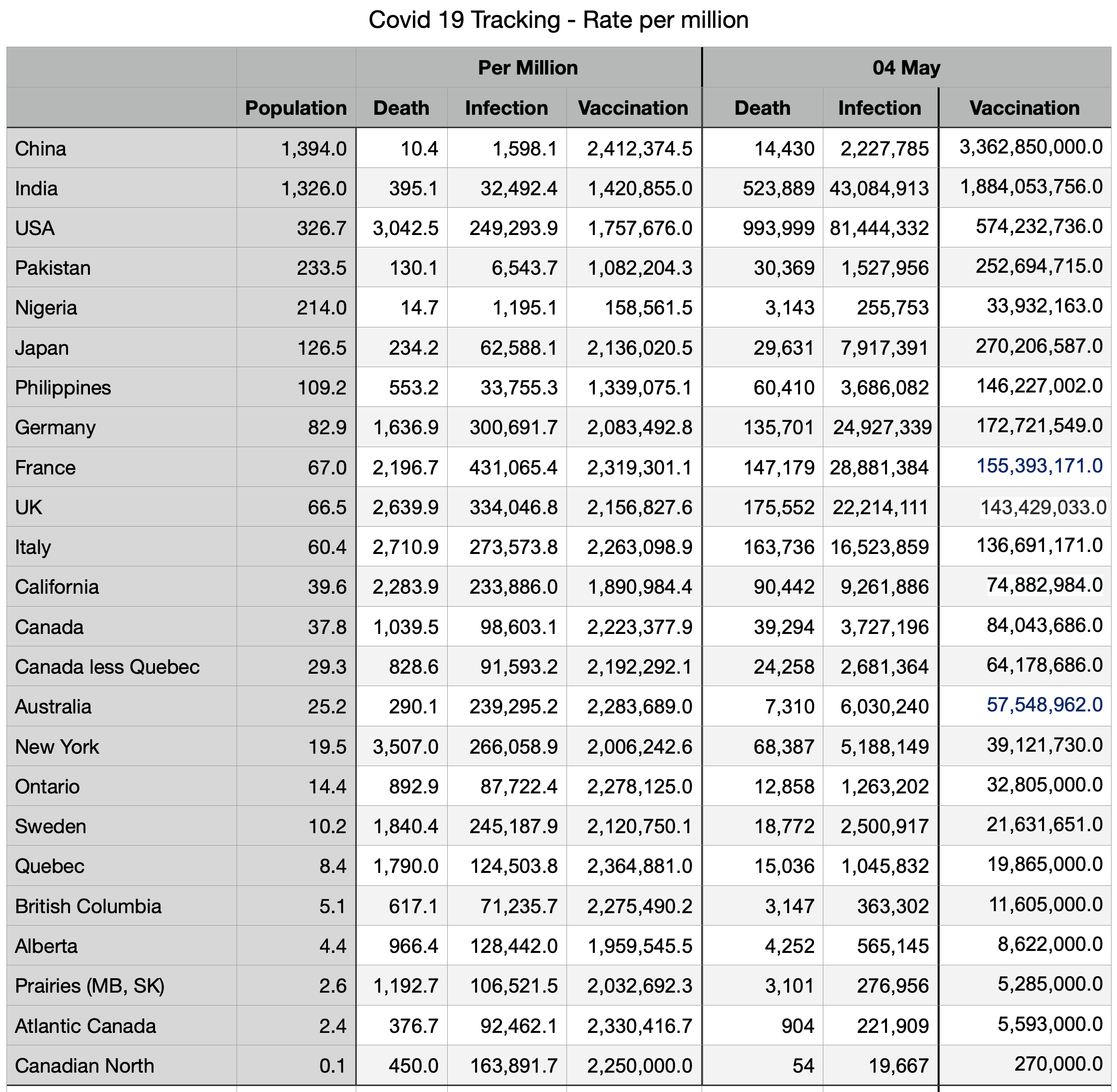
Vaccinations: Ongoing minor shifts and convergence among provinces and countries with plateauing of overall vaccination rates. Canadians fully vaccinated 81.8 percent, compared to Japan 80.2 percent, UK 73.2 percent and USA 66.6 percent.

Immigration source countries: China fully vaccinated 88.3 percent, India 61.8 percent, Nigeria 6.5 percent, Pakistan 55 percent, Philippines 61.7 percent.

Trendline Charts:

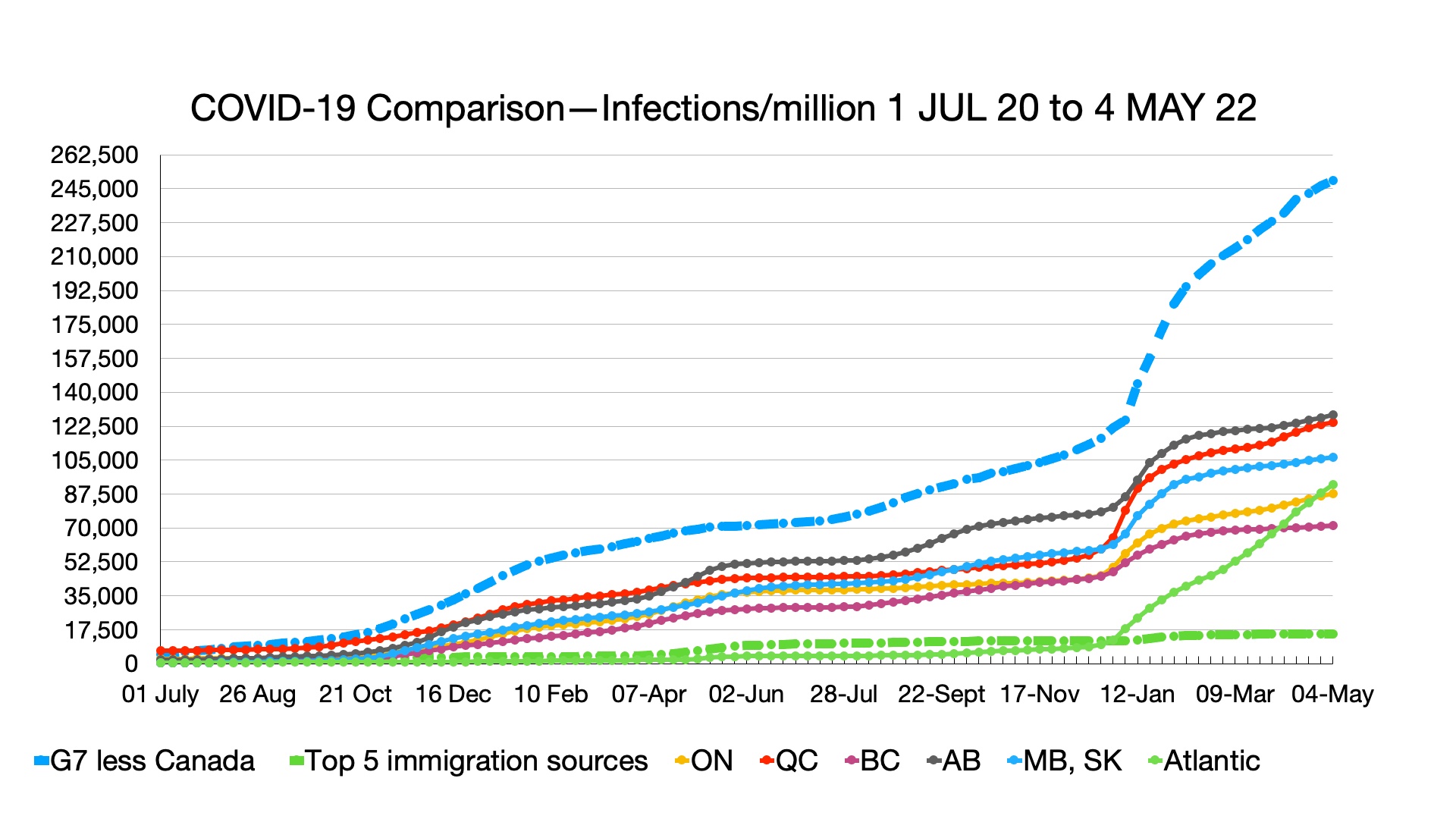
Infections: As noted, variations in reporting make comparisons difficult. Steep increase in Atlantic Canada may reflect more consistent reporting.

Deaths: No relative changes.

Vaccinations: Minor changes. All provinces have stalled in vaccinations, Saskatchewan reporting gaps account for Prairie fluctuations.

Weekly

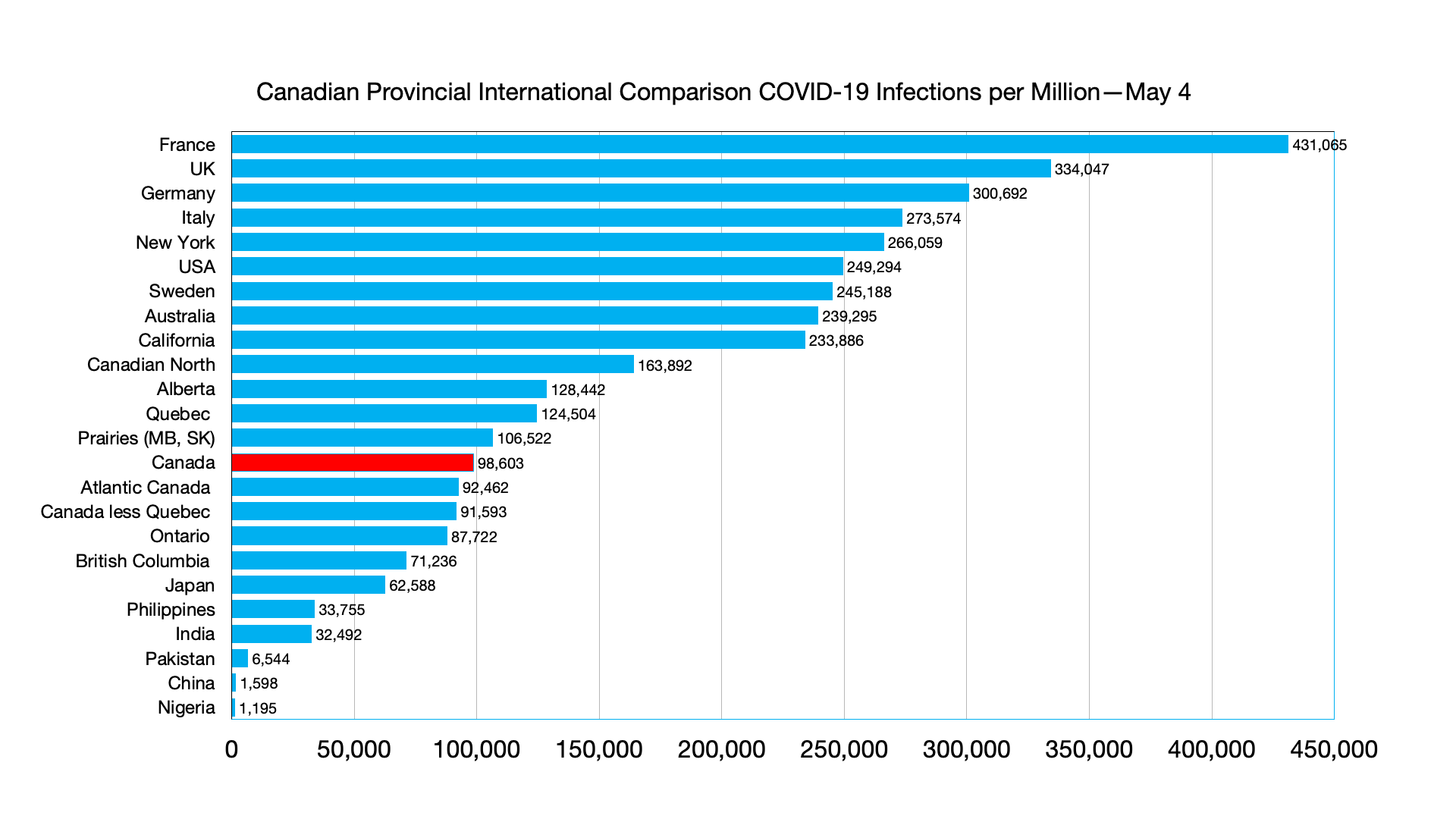
Infections: Italy ahead of New York, Australia ahead of California, Atlantic Canada ahead of Canada less Quebec, China ahead of Nigeria. 

Deaths: No relative change.

Sears: Where did Canada’s famed civility go?

Indeed:

At the beginning of this century, former senator Hugh Segal — one of the few politicians with genuine friendships across all party lines — made a plea. 

He called it “In Defence of Civility,” a book published in 2000. Segal is the classic Red Tory, fiscally somewhat conservative, socially somewhat liberal, always courteous.

His plea made the usual case for civility, especially in public discourse where its absence lets dangerous currents rise to the surface. Segal’s effort to put his finger in the dike came at a time when the decline in civility was still in its “Your mother wears army boots” phase. We had yet to fall to today’s depths, where a would-be prime minister once thought it was acceptable to attack a former Liberal party leader as the father of a policy “tar baby.” (Pierre Poilievre was forced to apologize.) 

Or when an MP can accuse Justin Trudeau of behaving like a “dictator,” although in his defence one must also note that Stephen Harper was regularly denounced as a “traitor” by opponents. 

This might all be dismissed as adolescent male schoolyard dissing, except for what comes in its wake. Some bewildered Canadians — like the man who rammed his pickup truck into Rideau Hall with the intention of killing the prime minister — decide traitors need to be “dealt” with. Or the vicious attacks on politicians — more often on women than men — on social media; attacks frequently include obscene death threats. 

Alberta MLA Shannon Phillips discovered that Lethbridge police officers had illegally surveilled her every move, stalked her into restaurants and then published covert photographs of her online, along with threatening commentary. All are still unpunished and on salary. 

Canadians used to be famous, even mocked, for our civility, tolerance and willingness to compromise, as in the joke: “How do you get a Canadian to apologize? Stomp on his toe.” 

It’s hard to nail down why a commitment to such an unusually mild public discourse emerged. 

It is certainly not part of the social DNA of Americans, Aussies or Brits, with whom we share so much common history. Traditional French incivility may be more elegantly framed, but no less wounding for all that. 

Perhaps it grew out of the need to pretend to show respect to Canada’s Indigenous peoples, so as to beguile them into suicidal concessions. 

Or as David Graeber and David Wengrow point out in “The Dawn of Everything,” their monumental study of how we made the societal choices we did, the influence may have been that of Indigenous peoples on Canadian settlers. Contrary to myth, most Indigenous peoples had deeply layered forms of courtesy and respect for each other and their enemies, communicating with eloquent formality on state occasions. It was part of how they kept the peace. 

Another thread in our effort to maintain a harmonious social tapestry must have been the often painful relationship between francophone and anglophone Canadians, and the need to manage mutual concessions on an ongoing basis. 

It is evident in our remarkable, if unfathomable, success at growing from an all-white, somewhat racist and socially rigid community to the most successful multicultural nation on earth. Surprisingly, we are in overwhelming agreement that adding nearly five million immigrants and refugees a decade — more than ten per cent of our population — to Canada is a good and necessary thing.

So why are we so frivolously throwing away the social civility that makes that possible? We can blame Americans, social media, too little civics education and more. More usefully, we might examine why over-the-top insults are so appealing to most of us, when directed at a hated target, or why Trudeau knows that when he uses insulting invective to attack his opponents, it’s a political plus for him. And then putting ourselves in the shoes of those under attack — especially the young and the vulnerable — before spitting a slur at someone who offends us. 

Perhaps even acknowledging that we are the masters of the fate of our civility, and that “ the fault, dear Brutus, is not in our stars, but in ourselves.”

Source: Where did Canada’s famed civility go?

Canadian military not ready to waive citizenship requirement

Of note. The public service has done so. But whether such a change would result in a measurable increase in diversity is uncertain. It will be interesting to see if the RCMP’s recent removal of the requirement results in any significant improvement to their notoriously poor results.

Will also be interesting to see if any backlash to these changes in terms of the meaningfulness and advantages of citizenship:

Canada’s military is not yet ready to allow permanent residents to join its ranks, even as it struggles to boost recruitment and fix the growing diversity gap in the nation’s armed forces.

In response to a request from New Canadian Media, ahead of the inaugural  Navy Fleet Weekend in Vancouver, numbers provided by the Canadian Armed Forces (CAD) show that three-quarters of its ranks are white men.

Women make up 16.3 per cent of the Canadian military demographic; Indigenous peoples come in at 2.7 per cent while there is less than 12 per cent of visible minorities in the Canadian military make-up.

Canada needs about 100,000 troops to be at full strength, but it is short about 12,000 regular force troops and reservists currently.

Scrapping the citizenship requirement

A little-known immigration pathway called the Foreign Skilled Military Applicant (FSMA) has only seen 15 successful candidates over the last five years. 

“Over the last year alone, the Canadian Forces Recruiting Group (CFRG) interacted with approximately 100 individuals who were interested in joining the military through the FSMA,” military spokesperson Major Brian Kominar told NCM.

“Discussions involving the Department of National Defence, the Canadian Armed Forces, and Immigration, Refugees and Citizenship Canada (IRCC) on lifting the citizenship requirement are continuing, though there are no changes to announce at this time,” he said.

The CBC reported in 2018, in line with the government of Canada’s objective of raising the number of forces personnel, there are discussions to review the possibility of foreign nationals’ recruitment beyond skills applicants.

Lifting the forces’ citizenship requirement would be a sharp departure from Canada’s traditional recruitment practices and could open the doors to applications from thousands of permanent residents, the CBC reported.

Other countries — the U.S. among them — allow non-citizens to serve, with certain restrictions on the positions and ranks they can hold.

In 2016, the RCMP scrapped its citizenship requirement, allowing permanent residents who have lived in Canada for more than 10 years to apply. The goal was, in part, to boost diversity in the ranks.

“We invite any associations, agencies, or organizations that work with new Canadians to contact the Canadian Forces Recruiting Group and find out what resources and tools are available to improve awareness of the over 100 full-time and part-time occupations available in the Canadian Armed Forces,” said Major Kominar.

“Non-Canadian citizen applicants must meet IRCC guidelines and requirements before proceeding through the CAF recruiting system,” he added.

Representing the country it serves

A report from the Advisory Panel on Systemic Racism and Discrimination in Canada’s Defence Teamacknowledged the need for increased new immigrant participation in the armed forces.

“The proportion of people belonging to visible minorities in the labour force who were born in Canada is expected to increase from 20 per cent in 2016 to 26 per cent of the labour force by 2036…the increasing ethnocultural diversity of the labour force is expected to continue,” the report noted.

Earlier this month, Chief of the defence staff Gen. Wayne Eyre told the Ottawa Defence Conferencethat the CAF needs to “win the battle for talent” both in the recruitment and retention of new military members.

“If we don’t keep pace with the changing demographics, the changing face of Canada, we are going to be irrelevant,” he told the conference.

Among those taking the message to new immigrants to seek careers in the CAF is Manjot Pandher who moved to B.C. from India in 2010 and joined the Canadian Navy seven years later.

“It has provided me with great opportunities to travel while I was at school and learn new skills which will help me in my civilian career, later in life,” said Pandher, who is now a Navy Sailor 2nd Class.

“The military is a big family which welcomes everyone and being part of this family, you feel connected to Canada as a whole,” Pandher told NCM, adding that he will be at the Canadian Navy Fleet weekend.

The upcoming event, from April 29 to May 1, 2022, alongside the Burrard Dry Dock Pier in North Vancouver will feature Her Majesty’s Canadian Ships (HMCS) Vancouver, Winnipeg, Brandon, and Edmonton, plus three Patrol Craft Training Vessels, the Naval Tactical Operation Group, and Fleet Diving Unit (Pacific).

On May 1, marching contingents from the ships will be attending the Battle of the Atlantic Ceremony at Sailor’s Point Memorial in Waterfront Park, North Vancouver, to commemorate the 77th anniversary of the Battle of the Atlantic.

Source: Canadian military not ready to waive citizenship requirement

Sarantakis: Taking data seriously: A call to public administrators

Important flagging of the importance of data for governments and how governments increasingly lag the private sector in their collection, analysis and use of data and AI to understand citizen needs.

However striking that a senior official would make the case without acknowledging the challenge in doing do for the public sector given that each time the government does so, significant criticism occurs, whether it be for IRCC’s use of the Chinook system, Statistics Canada use of anonymized credit card information to understand consumer spending, or PHAC’s collection of anonymized COVID phone data.

Perhaps a second piece on this harder issue?

It is said that the first step in overcoming a problem is first admitting its existence. So, here goes: Contemporary public administration is data-challenged.

This would have been an implausible statement to utter, historically. After all, public administrators as individuals know how important data is to public policy formulation and program delivery. Public administration has proved its worth over time with the value of record-keeping, and creating and using data — recording, ordering, sorting and tabulating counts of people, forests, geography, geology, tanks, guns and things like the production of butter.

Indeed, the two great and insatiable needs of the early state, formulated by Yale scholar James C. Scott, were taxation and conscription. Without revenues and the capacity to pay to defend sovereignty, states are not durable. In turn, without public administrators recording, ordering, sorting and tabulating data, the state does not endure.

Historically, public administration has been on the cutting edge of data. Entities often went to various state organs and state registries for data. The public service apparatus of the state knew, even in the state formed explicitly to curb government involvement in the daily affairs of its citizens.

But something dramatic has happened. The administrative state – that part of government that continues regardless of whether elections yield majorities or minorities that are red, blue, orange, green, or purple – is no longer on the cutting edge of data. Yes, the state still knows, but often it only now knows after, while private sector entities know now. Even more powerfully, with predictive analytics, sophisticated private entities increasingly know before.

How can we understand this switch? How can we understand public administration losing its historical position of relative data supremacy? To do that, we need to detour from public administration for a moment and veer into the private-sector economy. What we find gives us important clues to our mystery vis-à-vis data and public administration.

The factors of production 

Since Adam Smith, we have understood three core factors of production: land, labour and capital. There are others that have competed to be added to this list. Channeling Peter Drucker, some have argued for “management” – those who directresources. Others have argued for “entrepreneurs” – those who combine resources in new and innovative ways. But Smith’s formulation has proven remarkably durable for more than two centuries.

If Smith were to return and look at some of the most valuable and dynamic corporations of our era – the digital giants Google, Meta (formerly Facebook), Amazon, Apple, Spotify and others – he would likely be mystified. Yes, he would see some land. Yes, he would see some labour. But nowhere near enough to justify the heady heights – and incredible influence and power – of the digital giants. Finally, he would also see some capital. But remarkably, that capital would largely be a by-product of “production,” and not a driver of production.

Seeing the most valuable and powerful entities on earth during his era, Smith would have seen people – lots and lots of labour. He would have seen land. He would have seen capital in the form of constructed ships, and tools, and extracted then refined natural resources. He would have seen stuff – tangible things that he could touch.

But the contemporary Adam Smith would see negligible amounts of people and land in today’s largest companies. Certainly nothing approaching their value, status or their power. These companies, perhaps most surprisingly of all, “consume” relatively little capital.

So if you are generating enormous profits but not drawing heavily on the “factors of production” …. something makes no sense. What is going on?

Brains? Computers? Digital? Algorithms? Cloud computing?

Yes, yes, yes, yes, yes, and lots more.

But fundamentally, what is going on now is the fourth factor of production.

Data.

Data as differentiator 

Data has now become the most valuable commodity on earth. Data stocks are more valuable than natural resources. Data is more valuable than manufacturing facilities; more valuable than land; more valuable than labour. Data – the new oil? Oil should be so lucky.

Why?

Data is now the differentiator. Data is now the value-add. As computers, software, micro-processing power, storage, cloud computing and algorithms all become (or all trend toward) commodity status, it is the quantity and quality of data that will transform the mediocre into the successful.

A commodity is an interchangeable and undistinguished part. Where I buy a barrel of oil or a bar of gold or a truck load of gravel or road salt is overwhelmingly just price-contingent. The lowest price wins. To avoid becoming a commodity in data – valued only for how cheaply you can deliver something – you need more and better data than the competition. Increasingly, if you are data-deficient, you will not be competitive or sustainable as an entity.

Put another way, Company A and Company B already compete based on the quantity and the quality of their data. This will also increasingly be true in the coming years for Country A and Country B. Countries have competed forever for oil and gas and timber and nickel. Now they are also adding “quantity and quality of data” to that list of competitions.

Spotify is a data company that deals in music. Netflix is a data company that deals in entertainment. Tesla is a data company on wheels. Google is a data company that deals in information. Amazon is a data company that provides many things – same with Instagram, same with Facebook.

Computing, computation, communication, software, digital distribution – all are, or are rapidly becoming – commodities. Algorithms still have differentiating value, but as advances in artificial intelligence continue, these as well will also invariably trend to commodity status. What really adds value in production increasingly is the quality and quantity of data.

Data and public administration

What does all this have to do with public administration? At first glance, perhaps nothing. But on closer examination, a great deal.

The digital giants became digital giants because they understood – before others – the enormous value of enormous quantities of data. They understood – like the early state understood the power of knowing the quantity and location of trees and people and minerals – that data is power.

As Shoshana Zuboff expertly describes in The Age of Surveillance Capitalism, data becomes the nexus of power. But the power of data in the contemporary age isn’t about counting trees and people, it is rather about the “instrumentalization of behavior for the purposes of modification, prediction, monetization, and control.”

Contemporary public administration, which traces its very heritage back to data, is far less sophisticated in data today than the digital giants. Data is not utilized for public good applications anywhere near the degree to which data is utilized for commercial gain.

Over time, that will harm us all because the public-good realm will have less access to rich data than the private profit realm. Over time, that will make public administration a dinosaur. We need to better understand the power and application of data.

Public administration and real-time actionable data

States often revert to using blunt policy instruments because public administrations do not have the granularity of data – in real time – that is available to the digital giants. When you don’t have real-time actionable data, you estimate. You ask people to apply. You create programs with criteria instead of directly apply funding to public policy objectives.

That worked for a world when real-time actionable data either did not exist or was enormously expensive to actualize. But that is not today’s world. The percentage of the economy migrating online is growing every day, and the online economy has grown much faster than the analog economy in recent years. But something else is happening, too. With the internet of things(IoT), our toasters and our refrigerators and our lightbulbs and our ventilation systems and our water treatment plants and our garage doors and our pacemakers are all migrating online. The enormous oceans of data we have today will, in a few very short years, look like little trickles of water when the IoT begins to take hold in full flight.

Public administration is already behind. Imagine what happens when the volume of data being generated every moment of every day by billions of connected things across the globe increases at an even faster rate.

Does public administration understand the power of data? Do we understand how to use it to serve public policy goals? Do we understand how to regulate it for the public good? Do we have the systems in place to capture data? Do we have the systems in place to safeguard data? Do we have the systems in place to safeguard its use by non-state actors?

These are the many questions facing public administration today. The faster we get the answers, the better public administrators will be able to serve their political decision-makers and their state populations.

Time is not our friend on these questions.

Source: Taking data seriously: A call to public administrators