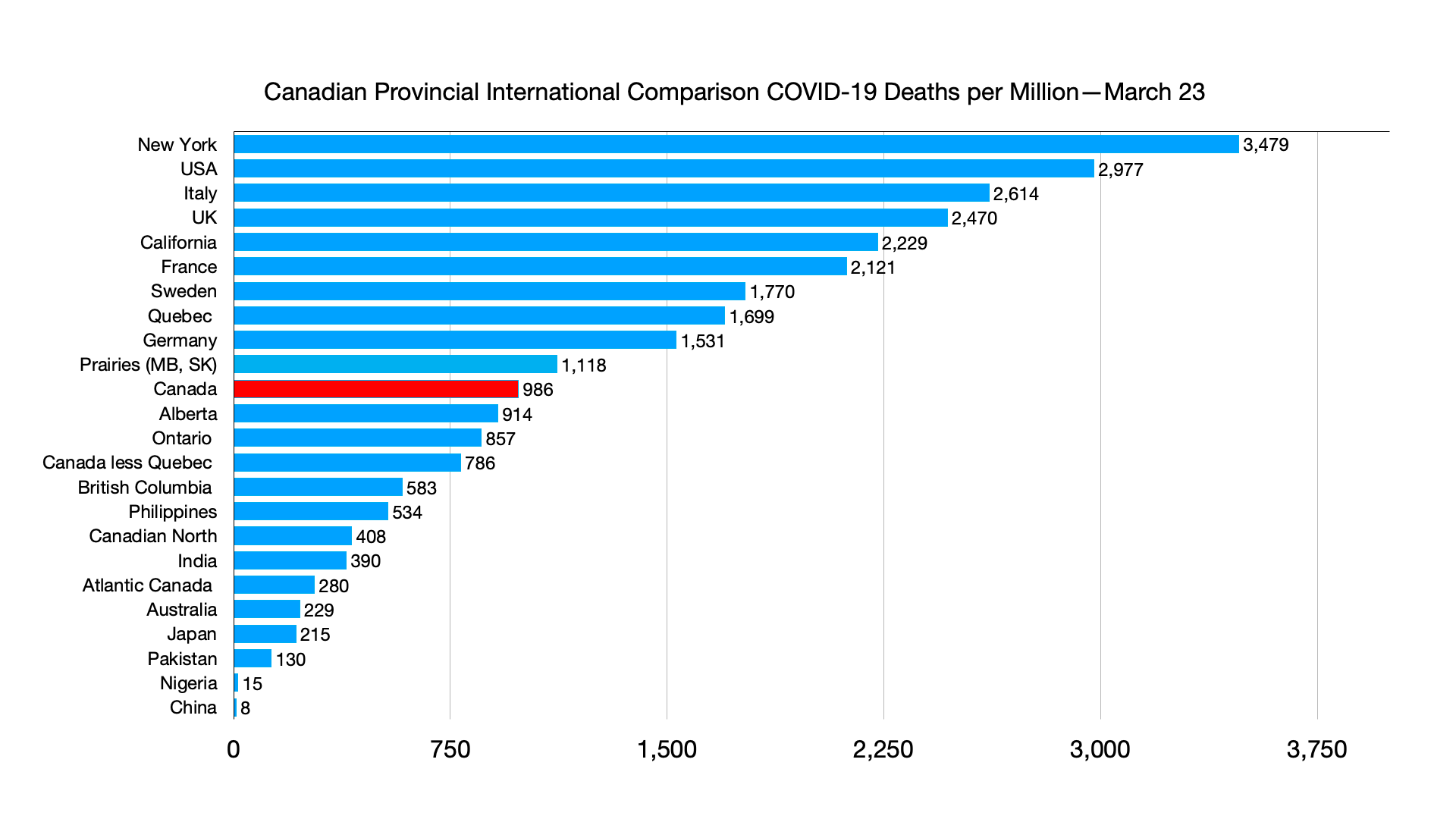
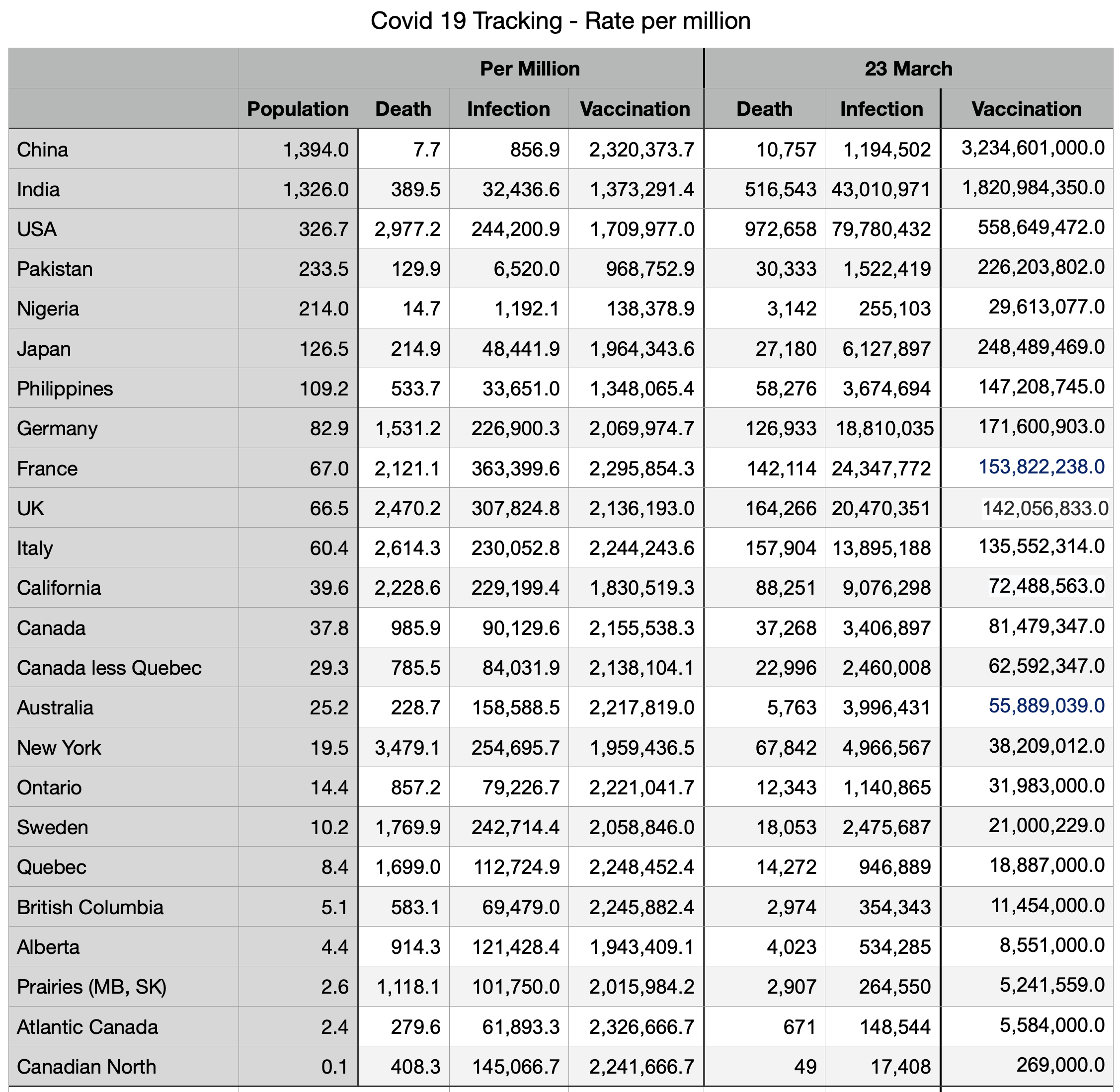
#COVID-19: Comparing provinces with other countries 23 March Update, Vaccinations in African countries

Numbers from China continue to climb with infections up 59 percent and deaths up 21 percent. New omicron variant showing up in increased infections in some countries.

Vaccinations: Some minor shifts but convergence among provinces and countries. Canadians fully vaccinated 82.7 percent, compared to Japan 79.6 percent, UK 73.8 percent and USA 66.1 percent.

Immigration source countries: China fully vaccinated 88.7 percent, India 60.1 percent, Nigeria 4.5 percent, Pakistan 47 percent, Philippines 60.3 percent.

Trendline Charts:

Infections: Limited signs of new omicron variant yet in Canada, with Atlantic Canada infection rates not yet slowing town.

Deaths: No major changes.

Vaccinations: No major relative changes, with Japan ahead of New York and Alberta.

Weekly

Infections: Italy ahead of California.

Deaths: No relative change.

Informative analysis in The Economist:

It is little over a year since the first doses of life-saving vaccines were delivered to Africa under the Covid-19 vaccines Global Access Facility (covax), a scheme aimed at helping poorer countries get inoculated. Yet what should have been a celebration of the region’s fastest-ever vaccine rollout—with 400m doses jabbed into waiting arms—was instead marred by disappointment at how much more could have been achieved.

Listen to this story.

Instead of complaining about not getting vaccines, some countries are now protesting that they are being drowned in a deluge of the stuff and are unable to use it all. Last month Africa cdc appealed to donors to stagger the supply of their shots. “We have not asked them to pause the donations, but to co-ordinate with us so that the new donations arrive in a way so that countries can use them,” said John Nkengasong, the director of Africa cdc.

Increased deliveries are exposing logistical defects in distribution within countries, while weak health-care systems have been unable to jab doses into arms as fast as they get them. Across Africa as a whole just 62% of delivered vaccines have been administered and 29 countries have used less than half of their supplies, says the who. Among the worst laggards are the Democratic Republic of Congo, which has used 15% of its consignments and jabbed less than 2% of its eligible population, and Burundi, which has used less than 2%.

Also hidden in the averages are big gaps in vaccination rates between cities and the countryside. Although continent-wide data are not available, Githinji Gitahi, the chief executive officer of Amref Health Africa, an ngo, says this trend is clear across many countries, including Ghana, Kenya, Rwanda and Tanzania. In Kenya 51% of adults in Nairobi, the capital, had been fully vaccinated by March 16th. But in Mandera county, a poor semi-arid region next to the border with Somalia, only 10% had been fully jabbed.

Part of the reason is logistical. Freezers for storing vaccines are in short supply. But this should be surmountable. Take Uganda. By November just 14% of its eligible population had received their first dose. But in a push supported by donors including the American government, it bumped that rate up to 47% in just six weeks. In Ivory Coast, where many people were nervous about the jab, the government bumped up the vaccination rate from 22% to 36% in the month of December by running radio campaigns to allay people’s fears. These speedy successes suggest that in many places the biggest shortage is not of freezers or nurses, but of zeal on the part of the authorities to go out and get injecting. 

Source: Africa has plenty of covid doses, but it lags in jabs

Helping A.I. to Learn About Indigenous Cultures

Interesting:

In September 2021, Native American technology students in high school and college gathered at a conference in Phoenix and were asked to create photo tags — word associations, essentially — for a series of images.

One image showed ceremonial sage in a seashell; another, a black-and-white photograph circa 1884, showed hundreds of Native American children lined up in uniform outside the Carlisle Indian Industrial School, one of the most prominent boarding schools run by the American government during the 19th and 20th centuries.

For the ceremonial sage, the students chose the words “sweetgrass,” “sage,” “sacred,” “medicine,” “protection” and “prayers.” They gave the photo of the boarding school tags with a different tone: “genocide,” “tragedy,” “cultural elimination,” “resiliency” and “Native children.”

The exercise was for the workshop Teaching Heritage to Artificial Intelligence Through Storytelling at the annual conference for the American Indian Science and Engineering Society. The students were creating metadata that could train a photo recognition algorithm to understand the cultural meaning of an image.

The workshop presenters — Chamisa Edmo, a technologist and citizen of the Navajo Nation, who is also Blackfeet and Shoshone-Bannock; Tracy Monteith, a senior Microsoft engineer and member of the Eastern Band of Cherokee Indians; and the journalist Davar Ardalan — then compared these answers with those produced by a major image recognition app.

For the ceremonial sage, the app’s top tag was “plant,” but other tags included “ice cream” and “dessert.” The app tagged the school image with “human,” “crowd,” “audience” and “smile” — the last a particularly odd descriptor, given that few of the children are smiling.

The image recognition app botched its task, Mr. Monteith said, because it didn’t have proper training data. Ms. Edmo explained that tagging results are often “outlandish” and “offensive,” recalling how one app identified a Native American person wearing regalia as a bird. And yet similar image recognition apps have identified with ease a St. Patrick’s Day celebration, Ms. Ardalan noted as an example, because of the abundance of data on the topic.

As Mr. Monteith put it, A.I. is only as good as the data it is fed. And data on cultures that have long been marginalized, like Native ones, are simply not at the levels they need to be. “Clearly, there’s a bias represented,” he said.

The workshop was the initiative of Intelligent Voices of Wisdom, or IVOW, a tech start-up that Ms. Ardalan, an executive producer of audio at National Geographic, founded to preserve culture through A.I. and to counter those biases.

“The internet is not representative of the entire population, and when people are represented, it may not be accurate because of stereotypes and hate speech,” said Percy Liang, an associate professor of computer science at Stanford University and director of the school’s Center for Research on Foundation Models.

To counter this tendency, Ms. Ardalan, who is an Iranian American of Bakhtiari and Kurdish descent, wants IVOW to develop tools to create “cultural engines” for underrepresented groups so they can generate, and take ownership of, their data. “The cultural engine cannot be a data scientist in Philadelphia trying to create data sets for a tribe in Arizona,” she said.

More representative, accurate data is beneficial not only to the groups it represents, but also to A.I. systems at large, said W. Victor H. Yarlott, an A.I. researcher at Florida International University, a member of the Crow Tribe of Montana and an IVOW collaborator.

“Lacking this knowledge just makes your system worse,” he said. “You’re not really representing human intelligence or human knowledge unless your system can handle it from a broad range of cultures.”

The participation of Indigenous people in the project was critical. Mr. Monteith, who led the effort to enter the Cherokee writing system into Microsoft Office, said he’s been working on building trust for technology, and more recently A.I., in his Native communities for decades. “I knew without me doing this that we would be in a worse spot in terms of literacy, and our culture,” he said.

The team at IVOW, along with a group of volunteer collaborators and advisers, has been developing proofs of concept for these cultural engines — smart data sets that can feed more inclusive A.I. tools, including chatbots and image recognition apps.

One such tool is IVOW’s Indigenous Knowledge Graph, or IKG, a cultural engine in early development that is focused on storytelling about Indigenous recipes and culinary practices. After meeting the IVOW team in 2018, Mr. Yarlott pitched the IKG, a sort of visualization of a data set, to capture Indigenous knowledge.

“You know in dramas, you see the person trying to unravel a mystery and they have the corkboard and the little notes and the string between them?” Mr. Yarlott said. “That’s basically what the IKG is, but for cultural knowledge.”

The first step was to gather the data. The team chose a culinary focus because it is a part of life that all people share. They collected recipes and related stories from both the public domain and team members.

Mr. Monteith chose to enter the story of the Three Sisters stew, a recipe created from symbiotic crops (corn, beans and squash) that he said is known among Indigenous peoples wherever those ingredients grow. The story of the Three Sisters, he said, is not only a recipe but a way to teach sustainability practices, such as the preservation of water. “It’s just a great metaphor for what we need to do as a society and as a people across the world,” Mr. Monteith said.

Using Neo4J, a graph database management system, the recipes were broken down into components (title, ingredients, instructions and related stories) and tagged with information, like the tribe of origin or whether the recipe was contemporary or historical, or had roots in folklore. This data set was then entered into Dialogflow, a natural language processing platform, so it could be fed into a chatbot — in this case, Sina Storyteller, the Siri-like conversational agent designed by IVOW. Currently, anyone can interact with the early version through Google Assistant.

The tools and techniques to create the IKG were designed to be basic enough that anyone, not just those with a background in computer science, could use them. And IKG uses only information that is widely available or that the team had permission to use from their own tribes, bands and nations.

There are challenges, though. The process is labor intensive and expensive; IVOW is a self-funded enterprise, and the work of the collaborators is voluntary.

“It’s a little bit of a chicken and an egg problem because you need the data to really build a big system that demonstrates value,” Mr. Yarlott said. “But to get all the data, you need money, which only really starts to come when people realize that there’s substantial value here.”

Mr. Liang said that while this kind of “artisanal” data is important, it is difficult to scale, and that more emphasis should be placed on improving foundation knowledge — models that are trained on large-scale data sets.

For years, computer scientists have warned Ms. Ardalan that cultivating this sort of data is a tedious process. She doesn’t disagree, which is why she says the time to start is now.

“The future is going to be these cultural engines that communities create that are relevant to their heritage,” she said, adding that the notion that A.I. will be all-encompassing is wrong. “Machines cannot replace humans. They can only be there with us around the campfire and inform us.”

Source: Helping A.I. to Learn About Indigenous Cultures

Hundreds march downtown calling for end to racial discrimination in Canada’s immigration system

More from the Migrant Rights Network:

Hundreds of people marched through downtown Toronto Sunday calling for an end to racial discrimination in Canada’s immigration system.

The demonstration organized by The Migrant Rights Network gathered near Toronto’s City Hall before taking their message to the streets, briefly blocking some downtown intersections.

The group called on the federal government to grant citizenship to an estimated 1.6 million migrant and undocumented workers in Canada.

Syed Hussan, executive director of the of Migrant Workers Alliance for Change, said migrant and undocumented workers are afraid to assert their rights and speak out about the exploitation they may face on the job.

“You can be made homeless because you live in employer-provided housing, you can be kicked out of the country, you’re not allowed to get another job,” Hussan said.

“To have a fair society, everyone must have equal rights. The only way to have equal rights, is if every resident in the country has the same citizenship rights and immigration status.”

Tina Kusbiantoro came to Canada from Indonesia more than three years ago and says not being able to secure permanent residency has been challenging.

“We have no equal rights and then we’re separated from our families a long time … we cannot access the health care and we don’t vote,” Kusbiantoro said.

A woman who identified herself only as Jane tells CTV News Toronto she feels ignored and disappointed in the immigration system.

Jane has been working as a personal support worker since arriving from Uganda.

“We have been working hard through the pandemic to ensure that we give services to vulnerable people who cannot help themselves,” Jane said.

“Being denied…it’s a kind of racism. I feel so bad, I feel so betrayed.”

Migrant rights activists were joined by a group from Community Solidarity Toronto, who rallied Sunday to take a stand against racism and what they see as the growth of Canada’s far right.

Source: Hundreds march downtown calling for end to racial discrimination in Canada’s immigration system

ICYMI: Craintes de voir l’anglais «éradiqué» du Québec

Of note:

Le ministre responsable de la Langue française, Simon Jolin-Barrette, a trouvé la « formule parfaite » pour « éradiquer » la minorité anglophone du Québec, avertit la présidente du Quebec Community Groups Network (QCGN), Marlene Jennings. Elle ne sait plus en quelle langue le dire pour être prise au sérieux.

« Réveillez-vous ! » lance l’ex-députée fédérale de 1997 à 2011, cherchant à secouer l’apathie des Québécois face aux offensives linguistiques menées à Québec — et à Ottawa — sur la foi, selon elle, de la « fabulation » selon laquelle la langue française est « en danger » dans les milieux de travail.

Le gouvernement est pourtant catégorique : la proportion de travailleurs qui accordent une place prédominante au français au travail s’est effritée au Québec au fil des 15 dernières années, passant de 82 % en 2006 à 79,7 % en 2016.

L’abandon du projet d’agrandissement du cégep Dawson ainsi que le gel des programmes conduisant au diplôme d’études collégiales (DEC) ou encore à l’attestation d’études collégiales (AEC) en anglais prévu dans la version amendée du projet de loi 96 entraîneront des conséquences « pernicieuses » pour les communautés anglophones du Québec, précise Marlene Jennings dans un entretien avec Le Devoir. Il y aura de moins en moins de professionnels « bilingues » dans le réseau de la santé, illustre-t-elle au bout d’une table de conférence dans les quartiers de QCGN dans le centre-ville de Montréal.

« On n’est pas stupides [les caquistes] sont en train d’étrangler le système », ajoute la directrice générale de QCGN, Sylvia Martin-Laforge.

Simon Jolin-Barrette promettait d’assurer le « respect le plus complet des institutions de la communauté anglo-québécoise » lors du dévoilement du projet de loi sur la langue officielle et commune du Québec, le français (projet de loi 96) en mai 2021.

Le groupe de pression soupçonne le gouvernement caquiste de réduire la « communauté anglo-québécoise » — qui est en droit de recevoir des services en anglais, selon lui — à la « communauté historique d’expression anglaise », ce qui exclut près de 500 000 Québécois anglophones, dont les immigrants provenant d’un État anglophone comme la Grande-Bretagne ou la Jamaïque, par exemple.

D’ailleurs, Marlene Jennings se dit lasse d’entendre que la minorité anglophone du Québec est « la mieux traitée », alors que les Québécois d’expression anglaise sont « sous-employés » et « sous-payés ». « La seule minorité linguistique qui se rapproche, qui a les mêmes statistiques dévastatrices, ce sont les Acadiens et les francophones du Nouveau-Brunswick, les seuls. Mais, on ne parle jamais de ça », dit la première personne noire à avoir représenté une circonscription québécoise à la Chambre des communes.

Les projets de loi signés par Simon Jolin-Barrette (96) et par Ginette Petitpas Taylor (C-13) exacerberont à coup sûr non seulement les inégalités économiques entre anglos et franco, mais aussi les tensions sociales, est persuadée Marlene Jennings.

Coût pour le Québec

« Ce n’est pas que l’affaire des anglos, des minorités, c’est l’affaire des francophones », soutient Sylvia Martin-Laforge, selon qui le renforcement de la loi 101 par « 96 » et « C-13 » ne se fera pas sans coût économique et moral pour le Québec.

Les patronnes du QCGN n’arrivent pas à croire que le gouvernement Trudeau puisse donner la possibilité aux entreprises privées de compétence fédérale présentes au Québec de mener « leurs communications avec les consommateurs » dans le respect de la Charte de la langue française du Québec — que Simon Jolin-Barrette s’emploie à blinder notamment au moyen des dispositions de dérogation aux chartes des droits et libertés.

« Quand je vois nos chartes [des droits et libertés] suspendues, et on n’est pas en situation de guerre, on n’est pas en Ukraine […], je suis découragée », indique Marlene Jennings au Devoir, ce qui n’est pas sans rappeler son gazouillis du 24 février, aujourd’hui disparu. La Montréalaise exprimait son étonnement de voir François Legault appuyer la démocratie ukrainienne face à l’assaut de la Russie alors qu’il a la « volonté de suspendre tous les droits et libertés de tous les Québécois avec son projet de loi 96 ».

« J’ai une grande gueule et j’en suis fière. I’m a Jennings et une Garand ! » s’exclame la « femme noire d’origine ethnique diverse » dans des locaux presque vides. Marlene Jennings est le fruit de l’union d’un homme noir émigré de l’Alabama et d’une femme blanche francophone, dont les ancêtres, français et belges, avaient défriché le Manitoba, dont un aux côtés du grand défenseur des Autochtones et de la langue française Louis Riel. « J’ai toujours été en faveur de Louis Riel », précise-t-elle.

Marlene Jennings, qui s’enorgueillit aussi d’avoir voté, en 1976, pour le chef du Parti québécois René Lévesque dans la circonscription de Taillon, et ce, même si sa mère « voulait [la] tuer », mène aujourd’hui la résistance au nom de la minorité linguistique anglophone du Québec. Et elle fait flèche de tout bois.

Le premier ministre du Canada, Justin Trudeau, n’est pas épargné. L’ex-élue du Parti libéral du Canada l’accuse de « rompre avec les valeurs fondamentales de notre société canadienne », dont celle de la dualité linguistique, en conférant aux travailleurs des entreprises privées de compétence fédérale du Québec notamment « le droit d’effectuer leur travail et d’être supervisés en français » et « le droit de recevoir toute communication et toute documentation […] en français ». « On a des employés anglophones qui travaillent [dans une banque] en français, mais pour une raison ou une autre, ils voudraient avoir leurs communications en anglais. Ils n’auront pas ce droit-là avec C-13 dans son format actuel. Alors quel genre d’atmosphère, de climat de travail ça va créer ? » demande Marlene Jennings, qui se défend d’être une « angryphone », comme la dépeignent ses détracteurs.

Mauvais « timing »

Marlene Jennings attribue la faible mobilisation contre les projets de loi 96 et C-13, à commencer au sein des communautés anglophones du Québec, aux occasions de socialisation — les discussions sur l’actualité autour de la machine à café du bureau, par exemple — qui se sont faites rares durant la pandémie de COVID-19, mais aussi, plus largement, à la montée de l’individualisme et de la désinformation dans la société canadienne.

Cela dit, la présidente de QCGN a pris bonne note de la décision du Parti libéral du Québec de s’opposer à l’adoption du projet de loi 96, qui a été officialisée par sa cheffe, Dominique Anglade, lors d’une visite du cégep Dawson il y a près d’un mois. « Je suis contente qu’elle se soit finalement ralliée, avec ses députés. Elle ne peut plus reculer là-dessus maintenant », fait remarquer Marlene Jennings. Le PLQ n’a pas mis son cahier de « 27 propositions pour l’avenir de la langue française » au rebut pour autant, lui signale Le Devoir. « Ça, c’est toute une autre question. »

Source: https://www.ledevoir.com/politique/quebec/688341/projet-de-loi-96-craintes-de-voir-l-anglais-eradique-du-quebec?utm_source=infolettre-2022-03-19&utm_medium=email&utm_campaign=infolettre-quotidienne

Paradkar: Scholar Strike 2022: Why professors and students will hit the streets in a show of resistance

The “woke” crowd in action:

The intersection of Bond and Gould streets in Toronto, which housed the statue of Egerton Ryerson for 132 years only to see it toppled last year, will be the starting point of a walking tour on Wednesday. 

Call it our very own tour de résistance, marking the last of the three-day Scholar Strike that begins March 21, the International Day for the Elimination of all forms of Racial Discrimination and Racism. It’s a labour action where scholars, activists and students from across the country will first participate in two days of virtual “teach-ins” that are free and open to the public, and then walk through the downtown core at various historical sites of resistance to oppression.

They will be protesting state violence against Black, Indigenous and racialized people and demanding, among other things, the defunding and abolition of police and prisons, and defunding of institutions such as Children’s Aid Societies, instead transferring funds to communities that offer care and affordable housing, and that work to eradicate poverty.

A running theme through the three-day strike is breaking down silos and drawing connections — between scholars and street-level organizers, between historical and current resistance movements, between anti-colonial and anti-racist struggles, between those who experience oppression and those who don’t. 

“We want to be able to say that this resistance movement is not against you. It’s about finding ways to be together,” said Mikinaak Migwans, assistant professor of Indigenous contemporary art in Canada and curator at the Art Museum, University of Toronto. The walking tour is Migwans’s brainchild. Migwans is Anishinaabekwe of the Wikwemikong unceded territory.

In the wake of the Black uprisings of 2020, the names Regis Korchinski-Paquet, Eishia Hudson, Chantel Moore, D’Andre Campbell, Ejaz Choudry were among those that began circulating around Canada to humanize and remember victims of police brutality. Two years later, not only are they all but forgotten by many — we all move on from crisis to next shiny crisis — but new names, new bodies have piled on the deck.

Anthony Aust, Moses Erhirhie, Trent Firth, Lionel Ernest Grey, Braden Herman, Julian Jones are some. As are Jared Lowndes, Sheffield Matthews, Dillon McDonald, Coco Ritchie and Latjor Tuel. 

They are among those Black, Indigenous or racialized people killed by police, or who died in police custody since the 2020 reckoning, that organizers from University of Toronto see as the genesis of this second Scholar Strike.

Tuel was experiencing mental distress when he was killed by Edmonton police in February even while various police handled Ottawa’s often violent convoy protesters with kid gloves. The Alberta Serious Incident Response Team is investigating Tuel’s killing. Edmonton police say they followed all protocols. They always say that. 

Given the worsening global context of a continuing pandemic, growing authoritarianism, war and climate change, the Scholar Strike launches with a discussion on the rise of ultra-right fascism, racism and white ethno-nationalism, said Beverly Bain, a professor of women and gender studies in the Department of Historical Studies at the University of Toronto Mississauga, who is one of the main organizers.

About 40 speakers will address topics such as harm reduction, migrants and borders and invasion of Indigenous territories. These sessions offer a way to connect the ivory tower to the streets.

“We can no longer afford to have this bifurcation of the university as a site of knowledge only and the community and activism as something different,” Bain said. “Many of us in the universities are scholar activists and organizers.”

Since the first Scholar Strike that Bain co-organized in 2020 that called for defunding of police, police budgets have grown. The Toronto police operating budget sits at a whopping $1.1 billion in 2022 after the city approved a $25-million increase. 

Police shootings and killings across the country have continued unabated. More than half the 64 police shootings in 2021 involved Indigenous people. 

Justice-seeking protests can be shrugged off as a series of disjointed events that allow people to let off steam or express anger over a particular incident or project, when in fact they are continuous and connected to each other by history and geography.

The United Nations designated March 21 as a day against racial discrimination because it commemorates the Sharpeville Massacre of 1960, when South African police killed 69 people and wounded 180 during a peaceful protest against apartheid. 

The walking tour on March 23 also offers connects current movements to historical resistance. 

“There has always been resistance in our communities from the time of arrival onwards,” said organizer Kristen Bos, assistant professor of Historical Studies and the Women and Gender Studies Institute at the University of Toronto, who is Métis. “That’s why the police exist, right? Like, that’s why they were literally created just in this country to stamp out Indigenous resistance.”

The tour sites include Trinity Bellwoods and Alexandra Park, where police violently destroyed encampments of unhoused people last year. Also, Christie Pits, which in 1933 saw violence break out between a baseball team that was mainly Jewish against members of what was called the Swastika Club, who told the Toronto Daily Star then they wanted “to get the Jews out of the park.”

Speakers on each site will address the injustices and connect them to larger movements. 

For instance, speakers will protest at Queen’s Park, the site of the Northwest Rebellion Monument to the officers who died suppressing an uprising led by Métis leader Louis Riel in 1885. Riel was tried and executed after being captured.

In 1920, when the RCMP was created out of the North-West Mounted Police, the old division headquarters were in the Post Office Building at 6 Charles St. E. in Toronto. Here, speakers will mark the century since the RCMP blocked Six Nations resistance against the dissolving of traditional governance and connect it to current 1492 Landback Lane, where Ontario is encroaching on and supporting a proposed real estate development on traditional land of Six Nations of the Grand River, near what we now call Caledonia.

At Yonge and College Streets, the site of the 1992 Yonge St. uprising after the police killing of Raymond Lawrence, speakers including activist-journalist Desmond Cole will talk about the history of the Black Action Defense Committee.

A big part of this tour, Bos said, is “about remembering our collective history and about reclaiming public space. So that we should be free to feel safe in parks as Black and Indigenous peoples and on campuses and on streets.”

It ends at the University of Toronto, where Bain will challenge the university’s reliance on institutions such as police in its approach to mental health issues and disproportionate policing of students of colour, and demand a police-free campus. 

“Our overall goals for this are to build collective memory and to build collective capacity to be safely and supportively together on this land,” Migwans said.

Source: Scholar Strike 2022: Why professors and students will hit the streets in a show of resistance

It’s not just Ukrainians looking to come to Canada. A flood of disgusted Russians are asking too

Of note. Will be interesting to see if there is a surge in web interest and applications from Russia, with a likely brain drain from Russia:

Shortly after the Kremlin invaded, Toronto immigration lawyer Lev Abramovich offered free legal advice for displaced Ukrainians seeking temporary shelter in Canada. He got tons of requests for assistance, many of them from a less-expected avenue: Russia.

Through Facebook, WhatsApp, Telegram and email, inquiries began pouring in from Ukrainians, yes, but also from Russians looking to escape Russia and come to Canada — some say they are disgusted by President Vladimir Putin’s ruthless aggression while others are deeply concerned about the collapsing economy and future of the country under an increasingly authoritative regime.

“This war was shocking for many Russians. I’ve seen the measures announced by the government with respect to the criminalization of speech and measures designed to stop independent thinking and stop independent reporting. Really, they’re draconian laws designed to quell unrest,” said Abramovich, who is of Russian descent and speaks the language.

“And then the sanctions started being introduced. A segment of the population, which is sort of younger and educated, realize that Russia is increasingly getting close to sort of North Korea and the level of isolation. There’s fear. There’s anxiety.”

Immigration lawyers are reporting a surge of interests among Russians about coming to Canada as students, foreign workers or permanent residents. Some lawyers representing already pending immigration applicants, meanwhile, are concerned about how their files would be affected by Canada and Russia’s now-strained relationship.

Polina Elizarova, another Toronto immigration lawyer whose firm has been helping Ukrainians navigate the immigration system, said she has received dozens of inquiries so far from Russians in Russia as well as those now abroad in Armenia, Turkey, Georgia and Mexico, where they don’t require visas and can stay temporarily.

Most inquirers are looking for fast-track options, which is not easy because applicants are all subject to biometrics, language test and background checks.

So far, Ottawa has not followed some European countries such as Greece, Iceland and Latvia by ceasing to accept visa applications from Russians or even revoking their residency permits, said Elizarova. However, Canadian visa processing takes time and there are plenty of logistical obstacles, given the limited flights out of Russia as well as the economic sanctions that have made e-payments and transfers of funds to simply hire an immigration lawyer here impossible.

“The situation in Russia is changing very fast. The economy is collapsing. People who have savings in Russian currency are losing money every day,” said Elizarova, who is Russian but whose husband is Ukrainian.

In recent years, Canada has not received a lot of permanent residents from Russia — about 2,200 a year between 2015 and 2019, before the pandemic — because the economy there was improving steadily.

Now, with Russian banks being banned from international money and security transfers through the Society for Worldwide Interbank Financial Telecommunications system, many global companies including Mastercard and Visa, have suspended and withdrawn from operations in Russia.

“Three months ago, there were McDonald’s in Russia and whatever franchises and all the big businesses and consulting firms had people there. Three months later, things are closing up,” said Toronto immigration lawyer David Garson, who has also received a rising number of inquiries from Russians about coming to Canada.

“People are upset about the morality of the situation and as well, the long-term effect on their country, on their reputation and their ability to function. They now have come from a country that is, at this point, an outlier in world opinion. Your future may not be great.”

Garson agrees with his colleagues that there just isn’t a fast way out for the Russians, who need to get a visa to visit any western country, even public opponents of the Russian invasion, who could make a refugee claim on the grounds that they’re persecuted for their political opinions or if they refused to serve in the military and participate in the war.

“Not only do Russian nationals need a visa, they need biometrics and background checks. I’m assuming the background checks will be very closely monitored now,” Garson said. 

“Canada is going to be extremely careful with regard to processing and the background checks will be enhanced for Russia.”

In the long run, as a result of the country’s military aggression in Ukraine, he expects more skilled Russians will look to leave — a brain drain.

“It depends on how the war goes and if Russia is going to be governed in a different manner or if there’s peace made, then we have a tendency, as time goes on, to be forgetful and forgiving,” he said. “But if this continues and is expanded, it will be an issue.”

Just last week, Abramovich had a successful Russian businesswoman in his office for consultation and the woman here on a visitor visa was exploring her options to stay in Canada.

“They’re living in an increasingly authoritarian system with a very stagnant economy. I think the brain drain could be quite significant. And ultimately, how many people leave will depend on their ability to actually get a visa,” said Abramovich, whose immigration inquiries from Russian nationals have seen a tenfold increase the last couple of weeks.

“Many Russians have suffered as a result of this war, as a result of Putin’s actions. There’s a lot of animosity toward Russia and some of which translates to ordinary Russians. People who do not support this regime are trapped.”

Source: It’s not just Ukrainians looking to come to Canada. A flood of disgusted Russians are asking too

Latif: Looking for a promotion? You may not get one if you are BIPOC in Canada

Of note, focussing on the public service, rather than broader society.

The public service figure of only 1.6 percent of executives being Black ignores the fact that Chinese EX are also only 1.6 percent and most other visible minority groups have lower representation.

While the “government is simply not doing enough or moving fast enough,”  one also needs to acknowledge the extent to which the public service at all levels has become more diverse following the Employment Equity Act and how reporting has improved through disaggregated data for visible minority and other groups:

Imagine being stuck in the same position for 30 years with no upward movement, despite having consistently good performance reviews and upscaling your learning with advanced degrees. Wouldn’t that inequity have a negative effect on your mental health and well-being?

Well, this is a reality for many Canadians of colour. 

2021 Edelman survey on business and racial justice in Canada found that a majority of those surveyed (about 56 per cent) have either witnessed or experienced racism in their organization. 

What makes this so concerning is that we have both federal and provinciallegislation that prohibits this type of discrimination. For example, the Ontario Human Rights Commission clearly states that every person has “a right to equal treatment in employment without discrimination because of race.” 

Racial discrimination can happen at either the individual or systemic level. At the individual level, biases lead to decisions about who is invited and valued; at the systemic/structural level, existing policies and practices in an organization can continue to perpetuate racial inequities.

This has many serious implications. Even after 400 years, Black Canadians are still not granted equal participation in society, and this extends to the workforce. For example, there is a disproportionate underrepresentation in management positions for Black federal public service employees, with only 1.6 per cent of Black workers in executive roles. It’s a staggering figure. A class-action lawsuit was filed in 2020 on behalf of Black federal employees, seeking long-term solutions to address systemic racism and discrimination in the Public Service of Canada. 

Remember the scenario I mentioned in the beginning? Kofi Achampong, a strategic and government relations adviser to the Black Class Action Group, echoed this unfortunate situation in an interview with me. He said scenarios like these “have many implications — loss of income, pension calculations and certainly the mental health toll.”

Prime Minister Justin Trudeau has publicly acknowledged existing inequities, committing to “a better future for Black Canadians, a future where they experience full and equal participation in society across political, social and economic life.” But Achampong finds that government is simply not doing enough or moving fast enough. 

“The government has a positive obligation as an employer to address these kinds of issues in the workplace,” said Achampong. “If you know for a fact — and they’ve known for decades — that we aren’t recruiting diverse people, especially at senior levels, then we have to examine who is getting interviews, who is ultimately getting hired or appointed, and ask: Have we taken appropriate corrective action? To be fair, it’s not just the federal government. Successive governments across the country and jurisdictions have long known about these issues, and have done little to nothing. It’s really a form of negligence that’s completely inconsistent with the Canada we’re trying to create and the wealth of diverse talent that exists in this country.” 

The lack of upward employment mobility in racial groups is troublesome. This risks the continuation of generational poverty within our communities: We keep people — especially Black people — down, and prevent them from seeking better opportunities to elevate their social and economic positions in society.

Tomorrow marks the International Day for the Elimination of Racial Discrimination. Government statements of solidarity are not enough; Canada is still failing to achieve equality and equity in the workplace. Marking the day with statements acknowledging the discrimination Indigenous Peoples, racialized communities and religious minorities face in Canada every day is important. However, if governments and organizations do not provide tangible change, these are simply words dying a slow death on paper.

Source: Looking for a promotion? You may not get one if you are BIPOC in Canada

Why aren’t more hate crime charges being laid in Canada? A Globe and Mail analysis examines police performance across the country

Good in-depth useful analysis. Money quotes:

A Globe and Mail analysis examined the performance of the country’s 13 largest municipal and regional forces, six of which had multiple officers dedicated full-time to solving hate crimes. The average rates at which individual forces solved a hate crime by charging someone – or “cleared” it, in police-speak – varied widely, ranging from six per cent to 28 per cent. But, in general, those forces that devoted more resources, such as full-time investigators and community liaison officers – like Montreal, which had an overall rate of 27 per cent through The Globe’s data period – tended to lay charges more often.

Those that did not fared the worst. Winnipeg, which has long had only a part-time co-ordinator reviewing their colleague’s hate crimes cases, ranked lowest in the Globe analysis at six per cent.

 2018 European Union study of the “life cycle” of hate-crimes cases in Sweden, England and Wales, Ireland, Latvia and the Czech Republic may hold clues for Canada as to how a suspect’s bias is often “filtered out” during the criminal justice process. The study found that this happened at the beginning, when police initially recorded the incident, but failed to tag the hate motivation behind it.

Researchers in England and Wales noted from interviews with prosecutors that many officers were well-versed in the nuances of racial or religious discrimination, but they often missed a suspect’s bias against other protected groups, such as those with disabilities. Prosecutors too often relied on the words uttered by a suspect as they committed a hate crime, and may not be as adept at proving this bias when prosecuting incidents where nothing was said at all.

“They talk about hate disappearing as you move through – and that’s clearly what is happening here [in Canada],” said Dr. Perry.

Source: Why aren’t more hate crime charges being laid in Canada? A Globe and Mail analysis examines police performance across the country

Woman outraged CIBC job application suggests traditional regalia for video cover letter

Interesting case. CIBC engaged an Indigenous consultant, who in turn consulted other Indigenous community leaders and experts, in order to encourage Indigenous recruitment and recognize Indigenous identities.

So clear intent to be inclusive but can understand why the “regalia” reference in particular provoked Paquette’s response.

Would have been interesting, of course, to know the reactions of other applicants:

Christine Paquette was scrolling through an online job site when she came across a posting looking to recruit Indigenous people for customer service jobs at CIBC.

The 21-year-old Ojibway and Métis woman works as a part-time receptionist at an esthetics salon and was hoping to find a second job, one that could lead to a possible career.

“It seemed kind of like a good way to get my foot in the door,” Paquette said in an interview with Go Public from her home in Winnipeg.

Her fluent French and work experience made Paquette think that a banking job could be a good fit for her — until she started going through the questions in the online application.

“It said along the lines, ‘Please explain, like, your favourite tradition or your favourite story,'” Paquette said. “I was like, ‘Huh, that’s a little odd thing to be asking.’ … How is a traditional story going to help me excel in, like, the role of a bank teller?”

Paquette continued with the application, even though that question didn’t sit well with her. But she didn’t get very far after that.

“That was, like, the appetizer,” she explained.

The questions continued: “How would you describe your communication skills? TIP: Why don’t you show us instead?” the application read.

It went on to encourage Indigenous applicants to let their personality shine in a video cover letter and “to write a song, poem, dress in traditional regalia or bring in back-up dancers!” as part of the video submission.

“I was like, OK, that’s enough, that’s all I need to see,” Paquette said.

“I want you to prove to me how Indigenous you are,” she said. “That’s how I took it.”

Like many businesses across Canada, CIBC told Go Public that it is committed to taking steps to ensure its workforce reflects the communities where its employees live and work. But experts in the field of Indigenous recruitment strategy say the bank’s job application — and Christine’s experience — is a good opportunity for companies to learn better practices when pursuing diverse workplaces.

The sacredness of regalia

Paquette says that the question asking her to share her “favourite Indigenous tradition/story” brought up a wide range of emotions.

She says her grandmother went to a residential day school and was made to be ashamed of her heritage, so she didn’t pass down any traditions to her daughter, Christine’s mother — who in turn couldn’t teach Christine.

“How are you going to go on and ask me to share my favourite story or tradition when … settlers and, like, residential schools taught us that it’s not OK?” Paquette said. “To be asking Indigenous people to share their favourite story or their favourite part of their culture that they don’t even have access to anymore is really insensitive.”

Paquette also thought it wasn’t appropriate for CIBC to suggest that she dress in traditional clothing as part of the application.

Go Public showed the CIBC application to experts in Indigenous recruitment work.

Patricia Baxter is a member of Sheguiandah First Nation and a board member with Indigenous Works, a non-profit organization that promotes inclusion and engagement of Indigenous people in Canadian workplaces. The group consults with a wide variety of companies across the country, including McDonald’s, Bell Canada and the Canadian Broadcasting Corporation.

Baxter says that for a professional position within a financial institution, she doesn’t see the purpose of the question.

“What many Canadians don’t realize is that regalia isn’t just traditional clothing,” she said. “It’s a right to wear that clothing, and it’s a responsibility on how you use that clothing…. It’s very sacred and it’s attached to ceremony. So it’s not something you just put on.”

CIBC consults Indigenous group

Paquette says she was so upset by the questions that she decided to post her concerns to CIBC on Twitter.

She says she was surprised by the response. The bank said it has been working with a not-for-profit Indigenous organization, Our Children’s Medicine (OCM), and that the questions that offended Paquette had actually been designed in consultation with Indigenous community leaders and elders.

“The purpose of these questions is to help remove barriers that may exist as part of a traditional job application process by showcasing transferrable skills and potential, while giving Indigenous candidates the opportunity to share stories that are important to them,” CIBC said in a Twitter response to Paquette.

“We encourage candidates to simply say ‘prefer not to answer’ if they … don’t feel comfortable with any specific questions.”

After Paquette shared her thoughts on social media, the regalia reference was removed from the CIBC application.

Go Public contacted the bank to ask more about the thought process behind the questions.

“At CIBC we are committed to taking steps to ensure our workforce reflects the communities where we live and work and to removing barriers that may exist through traditional job application processes,” Trish Tervit, CIBC’S director of public affairs, wrote in an emailed statement.

Tervit said CIBC’s relationship with OCM has been instrumental in creating relationships with First Nations, Métis and Inuit job-seekers and that the bank has hired more than 70 Indigenous people through its Indigenous recruitment program.

What CIBC didn’t say is that OCM wrote the questions on the application.

Go Public contacted OCM. In a statement, the organization confirmed that the questions were created “in consultation with Indigenous elders, knowledge keepers and other members of the community.”

The statement, sent to Go Public from one of the group’s managers, Kelly Hashemi, said that OCM’s application process “is crafted to allow hiring managers to identify lived, cultural and transferable skills which get lost during a traditional ‘corporate’ application and interview process.”

OCM said it’s a registered charity in Toronto that works with employers to “implement our hiring process at their companies and create action plans to learn from, engage with and attract talent from the Indigenous community.”

‘A learning experience’

An expert who spoke to Go Public says the situation is an opportunity for all businesses in Canada — not just non-Indigenous groups — to learn something and to recognize that any organization can make a mistake.

“Just because you’re an Indigenous person, Indigenous organization or Indigenous company doesn’t mean you’ve got some magical perspective on everything,” said Kelly Lendsay, who is Cree and Métis, and president and CEO of Indigenous Works, based in Saskatoon.

Lendsay says recruiters should ask open-ended questions, such as, “Tell me something you’re proud of,” and then leave it up to applicants to bring up stories about their culture or experience if they choose.

“Someone might say, you know, ‘I’m really proud of the fact that I chair the food bank,'” Lendsay said. “Another person says, ‘I’m really proud of the fact that I’ve reconnected with my culture to learn powwow dancing. I’m a fancy dancer.'”

While he commends the efforts of CIBC and OCM to help Indigenous people enter the banking sector, Lendsay says there’s room to grow.

“They’re obviously making good efforts here. But we have to listen to this, to Christine, and take that feedback and make the changes,” Lendsay said. “We don’t want employers to be turned off by … these stories. Let’s use it as a learning experience.”

Strategy in action

More than a decade ago, Calgary-based organization ECO Canada consulted with Indigenous Works — then called the Aboriginal Human Resource Council — to create a concrete strategy to break down barriers faced by Indigenous people looking to enter the workforce, particularly in the environmental sector.

The organization launched a weeks-long program called BEAHR, available to Indigenous community members looking to learn new skills in order to boost their chances of finding employment in that field. More than 4,000 participants from over 250 Indigenous communities across Canada have graduated from the program since its inception, and it’s caught the attention of employers across the country looking to develop their own recruitment policies.

“It’s a very complex issue, and it’s an issue where cultural sensitivity is very important,” said Yogendra Chaudhry, ECO Canada’s vice-president of professional services. When it comes to job applications, Chaudhry says, the process should have a consistent set of questions for both Indigenous and non-Indigenous groups.

“If you design two separate sets of questions … then you’re not looking at the inclusion part,” he said. “You’re still working with two separate systems and then trying to integrate the workers.”

Chaudhry says his organization is focused on creating meaningful and long-term employment, rather than looking at plans to create a diverse workplace as one-off opportunities or PR strategies.

As for Paquette, she says she supports the idea of companies, like CIBC, investing in diversifying their workforce. But she says the only questions related to an applicant’s Indigeneity should be whether the person identifies as First Nations, Métis or Inuit. The rest, she says, should be left out of the hiring equation.

“I think it’s great to encourage Indigenous people to show off their culture and be who they are,” Paquette said.  “But to … ask them to do it just for you to land an interview, I don’t think that was appropriate at all.”

Source: Woman outraged CIBC job application suggests traditional regalia for video cover letter

Newroz: not the “Persian” holiday politicians make it out to be

Of note.

Seems like the language around Nowruz is becoming more inclusive listening to the radio today.

Likely one of the reasons it is commonly referred as the Persian New Year is the relatively large size of the Iranian-Canadian community (over 200,000, about three quarters first generation):

Canadians who’ve arrived from many countries and those who trace their heritage to regions across Europe and Asia are getting ready to celebrate the ancient New Year’s holiday of Newroz, marking the spring equinox on March 21. Yet, Canadian media and politicians continue to call this a “Persian” holiday, bringing to Canada the ethnic politics that various minorities thought they had left behind.

Calling Newroz a Persian holiday is offensive to more than 300 million people and the many Canadian communities who have been celebrating it for over 3,000 yearsin the Balkans, the Black Sea Basin, the Caucasus, Central Asia, and the Middle East.

Prime Minister Justin Trudeau, despite efforts over the years — including personal appeals from myself — to raise awareness, continues to propagate this pro-Iranian language.

Last year, Trudeau did at least adopt the name of many communities that celebrate Newroz in his speech, but he still went on to say that these communities “will celebrate Newroz and the start of the Persian New Year.”

This message from our politicians will alienate the many non-Persians who celebrate Newroz as their new year. This occasion should be called “International Newroz Day,” as the United Nations has named it, without referencing any one specific community’s calendar since it’s celebrated widely.

Community Position

In a petition started on Jan. 30 and signed by over 700 people as of time of writing, the Canadian Group for Preserving Newroz as an International Day have asked Prime Minister Trudeau to stop identifying it as the “Persian New Year.”

“Even here, I am not able to talk freely and give my name if I want to avoid being killed or imprisoned like Zara Mohammadi was by the Iranian regime, and like many other Kurds, if I go back.” (Zara Mohammadi is a young Kurdish woman who was sentenced to five years of imprisonment in Iran simply for using her mother tongueand promoting her cultural heritage.)

Why is Canada taking so long to follow the United Nations’ lead in adopting more inclusive and accurate language, something that organization did 12 years ago when it named March 21 as International Nowruz Day. According to the UN, “The word Newroz (Novruz, Navruz, Nooruz, Nevruz, Nauryz) means new day; its spelling and pronunciation may vary by country.”

Several years ago, I emailed a number of politicians, including Trudeau and Alberta Premier Jason Kenney, as well as former federal immigration ministry officials, and explained that Newroz is not celebrated only by Persians, regardless of the number of regions they may have occupied in ancient days, regardless of how these occupied regions were obliged to celebrate it under ancient imperial control, and regardless of the fact that they are the ethnic group that holds authority in Iran.

Except for the Kurds, a majority of these ethnic groups and regions have been free for hundreds of years. Logically, neither those nations nor the 45 million oppressed Kurds living in Iran, Iraq, Syria, and Turkey would celebrate Newroz for the sake of Persians.

Furthermore, based on the historical facts about each aforementioned geographical region, their ethnic and religious backgrounds, and the number of people who celebrate it, Newroz is also in the calendars of many ethnic groups with an Indo-European origin. In fact, several other people claim to have contacted the Prime Minister’s Office about this issue, though those attempts were not taken seriously.

Professor Jaffer Sheyholislami of Carleton University’s School of Linguistics and Language Studies said that regardless of ancient history, nowadays, “thousands of Kurds, as well as many other non-Persian nationalities, call Canada home because they fled the assimilationist and discriminatory hegemony of Persian language, culture, religion, and politics.” That’s why Sheyholislami believes our leaders should not refer to Newroz as “Persian” as it is a multilingual observance.

Since some members of the Greater Toronto Kurdish House have also attempted to raise awareness by sending emails to politicians, I asked Chato Wany, the president of the Kurdish House, about his concerns.

He states: “They should know that our disappointment and sense of loss of culture and heritage are real. We feel challenged to explain and prove our culture in the workplace and schools, in the heart of democracy. A denial of our cultural identity, as well as a violation of our rights to identity and heritage, we believe. Also, our new generation may face an identity crisis.”

‘Influential’ groups

Multiculturalism is a defining feature of Canadian society. Our leaders make an effort to participate in events celebrated by various Canadian communities, to congratulate them, and to send them encouraging messages.

However, Canadian politicians are often unaware of disenfranchised and minority backgrounds, perhaps because they have created a political market for ethnic communities and those with the highest value seem to be those with the most members and the greatest economic influence.

Cultural heritage advisers to Canada’s politicians play a key role in explaining political sensitivities. If these advisers are hired based on their prominence within their respective communities, then their advice risks serving only the interests of that one, dominant group.

Therefore, as Sheyholislami puts it, our MP may have been “ill advised” about the Newroz celebration. This political pandering is dangerous. If left unchecked, it could lead to ethnic conflict or sectarianism in the near future.

To summarize, since Newroz is the new year for many different Canadian communities, our leaders shouldn’t link it to any one heritage in particular. Although some believe that the Prime Minister is not required to participate in community events, I value his engagement and say that every war, atrocity, and ethnic conflict began with words. Therefore, leaders and citizens must consider each word carefully. Regardless of the circumstances, we want our leaders to constantly encourage peaceful coexistence in their speeches.

Source: Newroz: not the “Persian” holiday politicians make it out to be