Canadian citizenship application delays causing uncertainty for Calgary immigrants; ‘There’s nothing left to do’: Soon-to-be Canadians slam long waits for citizenship oath ceremonies

Funny that on the same day, we have stories in Calgary and Montreal on the impact of delays on citizenship applications.

Significant delays in the approval process to become a Canadian citizen due to ongoing staffing shortages and widespread travel restrictions from the COVID-19 pandemic have forced some immigrants to wait nearly two years to take their oath.

The extra wait times are now impacting hopeful Canadians like Amani Kaman. who immigrated to Canada as a refugee in 2013 to escape from war. Sadly, his father was killed by rebels in the process.

Source: Canadian citizenship application delays causing uncertainty for Calgary immigrants

From Montreal:

When Rakhee Barua and her family’s permanent residency (PR) cards expired last year, she said she didn’t even consider renewing them.

After all, the Bangladesh-born family, who came to Canada in 2016, had passed their Canadian citizenship exam months earlier, and had just one last step to take before becoming full-fledged Canadian citizens: being sworn in at an oath ceremony, typically scheduled three to four months after passing the exam.

But almost a year later, Barua and her family are still waiting for an invitation to take their oath from Immigration, Refugees and Citizenship Canada (IRCC).

“We were thinking, ‘we’ll get it next month, we’ll get it next month, we’ll get it next month,'” said Barua’s husband, Jewel Debnath, of the torturous wait for the invitation.

The uncertainty weighs heavily on Barua, who can’t travel to Bangladesh to be with her mother — who has breast cancer — due to her expired PR card and the delay on her status.

“My mother is sick. I cannot wait because I don’t know what will happen.”

Barua said her mother has been pleading for a visit before undergoing more treatment.

IRCC delays in scheduling the simple ceremony, which has been moved online due to COVID-19, has left thousands of Canadian hopefuls like Barua and her family in limbo — waiting months, and even years, to become citizens.

“There’s nothing left to do,” said a frustrated Debnath of the citizenship process.

‘I’m just waiting for that oath’

Because her PR card has expired, Barua would not be allowed back into Canada after travelling overseas to visit her mother. Renewing the card costs $50 per person, and after looking into the process, she said the wait time is between five and six months due to the backlog at IRCC.

“Like us, many people are suffering,” she said.

Oleksii Verbitskyi, a software developer from Ukraine, says his family has been waiting for more than two years for their Canadian citizenship, and he’s spent 11 months of that time period waiting for a date to attend the oath ceremony.

“It’s ridiculous, I have everything completed, I’m just waiting for that oath,” said Verbitskyi, who came to Canada with his wife and daughter in 2016 and passed the citizenship exam in March 2021. His youngest son was born in Montreal.

“It’s important … but it’s [a] formality, to be honest.”

After contacting the IRCC through online forms and emails, Verbitskyi says he still only receives boilerplate responses from the department. He says the lack of communication is frustrating.

“We live in the 21st century, you have online tools and everything,” he said. “Give us something, some feedback, like some way to know.”

60,000 approved applicants awaiting ceremony

Last year, Canada announced it would spend $85 million to plow through the backlog of immigration applications caused by COVID-19. On Monday, Minister of Immigration, Refugees and Citizenship Sean Fraser said the government hopes to expand virtual citizenship ceremonies, as well as introduce an electronic oath of citizenship to help speed up the process.

Fraser said there are currently around 60,000 people approved for citizenship who are waiting for a ceremony.

“We will be having conversations to ensure that we administer the system in a way that improves efficiency, but at the same time doesn’t deny those people who want to take part in a formal ceremony and be welcomed into the Canadian family in that traditional way,” the minister said.

But the president of Quebec’s association of immigration lawyers, which goes by its French acronym, AQAADI, says there’s no reason the process should be taking this long.

“The oath is the end of the process, it’s not a question of deciding anything, it’s just to receive the documents,” said Stéphanie Valois. The process took only a few weeks before the pandemic, she said.

“[People have] been waiting a year, more than a year, a year and a half … It should definitely be addressed because there are no reasons,” she said.

A responsibility to make Canada better

Both Barua and Verbitskyi immigrated to Canada with the hope of giving their children a better life, and are eager to obtain citizen status.

“It’s a very peaceful country … It’s known as the best country in the world,” Barua said of Canada, smiling.

Verbitskyi says he loves living in the quaint suburb of Sainte-Anne-de-Bellevue in Montreal’s West Island, and he touts the expertise of doctors who he says saved the life of his youngest child.

“For eternity, I will be grateful to Canada,” he said, tearfully.

But Verbitskyi says calling out the inefficiencies in the country’s immigration system is his civic duty, and he hopes it will make the process easier for other prospective immigrants and citizens.

“It’s our responsibility as loyal citizens to make [Canada] even better.”

Source: ‘There’s nothing left to do’: Soon-to-be Canadians slam long waits for citizenship oath ceremonies
They paid big money up front to immigrate to Quebec — but face wait times of more than seven years

Sometimes the focus on individual stories misses the broader picture of the Quebec investor immigrant program being a backdoor to immigrants seeking to live in Toronto or Vancouver (How over 46,000 wealthy immigrants took a back door into Vancouver and Toronto’s housing markets).

One of the better decisions of the previous government was to cancel the business immigrant program given the evaluation showed that “their economic performance and extent to which BIs [business immigrants] had economically established is low compared to other economic classes considered.” Census data largely confirms the limited economic benefits and earnings of investor immigrants:

Pakistani entrepreneur Nazakat Nawaz had the money, so the process of moving to Quebec as an investor to start a new life in Canada seemed straightforward.

The province wanted net assets of $1.2 million, two years of management experience and a five-year, interest-free investment of $800,000 entrusted with the province. That was in 2016.

It took 18 months for Nawaz to be screened and issued a Certificat de Selection du Quebec by the Quebec government so he could be referred to the federal immigration department to complete the processing of his family’s permanent-residence application.

Today, after investing hundreds of thousands of dollars and years of time in the process, the 45-year-old, his wife and their four children are still waiting in the United Arab Emirates, waiting.

“For the immigration department, it’s no problem to wait for a few years, but, for us, it’s our lives at stake,” says Nawaz, who has been running his own computer business since 2004.

His application was submitted to the federal immigration department in October 2018. His plan was to open an autobody shop in Quebec.

“Canada kept taking new immigration applications. If they didn’t have the processing capacity, why did they keep accepting new ones? It’s all because they’re greedy for more money. Just take our money and throw our applications in cold storage.”

The federal immigration department has been plagued by backlogs since the pandemic hit in March 2020, with global travel restrictions limiting the admission of newcomers and lockdowns hampering the processing of immigration applications here and abroad.

Like other provincial immigration programs for investor and entrepreneurs that vet and nominate their own applicants, those looking to migrate to Quebec must go through the same two-step process: Get a nomination from the province, then go through another round of screening and processing by the federal government to obtain permanent residence.

But Quebec-bound investors are facing a particularly long queue at both the provincial and federal levels.

The current processing time for the Quebec investor immigration program now stands at 65 months just at the federal end, up from 43 months in 2017. (The wait is six months for online applications and 25 months for paper applications in other parts of Canada.)

As of Jan. 23, there were some 14,000 people in the queue who had been referred by the Quebec government, most of them in the investor stream.

On the provincial front, the processing time has also crept up over the same period — from 21 months to 28 months, with a backlog of 1,075 applications in the system — compared to anywhere between four weeks and six months in other provinces, according to their websites.

In Quebec, that means the whole process adds up to a combined 93 months — more than seven years.

“Quebec sets its own annual immigration thresholds, and we receive more applications than the number of spaces that Quebec has allocated for the Quebec Business Class program,” said federal immigration department spokesperson Rémi Larivière.

“The number of applications that we process cannot exceed the number of spaces that Quebec has allocated for this program.”

After coming into power in late 2018, the Coalition Avenir Québec or CAQ reduced the province’s annual immigration intake by 20 per cent to 40,000. It set an annual quota of 3,400 for its business immigration program, which covers the entrepreneur, investor and self-employed streams.

It’s not known how much the delay to the processing applications is a result of the province’s reduced intake or COVID-related disruption with its federal counterparts. However, after failing to meet even its lower target during the pandemic, the Quebec government this year has raised it aims and wants to admit 52,500 new permanent residents, including 4,000 to 4,300 under its business immigration program.

According to federal officials, the overall backlog for the Quebec business immigration category has actually decreased in the past five years.

Due to the pandemic travel restrictions, at the request of the province, federal officials have prioritized the processing of applicants from Quebec who were already in Canada in order to maximize admissions to meet Quebec’s target. That hurts the business class applicants: “More than 95 per cent of applicants in the Quebec business class reside abroad,” said Larivière.

Alain Ayache, a spokesperson with Quebec’s Ministry of Immigration, Frenchisation and Integration, said the province’s admission targets are determined based on its immigration objectives and integration capacity to meet its “socioeconomic needs.”

“These targets were established to reduce the waiting periods for the applicants, more specifically by reducing the number of applications to the federal government waiting for permanent residence,” Ayache said.

Applicants under the Quebec investor program, meanwhile, are left confused and frustrated.

Before submitting a permanent-resident application to the federal immigration department, Nazwaz, like other applicants accepted by Quebec at the time, was required to deposit $800,000 for the five-year investment, either directly in cash or financed by paying a non-refundable fee — about $230,000 — to a designated financial institution. (The five-year term investment requirement has since been raised to $1,200,000.)

“We contacted the Quebec government and they said the federal government is responsible for processing and delays. When we contacted the federal government, they said Quebec gave them a quota to process applications,” said Nawaz.

“All I can say is they have ruined our lives. Everybody got their share of money and we are left with empty promises.”

Anup Kishin Gandhi was 45 when he applied under the Quebec program in 2018. A year later, he was selected and issued the selection certificate from the province. He immediately applied to the federal immigration for permanent residence.

“The stress is that when we started the process, I was 45 and I was expecting to settle by 50 and start my business, but today, I have no idea where my file is,” said Gandhi, now 49, who is from India but works in Abu Dhabi as a vice-president in human resources for a French energy company.

“Any delay is going to make it difficult for me (at my age) to start a business and to sustain. It would require a minimum four to five years to build a successful business. If I start something at 55, it’s near impossible.”

Gandhi said he has lived all his life in the United Arab Emirates but his family’s status there hinges on his job and they would have to leave and return to India if he is ever no longer employed there.

“I wanted my children not to have similar situations. Accordingly we all decided to immigrate to Canada, where there is security, safety and equal opportunities,” said Gandhi, whose 17-year-old twin boys, Maaluv and Mankush, have been studying French and were hoping to study medicine at McGill University.

Naween Verma said he applied to the same program in Quebec in 2015 and came to Canada for an interview two years later. After making his deposit, he got the selection certificate for his family and applied to the federal government in September 2017.

“Both governments are playing the blame game. Quebec already got our money and now they don’t care about us. The federal government thinks we gave money to Quebec, not them, so we are not a priority,” said the 50-year-old man, who runs a company in New Delhi that helps build infrastructure like bridges, roads and industrial buildings.

“We have already contributed so much money in the Canadian economy even before we get to go to the country. We don’t know what the future holds for us.”

Another Indian applicant, Preet Mann, 53, has paid $10,000 to hire a consultant to help with the application and another $15,000 just for the application fee under the Quebec investor stream. He has also sent his 21-year-old son to study in Montreal as an international student in preparing for settlement in the province.

The family was approved and issued the selection certificate from Quebec in 2017. By the end of that year, the federal immigration department confirmed the receipt of their application, which has been stalled since.

“We cannot deny that the global pandemic has disrupted the immigration system to some extent, but we had applied in 2017, surely a delay of more than four years cannot be attributed to the pandemic alone,” said Mann, who is the head of the marine department of a Japanese oil and gas company.

“The ever increasing processing times are creating havoc for cases like ours. We have given Canada our very hard earned money and there is no turning back for us now.”

Source: They paid big money up front to immigrate to Quebec — but face wait times of more than seven years

Canada’s decision to land over 400,000 immigrants in 2021 has come at a cost

Good analysis and reasonable recommendations by Kareem Al-Assal:

Consequences of the 401,000 newcomer target

On the flip side, IRCC has recognized the decision to pursue 401,000 landings in 2021 has resulted in negative consequences. Regrettably, these consequences could have been avoided had the Canadian government chosen to pursue a more sustainable immigration policy last year

The purpose of increasing the immigration target was primarily to promote population, labour force, and economic growth, while also continuing to reunite families and help refugees. Given that some 60 per cent of new immigrants fall under the economic class, it is safe to say Canada’s main immigration objective is economic in nature.

And yet ironically, the Canadian government’s goal last year undermined its own objective of supporting the economy via immigration. It decided to focus on transitioning more people from within Canada to permanent residence. Prior to the pandemic, about 30 per cent of new economic class permanent residents transitioned from within Canada, while 70 per cent arrived from abroad. Last year, this was reversed, as 70 per cent of new economic class landings came from within Canada, while 30 per cent came from abroad.

A first consequence of this decision is the reduced flow of new immigrants from abroad is contributing to weaker population, labour force, and economic growth. Canada’s population growth is the weakest since 1915/16. Prior to the pandemic, Canada’s population was growing by over one per cent per year which was the highest rate among highly developed countries. Some 80 per cent of annual population growth was thanks to immigrants moving to Canada.

Reducing the share of new economic class immigrants coming from abroad last year has also hurt the labour market. Immigrants were comprising 80 per cent or more of Canada’s new workers each year. The limited foreign arrivals is contributing to the highest job vacancy rate in Canadian history, with nearly 1 million jobs currently unfilled.

Pursuing the target has also led to IRCC reducing its selection standards. When it launched Express Entry in 2015, IRCC said the new Comprehensive Ranking System (CRS) was a scientific way of selecting candidates best positioned to succeed in the labour market.

Prior to the pandemic, a candidate needed a CRS score of around 470 to be invited to apply for permanent residence. Last year, however, IRCC brought the score down to as low as 75, so it could get more in-Canada candidates to count towards its 401,000 admissions target. In other words, the Canadian government felt it was more important to achieve this target than to use the own evidence-based criteria it has set to evaluate an Express Entry candidate’s suitability to succeed in our economy.

This is not to say that those with lower CRS scores are unable to contribute to Canada. History shows that immigrants of all socio-economic backgrounds do make overwhelmingly positive contributions. But rather, this observation is meant to point out the disconnect in the Canadian government’s immigration policy.

It remains to be seen how well those who gained permanent residence via Express Entry with a lower CRS score will do in the labour market. Chances are they will do just fine, but IRCC and Statistics Canada research strongly suggests candidates with higher human capital end up with higher earnings and better overall labour market outcomes. If this holds true, IRCC will have given up the opportunity to select higher-potential immigration candidates in exchange for breaking Canada’s annual admissions record.

IRCC concedes that the focus on the target has made backlogs even worse. The department now sits on a backlog featuring 1.8 million people, up from 1.5 million in July 2021. This is because IRCC focused on processing in-Canada applications while existing and new applications were given less priority since they would not count towards the 401,000 admissions goal. Unfortunately, this is creating a vicious cycle.

The backlog will continue to slow the arrival of economic class immigrants from abroad, further stalling labour force and economic growth. In addition, family reunification and refugee resettlement processing will also remain slower.

As noted, IRCC and Immigration Minister Sean Fraser came out on January 31 to do some damage control by acknowledging the scale of the backlog problem and outlining the steps being taken to get processing times back to IRCC’s service standards.

This is a positive step but there are other things the government can do in the meantime to get the immigration system back on track.

Suggestions to get the immigration system back on track

It would be beneficial for IRCC to communicate to the public its strategy to tackle the backlogs. Applicants have a right to know where they stand and when they can expect decisions to be made on their files. It would be better for IRCC to be transparent and honest about the actual length of time it is taking to process a given application stream as opposed to the current approach of applicants being left in the dark for much of the process.

IRCC also needs to sustain its processing capacity at a high level throughout the year. Its processing capacity understandably fell immediately following the pandemic. However it was not until June 2021 that it began to finalize permanent residence applications at a much higher rate and they eventually managed to finalize over 500,000 in total last year.

According to IRCC, sustaining this level will see it get through its entire permanent residence inventory by the end of this year. IRCC should keep up this pace beyond 2022 so that all applicants see their files processed in a timely manner.

IRCC should also resume Express Entry invitations to Federal Skilled Worker Program (FSWP) and Canadian Experience Class (CEC) candidates immediately for a variety of reasons.

First, Express Entry is crucial to Canada’s economic recovery and alleviating current labour shortages.

Second, given its current Express Entry inventory, IRCC should be able to reduce processing times for new Express Entry applications by the second half of the year, and hence issuing Invitations to Apply (ITA) now would not create significant additional pressure for the department since they will be in better position to process such applications in a timely manner once they are submitted (applicants have up to 60 days from when they receive an ITA to submit a completed permanent residence application).

Third, the rationale for pausing FSWP invitations (travel restrictions) has not existed since Canada lifted travel restrictions on all Confirmation of Permanent Residence (COPR) holders in June 2021. It is also worth noting IRCC has been processing work permitstudy permit, and temporary resident visa applications of those abroad over the past year, so there is little justification for the slow pace of FSWP application processing.

Fourth, resuming draws would help to restore Canada’s global competitive standing. The pause in FSWP draws over the past year has caused global talent to consider their immigration options elsewhere.

Fifth, a sustained pause in draws will see thousands of CEC candidates lose their status in Canada and the absence of a solution by IRCC will force such individuals to leave Canada.

This leads to a final suggestion: IRCC should introduce another temporary public policy to allow those in Canada seeking to remain as a permanent resident to extend their temporary status in an easier way. For example, it can offer a one-time work permit extension to all CEC candidates residing in Canada that have been affected by the pause in Express Entry invitations to them since September 2021.

IRCC did something similar last year when it offered a one-time 18 month work permit extension to Post-Graduation Work Permit (PGWP) holders so they would have more time to obtain permanent residence. Among the benefits of this approach is it would give Canadian employers sustained access to such work permit holders and would mitigate the labour market risks of seeing tens of thousands of workers having to leave Canada due to the expiry of their work permit status.

The Canadian government can not undo the past, but what they can do is think creatively to come up with solutions to the negative consequences that have occurred due to their pursuit of over 400,000 immigrant landings in 2021. Coming up with effective solutions will be to everyone’s benefit and would be another major reason to commend IRCC.

Source: Canada’s decision to land over 400,000 immigrants in 2021 has come at a cost

IRCC Departmental Performance Report: #Citizenship

While I haven’t gone through the entire DPR, I have looked at the citizenship section, excerpted below, and have the following comments.

Percent of applications within service standards: Only 9 percent compared to the target of 80 percent, given the closing of the citizenship program for a number of months. IRCC relies on growing application volumes and dated systems as well to explain the dramatic decline (dated systems have long been an issue that IRCC has neglected but is being addressed with funding in Budget 2021). IRCC has also recently implemented online applications.

The other factor not acknowledged by the department is that citizenship is a lessor priority even under normal times.

In the context of the pandemic, some prioritization made sense (e.g., facilitating the entry of temporary agriculture and other workers); in others, it was more of a political and policy choice (e.g., lowering the Express Entry score to 75 for the large CEC draw or the focus on attaining the political target of 401,000 Permanent Residents).

Service Satisfaction: Basically met, less than 1 percent under the target of 90 percent. However, the DPR usefully contrasts the experience of applicants affected by COVID (82 percent) and those that were unaffected (96 percent).

Percentage of permanent residents who become Canadian citizens: This is IRCC’s and possibly the government’s most meaningless indicator, as it refers to all permanent residents, whether they arrived five or 50 years ago, and not the more meaningful measure of the percentage of permanent residents who with the last five-to-nine years (previous Census period) that measures naturalization of recent immigrants. The report even. states that: “naturalization rates in Canada have remained relatively steady and have demonstrated a slight growth” despite the the StatsCan report, Trends in the Citizenship Rate Among New Immigrants to Canada, that showed that the naturalization “rate has been falling among recent immigrants to Canada.”

Number of people granted Canadian citizenship: Only 58,000 compared to the target of 200,000, given the same reasons as for not meeting the service standards.

No mention, of course, of political commitments that have not yet been implemented, whether it be the release of the revised citizenship study guide or the elimination of citizenship fees.

———————

Eligible permanent residents become Canadian citizens2

Indicator: Percentage of citizenship applications that are processed within service standards

Date to achieve target: March 2021

Target: At least 80%. Actual result 9%. Status: Target not met

Result explanation: In 2020–21, 9% of all citizenship grant applications were processed within the 12-month service standard. Even before the COVID-19 pandemic related closures and the implementation of business resumption initiatives for the Citizenship Program, growing application volumes and dated systems have caused increased processing times. IRCC is exploring ways to deliver improved processing as it moves from paper-based applications to e-applications and continues to advance e-initiatives including the online knowledge test and virtual ceremonies.

MethodologyRationale: This indicator measures the degree to which IRCC is able to meet published service standards for those applying for Canadian citizenship.

Calculation / formula: Service standard adherence for citizenship grants is calculated as the percentage of completed applications that were processed within the published service standard. The performance target is to process 80% of completed applications within the 12-month service standard. (This standard is effective for all applications received after April 1st, 2015.) Data Source: GCMS Baseline: 2016-17: 90%

Definitions: NIL

Notes: NIL

Last year’s target: At least 80%

Last year’s actual result: 65%

Indicator: Percentage of citizenship applicants who report they were satisfied overall with the services they received

Date to achieve target: March 2021

Target: At least 90%

Actual result: 89.2%

Status: Target not met

Result explanation: While the client satisfaction rate has remained steady and satisfactory over recent years, 2020–21 saw the lowest applicant satisfaction rate of the past reporting years, including a drop of over 5% between 2019–20 and 2020–21. The effects of the COVID-19 pandemic, leading to office closures and processing delays, may have had a direct impact on client satisfaction levels over the past year. IRCC’s analysis shows a lower satisfaction rate of 82% for citizenship grant clients who said they were affected by the pandemic when interacting with IRCC, compared to a satisfaction rate of 96% for citizenship grant clients not affected by the pandemic when interacting with IRCC. IRCC remains committed to making services as efficient and client-focused as possible so that citizenship applicants are satisfied with their citizenship naturalization process.

MethodologyRationale: Client satisfaction is the broadest measure of overall success in providing excellent client service. It is the client’s perception of the service experience.

Calculation / formula: Percentage of respondents who answered ‘yes’ to ‘Citizenship Grant’ OR ‘Citizenship Certificate’ within the question “Have you completed the application process for in year” AND who answered ‘yes’ to the question “Overall, were you satisfied with the service you received from IRCC?”. The question regarding satisfaction is asked twice in the survey – once at the beginning of the survey, and once at the end. Here we will capture the latter question, which provides the respondent with a ‘yes/no’ response option.

Data Source: IRCC Client Satisfaction Survey Baseline: 2016: 94% (composite average for Citizenship Grants and Citizenship Certificates (i.e. Proofs)). The baseline is based on responses from the IRCC annual client satisfaction survey conducted in 2016.

Definitions: The Client Satisfaction Survey questionnaire focused on drivers of client satisfaction, such as timeliness, access and ease of use. Questions are developed based on the Common Measurement Tool (CMT). Respondents are directly asked the question, so the definition of “satisfaction” is determined by the respondent.

Notes: The narrative will be supplemented with information from additional indicators and data on areas such as ease of process, ability to find information/get updates, etc.

Last year’s target: At least 90%

Last year’s actual result: 95%

Indicator: Percentage of permanent residents who become Canadian citizens

Date to achieve target: December 2021

Target: At least 85%

Actual result (interim): 86%

Status: Result to be achieved in the future

Result explanation: The ultimate goal of the Citizenship Program is to facilitate naturalization for eligible permanent residents to become Canadians. This indicator reflects naturalization rates in Canada and is based on the 2016 Census. Over the last decade, naturalization rates in Canada have remained relatively steady and have demonstrated a slight growth. As this indicator is based on the Census, the result of the last fiscal year remains the same and there will be new naturalization rates based on the 2021 Census reported in the next fiscal year. Between fiscal year 2018–19 and 2020–21, over 512,000 permanent residents applied and met the requirements and were thus granted Canadian citizenship.

MethodologyRationale: Canada’s immigration model encourages newcomers to naturalize (become citizens) so that they can benefit from all the rights of citizenship and fully assume their responsibilities, thereby advancing their integration. Take-up rates are considered a proxy that illustrates to what extent permanent residents value Canadian citizenship.

Calculation / formula–Numerator: Permanent residents in Canada who are eligible to acquire Canadian citizenship and self-report on the Census that they have acquired Canadian citizenship. Denominator: Permanent residents in Canada who are eligible to acquire Canadian citizenship.

Data Source: Statistics Canada’s Census Baseline: 2016: 85.8%

Definitions: Naturalization: The Census instructs individuals who have applied for, and have been granted, Canadian citizenship (i.e., persons who have been issued a Canadian citizenship certificate) to self-report their citizenship as “Canada, by naturalization”.

Notes: In the performance narrative, IRCC administrative data could be used to tell the story of citizenship from an operational and policy perspective. Information on age, gender, immigration stream, and country of origin of new citizens would be considered in order to explain changing trends. It is also important to note that calculations using IRCC’s administrative data will be based on the number of people admitted as permanent residents who took up citizenship. Figures from Statistics Canada indicate that in 2011, about 6,042,200 foreign-born people in Canada were eligible to acquire citizenship. Of these, just over 5,175,100, or 85.6%, reported that they had acquired Canadian citizenship. This naturalization rate in Canada was higher than in other major immigrant-receiving countries. In telling the story of the naturalization rate, it will be important to explain the reasons why some people choose not to naturalize.Last year’s targetAt least 85%Last year’s actual result86%Programs tagged as contributing to this result

Citizenship Programs

  • Citizenship 2020-21 Spending: $83.3 M2020-21, Number of Full Time Equivalents: 917 See the infographic
  • Results
    • ▼People who meet the criteria for citizenship are successful at becoming Canadian citizens
      • Indicator: Number of people who are granted citizenship
      • Date to achieve target: March 2021
      • Target: At least 200,000
      • Actual result: 57,823
      • Status: Target not met
      • Result explanation: Due to the strained processing capacity of the Citizenship Program caused by COVID-19 closures almost 58,000 residents who applied and met the requirements were granted Canadian citizenship in 2020-21. Even before the pandemic, growing application volumes and dated systems strained the operational processing model for the Citizenship Program resulting in increased processing times. The Citizenship Program is continuing to explore ways to improve processing as it moves to online applications and advances online services such citizenship ceremonies, interviews and hearings and online testing.
      • MethodologyExplanation/rationale: The main objective of the Citizenship Program is to encourage and facilitate naturalization. The program seeks to ensure that all eligible permanent residents who apply are successful at becoming Canadians. The number of individuals who are granted citizenship is a measure of how this result is achieved.
      • Formula/calculation: Using GCMS, for the given fiscal year, count the total number of individuals who were granted citizenship and who have taken the oath when required: This count is based on the Citizenship Effective Date. This is the date that an applicant, who was granted citizenship in GCMS, is confirmed to have taken the oath of citizenship. In instances where a person is not required to take the oath, the effective date of citizenship is the date that they are granted citizenship in GCMS.
      • Application Categories: Adoption, Grant, Resumption
      • Citizenship Effective Date: the given fiscal year Count of persons
      • Measurement strategy: Data is extracted annually from GCMS. Baseline: 2016-2017: 109,543
      • Notes/definitions: Canadian citizen: Under the Citizenship Act, a person is described as a Canadian citizen if the person is Canadian by birth (either born in Canada or born outside Canada to a Canadian citizen who was themselves either born in Canada or granted citizenship) or the person has applied for a grant of citizenship and has received Canadian citizenship (naturalization). Grant of citizenship (Naturalization): Grant of citizenship or naturalization is the formal process by which a person who is not a Canadian citizen becomes a Canadian citizen.
      • Note: The count includes all individuals who became citizens of Canada under Sections 5(1), 5(2), 5.1 and 11(1) of the Citizenship Act.
      • Last year’s target: At least 138,000
      • Last year’s actual result: 247,139

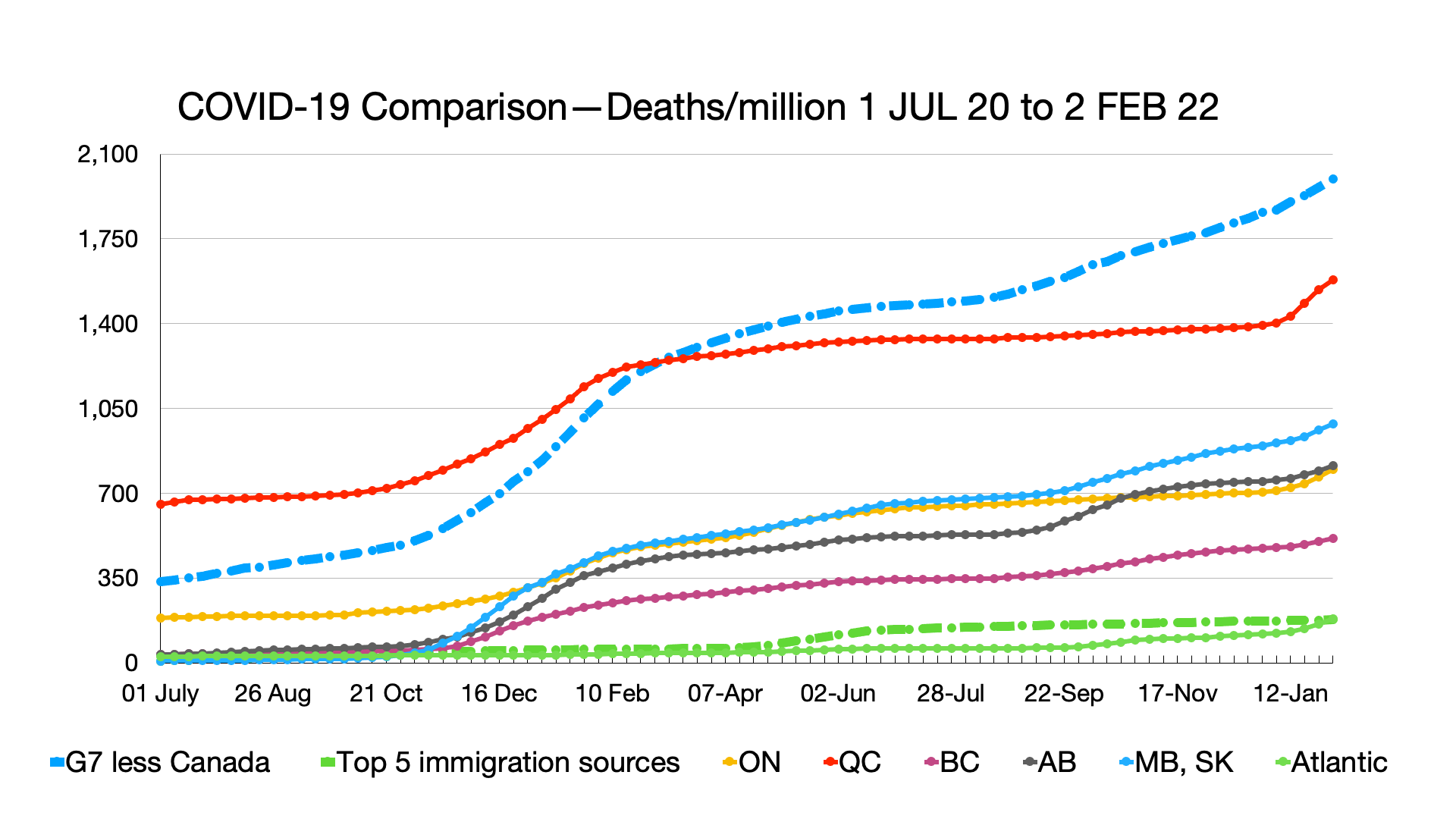
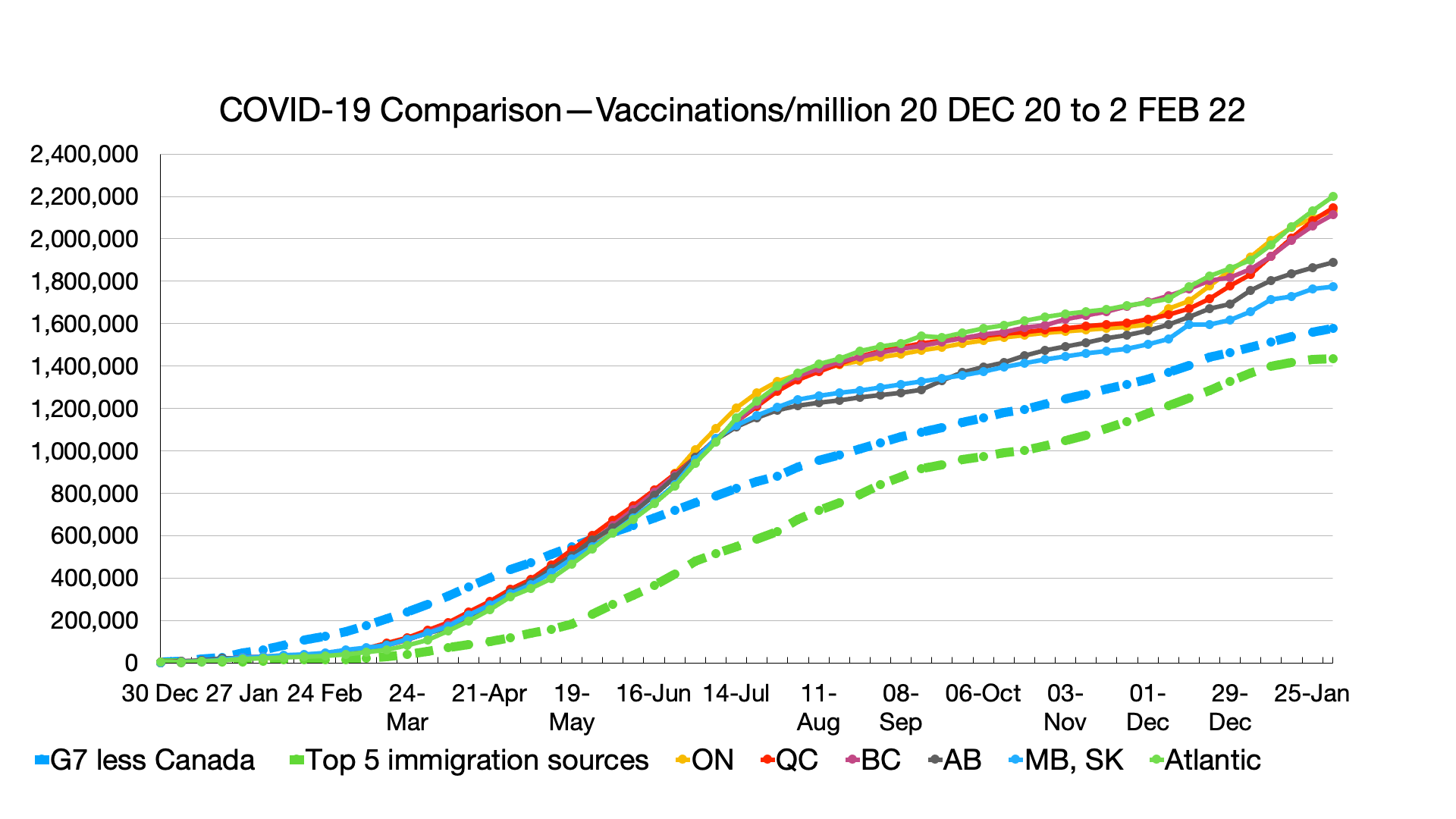
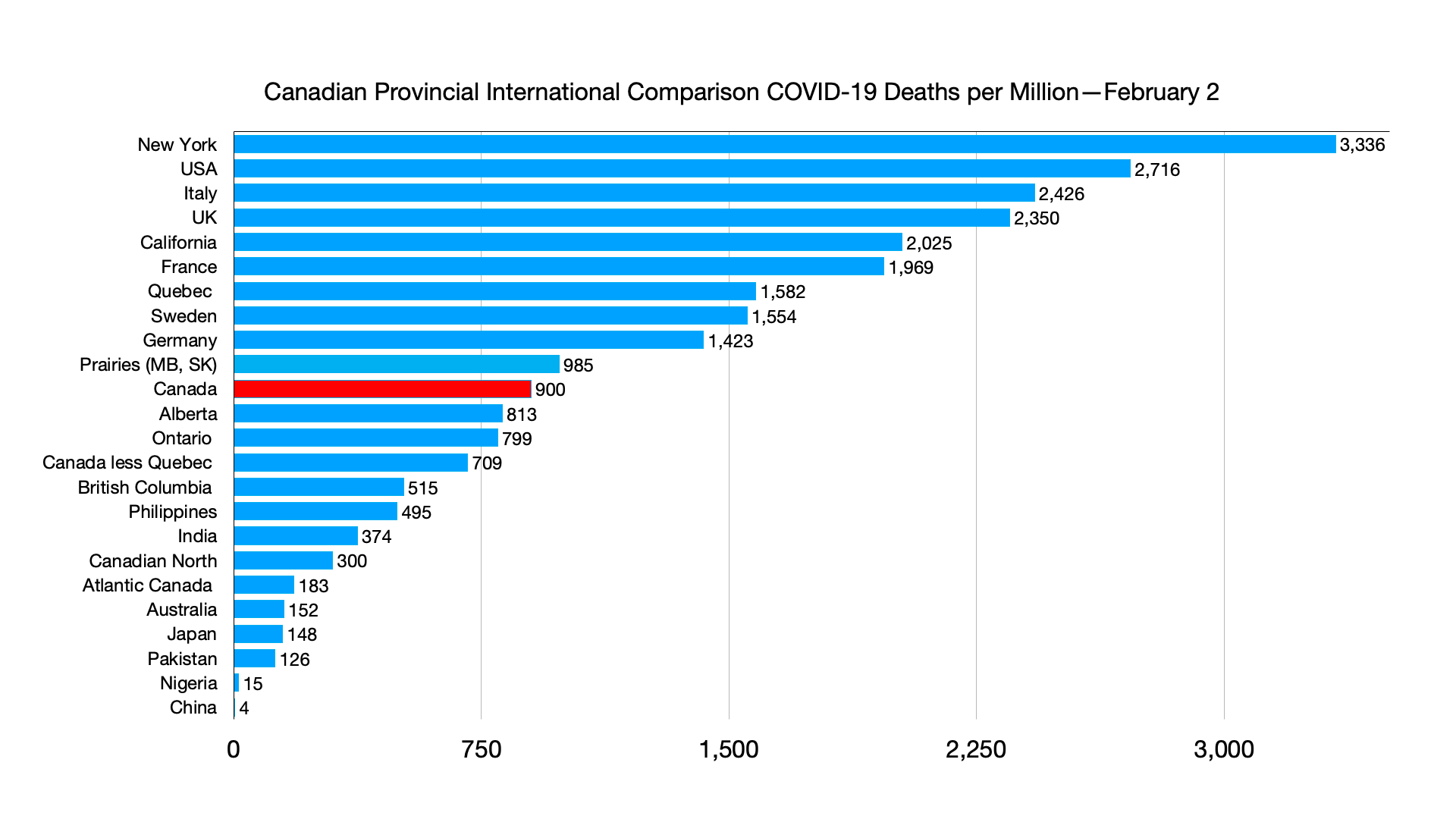
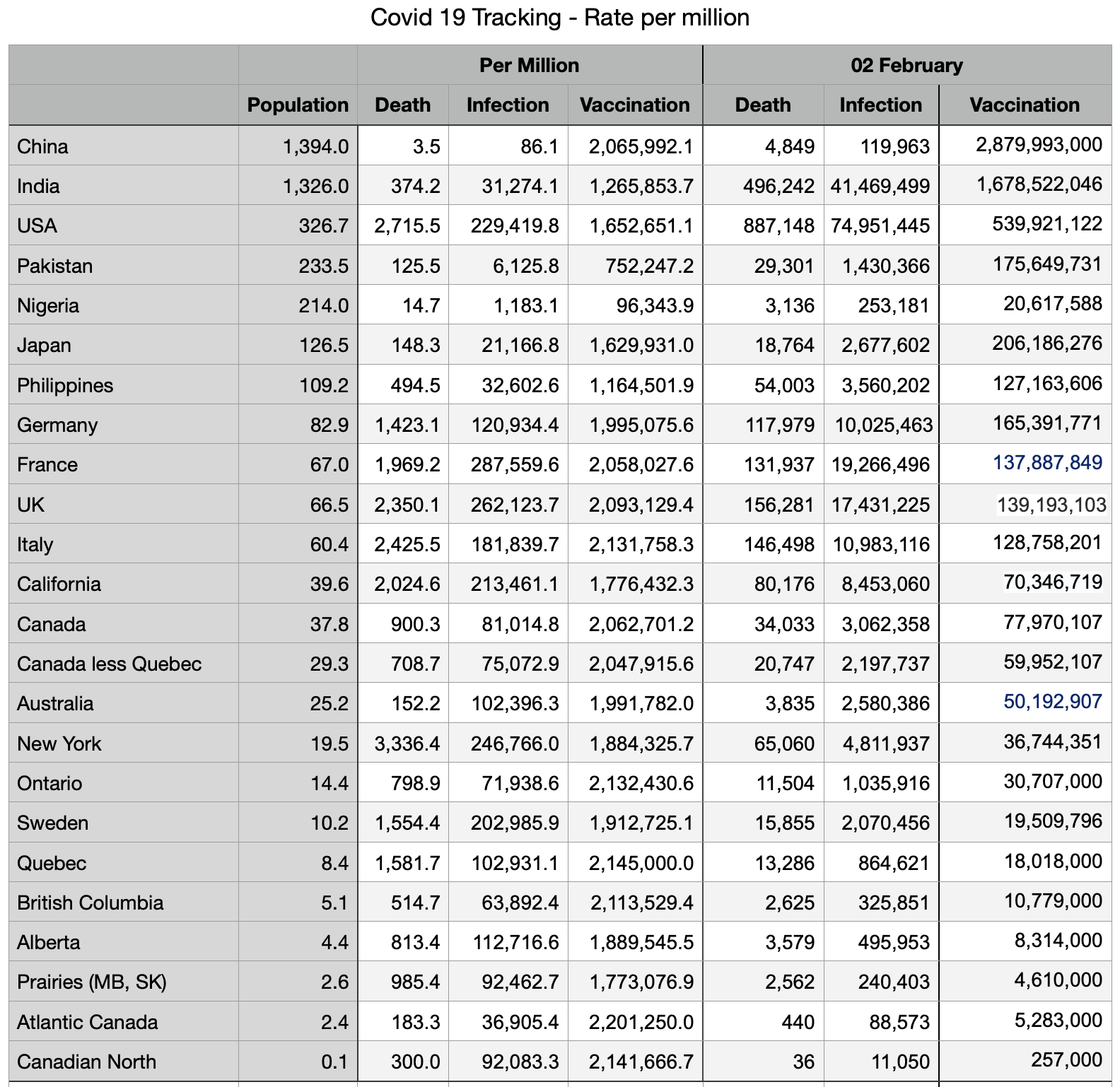
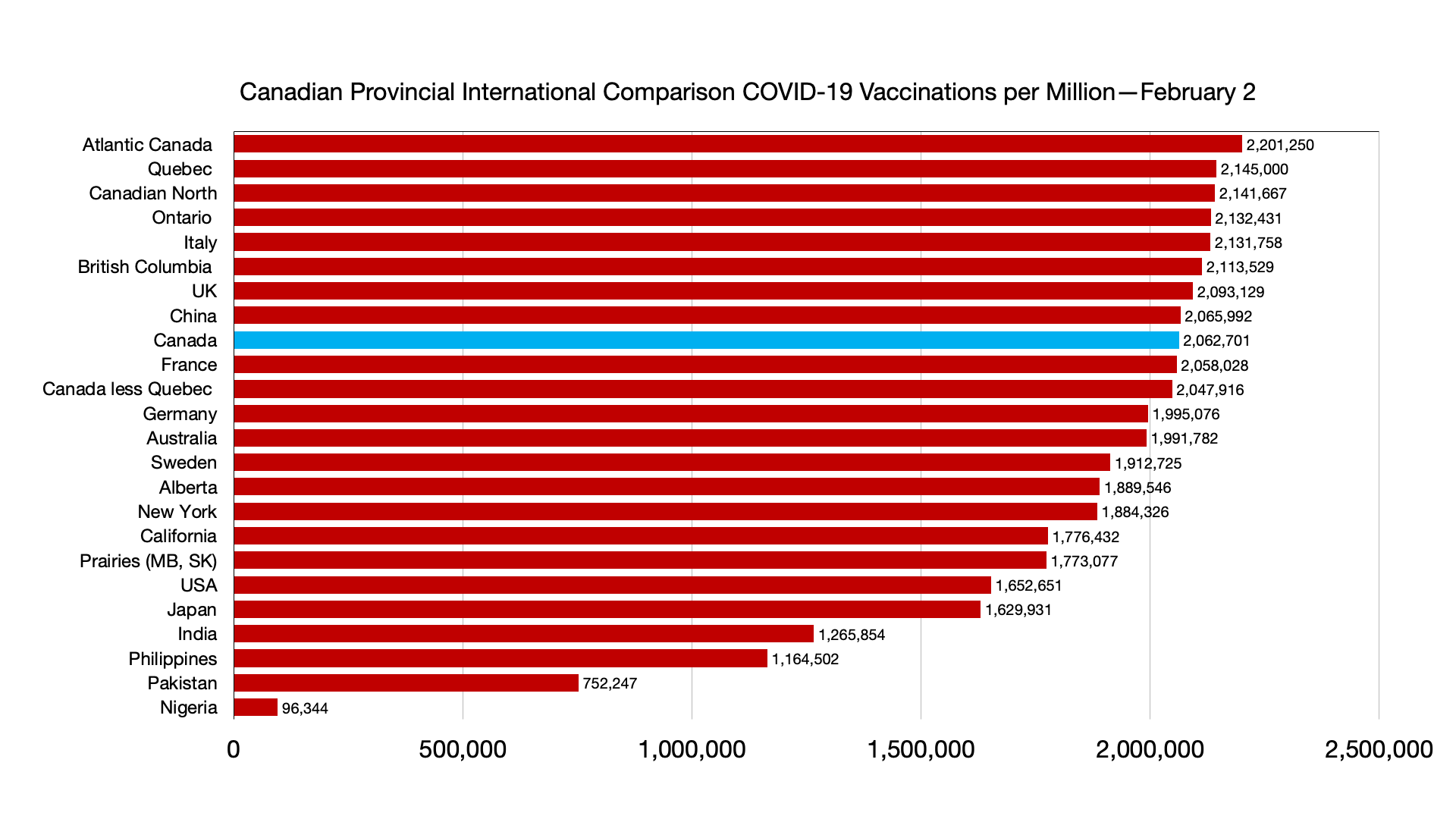
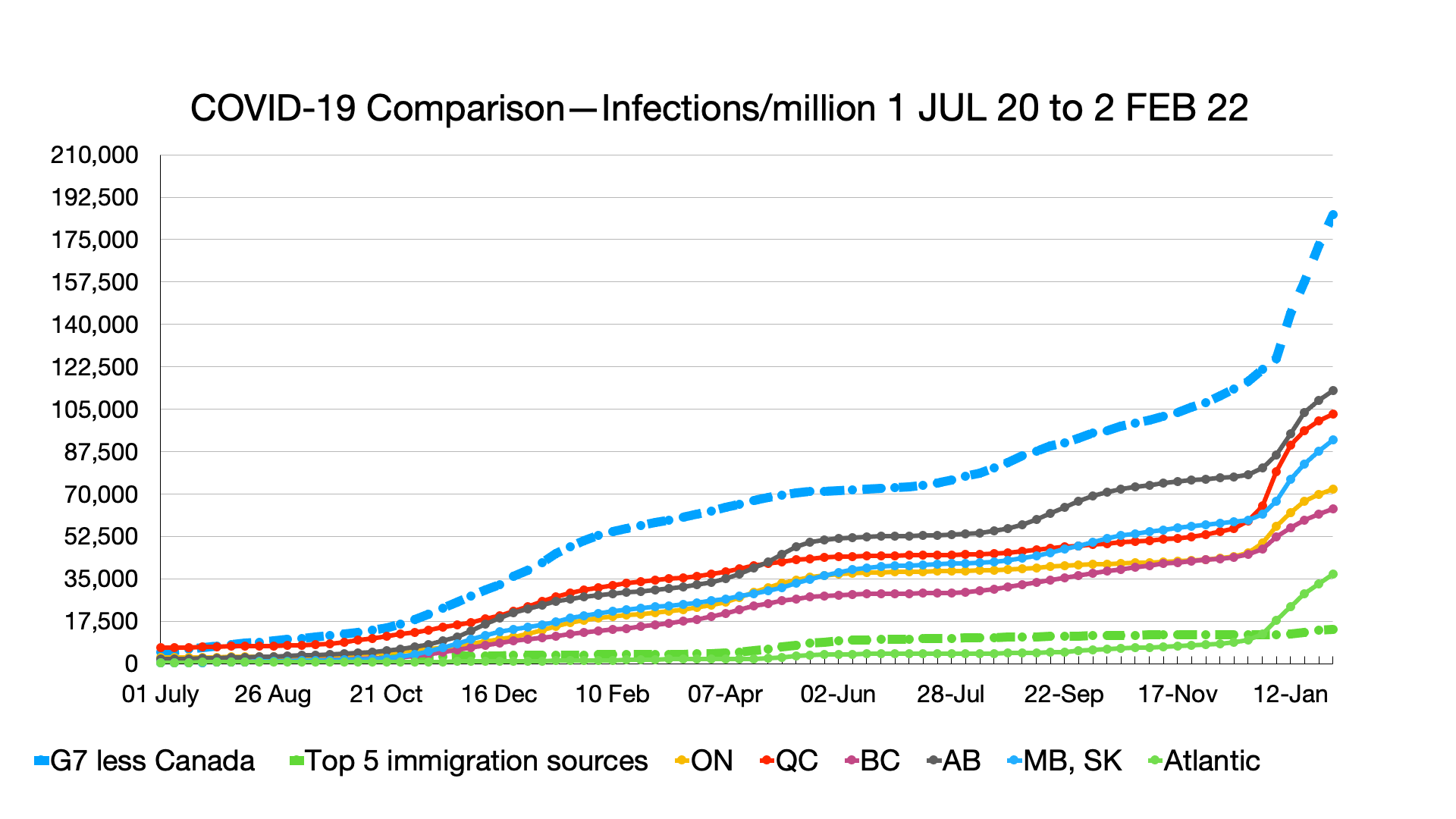
#COVID-19: Comparing provinces with other countries 2 February Update

While infections appear to have plateaued, lagging indicators such as hospitalizations, ICU use, and deaths have not for the most part.

Vaccinations: Some minor shifts but general convergence among provinces and countries. Canadians fully vaccinated 80.3 percent, compared to Japan 79 percent, UK 72.5 percent and USA 64.6 percent.

Immigration source countries are also converging: China fully vaccinated 87.8 percent (numbers have not budged over past two weeks), India 52.3 percent, Nigeria 2.7 percent (the outlier), Pakistan 38.1 percent, Philippines 54.7 percent.

Trendline Charts:

Infections: Moving towards a possible plateauing in most Canadian provinces, G7 less Canada still rising more steeply than Canada.

Deaths: No relative changes but Quebec uptick remains highly visible.

Vaccinations: No major change but Alberta and Prairies continue to be laggards compared to other provinces.

Weekly

Infections: UK ahead of USA, New York and California, Germany ahead of Alberta, Canadian North ahead of Canada.

Deaths: Australia ahead of Japan.

The federal public service desperately needs renewal

Under-reported:

The 28th Annual Report to the Prime Minister on the Public Service of Canada was released on Dec. 13, two weeks after the throne speech, one day before the economic update, and three days before the prime minister’s mandate letters to his cabinet.

The thread that connects each of these major transition milestone documents is the impact of the pandemic, the response to it, and its long-term economic and health implications for Canada. This report addresses the same theme with a focus on the professional public service.

Admittedly, the annual report to the prime minister generates few headlines in the mainstream media. Nevertheless, the report is one of the few public communications between the clerk of the Privy Council and the prime minister in his role as head of the public service. It’s one of his three roles, including deputy minister to the prime minister and secretary to cabinet. The latter two seldom lend themselves to regular or even annual public disclosure.

In broad terms, the report acknowledges the relationship or “partnership” that exists between the elected government and the professional non-partisan public service. While governments may change, the permanent public service supports peaceful transitions from one political party to the next, as well as continuity of services to Canadians, and, indirectly, a measure of predictability that financial markets crave.

The role of the public service is an important one and seldom discussed in any great depth. The annual report on the “state of the public service” provides a measure of transparency to the public, parliamentarians, and civil society. The report usually touches on the dominant issues, challenges, and opportunities that faced the country the previous year, and how the public service responded. While the clerk often highlights significant achievements, such as accepting 50,000 Syrian refugees in 2016, it also acknowledges failures, such as the Phoenix pay system.

This year’s report (April 2020 to March 2021) covered the standard “boilerplate” information contained in annexes, including the composition of the public service, key demographics, and the public service’s more notable achievements and successes that both the prime minister and the public should know about.

The report also looks forward. It recommends doing more to improve diversity and inclusion in the public service, as well as harnessing the “lessons from the pandemic.”

“Like an elastic band, we stretched to support the government’s response to the pandemic,” reads the report. “As the pressure eases, and, in time, it will, the natural inclination will be to ‘snap back’ to our previous state. That should not happen.”

Such strident language by the head of the public service reveals that the pre-pandemic situation wasn’t working particularly well, and the “suspension” of certain rules and procedures was necessary to respond to the public-health crisis at hand.

Yet, it would be a mistake to believe this was a call for the “swashbuckling” days of an older era in Canada that likely never existed in the first place. The clerk notes the need to ensure that probity, risk assessment, transparency, and accountability not be set aside, but perhaps applied in new, less cumbersome ways.

It also recommends exploring the benefits of going fully digital and increasing remote workforces. Each area interconnects with collective agreements, real property, official-language requirements, and possibly employment equity. The Accountability Act, which passed in 2006, would likely need updating.

Taken together, questions posed by the clerk in his report to the prime minister amount to a robust agenda for public-service renewal. Yet no such ambition was referred to in the throne speech, the ministerial mandate letters, or the economic update.

It’s interesting to note that the last reference to public-service renewal in a speech from the throne was under prime minister Stephen Harper in 2013. Admittedly, he didn’t have a global pandemic to contend with, but he did have his fair share of global problems, including the economic crisis of 2008, deficit reduction, and international events requiring the deployment of the Canadian military. Harper nevertheless made space on his policy agenda for altering the public service.

If public-service renewal isn’t in Budget 2022, it probably won’t be on the 44th Parliament’s agenda. It will be interesting to see what next year’s Annual Report to the Prime Minister on the Public Service of Canada says about the issues raised in this one.

Stephen Van Dine is senior vice-president of public governance at the Institute on Governance.

Source: The federal public service desperately needs renewal

German integration chief plans to ‘advertise’ to migrants with citizenship revamp

Of note:

Germany’s integration chief has said she wants to advertise the country to migrants and smooth their path to citizenship, as the country looks to plug expected gaps in the workforce.

Reem Alabali-Radovan said Germany was “in competition with other countries”, such as Canada, to attract migrants with the prospect of a good life and a path to German nationality.

Concerns over worker shortages are fuelled by an ageing population in Europe’s biggest economy, with the number of working-age people projected to decline by 150,000 a year.

Germany has historically been wary of dual citizenship, with some people forced to choose only one passport when they turn 18. But the three parties which formed a coalition last month have promised to loosen these rules.

“Germany has to present itself as a modern country of immigration that offers new prospects,” Ms Alabali-Radovan, who is Secretary for Migration, Refugees and Integration in Chancellor Olaf Scholz’s office, told the newspaper Tagesspiegel.

She said she wanted to support ministers in “advertising Germany” to potential workers.

“I see it as my task to work towards making people here want to stay here,” she said. “There’s much more to that than a work contract – we also need language courses, housing, schools and a chance to be part of society.”

Berlin’s tone contrasts with that of Britain, where Conservative ministers tout stricter migration rules as an accomplishment of Brexit, and France, where right-wing candidates are taking hard lines before April’s presidential election.

The arrival of hundreds of thousands of refugees in Germany after the 2015 migration crisis similarly led to a backlash on the right.

But the centre-left government that took power last month has promised to shorten the period for naturalisation to five years, instead of eight, and simplify the process of obtaining nationality.

Some migrants may be exempted from language requirements if they cannot afford lessons, while the threshold will be lowered for descendants of the mainly Turkish “guest worker” generation of the 1960s and 1970s.

Ms Alabali-Radovan said existing laws meant workers such as carers and tradespeople were facing the threat of deportation because they had only a temporary status in Germany.

“We have a shortage of skilled workers – we need them, we don’t want to deport them,” she said.

The head of Germany’s labour agency last year said the country would need 400,000 immigrants a year to fill its workforce.

Germany has separately promised to take in thousands of vulnerable Afghans, after refugees described fears and bureaucratic delays in the weeks after the Taliban took power.

Ms Alabali-Radovan, 31, is the child of Iraqi parents who left their home country after opposing former president Saddam Hussein’s regime.

Born in Moscow in the last days of the Soviet Union, she moved to Germany in 1996 and settled in the east of the country.

Source: German integration chief plans to ‘advertise’ to migrants with citizenship revamp

Canada squanders economic, social benefits by keeping out new Canadians’ relatives

More an opinion piece than factual reporting. Would be useful if Canada would have overstay data comparable to other countries like the USA:

Canada is losing manifold economic and social benefits and going against its own values when it denies visitor visas and study permits to family members of new Canadians. Denials are rooted in belief that visitors with family ties in Canada are more likely to overstay their visas, but while no data exists to back up this claim, why should that even be a concern?

In the last century, Canada has earned a great reputation for accepting a large number of immigrants and valuing multiculturalism. Immigrants are a great boost for the economy. In fact, Canada’s current plans to accept 411,000 immigrants in 2022 and 421,000 in 2023 were touted by former Minister of Immigration, Refugees and Citizenship Canada (IRCC) Marco Mendicino as a way to help the Canadian economy recover from COVID-19.

Such framing emphasizes how immigrants benefit our economy not just by filling labour force shortages and paying taxes, but also by significantly increasing employment creation.

Despite this warm welcome, new Canadians often face hurdles when their family members wish to come to visit. When applying for a visa, relatives of new Canadians frequently receive the following response: “I am not satisfied that you will leave Canada at the end of your stay as a temporary resident, as stipulated in paragraph 179(b) of the IRPR [Immigration and Refugee Protection Regulations], based on your family ties in Canada and in your country of residence.”

The first three thoughts that come to mind when I encounter a sentence like this are: Do people with family ties stay and those without them return? Is this a favourable decision for the Canadian economy or even the IRCC’s plan? Do officers denying visas consider the repercussions of such a decision?

For this article, I spoke with 11 new Canadians whose family members had gotten multiple denials because of their ties to Canada. These dismissals have affected each of them in various ways.

Many said they felt guilty, believing that rather than being of assistance, they were obstructing their families’ dreams. This is especially true for those whose siblings had education or job opportunities but were turned down because of their familial ties.

Some of the people I spoke to said their family members, particularly their parents, felt Canada could reject their submission multiple times. This resulted in either familial issues or a sour relationship.

Source: Canada squanders economic, social benefits by keeping out new Canadians’ relatives

Livermore, Welsh and Party: Ottawa shirking duty to help Canadians stuck abroad

The rhetoric versus the reality of consular assistance:

There is little that is more predictable than the soothing words spoken by Canadian governments when citizens are in difficulty in foreign countries. “We are fully aware;” “we are working to help;” and “we are doing everything to see them back safely in Canada” are among the familiar refrains.

For many Canadians in serious difficulty, the reality is different. Serious problems are not resolved quickly, communications and transportation are often difficult, legal problems are complex and even longer than in Canada to resolve, and frequently foreign governments do not see the problems of Canadians as warranting urgent action.

There are daily stories and reminders of such experiences and as recent ones demonstrate they are often matters of life and death. Since the 2015 election of the Trudeau government, there have been three deadly and tragic stories. In each, the actions—or lack thereof—by the government have contributed to the problems.

In 2016 two Canadians, John Ridsdel and Robert Hall, were executed in the southern Philippines when the government refused to initiate appropriate and available action to obtain their release from kidnappers. Two other Canadians, Michael Kovrig and Michael Spavor, between 2018 and 2021, spent more than 1,000 days in the prisons of China. Ottawa, once again, refused to initiate appropriate and legal action to see them freed and returned home. It was the action of the United States that led to their release.

Today, nearly 50 Canadian children, women, and men have spent over two years in “filthy, deeply degrading, life-threatening, and often inhuman conditions” in detention centres in northern Iraq and Syria, in the words of Human Rights Watch 2021 annual report. Again, the Canadian government has refused to take action to have these Canadians returned to Canada.

This, despite the willingness of the authorities administering the detainees to have the Canadians returned. As well, other governments, including the United States and allies in Europe and elsewhere, have made arrangements for the repatriation of their citizens from the same areas. The United Nations and the House Foreign Affairs Committee have urged Canada to “pursue all options possible” to repatriate its citizens with the UN placing Canada on a “list of shame” for its lack of action.

So far only a four-year-old child has returned to Canada, initially without her mother, but in the face of court action, the mother was issued a passport and returned home. Who made the arrangements for this child? Not Canadian authorities but a former American diplomat who went to the region and made the arrangements.

Some of these Canadians have now filed an application with the Federal Court seeking relief from the lack of action by the Canadian government. The case is yet to be heard but it is hoped the court will force the government to take the necessary action to have these Canadians returned home using the mobility and legal rights guaranteed by the Charter of Rights and Freedoms.

The government argues it is too dangerous for Canadian officials to go to the region to make the arrangements for the repatriations. This is fallacious—other governments go to the region; international humanitarian organizations operate in the area daily; and the authorities administering the regions are willing and able to assist. But the government maintains Canadian officials are without the ability to do so.

The government’s reasons for not helping are specious and are meant to disguise its complete unwillingness to help this specific group of Canadians. They are the reminders of the thousands of foreigners who rushed to the region in support of the early success of the Islamic State of Iraq and the Levant (IS/Daesh) in 2014. Countering military action by local governments supported by the United States and Russia put an end to IS in the region.

Thousands of the intervening foreign nationals were killed and thousands of other, and women and children, especially, were detained. For the most part, only the Canadians have been refused help by their government. In doing so, Ottawa conveniently ignores these persons are Canadians and are legally entitled to the support and assistance.

The government’s position finds some measure of public support and, importantly, both the RCMP and CSIS oppose the return of these detainees to Canada citing the impact on their responsibilities. Both organizations have a long history of opposing support for Canadians who have travelled to countries in conflict, some for legitimate reasons and others, like the detainees in Iraq and Syria, for misconstrued or illegal reasons. The RCMP and CSIS ignore the scope within our criminal justice systems for possible punishment in Canada.

Investigations by commissions of inquiry and various court applications provided ample examples of this opposition by the RCMP and CSIS. But tens of millions of dollars have been paid to the victims of this opposition and more is pending. For the small group of Canadians in Iraq and Syria it is now time for the government to accept its obligations and make the arrangements for their return to Canada.

Discretion must not be a cover for discrimination.

Dan Livermore is the former director general for security and intelligence. Michael Welsh and Gar Pardy are former directors general for consular services.  All three have served as ambassadors or high commissioners.   

Source: Ottawa shirking duty to help Canadians stuck abroad

Roads blocked during anti-illegal immigration protest in northern Chile

Of note:

The northern Chilean city of Iquique was the scene of roadblocks, store closures and a truck drivers’ strike on Monday, with protesters demanding action to address rising crime and an illegal immigration crisis in that region.

Trucks and other heavy equipment were used to block multiple roads leading into and out of the city and prevent workers from reaching the airport, according to different local reports.

The airport suspended operations early Monday and urged passengers to contact their airline for updates on the status of their flights.

“Retail establishments and the duty-free zone decided not to open, while different social leaders decided to join in the protest. The call (for change) is quite big at this time,” Mayor Mauricio Soria said.

Monday’s actions come after hundreds of people demonstrated Sunday in different parts of the far-northern Tarapaca region – home to Iquique and more than 1,800 kilometers (1,120 miles) north of Santiago – against the presence of undocumented migrants.

During that gathering, some protesters broke up tent structures used by foreigners and held up xenophobic signs.

Similar incidents occurred in September, when a mob of demonstrators burned tents and the belongings of Venezuela migrants who had been using a public square in Iquique as a makeshift nighttime shelter.

Those actions were roundly condemned by authorities and non-governmental organizations.

The Chilean Altiplano (high plain) is the main route of choice for undocumented migrants, despite severe health risks related to that region’s big temperature swings and high elevation.

After a surge in illegal border crossings in February 2021, the crisis worsened further in October when hundreds of mostly Venezuelan migrants fleeing economic crisis in their homeland occupied public squares and avenues, an influx that led the Chilean government to announce the construction of several shelters to mitigate the crisis.

The Office of the United Nations High Commissioner for Refugees said in December that nearly 500 Venezuelan refugees and migrants, including children, cross daily from Bolivia to Chile via irregular border crossings and arrive at their destination “after several days without eating and (suffering from) dehydration, hypothermia and altitude sickness.”

At least two people have died so far this year while trying to cross the border, while at least 23 have perished since migrants began arriving in large numbers in February 2021.

Around 1.4 million migrants live in Chile, equivalent to more than 7 percent of the population. Venezuelans make up the largest portion of the foreign-born population, followed by Peruvians, Haitians and Colombians.

Source: Roads blocked during anti-illegal immigration protest in northern Chile