Black and Indigenous people’s confidence in police and experiences of discrimination in their daily lives

Of note, even if not particularly surprising:

Black and Indigenous people are twice as likely as others to report that they have little or no confidence in police

The everyday experiences and perceptions of Indigenous and Black people in Canada differ from those of the non-Indigenous, non-visible minority people in many ways. Recently, social movements seeking racial and social equity in response to injustice—both current and historical—have demonstrated the importance of measuring and monitoring the perceptions and experiences of diverse populations. In particular, inequities among First Nations people, Métis, Inuit, and racialized groups regarding public safety measures, victimization, and the criminal justice system have been a key focus.

Two Juristat articles, released today, contain detailed analysis of the perceptions and self-reported experiences of diverse populations in Canada, with a particular focus on Black and Indigenous people: “Perceptions of and experiences with police and the justice system among the Black and Indigenous populations in Canada” and “Experiences of discrimination among the Black and Indigenous populations in Canada, 2019.” 

Black people twice as likely as non-Indigenous, non-visible minority people to report that they have little or no confidence in police

Black people have experienced and continue to experience various forms of racism, discrimination and unfair treatment in Canada, many of which are specific to the criminal justice system. On the whole, Black people living in Canada reported being less confident in police. According to the 2020 General Social Survey (GSS) on Social Identity, one in five (21%) Black people aged 15 and older reported having little or no confidence in police, double the proportion reported by non-Indigenous, non-visible minority people (11%).

Among non-Indigenous, non-visible minority people, 7 in 10 (70%) said that they had either some or a great deal of confidence in the police, compared with approximately half (54%) of Black people.

Chart 1  
Confidence in police, by population group, provinces, 2020

Chart 1: Confidence in police, by population group, provinces, 2020

Black people reported having lower general confidence when it comes to specific elements of police performance. Specifically, close to one in three (30%) Black people said that police were performing poorly in at least one part of their job, a higher proportion than non-Indigenous, non-visible minority people (19%).

Compared with the overall population, Black people had particularly negative perceptions of the police’s ability to treat people fairly and to be approachable and easy to talk to. For instance, 20% of Black people said that they felt that police were doing a poor job treating people fairly, compared with 7% of non-Indigenous, non-visible minority people.

Experiences of discrimination more common in the daily lives of Black people

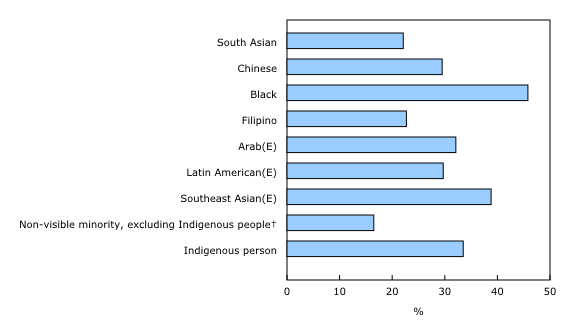
In daily life, Black people were more likely to report experiencing discrimination in a variety of circumstances, including in banks, stores or restaurants, and when dealing with the police. According to the 2019 GSS on Canadians’ Safety (Victimization), nearly half (46%) of Black people reported experiencing discrimination in the past five years—aproportion that was nearly triple that of the non-Indigenous, non-visible minority population (16%).

Chart 2  
Experiences of discrimination in the past five years, by population group, Canada, 2019

Chart 2: Experiences of discrimination in the past five years, by population group, Canada, 2019

Specifically, 4 in 10 (41%) Black people said that they had experienced discrimination based on their race or skin colour.

According to the GSS on Victimization, experiences of discrimination in the five years preceding the survey were more commonly reported in 2019 than in 2014. This was particularly the case among the Black population, with 46% of Black people reporting discrimination in 2019, compared with 28% in 2014.

Indigenous people are significantly more likely than non-Indigenous people to report little or no confidence in the police

Similar to the Black population, Indigenous people reported lower rates of confidence in the police, compared with non-Indigenous, non-visible minority people. Specifically—according to the 2020 GSS on Social Identity—2 in 10 (22%) Indigenous people reported having little or no confidence in the police. This proportion was double that reported by non-Indigenous, non-visible minority people (11%).

Chart 3  
Confidence in police, by Indigenous identity, provinces, 2020

Chart 3: Confidence in police, by Indigenous identity, provinces, 2020

As noted, 7 in 10 (70%) non-Indigenous, non-visible minority people reported having either some or a great deal of confidence in the police. This proportion is much higher than the proportion reported by First Nations people (48%) and Métis (54%). Estimates for Inuit from the 2020 GSS on Social Identity are not releasable because of the sample size.

When looking at indicators of police performance, Indigenous people were more likely than non-Indigenous, non-visible minority people to state police were doing a poor job at the following: enforcing the laws (10% versus 5%), promptly responding to calls (16% versus 7%), providing information on crime prevention (16% versus 9%), ensuring the safety of citizens (11% versus 5%), and treating people fairly (15% versus 7%).

According to the 2019 GSS on Canadians’ Safety (Victimization), one-third (33%) of Indigenous people reported experiencing discrimination in the past five years—a proportion well above that of the non-Indigenous, non-visible minority population (16%). More specifically, experiences of discrimination in the five years preceding the survey were reported by 44% of First Nations people, 24% of Métis, and 29% of Inuit.

Chart 4  
Experiences of discrimination in the past five years, by Indigenous identity, Canada, 2019

Chart 4: Experiences of discrimination in the past five years, by Indigenous identity, Canada, 2019

Often, Indigenous people reported experiencing discrimination based on their ethnicity or culture (15%), or their race or skin colour (14%). These proportions were notably higher than among the non-Indigenous, non-visible minority population (2% and 3%, respectively).

Indigenous people were also more likely than non-Indigenous, non-visible minority people to perceive discrimination or unfair treatment because of their physical appearance (14% versus 5%), physical or mental disability (7% versus 2%), and religion (5% versus 2%).

As was also the case for the Black population, discrimination was more common among Indigenous people in 2019 (33%) than in 2014 (23%). Among the non-Indigenous, non-visible minority population, discrimination also increased, albeit to a lesser extent (from 12% in 2014 to 16% in 2019).

Source: Black and Indigenous people’s confidence in police and experiences of discrimination in their daily lives

Immigration Minister Fraser takes heat for ‘short-sighted’ approach to processing backlogs

Informative account and opposition right to hold government to account on processing times and the choices and trade-offs they made in order to meet the higher levels in 2021:

Opposition MPs accused Immigration Minister Sean Fraser of being “misleading” about processing times for Canada’s considerable immigration backlog, with the department’s timeline to address the 1.8 million applications still “opaque.”

Fraser (Central Nova, N.S.) fielded questions and took heat from some MPs on the House Immigration and Citizenship Committee during his Feb. 15 briefing on immigration timelines and acceptance rates.

The government’s fall economic statement promised to inject $85-million into Immigration, Refugees, and Citizenship Canada (IRCC) to reduce the backlog of 1.8 million applications that continues to grow. The funding is being specifically directed towards reducing processing times for work and study permits, permanent residency applications, and visitor visas. Much of the money is being used to automate aspects of the application review process, as well as introducing electronic systems for immigration applicants to review the status of their applications.

In response to a question from NDP MP Jenny Kwan (Vancouver East, B.C.) about the processing times for family reunification applications, Fraser enthusiastically shared that immigration processing times were back to the service standard of 12 months.

Fraser acknowledged there were some “real frustrations” for some whose family reunification applications got stuck in limbo while Canada’s borders were closed due to the pandemic.

But, through federal investments in the system, including hiring 500 staff, Fraser said IRCC now has “the capacity to process new applications and family reunification streams in 12 months in accordance with the service standard that has existed since before the pandemic.”

However, later in the meeting, officials from IRCC confirmed this standard processing time is only back in place for new applications—not for those applicants who are still pending in the backlog. After hearing this, Kwan said the minister’s comments were “misleading.”

The 12-month processing time only applies to people who are submitting applications starting this year, Daniel Mills, senior assistant deputy minister at IRCC, told MPs at committee.

“However we do have to work on the backlog or the inventory that we have, and that’s what we are doing,” he said.

In the Immigration Levels Plan 2022-2024 tabled in Parliament on Feb. 14, Fraser set new goals for immigration levels, raising this year’s goal of 411,000 new immigrants to 432,000, with the hope to reach immigration levels of 451,000 newcomers to Canada by 2024. One way the department plans to do this, he said, is by boosting departmental productivity due to a new digital platform in the works. For MPs at committee, however, questions still remained as to how the department will clear the existing backlog, rather than more quickly process new and future applications.

In an interview with The Hill Times, Kwan said she hears from constituents who have family who have applied through the family reunification stream that have been stuck in the system for two or three years “all of the time.”

“Those people have already missed the boat with respect to that processing standard,” Kwan concluded. “And they’re going to probably get another problem because soon people will come back and say, ‘how come the newer applicants got processed before me?’”

Kwan called it a “short-sighted way of dealing with the situation.”

“They’re trying to create this perception that they are somehow on top of things, when in fact, frankly, they’re not. And the system remains opaque. There’s a lack of transparency, and lack of accountability,” she said.

At committee, Conservative MP Rosemarie Falk (Battlefords-Lloydminster, Sask.) followed up on Kwan’s point.

“I’m actually very concerned with what MP Kwan had just brought up. What I had heard you as the official say is that applicants as of this month, February 2022, will have the service standard of 12 months. So what is happening to all of the backlogs previous to this? What is the timeframe to clean these backlogs up?”

The department’s answer: “it depends.” Family class applications, for instance, has 35,000 pending applications, Mills said, and the department processed 8,000 applications in January—above the average processing rate of about 6,000 applications per month the department saw in 2021.

Falk pressed officials during the same exchange to offer details on Fraser’s instructions to the department.

“What direction has the minister given the department to clean up these backlogs, that I’m hearing the excuse of the delayed processing times is because of COVID?”

Mills told Folk the department is trying to reduce the inventory and process them “as quickly as we can.” That is being sped up through digitization of files, which allows the department to process applications virtually, he said.

Off the bat, Fraser laid blame for the backlog at the feet of the COVID-19 pandemic.

“As the members of the committee know, the pandemic has caused applicants processing delays and backlogs,” he said in French. In English, “folks, it’s not lost on me that there are challenges when it comes to processing in the immigration system,” he stated.

Several members of the committee across parties did not accept that premise, and said the COVID-19 pandemic was being used as an “excuse.”

Kwan said “that excuse is running tired.”

“Let’s face it, there were backlogs pre-pandemic. There’s no question that COVID has exacerbated it. But you know, we’re more than two years into the pandemic,” said Kwan, who is her party’s immigration critic.

Fraser said the primary cause of the backlog was the fact that during the first year of the pandemic when borders were closed, Immigration, Refugees, and Citizenship Canada stopped bringing in new immigrants, and instead processed the applications of newcomers and permanent residents who were already in Canada.

COVID-19 public health orders also resulted in the shut-down of a number of in-person immigration offices and services within an application process that requires some elements to be conducted in-person. Prior to the pandemic, for instance, citizenship ceremonies were only ever done in-person, and initially, the pandemic put these ceremonies on hold. Now, the minister said they are able to conduct them online, which should help expedite the clearing of that backlog.

“At the same time, when we were welcoming people who were located in Canada already, we continued to see a significant number of applications that were coming in from people who were overseas,” Fraser said.

He said he believed it was the right decision to make, and as a result of focusing on applications of people who were already here, Canada welcomed the most new permanent residents in any year.

“But we knew that that would come with certain consequences that we now need to deal with.”

At the meeting, Conservative MP Kyle Seeback (Dufferin-Caledon, Ont.) cited backlog figures including 548,000 Permanent Resident applications, 112,392 refugee applications, 775,000 temporary resident applications, including study permits and work permits, and; 468,000 Canadian citizenship applications.

Conservative MP Jasraj Singh Hallan (Calgary Forest Lawn, Alta.) also took issue with the suggestion that COVID-19 was responsible for the delays and lack of communication he is hearing about from Afghan refugees and their families who are trying to come to Canada.

“You know, it’s easy for now to say, you know, it’s COVID, and we didn’t have time or IRCC wasn’t prepared, but I mean, [the government was] more prepared for an election plan than they were for an evacuation plan. And the same thing goes with IRCC… I don’t think we can use COVID as an excuse anymore for what’s going on,” he said in an interview after the meeting.

MP Hallan’s exchange with the minister became heated early in the meeting, with Hallan concluding his line of questioning with accusations of the election taking priority over Afghan refugees. Tensions were high at the meeting as Conservative MP Brad Redekopp (Saskatoon West, Sask.) accused immigration officials of “remarkable callousness” in their lack of response to applicants, citing an instance in which one of his constituents’ permanent residence card was 66 days overdue, meaning she could not travel home to visit her dying mother.

“Is this a systematic failure based upon incompetence or are you maliciously blocking PR cards for people who want to see their dying parents?” Redekopp asked. The minister said he would “pass on commenting” on malicious intent.

“I can reassure all members of this House that any challenges that we are facing are due to the circumstances tied to the pressures that COVID-19 has put on Canada’s immigration system, including on PR cards, which typically require somebody to show up for an in-person appointment when many of the offices have been closed down and there hasn’t been that opportunity for face to face engagement,” Fraser said.

Source: Immigration Minister Fraser takes heat for ‘short-sighted’ approach to processing backlogs

Being Black in Mexico: How this country is changing its views

Of interest. Likely a lot of colourism in Mexico as in many countries in Latin America:

Black Mexicans are starting to get widespread public recognition after centuries of being ignored.

Why it matters: Mexico has historically underplayed the roles and contributions of Black people, largely keeping them out of textbooks, too.

  • The country added Afro-Mexicans to the Constitution’s second article, which lauds the nation’s multiculturalism, in 2019.
  • The 2020 Census asked, for the first time, whether people identified as Black, Afro-Mexican or of African descent.

What to know: Two out of 100 Mexicans, or around 2.5 million people, identified as Black in the Census.

  • Black communities are mostly found in Veracruz — where the Spanish disembarked enslaved people from Africa — and the coast of Oaxaca and Guerrero, where Afro-Indigenous traditions from colonial times endure, like the dance of the devils for Day of the Dead.
  • Mascogos, descendants of Black Seminoles and of people who fled U.S. slavery in the 1830s after Mexico outlawed the practice, live in Coahuila state, which borders the U.S.

Between the lines: The Spaniards had a racist caste systemthat considered Blackness the lowest societal status, creating a stigma around identifying as Black.

  • A majority of Mexicans consider themselves mestizos, or mixed race, and many falsely claim that disparities in access to education or jobs are due solely to socioeconomic differences, not skin tone.

What they’re saying: “It was difficult and painful to come out and say ‘soy negra,’ because it’s almost ingrained into you that the term itself is bad, let alone being Black,” Denisse Salinas, who owns a coffeehouse in Oaxaca, told Axios Latino.

  • “But I see many young people doing the same as me, reclaiming the term and identity, and that does give me a glimmer of hope.”

Flashback: Historians believe two key figures in Mexico’s independence were of African descent:

  • José María Morelos y Pavón, who led insurgents to occupy and reclaim the south and southeast parts of Mexico.

  • Vicente Guerrero, who was Morelos’ right-hand man and went on to be the second president of Mexico. Guerrero declared the end of slavery.

Source: Being Black in Mexico: How this country is changing its views

#COVID-19: Comparing provinces with other countries 16 February Update

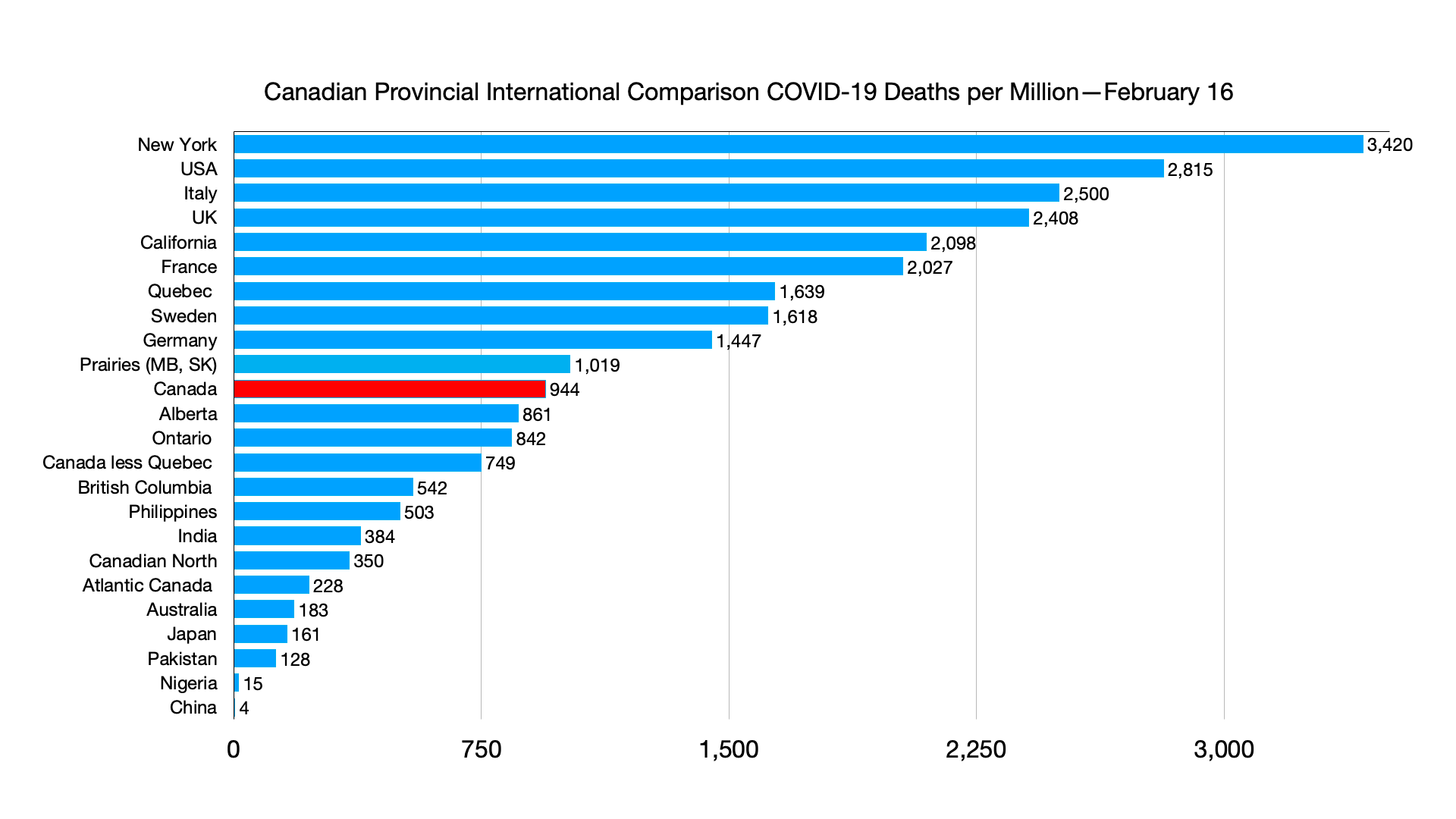
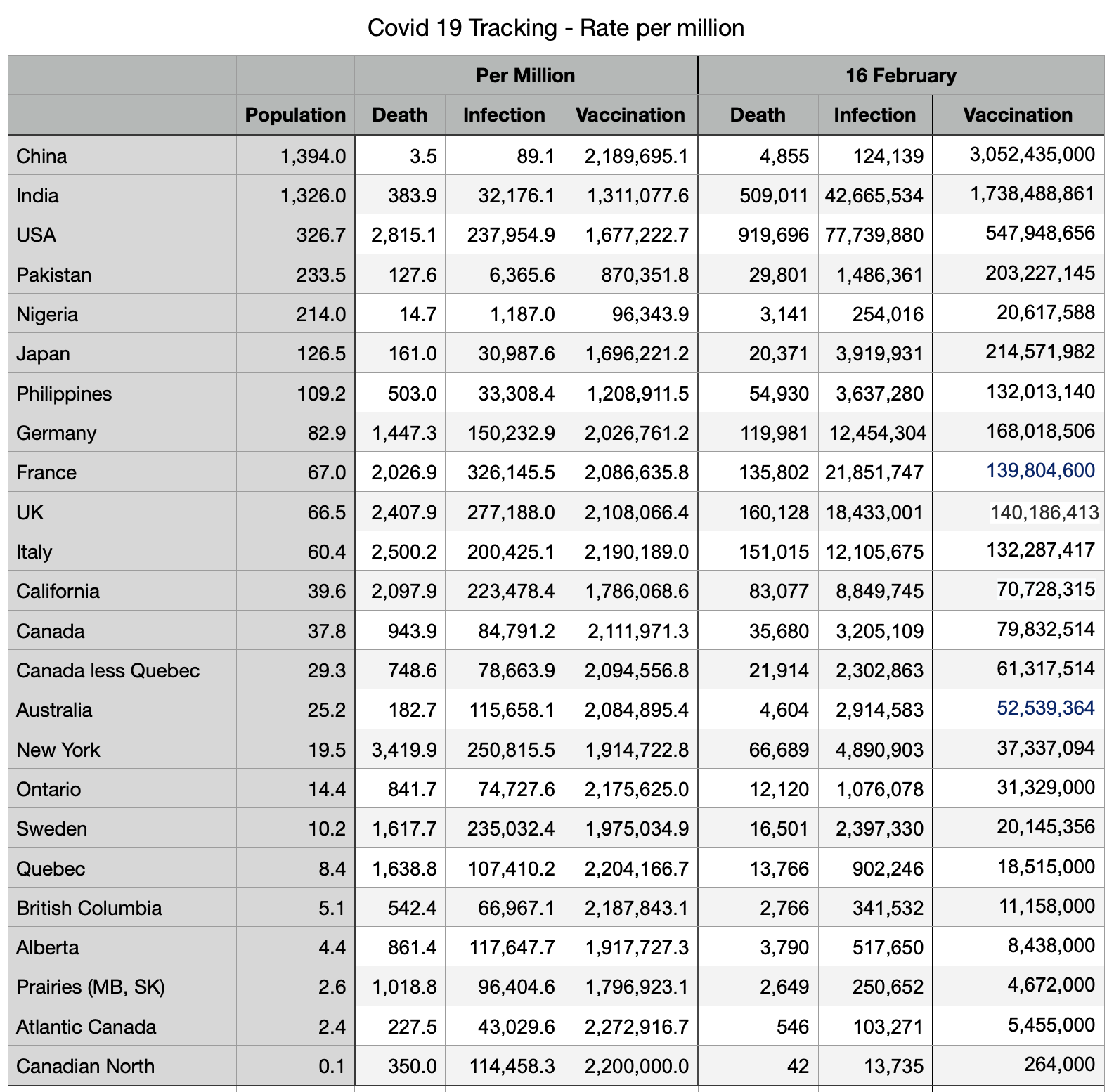
Overall decline in infections and deaths as omicron wave passes. Note Saskatchewan data is from previous Thursday given the government’s “see no evil” strategy of no longer publishing daily statistics.

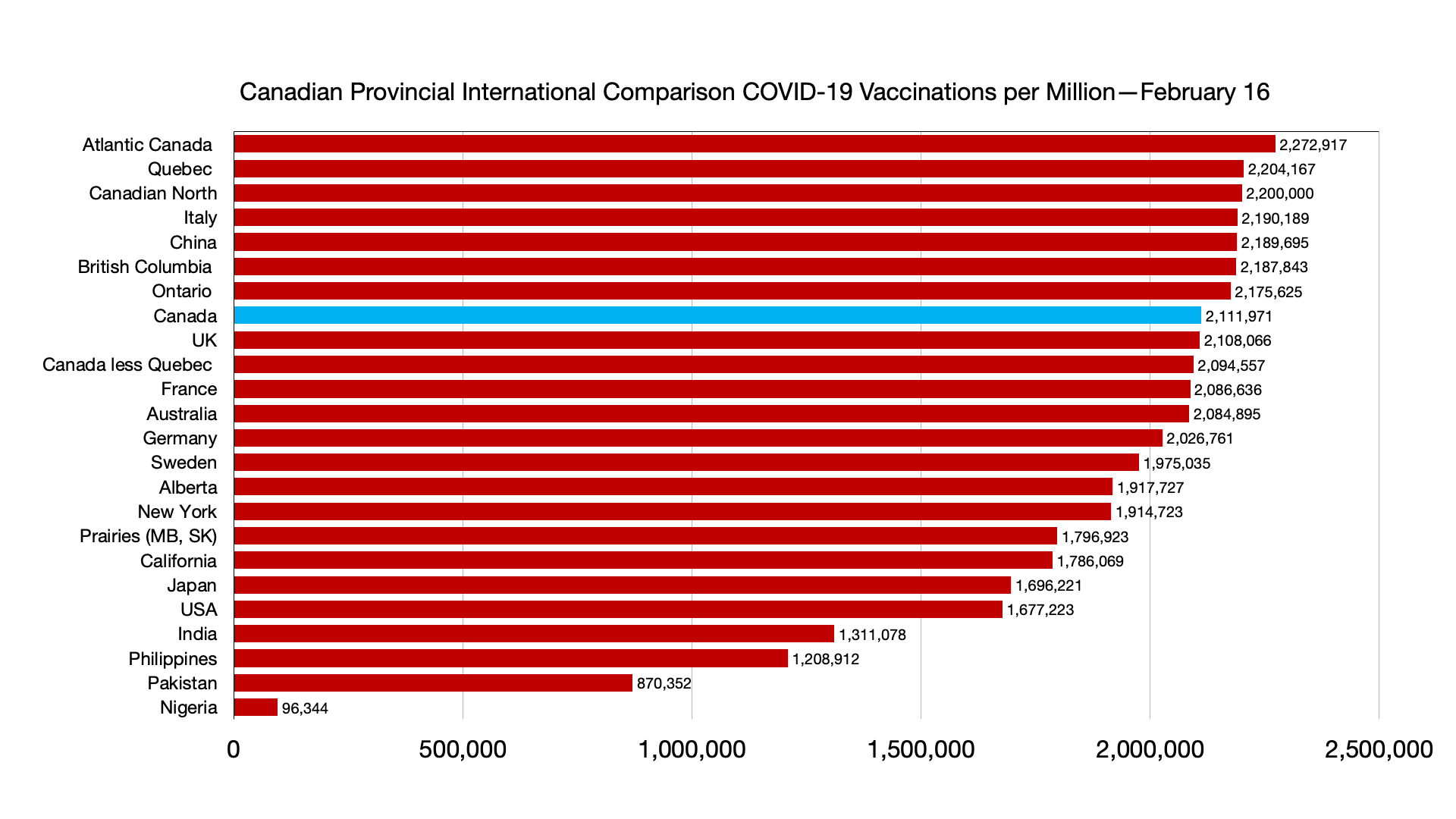
Vaccinations: Some minor shifts but general convergence among provinces and countries. Canadians fully vaccinated 81.6 percent, compared to Japan 79.2 percent, UK 72.7 percent and USA 64.9 percent.

Immigration source countries are also converging: China fully vaccinated 87.9 percent (numbers have not budged over past three weeks), India 55.6 percent, Nigeria 2.7 percent (the outlier, unchanged), Pakistan 43.2 percent, Philippines 56.7 percent.

Trendline Charts:

Infections: Further signs of omicron and other variants plateauing.

Deaths: Quebec plateauing.

Vaccinations: No major change but Alberta and Prairies continue to be laggards compared to other provinces given resistance among residents and political considerations.

Weekly

Infections: No significant relative changes.

Deaths: No relative change.

Immigration Plan 2022-24: Reports and Reactions

Expect to see more detailed analysis and commentary over coming days to round out the initial reporting.

Overall, the plan continues the government strategy of growing the economy through growing the numbers of immigrants.

This reflects the various interests of the “immigration industry” and business: more bodies means more consumers, more work for immigration lawyers and consultants, more funding for settlement organizations, more research opportunities for academics etc.

Not surprisingly, no questioning of these perspectives in articles and commentary to date (see my earlier Increasing immigration to boost population? Not so fast.). The government strategy continues to be based on overall GDP growth, not per capita GDP growth and productivity, a long standing issue that governments have tried to address with limited to no success.

The articles below capture some of the aspects which groups and individuals quoted have raised as concerns, but these are all in the context of general suppoort.

In terms of the politics of the plan, unlikely that this will create many issues for the government. The NDP generally supports higher numbers and the Conservatives will likely continue to focus on implementation and administrative issues, given the backlogs and that this is much safer than engaging in a debate over numbers, given their vulnerability to charges of being anti-immigration (unfair IMO but too tempting a target for the Liberals given the Conservatives still wear the legacy of the “barbaric practices tip line” and other ill-thought political messaging).

Given the overall shorter-term perspective of most immigration analysis and commentary, I continue to advocate for a royal commission or equivalent for a more independent and thorough look at immigration policy and programs with a longer-term perspective.

Media articles and commentary to date (nothing negative so far but expect some in more right leaning media and will continue to monitor):

The Star:

Canada plans to welcome more than 1.3 million new immigrants to the country over the next three years to help its economy recover from COVID-19 and to drive future growth.

Immigration Minister Sean Fraser’s multi-year immigration-levels plan was announced Monday.

“If we’re not ready to significantly increase our ambition when it comes to immigration, we are going to be in a position where our economy will suffer, and it could put into jeopardy so many of the public services and social supports that make me very proud to be Canadian,” Fraser said.

But the plan comes amid calls from critics for the federal government to first reduce the ballooning backlog of 1.8 million applications piling up in the system as a result of slowed processing capacity during the COVID-19 pandemic.

The new plan calls for an annual intake that will reach 431,645 in 2022; 447,055 in 2023; and 451,000 in 2024 — equivalent to 1.14 per cent of the population by 2024.

This year, the number of new permanent residents will include 241,850 from the economic class; 105,000 through family reunification; and 76,545 as refugees and protected persons.

Canada reached its 2021 goal — bringing in a record 405,000 newcomers — largely by granting permanent residence to migrants such as international students and foreign workers who were already in Canada and therefore not hampered by pandemic travel restrictions and border closures.

However, the disruptions caused by COVID-19 here and abroad — and the unexpected Afghan refugee crisis — have created an unprecedented backlog in the immigration system that experts believe will take at least three years to clear.

As of December, there were 548,195 pending permanent residence applications; 775,741 temporary residence applications, including study and work permits; and 468,000 citizenship applications in the queue for processing.

Fraser said he hopes to rein in the backlog through additional hiring and by modernizing processing through new digital platforms.

The new plan will change the composition of the intake slightly this year, with the share of economic and skilled immigrants down from 60 per cent to 56 per cent. The portion of newcomers under the family class will also fall from 26 per cent to 24 per cent, while the ratio of refugees will go from 14 to 20 per cent.

Immigration policy analyst Kareem El-Assal said he’s unsure how reducing the share of economic migrants to Canada is going to benefit the country’s economy, which faces a labour shortage equivalent to nearly one million jobs.

“That’s what they’re trying to tell us. And then you look at the numbers and you see that’s not what’s happened,” said El-Assal, managing editor of immigration news site CIC News and policy director at CanadaVisa.com.

“You don’t have to spin anything for us. Just tell us, ‘This is what we’re doing temporarily. We’re going to be reducing the economic class share and the family class share temporarily for two years so that we can accommodate more refugees.’”

Calling the government plan “ambitious,” Ravi Jain of the Canadian Immigration Lawyers Association said he was concerned about reducing the permanent residence quota for federal high skilled workers by half, from 111,000 to 55,900.

During the pandemic, many international students have been unable to earn the job experience they need to qualify for permanent residence despite the high tuition fees they have paid. Jain said Ottawa needs an immediate plan to extend their work permits in Canada.

“They’re going to be waiting potentially a few years and they’re going to need the status to be able to buy that time,” said the Toronto lawyer. “There are some major concerns around what to do about the people who are here and who won’t necessarily have a pathway for permanent residence.”

The federal government has devoted $827.3 million over five years to enable the department to develop and deliver an enterprise-wide digital platform, with an additional $85 million to hire staff to reduce backlogs.

But the system hasn’t transformed fast enough to meet the insatiable demand for immigration to Canada.

Shamira Madhany, managing director of World Education Services, said Canada can’t rest on its laurels, as other countries are also competing for skilled talents for their post-COVID economic recovery.

“What Canada has done here is basically saying, ‘Our borders are open for immigration,’” said Madhany. “In terms of our capacity (to absorb immigrants), it’s a different question. We need to make sure we have mechanisms and tools in place to leverage their prior skills and experience. We don’t want highly skilled people to come here to do low-skilled jobs.”

MP Jenny Kwan, the NDP immigration critic, said Fraser’s plan shows a continuation of the Liberals’ Band-Aid approach to systemic immigration problems.

“The government simply cannot continue to shift resources and immigration levels from one stream to another. This pattern of behaviour has and will continue to create further problems and chaos in the system,” said Kwan.

Source: Canada wants to welcome 1.3 million newcomers over three years — but can its immigration system keep up?

Globe and Mail:

The federal government aims to welcome nearly 432,000 immigrants to Canada this year, as a part of a three-year plan to fill critical labour-market gaps and support a post-pandemic economic recovery.

The annual immigration levels plan, tabled in Parliament Monday, projects Canada will admit 431,645 permanent residents in 2022, followed approximately by 447,000 in 2023 and 451,000 in 2024. The majority of the permanent resident spots – 56 per cent – will be designated for immigrants coming to Canada to fill job vacancies this year.

Speaking to The Globe and Mail, Immigration Minister Sean Fraser said the COVID-19 pandemic has highlighted how key immigrants are to Canada’s success, as newcomers fill many front-line jobs.

“When I talk to restaurants, machine shops, health care providers or virtually any other business, I see help-wanted signs in windows,” Mr. Fraser said.

“By launching what is the most ambitious immigration plan in the history of Canada, we are going to equip the Canadian economy with the workers it needs.”

Ottawa says immigration accounts for 100 per cent of labour-force growth and, with five million Canadians set to retire by the end of this decade, the worker-to-retiree ratio will drop – demonstrating the need for increased immigration.

Goldy Hyder, president and chief executive officer of the Business Council of Canada, said the number of job vacancies in the country is near an all-time high and immigration will be a key driver of pandemic recovery. He welcomed the government’s immigration targets Monday, but he said the plan must be supported by increased processing capability and supports for newcomers.

“To help meet these new targets, we urge the government to expand the immigration system’s processing capacity by adding new processing centres, updating outdated IT systems, and increasing recruitment and training of border agents and settlement services personnel. A growing workforce should also be accompanied by increased investments in public services, housing, and infrastructure,” Mr. Hyder said in a statement.

Mr. Fraser said the government recently hired 500 new processing staff and set aside $85-million in new funding to reduce application backlogs.

NDP immigration critic Jenny Kwan urged the government to introduce special immigration levels to give the 500,000 migrant workers already in Canada a path to settlement and help address the labour-skill shortage.

While the government plans to increase the number of economic immigrants it welcomes to Canada over the next three years, from nearly 242,000 this year to more than 267,000 in 2024, it will simultaneously reduce the number of refugees to whom it offers safe haven. Canada will resettle approximately 77,000 refugees this year, 74,000 in 2023 and 62,500 in 2024. Mr. Fraser said resettlement numbers will gradually decrease as Canada follows through with its commitment to resettle 40,000 Afghan refugees over the next two years. More than 7,550 Afghan refugees have been resettled in Canada since last August.

The reduction in refugee-resettlement targets – particularly the government’s plan to accept more privately sponsored refugees than government-assisted refugees – has sparked concern for advocates.

“The responsibility to resettle refugees lies with the government – to reflect that responsibility, the government should resettle more refugees than private citizens. Yet the levels show private sponsors are being asked to do one and a half times as much resettlement as the government,” the Canadian Council for Refugees said in a statement.

Overall immigration levels have grown substantially since the Liberals took power in 2015. Numbers continued to grow until 2020, when Canada only admitted 184,500 newcomers because of the challenges posed by the pandemic. Shuttered overseas visa offices, closed borders, quarantine restrictions and challenges booking flights heavily affected the immigration system.

Immigration numbers rebounded in 2021, when Canada welcomed 405,000 new permanent residents – breaking the all-time record set in 1913. The majority of the newcomers were already in Canada on temporary status, including temporary foreign workers in the skilled trades, health care and technology, and international students.

The government has not tabled an immigration levels plans since October, 2020. It normally announces it immigration targets by Nov. 1, but last year’s plan was delayed because of the federal election.

Source: Canada aims to welcome 432,000 immigrants in 2022 as part of three-year plan to fill labour gaps

Le Devoir

Ottawa espère également atteindre enfin sa cible d’immigration francophone hors Québec en 2023, soit 4,4 % de toutes les admissions, une cible ratée depuis des années selon le commissaire aux langues officielles.


En 2020, 184 606 résidents permanents ont été enregistrés au Canada, c’est-à-dire beaucoup moins que la cible annoncée de 341 000, confirme également ce rapport annuel. Ce nombre, selon le ministre Fraser, est néanmoins un « succès impressionnant compte tenu des fermetures et des restrictions frontalières » dues à la pandémie, y écrit-il.


Pour cette même année, on a compté 326 116 titulaires de permis de travail temporaire au pays, ce qui illustre une autre tendance lourde, soit l’augmentation des catégories temporaires. Ce qui s’appelle le « solde de résidents non permanents » représentait 1,3 million de personnes au 1er janvier 2020, selon des informations communiquées précédemment par le ministère fédéral de l’Immigration au Devoir. Les détenteurs de titre de séjour temporaire, toutes catégories de permis confondues, représentaient ainsi près de 3,5 % de la population totale la même année.


Il s’agissait lundi de la première annonce officielle de cibles depuis octobre 2020. En décembre dernier, le ministre Fraser avait affirmé dans une entrevue au Devoir vouloir être le gouvernement le plus ambitieux de tous les temps en matière d’immigration.


Pour 2021, il estime avoir atteint « cette réalisation historique » en accueillant plus de 401 000 nouveaux résidents permanents, avait-il annoncé par communiqué. La majorité de ces personnes était déjà à l’intérieur des frontières sous un statut temporaire et a accédé à la permanence par divers programmes.


Le record précédent datait de 1913, quand 400 900 nouveaux immigrants permanents avaient foulé le sol canadien. Le pays comptait alors seulement 7,6 millions d’habitants ; cet afflux représentait donc une proportion plus importante de sa population totale, soit plus de 5 %. En comparaison, la cible d’immigration pour 2022 équivaut à 1 % de tous les Canadiens.

Source: Ottawa dévoile des cibles d’immigration encore plus ambitieuses

New Canadian Media

Canada aims to attract about 1.3 million new immigrants over the next three years to help fill critical labour shortages and fuel post-pandemic growth.

Minister of Immigration, Refugees and Citizenship (IRCC) Sean Fraser announced the new targets on Monday as the government struggles to clear a backlog of about 1.8 million visa/citizenship and other applications in the queue exacerbated by pandemic-induced delays.

At the same time, the latest numbers from Statistics Canada show that job vacancies in the country remain high, with 874,700 unfilled positions.

In a statement, IRCC said there are still hundreds of thousands of positions in all sectors waiting to be filled. 

Immigrants  needed

“Immigration already accounts for almost 100% of labour force growth, and with 5 million Canadians set to retire by the end of this decade, the worker to retiree ratio will drop down to only 3:1,”  it said. “This is a clear sign that we have a strong economic need for increased immigration.”

The 2022–2024 Immigration Levels Plan aims to continue welcoming immigrants at a rate of about 1 per cent of Canada’s population, including 431,645 permanent residents in 2022 (an increase of about 21,000 people from its original plan), 447,055 in 2023, and 451,000 in 2024. 

“From farming and fishing to manufacturing, healthcare and the transportation sector, Canada relies on immigrants. Setting bold new immigration targets, as outlined in the 2022-2024 Levels Plan, will further help bring the immeasurable contribution of immigrants to our communities and across all sectors of the economy,” Fraser said during the announcement.

To support the new ambitious targets, which follows a record year of 405,000 new permanent residents in 2021, IRCC had earlier announced a plantomodernize Canada’s immigration system to fuel economic recovery and improve client experience.

Veteran Vancouver-based immigration lawyer, Richard Kurland, told  NCM  that “IRCC is banking on new information technology to deliver an aggressive program that will be faster for applicants and cheaper for government.”

“The objective is to have more people here, in less time, at less cost,” he said.

Goldy Hyder, president and CEO of the Business Council of Canada, said “even with full employment, the country will need newcomers to help fill all the jobs available.”

“To help meet these new targets, we urge the government to expand the immigration system’s processing capacity by adding new processing centres, updating outdated IT systems, and increasing recruitment and training of border agents and settlement services personnel,” Hyder said in a statement.

Perpetuating problems’

Jenny Kwan, the Vancouver East MP, who also acts as the NDP Immigration Critic, said the government is actually scaling back the Federal Skilled Workers Program by almost 50 per cent by shifting resources and immigration levels from one stream to another. 

“The immigration levels released today shows that the government is perpetuating the problems they created when they failed to adjust the levels to accommodate the new (temporary to permanent resident pathway) immigration measure,” she said.

The measure, also known as TR2PR, is a limited-time pathway to permanent residence applicable only to temporary residents currently working in Canada and to their families.

According to a government memo cited by the National Post, the federal skilled workers program was being scaled back because IRCC simply can’t process the applications quickly enough. 

It also said the “reductions are due to admissions space required to accommodate the TR2PR stream and the resettlement of Afghan nationals to Canada.”

“This pattern of behaviour has and will continue to create further problems and chaos in the system,” Kwan told New Canadian Media in an email.

The Canadian Immigration Lawyers Association (CILA) said it is pleased with the modest newcomer increase announced today, adding it will give IRCC time to improve its client experience, tackle its backlogs, and make the technological modernizations necessary to better manage the system moving forward.

However, it is calling for IRCC, in conjunction with Employment and Social Development Canada (ESDC), to immediately expand the list of occupations eligible for premium processing under the Global Talent Stream.  

According to CILA, an added support for Canadian employers would be for IRCC and ESDC to waive national recruitment requirements for all occupations processed under the Temporary Foreign Worker Program where labour shortages are well documented by industry.

“By immediately helping employers address their labour needs over the next two years or more, IRCC and ESDC can reduce government red tape that only serves to delay and frustrate international recruitment,” the association said.

A visa as Valentine’s

Meanwhile, IRCC’s Valentine’s Day message on its Facebook site has been met with derision from those in limbo waiting for their visa, PR cards and citizenship documents.

Mahmoud AR wrote “ How about you guys give me a Valentine’s day gift by finishing my 30 month application for citizenship?”

“Please give my wife (a) visa as Valentine’s gift,” said Pargat Gill

Mary Joy Lee responded “Roses are red, Violets are blue, Finish Applications that are delayed & overdue.”

Source: Canada eyes 1.3 million immigrants to overcome labour pains

And among the advocates, starting with CILA:

The Canadian Immigration Lawyers Association (CILA) is pleased with the modest newcomer increase announced today under the new Immigration Levels Plan 2022-2024. 

The gradual increase will give Immigration, Refugees and Citizenship Canada (IRCC) time to improve its client experience, tackle its backlogs, and make the technological modernizations necessary to better manage the immigration system moving forward.

The new levels plan is beneficial to families and will provide safety to more refugees. On the other hand, CILA regrets that economic class immigrants will be negatively impacted by this plan as IRCC looks to reduce its backlogs. CILA once again calls on IRCC to share its backlog reduction plan so that applicants know where they stand in the queue.

Economic Class 

Express Entry: CILA is disappointed with the halving of Express Entry admissions in 2022 and calls on IRCC to reverse course by immediately resuming invitations to Federal Skilled Worker Program (FSWP) and Canadian Experience Class (CEC) candidates.

FSWP candidates have unfairly paid the price throughout the pandemic. This has included expired holders of Confirmation of Permanent Residence (COPR) being neglected at the start of the pandemic, FSWP processing being significantly reduced in 2021, and IRCC pausing invitations to FSWP candidates since December 2020.

Welcoming more immigrants under the FSWP is key to supporting Canada’s labour force and economic growth. Temporarily cutting Express Entry admissions will undermine IRCC’s stated goal of strengthening the labour force via immigration. 

Ongoing disruptions to the FSWP will also hurt Canada’s international competitiveness as global talent will be forced to look elsewhere due to dimmer prospects for them in Canada over the next two years.

While it is good news that IRCC plans to bring Express Entry levels back to normal by 2024, this will be of little comfort to the many Canadian employers in desperate need of talent to address their immediate labour shortages.

The halving of Express Entry admissions this year will also be of grave consequence to Canadian Experience Class (CEC) candidates. The pause in CEC invitations since September 2021 is creating significant hardship for thousands of international students and temporary foreign workers who have spent years contributing to Canada’s economy and society, and who now have fewer permanent residence spots available to them. Many such individuals risk losing their legal status in Canada which may cause them to leave the country. This will also hurt Canadian employers and the economy. CILA calls on IRCC to quickly offer bridging permits to those with Express Entry profiles who have jobs, regardless of whether they have received an Express Entry Invitation to Apply. Alternatively, IRCC could re-introduce a one-time extension to Post-Graduation Work Permit (PGWP) holders like it did in early 2021.

Provincial Nominee Program (PNP): CILA is pleased to see that IRCC will be increasing its PNP admissions targets from 80,000 to 93,000 immigrants by 2024. Since its launch in 1998, the PNP has been successful in promoting a broader distribution of immigration across Canada and addressing local labour market needs. The PNP is crucial to regions across the country amid labour shortages caused by Canada’s aging population and shifts to the economy amid the pandemic.

Start-up Visa Program: CILA believes processing times for Canada’s Start-up Visa Program (SUVP) are not globally competitive and is disappointed to see that admission targets remain unchanged under the new levels plan. IRCC has noted that processing times for the SUVP are now up to six years which is far too slow to support an innovation-driven economy.

Temporary Foreign Worker Program (TFWP): The new immigration levels plan is ambitious and is premised on acute labour shortages across Canada. Employers experiencing labour shortages need continued access to international talent to meet the demand for their products and services in Canada and international markets. To complement the new levels plans, IRCC in conjunction with Employment and Social Development Canada (ESDC) should immediately expand the list of occupations eligible for premium processing under the Global Talent Stream. IRCC should immediately devote resources to applications eligible for two week processing under the Global Skills Strategy (GSS). Pending applications under the GSS remain backlogged by several months thereby negating the purpose of introducing the GSS.

An added support for Canadian employers would be for IRCC and ESDC to waive national recruitment requirements for all occupations processed under the Temporary Foreign Worker Program (TFWP) where labour shortages are well documented by industry and government data. A good practice that can be replicated across Canada is the Quebec List of Occupations Eligible for Facilitated Labour Market Impact Assessments (LMIAs). By immediately helping employers address their labour needs over the next two years or more, IRCC and ESDC can reduce government red tape that only serves to delay and frustrate international recruitment.

Family Class 

Spouses and Partners: CILA reiterates its call for IRCC to extend its Spousal Open Work Permit Pilot Program to spouses and partners living outside of Canada. It is unfair to offer work permits to inland sponsorship applicants as well as the partners of study and work permit holders, but force outland sponsorship applicants to remain separated or unemployed while inside Canada. Allowing spouses and common-law partners to work would allow these applicants to contribute to the labour market immediately. In addition, CILA hopes IRCC will achieve its goal of returning to a 12-month service standard for spousal sponsorship applications by the end of this year.

Parents and Grandparents Program (PGP): The increase in Canada’s PGP intake over the coming years is welcome and will help to support families across the country. At the same time, CILA encourages IRCC to consult widely on how to effectively manage the PGP moving forward.

Refugee and Humanitarian Class

Afghan refugees: CILA welcomes the Canadian government’s desire to fulfill its international humanitarian obligations by welcoming more refugees. CILA hopes Canada will be able to resettle Afghan refugees as quickly as possible to achieve its goal of providing safety to 40,000 Afghans.

Source: CILA’s Statement on Canada’s Immigration Levels Plan 2022-2024

More Canadians prefer status quo on immigration: poll

Of note. Will be interesting to see if the further increase in the 2022-24 immigration plan results in any change, most surveys don’t include the number of immigrants although I remember one which did which highlighted some concerns with the actual higher numbers:

In 2020, the ramifications of the COVID-19 pandemic on immigration to Canada were not particularly clear.

With universities moving to virtual classes, there was little incentive for international students to secure loans and pack their bags. Economic uncertainties at home also made hiring workers from abroad more complicated.

Last year, the federal government set an aspiration of welcoming 400,000 immigrants to Canada. In December, it was announced that the goal had been reached. Ottawa touted the benefits of immigration, particularly in the area of health care, where professionals who were not born in Canada amount to 25% of the workforce.

Other countries around the world have struggled to explain how immigration works over the past few years. Canada has not been immune to these problems, even if the issue is not as polarizing as it has been in the United States and parts of Europe.

It is also clear that COVID-19 exacerbated some unjustified feelings of animosity. A survey Research Co. conducted on behalf of BC’s Office of the Human Rights Commissioner (BCOHRC) found that 9% British Columbians have directly experienced hate incidents since the start of the pandemic, a proportion that rises to 15% among residents of East Asian descent.

Research Co. and Glacier Media recently reviewed the feelings of Canadians on immigration, and some views are stable. More than half of Canadians (54%, unchanged since a similar survey conducted in December 2020) think immigration is having a mostly positive effect in Canada, while just over one in four (26%, down four points) consider the effect as mostly negative and about one in five (19%, up three points) are undecided.

While majorities of Canadians of all ages concur on the positive effect of immigration, there are some regional differences. Ontario is ahead of all provinces at 58%, followed by Quebec and Alberta (each at 56%), Atlantic Canada (54%) and British Columbia (51%). The situation in Saskatchewan and Manitoba is strikingly different, with practically the same proportion of residents looking at immigration either positively (40%) or negatively (39%).

Canadians who voted for the Liberal Party and the New Democratic Party (NDP) in the 2021 federal election are also more likely to regard immigration in a favourable light (69% and 60% respectively) than those who cast ballots for Conservative Party candidates (46%).

There is some movement when Canadians are asked about the number of immigrants that are allowed to settle in the country each year. About two in five (39%, down four points) think immigration levels should remain the same, while the same proportions would prefer to increase them (25%, up eight points) or decrease them (25%, down seven points).

A seven-point drop in the proportion of Canadians who call for lower immigration levels is noteworthy, even if we continue to see larger numbers for the status quo. Once again, not every province feels the same way. Quebecers are particularly adamant on allowing more immigrants into Canada (36%), followed by Atlantic Canadians (26%). In Saskatchewan and Manitoba, more than a third (35%) want the number to be reduced.

There was no change in two other statements that we test every time we ask Canadians about this issue. Three in four Canadians (75%, unchanged) believe that the hard work and talent of immigrants makes Canada better. However, while almost half of supporters of the New Democrats (49%) and Liberals (46%) “strongly agree” with this statement, only 28% of Conservatives concur.

Finally, almost two-thirds of Canadians (65%, also unchanged) think immigrants should only be allowed in Canada if they adopt Canadian values. Four groups have particularly strong feelings about this dictum: men (70%), Canadians aged 55 and over (77%), Quebecers (72%) and Conservative voters in 2021 (80%).

On the economic front, Canada is going through a time of mixed signals. Canadians are increasingly worried about inflation but expect the economy to do better in the future. The national unemployment rate is 6%, making the argument of immigrants taking away domestic jobs moot.

Still, it is important to recognize that the divide on the immigration file is mostly ideological. Conservative Party voters are significantly more likely than other Canadians to say that immigration has a negative effect, to call for a decrease in the number of immigrants allowed into Canada and to demand that newcomers adopt Canadian values.

As a new leadership race gets underway, Canada’s official opposition party runs the risk of overreacting on immigration, in a similar fashion to the way its provincial cousins in Alberta and Saskatchewan have recently misread public sentiment about the pandemic. Conservative voters in Canada may be more reticent about immigration, but not in numbers that suggest that the ruinous positions of other centre-right parties around the world should be emulated.

Source: More Canadians prefer status quo on immigration: poll

Krugman: When ‘Freedom’ Means the Right to Destroy

Good commentary:

On Sunday the Canadian police finally cleared away anti-vaccine demonstrators who had been blocking the Ambassador Bridge between Detroit and Windsor, a key commercial route that normally carries more than $300 million a day in international trade. Other bridges are still closed, and part of Ottawa, the Canadian capital, is still occupied.

The diffidence of Canadian authorities in the face of these disruptions has been startling to American eyes. Also startling, although not actually surprising, has been the embrace of economic vandalism and intimidation by much of the U.S. right — especially by people who ranted against demonstrations in favor of racial justice. What we’re getting here is an object lesson in what some people really mean when they talk about “law and order.”

Let’s talk about what has been happening in Canada and why I call it vandalism.

The “Freedom Convoy” has been marketed as a backlash by truckers angry about Covid-19 vaccination mandates. In reality, there don’t seem to have been many truckers among the protesters at the bridge (about 90 percent of Canadian truckers are vaccinated). Last week a Bloomberg reporter saw only three semis among the vehicles blocking the Ambassador Bridge, which were mainly pickup trucks and private cars; photos taken Saturday also show very few commercial trucks.

The Teamsters union, which represents many truckers on both sides of the border, has denounced the blockade.

So this isn’t a grass-roots trucker uprising. It’s more like a slow-motion Jan. 6, a disruption caused by a relatively small number of activists, many of them right-wing extremists. At their peak, the demonstrations in Ottawa reportedly involved only around 8,000 people, while numbers at other locations have been much smaller.

Despite their lack of numbers, however, the protesters have been inflicting a remarkable amount of economic damage. The U.S. and Canadian economies are very closely integrated. In particular, North American manufacturing, especially but not only in the auto industry, relies on a constant flow of parts between factories on both sides of the border. As a result, the disruption of that flow has hobbled industry, forcing production cuts and even factory shutdowns.

The closure of the Ambassador Bridge also imposed large indirect costs, as trucks were diverted to roundabout routes and forced to wait in long lines at alternative bridges.

Any attempt to put a number on the economic costs of the blockade is tricky and speculative. However, it’s not hard to come up with numbers like $300 million or more per day; combine that with the disruption of Ottawa, and the “trucker” protests may already have inflicted a couple of billion dollars in economic damage.

That’s an interesting number, because it’s roughly comparable to insurance industry estimates of total losses associated with the Black Lives Matter protests that followed the killing of George Floyd — protests that seem to have involved more than 15 million people.

This comparison will no doubt surprise those who get their news from right-wing media, which portrayed B.L.M. as an orgy of arson and looting. I still receive mail from people who believe that much of New York City was reduced to smoking rubble. In fact, the demonstrations were remarkably nonviolent; vandalism happened in a few cases, but it was relatively rare, and the damage was small considering the huge size of the protests.

By contrast, causing economic damage was and is what the Canadian protests are all about — because blocking essential flows of goods, threatening people’s livelihoods, is every bit as destructive as smashing a store window. And unlike, say, a strike aimed at a particular company, this damage fell indiscriminately on anyone who had the misfortune to rely on unobstructed trade.

And to what end? The B.L.M. demonstrations were a reaction to police killings of innocent people; what’s going on in Canada is, on its face, about rejecting public health measures intended to save lives. Of course, even that is mainly an excuse: What it’s really about is an attempt to exploit pandemic weariness to boost the usual culture-war agenda.

As you might expect, the U.S. right is loving it. People who portrayed peaceful protests against police killings as an existential threat are delighted by the spectacle of right-wing activists breaking the law and destroying wealth. Fox News has devoted many hours to fawning coverage of the blockades and occupations. Senator Rand Paul, who called B.L.M. activists a “crazed mob,” called for Canada-style protests to “clog up cities” in the United States, specifically saying that he hoped to see truckers disrupt the Super Bowl (they didn’t).

I assume that the reopening of the Ambassador Bridge is the beginning of a broader crackdown on destructive protests. But I hope we won’t forget this moment — and in particular that we remember it the next time a politician or media figure talks about “law and order.”

Recent events have confirmed what many suspected: The right is perfectly fine, indeed enthusiastic, about illegal actions and disorder as long as they serve right-wing ends.

Source: When ‘Freedom’ Means the Right to Destroy

The Quiet Flight of Muslims From France

Of interest. Haven’t found any comparable data for Canada but will check the 2021 census data when it comes out (which will have religious affiliation data):

France’s wounded psyche is the invisible character in every one of Sabri Louatah’s novels and the hit television series he wrote. He speaks of his “sensual, physical, visceral love” for the French language and of his attachment to his hometown in southeastern France, bathed in its distinctive light. He closely monitors the campaign for the upcoming presidential elections.

But Mr. Louatah does all of that from Philadelphia, the city that he began considering home after the 2015 attacks in France by Islamist extremists, which killed scores of people and deeply traumatized the country. As sentiments hardened against all French Muslims, he no longer felt safe there. One day, he was spat on and called, “Dirty Arab.”

“It’s really the 2015 attacks that made me leave because I understood they were not going to forgive us,” said Mr. Louatah, 38, the grandson of Muslim immigrants from Algeria. “When you live in a big Democratic city on the East Coast, you’re more at peace than in Paris, where you’re deep in the cauldron.”

Ahead of elections in April, President Emmanuel Macron’s top three rivals — who are expected to account for nearly 50 percent of the vote, according to polls — are all running anti-immigrant campaigns that fan fears of a nation facing a civilizational threat by invading non-Europeans. The issue is top of their agenda, even though France’s actual immigration lags behind that of most other European countries.

The problem barely discussed is emigration. For years, France has lost highly educated professionals seeking greater dynamism and opportunity elsewhere. But among them, according to academic researchers, is a growing number of French Muslims who say that discrimination was a strong push factor and that they felt compelled to leave by a glass ceiling of prejudice, nagging questions about their security and a feeling of not belonging.

The outflow has gone unremarked upon by politicians and the news media even as researchers say it shows France’s failure to provide a path for advancement for even the most successful of its largest minority group, a “brain drain” of those who could have served as models of integration.

“These people end up contributing to the economy of Canada or Britain,” said Olivier Esteves, a professor at the University of Lille’s center on political science, public law and sociology, which surveyed 900 French Muslim émigrés and conducted in-depth interviews with 130 of them. “France is really shooting itself in the foot.”

French Muslims, estimated at 10 percent of the population, occupy a strangely outsize place in the campaign — even if their actual voices are seldom heard. It is not only an indication of the lingering wounds inflicted by the attacks of 2015 and 2016, which killed hundreds, but also of France’s long struggle over identity issues and its unresolved relationship with its former colonies.

Source: The Quiet Flight of Muslims From France

This initiative is opening doors for hundreds of Ontario’s internationally-educated nurses

On a more positive note, progress on pathways for internationally-educated nurses:

When Champ Noval came to Canada from the Philippines in 2012 he thought that the country that gave him permanent resident status because he was a nurse would enable him to continue in his profession.

Instead, he found himself cleaning toilets and waging a five-year battle — which he eventually won — to get licensed as a registered nurse with the College of Nurses of Ontario.

“I thought it was going to be faster, easier,” said Noval about getting licensed by the college, “and I just have to complete a couple of requirements, just like what other countries are doing. But it was completely different.”

Now, hospitals like Sunnybrook, where Noval works, are offering paid clinical placements to internationally-educated nurses that could give hundreds of foreign-trained nurses the credentials they need to get licensed.

The placements are part of the Supervised Practice Experience Partnership, a partnership between the College of Nurses of Ontario, Public Health and approved partners like Sunnybrook.

As of Jan. 28, more than 800 applicants, and 57 employers, were approved to participate in the program, according to the college. More than 30 of the applicants are willing to relocate to rural or northern hospitals, which can have trouble recruiting nurses.

Often, internationally-educated nurses, or IENs, come to Canada expecting to work in their profession but fall short of getting licensed because they don’t meet all of the standards set by the college, which was created to ensure safe nursing practice in Ontario.

The new partnership is for nurses who have met all of the college’s requirements for licensure, but are missing recent evidence of practice or language qualifications.

Part of the problem for many applicants is the length of time it can take to get assessed by the college, which can stretch to years.

In 2020, more than 14,600 IENs were pursuing licensing by the college, according to a report by the Office of the Fairness Commissioner. There were another 5,000 or so IENs who were inactive and hadn’t been in touch with the college for the past year.

The college says that in the last five years the number of internationally educated nurses that it has registered, or licensed, has increased, from 1,456 in 2017 to 3,235 last year.

While waiting to be assessed, an applicant often gets another job working in a field outside nursing and stays in it to support their families, as was the case, said Norval, with many of his friends.

Or the college takes so long to process an application that aspects of it, such as recent evidence of practice, or language competency tests, expire past the time frame set by the college.

When an IEN falls short of meeting the college’s requirements, going back to school to upgrade is not only expensive, but time-consuming.

Before this new program, school was the only way to get a clinical placement to meet the college’s requirement for recent hours of practice. And placements through schools are unpaid.

“There are a lot of nurses that I know that were excellent nurses back at home and just don’t do it anymore,” said Noval, who is a registered nurse and mentors IENs at Sunnybrook.

The hospital plans to do more than just offer the clinical placements. Sunnybrook says it is creating a career path for IENs, many of whom are already working in hospitals, hidden in plain sight in nonnursing roles such as PSWs or bed sitters, a paid role for employees who monitor patients with illnesses such as dementia.

The hospital wants to identify IENs who are employees, as well as hire more, in unregulated roles such as observers or patient support providers and help put them on a career path. For IENs who are already enrolled in an academic program or working on their language proficiency, the hospital is using funding from the Ministry of Health to offer paid placements in clinical teams in unregulated roles.

Since promoting the career pathway on its website, the hospital has had “an overwhelming response of people that are reaching out because they want guidance on how they can move along and how they can remove the barriers,” said Tracey DasGupta, Sunnybrook’s director of interprofessional practice.

“As a health-care system, knowing that we’ve got so many people that are skilled that could contribute to a system that’s in such need, our responsibility is to help people do that,” said DasGupta. “So we have to work together as a system to help know where these individuals are, provide clear direction, provide them with opportunities, but also employment opportunities because financial considerations are an important barrier.”

Many foreign-trained nurses have to navigate the system on their own.

Noval was working as a registered nurse in the Philippines, which requires a three-year diploma, before he came to Canada in 2012. He also taught and worked in research.

Once here, he registered with the College of Nurses of Ontario and was told he could write the exam to become a registered practical nurse, which requires a diploma in Ontario, and that he would have to go back to school to get a Bachelor of Science in nursing degree if he wanted to become a registered nurse.

Noval began working as a registered practical nurse and appealed the college’s decision. In the meantime, Noval started a bridging program for RPNs who want to become RNs, while working three jobs.

Just a couple of weeks before he graduated in 2017 he heard back about the appeal — the college told him he did indeed have the qualifications to become an RN and could write the exam.

At “that time, for you to get your licence, was an uphill battle with the College of Nurses of Ontario,” said Noval.

The situation was similar for Chandra Kafle, who came to Canada in 2012 from Nepal with five years of nursing education, including a three year diploma and another two years to get her Bachelor of Science in nursing. She had worked as a nurse for eight years before she came here to do her master’s degree.

Instead, the college told her she couldn’t write the NCLEX, the nursing exam for registered nurses, because she didn’t have all of the qualifications.

“Even just with a diploma, other nurses in Nepal who went to the U.S. were able to write the NCLEX exam,” said Kafle. “So I was hoping that I would be able to write (it) within a year or so. But it took so long for them to decide. It took more than three years just to say that no, your education is not enough.”

The college told her she would have to go back to school to get her degree.

“I felt deflated. I felt demotivated,” said Kafle. “But I had to keep going … I didn’t want to go (back) until I achieved something,” she said. “I felt like I lost my identity as a nurse and I wanted to regain that identity.”

Like Noval, Kafle wrote the exam to become a registered practical nurse and eventually started working part-time at Sunnybrook. She went to York to get her Bachelor of Science in nursing degree so that she could become an RN. She says she knew a number of foreign-trained nurses who remained as PSWs because they had to support their family.

Kafle now works as an RN in Sunnybrook’s cardiac intensive care unit and is pursuing her master’s degree.

She said of her journey, “I was a full-time student, part-time employee and my daughter was three, four years old at the time. So I had a tough time.”

Source: This initiative is opening doors for hundreds of Ontario’s internationally-educated nurses

Sears: Warning bells have rung for years over the risk of American money flowing into Canadian politics

Of note, and reinforcing the Marshall Fund analysis:

For decades now, Canadians have been proud at how effectively we have limited the influence of money in politics.

Arguably, there is not another G7 country with as clean a political culture as ours. It has been the hard work of two generations of campaign finance reformers. Those protections are now at serious risk, however, and our record on anti-money-laundering action has been frankly appalling. The issues are linked.

The attacks by small groups of truckers on several Canadian cities have revealed many things. That the Conservatives flirtation with anti-democratic militant groups continues. That our three orders of government are still dreadful at co-ordination. That Canadian intelligence and policing has not kept up with the “clear and present danger” represented by these well-funded groups of angry young men.

The most alarming revelation, though, is the large hole that has been blown in our walls of protection against foreign influence in Canadian political life. Conservative hysteria pre-pandemic about American environmental foundations’ funding of green groups here turned out to simply be that — hysteria.

In Alberta, the Kenney government spent millions of public dollars trying to find the secret bank accounts and found pennies. Conservatives’ reactions to the revelation that the militant truckers have access to millions of American dollars — with the promise of millions more from international neo-fascist allies — will be interesting. This flood of cash is a genuine threat to the sovereignty of Canadian democracy.

A chilling incident unfolded before my eyes this week, as I drove by the truckers’ Ottawa compound. Suddenly, two large black SUVs swept past me and turned into the protest command centre. They had New York state plates. Interestingly, they had no insignia, no flags and no slogans anywhere; they wanted to be invisible. It was an almost cinematic moment, with the bad guys surfacing at the scene of the crime.

We now need to reconsider how we prevent the flow of secret money from the U.S. into the hands of Canadian militants — or worse, from there into the war chests of the People’s Party of Canada, or even Conservative candidates. Our current election finance laws were not written to deal with this type of interference. Neither do we have the investigatory or prosecution expertise to track it being washed through third parties.

For years, experts have demonstrated our record on money laundering is embarrassing. Meanwhile, CSIS has been focused on Islamic terrorism for far too long, and only last year did Public Safety Canada recognize white supremacists as among the top 10 national security risks. Our police and intelligence agencies will need to pivot from their outdated focus to our actual reality: the growing power of these insurrectionists and their political allies.

Source: Warning bells have rung for years over the risk of American money flowing into Canadian politics