It’s Time to Abolish the Absurd (and Slightly Racist) Concept of “Visible Minorities”

Apart from some of the hyperbole, without some system of classification, it becomes difficult if not impossible to assess socioeconomic and political outcomes and thus inclusivity. Visible minorities, like Indigenous peoples, have disaggregated data which is increasingly more widespread (e.g., public service).

It is one thing to criticize how activist use the data, another to argue for not collecting and analyzing the data.

In my analysis of public service employment equity, I find many activists have not taken a serious look at the data in making their case for change (see Will the removal of the Canadian citizenship preference in the public service make a difference?, where I provide occupational and group breakdowns, which interestingly, for example, that Blacks in EX positions were under-represented to a lessor degree than South Asians and Chinese).

But data, in highlighting similarities and differences, provides a frame under which one can analyse and hopefully understand some of the underlying reasons for those differences, as Skuterud does (some of which may reflect historically patterns of discrimination).

As to repealing the Employment Equity Act, hard to see any government doing so or abandoning the collection of disaggregated data minority groups. But Woolley’s point of shifting the focus towards socioeconomic measures of disadvantage is not incompatible with attention to minority groups as a means of analyzing and assessing differences in outcomes.

No other country in the world divides itself along racial lines as we do in Canada. According to federal legislation, our country consists of three distinct race groups: Indigenous people, whites and everybody else. Members of this final catch-all category are officially deemed “visible minorities” and defined in law as “persons, other than Aboriginal people, who are non-Caucasian in race or non-white in colour.” Canadians can either be native, white or non-white. How’s that for inclusivity?

The term “visible minority” was invented in 1975 by black activist Kay Livingstone, founder of the Canadian Negro Women’s Association, as the means to unite disparate immigrant groups at a time when Canada was overwhelmingly Caucasian. By 1984, the phrase had gained sufficient currency to play a starring role in the final report of Judge Rosalie Silberman Abella’s Commission on Equality in Employment, and was later enshrined in law via the federal Employment Equity Act of 1986. This law requires all public and private sector employers to improve the job prospects for visible minorities, women, Aboriginals and people with disabilities through the elimination of barriers and creation of various “special measures,” such as targeted hiring. Today, this dichotomy of “able-bodied white males versus everyone else” still forms the basis for myriad policies and regulations meant to impose greater diversity in the workplace and throughout society.

While Abella’s report was instrumental in cementing the concept of visible minorities in federal law, she recognized at the time that lumping everyone who isn’t white into a single generic category could create complications. “To combine all non-whites together as visible minorities for the purpose of devising systems to improve their equitable participation, without making distinctions to assist those groups in particular need, may deflect attention from where the problems are greatest,” Abella wrote. That said, the future appointee to the Supreme Court of Canada figured a solution would eventually appear. “At present,” she observed, “data available from Statistics Canada are not sufficiently refined by race…to make determinative judgements as to which visible minorities appear not to be in need of employment equity programs.” (Emphasis in original.)

The term ‘visible minority’ was invented in 1975 by black activist Kay Livingstone, founder of the Canadian Negro Women’s Association, as the means to unite disparate immigrant groups at a time when Canada was overwhelmingly Caucasian.Tweet

Nearly four decades later, Canada no longer suffers from an absence of race-based data. We are, in fact, inundated with it. And the evidence arising from this flood of racially-focused statistical work is clear and unambiguous: the entire concept of visible minorities – along with the superstructure of policies and laws that support it – makes no sense in our pluralistic 21st century Canada. It’s time to abolish this outdated, imprecise and subtly racist idea.

The Data Speak Volumes

Among the Trudeau government’s many indulgences to the cause of social justice has been the creation of the Centre for Gender, Diversity and Inclusion Statistics at Statistics Canada. Reports from this branch of our national statistical agency focus almost exclusively on dividing Canadian society up into ever-smaller slices by race, gender and other attributes (a recent effort tracks the educational attainment of bisexual people) and frequently serve as fodder for activists intent on claiming Canada is rife with systemic discrimination and racism whenever a gap is identified. Yet a gap-filled study released last month examining how various racial groups within the visible minority category are doing in Canada’s labour market received surprisingly little attention from the media or within activist circles. This may be because most of the gaps it reveals aren’t the sort that give rise to claims of racism.

The results of the study by Statcan researchers Theresa Qiu and Grant Schellenberg will come as a shock to anyone expecting to find whites sitting atop the labour market. Rather, the best earners are Canadian-born Japanese males, who earn an average $1,750 per week. This compares to $1,530 earned by white men. Chinese, Korean and South Asian (from India, Pakistan etc.) males also take home more than whites. Among women, whites are out-earned by a majority of groups within the visible minority category, including Chinese, Korean, Japanese, Filipino, South Asian and Southeast Asian (from Vietnam, Thailand etc.). At $1,450 per week, the average Canadian-born Korean woman earns $330 more per week than the average white woman. For both men and women, the two lowest-earning categories are blacks and Latin Americans.
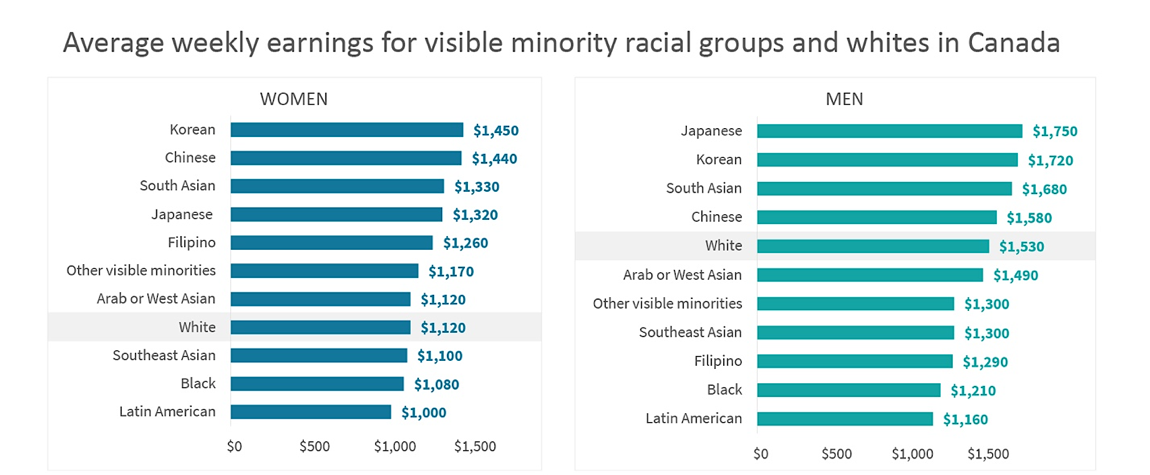
Source: The weekly earnings of Canadian-born individuals in designated minority and White categories in the mind-2010s by Theresa Qiu and Grant Schellenberg, Statistics Canada, 2022

While clearly contrary to current narratives declaring all of North America to be a bastion of white supremacy, these findings are not unusual for either side of the border. The latest American data on full-time workers similarly shows Asian men to be the highest income earners among full-time workers in the U.S., at US$1,457 per week, exceeding the US$1,108 per year earned by white men. 

Asian women also out-earn American white women, by nearly US$200 per week. Other data from the Pew Research Center on household income point to South Asian-born families as the top earners in the U.S. by a substantial margin.  It bears notice that Qiu and Schellenberg wisely avoid confusing the immigrant experience, which entails numerous challenges of language, culture and credentials, with that of being a visible minority in Canada. They do so by focusing only on Canadian-born visible minorities aged 25 to 45 (that is, young second-generation immigrants) and comparing them with similarly situated whites. 

Source: Facts on U.S. Immigrants, 2018 by Pew Research Center, 2020

The researchers further refined their work by adjusting for university education and other demographic characteristics. Here South Asian men were found to do significantly better than white men. Blacks and Latin Americans again did worse. Among women, several visible minority categories statistically outperformed whites, and no group – not even black women – did worse.

The results illustrate the pre-eminence of a university education in explaining job market success. ‘Nearly three-quarters of Canadian-born Chinese women have a university degree,’ marvels Skuterud. ‘That’s amazing.’Tweet

A Good News Story for Many, but not All

Do such results bolster the loud and widespread narrative that Canada is a systemically racist country? According to one labour market expert, such a declaration is impossible to make despite the large gaps in performance seen across the visible minority subgroups. “There is absolutely no way to infer any conclusion from this data about whether there is racial discrimination in the labour market,” says Mikal Skuterud, an economist at the University of Waterloo, in an interview. “Some groups are clearly outperforming whites, but no one would interpret that as evidence of discrimination against whites, or for Canadians with Chinese, Korean or Japanese ancestry.”

To Skuterud, the fact many Asian groups outperform the rest of Canadian society is a “good news story” since these segments comprise a large and growing share of Canada’s current immigration intake; this bodes well for the integration of future immigrants from these countries in coming years. The results also illustrate the pre-eminence of a university education in explaining job market success, as the strong performance across many Asian groups is closely linked to their high rates of university completion. “Nearly three-quarters of Canadian-born Chinese women have a university degree,” marvels Skuterud. “That’s amazing.”

Skuterud is troubled, however, by the poor results for blacks and Latin Americans, something that also appears in his own research. It is conceivable, he notes, that such persistent gaps are the result of labour market discrimination specifically targeted towards certain groups, rather than across the entire visible minority population. Such a possibility requires further investigation, he says. There are, however, numerous other explanations for this phenomenon, including broader cultural or socioeconomic factors not captured by the recent study. For example, another Statcan report found the rate of lone parenthood, a factor strongly associated with poverty and poor educational outcomes, is nearly three times more common among black mothers than in Canadian society at large. “Black immigrant populations stand out for their prevalence of lone mothers compared to the rest of the Canadian population,” the 2020 report observed. It is hard to imagine this not being a significant factor when it comes to the jobs market.

Taken at the broadest level, Qiu and Schellenberg’s results can be seen as a thorough dismantling of Livingstone’s nearly half-century-old claim that the term “visible minority” describes a single coherent category unified by the lack of whiteness of its members. This “group” now includes both the highest and lowest-earning racial categories in Canada, a fact that stretches diversity to the point of absurdity. The exceptional outcomes for Canadian-born Asian men and women strongly suggest factors other than discrimination – primarily education, family and socioeconomic status – are driving the divergence in earnings across race. And if skin colour is not a useful explanation for performance in the labour market, using it as a basis to set employment targets, as is the case within the federal public service, becomes a perversion of good policy.

“Did it ever make any sense?” 

In a column in the Globe and Mail nearly a decade ago, Carleton University economist Frances Woolley declared that, “There is something almost racist about the assumption that whites are the standard against which anyone else is noticeably, visibly different.” Her opinion hasn’t changed much since then. Asked today if it still makes sense for Canada to enshrine the concept of visible minority in law given the recent Statcan results, she shoots back, “Did it ever make any sense?”

The current system, Woolley observes in an interview, is entirely arbitrary in its binary conception of people as either white or not. “The word white is very imprecise,” she notes. According to Statcan, for example, Greek Canadians are European and part of the dominant white, mainstream society. Yet anyone who traces their roots to Turkey, right next door, is considered West Asian and hence a visible minority. As a result, one neighbour is eligible for special measures and one is not. Plus, “a lot of people who consider themselves white – such as Lebanese Christians – are identified as visible minorities by the Census,” Woolley adds. The U.S. classifies most Arab ethnicities as Caucasian.

The rise of individuals with multiple or competing racial identities due to the rapid growth in interracial marriages further complicates the notion of colour-coding Canada’s population. The share of mixed-race relationships has more than doubled over the past decade and now comprises 7.3 percent of all marriages and common-law relationships in this country. As these couples have children, it will get progressively more difficult to sort Canadians into separate racial baskets of white and non-white. (Aka oppressors and victims.)  

Then there is the issue of how nearly everyone can end up being considered part of a minority group and thus deserving of special treatment. Visible minorities currently comprise 22 percent of Canada’s total population, based on 2016 Census data, a figure that will undoubtedly rise with the release of updated 2021 Census data later this year. In some urban centres such as Surrey, B.C. or Markham, Ontario, visible minorities already constitute a clear majority. Indigenous people make up another 5 percent of Canada and people with disabilities are estimated at 22 percent. Finally, women represent 50 percent of all other groups. “Designated groups [under the Employment Equity Act] are now an overwhelming majority in the labour market,” says Woolley. “Surely we can all agree that’s problematic.”

The only slice of the Canadian population not offered special treatment under this framework is that of able-bodied white men. Yet the notion that white men stand astride the Canadian economy like a Colossus is both outdated and unfair. As Qiu and Schellenberg reveal, white men have one of the lowest rates of university completion across all racial groups, at 24 percent. This is significantly lower than black women at 36 percent, and only slightly higher than black men, at 20 percent. Given the importance of education to future earnings, low rates of university education in any racial group should be a troubling matter for fair-minded policy-makers.

Whites, both male and female, are also much more likely to live outside urban areas, another factor Qiu and Schellenberg found to be associated with lower earnings. And as a group, whites are noticeably older than those within the various visible minority subcategories. All of which suggests whites, and in particular white men, are likely to face strong headwinds in the future. They may, in fact, be more deserving of government attention than many other identity categories. “The real question,” insists Woolley, “is how can we make the system fair for everyone, not just designated groups.”

A Better Way Than Racializing Everything

Faced with the obvious folly of the entire visible minority concept, the progressive activist community appears focused on changes of nomenclature rather than substance. Linguistic constructs such as BIPOC or “racialized individuals” are more commonly used these days than the term visible minority. But such changes raise more questions than they answer. Consider BIPOC, an imported American acronym for Black, Indigenous and People of Colour. But aren’t black people also people of colour? And if so, why include them twice? As for “racialized,” the word appears derived from an invented verb: to racialize. But that suggests identity is dependant on the views of others, rather than a permanent, self-conceived state.

Any real commitment to tackling the inconsistencies inherent to the uniquely Canadian concept of visible minority must do more than just fiddle with terminology. In its 2020 Fall Economic Statement, the Trudeau government announced plans to review and modernize the Employment Equity Act. The most attractive solution would be to scrap it altogether and recuse the federal government from any further involvement in private-sector hiring practices. A competitive job market driven by need and focused on merit has no apparent problems hiring well-qualified candidates regardless of race, as the Asian experience ample demonstrates. Yet such a hands-off, market-driven and colour-blind approach seems extremely unlikely.

In the absence of simple economic logic, one immediate remedy would be to stop using whites as the reference group. Given evidence that whites no longer command the highest wages or best jobs, it makes more sense to shift to a simple Canadian average in future Statcan reports. This would resolve Woolley’s complaint about the implicit racism of making whites the standard by which all others are measured. “If you tested everyone relative to the Canadian average rather than whoever is considered ’white,’ I think that would be a good thing,” she says. “It would mean we are no longer taking the white experience as aspirational, or the norm.”

Achieving a colour-blind labour market would require shifting away from our current preoccupation with race to focus on more important factors. Poverty would be a good place to start.Tweet

Then again, any system that continues to examine performance by race, regardless of the comparator, perpetuates the fiction that racial identity is the ne plus ultra of the job market – if not personhood itself. While a fixation on skin colour has lately come to define public policy in many troubling ways, doing so embeds the concept that Canada is a collection of disparate racial groups constantly in conflict with one another. It would be far healthier for society to simply accept that we all share a common identity as members of a pluralistic Canada. Full stop.  

Plenty of evidence suggests Canadians don’t care nearly as much about race as the media or political classes constantly claim they do. Consider the 2019 federal election, which featured those potentially damning images of a young Justin Trudeau in blackface. Most Canadians simply shrugged it off. As author Christopher Dornan observed in his book recapping the election, “The issue of racism – overt and latent, deliberate and unwitting, systemic and extrinsic – simply did not take hold in the election discourse.”

Achieving a colour-blind labour market would require shifting away from a preoccupation with race to focus on more important factors. Poverty would be a good place to start. Says Woolley, “If your family income is a million dollars a year and both your parents have PhDs, then the colour of your skin doesn’t matter. The same goes if you grew up in foster care and have struggled all your life.” Disadvantage and hardship can occur in families of all races and ethnicities. Yet under Canada’s visible minority framework, needy individuals can be ignored while others with a different skin tone get a leg-up they don’t deserve. “We need a fair process and fair procedures,” Woolley asserts.

A fairer system, Woolley says, should “try to get at socioeconomic measures of disadvantage rather than assuming that identity” is the crucial factor. As an example of such a system, she points to the fact many universities around the world that now use socioeconomic status (SES) measures such as family income, rather than race, to determine entrance qualifications for disadvantaged students. Such “class-based” or “race-neutral” standards have a successful track record in Israel.

SES factors are also widely used in the U.S., although they remain a work in progress. The reason many American schools rely on SES is that they’ve been forbidden from accepting students based solely on race due to court rulings on constitutional grounds. In many cases, however, the universities manipulate their allegedly colour-blind SES rankings in order to sort students by colour regardless of what the courts say. This has led to numerous lawsuits objecting to such subterfuge, including one well-publicized case involving Asian students denied entrance to Harvard University because of their race. (They lost in 2019, but the case is now heading to the Supreme Court.) Regrettably, even plans meant to ignore race somehow end up becoming fixated on race.

The final word on ending to racial employment laws should go to the great human rights advocate Martin Luther King, Jr. King strongly opposed race-based quotas and other affirmative action measures because he anticipated their divisive effect on social harmony. In 1964 he wrote, “It is my opinion that many white workers whose economic condition is not too far removed from the economic condition of his black brother, will find it difficult to accept…special consideration to the Negro in the context of unemployment, joblessness etc. and does not take into sufficient account their [own] plight.” He argued against different treatment based on race because he thought help should be provided to all who need it, regardless of their skin colour. In other words, he dreamt of a truly just and fair world. We’re still waiting.

Source: It’s Time to Abolish the Absurd (and Slightly Racist) Concept of “Visible Minorities”

South Asian truckers say protest convoys didn’t resonate with them, caused financial losses

Yet another story on South Asian truckers (even if the convoy really wasn’t about truckers…):

Bearing a load of produce bound for Sobeys, Nihal Singh pulled up to a border checkpoint in northern Montana late last month, only to find the path blocked by big-riggers on the other side.

Semi-trucks and protesters barred the way in Coutts, Alta., as they demonstrated against vaccine mandates, holding up Singh for nearly two days — one of hundreds of drivers stopped by the blockade. After more than 24 hours, he and a group of other South Asian Canadian truckers approached authorities to find out when they could pass.

“That’s when another guy, he came out of his truck and he was, like, being racist. He was saying, ‘Go back to your truck, go back to India,”‘ recalled Singh, a 28-year-old driver from Edmonton.

Source: South Asian truckers say protest convoys didn’t resonate with them, caused financial losses

U.S. census director says the bureau needs to reduce chances of meddling after Trump

Of note:

The U.S. Census Bureau needs to work on ways the limit the potential for political interference with future national headcounts, the bureau’s director, Robert Santos, told NPR on Monday.

“I’m not too interested in looking back on and relitigating the events that occurred with the previous administration. But looking forward, I think it’s really important for us to make sure that there are policies and regulations that are in place to reduce the chance of meddling,” Santos said in one of his first media interviews since becoming the bureau’s leader in January.

After NPR previously reported on Santos’ comments about the Biden administration drafting new regulations to try to better protect the bureau from any interference from its parent agency, the Commerce Department, Santos said in an email that he misspoke.

“I am not aware of any regulations being drafted and apologize for the confusion,” Santos said.

Instead, he added, he meant to refer to ongoing work by the administration’s Scientific Integrity Task Force on improving the policies of federal agencies, including the Census Bureau and the Commerce Department.

Last month, a report by that task force, which included the bureau’s highest-ranking civil servant, Deputy Director Ron Jarmin, warned that the bureau and other federal statistical agencies “must protect against interference in their efforts to create and release data that provide a set of common facts to inform policymakers, researchers, and the public.”

The assessment came after years of meddling with the 2020 census by former President Donald Trump’s administration, which attempted to add a hotly contested question about U.S. citizenship status to the head count’s forms; added a series of political appointees with no obvious qualifications to the bureau’s top ranks; and cut short counting efforts after the COVID-19 pandemic delayed many of the bureau’s operations.

The moves by the previous administration have fueled calls for new ways to safeguard the once-a-decade head count’s integrity.

In recent decades, there have been proposals to move the bureau out of the Commerce Department and make it an independent agency. These efforts include bills in Congress introduced by Rep. Carolyn Maloney, a Democrat from New York who currently chairs the House Oversight and Reform Committee.

“I will support whatever it is that Congress decides that they want to do,” Santos, who is expected to serve as the bureau’s director through 2026, told NPR. “There are many issues that need to be worked out if an independent agency was created. However, I’m comfortable with the current structure, and I will work with Congress in terms of whatever they decide.”

The first Latino to head the federal government’s largest statistical agency, Santos is weeks into a political appointment that has landed him in not only U.S. history books but also a hotbed of controversy over the results of the 2020 head count.

Even though the results have already been used to reallocate each state’s share of congressional seats and Electoral College votes, as well as to redraw maps of voting districts across the country, questions about accuracy linger over the count.

On March 10, the bureau is set to start releasing results of its own assessment of the data’s quality.

Concerned about the lasting impacts of the COVID-19 pandemic and interference by the Trump administration, many census watchers are hoping to see to what extent the 2020 census may continue a decades-long pattern — the overcounting of people who identify as white and not Latino and the undercounting of people of color.

Flaws in the count carry big implications for political representation, the distribution of some $1.5 trillion a year and the country’s understanding of the people living in the United States. Santos and other bureau officials are under pressure to come up with new methods to mitigate the effects of a turbulent census.

Santos is also stepping into a heated debate over privacy protections applied to the 2020 census redistricting data and other more detailed information, just as the bureau ramps up its planning for the 2030 census, which could bring new ways of collecting data on race and ethnicity, particularly about Latinos and people of Middle Eastern or North African descent.

Lacroix: Niveaux d’immigration, la noyade

While some of his analysis overstates or incorrectly assesses (e.g., looking at declining French maternal language use while not recognizing that the vast majority of allophones have a working knowledge of French, thanks in no small part to Law 101), the overall points regarding the declining importance of Quebec in the federation is valid, as are some of his critiques of the federal government’s ongoing increase in immigration levels (need some more critical perspectives in English Canada):

Le ministre fédéral unilingue anglophone de l’Immigration, Sean Fraser, publiait, juste à temps pour la Saint-Valentin, le plan d’immigration du gouvernement de Justin Trudeau pour 2022-2024. Ce plan est de hausser, encore une fois, les volumes d’immigration, qui passeront de 184 606 personnes en 2020 à 431 000 nouveaux résidents permanents en 2022 et à 451 000 en 2024.

Ottawa souhaite admettre 1,33 million de nouveaux immigrants permanents en seulement trois ans. Il s’agit d’une hausse de 80 % par rapport aux seuils d’immigration qui avaient cours avant la prise du pouvoir par le Parti libéral du Canada en 2015. Au prorata de la population, le Canada est déjà l’un des pays occidentaux qui accueillent le plus d’immigrants.

Immigration temporaire

Et ces chiffres ne valent que pour les immigrants permanents, soit ceux qui obtiennent la résidence permanente. Parallèlement à cette hausse constante et soutenue de l’immigration permanente, nous assistons à une hausse vertigineuse de l’immigration temporaire, c’est-à-dire du nombre de personnes accueillies au Canada avec un permis d’études ou de travail temporaire. Le nombre de travailleurs étrangers détenteurs d’un permis de travail temporaire est passé de 66 600 en 2000 à 429 000 en 2018, soit une augmentation de 544 % en 18 ans. Ces travailleurs temporaires obtiennent de plus en plus, à terme, leur résidence permanente (à hauteur de 50 %). L’immigration « temporaire » est donc souvent de l’immigration permanente déguisée. À ces travailleurs temporaires il faut ajouter les étudiants étrangers, dont le nombre augmente exponentiellement ; en 2020, nous en étions à 530 540 étudiants étrangers au Canada. Si on combine ces deux catégories temporaires, il y avait, au 1er janvier 2020, 1,3 million d’immigrants temporaires au Canada.

Pour estimer le volume global et l’incidence de la migration, il faut additionner les permanents aux temporaires. Aux 431 000 immigrants permanents en 2022 il faut donc ajouter environ 1,3 million d’immigrants temporaires, ce qui donne le chiffre de 1,73 million d’immigrants pour 2022, soit environ 4,7 % de la population totale du Canada.

Conséquences pour le Québec

L’arrivée d’un aussi grand nombre d’immigrants en si peu de temps a plusieurs conséquences néfastes pour le Québec. L’immigration est d’abord la cause directe du recul accéléré du français auquel on assiste depuis 15 ans. Mais elle a aussi pour effet d’exacerber la crise du logement, la hausse du volume d’immigration étant directement responsable de la hausse débridée du prix de l’immobilier au Canada. La crise du logement, bien sûr, frappe d’abord les plus pauvres, ce qui inclut souvent les nouveaux arrivants.

Mais cela ne semble pas émouvoir outre mesure le Parti libéral.

En faisant de l’immigration temporaire la voie d’accès royale vers la résidence permanente depuis 2014, Ottawa a modifié unilatéralement le système d’immigration et a dépouillé le Québec d’une bonne partie de ses pouvoirs en immigration. Pourquoi ? Parce que le Québec n’a aucun pouvoir de sélection sur l’immigration temporaire, de plus en plus importante numériquement parlant, et qui relève strictement d’Ottawa. Le pouvoir de sélection des immigrants a ainsi glissé, indirectement, de Québec vers Ottawa.

À cela, il faut ajouter la discrimination exercée par Ottawa contre les immigrants francophones qui souhaitent s’installer au Québec ou y étudier en français. Le ministère fédéral de l’Immigration sabote activement, de façon volontaire ou non, les efforts du Québec pour attirer des francophones.

Un piège parfait

Les premiers chiffres publiés du recensement 2021 indiquent que le poids relatif du Québec au Canada a baissé pour un 11e recensement d’affilée, passant de 28,9 % en 1966 en 23 % en 2021. Avec la hausse des seuils, la baisse de ce poids va s’accélérer. Pour le contrecarrer, Québec devrait accepter environ 103 730 immigrants permanents par année à partir de 2024, soit plus du double des seuils actuels, seuils qui sont déjà en train de conduire à l’effondrement du français dans toute la grande région de Montréal.

Pour le Québec français, la question de l’immigration est donc un piège parfait ; pile, il perd ; face, le Canada gagne. L’avenir réservé au Québec dans le Canada, c’est la noyade démographique.

En 2017, Statistique Canada a publié une étude de projections démolinguistiques, qui annonçait un effondrement du poids démographique des francophones au Québec à l’horizon de 2036. La proportion de francophones au Québec passerait, selon ces projections, de 78,9 % en 2011 à 69 % en 2036, une chute de 9,9 points. Il s’agit d’un effondrement sans précédent dans toute l’histoire du Québec.

Cette projection de 69 % était calculée avec un scénario « immigration forte » qui correspondait, grosso modo, à 350 000 immigrants permanents par année au Canada. Or, la hausse des niveaux d’immigration à 451 000 signifie que le chiffre de 69 %, loin d’être un « plancher », est maintenant un « plafond » ; la proportion réelle des francophones au Québec en 2036 sera très certainement en dessous de ce chiffre.

Cela sera vrai même si le Québec ne hausse pas son seuil d’immigrants permanents actuel de 50 000 par année (note : le Québec n’a pas ce pouvoir et doit suivre les seuils fédéraux selon l’Entente Canada-Québec). Pourquoi ? Parce que le Québec n’a aucun contrôle sur la migration interprovinciale. Le solde de cette migration est devenu positif en 2020 pour la première fois depuis 1961. Il est probable que l’anglicisation accélérée de la grande région de Montréal fait que de nombreux Canadiens peuvent maintenant y vivre en anglais comme s’ils étaient à Toronto, et ce, à moindre coût. À Montréal, le fait français ressemble de plus en plus à un résidu historique appelé à se dissoudre dans le grand tout canadien. Le projet de loi 96, qui évite soigneusement toute mesure structurante, ne changera rien à cet état de fait.

Le portrait global qui se dégage est celui-ci : si Ottawa avait un plan méthodique, systématique, afin de liquider une fois pour toutes le Québec français, ce plan ressemblerait probablement à ce que l’on voit se dérouler sous nos yeux.

Il va falloir que le gouvernement du Québec se réveille. Et vite.

Source: Niveaux d’immigration, la noyade

Human rights? China won that Winter Olympics battle. Almost.

Time for Canadian Olympians and sport officials to speak up:

When three-time Olympian Gus Kenworthy took the remarkable, perhaps even brave decision to speak out against “human rights atrocities” while still in China at the Winter Games, the self-proclaimed “loud and obnoxious” British skier also proved that other athletes, had they chosen, perhaps could have used their Olympic platform to pipe up, too.

Because Kenworthy wasn’t hauled away and imprisoned, as Chinese critics of the ruling Communist Party routinely are. Doing so would have generated exactly the sort of global focus on the Chinese government’s authoritarian methods that it sought to avoid while global sports’ biggest show was in town. 

And with the notable exception of Kenworthy, China largely accomplished that mission. 

Olympians with any qualms about chasing medals in a country accused of genocide against its Muslim Uyghur population and of other abuses kept their views on those topics to themselves for the durations of their stay. And perhaps for good reason: They faced vague but, as it turned out, undeployed Chinese threats of punishment, constant surveillance and the sobering example of tennis star Peng Shuai’s difficulties after she voiced allegations of forced sex against a Communist Party official.

“We have seen an effective silencing of 2,800 athletes, and that’s scary,” said Noah Hoffman, a former U.S. Olympic skier and board member of the Global Athlete advocacy group pushing for Olympic reform.

Kenworthy, speaking to The Associated Press before his 8th-place finish in the halfpipe final on the Games’ penultimate day, laid out why.

“We’re in China, so we play by China’s rules. And China makes their rules as they go, and they certainly have the power to kind of do whatever they want: Hold an athlete, stop an athlete from leaving, stop an athlete from competing,” he said.

“I’ve also been advised to sort of tread lightly while I am here and that’s what I am trying to do.”

Immediately after competing, however, the proudly gay athlete’s gloves came off. 

He prefaced criticism with praise for China’s “incredible job with this Olympics” and carefully calibrated his words. But unlike other Olympians, he couldn’t bite his tongue until he got home. Kenworthy aimed jabs not only at the host country’s rights abuses and “poor stance on LGBTQ rights” but also at other athletes he said try “to appeal to the masses” and avoid ruffling feathers. 

“I’ve already kind of accepted that that’s not what I’m gonna do,” he said. “I’m just gonna speak my truth.” 

In fairness, Olympians found themselves squeezed on all sides in Beijing. Campaigners abroad hoped they would spark global outrage over the imprisonment in re-education camps of an estimated 1 million people or more, most of them Uyghurs. China, backed to the hilt by the International Olympic Committee, didn’t want critical voices to be heard. And their own voices told athletes to focus, focus, focus on the pursuit of Olympic success that they, their coaches and families sacrificed for.

The sweep and vagueness of a Chinese official’s threat before the Games of “certain punishment” for “any behavior or speech that is against the Olympic spirit” appeared to have a particularly sobering effect on Beijing-bound teams. Campaigners who met with athletes in the United States in the weeks before their departure, lobbying them about Uyghurs and the crushing of dissent in Tibet and Hong Kong, noticed the chill.

“Prior to the statement, we had been engaging with quite a few athletes,” said Pema Doma, campaigns director at Students for a Free Tibet. They “were expressing a lot of interest in learning more and being engaged in the human rights issue.” 

Afterward, “there was a very, very distinct difference” and “one athlete even said to an activist directly: ‘I’ve been instructed not to take anything from you or speak to you,’” she said in a phone interview.

Other concerns also weighed on Olympians, way beyond the usual anxieties that often come with travel to a foreign land, away from home comforts.

Warnings of possible cyber-snooping by Chinese security services and team advisories that athletes leave electronic devices at home were alarming for a generation weaned on social media and constant connectivity with their worlds. 

Also wearing were daily coronavirus tests that were mandatory — and invasive, taken with swabs to the back of the throat — for all Olympians, locked inside a tightly policed bubble of health restrictions to prevent infection spreads. The penalty for testing positive was possible quarantine and missed competition, a terrible blow for winter athletes who often toil outside of the limelight, except every four years at the Games.

“Who knows where those tests go, who handles the results,” Kenworthy said. “It’s definitely in the back of the mind.”

“And there’s like all the cybersecurity stuff. It is concerning,” he told The AP.

Often, athletes simply blanked when asked about human rights, saying they weren’t qualified to speak on the issue or were focused on competition, and hunkered down. 

On Twitter, Dutch speedskater Sanne in ’t Hof blocked, unblocked and then blocked again a Uyghur living in the Netherlands who posted critical comments of Olympians in what he called “genocide” Games. Mirehmet Ablet shared a screengrab with The AP showing that the skater had barred him from accessing her account, where she tweeted that she “enjoyed every second!′ of her first Olympics. Ablet’s brother was arrested in 2017 in the Uyghur homeland of Xinjiang in far western China, and Ablet doesn’t know where he’s now held.

Other athletes also were effusive in praising their China experience. “Nothing short of amazing,” said U.S. speedskating bronze-medal winner Brittany Bowe. 

Hoffman, who competed for the U.S. at the 2014 and 2018 Games, said internal politics within teams may also have dissuaded athletes from speaking critically. Coaches can bench athletes who bring unwanted attention and “there’s pressure from your teammates to not cause a distraction,” he said in a phone interview. Athletes with self-confidence dented by sub-par performances may also have felt that they’d lost any platform.

“There’s lots of really subtle pressure,” Hoffman said. 

He expects some athletes won’t be critical once home, so as to not disrespect the cheerful and helpful Games workers.

But he’s hopeful others will speak up on their return and that “we do get a chorus.” 

Feeling unmuzzled, some already are. 

Back in Sweden with his two gold medals in speedskating, Nils van der Poel told the Aftonbladet newspaper that although he had “a very nice experience behind the scenes,” hosting the Games in China was “terrible.” He drew parallels with the 1936 Summer Olympics in Nazi Germany and Russia hosting the Sochi Olympics before seizing control of the Crimean peninsula in 2014. 

“It is extremely irresponsible,” van der Poel said, ”to give it to a country that violates human rights as clearly as the Chinese regime does.”

Source: Human rights? China won that Winter Olympics battle. Almost.

USA: Investor immigrants say their applications are viable despite program lapse

Of note:

A group of immigrant investors have filed a lawsuit claiming the Biden administration is unlawfully refusing to process their applications for visas and green cards after Congress allowed a major visa program they participated in to lapse.

More than a dozen plaintiffs in a complaint filed in Seattle federal court on Thursday said that while a program earmarking EB-5 visas for investors who pool money has expired, federal law still requires U.S. Citizenship and Immigration Service and the Department of State to process their applications, which were filed before the expiration.

The EB-5 program allows foreign citizens who invest $1 million in a U.S. business – or $500,000 in economically depressed areas – and create at least 10 jobs to qualify for visas and green cards.

The plaintiffs, who are citizens of Canada, Russia, India and other countries, applied to participate in the EB-5 Regional Center program, which reserves thousands of visas each year for investors who pool their money into large economic development projects.

Authorization for the program, which was first created in 1992, expired in June without action from Congress and its future is still in limbo. USCIS in December said it would not process visa and green card applications tied to the program until it is renewed.

But in Thursday’s complaint, the plaintiffs said the expiration of the program only meant that the government no longer had to grant a preference to applicants involved in the Regional Center program. The federal Immigration and Nationality Act still requires USCIS to process their EB-5 applications and set aside visas for them if they qualify, the plaintiffs said.

Jon Wasden of Wasden Banias, a lawyer for the plaintiffs, said that a decision in the plaintiffs’ favor could ultimately spur USCIS to process thousands of other pending applications.

USCIS and the Department of State did not immediately respond to requests for comment.

The case is Bajaj v. Blinken, U.S. District Court for the Western District of Washington, No. 2:22-cv-00189.

Source: Investor immigrants say their applications are viable despite program lapse

Dutrisac: Le Québec largué [on immigration processing, levels and demography]

Of note, along with the ongoing trend of a relative decline compared to other Canadian provinces. Not clear that having more powers for Quebec would change that unless a Quebec government decides to match Canadian immigration targets:

Si on fait exception de 2020, année marquée par les sévères restrictions liées à la pandémie, le gouvernement Trudeau vole de record en record en matière d’immigration. Cette semaine, le ministre de l’Immigration, des Réfugiés et de la Citoyenneté, Sean Fraser, a dévoilé de nouvelles cibles qui placent le Canada au sommet des pays — et de loin — quant au nombre d’immigrants qu’ils accueillent.

Au cours de son premier mandat, le gouvernement Trudeau a fait passer le seuil de 280 000 immigrants du gouvernement Harper à quelque 350 000. L’an dernier, Ottawa a voulu effectuer un rattrapage en raison des contraintes touchant les déplacements internationaux et des ratés administratifs qui ont contribué à réduire à 186 606 le nombre d’immigrants admis en 2020 au lieu des 341 000 prévu ; il a donc porté ce nombre à 400 000 en 2021.

Cet objectif de 400 000 et plus, c’est maintenant le nouveau plancher canadien en matière d’immigration. Dans son rapport annuel de 2021 présenté cette semaine au Parlement, le ministre Fraser a établi les seuils à 431 000 pour 2022, 447 000 pour 2023 et 451 000 pour 2024. C’est grosso modo 20 000 à 30 000 de plus que les niveaux avancés dans le rapport annuel précédent.

Si on se réfère à la cible élevée plutôt que moyenne, telle qu’inscrite dans le rapport pour 2024, soit 475 000 immigrants, nous sommes tout près de la recommandation de l’organisme canadien-anglais Century Initiative, qui entend convaincre le gouvernement Trudeau de hausser à 500 000 le seuil d’immigration pour 2026. L’objectif, c’est de faire passer la population canadienne de 37 millions à 100 millions en 2100.

Tandis que le ministre pousse à la hausse le nombre de dossiers à traiter, sa machine administrative ne suit pas. On ne sait d’ailleurs pas sur quelle planète Sean Fraser vit quand il écrit dans son rapport : « Heureusement, le Ministère a su s’adapter aux immenses pressions exercées par la pandémie. » La réalité, c’est qu’au Québec, son ministère est dysfonctionnel.

Les délais pour obtenir le statut de résident permanent, c’est-à-dire devenir un immigrant reçu en bonne et due forme après avoir été sélectionné par Québec, ont encore augmenté, pour atteindre en moyenne 28 mois.

En raison de problèmes administratifs, Ottawa n’arrive même pas à remplir les objectifs d’immigration que lui transmet le gouvernement du Québec. Le ministère de l’Immigration, de la Francisation et de l’Intégration a demandé qu’un rattrapage soit effectué en 2021 pour combler les retards engendrés par la pandémie, soit un total de 18 000 nouveaux résidents permanents de plus. Manquent à l’appel 15 000 d’entre eux.

Qui plus est, sur les 48 600 détenteurs d’un certificat de sélection du Québec toujours en attente de leur résidence permanente, 25 000 résident au Québec et occupent un emploi. Le ministre Jean Boulet a demandé à son homologue fédéral d’accorder la priorité à ces demandeurs. Mais Ottawa se montre réticent. Si on tient compte de toutes les catégories de nouveaux arrivants, ce sont 90 000 personnes qui sont en attente, selon les données obtenues par Radio-Canada auprès d’Immigration, Réfugiés et Citoyenneté Canada.

C’est deux poids, deux mesures, car les délais imposés au Québec sont beaucoup plus importants que dans le reste du Canada. Par ailleurs, les autorités fédérales exercent une discrimination à l’endroit des étudiants étrangers en provenance de l’Afrique francophone qui souhaitent étudier au Québec : le taux de refus de ces étudiants pourtant admis dans nos cégeps et nos universités est beaucoup plus élevé que celui des étudiants étrangers anglophones.

Mais plus grave encore, c’est que le Canada, avec sa politique d’immigration extrêmement vigoureuse, est en train de larguer le Québec. On voudrait diminuer rapidement son poids démographique — et celui du Québec français — au sein du Canada qu’on n’agirait pas autrement. En clair, le reste du Canada, toutes proportions gardées, accueille deux fois plus d’immigrants que le Québec. Si l’on voulait résister à cette érosion démographique, ce ne sont pas 53 000 immigrants qu’il faudrait admettre, mais près de 120 000 l’an prochain et davantage les années suivantes.

Dans ce contexte, il est clair que l’entente Canada-Québec sur l’immigration, signée en 1991 par les ministres Gagnon-Tremblay et McDougall, ne tient plus, du moins dans son esprit. Cette entente prévoyait que le Canada consulte le Québec pour établir ses seuils d’immigration, ce qu’il ne fait plus. En outre, les seuils canadiens devaient permettre au Québec de recevoir un pourcentage d’immigrants égal à celui de sa population. Ce n’est plus possible.

Cette évolution du Canada postnational constitue une menace pour la nation québécoise. Il est temps — et c’est un minimum — que le Québec obtienne tous les pouvoirs en matière d’immigration.

Source: Le Québec largué

Refugees in Quebec will have to learn French within 6 months

Not realistic and discriminatory (but not surprising), unfortunately):

The Quebec government is moving ahead with a controversial part of its proposed language bill, which will require all government officials to communicate with new immigrants exclusively in French, six months after their arrival — with no exceptions for refugees and asylum seekers.

The article of Bill 96, which was introduced at the National Assembly last May, was recently approved by the legislative committee studying the bill, amid criticism from opposition Liberal and Québec Solidaire MNAs. The bill is expected to become law this spring but still faces detailed study in committee.

Some organizations, opposition members and even the union representing public servants tried to persuade the government to soften the rule, to no avail.

“For newly arriving immigrants, the basic principle of the law is clear: as of Day 1, it’s exclusively in French,” said Simon Jolin-Barrette, justice minister and minister responsible for the French language.

There are exemptions in the law, which allow communication in a language other than French, “where health, public safety or the principles of natural justice so require” such as getting health care.

As well, the bill allows for a six-month grace period for “particular situations that require the use of a language other than French with new immigrants” according to Élisabeth Gosselin, spokesperson for Jolin-Barrette.

The bill says after that six-month period has lapsed, communication must be in French.

“Currently, the government communicates with immigrants who have requested it, sometimes for years, or for their whole lifetime, in a language other than French, which does not foster integration,” Gosselin said.

Learning French in 6 months

Community organizations working with newly arrived immigrants have been calling on the government to extend the six-month grace period.

“We all agree that the government cannot respond to immigrants in every language. But we have to give them time to learn French,” said Élodie Combes, member of the Table de concertation des organismes au service des personnes réfugiées et immigrantes (TCRI), a working group that represents community organizations working with immigrants.

Combes believes that the bill may actually hinder the integration of immigrants, by making it more difficult for them to get government services.

“It’s as if we’re telling them to retreat into their lingustic minority, that the government is not there for them, because they aren’t francophone enough,” she said.

Garine Papazian-Zohrabian, an associate professor in educational psychology at the Université de Montréal who researches French-language training for immigrants, says the six-month hard cap will be most harmful for refugees and asylum seekers, who are arriving in a vulnerable state.

“Members of this population are already disoriented, arriving in Quebec. They can been burdened by a difficult past and face cultural challenges. They’re not ready to learn a new language, like French, right after their arrival,” said Papazian-Zohrabian.

“You might as well say that we don’t accept refugees or immigrants, rather than place so many obstacles in front of them,” she added.

Opposition slams ‘excessive’ measures in bill

The union representing 40,000 Quebec civil servants, the Syndicat de la fonction publique et parapublique du Québec (SFPQ), is also in favour of extending the six-month grace period.

In its submission to the committee examining the bill, the union suggested the delay could be extended to two years, to allow new immigrants more time to adapt.

Ruba Ghazal, Québec Solidaire MNA for the Mercier riding in Montreal, proposed a grace period of three years, saying that Jolin-Barrette is “totally disconnected from the reality of newly arrived immigrants.”

“The minister makes no distinction between a refugee and an economic class immigrant,” she said. “These people need more kindness and understanding.”

Jolin-Barrette dismissed the idea of extending the grace period, saying six months was a “reasonable” period.

Ghazal said while the bill takes a harsh stand with newly arrived immigrants, it contains a clause that allows the government to continue to communicate in languages other than French with people who immigrated to Quebec in the past.

Source: Refugees in Quebec will have to learn French within 6 months

Regg Cohn: Pipeline protest or convoy blockade — police should apply the same standards to all illegal demonstrations

This really becomes a test of being consistent of not, one that applies to both the right and left. And if not, what should be the criteria for when a blockade is acceptable and when it is not (Brian Lee Crowley made similar points We undermine the neutrality of the law at our peril:

The belated liberation of Ottawa from occupation is a lesson.

The breaking of blockades at the borders is a primer.

They are refresher courses in the fragility of democracy and the rigour of the rule of law.

They are reminders that there is a fine line between the consent of the governed, the discontent of anti-government protesters, and the disinformation that fuels it.

How did we get there? Where do we go from here?

A couple of thousand protesters make up a mere 0.01 per cent of the 17.2 million Canadians who voted in the last election. When a tiny minority insists on imposing its will on our elected Parliament, they are dissenters from democracy.

Their written demands were to disband the government and replace it with their own convoy cabinet. Until they got their way, they’d stay — and for nearly a month, they called Canada’s bluff in the heart of the nation’s capital.

Through their determination and defiance, they exposed the emptiness of police threats and the hollowness of deterrence. Outnumbered and outmuscled, local police in Ottawa and Windsor had to call in reinforcements and regroup before they could reclaim lost territory and frontiers.

Declarations of emergency followed — first municipally, next provincially, finally federally. On Friday, as MPs tried to debate the latest measures, Parliament was suspended for the day because of urgent fears for their safety.

That this ragtag band of occupiers sang civil rights hymns, brandished bibles and soaked in hot tubs hardly lessens the gravity of the challenge. They ransomed the economy and entrapped a city while crying for freedom. They wielded captive children as human shields while boasting of their fearlessness.

There is a legitimate debate, in the aftermath, as to whether the disruption and disorder rose to the level of an emergency in strictly legal terms. Critics argue that the authorities had sufficient laws and tools to get the job done without special powers.

In ordinary times, the regular tool box should suffice. But in extraordinary times the tactics of conflict resolution, de-escalation and deterrence are merely theories without practical application — as Ottawa’s former police chief, Peter Sloly, discovered to his dismay after a career devoted to dialogue and community engagement while in Toronto’s force.SKIP ADVERTISEMENT

Amid the disorder, the flow of cash (and bitcoin) continued apace and tow truck operators who normally converge on accidents were running for cover. The reality is that the regular playbook was insufficient to restore the rule book.

Critics of the emergency laws point to Toronto as the model of effective enforcement, noting that without special powers our police kept the convoys from becoming blockades at Queen’s Park. Full credit to Mayor John Tory and Toronto’s police chief for learning lessons from the failures in Ottawa and Windsor, mustering a show of force to enforce law and order.

By avoiding the mistake of being outnumbered, Toronto’s cops were not cornered — and therefore had no need of emergency laws to oust any occupiers. But there are glaring contradictions in this comparison.

Many who praise Toronto today for keeping the convoys at bay were harsh critics last year, accusing the city of deploying disproportionate force to remove illegal encampments that had persisted in public parks for more than a year. Most accounts at the time overstated the actual use of force while condemning the mere show of force.

Police were there to safeguard the city workers who did the actual evicting and escorting of the tent occupants — occupiers, if you will — to shelters. Most of the non-violent conflict arose between cops and outside supporters of the encampments (and in some cases photographers — a recurring question of rightful media access).

The argument from many self-styled progressives seems to be that occupying parks for years at a time is no big deal, because it doesn’t directly impede people or commerce. As if the urban planning imperative of public parks and right of access for all Torontonians is optional and dispensable depending on your politics.

Across the country, police have rightly been questioned for apparent hypocrisy — diligently enforcing court orders against earlier Indigenous protests, while turning a blind eye to the latest blockades. If the argument is that police were unacceptably inconsistent, that is incontestably true; but if the point is that two wrongs make a right — that illegality should be ignored equally everywhere — then it simply doesn’t add up.

Police should absolutely be consistent. They should break up occupations in Ottawa and blockades at the border, just as they should also end blockades of rail lines or pipelines that hold the economy hostage in similar ways.

That doesn’t mean police cannot use common sense and exercise discretion, for each demonstration is different in its own way. But all protesters share an unshakable belief that they are in the right and have been wronged.

If politicians pick and choose their favourite causes — as Conservative MPs did by meeting and greeting the Ottawa occupiers — we will privilege some protesters over others and be caught in the contradictions.

The quintessentially Canadian phrase, “Peace, order and good government,” is written into our Constitution and etched into our ethos. Those five words go hand in hand, until they don’t — and people take the law into their own hands.

Source: Pipeline protest or convoy blockade — police should apply the same standards to all illegal demonstrations

For Companies, Winning in China Now Means Losing Somewhere Else

Should be an awaking, both given Chinese government repression and the IOC various wilful blindnesses:

Companies usually shell out for Olympic sponsorship because it helps their business and reflects well on their brands. But this year, with the Olympics in Beijing, Procter & Gamble paid even more to try to prevent any negative fallout from being associated with China’s repressive and authoritarian government.

The company, one of 13 “worldwide Olympic partners” that make the global sports competition possible, hired Washington lobbyists last year to successfully defeat legislation that would have barred sponsors of the Beijing Games from selling their products to the U.S. government. The provision would have blocked Pampers, Tide, Pringles and other Procter & Gamble products from military commissaries, to protest companies’ involvement in an event seen as legitimizing the Chinese government.

“This amendment would punish P.&G. and the Olympic movement, including U.S. athletes,” Sean Mulvaney, the senior director for global government relations at Procter & Gamble, wrote in an email to congressional offices in August.

Some of the world’s biggest companies are caught in an uncomfortable situation as they attempt to straddle a widening political gulf between the United States and China: What is good for business in one country is increasingly a liability in the other.

China is the world’s biggest consumer market, and for decades, Chinese and American business interests have described their economic cooperation as a “win-win relationship.” But gradually, as China’s economic and military might have grown, Washington has taken the view that a win for China is a loss for the United States.

The decision to locate the 2022 Olympic Games in Beijing has turned sponsorship, typically one of the marketing industry’s most prestigious opportunities, into a minefield.

Companies that have sponsored the Olympics have attracted censure from politicians and human rights groups, who say such contracts imply tacit support of atrocities by the Chinese Communist Party, including human rights violations in Xinjiang, censorship of the media and mass surveillance of dissidents.

“One thing our businesses, universities and sports leagues don’t seem to fully understand is that, to eat at the C.C.P.’s trough, you will have to turn into a pig,” Yaxue Cao, editor of ChinaChange.org, a website that covers civil society and human rights, told Congressthis month.

The tension is playing out in other areas as well, including with regards to Xinjiang, where millions of ethnic minorities have been detained, persecuted or forced into working in fields and factories. In June, the United States will enact a sweeping law that will expand restrictions on Xinjiang, giving the United States power to block imports made with any materials sourced from that region.

Multinational firms that are trying to comply with these new import restrictions have found themselves facing costly backlashes in China, which denies any accusations of genocide. H&M, Nikeand Intel have all blundered into public relations disasters for trying to remove Xinjiang from their supply chains.

Harsher penalties could be in store. Companies that try to sever ties with Xinjiang may run afoul of China’s anti-sanctions law, which allows the authorities to crack down on firms that comply with foreign regulations they see as discriminating against China.

Beijing has also threatened to put companies that cut off supplies to China on an “unreliable entity list” that could result in penalties, though to date the list doesn’t appear to have any members.

“Companies are between a rock and a hard place when it comes to complying with U.S. and Chinese law,” said Jake Colvin, the president of the National Foreign Trade Council, which represents companies that do business internationally.

President Biden, while less antagonistic than his predecessor, has maintained many of the tough policies put in place by President Donald J. Trump, including hefty tariffs on Chinese goods and restrictions on exports of sensitive technology to Chinese firms.

The Biden administration has shown little interest in forging trade deals to help companies do more business abroad. Instead, it is recruiting allies to ramp up pressure on China, including by boycotting the Olympics, and promoting huge investments in manufacturing and scientific research to compete with Beijing. 

The pressures are not only coming from the United States. Companies are increasingly facing a complicated global patchwork of export restrictions and data storage laws, including in the European Union. Chinese leaders have begun pursuing “wolf warrior” diplomacy, in which they are trying to teach other countries to think twice before crossing China, said Jim McGregor, chairman of APCO Worldwide’s greater China region.

He said his company was telling clients to “try to comply with everybody, but don’t make a lot of noise about it — because if you’re noisy about complying in one country, the other country will come after you.”

Some companies are responding by moving sensitive activities — like research that could trigger China’s anti-sanctions law, or audits of Xinjiang operations — out of China, said Isaac Stone Fish, the chief executive of Strategy Risks, a consultancy.

Others, like Cisco, have scaled back their operations. Some have left China entirely, though usually not on terms they would choose. For example, Micron Technology, a chip-maker that has been a victim of intellectual property theft in China, is closing down a chip design team in Shanghai after competitors poached its employees.

“Some companies are taking a step back and realizing that this is perhaps more trouble than it’s worth,” Mr. Stone Fish said.

But many companies insist that they can’t be forced to choose between two of the world’s largest markets. Tesla, which counts China as one of its largest markets, opened a showroom in Xinjianglast month.

“We can’t leave China, because China represents in some industries up to 50 percent of global demand and we have intense, deep supply and sales relationships,” said Craig Allen, the president of the U.S.-China Business Council.

Companies see China as a foothold to serve Asia, Mr. Allen said, and China’s $17 trillion economy still presents “some of the best growth prospects anywhere.”

“Very few companies are leaving China, but all are feeling that it’s risk up and that they need to be very careful so as to meet their legal obligations in both markets,” he said.

American politicians of both parties are increasingly bent on forcing companies to pick a side.

“To me, it’s completely appropriate to make these companies choose,” said Representative Michael Waltz, a Florida Republican who proposed the bill that would have prevented Olympic sponsors from doing business with the U.S. government.

Mr. Waltz said participation in the Beijing Olympics sent a signal that the West was willing to turn a blind eye to Chinese atrocities for short-term profits.

The amendment was ultimately cut out of a defense-spending bill last year after active and aggressive lobbying by Procter & Gamble, Coca-Cola, Intel, NBC, the U.S. Chamber of Commerce and others, Mr. Waltz said.

Procter & Gamble’s lobbying disclosures show that, between April and December, it spent more than $2.4 million on in-house and outside lobbyists to try to sway Congress on a range of tax and trade issues, including the Beijing Winter Olympics Sponsor Accountability Act.

Lobbying disclosures for Coca-Cola, Airbnb and Comcast, the parent company of NBC, also indicate the companies lobbied on issues related to the Olympics or “sports programming” last year.

Procter & Gamble and Intel declined to comment. Coca-Cola said it had explained to lawmakers that the legislation would hurt American military families and businesses. NBC and the Chamber of Commerce did not respond to requests for comment.

Many companies have argued they are sponsoring this year’s Games to show support for the athletes, not China’s system of government.

In a July congressional hearing, where executives from Coca-Cola, Intel, Visa and Airbnb were also grilled about their sponsorship, Mr. Mulvaney said Procter & Gamble was using its partnership to encourage the International Olympic Committee to incorporate human rights principles into its oversight of the Games.

“Corporate sponsors are being a bit unfairly maligned here,” Anna Ashton, a senior fellow at the Asia Society Policy Institute, said in an event hosted by the Center for Strategic and International Studies, a Washington think tank.

Companies had signed contracts to support multiple iterations of the Games, and had no say over the host location, she said. And the funding they provide goes to support the Olympics and the athletes, not the Chinese government.

“Sponsorship has hardly been an opportunity for companies this time around,” she said. 

Source: For Companies, Winning in China Now Means Losing Somewhere Else