White Nova Scotia Premier Tim Houston Picks White Guy Pat Dunn to Represent African Nova Scotians

Silly article. He has no African Nova Scotian in his caucus. Far better to judge the government on what it does and does not do:

On his first day in office, the white premier of Nova Scotia chose a fellow white man to serve as a representative for thousands of African Nova Scotians and as head of the Canadian province’s anti-racism efforts, enraging members of his community.

“I understand the emotions of it but [the decision] shouldn’t be interpreted as not being concerned about listening to the community,” Tim Houston, a member of the Progressive Conservative Party, said in a statement Tuesday night. He picked Pat Dunn, a member of the Canadian Legislative Assembly, as the minister for African Nova Scotian Affairs and the Office of Anti-Racism Initiatives.

There are roughly 21,000 people of African descent in the province distributed among 50 African Nova Scotia communities. Replies to Canadian Broadcasting Corporation tweets about the decision as well as Facebook comments on Houston’s announcement denounced the decision as “tone deaf.”

Among the Progressive Conservative Party’s 31 members elected to office in August, there were no Black members. Three Black Progressive Conservative candidates had run and lost. Houston said, rather than choose a Black candidate from outside his party for the post now occupied by Dunn, that “our democracy works best when the people that are elected are put into positions of accountability,” according to the Toronto Star.

Source: White Nova Scotia Premier Tim Houston Picks White Guy Pat Dunn to Represent African Nova Scotians

Congress Can’t Solve Immigration. Maybe the States Can.

Seeing more arguments in US media regarding providing a role for states in selecting immigrants, citing Canada’s Provincial Nominee Program as a model. Given the political dynamics, hard to see this getting much traction as presume there would need to be legislative authority for such a change:

“A moral failing and a national shame.” During his 2020 campaign, that was how Joe Biden characterized America’s immigration policies in the Trump era. On his first day in office, the new president announced an ambitious reform. The U.S. Citizenship Act of 2021 would include a pathway to citizenship for undocumented immigrants. It would raise caps on legal immigration. It would increase aid for Central America. It touched all the progressive erogenous zones.

And it was dead on arrival. “It’s such a progressive wish list that it’s almost counterproductive,” a pro-immigration lobbyist told me. By summer, the reform effort had stalled, migrants were flooding the border, the Democrats were divided, and the Republicans were demagoguing. Just like always.

For the country, as well as for immigrants and their families and employers, the cost of our never-ending immigration crisis has been very high. Among its consequences was the presidency of Donald Trump, who could not have reached the White House without the disruptive energy that immigration unleashed. In fact, if you had to pick a date when America launched itself toward Trumpism, June 28, 2007, would be a good choice.

Immigration was on the floor of the Senate. A bipartisan coalition had revived what was then—and still is—the logical compromise: stricter controls at the borders and at job sites, more legal immigration (especially of skilled workers), and a path to citizenship. Had the compromise passed, “it would have changed the politics,” Jim Kolbe, who was then a House Republican representing an Arizona border district, recently told me. “It would have been seen as putting the immigration issue behind us.”

Instead, the bill failed, badly. A disappointed Mitch McConnell, then the Senate minority leader, said, “I had hoped for a bipartisan accomplishment, and what we got was a bipartisan defeat.”

Before 2007, immigration had been a controversial issue but also a normal one—susceptible to bargaining and compromise. Congress had passed major reform under President Ronald Reagan in 1986, and then a series of tune-ups in the ’90s. After 2007, paralysis set in. For conservatives, the stalemate became emblematic of the country’s inability to secure its borders and enforce its laws. For liberals, it was emblematic of the country’s inability to deal humanely with millions of immigrants. And for moderates, it was a symbol of congressional incompetence. According to the Pew Research Center, two-thirds of the public wants a pathway to citizenship and better border control. “Everyone knows what has to be done,” Kolbe told me, “but no one has the will to do it.”

This dispute has now inflamed our whole body politic. “I think the immigration debate is a bigger problem for the country than any of the failures of the immigration system,” Yuval Levin of the American Enterprise Institute told me. In other words, the country needs a resolution to the political crisis around immigration at least as much as it needs a solution to the policy mess. As long as voters believe Washington is too incompetent and venal to handle immigration, they will not trust it to do anything else, and the door will stay open to demagogues and nihilists.

So now what? Plan A, comprehensive progressive reform, will not work. Plan B, comprehensive conservative reform, will not work. Plan C, compromise, should work but has failed time and again. That leaves Plans D, E, and F: piecemeal reforms for groups such as “Dreamers” and farmworkers, and the kinds of patchwork changes that congressional Democrats were seeking to include in their budget-reconciliation package this fall. They may be the best we can do.

But there is one piecemeal proposal that deserves special attention. I think of it as Plan Z, because it reframes the whole problem.

In 2019, representative John Curtis, a Republican from Utah, introduced what he called the State-Sponsored Visa Pilot Program Act. It would have allowed a new avenue for immigration by authorizing states to sponsor people for three-year, renewable work visas. The bill found no co-sponsors and never came up for debate, but Curtis told me he intends to reintroduce it in the current Congress.

Delegating immigration authority to the states is not a new concept; Senator Ron Johnson, a Republican from Wisconsin, introduced a similar plan in 2017. According to Alex Nowrasteh of the Cato Institute, a libertarian think tank, bills seeking authority to issue work visas have been introduced in 11 state legislatures since 2008, and three such bills have been voted into law. But the federal government has ignored them.

One problem is that people just can’t get their mind around letting someone other than the federal government decide who comes and stays. You can’t have individual states picking immigrants for the whole country! What about security? What about fairness? Could a conservative state discriminate on the grounds of, say, race or religion?

But the idea is not really that dramatic. This proposal wouldn’t encroach on the existing federal systems for visas, refugees, or family reunification. Any state-sponsored work permits would be in addition to the current number. The federal government would still vet the applications and control permanent residency and citizenship. Federal law and the Constitution would still forbid discrimination.

When I asked Mitch Daniels, the president of Purdue University, in Indiana, and a former Republican governor of the state, whether policy makers there would participate in such a program, he replied with a prompt yes. “The one thing” keeping Indiana from economic competitiveness, he said, “is that we don’t have enough people with the right skills.” Besides, he added, universities and businesses can already sponsor immigrants for visas; why shouldn’t states have the same authority?

how would state-sponsored visas work? In Curtis’s 2019 version, every state would have the option of sponsoring 5,000 work visas a year, plus an additional allotment based on its population, up to a nationwide total of 500,000. No state would be obligated to sponsor anyone, so states could shut their doors if they chose to. They could favor tech workers, farmworkers, family members; they could even use their visas to temporarily legalize undocumented workers already living there. The only requirements would be that the visas couldn’t be employer-specific (so bosses couldn’t use them to blackmail workers with deportation threats) and that the immigrants holding them live and work in the state that sponsored them.

How would the plan prevent immigrants from moving out of state? Each state would be required to report where its visa holders live and work, and if it couldn’t account for them, it would lose visas the next year. States that administered their programs well would be rewarded with more visas.

In any case, immigrants who settle into jobs and communities are not all that inclined to move. In Canada, which has allowed its provinces to sponsor immigrants since 1996 and which does not restrict where visa holders reside, more than 80 percent of them stay put for more than 10 years. “The vast majority,” a government report on the program said in 2017, “have become established economically, with high employment rates and earnings that increase over time.”

Even if this system isn’t perfect, the politics would be healthier than at present, when the federal government is making decisions, or nondecisions, and the states have no voice. “We’ve been so wrapped around the axle on immigration law and policy for so long that it might be very constructive to look at it through a different lens,” Janet Napolitano, a former governor of Arizona and secretary of homeland security in the Obama administration, told me. “Maybe it avoids some of the hard lines that both sides have drawn.”

State-sponsored immigration is not a cure-all. It would not remedy Congress’s deficiencies or resolve difficult questions about border control, asylum, or citizenship. What it would do is make American communities feel that they have some influence. It might dispel the rancid air that has suffocated reform. And it might begin to free our national politics from the curse of immigration gridlock.

Jonathan Rauch is a contributing writer at The Atlantic and a senior fellow at the Brookings Institution. He is the author of The Constitution of Knowledge: A Defense of Truth.

Source: Congress Can’t Solve Immigration. Maybe the States Can.

The racist history of Chinese labour in Canada shows not much has changed. Deemed essential, but still invisible

Overwrought, IMO, in terms of the implications that nothing has changed. Not as much as needed, of course.

Given the examples, an interesting question would be whether Chinese Canadian are employees treated worse or better in Chinese or “mainstream” supermarkets?

Arab, West Asian and Korean have greater incidence of low income than Chinese first generation, but second generation Chinese Canadians, particularly those with university education, have higher median incomes than non visible minorities:

Throughout the COVID-19 pandemic, Chinese Canadians and other visible Asians became targets of threats and attacks in the nonsensical scapegoating of the coronavirus.

In 2020, the Chinese Canadian National Council Toronto Chapter (CCNCTO) and community partners across Canada documented 1150 cases of racist attacks nationally, with Vancouver seeing a 717 per cent increase in anti-Asian hate crimes.Asian elders have been especially targeted, including a 92-year-old man with dementia who was violently shoved onto the pavement in Vancouver and an 80-year-old woman who was assaulted and struck in the head with a rock in Pembroke.

A year and a half later, new anti-Asian racism cases continue to flood into Fight COVID Racism’s self-report and witness-report tracking tool.

While these are examples of overt, hate crimes, the type of racism that cannot be tracked, but continues to happen is the experience of someone like Michael. Michael is a Chinese Canadian who has worked in Chinese supermarkets for nine years. He has low pay, works long hours and faces the systemic violations of minimum wage and vacation pay. It is par for the course in this line of work. Michael’s situation is already far better than that of his co-workers who have precarious immigration status and endure worse treatment and exploitation.

When the pandemic hit, Michael saw his pay and hours reduced. He and other workers had to pay out-of-pocket for their own masks and even disinfectant to stay safe on the job and at home. Confronted with the financial squeeze and risk of infection at work, he also faced a growing anti-Asian sentiment outside of work due to racist scapegoating.

Michael’s experience, detailed in a new report Our Lives Are Essential by CCNCTO, is both recurrent and commonplace within Chinese Canadian working class communities, where precarious working conditions and endemic poverty are deep and persistent. Chinese Canadian communities experience conditions of low-income at rates nearly double that of white communities (22.2 per cent to 11.5 per cent), making up the largest population of racialized people living in poverty.

Racially-motivated hate is the most obvious manifestation of anti-Asian racism; the tip of the iceberg visible above water. Beneath the surface lies the far more subtle and insidious nature of racialized social and economic exclusion: elevated levels of poverty, racial disparities in employment, underinvestment in working-class communities, reduced access to health and social services, legally-produced immigration status precarity, reduced support for collective bargaining and morepronounced violations of workers’ rights. The hypervisibility of hate crimes and related calls for greater policing stand in stark contrast to the normalized indignities of racialized poverty and labour injustice.

This invisible side of anti-Asian racism often is erased by the “model minority” myth, which fixates on visible Asians who are wealthy, educated, and upwardly mobile, rather than the poor and marginalized. But the working-class genesis of the model minority trope originated more maliciously. When white settlers enlisted Chinese migrant workers in the 1880s to build the Canadian Pacific Railway, Chinese workers were seen as economic threats because of their supposed inherent “propensity” to be compliant, manageable, accepting of lower wages, longer hours, and dangerous work … all threats to white workers’ chances for prosperity.

Operating parallel to the federal government’s imposition of racially exclusive policies, like the Chinese head taxes and immigration restrictions, were white labour unions that passed restrictions banning Chinese workers (and later Japanese and South Asian workers) from their ranks. The idea of the toiling Asian worker continues to manifest as a threat to Canadian labour to this day — with former Toronto Mayor Rob Ford infamously remarking “Oriental people work like dogs” and were “slowly taking over.”

The entanglements between worker exploitation and racial caricature of the Asian labourer has resulted in a host of anti-Asian racist harms: perpetual foreignness, immigration controls combined with racial exclusion, and the undermining of labour solidarity — limiting our capacity to see workers’ struggles as tied to struggles for racial and migrant justice.

As a result, the successes of Chinese Canadian labour organizing is also lost, from the strikes led by Chinese and other Asian shingle mill workers in British Columbia that predated the 1919 Winnipeg General Strike, to the creation of the Ontario Employee Wage Protection Program in the 1990s after Chinese Canadian garment factory workers organized against wage theft by Lark Manufacturing.

Alongside anti-Asian racist attacks, a hierarchy of “essential” work has emerged during this pandemic. The invisible low wage labour that disproportionately relies on racialized immigrant workers in industries like food, transportation, personal support and more. Those jobs were first labelled non-essential, despite taking the front-line brunt of running establishments that supplied basic necessities to us during the series of lockdowns. This Labour Day, in the shadow of a federal election and another spike of COVID cases, the invisible side of anti-Asian racism hidden behind the model minority myth — valuing certain labour over others — must be made visible again.

Michael is not the only racialized immigrant low wage worker whose blood, sweat and tears remains ignored by our political system. So many have been made invisible and isolated in their labour struggles, while simultaneously made hypervisible by continued anti-Asian sentiment.

Only by seeing the labour and lives of racialized immigrant workers as essential to our communities will we recover towards a fair and just society for all.

Vincent Wong is a human rights lawyer and PhD student at Osgoode Hall Law School.

Kennes Lin works as a community social worker and is the co-chair of the Chinese Canadian National Council Toronto Chapter.

Source: The racist history of Chinese labour in Canada shows not much has changed. Deemed essential, but still invisible

Immigration and natives’ exposure to COVID-related risks in the EU | VOX, CEPR Policy Portal

Interesting assessment that immigrant workers in EU countries helped non-migrants avoid COVID-related risks given that immigrant workers filled the more difficult and dangerous jobs and that native workers were more able to shift to jobs that could be filled from home:

In recent years, immigration policy has been at the forefront of political debates in high-income destination countries. The UK completed its withdrawal from the EU on 31 January 2020, due in part to the desire to have more control over its immigration policies and to limit migrant flows. Intense political debates and polarisation on immigration helped fuel the rise of right-wing parties in Europe and political controversies over the border wall and the Dream Act in the US.

Despite these high-profile examples of the popular and political backlash against immigration, the academic literature provides evidence that immigrant workers often fill difficult and dangerous jobs that locals are not willing to undertake (Orrenius and Zavodny 2009 and 2013, Sparber and Zavodny 2020).

The recent COVID-19 shock exerted unforeseen and sudden pressures on labour markets across the world. While the negative effects of the pandemic were widespread, some categories of workers were hit much harder than others due to their occupations (Adams-Prassl et al. 2020a and 2020b, Dingel and Neiman 2020, Garrote-Sanchez et al. 2020, Gottlieb et al. 2021). Migrant workers, in particular, have been more exposed to the negative impacts of COVID-19 (Basso et al. 2020, Borjas and Casidi 2020, Fasani and Mazza 2020 and 2021). Another strand of the migration literature shows that in response to immigration, native workers reallocate to different occupations in which they have a comparative advantage (Peri and Sparber 2009).

Against this backdrop, a question of interest is whether immigration contributed to reducing locals’ exposure to the COVID-19 pandemic. In a recent paper (Bossavie et al. 2020), we explore how the prevalence of immigration in a labour market affects different types of workers’ exposure to COVID-19 related risks. We provide evidence that not only were immigrant workers more exposed to the economic and health-related shocks of the pandemic; they also served as a protective shield for native workers. By selecting into higher-risk occupations prior to the pandemic, immigrants enabled native workers to move into jobs that could be undertaken from the safety of their homes or with lower face-to-face interaction with customers and co-workers during the pandemic.

To assess the exposure of immigrant and native workers to the economic and health risks posed by the pandemic, we construct various measures of vulnerability. We look at three main dimensions of occupational vulnerability in the context of COVID-19: whether an occupation can be carried out from home, whether it has been categorised as essential by governments in the context of COVID-19, and whether it is exposed to COVID-19 health risks. In general, lower-skilled occupations such as machine operators, waiters, and day laborers tend to be less amenable to work from home than professional and managerial occupations. Essential jobs are concentrated in key sectors such as healthcare or agriculture. The higher health risks are found in essential occupations that require intensive face-to-face interactions such as doctors, personal care workers, or bus drivers.

We focus on destination countries in Western Europe, including the 15 countries that were the initial members of the EU (prior to the 2004 enlargement), Norway, and Switzerland. This region is the destination for an estimated 60 million of some 272 million immigrants worldwide. The analysis is based on a harmonised labour force dataset (EU Labor Force Survey) that contains detailed information on personal characteristics (such as age, education, occupation, and sector) of native workers and labour migrants in hundreds of local labour markets in subregions within European countries.1 The distribution of occupations by type of exposure to COVID-19 and by migrant status in the EU is reported in Figure 1.

Figure 1 Relative size of telework, essential, and non-face-to-face jobs in the EU

Source: Own calculation based on EU-LFS 2018 data, following EC directive (2020) and Fasani and Mazza (2020).

We first find that immigrants are generally employed in occupations that are more vulnerable to COVID-19-related risks (Fasani and Mazza 2021 report similar findings). Our estimates show that only 27% of employed migrants in the EU15 have a job amenable to telework, compared to 41% of native workers (Figure 2). On the other hand, migrants are slightly more likely to be in essential occupations. Combining those two categorisations of job vulnerabilities, migrants are more than 10% less likely than natives to hold jobs that are shielded from negative income shocks associated with the COVID-19 pandemic. Furthermore, migrants are also more likely to have jobs that are exposed to health risks, though we report significant heterogeneity in exposure among immigrant groups. The higher vulnerability of migrants is common across skill levels but varies depending on country of origin, with Eastern European migrants being the most exposed to income risks while migrants from Western Europe or North America have a similar risk profile to natives. Recent Eurostat statistics show that the higher vulnerability of migrants to the COVID-19 shock in Western Europe resulted in higher employment losses in 2020 (4% drop vis-à-vis 2019, compared to 0.8% fall for natives during the same period).

Figure 2 Share of workers by region of origin and risk type

Source: Own calculation based on EU-LFS 2018 data, following EC directive (2020) and Fasani and Mazza (2020).

We then examine whether the presence of immigrants in local labour markets has a causal impact on the vulnerability of native workers in the same geographic areas. Our empirical analysis is motivated by a general equilibrium model of comparative advantages in task performance between immigrant and native workers (Peri and Sparber 2009). In the model, native workers reallocate to other occupations in response to an influx of immigrant workers. In the empirical analysis, we use an instrumental variable approach to account for the non-random location choices of migrant responses to local job opportunities, which is based on past migration presence in the same region. Because of information, networks, and preferences, there is a strong positive association between current and past immigrant presence across European regions, as immigrants tend to move to the same locations where previous immigrants from the same country already live.

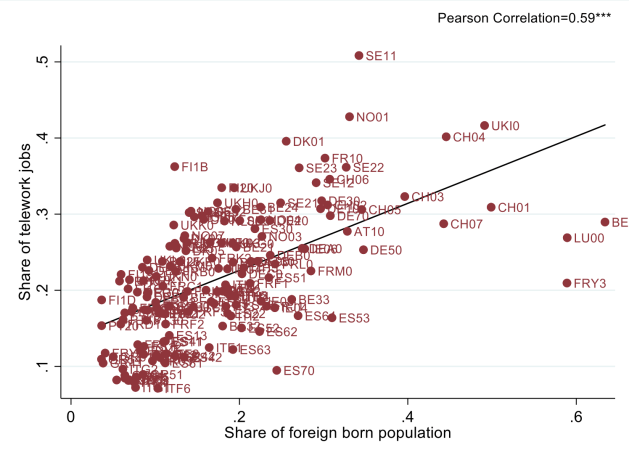
We find that native-born workers in those European subregions with a higher share of immigrants are significantly less likely to be exposed to various dimensions of occupational vulnerability associated with COVID-19. This association is especially strong when looking at the likelihood of being employed in teleworkable occupations (Figure 3), and the results get stronger once the endogeneity of immigrants’ location choices is taken into account. Immigration thus had a causal impact in reducing the exposure of native workers to some labour markets risks associated with the COVID-19 pandemic.

Figure 3 The relationship between share of immigrants in the working-age population and share of natives employed in jobs amenable to work from home in European regions

Source: Authors’ calculations using the EU Labor Force Survey 2018.
Note: The sample includes NUTS-2 regions from the EU-15 as well as Switzerland and Norway.

We also find heterogeneous effects depending on the characteristics of native workers. The effects of immigration on job safety are stronger for highly (i.e. tertiary) educated native workers, who benefit from the presence of both high-skilled and low-skilled migrants. By contrast, the effects are smaller and statistically insignificant for less (i.e. non-tertiary) educated native workers. We also assess whether these compositional effects on employment of certain types of native workers are accompanied by overall changes in total employment and wages. We find no evidence of wage or employment impacts among native workers, suggesting that the increase in job safety among native workers is driven purely by their reallocation from vulnerable jobs to safer jobs.

In short, we find that immigration to Western Europe reduced the economic exposure of natives to COVID-19 related labour market shocks by pushing them towards occupations that are more amenable to work from home. Our paper thus provides another example of immigrant workers in effect ‘protecting’ native workers by taking on the riskiest jobs during the pandemic.

Source: Immigration and natives’ exposure to COVID-related risks in the EU | VOX, CEPR Policy Portal

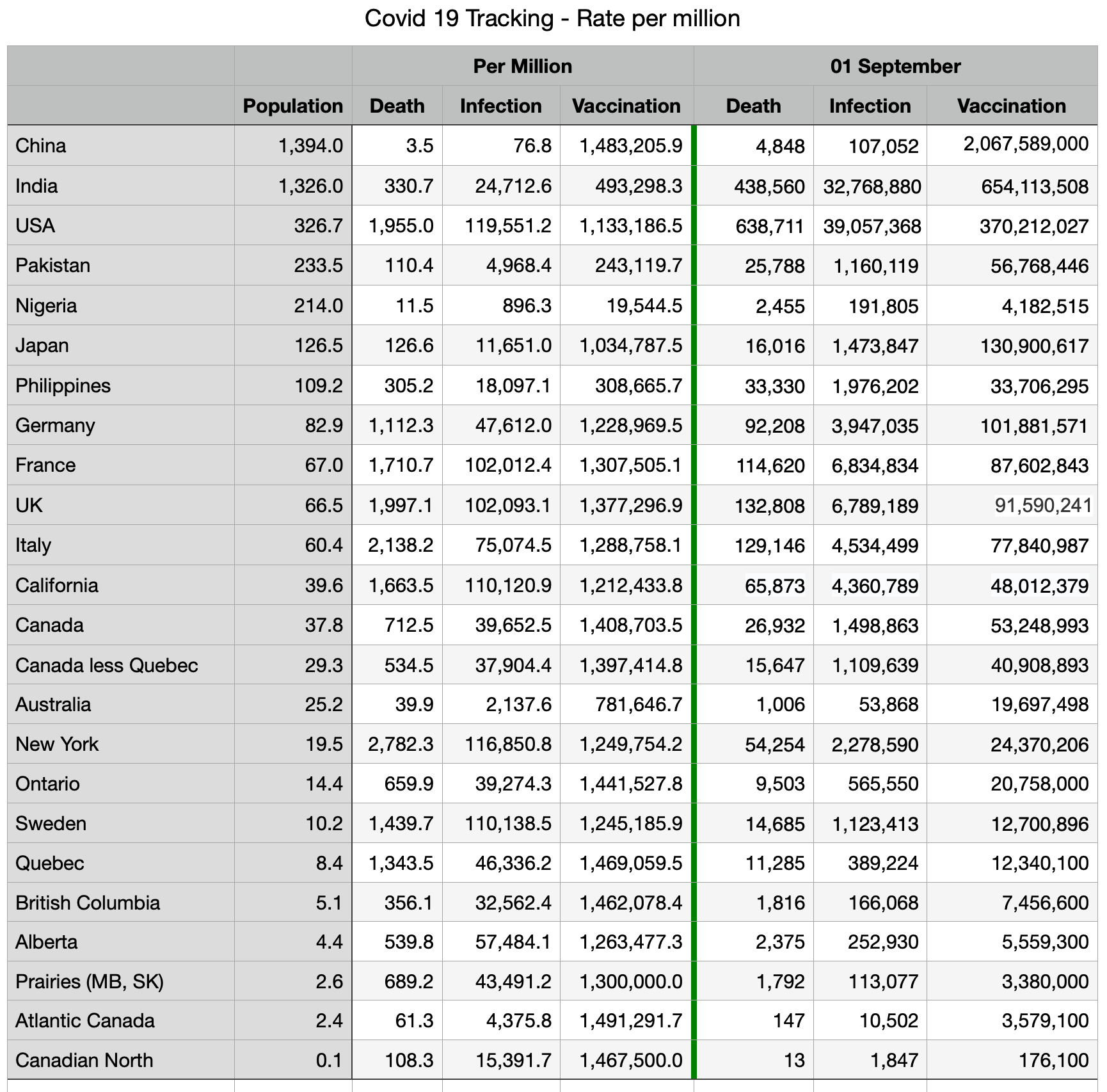
#COVID-19: Comparing provinces with other countries 1 September Update

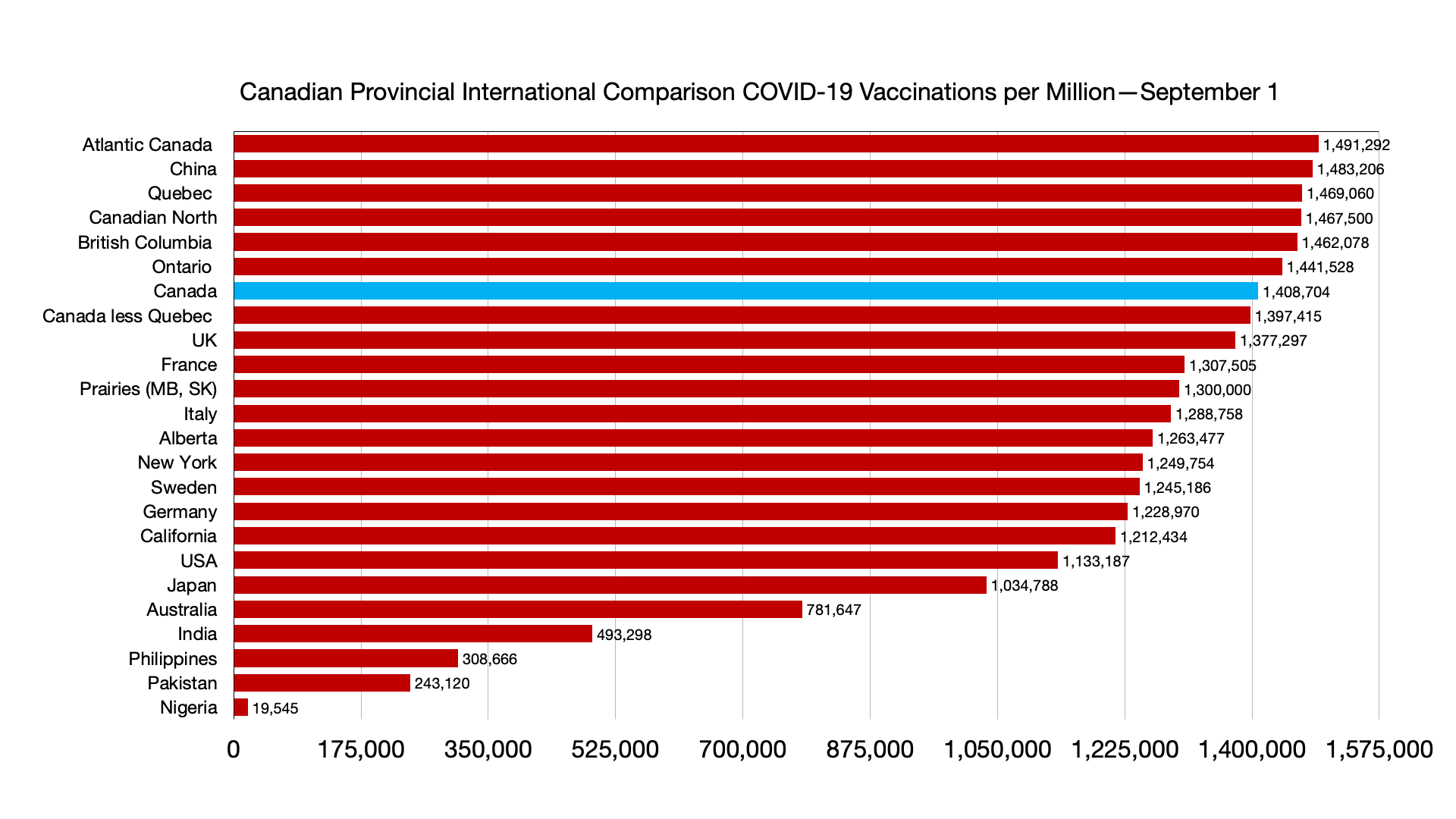
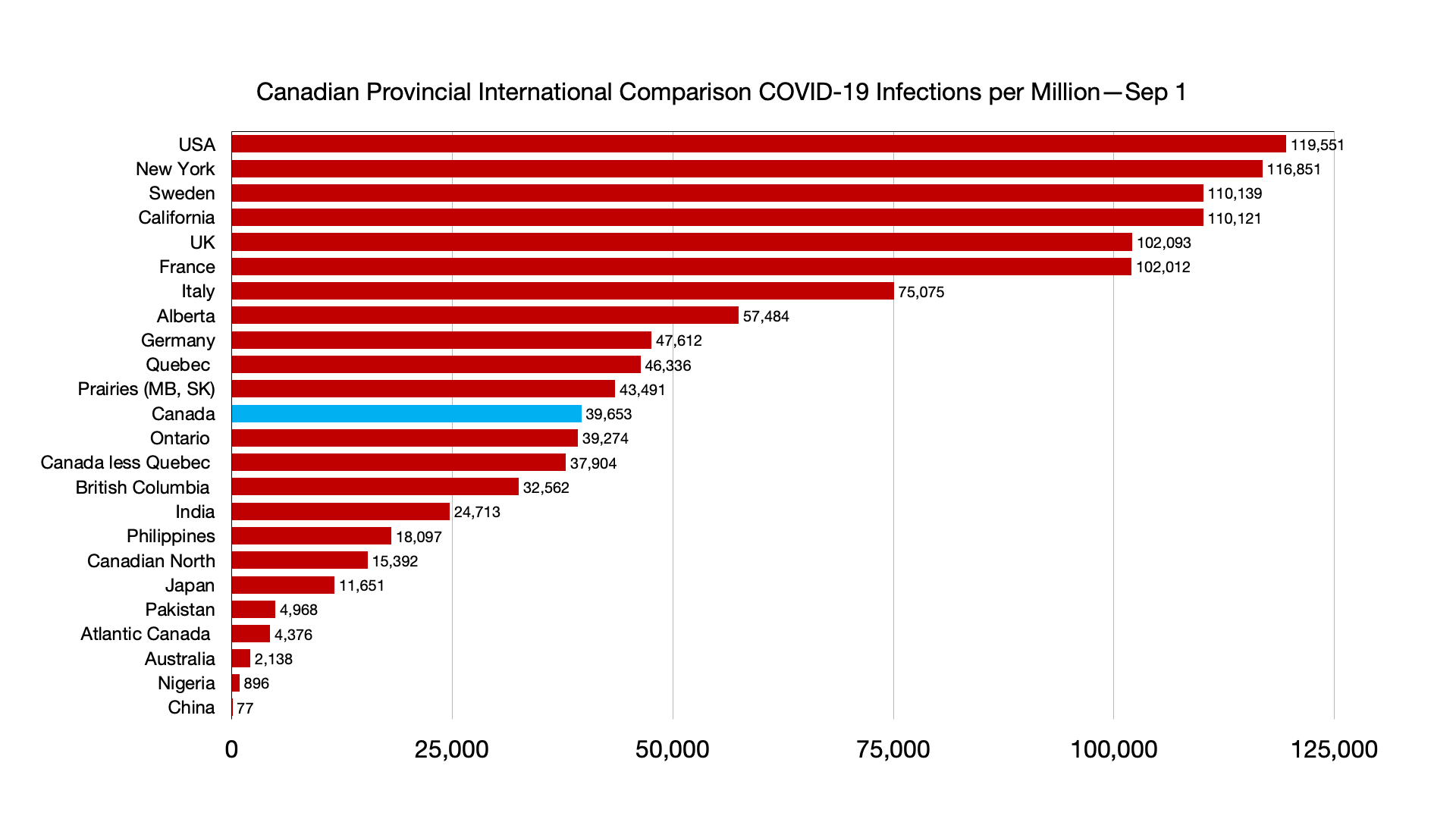
The latest charts, compiled 1 Septe mberas overall rates in Canada increase slightly due to the variant. Canadians fully vaccinated 67.6 percent, higher than USA 53 percent and the UK 64 percent), although all three countries appear to be reaching a wall with respect to vaccination.

Vaccinations: China second after Atlantic Canada, Quebec ahead of Canadian North, France ahead of Prairies, and Germany ahead of Sweden. Chinese fully vaccinated, 63.3 percent, if numbers are accurate.

Trendline charts

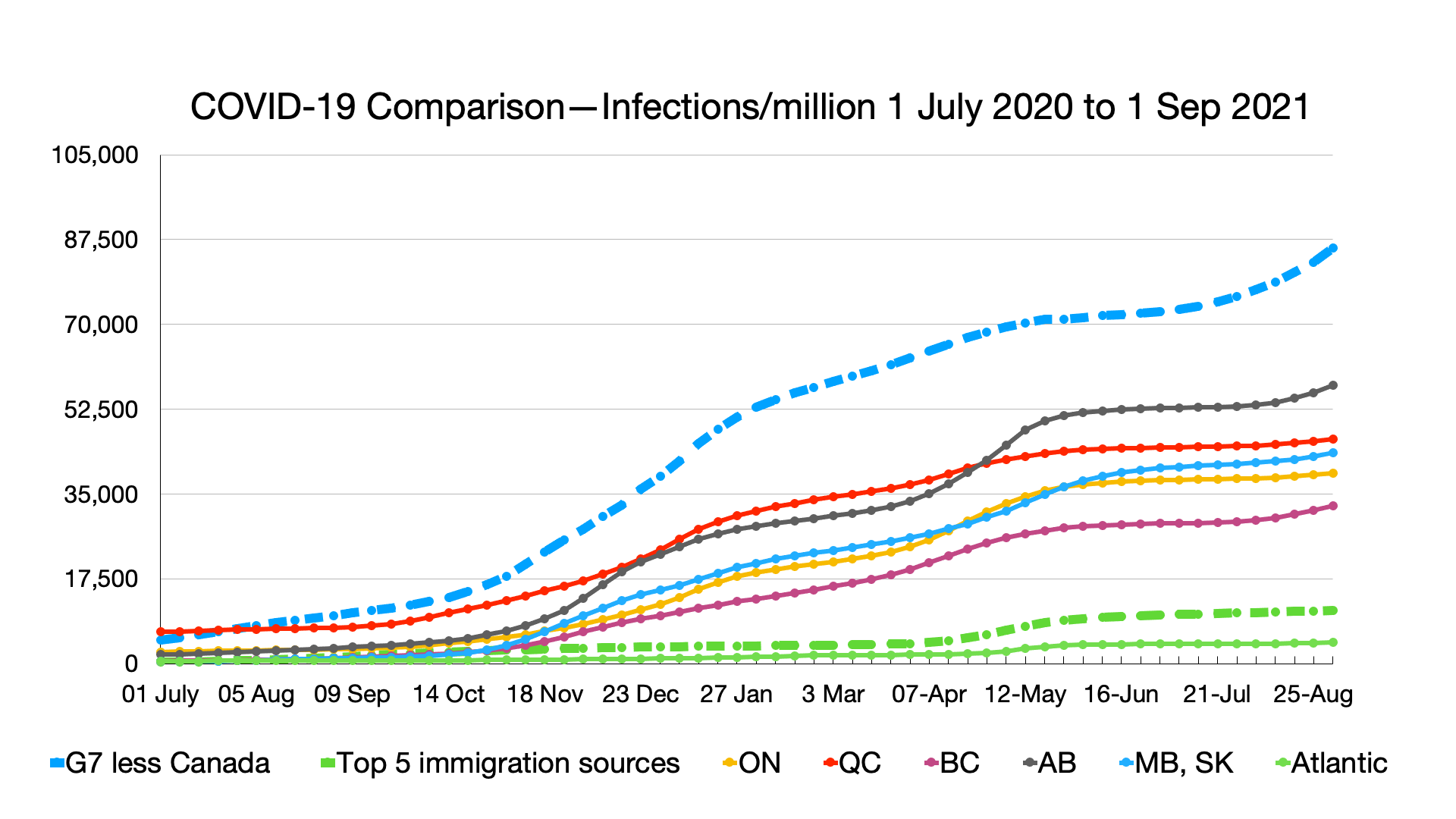
Infections: Same ongoing trend: More pronounced uptick in G7 less Canada (driven largely by USA). While all provinces showing increased infections, greater upticks in Alberta, British Columbia.

Deaths: No significant change.

Vaccinations: Ongoing steady gap between Alberta and Prairies with lower vaccination rates than elsewhere in Canada. More rapid increase of immigration sources countries driven by China and to a lesser extent, India.

Weekly

Infections: No relative change except UK slightly ahead of France.

Deaths per million: No significant change.

When the ‘Silent Majority’ Isn’t White

While focus is on the USA, fundamental point regarding political diversity within minorities also applies in Canada:

In her 1990 book “Fear of Falling,”Barbara Ehrenreich detailed how the widely broadcast violence at the 1968 Democratic National Convention in Chicago led to an immediate, dramatic paradigm shift in media coverage. In the month before the event, Mayor Richard Daley had denounced the various anti-Vietnam War protest groups who were planning to converge outside the city’s International Amphitheater. When those protesters arrived, Daley fought back with his police force who, on Aug. 28, attacked protesters in Grant Park.

In scenes that would be echoed a half-century later during the George Floyd protests, the police beat, detained and intimidated everyone from the Yippies to the Young Lords to Dan Rather. In both 1968 and 2020, the press heightened its critique against the police and the mayor once they saw their own being attacked in the streets.

Then came the reckoning. Ehrenreich writes:

Polls taken immediately after the convention showed that the majority of Americans — 56 percent — sympathized with the police, not with the bloodied demonstrators or the press. Indeed, what one could see of the action on television did not resemble dignified protest but the anarchic breakdown of a great city (if only because, once the police began to rampage, dignity was out of the question). Overnight the press abandoned its protest. The collapse was abrupt and craven. As bumper stickers began to appear saying “We support Mayor Daley and his Chicago police,” the national media awoke to the disturbing possibility that they had grown estranged from a sizable segment of the public.

Media leaders moved quickly to correct what they now came to see as their “bias.” They now felt they had been too sympathetic to militant minorities (a judgment the minorities might well have contested). Henceforth they would focus on the enigmatic — and in Richard Nixon’s famous phrase — silent majority.

The following months would provide even more evidence that the media had misjudged the moment. A New York Timespoll conducted a day after showed an “overwhelming” majority supported the police in Chicago. CBS reported that 10 times as many people had written to them disapproving of their coverage of the events as had written in approval.

In response, the media class spent the next few years, in Ehrenreich’s words, examining “fearfully and almost reverently, that curious segment of America: the majority.” The problem, of course, was that the same people who had just believed the world ended at the Hudson were the same people who now would be tasked with discovering everything beyond its banks. As a result, the media’s coverage of “the silent majority” was abstract and almost mythic, which allowed it to be shaped into whatever was most convenient.

There are a couple of obvious questions here: A year after the nationwide George Floyd protests, has mass media, which I’ll define here as the major news outlets and TV networks, undergone a similar paradigm shift? And if there is a new “silent majority” whose voices must be heard, who, exactly, is it?

Are we seeing a media backlash to the summer of 2020?

A quick caveat before we go much further into this: I am generally skeptical of the types of historical matching games that have become popular these days, especially on social media, where false symmetries can be expressed through heavily excerpted screenshots or video. Just because something looks vaguely like something that happened in the past doesn’t mean that the two events are actually analogous. More important, I do not see the need to take every current injustice by the hand and shop it around to a line of older suitors — if nothing else, the act of constant comparison can take away from the immediacy of today’s problem.

But regardless of whether the comparison between 1968 and 2020 is apt, plenty of people made it. Most notably, Representative Jim Clyburn of South Carolina, who, after what was seen as a disappointing result in a handful of House races, compared the slogan “defund the police” to “burn, baby, burn” from the 1965 Watts riots and said such talk was “cutting the throats of the party.” Omar Wasow’s work on voting patterns during the civil rights movement and how the public and media responded to different images of violence also became a central part of opinion discourse.

As was true in 1968, we’ve also seen a shift in public opinion polls, perhaps confirming Wasow’s claim that while images of law enforcement committing violence against protesters will generate a significant upsurge in sympathy, images of looting and rioting will have the opposite effect. A Washington Post-Shar School poll conducted in early June of 2020 found that 74 percent of respondents supported the protests, including 53 percent of Republicans­­ — stunning results that suggested a radical shift in public opinion had taken place — and the media followed suit with an enormous amount of coverage.

Writing in The Washington Post,Michael Heaney, a University of Glasgow lecturer, wrote, “Not since the Kent State killings, in which National Guard troops shot and killed four student protesters in May 1970, has there been so much media attention to protest.” Heaney also pointed out that the coverage had been “generally favorable.” But as of this summer, polling of white Americans on support for Black Lives Matter and policing reform had reverted to pre-2020 levels. Has media coverage followed suit?

We might look at coverage of the recent New York City mayoral race as a kind of case study. The campaign of Eric Adams, a former N.Y.P.D. officer who largely positioned himself against his more progressive opponents on public safety and school issues, was cast as a referendum on last summer. The media attributed Adams’s victory in the Democratic primary almost entirely to his pro-police platform. In June, a Reuters headline read, “Defying ‘Defund Police’ Calls, Democrat Adams Leads NYC Mayor’s Race.” In July, The Associated Press wrote that Adams’s win was part of a “surge for moderate Democrats” and said the centerpiece of his campaign was a rejection of activists’ calls to defund the police.

This echoed the coverage of Clyburn’s declarations after the election and fell in with a spate of media coverage about the shift in opinions on policing. So, some regression of media sympathy toward the summer of 2020 does seem underway — although we shouldn’t believe the media underwent some fundamental change during the summer of 2020, or, for that matter, in the months leading up to the 1968 Democratic National Convention. Those moments should be seen, instead, as flare-ups that subsequently shamed the media into seeking out “the real America” or whatever.

Who is the silent majority in 2021?

In 1968, the turn in opinion came mostly at the expense of Black radicals and young protesters in favor of what was largely then assumed to be white working-class voters.

Today’s silent majority certainly does include white voters, but this time, recent coverage suggests that the media is reproaching itself for a somewhat different failing: neglecting the perspective of more-moderate voters of color.

The post-mortem of the 2020 election — in which more immigrants than anticipated, whether Latinos in Florida and Texas or Asian Americans in California, voted for Donald Trump — coincided with the need to make some sense of what had happened to public opinion after last summer. Connections were made. By the time Adams gave his victory speech, a narrative about the diverse silent majority had taken hold: People of color supported the police, hated rioting and wanted more funding for law enforcement. They did not agree with the radical demands of the Floyd protests — in fact, such talk turned them off.

There’s a lot of truth to the concerns about how much the mass media actually knows about minority voters. When the Latino vote swings from Texas and Florida came to light on election night, Chuck Rocha, a political strategist who specializes in Latino engagement, went on a media tour and placed the blame on “woke white consultants” who believed that a broad message of antiracism would work for “people of color.” As I wrote in a guest essay, a similar pattern held in Asian American communities — it turns out that Vietnamese refugees who reside in Orange County, Calif., might have different opinions on Black Lives Matter, capitalism or abortion rights than, say, second-generation Indian Americans at elite universities.

These mistakes came from a grouping error: Liberal white Americans in power, including members of the media, tended to think of immigrants as huddled masses who all shook under the xenophobic rhetoric of the Republican Party and prayed for any deliverance from Donald Trump. They did not see them as distinct populations who have their own set of political priorities, mostly because they took their votes for granted.

So, if the media is actually overlooking an entire population and sometimes misrepresenting them, what’s the big deal if it’s now correcting for this?

A few things can be true at once: Yes, the media overwhelmingly misconstrued the actual beliefs of minority voters, particularly in Latino and Asian American communities. Yes, those voters tend to have more moderate view on policing.

The problem isn’t one of description, but rather of translation. The media took a normal regression in polling numbers, mixed it with some common sense about how minority populations actually vote and created a new, diverse “silent majority.” This is a powerful tool. These unheard, moderate minorities carry an almost unassailable authority in liberal politics because of the very simple fact that liberals tend to frame their policies in terms of race. If those same objects of your concern turn around and tell you to please stop what you’re doing, what you’ve created is perhaps the most powerful rebuttal in liberal politics. Over the next few years, I imagine we will see an increasing number of moderate politicians and pundits hitch their own hobbyhorses to this diverse silent majority. The nice thing about a vaguely defined, still mysterious group is that you can turn it into anything you want it to be.

Some version of this opinion engineering, I believe, is happening with the police and public safety. There’s not a lot of evidence that Latino and Asian voters care all that much either way about systemic racism or funding or defunding the police. (Black voters, on the other hand, listed racism and policing as their top two priorities leading up to the 2020 election.) Polls of Asian American voters, for example, show that they prioritize health care, education and the economy. Latino voters listed the economy, health care and the pandemic as their top three priorities. (“Violent crime” ranked about as high as Supreme Court appointments.) If asked, a large number of people in both of these groups might respond that they support the police, but that’s very different from saying they base their political identity on the rejection of, say, police abolition. If they’re purposefully voting against the left wing of the Democratic Party, it’s more likely they are responding to economic or education policy rather than policing.

And so it may be correct to say that within the new, diverse “silent majority,” attitudes about the police and protest might be much less uniform than what many in the mass media led you to believe in the summer of 2020. It may also be worth pointing out that reporters, pundits and television networks should probably adjust their coverage to accurately assess these dynamics, just as I’m sure there were legitimate concerns with media bubbles in 1968. But it also seems worth separating that assessment from the conclusion that the media should now see the summer of 2020 as political kryptonite and cast the millions of people who protested in the streets as confused revolutionaries who had no real support.

After 1968, the mass media’s turn away from the counterculture of the ’60s and its indifference to the dismantling of Black radical groups narrowed the scope of political action. This constriction would be aided over the next decade by lurid, violent events that all got thrown at the feet of anyone who looked like a radical. When Joan Didion wrote of the Manson murders, “Many people I know in Los Angeles believe that the Sixties ended abruptly on Aug. 9, 1969, at the exact moment when word of the murders on Cielo Drive traveled like brushfire through the community, and in a sense this is true. The tension broke that day. The paranoia was fulfilled,” she was saying that all the fears of the so-called silent majority had come to pass.

We are living through some version of that today. But what seems particularly telling about this moment is that the retreat no longer requires Charles Manson, the fearmongering over Watts or the police riots at the 1968 Democratic National Convention. Those images hover above the public’s consciousness as evergreen cautionary tales; the paranoia they fulfilled will do just fine.

The question at the outset of this post, then, has a split answer: Yes, we seem to be reliving a moment of media revanchism in the name of the (diverse) silent majority, but it is also a replay of a replay, akin to filming a television screen with your phone’s camera, with all of its inherent losses in resolution, clarity and immediacy.

Source: https://www.nytimes.com/2021/08/30/opinion/silent-majority-white-media.html

Will hate crimes make Canada a less attractive destination for immigrants?

Not convinced. Unlikely that among the various factors that influence destinations of immigrants that this will dominate the others. More important, even as a factor, this will be in relation to other countries, most of which have higher degrees of polarization on immigration and diversity issues:

Since the start of the pandemic, there has been a reported intensification in racially motivated hate crimes against immigrants from East and Southeast Asia in many Western countries, including Canada. But do such xenophobic crimes affect migration to the countries in which they take place?

To answer this question, we first need to understand that, to many immigrants, the decision to migrate depends on a set of factors; some that push them to leave their home country, while others pull them to the host country.

The fact is that Canada has not always been a welcoming country – rather it has a well-documented history of racial discrimination against immigrants. In fact, most Asian immigrants in Canada are aware of racism, both covert and overt. With the popularization of information and communication technology, it is imaginable that many seeking to move to the country have been prepared by their families and friends already in Canada for discrimination, particularly in the job market, which is notorious for its systemic discrimination against professional credentials, work experience, language, culture and race of ethno-racial minority immigrants.

Of the top ten countries of birth of recent immigrants to Canada, seven are in Asia

Yet given these challenges, why do tens of thousands of immigrants from East and Southeast Asian countries still decide to immigrate to Canada every year?

Before 1967, when Canada introduced its points-based immigration system, immigrants to Canada were overwhelmingly from Europe. The point system welcomed young, educated and skilled immigrants, andshifted the major sources of immigrants to Canada from Europe to Asia. According to the 2016 census, among the top ten countries of birth of recent immigrants, seven are in Asia, namely the Philippines, India, China, Iran, Pakistan, Syria and South Korea. With a long history of migration to Canada, immigrants from these countries have also established a strong transnational social network that facilitates the migration of fellow friends and families and their settlement and integration in Canada.

A better future

Seeking a better economic future is believed to be a key force behind transnational migration, particularly from the Global South to the Global North. Political instability and oppression are other major factors driving people voluntarily and involuntarily to leave their countries, such as the case of Syria and Iran. Recently, the military suppression of democracy movements in Myanmar, the civil unrest in Thailand, China’s military pressure on Taiwan and the imposition of National Security Law on Hong Kong have caused many people to consider leaving their home countries.

Immigrants to Canada have long cited seeking better futures for their families as the number one reason why they decided to emigrate. Some were even willing to trade off economic loss for political stability. One example is the 380,000 Hong Kong immigrants who travelled to Canada in the 1980s and 1990s, amid the uncertainties surrounding the transfer of sovereignty of Hong Kong from Britain to China.

For many immigrants, Canada and other Western countries are attractive not only because of better economic opportunities but because of political stability, safety, lifestyle, education, as well as social and health protection, to name just a few reasons.

Canada has repeatedly claimed to be a global defender of human rights. Recently, the Canadian government apologized and compensated for racially motivated wrongdoings in the past, such as the head tax on Chinese immigrants and the internment of Japanese-Canadians. Hate crimes against Asians and any other ethno-racial groups simply jeopardize Canada’s global reputation and moral credibility.

Related story

PA-53949819.jpg
Canada’s immigration planning is increasingly divorced from the real impacts of COVID-19 – and undervalues ‘essential workers’

Meanwhile, as a country that relies on immigrants to replace the shrinking domestic supply of talents to our labour market, Canada is competing for high-skilled talents in demand globally. If it is to become an appealing destination, we must create a welcoming and inclusive environment for immigrants in Canada. Racism will certainly weaken this, and also make it more difficult to retain immigrants, particularly those who are highly skilled, and can choose to leave. In 2006, there were already 2.8 million Canadians living abroad, many of whom had originally been immigrants to Canada, including 300,000 who returned to, and still reside in, Hong Kong.

The intensification of anti-Asian hate crimes since the start of the pandemic may not reduce the number of immigrants who choose to move to Canada or to other Western democracies. But a socially unwelcoming society will have difficulties competing for and retaining global talents.

To make Canada a welcoming place, where immigrants can secure a better future for their families and contribute to society, all levels of government and the general public need to step up to combat all forms of racism against all minorities.

Source: Will hate crimes make Canada a less attractive destination for immigrants?

O’Toole says he’s condemned racism in past, when asked why platform makes no mention of it

Hard to believe that omission was not deliberate but still surprising:

Conservative Leader Erin O’Toole spent his 16th day on the election campaign talking about his plan to ban puppy mills and to crack down on unethical breeders , and defended the fact his party’s platform mentions neither racism nor systemic racism.

The Conservative Party of Canada’s election platform, entitled “Canada’s Recovery Plan,” stretches 160 pages and comprises some 49,000 words, some of which are more used much more frequently than others.

For instance, the phrase “a detailed plan” is used 22 times in the table of contents alone, while the word “secure” is used in five sub-headers highlighting the party’s plan to “secure” the economy, jobs, and other key election issues. The word “puppy” as it relates to today’s announcement appears twice.

But, as CTV News’ Omar Sachedina noted, there are some words that are missing from the document entirely, including “racism” and “Islamophobia.”

Asked by CTV News during a media availability on Monday about the discrepancy, O’Toole didn’t address the absence of the words directly, but said he has spoken out against racism and pointed to diversity among the Conservative slate of candidates.

“I’ve spoken out on the horrific rise of anti-Semitism, Islamophobia, racism against people of colour, indigenous Canadians,” he said during a campaign stop at a dog rescue and sanctuary in King City, Ont.

“I will fight for Canadians who have not had fair treatment, who face inequalities in their daily life. We need to make sure that they have an economic recovery as well, and so you’ll see in our plan we want to see solidarity in communities,” he added.

O’Toole made headlines during a Conservative leadership debate in June 2020 when he wouldn’t say whether he thought systemic racism exists, although he said at the time he had zero-tolerance for racism.

The Liberals have yet to release their full platform, while the online NDP platform includes the word “racism” more than a dozen times, and mentions “Islamophobia” at least twice.

Source: O’Toole says he’s condemned racism in past, when asked why platform makes no mention of it

Canada accepted 7,300 more immigration applications due to technical bug

Shouldn’t have happened but good that IRCC accepted the invitations (of course, in current context of government target of 400,000 new Permanent Residents, doesn’t hurt):

A bug in the Canadian immigration system led to the government accepting an additional 7,307 immigration applications, surpassing the imposed limit.

This comprised files from international graduate stream applicants aspiring to change their temporary visa status to permanent residency.

Glitch led system to accept 7,307 applications over the limit

Canadian immigration law typically sets an annual limit for the number of immigration applications that can be accepted in a year under each route.

For example, eligible international graduates in Canada can apply to adjust their temporary residency status to permanent residence (PR) via an online application.

For 2021, the international graduate stream had an upper cap of 40,000 applications. However, a bug in the online system led to the acceptance of thousands of excess applications over the limit.

cic upper limit on applications
CIC upper limit on PR applications under each route

BleepingComputer reached out to Immigration, Refugees and Citizenship Canada to learn more:

“Due to a technical issue, IRCC received applications above the limit for the international graduate stream of the temporary pathway to permanent residence,” Philippe Couvrette, a government spokesperson told BleepingComputer.

The bug also caused the system to treat multiple applications as a single one:

“In some cases where two or more applications were submitted simultaneously, the electronic application system counted them as a single application.”

“As a result, the electronic application system accepted approximately 7,300 applications above the 40,000 limit for this stream,” continued Couvrette.

Minister enacts temporary policy to accept excess applications

Shelby Thevenot, editor of CIC News who first reported on the technical glitch shared additional insights with BleepingComputer.

In an internal memo shared with BleepingComputer, the government department requested Immigration Minister Marco Mendicino to allow for the excess applications to be processed as normal.

Without ministerial approval, as the current law dictates, applications accepted in excess due to the glitch would normally have been returned to the applicants, along with the fees.

The minister approved the policy on June 28th this year, allowing for the 7,307 extra applications above of the annual limit to be considered.

The move saved the applicants from unnecessary penalties and inconvenience caused by no fault of their own.

“IRCC is processing the applications received above the limit to ensure the 7,300 applicants are not penalized due to a system error. IRCC also made changes to the system to make sure this no longer happens,” Couvrette further told BleepingComputer.

The government agency said it is committed to delivering quality client service across its global network by making their programs and services more efficient, clear and consistent.

As more people come to Canada and application volumes continue to rise, IRCC must keep improving its operations and provide timely and efficient service to attract more immigrants and visitors and remain globally competitive, says the department.

“IRCC has been moving towards a more integrated, modernized and centralized working environment in order to help speed up application processing globally.”

“We move applications around our global network to ensure they are processed as efficiently as possible, which means applications may not be processed at or decided upon by decision makers at the office closest to where a client lives, or where an application is submitted,” concluded IRCC in their email to BleepingComputer.

IRCC is expected to enact a separate public policy for processing applications from persons requiring accommodation, details of which are to be announced.

Temporary residents and international students wanting to assess their eligibility towards one or more immigration streams can check out the online eligibility tool.

Source: Canada accepted 7,300 more immigration applications due to technical bug

McParland: Renaming Ryerson University to appease the delicate is probably harmless, if pointless

Valid critique of single-minded blinkers:

The only reason I knew anything about Egerton Ryerson, before he ran afoul of the forces of statue reclamation, was because, for a brief period, I attended the Toronto school that took his name.

That was a long time ago. Ryerson was a mere polytechincal institute at the time and no one cared much who it was named after. Given I was to spend time there, I checked out the man whose name was on the building. Turned out he was a key figure in the staid, grey, ultra-respectable clique that ran the Toronto in the early and middle decades of the 19th century. Most of them were rigid, unbending figures, steeped in their self-regard, but Ryerson was an education maven: arguing that education should be mandatory, schools should be free, teachers should be professionally trained, textbooks should include Canadian authors, schools should be run independently and freed of the monopolistic hands of the priests. For that he won wide plaudits and remained a respected and admired figure well into the current century, until history was suddenly revised and he became a reviled character accused of plotting to demean and degrade Canada’s Indigenous people.

His sin was that, approached for advice on a means of educating Aboriginal children, he advocated for teaching in English in boarding schools away from families. While he could hardly be blamed for the horror show the system later became, his presence at the birth of the concept has seen him seized on by revisionist extremists intent on denouncing the dead for failing to adopt 21st century processes in a 19th century world.

The old-timey Ryerson Polytechnical Institute I attended has since grown considerably, sprawling over a network of streets and byways all over central Toronto and proudly re-branding itself as a fully-fledged university. Now it is to have a new name, because any association with Egerton Ryerson is a wholly unsatisfactory state of affairs for the ultra-woke, easily offended young people who make up the student body or the timid functionaries who populate the administration.

The decision was announced Thursday after approval by the university’s board of governors, based on the recommendations of a report commissioned last November. In addition to designating Ryerson an unperson, the board agreed the university “will not reinstall, restore or replace” a statue that had been pulled down and disfigured, and will issue “an open call for proposals for the rehoming of the remaining pieces … to promote educational initiatives.” Anyone looking for an extra kneecap or a spare left hand as a conversation piece or garden ornament should presumably apply at the bursar’s office.

Ceremonies to promote “healing and closure” will be held at the spot the statue once occupied. Board members agreed something will also have to be done about “Eggy,” a school mascot that will obviously no longer do unless the faculty redirects its interests towards the reproductive habits of chickens.

If a new name makes the delicate daisies at Ryerson happy it seems kind of harmless. And maybe it’s just as well. Parts of the university border on Dundas Street, a main thoroughfare christened after another long-dead figure who got himself mixed up with the wrong side of history. Since the city had already decided to rename the offending stretches of pavement, the university was going to have to order up new letterhead anyway, so why not go for the full magillah? Next on the list could be Yonge St., which also skirts the campus and honours a figure far more objectionable than either Dundas or Ryerson, but who has somehow escaped the roving hordes of Puritans now dictating the acceptable limits of nomenclature to a crushed and cowering city. By this time next year whole swaths of the city core could find itself operating under new identities, confusing the tourists and playing havoc with street maps.

It’s possible trouble still lies ahead, however. Among findings in the task force report was a potentially troubling recommendation that some recognition of Ryerson’s existence be allowed to continue. Specifically, “the establishment of a physical and interactive display that provides comprehensive and accessible information about the legacy of Egerton Ryerson and the period in which he was commemorated by the university,” and  “the creation of a website that disseminates the Task Force’s historical research findings about Egerton Ryerson’s life and legacy.”

Given that the man was hardly the ogre imagined by his statue-bashing accusers, and bears much credit for the early development of an advanced education system in what was then a remote and underpopulated province, it’s possible an honest assessment of his life won’t be as dark and discreditable as today’s student body obviously hopes.

What happens then? Will they tear down the display and banish the web site? Probably. Truth can never be allowed to spoil the prejudices of historical ignorance. Especially at an institution of higher education.

Source: https://ottawacitizen.com/opinion/kelly-mcparland-renaming-ryerson-university-to-appease-the-delicate-is-probably-harmless-if-pointless/wcm/9cdcaa08-96aa-44ea-b856-6e13345e8373