Who voted for the People’s Party of Canada? Anti-vaxxers and those opposed to vaccine mandates

Preliminary analysis. Will be interesting to see what others come up with such as the Canada Election Study. As it is likely that COVID and vaccination will not be a top issue (we hope!) in the next election, likely the PPC will focus on immigration and other related issues, and their advocacy for more restrictive policies:

At first glance, the 2021 federal election appears to have changed very little. Each party was returned to the House of Commons with about as many seats as it had previously held. 

Beneath the surface, however, some shifts occurred. Most notably, while the People’s Party of Canada failed to win any seats, its share of the popular vote grew to five per cent — more than double what it earned two years earlier.

The PPC’s support is small yet not easily dismissed. The 841,000 votes it earned makes it the fifth most popular party in the country, well ahead of the Greens (who have appeared on the ballot, addressing the prominent issue of climate change, for decades). The People’s Party won three times more votes than the Reform Party did when it first fielded candidates in 1988, one election prior to its breakthrough in 1993.

Understanding exactly what to make of the PPC’s growing support is especially important for the leadership of the Conservative Party of Canada. If PPC voters are former Conservative supporters disappointed with the party’s attempt to appeal to middle-of-the-road, suburban Canadians, it signals a serious dilemma — each voter the Conservatives gain by moving to the centre could be matched by a right-leaning voter lost to the PPC.

PPC voters bemoan ‘loss of freedom’

What, then, do we know about PPC voters? At first glance, our fall 2021 survey shows PPC voters have the profile many would expect. They’re dissatisfied with the way things are going in our country today, feel the economy is getting weaker, think there are too many immigrants coming to Canada who don’t adopt the country’s values and hold a favourable opinion of the United States.

Yet these opinions do not really set them apart. Most Conservative Party supporters also hold these views. What does distinguish current PPC voters is their views on the COVID-19 pandemic, and specifically on the issue of vaccination, vaccine mandates and vaccine passports. 

Our survey, conducted during the 2021 election campaign, asked Canadians to identify the most important problem facing the country today. 

Both Liberal and Conservative Party supporters were most likely to mention the COVID-19 pandemic in general. Climate change was most likely to be mentioned as the most important problem by NDP, Bloc Québécois and Green Party supporters. 

But for PPC supporters, the No. 1 issue was the loss of freedom stemming from vaccine mandates — a concern barely mentioned by anyone who supported other parties. 

A more rigorous analysis of the survey results, which tests the significance of different factors while holding others constant, confirms the importance of vaccination issues to current PPC voters. 

Someone who singled out “loss of freedom” during the pandemic as the most important issue facing the country had a 59 per cent chance of supporting the PPC, compared to only a five per cent chance for someone who mentioned any other issue. 

Similarly, someone who singled out “COVID-19 vaccination issues” as the most important issue facing the country had a 44 per cent chance of supporting the PPC, compared to a six per cent chance for someone who mentioned any other issue. 

Immigration not a decisive factor

This last example, furthermore, likely underestimates the impact of PPC voters’ irritation with vaccination requirements. It can be assumed that the very few number of Liberals who also singled out “COVID-19 vaccination issues” as the most important issue probably had something very different in mind — perhaps frustration with those who won’t get vaccinated — than their PPC counterparts. 

Nonetheless, the main point is clear: voters concerned about the push to be vaccinated and what they perceive as a loss of freedom during the pandemic were much more likely to vote PPC than voters concerned about anything else. 

Equally important is the finding that PPC voters stand out much less for their attitudes on immigration. The impact of immigration views on someone’s likelihood of supporting the PPC is barely significant, in stark contrast to their opinions on vaccination.

This does not mean that PPC voters are strong supporters of immigration; rather, it means simply that their views on the subject do not differentiate supporters of the PPC from supporters of some other parties — notably, the Conservatives. 

Incidentally, it should be noted these findings apply only to Canadians indicating they intended to vote for the PPC, not to the party’s leadership, organizers or funders who may regard closing our borders to newcomers as more of a priority.

A message for Conservatives

Nonetheless, the fact that the growth in PPC support is tied to the unusual issue of vaccination against COVID-19 is no guarantee that the party’s popularity will fade once the pandemic ends. Other issues may come along to take its place. 

But it does send a cautionary note to Conservatives who might be wondering what the party can do to bring PPC voters back into the fold. Rejecting new policies on climate change or social diversity is unlikely to help so long as PPC supporters continue to be motivated largely by a single issue — their opposition to vaccines. 

As the election outcome itself showed, showing flexibility on vaccine mandates in order to win back defectors to the PPC risks putting more distance between the Conservative Party and the mainstream of Canadian public opinion

In short, PPC voters were not simply typical Conservative supporters leaning furthest to the right on a range of issues that include government spending, taxation, climate change and immigration. They were, on average, a unique cluster of voters who have rejected the overwhelming public consensus on the need to be vaccinated to contain the spread of COVID-19.

The growth potential for the Conservative Party lies not in chasing the small number of voters angered by vaccine mandates, but in appealing to the much larger pool of voters whose top priorities include bringing the pandemic to an end and refocusing attention on the fight against climate change.

Source: https://theconversationcanada.cmail19.com/t/r-l-triyyhjl-kyldjlthkt-n/

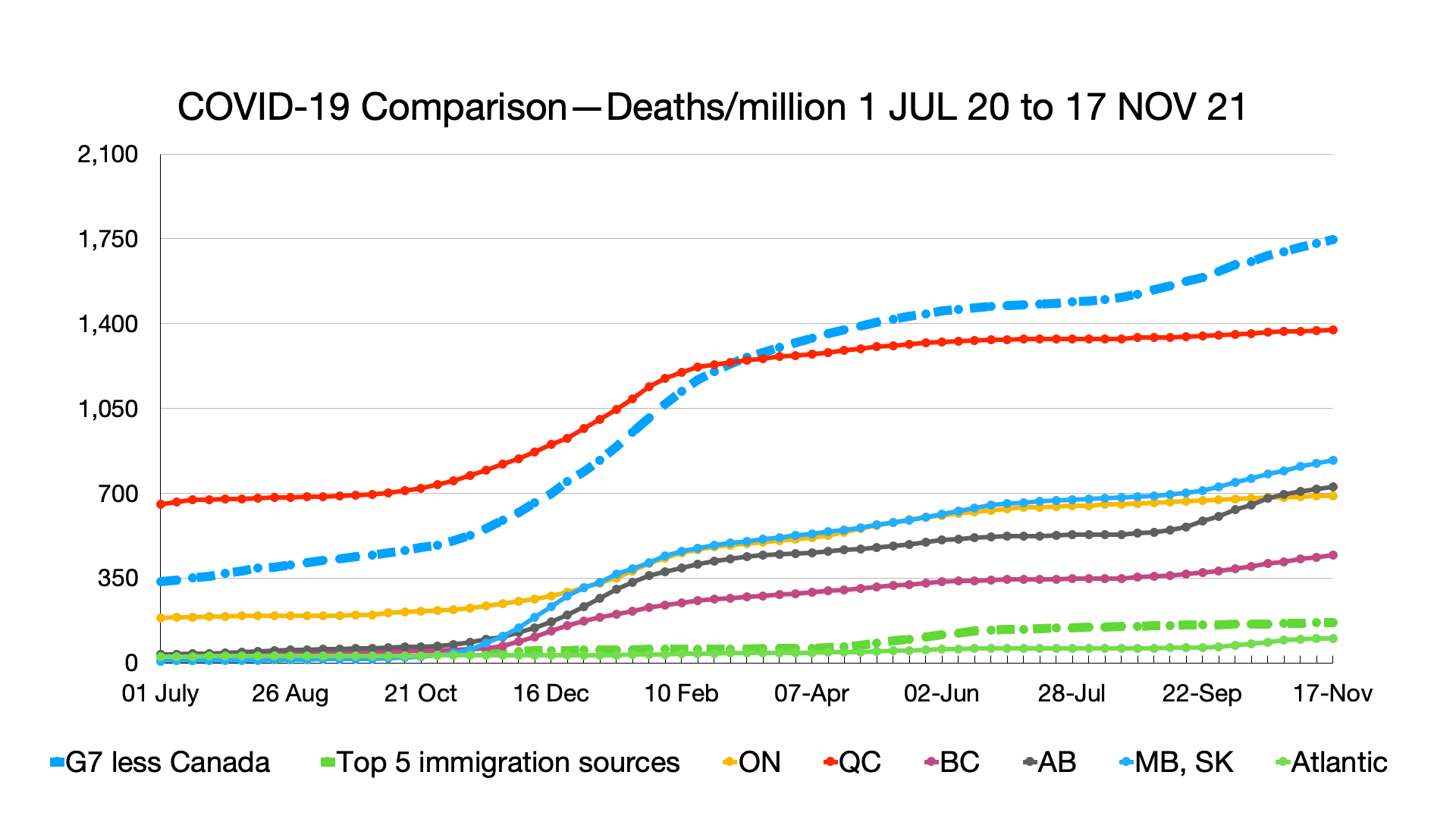
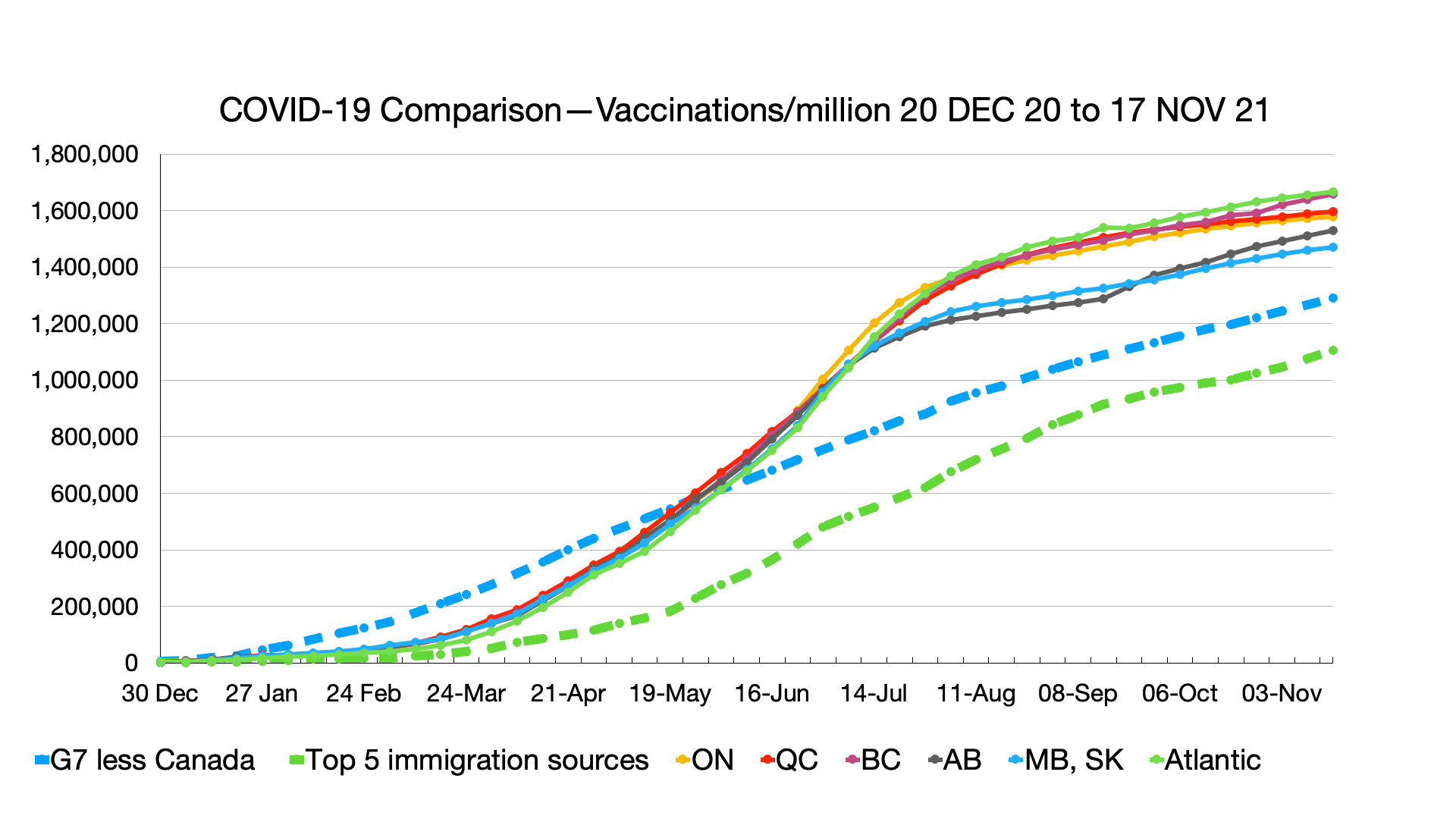
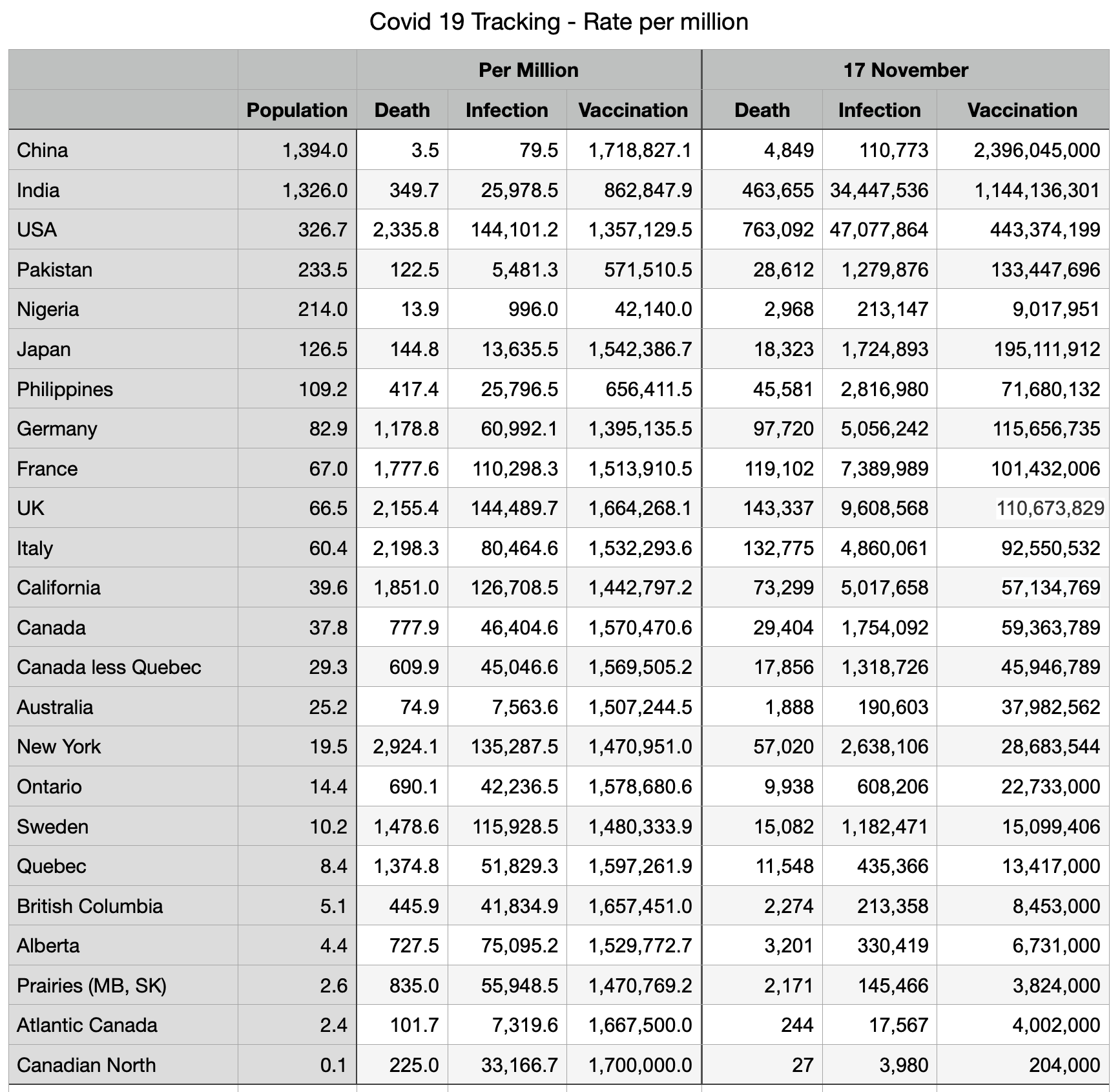
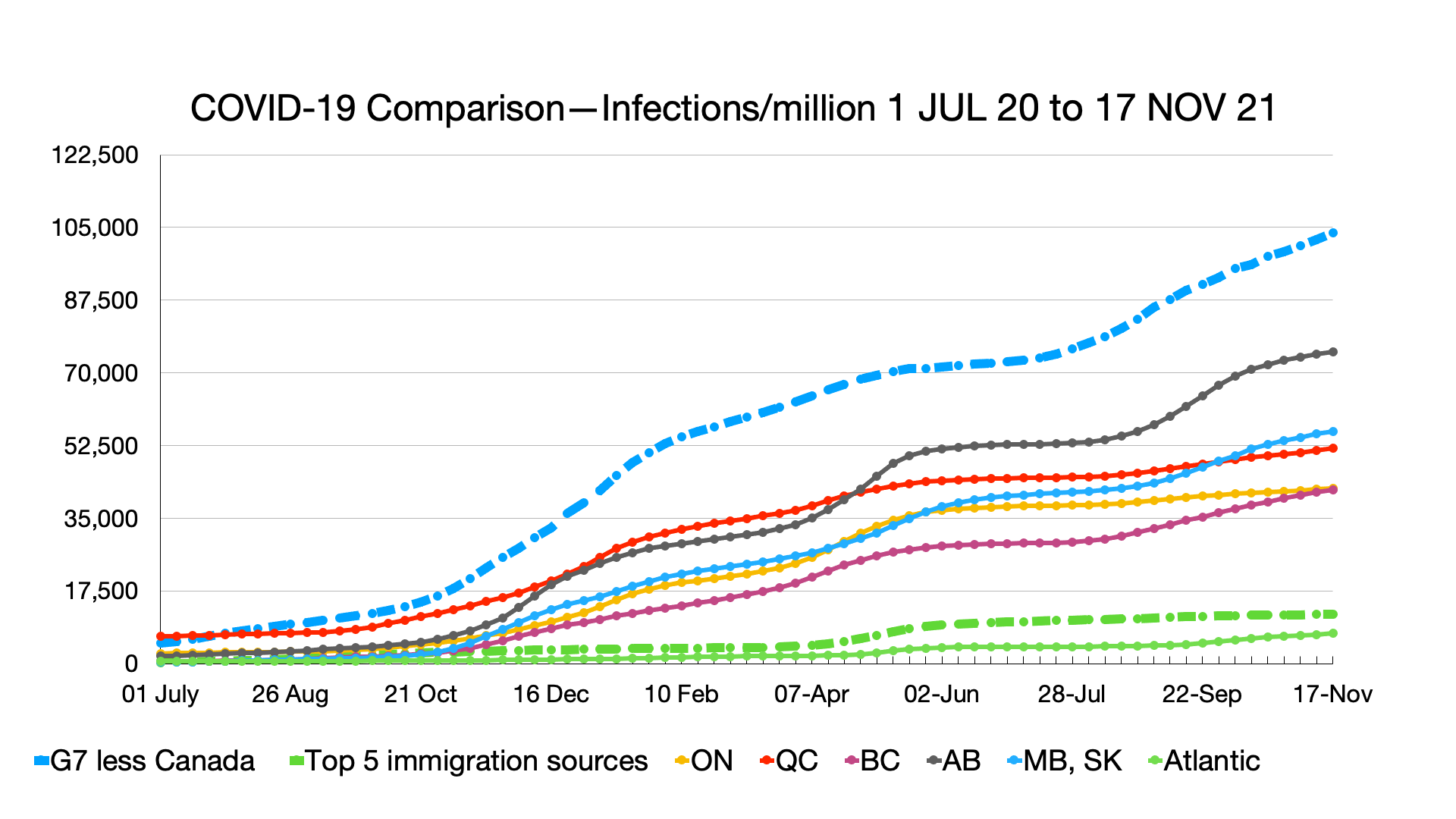
#COVID-19: Comparing provinces with other countries 17 November Update

The latest charts, compiled 17 November. Canadians fully vaccinated 76.4 percent, compared to Japan 75.8 percent, UK 68.9 percent and USA 59.4 percent.

Vaccinations: Canadian North ahead of Atlantic Canada, UK and British Columbia, Sweden and New York ahead of Prairies. China fully vaccinated 76.8 percent, India 27.6 percent, Philippines 36.5 percent.

Trendline Charts:

Infections: Recent trends of increased infections in Europe becoming more apparent. Canadian provincial trends showing minimal change from last week.

Deaths: Albert, Prairie and British Columbia deaths climb at slower à rate to G7 less Canada (driven mainly by USA).

Vaccinations: Ongoing convergence among provinces and G7 less Canada and narrowing gap with immigration source countries.

Weekly

Infections: UK ahead of USA with no other relative change.

Deaths: No relative change

And an interesting article on cognitive bias and vaccine hesitancy:

The World Health Organization recognized vaccine hesitancy as a growing challenge in 2011, and identified it as a new priority topic. This was mostly because of the return of vaccine-preventable diseases like measles in Europe and the United States

Ten years later, in 2021, we see that vaccine hesitancy has become an even more significant challenge despite all the efforts. The COVID-19 pandemic has brought it to a peak, and all efforts to manage the pandemic depend on the people’s willingness to take the vaccination. However, the numbers are not very promising as some percentage of populations in every country are reluctant to vaccinate.

Vaccine hesitancy means “delay in acceptance or refusal of vaccines despite availability of vaccination services.” Vaccine-hesitant people cite distrust in vaccine safety and concerns over vaccine adverse eventsas the most common reasons for reluctance to get vaccinated. 

Vaccines are used in healthy people to prevent a disease that might harm them in the future. However, as they are healthy at the time of vaccination, they may worry about the vaccine’s safety.

Our team of business analytics and artificial intelligence researchers at Concordia University, along with a professor of epidemiology at McGill University, has published a paper in the BMC Public Health journal that investigated this critical concern from two perspectives. 

First, we addressed vaccine safety concerns by analyzing data from vaccine adverse events systems. These are vaccine surveillance systems where adverse events following immunization are reported, monitored and stored in a database. Canada’s system is called the Canadian Adverse Events Following Immunization Surveillance System (CAEFISS).

Second, we focused on cognitive science and highlighted the critical role of cognitive biases in people’s vaccination decision-making that might lead to vaccine hesitancy.

Data-driven evidence to address vaccine safety

A solution to mitigate distrust in vaccines safety is to provide evidence-based meaningful information about vaccine safety and adverse events. We followed this path and analyzed all the adverse events reported to the U.S. Vaccine Adverse Event Reporting System (VAERS).

We analyzed almost 294,000 reports over eight years from 2011 to 2018. It equals roughly 115 reports per million people, covering 87 vaccine types. The most frequently reported vaccines were those for chickenpox, influenza, pneumococcal bacteria and human pappilomavirus (HPV).

Each VAERS report (representing one incident) involved an average of three adverse events, the most common being rashes, fever, swelling, pain and headaches. Only 5.5 per cent of the reports were marked as serious, resulting in hospitalization, disability, threats to life or death. The top adverse events in this group also include fever, pain, vomiting, headaches and shortness of breath. 

We also analyzed the vaccine adverse events reported to Canada Vigilance. Our findings were consistent with those from the VAERS.

We have provided our results in an interactive dashboard. Health-care professionals and others involved in vaccine communication can use this dashboard to provide evidence-based information to the public. Research suggests that summarized data is the best format for communicating vaccine safety information, so using this dashboard in vaccination communication can help mitigate vaccine hesitancy and safety concerns, and increase trust in vaccines.

The role of cognitive biases in vaccine hesitanc

In the second part of our study, after addressing concerns about vaccine adverse events, we examined the role of cognitive biases on vaccine hesitancy. We identified cognitive biases that might affect vaccine communication and decision-making. 

As mentioned earlier, vaccines are administrated to healthy people. When people are making decisions about vaccination, they might feel some degrees of risk, ambiguity and uncertainty about the results, which can instigate cognitive biases in the decision-making process. Such cognitive biases might nudge people toward vaccine hesitancy.

For example, contrary to the positive effect of providing people with summarized vaccine safety information that increases vaccine trust, detailed vaccine adverse event reports will decrease trust because of two cognitive biases. 

First, when vaccine hesitant people read a detailed report about a vaccine adverse event, it gives them the chance to see what they want to see. It is an example of confirmation bias, which is the tendency to recall and interpret information that confirms our existing beliefs

Second, a detailed adverse event report will also increase the event’s vividness, making it easier to recall the next time there is a decision to be made about taking a vaccine. That is the effect of availability bias, the tendency to attribute more weight to factors that are easier to recall.

We identified 15 cognitive biases in the vaccine decision-making process and categorized them into three groups:

  • Cognitive biases triggered by processing vaccine-related information include availability bias, as in the above example, as well as framing effect, base rate neglect, availability bias, anchoring effect and authority bias.
  • Cognitive biases triggered in vaccination decision-makinginclude omission bias, which is when the results of not taking an action are viewed as less damaging than the results of taking action, even when this is not the case. Others include ambiguity aversion, optimism bias, present bias and protected values. 
  • Cognitive biases triggered by prior beliefs regarding vaccination include confirmation bias such as the one in the example, as well as belief bias, shared information bias and false consensus effect.

The full list of cognitive biases affecting vaccination decision-making and their examples is available here. Public health officials and practitioners can use this list and customize their plans, interventions and other forms of vaccine communication to decrease vaccine hesitancy. 

You also can check the list and see if these biases have influenced your own vaccination decisions.

Source: https://theconversationcanada.cmail19.com/t/r-l-trtukldd-kyldjlthkt-b/

Why some people say Peel police diversity and inclusion committee isn’t enough to address anti-Black racism

I have sympathy with having an overall diversity and inclusion committee, with sub-committees for specific issues or communities as needed, to ensure better understanding of the both the commonalities and the differences needed to ensure more effective policies and programs. As well, care needs to be taken to ensure a variety of perspectives is heard in such consultations and discussions, including both activists and pragmatists:

Contrary to the wishes of many residents in Mississauga and Brampton to create an anti-Black racism advisory panel, the Peel Police Services Board (PPSB) has decided to move forward with a diversity and inclusion (D&I) committee instead.

Members voted to move ahead with the general organization, which will have a subcommittee dedicated to the Black community, at the October meeting following calls more than six months ago from local activist David Bosveld and others to create the panel.

In his latest deputation at the same meeting, Bosveld said a specific panel is needed because of “the disparate outcomes, interactions, violence, criminalization, over policing and systemic issues of anti-Black racism” experienced and documented in recent reports and findings from the force.

Board members went back and forth on the pros and cons of a general committee or specific panel, with newest member Martin Medeiros listing one con being other racialized communities may also want their own panel.

“Realistically, we can’t have four or five or six or seven boards; technically, it’s not sound,” he said at the meeting, while adding that choosing what groups get to have their own panels is like “picking winners and losers.”

The original recommendation for the D&I committee said the panel wouldn’t fill any gaps due to anti-racism work done across the region.

In August, the board moved to defer their decision on implementing the specific panel, requesting more information on how the D&I committee would operate and overviews of similar operations at other forces.

Executive director Rob Serpe delivered a report two months later that said the committee would “provide its advice and recommendations to the board,” on issues and policies “relating to system racism, equity, diversity and inclusion as well as issues relating to anti-Black racism.”

But as Dr. Tope Adefarakan, an equity, diversity and inclusion expert, explains, a D&I committee (even with a sub-committee), is not nearly enough to address specific issues of anti-Black racism within the realm of policing.

To understand why, the relationship between police and Black communities needs to be looked at historically.

“If you think of the history of policing, it’s about patrols who catch Africans that were enslaved,” she said.

Add to that the many stereotypes and racist tropes applied to Black individuals involving law enforcement, and this leads to a historical legacy impacting one community.

“Black communities are being seen as inherently criminal. That ideology is deeply embedded in policing in and of itself,” said Adefarakan.

She argues those views are uniquely applied to Black communities, saying “criminality or violence don’t get attached to other communities in the same way.”

This can be seen in countless reports on policing, including a recent study in Peel that showed Black individuals were 3.5 times more likely to be met with force from police than any other race.

“Black people are seen as the most threatening, the most dangerous, the most criminal, hence the over representation,” she said.

The report alone should be enough for members to implement the panel, since it echoes the same message Black residents have been talking about for years, said Adefarakan.

A panel would also be able to discuss solutions or make recommendations directly related to the report and work on other areas of policing that aren’t often looked at such as the impact on Black women, children and LGBTQI+ members.

But perhaps most topical is what Adefarakan says are the “beginnings of a shift” among the general public in understanding Black people’s experiences with police, following the murder of George Floyd.

“People in the Black community have been talking about police brutality for a long time,” which has only recently trickled into the greater population, she said.

Anu Radha Verma, who made a deputation at the August board meeting, said creating a general panel completely misunderstands Bosveld’s multiple asks and the “broader demands” from groups and individuals in Peel.

“The case is already made in the data that we need to actually talk about tackling anti-Black racism. One thing that we know, as a non-Black, south Asian person is, when we can address anti-Black racism within our community in Peel, it benefits everyone, and that should be justification enough,” she said.

She also pointed out there are no Black members on the board, and none of the current members have any skills or expertise on addressing anti-Black racism, gaps the specific panel could fill.

Also at the board meeting was Dr. Akwasi Owusu-Bempah, professor at the University of Toronto, who, when asked his opinion on the formation of a general committee, said “when the issues facing Black people are subsumed under diversity, which includes sexual orientation, religion, race and ethnicity, which are different, then those concerns do often get lost.”

Despite these multiple deputations, lengthy discussions and expert opinions, no such panel will be created, with Bosveld saying his request and other concerns from the Black community have been ignored.

“The issues faced by Black communities on policing are very specific and troubling and need to be addressed as such. How that cannot be obvious is beyond me,” he said.

Source: Why some people say Peel police diversity and inclusion committee isn’t enough to address anti-Black racism

Share of World Population Allowed to Immigrate Legally to U.S. 85% Below Its Peak

Canada’s peak year for immigration in relation to its population was 1913, when over 400,000 arrived, or 5.2 percent of our total population of 7,632,000. In world population terms, that would be 22 per 100,000; today’s 400,000 is about 5 per 100,000. So not sure how meaningful this argument is but fun to work the numbers:

In fiscal year 2021, the share of the world population that the U.S. government permitted to immigrate legally to the United States was about 85 percent below its peak year of 1907 when 74 in 100,000 people became legal permanent residents of the United States. By 2021, that number had fallen to about 11 in 100,000—slightly lower than the 13 in 100,000 in 2019 or 16 in 100,000 in 2016.

Unlike those with various temporary statuses or no status, legal permanent residents are the only non‑U.S. citizens who may naturalize to become U.S. citizens. Measuring legal immigration as a share of the world’s population contextualizes potential immigrants’ actual opportunity to immigrate to the United States better than the absolute number of immigrants. No year has seen more than a fraction of a percent of the world’s population become U.S. legal permanent residents, but the share has declined, even as the desire to immigrate has increased.

Figure 1 shows the number of new legal permanent residents to the United States as a share of the non‑U.S. world population from 1840 to 2021. The lines after 1952 reflect the fact that some immigrants could adjust to legal permanent residence while already the United States. The share of “new arrivals” who enter from abroad as permanent residents fell even more dramatically from its high—nearly 95 percent below its peak in 1907.

During the era of mostly free immigration prior to 1925, legal immigration fluctuated wildly based on world events and the U.S. economy. But after visas were capped, an unnatural consistency developed at a low level. The one anomaly is in the period of 1989 to 1991 when the immigrants legalized by the 1986 amnesty adjusted to legal permanent residence. This experience was a small window into the demand that would exist if the United States had retained free immigration.

Table 1 ranks the years based on the share of the world population immigrating to the United States. Out of the 182 years, fiscal year 2021 ranks 122nd in terms of total new legal permanent residents as a share of the world population and 167th in terms of newly arriving legal permanent residents from abroad—which means only 15 years saw fewer new arrivals as a share of the world population than 2021.

If the United States had retained the same level of new legal permanent residents as a percentage of the world population as it saw during 1900 to 1924—the 25 years before the borders were closed—from 1925 to 2021, 160 million immigrants would have received permanent residence, compared to the 51 million who did. The level of legal immigration for 2000 to 2021 would be about 2.7 times the rate it actually was, permitting about 62 million immigrants as opposed to 22 million.

It’s reasonable to suppose that the actual rate would be higher than this, had the United States maintained its earlier policies. It certainly looks like the trend before World War I was upward from peak to peak. Transportation has also decreased significantly in price as well. The upshot is that the United States has extremely closed borders relative to what a reasonable person would expect under an even relatively open immigration system. This fact also explains why the country is experiencing so much more illegal immigration than in the past. When legal immigration is closed off, illegal immigration becomes most people’s only option.

Source: Share of World Population Allowed to Immigrate Legally to U.S. 85% Below Its Peak

Climate migration is already happening — Canada must lead in developing a coherent response

Silent on the impact of increased immigration to Canada on Canada’s climate footprint and how to mitigate it. And would these new classes be part of current and future expected immigration levels or supplemental? Would this approach risk the overall consensus in favour of immigration in Canada?:

Representatives from much of the world gathered in Glasgow to discuss how to respond to the existential impacts of climate change. COP26 brought with it a heightened sense of urgency and the destructive effects of climate change can no longer be ignored, even for the most stubborn amongst us. 

But the consequences of climate change will hit some people harder and many will be forcibly displaced from their homes. Climate migration is projected to create the largest amount of displacement we have seen in modern history. An estimated 216 million people in six regions across the globe will be displaced due to climate change by the year 2050. 

In 2020 alone, over 30 million people were internally displaced by natural disasters. By the end of the century, the homelands of 280 million people could be permanently submerged due to rising sea levels.

Some of the displaced will inevitably find their way to Canada. The need is urgent for Canada to put forward a comprehensive law and policy framework for climate migrants.

We must be better prepared for the inevitable. We must also meet our international law obligations and create meaningful pathways for displaced individuals to find safety within our borders. Canada must lead in developing a coherent response on climate migration.

As the echoes grow louder at COP26 for proactive action on the resettlement of climate migrants and refugees, the Canadian Association of Refugee Lawyers has released a new 2021 Report on Climate Migrants to offer a number of policy and legal options for the Canadian government to consider.

Despite the inevitability of climate migration and the known scale of the impending issue facing Canada, there is no comprehensive plan or framework in Canada to address the issue of climate migrants, aside from the brief 2010 background federal report entitled “Climate Change and Forced Migration.” 

However, much has changed since 2010. We know more about the severity of the climate risks faced by millions across the world and we know more about the timing of the impending issues we face as a country. Indeed, the issues posed by climate change and climate migration provide an opportunity by Canada for global leadership on a pressing issue while the numbers of actual climate migrants are presumably low. Canada should act now so that it is able to thoughtfully design and test evidence-based, proactive policy and law.

There are a host of policy and legal options available to Canada in order to address climate migration proactively:

First, Canada can broaden categories for protection by granting “protected person status” to climate migrants, exempting them from the requirement of demonstrating personalized risk given the often generalized nature of climate induced displacement.

Second, Canada can create a public policy class under its humanitarian and compassionate program for persons facing climate disasters. We did this in the aftermath of the 2010 Haitian earthquake, and we can test this in the case of climate migrants.

Third, we can expand private refugee sponsorship categories to include a class of individuals who have been displaced by climate change.

Fourth, we can ensure that individuals are not deported from Canada where they do not have a home to return to due to climate induced displacement. The reality is that Canada has options in law and policy, but we must begin doing the work now — and quickly.

Climate migration is inevitable, and its scale is growing by the day. Canada must get ahead of the matter before it is too late.

Source: https://www.thestar.com/opinion/contributors/2021/11/15/climate-migration-is-already-happening-canada-must-lead-in-developing-a-coherent-response.html

Dave Chappelle, Transphobia And Anti-Semitism

Interesting take and contrast:

Dave Chappelle’s alma mater, the Duke Ellington School of the Arts in Georgetown, first cancelled his fundraiser for the school and then changed their minds and postponed him to late April. Now they have announced that they are still going to name their theater after him.

It’s easy to see what’s going on here. Chappelle has been a loyal alum to the Duke Ellington School and has donated lots of money to it. But he spoke quite a bit about transgendered people in his last Netflix special, “The Closer”, and many people consider his jokes transphobic. Students at Duke Ellington complained and threatened to protest the fundraiser. The school’s first instinct was to mollify the most vocal students and cancel Chappelle. But it didn’t want to kill the golden goose and is hoping that by April the controversy will have died down enough that they can have the fundraiser, avoid too much controversy and not alienate Dave Chappelle.

Hypocrisy reigns supreme over this entire situation. The school is obviously triangulating desperately to balance its desire for Chappelle’s money with its desire to avoid controversy.

There is no indication that they might consider this a teaching moment. There is a genuine discussion to be had about whether “The Closer” is transphobic. The word itself is clumsy and inaccurate. Phobias are fears and Chappelle certainly isn’t afraid of trans people. He does believe that gender is matter of biology. He says that: “every human being in this room, every human being on Earth, had to pass through the legs of a woman to be on Earth.” So, he doesn’t believe that a trans woman, who can’t give birth, is a woman in the same sense as a woman with a uterus, birth canal, etc. Obviously, trans women who are incapable of giving birth but deeply believe themselves to be women strongly object to what he said, and they have every right to do so. He also makes a joke comparing trans genitals to plant-based meat substitutes and it’s easy to understand why many trans individuals find this hurtful.

But this doesn’t automatically make Chappelle afraid of trans people or hateful towards them. Many people are confused by the idea of women with penises and men with vaginas. Joking about it isn’t the same thing as spreading hate or fear. The worst thing anybody can do to another group (short of violence of course) is to dehumanize them. Chappelle does the opposite of that. He has a long segment about a trans woman comedian, Daphne Dorman, whom he invited to open for his act in San Francisco. Dorman defended Chappelle against charges of transphobia, writing: “Punching down requires you to consider yourself superior to another group. He doesn’t consider himself better than me in any way. He isn’t punching up or punching down. He’s punching lines. That’s his job and he’s a master of his craft.”

Dorman got mauled on social media for defending Chappelle and ended up committing suicide. No one can know for sure if the criticism is what drove her to take her own life, but Chappelle paints a rich portrait of her and makes the point that hate against a trans person can take many forms. It’s not always obvious who is “punching up” and who is “punching down”. When a social mob gangs up on a vulnerable person, Chappelle believes that they are victimizers even if many are trans persons themselves. One can agree or disagree with this, but his point merits discussion, not boycotts, and certainly not the craven hypocrisy of the Duke Ellington School.

The left’s obsession with “punching up” and “punching down” leads to another form of hypocrisy as well—it’s blindness towards anti-Semitism (unless it comes from the political right). In the same show, Chappelle makes a joke about making a movie called “space Jews” in which the Jews come back from an unsuccessful venture into outer space and now want to conquer Earth and take it back. The idea that Jews want to rule the world is an old anti-Semitic trope and a very harmful one. And Chappelle certainly doesn’t balance it with any warm and empathetic stories about Jewish people he knows. It is anti-Semitism served straight up. Yet, outside of the Jewish press, this blatantly anti-Semitic joke produced almost no reaction.

The point isn’t that Chappelle is necessarily ant-Semitic. He may have been trying to put the audience on edge. After the joke he said “it’s gonna get worse than that, hang in there.” The point is that, because the left thinks of Jews as being on top of the power hierarchy, they don’t react to a dehumanizing joke about Jews being alien invaders bent on taking over the world. Because they see trans people as lacking power, they paint a simplistic picture of Chappelle as phobic and hateful. An argument can certainly be made that, despite the warm portrait of a trans woman comedian, Chappelle’s show is harmful to transgendered people. That’s a great discussion to have. But the silence over raw anti-Semitism while Chappelle is simplistically vilified over his jokes about transgender people shows that we need more dialogue and fewer cancellations.

Source: Dave Chappelle, Transphobia And Anti-Semitism

Canada is refusing more study permits. Is new AI technology to blame?

Given the high volumes (which immigration lawyers and consultants benefit from), expanded use of technology and templates inevitable and necessary, although thorough review and safeguards necessary.

Alternate narrative, given reporting on abuse and exploitation of international students and the program itself (The reality of life in Canada for international students), perhaps a system generating more refusals has merit:

Soheil Moghadam applied twice for a study permit for a postgraduate program in Canada, only to be refused with an explanation that read like a templated answer.

The immigration officer was “not satisfied that you will leave Canada at the end of your stay,” he was told.

After a third failed attempt, Moghadam, who already has a master’s degree in electronics engineering from Iran, challenged the refusal in court and the case was settled. He’s now studying energy management at the New York Institute of Technology in Vancouver.

His Canadian lawyer, Zeynab Ziaie, said that in the past couple of years, she has noticed a growing number of study permit refusals like Moghadam’s. The internal notes made by officers reveal only generic analyses based on cookie-cutter language and often have nothing to do with the particular evidence presented by the applicant.

“We’re seeing a lot of people that previously would have been accepted or have really what we consider as complete files with lots of evidence of financial support, lots of ties to their home country. These kinds of files are just being refused,” said Ziaie, who added that she has seen more than 100 of these refusals in her practice in the past two years.

It’s a Microsoft Excel-based system called Chinook. 

Its existence came to light during a court case involving Abigail Ocran, a woman from Ghana who was refused a study permit by the Immigration Department.

Government lawyers in that case filed an affidavit by Andie Daponte, director of international-network optimization and modernization, who detailed the working and application of Chinook.

That affidavit has created a buzz among those practising immigration law, who see the new system — the department’s transition to artificial intelligence — as a potential threat to quality decision making, and its arrival as the harbinger of more troubling AI technology that could transform how immigration decisions are made in this country.

All eyes are now on the pending decision of the Ocran case to see if and how the court will weigh in on the use of Chinook. 


Chinook was implemented in March 2018 to help the Immigration Department handle an exponential growth in cases within its existing, and antiquated, Global Case Management System (GCMS).

Between 2011 and 2019, before everything slowed down during the pandemic, the number of visitor visa applications skyrocketed by 109 per cent, with the caseload of applications for overseas work permits and study permits up by 147 per cent and 222 per cent, respectively.

In 2019 alone, Daponte said in his affidavit, Canada received almost 2.2 million applications from prospective visitors, in addition to 366,000 from people looking to work here and 431,500 from would-be international students.

Meanwhile, the department’s 17-year-old GCMS system, which requires officers to open multiple screens to download different information pertaining to an application, has not caught up. Each time decision-makers move from screen to screen they must wait for the system to load, causing significant delays in processing, especially in countries with limited network bandwidth.

Chinook was developed in-house and implemented “to enhance efficiency and consistency, and to reduce processing times,” Daponte said.

As a result, he said, migration offices have generally seen an increase of between five per cent and 35 per cent in the number of applications they have been able to process.

Here’s how Chinook works: an applicant’s information is extracted from the old system and populated in a spreadsheet, with each cell on the same row filled with data from that one applicant — such as name, age, purpose of visit, date of receipt of the application and previous travel history.

Each spreadsheet contains content from multiple applicants and is assigned to an officer to enable them to use “batch processes.”

After the assessment of an application is done, the officer will click on the decision column to prompt a pop-up window to record the decision, along with a notes generator if they’re giving reasons in the case of a refusal.

(An officer can refuse or approve an application, and sometimes hold it for further information.)

When done, decision-makers click a button labelled “Action List,” which organizes data for ease of transfer into the old system. It presents the decision, reasons for refusal if applicable, and any “risk indicators” or “local word flags” for each application.

The spreadsheets are deleted daily after the data transfer for privacy concerns.

While working on the spreadsheet, said Daponte, decision-makers continue to have access to paper applications or electronic documents and GCMS if needed.

“Chinook was built to save decision-makers time in querying GCMS for application information and to allow for the review of multiple applications,” Daponte noted.

However, critics are concerned that the way the system is set up may be guiding the officers toward certain conclusions, giving them the option of not reviewing all the material presented in each case, and that it effectively shields much of the decision making from real scrutiny.

According to Daponte’s court affidavit, the notes generator presents standard language that immigration officers may select, review and modify to fit the circumstances of an application in preparing reasons for refusal. The function is there to “assist them in the creation of reasons.”

Ziaie believes that explains the templated reasons for refusals she’s been seeing.

“These officers are looking at a spreadsheet of potentially 100 different applicants. And those names don’t mean anything to the officers. You could mix up rows. You could easily make errors,” said the Toronto lawyer.

“There’s no way to go back and check that because these decisions end up with very similar notes that are generated right when they’re refused. So my concern is about accountability. Every time we have a decision, it has to make sense. We don’t know if they make mistakes.”

That’s why she and other lawyers worry the surge of study permit refusals is linked to the implementation of Chinook. 

In fact, that question was put to Daponte during the cross-examination in the Ocran case by the Ghanaian student’s lawyer, Edos Omorotionmwan.

Immigration data obtained by Omorotionmwan showed the refusal rate of student permit applications had gone from 31 per cent in 2016 to 34 per cent in 2018, the year Chinook was launched. The trend continued in 2019 to 40 per cent and reached 53 per cent last year.

“Is there a system within the Chinook software requiring some oversight function where there is some other person to review what a visa officer has come up with before that decision is handed over to the applicants?” asked Omorotionmwan.

“Within Chinook, no,” replied Daponte, who also said there’s no mechanism within this platform to track if an officer has reviewed all the support documents and information pertaining to an applicant’s file in the GCMS data.


“This idea of using portals and technology to speed up the way things are done is the reality of the future,” said Vancouver-based immigration lawyer Will Tao, who has tracked the uses of Chinook and blogged about it.

“My concern as an advocate is: who did this reality negatively impact and what systems does it continue to uphold?”

Tao said the way the row of personal information is selected and set out in the Chinook spreadsheet “disincentivizes” officers to go into the actual application materials and support documents out of convenience.

“And then the officers are supposed to use those notes generators to justify their reasoning and not go into some of the details that you would like to see to reflect that they actually reviewed the facts of the case. The biggest problem I have is that this system has had very limited oversight,” he said.

“It makes it easier to refuse because you don’t have to look at all the facts. You don’t have to go through a deep, thoughtful analysis. You have a refusal notes generator that you can apply without having read the detailed study plans and financial documents.”

He points to Chinook’s built-in function that flags “risk factors” — such as an applicant’s occupation and intended employer’s information — for inconsistency in an application, as well as “local flag words” to triage and ensure priority processing of time-sensitive applications to attend a wedding or a funeral.

Those very same flag words used in the spreadsheet can also be misused to mark a particular group of applicants based on their personal profiles and pick them out for refusals, said Tao.

In 2019, in a case involving the revocation of citizenship to the Canadian-born sons of two Russian spies, the Supreme Court of Canada made a landmark ruling that helps guide judges to review the decisions of immigration officials.

In the unanimous judgment, Canada’s highest court ruled it would be “unacceptable for an administrative decision maker to provide an affected party formal reasons that fail to justify its decision, but nevertheless expect that its decision would be upheld on the basis of internal records that were not available to that party.”

Tao said he’s closely watching how the Ocran decision is going to shed light on the application of Chinook in the wake of that Supreme Court of Canada ruling over the reasonableness standard.

“Obviously, a lot of these applications have critical points that they get refused on and with the reasons being template and standard, it’s hard for reviewers to understand how that came to be,” he said.

In a response to the Star’s inquiry about the concerns raised about Chinook, the Immigration Department said the tool is simply to streamline the administrative steps that would otherwise be required in the processing of applications to improve efficiency.

“Decision makers are required to review all applications and render their decisions based on the information presented before them,” said spokesperson Nancy Caron.

“Chinook does not fundamentally change the way applications are processed, and it is always the officer that gives the rational for the decisions and not the Chinook tool.”

For immigration lawyer Mario Bellissimo, Chinook is another step in the Immigration Department’s move toward digitalization and modernization.

Ottawa has been using machine learning technology since 2018 to triage temporary resident visa applications from China and India, using a “set of rules derived from thousands of past officer decisions” then deployed by the technology to classify applications into high, medium and low complexity.

Cases identified as low complexity and low risk automatically receive positive eligibility decisions, allowing officers to review these files exclusively on the basis of admissibility. This enables officers to spend more time scrutinizing the more complex files.

Chinook, said Bellissimo, has gone beyond the triage. He contends it facilitates the decision-making process by officers.

The use of templated responses from the notes generator makes the refusal reasons “devoid of meaning,” he noted.

“Eventually, do you see age discriminators put into place for study permits when anyone over the age of 30 is all automatically streamed to a different tier because they are less likely bona fide students? This is the type of stuff we need to know,” Bellissimo explained.

“When they’re just pulling standard refusal reasons and just slapping it in, then those decisions become more difficult to understand and more difficult to challenge. Who made the decision? Was technology used? And that becomes a problem.”

He said immigration officials need to be accountable and transparent to applicants about the use of these technologies before they are rolled out, not after they become an issue.

Petra Molnar, a Canadian expert specializing in migration and technology, said automated decision-making and artificial intelligence tools are difficult to scrutinize because they are often very opaque, including how they are developed and deployed and what review mechanisms, if any, exist once they are in use.

“Decisions in the immigration and refugee context have lifelong and life-altering ramifications. People have the right to know what types of tools are being used against them and how they work, so that we can meaningfully challenge these types of systems.”

Ziaie, the lawyer, said she understands the tremendous pressure on front-line immigration officers, but if charging a higher application fee — a study permit application now costs $150 — can help improve the service and quality of decisions, then that should be implemented.

“They should allocate a fair amount of that revenue toward trying to hire more people, train their officers better and give them more time to review the files so they actually do get a better success rate,” she said. “By that, I mean fewer files going to Federal Court.”

As a study permit applicant, Moghadam said it’s frustrating not to understand how an immigration officer reaches a refusal decision because so much is at stake for the applicant.

It took him two extra years to finally obtain his study permit and pursue an education in Canada, let alone the additional application fees and hefty legal costs.

“Your life is put on hold and your future is uncertain,” said the 39-year-old, who had a decade of work experience in engineering for both Iranian and international companies.

“There’s the time, the costs, the stress and the anxiety.”

Source: https://www.thestar.com/news/canada/2021/11/15/canada-is-refusing-more-study-permits-is-new-ai-technology-to-blame.html

Blow: The Impact of the Browning of America on Anti-Blackness

Likely similar in Canada:

One of the things I often hear as a person who frequently writes about race, ethnicity and equality, is that the browning of America — the coming shift of the country from mostly white to mostly nonwhite — is one of the greatest hopes in the fight against white supremacy and oppression.

But this argument always flies too high to pay attention to the details on the ground. For me, white supremacy is only one foot of the beast. The other is anti-blackness. You have to fight both.

The sad reality is, however, that anti-blackness — or anti-darkness, to remove the stricture of a single-race definition for the sake of this discussion — exists in societies around the world, including nonwhite ones.

In too many societies across the globe, where a difference in skin tone exists, the darker people are often assigned a lower caste.

And, when people migrate to this country from those societies, they can bring those biases with them, underscoring that you don’t have to be white to contribute to anti-blackness.

fascinating report issued this month by the Pew Research Center explored colorism in the Hispanic community and underscored how anti-blackness, or anti-darkness, is no respecter of race or ethnicity. It is pervasive and portends a future in which the browning of America does not succeed in wiping away its racial prejudices.

First, the report reaffirmed what we all know to be true: A majority of Hispanic adults, regardless of skin tone, report experiencing discrimination.

But dark-skinned Hispanics reported far more discrimination than light-skinned ones.

The survey allowed Hispanics to select the skin tone closest to their own on a 10-point scale. Eighty percent of respondents chose the four lightest tones, which the report identified as light-skinned, but only 15 percent chose the six darker skin tones, which the report identified as dark-skinned. Others chose not to answer.

The survey found that:

“A majority (62 percent) of Hispanic adults say having a darker skin color hurts Hispanics’ ability to get ahead in the United States today at least a little. A similar share (59 percent) say having a lighter skin color helps Hispanics get ahead. And 57 percent say skin color shapes their daily life experiences a lot or some, with about half saying discrimination based on race or skin color is a “very big problem” in the U.S. today.”

Intolerance wasn’t only coming from outside the Hispanic community, but also from within it. Nearly half of the Hispanic adults surveyed said that they have often or sometimes heard a Hispanic friend or family member make comments or jokes about other Hispanics and about non-Hispanics “that might be considered racist or racially insensitive.” Dark-skinned Hispanics reported these incidents at a higher rate than light-skinned Hispanics.

When it came to how much attention was paid to racial issues in this country, a majority of Hispanics, understandably, said too little attention is paid to race and racial issues concerning Hispanics. A plurality also said that too little attention is paid to race and racial issues nationally.

But a plurality said too much attention was paid to issues concerning Black people.

This is troubling. Concern over racial issues isn’t a zero-sum game. There should be more concern for all groups and less of a belief that some are receiving too little and others too much.

These issues around how darker-skinned people of all races and ethnicities are perceived and treated must be addressed. This is in part because we are racing toward a future in which the share of minorities who are dark-skinned will only be a fraction.

By 2065, it is projected that not only will Asian Americans outnumber African Americans, but there will also be nearly twice as many Hispanics in the country as Black people.

As I have mentioned before, I worry that white supremacy could be replaced with a light supremacy, a society in which light-skinned people are still advantaged and dark-skinned people are still oppressed, even as the white majority recedes.

Interestingly, in the Pew report, respondents who identified as Hispanic, Latino or of Spanish origin were asked their race and told that for the purposes of the race question, “Hispanic origins are not races.” They could pick more than one race. According to the report, 58 percent identified as white. (Actual census datafound that dramatically fewer identified as white.)

I have seen some encouraging allyship between Black and brown people in my lifetime. Just last year, following the murder of George Floyd, a Pew survey found that an even higher percentage of Hispanics than Black people said that they had participated in protests.

But these groups have different histories with oppression in this country and different ongoing relationships with it. Pew found in 2015 that “immigration since 1965 has swelled the nation’s foreign-born population from 9.6 million then to a record 45 million.” The vast majority of that growth obviously happened after the Civil Rights Movement.

We must all recognize these differences and confront them in honest and deliberate ways. Colorism and racism are cousins, and both are a pestilence.

Source: https://www.nytimes.com/2021/11/14/opinion/latinos-colorism-anti-blackness.html

Soccer stars, technocrats among those granted Saudi citizenship

Apart from the propagandist language (“wise leadership”) interesting to note Saudi priorities and how they define “exceptional:”

Three leading Saudi football players as well as a number of technocrats and eminent academics are among those who were granted Saudi citizenship following a royal order issued by Custodian of the Two Holy Mosques King Salman on Thursday, Saudi Gazette has learned from well informed sources. This was in recognition of their outstanding contributions and distinguished services to Saudi Arabia in their respective fields.

Saudi Arabia has decided to grant citizenship to a selected number of expatriates with distinguished talents, unique expertise and specialized skills in a number of key professions such as medicine, industry, energy, agriculture, geology, space, aviation and artificial intelligence. The initiative emanates from the wise leadership’s ambitious drive to attract top world-class professionals to these vital sectors.

Saudi Arabia needs such top standard professions to supervise the Kingdom’s development march in those vital areas where it wants to achieve and consolidate its leadership and expertise par excellence. This will facilitate these professionals to contribute vigorously to the nation’s development march and initiatives to diversify its sources of income and spurring its robust economic growth.

The great initiative is aimed at supporting to achieve the Kingdom’s Vision 2030 goal to create an environment that enables attracting, investing in and retaining professionals with exceptional creativity and talent.

The following are the prominent professionals who were granted citizenship. They include three football stars, who all were born in the Kingdom and represented the national team several times.

It is noteworthy that the decision to grant citizenship to those who made outstanding contributions in sports to benefit from the country’s children who grew up on its land and imbibed its culture, after many of them left and started serving countries of their origin.

The list of distinguished persons who were granted citizenship also included some top professionals in the fields of technology and various branches of science.

Abdulfattah Adam

Abdulfattah Adam is a professional footballer who plays as a striker for Al-Nasr Club in the Saudi League, and represented Saudi Arabia’s national team in many matches. Born on Jan. 1, 1995, in Saudi Arabia, he is a famous Association Football Player. Abdulfattah is also listed among famous people born on Jan. 1, and one of the richest celebrities born in Saudi Arabia.

Mukhtar Ali

Mukhtar Ali is a professional footballer who plays as midfielder for Al-Nasr and the Saudi Arabian national football team. He was born in Saudi Arabia, and was a professional in the English Premier League at Chelsea, and contributed to Saudi Olympic team’s qualification to the Tokyo 2020 Olympics. In 2008, Ali joined Chelsea and was part of the Chelsea youth side, which recorded back to back triumphs in the FA Youth Cup in 2015 and 2016. Later in 2017, Ali joined the Dutch club Vitesse and later became part of Al-Nasr team.

Haroune Camara

Haroune Moussa Camara is a professional football player who plays as striker for Al-Ittihad in the Saudi Professional League. Born on Jan. 1, 1998 in Saudi Arabia, he represented the Saudi national team at the youth and Olympic level, and was selected more than once for the camp of Saudi national team.

Dr. Manahel Thabet

Dr. Manahel Abdulrahman Thabet is an internationally-acclaimed mathematics and finance expert. She is the youngest and only Arab with a PhD in Financial Engineering. She writes research papers on quantum mathematics. Her work to revolutionize understanding of math and physics is poised to earn her a second PhD at the age of 32.

She is one of the rare Arab women to have entered the field of Quantum Mathematics, and currently her research has been adopted by several American universities for development purposes. In the year 2000 she attained the “Excellence of Global International Environmental and Humanitarian Award.”

She was also recognized as “The Woman of the Year 2000” by “Woman Federation for World Peace.” In December 2010, Dr. Thabet was awarded L’Officiel Women Of the Year, Inspiration Women Of the year award.

Dr. Thabet is the vice president of the World Intelligence Network, and supervisor of the Arabian Intelligence Network. She is an active member of MENSA, Young Arab Leaders, and the International Association of Financial Engineers.

This is all in addition to her day job as President of SmartTips Consultants, a company offering management consultancy, feasibility studies, strategic planning advice and crisis management to the business community. She is also a columnist and an economic researcher in many leading financial publications.

Omar Mounes Yaghi

Omar Mounes Yaghi is in the field of advanced research as a chemist currently working at the famous Lawrence Berkeley Research Center and a chemistry professor at the University of California Berkeley.

Born in Jordan to a Palestinian family, Yaghi pioneered a new field known as reticular chemistry. He is the founding director of the Berkeley International Institute for Science, which offers educational programs to people who would otherwise not have access to them. Yaghi has established several laboratories in different universities.

He has been awarded numerous accolades including the Newcomb Cleveland Prize, the Albert Einstein World Award of Science, and Saudi Arabia’s King Faisal International Prize. He received the US Department of Energy’s Hydrogen Program Award.

Ihab Khalil

Ihab Khalil is an expert in corporate finance and investment strategies and his experience in financial consultancy spans 20 years. He had his higher education at the American University of Beirut. He has experience in closed-end stocks, corporate finance, investment strategies and evaluating and structuring investments. Khalil has been a managing director and partner of management consultant giant Boston Consulting Firm for the last five years.

Asif Sajid

Asif Sajid has held many leadership positions in consulting and financial services companies. His work in the field contributed to the digital strategies of several Saudi ministries and government agencies, including ministries of justice, human resources, and commerce. An expert in digital technologies, Sajid has contributed to the formation of strategic programs for a number of government agencies. He served as the head of the public sector and financial services for the consulting company KPMG. He is currently the CEO of Raz Group in Riyadh

Source: Soccer stars, technocrats among those granted Saudi citizenship

Big rise in Irish citizenship decisions this year after streamlining

Small numbers but recovery from COVID impact of note:

The Department of Justice is “on track” to make 11,000 citizenship decisions this year, despite the administrative difficulties created by the Covid-19 pandemic, Minister for Justice Helen McEntee has said.

The department made only 5,159 decisions last year, down significantly on 2019 (9,332) and 2018 (11,139). However, new temporary processes were introduced in January.

A number of changes to streamline the application process, and to facilitate immigration movements over the Christmas period, have been announced by Ms McEntee.

From January 1st, new applicants for citizenship will not be required to submit their original passport with their initial application. Instead they can submit a full colour copy of their entire passport, including the front and back covers, witnessed by a solicitor.

“I know that this change in practice will be very much welcomed,” Ms McEntee said. “They may need their passport to travel to see family or friends abroad, something many of us have not have been able to do for a long time due to Covid-19.”

The department is to introduce measures to streamline the system in January, including measures aimed at helping doctors working in the HSE or the voluntary hospitals in relation to proof of residence.

People who are entitled to receive a new Irish Residence Permit card may use their current expired card to enable them to depart from and return to Ireland over Christmas and until January 15th, 2022, the Minister said. The re-entry visa requirements for children under the age of 16 are also being suspended during this period.

“This will benefit up to 6,000 children and their families,” she said.

A residence permit card that was in date at the beginning of the pandemic in March of last year now has its validity period extended to January 15th.

Anyone travelling during this time will be able to print a copy of the travel confirmation notice provided by the department and display it with their existing card to show proof of residence when returning to Ireland.

The department is engaging with airline carriers to notify them of this new arrangement and to ensure that the process runs smoothly, the Minister said.

Source: Big rise in Irish citizenship decisions this year after streamlining