We speak a lot of languages in Canada — elections should reflect our diversity

How significant a barrier are official languages on ballots? Any evidence-based studies?

According to the 2011 census, almost 213,500 people reported an Indigenous mother tongue, including 144,000 who speak an Algonquian language and 35,500 who speak an Inuit language. All Indigenous languages are the languages of this land.

In the same 2011 census, more than 20 per cent of Canadians (6.8 million people) reported a mother tongue other than English or French. At home, more than a million Canadians reported speaking a variant of Chinese, and six other languages (Punjabi, Spanish, Italian, German, Tagalog and Arabic) were each spoken by some 400,000 to 500,000 Canadians. 

The census revealed more than 200 languages spoken by Canadians as a home language or a mother tongue, with 20 languages each numbering over 100,000 speakers.

These “immigrant” languages are also the languages of Canadians, along with the two official languages — English and French (which are also immigrant languages). With some 350,000 new immigrants arriving to Canada each year and numbers rising, the variety and number of non-official minority language speakers are constantly increasing.

Canada has taken the first steps towards the linguistic accommodation of its minority citizens. During the 2019 federal election, Elections Canada developed and offered to voters two publications — the Guide to the Federal Election and the Voter ID info sheet — in more than 30 minority languages and 16 Indigenous languages

The Canada Elections Act also specifies that electors may contact electoral returning officers if they require a language or sign-language interpreter. The aim is to facilitate greater participation of all citizens in the fundamental democratic process.

Discretionary accommodation measures

Canada’s 2019 Indigenous Languages Act states that a federal institution (like Elections Canada) may provide access to services in an Indigenous language. It may also translate a document into an Indigenous language, or provide for interpretation services to facilitate the use of an Indigenous language in the course of the federal institution’s activities. 

However, these otherwise progressive provisions do not mandate linguistic accommodation, meaning these measures are discretionary and not guaranteed.

Electoral rights are universally recognized as among the most fundamental of civil and political rights. They are the hallmark of democracy. Barriers to their exercise and enjoyment — including linguistic barriers — are a human rights and equality issue.

The law and its practice in the United States are instructive. The language minority provisions of the U.S. Voting Rights Act state:

“Whenever any state or political subdivision provides registration or voting notices, forms, instructions, assistance, or other materials or information relating to the electoral process, including ballots, it shall provide them in the language of the applicable minority group as well as in the English language.” 

These provisions apply to situations where more than 10,000 people, or five per cent of the total voting-age citizens in a single political jurisdiction, are members of a single language minority group, have depressed literacy rates or don’t speak English sufficiently well in order to exercise their electoral participation rights.

During the November 2020 elections, voters in California were able to request ballots in widely spoken languages like Arabic, Armenian, Hmong, Korean, Persian, Spanish and Tagalog. 

In Harris County in Texas (home to America’s fourth largest city, Houston) the ballot was printed in four languages: English, Spanish, Vietnamese and Chinese.

In Cook County (home to Chicago, America’s third-largest city), where over one-third of residents speak a language other than English at home, elections-related information and fully translated ballots were provided to the voters during the November 2020 elections in 12 languages: English, Spanish, Chinese, Hindi, Korean, Tagalog, Arabic, Gujarati, Polish, Russian, Ukrainian and Urdu.

The UN urges accommodation

International human rights standards under the United Nations system and within the Organization for Security and Cooperation in Europe (OSCE), of which Canada is part, urge the accommodation of linguistic minorities.

Most notable provisions can be found in the 1966 International Covenant on Civil and Political Rights, the 2001 OSCE Guidelines to Assist National Minority Participation in the Electoral Process and the 2017 handbook Language Rights of Linguistic Minorities by the UN Special Rapporteur on Minority Issues. 

Similar provisions on political participation of Indigenous peoples can be derived from the United Nations Declaration on the Rights of Indigenous Peoples (UNDRIP), brought into Canadian law this year through Bill C-15.

To be more inclusive and rights-based, Canada needs to fully embrace linguistic diversity for its elections. Greater use of Indigenous and minority languages will enhance the quality of Canada’s elections in line with international norms and standards.

This will certainly resonate well with current pledges of reconciliation with Indigenous peoples and with Canada’s Inuktitut-speaking new governor general, Mary Simon

As a multicultural, plurilingual and well-heeled country, Canada can do better to accommodate and facilitate the fuller participation of citizens in our elections. In so doing, we can offer a leading example to the world.

Source: https://theconversationcanada.cmail19.com/t/r-l-tryhljdk-kyldjlthkt-f/

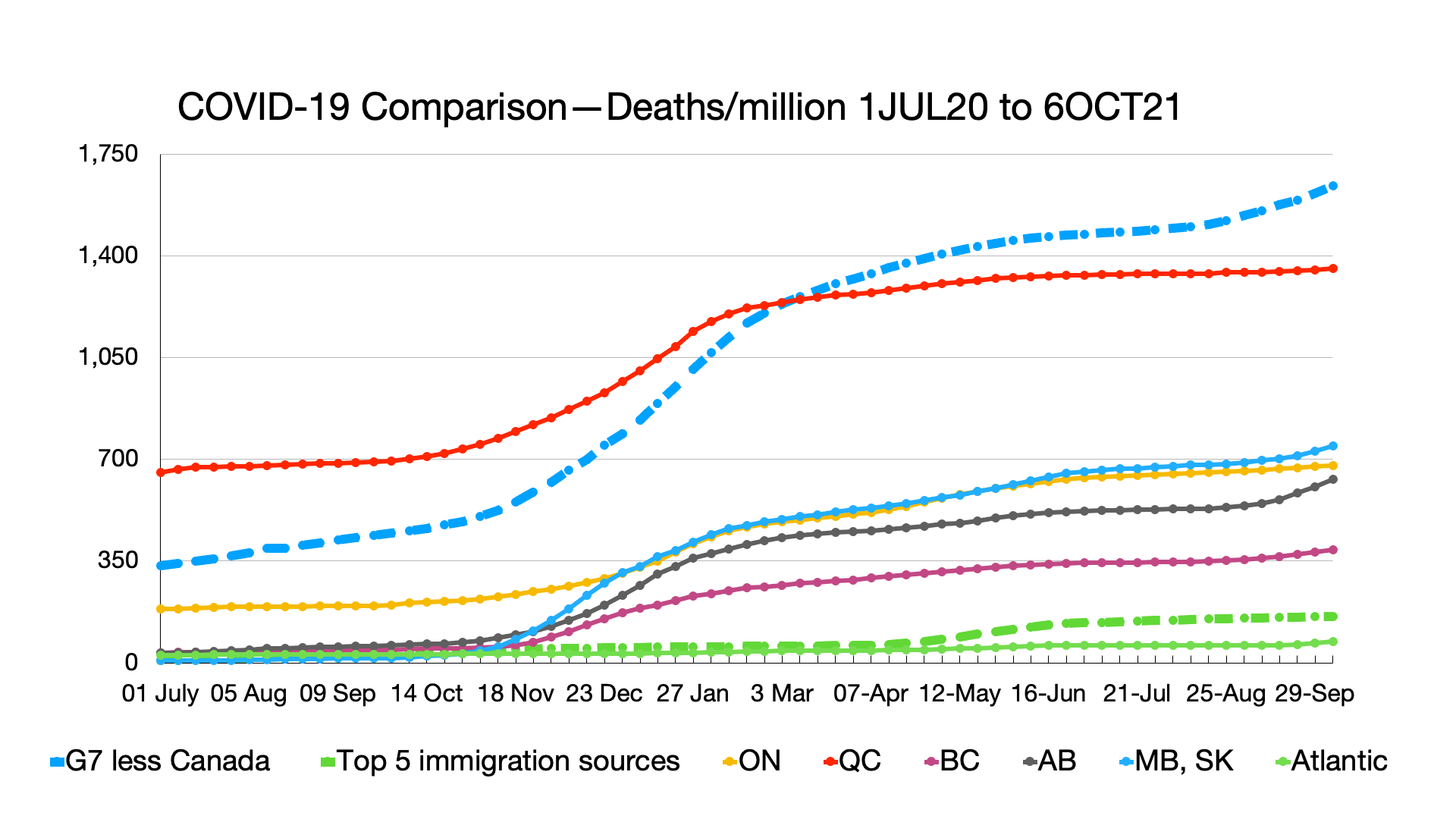
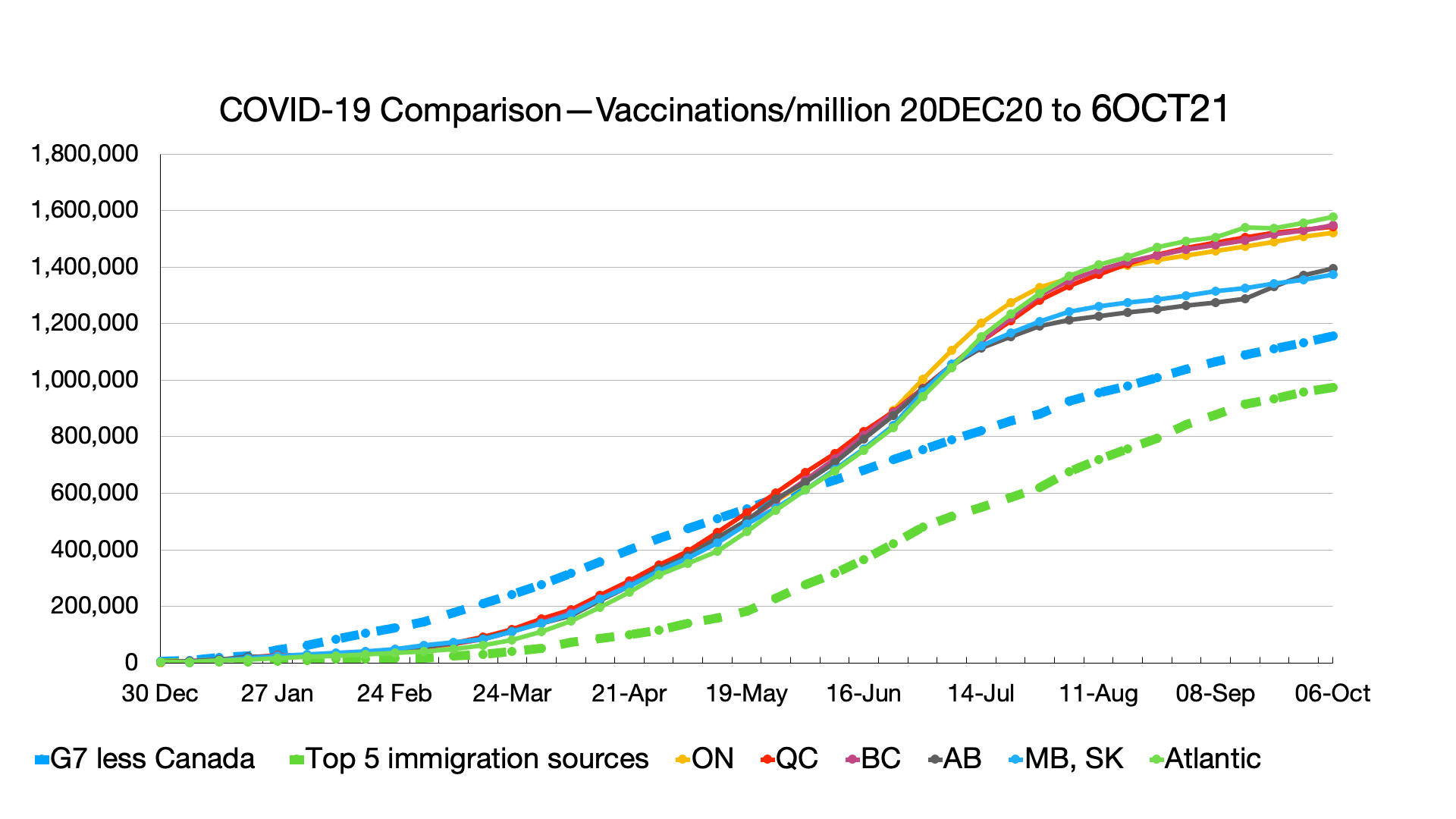
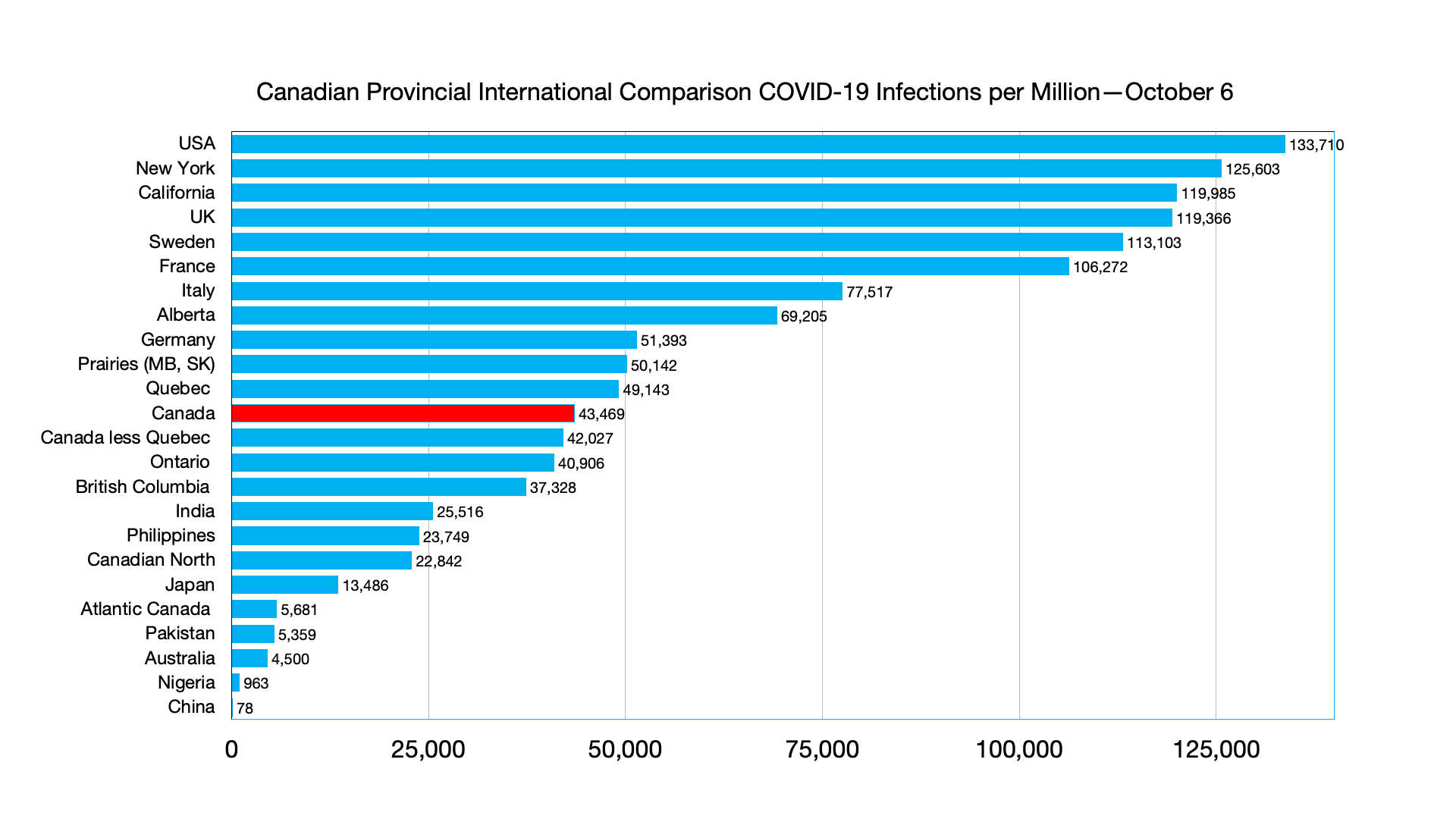
#COVID-19: Comparing provinces with other countries 6 October Update

The latest charts, compiled 6 Octoober as overall rates in Canada increase slightly due to the variant. Canadians fully vaccinated 72.4 percent, higher than USA 56.7 percent and the UK 67.4 percent).

Vaccinations: Minor changes in Canada, Japan now ahead of New York and Germany. China fully vaccinated 75 percent (unchanged), India 18.4 percent.

Trendline Charts:

Infections: Continued trend of pronounced uptick in G7 less Canada (driven largely by USA). Continued sharp rise in Alberta particularly notable as has been extensively covered in the media. British Columbia has overtaken Quebec.

Deaths: Canadian North ahead of Japan, Alberta approaching Ontario deaths.

Vaccinations: No significant change from last week. New Brunswick recent increase less apparent in Atlantic as a whole.

Weekly

Infections: Canada ahead of Canada less Quebec, Atlantic Canada ahead of Pakistan:

Deaths per million: Prairies ahead of Canada, Philippines ahead of India, Canadian North ahead of Japan:

As Tories review election loss, weak support in immigrant communities a crucial issue

Article over-dramatises even if there is a need for a review.
Margins in many of these ridings were relatively small. Moreover, in Ontario, the provincial conservatives swept most of the same seats and, as the article notes, active outreach by Conservatives allowed them to make inroads.
But beyond the 41 ridings, there are an additional 93 ridings with between 20 and 50 percent visible minorities which should also be looked at:
The Conservative Party is only beginning to sift through the data from the 2021 election, but there is at least one warning light flashing red on the dashboard: the party has been nearly wiped out in Canadian ridings where visible minorities form the majority.

Of the 41 ridings in Canada where more than half the population is racialized, the Conservatives won just one in the 2021 election — Calgary Forest Lawn — despite winning 119 seats overall.

Source: As Tories review election loss, weak support in immigrant communities a crucial issue

‘Earth-shattering’: Why applicants to Canada’s special, one-time immigration program fear a computer glitch may have dashed their dreams

Not good if correct:

Parthkumar Patel graduated from a two-year program in computer science from the University of Regina in January but was having a tough time finding a job in his field in Canada.

For months, the international graduate from India worked jobs in restaurants before he was hired by a car-rental company as a customer-service representative. With no end to the pandemic in sight, he says, he wondered if he’d ever land a job that would qualify him for permanent residence here.

Then in April, the federal government announced it would roll out a one-time pathway for temporary residents such as international graduates and essential migrant workers already in Canada to become permanent residents, in part to recognize their contributions to Canada during the pandemic.

Like other enthused applicants, Patel scrambled to compile all the documentation he needed for the online application process. He drove eight hours from Regina to Edmonton to sit for an English language test, because it was the closest centre with an available spot.

On May 6, before the application process opened at noon, he sat with two other friends also applying to the program so they could do it together and make sure there were no mistakes and that they had all the i’s dotted and crossed all the t’s for the application. At 12:22 p.m., he completed his application.

Patel says he was shocked last month when he received a refusal of his application, for failing to submit his French language test result. The problem? He said he’d applied to the English international graduate stream — not the French one. He already submitted his English test result and shouldn’t have needed a French test result.

He said he’s certain he selected the right stream from the drop-down menu in the intake portal.

“I’m 100 per cent sure,” said the 21-year-old. “It’s my best chance to become a permanent resident in Canada. This was so important to me that I double-, triple-checked everything before I submitted my file to make sure I got everything right.”

The so-called TR-to-PR pathway has six streams, three each for English-speaking and French-speaking applicants, under international graduates, health and non-health essential worker categories. All three English-speaking streams had caps and were removed from the portal once they were filled.

As the applications are being processing, a growing number of applicants for the English-speaking streams are claiming that a glitch in the immigration application portal has wrongfully bumped them into the French streams. While some have already received refusal letters, others are just starting to spot the problem in their application record.

Toronto immigration lawyer Mario Bellissimo has filed a challenge against the immigration department for refusing another applicant’s case, claiming that his client was misplaced and processed in the wrong stream.

“We have also reached out to the Department of Justice early on, because we want to make sure that it’s not a client error and we want to know what’s happening, because the implications are huge,” said Bellissimo, who said he’s had several similar inquiries.

“Let’s assume there is a glitch. If, in fact, there’s no client error, then is there still a manual review? I really hope that when we drill down on these cases, it was a glitch that somehow can be remedied.”

The immigration department said applicants to the pathway are assessed against the requirements of the stream they selected in the drop-down menu.

“It is possible that the applicant selected the French-speaking stream because the general stream was already filled and the general stream was not present in the drop-down menu,” department spokesperson Jeffrey MacDonald said in an email.

But Patel insists that’s an impossible scenario in his case, as he was among the first to submit the application, a day before the English international graduate stream was filled.

He pointed out there is a precedent of a glitch in the pathway’s application portal. It had continued to accept new applications under the English international graduate stream even after all the 40,000 spots had been taken within 24 hours. That forced officials to issue a special public policy in late June to ensure the 7,300 additional applicants wouldn’t be penalized due to the system error.

“I am heartbroken by this unfair rejection of my application,” said Patel, who hopes officials will investigate and provide remedies to him and others.

Wenjing Xie, a former international student from China, has worked in customer service at a bank in Ottawa on a postgraduate work permit since she graduated with a degree in finance from the University of Ottawa in 2019.

The 25-year-old said she applied under the non-health essential worker stream on May 6 with three other friends with their immigration consultant watching every step on Zoom.

She submitted the complete application at 12:33 p.m. and received a refusal on Sept. 14 under the French non-health essential worker stream for failing the language requirement.

“I just cried. I was so depressed that I had to take a day off from work when I got the rejection letter,” said Xie, whose work permit expires in May 2022.

“I met all the requirements and I did everything on time. Unfortunately, I didn’t take any screen images and I don’t have proof. Who would have?”

Bellissimo said he hopes the actual uploading and the technology of the system can reveal the truth through his litigation, which is now before the court.

“If you haven’t kept your screenshots, you haven’t had the benefit of doing all of that. How are you going to prove your case? What’s actually kept by the department? We don’t know,” he explained.

“It just seems like there would have to be multiple breakdowns for this to occur. I’m having a difficult time understanding how you get to this point. That’s why we felt it was important to move forward with this (legal) challenge and see how it gets resolved.”

Nishith Vagjani, who came here from Nigeria and finished two postgraduate programs last December at Fanshawe College in London, Ont., applied to the English non-health essential worker stream on July 16 hours before the application closed.

He went to his immigration application account in early September after hearing from people on social media about applicants being processed in the wrong stream. To his surprise, his application was placed in the French non-health essential worker stream.

“That was an earth-shattering moment for me. I put in so much hard work into the process,” said the 26-year-old, who scrambled to collect all the documents required — including from India, where he received his undergraduate degree — to complete the application.

The only proof he said he has is the mandatory form, the IMM0130, that all applicants were required to put a check mark on the stream they selected, plus an acknowledgment of receipt of his application.

Vagjani said he contacted the immigration department to fix the problem but was told nothing could be done.

Immigration officials said anyone who has an issue with their applications under the pathway can contact them directly through their web form.

Source: ‘Earth-shattering’: Why applicants to Canada’s special, one-time immigration program fear a computer glitch may have dashed their dreams

IRCC’s immigrant settlement funding by province/territory for 2021-22

Not much new but useful to have this overview, which again highlights the disproportionate share allocated to Quebec:

…IRCC settlement funding by province and territory

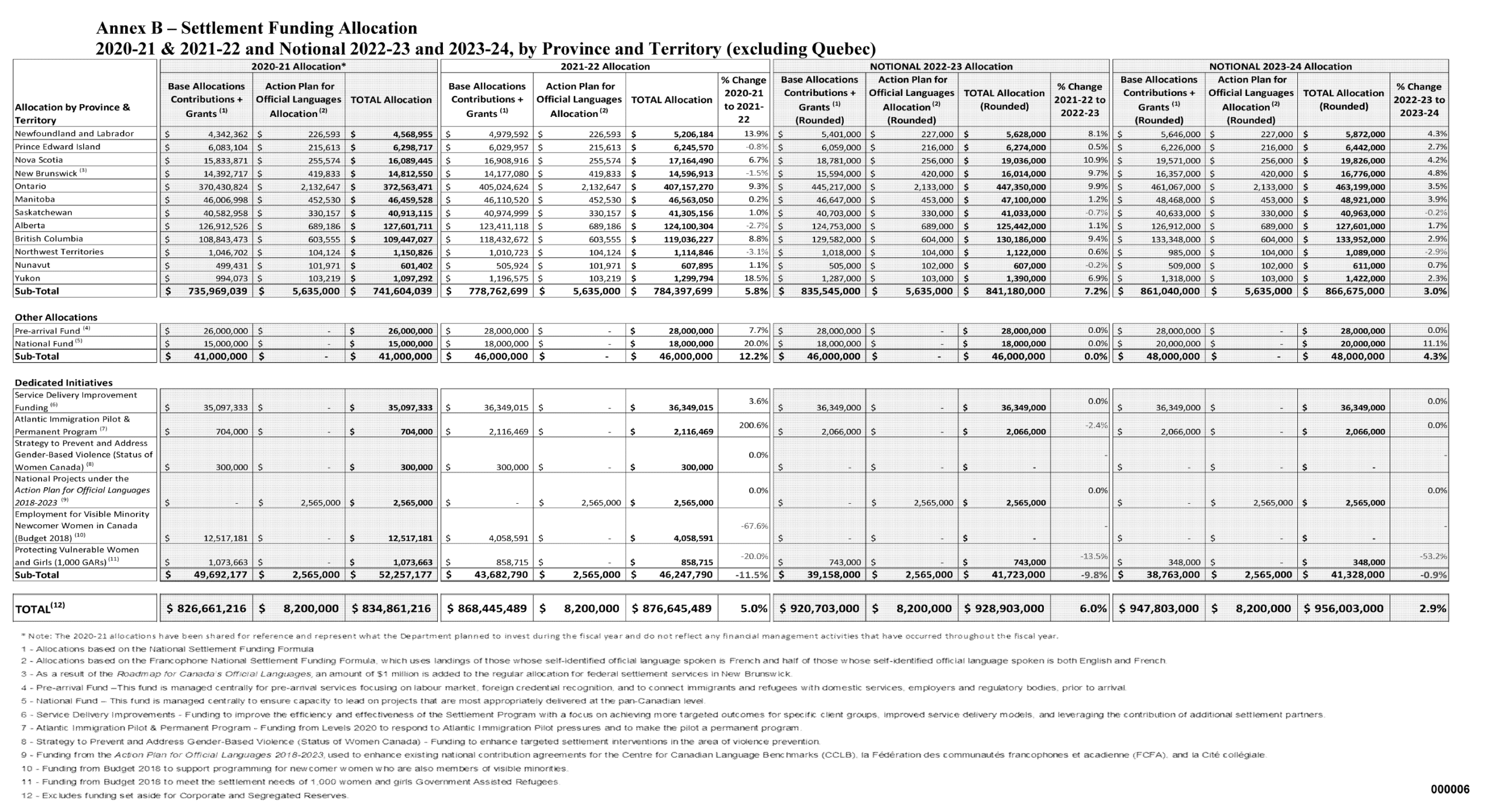
The memo shows that Mendicino approved the following 2021-22 allocation by province and territory (except Quebec). Note that all figures are rounded and also include spending projections obtained from IRCC’s publicly available 2021-2022 departmental plan:

  • Ontario: $407.2 million
  • Alberta: $124.1 million
  • British Columbia: $119 million
  • Manitoba: $46.6 million
  • Saskatchewan: $41.3 million
  • Nova Scotia: $17.2 million
  • New Brunswick: $14.6 million
  • Prince Edward Island: $6.2 million
  • Newfoundland and Labrador: $5.2 million
  • Yukon: $1.3 million
  • Northwest Territories: $1.1 million
  • Nunavut: $608,000
  • Sub total: $784.4 million
  • Other allocations: $46 million
  • Dedicated IRCC Initiatives: $46.2 million
  • Quebec (Not included in the memo): $650.3 million via the separate annual grant it receives from IRCC
  • Resettlement services (Not included in the memo): $145.7 million
  • Grand total (Not included in the memo): $1,672.6 billion

Sources: IRCC memo and IRCC’s Departmental Plan 2021-22.

Screenshot 1: Settlement Funding Allocation (Click on image to enlarge):

ircc settlement funding allocation 2021-2022
Source: IRCC

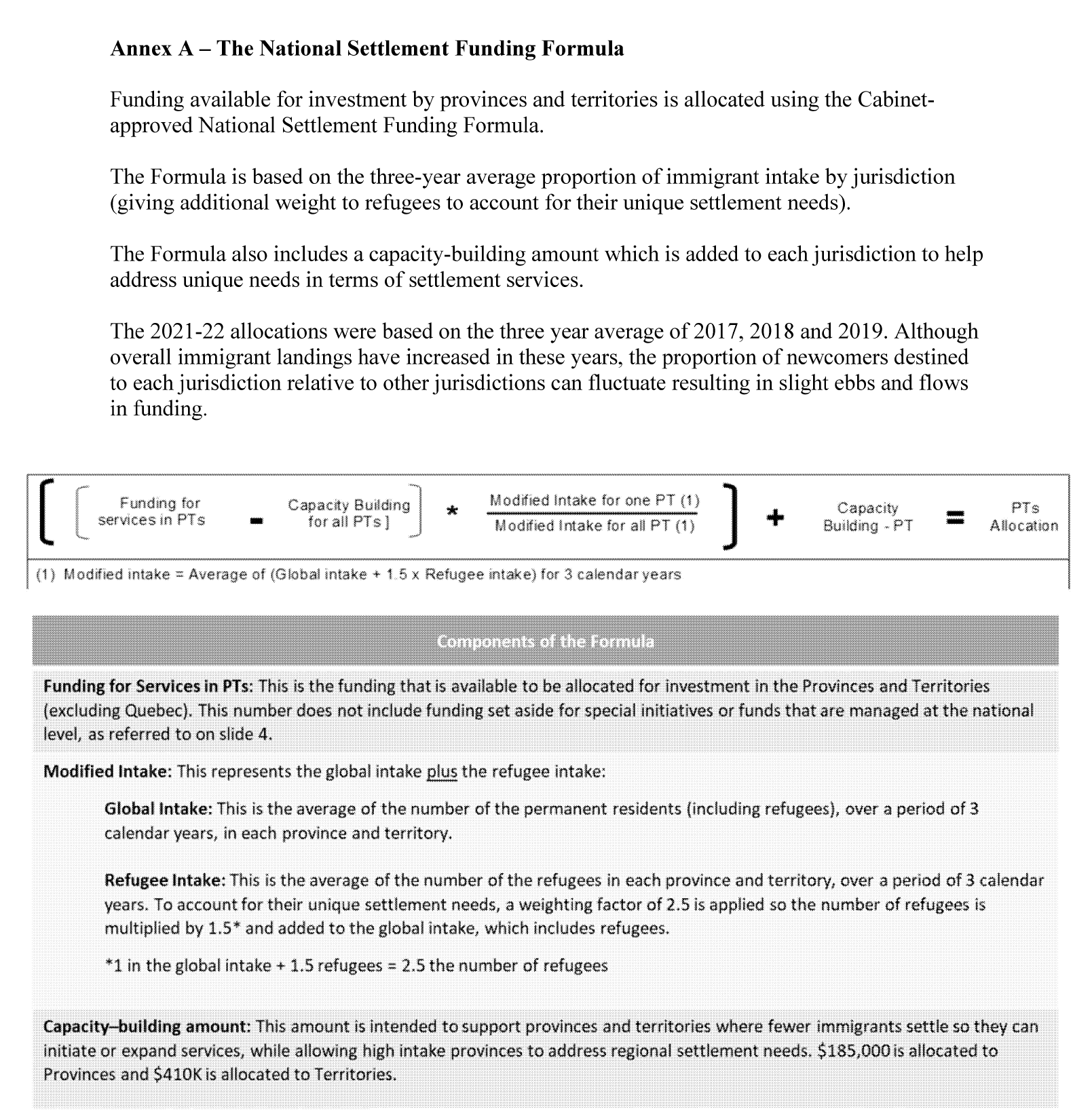
IRCC’s settlement funding formula

One possible reason IRCC has stopped sharing this information publicly is due to the controversy it garners among provinces, territories, and the service provider organizations. These stakeholders are in constant negotiations with IRCC on identifying the most appropriate funding levels for their respective jurisdictions. IRCC acknowledges the controversial nature of this process in the memo.

The memo outlines that the allocation of funding by province and territory is based on a federal Cabinet approved National Settlement Funding Formula. The formula allocates funding for each jurisdiction based on the three-year average proportion of immigrant landings by jurisdiction. It also gives additional weight to refugees to account for their unique settlement needs (refugees tend to require more settlement services than economic and family class immigrants). Quebec is not subject to this formula since its grant is calculated based on the formula outlined in the Canada-Quebec Accord relating to Immigration and Temporary Admission of Aliens signed in 1991. Due to Quebec’s special status as Canada’s only French-speaking province, it has more authority than any other jurisdiction to select immigrants. It also receives more IRCC settlement funding than any jurisdiction and has more flexibility to use the funding.

Screenshot 2: The National Settlement Funding Formula (Click on image to enlarge):

ircc settlement funding formula

Source: IRCC.

Settlement funding per capita

As indicated in Screenshot 2, IRCC determined the 2021-22 allocations based on immigrant landings in each province and territory in 2017, 2018, and 2019. This results in the following settlement funding amounts per capita:

  • Nunavut: $16,432
  • Quebec: $13,541
  • Northwest Territories: $4,622
  • Yukon: $4,194
  • Newfoundland and Labrador: $3,428
  • New Brunswick: $3,072
  • Ontario: $3,033
  • Alberta: $2,913
  • Manitoba: $2,862
  • Nova Scotia: $2,857
  • Saskatchewan: $2,691
  • Prince Edward Island: $2,684
  • British Columbia: $2,671

Sources: IRCC; Author’s calculations. The methodology is: Allocations for each province and territory divided by annual average of each province/territory’s immigrant intake between 2017-2019.

IRCC’s memo states that smaller jurisdictions receive capacity building funding to allow them to increase the scale of their services. This may explain why jurisdictions with low newcomer intakes including Nunavut, the Northwest Territories, Yukon, Newfoundland and Labrador, and New Brunswick are at the top of the list. Ontario gets more than the provinces west of it due to it having the highest refugee intake in the country.

Quebec leads all provinces due to the generous settlement formula identified in the Canada-Quebec Accord. Among its provisions, the formula dictates the grant amount can only increase over time.

What does this all mean?

IRCC goes to great lengths to help immigrants succeed. This is demonstrated by its settlement program accounting for nearly half of the department’s annual $3.6 billion budget. Canada is the largest funder of immigrant settlement services in the world.

At the same time, IRCC has the difficult task of identifying how to distribute its settlement funding across the country in a manner that takes into consideration the needs of each jurisdiction. This results in an imperfect process that is subject to intense scrutiny and debate among Canada’s governments, settlement provider organizations, researchers, and the media.

Quebec enjoys the most funding in absolute terms as well as the second most per capita even though its provincial government was elected in 2018 on a mandate to reduce immigration. The province’s settlement funding formula was agreed to in 1991 based on the expectation that Quebec’s immigration levels would increase over time to help compensate for its aging population and low birth rate. However the election of the Coalition Avenir Quebec (CAQ) party in 2018 highlighted a flaw in the formula, as Quebec has since seen its annual grant from IRCC continue to rise as its newcomer intake declined by 22 per cent in 2019 compared to 2018.

Conversely, Alberta, New Brunswick, Prince Edward Island (PEI) and the Northwest Territories have each seen their settlement allocations decline this federal fiscal year due to recent declines in their newcomer arrivals. Decreasing allocations to jurisdictions when their newcomer levels decline may seem fair, but it also creates operational challenges. Namely, lower IRCC funding to a province or territory could come at a time when that jurisdiction sees an increase in their newcomers (and hence, strains their ability to deliver settlement supports to newcomers). In addition, decreased funding means that service provider organizations may need to scale back their operations which sometimes entails laying off staff.

IRCC recognizes such challenges, which is why the memo notes that IRCC will make a one-time transfer to their Western Canada operations to top-up the funding provided to Alberta. The purpose of the top up is to ensure that Alberta can continue to provide high quality settlement supports to its newcomers.

Finally, IRCC recognizes that further investments will be needed to support future newcomers. The memo states the department anticipates more settlement funding to become available as it looks to welcome more newcomers through its Immigration Levels Plan. The 2021-2023 levels plan is the most ambitious in Canadian history as it seeks to welcome over 400,000 new immigrants per year. Since its founding in 1867, Canada has welcomed 400,000 immigrants in a year just once, in 1913. As such, the memo indicates an expectation the allocation for all provinces and territories (excluding Quebec) will increase by another $100 million for the 2023-24 federal fiscal year. This suggests the department’s total settlement spending will reach some $2 billion annually within the next few years.

Source: IRCC’s immigrant settlement funding by province/territory for 2021-22

COVID-19 Immigration Effects: July update

This update is somewhat delayed given IRCC only released the operational processing series of data (applications, citizenship, and visa) on October 4. August Permanent Residents admissions just under 38,000, slightly lower than July.


General observations:

  • IRCC’s 2021 strategy to meet the target of 400,000 new immigrants through transitioning temporary residents (students and workers) to permanent residency continues.
  • Of note, applications from Afghans increased more than sixfold in July, from 337 to 2,078
  • Temporary Residents IMP remained stable whereas Temporary Residents TFWP declined (reduced number of agriculture workers)
  • The number of study permit applications and study permits both increased significantly
  • Asylum claimants remained stable at the sharply reduced level due to travel and border restrictions
  • Settlement service web interest has yet to recover from pre-pandemic levels
  • The number of new citizens remain at about half of pre-pandemic levels
  • There was a doubling of visitor visas issued reflecting summer travel, with visas from Indian nationals increasing more than seven times, compared to Chinese nationals only doubling.

Latif | Equity and diversity were shamefully ignored during the election

In the debates, yes, but the Liberal, NDP and Green parties all had substantial commitments whereas the Conservatives, inexplicably, had none:

While pandemic recovery, gun control, and even puppies took centre stage during the federal election, we failed to seize the opportunity to hold our leaders accountable on equity issues.

In the lead up to the election, we had unprecedented conversations about the disproportionate impact of the pandemic on racialized people; anti-Black racism in policing; Islamophobic violence; the unearthing of thousands of Indigenous children who died at Canadian residential schools; and a spike in hate crimes against members of the Asian community. Yet none of the political parties prioritized equity, diversity and inclusion issues in their platforms, tours or advertising.

As voters, we had the power to hold our leaders accountable by asking the hard questions, but we didn’t. Even when there was a moment on the national stage provided by debate moderator Shachi Kurl, we didn’t seize it. Instead, we allowed the conversation around bills 21 and 96 to turn into a conversation about the impact on the horse race and the polls in Quebec, rather than a conversation about values.

I spoke with Erin Tolley, Canada research chair in gender, race and inclusive politics at Carleton University, who suggests party leaders, the media and the public all play a role in sparking — and continuing — these conversations.

Tolley notes that “there is a long history in Canada of parties not seeing a focus on multiculturalism, immigration or diversity as a winning strategy. They see those issues as divisive. All parties know they need to discuss the economy because voters demand it, but these other issues are viewed as niche. If voters don’t put pressure on parties, then parties are going to ignore the issue. So when we’re thinking about who to blame, I don’t only blame parties.”

There have been many campaigns where a catalyzing moment captured media attention and turned equity issues into election issues. I recall the 2011 provincial election, when a $10,000 tax credit to hire an immigrant for their first job in Ontario got leaked before the Liberal platform launch, and became a lightning rod that almost derailed the campaign. Although it was sound policy, the Conservatives tried to make it a wedge issue. I worked with a Liberal team, behind the scenes, to ensure this did not sabotage our efforts.

Another example of an election flashpoint was the tragic death in 2015 of a three-year-old Syrian refugee, Alan Kurdi, which sparked immigration, refugee and asylum debates. The Conservative’s “barbaric cultural practice hotline” was anti-Muslim and ugly but meant to grab votes. Then, the 2019 election focused on gender inequality and systemic racism as pictures of Prime Minister Justin Trudeau in blackface surfaced during the election.

But in this year’s campaign, we watched as the debate moment barely scratched the surface; as the racism, sexism, and anti-Semitism faced by Annamie Paul, former leader of the Green Party of Canada, didn’t raise eyebrows; and as NDP MP Don Davies was given a pass on his unacceptable comments against his opponent Virginia Bremner, a Filipino-Canadian woman.

Source: Opinion | Equity and diversity were shamefully ignored during the election

Chris Alexander: China Against the Rule of Law

More on Senators Woo, Harder and Boehm. Again, given the release of the two Michaels, time for them to take a tougher line on Chinese government actions such as extensive arbitrary detention, crushing democracy in Hong Kong, and the ongoing repression of Uighurs:

On the same day Michael Kovrig and Michael Spavor arrived home, the Honourable Yuen Pau Woo, an independent senator appointed by Prime Minister Justin Trudeau in 2016, tweeted an invitation to Canadians to savour the happy moment. He also congratulated Canada’s ambassador Dominic Barton, and suggested there was “an opportunity to reflect on lessons learned.”

Without offering any didactic points of his own, the honourable senator provided a link to an opinion piece from the Toronto Star whose core message was that “the United States, assisted by Canada, took Meng hostage in the first place as part of its trade-and-technology war with China (…).” “Should Ottawa have arrested Meng in the first place?” asked author Wenran Jiang, an advisory board member of the Toronto-based Institute for Peace & Diplomacy. “Why did this final package deal take so long if a ‘hostage exchange’ is the result?” 

This senator’s choice of lessons was unsurprising. In June of this year, he was instrumental in defeating a Senate motion to recognize China’s genocide against the Uighurs and other Turkic Muslims — contradicting the elected House of Commons, which passed a similar measure in February by a vote of 266 to zero. Senator Woo then side-stepped discussion of a proposed boycott of the 2022 Winter Olympics in China, arguing politics should not influence sporting events. Again, this went against a unanimous motion of Canada’s House of Commons on February 22, 2021 calling “upon the International Olympic Committee to move the 2022 Olympic Games” in light of the continuing genocide against Uighurs and others.

Yuen Pau Woo was joined in these arguments by senators Peter Boehm and Peter Harder, both seasoned diplomats, who also urged Canada to suspend its judgement with regard to China’s persecution of the Uighurs. This includes the use of concentration camps and forced labour, as well as the repression of language, culture and religion. These are all blatant acts committed with the “intent to destroy, in whole or in part, a national, ethnical, racial or religious group,” as the 1951 Genocide Convention defines this “odious scourge.”

Throughout this unfortunate saga, Beijing has had a Greek chorus of supporters across Canada — mostly from people with well-remunerated corporate or political backgrounds — for the preposterous notion of a “prisoner exchange” that would get relations with China back to “normal.”

In the end, the Senate’s genocide motion failed by a vote of 29 in favour to 33 opposed, with 13 abstentions. China’s Foreign Ministry praised Woo, Boehm and Harder as “people of vision” who had seen through the “despicable schemes of a few anti-China forces.” The “clumsy trick of attacking China for selfish political gains” and “the hype of ‘genocide’ in Xinjiang is unpopular and doomed to fail,” the Foreign Ministry spokesperson crowed.

Had Woo, a former president and CEO of the Asia Pacific Foundation of Canada, and the “two Peters,” both former deputy ministers of foreign affairs, voted in favour, the Senate’s genocide motion would have passed. Instead all three chose, on an issue directly threatening the identity and lives of millions, to take the position of the Communist Party of China over one unanimously endorsed by Canada’s elected House of Commons — all in the empty hope of getting back to “normal” with Beijing.

The truth is that “normal” in the People’s Republic of China, at least since 1959, has never included the rule of law. From China’s ferocious and brutal invasion of Tibet that same year, through the murderous Great Leap Forward ending in 1962, to the decade-long Cultural Revolution up to Mao’s death in 1976 (and beyond), China has been a legal void. Serious judicial reforms never featured in Deng Xiaoping’s economic relaunch. On the contrary, basic rights were decimated, as Tibetan, Mongolian, Uighur and other refugees attest.

According to Freedom House, the current General Secretary of the Chinese Communist Party Xi Jinping’s relentless push for all-encompassing surveillance and censorship has made China the worst environment in the world for internet freedomfor the seventh year running. Compliance with such global gag orders is enforced by the CCP’s Orwellian digital panopticon, the notorious United Front Work Department, which seeks to browbeat, buy, corrupt, blackmail, extort or otherwise leverage people and firms with connections to China in support of Xi’s agenda.

Thanks to United Front subterfuge, some prominent Canadians still take China’s side, even as Beijing’s favourability score in Canadian public opinion plummeted to 14 per cent, mirroring a worldwide nosedive for China’s image driven by the two Michaels’ ordeal and Beijing’s “wolf warrior” belligerence.

Canada has a decidedly mixed record of confronting outrages by Beijing’s Communist rulers. On the one hand, we fought in Korea. But on the other hand, Norman Bethune and Pierre Trudeau remain bywords for indifference to the brutality of Chinese Communists under Mao.

Self-indulgent aloofness has cost us. Huawei’s rise was reportedly fuelled by massive theft of intellectual property from Nortel, once the darling of Canada’s tech industry. Canadians were among the first to be disenfranchised by the demise of democracy and the rule of law in Hong Kong. Meanwhile, China’s merchandise exports to Canada remain nearly triple what we export to them, even as 115 Canadians languish in Chinese jails, including Uighur activist Huseyin Celil and four others who are on death row

Today’s China under Xi uses strong-arm tactics straight out of Soviet Cold War playbooks. From Cambodia to the Czech Republic, it is corrupting democratic politicsand tilting cyber-space to boost United Front agitprop. (Though ironically, China’s level of global ambition is rising just as its growth path starts to look unsustainable.)

The Meng Wanzhou saga should remind us that the rule of law, which China lacks, remains a crucial “distinction with a difference” between us. In a tweet back in April, Senator Woo urged Canada and China to “recognize the legitimacy of each other’s judicial system.” Yet of eight principles constituting the rule of law identified by a former Lord Chief Justice of the United Kingdom, China today fulfills barely two.

Despite all the speculation about political interference and “diplomatic triangulation,” it was Canada’s rule of law that ultimately prevailed in the cases of Meng Wanzhou, Michael Spavor and Michael Kovrig. The deferred prosecution agreement Meng ultimately accepted had been on the table for years: she reportedly elected to take it when her legal team learned the B.C. court was likely to make a ruling in October clearing the way for her extradition.

Rather than face a full U.S. trial, Meng exercised an option that had been available since early 2019. This leaves Meng free, but Huawei still in legal jeopardy. Meanwhile, the costs to China’s reputation worldwide and Huawei’s global business have been asymmetrical, astronomical and devastating. Any illusions about progress towards independent Chinese justice institutions have been shattered, as the reality of genocide and repression across China come into ever sharper focus.

Democratic politics glories in disagreement. But democratic politicians that parrot the propaganda of dictators do unnecessary discredit to our institutions. Meng Wanzhou enjoyed every benefit of the rule of law in confessing to having misled U.S. authorities about Huawei’s attempts to skirt Iran-related sanctions. The two Michaels did not.

Canada’s answer to their ordeal should be to relocate or boycott the 2022 Beijing Olympics: the ghastly legacy of Hitler’s 1936 horror show requires that states committing genocide never host Olympic Games.

This is the least we can do for repressed Uighur Muslims, Tibetans, Mongolians and others still facing erasure by genocide, as well as Hong King’s brave democratic activists, many of whom who are now in jail or in exile. These persecuted people revere the rule of law in Canada as the real hero in this drama. Indeed, in the face of China’s drum roll of threats, our institutions held up remarkably well, despite the best efforts of a number of prominent Canadians to undermine them.

Our principled commitment to upholding the rule of law in China starts now — by fulfilling the commitment our democratically-elected representatives made to ensure Olympic Games are not held in a country now perpetrating genocide.

Chris Alexander was Canada’s Minister of Citizenship and Immigration (2013-15) and Parliamentary Secretary for National Defence (2011-13). He served for 12 years in Canadian embassies in Russia and Afghanistan, wrote The Long Way Back: Afghanistan’s Quest for Peace (2011) and recently released Ending Pakistan’s Proxy War in Afghanistan. He is a Distinguished Fellow for the Canadian International Council.

Source: https://email.mg1.substack.com/c/eJxVUk2P4jAM_TX01iof_aCHHGany0yZLWg1wA5cqjRJaSAkVZtSyq_fDOxlpTi2nu1nyc-MWnE03URa01vv-yvt1AqixdgrYa3ovKEXXSk5gSCBaQQSjxOQIJZUnuzLuhPiQqUiXjtUSjJqpdHf1QkAGHkNiWGF4phDkEY0SVg6D2PG0TyCUYzqOU-fM-nApdBMEKPVVLZUck-Rxtq2n-GXGVq4ZxuhpBZBP1S9pewcMHNxcOuMNZ3sfarEjWouOp81UlOfHqnUvfVd4wwvrDkLPcOZmJaQod30hdQ5P5lbkbHberMdV9Mo2Vt654u0Pbzm8SrLXS4fi_vPPr-ohjus2Ozvxb2ARbYf15-jpF-ru-OQ7H0nf23YWGTFlEvHg3fygX_zvcLp8Gdx4m_qWsllGmz9KL9uPny2iq757-vwsa7BarecXn40Z4pND9X7jR62m8zuPUkQQBACEEKEAYgDFIQpCgGoBWJ0XoEYBSkzp7kZq1kILkf433q8jriFdGJUx07WtbSNK5JMmYE_0k6y0vnLoKWdSqFppQQnthuEZ58H8dC2PAotOncovKSWwBhjHIEYAhc91XNyhwgCBDD03HxuXJcm_wT7C6NFzsw

No more immigration: PM says Britain is in period of adjustment

Will see whether this holds up, or ongoing shortages force a change (see Doug Saunders Bare shelves, empty pumps: Britain’s self-inflicted Brexit wound):

British Prime Minister Boris Johnson said on Sunday he would not return to “uncontrolled immigration” to solve fuel, gas and Christmas food crises, suggesting such strains were part of a period of post-Brexit adjustment.

At the start of his Conservative Party’s conference, Johnson was again forced to defend his government against complaints from those unable to get petrol for their cars, retailers warning of Christmas shortages, and gas companies struggling with a spike in wholesale prices.

The British leader had wanted to use the conference to turn the page on more than 18 months of COVID-19 and to refocus on his 2019 election pledges to tackle regional inequality, crime and social care.

Instead, the prime minister finds himself on the back foot nine months after Britain completed its exit from the European Union – a departure he said would give the country the freedom to better shape its economy.

“The way forward for our country is not to just pull the big lever marked uncontrolled immigration, and allow in huge numbers of people to do work … So what I won’t do is go back to the old failed model of low wages, low skills supported by uncontrolled immigration,” he told the BBC’s Andrew Marr Show.

“When people voted for change in 2016 and … again in 2019 as they did, they voted for the end of a broken model of the UK economy that relied on low wages and low skill and chronic low productivity, and we are moving away from that.”

It was the closest the prime minister has come to admitting that Britain’s exit from the EU had contributed to strains in supply chains and the labour force, stretching everything from fuel deliveries to potential shortages of turkeys for Christmas.

“There will be a period of adjustment, but that is I think what we need to see,” he said.

But while the government plans to issue thousands of temporary visas for foreign truck drivers and poultry workers, Johnson was clear he would not open the taps of immigration, again shifting the responsibility to businesses to lift wages and attract more workers.

Shortages of workers after Brexit and the COVID-19 pandemic have sown disarray in some sectors of the economy, disrupting deliveries of fuel and medicines and leaving more than 100,000 pigs facing a cull due to a lack of abattoir workers.

Conservative Party chair, Oliver Dowden, said that the government was taking measures to hire more truck drivers in general and that the government had started training military tanker personnel to start fuel deliveries on Monday.

“We will make sure that people have their turkey for Christmas, and I know that for the Environment Secretary George Eustice this is absolutely top of his list,” he told Sky News.

But the overwhelming message from the government was that businesses must step up to solve supply chain issues and to entice more British workers with higher wages.

“I don’t believe in a command and control economy so I don’t believe the prime minister is responsible for what is in the shops. This is why we have a free enterprise economy,” foreign minister Liz Truss told an event at the conference.

“I’m sure that the goods will be delivered into our shops.”

But rather than the reset Johnson hoped to preside over in the northern English city of Manchester, the conference looks set to be overshadowed by the crises and criticism of the government’s withdrawal of a top-up to a state benefit for low-income households.

The main opposition Labour Party is set to focus on the removal of the uplift, hoping to undermine those Conservative lawmakers who won over its traditional supporters in northern and central England.

Johnson may also come under fire for breaking with the Conservatives’ traditional stance as the party of low taxes after increasing some of them to help the health and social care sectors.

“We don’t want to raise taxes, of course, but what we will not do is be irresponsible with the public finances,” he said. “If I can possibly avoid it, I do not want to raise taxes again, of course not.”

Source: No more immigration: PM says Britain is in period of adjustment

Canadian Muslims have given Justin Trudeau a mandate to eliminate Islamophobia

Summit recommendations are just that and mandates are less categorical. More reduce than eliminate.

While the government needs to provide a response, the nature of the response will need to consider broad public policy issues as well as responses to other forms of xenophobia, discrimination and prejudice:

Progress has been made, such as the addition of right-wing extremist groups to Canada’s terror lists. The attacks on the Afzaal family in London and on Mohamed-Aslim Zafis outside an Etobicoke mosque, on the other hand, underlined the need for stronger action.

In reaction to the rise of anti-Muslim hate, the Liberal government convened the July National Action Summit Against Islamophobia shortly before the federal election. Many community organizations submitted recommendations with the expectation that the government would take concrete action. The government listened intently to people’s lived experiences and demands for reform, but only a few first steps were proposed.

Following the 2019 federal election, Canada’s Muslim community outlined four priorities that the Liberal government should address immediately: the rise in Islamophobia, Bill 21 in Quebec, Islamophobia’s presence in Canada’s national security regime, and a foreign policy committed to speaking out against human rights violations.

Progress has been made, such as the addition of right-wing extremist groups to Canada’s terror lists. The attacks on the Afzaal family in London and on Mohamed-Aslim Zafis outside an Etobicoke mosque, on the other hand, underlined the need for stronger action.

In reaction to the rise of anti-Muslim hate, the Liberal government convened the July National Action Summit Against Islamophobia shortly before the federal election. Many community organizations submitted recommendations with the expectation that the government would take concrete action. The government listened intently to people’s lived experiences and demands for reform, but only a few first steps were proposed.

Prime Minister Justin Trudeau delivered a strong message: “There’s no question that there is work to be done within government to dismantle systemic racism and Islamophobia. Because from the Canada Revenue Agency (CRA) to security agencies, institutions should support people, not target them. We hear that.”

If anything, the July summit meeting successfully established the mandate of Canada’s newly elected government to combat Islamophobia, giving the Liberal party a second chance to get this right.

Systemic Islamophobia in government institutions is among the most serious aspects of anti-Muslim hate. Hatred and violence against Muslims will never be eradicated as long as anti-Muslim sentiment persists inside our agencies and institutions.

The top of the list is the Review and Analysis Division (RAD) of the Canada Revenue Agency, which has been targeting Muslim groups with biased audits and unjust sanctions for more than a decade.

Before the election the Liberal government announced a review by the CRA Ombudsperson’s office. This is simply not enough. RAD’s biased audits are rooted in a broader government problem based primarily in the national security regime, over which the Ombudsperson has no control.

The next minister of National Revenue must take a number of immediate actions. The National Security and Intelligence Review Agency should undertake its own investigation. The 2015 National Risk Assessment, a government directive to the CRA that contributed to the targeting of Muslim charities, should also be re-evaluated. Most importantly, the CRA should declare a moratorium on RAD audits until these reviews are completed.

The Canada Border Services Agency for years has profiled Muslims and targeted refugees from Muslim countries. The Liberal government has ready-to-go CBSA oversight legislation, Bill C-3, that died when Parliament was prorogued last year. Re-introducing this bill should be a top priority for the government.

Many communities, including Muslims, have urged the government to adapt regulations to the changing social media environment, which has allowed online hate to spread and provided a platform for white supremacist groups to thrive.

The Liberal Muslim caucus highlighted the top five priorities for Prime Minister Trudeau following the National Summit, which include the above. Muslim leaders reinforced these during the election.

If we want to fight Islamophobia “we need to bring Canadians together with us,” Prime Minister Trudeau said as he addressed the national summit. He was indicating that Canadians should support him as he heads back to Ottawa with a new mandate.

With their votes, Canadian Muslims have shown their faith in the Prime Minister’s sincerity and willingness to solve these challenges. Community members hope he will make addressing systemic Islamophobia in Canada a major priority when he issues mandate letters to his ministers outlining the goals for this government’s tenure.

Sharaf Sharafeldin is executive director of the Muslim Association of Canada, a national non-profit organization providing religious and educational services for the Muslim community in Canada.

Source: https://www.thestar.com/opinion/contributors/2021/10/04/canadian-muslims-have-given-justin-trudeau-a-mandate-to-eliminate-islamophobia.html