#COVID-19: Comparing provinces with other countries 4 August Update, China’s Delta variant

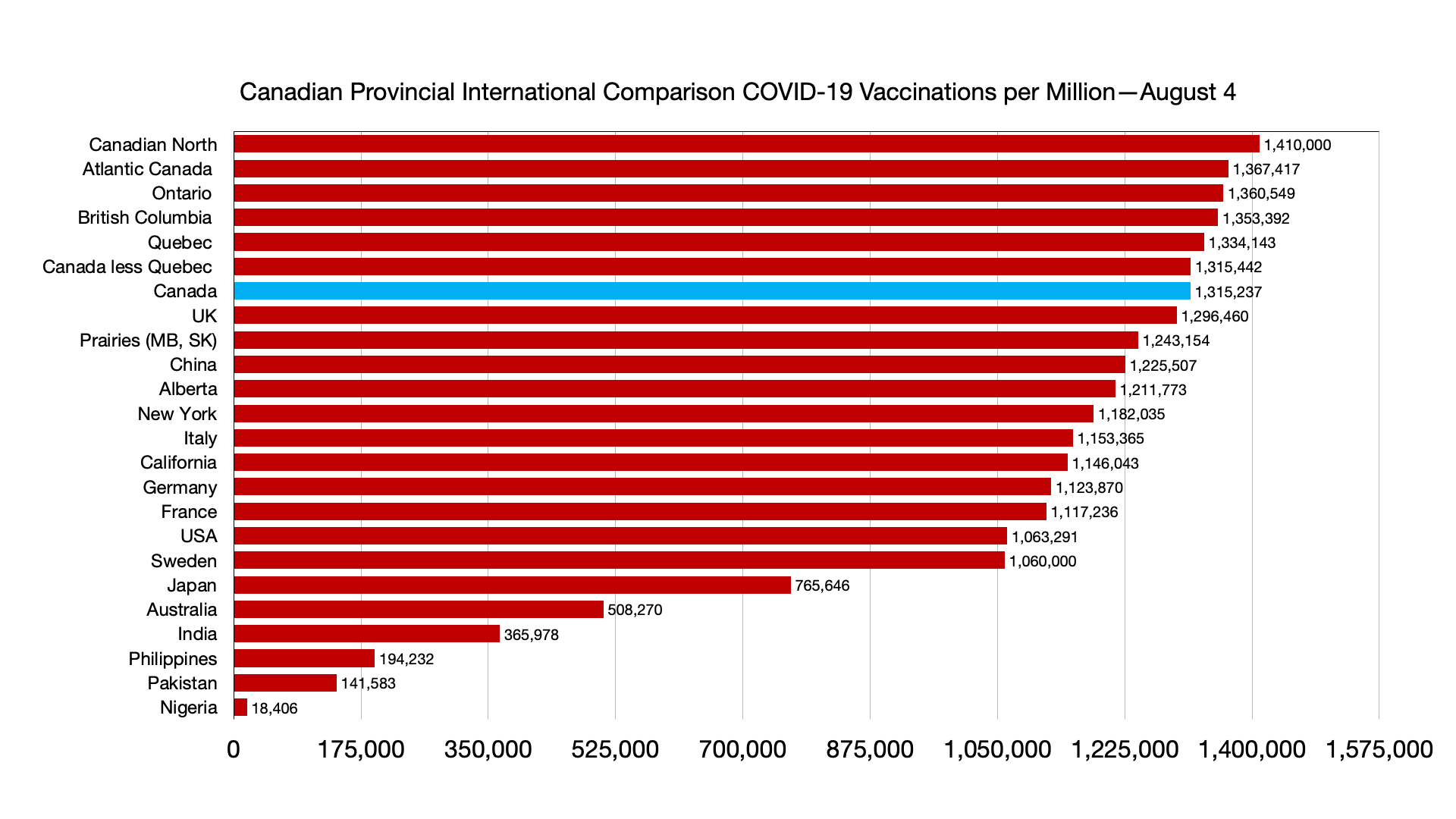
The latest charts, compiled 4 July as overall rates in Canada remain relatively stable but with slight increases due to the variant. Canadians fully vaccinated now 59.8 percent, higher than USA 50.3 percent and the UK 57.2 percent).

Vaccinations: All Canadian provinces ahead of USA and EU countries, all but Prairies ahead of UK.
Trendline charts

Infections: No significant change but slight uptick in G7 less Canada more apparent given increased infections in UK and USA. The outbreak of the Delta variant in China and consequent lockdowns is covered in the article following the charts.

Deaths: No significant change.

Vaccinations: Ongoing steady gap between Canadian provinces and G7, immigration source country increase continues to be driven by China (fully vaccinated 16 percent) and India (fully vaccinated 7.6 percent).

Weekly

Infections: No relative change.

Deaths per million: No significant change.

China now grappling with the Delta variant with Wuhan under lockdown:

China’s spiraling Delta variant outbreak has reached Wuhan, the original epicenter of the pandemic, prompting citywide coronavirus testing as authorities scramble to contain the city’s first reported local infections in more than a year.China is grappling with its worst outbreak in months, with more than 300 cases detected in more than two dozen cities across the country. The country now has 144 medium- and high-risk areas, the most since the initial outbreak in early 2020, the National Health Commission said Wednesday.The speed and scale of the spread has spurred mass domestic travel restrictions, with all inter-city coach, taxi and online car hailing services suspended in medium- and high-risk areas. Chinese immigration authorities have also vowed to “strictly restrict non-urgent, unnecessary cross-border travel,” including tightening the issuing of passports for Chinese citizens.

On Monday, seven infections were reported among migrant workers in Wuhan, the central Chinese city where the coronavirus was first detected in December 2019. As of Wednesday, a total of 20 local infections have been reported, including 8 asymptomatic cases, according to the Hubei provincial health commission.

The city of 11 million people was placed under the world’s first and arguably strictest coronavirus lockdown in January 2020, during the height of its devastating initial outbreak. The paralyzing 76-day lockdown came at a huge personal cost to residents, but eventually succeeded in taming the virus. Wuhan had not reported any locally transmitted cases since May last year.

Despite the initial mishandling, the Chinese government has heralded Wuhan as a success story in its fight against the pandemic. In August 2020, as much of the world grappled with Covid-19, Wuhan made international headlines when it held an electronic music festival in an open air water park, with thousands of people partying without any masks or social distancing measures in sight. 

Some fear the return of a stringent lockdown. Videos and photos shared on social media Monday show empty shelves and long lines at supermarkets, as residents rushed to stock up daily supplies.”Seeing Wuhan people panic buying at supermarkets makes me feel sad. Only those who have experienced it understand how terrible it is, (we) dread a return to the days of staying at home and not knowing where the next meal is,” said a Wuhan resident on Chinese microblogging site Weibo.During Wuhan’s initial lockdown, millions of residents were ordered to stay in their homes, relying on officials and volunteers for daily necessities — often at a higher price.As of Wednesday, no citywide lockdown has been announced for Wuhan, although residential compounds linked to detected cases have been placed under targeted lockdowns.

Spiraling outbreak

The ongoing outbreak first started in Nanjing, Jiangsu province in eastern China, where nine airport cleaners were found to be infected on July 20 during a routine test. Chinese authorities have linked the cluster to a flight from Russia, which arrived at the Nanjing Lukou International Airport on July 10. 

“It is believed that the cleaners did not strictly follow anti-epidemic guidelines after cleaning Flight CA910 and contracted the virus as a result. The infection further spread to other colleagues, who are also responsible for cleaning and transporting garbage on both international and domestic flights,” reported state news agency Xinhua.

Since then, the cluster has spread to at least 26 cities, including the tourist hot spot Zhangjiajie and the capital Beijing. In just two weeks, China has reported more than 480 locally transmitted confirmed cases, according to a CNN tally of the National Health Commission’s daily reports. Not all infections have so far been directly linked to the cluster in Nanjing.

On Monday, 63 local infections, including 50 asymptomatic cases, were reported in Zhengzhou, the provincial capital of Henan province which was ravaged by deadly floods last month. Most cases are linked to an outbreak at a hospital, where janitors, medical staff and patients are among those infected. The city launched citywide testing Sunday.

The fast spreading Delta variant has posed a major challenge to China’s hardline zero Covid strategy, which relies on mass testing, targeted lockdowns, extensive contact tracing and strict quarantine measures to quickly suppress local flare-ups.

China responded by doubling down on its containment approach, adopting stringent measures on a scale not seen in months. Several cities have been placed under effective lockdowns, ordering residents to stay in their homes and canceling flights and trains. The country has also imposed massive nationwide travel restrictions. All provincial authorities have urged citizens not to travel to medium and high-risk areas or leave the provinces where they live unless it is strictly necessary. 

The Chinese government is particularly concerned about the spread of the virus to Beijing, which is set to hold the Winter Olympics in February next year. The city has reported a handful of cases since last week — its first coronavirus resurgence in months. 

Beijing authorities have banned people from medium- or high-risk areas from entering, suspending flights, trains and buses from Covid-hit places. Since Tuesday, 23 railway stations have halted ticket sales for train rides heading to the capital, Xinhua reported.

Chinese authorities are also tightening restrictions on cross-border travel. China is still largely closed off from the outside world, and those who are allowed to enter are subject to lengthy hotel quarantine. At a press conference Wednesday, an official with the National Immigration Administration said authorities would stop issuing travel documents, such as passports, for Chinese citizens who want to leave China for “non-urgent, unnecessary” reasons. Individuals who need to travel overseas for study, work or business purposes would still be issued travel documents upon approval, he added. 

Mahjong parlors

China reported 71 locally transmitted confirmed cases On Wednesday, with nearly half of them coming from Jiangsu province, according to the National Health Commission. The city of Yangzhou, neighboring Nanjing, has become the latest hotspot, reporting 32 local infections.Authorities have blamed the outbreak in Yangzhou on a 70-year-old Nanjing resident, who traveled to Yangzhou on July 21 despite her residence in Nanjing had been placed under a lockdown, according to a statement from the Yangzhou police.The elderly woman, who stayed in Yangzhou with her sister, did not inform local officials of her travel history as required, and repeatedly visited crowded places including restaurants, markets and mahjong parlors, the statement said.The woman sought treatment at a hospital on July 27 after she started coughing and developed a fever, and tested positive for coronavirus a day later. She has been criminally detained by police and is under investigation for suspected obstruction of the prevention and control of infectious diseases, according to the statement.

Mahjong parlors, popular with older people, have played a central role in the spread of Covid in Yangzhou, according to authorities. On Wednesday, Jiangsu officials said at a press conferencethat 64% of Yangzhou’s 94 confirmed cases as of Tuesday were linked to Mahjong parlors, and 68% of confirmed cases are above 60 years old. Both Yangzhou and Nanjing have conducted several rounds of citywide testing, and suspended all domestic flights, long-distance buses, taxis and online car hailing services from arriving and departing.

Source: https://www.google.com/url?sa=t&rct=j&q=&esrc=s&source=web&cd=&cad=rja&uact=8&ved=2ahUKEwia6cWm95fyAhVNMlkFHVudBGgQFnoECAkQAw&url=https%3A%2F%2Fwww.cnn.com%2F2021%2F08%2F04%2Fchina%2Fchina-delta-outbreaks-intl-hnk%2Findex.html&usg=AOvVaw3PoVYncfFvnc5YrT6b2bw5

Khan: We all have a role to play in rooting out Islamophobia

While I am not a fan of one-time summits to effect change, Khan’s more positive commentary worth noting. Noteworthy that the silence of the PM and other leaders on Quebec’s discriminatory bill 21 is highlighted. Money quote:

“With a federal election on the horizon, here are a few recommendations to party leaders whose words and actions carry great responsibility: Disqualify any candidate who has expressed xenophobia or has been affiliated with extremist groups; reject dog whistles to rile up your base; and finally, sign a memorandum of understanding among all party leaders to speak in unison against Bill 21 as an affront to fundamental human rights. Stop jockeying for Quebec votes on the backs of religious minorities.”

William Wordsworth famously wrote “the child is father of the man,” implying that childhood experiences shape our development into adulthood. Trauma, if left unaddressed, often leads to devastating consequences. We see this today in the aftermath of the Canadian government’s 150-year-old policy of cultural genocide toward the Indigenous peoples of this land.

Unfortunately, we are witnessing the emergence of a traumatized generation of Canadian children due to Islamophobia, exacerbated by the targeted killings of Muslims in Quebec City, Etobicoke and London. This alarming state of affairs was described in depth by lawyer Nusaiba Al-Azem at the National Summit on Islamophobia recently, which brought together government officials and members of the Muslim community for a spirited dialogue on ways to confront the scourge of anti-Muslim sentiment.

The summit wasn’t merely a gabfest, but provided a platform for community groups and experts to submit concrete policy recommendations, such as a national support fund for survivors of hate-motivated crimes, a special envoy for Islamophobia, and amendments to municipal bylaws and the federal Criminal Code to better deal with hate crimes.

On the issue of children, many panelists emphasized the importance of raising awareness of different cultures and faiths in our schools, so as to broaden the outlook of Canada’s youth. One excellent resource is the comprehensive Islamic Heritage Month Resource Guidebook for Educators developed for the Toronto District School Board. Pleas were made to review school curriculums with an anti-Islamophobic lens.

The plethora of voices at the summit included a new generation of leaders within the Muslim community that is articulate, insightful and fully immersed in Canadian culture and politics. A number of common themes did emerge from the diversity of opinions at the event.

First and foremost, there is an expectation that there will be tangible government action on the recommendations. Further consultations without action are not acceptable.

There is a pressing need to address online hate through legislation, since social media companies have failed to rein it in – with devastating consequences. This was tied to demands that the federal government take more forceful action against white supremacist groups.

Another common theme included the need to investigate anti-Muslim bias in a number of federal agencies, such as the Canada Revenue Agency, the Canada Border Services Agency and the Canadian Security Intelligence Service.

Gendered Islamophobia also emerged as concern, given that it is Muslim women who are bearing the brunt of hate-motivated incidents. The spate of attacks against veiled Muslim women in EdmontonCalgary, and Hamiltonrequires immediate action. No woman should ever be assaulted – let alone for what she chooses to wear in public. On the flip side, many hate incidents go unreported because victims don’t believe the police will take any concrete action. We need to build trust between law enforcement, the justice system and communities subject to hate-motivated attacks.

And while Prime Minister Justin Trudeau, cabinet ministers, elected MPs and other government officials all expressed support for many of these initiatives, their steely silence on one issue spoke volumes. Muslim panelists unanimously spoke of the harm fostered by Quebec’s Bill 21, which forbids public employees from wearing religious-based symbols in the workplace. Judge Marc-André Blanchard, ruling on Bill 21 this spring, described how it ostracizes, excludes and dehumanizes those targeted, but said it was nonetheless legal because of the notwithstanding clause. All groups at the summit called for the attorney-general to be involved in legal challenges to this discriminatory law, which targets religious minorities.

Rarely discussed at the summit was the role of the political class in fostering anti-Muslim sentiment. Erica Ifill, writing in The Hill Times, lays out the evidence of “a direct line from the political and policy responses following 9/11 to the murder of the Afzaal-Salman family.” Muslims were vilified as a result of the “barbaric practices” snitch line and the banning of the niqab at citizenship ceremonies. Less than two months after the mass shooting of Muslims at a Quebec City mosque, Conservative and Bloc MPs voted against a non-binding motion condemning Islamophobia.

With a federal election on the horizon, here are a few recommendations to party leaders whose words and actions carry great responsibility: Disqualify any candidate who has expressed xenophobia or has been affiliated with extremist groups; reject dog whistles to rile up your base; and finally, sign a memorandum of understanding among all party leaders to speak in unison against Bill 21 as an affront to fundamental human rights. Stop jockeying for Quebec votes on the backs of religious minorities.

Let’s not forget that each of us has the responsibility to work toward the kind of society we wish to foster – a place where every member feels safe, where we value the humanity of every individual, and where we respect differences – remembering that it is our common values that unite us.

Sheema Khan is the author of Of Hockey and Hijab: Reflections of a Canadian Muslim Woman.

Source: https://www.theglobeandmail.com/opinion/article-we-all-have-a-role-to-play-in-rooting-out-islamophobia/

Crimes au nom de l’honneur?

Of note:

Lors du quadruple crime de la famille Shafia, n’avons-nous pas entendu une psychologue nous expliquer le dilemme dans lequel se trouvait le criminel Mohamed Shafia : déchiré entre sa culture d’origine et celle du pays dans lequel il avait choisi de vivre, excusant ainsi sa culpabilité par rapport aux trois corps de ses filles et celui de sa première épouse qui venaient d’être repêchés dans le canal Rideau. C’était le 30 juin 2009.

Peut-il y avoir un quelconque honneur dans un crime froidement planifié, réfléchi et programmé par des hommes dont la victime a un lien de sang direct avec ses criminels ?

Dans ces sociétés où le patriarcat a force de loi, « crime pour l’honneur » se traduit par un crime contre les femmes. Ce crime pour l’honneur concerne uniquement la femme : c’est le fardeau lié à notre sexe.

Dans ces sociétés, la femme appartient d’abord à sa « tribu », c’est-à-dire à son père, à ses frères, à ses oncles, à ses cousins et par extension à la gent masculine que constitue la société. Son corps ne lui appartient pas, il appartient à sa famille, laquelle s’octroie le pouvoir de vie ou de mort sur cette possible « bombe à retardement » qui porte, sans aucunement l’avoir souhaité, cet honneur de la famille que les hommes par lâcheté préfèrent lui déléguer.

Le 27 juillet 2021, quand un Sherbrookois de 22 ans est attaqué par quatre individus lors d’un possible « crime d’honneur », il est rapporté dans le Journal de Montréal que la police estime que « rien ne porte à croire que la victime aurait commis une quelconque faute ; il n’y aurait eu possiblement aucune relation intime ». Cette phrase lourde de sens donne à penser qu’une relation intime aurait rendu le crime acceptable. Vraiment ?

Le 29 juillet, à Kirkland, quand La Presse rapporte le cas d’une adolescente de 16 ans violentée par son frère sur son lieu de travail, le SPVM précise que « l’affaire est fort probablement “reliée à un conflit de violence intrafamiliale”, sans toutefois s’avancer sur l’éventualité d’un crime d’honneur pour le moment ».

Pour Nour (nom fictif de l’adolescente de Kirkland), les interdits sont nombreux : contrôle de sa tenue vestimentaire, de ses fréquentations, de ses textos, de son argent et du wifi résidentiel. Pourtant, ce cas éloquent n’est pas unique.

Il est de notoriété publique que les crimes dits « d’honneur » ont cette particularité de mettre en évidence l’appui de la « tribu » qui soutient les hommes qui les commettent. N’est-il pas lâche de s’organiser à plusieurs contre une seule personne appartenant au sexe dit faible ?

Les noms des personnes inculpées ne font réagir aucun imam pour dénoncer cette barbarie à l’endroit d’adolescentes innocentes.

Indifférence

Le plus insoutenable, car offensant au plus haut point, c’est la condescendance du gouvernement du Canada qui mène avec assurance sa politique communautariste dans laquelle nous sommes enfermées, condamnant ainsi sans appel nos protestations et niant nos aspirations.

Combien d’adolescentes vivent ce calvaire dans la plus grande indifférence ?

Combien de filles, d’adolescentes et de femmes auraient aimé témoigner de leur quotidien au procès de la Loi sur la laïcité de l’État ?

Combien d’entre elles auraient aimé être entendues au Sommet national sur l’islamophobie et proposer leurs recommandations ? Mais leurs voix, nos voix sont inaudibles.

Combien d’adolescentes victimes de ces crimes doivent taire les violences subies alors que le relativisme culturel sévit dans les écoles québécoises, où on banalise la présence des femmes dites musulmanes représentées toujours voilées, et cela conformément à un profilage établi selon l’origine géographique ou ethnique et souvent confondu avec la religion, comme dans le cours ECR ?

Il ne s’agit pas de stigmatiser une culture ou une religion, mais bien de dénoncer certains faits de culture ou de religion qui n’ont vraiment plus lieu d’être dans notre société d’aujourd’hui.

S’il y a déshonneur dans une relation entre une femme et un homme, demandons-nous qui porte l’honneur et qui assume le déshonneur ?

Nous, les femmes, sommes atterrées par le silence assourdissant du premier ministre du Canada et de toute la classe politique, tant au fédéral qu’au provincial.

Nous sommes consternées par le silence complaisant des organismes gouvernementaux dédiés aux droits des femmes.

Est-ce ce choix de société et de vivre-ensemble que nous voulons pour nos enfants ?

Leila Lesbet, Présidente de Pour les droits des femmes du Québec

Source: Crimes au nom de l’honneur?

Immigration Can Offset US Population Decline | Cato at Liberty Blog

Cato Institute’s reply to the CIS post highlighting the limits of immigration in addressing an aging population ( Immigration and the Aging Society ). Not convinced. And like all immigration debates, the question is one of balance and understanding the limits of immigration in addressing ongoing policy and demographic issues:

The U.S. population is growing slowly and the average age of Americans is increasing as a result. Although the United States is not as old as other countries and likely to age better, the future looks demographically grim. Some social scientists and commentators think that boosting immigration can help delay or reverse those trends. Steven Camarota, director of research at the Center for Immigration Studies, makes a series of silly argumentsagainst the notion that immigration can slow the aging of the U.S. population. Camarota’s points below are in quotes and my responses follow.

In reality, a significant body of research shows that the impact of immigration on population aging is small. While immigration can certainly make our population larger, it does not make us dramatically younger.

Camarota might be correct that the current and historically low rate of immigration to the United States doesn’t much lower the average age of the population, but that does not mean that immigration could not lower the average age if it were expanded. He merely shows that current U.S. immigration policy, which is very restrictive and much closer to his ideal level than mine, cannot much affect the average age. We shouldn’t expect a restrictive immigration system that allows in, at least prior to the immigration restrictions adopted by President Trump and partly maintained by President Biden (so far), a number of immigrants roughly equal to 0.3 percent of the population annually to have a big effect on the average age of the population. In 2018, 32 OECD countries had higher immigration flows as a percent of their populations and only five had lower flows, relative to the United States. Camarota’s point does not rebut the argument that expanded immigration would lower the average age and expand U.S. population.

But demographers have known for a long time that, absent truly gargantuan and ever‐​increasing rates of immigration, it isn’t actually possible for immigrants to undo or dramatically slow the overall aging of society. As Oxford demographer David Coleman observes, ‘it is already well known that [immigration] can only prevent population ageing at unprecedented, unsustainable and increasing levels of inflow.’

Do demographers know that? I looked up the source of the quote by David Coleman, former British MP and member of the Galton Institute. Camarota clipped a portion of a longer quote that makes a slightly different point. Coleman’s full quote is: “Although immigration can prevent population decline, it is already well known that it can only prevent population ageing at unprecedented, unsustainable and increasing levels of inflow, which would generate rapid population growth and eventually displace the original population from its majority position [Camarota’s quote italicized].”

Coleman agrees that immigration can prevent population decline. He identifies two problems with more immigration: It would “generate rapid population growth and eventually displace the original population from its majority position.” Rapid population growth is one of the many goals of those of us who favor liberalized immigration, so I have no argument with Coleman there. We simply disagree as I believe that population growth is positive and he thinks it’s negative. When it comes to “displace the original population from its majority position,” Coleman means that immigrants and their descendants would eventually become the majority of the population in the United Kingdom at a high level of immigration.

There’s no good reason for Camarota to find that shocking as it has happened at least once in U.S. history. As sociologist Charles Hirschman pointed out, the population of the United States today would only be about 100 million if immigration had stopped in 1800. Since the current population is about 330 million, that means most Americans are immigrants or the descendants of post‐​1800 immigrants. That doesn’t mean that boosted immigration would be “unprecedented” or “unsustainable.” It sounds like a return to immigration normality for Americans.

There are four broad reasons why the demography doesn’t support the political credo. First, not all immigrants arrive young — in fact, a growing share are arriving at or near retirement age. Second, immigrants age just like everyone else, adding to the elderly population over time. Third, immigrant fertility rates tend to converge with those of the native born. Fourth, to the extent that immigrants do have higher fertility rates than the native born, their children add to the dependent population — those too young or old to work.

Camarota’s first point is a curious criticism of the current restrictive immigration system. If this is his concern, why not just increase legal immigration opportunities for younger immigrants? Camarota’s second point somewhat answers that criticism – because “immigrants age just like everyone else, adding to the elderly population over time.” After all, newborn babies age too and will one day retire, which is a particularly poor argument against having children or increasing immigration.

Camarota’s third point is that immigrants assimilate. While a surprising admission from Camarota given his research, immigrants and their children still increase the population, and it takes time for immigrant fertility to approach that of natives – which he admits in his next point. Camarota’s fourth point is that immigrants have higher fertility rates that produce children who are also dependents.

To sum up, Camarota thinks that our current immigration system doesn’t help reduce the ratio of dependents to workers, immigrants age like everybody else, immigrant fertility shrinks too rapidly, and immigrant fertility doesn’t shrink fast enough.

The Census Bureau also estimates that, in 2060, 59% of the population will be of working age. Again, this is based on the assumption that net migration will amount to an average of 1.1 million each year. Under a zero‐​immigration scenario, just under 57% of the population would be of working age. In other words, while immigration is projected to add 75 million people to the American population by 2060, it will only increase the working‐​age share of the population by about two percentage points. Even if annual net immigration were expanded by 50% above what the Census Bureau projects, so that it averaged about 1.65 million a year, it would still only increase the working‐​age share of the population by three percentage points.

In other words, Camarota writes that the U.S. can increase immigration by 50 percent and have a working‐​age share of the population in 2060 similar to what it would otherwise be in 2027 or, on the extreme other side, 2060 America will look like Japan will in 2032. The percentage point spread is small, but the social, economic, and fiscal impacts are larger than they appear. Japan’s looming population collapse is terrifying and a few percentage points difference caused by expanded legal immigration can delay it for decades or longer. Even better, expanding legal immigration is a lot cheaper than birth subsidies.

You can read the rest of Camarota’s piece as it merely expands upon his points, offers some politically correct suggestions for reforming entitlement programs, and adds more figures. Nowhere does Camarota contest the obvious counterargument that immigration’s currently small effects on America’s age distribution result from very restrictive immigration policies.

The U.S. fiscal imbalance is a serious problem created by a poorly designed entitlement system. Declining U.S. fertility exacerbated the problem of the fiscal imbalance in a way that a well‐​designed system would not face. In addition to that, a growing population is correlated with increasing prosperity over the long term. More people mean more ideas, workers, consumers, investors, as well as potential friends, neighbors, and family members.

The worldwide and American increase in economic output from expanded legal immigration would be large and much of it could be captured to resolve the fiscal imbalance – at least for a few more generations. According to some estimates, massively expanded immigration would place the United States in an unassailable economic position. Allowing Americans and immigrants to interact as they see fit would also be a more ethical policy. In short, there are many reasons to support expanding legal immigration, and reversing expected US population decline is one of them, despite what Neo‐​Malthusians say.

Source: Immigration Can Offset US Population Decline | Cato at Liberty Blog

Immigration: Canada expands non-Canadians’ rights to information and privacy requests

Given the lengthy ATIP processes, particularly for policy-related requests, not sure the degree to which this change will results in material benefits:

Earlier this month, Canada announced a major change to its rules for access to information and privacy (ATIP) in the Canada Gazette.

The change is simple, but the impacts are profound. The Canadian government is going to allow anyone to make an ATIP request under the Privacy Act. This new policy will bring Canada into line with global standards on ATIP. It will also vastly expand the rights of non-Canadians.

Laws such as the Privacy Act allow people to make ATIP requests to the federal government. Immigration, Refugees, and Citizenship Canada (IRCC) is a federal agency, so it is subject to the Privacy Act.

Currently, there are limitations on who can make an ATIP request through the Privacy Act. One of the items limits the right of access to two groups:

  • Canadian citizens and permanent residents, inside or outside of Canada; and
  • any entity (person or business) inside Canada, whether a citizen or not.

This limitation means that non-Canadians who are outside of Canada cannot make requests under the Privacy Act. There is a way to get around this rule. An ineligible person can get someone who is eligible to make a request on their behalf. However, this process can be expensive and time-consuming.

Having the ability to make an ATIP request to IRCC can be very helpful. For example, an ATIP request can allow a person to access their Global Case Management System (GCMS) notes. These are the detailed records of a person’s immigration case. They will explain IRCC staff’s thinking and decision-making. They can help a person understand why IRCC has decided the way it has. This knowledge, in turn, can also help the person challenge the IRCC decision. For example, the person could show the officer ignored or mis-interpreted something.

IRCC is a popular target for ATIP requests. In fact, there are more ATIP requests for IRCC than there are for any other federal government department combined.

Because this change is so important, IRCC expects it will need time to make sure it goes smoothly. For example, IRCC will have to change forms and processes. It will also likely have to deal with a much greater number of requests. For this reason, the government is delaying when the new rule takes effect. Per the Canada Gazette, the Canadian government changed the Extension Order on July 14, 2021. However, the Gazette also noted that the change takes effect on its first anniversary. This means that on July 14, 2022, the new rule will come into force.

The new rule is a major step forward for non-Canadians. There is a delay in effect. This delay, itself, is because the change is so large and important.

Source: Immigration: Canada expands non-Canadians’ rights to information and privacy requests

Canada faces a staggering immigration backlog. With the border reopening and applicants anxious to get here, how should Ottawa prioritize?

Good overview of the backlog and related issues that IRCC will have to address:

Thanks to COVID-19, Linda Shaji and Canada have had what you might call a bad romance.

After a lengthy vetting process, the 29-year-old from India was approved for permanent residence here on March 20, 2020 — two days after this country’s border was closed.

Now, 16 months later, her Canadian immigration visa has expired and Shaji is still home at her parents’ house, waiting to be admitted into this country.

The worst part is, after all this time, she’s still in the dark — met with automated email responses and told by Canada on its immigration website: “To wait for us to tell you what happens next. You don’t need to contact us again.”

“Ghosting us when we ask questions. Denying anything is wrong. Saying we are too needy when we question the long silence,” Shaji paused, “if this is a relationship, these are some serious red flags.”

The pandemic has wrecked havoc on the entire immigration system, with backlogs for every program — from family reunification to different economic immigration streams — that are only growing.

Now, as the border begins to reopen, the federal government is faced with long lines of disgruntled applicants, all looking to be the first to come in and start new lives in this country, while the bureaucracy struggles to digitalize an outdated case management and processing system.


Since March 18, 2020, when Canada closed its border in the face of the emerging pandemic, the immigration system has ground to a halt. The federal immigration department found itself scrambling to secure laptops for stay-at-home staff and to transition its processing online.

As of July 6, the backlog of permanent residence applications had skyrocketed by 70 per cent to 375,137 since February 2020, with the number of applications for temporary residence currently sitting at 702,660 cases.

The backlog of citizenship applications has also ballooned: it’s reached 369,677 people from 208,069 over the same period. These numbers do not include the applications that have been received at the mailroom of immigration offices but which have yet to be entered into the system.

Amid border lockdowns here and around the world, Canadian officials prioritized foreign nationals whose travels were deemed essential, such as migrant farm workers and health workers. They also responded to the plight of international students, who had paid a fortune to study in Canada and were in immigration limbo.

Wanting to keep the country’s immigration pipeline flowing, but not knowing how long travel restrictions would be in place, officials turned to the huge pool of migrant workers already in Canada to offer some of them permanent residency.

Immigration Minister Marco Mendicino has, meanwhile, been criticized by applicants left, right and centre who have had their lives, careers and dreams put on hold, some facing prolonged separation from spouses and parents or grandparents who are being kept out of the country.

“The growth of the inventory or what is described as backlogs is very much a function of the pandemic. There (was), quite literally, in the case of new permanent residents, no place for them to come to as a result of the travel restrictions,” Mendicino said.

“We hear you. We see you. Each and every one of your cases matters to me and to our department and to our government.”

While Mendicino has boasted about the quick adaptation of the immigration system to the pandemic, often citing the virtual citizenship test and oath-taking ceremony as examples, he has yet to make public a detailed plan or priorities for when the border reopens.

Recently, Canada’s reopening effort reached a new milestone, with the federal government set to welcome fully vaccinated U.S. citizens and green card holders at the land border for non-essential travel beginning on Aug. 9 without having to quarantine, and from other countries beginning Sept. 7.

What Mendicino needs to do immediately, experts and advocates say, is bring in the migrants who have already been vetted and approved for permanent residence but kept outside of Canada.

“All of the backlogs have now been exacerbated. The government has to provide some clear pathways and criteria for prioritization,” said independent Sen. Ratna Omidvar, a strong voice on migration, diversity and inclusion in the Senate.

“It should do everything it can to process those people who’ve already been processed. They should be a priority. They’ve put their lives on hold because we’ve selected them. They need to come to Canada. They need to put roots down.”


Shaji quit her job at an artificial intelligence development firm last July, when she got her visa after the visa office in India reopened. But Canada’s door was closed to immigrants even if they had valid visas because it was deemed non-essential travel.

“There is still no set timeline for anyone. It means further agony of waiting,” said Shaji, who has yet to hear from the federal government on what she needs to do regarding her expired documents in order to get here.

“Immigration surely matters to Canada, but do immigrants matter?”

In late June, Ottawa started opening the border to immigrants who have valid permanent residence visas to enter Canada, but the ones with expired documents were told more information would be forthcoming and not to contact officials.

For travellers like Shaji from India, Canada’s top immigrant-source country, getting here is another logistical challenge.

Ottawa has just extended its ban on all flights from India to Aug. 21, meaning even Canadian citizens can’t travel back. The ban was introduced in April due to the unruly surge of COVID-19 cases and deaths in the country.

The pandemic has exposed many shortcomings of the immigration process, said MP Jenny Kwan, the NDP’s immigration critic, and officials must cut unnecessary red tape and bureaucracy in these unprecedented times.

One of the things they could do, she said, is to automatically renew immigration applicants’ expired documents.

Requiring people to scramble to update outdated documents during a pandemic may buy Ottawa time, she noted, but it won’t solve the crisis and is going to further agonize immigration applicants.

“To this day, it is a mystery to me why the government has insisted on contacting each individual with an expired or expiring permanent resident visa to see if they still wanted to come to Canada, instead of just automatically renewing it,” Kwan said.

“Why did they do that? Why did they spend all those resources doing that instead of putting it into processing applications? They need to adopt an approach that’s not so rigid.”


Taraneh Gojgini sponsored her parents, Kaykavoos and Sima Gojgini, both American citizens, to join her in Vancouver from Long Island, N.Y., in 2018. The couple were issued their confirmation of permanent residence in September 2019 and had booked a flight to move here in April 2020. Due to COVID-19, the border was closed and their flight cancelled.

They didn’t hear anything from immigration officials for 10 months until this February, when they were asked if they were still interested in moving to Canada. The couple confirmed their desire to come here but wanted to delay the trip until the summer after most Canadians were expected to have been vaccinated.

Last April, after their visas expired, they were asked again if they were ready to come and told to send in their passports and photos for a new visa. In June, another email came asking them a third time if they planned to come to Canada. This time, they were also told to do a new medical exam.

“My parents are past the point of worry. They are so upset and anxious that there is no calming down their concern at this point,” said Gojgini, who moved to Vancouver in 2011 after marrying her husband, Behzad Pourkarimi. “They have become disillusioned with Canada.”

Kwan said reuniting families, whether spouses or parents, should be a priority for the immigration department, even if it means letting applicants abroad come here first on temporary visas and have their permanent residence applications processed within Canada so families won’t be kept apart even longer.


Suhani Chandrashekar, an engineer, came to Canada from India on a work permit in 2018 and went back to marry Naveen Nagarajappa, a close family friend, in December 2019. She returned to Canada and entered her profile into the skilled immigration pool for permanent residence.

In March 2020, just before COVID was declared a global pandemic, she received an invitation to submit her application under the Canadian Experience Class. Her case has since been stalled.

“Staying away from each other for so long is putting unnecessary strain on our marriage. We are also planning to start a family. But the uncertainty is not helping our cause here,” said the 29-year-old Toronto woman, who also has a pending application to have her husband join her here on a temporary work permit.

“Even after more than a year and a half of marriage, we are not able to see each other.”

Vancouver immigration lawyer Steven Meurrens said many of the permanent residence applications in the backlogs are actually near “finalization,” just pending approvals and admission.

Application backlogs in economic immigration, such as Canadian Experience Class or federal skilled workers, should be quick to clear, he contends, because they are processed online based on points allotted to applicants’ age, education, language test result and related work experience — and only require straightforward document reviews.

The paper-based family class applications, however, will be a problem because these are harder to process remotely and involve more discretionary decision-making by individual officers, and will take longer to finalize.

“The government has shown that where they’re willing to allocate resources and put the effort toward processing files, they can achieve it,” Meurrens said. “If they want, they can clear out this backlog easily.”

To him, the biggest question for Ottawa is whether it has the will to greatly exceed the annual immigration targets that they’d set — 401,000 in 2021; 411,000 in 2022; and 421,000 in 2023 — while simultaneously clearing backlogs and processing new applications that keep coming in.

“Are they prepared to explain to Canadians why immigration levels are going to go up because we’re processing this backlog while maintaining existing plans?” Meurrens asked. “If they don’t do that, they will have more application backlog delays.”

One of the blessings of the pandemic, he said, is that it gave Ottawa the opportunity to transition a large number of migrants on temporary status in Canada, such as precarious low-skilled workers who otherwise wouldn’t qualify for immigration, to become permanent residents.

“COVID has reduced that gap between the number of people who work here and the number of people who can immigrate,” said Meurrens. “Otherwise, we risk developing this permanent foreign worker class in Canada.”

Earlier this year, Ottawa introduced a one-time special program to grant permanent residence to 90,000 international graduates and essential migrant workers already in Canada in part to meet its 2021 immigration targets and in part to recognize migrant workers’ contributions to Canada during the pandemic.

Sen. Omidvar said the pandemic has shown Canadians that our economy not only needs highly educated STEM scientists and engineers but also immigrants who deliver essential services such as in agriculture and health care during the crisis.

A 21st-century immigration system needs to recognize those “essential skills” in the labour market that go beyond minimum language requirements and how many university degrees an immigration applicant has, she said.

“Let’s get away from this dichotomy and this unfortunate language of low skills and high skills. It doesn’t suit us anymore in this new era,” Omidvar said. “We need to view the labour market a little bit more broadly than we have done in the past. Coming out of this crisis, that’s the new horizon we need to grasp.”


For front-line immigration officers, many of whom are still working from home, having the proper digitizing infrastructure is key post-COVID-19, said Crystal Warner, national executive vice-president of the 27,000-member Canada Employment and Immigration Union.

During the pandemic, immigration staff were not equipped to work from home and some had to take turns going into the office, which only allowed a 20 per cent capacity at one point. Programs were de-prioritized and then reprioritized, and her members — 78 per cent women — weren’t given proper training and support, she said.

“There is a lack of a centralized digitization process. Staff are scanning mailed applications on desktop scanners at their desks in the office. It’s not an effective strategy. Progress is being made, but it is slow,” she said.

Warner said some of the systems are still not upgraded appropriately and crash all the time. Just recently, after a meeting where staff were told that significant investments were being made into the bandwidth and server space, the whole system crashed for the day, nationwide.

“This is ongoing,” she said. “On the one hand, they are digitizing like crazy and on the other hand, the hardware and system upgrades are not keeping pace.”

It’s an issue the federal government is hoping to address with an $800-million investment to modernize the immigration system in its 2021 budget, said the immigration minister.

“That’s the really exciting work that lies ahead of us, which is going to, I think, catapult us into an entirely transformed immigration system,” Mendicino said. “Our system needs to be transformed, needs to be modernized, so that it can accommodate the great demands that are placed on it.”


While the current immigration case management system certainly needs an upgrade, critics said Mendicino must first figure out the vaccination requirement for travellers — both permanent and temporary residents — who don’t meet current border exemptions.

Whether to let someone into the country should be based on vaccination status rather than just about which immigrant group Ottawa wants to prioritize, said Ravi Jain, past president of the Canadian Bar Association’s immigration division.

“If people are fully vaccinated, I think we’ve got to start opening up,” he said, adding that processing immigration applications abroad depends very much on how well other countries manage the pandemic and their lockdown conditions, which hinders Ottawa’s priorities.

Ottawa, Jain noted, needs to figure out a vaccine passport that’s easy to enforce and can complement ArriveCan, the government app for travellers to provide travel info before and after entry to Canada, as well as which vaccines should be recognized based on science.

For fairness, he said, officials do need to allow prospective immigrants who have been waiting the longest to come first and start a new life here, as well as fast-tracking investors and businesspeople who can create employment in Canada for its economic recovery.

“I don’t want to say that you prioritize this and that particular group, and everyone else is waiting,” said Jain.

“There’s nothing preventing the government from moving forward on all fronts and on all these issues. What’s been preventing them, frankly, has been the border. That’s been the real sticking point.”

For overseas immigration applicant Maninderjit Singh, it’s simply heartbreaking to see those applying for permanent residence from abroad being shut out from the process.

The lawyer from Punjab, India, entered the federal skilled worker pool in January with 467 points, but the government has not had one single draw for the program.

And time is running out because a candidate loses points with increased age, five points per year as the system targets those in prime working age. Singh’s score has already come down by five points to 462 after he turned 32 recently.

“Thousands of federal skilled worker applicants are getting prejudiced with each passing day. Our life is now at a stand still,” he said. “With reduced score and thousands of new applications adding into the pool, the chances are getting bleak for me to get invited to Canada.”

Source: Canada faces a staggering immigration backlog. With the border reopening and applicants anxious to get here, how should Ottawa prioritize?

Stop poisonous prejudice against Canadians of Chinese descent

Sigh. The inability, deliberate or not, to recognize that legitimate criticism of Chinese regime policies and practices is not anti-Chinese Canadians, by people who should know better is disappointing. And rather striking that none of the authors have strongly condemned publicly Chinese government repression of Uighurs or Hong Kong (Google search):
The rising tide of hatred against Asians is a matter of urgent concern and deserves to be condemned by all Canadians. In this context, we are especially perturbed by blatant personal attacks against prominent Canadians of Chinese origin who have soberly expressed views on China and Canada-China relations, as with the case of Senator Yuen Pau Woo. As Canadian academics and China experts, we deeply value freedom of opinion. However some public commentators have gone well beyond debating the issues and descended to distorted and racially tainted xenophobic slurs that not only further poison the discourse on China and Canada-China relations, but give rise to unalloyed McCarthyism in a contemporary racialized form. News reports and commentary distorted what Senator Woo actually said. His Senate speech on the genocide resolution never whitewashed Beijing, nor did it draw equivalence between Canada’s current contrition over residential schools and the treatment of Uyghur and other Muslim minorities in Xinjiang. Instead, Senator Woo rued the day when Chinese, like Canadians, may come to realize the damage caused by their own policies in Xinjiang. In his response to news reports and biased attacks, Senator Woo rightly pointed out how the public had been misled about his views. More egregiously, critics, in particular Derek Burney, Canada’s former ambassador to Washington, singled out Senator Woo’s immigrant background and lashed out at him for “living in the wrong country” simply because Senator Woo dared to express views on China different from his own. Other critics of China have darkly insinuated about ‘captured elites’ with respect to Canadians who express views on China different from their own. To these Sinophobic forces, denouncing China and its government is now a litmus test of loyalty for every bona fide Canadian. There are no second class Canadians, and those who would insinuate that have a whiff of the dark days of “Oriental Exclusion” and the Head Tax. Further, Senator Woo is an acknowledged China expert and former president of the Asia Pacific Foundation of Canada. His reasoned, balanced and moderate views on China, always with Canada’s best interests in sight, are well respected in the academic and policy community. During his many years of leadership, APF produced excellent analyses of China and the Asia Pacific region to assist decision-making by Canadian governments, corporations, and other institutions. But in those prejudiced mind, Senator Woo’s position is reduced to his Chinese ethnicity and none of these stellar professional qualifications therefore matter. The logic behind the vicious call for Senator Woo to resign from the Senate and register as a Chinese government lobbyist suggests that anyone having a different opinion on China than a particular group’s must not be allowed to hold a post in Canada, be it a Senator, or an academic, or whatever job they hold. This is more than dangerous. Our questions are: What is their agenda? What is the purpose of questioning the loyalty of Canadians? Is it to railroad Canadians of Chinese origin out of public life if they demur with the demonization of China? It is sad to see that our society is forging a toxic environment of discourse on China, with racist innuendo lurking just beneath the surface. This attack is part of a broader distortion effort. Thirty-three Senators voted against the Senate motion labelling current Chinese policy in Xinjiang as genocide. Most media reports used a particular phrase to report Senator Woo’s speech as “echoing the argument by Chinese officials,” which implies either Senator Woo was speaking for the Chinese government, or he is simply not able to form his own opinions. No such insinuation was made when Senator Peter Harder expressed similar views in his speech against the motion. No wonder anti-Asian hate crimes are rising in this country. When prominent Canadians express intolerant views, the result at the street level is to attack those who look Asian as communist China sympathizers or even agents. This is unworthy of our liberal and multicultural heritage and moreover is deeply misguided, as it both apes Stalinist tropes targeting dissent as disloyalty and seeks to discredit those who have expertise on China at a time when the challenges of dealing with a powerful China have made such expertise more important than ever. How to characterize the ongoing repressive policies in Xinjiang is beyond the point here. Senator Woo, and for that matter, any Canadian has the right to express their views about Xinjiang without being subjected to deliberate personal attack. We call on everyone, especially his Senate colleagues, who may or may not agree with his views, to support Senator Woo against such a character assassination. Jeremy Paltiel is professor of political science at Carleton University. Daniel A Bell is Dean of the School of Political Science and Public Administration at Shandong University in China. Xiaobei Chen is professor of sociology at Carleton University. Wenran Jiang is retired political science professor and founding director of the China Institute at the University of Alberta.
Source: Stop poisonous prejudice against Canadians of Chinese descent And in the China Daily:
A professor at one of Canada’s major universities has written a column for a state-run newspaper in China in which she defends Beijing’s record on ethnic minorities such as the Uyghurs and argues Canadians are being thoughtless and self-righteous in accusing the Chinese government of genocide in Xinjiang. Yuezhi Zhao holds the Canada Research Chair in Political Economy of Global Communication at Simon Fraser University. Her column, titled Canada Should Reflect On Its Struggle With Racism and dated July 29, ran in China Daily. The Beijing-based English-language media outlet describes itself as a government agency on LinkedIn, and it is a central fixture of the Chinese government’s efforts to disseminate its views abroad. The Chinese government has come under intense criticism for its repression of Uyghurs and other Turkic Muslim minorities in the northwestern province of Xinjiang. It has rejected calls for an independent investigation into documented reports of abuses, including torture, forced sterilization, forced abortions and involuntary separation of children from their parents. The Canadian, British, Dutch and Lithuanian parliaments, among others, have this year passed motions declaring China’s abuse of Muslim minorities to constitute genocide. Chinese officials have acknowledged that the birth rate across Xinjiang fell by nearly a third in 2018. Prof. Zhao says in her China Daily column that people should consider how the population of Uyghurs has flourished over the long term, particularly since the Chinese Communist Party took power more than 70 years ago. “Contrary to the genocidal decline of the aboriginal population in North America over the past 500 years, minority populations such as Tibetans and Uyghurs [in China] have grown significantly, and that has especially been the case since the founding of the People’s Republic of China in 1949,” she writes. Prof. Zhao also takes aim at what she calls the “moral high ground that Canadian politicians have assumed in critiquing the Chinese state.” The Chinese government in June locked horns with the Canadian government after Canada led more than 40 countries at the United Nations Human Rights Council in expressing “grave concerns” over China’s conduct in Xinjiang. In response, Beijing confronted Canada about its own mistreatment of Indigenous peoples and the discovery of what appeared to be the remains of more than 200 children at a former residential school in Kamloops. China countered the Canadian criticism by calling for a “thorough and impartial investigation” into crimes against Indigenous peoples, which it said were instigated by racism and xenophobia in Canada. In a similar vein, Prof. Zhao accuses Canada of genocide, saying “the genocide of the aboriginal population has been at the very core of the founding of Canada.” She argues Canadians are mistakenly assuming that Beijing is trying to assimilate the Uyghurs. “When Canadian politicians, media outlets and scholars attack China for alleged human rights abuses, especially when they accuse China of genocidal treatment of the Uyghurs in the Xinjiang Uyghur autonomous region, we are witnessing the same unreflective application to China of a home-based paradigm based on the genocidal assimilation of aboriginal people,” she writes. She contrasts the 100th anniversary of the Chinese Communist Party on July 1 with “disbelief and shock” in Canada at historical mistreatment of Indigenous children at residential schools. The Communist Party, she writes, “despite all the trials and tribulations, even grave mistakes, is in a position to tell the proud history of national liberation, a history in which the Chinese nation overthrew the ‘three mountains’ of imperialism, feudalism and bureaucratic capitalism.” Prof. Zhao could not immediately be reached for comment. A spokesperson for Simon Fraser University, Melissa Shaw, said “all faculty members have the right to academic freedom” when asked to comment on Prof. Zhao’s column. Mehmet Tohti, a Uyghur-Canadian and executive director of the Uyghur Rights Advocacy Project, said he’s shocked to hear the long-term increase in the Uyghur population since 1949 invoked as a counterargument to concern over Xinjiang. He said it’s rare to hear this kind of argument from Canada’s academic ranks, and that dismissing criticism of China’s record in Xinjiang ignores the “concentration camps and the massive internment of people and the forced labour” of recent years. Mr. Tohti said that, as a Uyghur-Canadian, he found it disappointing to hear “whataboutism” arguments that redirect debate over China’s current mistreatment of Uyghurs to past wrongs committed by Canada. He said it would make sense for China to establish an independent truth and reconciliation commission for Xinjiang. Canada’s Truth and Reconciliation Commission, which ran for more than six years until 2015, documented the history and effect of the residential school system on Indigenous students and their families. David Mulroney, a former Canadian ambassador to China, said while residential schools were part of a “cruel and deeply flawed policy,” any comparison with what China is doing in Xinjiang is “almost certainly designed to diminish awareness of Beijing’s vast, ambitious and technologically sophisticated destruction of a people and a culture.” Darren Byler, an assistant professor with the School for International Studies at Simon Fraser, and an expert in China’s treatment of the Uyghurs, said that for more than 70 years Beijing has sought to transform Xinjiang into an “internal settler colony” by transferring the Han Chinese ethnic majority into the region. “Over the past four years, this process has dramatically intensified with the implementation of a widespread residential boarding school system, where Uyghur and Kazakh children are instructed in Chinese and not permitted to practice their faith traditions,” he said. “A mass incarceration and internment system has resulted in 533,000 criminal prosecutions and the internment of hundreds of thousands more who have been deemed untrustworthy,” he added. “Because genocidal violence is just now emergent in China, it is particularly crucial that people of conscience demand that it be stopped.”
Source: https://trk.cp20.com/click/e7a4-2fd515-c1xqj1-7qf243g8/pmreg33oorqwg5boivugc43iei5cejjsijkhqolri52xqq2ghfjekvjwnnhgyzdki5fhi4cwkvdusvscgnmse7i%3D

Atossa Araxia Abrahamian: There Is No Good Reason You Should Have to Be a Citizen to Vote

A rather controversial and unrealistic proposal, one that expands on arguments used in the case of municipal voting rights. As always, I prefer to address citizenship requirements and processes rather than expanding one of the most fundamental rights of citizenship to non-citizens:

Washingtonians love to complain about taxation without representation. But for me and my fellow noncitizens, it is a fact of political life that we submit to unquestioningly year after year, primary after primary, presidential election after presidential election. Nearly 15 million people living legally in the United States, most of whom contribute as much as any natural-born American to this country’s civic, cultural and economic life, don’t have a say in matters of politics and policy because we — resident foreign nationals, or “aliens” as we are sometimes called — cannot vote.

Considering the Supreme Court’s recent decision undermining voting rights, and Republicans’ efforts to suppress, redistrict and manipulate their way to electoral security, it’s time for Democrats to radically expand the electorate. Proposing federal legislation to give millions of young people and essential workers a clear road to citizenship is a good start. But there’s another measure that lawmakers both in Washington and state capitals should put in place: lifting voting restrictions on legal residents who aren’t citizens — people with green cards, people here on work visas, and those who arrived in the country as children and are still waiting for permanent papers.

Expanding the franchise in this way would give American democracy new life, restore immigrants’ trust in government and send a powerful message of inclusion to the rest of the world.

It’s easy to assume that restricting the franchise to citizens is an age-old, nonnegotiable fact. But it’s actually a relatively recent convention and a political choice. Early in the United States’ history, voting was a function not of national citizenship but of gender, race and class. As a result, white male landowners of all nationalities were encouraged to play an active role in shaping American democracy, while women and poor, Indigenous and enslaved people could not. That wholesale discrimination is unquestionably worse than excluding resident foreigners from the polls, but the point is that history shows how readily voting laws can be altered — and that restrictive ones tend not to age well.

Another misconception is that citizen voting rights have always been the prerogative of the federal government. In fact, states have largely decided who had a say in local, state and national elections. Arkansas was the last state to eliminate noncitizen voting in 1926, and it wasn’t until 1996 that Congress doubled down with the Illegal Immigration Reform and Immigrant Responsibility Act, which made voting in federal elections while foreign — already not permitted because of state-level rules — a criminal, and deportable, offense. (This means that congressional Democrats working on immigration and election reform can reverse the 1996 sanctions the same way they voted them in.)

The strongest case for noncitizen voting today is representation: The more voters show up to the polls, the more accurately elections reflect peoples’ desires. The United States already has plenty of institutions that account for noncitizens: The census aims to reach all residents because it believes everyone, even aliens, matters. Corporations enjoy free speech and legal personhood — and they’re not even people. Would it be such a stretch to give a noncitizen resident a say in who gets elected to their state legislature, Congress or the White House?

What’s more, allowing noncitizens to vote in federal, state and municipal elections would help revitalize American democracy at a time when enthusiasm and trust are lacking. While 2020 was considered a “high turnout” election, only about 65 percent of eligible voters cast ballots. Compare that to Germany, where turnout was 76 percent in the last general election.

Democrats are likely to be the biggest beneficiaries of this change — at least at first. But it could have interesting ripple effects: Elected Republicans might be induced to appeal to a more diverse constituency, or perhaps to enthuse their constituents so deeply that they too start to vote in greater numbers.

It’s also just good civics: Allowing people to vote gives them even more of a sense of investment in their towns, cities, communities and country. There’s a detachment that comes with not being able to vote in the place where you live. Concerns about mixed loyalties, meanwhile, are misplaced. The United States not only allows dual citizenship but also allows dual citizens to vote — and from abroad. Is there any reason to think resident foreigners should be less represented?

Voting is, in a sense, a reward for becoming an American. But in truth, it’s often much harder to get a visa or green card than to then become a naturalized citizen. It took me 15 years and over $10,000 in legal fees (not to mention the cost of college) to obtain permanent residency. The citizenship test and oath feel comparatively like a piece of cake.

It shouldn’t be this onerous to emigrate. But given that it is, it would make much more sense to make residents provide proof of voter registration as a requirement for naturalization, rather than the other way around. We will have more than “earned” it. And what better way to learn about American life than to play an active role in deciding its elections?

In the absence of federal- or state-level action, local lawmakers are already free let noncitizens decide on things like garbage pickup, parking rules and potholes. Some do. Since 1992, Takoma Park, Md., has allowed all residents to vote, regardless of their citizenship. Nine additional Maryland towns, as well as districts in Vermont and Massachusetts, have voted to re-enfranchise noncitizens. The cities of Chicago, Washington and Portland are also considering the idea, and a bill that would give New York City’s authorized immigrants voting rights has a new supermajority in the City Council.

I’ve lived in New York since 2004, but haven’t once had a chance to cast a ballot here. Last fall, I grew so frustrated that I started mailing ballots to my hometown in Switzerland. But voting in a place I haven’t lived in since I was a minor makes about as little sense as not voting in the city where I’ve lived my entire adult life.

I’m looking forward to City Council giving me, and the other million or so friendly aliens living here, the right to vote for New York’s officials. But we should be able to vote for our representatives in Washington, too. I hope that Democrats seize their chance, and realize the power and the enthusiasm of their potential constituents. They — and we — will not regret it.

Source: https://www.nytimes.com/2021/07/28/opinion/noncitizen-voting-us-elections.html

Canada’s international students are becoming less diverse. Here’s why Ottawa says that’s a problem

Of note (so much for the 2019 strategy!):

More and more foreign students are coming from the same countries, concentrating in particular school programs and provinces, and that could spell trouble for Canada’s international education sector, says a new study.

Based on immigration and post-secondary student information data between 2000 and 2019, Statistics Canada examined the countries from which international students come, and how those students’ level of study and province of study have evolved over the years.

Over nearly two decades, the number of first-time study permit holders almost quadrupled to 250,020, with the most notable jump coming post-2015 with the annual growth rates ranging between 12.5 per cent and 27 per cent.

The share of the international student population from the top 10 countries has grown from 67.9 to 74.9 per cent, with those from India skyrocketing to a whopping 34.4 per cent of the pie from just 2.7 per cent 20 years ago.

Increasingly, international students are drawn to shorter, cheaper college programs with business, management and public administration becoming the dominant fields of study.

While international enrolment increased in all provinces, Ontario consistently attracted the largest share of foreign students, with its percentage up steeply to 48.9 per cent in the 2015-19 cohort from just 37.4 per cent in the 2000-04 cohort.

“Despite its growth, the international student population has become less diverse in many ways over the past two decades,” said the study released this week.

And those trends go against Ottawa’s International Education Strategy, unveiled in 2019, which cited the “need for diversification” in the flow of international students to Canada as well as their fields as well as levels and location of study.

“Attracting students from a wider diversity of countries, as well as to a greater variety of regions and schools, would foster sustainable growth of Canada’s international education sector and distribute the benefits more equitably across the country,” said the strategic plan.

“The new strategy contributes to these goals by increasing the diversity of inbound student populations, skill sets and programs, and by fostering people-to-people ties and international networks.”

Like diversifying investments to reduce risk, attracting students from different countries can also minimize the impact on international enrolment if there is a particular regional economic downturn — the kind that might make students from a certain area halt their studies.

According to the study, the growth of international education in the past five years has much to do with new regulations in 2014 that set up a designated learning institution regime to stamp out “nongenuine and poor quality” schools as well as automatically allowing the students to work off-campus for up to 20 hours per week.

Over the years, Ottawa has also made a strong push to favour those with Canadian education credentials and work experience as potential permanent residents, turning international students into a pipeline for permanent immigration.

At the program level, the Statistics Canada study said, the shares of international students in elementary through secondary schools have declined, but it was made up for by increases in the shares intending to study at the college and master’s degree levels.

In 2019, the share of first-time study permit holders at the elementary school level was five per cent, a drop from the 10 per cent in 2000. The corresponding share also declined at the secondary level from 18 per cent in 2000 to 11 per cent in 2019.

In contrast, those in college programs grew from 27 per cent to 41 per cent as their peers studying at the master’s degree level doubled from five per cent to 10 per cent. The share of international students at the doctoral degree level was steady, at two per cent.

Among the 2015-19 cohort, there were 324,000 international students in college programs, compared to 246,000 in universities over the same period.

Over the past five years, India (34.4 per cent) has replaced China (16.5 per cent) as the top source country for international students, followed by South Korea (4.7 per cent), France (4.5 per cent), Brazil (3.3 per cent), Vietnam (2.7 per cent), Japan (2.6 per cent), the United States (2.6 per cent), Mexico (2.1 per cent) and Nigeria (1.9 per cent).

Of those in college programs, Indian students made up 66.8 per cent of the international student population. Those from India also accounted for 21.3 per cent of that population in universities.

Ontario was the main beneficiary in the competition for international students, with its share up from 37.4 per cent in 2000 to 48.9 per cent in 2019, while B.C. saw the biggest drop from 31.1 per cent to 22.7 per cent over the two decades. Alberta’s and Quebec’s shares both dropped slightly as well.

At both the college and university levels, the most common field of study for international students was business, management and public administration, although growth in the field being more prominent at colleges, up from 37 per cent to 41 per cent in the last decade, at the expense of international enrolment in architecture, engineering and related technologies, and of visual and performing arts, and communications technologies.

The share of international students in math, computer and information sciences was up notably in colleges while universities saw a bigger gain in international students studying physical and life sciences and technologies.

“Looking forward, trends in the sociodemographic characteristics of international students have the potential to influence the sustainable growth of Canada’s international education,” the Statistics Canada study concluded.

“Increased concentration of international students by source country, level of education, province of study and field of study may have a downstream impact on the potential pool of candidates for permanent immigration and the Canadian labour force.”

Source: Canada’s international students are becoming less diverse. Here’s why Ottawa says that’s a problem

A ‘safe space for racists’: antisemitism report criticises social media giants

Sigh….

There has been a serious and systemic failure to tackle antisemitism across the five biggest social media platforms, resulting in a “safe space for racists”, according to a new report.

Facebook, Twitter, Instagram, YouTube and TikTok failed to act on 84% of posts spreading anti-Jewish hatred and propaganda reported via the platforms’ official complaints system.

Researchers from the Center for Countering Digital Hate (CCDH), a UK/US non-profit organisation, flagged hundreds of antisemitic posts over a six-week period earlier this year. The posts, including Nazi, neo-Nazi and white supremacist content, received up to 7.3 million impressions.

Although each of the 714 posts clearly violated the platforms’ policies, fewer than one in six were removed or had the associated accounts deleted after being pointed out to moderators.

The report found that the platforms are particularly poor at acting on antisemitic conspiracy theories, including tropes about “Jewish puppeteers”, the Rothschild family and George Soros, as well as misinformation connecting Jewish people to the pandemic. Holocaust denial was also often left unchecked, with 80% of posts denying or downplaying the murder of 6 million Jews receiving no enforcement action whatsoever.

Facebook was the worst offender, acting on just 10.9% of posts, despite introducing tougher guidelines on antisemitic content last year. In November 2020, the company updated its hate speech policy to ban content that denies or distorts the Holocaust.

However, a post promoting a viral article that claimed the Holocaust was a hoax accompanied by a falsified image of the gates of Auschwitz with a white supremacist meme was not removed after researchers reported it to moderators. Instead, it was labelled as false information, which CCHD say contributed to it reaching hundreds of thousands of users. Statistics from Facebook’s own analytics tool show the article received nearly a quarter of a million likes, shares and comments across the platform.

Twitter also showed a poor rate of enforcement action, removing just 11% of posts or accounts and failing to act on hashtags such as #holohoax (often used by Holocaust deniers) or #JewWorldOrder (used to promote anti-Jewish global conspiracies). Instagram also failed to act on antisemitic hashtags, as well as videos inciting violence towards Jewish people.

YouTube acted on 21% of reported posts, while Instagram and TikTok on around 18%. On TikTok, an app popular with teenagers, antisemitism frequently takes the form of racist abuse sent directly to Jewish users as comments on their videos.

The report, entitled Failure to Protect, found that the platform did not act in three out of four cases of antisemitic comments sent to Jewish users. When TikTok did act, it more frequently removed individual comments instead of banning the users who sent them, barring accounts that sent direct antisemitic abuse in just 5% of cases.

Forty-one videos identified by researchers as containing hateful content, which have racked up a total of 3.5m views over an average of six years, remain on YouTube.

The report recommends financial penalties to incentivise better moderation, with improved training and support. Platforms should also remove groups dedicated to antisemitism and ban accounts that send racist abuse directly to users.

Imran Ahmed, CEO of CCDH, said the research showed that online abuse is not about algorithms or automation, as the tech companies allowed “bigots to keep their accounts open and their hate to remain online”, even after alerting human moderators.

He said that media, which he described as “how we connect as a society”, has become a “safe space for racists” to normalise “hateful rhetoric without fear of consequences”. “This is why social media is increasingly unsafe for Jewish people, just as it is becoming for women, Black people, Muslims, LGBT people and many other groups,” he added.

Ahmed said the test of the government’s online safety bill, first drafted in 2019 and introduced to parliament in May, is whether platforms can be made to enforce their own rules or face consequences themselves.

“While we have made progress in fighting antisemitism on Facebook, our work is never done,” said Dani Lever, a Facebook spokesperson. Lever told the New York Times that the prevalence of hate speech on the platform was decreasing, and she said that “given the alarming rise in antisemitism around the world, we have and will continue to take significant action through our policies”.

A Twitter spokesperson said the company condemned antisemitism and was working to make the platform a safer place for online engagement. “We recognise that there’s more to do, and we’ll continue to listen and integrate stakeholders’ feedback in these ongoing efforts,” the spokesperson said.

TikTok said in a statement that it condemns antisemitism and does not tolerate hate speech, and proactively removes accounts and content that violate its policies. “We are adamant about continually improving how we protect our community,” the company said.

YouTube said in a statement that it had “made significant progress” in removing hate speech over the last few years. “This work is ongoing and we appreciate this feedback,” said a YouTube spokesperson.

Instagram, which is owned by Facebook, did not respond to a request for comment before publication.

Source: A ‘safe space for racists’: antisemitism report criticises social media giants