Government multiculturalism-related definitions

As part of its instructions to departments in providing their input to the annual multiculturalism report, Canadian Heritage provided the following instructions to departments, with pages 6-10 providing relevant definitions to assist them.

Not a bad list but interesting that reasonable accommodation is not one of the terms highlighted:

Harvard Research: Why Immigrants Are More Likely to Become Entrepreneurs

Of interest:

If you’re lucky enough to have received a Covid-19 vaccination, you probably have an immigrant entrepreneur to thank. Not only are Pfizer, BioNTech, and Moderna pioneers in the field of mRNA-based vaccine research; they were all founded or cofounded by immigrants.*

The entrepreneurs who started those companies are prominent examples of a larger trend. A 2012 study found that immigrants were more likely to start businesses than members of the native population in most of the 69 countries surveyed. In the United States, where 13.7% of the population is foreign-born, immigrants represent 20.2% of the self-employed workforce and 25% of startup founders. And according to a 2018 study by the National Foundation for American Policy, immigrants founded or cofounded 55% of the United States’ billion-dollar companies — so-called unicorns.

Yet we have a limited understanding of why so many immigrants take the risk of starting a company. Previous research has attributed the phenomenon to host-country effects, such as labor market discrimination, selective immigration policies, and the availability of specific opportunities within ethnic groups in areas with high overall immigration.

In my recent research, I explored a more hidden driver of immigrant entrepreneurship: personality-based self-selection. The decisions to emigrate voluntarily and to start a company are both associated with high levels of risk. Entrepreneurs of all types face the threat of business failure. As a study of startups in several OECD countries showed, just above 60% survive past their third birthday, and only 40% make it past their seventh one. Immigrants, too encounter significant additional risks, from unemployment or underemployment to xenophobia and psychological trauma.

My hypothesis was that people with a high tolerance for risk would be more likely than others to perceive both voluntary emigration and entrepreneurship as viable paths. So I expected that immigrants would be more likely than others to start businesses precisely because of their appetite for risk, which helped them go abroad in the first place. I tested the hypothesis through a longitudinal study of engineering and business students at two Austrian universities. In 2007 I surveyed 1,300 students about their risk-taking preferences and their intentions and concrete plans to start a business and move abroad for work. Twelve years later I collected a second wave of data from 360 of them, via two professional social media platforms, to learn about their careers since the first survey was conducted.

The results confirmed my hypothesis: Students with a high willingness to take risks were significantly more likely than others to plan to emigrate and start a business, and by 2019 those plans had become reality. More than a quarter of the former students had moved abroad, and many had become entrepreneurs. While 19% of the non-emigrants in the sample had started one or more companies, 29% of those who had emigrated and still lived abroad had done so. Among those who had emigrated but subsequently returned to Austria, the figure was even higher: 43% had started a business in the 12 years covered by the study.

Statistical analyses confirmed that a high willingness to take risks contributed greatly to the results, even after controlling for age, gender, entrepreneurship experience, and other variables. Additional findings suggested that self-selection effects might extend to other personality traits that have been associated with success as entrepreneurs and in the labor market. The data showed that individuals with a high achievement motivation (a tendency to set and accomplish challenging goals) were significantly more likely than others to emigrate and to plan on becoming entrepreneurs at some point in the course of their lives.

These findings have direct implications for investors and policymakers. In recent years some venture capitalists, such as Unshackled Venturesand OneWay Ventures, have set up funds that work exclusively with ventures founded or cofounded by immigrant entrepreneurs. Along with startup support, they provide services tailored to the needs of foreign-born founders, including visa and legal advice. Their investment rationale is simple, and it’s very much supported by my study’s results. As OneWay Ventures argues, owing to self-selection, “immigrant founders have a competitive advantage when it comes to building impactful, global reaching ventures.”

From a policy perspective, the findings suggest that the entrepreneurial potential of immigrants extends beyond the small group of late-stage international entrepreneurs who are usually the target of entrepreneurship visa programs and investment promotion agencies. Public policy should also support nascent entrepreneurs among immigrants by providing funding, training, access to work spaces, and help navigating the administrative processes associated with starting a business as an immigrant.

In countries with net emigration, self-selection can pose challenges; entrepreneurial talent can become part of the overall “brain drain.” Although countries of origin benefit from emigrants’ entrepreneurial activities through trade and remittances, they experience fewer job-creation and economic-spillover effects than host countries do. Still, there’s a silver lining to my findings: As noted, emigrants who returned to their countries of origin were the most entrepreneurial group in the study’s sample, most likely because of the experience and opportunity-recognition capabilities they gained abroad and the advantage of operating in a familiar environment upon their return. Successful public programs in China, Senegal, Mexico, and the Philippines show that countries of origin can make use of the high potential of this group through targeted entrepreneurship support.

The social impacts of such policies can be significant. Entrepreneurship can provide immigrants and return immigrants with opportunities for upward mobility and integration. What’s more, it contributes to job creation and innovation in the society at large. It might even lead to the development of a new type of vaccine against a global pandemic.

Source: Research: Why Immigrants Are More Likely to Become Entrepreneurs

USA: Public Opinion Shifts in a Pro-Immigration Direction

Of note. Dysfunctional US political system does not translate shift into political action:

Since 1965, Gallup has been polling Americans about whether they want immigration levels to decrease, increase, or remain the same. Last year, the percentage of Americans who want to increase immigration rose above the percentage who want to decrease it for the first time. In 2021, that shift held with more respondents again supporting increasing immigration than decreasing it (Figure 1). The support for increasing legal immigration may have narrowed in 2021 to 33 percent from 35 percent in 2020, but the changes are so small that they are likely statistically insignificant.

Consistent with the general rise in support for increasing immigration, a large majority of Americans still believe that immigration is a good thing for the United States (Figure 2). Just like in Figure 1, the percentage saying it’s a good thing has declined by 2 percentage points but that is a small shift a statistically insignificant shift. Although this is consistent with pro‐​immigration policy views, it also includes those who like the current level of immigration.

However, an even more important shift has continued in U.S. opinion about immigration. Since 2001, Gallup has asked this question: “(Asked of those dissatisfied with level of immigration into U.S.) Would you like to see the level of immigration in this country increased, decreased or remain about the same?” Respondents who are dissatisfied with the level of immigration are increasingly likely to be dissatisfied because they think that there is too little immigration. I wrote about this last year but the trend has grown in 2021 (Figure 3). In 2020, 26 percent of respondents were dissatisfied with the level of immigration and they wanted to decrease immigration. By 2021, that percentage had fallen to 19 percent. The percent of those who were dissatisfied and wanted an increase stayed about the same and the percent of those satisfied climbed slightly.

That’s a tectonic shift. From 2001–2016, an average of 63 percent of respondents were dissatisfied with the level of immigration. Only about 5 percent of respondents were dissatisfied and wanted to increase immigration levels and a whopping 44 percent of the dissatisfied wanted to decrease them (Figure 3). This began to change shortly after President Trump took office. From 2017–2020, an average of about 11 percent of respondents wanted to increase immigration levels while 28 percent were dissatisfied and wanted to decrease them. By the end of the Trump administration, there was still quite a gap among those dissatisfied with immigration, but it had narrowed.

We’re clearly seeing a shift in public opinion where those who dislike the current system are beginning to dislike it because it’s too restrictive. To the extent that we can believe surveys that measure opinions unexpressed through concrete actions like voting, this is a big shift. So far, virtually all of the political energy and enthusiasm has been for immigration restriction. Anti‐​immigration voters cared a lot more about this issue than pro‐​immigration voters. Now, the decline in the percent of respondents who are dissatisfied and who want less immigration is beginning to look like the collapse in anti‐​immigration sentiment that began in the mid‐​1990s (Figure 1).

One doubt I had about this change in behavior last year was that this increased pro‐​immigration opinion was just a reaction to President Trump and that it would fade out after he left office. In other words, I was worried that this was just an ephemeral liberal reaction of President Trump rather than a real and sustained change in opinion. But since the 2021 survey results show that only 19 percent of respondents are dissatisfied and want less immigration, a number 7 percentage points below the previous response in 2020, that is an indication that the pro‐​immigration sentiment of the American public is continuing to increase in the Biden administration. That improvement is especially surprising considering the rise in apprehensions along the border.

This appears to be a positive and sustainable change in American public opinion.

Source: Public Opinion Shifts in a Pro-Immigration Direction | Cato at …https://www.cato.org › blog › public-opinion-shifts-pro…

Stephens: What Should Conservatives Conserve?

Of interest and relevance even if the conclusion is likely over-optimistic:

In 1990, V.S. Naipaul delivered a celebrated lecture on the subject of “Our Universal Civilization.” The Berlin Wall had fallen, liberal democracy was ascendant, and Naipaul wanted to reflect on what the universal civilization — by which he meant the West — meant for someone like him, a Hindu son of colonial Trinidad who had made his way “from the periphery to the center” to become one of the great novelists of his time.

Naipaul intended his lecture as a celebration of the West. But he sensed an undercurrent of disquiet, which he found expressed in Nahid Rachlin’s 1978 novel, “Foreigner.” The book is about an Iranian woman who works in Boston as a biologist and seems well assimilated to American life. But on a return visit to Tehran she loses her mental balance and falls ill. The cure, it turns out, is religion.

“We can see that the young woman was not prepared for the movement between civilizations,” Naipaul observed, “the movement out of the shut-in Iranian world, where the faith was the complete way, filled everything, left no spare corner of the mind or will or soul, to the other world, where it was necessary to be an individual and responsible.”

I’ve been thinking of Naipaul and Rachlin while reading Sohrab Ahmari’s new book, “The Unbroken Thread.” Ahmari, now the op-ed editor of The New York Post, is a friend and former colleague with whom I’ve had a political falling out. About three years ago, he made an abrupt switch from being a NeverTrump conservative, railing against the new illiberalism, to being something of a new illiberal himself, railing against “nice” conservatives who, he believes, fail to appreciate that rights-based liberalism is a sucker’s game that only the left can win.

Ahmari’s elegantly written book matters because it seeks to give moral voice to what so far has mainly been a populist scream against the values of elite liberalism, above all its disdain for limits, from moral taboos to national borders to religious rituals. His device is a series of capsule biographies of important thinkers — Confucius, Seneca, Augustine, C.S. Lewis, Abraham Joshua Heschel and Andrea Dworkin, among others — who led richer lives by observing and celebrating the limits.

There’s much to admire here, particularly in the fact that many of Ahmari’s exemplars chose the lives they did, swimming against the current of their times.

The same might be said of Ahmari himself, an immigrant from Iran who arrived in America in impoverished circumstances, rose swiftly up the ranks of conservative intelligentsia, bounced between Seattle, Boston, London and New York, converted to Catholicism and switched from neoconservatism to paleoconservatism — all by his mid-30s.

It’s a trajectory that resembles Naipaul’s. But Ahmari has a political purpose at odds with the personal one. He’s grown disenchanted with the society that has provided him with such a bounty of choice.

He frets that his son will grow up to become a member of a ruthlessly meritocratic but spiritually vacuous Western elite. He mourns North Dakota’s decision to abandon its blue law against doing business on Sundays. He laments that the “American order enshrines very few substantive ideals I would want to transmit to my son.”

In short, Ahmari, rather like the protagonist in Rachlin’s novel, thinks it would be better to put some limits on choice, not just for himself but for others as well.

There’s a charge of hypocrisy to be made here, to which Ahmari partially owns up. What he doesn’t mention is that his admiration for the unflinching high-mindedness of a Heschel or an Aquinas somehow didn’t stop him from becoming a late but enthusiastic convert to the cult of Donald Trump — that is, of the hedonistic bully.

But the larger charge against Ahmari’s book is its failure of moral and political imagination. Choice is no enemy of morality. It’s a precondition for it. It’s why, theologically speaking, temptation must exist. It’s why America, for all of its flaws, tends toward a certain kind of easygoing decency. It’s also why virtue-obsessed countries like Iran and Saudi Arabia tend to be so publicly brutal and so privately corrupt.

Ahmari’s larger falsehood is that the American order transmits few substantive ideals. “This idea of the pursuit of happiness is at the heart of the attractiveness of the civilization to so many outside it or on its periphery,” Naipaul said in that speech.

“So much is contained in it: the idea of the individual, responsibility, choice, the life of the intellect, the idea of vocation and perfectibility and achievement. It is an immense human idea. It cannot be reduced to a fixed system. It cannot generate fanaticism.”

Today, what remains of conservative intelligentsia is split. On one side are those who think that what conservatism should revert to is a kind of anti-liberalism, in the reactionary 19th-century European tradition. On the other, there are those who believe that the purpose of American conservatism is to conserve the substantive principles of 1776 — that is, of the open mind and the ever more open society.

Naipaul could have set Ahmari straight: The universal civilization “is known to exist, and because of that, other more rigid systems in the end blow away.”

Source: https://www.nytimes.com/2021/08/03/opinion/what-should-conservatives-conserve.html?action=click&module=Opinion&pgtype=Homepage

One year after Trudeau took a knee, is his government living up to its anti-racism promises?

Useful review, showing a reasonable yes. The effectiveness, of course, will require some time to assess:

Prime Minister Justin Trudeau took a knee at a Black Lives Matter rally on Parliament Hill over a year ago, after the murder of George Floyd sparked worldwide protests. Some welcomed the action as a commitment to fight anti-Black racism, while others dismissed it as a hollow gesture.

Shortly after that rally, the MPs and senators who make up the Parliamentary Black Caucus issued a letter listing more than 40 calls to action to confront racism. They called on the Trudeau government to go beyond mere “words and symbolic gestures” to tackle the “crisis” Black Canadians face.

“We urge all governments to act immediately. This is not a time for further discussion,” said the letter.

Source: One year after Trudeau took a knee, is his government living up to its anti-racism promises?

Former BC DM Wright: Rhetoric vs. Results: Shaping Policy to Benefit Canada’s Middle Class – Immigration excerpt questioning approach

Interesting and relevant paper on rebalancing policy priorities. Excerpt on immigration of note:

Some nuance on immigration policy, please (it’s GDP per capita, stupid!)

There is a growing push from opinion leaders and decision makers to

significantly raise the level of immigration.[19] The current federal government has raised the target for annual immigration levels and seems on a path to raise it further down the road.

Let me state upfront that I am in favour of maintaining immigration at significant levels. Over the past 60 years Canada has evolved into a wonderful multiethnic, multicultural nation. That doesn’t mean it doesn’t have issues with tolerance and inequitable socioeconomic outcomes. But the general view of the

population is that immigration continues to be positive for Canada.[20] Furthermore, Canada has a moral obligation to do its share of ameliorating the suffering of the millions of refugees created from regional wars, civil wars, ethnic cleansing and failed states.

Given the emphasis in this paper on the essential need for tightness in the labour market, however, it is important to consider whether higher immigration levels will be helpful or harmful in re-establishing a rising standard of living.

The rationale for the need to increase immigration levels weaves together four elements:

  1. To offset the challenges of the aging baby-boomer bulge in the population pyramid;
  2. To keep GDP growing by increasing the labour supply and the demand for goodsand services;
  3. To realize greater economies of scale; and
  4. To supply employers with the workers they cannot find.

The first of these sounds reasonable on the face of it. But there is much less

there than one might suppose. The age structure of immigrants is not that different from the existing population in Canada. On average it is somewhat younger, but not dramatically so. This is because, in addition to prime working age adults and their children, the immigration mix also includes family class parents and grandparents. This has led at least one analyst to joke that the only way immigration could be a solution to the population pyramid problem is if Canada only accepted 15-year-old orphans as immigrants.

A recent analysis[21] shows that “changes in immigration levels have impacts on the margin only: no increase within the realm of practicality can prevent population aging. Other policies to ease the demographic transition, notably encouraging people to work longer are at least as powerful.” The authors calculate that Canada would need to raise immigration levels to 1.4 million a year to even out the population pyramid. In 2019, 341,000 — a record level — arrived in Canada.

The second is more than a little specious, hence the somewhat rude subtitle for this sub-section. Almost daily news items quote somebody of influence saying the only way to increase the rate of growth of GDP is to increase immigration. Some interests will benefit from increasing immigration levels — employers who would prefer a buyers’ labour market to a sellers’ labour market, the real estate industry, financial institutions that provide mortgages and people who already own their homes. But the critical metric is not GDP; it is GDP per capita and how it is distributed.

Source: https://ppforum.ca/publications/don-wright-middle-class/?output=pdf

Europe’s Hijab Test: War of the Headscarves and Death of Multiculturalism

Of note:

In mid-July, the Court of Justice of the European Union (CJEU) ruled that private employers in the EU can ban employees from wearing religious symbols, including headscarves, in order to present an image of “political, philosophical, and religious neutrality” in the workplace. The verdict reaffirmed a 2017 CJEU ruling and highlights longstanding tensions over multiculturalism in Europe. In particular, it raises the question of whether there is a place for visibly Muslim women in European public life.

I have spent the last several months interviewing Muslim women, many of them citizens and residents of European countries, about their portrayal in the media and perception of belonging in their countries. While many reported similar experiences of ostracism or harassment, the European women, particularly those who choose to wear the hijab (head covering), told me time and again: “I feel like I don’t exist.” The hijab is more than a religious symbol to those who wear it. Muslim women cover their hair out of tradition, to maintain a connection to their cultural heritage, or for reasons of modesty. Several young European women I spoke to explained that they wear the hijab despite protests from their immigrant families, who do not want them to face undue scrutiny or discrimination at work.

But their choice carries a high personal cost. The rampant European misperception of the hijab as a symbol of a supposedly misogynistic Islamic culture has made women who wear one feel like faceless, nameless “victims” who must be saved, instead of empowered individuals making a personal decision. “It’s frustrating, because [the media] always brings out [sic] the male members of the family,” one of them, Sama, said in a message she sent me from Italy. “It’s like, ‘did your father force you to make this choice that I actually made?’” Likewise, Lama, a French-Algerian woman now living outside France, laments the phenomenon of “white men in the media debating whether we should have the hijab.” The problem, she says, is that “it’s never about the objective garment, it’s about what the garment symbolizes [to them].”

The CJEU’s recent ruling resurfaces tensions between the right to freedom of religion and Europeans’ increasing discomfort regarding the visible face of Islam in the region. Article 9 of the European Convention on Human Rights sets a high bar for limiting the manifestation of freedom of religion. But the CJEU’s 2017 and 2021 rulings appear to attach greater weight to the concept of overall “neutrality” and, in the case of its recent decision, the effect on others – an issue that already weighs heavily on many Muslim women’s minds. Several women I spoke to described going through a draining mental exercise before leaving their homes – what I call the “friendly enough” test. “Muslim women look in the mirror in the morning and think, ‘do I look friendly? Do I look approachable?’” Maha, a journalist, explained. And it is not only men whose judgment these women worry about. Khadija, a young French-Algerian woman, confessed that she once stopped to put on red lipstick before going to an interview for a babysitting job. “I told them I wore the hijab ahead of time. I don’t know why I did that, preparing them for me,” she said. “I took out my lipstick and put it on so that [the mother] can see I am French, [that] I am not a terrorist.”

These psychological strains underscore the agonizing choice forced upon European Muslim women today between their faith and identity on one hand, and their nationality on the other. Whereas most European girls can dream of pursuing the career of their choice, Muslim girls in Europe face a demoralizing caveat: “but you cannot wear the hijab.” In a post-#MeToo world where young women are increasingly taught to be empowered, Europe’s Muslim women are being held back by legislation and told that their very appearance is problematic. Khadija went on to tell me that the experience of removing her hijab for a job when she was 19 left her feeling denigrated and ashamed. “It made me feel like I am nothing,” she said. “I am not the same as everyone else. I am a little bit lower.” She went on to ask, rhetorically, “What gives you the right to do that?”

Despite Europe’s stated values of emancipation, freedom, and self-sufficiency, the dearth of female Muslim voices in the European public debate over the hijab leaves many young women with little hope that the conversation will change. In a stark display of hypocrisy, some of the European politicians who decry Islam for being repressive and anti-feminist champion laws that threaten to strip away Muslim women’s agency. “Muslim women exist and have things to say when the subject concerns them,” Soumaya, 15, told me. “We are not objects, we think, we feel, we have free will, we are strong and intelligent and, above all, capable.” But, she said, “the media does not want to recognize that. It’s a pity.”

Rather than asking whether Islam is liberal enough to belong in Europe, the more relevant question today appears to be whether Europe is liberal enough to accept its female Muslim citizens – regardless of their attire – in public life. The debate will no doubt continue in Europe’s courtrooms. In the meantime, the lives and livelihoods of the region’s female Muslim population hang in the balance. As one young woman said to me resignedly, “I have to wait for a woman who doesn’t wear the hijab or a man to fight for me, because right now I don’t exist. I am no one.”

‘Europe’s Hijab Test’ – Commentary by Jasmine M. El-Gamal – Project Syndicate.

Source: Europe’s Hijab Test: War of the Headscarves and Death of Multiculturalism

Canada should Indigenize the Senate

Hard to see any government making such a significant change, given the constitutional and institutional impact and the likely Charter issues that such a policy would raise. About 17 percent of the current government’s Senate appointments are Indigenous.

And of course, given that such an ongoing process of new senators being Indigenous, this would require national and provincial consensus for future governments to follow such an approach. Not going to happen:

The appointment of Inuk leader Mary Simon as Canada’s 30th Governor-General is a vital step toward recognizing the significance of Indigenous peoples in Canada’s past, present and future. A northerner with decades of experience and a woman grounded in culture, she represents a true shift in Canada – and beyond.

We are all celebrating. In early July, Kahnawà:ke, Que., elected its first woman and 2SLGBTQ+ member as Grand Chief. And now RoseAnne Archibald is the first woman to be Assembly of First Nations National Chief. I agree with those who say this is an era of matriarchs.

This paradigm shift gives me hope, especially after a Canada Day unlike any other. There were fewer fireworks and less flag-waving, while orange shirts appeared to outnumber red-and-white ones in some communities. The nation took pause to reflect on the disturbing discoveries of children’s remains outside of former residential schools.

Canadians are increasingly recognizing the horror of their country’s deep-rooted colonial past and have begun looking for, and demanding, remedies. Now is the time for change.

One place where significant and meaningful change is immediately possible is in the Canadian Senate, which might be this country’s ultimate colonial institution. A remnant of the undemocratic legislative councils that governed the colonies before Confederation, the Senate was created both to represent the provinces, but more importantly, also as a check on elected government. Like the House of Lords in Britain, Canada’s Senate was created to safeguard the interests of propertied elites.

Following a series of scandals and a larger conversation about the purpose and nature of the institution, Prime Minister Justin Trudeau disbanded the Liberal caucus in the Senate several years ago. In its place, he vowed to appoint only independent senators, which would be recommended by the Independent Advisory Board for Senate Appointments, established in 2016. The effect has been positive, and already he has appointed 60 senators – a majority of its current members – in this way.

Further Senate reform should be Mr. Trudeau’s next step. He can reform the Senate to be not only independent but also Indigenous, which would mean a vital shift in how Canada is governed and power is shared. Indeed, Mr. Trudeau should ask the Senate advisory board to recommend only exceptional Indigenous candidates who are well-regarded by recognized Indigenous communities.

Transforming the Senate to truly reflect and include a majority Indigenous representation would be a significant gesture toward reconciliation. It would have natural legitimacy as a custodial body safeguarding the land and all peoples. In using his discretion to establish this new convention, Mr. Trudeau would set Canada on a new and more equitable constitutional path. “Indigenizing” the Senate could be among the Prime Minister’s most consequential legacies.

Of course, Indigenous perspectives vary and not all will welcome a dedicated parliamentary chamber within an apparatus some view as illegitimate. An Indigenized Senate would grapple with adequately representing the diversity of Indigenous perspectives, Nations and interests while preserving Canada’s constitutional commitment to bilingualism and representation of the provinces.

An Indigenous Senate would continue to scrutinize and improve legislation, while at the same time place Indigenous perspectives at the heart of Parliament and at the centre of our national conversation. It would exercise its responsibilities on behalf of all residents of this land – not only Indigenous ones.

With today’s 105 senators serving until age 75, the transition to a fully Indigenized Senate would happen over several decades. This would allow the Senate’s newest members to learn its traditions while also providing time for new practices to evolve.

In an interview before retiring as a senator, Truth and Reconciliation Commission chairman and former judge Murray Sinclair referred to his vision of the Senate as a “council of elders” that would provide thoughtful, non-partisan government oversight. An Indigenized Senate takes Justice Sinclair’s vision at face value – and to heart – and considers that his idea might be applied literally.

Ultimately, reconciliation will mean ceding and sharing power. The Prime Minister, acting of his own initiative, could and should demonstrate his commitment to Indigenous people with this act of political imagination.

Kluane Adamek has served as the Assembly of First Nations (AFN) Yukon Regional Chief since January, 2018. She is a proud northerner and citizen of Kluane First Nation. Regional Chief Adamek belongs to the Dakl’aweidi (Killer Whale) Clan and comes from a diverse background with Tlingit, Southern Tutchone, German and Irish origins.

Source: https://www.theglobeandmail.com/opinion/article-canada-should-indigenize-its-senate/

Hollywood reaps the rewards of becoming more diverse

Of note:

HATTIE MCDANIEL was the first black person to win an Oscar, in 1940. She received her Academy Award for Best Supporting Actress for her portrayal of “Mammy”, a house slave in “Gone With the Wind”. Although critics allege that the film romanticised slavery in the antebellum South, McDaniel thought that her Oscar represented a watershed moment for America. “My own people were especially happy. They felt that in honouring me, Hollywood had honoured the entire race,” she wrote in the Hollywood Reporter in 1947.

Racial minorities have made significant gains in Hollywood in the 80 years since. Darnell Hunt and Ana-Christina Ramón of the University of California, Los Angeles, have tracked the diversity of film roles for the top 200 films (ranked by box-office revenues and viewers’ ratings) released in cinemas and on streaming platforms since 2011. They found that 2020 was the most diverse year yet. Actors from racial minorities were cast in 40% of leading roles last year, compared with an average of 27% for 2018-19. Women’s representation in leading roles increased towards parity, too (see centre chart).

Although racial minorities as a whole and women nearly match their shares of the American population in acting roles, they remain under-represented behind the camera. They made up about one-fifth to one-quarter of the directors and writers of the top 200 films last year. And in front of the camera some races are more present than others: Latinos, who make up 19% of America’s population, were cast in 5.7% of all acting roles last year (see right-hand chart).

The report also found that films with the most diverse casts tended to do better at the box office. Among the ten most successful films released in cinemas in 2020, eight had casts of which at least 30% were non-white. By a similar measure, the dozen poorest-performing films last year also had the least diverse casts. Although the covid-19 pandemic disrupted theatrical releases last year a similar pattern emerges among movies released through streaming services such as Netflix and Disney+. Six of the top ten rated films released online had casts that were at least 40% non-white.

Although audiences appear to be favouring a handful of blockbusters with more diversity, the most diverse films tend to have smaller budgets, on average. Nearly three-quarters of films with a minority leading actor had a budget of less than $20m, compared with 58% of films with white leading actors. A similar disparity exists between female- and male-led films. This may be because these films are also more likely to be directed by minorities or women, who are given smaller budgets and, in turn, cast actors who are female or from minority races.

The study also finds that films with the best chance of winning an Oscar in recent years have had the least diverse cast of actors. Since 2016 the social-media hashtag #OscarsSoWhite has brought attention to the lack of diversity among Academy Award nominees. Efforts have since been made to grapple with the problem. At the Academy Awards in April, half of the nominees for leading roles were racial minorities. Daniel Kaluuya, a British actor born to Ugandan parents, won the Oscar for Best Supporting Actor for his role in “Judas and the Black Messiah”—the first film with an all-black production team to be nominated for Best Picture. Youn Yuh-jung, of South Korea, won Best Supporting Actress, and Chloé Zhao, a film-maker born in China, won Best Director. More change is under way. From 2024 the Academy Awards will screen out films that do not meet strict diversity thresholds. What McDaniel started may at last be bearing fruit.

Source: https://www.economist.com/graphic-detail/2021/07/30/hollywood-reaps-the-rewards-of-becoming-more-diverse?utm_campaign=data-newsletter&utm_medium=newsletter&utm_source=salesforce-marketing-cloud&utm_term=2021-08-03&utm_content=data-nl-article-link-4&etear=data_nl_4

Rise in expat voting expected to continue, creating new political footholds, say experts

Of note. One of the reasons that one of the former Chief Electoral Officer did not oppose expatriate voting was his expectation that most will not bother to vote which the 2019 election confirmed although that will likely increase slowly. And yes, riding breakdowns would be useful, but it is interesting to note the Conservative focus on Canadian expatriates in Hong Kong rather than the much larger living in the USA:

Expat voting tripled between the last two Canadian federal elections, and sources who recently spoke with The Hill Times say they expect numbers of those who cast ballots from abroad to continue to trend upwards, opening new opportunities for political parties.

But while a conservative group launched in January is working to boost registration of international electors, there’s no sign of a liberal equivalent.

“I think we’re the only Canadian kind of political-oriented expat group that’s trying to help Canadians get registered [to vote] abroad,” said Brett Stephenson, vice-chair and policy chair of Canadian Conservatives Abroad(CCA), which officially launched in January of this year with an aim, in part, to encourage registration of international voters, in a recent phone interview with The Hill Times from Hong Kong.

Involved in the group are a number of notable names: former Conservative foreign affairs minister John Baird, who now works for a number of international firms in Toronto; Nigel Wright, a former chief of staff to then-prime minister Stephen Harper who’s working for Onex in London, U.K.; Herman Cheung, a former manager of new media and marketing in the Harper PMO who now works for Philip Morris International in Hong Kong; Barrett Bingley, a former adviser to then-foreign affairs minister David Emerson who’s now working for The Economist Group in Hong Kong; Patrick Muttart, a former deputy chief of staff to PM Harper who’s now working for Philip Morris International in London, U.K.; Jamie Tronnes, a former Conservative staffer on the Hill who’s now working as a consultant in Oakland, Calif.; Georganne Burke, an experienced Conservative campaigner and organizer who’s based in Ottawa; and Ian Vaculik, who briefly worked as an adviser in the Harper PMO and now works for KBR Inc. in London, U.K. Mr. Stephenson is also a former Conservative staffer, including to Lisa Raitt during her time as natural resources minister. 

“I don’t think the … small ‘L’ liberals have come together to form an organization. I thought they would after we had formed in January, but there still hasn’t been any effort as far as I can see,” said Mr. Stephenson. 

Similar efforts have been underway by political parties in the U.S., the U.K., and Australia for decades, said Mr. Stephenson—for example, Democrats Abroad or Republicans Overseas—but similar outreach to Canadian expats has long been a “missing component.”

“We’re about 40 years behind our fellow English-speaking countries when it comes to having some sort of international space to engage with expats abroad,” he said. 

Citizens who had resided outside of Canada were barred from voting if they’d lived outside the country for more than five years in 1993, though it was seen as loosely enforced until 2011. In that year’s election, two Canadians who’d been outside the country for more than five years—Gillian Frank and Jamie Duong—had their ballots rejected, a decision they took to court, leading to a January 2019 Supreme Court decision that ruled expats have the right to vote in federal elections no matter how long they’ve lived outside the country. That decision came on the heels of a Trudeau Liberal bill, the Elections Modernization Act, which received royal assent in December 2018 and, among other things, amended the Canada Elections Act to scrap the requirement that only Canadians living outside the country for less than five consecutive years, and who intended to return in the future, could vote.

Subsequently, expat voting surged. In 2015, 15,603 expats were registered with Elections Canada as of that year’s election, with 10,707 valid ballots cast. In 2019, 55,512 Canadians were on the international register of electors come the October election, of which 32,720 cast valid ballots, an increase of nearly 206 per cent from the election prior. 

Even with the increase, that’s still a small fraction of the total number of Canadians living abroad. The Canadian Expat Association estimates some 2.8 million Canadians live outside the country (the number of eligible voters among that count though is unknown); registration with Global Affairs Canada is entirely voluntary, and only 352,245 Canadians are currently registered.
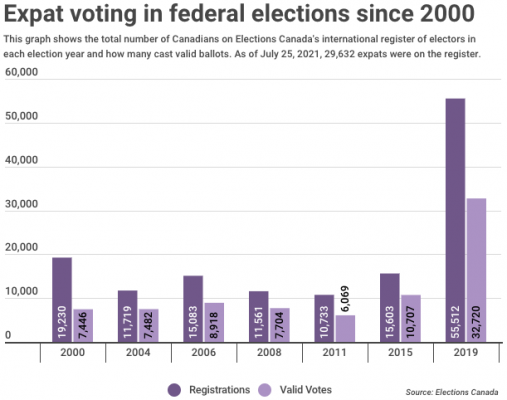
Graph courtesy of Infogram.

There are early signs that the number of expats registering to vote continues to rise.

On Sept. 13, 2019, two days after the writs were issued and roughly one month out from voting day (Oct. 21) in the last election, the Huffington Post reported that, at that point, 19,784 people were on the international register of electors. That number rose 180.6 per cent to 55,512 by election day. 

As of July 25, there were 29,632 Canadians on Elections Canada’s international register of electors—roughly 10,000 more than were on the list one month out from the last election. (Elections Canada does a verification process after each federal election, asking those registered to confirm their continued registration and mailing address, and removes the names of those who don’t respond or have returned to Canada.)

Though it’s still not official that a federal election will happen soon, expectation seems widespread that an election call is imminent, with the vote seen as likely to be held this fall, possibly in September.

“The opportunity is there for expats to have an impact,” said Mr. Stephenson, adding he expects the number of ballots cast by expat voters in the next election to be on par with 2019 levels or to potentially go up. “I don’t think it will dip down.”

John Delacourt, a former Liberal staffer and now a vice-president with Hill and Knowlton Strategies, said the numbers “certainly suggest” expat voting is on the rise.

“If that is indeed the case … it would be viewed as an opportunity, and as an opportunity for outreach, and virtually every party, I think, is interested in growth to connect with members, whether they be beyond our borders” or in Canada, he said. 

Semra Sevi, a PhD candidate with the University of Montreal’s department of political science who has explored the subject of expat voting (her master’s thesis looked at the impact of such voters in Canada), said the fact that expat voting appears to be on the rise is “not very surprising,” given increased attention on the matter, and she expects it “will continue to climb,” as political groups increasingly turn their sights to such voters and awareness builds. 

Mr. Delacourt said he doesn’t know of a Liberal-equivalent group to the CCA, adding the Conservative effort is “a little ironic” given the party’s past position supporting previous expat voting limits.

The Hill Times asked the federal Liberal Party directly about the existence of any such groups, and none were noted in response, though senior director of communications Braeden Caley did highlight that the party “works both with volunteers and organizers on a series of initiatives to help encourage Canadians abroad to participate in our democracy and elections,” noting “particularly strong support from Canadian students who have been living abroad in recent years.” 

Mr. Stephenson and Mr. Bingley previously formed a Canadian Conservatives in Hong Kong group in 2019, on the heels of the Supreme Court’s decision, similarly aimed at encouraging expats to register to vote. Through one registration drive event held a few days before writs dropped in 2019, attended by Mr. Baird, he said the group helped get between 150 to 200 expats registered. (The total number registered overall as a result of the group’s efforts is unknown, as expats have to register themselves.)

“That’s the kind of thing we’re hoping to replicate more on a global level” now, he said, with a particular focus currently on the Asia-Pacific region (Hong Kong, Singapore, and Australia in particular), the European Union (France and Germany in particular), Israel, the U.K., and the U.S., with the latter two being “likely where most Canadian expats live.” 

A lot of the group’s work, said Mr. Stephenson, is about “information sharing” and helping expats understand the process of registering, a process that involves “a lot of clicking” and is “not very simplified.” For example, a question that often comes up among expats, he said, is how voting in Canada could impact their taxes (zero impact, he said, citing Canadian tax experts).

Along with expat registration, Mr. Stephenson said the CCA is working to build a conservative network across the globe and has plans to start advertising on social media “soon.” The group also has a third function: providing informal policy advice and feedback to the Conservative Party and caucus back home (as well as provincial conservative parties, “as it comes”—for example, they recently had an open forum discussion with Alberta Premier Jason Kenney, he said). 

“Tapping into that network of experience and breadth of knowledge across sectors and countries can help to really inform policy issues back into Canada,” he said. “Canada sometimes gets a little bit isolated in international conversations … and sometimes we don’t read the newspapers in other countries about what’s going on, so we wanted to be able to have that policy feedback loop to improve the discussion back in Parliament a bit more.” 

To be on the international register of electors, you need to be a Canadian citizen, at least 18 years old on polling day, and have lived in the country at some point in your life. Elections Canada requires a copy of one piece of ID, either from a Canadian passport, birth certificate, or citizenship card/certificate. Expats also need to provide the last address they lived at in Canada (it can’t be a PO box). That address is used to determine the federal riding in which their vote will be counted. Registration can happen at any time, according to Elections Canada, but must happen before 6 p.m. on the Tuesday before election day (which is always a Monday) to have their vote counted in that election.

Elections Canada begins the process of mailing out special ballot kits to those on the register “immediately after the drop of writs” and it typically takes two to three days to mail all of them out, said spokesperson Matthew McKenna. 

“This time around, we have done what we can to prepare kits in advance so we are ready to go as soon as possible,” he said. 

How long it takes to reach international voters varies by country, he said, noting the agency uses DHL, a private courier service, for “many destinations.” Completed kits have to be received at Elections Canada’s Ottawa distribution centre by no later than 6 p.m. on election day.

Since 2015, Elections Canada has run a “paid advertising component” to reach out to international electors online; prior to then, it did “some smaller-scale targeted advertising” along with “non-paid outreach and organic communication,” explained Mr. McKenna. The agency also works with Global Affairs Canada to share information with Canadians living abroad about how to register and vote, and has a dedicated section on its website.

Impact of expat voters hard to gauge, says Sevi

In the 2019 federal election, 18.4 million Canadians cast valid ballots. International voters accounted for a small fraction of that, rounded to just 0.2 per cent. 

But Mr. Stephenson said he thinks there’s still potential for expats to make an impact. In his understanding, “many of the Hong Kong Canadians,” for example, are from B.C.’s Lower Mainland, the Greater Toronto Area, and Calgary and Edmonton. If “even just 10 or 20 per cent” of Canadians in Hong Kong vote, he suggested “it could tip the scales in a lot of close election races in the GTA and Lower Mainland.” Both areas are seat-rich and seen as target regions by Canada’s major political parties. 

Gauging the impact expat voters have had in federal elections is hard to do, said Ms. Sevi. The riding-by-riding vote breakdown currently provided by Elections Canada lumps together all votes by special ballot as one category; that includes international electors, but also captures votes cast by prisoners, members of the military, and people voting domestically by mail-in ballot. (Elections Canada is anticipating mail-in ballot use to rise considerably in the next federal election as a result of COVID-19.) 

“It’s hard to disentangle the patterns to say that you know expat votes would make a difference in a specific constituency historically,” said Ms. Sevi. The Conservative Party has in recent elections gotten more votes by special ballot than any other party, she said, but that’s special ballots as a combined group. A Maclean’s piece penned by Ms. Sevi and Peter H. Russell in 2015, notes that in 2008 and 2011, Ontario saw the highest share of expat voters, followed by Quebec, then B.C., then Alberta, with expat votes spread “increasingly in urban ridings.”

However, separate research she’s done into voting by Turkish expats (in Turkey’s elections)—information on which is “disentangled” as a separate category—indicates that while turnout is lower than among domestic voters in Turkey, expats “tend to vote along similar lines as domestic voters.”

Ms. Sevi said she hopes Elections Canada provides a riding-by-riding breakdown of the types of special ballot votes in the future. 

Source: Rise in expat voting expected to continue, creating new political footholds, say experts