USA: Using Cultural Competency for Mental Health Access Outreach

Relevant study:

College campuses need stronger cultural competency when designing mental health access outreach, as racial and ethnic minorities increasingly forego access to care, according to data from the University of California, Riverside.

The study, published in the Journal of Racial and Ethnic Health Disparities, particularly recommended college campuses look at the shared cultural values between Asian and Latinx students, two populations that researchers said often go without needed mental healthcare.

“This means counselors can identify a culturally sensitive, value-driven approach to encouraging greater participation in campus mental health services, instead of focusing only on students’ ethnicity in their outreach efforts” Kalina Michalska, the study’s senior author and a UCR psychology researcher, said in a statement.

Currently, about three-quarters of Asian students and 65 percent of Latinx students go without needed mental healthcare, the researchers reported. Those staggering figures could be due to cultural differences, like commitment to family obligations and interdependence that could make the burden of stigma stronger for Asian and Latinx students.

That is not to mention the social determinants of health, like racial bias or financial barriers, keeping Asian and Latinx students from accessing mental healthcare as often as their White peers.

Through surveying about Asian and Latinx culture, as well as about perceptions about mental healthcare access, the researchers were able to determine they were right, at least about cultural differences.

The survey 25- and 35-question surveys for Asian and Latinx students, respectively, highlighted a culture of deference to one’s family that could dissuade students from accessing mental healthcare for fear of stigma or shame.

Additionally, the stronger a student reported cultural beliefs in interdependence, the less likely they were to signal a need or a likelihood to access mental healthcare. For these students, support in one’s family and social circle was deemed essential for addressing mental health issues.

Importantly, the researchers could not draw a direct link between a student’s desire to honor her culture with a conscious decision not to access mental healthcare. However, the surveys did suggest some links between cultural attitudes and mental healthcare access that differ somewhat for White students of Western descent.

This comes as US institutions, like colleges, are becoming increasingly diversified. At UC Riverside, about a third of the students are Asian and 41 percent are Latinx. Campuses like UC Riverside need to account for multiculturalism in numerous ways, including as it relates to health and mental healthcare.

“Given the increasing diversity among U.S. college students, there is an urgent need for universities to develop proactive and culturally informed programs designed to improve mental health support for students, especially those from underrepresented backgrounds,” Michalska said.

Although Michalska and her team did not outline specific steps for building culturally competent patient outreach strategies, they did note that understanding cultural beliefs about interdependence and support through family would be important for understanding how to better tailor mental healthcare efforts on college campuses.

And in doing so, colleges can help ensure better and more equitable patient access to care, the researchers concluded.

Source: Using Cultural Competency for Mental Health Access Outreach

Curbing the Hate Pandemic by Irwin Cotler, Ahmed Shaheed and Brandon Silver

Strong arguments in favour of using Magnitsky Laws to combat incitement to violence and discrimination. In addition to the examples cited, would this apply to some of the statements by former president Trump? And will governments have the political will to do so given economic and other interests?

Liberal democracies have not provided an adequate policy response to widespread and systematic state-sanctioned hate directed at many minorities. Rapid implementation of targeted sanctions against individuals inciting hatred and discrimination could possibly prevent further crimes.

The COVID-19 pandemic has intensified the spread of an equally virulent virus: hate. Effective vaccines offer the best hope of defeating the coronavirus. We now need similarly targeted legal measures against those inciting hatred.

Today, a rapid worldwide resurgence of racism and xenophobia is targeting minorities like Jews, East Asians, and LGBT persons – with attendant harassment and physical harm – as being responsible for the spread of the coronavirus. In addition, some states have used the cover of COVID-19 restrictions and distractions to extend long-standing hateful policies.

This pandemic of hate long preceded the public-health pandemic, which exposed and expanded it. But despite this growing threat, far too many instances of hateful incitement go unaddressed, much less redressed, contributing to cultures of criminality and the impunity that underpins them. In particular, liberal democracies have not provided a commensurate and concrete policy response to the widespread and systematic state-sanctioned hate that continues to cause the misery, murder, and migration of many minorities.

Sadly, state-sanctioned anti-Semitism, anti-Muslim hatred, and bigotry against black and indigenous people are global phenomena. Emblematic examples of country-specific hate include the constitutionally enshrined discrimination and government incitement against Ahmadiyya Muslims in Pakistan, and the apartheid-like system of unjust imprisonments and dispossession of the Baha’i religious minority in Iran.

Worse, the perpetrators of these crimes continue to travel largely unimpeded around the world. Maintaining the status quo – decades of brutal persecution that shows no signs of abating – could best be described as complicity.

Combatting such hate is not only an ethical imperative, but also a public-policy one. Hate tears at society’s seams, and catalyzes crisis and conflict. This naturally progresses to mass atrocity. The Holocaust and subsequent genocides resulted not simply from a machinery of death, but also from an ideology of hate. The dehumanization of Tutsis as “cockroaches” by Radio Télévision Libre des Mille Collines planted the seeds of Rwanda’s killing fields in the 1990s in the same way that Joseph Goebbels’ anti-Semitic propaganda paved the path to the gas chambers of Auschwitz.

The world has long had a corpus of international laws intended to combat such crimes. After the horrors of the Holocaust, the international community crystallized a commitment to our common humanity in documents like the Universal Declaration of Human Rights, and treaties such as the Genocide Convention, conventions on the elimination of racial discrimination and discrimination against women, and the International Covenant on Civil and Political Rights. They recognize – and enshrine in law – the imperative of the struggle against hate and incitement, and the need to prevent and punish its manifestations, lest it metastasize.

But the implementation of human-rights foreign-policy tools based on these norms has been woefully inadequate, failing to challenge hate in the manner that it warrants. In particular, targeted sanctions frameworks such as Magnitsky Laws – nowadays the paradigmatic tool to punish human-rights abusers – have never been used expressly to combat incitement to violence and discrimination. This is despite many such frameworks being linked to the relevant international treaties, whether explicitly, such as in the European Union and United Kingdom, or implicitly, like in Canada and the United States.

Such sanctions have been a powerful post-facto tool, adding substance to statements condemning discriminatory violence against the vulnerable and – with applicable due-process safeguards – targeting the individuals most responsible for these crimes. They have been used, for example, in relation to Houthi-controlled security and intelligence agencies’ unjust detention and rape of politically involved women in Yemen, Chechen leaders’ torture and murder of LGBT persons, and the atrocities committed by Myanmar’s military, the Tatmadaw, against the country’s Rohingya Muslim minority. But these sanctions, while commendable, deal with the criminal consequences of hate, not its cause.

Rather than providing posthumous redress, targeted sanctions could possibly have prevented such crimes. Rapidly implementing such measures in response to incitement to hatred and discrimination – an initial early warning sign that often foreshadows major crimes – would sound the alarm and shine an international spotlight on the situation, naming and shaming individual perpetrators while providing protective cover to victims.

Moreover, sanctioning such individuals for incitement – typically with visa bans and asset seizures – could potentially serve as a deterrent, as they may modify their behavior in the hopes of being delisted. Even where those listed do not change their ways, targeted sanctions would reduce the virality of their hate by minimizing their resources and restricting their global mobility.

Such sanctions would be an important expression of solidarity and support for those suffering in other countries. Furthermore, they would safeguard the implementing country’s sovereignty by protecting against a corrosive influx of foreign assets and individuals linked to the promotion of divisive – and often deadly – discrimination.

Government leaders who violate internationally recognized obligations by promoting hate should not enjoy the freedoms abroad that they deny minorities at home. Protecting freedom of speech is not inconsistent with holding to account those inciting violence and discrimination. In fact, ending impunity for stirring up hatred would widen the scope for freedom of expression for all, especially for minorities whose voices are suppressed by rampant hate speech.

In these difficult and dangerous times, the shared desire for a peaceful and harmonious future, in which we celebrate our differences and the solidarity of humanity, can be a source of inspiration and a catalyst for global cooperation. To achieve it, we must stand up and strike out against the hate that ultimately hurts us all.

Source: Curbing the Hate Pandemic by Irwin Cotler, Ahmed Shaheed and Brandon Silver

American Muslims Are 2 Times More Likely To Have Attempted Suicide Than Other Groups

Of note. Wonder if there are compable studies for Canada:

For an entire year that involved emergency room visits, legal proceedings, involuntary unemployment and the death of loved ones, Mehran Nazir struggled with a depressive episode. He would find his mind flooded with self-destructive thoughts. He’d faintly hope his plane from Newark to San Francisco would crash or that he would doze off at the wheel of his car and end up in a fatal accident.

The normally extroverted Nazir would lie paralyzed in bed for hours doing nothing, not wanting to speak with family and canceling plans with friends.

It came to a head when Nazir found himself on the brink of suicide. In his darkest moment, he drafted a will and decided where it would happen.

Eventually, Nazir found comfort in journaling. And when he shared his writings online, he quickly found that other Muslims shared his struggles.

“I realized that this is not something that is unique in my history,” Nazir told NPR. “This was not a random occurrence.”

Nazir was right. U.S. Muslims are two times more likely to have attempted suicide compared with other religious groups, according to a study published last month in JAMA Psychiatry. Nearly 8% of Muslims in the survey reported a suicide attempt in their lifetime compared with 6% of Catholics, 5% of Protestants and 3.6% of Jewish respondents.

“Anecdotally and in clinical settings, we’re definitely seeing an uptick in suicides and suicide attempts,” Dr. Rania Awaad told NPR. She’s the director of the Muslim Mental Health & Islamic Psychology Lab at Stanford University and a researcher on the study.

At the heart of these numbers are several issues

Researchers attribute the high suicide attempt rate to two factors: religious discrimination and community stigma — both of which, they say, prevent Muslim American communities from seeking mental health services.

Earlier this year, a murder-suicide involving a Muslim family in Allen, Texas, sent shock waves through the community. Brothers Farhan Towhid, 19, and Tanvir Towhid, 21, both of whom reportedly battled depression, made a pact to die by suicide and kill the rest of their family so they wouldn’t have to live with the grief. Since then, public discussions on mental health, trainings on suicide response and healing circles have taken on new urgency.

“We have a very long way to go,” Awaad said. “There is just the beginning of a discussion that is happening now.”

There’s still a community stigma surrounding mental health

Naureen Ahmed, now 39, remembers how her family would visit her mother, Seema, at a psychiatric hospital. But the family never openly discussed why she was there.

Some days, Seema would sing along to Bollywood music at home wearing red lipstick. Other days, she’d walk around the house brandishing knives — or jump out of the car on the highway, threatening to kill herself.

Ahmed, a social butterfly at school, was hesitant to invite friends over because she never knew which side of her mother she would get that day.

It wasn’t until she was 25 that Ahmed finally learned why her mom acted that way: she had bipolar depression and schizoaffective disorder, her grandparents told her.

“It was difficult to say it out loud, this secret that I had held inside my entire life,” Ahmed told NPR.

Of the many factors that prevent families or individuals from seeking mental health treatment, stigma is “perhaps the most significant,” according to a 2013 study that looked at the cultural backgrounds of Muslims.

“If you believe that your mental illnesses will bring shame on you or your family, then you tend to stay silent about it,” said Dr. Farha Abbasi, founder of the Muslim Mental Health Conference. Through the conference, hosted by Michigan State University for 13 years, Abbasi hopes to destigmatize mental illness within the Muslim community using open dialogue.

After Ahmed’s mother died in 2012, she created SEEMA to support families like hers who are shamed by the stigma of mental illness, are isolated by their communities or are suffering alone.

SEEMA, launched in 2018, hosts support groups with licensed therapists at community centers and mosques and awareness workshops highlighting the importance of mental health and how to care for someone struggling with a mental illness.

“We need to have these conversations to destigmatize and bring awareness because people think that they’re alone,” Ahmed said.

Religious discrimination makes them more vulnerable

Abbasi, who has studied the impact of growing Islamophobia on Muslims’ mental health, says she was not surprised by the results of the Stanford study.

“Right now, the exposure to toxicity is making us more vulnerable,” Abbasi told NPR.

U.S. Muslims were more likely to report suicide attempts than those from Muslim-majority countries, according to the Stanford study. As a religious minority in the U.S., Muslims are highly vulnerable to religious discrimination, which is associated with depression, anxiety and paranoia.

According to 2020 polling from the Institute for Social Policy and Understanding, 60% of Muslims reported personally experiencing religious discrimination. And the FBI’s latest hate crime statistics in 2019 suggest that, of the reported 1,715 victims of anti-religious hate crimes, 13.2% were victims of anti-Muslim bias.

“There’s just trauma over trauma over trauma,” Abbasi says. “The impact of growing Islamophobia, the violence that is being directed against Muslims, all that is having a huge impact on mental health.”

They sometimes find it hard to reconcile their feelings and their faith

Last November, 39-year-old Chicago investor Jessica Ali broke down after separating from her husband.

“I felt that I was unworthy and there was no reason for me to live,” she said. Ali, a mother of three, had attempted suicide for a third time. The first two were in 2008 and 2018. “I started believing that I was crazy, that I must be a bad Muslim.”

That was until she joined a Muslim support group. It was there that Ali, who was diagnosed with severe depression, first came to terms with her mental illness.

“It’s very likely that when you’re sitting at the masjid, somebody in your praying row has felt this way,” Ali told NPR.

Now, Ali takes medication and visits a therapist.

But unlike Ali, some Muslims may not get the help and support they need.

To help jump over these hurdles, Muslim mental health professionals across the country are providing more culturally appropriate and religiously sensitive resources for Muslims.

Culturally appropriate resources can help

Dr. Sameera Ahmed, executive director of The Family & Youth Institute, a Muslim nonprofit, developed a suicide prevention toolkit in 2017 that helps Muslim American families navigate suicide risks, intervention, assessment and prevention.

“There may be mental health providers available, but if an individual doesn’t trust the system, they’re not going to use it,” Ahmed told NPR. “We try to translate the research into culturally and religiously tailored mental health resources that are community informed and disseminated by Muslim American mental health professionals.”

In 2017, the Khalil Center, which offers Muslims faith-based mental health services, launched a hotline that provides a “safe and empathic space” for those in crisis situations. “There’s more awareness happening,” Khalil Center psychologist Dr. Fahad Khan told NPR. “We have seen a rise in those who are seeking services.”

Imams have an integral role in community mental health because Muslim Americans may be more willing to seek help from religious leaders. That’s why Awaad started a campaign to train 500 Muslim leaders on suicide response in their communities by 2022.

“A number of imams came forward and said, ‘We as the religious and community leaders of the Muslim community really need to step up to this discussion,’ ” Awaad said.

Dr. Heather Laird, founder of the Center for Muslim Mental Health and Islamic Psychology, found that Muslims were more likely to seek psychotherapy if it aligned with Islamic values. So she ignited a movement toward Islamic psychology. By Laird’s definition, Islamic psychology is the treatment of the mind and soul within an Islamic context.

As for Nazir, he uses a combination of therapy and journaling to tend to his psychological wounds.

“This battle for mental health is not necessarily you solve it, you cure it, you move on,” Nazir said. “For me, it’s an ongoing journey.”

Source: American Muslims Are 2 Times More Likely To Have Attempted Suicide Than Other Groups

Expat Canadians should pay income tax, argues reader

USA and Eritrea are the only countries that have citizenship-based, rather than residency-based taxation. Superficially attractive but as the US experience indicates, implementation not as simple as Auerbach presents.

Funny how advocates always have confidence that “we can do this in a way that is just as fair, but less complex, than the American system:”

By all means we should be encouraging expats to exercise their rights as citizens to vote in Canadian elections. This includes of course the well-off expats whom the Conservatives are reaching out to.  

However, with rights come responsibilities, including the responsibility to pay income taxes on one’s world-wide income. The U.S.A. recognizes this fact by imposing income tax on all its citizens, including expats who live abroad.  

The principle is simple: if you are a citizen you owe taxes on your income, no matter where you live. 

In practical terms, U.S. expats living in higher-tax countries get a credit for these foreign taxes and do not owe additional U.S. taxes, but those living in low-tax countries or tax havens do owe more. 

Needless to say, this means that thousands of American expats have given up their citizenship to avoid paying taxes to the country where they no longer live. However, they are no longer entitled to vote in American elections.  

Canada should do the same. It’s only fair. We Canadian citizens should be obligated to pay income taxes on our world-wide income (with a credit, of course, for taxes paid to other jurisdictions), no matter where we live. 

I am confident that we can do this in a way that is just as fair, but less complex, than the American system. 

It will be interesting to see what our political parties say about the fairness of linking the rights of citizenship to its responsibilities, and what the Parliamentary Budget Officer would estimate would be the amount of taxes that could be collected. 

Lewis Auerbach
Ottawa, Ont.

Source: https://www.hilltimes.com/2021/08/11/expat-canadians-should-pay-income-tax-argues-reader/310084

Italy’s citizenship law back in focus as multicultural stars triumph at Tokyo Olympics

Of note. Will see extent to which if influences the policy debates:

Italy’s enthusiasm over its Olympics success, driven in part by multicultural athletes, has once again reignited debate over its citizenship law and the bureaucratic hurdles faced by thousands of young people.

The debate comes on the heels of Italy’s best performance in history at the Olympic Games, with 40 gold medals from a diverse band of athletes from a variety of backgrounds, including the country’s new star, Texas-born sprinter Lamont Marcell Jacobs.

The debate was sparked anew after the head of Italy’s National Olympic Committee, Giovanni Malago, complained of the bureaucratic headaches confronting Italian-born athletes who want to compete for their country but lack citizenship.

Under its current path to citizenship, Italy is an outlier in Europe, providing rights based on blood ties rather than based on where children are born – an idea known as “ius soli”, or “right of the soil”.

Children born in Italy to foreign parents must await their 18th birthdays before applying for citizenship, beginning an arduous process that can take four years, one that Malago described as “a Dante-esque circle”.

After Interior Minister Luciana Lamorgese said Malago’s criticism was valid, far-right leader Matteo Salvini, head of the populist Lega party, retorted that the minister would be better served controlling the countries’ borders than rekindling “ius soli”.

In Italy, the far-right has linked the debate over citizenship with the ongoing migrant crisis, which this year has seen 31,777 migrants land on the country’s coasts, more than double that in the same period in 2020, according to interior ministry figures.

“I think the important thing is that for these kids we have to think of social inclusion,” Lamorgese told La Stampa daily on Tuesday, noting that the issue went beyond Italy’s young athletes.

“They have to feel an integral part of society,” she said.

‘Full-fledged Italian’

There are various paths to citizenship in Italy — Jacobs’ citizenship was accorded through his Italian mother despite being born in the United States to an American father — but that involving children of two foreign-born parents is the most complicated.

Case in point is 17-year-old pole vaulter Great Nnachi, who was born in Turin to Nigerian parents, and is already a champion. Having broken records throughout her teens, she most recently won a junior title with her personal best of 4,01 metres in February.

But her records are not recognised by the state, as she is not technically Italian, and she cannot compete for Italy in international competitions.

“Despite being a full-fledged Italian, I can’t represent my country in sports,” Nnachi told La Stampa Tuesday. “I’m an Italian champion but I can’t demonstrate it outside the border.”

Italy’s national statistics agency Istat calculates there are about 800,000 minors in Italy who would receive Italian nationality were “ius soli” adopted, while some 60,000 newborns a year would become automatically Italian.

According to Italy’s Olympic Committee, 46 of its athletes who competed in the Tokyo Olympics this year were foreign-born.

Source: Italy’s citizenship law back in focus as multicultural stars triumph at Tokyo Olympics

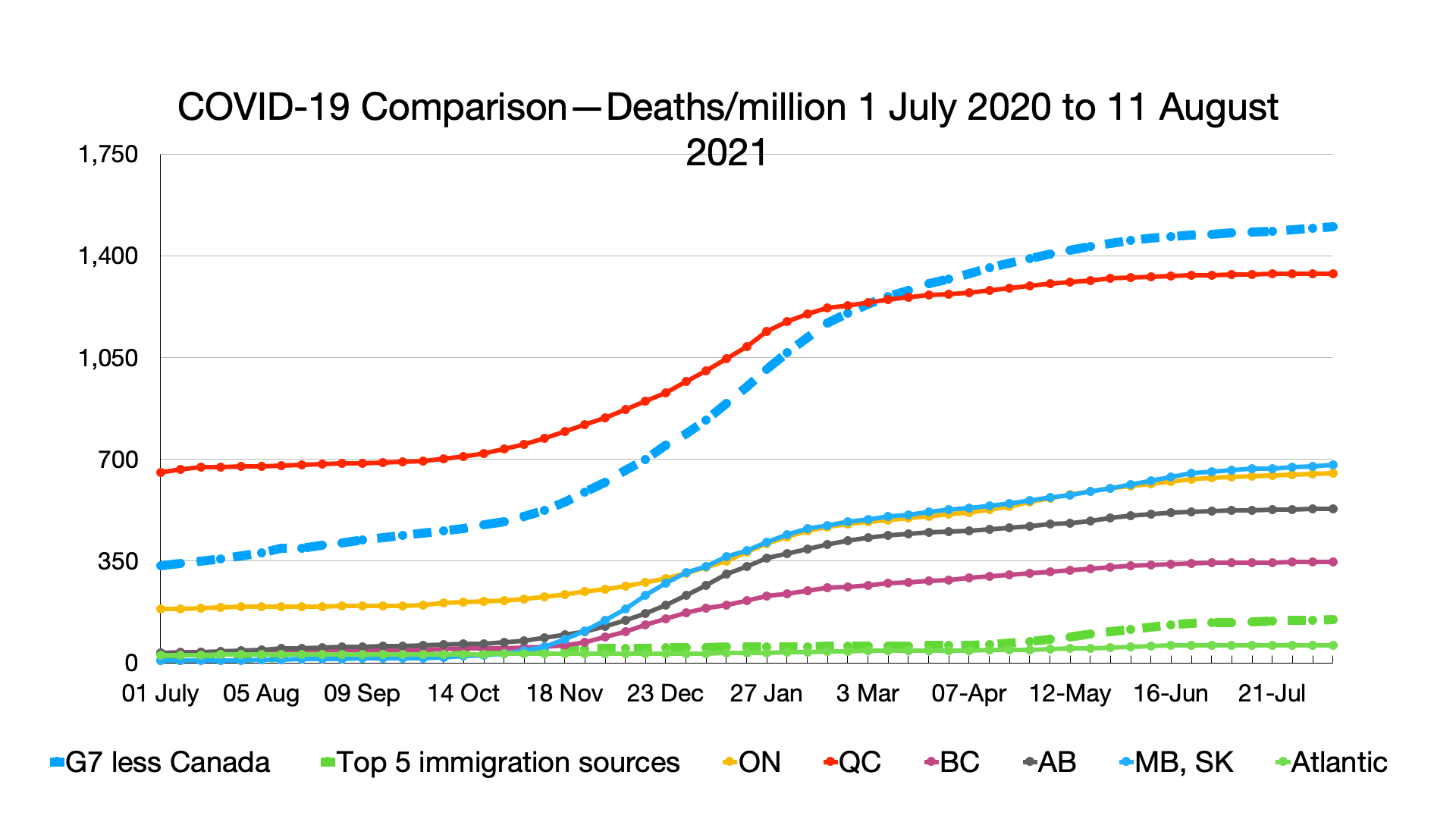
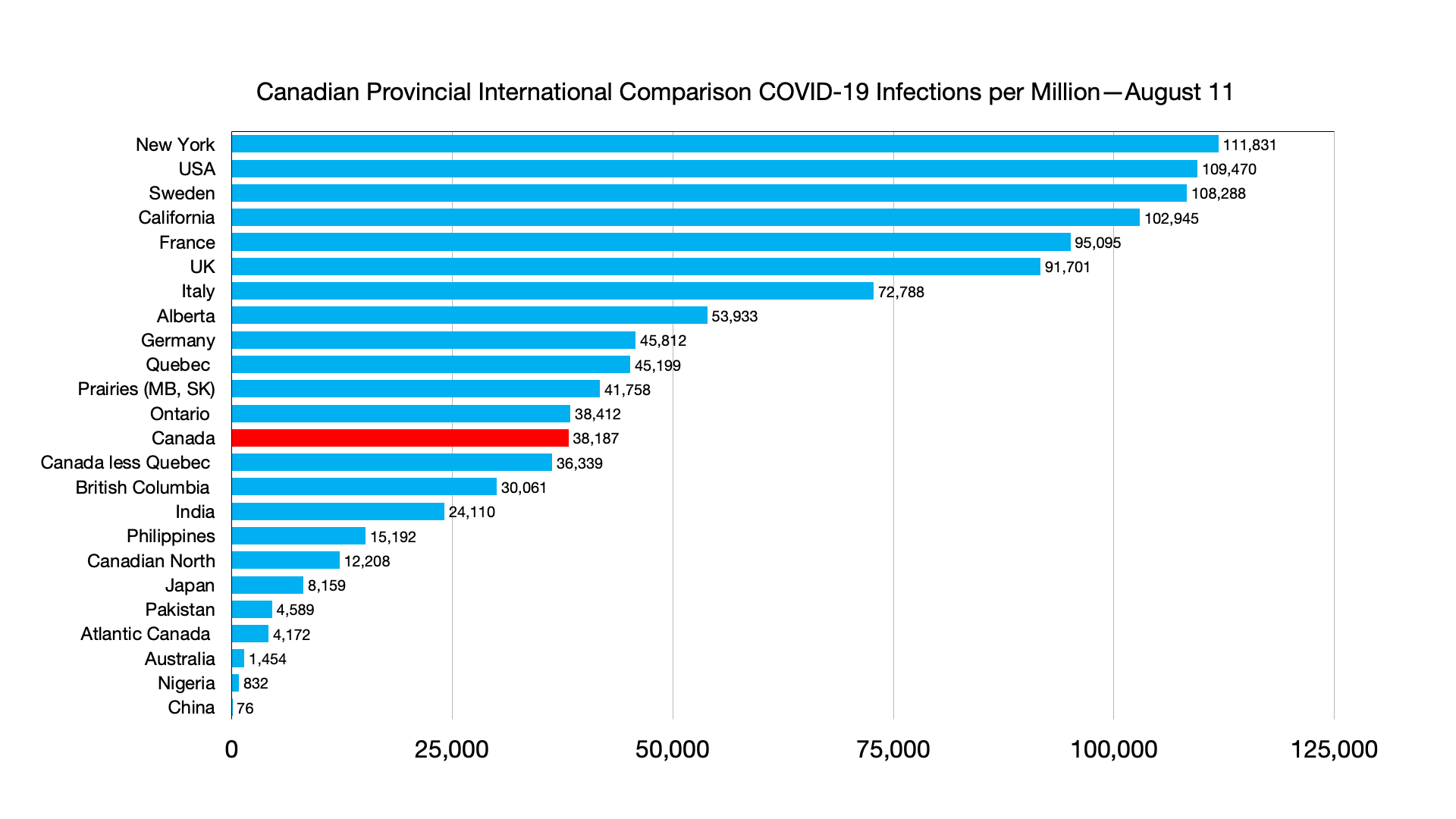
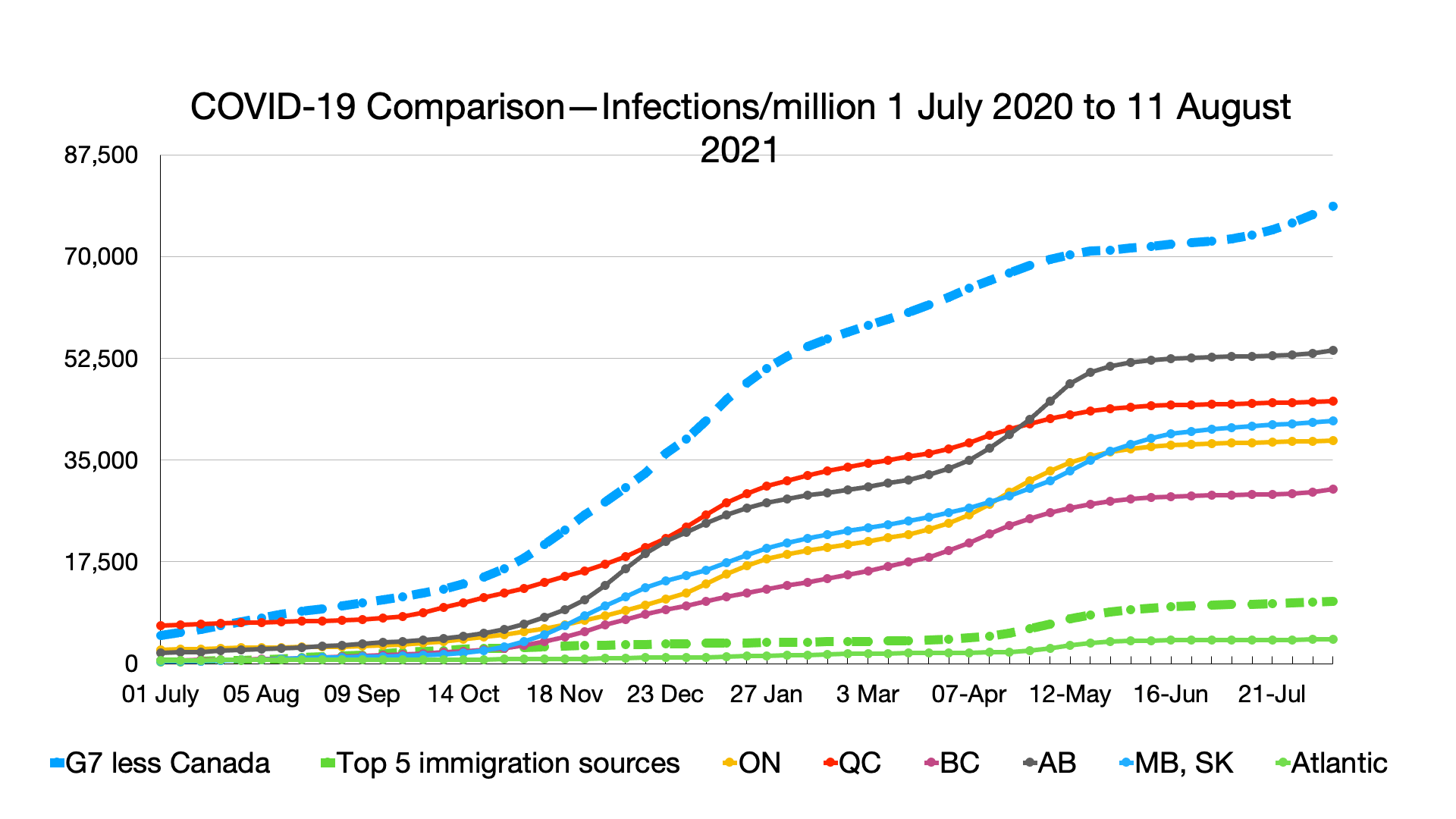
#COVID-19: Comparing provinces with other countries 11 August Update

The latest charts, compiled 11 July as overall rates in Canada remain relatively stable but with slight increases due to the variant. Canadians fully vaccinated now 62.7 percent, higher than USA 50.8 percent and the UK 59.4 percent).

Vaccinations: All Canadian provinces ahead of USA and EU countries, UK and China now ahead of Alberta and Prairies.

Trendline charts

Infections: More pronounced uptick in G7 less Canada (driven largely by USA). While all provinces showing increased infections, greater upticks in Alberta, British Columbia.

Deaths: No significant change.

Vaccinations: Ongoing steady gap between Canadian provinces and G7, immigration source country increase continues to be driven by China (fully vaccinated still at 16 percent) and India (fully vaccinated 8.5 percent). Flattening of Canadian vaccination rates as reported elsewhere.

Weekly

Infections: No relative change.

Deaths per million: No significant change.

It’s a system meant to help newcomers to Canada learn English. But critics say it prioritizes testing — at students’ expense

Hard balance to strike between the need for accountability through testing of progress and pedagogy:

After having his education stalled by war, Fahed Diab was thrilled to have a chance to return to school in Canada. But before he could apply to college, the Syrian refugee needed to enrol in adult English classes.

In those classes, the then 21-year-old worked to learn a foreign language from scratch while, more importantly, rebuilding his self-confidence and mingling with other newcomer students like him who were also trying to learn the history, values and cultures of their adopted homeland.

“I wanted to be able to communicate with people and learn how to ask for help, go to a doctor and book an appointment,” said Diab, who resettled in Canada with his family via Lebanon in 2015 under a refugee sponsorship.

“I went to classes and met friends in similar situations as me. I enjoyed interacting with people from different backgrounds and learning about this country. My self-confidence was getting better.”

However, when changes were made to the federal immigration department-funded Language Instruction for Newcomers (LINC) while he was about halfway into his one-year program, Diab, now studying engineering at Lakehead University, said he lost his drive as a result of the frequent in-class assessments required to prove the students’ progress.

“We had two or three tests a week, sometimes for writing and reading, or listening and speaking. We must pass all these tests to move up to the next level,” said the now 27-year-old Hamilton man.

“All the tests distracted me from the learning. I was obsessed with passing the tests rather than learning the language and culture.”

After about a year enrolled in the immigrant English classes, Diab quit and moved to an academic credit program for adults at a school board to finish his Canadian high school diploma as a bridge to the language requirement for post-secondary education.

He could’ve met college admission English requirement if he’d reached LINC level 7, which requires the learner to be able to communicate “comfortably and reasonably fluently” in most common daily situations.

Based on the Canadian Language Benchmarks, LINC goes from level 1 for low beginners to level 8 for high intermediate learners. While most Canadian colleges require minimum scores in standard language tests such as IELTS and TOEFL, they also accept adult immigrant students who have completed at least level 7 in LINC.

Adult immigrant students do drop out of English classes once their language proficiency reaches the level they need to navigate their day-to-day life; for many, it’s just a means to obtain the certificate to meet the bar of the language requirement for citizenship applications. Immigration data shows as many as half of all students discontinue after completing one level.

However, students and instructors say the portfolio-based language assessment or PBLA introduced in 2013 is taking the fun — and class time — out of learning for students such as Diab.

The language assessment system, which has been rolled out incrementally since then, is meant to provide a standardized tool to measure the program’s impact on participants’ language learning and track their progress at each English benchmark.

According to its practice guidelines, PBLA is a “comprehensive, systematic and collaborative approach to language assessment” based on the use of real world language tasks throughout the teaching and learning cycle.

Teachers and participants together are supposed to set learning goals, build a body of work to showcase the student’s language proficiency over the span of a school term and use it to make plans to advance the learner’s journey.

According to the immigration department’s most recent review of its language program, 87,140 or 16 per cent of adult newcomers admitted between 2015 and 2017 enrolled in formal language training. Women accounted for 62 per cent of the enrolment and three quarters of the students were between the ages of 25 and 54.

Students surveyed told researchers they were in classes to improve English for daily life (78 per cent), to help get a job (67 per cent), to better communicate at work (61 per cent), to learn about Canada (58 per cent) and to meet people (53 per cent).

About two-thirds said PBLA was helpful in encouraging them to learn more, that in-class assessments were useful in showing they are learning (64 per cent), and that the frequency of tests was just about right (67 per cent).

Instructors who did not find the assessment approach helpful complained the process took too much preparation (88 per cent) or classroom time (80 per cent), and that learners might not be comfortable with or understand the goal-setting (76 per cent).

“The PBLA may be useful ‘as a learning tool,’ but ‘not as an assessment tool,’” said the 75-page report, released in May. “PBLA is time consuming, and that training for PBLA is in high demand.”

Kelly Morrissey, who has taught English to immigrants and refugees in Toronto since 2010, says the tool looks good on paper but is so labour intensive when applied to a class of 20-plus adult students that it turns into sheer test-oriented learning and assessment rubrics.

PBLA requires students to collect what’s called artifacts — evidence of success in applying vocabulary, grammar and pronunciation in group activities — throughout the term. They need 32 artifacts in writing, reading, listening and speaking based on the instructor’s assessment to move up each ladder. There are eight LINC levels in total.

“Language needs a lot of repetition in different contexts. You need to give the brain as many ways to acquire the language skills as possible. You need to bring in all the senses,” said Morrissey.

“Language is one of the humanities. It’s not like a hard science. You can’t treat language students like laboratory rats.”

Morrissey tailors her curriculum to what her students’ needs are and those needs vary from cohort to cohort.

For a lesson about grocery shopping, she would go to a local store to take pictures of aisle signs, bring empty food packaging to the class and turn the classroom into a supermarket to allow students to do role-playing and learn English in that setting. Sometimes, that would also include a field trip to a store.

While the task-based learning approach that many instructors have already been doing is fantastic, says Morrissey, the paper work involved in PBLA has cut into the time students spend on those activities.

And it doesn’t help that instructors have to develop their own course content outside of the class based on rough PBLA guides. Those hours are unpaid.

“PBLA focuses on test, test, test, test. I had refugees from war-torn areas in my literacy class, experiencing post-traumatic stress disorder. I wanted more than anything to protect them from stress of these tests,” said Morrissey. “I think it’s unethical to be asked to do that to them.”

Ethiopian newcomer Ibsa Abdurzak, who was sponsored to come to Canada by a community group in 2017, spent six months in the language program in 2018 before quitting. While the assessment helps students get a sense of their English levels, he said he became hung up with making the grades.

“The best way to learn a language is through practice. But there’s too much assessment and it was too tedious for students,” said the 28-year-old, who had a degree in education back home and now studies business accounting at Mohawk College.

“We don’t like to be judged. It makes people nervous and stressed. It did take away the time to practise English.”

Yuliya Desyatova, a University of Toronto doctoral student, focuses her research on PBLA in adult language training in Canada. She says learners, often self-conscious and afraid to fail, could benefit more from engaging in activities than being assessed.

“They need the opportunity to interact in the language in a social environment. Many of my students are isolated at home. They don’t have interaction (in English) beyond classroom hours. They have so much responsibility,” said Desyatova, herself a LINC instructor since 2006.

“When this opportunity to interact with classmates and teachers is replaced by you filling out paper after paper after paper in the hope to pass, the interaction is pushed aside.”

While the assessment is supposed to offer a “better and reliable measurement” to gauge a learner’s progress, Desyatova says it’s still an inconsistent instrument because each teacher applies the standards differently, with some more heavy-handed than others — an issue the immigration department’s review recognized.

“A simple solution is to remove the mandatory nature of PBLA and let teachers decide how much and how frequently tests need to be done,” she said. “We don’t need to test our students 32 times to see this student is not learning anything more from my class and needs to move to the next.”

Settlement Assistance and Family Support Services, an immigrant agency in Toronto, provides adult language training to some 400 newcomers a year at three locations from literacy to level 7.

Its executive director Sudip Minhas said PBLA allows students to be the centre of the learning and give them ownership of the process, though she admits that the concept of evaluation scares people.

“The intent of PBLA is to take that anxiety out of testing. If I’m given the ownership of my own learning, the assessment is not about pointing out whether I fail or pass, but rather if this route didn’t help (my learning), can I take a different route?” said Minhas.

“But for all our instructors as well as administrators, we have not been able to translate that into practice because we’ve been conditioned by years of certain structured exams and of assessing people by failing or passing them.”

Although PBLA has been implemented for some years now, she says it takes time for instructors and learners to recondition their thinking about the assessment and apply it correctly.

The big setback was that the teachers were not given enough training and support at the onset, she’s glad to see the immigration department’s review recognizes that instructors can “benefit from many supports” and recommends more adaptable PBLA materials, limiting the amount of unpaid work and extra training.

Source: It’s a system meant to help newcomers to Canada learn English. But critics say it prioritizes testing — at students’ expense

Lawyer who called for elimination of citizenship tests named to bench

I thought the right-wing press might notice Avvy Go’s appointment. Will be interesting to see how she manages the transition from a very public activist to being a more discrete judge:

A Toronto legal activist who questioned the need for immigrants to take immigration citizenship tests and said the COVID-19 pandemic has created an increase in racism in Canada, has been appointed a federal judge.

Blacklock’s Reporter said Avvy Yao-Yao Go has also lamented the “shameful history” of Canada’s first Prime Minister, John A. Macdonald.

Go had been director of a Toronto law clinic that criticized Canadians for “anti-China sentiment and white supremacy.”

Go described herself in a 2020 commentary in the Globe & Mail as a lawyer “fighting for social justice” and cohesion.

“The past several years of turmoil both in the United States and Canada have taught us our democracy is fragile and that structured racism, if left unchecked, poses a serious risk to social cohesion,” wrote Go.

Attorney General David Lametti appointed Go to the bench on Friday saying he was confident she will “serve Canadians well.”

Go was director of the Chinese and Southeast Asian Legal Clinic of Toronto. The federally-funded group in a June 1, 2020 submission to the United Nations Office of the High Commissioner for Human Rights complained of widespread racism in Canada.

“In contrast to the image of Canada as multicultural and welcoming, many Canadians have been emboldened to use the pandemic as a license to exhibit hate and racism,” said the submission to the UN.

“Moreover, since the outbreak of the pandemic, anti-Asian hate speech has proliferated on social media platforms fueled by right-wing extremists who are using the pandemic as an opportunity to stir up racist ideologies.

“The collision of conspiracy theories, anti-China sentiment and white supremacy has rendered dangerous results, including the movement of racist theories and messaging from the fringe to the mainstream.”

The group earlier received a $301,904 grant from the Canadian Heritage department.

“While the Prime Minister has remarked that ‘hate, violence and discrimination have no place in Canada’ and his government stands with ‘Asian-Canadians across the country,’ his government has failed to take any concrete steps to address the surge of hateful violence and messaging that has arisen during the pandemic,” said the report.

Meanwhile, Go in numerous commentaries and letters to editors criticized Canadians’ treatment of racial issues and proposed abolishing the citizenship test as a “hollow screening” of immigrants.

“The moment I became a true Canadian was the very moment when I began to challenge the Canadian system,” the Hong Kong-born Go wrote in 1998.

In a 2014 commentary in the Toronto Star, Go lamented the “shameful history” of Macdonald, “architect of racist law” that saw Canadians “forced to live in nightmarish conditions while Macdonald pursued his dream to unite Canada.”

“Given the stark human rights record under his belt, why should Canadians celebrate John A. Macdonald’s birthday?” wrote Go.

In a 2013 letter to the Globe, the judge wrote: “The term ‘visible minority’ is fraught with issues, the key one being it uses ‘white’ as a standard against which everyone else is measured.”

“As we prepare to mark Canada Day, Ottawa must admit past wrongs particularly against Chinese-Canadians,” she wrote Toronto Star editors in 2003.

Go was one of thirteen new federal appointees named to the bench Friday.

Source: Lawyer who called for elimination of citizenship tests named to bench

The U.S. Attracts Fewer International Students, Loses Billions In Revenue. Here’s Why

Of note:

The Biden administration is hoping to attract tens of thousands of international students who stayed away from U.S. campuses during the pandemic. Foreign enrollment plummeted by 20% last year costing nearly $10 billion dollars in lost revenue. Though some students are starting to return, recovery might not be so easy. Even before the pandemic, international students were already turning away from the U.S.

In the 2018-2019 school year, foreign enrollment peaked at 1.1 million students and it’s been declining ever since as countries like Australia, Canada and the U.K gain more foreign students.

That’s a challenge for American colleges. But it also could be a blow to U.S. competitiveness. ​​​​Foreign students often go on to build their lives in the United States, filling our faculty offices, our laboratories, our boardrooms. One in five entrepreneurs who founded start-ups in the United States is an immigrant — and three-quarters of them first came to America as students.

International students are more likely than Americans to pay full freight. At public universities, the out-of-state tuition they pay has helped make up for a drop in state funding, especially after the Great Recession.

“They [colleges] need the tuition. They need full four-year out of state tuition payers,” says Robert Daly who directs the Kissinger Institute on China and the United States at the Wilson Center. Daly argues that colleges have become too reliant on students from one country: China. “They’ve become addicted to this money.”

Higher education is one the America’s largest service exports

When the pandemic sliced away a huge chunk of foreign students, the new administration took note. Higher education is one the nation’s largest service exports — bigger than agriculture exports like corn and soybeans.

Unlike the Trump administration’s hostility to foreigners, the Biden administration recently called it a “foreign policy imperative” that the U.S. remain the top study destination for international students. It’s putting students first in line for interviews and visa processing at U.S. consulates around the world.

But for many foreign students, the U.S. just isn’t as dominant. Emily Dobson calls it the “geoswerve.” Dobson, a college counselor in Brazil, has seen more diversity in where her students apply to colleges over the past few years. She says they’re finding options not just in traditional destinations like Australia and the U.K. but in Qatar, Japan, and the Czech Republic. “We’re not seeing the future we used to see here,” she says of the United States. “Still love you. A few of you are on our list. But you know, we’re going to go to other schools.”

“The American Dream idea,” she says, “is being questioned more.”

Dobson’s students are looking for more affordable options than the U.S. and for places where they can earn a degree in just three years. Safety is also a big concern — America’s gun violence scares many families.

New hesitancy by foreign student spells big trouble for U.S. colleges and economy

And 70% of international students on American campuses are from Asia. The recent rise in anti-Asian hate crimes have made some of them reconsider their futures in the U.S. Early in the pandemic, Lily Cao, a Chinese student at Mount Holyoke College, was confronted in a grocery store by a woman accusing her of spreading the coronavirus. “COVID has really been the trigger point where I felt like, Oh, I might get discriminated against,” Cao says. She plans to return to China to build her career in public health.

This new hesitancy spells big trouble for colleges — and for the larger U.S. economy, which is propelled by immigrant entrepreneurs, many of whom came here as college students. Competitor countries, such as Australia and Canada, make it easy for international graduates to stay and work and give them priority above other applicants for permanent residency. Britain last year introduced a global talent visa that fast-tracks people in in-demand fields for immigration. Universities in those countries frequently promote the ability to work after graduation when they recruit international students.

U.S. colleges are trying to regain their competitive edge and the pandemic may offer something of a blueprint. After more than a year of remote learning, both professors and students are more comfortable with online education. More hybrid and online programs could shorten the amount of time students would need to be in the U.S. And colleges hope a new commitment by the Biden administration to welcome international students can reignite the American Dream for students from abroad.

Source: The U.S. Attracts Fewer International Students, Loses Billions In Revenue. Here’s Why

Column: Is it time to let noncitizens vote in local elections? Some Americans think that’s just nutty

Even at the municipal level questionable, particularly in Canada with reasonable and not excessive requirements. And it still raises issues regarding minimum residency and other requirements:

Should noncitizens be allowed to vote?

That sounds a little crazy, doesn’t it? Weren’t we taught growing up that the right to vote belongs only to full-fledged, passport-eligible citizens of this country?

Nonetheless, the movement to expand immigrants’ voting rights is gaining ground.

We pay taxes, immigrants say. We run businesses. We send kids to public schools, drive the roads, ride the subways and fight in America’s wars. We are stakeholders in our communities and shouldn’t be excluded from the decision-making process that affects us.

There’s currently a bill before the New York City Council to let legal permanent residents vote in municipal elections — up to and including mayoral elections. Since 2018, San Francisco has allowed noncitizens to vote in school board elections, regardless of whether they’re in the country legally or not. Chicago allows it for school council elections.

Here in Los Angeles, the L.A. Unified school board authorized a study more than a year ago on how to extend voting rights in school board elections to noncitizen parents, grandparents and caregivers. The study — which would presumably lead to a ballot measure — was delayed by the pandemic but will be revived as school reopens.

There’s no question that noncitizen voting rights is a radical notion. It’s understandably worrisome to those who believe citizenship matters.

And you don’t have to be a xenophobe or a white nationalist or a Trump voter to feel that way.

A few years ago, then-Gov. Jerry Brown, whose liberal credentials are pretty impeccable, vetoed a bill passed by the California Legislature that would have allowed permanent legal residents to serve on juries, saying: “Jury service, like voting, is quintessentially a prerogative and responsibility of citizenship.”

Citizenship is a concept, a construct — but it’s a meaningful one. The idea is that there is a difference between merely living in the U.S. and being a full participant in its democratic self-government. Many people are stakeholders, but citizens are more like shareholders.

Becoming a citizen is a process (unless you’re born here, in which case it’s simple luck). At the end of it — after you’ve waited your time, lived in the U.S., taken a test, paid your fees, pledged your loyalty — you are rewarded for your formal commitment with both rights and responsibilities.

And there’s a value to waiting. The term “assimilation” is out of favor (perhaps because it implies that immigrants must check their differences at the door), but “incorporation” and “integration” are still important — learning the language, understanding the culture, making sure you buy into the rules and values laid out in the Constitution. Shared citizenship is a unifying force.

My mother, who came to America during World War II, went through this process, becoming a citizen seven years after she arrived.

Nevertheless, despite everything I’ve just said, I’ve come around to the idea that we should try noncitizen voting anyway, at least in a limited way on the most local level. The advantages outweigh the disadvantages.

After all, the United States was founded on the promise of “no taxation without representation” — yet there are some 25 million people living in the country, more than half of them legally, who are unable to participate in the elections that affect their lives and livelihoods. And yes, most of them pay taxes.

When a segment of the population is excluded from the political process, it can lead to discriminatory public policy and mistreatment.

Furthermore, noncitizen voting was widespread in the U.S. at the beginning of the nation’s history; it ended only in the 1920s. It is permitted in 45 countries around the world in local or regional elections, and in some cases, at the national level.

Noncitizen voting in federal elections was barred in 1996, but where it’s been allowed in the U.S. in recent years — in 11 towns in Maryland as well as San Francisco, two cities in Vermont and a few other jurisdictions — the sky hasn’t fallen. In many cases, it has led to greater political engagement and often to “improved outcomes,” says Ron Hayduk, a political science professor at San Francisco State.

Hayduk argues that noncitizen voting on the local level can be seen as part of the process of becoming a citizen, rather than a substitute for it. It undoubtedly fosters a sense of belonging and investment in the community.

It’s all well and good to tell immigrants to wait their turn to vote, but gaining citizenship is caught up in the U.S. immigration system, which is broken and irrational by all accounts, with no fix in sight.

In contrast, a limited experiment in noncitizen voting by the L.A. Unified School District makes sense. After all, the school board cited an estimate that 42% of Southern California’s children have at least one parent who is not a citizen, without a voice in the district’s leadership.

The expansion of the franchise should be narrow. It should be for school board elections only, and it could be restricted to legal permanent residents with children in the system. Let’s try it and see what happens.

Noncitizen voting raises fundamental questions about our country. Who is an American? Who gets to set the rules? What does it mean to run a country “with the consent of the governed”? What are the costs if millions of stakeholders are excluded from decision-making?

This experiment would challenge our assumptions but perhaps make us stronger in the long run.

Source: Column: Is it time to let noncitizens vote in local elections? Some Americans think that’s just nutty