Mesley: I made mistakes. But my departure wasn’t the solution to the CBC’s problem with racism

Context matters, as was the case of the UofOttawa professor (University of Ottawa professor at centre of controversy …https://www.theglobeandmail.com › canada › article-un…):

For almost 40 years, my name had a prefix: I was “the CBC’s Wendy Mesley.” And all that time I never wanted to be seen as an enemy of change. I’ve always tried to give voice to those who aren’t being heard; I’ve fought against the status quo my whole life. It’s why I got into journalism.

When I started out, there were few women in senior journalism roles. I was the first woman to cover the prime minister in CBC TV’s parliamentary bureau. Other women soon joined me. We fought for changes in coverage, and it happened because we saw things differently than men. It was the age of second-wave feminism, and we were told we could do anything. But women (and men) of colour did not receive the same openings, which meant many of their stories weren’t told and many of their insights weren’t considered. Today, change is happening, and I think much of it is good.

None of that matters now. I hurt people I never meant to. After a scandal last year, my prefix is now gone, the split with the CBC is official, and I have retired. The company gets a rebrand, and I go away.

But first, I’d like to do something I wish I’d been able to do long ago: Tell my side of the story, and finally talk about the two worst mistakes I made in my long and generally happy career.

After George Floyd’s murder last May, a Black CBC reporter tweeted that she had repeatedly been called the N-word. I was furious. I wanted to put her on the air to discuss that, and said so in a conference call with producers for The Weekly with Wendy Mesley.

During our discussion, I was so upset over what our colleague experienced that I stupidly filled in the N-word. Why? I’ve asked myself that question a thousand times, and I have no good answer. I was mad that she faced this kind of abuse. I can be very blunt. And I didn’t understand how any use of that word could hurt, regardless of its context. It was thoughtless and wrong.

One of the producers of the show was Black; another was of Asian descent. They went silent on the call. I was horrified I had hurt them and apologized, but the damage was done. I was told that bosses would be informed, and that there would be an investigation.

That would unearth an incident from months before while preparing another show on racism focusing on Quebec’s controversial Bill 21, which banned head coverings. After reflecting on the years I spent as a reporter in Montreal and Quebec City, I tried to make the point in an editorial meeting that many francophone Quebeckers feel like an endangered minority within Canada, and that they are victims of prejudice. I argued that this left less room for them to understand others, particularly people who weren’t like them. To make my point, I referenced the seminal 1968 book Nègres blancs d’Amérique, a Marxist analysis by the Francophone writer Pierre Vallières.

Again, I filled in the blank by saying the English title. To be honest, it didn’t occur to me to say “White N-words of America,” which is how the title appears in the translated English publication, except with the second word in the title fully explicit and uncensored.

All of this was leaked to the press. A storyteller became the story – even worse, I became a scandal.

The CBC suspended me. At one point, I thought I was going to be fired. Instead, I was punished and also ordered to take sensitivity training. The details of the investigation, I was told, were to be kept confidential. Eventually, I would be allowed to make a statement that would be vetted by my employers. It was made clear to me that the CBC would look after the story – and me.

Trusting them was my second big mistake.

The CBC did not offer me any public support. And I did not defend myself because I just wanted to return to work. In the midst of last year’s racial reckoning, I also felt it would have been wrong for me to play the victim card.

But my silence backfired as players on all sides used me as a cudgel to advance political interests. While some journalists offered public support, my most vocal defenders were free-speech warriors who wanted to make me a cautionary tale about the dangers of cancel culture. That distinction horrified me, because I’ve fought to cancel injustice my whole life. I resented being made a poster child of a movement I wasn’t part of.

I also believed my punishment would be proportionate, because people would come to understand there’s a difference between a reporter repeating a hateful remark with colleagues while in pursuit of a story, and a gleeful racist trying to draw blood.

I was wrong about that too.

Nature abhors a vacuum, and narratives can be filled in on blank slates. People assumed I’d been let go or retired in shame, and that because I had disappeared and not defended myself, the situation must have been even worse than it was.

And I believe the CBC had an agenda too: using me to distract or absolve themselves from their own underlying problems. A month after the murder of Mr. Floyd, as protests by Black Lives Matter activists swept across Canada, almost 500 current and former employees sent a letter to management “urging them to take action to dismantle systemic racism in the corporation.”

“The journalistic failures in the CBC’s coverage of this historic moment are the direct result of whose voices and experiences drive decision-making at the CBC,” the letter read. “The problem lies with white editors who dismiss pitches from non-white journalists as ‘biased’ or ‘unimportant’ because they might not appeal to a white audience.”

When the CBC’s licence came up for renewal at the CRTC that June, president Catherine Tait told the hearings: “We recognize that systemic racism exists in Canada and within many of its institutions, including its national public broadcaster. We are committed to combatting racism in all its forms.”

But I soon learned there had been at least three other cases at the network involving shows in which the N-word was allegedly used in meetings. While one was reported, the other cases seem to have disappeared internally – the broader questions of systemic racism swept under the rug – until I became a convenient device for cleaning up their brand. Even the corporation’s own ombudsperson concluded that it was “disappointing” that the network’s ensuing coverage of my actions “did not offer a wider variety of perspectives.”

After the cancellation of my show, I was offered another role that I saw as unreasonable. I asked whether we could find a mutually agreeable departure and was told that any such arrangement would require that I not discuss events of the last year. As a journalist who put a lot of people on the spot, and who hated being told “no comment,” that was never gonna happen.

I remain angry. I’m angry at myself for hurting people. I’m angry at the CBC for abandoning me because of two moments, instead of judging me by my whole career. I understand the mistake I made was serious and invited repercussions, but I also submit that using a particular situation to advance broader agendas is divisive and wrong.

I know it’s easier to say this as a white person, but I have long argued for journalistic objectivity, which is seen by some, reasonably, as reinforcing the status quo. But it doesn’t have to. Journalism should just be a search for the truth – all truths.

In 2005, when I had cancer, I saw a story I thought needed telling. I did a documentary about how I thought “big pharma” and cancer agencies weren’t doing enough to stop the spread of the disease. You could argue I was opinionated and not objective. I faced some criticism, but I was never accused of bias by my bosses. I think we need to listen to the accounts of Black and Indigenous journalists and other journalists of colour when they report being accused of bias for challenging the status quo.

I’m sad about how this has all played out. It’s certainly not how I’d hoped to bring down the curtain on my CBC career. But after a year of reflection and a whole range of emotions, I’m left feeling mostly disappointed, because this could have been handled so differently. It could have been a more productive process, in which the CBC used the moment to help foster greater dialogue about a difficult topic. Instead, it was all about blame, shame and regret. Had things gone differently, maybe my last story at the CBC could have been as meaningful as all the stories I’d told in the past 38 years.

Source: I made mistakes. But my departure wasn’t the solution to the CBC’s problem with racism

Bill S-230: It’s Time to Restore Citizenship to “Lost” Canadians. Limited numbers although rhetoric continues

This issue continues to attract more political support than is warranted given that the major issues were dealt with in citizenship legislation in 2009 and 2014.

The Bill concerns a small cohort of second-generation Canadians born inside a 50-month window, from February 15, 1977, through April 16, 1981, so those who had already turned 28 when that age 28 rule was repealed through Bill C-37. 

Despite all the earlier and current rhetoric regarding the large numbers affected, IRCC officials advised SOCI of the numbers:

  • Following the 2009 changes, about 17,500 applied and were granted citizenship;
  • Following the 2015 changes, about 600 applied and were granted citizenship;
  • Since 2014, there were 109 persons who applied for a discretionary grant to address particular hardship situations. 105 have been granted with four still under review;
  • Estimates of remaining cases are in the order of a few hundred.

Substantively, given the small number remaining in the window, discretionary grants are the appropriate response. What is clear from the numbers, is that the actual number of “Lost Canadians” who wish to claim Canadian citizenship is small, contrary to earlier and current claims.

It is unclear why Senators wish to pursue this when there are many more substantive citizenship issues that warrant attention.

The contrast between these small numbers and the inflammatory, often fact-free and exaggerated rhetoric of long-term advocate Don Chapman in his opening statement and subsequent comments is striking. Opening statement below gives the flavour (highlights some of the more egregious assertions):

Don Chapman, Head, Lost Canadians: Thank you, honourable senators. I’m honoured to be in the presence of all of you. I admire your social and moral engagement in serving Canada to make it a better and more inclusive country. We’re on common ground.

Bill S-230 is a continuation of recommendations the Senate made 13 years ago.

Senators, Lost Canadians is the Canadian version of the British Windrush scandal, except ours is mostly off the radar, far larger, affects way more people and is one of the biggest scandals in Canada’s history. Now, that probably sounds presumptuous, especially after the horrific discovery of the remains of hundreds of Indigenous children. To explain why I make the comparison, those children, including all Indigenous people, are part of the Lost Canadian narrative. There are at least 15 categories of Lost Canadians, and Indigenous and First Nations are just one. But their story is our story and our story is their story. It’s about a country that has and continues to turn against its own people. Since Confederation, Canada has not always embraced Brown or Jewish people or other subgroups. Canadian history was written to conveniently include a colossal fabrication, which has produced heinous results. To know the truth, you must understand the history of citizenship.

Senators, you and the MPs are the guardians and caretakers of our collective identity called citizenship. You’re our parents, we’re your children and the family’s dysfunctional. Picture a neighbour befriending kids from all around but then secretly abusing their own children. That’s how it is for Lost Canadians. Canada welcomes people from around the world, but not us, your own children. To be clear, we’re pro-immigration; Canada needs people. But why are long-standing Canadian families rejected while immigrants are welcome? Why can’t there be room for everyone?

In 2003, in my first House of Commons Citizenship and Immigration Committee testimony, I described myself as a Canadian in exile. Years later and after numerous rejections, I actually considered declaring refugee status in my own country, and I wasn’t the only Lost Canadian so desperate. Regrettably, this horror show is ongoing. It’s about identity, belonging and culture.

Indigenous Canadians are proud of who they are. I’m proud of who they are and admire their perseverance in standing up for what is right. Canada wrongly tried to strip them of their identity, with deadly consequences. Be forewarned: They are not the only category of Lost Canadians who died due to the neglect.

Now think of citizenship as being a member of a family. It’s the fibre of your being. How would you feel if your parents booted you out? Picture a six-year-old, born in Canada and extremely proud of being Canadian. Psychologically, how is that child affected when they discover that their own country or family doesn’t want them anymore? That child was me. How deplorable that this is still happening to other children, with the obvious devastating results. Their hurt lasts a lifetime.

Now flip the coin. How does it feel being the Canadian parent of a minor child being rejected? I know this too because, as an adult, after 47 years, Canada finally said I could go home with citizenship, but on condition I leave behind my minor-aged daughters. Today, some Canadian citizen parents are in the same boat, forced to explain to their kids why Canada doesn’t want them.

Lost Canadians is not about immigration. It’s about citizenship and rights. Please make the distinction.

Also, senators and MPs are appointed or elected to represent Canadian citizens. The problem is you don’t really know who is or is not a citizen, yet citizens are your constituents. So who exactly do you represent? The legislation remains a Rubik’s cube of confusion. Maybe it’s you, a family member, a grandchild or someone you know that’s a Lost Canadian. Roméo Dallaire lost his citizenship, as have other parliamentarians.

Question: If you’ve been aware of ongoing Lost Canadian abuses, why were you silent? Personally, I don’t think you were fully aware, but it wasn’t for my lack of trying to tell you. Going forward, no excuses, you now know. As for citizenship, Canada, the country you represent, is violating three United Nations human rights conventions, the Universal Declaration of Human Rights, the Canadian Charter of Rights and Freedoms, and it’s already broken promises made on gender equality at the recent G7 summit. Maybe that’s because citizenship is not and has not been Canada’s priority. Take the name, IRCC. Immigration and refugees come before citizenship, the latter being the bastard child. For Lost Canadians, Canada’s outcasts, that’s exactly how it feels.

Bill S-230 is a much-needed fix. Thank you to my good friend Senator Martin and to Senator Omidvar. But for importance, the age 28 rule is third in priority of the five remaining Lost Canadian deficiencies. For the complete fix, Bill S-230 would need amendments that I’ve included, and the fixes are relatively simple. But absent that, tiered citizenship and unequal rights remain. Are you okay with that? It’s certainly against the Charter. That said, if amendments would delay the passage of this bill, then please pass it as is. Just don’t ignore other desperate Lost Canadians still in limbo, like children. As an airline pilot, I’d never ditch in the Hudson River and knowingly leave people behind. As overseers and protectors of Canadians and their identity and citizenship, please don’t you leave anyone behind either.

With urgency, put forward another Lost Canadians bill so that women have equal rights; that all Canadians are able to prove their substantial connection; that naturalized Canadians don’t have more rights than other Canadian citizens. Make it so that every naturalized Canadian, not just 99% of them, be deemed to have been born in Canada so that they too can confer citizenship to their children. Canada’s war dead must be recognized as having been the Canadian citizens they were.

After that, together, let’s work on introducing a mint-fresh, inclusive and Charter-compliant Citizenship Act. That’s what this committee recommended 13 years ago in your report on Lost Canadians, and then you promptly forgot about it, just like Canada did with the age 28 rule.

Now there are MPs and Canadians who believe the Senate is irrelevant. They’re wrong. For me and the hundreds of thousands of other Lost Canadians, we regained or qualified for citizenship because of wonderful and compassionate senators like yourselves, from all sides of the aisle. You were our saviours as Bill S-2 was our first parliamentary victory, and it was unanimous. Now let’s do it again, in the Senate today, with Bill S-230. Make it the first bill to correct these egregious wrongs, and then introduce a brand new, Charter-compliant national identity, making Canada the beacon of light to the world for its vision, its inclusiveness, its values and for its positive actions on human rights and equality.

Honourable senators, citizenship could be one of your greatest legacies. I look forward to working with you, and thank you.

Source: https://sencanada.ca/en/Content/Sen/Committee/432/SOCI/55289-e

And the earlier statement in the Senate by Senator Omidvar

Hon. Ratna Omidvar: Honourable senators, I rise today to speak to Bill S-230, An Act to amend the Citizenship Act (granting citizenship to certain Canadians), introduced by our colleague Senator Martin.

Before I comment on this bill, I would like to mark June 1 as a transformational day in the Senate. We have passed Bill S-4. We have held on to tradition where we have needed to, but we have also gone with confidence into the future. I want to thank our colleague, Senator Marc Gold, for his dedication to bringing this to our chamber.

I am the official critic for Bill S-230. I always think of a critic as someone who has something to object to. In truth, there is very little to object to in this bill, so I stand very much as a supporter of this long overdue piece of legislation.

When I became a senator in 2016, I started to get emails from Canadians who knew of my interest in citizenship. I heard the term Lost Canadians for the first time. I have to be honest, I was, frankly, lost when I heard that terminology because those of us who have found Canada know what a privilege it is to be Canadian. To have inadvertently lost your citizenship — because of what I can best describe as bureaucratic missteps and fumbling and lost opportunities — is unimaginable to me.

In June 2016, I rose in the chamber as the sponsor of the citizenship bill, Bill C-6, and I drew a picture of Canada and its citizenship as a house with a strong roof, a strong door, a lot of windows to let the sunshine in, but also to keep danger out. I believe that metaphor still stands today, but the foundations of this house are grounded in a few principles.

First and most important is equality amongst citizens. Equality sees all Canadians — by birth or naturalization, mono-citizens or dual citizens, whether citizens of 50 years, 10 years or 1 month — treated equally under the law. Equal rights, equal responsibility and, when necessary, equal punishment. These are not aspirational goals. This is the floor; the absolute foundation of how equality is expressed in Canada.

Second is the principle of facilitating citizenship, making it accessible for those who qualify. I think of this again as the main family room of the house: a big fire blazing to keep out the wretched cold and a big, welcoming door. However, for a few Canadians, the fire has lost its warmth, and they were inadvertently expelled, banished, so to say, from this house.

Many have lived in Canada for years, as Senator Martin has pointed out, without even realizing they may not have Canadian citizenship any longer. Although legislative fixes have tried to bring citizenship back in different ways, it has never captured everyone. This is a true example of the unintended, negative impact of legislation that we deal with in so many different ways.

When I rose to speak on Bill C-6, which was an omnibus citizenship act, former senator Willie Moore, who was with us, asked me whether or not Lost Canadians would be brought back into the fold. Sadly, I had to say to him, no, that was out of the scope of the bill.

After Bill C-6 was passed, former Senator Eggleton took it on and was almost ready to table the bill when his resignation date approached. Again, the bill was left orphaned, in a way. Since that time, Don Chapman and others have been talking to Senator Martin, Senator Jaffer and all of us to try to bring this back to our attention. I am incredibly grateful to Senator Martin for taking this bull by the horns and bringing our attention to it.

As we know, and as Senator Martin has explained, our immigration system is incredibly complex. Immigration law is complex. Within immigration law, there is citizenship law that is incredibly complex. It sometimes catches people in a net from which it is hard to escape.

As Senator Martin has explained, it’s a narrow bill. In 1977, the government introduced a new Citizenship Act. Under that act, children born abroad on or after February 14, 1977, received their Canadian citizenship if one of their parents was a Canadian citizen, regardless of their marital status.

However, if that Canadian parent was born outside Canada and, therefore, the child was what we would call second generation, the child had to apply for citizenship by the age of 28. If they did not put an application by age 28, their citizenship was taken away from them, often without them ever realizing it.

Later, in April 2009 — many years later, still trying to catch up on the problem — Bill C-37 changed the Citizenship Act again and repealed the age 28 rule. However, the bill didn’t completely deal with Canadians who were born abroad between that narrow window of 1977 and 1981, and who turned 28 before Bill C-37 became the law. Some of these individuals were well informed enough and applied for their citizenship. Others simply fell in between the cracks.

Senator Dalphond asked the question, how many are these? I’m also curious. My information is that there are definitely not thousands. There may even be just a few hundred. But I hope we all recognize, even for just a few hundred, how important it is to be able to be franchised as Canadians.

Many who were born overseas but raised in Canada had an entrenched life in Canada. They went to school here; they have jobs and families here. Their roots are firmly here. They have paid income taxes. But they were unaware of the issue — just as I’m often unaware of when my driver’s licence expires, and then I have to really struggle to regain it — which certainly happens to people. We are talking, as I said, about a few hundred people, at most.

The government relies, as Senator Martin has stated, on ministerial appointments. Every time I’ve spoken to every successive immigration minister, they have said, “It’s not a problem. I can deal with it. Send me the file.” But, colleagues, that is not a systemic way of dealing with an injustice of this kind. We need a law. Even though Byrdie Funk — someone whom I admire a great deal — and Anneliese Demos — the same — even though they had the agency, the voice, the capacity to advocate for themselves, I worry about those who do not, who cannot get the minister’s attention or that of his department. I think it is time for us to fix this in a systemic manner.

There are severe consequences for having to wait to get formal recognition back. While waiting to get your citizenship, you can’t have a social insurance number. You may not be able to get a job. You may not be able to travel. Likely you’re not able to travel because you don’t have a passport. You have limited access to health care. All this at the same time when there is always the threat of deportation hanging over you.

In the case of Byrdie Funk, it is not clear whether all her years of contribution to the Canada Pension Plan will be honoured when she gets her pension.

Bill S-230 will allow citizens who were born abroad and have built a life here to prove that they are Canadian and that they have the right to pass citizenship onto their children. It will not lead to a perpetual passage of Canadian citizenship to generations who may never live in Canada. This does nothing for third-generation Canadians.

Honourable senators, I urge you, in short, to support this bill and send it to committee for further study. Lost Canadians have already waited too long. Let’s bring them back into the Canadian fold sooner than rather later. Thank you.

Source: https://www.ratnaomidvar.ca/speech-on-bill-s230-its-time-to-restore-citizenship-to-lost-canadians-2/


Racism harms workplace relationships in Canada, CEOs expected to take action: Survey

Interesting survey by Edelman, even if online:

Racism is harming workplace dynamics in Canada, with nearly 80 per cent of Black Canadians saying racism has damaged their relationship with their employer, according to new research released Tuesday.

That’s nearly double the reported response from the general population and is followed closely by South Asian employees, with nearly two-thirds also reporting that workplace racism has damaged their employer relationship.

The findings, included in the 2021 Edelman Trust Barometer Special Report: Business and Racial Justice in Canada, are based on an online survey of more than 2,000 Canadians.

The research found racism is a growing concern in Canada, but only one in three people surveyed said the country has made progress tackling racism in the past year.

More than 60 per cent of people said the biggest challenge in solving racial injustice is changing the attitudes of people who are racist, while nearly 40 per cent said the biggest challenge is changing systems that are racist.

Meanwhile, the research found the vast majority of Canadians expect CEOs to take some form of action to address racism and racial injustice.

It also found that brands and corporations that take a stand against racism are far more likely to gain consumer trust than lose it.

Still, over half the people surveyed said brands and companies that issue a statement in support of racial equality need to follow it up with concrete action to avoid being seen by consumers as exploitative or as opportunistic.

Actions that improved a company’s reputation included replacing a racist logo, jingle or product name with one that is non-racist and creating a nationwide campaign to raise awareness regarding systemic racism.

Nearly a third of Canadians said they have started or stopped using a brand in the past year because of its response to protests against systemic racism and calls for racial justice.

Edelman said the survey includes an oversample of racialized people, with a special focus on Indigenous Peoples.

According to the polling industry’s generally accepted standards, online surveys cannot be assigned a margin of error because they do not randomly sample the population.

Source: Racism harms workplace relationships in Canada, CEOs expected to take action: Survey

Cancellation puts spotlight on Malaysia’s cultural conservatism

Of interest:

When his online talk on how multicultural performing arts should transcend race was cancelled in early June by the Islamic centre of a prominent Malaysian university, Ramli Ibrahim, was both puzzled and angered.

An official statement by Universiti Teknologi Malaysia (UTM), one of the country’s most highly regarded public universities, said that “the organisers have been instructed by the university’s Islamic centre to cancel the programme over undisclosed reasons.”

Ramli, the celebrated artistic director of the Kuala Lumpur-based Sutra Dance Theatre, who is a Malay Muslim and globally renowned for his choreography of Indian classical dance, notably the Odissi style, went online to call UTM’s Islamic centre “narrow-minded” and “bigoted”. The centre did not respond to Al Jazeera’s questions about the cancellation.

“We have sanctioned extreme religious indoctrination to infiltrate our education system,” Ramli told Al Jazeera in an interview. “The latter is the axis mundi of cultivating the kind of citizenry we will eventually produce.”

Ramli’s case is the latest episode in a long-running national debate on the state of the arts in Malaysia and underlines the continuing role of Islamic conservatism in policing and shaping the nation’s cultural identity and practices. Most of Malaysia’s population is ethnic Malay Muslim, but there are also large communities of ethnic Chinese and Indians, as well as Indigenous peoples, especially in the states of Sarawak and Sabah on the island of Borneo.

“We have produced a generation with a rather skewed and narrow world view. Unfortunately, these are the same people who run the country,” Ramli said.

Going against the grain

Ramli’s experience is a reminder that in Malaysia it is not just political artists like Fahmi Reza and Zunar, or the budaya kuning (“yellow culture”, meaning Western culture) of banned foreign films and censored international pop and rock acts that come onto the authorities’ radar. Even traditional, but non-Islamic, art forms like Ramli’s Odissi Indian dance are at risk of being sanctioned by conservatives.

The current state of affairs has roots going back several decades.

In 1970, the government unveiled a National Culture Policy following a violent and racialised political crisis the previous year, which aimed to establish what was claimed to be a new basis for “national unity” in the multiethnic and multireligious nation.

The result was a national culture based largely on the traditions of the Malay majority, with Islam as an important component.

By the 1990s, the identity focus of the NCP started to wane as the country faced new and more pressing challenges in keeping up with globalisation. But as Ramli’s recent case illustrates, the core of the policy continues to inform mainstream cultural decisions.

“Cultural elements of the Chinese, Indians, Arabs, Westerners and others, which are considered suitable and acceptable are included in the national culture,” read a 2019 document explaining the National Culture Policy on the website of the Prime Minister’s Office.

It noted that “acceptance” depended not only on provisions within the Constitution, but other issues including “national interest, moral value and the position of Islam as the official religion of the country”.

Experts said the approach is stifling Malaysia’s cultural traditions.“The attempts to control and manipulate the arts have not only stifled the creativity of all arts practitioners but will lead to the demise of our local traditions,” said Tan Sooi Beng, a professor of ethnomusicology at Universiti Sains Malaysia’s School of Arts in Penang, and an advocate of the sustainability of local traditions through community-engaged research.

Tan points to laws like the Printing Presses and Publications Act, which allows the government to ban cassettes, videos and books that are not approved by the official censors; and the Police Act, under which applications for police permits have to be made to hold public gatherings, including performances of theatre, music and dance.

Ramli, who founded the Sutra dance company in 1983 after returning from Australia, has seen Islam in Malaysia grow more conservative in the years since he returned home.

While his company’s productions have been popular with local and international audiences and achieved considerable critical acclaim, his artistic ethos, drawing on a rich tapestry of cultural elements, has faced a constant struggle with the religious censors.

“There had been initial official opposition to my performances up to the mid-1990s, even before the Department of Islamic Development Malaysia (Jakim) was formed. And there was an unstated understanding among organisers that my performances would be considered ‘controversial’ due to the reference of a Muslim performing Hindu ‘temple dance’,” he said. Jakim is part of the Prime Minister’s Office and responsible for Islamic affairs.

Concerns seemed to have settled in the past decade when Ramli started receiving considerable support in India and stopped being seen as, in his own words, “an aberration”, among Malay cultural gatekeepers. But he also notes that getting major government sponsorship for taking his dynamic and innovative Indian classical dance company abroad remains difficult.

Cultural desertification

The cultural traditions of Malaysia’s Malay majority have also come under pressure from government regulation.

Age-old dance-drama performances such as mak yong, main puteri and kuda kepang, and the shadow puppet theatre, wayang kulit – the foremost examples of traditional Malay culture – were officially banned in 1998 for being “un-Islamic” under the entertainment laws passed in the northeastern state of Kelantan, which has been controlled by Malaysia’s Islamic Party for 30 years. Kuda kepang, with its trance elements and mysticism, has also been the subject of a religious decree in southern Johor state since 2009.

Traditional Malay arts have been around for well more than a millennium, originating in the pre-Islamic era, during the time of the regional Srivijaya Empire. And as with similar traditions in Thailand, Cambodia, Laos or the Indonesian island of Java, the Malaysian versions are at their heart local adaptations of stories and characters from the Hindu epic Ramayana.

Mak yong – performed in Kelantan for centuries – has been particularly targeted by Islamic conservatives for having female performers who also interpret male roles. According to their interpretations of Islam, female performers, and cross-dressing especially, are shunned.

“The rituals, the costumes for the women, the content and stories that contain the key to understanding the female energy in Malay traditional healing practices have all been affected for a long time, since we gave up the power of the art itself to the control of men,” said Aida Redza, a Malay choreographer and performer whose original and modern productions are lauded abroad yet struggle to find spaces at home.

Declared a Masterpiece of Oral and Intangible Heritage of Humanity by UNESCO in 2005, mak yong’s ban was finally lifted in late 2019 thanks to pressure from the UN special rapporteur in the field of cultural rights, Karima Bennoune, who campaigned against the deliberate stifling of the tradition. Even so, mak yong performances can only proceed if they adhere to Islamic law-compliant requirements that experts said fundamentally alter their original style and symbolic significance.

“The ban on mak yong was cosmetically lifted, but it makes the form unrecognisable from its origins – only men are permitted to perform roles that are ritually and traditionally performed by women. You cannot get further from the roots of mak yong than that,” said Eddin Khoo, a writer and founder of PUSAKA, a Kuala Lumpur-based cultural organisation involved in the ritual arts of Malaysia.

Khoo also emphasises that, regardless of bans, mak yong has survived among traditional grassroots communities as a form of resistance to “cultural cleansing”.

“Mak yong is a Muslim art form,” emphasised Khoo, who pointed out that many pre-Islamic art forms have developed with Islam across the centuries. “That process is part of the evolution of the Islamic faith itself in Malaysia and throughout much of Southeast Asia. This struggle is not about art or culture or religion – it is a struggle about power: who has the power to condition the minds, attitudes and behaviours of a particular community.”

Navigating restrictions

Bans and restrictions translate into a gridlocked system in which government-run arts agencies also act as filters and censors, reminding the artists of what is permitted – and what is not – in order to issue licences to perform.

“There is a strong subtext of strict religious values in the procurement of permits which lean more towards austere Sunni Islam,” Ramli told Al Jazeera. “The ‘thou shall not’ dictums censor and shackle most institutions, not just in education, but also literature, film, music, food and beverage, attire, and so on.”

One recent example is the film, The Story of Southern Islet, by Chong Keat Aun, which was nominated for four awards at Taipei’s high-profile Golden Horse Awards last November nominations and won for Best New Director. Set in Kedah state near the Thai border and based on the filmmaker’s childhood memories, the film tells of a woman’s dream-like spiritual journey to heal her husband, who has fallen mysteriously ill to what he believes is a supernatural curse.

Regardless of international acclaim, the film was subjected to a dozen cuts by the Malaysian censorship board, all related to elements of ancient pre-Islamic rituals, including wayang kulit gedet – a form of shadow play typical of the northern state which was very popular in the 1980s. Today, only two wayang kulit troupes remain.

Wayang kulit – perhaps the most popular form of traditional entertainment in both Malaysia and parts of Indonesia and once used as way to share news and gossip among villagers – was also banned in 1998 because its origins hark back to pre-Islamic traditions. Before COVID-19 halted performances altogether, wayang kulit had already been reduced to a shell of its former self, staged only in selected locations and during weddings and opening ceremonies.

“The cancellation of a high-profile artist like Ramli Ibrahim is very unwise: if the organisers thought he’d be unsuitable, then don’t invite him in the first place,” said Tintoy Chuo, the founder and primary concept creator for Fusion Wayang Kulit, a Kuala Lumpur-based group that has helped revive Kelantanese wayang kulit by fusing it with modern elements.Their Peperangan BintangWayang Kulit updated the tradition using characters from the Star Wars saga and DC Comics’ superheroes like Batman and Wonder Woman. This made the art form more appealing to today’s multiethnic urban audiences – some of whom might never have bothered with a traditional performance – while side-stepping the thematic restrictions.

“Whatever happened to this land before Islam is history, and everything should be accepted as a historical background we cannot change,” Chuo said. “Look at our neighbouring countries and wonder how they are doing arts so well? Because they understand the separation between religion and art, and they respect that.”

For Ramli, the challenge is to transform Malaysia’s majority cultural identity – Malay Muslim, or Melayu in the Malay language – into a more encompassing, updated worldview.

“I wouldn’t dare to define what a ‘sustainable Melayu’ should be, but suffice to say that I prefer my Melayu not to wear his religion like an albatross around his neck,” he said.

Ramli was introduced to Bharatanatyam classical Indian dance while studying in Melbourne in the 1970s.

He joined the newly formed Sydney Dance Company in 1977, and was then introduced to the Odissi style, which he perfected under the guidance of Guru Debaprasad Das in Odisha, continuing to visit the late master until his death in 1986.

“He doesn’t have to justify himself all his life that he is a Melayu … my Melayu doesn’t have to be so ‘pure’ in his pedigree and is confident that he is Melayu regardless of what he does and importantly, proud to be a Malaysian first.”

Source: Cancellation puts spotlight on Malaysia’s cultural conservatism

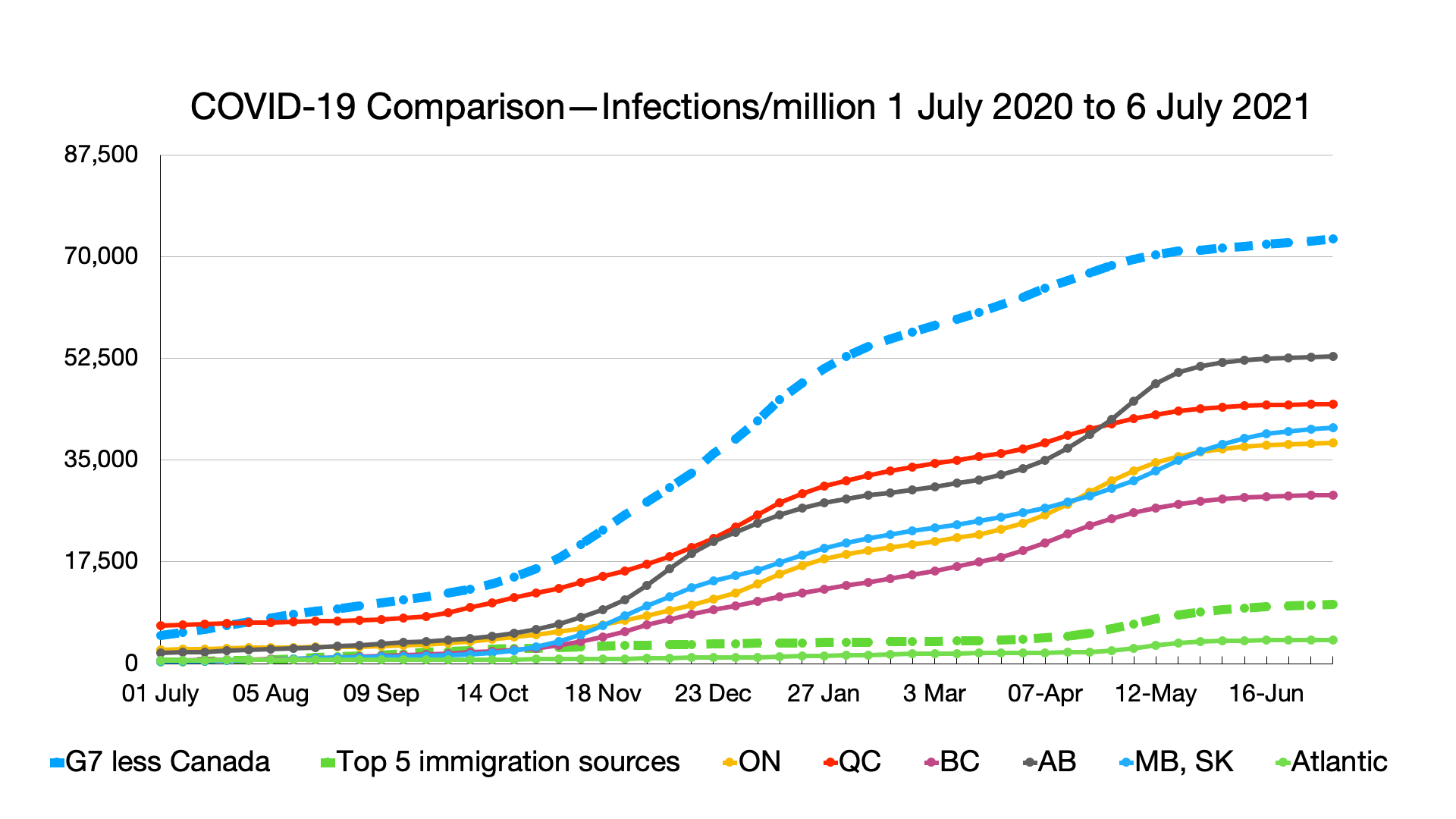
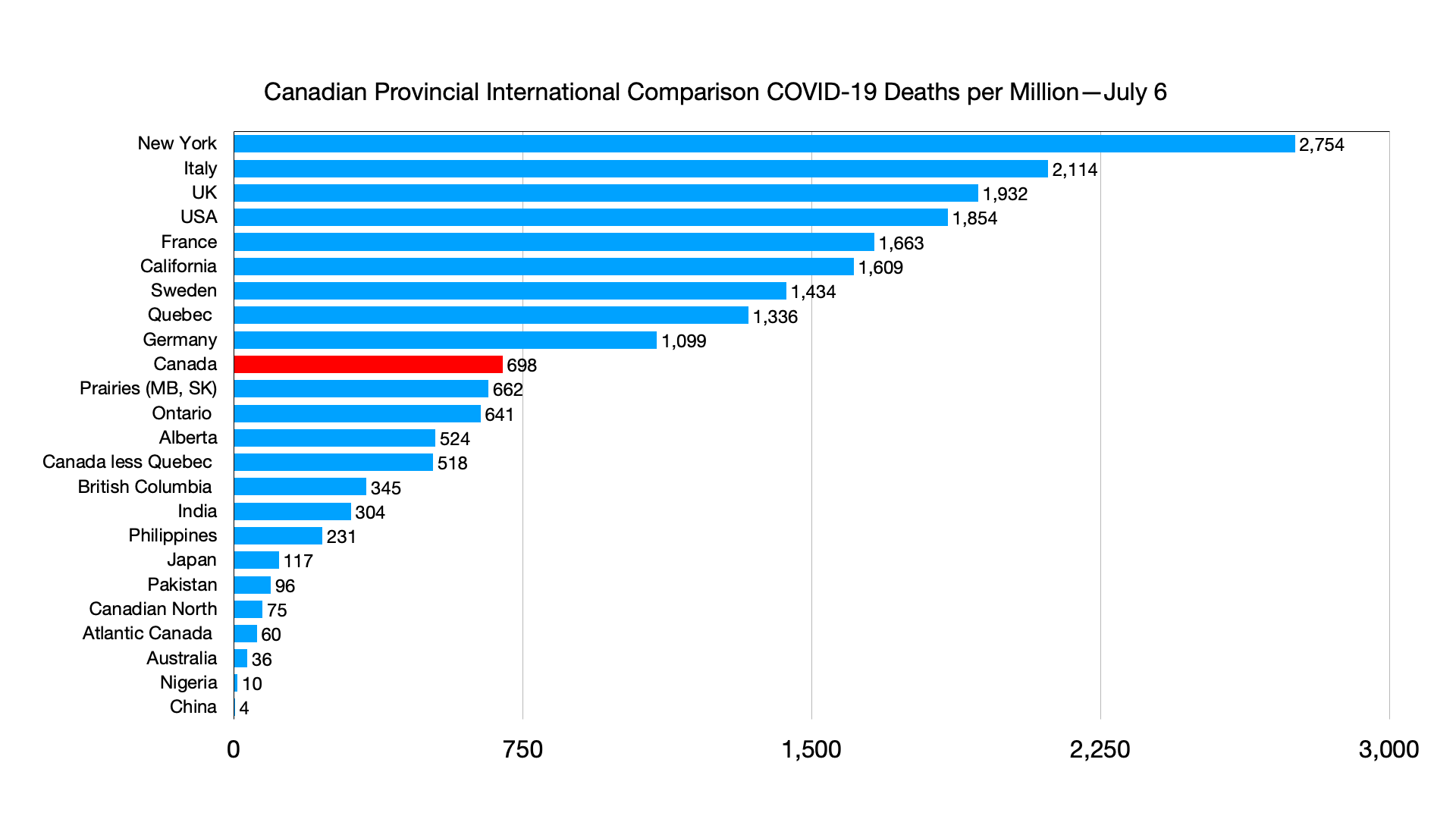
#COVID-19: Comparing provinces with other countries 6 July Update, Economist Normality Index

The latest charts, compiled 6 July as overall rates in Canada continue to decline along with increased vaccinations (still largely first dose, Canadians fully vaccinated 36.6 percent, comparable to or higher than most EU countries). Steep upward trend as per Globe chart below suggests gap between USA and UK fully-vaccinated will continue to narrow.

Vaccinations: All Canadian provinces ahead of USA, China now ahead of Germany and other EU countries.

Trendline charts

Infections: No significant change

Deaths: No significant change.

Vaccinations: Captured above.

Weekly

Infections: No relative change.

Deaths per million: No significant change.

Interesting integration of various data sources to develop a normality index (Canada is 63.4, slightly below the number for all countries, ranking 35, just ahead of UK):

Since the onset of the coronavirus pandemic in early 2020 many have wondered when the world will return to “normal”. But whether things will ever go back to the way they were is unclear: remote working looks set to continue, for example, and going to the movies may never be as popular as it used to be. 

The Economist has devised a “normalcy index” to track how behaviour has changed, and continues to change, because of the pandemic. Our index comprises eight indicators, split into three domains. The first grouping is transport and travel: public transport in big cities; the amount of traffic congestion in those same cities; and the number of international and domestic flights. The second looks at recreation and entertainment: how much time is spent outside the home; cinema box-office revenues (a proxy measure for cinema attendance); and attendance at professional sports events. The third is retailing and work: footfall in shops; and occupancy of offices (measured by workplace footfall in big cities). 

Our index covers 50 of the world’s largest economies that together account for 90% of global GDP and 76% of the world’s population. Our aggregate measure is the population-weighted average of each country’s score. The pre-pandemic level of activity is set at 100 for ease of comparison. The tracker is updated with new data once a week. 

Overall activity

The global normalcy index plummeted in March 2020 as many countries imposed draconian restrictions on their citizens. It fell to just 35 in April 2020, before improving gradually over the following months. Today it stands at 66, suggesting that the world has travelled roughly half of the way back to pre-pandemic life. Some indicators, such as traffic congestion and time spent outside, have recovered faster than others, particularly sports attendance and flights. The global average masks a lot of variation across countries. Click on the drop-down box to explore how behaviour has changed in each one.

Source:

Anti-Critical Race Theory Laws Are Un-American

Good joint commentary from a variety of perspectives:

What is the purpose of a liberal education? This is the question at the heart of a bitter debate that has been roiling the nation for months.

Schools, particularly at the kindergarten-to-12th-grade level, are responsible for helping turn students into well-informed and discerning citizens. At their best, our nation’s schools equip young minds to grapple with complexity and navigate our differences. At their worst, they resemble indoctrination factories.

In recent weeks, Tennessee, Oklahoma, Iowa, Idaho and Texas have all passed legislation that places significant restrictions on what can be taught in public school classrooms, and in some cases, public universities, too.

Tennessee House Bill SB 0623, for example, bans any teaching that could lead an individual to “feel discomfort, guilt, anguish or another form of psychological distress solely because of the individual’s race or sex.” In addition to this vague proscription, it restricts teaching that leads to “division between, or resentment of, a race, sex, religion, creed, nonviolent political affiliation, social class or class of people.”

Texas House Bill 3979 goes further, forbidding teaching that “slavery and racism are anything other than deviations from, betrayals of, or failures to live up to, the authentic founding principles of the United States.” It also bars any classroom from requiring “an understanding of the 1619 Project” — The New York Times Magazine’s special issue devoted to a reframing of the nation’s founding — and hence prohibits assigning any part of it as required reading.

These initiatives have been marketed as “anti-critical race theory” laws. We, the authors of this essay, have wide ideological divergences on the explicit targets of this legislation. Some of us are deeply influenced by the academic discipline of critical race theory and its critique of racist structures and admire the 1619 Project. Some of us are skeptical of structural racist explanations and racial identity itself, and disagree with the mission and methodology of the 1619 Project. We span the ideological spectrum: a progressive, a moderate, a libertarian and a conservative.

It is because of these differences that we here join together, as we are united in one overarching concern: the danger posed by these laws to liberal education.

The laws differ in some respects but generally agree on blocking any teaching that would lead students to feel “discomfort, guilt or anguish” because of one’s race or ancestry, as well as restricting teaching that subsequent generations have any kind of historical responsibility for actions of previous generations. They attempt various carve outs for the “impartial teaching” of the history of oppression of groups. But it’s hard to see how these attempts are at all consistent with demands to avoid discomfort. These measures would, by way of comparison, make Germany’s uncompromising and successful approach to teaching about the Holocaust illegal, as part of its goal is to infuse them with some sense of the weight of the past, and (famously) lead many German students to feel “anguish” about their ancestry.

Indeed, the very act of learning history in a free and multiethnic society is inescapably fraught. Any accurate teaching of any country’s history could make some of its citizens feel uncomfortable (or even guilty) about the past. To deny this necessary consequence of education is, to quote W.E.B. Du Bois, to transform “history into propaganda.”

What’s more, these laws even make it difficult to teach U.S. history in a way that would reveal well-documented ways in which past policy decisions, like redlining, have contributed to present-day racial wealth gaps. An education of this sort would be negligent, creating ignorant citizens who are unable to understand, for instance, the case for reparations — or the case against them.

Because these laws often aim to protecting the feelings of hypothetical children, they are dangerously imprecise. State governments exercise a high degree of lawful control over K-12 curriculum. But broad, vague laws violate due process and fundamental fairness because they don’t give the teachers fair warning of what’s prohibited. For example, the Tennessee statute prohibits a public school from including in a course of instruction any “concept” that promotes “division between, or resentment of” a “creed.” Would a teacher be violating the law if they express the opinion that the creeds of Stalinism or Nazism were evil?

Other laws appear to potentially ban even expression as benign as support for affirmative action, but it’s far from clear. In fact, shortly after Texas passed its purported ban on critical race theory, the Texas Public Policy Foundation, a conservative think tank, published a list of words and concepts that help “identify critical race theory in the classroom.” The list included terms such as “social justice,” “colonialism” and “identity.” Applying these same standards to colleges or private institutions would be flatly unconstitutional.

These laws threaten the basic purpose of a historical education in a liberal democracy. But censorship is the wrong approach even to the concepts that are the intended targets of these laws.

Though some of us share the antipathy of the legislation’s authors toward some of these targets, and object to overreaches that leave many parents understandably anxious about the stewardship of their children’s education, we all reject the means by which these measures encode that antipathy into legislation.

A wiser response to problematic elements of what is being labeled critical race theory would be twofold: propose better curriculums and enforce existing civil rights laws. Title VI and Title VII of the Civil Rights Act both prohibit discrimination on the basis of race, and they are rooted in a considerable body of case law that provides administrators with far more concrete guidance on how to proceed. In fact, there is already an Education Department Office of Civil Rights complaint and federal lawsuit aimed at programs that allegedly attempt to place students or teachers into racial “affinity groups.”

The task of defending the fundamentally liberal democratic nature of the American project ultimately requires the confidence to meet challenges to that vision. Censoring such challenges is a concession to their power, not a defense.

Let’s not mince words about these laws. They are speech codes. They seek to change public education by banning the expression of ideas. Even if this censorship is legal in the narrow context of public primary and secondary education, it is antithetical to educating students in the culture of American free expression.

There will always be disagreement about any nation’s history. The United States is no exception. If history is to judge the United States as exceptional, it is because we welcome such contestation in our public spaces as part of our unfolding national ethos. It is a violation of this commonly shared vision of America as a nation of free, vigorous and open debate to resort to the apparatus of the government to shut it down.

Source: https://www.nytimes.com/2021/07/05/opinion/anti-critical-race-theory-laws-are-un-american.html?action=click&module=Opinion&pgtype=Homepage

Canada has an access-to-information system in name only

Have encountered some of the same frustrations:

The Treasury Board is quietly conducting a long-promised review of the Access to Information Act, which governs how Canadians can obtain records held by the government. Unfortunately, these consultations appear to be more of a public relations exercise than a serious effort to improve Canadians’ right to access.

The original act dates to 1983 and has barely changed since then. It has not kept up with the advent of the internet, nor have fundamental weaknesses been fixed. Changes made by the Trudeau government in recent years have failed to fully open promised classes of records and have not advanced pro-active publication as far as needed.

Today, we have an access-to-information system in name only. A lack of firm timelines means requests regularly stretch on for months, if not years. Broad exemptions mean crucial information is withheld from the public. A culture of secrecy in many departments undermines the act almost entirely. The Office of the Information Commissioner is underresourced to handle the deluge of complaints.

The current review process is not going to fix all that. Unlike in past consultations, the Treasury Board is not releasing any kind of green paper or other consultative document to chart a course for the reforms, nor has the government sought independent expert advice.

A green paper is essential to capturing and conveying the essence of the innumerable public reports on problems with the system, which go back decades. Drawing on outside experts is equally important for any real reform agenda, especially one that might return the Canadian government to an equal footing with many allied jurisdictions. Canada was an early entrant into the arena of freedom of information; now we are a disappointing laggard.

Reform and revitalization of the Access to Information regime must include significant legislative changes, but must also consider the ecosystem in which it operates.

As it stands, the act allows for the government to exempt and withhold information “obtained in confidence,” information deemed “injurious to the conduct of international affairs,” virtually any information relating to defence and security, and nearly every record that could be described as providing “advice” to the government. These exemptions, as currently worded, simply reinforce practices of hoarding records and a culture of entrenched secrecy. We propose strict limitations on these exemptions, and a test that would require the government to prove the harm of releasing such information.

Some records are completely excluded at present, such as Cabinet confidences. These should be brought under the act, with appropriate restrictions so disputes over access to them can be adjudicated by the Information Commissioner. In addition, information practices are changing in government with ever greater reliance on text messaging, verbal briefings and other transitory material. The act should oblige all government agencies to properly document their decision-making processes and retain these records.

Equally important, a real public-interest override clause must be added, with an oversight role for the Information Commissioner.

There needs to be a declassification regime for all government records. Other governments declassify documents after 30 years or less: Canadians are lucky if these files are ever released. Library and Archives Canada, in particular, should play a role in receiving such records and educating Canadians on their importance.

Once processed and released to an individual requester, the information in question should be made publicly available on a consolidated and searchable government database, including both the metadata about the record and the record itself. We should do away with the wasteful cycle of returning records back into the hands of departmental gatekeepers after every request is fulfilled.

These measures need to be accompanied by a major change in culture within government, including a lowering of the walls of secrecy and an alignment between the Access to Information Act and the principles that underscored the National Security Transparency Commitment promised by the Liberal government in 2017.

A broken access system wastes government resources, does not serve Canadians and does not illuminate our governance history and practice. But it is not yet beyond salvation. The Treasury Board review needs to embrace a bold vision for the future and make a deep change to the legislation and administration of the act.

Dean Beeby is an Ottawa-based independent journalist, author and a specialist on freedom of information. Justin Ling is a freelance investigative journalist. James L. Turk is the director of the Centre for Free Expression at Ryerson University. Wesley Wark is a senior fellow at the Centre for International Governance Innovation.

Source: https://www.theglobeandmail.com/opinion/article-canada-has-an-access-to-information-system-in-name-only/

A French Teenager’s Anti-Islam Rant Unleashed Death Threats. Now 13 Are on Trial.

No excuse for death threats, words have consequences:

The French girl, 16, was sharing highly personal details about her life in a livestream on Instagram, including her attraction to women. Just not Black or Arab women, she said.

When insults and death threats started pouring in to her Instagram account in response to her comments in January 2020, some from viewers saying she was an affront to Islam, the teenager, Mila, dug in, quickly posting another video.

“I hate religion,” she declared. “The Quran is a religion of hatred.” She also used profanity to describe Islam and the crudest of imagery in referring to God.

The ensuing onslaught of threats after the video went viral has landed 13 people in court on charges of online harassment.

The case has put a spotlight on the roiling French debate over freedom of expression and blasphemy, especially when it touches on Islam. It is also a landmark test for recent legislation that broadens France’s definition of cyberharassment in regards to attacks on the internet, where vitriol is plentiful, modulated debate less so.

“We are setting the rules of what is acceptable and what is unacceptable,” Michaël Humbert, the presiding judge, said at the trial.

Some looked to history to capture the brutality of what Mila experienced online. Mila’s lawyer said she had been subjected to a digital stoning. The prosecutor in the case spoke of a “lynching 2.0.”

More than a year after Mila — The New York Times is withholding her last name because she has been the subject of harassment — posted her videos, her life remains in a tumult. She lives under police protection and she no longer attends school in person.

The 13 defendants, some teenagers themselves, are on trial in Paris, most accused of making death threats. They face the possibility of jail. The verdict is expected Wednesday.

Israel blocks law that keeps out Palestinian spouses

Of note, both the discriminatory substance as well as the identity politics:

Israel’s parliament early on Tuesday failed to renew a law that bars Arab citizens from extending citizenship or residency rights to spouses from the occupied West Bank and Gaza, in a tight vote that raised doubts about the viability of the country’s new coalition government.

The 59-59 vote, which came after an all-night session of the Knesset, marked a major setback for Prime Minister Naftali Bennett.

The new Israeli leader, who had hoped to find a compromise between his hard-line Yamina party and the dovish factions in his disparate coalition, instead suffered a stinging defeat in a vote he reportedly described as a referendum on the new government. The vote means the law is now set to expire at midnight Tuesday.

The Citizenship and Entry into Israel Law was enacted as a temporary measure in 2003, at the height of the second intifada, or uprising, when Palestinians launched scores of deadly attacks inside Israel. Proponents said Palestinians from the occupied West Bank and Gaza were susceptible to recruitment by armed groups and that security vetting alone was insufficient.

Under it, Arab citizens, who comprise a fifth of Israel’s population, have had few if any avenues for bringing spouses from the West Bank and Gaza into Israel. Critics, including many left-wing and Arab lawmakers, say it’s a racist measure aimed at restricting the growth of Israel’s Arab minority, while supporters say it’s needed for security purposes and to preserve Israel’s Jewish character.

The law has been renewed annually and appeared to have the support of a large majority in parliament, which is dominated by hard-line nationalist parties. But former Prime Minister Benjamin Netanyahu’s Likud Party and his allies decided to oppose it to embarrass Bennett and harm his coalition, which includes a collection of eight parties across the political spectrum, including a small Islamist Arab party.

Interior Minister Minister Ayelet Shaked, a member of Bennett’s Yamina party, said the opposition move to block the law’s renewal would lead to thousands more applications for citizenship. She accused Netanyahu and his allies of choosing “petty and ugly politics, and let the country burn.”

Amichai Chikli, a renegade member of Yamina who voted with the opposition, said the outcome was a sign of deeper issues.

“Israel needs a functioning Zionist government, and not a mismatched patchwork that is reliant on” the votes of Arab lawmakers, said Chikli. He was the only member of his party to oppose the new coalition-led government last month.

Netanyahu, ousted by the new coalition after 12 years as prime minister, made clear his political goals.

“With all due respect for this law, the importance of toppling the government is greater,” Netanyahu said Monday.

Bennett reportedly proposed a compromise with liberal members of the coalition that would have extended the law by six months while offering residency rights to some 1,600 Arab families, a fraction of those affected. But the measure was defeated, in part because two Arab members of the coalition abstained. The vote exposed the deep divisions and the fragility of the new government.

The decision, however, gave some hope to Arab families that have been affected by the law. The law has created an array of difficulties for thousands of Palestinian families that span the war-drawn and largely invisible frontiers separating Israel from east Jerusalem, the West Bank and Gaza, territories it seized in the 1967 war that the Palestinians want for a future state.

“You want your security, it’s no problem, you can check each case by itself,” said Taiseer Khatib, an Arab citizen of Israel whose wife of more than 15 years, from the West Bank city of Jenin, must regularly apply for permits to live with him and their three children in Israel.

“There’s no need for this collective punishment just because you are Palestinian,” he said during a protest outside the Knesset on Monday ahead of the vote.

The law has been continually renewed even after the uprising wound down in 2005 and the number of attacks plummeted. Today, Israel allows more than 100,000 Palestinian workers from the West Bank to enter on a regular basis.

Male spouses over the age of 35 and female spouses over the age of 25, as well as some humanitarian cases, can apply for the equivalent of a tourist permit, which must be regularly renewed. The holders of such permits are ineligible for driver’s licenses, public health insurance and most forms of employment. Palestinian spouses from Gaza have been completely banned since the militant Hamas group seized power there in 2007.

The law does not apply to the nearly 500,000 Jewish settlers who live in the West Bank, who have full Israeli citizenship. Under Israel’s Law of Return, Jews who come to Israel from anywhere in the world are eligible for citizenship.

Israel’s Arab minority has close familial ties to Palestinians in the West Bank and the Gaza Strip and largely identifies with their cause. Arab citizens view the law as one of several forms of discrimination they face in a country that legally defines itself as a Jewish nation-state.

Palestinians who are unable to get permits but try to live with their spouses inside Israel are at risk of deportation. Couples that move to the West Bank live under Israeli military occupation.

The citizenship law also applies to Jewish Israelis who marry Palestinians from the territories, but such unions are extremely rare.

Source: Israel blocks law that keeps out Palestinian spouses

Cardozo: Dialogues on diversity is what we need

Agree with need for commission or enquiry to allow for a more substantive, comprehensive and non-partisan review.

Issue is with respect to what the focus should be and what kind of research, process and recommendations are needed (stay tuned, working on my thoughts):

“They made us believe we didn’t have souls,” Elder Florence Sparvier, a residential school survivor, said at a press conference in Cowessess, Sask.

Canada Day 2021 and this entire period has been a time for reflection. We are a good country. We have the self-confidence to know that we have lots of strengths. And in that confidence, we also have the ability to be self-critical to recognize the bad parts of our history, or the problems we have today, and to make amends, or at least to try to do better.

Over 50 years ago Lester B. Pearson established two royal commissions: one on the status of women and one on bilingualism and biculturalism. They recognized the fundamental, and, yes, systemic discrimination that was faced by women and by francophones. The results of the commissions have seen significant advances, and committed Canada to an ongoing path to betterment. To be clear, it has not been flowers and rainbows on these paths, but overall the trajectory has been positive as we try to get things better.

And so today as we need to think deeply, carefully and compassionately about our country and be conscious of the racism epidemic that has met the COVID pandemic, as was articulated by Senator Wanda Thomas Bernard at a Pearson Centre webinar last summer.

What can we do? Many things, but here is one idea, a thoughtful national dialogue on diversity. There are many ways to do this, but, as a nation, we must listen to each other, and, most importantly, we must listen to those with grievances.  That’s how we build a better country.

The discovery of unmarked graves at residential schools has not been a surprise to most Indigenous people, but it is the harsh reality that has triggered for many, the many real stages of grief. Made more devastating by the fact that they have been saying this for years and governments and the rest of society either had not believed them or just looked the other way.

This tragic discovery has become a precipitating event that has been a shock for non-Indigenous Canadians, for the political class, and the mainstream media. We somehow missed Calls Action 71 to 76 in the Truth and Reconciliation Commission report, the missing children and burial information, and all the conversations on this for years.

2020 and 2021 have also seen other aspects of racism come to the fore. With the killing of George Floyd, a Black man killed by a white police officer, in the U.S., our racism problems became much more apparent. Once again, it was the precipitating event there that caused us to become more aware in Canada. In addition to systemic and overt racism faced by Indigenous peoples for years, the reality of anti-Black racism has become more evident. Anti-Semitism has reached new heights—or should we say new depths. Islamophobia is on the rise. We saw the killing of a Muslim family in London, Ont., in June. And with the rise of COVID, we have seen the ridiculous anti-Asian acts of overt racism and racial violence.

There is something rotten in our state these days. And there is nothing wrong in recognizing it and dealing with it. The solutions are many: from legal, to social, to economic, to educational measures. But it starts with dialogue and understanding what marginalization feels like, what unspoken discrimination feels like, or what the hand of racial violence feels like. Also what does white uneasiness or fragility feel like?

At the Pearson Centre we launched a six-month dialogue with two webinars, one with Edmonton Mayor Don Iveson who spoke about the ancient Indigenous history of his city and one with award-winning author Michelle Good. Her novel, Five Little Indians, is about the lives of five young residential school survivors as they make their way through life seriously damaged by their experience. There will be more over the months ahead, that explore systemic racism and various aspects of inequality while always trying to increase understanding across divides and identifying solutions. Using the marvels of webinars we will easily pull together Canadians from across the country into important discussions.

October marks the 50th anniversary of the multiculturalism policy—in the world. It is a good time to take stock and plan the future.

I urge other think tanks, organizations, and companies to launch their own dialogues and to get involved. As Cowessess First Nation Chief Cadmus Delorme said, “All we ask of all of you listening is that you stand by us as we heal and get stronger. All must put down our ignorance and accidental racism of not addressing the truth that this country has with Indigenous people. We are not asking for pity, but we are asking for understanding.”

We are too far apart and we understand too little about each other. We need to learn from each other. And of course dialogue is no reason not to take action. Governments need to engage in dialogue and seriously step up their actions at the same time.

I also think about “what would Pearson do.” I dare say he would strike a royal commission on diversity and equity of some kind, to dialogue about inequality in its various forms.

Source: Dialogues on diversity is what we need