‘Words are no longer enough’: Muslim group releases 60 calls to action ahead of National Summit on Islamophobia

Of note. Summits are often short-term political events to respond to community and raise broader awareness, providing platforms for organizations and political leaders. More substantive approaches involve more time and preparation than a one-day summit on the eve of an election, which runs the risk of being more virtue signalling than substantive.

And the risk of separate summits for Islamophobia and antisemitism is that the focus on the particular communities distracts from the fundamental commonalities of all groups that experience prejudice, bias and discrimination:

The National Council of Canadian Muslims (NCCM) has released a list of policy recommendations for federal, provincial and municipal governments in Canada to tackle violent and systemic forms of Islamophobia. 

Among the 60 policy recommendations are calls for the federal government to create an anti-Islamophobia strategy by the end of the year, for provincial Ministries of Education to develop localized strategies to address anti-Muslim sentiment, and for municipalities to invest in alternative forms of policing to combat increasing harassment and violence against Muslims.

The NCCM is also calling on governments to expand legislation to dismantle white supremacist groups in Canada, to challenge Bill 21 in Quebec, and to provide resources to empower Muslim Canadians to tell their own stories.

The 60 calls to action will be presented at the National Summit on Islamophobia, which will be hosted by the federal government on July 22. A National Summit on anti-Semitism will be held on July 21.

“These summits will bring together a diverse group of community and political leaders, academics, activists, and members with intersectional identities within these communities,” according to a statement by Bardish Chagger, minister of diversity, inclusion and youth of Canada. 

On its website, the NCCM says it is an independent and non-partisan organization “that protects Canadian human rights and civil liberties, challenges discrimination and Islamophobia, builds mutual understanding, and advocates for the public concerns of Canadian Muslims.”

For Mustafa Farooq, the CEO of NCCM, the only way to measure the success for the upcoming summit will be whether action is taken or commitments are made in regards to the 60 calls to action and recommendations from other groups. Farooq says the NCCM will release an updated document following the summit to record any commitments made by governments and track any agreed-upon timelines. 

“This is not about getting together to talk about best practices,” he told the Star. “This is about committing to action.”

Thursday’s summit comes in the wake of the deadly June attack on a Muslim family in London, Ontario, along with a steep rise in targeted hate crimes against Muslims across the country. According to the NCCM, more Muslims have been killed in targeted hate attacks in Canada than any other G-7 country in the past five years because of Islamophobia. In Alberta alone, at least nine attacks have been reported against Muslim women, most of them Black and wearing a hijab, since December.

On June 11, following calls from the Muslim community and a petition from the NCCM, the House of Commons gave unanimous consent to an NDP motion to convene an emergency summit on Islamophobia. The motion also called on leaders from all levels of government to “urgently change policy to prevent another attack targeting Canadian Muslims.”

Following the motion, the NCCM launched consultations with Canadian Muslims from coast to coast, in search of tangible policy solutions.

“Canada doesn’t have the appropriate infrastructure to challenge Islamophobia,” Farooq told the Star. “There isn’t a single body of governance in this country that is dedicated to fighting Islamophobia. This despite the fact that the impacts of Islamophobia have resulted in the worst attack on a religious institution in modern Canadian history.”

Thus, an overarching theme of the NCCM’s calls to action is the need to institutionalize the fight against anti-Muslim sentiment. This includes the creation of an Office of the Special Envoy on Islamophobia. 

“This position needs to work with various ministries to inform policy, programming and financing of efforts that impact Canadian Muslims,” the document reads. “The envoy should have the powers of a commissioner to investigate different issues relating to Islamophobia in Canada, and to conduct third-party reviews across all sectors of the federal government relating to concerns of Islamophobia.”

Another theme found in the NCCM’s recommendations is the need to address the way that education in Canada deals with Islamophobia. Specifically, the organization recommends that provincial education ministries develop anti-Islamophobia strategies that are responsive to local contexts. This includes changes to curricula that relate to Islam, improving religious accommodations for Muslim students and staff, anti-Islamophobia training.

“The reality is that (Quebec City mosque attacker) Alexandre Bissonette and (alleged London attacker) Nathaniel Veltman were young men,” Farooq told the Star. “We need to see a different approach to education, and the way that young people are learning about Canadian Muslims. A large percentage of Canadians have suspicions towards their Canadian Muslim brothers and sisters, and we think education and anti-Islamophobia awareness is a key component.”

NCCM’s document is broader than the 30 calls to action to combat systemic racism and hate that was published by a federal Heritage committee in 2017. However, Farooq believes that now is the time to take bold action.

“Words are no longer enough,” he told the Star. “The reality is that at this point, every single federal political party, the vast majority of the provinces, dozens of municipalities have all expressed their concerns about Islamophobia and Islamophobic violence. Faith communities are united about this, civil society folks are united — Canadians are united about the fact that things need to change. We just need to translate this into real political will to move things forward.”


Here are some of the recommendations from the NCCM’s 60 calls to action.

  • The NCCM is calling for the release of a federal anti-Islamophobia strategy by year’s end. The NCCM recommends the strategy include a clear definition of Islamophobia to be adopted across government, plus funding and resources for research, programs and education campaigns to address Islamophobia.
  • The NCCM wants the federal government to take action against Quebec’s Bill 21, which bans public servants from wearing religious symbols. Specifically, it wants the attorney general to commit to being an official intervener in court battles on the legislation. The document calls Bill 21 “a fundamentally discriminatory law” that perpetuates the idea “that Islam, Muslims, and open religious expression in general, have no place in Quebec.” The NCCM is also calling for the creation of a fund to financially assist those affected by the legislation.
  • Citing the rising tide of online hate and Islamophobia on social media, the NCCM is calling on the federal government to complete a legislative review of the Canadian Human Rights Act, in order to ensure that Canada is equipped to deal with modern forms of Islamophobia and hate. 
  • The NCCM is calling on the federal government to invest in a national support fund for survivors of hate-motivated incidents or attacks. The NCCM is also recommending changes to the country’s Security Infrastructure Program, to provide funding for security upgrades to mosques and community organizations under threat.
  • There are several calls to action dedicated to reforming national security and dismantling white supremacist groups. These include creating legislation “to implement provisions that place any entity that finances, facilitates, or participates in violent white supremacist and/or neo-Nazi activities on a list of violent white supremacist groups, which is separate and distinct from the terror-listing provisions.” The NCCM also calls on provincial governments to introduce legislation that bans white supremacist groups from incorporating.
  • The NCCM wants the Criminal Code changed to better deal with what is often called a “hate crime.” Specifically, the group is calling for amendments that “reinvigorate how we approach hate crimes, and that strengthens a prosecutorial approach that lacks consistency, clarity and resourcing across the country,” according to Farooq. 
  • The document includes several policy changes to tackle systemic Islamophobia at a federal level, including changes to the Canadian Border Services, the Canadian Revenue Agency and Canada’s approach to security and counterterrorism. For example, the NCCM is calling for the establishment of an oversight body specifically for the Canadian Border Services Agency, citing allegations that the agency engages in racial profiling that disproportionately targets Muslims.
  • The NCCM is recommending changes to policing at the municipal and provincial levels. This includes investing in alternative forms of policing for municipalities and introducing street harassment bylaws that protect Canadians against hateful verbal assaults. The NCCM also recommends that all provinces adopt the recommendations of Ontario’s 2017 Tulloch report, which calls for a sweeping overhaul in police oversight.
  • The document also includes several calls for governments to invest in and collaborate with storytellers, artists and filmmakers to help Muslim Canadians tell their stories and challenge narratives that contribute to all forms of Islamophobia. This includes funding local initiatives to celebrate the long history and contributions of Muslim Canadians.
Source: https://www.thestar.com/politics/federal/2021/07/19/words-are-no-longer-enough-how-one-muslim-group-wants-canada-to-deal-with-islamophobia.html

Biden Is Reviving An Effort To Change How The Census Asks About Race And Ethnicity

Of note (as Canada continues its review):

President Biden’s White House is reviving a previously stalled review of proposed policy changes that could allow the Census Bureau to ask about people’s race and ethnicity in a radical new way in time for the 2030 head count, NPR has learned.

First proposed in 2016, the recommendations lost steam during former President Donald Trump’s administration despite years of research by the bureau that suggested a new question format would improve the accuracy of 2020 census data about Latinos and people with roots in the Middle East or North Africa.

The proposals also appear to have received the backing of other federal government experts on data about race and ethnicity, based on a redacted document that NPR obtained through a Freedom of Information Act request. The document lists headings for redacted descriptions of the group’s “recommended improvements,” including “Improve data quality: Allow flexibility in question format for self-reported race and ethnicity.”

Stalling by Trump officials, however, sealed the fate of last year’s census forms. With no public decision by the White House’s Office of Management and Budget, the bureau was forced to stick with previously used racial and ethnic categories and a question format that, the agency’s studies show, a growing number of people find confusing and not reflective of how they identify.

That has raised concerns about the reliability of the next set of 2020 census results, which are expected out by Aug. 16 and face a tangle of other complications stemming from the coronavirus pandemic, the Trump administration’s interference with the count’s schedule and the bureau’s new privacy protection plans. That detailed demographic data is used to redraw voting districts, enforce civil rights protections and guide policymaking and research.

The review continues under Biden’s OMB

The proposals, however, may be approved by the White House’s Office of Management and Budget under the Biden administration, which has been calling to change how the government produces and uses data about people of color and other marginalized groups.

“We are continuing to review the prior technical recommendations and public comment, and the extent to which those recommendations help advance this Administration’s goal of gathering the data necessary to inform our ambitious equity agenda,” Abdullah Hasan, an OMB spokesperson, tells NPR.

Hasan did not provide a timeline for the current review of the proposed changes to the government’s standards for data about race and ethnicity, which are set by OMB and must be followed by all federal agencies, including the bureau. OMB had previously planned to announce a decision in 2017, before the bureau had to finalize the 2020 census forms.

Other recommended changes include no longer officially allowing federal surveys to use the term “Negro” to describe the “Black” category. Another proposal would remove the term “Far East” from the standards as a description of a geographic region of origin for people of Asian descent.

Support from Biden’s pick for Census Bureau director

This month, Biden’s nominee for Census Bureau director, Robert Santos, pledged to lawmakers that, if confirmed, he would support one of the major recommendations, which would allow census forms to combine the separate race and Hispanic origin questions into one. A combined question, tests by the bureau’s researchers show, would help the bureau address the problem of increasingly more people leaving the race question unanswered or checking off the box for “Some Other Race”— the third-largest racial group reported in 2000 and 2010.

“The census director doesn’t have the authority to include any specific questions,” Santos said in response to a question from Sen. Alex Padilla, D-Calif., during a confirmation hearing before the Senate Homeland Security and Governmental Affairs Committee. “But I can use my own personal perspective as a Latino and use my research experience and my leadership position to work with OMB to make sure that the proper attention is given to that specific issue.”

An expert in designing surveys and currently the Urban Institute’s chief methodologist, Santos has written about the need for questions and categories on census forms to “evolve and adapt to ensure everyone is fairly represented,” including the Latinx population, one of the country’s fastest-growing groups.

“Racial and ethnic categories are social constructs, defined and designed by those who have historically held positions of influence,” Santos said in a 2019 blog post co-written with Jorge González-Hermoso, an Urban Institute research analyst. “The policy implications of using inadequate methods to collect data on identity are not trivial.”

During the hearing, Santos suggested that if OMB ultimately approves the proposed policy changes, the bureau may not have to wait until the 2030 census to use a combined race-ethnicity question, which Santos said could potentially be incorporated into the bureau’s ongoing American Community Survey.

Lloyd Roberston: How to Cool Canada’s Overheated Statue Removal Business

Every now and then, I come across an article in C2C that has broader interest and application than others. This one by Robertson is one of these, particularly citing this test for discussing whether a statue or monument should be considered for removal.

While there will always be different interpretations and opinions, these kind of “tests” provide useful frameworks for debate and discussion, rather than more knee-jerk responses, both from those advocating for removal as well as opposing removal.

There are likely some other tests out there and grateful readers flag any of interest.

The Witt Test

This brief survey reveals several possible ways to deal with statues of complicated historical figures without allowing the decision to be made by a mob with a hack saw and length of rope. Simply engaging in extensive public debate, as per Frum v. Cosh, is one way to channel energy away from violent beheadings. Adding extra information or modifying displays, as has been the case with Champlain, Bryce, Scott and Mason, allows more voices to be heard, which also seems fair. And India’s Victoria Memorial provides the option of a statuary refuge where past figures can be given general immunity from their crimes of history in a peaceful and contemplative setting. There is, however, another possibility: come up with a dispassionate and rigorous system to judge all figures from the past and let the evidence determine who is worthy of memorialization and who is not.   

Applying the Witt Test to Canadian figures such as Macdonald, Ryerson and all the others now in peril of being removed from the national landscape offers a rational and fact-based method for making these decisions.Tweet

In 2016 Yale University gave historian John Fabian Witt the task of figuring out whether Sen. John C. Calhoun, a central figure in the lead-up to the Confederacy, should continue to have his name recognized on campus with Calhoun College. Witt’s report is a marvel of clear thinking on this fraught topic. It begins by characterizing renaming exercises as “exceptional events” that should not be used frivolously or to make political statements. “Renaming has often reflected excessive confidence in moral orthodoxies,” he observes, pointing with caution to the Soviet Union. He then lays out four questions meant to judge a historical figure’s actions by both the standards of his or her time and contemporary values. Answering each requires substantial research and documentation, rather than hair-trigger emotionalism. And while his remit was to decide on the names of buildings at Yale, Witt’s four questions work just as well for statues in Canada. Here, modified for the task at hand, is a Canadian Witt Test: 

  • Is the principal legacy of the person fundamentally at odds with Canadian values? 
  • Was the relevant principal legacy of the person significantly contested during their lifetime? 
  • At the time the statue was erected, was the person being honoured for reasons fundamentally at odds with Canadian values? 
  • Does the statue play a substantial role in forming community? 

Note that the first two questions require a determination of the “principal legacy” of the historical figure in question. This raises the standard of proof beyond evidence that someone might have once briefly supported a concept now considered repugnant, as has been the case with Ryerson or Wood. And it forces Macdonald’s critics to grapple with his accomplishments as a whole, rather than simply focusing on his impact on Indigenous people. This system also requires a clear enunciation of Canadian values then and now and consideration of what public art means for the public-at-large.  

Using the Witt test, Yale declared Calhoun unworthy of memorialization and removed his name from campus. This was because his principal legacy was determined to be the promotion of a white supremacist view of America. Calhoun called slavery “a positive good” and claimed the Declaration of Independence erred in stating all men were created equal. It was a position strongly contested in his time, as well as ours. It is hard to argue with Yale’s conclusion because it carries the weight of evidence and offers due process to the accused. The University of Mississippi has also used the Witt Test to decide its own historical controversies, and its use was briefly discussed in Halifax as a way to decide on the fate of Cornwallis’ statue, before less-rational heads prevailed. 

Applying the Witt Test to Canadian figures such as Macdonald, Ryerson and all the others now in peril of being removed from the national landscape offers a rational and fact-based method for making these decisions. It may be true that not every figure from our past deserves the honour of a public statue. But their legacies ought to be given a chance to speak in their defense. Surely we owe our predecessors that much. 

Lloyd W. Robertson holds a Ph.D. from the University of Toronto and has taught at the post-secondary level in the U.S. and Canada. He writes on Canadian and U.S. politics and history. 

Source: https://c2cjournal.us19.list-manage.com/track/click?u=e8efce716429c34122979e2de&id=11a8ef3065&e=4174a59277

Khan: Coming to terms with a national shame

Good thoughtful piece, with the German approach in dealing with the Holocaust. Money quote:

“We have to understand these atrocities not as freak accidents of history, but as potentialities that can happen again,” she says. “Only then can we take responsibility for the past to work against tendencies in our society that ostracize others and make such atrocities possible.”

It’s a hard thing to reconcile: the dream of national destiny with the reality of national shame. My father struggled with it. As a Muslim in a fracturing India who lived through the trauma of partition in 1947, he has walked—literally—through fire to what he was told would be the promised land. When Pakistan was created, it was supposed to be a refuge for Muslims fleeing the communal killings on the Indian subcontinent; instead, it turned into a nightmare of corruption and state failure. As an adult, he was forced to flee again, this time to Canada, to another refuge.

To this day, my father still refuses to fully acknowledge the failure of Pakistan. He laments the corrupt leadership and the crimes committed there in the name of Islam. But Pakistan, the idea of it, still endures in his imagination. The national destiny he was promised lingers. It’s hard to let go.

For the first time in my life, I can now relate. For me, Canada has always been that place beyond the parched horizon, that shimmering oasis in a sea of global failures. Over two decades of working in some of the world’s cruelest places, Canada has always stood out for me as an example of what is possible for humanity. The national destiny of Canada, I’ve argued openly, is the hope for the world.

Over the past few weeks, I’ve struggled to reconcile that dream of a pristine, untainted Canada with the reality of the cruelties committed on its soil. I’m not naïve, of course. I’m not only now waking up to the horrors of colonialism and the crimes perpetrated against the original inhabitants of this continent. What I’m waking up to after the discovery of hundreds of dead and buried children—and the knowledge that there are thousands more waiting to be unearthed—is the attempted erasure that has occurred since those crimes were committed.

For me, this is the terrifying truth: As a child in elementary school in Toronto in the 1970s and 1980s, I was taught all the wonderful ways in which the “Indians” cooperated with European fur traders to help create what is our glorious Canada. It was, of course, mostly lies, but what is even worse is that at the same time, First Nations children were still being subjected to the cruelties of residential schools. While I was being told that Canada is unique in this world because of its multiculturalism, Indigenous culture and identity were being systematically erased.

All of this happened in my lifetime, in my country. Unmarked graves could very well have been dug while I was a child in Toronto, blissfully living the multicultural dream. And I was taught to forget.

***

The first time I saw a mass grave was in the spring of 2003. I was in Baghdad, not long after the fall of Saddam Hussein’s regime. The city was still smoldering from the devastation of America’s Shock and Awe campaign and the convulsion of retributive violence that followed. Admittedly, there was something poetic about the looting and the rioting: the people of Iraq were ransacking Saddam’s palaces and the countless villas belonging to his senior officials—bought with the country’s stolen oil wealth—in a burst of celebratory anarchism. Baghdad’s streets were buzzing with joy and cathartic outbursts of destruction. Statues of the dictator were being torn down; murals of his murderous sons were being graffitied over or left pock-marked by automatic gunfire.

Meanwhile, a quieter but more heart-wrenching ritual was playing out beyond the din of Baghdad’s dancing streets. Some 35 km east of the Iraqi capital, mothers were gathering daily on a patch of dusty ground in Abu Ghraib prison. Fathers and brothers were carefully picking through the earth, sometimes with their bare hands, uncovering the putrid remains of young men who had been executed in the fading hours of Baathist regime rule. These were the final executions the Baathists would carry out in their long and bloody history of executions, their victims hurriedly dumped in a shallow grave literally on the doorstep of the prison’s execution chamber, even as U.S. bombers were beginning their sorties overhead.

I met one distraught mother who told me her son had disappeared five years earlier. He went to work one morning, she said, and never came home. Since then, she had recurring dreams in which her son would appear to reassure her that he was in a better place. It had comforted her during the years he was missing, and while Saddam was still in power: searching for his remains at that time might have placed the rest of her family in danger. So instead, she wrapped herself in the belief that her son had made it into heaven, despite his body never receiving the proper Islamic funeral rites.

Watching this woman struggle with her grief while her husband clawed deeper into the earth reminded me of a passage from Michael Ondaaje’s novel, Anil’s Ghost, about a forensic pathologist investigating war crimes during Sri Lanka’s civil war:

“There was always a fear, double-edged, that it was their son in the pit, or that it was not their son—which meant there would be further searching. If it became clear that the body was a stranger, then, after weeks of waiting, the family would rise and leave. They would travel to other excavations in the western highlands. The possibility of their lost son was everywhere.”

In Iraq, in the spring of 2003, mothers everywhere were scouring the earth for the remains of their children. The woman at Abu Ghraib admitted she was only at the beginning of her journey toward some measure of peace after the horror of the Baathist regime. Her son was lost to her but she knew her journey would not end until he was found. “If we don’t find him here,” she told me, “we’ll dig up all of Iraq until we do.”

***

I met a carpet salesman once in Afghanistan, from a family of Sufi intellectuals, who lost his brother and father to the convulsions of political violence that preceded the Soviet invasion in 1979. Like thousands of other disappeared, their bodies were never returned and were likely buried in a mass grave somewhere in one of the valleys surrounding Kabul. Noorali in his carpet shop on Chicken Street in the city centre would sip sweet green tea and wax poetic about those days. “Graveyards are remembrance,” he told me once, “mass graves are erasure.”

That line has stuck with me as I’ve walked around other mass graves since, in Syria and Pakistan and Iraq. What’s striking is not its inherent truth but its implied failure. Mass graves are an attempt at erasure. In telling me the story of his father and brother decades later, Noorali was still resisting. The mother in Abu Ghraib, who had only begun her quest to find her son’s remains, was also resisting. In trying to erase their crimes, the diggers of mass graves had instead created a kind of permanent absence, a black hole pulling the living permanently into its orbit.

In her 2008 book, To Know Where He Lies: DNA Technology and the Search for Srebrenica’s Missing, the anthropologist Sarah E. Wagner describes how survivors of the genocide in Bosnia returned home and how the empty spaces left by the missing became permanent fixtures in the lives of the living.

“Their absence has seeped into the vernacular of the city,” Wagner writes. “Repeatedly I heard the phrase ‘nije došao‘ (He didn’t come) as an explanation of where sons, husbands, friends, and former neighbors were. Didn’t come home? Didn’t come back? Didn’t survive? I could not quite grasp the oblique reference of place implicit in this simple phrase.”

Later, she realizes that what was being alluded to was not a physical place but a journey, a passage from darkness into the light, from the horrors of the war back to peace. The missing were not merely lost to the world, they were lost to the process of return, to the journey to healing. “They did not come”, and in their absence that journey would remain incomplete.

***

Death has its own logic and the rituals associated with it reflect how intimately death is woven into the fabric of our lives. My wife is fascinated by the relationship between the living and the dead. The bookshelf in our home office is peppered with some rather morbid titles, like Zakes Mda’s Ways of Dying and Thomas W. Laqueur’s The Work of the Dead: A Cultural History of Mortal Remains. As a cultural anthropologist specializing in Afghanistan, she recently became interested in the transfer of human remains and how Afghans deal with missing loved ones—the war dead, refugees who have died in a distant land. From her point of view, the phrase ‘He didn’t come’ is an expression of a disconnect, of a severing of the living world and the spirit world. In the absence of the body there can be no funeral rites; and in the absence of funeral rites, the dead are lost to the living.

As a German, and successor to the national shame of the Holocaust, my wife has a visceral relationship with missing bodies and what it means to the survivors of mass erasure. The German experience of the Holocaust remains a kind of living memory; there is no escaping it, even three generations later. Germans are taught from a young age about what their ancestors attempted. There is no glossing over of facts, and the horror of that shared history is reinforced year after year during a person’s education.

As a result, the national shame of the Holocaust has been internalized by Germans. Some, of course, resist, arguing it is better for society to “move on”. My wife disagrees. The repeated exposure to the Holocaust has helped her develop a nuanced understanding of what Germans did. “We have to understand these atrocities not as freak accidents of history, but as potentialities that can happen again,” she says. “Only then can we take responsibility for the past to work against tendencies in our society that ostracize others and make such atrocities possible.”

The crimes we are willing to commit in the name of national destiny beget our national shame. We need to learn from the Germans and turn our faces to the horrors committed by our ancestors. We must do as the Germans do: relentlessly teach our own children about that history, to teach them that national shame is not something to bury away and forget. It is the only path to our redemption.

Source: Coming to terms with a national shame

As Canada eases COVID-19 border restrictions, advocates say refugees’ travel is ‘essential’

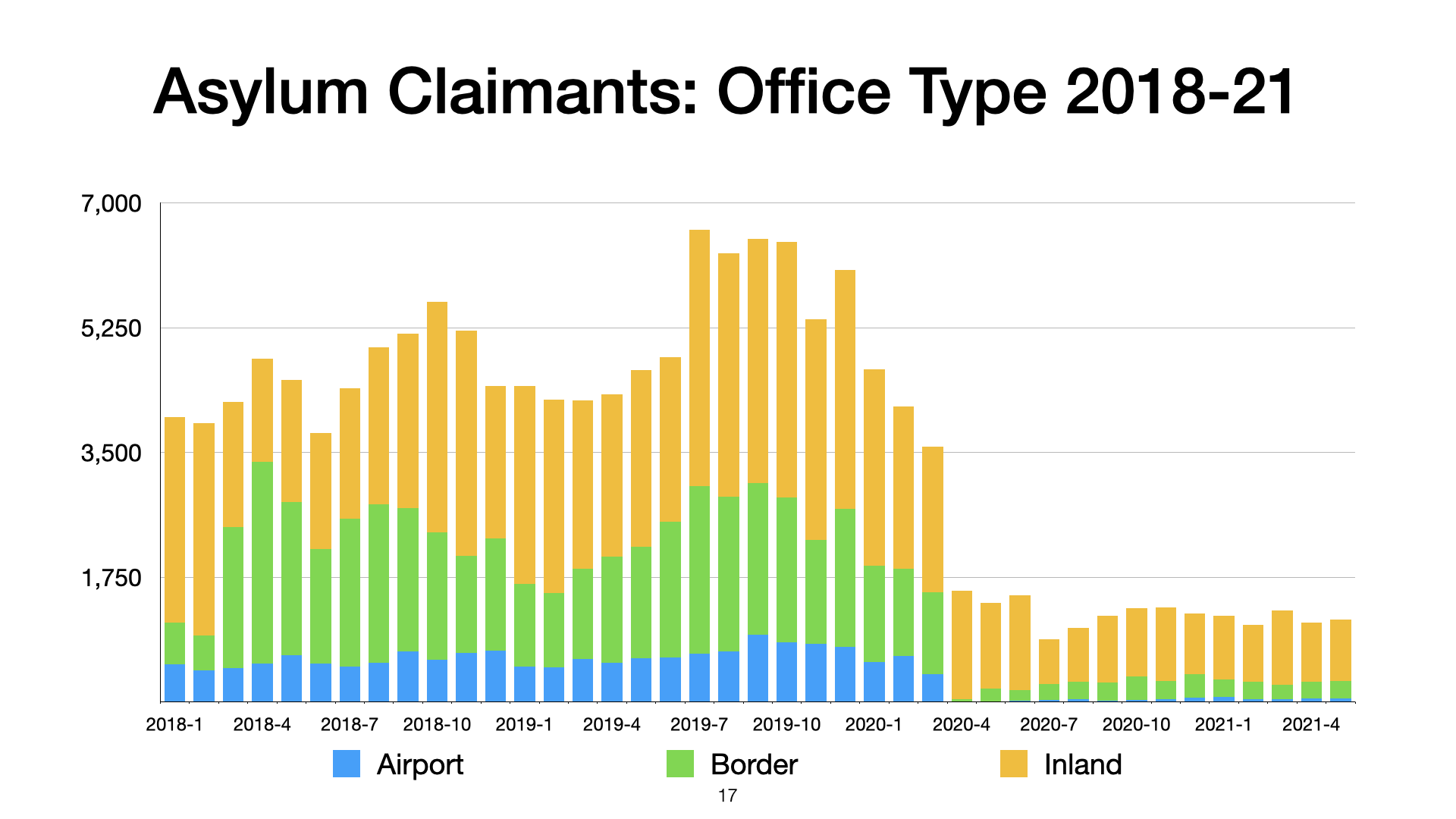
Covid-19 immigration effects - Key Slides - May 2021 Draft.017On the good news side, the IRB backlog declined dramatically, with new claims falling by 68% and the backlog by 30%.

The progressive reduction in travel restrictions and requirements should allow for a more normal flow, with less concern for the irregular arrivals at non-official border posts given the Biden Administration’s approach:

Thanks to COVID-19 outbreaks in jails, immigration detainee Apollinaire Nduwimana was released from a U.S. prison in late April last year, after being held among convicted criminals for almost three years.

The asylum seeker from Burundi tried to head north for protection at Roxham Road in Quebec last October. But he didn’t know Canada had closed the border to refugees.

He was immediately intercepted, sent back to America and detained at the Clinton jail in Pennsylvania. He was threatened with deportation to his homeland despite assurances from Ottawa to let him return once COVID travel restrictions were lifted.

As of July, Nduwimana was one of 450 asylum seekers “directed back” to the U.S. since March 21, 2020, when Ottawa closed the border to non-essential travels. Although there have been exemptions, seeking asylum isn’t one of them.

With Ottawa slowly easing its travel restrictions, and border rules with the U.S. up for renewal on Wednesday, advocates say the federal government’s first order of business should be reopening the door to asylum seekers and sponsored refugees, the most vulnerable migrant group during the pandemic.

“Refugee travel is essential, we know that no one chooses to be a refugee,” said Maureen Silcoff, president of the Canadian Association of Refugee Lawyers. “Refugees can in fact enter and quarantine. So that really should have been the starting point.”

According to the latest UN Refugee Agency report, 1.5 million fewer people fled their homelands in 2020 than forecast, but the world’s displaced population still edged to a record 82.4 million by the end of last year, up from 79.5 million in 2019.

That’s because, it said, asylum seekers were unable to cross borders, with 164 countries imposing travel bans, and 99 states, including Canada, making no exception for people seeking asylum.

In total, only 34,400 refugees were resettled to third countries in 2020, down 69 per cent from 107,800 the year before. Today, 1.4 million refugees are awaiting resettlement.

Amid the chaos, the Immigration and Refugee Board of Canada is the rare beneficiary of the border closure.

Last year, the number of new claims fell 68 per cent to 18,500, from 58,378 in 2019. These were mostly from those within Canada who entered legally and later decided to seek asylum, or who came to the border before the lockdown or belonged to one of the exemption groups.

The slowdown allowed the board to reduce its backlog, which fell 30 per cent to 65,000 by the end of June, from 91,300 in March 2020, as refugee judges moved hearings online and adapted to new health protocols in offices.

Nduwimana first arrived in the U.S. for asylum in 2017 but was detained until his release in April 2020.

Thanks to interventions of advocates on either side of the border, he is one of nine asylum seekers who have been issued a “national interest exemption letter” to return to Canada on a later date after he was turned back at the border.

But it’s not without hassles because there are no bilateral policies to ensure these “direct-back” asylum seekers will be released from detention or spared from deportation to come back to the border.

“I am not a criminal but I was detained with people convicted of murder and rape,” said Nduwimana, 41, who fled political persecution in Burundi, an East African country where human rights violations are such that Canada suspends all removals to that country.

“Canada has the obligation to protect asylum seekers. Instead they sent me back to a country that’s not safe for refugees,” added the former church pastor and university language instructor, who almost got deported in January before a U.S. court intervened.

Upon his release in March from another jail in upstate New York, he entered Canada at Fort Erie and had his 14-day mandatory quarantine at a Niagara hotel. He is now awaiting his proceedings.

Silcoff said Nduwimana’s case shows refugee travel can coexist with public health measures and the current refugee ban can be lifted.

Despite public fear that Canada would see another surge of asylum seekers once the border reopens, Silcoff believed that’s unlikely under the new White House administration. Since Joe Biden became president in January, Washington has reversed many Trump-era anti-migrant, anti-refugee policies.

Temporary protected status has been granted to migrants currently in the U.S. from major refugee source countries such as Haiti, Venezuela and Yemen. In June, the U.S. restored the possibility of asylum protections for women fleeing domestic violence in other countries as well as for families targeted by violent gangs.

“It’s a different climate,” said Silcoff. “It’s hard to know what the future would bring but we know that Canada is able to handle fluctuations in numbers of asylum seekers.”

During the pandemic, Ottawa has also rolled out several measures that involved asylum seekers and failed refugees in Canada, such as releasing immigration detainees with less serious immigration violations and suspending deportations at the peak of the pandemic.

Another positive during this global public health crisis is the special program that grants permanent residence to asylum seekers who work in health care and essential jobs during the pandemic, said Janet Dench of the Canadian Council for Refugees.

“So there have been some good parts,” she said.

In June, the immigration department also announced plans to expedite the processing of permanent residence applications of people who have been granted asylum in Canada, with a new target of 45,000, up from 23,500.

That commitment will help someone like Mohammed Jadallah, who fled to Canada for asylum from Gaza via the U.S. in 2018 and has since been separated from his wife and five children.

When war erupted between Hamas militants in Gaza and Israel earlier this year, with bombs raining down on his homeland, the 41-year-old Toronto man could only console his family helplessly from afar, on a computer screen.

Although he was granted protected status in Canada in October and immediately applied for permanent residence, the process was set to take an average of 39 months.

“There was an airstrike in our neighbourhood in Rimal. The building that’s just 200 metres from ours was flattened,” said Jadallah, a rebar detailer, whose family struggles with food and fuel shortages.

“As a parent, you try to protect your children. It’s so hard when you can’t do nothing for them.”

Until he receives his permanent residence, Samaa, 37, and their children — Nidal, 15; Asil, 12; Mustafa; 9, Ali, 8; and Yusuf, 5 — cannot join him in Canada.

Dench said that speaks to the need to do away the bureaucracy that requires accepted refugees to go through all the hoops to apply for permanent residence.

“It will cost us less if we give them permanent residence more quickly because then it makes it easier for them to upgrade their skills and to reunite with their family and to contribute more fully,” she said. “If you’ve been vetted and accepted as a refugee, you should be automatically a permanent resident.”

During the pandemic, the resettlement of overseas refugees in Canada has also come to a halt due to border closures and the reduced processing capacity by the International Organization for Migration, the UN and local Canadian visa posts — except for the most vulnerable who require emergency resettlement.

As of the end of October, only 2,879 resettled refugees landed in Canada since March 18, 2020, including 1,603 sponsored by community groups, 1,262 by the federal government, and 14 through a joint public and private sponsorships. Another 40 arrived under the “urgent protection” program.

In 2021, Ottawa has set a target to bring in 36,000 sponsored refugees, but only 1,630 had arrived by the end of April, according to a report by Reuters. Last year, the target was 31,700 but only 9,200 made it, leaving 22,500 spots unfilled.

Critics ask: Will Immigration Minister Marco Mendicino allow the unused spots to carry over in coming years when international travel is back to normal?

“It’s 65,000 who are in the queue essentially, who are waiting to travel,” said Brian Dyck, national migration and resettlement program co-ordinator of the Mennonite Central Committee Canada. “And that queue has never been longer than now. Their applications are going in but there are none that are going out.”

Those who managed to come during the pandemic, he said, had their proof of permanent residence in hand on or before March 18, 2020.

While the task to bring in a huge number of sponsored refugees in a short time appears daunting, Dyck said that’s doable, as shown in how Canada and Canadians successfully brought in 25,000 Syrian refugees in a matter of months in 2015 and early 2016.

“I think that the government has learned how to use a variety of networks to process sponsorship applications in different ways,” he noted..

And there’s been no shortage of public support during the pandemic, said Dyck, whose office has continued to receive a lot of inquiries from people looking to sponsor refugees even without promoting the idea.

Torontonian Marika Elek and her sponsorship group, Beach Cares, submitted a private sponsorship application in January to bring a Syrian family of five to Canada from Lebanon.

“I remember what happened in 2015 and 2016 when there was a real surge of refugees coming in, and people managed to handle that,” said Elek, whose family was sponsored here by the Canadian government in 1957 from Hungary when she was a girl.

During the pandemic, she and some 350 sponsors got together online and officially launched The Private Refugee Sponsor Network to “connect, learn and share” information and provide free training to help each other problem-solve in anticipation of the border reopening.

“We have people who are ready to welcome them.”

Source: As Canada eases COVID-19 border restrictions, advocates say refugees’ travel is ‘essential’

Does Canada’s census undercount visible minorities?

A relatively minor issue IMO compared to other priorities given only affects less than 3 percent of Census respondents (but likely to increase over time given mixed unions).

The separate issue of Blacks being counted only as part of visible minorities applies only to the federally regulated sectors (banking, communications, transport) and TBS now provides disaggregated data for visible minorities, Indigenous peoples and Persons with disabilities for the last four years (summaries in the annual employment equity groups, detailed tables on open data – https://www.canada.ca/en/treasury-board-secretariat/services/innovation/human-resources-statistics/diversity-inclusion-statistics.html).

And of course, the census data has these breakdowns that allow a wide range of analysis of socioeconomic status and other issues:

Statistics Canada is working to improve how it collects and analyzes data about people who belong to more than one visible minority group, as critics fear the federal agency’s current methodology has led to an “undercount” of racialized populations.

Ever since questions about visible minorities were added to the census in 1996, people belonging to those population groups have been classified in several ways.

At issue are those who check off more than one group out of the listed options: Chinese, South Asian, Black, Arab, West Asian, Filipino, Southeast Asian, Latin American, Japanese and Korean. Those individuals are lumped together in one group — which Statistics Canada calls “multiple visible minorities” — and are not broken down by the pairs or combinations of groups to which they belong.

Someone who checks off Black and Arab, for example, is included in that catch-all category, instead of being counted as part of Canada’s Black or Arab population. In contrast, people who identify as part of a visible minority group and the white population are counted, in most cases, as a member of whichever minority group they endorsed.

In the 2016 census, 232,275 people — or 2.7 per cent of the total visible minority population — were identified as multiple visible minorities.

That’s led some people, like Toronto lawyer Courtney Betty, to question whether the true number of people belonging to specific communities is being counted inaccurately.

“The whole idea of the census is to know how many individuals are within the population of our society, and potentially get a breakdown, so that we can do proper planning as to how we’re going to look at growth and also allocate economic resources,” Betty told the Star. “If you don’t have a proper count, that can’t happen.”

Betty is one of people leading the legal team representing hundreds of current and former Black public servants involved in a proposed class-action lawsuit, which alleges decades of discrimination and harassment within federal departments and agencies.

The multiple visible minorities category is being considered in the context of the lawsuit as part of an argument that the federal government won’t be able to claim that specific racialized communities, like the Black population, are adequately represented in the federal public service if it doesn’t have precise counts of those populations in the first place.

“I think there’s something that has to be adjusted, whether it be on the intake side … or on the analysis side,” Betty said. “Even if it’s a matter of …‘We recognize that there may be 50,000 Blacks that may not have been counted, and therefore, as we’re planning our policy decisions, we’re going to take that number into account.’”

Statistics Canada says it’s an issue the agency is actively studying.

“I know there’s an appetite to have more information,” said Hélène Maheux, a senior analyst with the agency’s diversity and socio-cultural statistics department. “Right now, we are looking at different alternatives, providing more disaggregated information for the multiple visible minority (category) for the 2021 census.”

Part of the problem is that counting a single individual as part of several populations muddies the data. There are also some who would prefer to be identified as a combination of groups instead of being counted as part of separate populations, the Star has previously reported.

But another reason, Maheux says, is that Statistics Canada’s database doesn’t actually allow for more detailed analysis of census data.

“It is not possible to distinguish all the various combinations of the visible minority groups included inside the multiple visible minorities. I had this challenge when I was doing this analysis. I wanted to include them, but it wasn’t possible because the database was not processed in a way that allowed me to make that distinction.”

When the Star asked Statistics Canada to provide, as one example, data on the number of Black people who were included in the multiple visible minority count, the department said the information was not “readily” available. The only way to obtain the data would be through the creation of a “custom tabulation,” which would need to go through a writing, testing and verification process.

Maheux said in the past, analysts have not typically received requests to dig into the category.

“But with the current context, we are receiving more requests. We are looking at avenues to improve our database,” she said.

It’s not just Statistics Canada that knows changes must be made.

On Tuesday, Ottawa launched a 13-member task force set to modernize the Employment Equity Act, which was first introduced in 1986, to improve “the state of equity, diversity and inclusion in federally regulated workplaces.”

Among the issues the task force will examine is whether visible minority groups should be updated, expanded or redefined.

Any changes would directly impact the way Canada’s census poses questions about race; the purpose of asking people to identify with certain population groups is tied to the act, which necessitates collecting information about visible minorities.

Liberal MP Greg Fergus said the work the task force is undertaking is critical to changing how Canada thinks about race. He hopes it will lead to a better snapshot of what’s really happening on the ground.

“For the Black community, it’s very clear that when Blacks are lumped into a visible minority, we actually end up becoming invisible,” Fergus told reporters following the announcement.

Adelle Blackett, a McGill University law professor who chairs the task force, said there have long been warning signs that the way racialized groups are categorized could lead to valuable data being lost.

She cited the 1984 Equality in Employment commission led by Judge Rosalie Abella, who wrote in her final report that combining “all non-whites together as visible minorities … may deflect attention from where the problems are greatest.”

The task force plans to conclude its review and present its recommendations to the federal labour minister in early 2022.

Source: Does Canada’s census undercount visible minorities?

Canada rejected humanitarian bids to stay in the country at a much higher level during the pandemic. Critics want to know why

Would be interesting to know the reasons for the increased rejections and how IRCC was able to process more bids when every other program declined:

Despite the processing of immigration applications being scaled back during the pandemic, Canada dramatically increased the number of bids it rejected from those seeking to stay in this country on humanitarian and compassionate grounds.

Unlike other immigration programs, Immigration, Refugees and Citizenship Canada actually finalized more applications under the so-called H&C category in the last year than in 2019.

In 2020, officials processed 8,735 H&C applications, 900 more than the year before COVID-19 was declared a global health crisis, prompting border closures and travel restrictions, and stalling immigration operations.

However, last year’s refusal rate reached a five-year high of 57 per cent, up from 35 per cent in 2019. In the first quarter of 2021, 70 per cent of the H&C applications were refused.

In general, prospective migrants must apply for permanent residence from outside Canada but those already inside the country and out of status as overstayed visitors and workers or failed refugees can ask for special permission to acquire permanent status if they can provide proof of establishment in Canada or undue hardship upon removal from the country.

“With these historic rejection rates, the federal government is condemning those migrants already here, and working in the most precarious situations to further insecurity and deportation,” Syed Hussan of the Migrant Rights Network told a news conference Tuesday.

“By doubling rejections, Prime Minister Justin Trudeau is doubling the potential for exploitation.”

With the myriad programs to bring in temporary residents such as international students and migrant workers, Hussan said migrants can easily fall through the cracks and become undocumented and the H&C is the only way for them to access permanent status in Canada.

During the pandemic, the immigration department has focused on transitioning temporary residents in Canada into permanent residents. In May, it opened new immigration pathways to 90,000 international graduates and essential workers, but undocumented migrants were ineligible.

“We need comprehensive not piecemeal change, that is to ensure full and permanent immigration status for all migrants, including undocumented people in the country,” said Hussan, who estimated there are half a million of non-status migrants in Canada.

“To avoid facing the same crisis in the future, ensure that all residents that arrive in the future do so with permanent resident status.”

Hussan said it’s not known what has led to the skyrocketing refusals against H&C applicants because there have been no policy changes as to how these applications are processed.

“The Liberal government must provide answers to why there is such a significant jump in H&C refusals and take immediate action to rectify this,” said NDP immigration critic Jenny Kwan, who obtained the data.

Applicants from the Philippines and India were the most overrepresented groups under the humanitarian program, with refusal rates hovering at 72 per cent and 75 per cent respectively.

“It’s long past time that Canada returns to an immigration system that honours the contributions of all workers with a full range of diverse skills and occupations with landed status on arrival,” Kwan said. “A regularized immigration stream for migrant workers is the only way to ensure workers’ rights are respected.”

Queen Gabriel was among those whose humanitarian application was refused last year. The 39-year-old Trinidadian woman arrived in Canada on a visitor visa in 2013 and has worked as a personal support worker even though she is without status in Canada.

She said precarious immigration status puts migrants like her at risk to exploitation at work places. She said she was made to work 400 hours a month for more than two years and the employer refused to pay overtime and vacation. She couldn’t even travel for her father’s funeral or bury her brother, who died last year.

Ottawa introduced a time-limited “Guardian Angel” immigration program in December to eligible asylum seekers who work in Canadian health care. However, Gabriel did not qualify because she’s never made an asylum claim here.

Three years ago, she needed to be admitted to a hospital emergency department for a gynecological surgery and the medical bill was more than $8,000. She still owes the doctor $5,000.

“There’s no living without status in Canada. There’s only existing dead end jobs for survival,” she told the Tuesday news conference. “Landed status to all is necessary, especially when the immigration process is slowly choking the life out of us.”

The Migrant Rights Network is calling on the federal government to implement a “regularization” program to grant permanent status to all temporary residents currently in Canada.

“It is not a gift or a privilege,” Hussan said. “It is the only existing mechanism for migrants to access the same rights as other residents of the country.”

Source: Canada rejected humanitarian bids to stay in the country at a much higher level during the pandemic. Critics want to know why

Black Canadians more likely to be hesitant about COVID-19 vaccines, survey suggests

Not just governments but governments do have a role in reducing economic barriers to vaccination (paid time off work etc). Access has become less of an issue given pop-up and other clinics, compared to earlier periods when it was more significant:

Black Canadian leaders say governments must do more to help overcome vaccine hesitancy in their communities.

Toronto orthopedic surgeon Dr. Ato Sekyi-Otu, leader of the health-care task force of the Black Opportunity Fund, says a new survey confirms unpublished public health data that hesitancy is higher among Black Canadians than among white or non-Black racialized people.

“There’s a 20-point gap with respect to the rate of vaccination in Black Canadians compared to the Canadian average,” Sekyi-Otu said in an interview. “When you look at vaccine confidence, unvaccinated Black Canadians are least likely to say that they’ll definitely get the vaccine.”

Sekyi-Otu said the Black Opportunity Fund partnered with the African Canadian Civic Engagement Council and the Innovative Research Group to try to understand why Black Canadians appeared to be getting vaccinated in lower numbers.

The survey found that as of early June, when more than 60 per cent of Canadians had received at least one dose of the COVID-19 vaccine, 45 per cent of Black Canadians surveyed said they were at least partially vaccinated, compared with 65 per cent of white Canadians and 43 per cent of non-Black visible minorities.

Sixty per cent of Black Canadians surveyed who didn’t have at least one dose expressed some level of hesitancy to get vaccinated, compared with 55 per cent of white Canadians and 44 per cent of non-Black visible minorities.

The figures are in line with vaccination data in Toronto, where the neighbourhoods with the lowest vaccination rates also have some of the largest Black populations.

Dunia Nur, president of the African Canadian Civic Engagement Counsel based in Edmonton, said addressing hesitancy in Black communities will require “a variety of policy shifts” from government that take into consideration language needs, as well as differences in education and socio-economic disparities.

“These include investing in strategies that work with Black-led and Black-focused community organizations to address COVID-19 vaccine knowledge gaps and related trust barriers,” Nur said in a statement.

Black Canadians responding to the survey were less likely to be hesitant about vaccines if they trusted their health-care providers and the vaccine makers, could take paid time off work to get vaccinated, and were confident in where and how to go about getting a shot.

“When we talk about hesitancy, we speak about the ABCs,” said Sekyi-Otu. “I’m talking about access, belief and confidence.”

He said access is affected when Black Canadians are more likely to work in jobs where taking paid time away to be vaccinated is difficult or impossible. Belief in the vaccines can be eroded if you don’t trust the people providing the information about them, and confidence that the vaccines work is harmed when people who are already less trusting of the health-care system get mixed messages about vaccine safety and effectiveness.

“It’s not surprising that if someone has a bad experience with one institution, for example, criminal justice, when he or she is 19 years old, he or she may not want to take the vaccine in 2021 when he or she is 45 years old,” he said.

Sekyi-Oto says governments need to ensure that people can take time off work to be vaccinated and take immediate steps to provide culturally sensitive and appropriate delivery and education about vaccines in Black communities.

“You have to build a system where the people who are leading the system look like the people using the system,” he said. “And so we want to create a culturally sensitive system, engage with the community so that they can come up and take the vaccine.”

The survey is being released as the Public Health Agency of Canada reports new data showing COVID-19 death rates in the first eight months of the pandemic were highest in communities with lower incomes and higher visible minority populations.

The data is the latest report from the agency that outlines the inequities surrounding COVID-19 in Canada.

Source: Black Canadians more likely to be hesitant about COVID-19 vaccines, survey suggests

Education minister under fire after introduction deleted from Ontario’s new Grade 9 math curriculum

Appears that the substantive aspects related to systemic barriers and inclusion remain while the ideologic reference to “non-Eurocentric mathematical knowledges” has been dropped. Much of math has non-European roots (numerals, algebra etc):

Premier Doug Ford’s government has deleted a preamble to Ontario’s new Grade 9 curriculum that said math “has been used to normalize racism and marginalization of non-Eurocentric mathematical knowledges.”

While the updated syllabus remains unchanged, introductory language for teachers was quietly edited earlier this week.

The modernized curriculum was introduced June 9 as the first step of ending the streaming of students so early in high school. That practice that has been tied to poor outcomes for Black and Indigenous youth.

As first reported by the Toronto Sun on Saturday, the Progressive Conservatives initially approved of a curriculum introduction that said “a decolonial, anti-racist approach to mathematics education makes visible its historical roots and social constructions.”

“Mathematics is often positioned as an objective and pure discipline,” said the preamble to the curriculum, which was made public last month.

“The Ontario Grade 9 mathematics curriculum emphasizes the need to recognize and challenge systems of power and privilege, both inside and outside the classroom, in order to eliminate systemic barriers and to serve students belonging to groups that have been historically disadvantaged and underserved in mathematics education.”

But within the past few days, that entire 124-word paragraph entitled “An equitable mathematics curriculum recognizes that mathematics can be subjective” was deleted.

Sources told the Star that “while the section referenced is not in the core curriculum taught to students, we revised it to ensure there is no confusion when it comes to making sure our students are being taught fundamental math concepts.”

“The curriculum did not change. It continues to educate on cultural understandings of math, of the history of these concepts, and attempts to advance that lens throughout the curriculum. What changed was language in the preamble only,” an official said.

In a statement Wednesday, Education Minister Stephen Lecce’s office said the Tories “ended streaming in the Grade 9 math curriculum — a system that disproportionately affected Black, racialized and Indigenous students — along with launching new and specialized supports to ensure these students graduate, enter post-secondary education and get good-paying jobs.”

But the new president of the Ontario Secondary School Teachers’ Federation, which supports destreaming, said the education minister “needs to take responsibility” for the episode.

“It’s time for a mea culpa. If you make a mistake, you have to own up to it,” said Karen Littlewood, who took over the union’s presidency on June 22.

Littlewood said “it seems to be very reactionary” for Lecce to amend the language in the wake of media coverage.

“The preamble really sets the stage for the changes to the curriculum and why it was necessary,” she said.

Despite the editing, the lesson plan still addresses inequities in society.

The revised curriculum emphasizes “there are groups of students (for example, Indigenous students, Black students, students experiencing homelessness, students living in poverty, students with LGBTQ+ identities, and students with special education needs and disabilities) who continue to experience systemic barriers to accessing high-level instruction in and support with learning mathematics.”

“Systemic barriers, such as racism, implicit bias and other forms of discrimination, can result in inequitable academic and life outcomes, such as low confidence in one’s ability to learn mathematics, reduced rates of credit completion, and leaving the secondary school system prior to earning a diploma,” it states.

“Achieving equitable outcomes in mathematics for all students requires educators to be aware of and identify these barriers, as well as the ways in which they can overlap and intersect, which can compound their effect on student well-being, student success, and students’ experiences in the classroom and in the school,” it continues.

“Educators must not only know about these barriers, they must work actively and with urgency to address and remove them.”

Still, the New Democrats expressed concern about the deletion.

“The Grade 9 math program was changed specifically because Ontario had to finally recognize that the existing system treated Black, Indigenous and racialized students inequitably,” NDP MPPs Laura Mae Lindo (Kitchener Centre) and Marit Stiles (Davenport) said in a joint statement.

“It’s pretty clear we need more of an equity and anti-racism lens in schools, not less.”

Source: Education minister under fire after introduction deleted from Ontario’s new Grade 9 math curriculum

Malaysian mothers fight government over ‘sexist’ citizenship law

Of note:

Former Malaysian squash champion Choong Wai Li has a cabinet full of trophies from the five years she played for her country, but if her son were to inherit her sporting talents he would not be able to represent the nation.

That is because Malaysia is one of 25 countries that do not give mothers and fathers equal rights to pass their nationality to their children.

Choong’s son Michael has his father’s Irish nationality and is considered a foreigner in Malaysia, the country they call home.

Along with five other Malaysian mothers, Choong has launched legal action against the government over “sexist and outdated” citizenship rules, which they say risk trapping women in abusive relationships and can leave children stateless.

Lawyers say a victory could have implications for tens of thousands of binational families and increase pressure on other countries to reform their own laws.

“I feel very betrayed after everything I’ve done for my country,” said Choong, once Malaysia’s top junior player.

“Malaysia is our home, but my son is living here as a foreigner,” she told the Thomson Reuters Foundation.

The problem arises when children are born overseas to Malaysian women with foreign spouses. Although Malaysian men can automatically confer citizenship to children born abroad, women do not enjoy the same right.

“It’s an embarrassment this situation still exists in 2021,” the women’s lawyer Joshua Andran said, adding that such laws could have tragic consequences.

Some women end up trapped in abusive marriages for fear they will lose custody of their children, while others may end up separated from their children if their marriages break down.

Andran said the pandemic had underlined the urgency of resolving the issue, with some mothers overseas unable to return home due to entry restrictions on foreign nationals – including their children.

“The law is the product of a patriarchal system,” he said. “The damage it’s causing these families is very significant.”

TIME FOR CHANGE

Choong has battled for years to get Malaysian nationality for Michael, now seven, who was born while the family was living in Hong Kong where she worked as a headhunter.

Although Malaysian women can apply for citizenship for children born overseas, decisions often take years and rejections are common.

“It’s time for change. We just want equal rights,” Choong said from Kuala Lumpur.

Children like Michael do not have the same rights to free education and healthcare as Malaysian children, and the pandemic has made it harder to renew visas.

Campaigners said school fees, health insurance and visa costs could create a serious financial burden for families.

This often deters women from returning home to raise their families, as does the fear that their children will have to leave the country once they are adults.

In May, the Malaysian government asked the High Court to throw out the women’s lawsuit, deeming it “frivolous”.

But the judge ruled it was an important issue and said the government must provide justification for the apparent discrimination.

The government, which is appealing the ruling, did not respond to a request for comment. The case is expected to be heard next month.

Campaign group Family Frontiers, also a plaintiff in the case, said the number of binational families was increasing every year and the law needed to catch up.

“It makes no sense for the government to make it so hard for professional women to return home at a time when the country is keen to reverse a brain drain,” said spokeswoman Chee Yoke Ling.

She said some of the cases they dealt with were “heart-wrenching”.

“Some women stay in very toxic marriages because they are so scared that if they leave then their children, not being Malaysian, won’t be able to come back with them.”

In cases where the father also cannot confer his nationality children have ended up stateless, leaving them very vulnerable, Chee said.

Stateless people are deprived of basic rights and often unable to access education, healthcare, jobs and housing.

CLOSED DOORS

Malaysian businesswoman Rekha Sen, another plaintiff in the case whose three children were born in neighbouring Thailand, was granted citizenship for one child, but not the others. No explanation was given.

Sen, who founded her jewellery company in Malaysia but lives in Bangkok, said her country risked losing a lot of working professionals by creating barriers to their return.

“Malaysia is home to me and I’ve always wanted to give back to my country, but I feel in many ways that door is now being closed to me.”

She said the pandemic had highlighted the harm caused by discriminatory citizenship laws, with some families left separated as countries restricted entry to non-nationals.

“COVID-19 has amplified the issue,” added Sen. “These laws really do cause distress.”

Six countries have similar rules to Malaysia including Barbados, Iraq and Liberia.

Another 18 – including Nepal, Kuwait and Saudi Arabia – do not let mothers confer citizenship to their children even if born in the country.

But the Global Campaign for Equal Nationality Rights said there was growing momentum to address the issue with more than 20 countries having amended discriminatory citizenship laws since 2003, although reforms were often partial.

The Malaysian mothers say the constitution’s provisions on citizenship violate Article 8 of the constitution, which bans gender discrimination, and are seeking a declaration that mothers can pass citizenship to children born overseas.

“This law has no place in 2021,” said Sen. “It’s archaic and makes no sense.”

Source: Malaysian mothers fight government over ‘sexist’ citizenship law