Algorithmic bias is often described as a thorny technical problem. Machine-learning models can respond to almost any pattern—including ones that reflect discrimination. Their designers can explicitly prevent such tools from consuming certain types of information, such as race or sex. Nonetheless, the use of related variables, like someone’s address, can still cause models to perpetuate disadvantage.
Ironing out all traces of bias is a daunting task. Yet despite the growing attention paid to this problem, some of the lowest-hanging fruit remains unpicked.
Every good model relies on training data that reflect what it seeks to predict. This can sometimes be a full population, such as everyone convicted of a given crime. But modellers often have to settle for non-random samples. For uses like facial recognition, models need enough cases from each demographic group to learn how to identify members accurately. And when making forecasts, like trying to predict successful hires from recorded job interviews, the proportions of each group in training data should resemble those in the population.
Many businesses compile private training data. However, the two largest public image archives, Google Open Images and ImageNet—which together have 725,000 pictures labelled by sex, and 27,000 that also record skin colour—are far from representative. In these collections, drawn from search engines and image-hosting sites, just 30-40% of photos are of women. Only 5% of skin colours are listed as “dark”.
Sex and race also sharply affect how people are depicted. Men are unusually likely to appear as skilled workers, whereas images of women disproportionately contain swimwear or undergarments. Machine-learning models regurgitate such patterns. One study trained an image-generation algorithm on ImageNet, and found that it completed pictures of young women’s faces with low-cut tops or bikinis.
Similarly, images with light skin often displayed professionals, such as cardiologists. Those with dark skin had higher shares of rappers, lower-class jobs like “washerwoman” and even generic “strangers”. Thanks to the Obamas, “president” and “first lady” were also overrepresented.
ImageNet is developing a tool to rebalance the demography of its photos. And private firms may use less biased archives. However, commercial products do show signs of skewed data. One study of three programs that identify sex in photos found far more errors for dark-skinned women than for light-skinned men.
Making image or video data more representative would not fix imbalances that reflect real-world gaps, such as the high number of dark-skinned basketball players. But for people trying to clear passport control, avoid police stops based on security cameras or break into industries run by white men, correcting exaggerated demographic disparities would surely help.■
As I reflect on vile attack on five members of the beautiful Azfaal family — Salman, Madiha, Yumna, Talat and Fayez — I was initially deeply angered by how quick some were to use this vile, hate-motivated act of terrorism to confirm their political priors.
And yet.
The fact that the alleged attacker, Nathaniel Veltman, is a young Dutch blond boy who could well have come from my own religious community hit close to the heart.
Now let me be clear. I apportion no blame for this act on Conservatives, religion, or even the Dutch privilege in which I assume Veltman, like me, grew up in. If guilty of this crime, Veltman is a hate-motivated terrorist who committed multiple murders. That would be on him. May the justice system rain down.
And yet.
My reflection called to mind times when, as a religious social conservative, I should have felt more uncomfortable with some of the things my fellow conservatives have said in recent years about terrorism, culture and religion. Times when we too easily crossed lines that conservatives — and religious conservatives in particular — should not have crossed.
The line got crossed when some seemed to weigh their critique of a terrorist act based entirely on the motivation for that terrorist act. To put it another way, they became more interested in combatting terrorism motivated by some beliefs than terrorism motivated by other beliefs. Compare, for example, the disgustingly light-hearted condemnation of the far-right, neo-Nazi terrorist act in Charlottesville by the same populist U.S. president that proposed banning all Muslim immigration as part of an effort to prevent domestic terrorism. Or those who called for a “values test” to root out radical Islam one day — and then stood with a street preacher who flagrantly breaks the law the next.
The line got crossed when we got more concerned with the actions of individuals within the institutions of our liberal capitalist democracy than the ideas underpinning those institutions. As a religious social conservative I hold freedom of religion extremely dear. In my world of competing rights, religious freedom comes out near the top. But that means holding expressions of other religions — like a turban, kirpan, hijab or burka — as dear as holding symbols of one’s own religion. Banning or restricting any of these things should make me deeply uncomfortable. Religious freedom should be religion blind.
The same goes for religious practices. If something is a criminal act, call it a criminal act and treat it as such. If something is a part of one’s religious practice or tradition, leave it at that and leave it alone. Blurring the lines by referring to “barbaric cultural practices” crosses the line. The use of the word “cultural” kind of gives it away.
The line got crossed when some tried to use the power of the state to impose their own religious views. Now let me be clear. I attend a Christian church — honestly, I need it more than most — and I hold my religious views as truth. I’d not be much of a religious person if I didn’t. I don’t go to a mosque, a synagogue, a temple, or a Richard Dawkins book club to practice my religion. Yet I want my public square to have room for all of these, and many more.
The investigation into the horrible attack in London continues. If the early information is confirmed, it appears that Veltman alone is responsible for the hate-inspired terrorism of which he is accused.
But an act this vile, particularly when its perpetrated by a member of your own community also warrants deep reflection.
I spent the afternoon writing down the lines I have crossed. I pray others do the same.
Unfortunate. Perspective of former CPC candidate Jeff Bennett revealing:
Justin Trudeau has made his clearest statement yet on what he will and will not do to stand up against Islamophobia in Canada.
The prime minister says he will call out anti-Muslim crime, using the strongest words possible — “terrorism” — to condemn the killing of a family in London, Ont.
Trudeau will not, however, call out Quebec for the secularism law that has made Muslims feel unwelcome in that province — Bill 21, which forces Muslims to relinquish any religious clothing if they want to work in public professions.
“No,” Trudeau said bluntly on Tuesday when asked whether Bill 21 bred intolerance of Muslims. He talked of how Quebec had a right to make its own laws, how people in Quebec might be having “conversations” and “reflecting” on the law in days ahead, and said his government would be “watching” and “following.”
In other words, not leading.
So, to recap: anti-Muslim sentiment is wrong. Anti-Muslim crime is terrorism. Legislation that denies religious expression to Muslims is something to be discussed, but not by this prime minister or other political leaders.
None of the fine-sounding speeches in the House of Commons on Monday came anywhere near mention of the legislation in Quebec.
“Right now, people are talking to their families and saying maybe they should not go for a walk,” New Democratic Party Leader Jagmeet Singh said in an emotional speech. “There are people literally thinking about whether they should walk out their front door in our country.”
Singh was not talking about Bill 21.
Conservative Leader Erin O’Toole spoke from the heart about the nine-year-old child who survived the attack, and what kind of Canada he should be allowed to grow up in.
“He deserves a Canada where Muslim women of faith can wear a hijab without fear of being accosted or harassed in public,” O’Toole said.
He wasn’t talking about Bill 21 either, or his own Conservative party’s dog-whistle record on everything from “veiled voting” to “barbaric cultural practices” in the 2015 election.
What makes the silence so breathtaking is that all of Canada’s political leaders have just emerged from two weeks of hard talk about how governments in the past did too little about racism toward Indigenous people.
They are all collectively, retrospectively sorry that an entire culture suffered at the hands of successive politicians who were not courageous enough to stand up to the widespread racism at the time.
Would Canada’s blotted history be improved if we unearthed a speech of John A. Macdonald saying he was following events closely at residential schools and hoped Canadians were having conversations about them?
The contrast between Trudeau’s strong words in the Commons on Tuesday and his tiptoeing around Bill 21 was striking, and the latter may cancel out the former. The prime minister did allow that he has long opposed Bill 21, but he clearly doesn’t intend to use the weight of his office or his words to change the reality of it.
For real political bravery on Tuesday, one had to look in more out-of-the way places — to London, in fact, where a former candidate for the provincial Progressive Conservative party decided to tell the difficult-to-hear truth of racism in politics.
Jeff Bennett, who ran for the PCs in the 2014 election, recounted in a Facebook post how people in his riding were happy to see that he had replaced the former candidate, a man named Ali Chahbar. Loyal Conservatives in London told Bennett they were relieved that “his name was English and his skin was white.” Bennett remembered how Chahbar had been smeared on local talk radio with talk of sharia law and other nonsense.
Bennett wrote that he was tired of people saying London was better than what happened on Sunday. “Bullshit. I knocked on thousands of doors in the very neighbourhood this atrocity occurred. This terrorist may have been alone in that truck on that day, but he was not acting alone. He was raised in a racist city that pretends it isn’t.”
Bennett came in second in London West in 2014 and has likely abandoned any aspirations to be elected again, given his willingness to tell voters what they don’t want to hear about themselves.
This of course explains the silence on Bill 21 on Tuesday, even as the political leaders are making bold proclamations about intolerance towards Muslims. An election looms, Quebec is a crucial battleground and Bill 21 is popular.
Canadian history has been on trial, rightly, for the past two weeks, and Bill 21 is indeed making its own way through the courts. One wonders how history will judge the failure of political leaders to speak up against that legislation when they could have seized the moment.
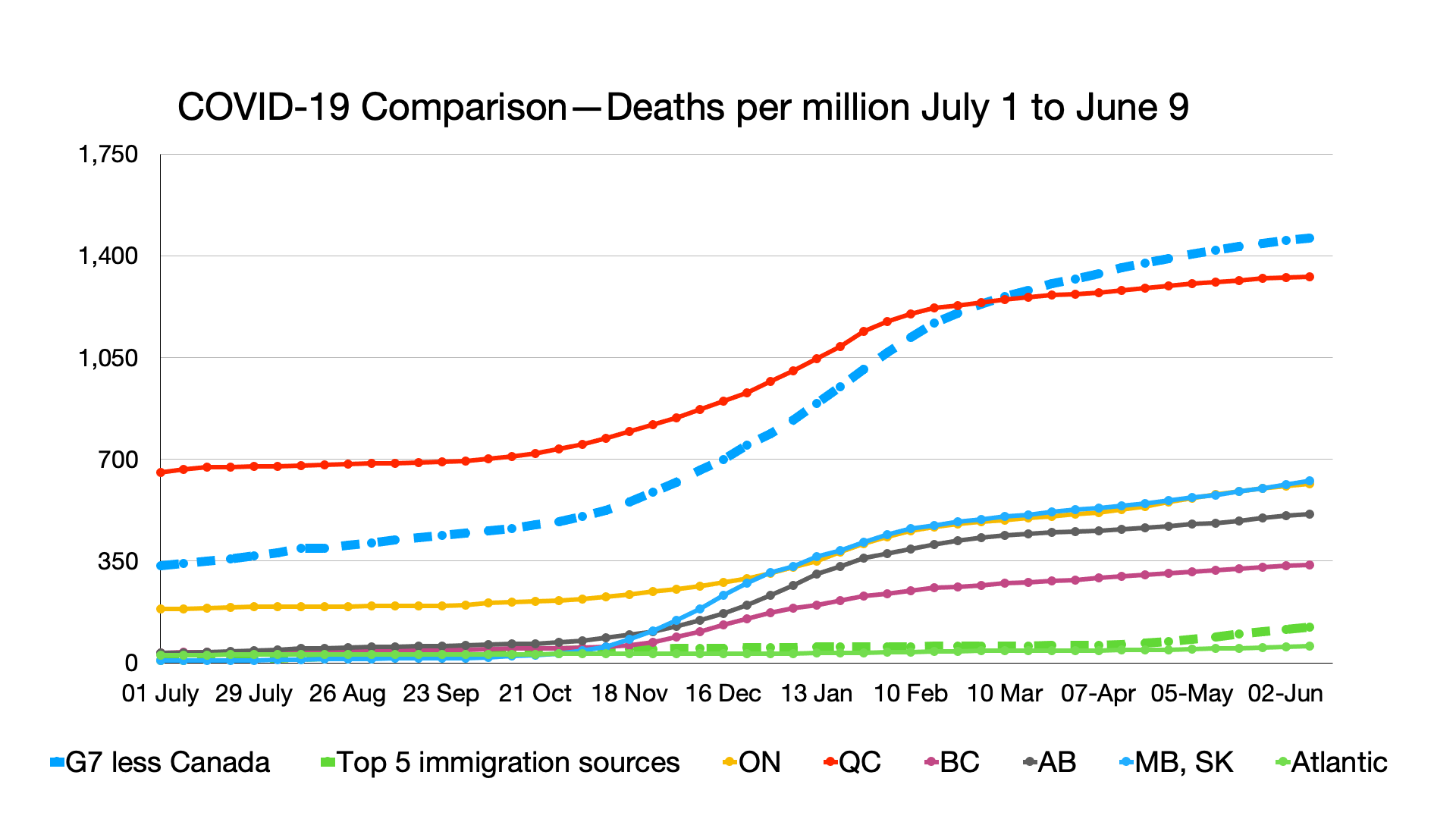
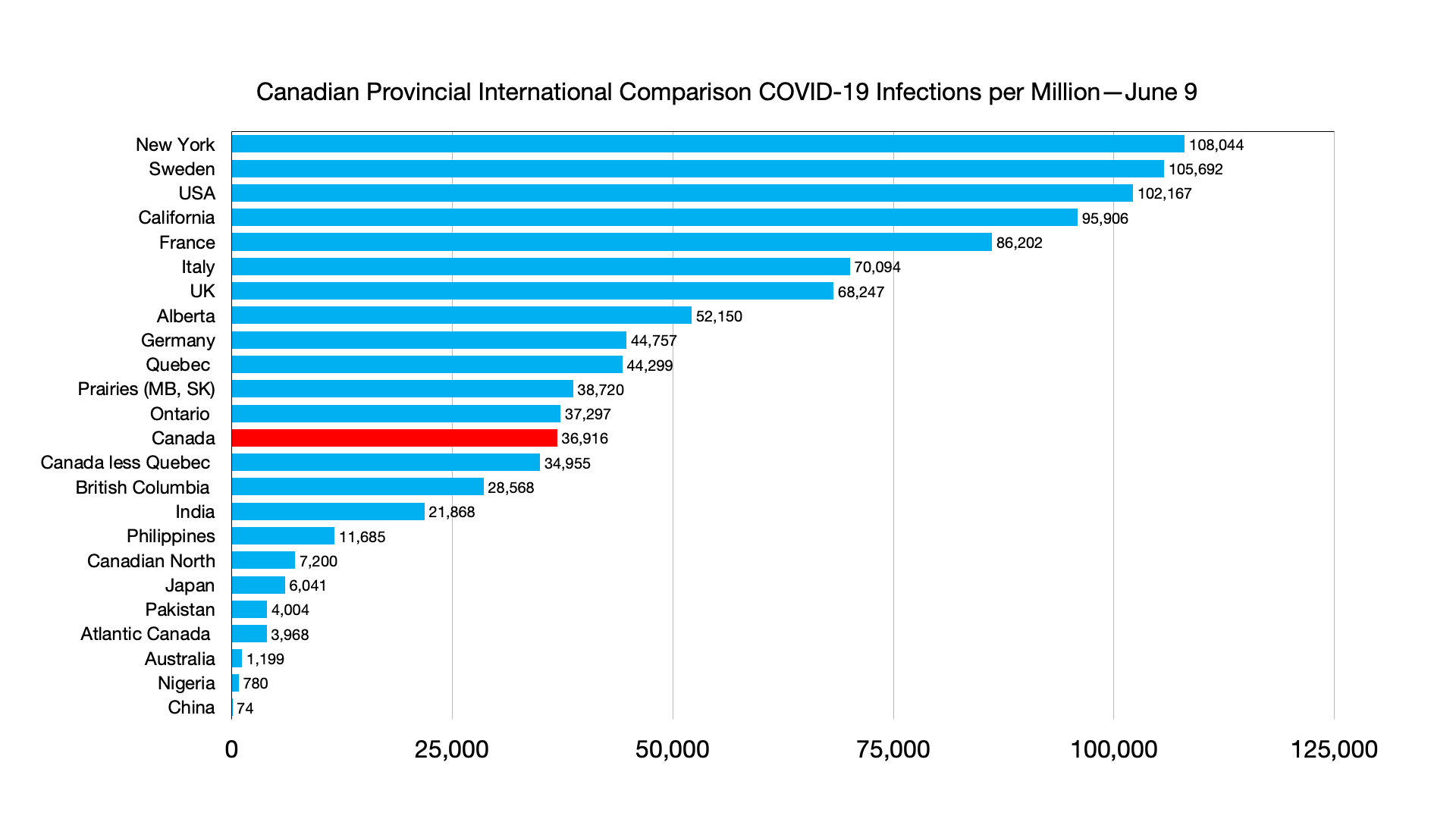
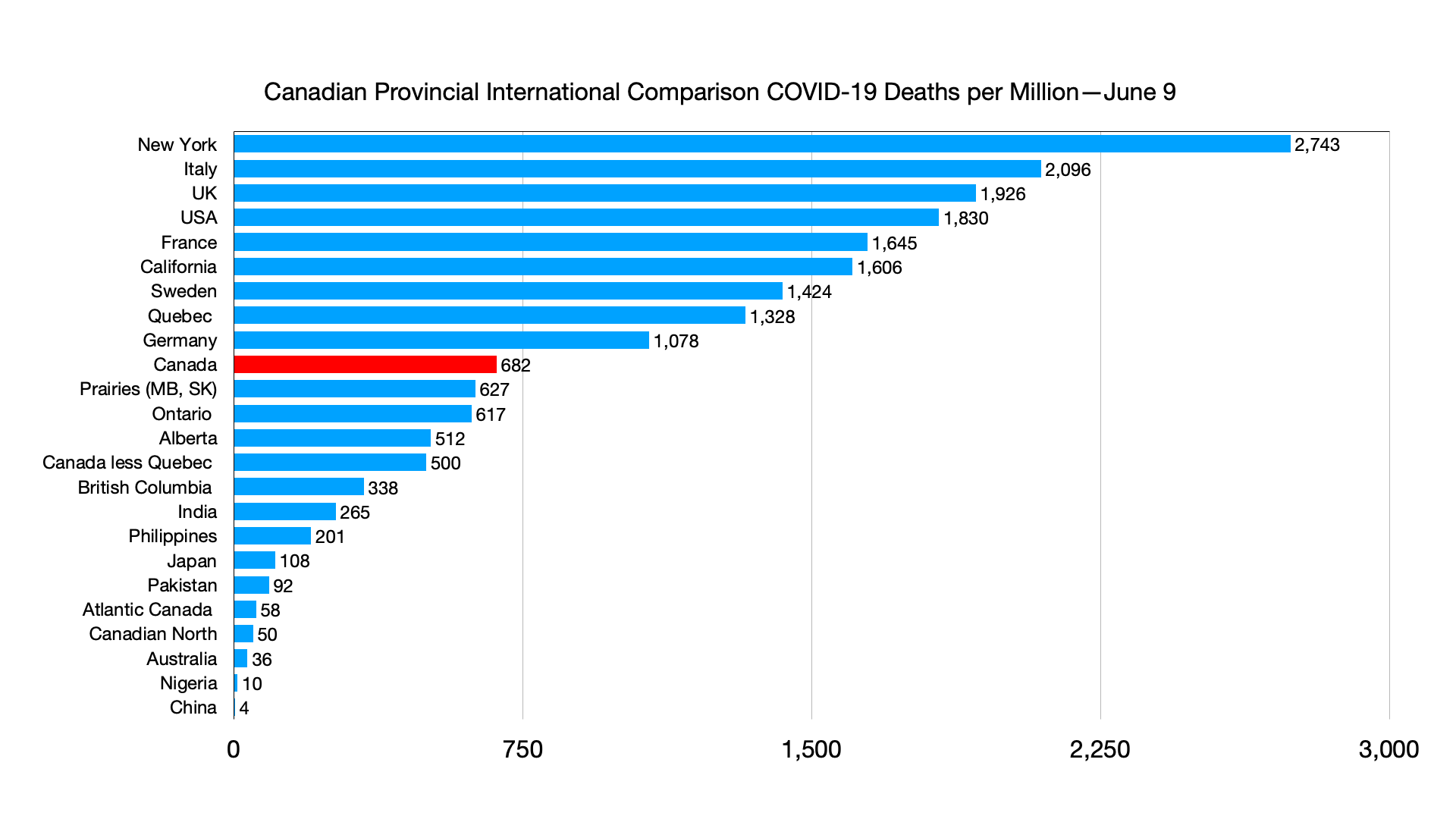
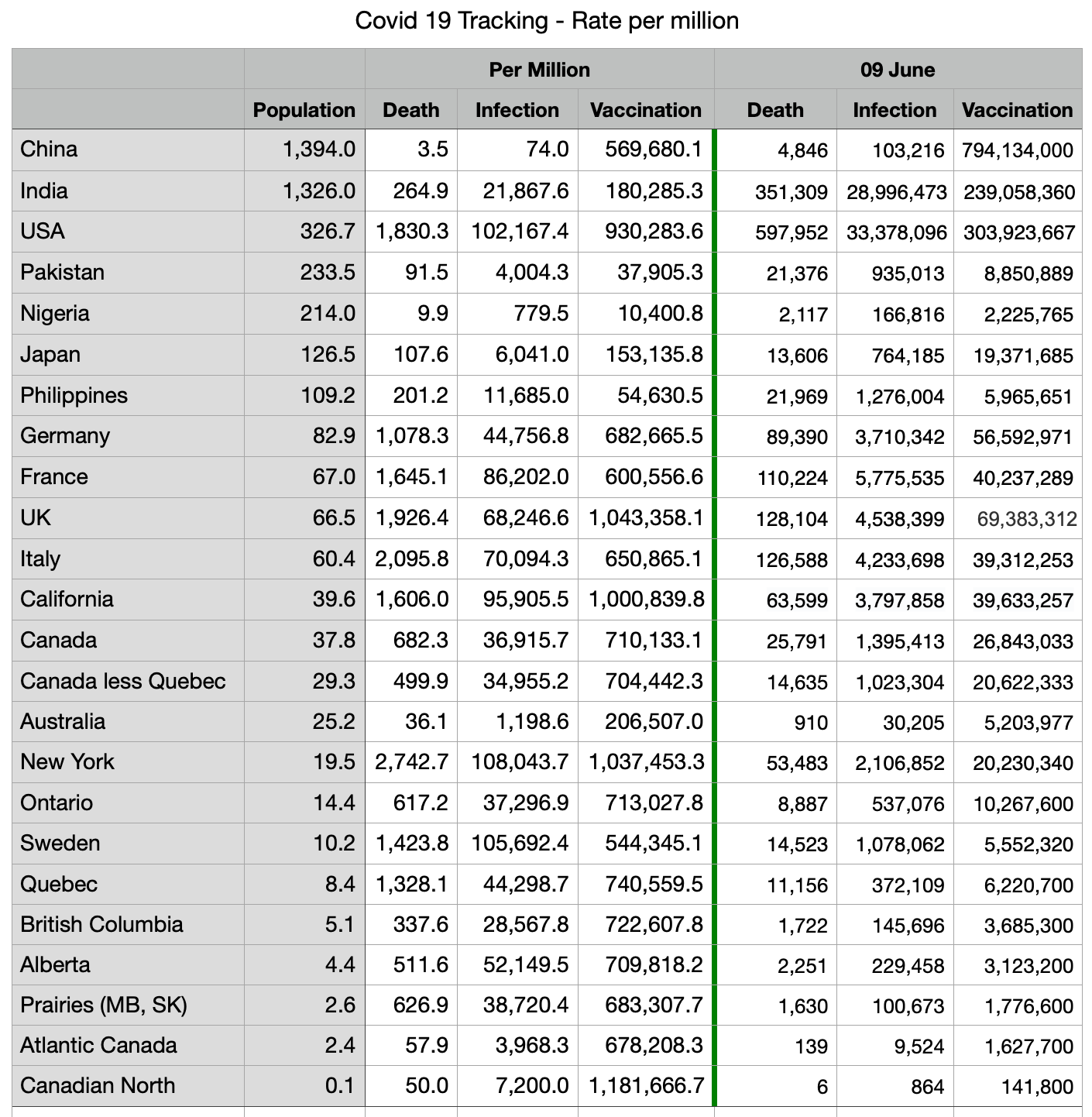
The latest charts, compiled 9 June as overall rates in Canada continue to decline along with increased vaccinations (still largely first dose, fully vaccinated less than 10 percent).
Vaccinations: Minor relative changes, Canadian provinces all ahead of EU countries save Germany.
Trendline charts
Infections per million: No major relative changes and recent surges appear to be levelling off save for the Prairies (mainly Manitoba).
Deaths per million: No significant change, Prairies slightly ahead of Ontario.
Vaccinations per million: Canadian vaccination rates now exceed G7 less Canada with Quebec. US vaccination rates continue to stall. Vaccination rate increase in immigration source countries driven mainly by China and India to a lessor extent.
Weekly
Infections per million: No relative change.
Deaths per million: Prairies ahead of Ontario, driven by Manitoba.
History’s purpose isn’t to comfort us, says David Olusoga, although many in the UK seem to think it is. “History doesn’t exist to make us feel good, special, exceptional or magical. History is just history. It is not there as a place of greater safety.”
As a historian and broadcaster, Olusoga has been battling this misconception for almost two decades, as the producer or presenter of TV series including Civilisations, The World’s War, A House Through Time and the Bafta-winning Britain’s Forgotten Slave Owners. His scholarship has been widely recognised: in 2019, he was awarded an OBE and made a professor at the University of Manchester. (He is also on the board of the Scott Trust, which owns Guardian Media Group.) Yet apologists for empire, in particular, like to dismiss him as a “woke historian” in an attempt to politicise his work or flatly deny the realities that he points out.
First published in 2016, and made into a TV series the same year, the book charts black British history from the first meeting between the people of Britain and the people of Africa during the Roman period, to the racism Olusoga encountered during his own childhood, via Britain’s role in the slave trade and the scramble for Africa. It is a story that some of Olusoga’s critics would prefer was forgotten.
Hostility to his work has grown since the Brexit vote, shooting up “profoundly since last summer”, he says, speaking over Zoom from his office in Bristol. “It has now got to the point where some of the statements being made are so easily refutable, so verifiably and unquestionably false, that you have to presume that the people writing them know that. And that must lead you to another assumption, which is that they know that this is not true, but they have decided that these national myths are so important to them and their political projects, or their sense of who they are, that they don’t really care about the historical truths behind them.
“They have been able to convince people that their own history, being explored by their own historians and being investigated by their own children and grandchildren, is a threat to them.”
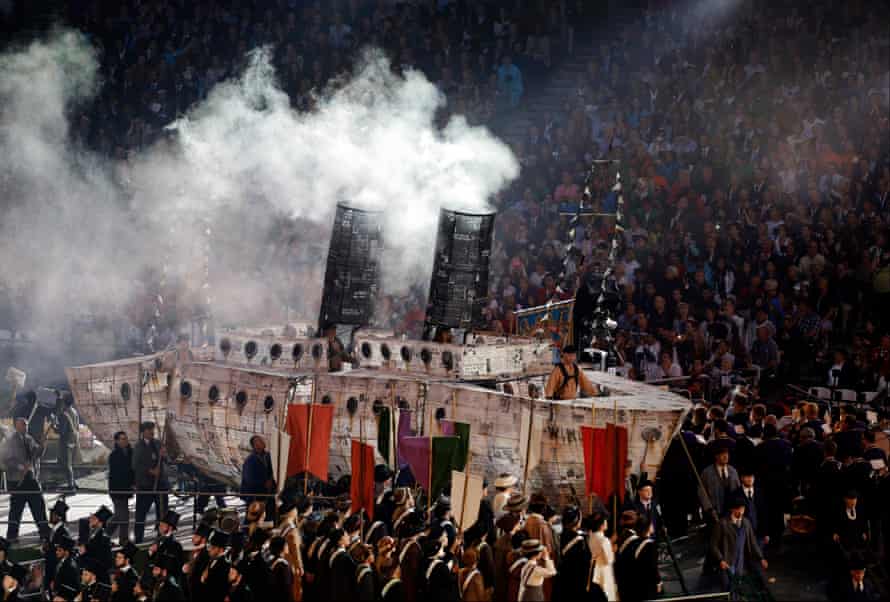
‘You have to have a real tenure in the country to play your ancestors’ … a recreation of the Empire Windrush at the opening ceremony of the London Olympics in 2012. Photograph: Lee Jin-man/AP
For Olusoga, 51, this hostility can in part be explained by ignorance. “If you were taught a history that the first black person to put his foot on English soil was stepping off the Windrush in 1948, then this can seem like a conspiracy,” he says.
But there is a deeper issue at play. “If you have been told a version of your history and that is part of your identity, it’s very difficult when people like me come along and say: ‘There are these chapters [that you need to know about].’ People feel – wrongly in my view – that their history is being undermined by my history. But my history isn’t a threat to your history. My history is part of your history.”
When the book was published in 2016, it ended on a hopeful note. Olusoga was writing just a few years after the London Olympics, in which a tantalising view of Britain emerged – a country at ease with its multiculturalism, nodding with pride to the arrival of the Windrush generation in 1948. Black Londoners dressed up as their ancestors for the opening ceremony, “with long, baggy suits, holding their suitcases”, says Olusoga. “You have to have a real tenure in the country to play your ancestors.” That moment, he says, was profoundly beautiful.
But that upbeat note has begun to feel inaccurate – an artefact of a more optimistic time. In the new edition of Black and British, which includes a chapter on the Windrush scandal and last year’s Black Lives Matter protests, Olusoga describes that moment in 2012 as a mirage. The summer afterwards, vans bearing the message “Go home or face arrest” were driven around London as part of Theresa May’s notorious “hostile environment” strategy, aiming to make the UK inhospitable for undocumented migrants. Thousands of people who had lived legally in the UK for decades, often people who had arrived from the Caribbean as children, were suddenly targeted for deportation.
But this movement for racial justice has been met with a severe backlash. In January, Robert Jenrick, the secretary of state for housing, communities and local government, said he would introduce laws to protect statues from what he called “baying mobs”. The government’s recent review on racial equality concluded controversially that there was no institutional racism in areas including policing, health and education, despite all the evidence to the contrary.
“I’m really frightened about the future of this country, and frightened about people using forces of race and racism for electoral reasons and not being cognisant about how difficult it is to control those forces after elections have been counted,” says Olusoga. “I’m really frightened about the extent to which people are able to entirely dehumanise people who they deem to be their enemies in this culture war.”
Olusoga was born in Lagos in 1970, to a white British mother and a Nigerian father, moving to his mother’s home town, Gateshead, at an early age. As one of a handful of mixed-race families on the council estate where they lived, they were regularly terrorised by the far right. The violence culminated in a brick being thrown into the family’s home, wrapped in a note demanding they be sent “back”. He was 14. Eventually, the family had to be rehoused.
His early experience of education was also distressing. “I experienced racism from teachers in ways that are shocking if I tell them to young people at school now,” says Olusoga. He was dyslexic, but the school refused to get him tested until he did his GCSEs: “It was the easier story to believe that this kid was stupid because all black kids are stupid.” When he finally got his diagnosis and support – thanks in large part to his mother’s fierce determination – Olusoga went to study history at the University of Liverpool, followed by a master’s degree at Leicester.
Olusoga was confident about having two identities, despite the prejudice he had encountered. He was proud of being a black Nigerian of Yoruba heritage and was perfectly happy being part of his mother’s white working-class geordie tradition. But he has always had a third identity.
“I’m also black British – and that had no history, no recognition. It was presented as impossible – a dualism that couldn’t exist, because whiteness and Britishness were the same thing when I was growing up. So, to discover that there was a history of being black and British, independent from being half white working-class and being half black Nigerian, that was what was critically important to me,” he says. His book does its best to uncover that history, exploring the considerable presence of black people in Britain in the age of slavery, as well as the part played by black Britons in both world wars.
He says that some of the aggression shown towards black historians who write honestly about Britain’s past comes from people who think “this history is important because it gives black people the right to be here”. They hold on to the belief that the UK was a “white country” until the past few decades and refuse to accept evidence that shows the presence of black people goes back centuries. But this is to fundamentally misunderstand what drives him and also why this history is important for black people.
“I don’t feel challenged in my right to be proud to be British,” he says. “I’m perfectly comfortable in my identity. I’ve looked at this history because it’s just exciting to be part of a long story. This comes out of wanting to enrich life, not seeking some sort of needy validation of who I am.”
He found it refreshing to see the UK’s history of empire and colonialism acknowledged in last summer’s anti-racist placards, with one popular slogan stating “The UK is not innocent”. “A generation has emerged that doesn’t need history to perform that role of comfort that its parents and grandparents did,” he says.
As for black people’s experiences in Britain, he says, there is a “hysterical” level of anger if you point out that many have lived in some form of slavery or unfreedom. Recently, historians have uncovered notices of runaway enslaved people or advertisements for their sale. This adds to the evidence that thousands of black people were brought to Britain, enslaved as well as free.
“It brings slavery to Britain and therefore undermines the idea that it doesn’t really matter because it happened ‘over there’,” says Olusoga. “It short-circuits an idea of British exceptionalism. And there are a lot of people for whom that idea of exceptionalism is a part of how they see themselves. I’m really sorry that the stuff I do and that other people do is a challenge to that, but my job is to be a historian. It’s not to make people feel good.”
Olusoga is often accused of pursuing a political agenda. He is asked, for instance, why he doesn’t speak about the Barbary slave trade of the 16th to 18th centuries, in which Europeans were captured and traded by north African pirates. He has a simple response: that he has been trying to get a programme made about it for his entire career and it is finally happening.
He gives another example: “I have been accused literally hundreds of times of ignoring the slavery suppression squadron that the Royal Navy created after 1807.” Its task was to suppress the Atlantic slave trade by patrolling the coast of west Africa. “I think the chapter in Black and British about that is 30,000 words, which is as long as some books.”
What his more extreme critics fail to understand, he adds, is that he is loyal to history and not a political agent. He remains committed to one goal: to uncover the stories of those who have long been deemed unimportant. When he wrote his first book on the 1904-08 Namibian genocide, he went to mass graves where he saw bones sticking out of the ground. “We promised the victims of that genocide that we would be their voice, we would fight for them and we would tell their story – and we use every skill we have to do that.
“I care deeply about people who were mistreated in the past. I care about the names on slave ledgers, I care about the bones of people in Africa, in mass graves in the first world war and in riverbeds in Namibia. I care about them. I think about them when I read the letters, when I look at their photographs and their faces. No one gave a damn about them. That’s my job – to care about them. And I will be ruthless in fighting for them.”
The federal government is opening up new immigration options for Hong Kongers to make Canada their home as Beijing continues its unprecedented crackdown on the former British colony.
Immigration Minister Marco Mendicino said two new immigration streams will now begin taking applications from Hong Kongers working in Canada or recent university graduates from Hong Kong now living in Canada. They will be offered a quicker and more efficient pathway to permanent residence.
“At this difficult moment, Canada continues to stand shoulder to shoulder with the people of Hong Kong. We are deeply concerned about China’s imposition of the National Security Law, and more broadly the deteriorating human rights situation in Hong Kong,” the Immigration, Refugees and Citizenship department said in a statement.
This is on top of a program announced in February targeted at people living in Hong Kong who had graduated from a Canadian or foreign university. It offers them a three-year open work permit that would help pave the way for applying for permanent residency.
The work permit program opened in February and has so far attracted 3,481 applications, the department said on Monday.
An exodus from Hong Kong has been expected since the Chinese government imposed the national security law on Hong Kong in June, 2020, saying it was to target secession, subversion and terrorism. But it includes vaguely defined offences that critics say effectively criminalize dissent and opposition to the Chinese Communist Party’s rule.
“With young Hong Kongers casting their eyes abroad, we want them to choose Canada,” Mr. Mendicino said in a statement.
“Skilled Hong Kongers will have a unique opportunity to both develop their careers and help accelerate our recovery. This landmark initiative will strengthen our economy and deepen the strong ties between Canada and the people of Hong Kong.”
Canada and Western allies have called China’s clampdown a violation of the international treaty it signed pledging to allow local autonomy and civil rights to continue for 50 years after the 1997 handover.
Records show Hong Kongers have already moved billions of dollars to Canada. Last year, capital flows out of Hong Kong banks and into Canada reached the highest level on record, with about $43.6-billion in electronic funds transfers recorded by FINTRAC, Canada’s anti-money-laundering agency.
A crackdown on civil rights in Hong Kong that accelerated in 2020 amid the global pandemic has steadily eroded the territory’s political and social freedoms that were unique in China, a legacy of the territory’s years under British control. Earlier this year, Chinese lawmakers approved changes to Hong Kong’s electoral system, further reducing democratic representation in the city’s institutions and introducing a mechanism to vet and screen politicians for loyalty to Beijing.
A lament for what is lost. I suspect each generation has similar regrets, reminding me of Woody Allen’s treatment of nostalgia in Midnight in Paris:
Darwin’s Arch, the magnificent rock formation near the Galápagos Islands, collapsed last month. It took millions of years of erosion, and then gravity finished the work instantly. It was witnessed by a handful of divers on a nearby ship, Galapagos Aggressor III. What’s left over is being renamed “the Pillars of Evolution.” Why not “Darwin’s pillars”? Probably because Darwin is problematic now. Far safer to name things after the pitiless laws of nature, which cause every poorly adapted beast to disappear from the face of the earth forever.
The world is always disappearing. And faster than you think. The British writer Peter Hitchens visited Bhutan some 16 or so years ago in the first years after it had been introduced to the television. The mountainous and mysterious little country that sits between China and India was ruled by a king who famously privileged “gross domestic happiness” and who banned blue jeans. Hitchens worried about the effect of television on this peaceful, quiet, and devout kingdom. His essay made me long to visit a nation that was culturally formed by Buddhism and whose mountainous geography was so imposing that the two giants of Eurasia had not dared to conquer it.
Hitchens was right to worry about the effects of television. Now, Bhutanese youth are crowding in the capital city, Thimphu. They have smartphones. The traditional culture of Bhutan — its sports, music, and folklore — competes directly with the Bollywood hits that are beamed in to their Motorola phones. Elements of land reform that other nations completed in the 19th century are still part of active debate. And yet, the young King Jigme Khesar Namgyel Wangchuck just this year abolished the last laws criminalizing same-sex relations and was congratulated by a native identity lobby group, Queer Voices of Bhutan. Such a development was literally unthinkable three decades ago, and yet also inevitable once Facebook arrived.
Even still, something left over from Bhutan’s mannerly and courteous culture shines through. An article about these changes dictated to Vice by Tashi Tsheten, a gay Bhutanese man, noted that Bhutan has never had a single pride parade and doesn’t plan on it. Why? Because “parades are a form of activism where people go out on the streets and talk about policy and legal changes; that’s not something that we Bhutanese agree with.” A Buddhist nation can be queered, but they won’t march about like a bunch of drumming Presbyterians in Belfast. How long can that last? Social media is like a different kind of social physics. Perhaps there will be a police-shooting incident in Nevada someday, and within hours the youth of Bhutan will put Thimphu to flames like Minneapolis last summer.
Global capitalism talks about diversity and multiculturalism, but we are all modernizing toward conformity. Globalization destroys diversity. Sometimes it does so with a malign purpose, such as the Chinese Communist Party using every totalitarian means to extirpate the native Muslim cultures of Western China. But half the time it is hardly intended at all. It proceeds by our attraction to power and wealth. Bhutan’s Buddhist culture, if the lines of transmission are set the right way, will slowly be zapped away by the parts of India’s culture that are made for export. Much of that culture too will have been borrowed by America.
Our desire for better and more easeful lives, not only for ourselves but our children, optimizes for the selection of a few lingua franca. Half of all human languages still spoken today will cease to exist before the end of the next century. Most of them before they had the chance to develop a literature. There will be efforts to preserve and revitalize these treasure chests of human culture and civilization — but it’s like trying to make water gush from a sand dune where there was once a riverbank.
The Trudeau government’s former representative in the Senate says a proposed motion in the Red Chamber to condemn China’s treatment of ethnic Muslim minorities as genocide smacks of “moral superiority and self-righteousness,” given Canada’s past conduct toward Indigenous people including in residential schools.
Senator Peter Harder, a former deputy minister of Foreign Affairs who later headed the Canada-China Business Council, recently spoke in the Senate to oppose a motion that would say the Chinese government’s repression of Uyghurs and other Turkic Muslims fits the United Nations’ definition of genocide. A similar motion has already passed the Commons, although Prime Minister Justin Trudeau and his cabinet abstained from voting.
Activists and UN experts have said a million Uyghurs and other Turkic Muslims have been subject to mass detention in Xinjiang. China denies abuses and says the centres provide vocational training and are needed to fight extremism in the remote western region. Reports have emerged about Beijing’s success in slashing the birth rate of Uyghurs and other minorities through mass sterilization, forced abortions and mandatory birth control.
Senate motion No. 79, which has not yet been put to a vote, notes that two successive U.S. administrations have labelled China’s behaviour as genocide. It also proposes calling upon the International Olympic Committee to deny Beijing the 2022 Winter Olympics by relocating the Games to another country “if the Chinese government continues this genocide.”
The Dutch, British and Lithuanian parliaments have in recent months adopted similar motions recognizing the treatment of Uyghurs as genocide.
Mr. Harder, however, urged fellow senators to consider Canada’s conduct toward Indigenous people before they vote.
He noted that the debate is occurring after “the tragic discovery” of unmarked graves containing the remains of 215 children and “adds to the indictment of our centuries-long practice of residential schools, forced sterilization and what the former chief justice of Canada described as cultural genocide of our Indigenous peoples,” the senator said.
“This horrifying reality of our history stands in rather cynical contrast to the tone of moral superiority and self-righteousness contained in the motion before us tonight.”
The former Trump administration declared the repression of the Uyghurs to be genocide and U.S. President Joe Biden’s Secretary of State, Anthony Blinken, said he concurs with that assessment. In addition, a March, 2021 State Department report on human rights issued under the Biden administration declares that “genocide and crimes against humanity occurred during [2020] against the predominantly Muslim Uyghurs and other ethnic and religious minority groups in Xinjiang.”
Mr. Harder, speaking to the Senate motion late last week, said this is not the way to engage with China.
“We should get off our high horse and seek to engage more appropriately, not bellicosely and belligerently, with countries – not just China, but countries that we need to engage.”
Ottawa has already joined with the U.S., Britain and the European Union in imposing sanctions on several Chinese government officials for “gross and systematic human-rights violations” against Uyghurs, Kazakhs and other largely Muslims groups.
Senator Leo Housakos, the sponsor of motion No. 79, said that unlike China, Canada has acknowledged its atrocities. “China still doesn’t acknowledge what they are doing is ethnic cleansing.”
David Mulroney, a former Canadian ambassador to China, said Beijing’s use of technology to monitor, coerce and control a whole people is providing a how-to manual for other authoritarian powers to follow. “It’s writing the book on genocides of the future,” Mr. Mulroney said.
He said Canada’s shameful treatment of Indigenous people shouldn’t preclude Canadians from identifying and calling out misconduct elsewhere. “We call out the Uyghur genocide and question Beijing’s hosting of the Olympics not as a political statement but as a moral statement,” Mr. Mulroney said.
“Surely if we have learned anything as a country it is that you need to act swiftly against genocide anywhere.”
Mr. Harder also said he worried that the motion declaring China’s conduct to be genocide could jeopardize the treatment of Michael Kovrig and Michael Spavor, the two Canadians locked up by Beijing after Ottawa arrested a Huawei executive on a U.S. extradition request.
In addition, he cited concerns that it could also inflame anti-Asian violence in Canada and hurt Ottawa’s ability to find common cause with China in fighting climate change and building stronger global trading rules.
Asked for further comment, Mr. Harder said Monday that Canada should be humble. “It’s not that we lack moral authority as much as we should speak with humility and acknowledge our own historic (and recent) failings,” he said in an e-mailed statement. “Regardless of the motivation of our governmental and church leaders at the time, history has shown that we were wrong.”
The Globe and Mail asked Perry Bellegarde, National Chief of the Assembly of First Nations, for comment on whether he feels Canada’s conduct toward indigenous people – in particular, its record of residential schools – precludes Canadians from criticizing China. Chief Bellegarde’s office said that he was not able to respond Monday afternoon.
No surprise. Like the vast majority of these programs, vulnerable to corruption, both in terms of those applying and administering:
The Cyprus government continued for at least four years to unlawfully issue passports to relatives of wealthy investors under an investment-for-citizenship program, despite warnings by the Attorney-General that this could be in breach of the law, the head of an independent commission said on Monday.
Former Supreme Court President Myron Nicolatos said that, of the 6,779 passports issued during the program’s 13-year run, 53% were issued not to the investors themselves but to family members or top company executives.
The Attorney-General’s Office had warned on separate occasions in 2015 and 2016 that the practice might be unlawful because there was no specific law enabling the government to issue such passports.
Of the remainder that were granted to investors, one-third failed to meet all the criteria, Nicolatos said. He was speaking after handing the final, 780-page report of an investigation into the multibillion-euro program to Attorney General George Savvides,
He said 8% didn’t meet the primary condition of investing around 2.5 million euros ($3 billion) into the Cypriot economy, while another 12% failed to meet the bar on owning a permanent residence in Cyprus.
Nicolatos said the four-member commission is recommending that authorities look into revoking citizenship in 85 cases in which the applicants may have committed criminal or other offenses to secure a passport.
He said that revoking the citizenship of investors’ relatives and company executives who weren’t directly at fault could prove “particularly complicated” because of legal clauses enshrined in Cypriot and European Union law.
“It’s obvious that the (program) operated between 2007 and Aug. 17, 2020, with blanks and omissions, without a legal framework and almost without a regulatory framework,” Nicolatos said.
“Also absent were those safety valves, the proper legal guidance as well as adequate supervision regarding existing laws and regulations.”
The program was scrapped last year amid much controversy over an undercover TV report that allegedly showed the parliamentary speaker and a powerful lawmaker claiming that they could skirt the rules to grant citizenships.
They had made the pledge to a reporter posing as a representative of a fictitious Chinese investor who had been convicted of fraud in his country. Both resigned shortly after the report was aired.
The golden passport program ran for 13 years but was ramped up in 2013 following the financial crisis. It generated more than 8 billion euros (almost $10 billion) for the east Mediterranean island nation and proved particularly attractive to foreign investors because obtaining an EU passport allowed them access to the 27-member bloc.
The EU had also taken Cyprus to task over the scheme.
Nicolatos also faulted some lawyers, accountants, banks, real estate brokers and developers who he said “didn’t sufficiently live up to their legal or other obligations” through the application process, while in some instances, supervisory authorities failed to do their job properly.
Politicians and officials may bear “political” responsibility for the debacle and some could face disciplinary action.
Although the program spanned the tenure of three different presidents, the overwhelming majority of citizenships were granted during seven years during which the sitting president, Nicos Anastasiades, held the office.
He called on law enforcement authorities to prosecute alleged law breakers and to mete out punishment to the degree of an individual’s responsibility.
Attorney General Savvides said authorities would examine revoking citizenships, take lawbreakers to court and take disciplinary action in those instances that the report recommends.
In the first such legal action, his office last month took five individuals and four legal entities to court to face 37 charges in connection with the commission’s findings.
A redacted version of the final report — so as not to compromise ongoing legal actions — will be made public in due course, Savvides said.
An interim report released in March also pointed to serious shortcomings in how the Interior Ministry processed applications, including the “complete lack” of a database to properly vet applicants. It said the Finance Ministry was also at fault for “green lighting” certain applications that didn’t fulfil all the criteria due to the size of the investment.
Good depiction of some of the issues, including increased inequality:
Millions of Canadians are now well into their second year of working from home. As the COVID-19 pandemic hit, non-essential employees began working from their couches, kitchens and bedrooms, hopping virtually from one endless video meeting to another. What began as a temporary arrangement, however, will likely change the way we do our jobs permanently: working from home has its challenges, but it has enough upsides that both workers and employers may be reluctant to go back to the old ways. If this happens, we must ensure that this shift does not widen workplace inequalities.
Not all workers are equally likely to have been working from home during the pandemic. The shift was easier for people with office jobs, for instance, than for those in retail. Workers with permanent, full-time, higher-paid jobs are also more likely than those with less secure, lower-paid positions to have been working from home. This is the first way in which the change has exacerbated inequality within Canadian society: more economically vulnerable workers also ended up more vulnerable to the virus owing to their need to be physically present at work. All Canadians have been urged to stay at home as much as possible during the pandemic, but their ability to do so is in large part a function of the types of jobs that they hold.
For many who made the transition from office desk to the kitchen table, the experience has generally been positive – perhaps surprisingly so. In our recent survey, more than three in five agree that working from home has been easier than expected, and they say they like working from home better than their regular workplace. The same proportion even say that working remotely has been less stressful than working in the office. So far, so good.
At the same time, more than two in five express concerns about juggling work and family responsibilities while working from home – they feel like they are constantly working and never have time for themselves or their families. One in three find it impossible to do their job well while working from home.
It will shock no one that these stresses are most acutely experienced by parents of young children. Three in five of those caring for young children say they worry that they can’t be a good parent and be good at their job at the same time while working from home.
Younger workers, immigrants, racialized people, Indigenous workers and workers with a physical or mental condition that limits their daily activity are also more likely to experience challenges working from home. Most notably, each of these groups is morelikely than average to worry that working from home will have a negative impact on their career. These workers may be less securely employed, and therefore more concerned about the longer-term consequences of being physically distant from their workplaces.
What’s notable, though, is that many of those experiencing challenges with working from home nonetheless feel positive about the arrangement overall. In fact, seven in 10 of those who have been working at home say that once the pandemic is over, their employer should continue to allow them to work remotely at least a few days a week. Clearly, workers are likely to expect greater flexibility from employers from now on.
All of this puts the onus to act back on employers and policy makers alike. It is not enough to pick up on the current zeitgeist and consider offering more flexible working arrangements once all lockdowns have been lifted. This experience should bring with it an obligation to ensure that new arrangements do not simply place further disadvantages on those already less connected to the centres of power.
Coming out of the events of the past year, we must renew our resolve to tackle persistent inequalities. This includes confronting the higher risks faced by front-line workers, the bigger challenges for those combining work and family responsibilities, and the greater barriers facing minority groups. New working arrangements will need new infrastructure, new policies, new supports, new ways of thinking about work and new skills for both employee and managers. These changes must now be made, not only in the context of physical offices and places of business, but in virtual ones as well.




 Multicultural Meanderings