Drastic drop in COVID infected international flights in May

Of note:

Transport Canada’s decision to ban passenger flights from India appears to have had an impact.

While numbers are always updated as new cases are diagnosed, data posted online by Health Canada as of Tuesday shows only 113 flights landing at Canadian airports last month carried passengers infected with COVID-19.

That’s compared to 288 flights counted in April — 66 of which were direct flights from India’s capital of Delhi.

Federal Transport Minister Omar Alghabra halted passenger flights from India and Pakistan for 30 days as of April 22, as well as adding additional restrictions on travellers arriving from India via connecting flights — including requiring a negative PCR COVID-19 test taken at the last port of entry before entering Canada.

This all but halted passenger traffic from both countries, as laboratory tests that typically require 24 hours can’t be accommodated during airport stopovers usually only lasting a few hours.

As many travellers from India had been connecting through Middle Eastern airports like Dubai, Abu Dhabi and Doha, infected passengers on those flights likewise saw big drops — just four from the United Arab Emirates last month compared to 35 in April.

Initially meant to last 30 days, the flight ban was extended last month to June 22.

During the first part of the pandemic, India typically only saw a handful of infected flights landing at Canadian airports each month.

All that changed in mid-February with a spike of infected flights coinciding with that country’s devastating variant-fuelled second wave.

Pakistan, meanwhile, has never been a significant factor, with Health Canada only reporting five such flights in April.

The United States was Canada’s largest source of infected flights last month, seeing 23 planes land with at least one passenger testing COVID positive — that’s compared to 49 in April.

Paris and Doha, Qatar, tied for second place with 11, followed by 10 from Guatemala, eight each from Frankfurt and Panama, seven from Istanbul, six from Amsterdam and five from Mexico City.

Toronto saw the most arrivals last month with 49 compared to 167 in April; followed by Montreal with 43 versus 57 in April; 14 in Vancouver compared to 42 in April; and six landing in Calgary compared to 19 the month previous.

Top sources of international flights with COVID-19 infected passengers in May (April’s total in parentheses)

1. USA: 23 (49)
2. Doha: 11 (21)
3. Paris: 11 (16)
4. Guatemala: 10 (4)
5. Amsterdam: 6 (12)
6. Frankfurt: 8 (13)
7. Panama: 8 (4)
8. Istanbul: 7 (18)
9. Mexico City: 5 (5)
10. Kingston, Jamaica: 3 (8)

Source: Drastic drop in COVID infected international flights in May

USA: The Brewing Political Battle Over Critical Race Theory

Latest iteration of the “culture wars:”

Last month, Republican lawmakers decried critical race theory, an academic approach that examines how race and racism function in American institutions.

“Folks, we’re in a cultural warfare today,” Rep. Ralph Norman, R-S.C., said at a news conference alongside six other members of the all-Republican House Freedom Caucus. “Critical race theory asserts that people with white skin are inherently racist, not because of their actions, words or what they actually believe in their heart — but by virtue of the color of their skin.”

Rep. Lauren Boebert, R-Colo., added: “Democrats want to teach our children to hate each other.”

Republicans, who are fighting the teaching of critical race theory in schools, contend it divides Americans. Democrats and their allies maintain that progress is unlikely without examining the root causes of disparity in the country. The issue is shaping up to be a major cultural battle ahead of next year’s midterm elections.

Academics, particularly legal scholars, have studied critical race theory for decades. But its main entry into the partisan fray came in 2020, when former President Donald Trump signed an executive order banning federal contractors from conducting certain racial sensitivity trainings. It was challenged in court, and President Biden rescinded the order the day he took office.

Since then, the issue has taken hold as a rallying cry among some Republican lawmakers who argue the approach unfairly forces students to consider race and racism.

“A stand-in for this larger anxiety”

Andrew Hartman, a history professor at Illinois State University, described the battle over critical race theory as typical of the culture wars, where “the issue itself is not always the thing driving the controversy.”

“I’m not really sure that the conservatives right now know what it is or know its history,” said Hartman, author of A War for the Soul of America: A History of the Culture Wars.

He said critical race theory posits that racism is endemic to American society through history and that, consequently, Americans have to think about institutions like the justice system or schools through the perspective of race and racism.

However, he said, “conservatives, since the 1960s, have increasingly defined American society as a colorblind society, in the sense that maybe there were some problems in the past but American society corrected itself and now we have these laws and institutions that are meritocratic and anybody, regardless of race, can achieve the American dream.”

Confronted by the Black Lives Matter protests of last summer, as well as the Pulitzer Prize-winning 1619 curriculum, which roots American history in its racist past, Hartman said many Americans want simple answers.

“And so critical race theory becomes a stand-in for this larger anxiety about people being upset about persistent racism,” he said.

Legislative action

States such as Idaho and Oklahoma have adopted laws that limit how public school teachers can talk about race in the classroom, and Republican legislatures in nearly half a dozen states have advanced similar bills that target teachings that some educators say they don’t teach anyway.

There’s movement on the national level too.

Sen. Tom Cotton, R-Ark., has introduced the Combating Racist Training in the Military Act, a bill that would prohibit the armed forces and academics at the Defense Department from promoting “anti-American and racist theories,” which, according to the bill’s text, includes critical race theory.

Rep. Byron Donalds, R-Fla., said he is co-sponsoring legislation that would prevent federal dollars from being spent on critical race theory in schools or government offices.

“The ideas behind critical race theory and [its] implementation is creating this oppressor-oppressed divide amongst our people,” Donalds told NPR. “And so no matter how you feel about the history of our country — as a Black man, I think our history has actually been quite awful, I mean, that’s without question — but you also have to take into account the progression of our country, especially over the last 60 to 70 years.”

Donalds said the country’s history, including its ills, should be taught, but that critical race theory causes more problems than solutions.

“It only causes more divisions, which doesn’t help our union become the more perfect union,” he said.

A post-racial country?

Nearly half of the speakers at the Republican news conference in May invoked Martin Luther King Jr., expressing their desire to be judged “by the content of their character, not the color of their skin.”

But Eduardo Bonilla-Silva, a sociology professor at Duke University, said King’s dream was about the future. “He didn’t say, ‘We are now in a colorblind society,’ ” he said.

Bonilla-Silva, whose book Racism Without Racists critiques the notion that America is now “colorblind,” says he too shares King’s dream, “but in order for us to get to the promised land of colorblindness, we have to go through race. It’s the opposite of what these folks are arguing.”

He says the idea that American society is post-racial is nonsense.

“We are not, because we watched the video of George Floyd, and we are not because we have the data on income inequality, on wealth inequality, on housing inequality,” he said.

As an example, Bonilla-Silva noted the opposition of whites to affirmative action in the post-civil rights era.

“Many whites said things such as, ‘I’m not a racist. I believe in equal opportunity, which is why I oppose affirmative action, because affirmative action is discrimination in reverse,’ ” he noted.

“That statement only works if one believes that discrimination has ended,” he added. “But because it has not ended, claiming that you oppose affirmative action because it’s presumably discrimination in reverse ends up justifying the racial status quo and the inequalities.”

Motivator for the midterms?

The fight over critical race theory will likely continue to be a heated issue ahead of next year’s midterm elections. Although November 2022 seems a long way away, Christine Matthews, president of Bellwether Research and a public opinion pollster, says pushback to anti-racism teaching is exactly the kind of issue that could maintain traction among certain voters.

“I think it’s just one more addition to the culture war that the Republicans really want to fight and it’s what they want to make the 2022 midterms about,” she said.

Matthews noted that Biden’s approval ratings, in the mid-50s, are significantly higher than Trump’s were throughout his term in office, “so Republicans are wanting to make this about othering the Democrats and making them seem as extreme and threatening to white culture as possible.”

“If Republicans can make [voters] feel threatened and their place in society threatened in terms of white culture and political correctness and cancel culture, that’s a visceral and emotional issue, and I do think it could impact turnout.”

These issues could be used to galvanize conservative voters and increase their numbers at the polls.

“We have seen evidence that the Republican base is responding much more to threats on cultural issues, even to some degree more than economic issues,” Matthews said.

But Rep. Donalds said the Republican Party doesn’t need to rally the base to get it to show up to vote.

“When it comes to the ’22 elections, we don’t need additional ammunition,” he said, pointing to what he views as a list of failures from the Biden administration, from budget and taxes to shutting down the Keystone pipeline.

Doug Heye, the former communications director for the Republican National Committee, said in some ways, the attempts to mandate what schools can or can’t teach highlights just how far the GOP under Trump has moved away from traditionally conservative principles — like wanting less federal involvement in schools.

“A lot of what we might have described as conservative policy five years ago, 10 years ago, now just isn’t that case,” he said. “If we’re pushing what is a current priority for the Trump base, that’s defined as conservative, whether or not that’s a federal top-down policy or not. So the old issues of federalism has really been upended under Donald Trump’s reign as the leader of the party.”

Heye said at this point, critical race theory is still politically a “niche issue” among conservative voters, but he expects it to play a larger role in state assemblies, governors races and school boards rather than in national politics.

He said he believes it’s an issue some candidates will raise “to further rile up the base that is already pretty riled.”

“So the question will be then for Republicans: What else are they really emphasizing?” he said.

From a strategy perspective, Matthews says she thinks it will all come down to messaging.

“The Republicans are trying to make it a bad thing,” she said, “but I feel like if the Democrats got the messaging right, they could make it a good thing.”

Both sides have a little more than a year to do that.

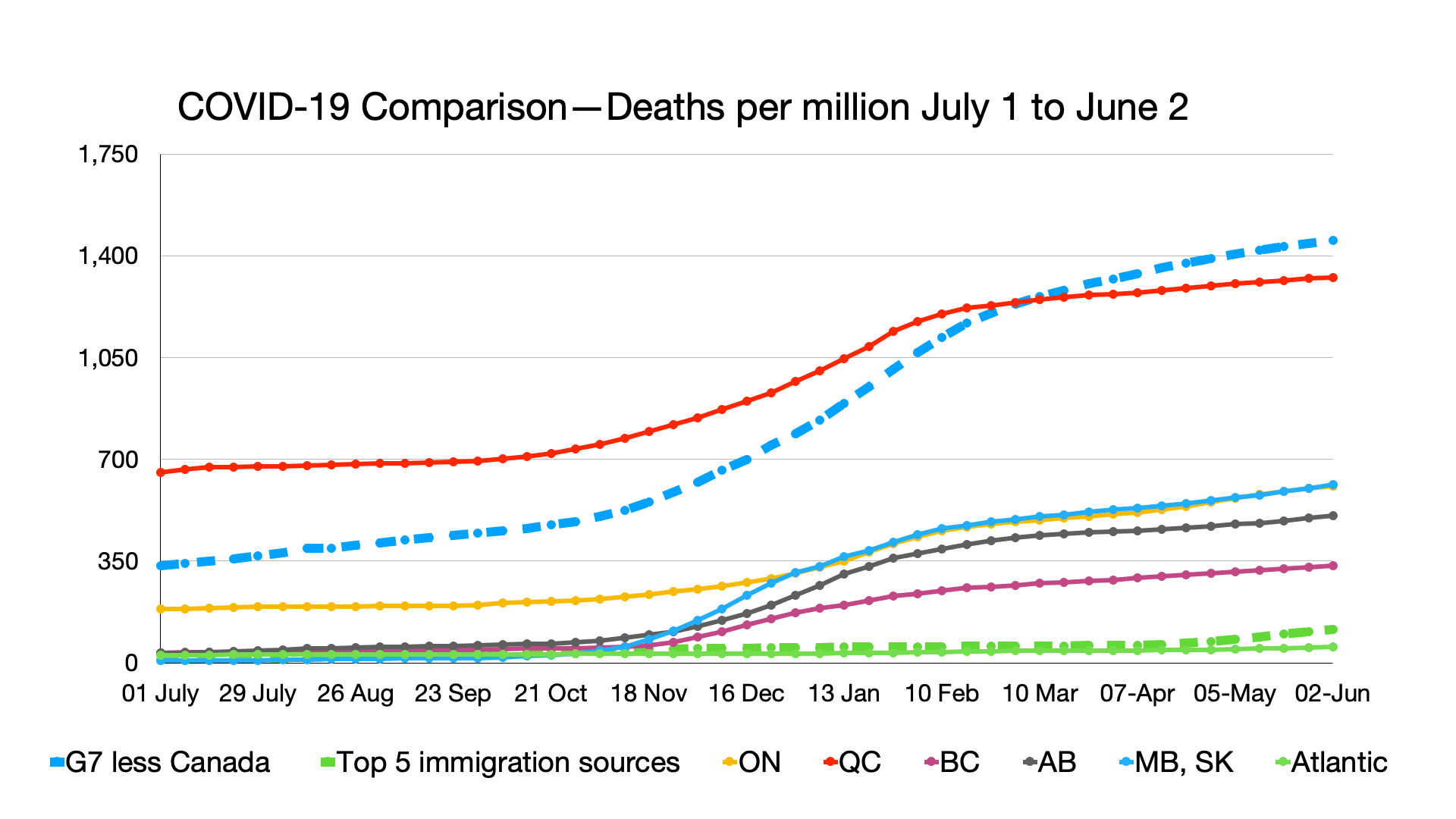
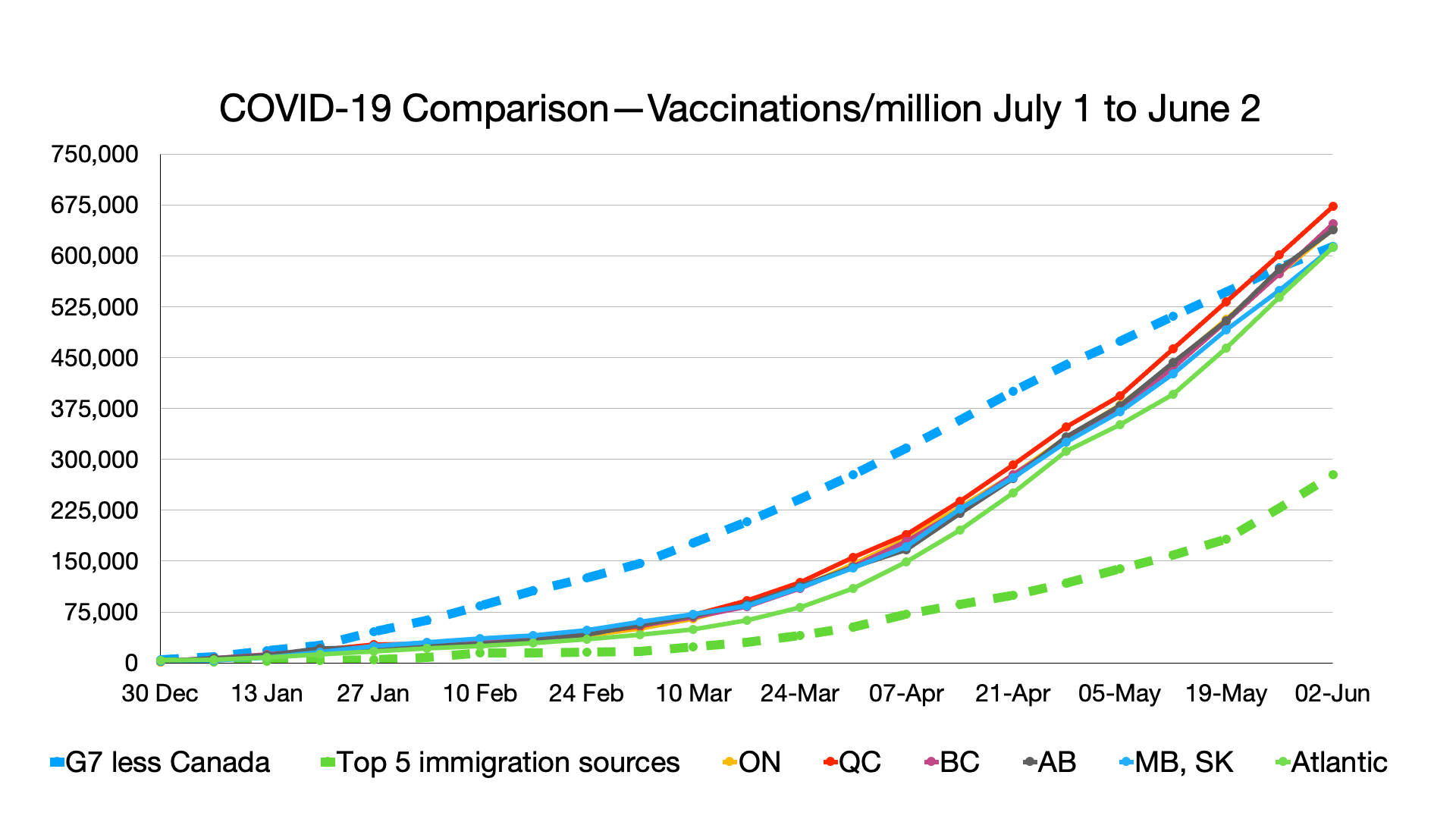
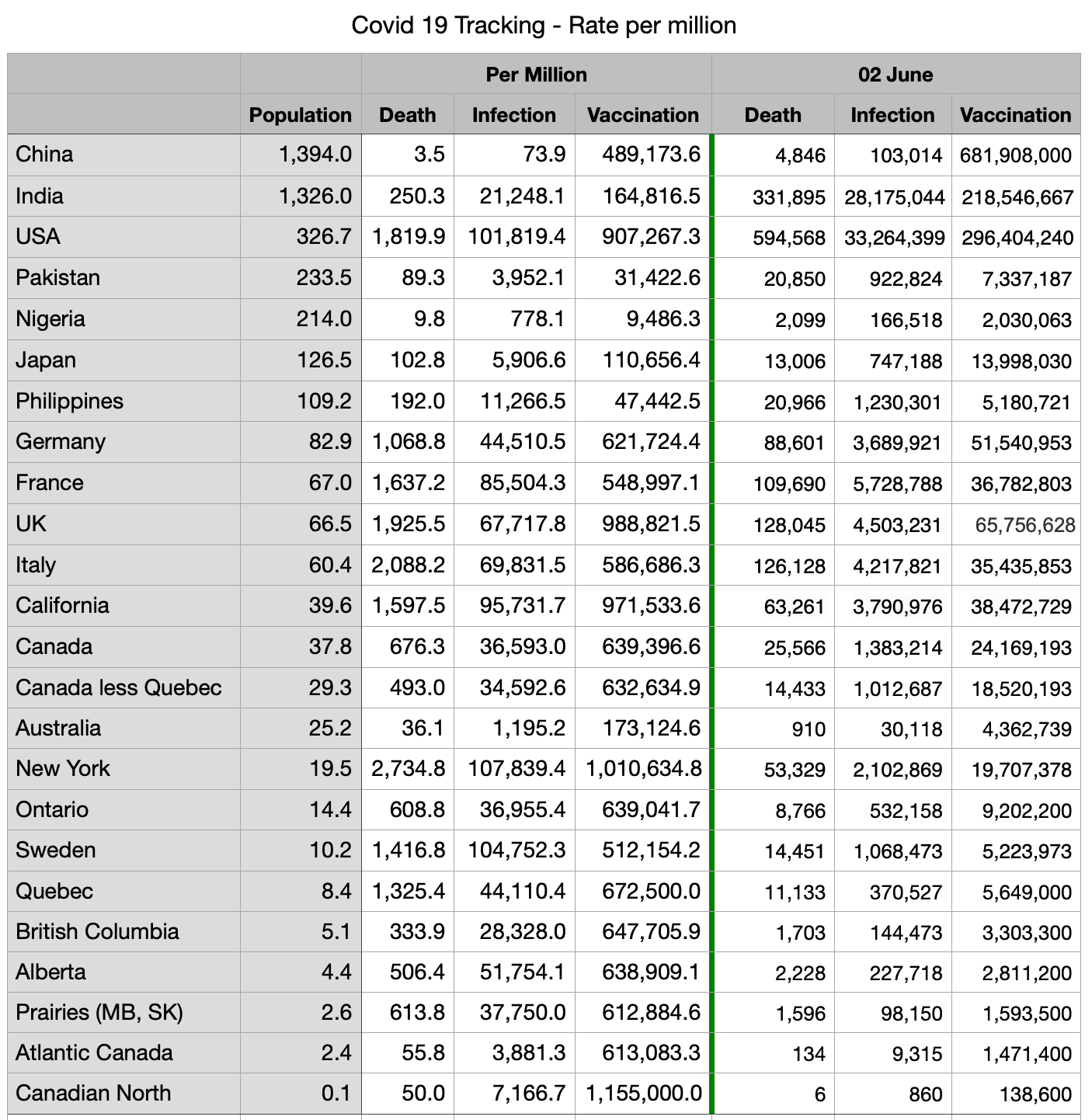
#COVID-19: Comparing provinces with other countries 2 June Update

The latest charts, compiled 2 June as overall rates in Canada continue in all provinces save Manitoba to come down along with increased vaccinations.

Vaccinations: Minor relative changes, Canadian provinces all ahead of EU countries save Germany.

Trendline charts

Infections per million: No major relative changes and recent surges appear to be levelling off save for the Prairies (mainly Manitoba).

Deaths per million: No significant change, Prairies slightly ahead of Ontario.

Vaccinations per million: Canadian vaccination rates have caught up to G7 less Canada with Quebec ahead as US vaccination rates are stalling.

Weekly

Infections per million: No relative change.

Deaths per million: Prairies ahead of Ontario, driven by Manitoba.

Federal government launches loan program for Black-owned businesses

Useful initiative and will be interesting to see the results over the next few years:

The federal government is opening the doors to a loan program that will provide financing to Black-owned businesses that often face a steep hill to access capital.

The Black Entrepreneurship Loan Fund will provide loans of up to $250,000 for businesses that are majority Black-owned, or entrepreneurs for their startups or existing for-profit small businesses.

Social enterprises, partnerships and co-operative businesses are also eligible for the financing.

The government says applicants must have a business number, a business plan and financial statements, or project plans in the case of startups.

The Liberal government seeded the loan fund with $33.3 million, while the remainder of the $291.3 million program comes from a $130-million infusion from Business Development Bank of Canada, a Crown corporation, and $128 million split between the country’s biggest banks and two credit unions.

The Federation of African Canadian Economics will administer the loans, which will initially flow through BDC, and credit unions Alterna Savings and Vancity.

The latter two institutions will also take part in a pilot project in Ontario and British Columbia to provide microloans of between $10,000 and $25,000 to help those Black businesses that need some support to start or grow to address what the government calls a critical gap in the marketplace.

The launch of the loan program comes months after the Liberals first laid out the plan last September, and days after the one-year anniversary of the death of George Floyd at the hands of a white Minneapolis police officer, which sparked a worldwide reckoning with racial inequality.

In its wake, the Black parliamentary caucus, backed by multiple cabinet ministers, outlined a series of recommendations for the government to address, including financing aid.

“This is a meaningful historic step to correct a historic wrong: the systemic barriers in accessing financing faced by people of African descent,” Greg Fergus, chair of the Black parliamentary caucus, said in a statement.

“This loan fund partnership unlocks our extraordinary potential and creates economic prosperity for all Canadians.”

A recent survey of 342 Black entrepreneurs, commissioned by the African Canadian Senate Group, found three-quarters of respondents said their race makes it harder to succeed in business, with systemic racism, access to capital and the lack of a business network all cited as barriers to growth.

Source: Federal government launches loan program for Black-owned businesses

Ibbitson: Questioning government policy on China is not fomenting racism, Prime Minister

Agree:

Last week, Conservative MP Candice Bergen asked Prime Minister Justin Trudeau why scientists at the Winnipeg infectious-diseases laboratory had been collaborating with Chinese military scientists. Two Canadian scientists have been fired from the lab, so Ms. Bergen’s question was reasonable. Mr. Trudeau’s response was not.

“The rise in anti-Asian racism we have been seeing over the past number of months should be of concern to everyone,” Mr. Trudeau replied, from left field. “I would recommend that the members of the Conservative Party, in their zeal to make personal attacks, not start to push too far into intolerance toward Canadians of diverse origins.”

What a foolish thing to say.

No one can deny that Canada has a long and unhappy history of discriminating against immigrants from countries in conflict with ours. On Thursday, Mr. Trudeau extended a formal apology on behalf of the government and people of Canada for persecuting Italian Canadians during the Second World War. German Canadians endured discrimination as well. Worst of all, more than 20,000 Japanese Canadians were forced into internment camps, one of the darkest stains on this country’s history, for which Brian Mulroney apologized when he was prime minister.

Asian Canadians today are suffering racist insults and worse in the wake of a virus that spread from Wuhan, China, to Canada and the rest of the world. A report released in March detailed more than a thousand incidents of harassment and physical assault against Asian Canadians between March, 2020, and February, 2021.

But while we need to protect Asian minorities from hate, we also need to question this government’s willingness to co-operate with China despite its misdeeds. It is irresponsible to slander the opposition for doing its job in asking why scientists at the Winnipeg lab were co-operating with Chinese scientists, just as it was irresponsible for the government to allege racism back in the winter of 2020, when Conservatives asked why Ottawa had not imposed a travel ban on China amid reports of a dangerous new virus emanating from Wuhan.

“One of the interesting elements of the coronavirus outbreak has been the spread of misinformation and fear across Canadian society,” Health Minister Patty Hajdu warned on Feb. 3. The best way to prevent that spread, she added “might be if the opposition does not sensationalize the risk to Canadians.”

As late as March 5, as countries around the world imposed travel restrictions, Mr. Trudeau accused his critics of intolerance for questioning Canada’s wide-open borders. “There is a lot of misinformation out there, there is a lot of knee-jerk reaction that isn’t keeping people safe,” Mr. Trudeau said on March 5. “That is having real, challenging impacts on communities, on community safety.” Days later, Canada closed its borders to the world.

Some commentators allege that even suggesting the virus might have escaped from a Chinese laboratory in Wuhan is a racist conspiracy theory. But President Joe Biden last week ordered the intelligence services to redouble their efforts to determine whether that happened.

We all need to fight racial intolerance toward Asian Canadians. But it is not racism to ask why this Liberal government still hasn’t banned, as other countries have, the use of Huawei technology in Canada’s 5G network, why it launched a failed effort to co-produce a COVID-19 vaccine with China, or why the Winnipeg lab was co-operating with the Chinese military.

China is a major power and economy. Dealing with that reality while also condemning its persecution of the Uyghur minority, its suppression of democracy in Hong Kong, its arbitrary imprisonment of Canadians Michael Spavor and Michael Kovrig over an extradition dispute, its aggressive actions in the South China Sea and its threatening actions toward Taiwan is one of the biggest challenges in Canadian foreign policy. It’s the job of the opposition parties to scrutinize the government’s conduct as it executes that policy. Accusing the Conservatives of fomenting racism every time they ask a legitimate question about China does more to encourage intolerance than any question the Conservatives might ask.

“The Prime Minister conflated our legitimate concerns about national security with racism against Asian Canadians,” Conservative MP Nelly Shin told the House. “He spun an inflammatory narrative that implies Conservatives are stoking intolerance. By using this false narrative, he has cheapened and undermined the ongoing efforts to combat the rise of anti-Asian racism.”

Hear, hear.

Source: Questioning government policy on China is not fomenting racism, Prime Minister

New report details Beijing’s foreign influence operations in Canada

Of note:

China has set up a sophisticated network in this country to harass people of Chinese ethnicity and Uyghur- and Tibetan-Canadians, distort information in the media, influence politicians and form partnerships with universities to secure intellectual property, a new study says.

A report by Alliance Canada Hong Kong (ACHK) that was tabled on Monday evening at the special House of Commons committee on Canada-China relations warns that the influence operations by the People’s Republic of China (PRC) are widespread, but have gone largely unnoticed. Alliance Canada Hong Kong is an umbrella group for Hong Kong pro-democracy advocates in this country.

“In Canada, individuals and groups are targeted by [Chinese] party state actors and Chinese nationalists, both directly and indirectly,” said the report titled In Plain Sight: Beijing’s Unrestricted Network of Foreign Influence in Canada. “Chinese authorities co-ordinate intimidation operations and use families who are in PRC-controlled regions as bargaining chips.”

Cherie Wong, executive director of ACHK, said the human-rights group is trying to draw attention to Chinese Communist Party (CCP) surveillance and intimidation without fanning the flames of xenophobia.

The report details how the United Front Work Department – the agency responsible for co-ordinating Beijing’s overseas influence operations – guides and controls an elaborate network of proxies and front organizations to intimidate and co-opt Chinese-Canadians as well as politicians, academics and business leaders.

“The United Front has created and mobilized shell groups, registered [non-governmental organizations] and civil societies in Canada. These groups are designed to mimic legitimate community programs …while aggressively spreading pro-Beijing messages and party lines, whether in praising Hong Kong’s national security law or condemning dissent against the Beijing Olympics.”

Harassment and intimidation campaigns are organized by United Front-affiliated community groups, and misinformation is directed from WeChat and Chinese-language media against Uyghurs, Tibetans, Taiwanese, pro-democracy Hong Kongers and dissidents from mainland China, the report said.

“WeChat is among the top news sources for Chinese-Canadians, and social media apps may be the single most effective and concerning factor in the CCP’s arsenal over Canadian-Chinese language media, simply for the PRC’s direct ability to censor and monitor WeChat, Weibo, Youku, TikTok [Douyin] and other Chinese media entities.”

The report said Canadian universities and research institutions are especially vulnerable to foreign influence, citing Chinese-funded Confucius Institutes that spout Beijing propaganda, and partnerships with Canadian academics to obtain intellectual property.

“Various Canadian universities are known to collaborate with potentially compromising entities like the People’s Liberation Army,” the report said, noting that many academics don’t understand China’s efforts to blur the line between civilian and military research.

Alberta recently ordered its four major universities to suspend the pursuit of partnerships with people or organizations linked to Beijing or the Chinese Communist Party, citing concerns over national security and the risk the research could be used to facilitate human-rights abuses. The order came after The Globe and Mail reported on the University of Alberta’s extensive scientific collaboration with China that involves sharing and transferring research in strategically important areas such as nanotechnology, biotechnology and artificial intelligence.

The report by Ms. Wong’s group also warned about Chinese foreign influence operations that attempt to win over politicians and business leaders through all-expense-paid trips and lucrative investment projects. WeChat is often used to mobilize volunteers and donations for politicians who are sympathetic to Beijing’s interests, the report added.

“Though the majority of these operations are not considered criminal or direct threats to national security, these patterns of behaviour are inappropriate and should be disclosed to the public,” the report said.

Ms. Wong told the committee these influence operations will continue until the federal government takes the kind of actions to limit them that the United States and Australia have adopted, and stops worrying about angering Beijing.

She called for an Australian-style law that requires people and organizations acting on behalf of a foreign state to register as foreign agents. A government agency on foreign influence should be established with powers to investigate and enforce the law as well as initiate public inquiries and collect data on foreign influence.

Ms. Wong said Ottawa should also ban Canadian innovative research from being shared with the military and security apparatus of hostile states, such as China. Restrictions should also be placed on sharing Canadian data and private information that could be exploited by China.

Source: https://www.theglobeandmail.com/politics/article-new-report-details-beijings-foreign-influence-operations-in-canada/

Immigration New Zealand hires 100 as Beijing office shuts

Part of other office closures (Mumbai, Manila and Pretoria) given reduced volumes, with more “anchoring” of visa processing and “strengthening our risk and verification”.

INZ shed more than 300 jobs overseas as it shut branches in the wake of the Covid-19 pandemic, but recruitment had been on hold due to financial constraints.

It today announced its Beijing visa processing office would shut by the end of July, joining closures in Mumbai, Manila and Pretoria earlier this year.

Before Covid-19 struck, the Beijing office decided half of all New Zealand’s temporary visas.

One overseas visa processing office will remain – in Samoa – when the branch in China closes, although risk and verification staff will continue to work in other offshore locations.

“This is a continuation of INZ’s adaptation to the impact of Covid-19,” a spokesperson said.

“INZ is taking this opportunity to reduce costs, introduce advanced technology to improve efficiency, manage offshore risk more effectively and move visa processing activities onshore.”

Some of the newly recruited staff in New Zealand are understood to have been taken on to process residence applications.

The government asked for 50,000 to 60,000 new residents to be approved in the last 18 months under the residence programme (NZRP).

The NZRP is the framework for granting residence to skilled, family and humanitarian migrants. With one month left before the NZRP expires, it is 3500 away from the lowest end of that range.

In a statement, INZ said that from January 2020 to last month it had approved 46,562 people for residence.

“INZ continues to ensure that resourcing for the processing of skilled residence applications remains in line with the levels agreed to under the previous NZRP, as agreed with the previous Minister of Immigration,” INZ border and visa operations general manager Nicola Hogg said.

“Skilled residence applications are processed in INZ’s Manukau office. As at 21 May 2021, 85 immigration officers are responsible for processing skilled residence applications. Residence applications take time to process given how much there is at stake and the level of scrutiny required for each application.

“Recruitment throughout Immigration New Zealand’s onshore visa processing network is under way, with 100 vacancies recently being filled. This recruitment will allow INZ to increase its onshore visa processing capacity.”

The government is reviewing how it will draw up residence targets in future, alongside policy work on the skilled migrant category.

Among skilled migrant residence visas, the number of residents decided last month fell to 658, down from a high of 1925 in November. Rejection rates increased from 7 percent to 21 percent over the same period.

A quarter of applicants have been waiting two years for a decision.

For the past two months since March 2021, INZ has been working on applications made in August 2019.

Source: Immigration New Zealand hires 100 as Beijing office shuts

Tribes to Confront Bias Against Descendants of Enslaved People

Of interest:

With pressure growing from the Biden administration, two Native American tribes in Oklahoma have agreed to consider reversing their policies of denying citizenship to descendants of Black people who were enslaved by them before the Civil War.

The tribes, the Choctaw Nation and Muscogee (Creek) Nation, said they would take initial steps to address the long-running demands of the descendants that they be granted equal rights as tribal citizens, an issue that has split their communities and highlighted clashes over identity and racism among Native Americans.

But the two tribes stopped short of a commitment to grant citizenship to the Black descendants, who are known as Freedmen, instead saying they would open discussions about the issue. In February, the Cherokee Nation eliminated from its constitutionlanguage that based citizenship on being descended from “by blood” tribal members listed on a federal census, the biggest step by a tribe so far to resolve the issue.

Those tribes and others, which had originally inhabited the Southeast, purchased enslaved Black people as laborers in the 18th and 19th centuries, and had brought them along when they were forcibly relocated by the federal government in a deadly ordeal known as the “Trail of Tears.”

Post-Civil War treaties in 1866 gave the formerly enslaved people all the rights of tribal citizenship. But in practice they were segregated and their citizenship rights later denied by a requirement that they be descended from non-Black tribal citizens who were on census lists more than a century ago, a situation that prompted increasing protests in recent years.

“Today we reach out to the Choctaw Freedmen. We see you. We hear you. We look forward to meaningful conversation regarding our shared past,” Gary Batton, chief of the Choctaw Nation, said in a letter announcing that the nation would consider “tribal membership for Choctaw Freedmen.”

David Hill, the principal chief of the Muscogee (Creek) Nation, also wrote to the tribe’s national council proposing town hall events and a period of public comment to discuss citizenship for Creek Freedmen.

Freedmen said the tribes took action only after being pushed into it.

“Black Indians were a part of this tribe, the Choctaw Nation, they lived in the Choctaw Nation,” said Verdie Triplett, a descendant of both Choctaw and Chickasaw Freedmen, and who lives on the Choctaw reservation in Fort Coffee, Okla.

He added: “For them to do this now, they didn’t do it on their own. This right here is a prime example of pressure.”

The announcement from the Choctaw Nation followed a statement this month from Deb Haaland, the first Native American secretary of the Interior, addressing the Freedmen of Native American nations in Oklahoma and acknowledging their rights as citizens of the tribes that had enslaved them.

“The Cherokee Nation’s actions,” Ms. Haaland said, referring to the tribe’s decision to amend its constitution in February to grant equal status to its Freedmen population, had fulfilled “their obligations to the Cherokee Freedmen.”

“We encourage other Tribes to take similar steps to meet their moral and legal obligations to the Freedmen,” Ms. Haaland said, naming four other Native American nations in Oklahoma — the Muscogee (Creek) Nation, the Choctaw Nation, the Chickasaw Nation and the Seminole Nation — that had owned slaves and allied themselves with the Confederacy to preserve slavery as an institution.

With those words, Ms. Haaland waded into a painful reckoning within Native American nations in Oklahoma that had historically owned slaves.

Changes to the Choctaw constitution in 1983 and the Muscogee (Creek) constitution in 1979 required that a citizen of the nation must be descended from “by blood” citizens, disqualifying the Freedmen who were counted separately in the federal census known as the Dawes Rolls of 1906. The Cherokee Nation had also previously expelled its Freedmen, and the Seminole Nation currently grants only limited citizenship to its Freedmen.

Equal citizenship in a Native American nation would qualify the Freedmen for a number of tribal services — including housing, health care and education — much of it funded by the federal government. Older Choctaw and Creek Freedmen recall being eligible for these services before they were expelled from the nations.

Funding in the CARES Act distributed to tribal nations recently funded services exclusively available to “by blood” tribal citizens. Seminole Freedmen who applied were denied because of their limited citizenship in the Seminole Nation.

The Choctaw and Creek Freedmen would also be guaranteed civil and political rights within their nations, such as the ability to vote and run for tribal office.

In interviews, descendants of Freedmen described repeated appeals to the tribes for inclusion as equal citizens and repeated denials on the basis of their race.

“It’s heartbreaking. It really is heartbreaking,” the Rev. McKinley Rice, the senior pastor at St. Matthew Baptist Church in Okmulgee, Okla., and a Creek Freedmen, said. “In the day that we live in, and in the time that we live in, we was hoping and praying that racism and discrimination was, you know, gone.”

The letter from Mr. Batton marked a shift by the Choctaw Nation. Mr. Batton wrote to Speaker Nancy Pelosi nearly a year ago condemning efforts by Representative Maxine Waters, the chairwoman of the House Financial Services Committee, to compel the tribe to re-enroll its Freedmen as citizens by withholding federal funding.

“The Freedman issue is a problem caused by the United States, not the Choctaw Nation,” Mr. Batton said at the time, referring to “America’s enslavement of African Americans” while making no mention that the Choctaw Freedmen are descendants of people enslaved by the Choctaw Nation.

In an interview, Mr. Batton said the federal government played a role in facilitating racist policies like the “by blood” requirement for citizenship. He added that the Interior Department ultimately accepted the constitutional changes from the Native American nations that had expelled the Freedmen in violation of Reconstruction treaties.

“My issue with the federal government is because they’ve implemented policies, and we followed those, and now they’re saying that we should not abide by those policies.” Mr. Batton said. “It’s kind of a Catch 22 as far as I’m concerned.”

Chuck Hoskin Jr., the chief of the Cherokee Nation, who has been a longtime supporter of the Freedmen, said tribes had worked tirelessly to make sure the federal government upholds its treaty obligations. Cherry picking which treaties to uphold undercuts that fight, he said.

“I don’t think any nation is as strong as it can be when it denies its history and suppresses part of its society,” Mr. Hoskin said. “I think that’s what’s happened in respect to the Freedmen.”

The Chickasaw Nation had jointly signed its Reconstruction treaty with the Choctaw Nation, but did not comply with the condition to enroll its Freedmen as citizens. Some Chickasaw Freedmen enrolled as citizens of the Choctaw Nation, but were never included as citizens of the tribe that had enslaved them.

Bill Anoatubby, the governor of the Chickasaw Nation, said in a statement responding to Ms. Haaland’s remarks that “Chickasaw citizenship is a matter of sovereignty and is clearly defined in the Chickasaw Constitution.”

The Seminole Nation did not respond to requests for comment.

LeEtta Osborne-Sampson, a Seminole Freedman who serves on the tribe’s governing council, said she did not expect the Seminole Tribe of Oklahoma to follow suit voluntarily. Ms. Osborne-Sampson said the tribe’s position had long been that it would take a ruling by a higher court to compel them to allow Freedmen to be recognized as equal citizens.

Eli Grayson, a Creek citizen with Freedmen heritage, said he was skeptical of the statements from tribal leadership. He noted that the Freedmen barred from citizenship would have no influence over a vote to change the tribes’ constitutions, and predicted the measures would ultimately fail.

“Citizens today do not have a right to vote on an issue that was settled during the Civil War,” Mr. Grayson said. “They’ve already settled this treaty with the U.S. They don’t have a right to change the conditions of that treaty.”

For the Muscogee (Creek) Nation, race was a key motivation for changing the constitution. In a national council meeting in 1977discussing the changes, the principal chief at the time, Claude Cox, expressed fear that the nation would be outnumbered and replaced by its Black citizens over time.

“The full-bloods lost control. That’s what we’re fighting,” Mr. Cox said.

Mr. Hill, the current principal chief of the Muscogee (Creek) Nation, said in his proposal that citizenship for Freedmen “is a polarizing issue for our citizens.”

“This deeply personal and highly emotional issue goes to the heart of identity for both Creek citizens and the descendants of Freedmen,” Mr. Hill said. “As a nation committed to truth and justice it is important that we reflect upon this issue with an open heart and seek to understand what is right and equitable.”

Biden Aims to Rebuild and Expand Legal Immigration

Good overview:

If President Biden gets his way, it will soon be far easier to immigrate to the United States. There will be shorter, simpler forms and applicants will have to jump through fewer security hoops. Foreigners will have better opportunities to join their families and more chances to secure work visas.

A 46-page draft blueprint obtained by The New York Times maps out the Biden administration’s plans to significantly expand the legal immigration system, including methodically reversing the efforts to dismantle it by former President Donald J. Trump, who reduced the flow of foreign workers, families and refugees, erecting procedural barriers tougher to cross than his “big, beautiful wall.”

Because of Mr. Trump’s immigration policies, the average time it takes to approve employer-sponsored green cards has doubled. The backlog for citizenship applications is up 80 percent since 2014, to more than 900,000 cases. Approval for the U-visa program, which grants legal status for immigrants willing to help the police, has gone from five months to roughly five years.

In almost every case over the last four years, immigrating to the United States has become harder, more expensive and takes longer.

And while Mr. Biden made clear during his presidential campaign that he intended to undo much of his predecessor’s immigration legacy, the blueprint offers new details about how far-reaching the effort will be — not only rolling back Mr. Trump’s policies, but addressing backlogs and delays that plagued prior presidents.

The blueprint, dated May 3 and titled “D.H.S. Plan to Restore Trust in Our Legal Immigration System,” lists scores of initiatives intended to reopen the country to more immigrants, making good on the president’s promise to ensure America embraces its “character as a nation of opportunity and of welcome.”

“There are significant changes that need to be made to really open up all avenues of legal immigration,” said Felicia Escobar Carrillo, the chief of staff at U.S. Citizenship and Immigration Services, of the efforts to reverse Mr. Trump’s agenda. “In the same way that they took a broad-stroke approach to closing off avenues, I think we want to take a broad approach toward opening up the legal avenues that have always been available but that they tried to put roadblocks up on.”

Since taking office four months ago, Mr. Biden has struggled with a historic surge in migration by Central American children and teenagers that has prompted some Republicans to accuse the president of flinging open the nation’s borders to people trying to enter the country illegally, a charge the White House rejects.

In fact, Mr. Biden does want to open the country to more immigrants. His ambition, as reflected in the blueprint, is to rebuild and expand the opportunities for foreigners to enter the United States — but to do so legally.

Divided into seven sections, the document offers detailed policy proposals that would help more foreigners move to the United States, including high-skilled workers, trafficking victims, the families of Americans living abroad, American Indians born in Canada, refugees, asylum-seekers and farm workers. Immigrants who apply online could pay less in fees or even secure a waiver in an attempt to “reduce barriers” to immigration. And regulations would be overhauled to “encourage full participation by immigrants in our civic life.”

Even with a more restrictive and slower immigration system, about 1 million people obtained green cards in 2019, the last full year before the pandemic. Most had been waiting for years. In the final year of the Obama administration, 1.2 million people received green cards.

But if Mr. Biden accomplishes everything in the document, he will have gone further than just reversing the downward trend. He will have significantly increased opportunities for foreigners around the globe to come to the United States, embracing robust immigration even as a divisive, decades-long political debate continues to rage over such a policy.

Most of the changes could be put into practice without passage of Mr. Biden’s proposed overhaul of the nation’s immigration laws, which would provide a pathway to citizenship for millions of undocumented people living in the United States but has stalled in a bitterly divided Congress. While surveys show that most Americans support increased immigration, many Republican voters have eagerly backed Mr. Trump’s more restrictive policies.

White House officials declined to comment directly on the Homeland Security Department’s blueprint, saying that such documents go through many drafts and that decisions about specific steps to address legal immigration remain in flux. But they said the president remained committed to significantly rolling back the restrictions imposed by his predecessor.

That effort will take time and has not yet caught the public’s attention like the surge of crossings at the southwest border. But conservative activists who have for years demanded lower levels of legal immigration are vowing a fight to stop Mr. Biden and extract a political price for his actions.

“They just want to shovel people in here,” said Kenneth T. Cuccinelli II, a former Virginia attorney general who served as the acting head of Citizenship and Immigration Services under Mr. Trump. “They are not running an immigration system for the benefit of America, and certainly not for the benefit of ordinary Americans. ”

Most research has shown that legal immigration to the United States has benefits for the country’s economy, especially at a time when the country’s population growth is slowing. But Mr. Cuccinelli and others who favor severe restrictions on immigration say it is obvious to them that letting foreigners compete for jobs — especially when the country is still recovering from an economic downturn like the one created by the pandemic — will hurt the prospects for American citizens.

“The number one job for the immigration services is to make sure that immigration does not hurt Americans,” said Roy Beck, the founder of NumbersUSA, a group dedicated to far lower levels of legal immigration.

Motivated by that belief, Mr. Cuccinelli set in motion a transformation of the government’s legal immigration system during the Trump administration — changing his agency from one that confers benefits on foreigners into a “vetting agency,” in part by issuing numerous restrictions on offering asylum for immigrants and trying to raise fees.

The increased vetting, as well as travel restrictions imposed during the pandemic, helped contribute to the result the Trump administration had sought: The influx of immigrants slowed significantly, as winning legal approval to enter the United States became much harder.

With fewer immigrants coming through the pipeline, there has been less money to finance Citizenship and Immigration Services, which is supported almost entirely by fees paid by immigrants. Restoring the agency to full capacity is at the heart of Mr. Biden’s effort to expand legal immigration, according to the document and interviews with administration officials.

A central element of the blueprint is addressing backlogs in the immigration system.

The administration is planning to fast-track immigration applications by expanding virtual interviews and electronic filing, as well as limiting the requests for evidence from applicants. Mr. Biden has tapped Cass R. Sunstein, a former Obama administration official and legal scholar at Harvard Law School, to remake the immigration system so it is “more effective and less burdensome” than it has been in decades by “reducing paperwork and other administrative requirements.”

Mr. Biden wants to restore opportunities for foreign employees through the existing H-1B visa program, which is intended for workers with special skills. The administration also intends to create new pathways for foreign entrepreneurs who wish to “start-up businesses and create jobs for U.S. workers,” according to the document.

Officials are working on a regulation that could allow migrants to win asylum in the United States if they are victims of domestic violence or their relatives were persecuted. During the Trump era, Attorney General William P. Barr moved to end asylum protection for those who claimed they deserved it for those reasons.

Mr. Biden is also aiming to expand immigration opportunities for L.G.B.T.Q. refugees from countries where they are persecuted or where same-sex marriages are not recognized.

In addition, he wants to revamp a program that provides a pathway to citizenship for undocumented immigrants who help law enforcement by cooperating with police or testifying in court.

The waiting list for the U-Visa program has ballooned, leaving crime victims and survivors of domestic abuse vulnerable to abusers who may threaten to report them for deportation if they continue to talk to the police, said Leslye E. Orloff, director of the national immigrant women’s advocacy project at American University.

The Biden administration is considering extending protections to immigrants who cooperate even before they make it on the official waiting list for the visa, according to the document.

“They’re recognizing that there’s danger for these victims,” Ms. Orloff said.

Critics say the Biden administration is ignoring the negative consequences of their efforts. The H-1B program has been attacked as a loophole for tech companies to import cheap foreign workers to compete for jobs. Granting asylum to the victims of domestic abuse could open the door to accepting millions of additional people. And some Republicans say Mr. Biden should not loosen vetting of foreigners, though officials insist they will continue to screen for terrorists and other threats.

As the Biden administration pushes forward with the changes, officials appear willing to use emergency rules and presidential memos to avoid the lengthy regulatory process, in much the same way that Mr. Trump put his own agenda in place. But that could make Mr. Biden’s immigration legacy subject to a similar reversal by a Republican president in the future.

“The question looming over all of this work is how do you do this in a way that isn’t easily so capsized next time around,” said Doug Rand, a founder of Boundless Immigration, a technology company in Seattle that helps immigrants obtain green cards and citizenship.

Change could not come soon enough for Jenn Hawk, 37, who is currently living in with her Argentine husband in Poland, where he works, even though her autistic son is in the Washington area with his father.

Because of delays in processing her husband’s immigration application, she is faced with a choice: stay in Poland with the man she married, or go back to the United States alone to be with her 10-year-old son.

Ms. Hawk filed to sponsor her husband’s immigration to the United States in October of 2020, spending $575 on the application. But they are facing a delay of more than a year and a half before they can even submit their financial and medical information, let alone get an interview with an immigration officer.

“I just want to go home,” Ms. Hawk said. “It seems like they’re doing everything in their power to restrict that from being a possibility.”