Neve: We need a human rights game plan for the 2022 Beijing Winter Olympics

Good suggestions. Latest Angus-Reid poll shows 55 percent support boycott compares to 27 percent opposed:
As the 2022 Winter Olympics in Beijing draw nearer – less than eleven months to go – calls for a boycott grow.

Every day, grave human rights violations suffocate freedom in Hong Kong; brutalize Tibetan, Falun Gong, pro-democracy and other prisoners because of who they are or what they believe; and jeopardize the survival of Uyghurs and other Muslim minorities. Worry for unjustly imprisoned Canadians, including Huseyin Celil, Sun Qian, Michael Kovrig and Michael Spavor – and four Canadians currently sentenced to death in China – is top of mind. Understandably, there is much debate about holding the Olympics in a country responsible for a human rights crisis of this magnitude.

Immediately there is pushback. We hear indignation that a boycott politicizes the Olympics. But concern for universal human rights is anything but political. These are international obligations binding on all nations, including China.

The Olympic Charter itself affirms that: “The goal of Olympism is to place sport at the service of the harmonious development of humankind, with a view to promoting a peaceful society concerned with the preservation of human dignity.” Surely championing universal human rights is true to the essence of that vision.

What is particularly galling is for governments and the Olympic movement to dismiss boycott calls as inappropriate, then go no further. That is an utter abdication of responsibility. Boycott or not, there must be a forceful human-rights game plan for these Olympics.

With the House of Common’s recognition of China’s genocide against the Uyghurs; with an iron grip of repression closing around Hong Kong; with Canadians unjustly locked up in Chinese prisons; and with the Chinese government determined to bask in a favourable international spotlight – if this is not the time to sharpen the world’s focus, build pressure, and set out clear expectations for human rights change in China, when will that time be?

Here is the beginning of a three-part game plan for Canada.

First, work with other governments to hold China accountable within the United Nations human rights system. The UN Human Rights Council is in session and will meet two more times before the flame is lit in Beijing. Governments need to find their resolve and use the world’s premier human rights body to call out one of the world’s most egregious human rights violators.

Second, take steps that are readily available. Canadian law and policy already provide for a range of meaningful measures such as more robust bans on products made through forced labour; targeted sanctions on Chinese government officials; concrete initiatives to protect activists in Canada facing threats for their Chinese human rights advocacy; and dedicated programs for refugees fleeing this repression. House of Commons committees on the Canada-China relationship, international human rights and immigration have explored and proposed those and other recommendations in recent months. It is time for action.

And third, all stakeholders need human rights-focused Olympics strategies. That includes the government, the Canadian Olympic Committee, media, corporate sponsors and individual athletes.

There needs to be a coherent response with other governments, including maintaining pressure with respect to key human rights concerns throughout the lead-up to and during the Olympics. Coordinated decisions as to which officials will attend and who will pointedly stay away from the lavish opening ceremony should be publicized.

Attention will be needed to ensure that journalists have freedom and are encouraged to report about China’s human rights reality. Similarly, marketing campaigns cannot gloss over China’s grim human rights record. Television networks with Olympic broadcast rights, and companies paying big bucks to use the logo, need to figure out how they will lift up human rights.

And there must be assurances of safety and support for individual athletes who will feel compelled by conscience to show solidarity.

If governments and the Olympic movement are going to rebuff boycott suggestions, it is incumbent upon them to demonstrate they are nonetheless committed to addressing the harrowing human rights backdrop behind the Beijing Games’ fanfare.

This is not playing politics. It is about respecting what the Olympics aspire to be.

Above all, it is about honouring the Uyghur people, the people of Hong Kong, Tibetans, Mongolians, Falun Gong practitioners, democracy campaigners, human rights defenders, journalists, labour activists, imprisoned Canadians, and countless others.

For them, the Olympic flame offers no inspiration or comfort.  For them, we must set the flame ablaze with concern, solidarity and action for human rights.

Alex Neve is a Senior Fellow with the University of Ottawa’s Graduate School of Public and International Affairs.

Source: Neve: We need a human rights game plan for the 2022 Beijing Winter Olympics

Latest Angus-Reid poll showing 55 percent favouring a boycott, 27 percent opposed.

Source: https://angusreid.org/china-meng-kovrig-spavor-trial/

Mendes: We say ‘never again,’ then it happens again in China and we do almost nothing

Good op-ed by Errol Mendes:

We are witnessing what we’d hoped would “never again” happen after the Second World War: There is compelling evidence that over a million Uyghurs are being detained in Xinjiang, China.

While the Chinese government claims the detention camps are in fact vocational or training camps, the detainees are subjected to propaganda sessions, forced labour, and physical abuse, including gang rapes, according to credible news reports.

There’s also evidence that the Chinese government is trying to reduce the numbers of this ethnic and religious group through enforced birth control.

I agree with former Justice minister Irwin Cotler that we should join the U.S. and other countries in imposing targeted sanctions against key planners of the mass detention of the Uyghurs in Xinjiang.

I have suggested in Canadian Parliament that sanctions should target the architects of the suppression and detention of the Uyghurs. Such sanctions could target governor Shohrat Zakir of Xinjiang, and the region’s party chief, Chen Quanguo, who’s a member of the politburo of the party in the highest ranks of the Chinese government. Both have asserted that these allegations, of what amount to serious international crimes against the Uyghurs, are fabricated lies and absurd. Zakir goes further by describing the camps as boarding schools where the rights of the “students” are protected.

In 2017, Parliament passed the Justice for Victims of Corrupt Foreign Officials Act, which implements the Magnitsky targeted sanctions that allow Canada to freeze the assets and ban the travel of human-rights abusers and corrupt officials around the world. Similar laws have been adopted by the U.S., the U.K., and many European countries, and the European Union is considering adopting a law for the whole region. The law was championed by Bill Browder, the global human-rights and anti-corruption campaigner whose lawyer, Sergei Magnitsky, was murdered by Russian officials.

In an interview in the Globe and Mail, Bob Rae, Canada’s ambassador to the UN, said the federal government must consider the consequences, including possible retaliation, before imposing sanctions on senior Chinese officials for violating the human rights of minority groups. I agree with him that a government can never afford to engage in non-consequential thinking or actions that could threaten our two Canadians, Michael Spavor and Michael Kovrig, or engage in further trade actions that could threaten our agricultural and lumber exports.

However, Canadian society can’t bend its foundational commitments to the rule of law to the laws practised by China and other dictatorships. We can’t ignore our oft-stated commitments to the promotion and protection of universal human rights embodied in the promise of “never again.” We can’t just stand by while, yet again, crimes against humanity are committed, including genocide, torture, and brutal violence and rape against women detainees.

When we stay silent or don’t act in the face of these atrocities, we forfeit our right to be regarded as champions of the equal dignity and rights of all peoples on the world stage. History has shown that silence is the complicit partner to genocide. Canada can’t stand by while genocidal acts and crimes against humanity take place in Myanmar, China, or elsewhere. By forcing birth control on the Uyghurs, the Chinese government is committing both crimes against humanity and genocide.

The officials who I suggest we target for their involvement in the detention, subjugation, and forced birth control in Xinjiang may not want to travel to Canada or have any assets here to be frozen, but the signal we send with the targeted sanctions to, not just China, but the entire world, is that we’re acting on behalf of humanity. They’re meant to bestow pariah status on those at the highest levels of the Chinese government.

Our traditional allies should be urged to follow suit, and even consider doing it jointly with us. As for China’s possible retaliation, “the two Michaels” are already paying the price with their detention and imminent trial. Their fate is sealed as long as Huawei executive Meng Wanzhou isn’t freed.

Canada must develop a longer-term strategy and policy for China that addresses both the country’s “hostage diplomacy” and the use of trade punishments that are substantially in violation of global trade rules under the World Trade Organization.

As China breaches international norms and laws, Canada and its government must develop a long-term strategy with our traditional democratic allies, especially the European Union and the new Biden administration in the U.S. The goal of such a coalition would be the economic, social, and multilateral deterrence of, not only the use of hostage diplomacy by China and other countries, but also China’s ability to target democratic countries that are bound by their values, principles, and constitutions to adhere to the rule of law and the promotion and protection of universal human rights.

U.S. President Joe Biden has already promised to hold a global democracy summit to renew the spirit and shared purpose of the nations of the free world. Yet again, the risk is high that authoritarian China will collude with similar powers to make the entire democratic world cower in fear of them.

Canada could urge such a summit, where measures can be agreed on to subject Chinese global companies to national-security, human-rights, and anti-corruption scrutiny, and to penalize them for complicity in their state’s serious international crimes.

We need government, private-sector, and civil-society partnerships to oppose hostage diplomacy and impunity for the most serious international crimes. Such coalitions could build on the “Five Eyes” intelligence alliance, comprised of Canada, the U.S., the U.K., Australia, and New Zealand, which functions well already. The commitment to the rule of law — and respect for the equal dignity and rights of all peoples, which underlies the alliance of truly democratic nations — is under attack from authoritarian leaders around the world. Canada can’t acquiesce or stand by in this assault on democracy around the world.

Source: We say ‘never again,’ then it happens again in China and we do almost nothing

Ottawa is right to attract more immigrants

The Conference Board pro-immigration level opinion. Money quote: “It’s prioritizing its immigration targets and devaluing the very high social-capital standards that underpin Canada’s system of economic immigration.”

As I have indicated a few times, I disagree with this approach as I think it understates, if not ignores, some of the inequality aspects of this policy:

In the short term, spending by immigrants can help fuel economic recovery, while the availability of immigrant labour will be essential in restoring the restaurant and hospitality sectors.

The federal government’s latest efforts to make it easier for immigrants with Canadian work experience to become permanent residents is another sign it’s committed to attracting more immigrants. 

Clearly, federal officials are convinced of the social, economic, and labour-market benefits of high immigration levels.

But what does their approach mean for the immigrants who will arrive at this challenging time? And what might this period teach us about our immigration system?

Earlier this month, Immigration, Refugees and Citizenship Canada invited 27,322 people to apply for permanent residency as part of the Express Entry program’s “Canadian experience” class. This draw from the pool of registered candidates was five to 10 times greater than the usual number of invitations made in a single draw.

The increase was made possible by significantly lowering the points threshold to qualify for an invitation to become a permanent resident. These points are awarded for a variety of social and human-capital reasons that align with long-term integration and economic resiliency, such as: education, age, knowledge of an official language, and experience living in Canada as a temporary resident.

This is the second major step by the federal government to ensure we continue to attract immigrants in large numbers, despite the COVID-19 pandemic. Last October, Ottawa updated its three-year immigration planwith record targets culminating in 421,000 arrivals in 2023.

The new targets were warmly received by immigration advocates who hoped the federal government wouldn’t follow the lead of many other countries by restricting immigration because of the pandemic and the recessions caused by its associated public-health measures.

However, even advocates are skeptical that Ottawa can attract 401,000 immigrants in 2021 — not because of a lack of demand, as Canada’s appeal as a destination for emigrants has only increased during the pandemic. Rather, they fear that continued travel restrictions, and the news that mass vaccinations won’t arrive in Canada until this fall at the earliest, will have a dampening effect on immigration.

Even in 2020, the government relied heavily on those already in Canada to boost invitations for permanent residency. Research by the Conference Board of Canada shows that 60 per cent more permanent-resident “arrivals” were already in Canada than in the previous two years.

The latest move is a doubling-down on this strategy, and leans heavily on temporary workers and students who are already in the country.

In this way, Ottawa is making a clear trade-off. It’s prioritizing its immigration targets and devaluing the very high social-capital standards that underpin Canada’s system of economic immigration.
So how do we assess this trade-off?

The long- and short-term benefits of maintaining high immigration levels are clear. In the long term, immigration fuels economic growth, improves our ratio of working-age Canadians to retirees, creates more tax revenue, and supplies skilled labour to key sectors. Economic and population modelling by the Conference Board of Canada demonstrates that more immigration benefits the economy.

In the short term, spending by immigrants can help fuel economic recovery, while the availability of immigrant labour will be essential in restoring the restaurant and hospitality sectors, for instance.

Therefore, the government has good reasons to want to get as close to its immigration targets as possible, despite the challenges of COVID. The pattern of relying on immigrants who have Canadian experience, but lower social capital, might continue as long as significant travel restrictions remain.

But this doesn’t mean immigrants who arrive during this period won’t be successful or contribute as much to the Canadian economy. Our economic modelling indicates that even immigrants with comparatively lower social-capital attributes — for instance, refugee and family-class immigrants — still make significant contributions to the economy, especially over time.

Also, most newcomers with experience living in Canada will already have Canadian work experience. This helps with future job searches, as employers tend to assess Canadian experience more favourably than foreign work experience. They will also arrive at jobs with a better understanding of Canadian culture and workplace norms, and greater facility with our official languages, neither of which may be their first.

There is great short- and long-term economic value in trying to reach Canada’s immigration targets. In closely observing the progress of immigrants who arrive during and just after the pandemic, we can learn a lot about the value of Canadian experience, compared to other social-capital factors.

The key is not to let individual immigrants suffer for the sake of Canada’s economy and our understanding of the integration process. They should be monitored closely, and both government and the immigration sector should be prepared to offer additional support if they struggle.

Source: https://go.conferenceboard.ca/MDk0LUVHRi02MzkAAAF71qV7cSskUNcrhiS4-30l_NQZjeNl-F2yhUwu_YEwPrJPoUe8DYze02tYZtddvE27AJPjm1k=

Study: Estimating immigrants’ presence in Canada [and emigration using tax filing data]

Useful analysis, with best estimates I have seen to date pending full implementation of the exit-entry program:

By the tenth year after landing, about 15% to 20% of adult immigrants who landed between 2000 and 2004 were estimated to have emigrated from Canada, depending on the definition and data sources used to estimate emigration. Emigration refers to leaving Canada to settle in another country.

A Statistics Canada technical report “Estimating immigrants’ presence in Canada within the context of increasingly fluid international migration patterns” seeks to refine the estimation of emigration among immigrants by assessing methodological choices concerning the scope of the data and definitions of emigration using tax-based administrative data. This study was conducted in collaboration with Immigration, Refugees and Citizenship Canada.

The analysis showed that if emigration is defined proximately as absence from the T1 Personal Master File for two consecutive years, the estimated emigration rate by the tenth year after landing would reach 20% among immigrants who landed between 2000 and 2004 and were aged 25 to 64 on arrival.

The estimated emigration rate was reduced to 15% when emigration was defined as absence for four consecutive years from 14 available tax- or benefits-based data sources.

Even with the 14 available data sources, it is still possible for immigrants who are present in tax files in a given year to not actually reside in Canada, or for those who are absent from tax files to still reside in Canada. The federal government has established an entry–exit program to collect exit and entry data at the land border with the United States and exit data from airlines on all travellers leaving Canada by air. Once available for research purposes, these exit data will further improve the estimation of individuals’ Canadian residence status.

Products

The study “Estimating Immigrants’ Presence in Canada within the Context of Increasingly Fluid International Migration Patterns,” part of the Analytical Studies: Methods and Reference Series (Catalogue number11-633-X), is now available

Who Is Making Sure the A.I. Machines Aren’t Racist?

Good overview of the issues and debates (Google’s earlier slogan of “do no evil” seems so quaint):

Hundreds of people gathered for the first lecture at what had become the world’s most important conference on artificial intelligence — row after row of faces. Some were East Asian, a few were Indian, and a few were women. But the vast majority were white men. More than 5,500 people attended the meeting, five years ago in Barcelona, Spain.

Timnit Gebru, then a graduate student at Stanford University, remembers counting only six Black people other than herself, all of whom she knew, all of whom were men.

The homogeneous crowd crystallized for her a glaring issue. The big thinkers of tech say A.I. is the future. It will underpin everything from search engines and email to the software that drives our cars, directs the policing of our streets and helps create our vaccines.

But it is being built in a way that replicates the biases of the almost entirely male, predominantly white work force making it.

In the nearly 10 years I’ve written about artificial intelligence, two things have remained a constant: The technology relentlessly improves in fits and sudden, great leaps forward. And bias is a thread that subtly weaves through that work in a way that tech companies are reluctant to acknowledge.

On her first night home in Menlo Park, Calif., after the Barcelona conference, sitting cross-​legged on the couch with her laptop, Dr. Gebru described the A.I. work force conundrum in a Facebook post.

“I’m not worried about machines taking over the world. I’m worried about groupthink, insularity and arrogance in the A.I. community — especially with the current hype and demand for people in the field,” she wrote. “The people creating the technology are a big part of the system. If many are actively excluded from its creation, this technology will benefit a few while harming a great many.”

The A.I. community buzzed about the mini-manifesto. Soon after, Dr. Gebru helped create a new organization, Black in A.I. After finishing her Ph.D., she was hired by Google.

She teamed with Margaret Mitchell, who was building a group inside Google dedicated to “ethical A.I.” Dr. Mitchell had previously worked in the research lab at Microsoft. She had grabbed attention when she told Bloomberg News in 2016 that A.I. suffered from a “sea of dudes” problem. She estimated that she had worked with hundreds of men over the previous five years and about 10 women.

Their work was hailed as groundbreaking. The nascent A.I. industry, it had become clear, needed minders and people with different perspectives.

About six years ago, A.I. in a Google online photo service organized photos of Black people into a folder called “gorillas.” Four years ago, a researcher at a New York start-up noticed that the A.I. system she was working on was egregiously biased against Black people. Not long after, a Black researcher in Boston discovered that an A.I. system couldn’t identify her face — until she put on a white mask.

In 2018, when I told Google’s public relations staff that I was working on a book about artificial intelligence, it arranged a long talk with Dr. Mitchell to discuss her work. As she described how she built the company’s Ethical A.I. team — and brought Dr. Gebru into the fold — it was refreshing to hear from someone so closely focused on the bias problem.

But nearly three years later, Dr. Gebru was pushed out of the company without a clear explanation. She said she had been firedafter criticizing Google’s approach to minority hiring and, with a research paper, highlighting the harmful biases in the A.I. systems that underpin Google’s search engine and other services.

“Your life starts getting worse when you start advocating for underrepresented people,” Dr. Gebru said in an email before her firing. “You start making the other leaders upset.”

As Dr. Mitchell defended Dr. Gebru, the company removed her, too. She had searched through her own Google email account for material that would support their position and forwarded emails to another account, which somehow got her into trouble. Google declined to comment for this article.

Their departure became a point of contention for A.I. researchers and other tech workers. Some saw a giant company no longer willing to listen, too eager to get technology out the door without considering its implications. I saw an old problem — part technological and part sociological — finally breaking into the open.

It should have been a wake-up call.

In June 2015, a friend sent Jacky Alciné, a 22-year-old software engineer living in Brooklyn, an internet link for snapshots the friend had posted to the new Google Photos service. Google Photos could analyze snapshots and automatically sort them into digital folders based on what was pictured. One folder might be “dogs,” another “birthday party.”

When Mr. Alciné clicked on the link, he noticed one of the folders was labeled “gorillas.” That made no sense to him, so he opened the folder. He found more than 80 photos he had taken nearly a year earlier of a friend during a concert in nearby Prospect Park. That friend was Black.

He might have let it go if Google had mistakenly tagged just one photo. But 80? He posted a screenshot on Twitter. “Google Photos, y’all,” messed up, he wrote, using much saltier language. “My friend is not a gorilla.”

Like facial recognition services, talking digital assistants and conversational “chatbots,” Google Photos relied on an A.I. system that learned its skills by analyzing enormous amounts of digital data.

Called a “neural network,” this mathematical system could learn tasks that engineers could never code into a machine on their own. By analyzing thousands of photos of gorillas, it could learn to recognize a gorilla. It was also capable of egregious mistakes. The onus was on engineers to choose the right data when training these mathematical systems. (In this case, the easiest fix was to eliminate “gorilla” as a photo category.)

As a software engineer, Mr. Alciné understood the problem. He compared it to making lasagna. “If you mess up the lasagna ingredients early, the whole thing is ruined,” he said. “It is the same thing with A.I. You have to be very intentional about what you put into it. Otherwise, it is very difficult to undo.”

In 2017, Deborah Raji, a 21-​year-​old Black woman from Ottawa, sat at a desk inside the New York offices of Clarifai, the start-up where she was working. The company built technology that could automatically recognize objects in digital images and planned to sell it to businesses, police departments and government agencies.

She stared at a screen filled with faces — images the company used to train its facial recognition software.

As she scrolled through page after page of these faces, she realized that most — more than 80 percent — were of white people. More than 70 percent of those white people were male. When Clarifai trained its system on this data, it might do a decent job of recognizing white people, Ms. Raji thought, but it would fail miserably with people of color, and probably women, too.

Clarifai was also building a “content moderation system,” a tool that could automatically identify and remove pornography from images people posted to social networks. The company trained this system on two sets of data: thousands of photos pulled from online pornography sites, and thousands of G‑rated images bought from stock photo services.

The system was supposed to learn the difference between the pornographic and the anodyne. The problem was that the G‑rated images were dominated by white people, and the pornography was not. The system was learning to identify Black people as pornographic.

“The data we use to train these systems matters,” Ms. Raji said. “We can’t just blindly pick our sources.”

This was obvious to her, but to the rest of the company it was not. Because the people choosing the training data were mostly white men, they didn’t realize their data was biased.

“The issue of bias in facial recognition technologies is an evolving and important topic,” Clarifai’s chief executive, Matt Zeiler, said in a statement. Measuring bias, he said, “is an important step.”

Before joining Google, Dr. Gebru collaborated on a study with a young computer scientist, Joy Buolamwini. A graduate student at the Massachusetts Institute of Technology, Ms. Buolamwini, who is Black, came from a family of academics. Her grandfather specialized in medicinal chemistry, and so did her father.

She gravitated toward facial recognition technology. Other researchers believed it was reaching maturity, but when she used it, she knew it wasn’t.

In October 2016, a friend invited her for a night out in Boston with several other women. “We’ll do masks,” the friend said. Her friend meant skin care masks at a spa, but Ms. Buolamwini assumed Halloween masks. So she carried a white plastic Halloween mask to her office that morning.

It was still sitting on her desk a few days later as she struggled to finish a project for one of her classes. She was trying to get a detection system to track her face. No matter what she did, she couldn’t quite get it to work.

In her frustration, she picked up the white mask from her desk and pulled it over her head. Before it was all the way on, the system recognized her face — or, at least, it recognized the mask.

“Black Skin, White Masks,” she said in an interview, nodding to the 1952 critique of historical racism from the psychiatrist Frantz Fanon. “The metaphor becomes the truth. You have to fit a norm, and that norm is not you.”

Ms. Buolamwini started exploring commercial services designed to analyze faces and identify characteristics like age and sex, including tools from Microsoft and IBM.

She found that when the services read photos of lighter-​skinned men, they misidentified sex about 1 percent of the time. But the darker the skin in the photo, the larger the error rate. It rose particularly high with images of women with dark skin. Microsoft’s error rate was about 21 percent. IBM’s was 35.

Published in the winter of 2018, the study drove a backlash against facial recognition technology and, particularly, its use in law enforcement. Microsoft’s chief legal officer said the company had turned down sales to law enforcement when there was concern the technology could unreasonably infringe on people’s rights, and he made a public call for government regulation.

Twelve months later, Microsoft backed a bill in Washington State that would require notices to be posted in public places using facial recognition and ensure that government agencies obtained a court order when looking for specific people. The bill passed, and it takes effect later this year. The company, which did not respond to a request for comment for this article, did not back other legislation that would have provided stronger protections.

Ms. Buolamwini began to collaborate with Ms. Raji, who moved to M.I.T. They started testing facial recognition technology from a third American tech giant: Amazon. The company had started to market its technology to police departments and government agencies under the name Amazon Rekognition.

Ms. Buolamwini and Ms. Raji published a study showing that an Amazon face service also had trouble identifying the sex of female and darker-​skinned faces. According to the study, the service mistook women for men 19 percent of the time and misidentified darker-​skinned women for men 31 percent of the time. For lighter-​skinned males, the error rate was zero.

Amazon called for government regulation of facial recognition. It also attacked the researchers in private emails and public blog posts.

“The answer to anxieties over new technology is not to run ‘tests’ inconsistent with how the service is designed to be used, and to amplify the test’s false and misleading conclusions through the news media,” an Amazon executive, Matt Wood, wrote in a blog post that disputed the study and a New York Times article that described it.

In an open letter, Dr. Mitchell and Dr. Gebru rejected Amazon’s argument and called on it to stop selling to law enforcement. The letter was signed by 25 artificial intelligence researchers from Google, Microsoft and academia.

Last June, Amazon backed down. It announced that it would not let the police use its technology for at least a year, saying it wanted to give Congress time to create rules for the ethical use of the technology. Congress has yet to take up the issue. Amazon declined to comment for this article.

Dr. Gebru and Dr. Mitchell had less success fighting for change inside their own company. Corporate gatekeepers at Google were heading them off with a new review system that had lawyers and even communications staff vetting research papers.

Dr. Gebru’s dismissal in December stemmed, she said, from the company’s treatment of a research paper she wrote alongside six other researchers, including Dr. Mitchell and three others at Google. The paper discussed ways that a new type of language technology, including a system built by Google that underpins its search engine, can show bias against women and people of color.

After she submitted the paper to an academic conference, Dr. Gebru said, a Google manager demanded that she either retract the paper or remove the names of Google employees. She said she would resign if the company could not tell her why it wanted her to retract the paper and answer other concerns.

The response: Her resignation was accepted immediately, and Google revoked her access to company email and other services. A month later, it removed Dr. Mitchell’s access after she searched through her own email in an effort to defend Dr. Gebru.

In a Google staff meeting last month, just after the company fired Dr. Mitchell, the head of the Google A.I. lab, Jeff Dean, said the company would create strict rules meant to limit its review of sensitive research papers. He also defended the reviews. He declined to discuss the details of Dr. Mitchell’s dismissal but said she had violated the company’s code of conduct and security policies.

One of Mr. Dean’s new lieutenants, Zoubin Ghahramani, said the company must be willing to tackle hard issues. There are “uncomfortable things that responsible A.I. will inevitably bring up,” he said. “We need to be comfortable with that discomfort.”

But it will be difficult for Google to regain trust — both inside the company and out.

“They think they can get away with firing these people and it will not hurt them in the end, but they are absolutely shooting themselves in the foot,” said Alex Hanna, a longtime part of Google’s 10-member Ethical A.I. team. “What they have done is incredibly myopic.”

Source: https://www.nytimes.com/2021/03/15/technology/artificial-intelligence-google-bias.html

Romney: The Right Way to Boycott the Beijing Olympics

Useful suggestion regarding alternative to athlete boycott by Senator Romney but one that requires buy-in by governments and corporate sponsors to have impact. Whether governments and corporate sponsors will have the courage and ethics to do so remains in question, including the Canadian government and sponsors:

As the Beijing Olympic Games approach, it is increasingly clear that China, under the control of the Chinese Communist Party does not deserve an Olympic showcase. Because it is too late to move the Winter Games scheduled for Beijing next February, some have proposed, understandably, that the United States boycott the Games.

China deserves our condemnation. The Chinese Communist Party has reneged on its agreement to allow Hong Kong self rule; it has brutally suppressed peaceful demonstrators and incarcerated respected journalists. It is exacting genocide against Uighurs and other ethnic minorities; Uighur women are forcefully sterilized or impregnated by Han Chinese men. Adults, ripped from their families, are sentenced into forced labor and concentration camps. Among ethnic Chinese, access to uncensored broadcast news and social media is prohibited. Citizens are surveyed, spied upon and penalized for attending religious services or expressing dissent.

Prohibiting our athletes from competing in China is the easy, but wrong, answer. Our athletes have trained their entire lives for this competition and have primed their abilities to peak in 2022. When I helped organize the Salt Lake City Games in 2002, I gained an understanding of the enormous sacrifice made by our Olympic hopefuls and their families. It would be unfair to ask a few hundred young American athletes to shoulder the burden of our disapproval.

It could also be counterproductive. The Olympic Games aren’t just a showcase for the host nation, but a platform for values both American and universal. If our athletes skip the Games, millions of young Americans at home might skip watching it. And the Olympic Games are one of the most enduring demonstrations of the great qualities of the human spirit on the world stage: We witness determination, sacrifice, patriotism, endurance, sportsmanship. We would also lose the global symbolism of our young American heroes standing atop the medals podium, hand to their hearts, as “The Star-Spangled Banner” plays on Chinese soil.

Moreover, if an athlete boycott is meant to influence the behavior of the home country or delegitimize its government, it probably won’t work. When President Jimmy Carter applied an athlete boycott to the Moscow Olympics in 1980, the result was more medals for Russians and dashed dreams for American athletes. No one seriously believes it improved Soviet behavior.

So if we shouldn’t forbid American athletes from competing, then how should we meaningfully repudiate China’s atrocities? The right answer is an economic and diplomatic boycott of the Beijing Olympics. American spectators — other than families of our athletes and coaches — should stay at home, preventing us from contributing to the enormous revenues the Chinese Communist Party will raise from hotels, meals and tickets. American corporations that routinely send large groups of their customers and associates to the Games should send them to U.S. venues instead.

Rather than send the traditional delegation of diplomats and White House officials to Beijing, the president should invite Chinese dissidents, religious leaders and ethnic minorities to represent us.

An economic and diplomatic boycott should include collaboration with NBC, which has already done important work to reveal the reality of the Chinese Communist Party’s repression and brutality. NBC can refrain from showing any jingoistic elements of the opening and closing ceremonies and instead broadcast documented reports of China’s abuses.

We should enlist our friends around the world to join our economic boycott. Limiting spectators, selectively shaping our respective delegations and refraining from broadcasting Chinese propaganda would prevent China from reaping many of the rewards it expects from the Olympics.

Finally, America and the nations of the free world need to have a heart-to-heart with the International Olympic Committee. The I.O.C. has hoped that awarding Games to repressive regimes would tend to lessen their abuses. But hope has too often met a different reality — in Hitler’s Germany, Putin’s Russia and Xi’s China. In authoritarian states, the Olympics has more often been a tool of propaganda than a lever of reform.

Let us demonstrate our repudiation of China’s abuses in a way that will hurt the Chinese Communist Party rather than our American athletes: reduce China’s revenues, shut down their propaganda, and expose their abuses. An economic and diplomatic boycott of the Beijing Olympics — while proceeding with the Games — is the right answer.

Source: https://www.nytimes.com/2021/03/15/opinion/politics/beijing-olympics-mitt-romney.html

Osler: Diversity Disclosure Practices – Diversity and leadership at Canadian public companies

Useful comprehensive and detailed report, looking at representation at the board and executive levels, for Canada’s largest publicly trade companies, including sector breakdowns.

Previous reports have only looked at women’s representation, the current report includes all four employment equity groups. Summary below, along with tables for visible minorities, Indigenous peoples and persons with disabilities:

Women now hold over 21.5% of board seats among TSX-listed companies disclosing the number of women on their boards, an increase of almost 3% compared to 2019. The rate at which women are being appointed to fill newly created or vacated board seats declined slightly to 35%, compared to 36.4% in 2019. As in past years, Canada’s larger companies continue to lead the way as women hold 31.5% of board positions among the S&P/ TSX 60 companies and 28.3% of board positions among the 221 companies included in the S&P/TSX Composite Index. All-male boards continue to wither away, representing only 18.5% of the TSX-listed companies.

We anticipate that certain of our 2020 full-year results, including the percentage of board seats held by women, will be approximately 1% lower than our 2020 mid-year results as a significant number of issuers which historically have had below average diversity results took advantage of permitted extensions of normal deadlines to file their disclosure after our July 31, 2020 cut-off for our mid-year results.

The number of TSX-listed companies with written board diversity policies increased to 64.7% and approximately 97% of the time those policies included a specific focus on women on the board. This year we noticed a significant increase in companies disclosing that their board policy also considers other diversity characteristics – the most common of which was ethnicity/race, which was identified approximately 57.5% of the time.

However, we continue to see no progress being made at the executive officer level. The proportion of women executive officers has remained largely unchanged since 2015, and under 10% of TSX-listed companies have targets for women executive officers.

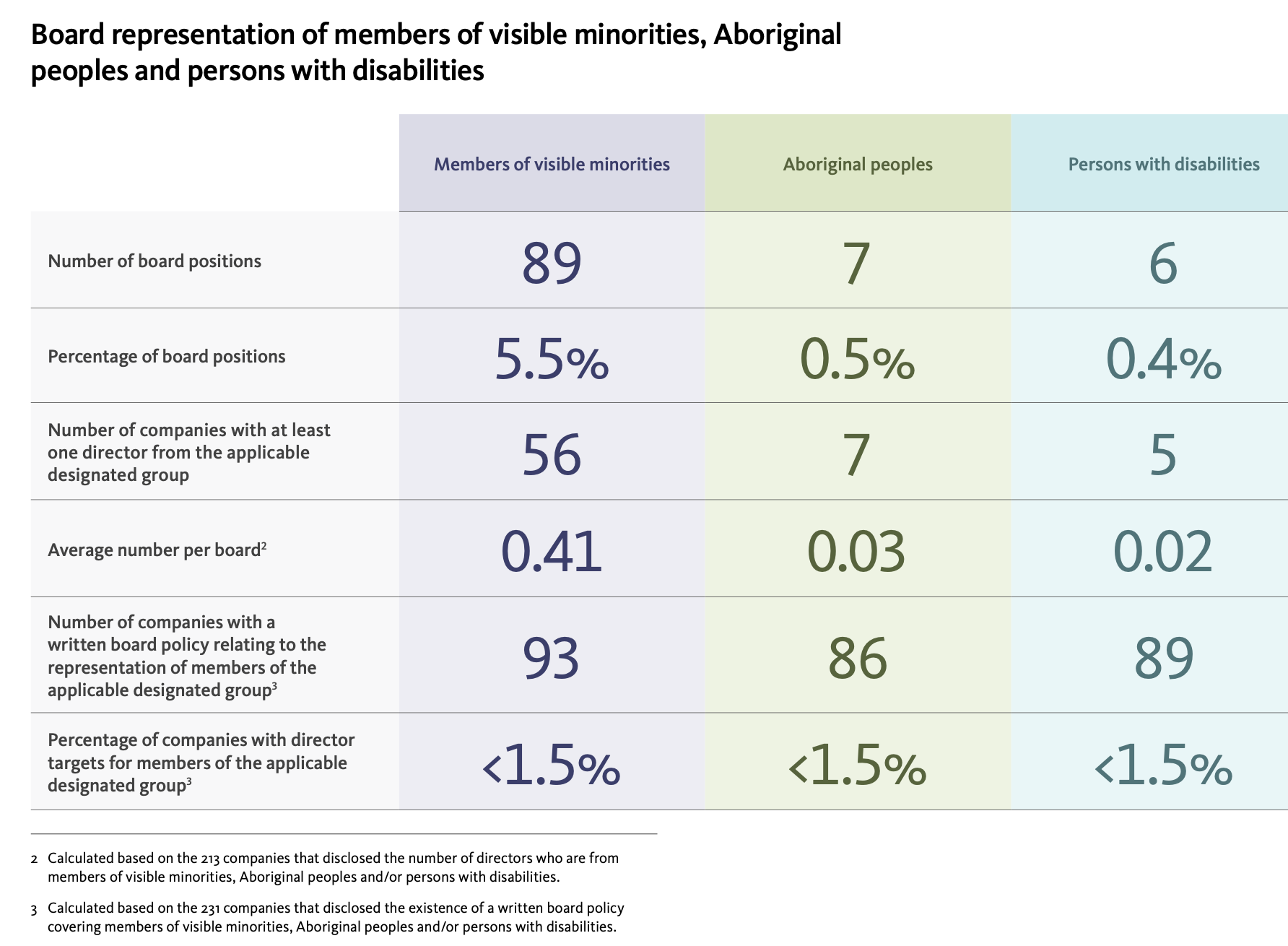
Our review of diversity disclosure by CBCA companies under the new CBCA requirements shows results on the representation of women that are comparable to those reported for TSX-listed issuers under the new CBCA requirements. However, there is a marked absence of directors from other diversity groups. Only 5.5% of the 217 disclosing CBCA company directors are visible minorities. And among the 2,023 board positions of the 270 CBCA companies that provided full or partial disclosure on their practices before July 31, 2020, there were only 7 positions held by Aboriginal peoples and only 6 positions held by persons with disabilities.

The key data tables:

Source: https://www.osler.com/osler/media/Osler/reports/corporate-governance/Diversity-and-Leadership-in-Corporate-Canada-2020.pdf

These Asian countries are giving dual citizens an ultimatum on nationality — and loyalty

Good overview:
 
Anna was born with the right to dual citizenship, because she has a Japanese mother and American father. She spent her life traveling between both countries, and says she felt deeply connected to the two cultures.
 
But Japan requires those with multiple passports to pick one by the age of 22 — an impossible choice for Anna, who requested a pseudonym for privacy reasons.
 
“I’m mixed race, I’ve lived both in Japan and the US, I speak both languages, I am completely split down the middle in terms of my identity,” she said. “It’s like asking someone whether they love their mother or father more. It’s such a cruel question.”
 
The past few decades have seen people travel and live abroad more, with the number of international migrants — people who changed their country of residence for at least a year — tripling from 1970 to 2015, according to the International Organization for Migration.
 
At the same time, tolerance to dual citizenship has generally increased. In 1960, less than one-third of countries allowed citizens to acquire a second nationality, compared to three-quarters today, according to a 2019 paper by Maartin Vink, professor of political sociology of Maastricht University in the Netherlands.
 
Asia is an exception to that trend. It is the world’s most restrictive region in terms of dual citizenship, with only 65% of countries and territories permitting it, according to the Maastricht Center for Citizenship, Migration and Development. To put that in perspective, 91% do in the Americas, which rank as the most liberal.
 
And some Asian countries are tightening their immigration laws. Japan reinforced its strict stance in January when a court upheld the country’s ban against dual citizenship, rejecting a lawsuit filed by Japanese citizens living in Europe. Hong Kong took a harder line in February, barring dual citizens from receiving consular protection — a step never before taken in the Chinese city, where dual citizenship is not legally allowed but had been tolerated.
 
“Dual nationality is not recognized in the Chinese Nationality Law,” said Hong Kong leader Carrie Lam in February. “That is very clear. We are strictly enforcing or implementing that particular policy.”
 
There are a number of reasons why the region is so resistant toward dual citizenship, including histories of conflict and colonialism. But in some countries, critics say the ban on dual citizenship also reflects a tilt toward nationalism — and the desire to maintain a monoethnic, monocultural identity.

Loyalty and nationalism

In Asia Pacific, only a few places accept dual citizenship with no caveats, including Cambodia, East Timor, Australia, New Zealand and Fiji.
 
Most countries are against it, although some choose not to strictly enforce their policies, allowing people to keep multiple passports by simply not declaring them. Others allow dual citizenship in restricted forms: the Philippines permits it for those who were born Filipino citizens, but not for naturalized Filipinos. South Korea allows children born to its nationals abroad to hold the passport of both their birth country and their parents.
 
One reason why many Asian countries oppose dual nationality is a belief that it can create divided loyalties among citizens, said Jelena Dzankic, co-director of the Global Citizenship Observatory (GLOBALCIT), an international citizenship research network. “The reason why, historically and traditionally, countries have not been permissive of dual nationality is because, whom are you going to defend if the two of our countries go to war?” she said.
 
Japan drafted its current nationality laws shortly after World War II, when many Japanese Americans were put in internment camps in the US; other dual citizens renounced their loyalty to the Japanese Emperor for their own safety, said Atsushi Kondo, a law professor at Japan’s Meijo University.
 
In one famous case, a US-born Japanese-American dual citizen worked in Japan for a company that oversaw American prisoners of war. Upon his return to the US after the war, he was sentenced to death on treason charges. He was eventually pardoned and deported to Japan — but for decades afterward, Japanese lawmakers pointed to this case as an example of the conflicting obligations that came with dual nationality.
 
“In wartime, double citizenship showed disadvantage,” Kondo said. “But in peacetime, dual citizens have many advantages” — including visa-free travel to more countries, greater international employment opportunities, potentially cheaper university education, and more. There are modern downsides, too — for instance, US dual citizens have to pay double taxation, but that’s not the case for most countries.
 
The international context has now changed, and Japan’s “beliefs are a little outdated,” he added — yet the government is reluctant to open up immigration laws and risk upsetting conservative voters.
 
China’s ban on dual nationality is also to ensure that its nationals are “only giving undivided loyalty to the government,” said Low Choo Chin, a history lecturer at the Universiti Sains Malaysia. During the Cold War era, China’s efforts to normalize relations with neighboring countries and end international isolation were hampered because “overseas Chinese were associated with revolutionary activities” and Communist uprisings, Low wrote in a 2016 paper. So, the Communist government formulated the current nationality law in 1980 to resolve “diplomatic frictions” and to “end divided loyalty among the overseas Chinese.”
 
Under Chinese President Xi Jinping, the government has cracked down on dual citizens, encouraging the public to report people secretly holding two passports. Those caught can find their access to public services curtailed.
 
The crackdown is part of the government’s anti-corruption efforts against “dual nationals taking advantage of the grey areas in the law, and trying to evade legal sanctions with (their) foreign nationality status … fleeing abroad, transferring their assets,” said Low, pointing to estimates by the Chinese central bank that 18,000 corrupt officials may have fled the country with 800 billion yuan ($122 billion) between the mid-1990s and 2008.
 
The matter of citizenship was thrust to the fore during the Covid-19 pandemic. In the midst of a crisis that transcended national boundaries, governments were suddenly faced with questions like: Which citizens do we claim as our own? For whom are we responsible? Who do we protect?
 
Because China doesn’t recognize dual citizenship, many Chinese nationals were forbidden from evacuating back to their country of second citizenship — even if that was their place of birth or primary residency.
 
There were cases of families split apart; one British woman was told she could not evacuate with her 3-year-old son because he has a Chinese passport, even though he is also a British citizen with a British passport. In the face of international pressure, the government eventually relented.

Ethnicity and blood

The idea of loyalty to a single country and culture, particularly in East Asia, may also “imply the desire to maintain a cohesive ethnocultural identity,” said Dzankic, of GLOBALCIT. Several of the countries that don’t allow dual citizenship are also highly homogenous — for instance, 92% of China is Han Chinese, according to the CIA’s World Factbook.
 
And one of the easiest ways for a country to control its ethnic makeup is through the type of citizenship it chooses to recognize.
 
There are multiple ways of obtaining a first, or second, citizenship, including through marriage, adoption and naturalization. But the most common ways are birthright citizenship (jus soli) — meaning babies automatically gain citizenship of the country they are born in — and through parental descent (jus sanguinis), which sees childrenautomatically gain the citizenship of their parents.
 
In Asia, the vast majority of countries today don’t recognize birthright citizenship, one of the quickest ways for ethnically foreign or minority populations to grow in a country.
 
Or if they do, it is so with certain conditions, according to GLOBALCIT. South Korea, for instance, only applies birthright citizenship for children whose parents are unknown or have no nationality — so if a child born on Korean soil has been abandoned, or its parents are stateless, it will receive Korean citizenship.
 
“A shift from jus soli to jus sanguinis has been witnessed in Asia in the course of the twentieth century,” wrote Olivier Vonk at the Maastricht Centre in a 2017 paper. Bangladesh, Indonesia, and India are among the countries that have transitioned to primarily recognizing citizenship by descent.
 
The type of citizenship recognized, and the rigidity of a country’s restrictions, influence how diverse or homogenous its population can be, said Kondo.
 
“South Korea was also a monoethnic country in the old days,” he said. “But they changed the policies, so they are more relaxed to double citizens now … And now they are considered multi-ethnic, or a multicultural country,” Kondo added.
 
South Korea liberalized its nationality law with sweeping amendments in 2010, which allowed permanent dual citizenship for its nationals for the first time (albeit under specific circumstances); dual citizens who fall outside those circumstances were given longer to choose; and a special naturalization path was created for talented individuals.
 
Japan remains strict in its nationality laws and is ethnically homogenous, said Kondo, though the government’s statistics don’t include an ethnic breakdown.
 
“Maybe ordinary Japanese (consider) ethnicity and citizenship as equal … Such a traditional feeling is strong in common Japanese,” he said.
 
Even some current politicians believe Japan “should be a monoethnic country,” he said.
 
Even the term jus sanguinis, citizenship by descent, implies ethnicity, said Anna, who is now based in the UK and declined to disclose her current citizenship status. The Latin translation means “right of blood,” and Japanese citizenship is built on this idea — so “the idea of blood is very strong in their understanding of citizenship.”
 
If a naturalized Japanese citizen who isn’t ethnically Japanese gives birth, that child would automatically become a Japanese citizen — but social attitudes and norms continue to draw lines around ethnicity, she said. There continues to be bullying in schools and a sense of social exclusion for biracial or mixed-race Japanese.
 
“It is this thought of blood purity … which is why even though I have Japanese citizenship, I’m not accepted as Japanese citizen in most cases because I’m not ‘purely’ Japanese as they would say … because I don’t look like them,” she said. “A lot of it is xenophobia. A lot of it is racism.”

Looking forward

The recent moves in China, Japan and Hong Kong suggest parts of Asia are moving further away from dual citizenship even as other parts of the world embrace it. Malawi, which had previously banned dual citizenship, amended its laws to allow it in 2019. Russia and Norway followed suit in 2020.
 
In Hong Kong, the future of dual citizenship is unclear. Though the government has insisted that it is taking a harder line in enforcement, it hasn’t provided information on what measures will be taken or how the city’s thousands of dual citizens will be affected.
 
“Maybe 70% of my friends have another passport,” said Janice Tam, a Hong Konger who also holds a British passport. She isn’t particularly worried about the government’s recent rhetoric — but “it depends on whether they force you to select one,” she said. “What is the consequence of that? If you’ve chosen your foreign passport, what do you still get if you stay in Hong Kong?”
 
Ella Wong, who holds Canadian and Hong Kong passports, is also “optimistic” that dual citizens might not be affected in their daily life. Her only concern is if Hong Kong continues to change its immigration laws to be similar to mainland China — or adopt mainland laws altogether.
 
“With the Hong Kong passport, you don’t know what it’s going to evolve into,” she said. “Could it become a Chinese passport, and then what does that mean in terms of travel and work and living?”
 
More broadly across Asia, most countries are unlikely to liberalize their laws anytime soon, said Low. The West “prioritizes liberalism, individual rights to (dual) nationality,” she said. “(But) in many Asian constitutions, access to citizenship is very tough for migrant communities because governments believe that the right to nationality is a privilege, not a right. In this context, it’s quite difficult to imagine that Asian governments would allow dual citizenship.”
 
Yet, experts and dual citizens remain hopeful that change will inevitably come as global migration grows. It takes time, said Vink, the Maastricht University professor.
 
And though they remain a minority, a few Asian countries have introduced new rules allowing for more flexible citizenship arrangements. India, for instance, created a new category of permanent residency in 2005 that allowed people of Indian descent to live and work in the country.
 
It’s still not dual citizenship — but it marked “a way of acknowledging the realities of a globalizing world and adapting to them step by step,” Dzankic said. “Even though countries are generally restrictive of dual citizenship, one could wonder whether those intermediate statuses could be a step or a move towards a more permissive policy.”
 
“I hope that the world will change,” she added. “What I think is essential or what will be important is a move towards dual nationality, not as a mechanism of being related to the state, but also as a mechanism for protecting individuals — for granting them greater life opportunities in the future.”
Source: These Asian countries are giving dual citizens an ultimatum on nationality — and loyalty

Asma al-Assad risks loss of British citizenship as she faces possible terror charges

While I don’t support revocation of citizenship in general, if the UK continues to believe in revocation, certainly Asma al-Assad is a legitimate candidate:

The British wife of Syria’s ruler, Bashar al-Assad, is facing possible terrorism charges and the loss of her British citizenship after the Metropolitan police opened a preliminary investigation into claims she has incited, aided and encouraged war crimes by Syrian government forces.

Asma al-Assad, 45, who was born and educated in London before becoming Syria’s first lady in 2000, is being investigated in response to legal complaints alleging her speeches and public appearances in support of the Syrian army implicate her in its crimes, including the use of chemical weapons.

Ten years into Syria’s ongoing civil war, the country’s military has been accused of deliberately attacking civilians, using starvation as a weapon of war and subjecting populations to rape and sexual violence, among other breaches of international humanitarian law.

Two UN commissions have concluded the regime has repeatedly deployed chemical weapons against civilians.

The Guardian understands the Met’s war crimes unit began its inquiries into Asma al-Assad earlier this year and is determining if there is enough evidence to launch a full investigation.

Source: Asma al-Assad risks loss of British citizenship as she faces possible terror charges

College campus follies

Good long read by my fried at AWAV.

Arun's avatarArun with a View

American college campus follies, to be precise. Hardly two weeks goes by, or so it seems of late, without some crazy story from a US college or university about an identity-related incident or protest by performative woke student activists. The latest we’ve learned about, which actually happened in 2018, is described in detail in a front page article in The New York Times, dated Feb. 25th, by national reporter Michael Powell—whose beat includes “issues around free speech and expression, and stories capturing intellectual and campus debate”—that carried the click-bait title “Inside a battle over race, class and power at Smith College: A student said she was racially profiled while eating in a college dorm. An investigation found no evidence of bias. But the incident will not fade away.” A great elite liberal arts college in a wonderful town (if I had had a proper academic career, I would…

View original post 5,042 more words