Asian-Americans Are Being Attacked. Why Are Hate Crime Charges So Rare?

Interesting analysis of some of the challenges:

On a cold evening last month, a Chinese man was walking home near Manhattan’s Chinatown neighborhood when a stranger suddenly ran up behind him and plunged a knife into his back.

For many Asian-Americans, the stabbing was horrifying, but not surprising. It was widely seen as just the latest example of racially targeted violence against Asians during the pandemic.

But the perpetrator, a 23-year-old man from Yemen, had not said a word to the victim before the attack, investigators said. Prosecutors determined they lacked enough evidence to prove a racist motive. The attacker was charged with attempted murder, but not as a hate crime.

The announcement outraged Asian-American leaders in New York City. Many of them protested outside the Manhattan district attorney’s office, demanding that the stabbing be prosecuted as a hate crime. They were tired of what they saw as racist assaults being overlooked by the authorities.

“Let’s call it what it is,” said Don Lee, a community activist who spoke at the rally. “These are not random attacks. We’re asking for recognition that these crimes are happening.”

The rally reflected the tortured public conversation over how to confront a rise in reports of violence against Asian-Americans, who have felt increasingly vulnerable with each new attack. Many incidents have either not led to arrests or have not been charged as hate crimes, making it difficult to capture with reliable data the extent to which Asian-Americans are being targeted.

That frustration erupted on a national scale this week after Robert Aaron Long, a white man, was charged with fatally shooting eight people, including six women of Asian descent, at spas in the Atlanta area on Tuesday night.

Investigators said it was too early to determine a motive. After Mr. Long’s arrest, he denied harboring a racial bias and told officials that he carried out the shootings as a form of vengeance for his “sexual addiction.”

The Atlanta shootings and other recent attacks have exposed difficult questions involved in proving a racist motive. Did the assaults just happen to involve Asian victims? Or did the attackers purposely single out Asians in an unspoken way that can never be presented as evidence in court?

Trudeau Sr. cabinet opposed payments to interned Japanese-Canadians

Not much new here in terms of the substance of former PM Trudeau and his Cabinet’s position but nevertheless of interest:

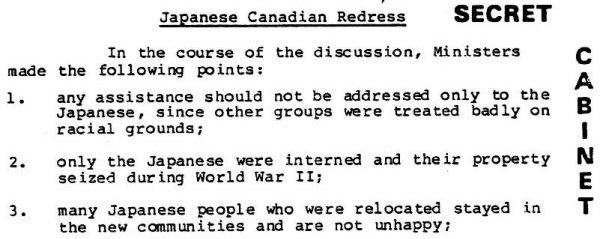
The cabinet of then-Prime Minister Pierre Trudeau opposed compensation for interned Japanese-Canadians because they didn’t seem unhappy, say secret documents.

The declassified documents, obtained by Blacklock’s Reporter, said the cabinet was concerned about the precedent it would set to give cash to people whose property was seized.

“Any assistance should not be addressed only to the Japanese since other groups were treated badly on racial grounds,” cabinet agreed at a confidential April 18, 1984 meeting.

The National Association of Japanese Canadians had sought for years settlement of claims over the seizure and forced sale of property in 1942.

About 22,000 Japanese, including Canadian citizens, were removed from the BC coast after the Pearl Harbour attack and taken to the interior, Alberta, Manitoba and northern Ontario.

The wartime cabinet invoked the War Measures Act and seizing more than $152.4 million worth of fishing boats, real estate and automobiles owned by Japanese-Canadians.

Then-Multiculturalism Minister David Collenette in a censored 1984 report to cabinet proposed a settlement of claims.

“Many Japanese people who were relocated stayed in the new communities and were not unhappy,” said Cabinet Minutes.

“A nation cannot go back and wipe out the past, it should look forward. A more general approach should be taken, if anything is to be done.”

“All minorities will feel they should have a right to redress. Any resolution in the House of Commons should not be related to a single group.”

Cabinet said instead of compensating Japanese-Canadians, “other ways should be looked at, for example endowing chairs at universities,” said Minutes.

“In concluding, Ministers expressed the wish that the Minister (of Multiculturalism) look at the issue again and have it discussed in the cabinet committee on social development.”

Trudeau, Sr. at the time also publicly opposed any apology or compensation for the wartime internment.

“I’m not inclined to envisage questions of compensation about acts which have maybe discoloured our history in the past,” Trudeau told the Commons.

“I’m not sure where we would stop in compensating.”

The Liberal cabinet lost re-election five months later without settling the issue.

When Prime Minister Brian Mulroney was elected, in 1he 988 formally apologized for the wartime internment and approved $21,000 in compensation to some 6,000 surviving internees.

“All Canadians know apologies are inadequate,” Mulroney said at the time.

Japanese were interned under a 1942 order that demanded “all property situated in any protected area of British Columbia belonging to any person of the Japanese race be delivered up” for sale by federal agents.

Japanese-Canadians did not regain the right to vote until 1949.

Source: Trudeau Sr. cabinet opposed payments to interned Japanese-Canadians

Cross and Taylor: Lies, Damned Lies, And Race-Based Statistics

Reading this commentary reminded me of an anecdote that I can’t unfortunately locate: former PM Harper’s decision to replace the mandatory census with the voluntary, and less accurate, National Household Survey in 20ll was driven in part by the data being used by academics, advocates and activists as a basis for more progressive policies.

The alternative, as Cross and Taylor appear to advocate, is not to have visible minority breakdowns in the labour force survey to avoid this use of data. To my mind, it is a head in the sand approach as such data is needed to understand how well Canadian society is working in terms of economic integration.

COVID-19 has demonstrated the various inequalities between different groups. The regular censuses have also captured these inequalities as well so expanding this to the labour force survey (and public service employment equity reports) is consistent with long-standing practice.

To my mind, issues lie more with respect to how the disparities are interpreted, whether narrowly or looking at the range of factors that influence these disparities.

For example, when I look at public service employment equity data, groups that have lower levels of educational attainment (e.g., Blacks, Latin Americans) are less represented among occupations requiring university degrees. This disparity, of course, likely reflects in part earlier barriers and discrimination encountered by those groups (e.g., streaming of Blacks into non-academic streams, recently addressed by the Ford government).

Disaggregated date is need to be aware of disparities and point towards questions regarding the reasons for these disparities, and assess the degree to which policy interventions, and which kinds, may be warranted.

To their credit, Cross and Taylor do some analysis, looking at occupations and visible minorities, highlighting that Koreans, Filipinos and Southeast Asians are more concentrated in the accommodation and food service industry than not visible minorities as an explanation of why these groups were more affected by COVID-19 lockdowns.

But it is ingenuous, at best, to present socioeconomic circumstances as completely unrelated to barriers faced by some groups.

And of course, the data will be used and sometimes misused by advocates and activists, and one could argue that Cross and Taylor are equally and legitimately using data to support their position.

But curious for a former statistician to be arguing for less data and thus less needed information for evidence-based policy. And using France as a model?:

Since July, Statistics Canada has been publishing labour-market data divided into 12 ethnocultural categories including Chinese, South Asian, Southeast Asian, West Asian, Korean, Japanese, Arab, Black, Filipino, Latin American, White, and Others. Sliced this way, Statcan’s figures reveal the unsurprising fact that unemployment is unevenly distributed across Canada’s racial populations, just as it varies by region, gender and age. The adult Canadian unemployment rate in January was 9.4 percent, but 20.1 percent for Southeast Asians, 16.4 percent for Blacks and 16.6 percent for Latin American Canadians. “Others” had a slightly-better-than-average unemployment rate of 8.9 percent.

This move to produce racially-specific labour-market data may well have been inevitable, given the intersectional enthusiasms of Prime Minister Justin Trudeau, who recently declared his next budget will be an explicitly “feminist”document. It also follows logically from his government’s creation of Statcan’s Centre for Gender, Diversity and Inclusion Statistics in 2018. Equally predictable is the effect this new information has had on public discourse.

The release of race-based labour-market data has provided further fuel to the ascendent view that Canada is an inherently unfair and racist country. Lobby groups and organizations representing the various racial groupsidentified by Statcan have latched onto the new data to back up claims regarding the “negative labour market impact of racism on Black youth” and other collective sins aimed at Canadian society. The figures are also frequently held as proof that employment equity programs and other government market interventions must be scaled to industrial proportions to eliminate the discrimination baked into Canada’s labour market.

But when it comes to fomenting outrage, Statcan is just getting started. In a recent commentary in The Globe and Mail, Anil Arora, Chief Statistician at Statistics Canada, explained his organization’s intention to double down on the collection and dissemination of race-based data. Because the initial effort last July revealed such glaring “racial disparities”, he wrote, Statcan will now be using “data from varying lenses…to measure those inequalities and track the progress being made to address them.”

French law specifically forbids INSEE from processing or analyzing data regarding “ethno-racial classifications” because it could violate constitutional requirements that all citizens must be treated equally.Tweet

As exciting and progressive as all this may seem, however, Statcan should tread carefully. Collecting race data is inherently contentious and divisive, something all national statistical agencies must recognize. While the United States has a long history of collecting very detailed race-based data, others such as France’s Institut national de la statistique et des études économiques (INSEE) do not disseminate any race statistics. In fact, French law specifically forbids INSEE from processing or analyzing data regarding “ethno-racial classifications” because it could violate constitutional requirements that all citizens must be treated equally “without distinction of origin, race or religion.”

As we shall see, unequal racial outcomes revealed by national statistics do not necessarily prove racism, and often lead to intractable debates. This is especially so in a country like Canada, where there’s a large overlap between visible minorities and immigrants who historically take years to match the outcomes for Canadians born in the country. Feeding a culture of grievance that denies any role for cultural differences in generating observed inequality can, paradoxically, perpetuate unequal racial outcomes. And as the state of affairs in the U.S. suggests, a surfeit of race-based statistics is no guarantee of racial harmony.

Neither is Statcan exempt from the principle of opportunity cost. Collecting one set of data inevitably means foregoing others – some of which may be of greater value. For years, researchers from social policy groups such as Cardus have asked for better data on how marital status affects employment and income. This would provide more detail on the important role played by family in the labour market. Yet these requests have long been ignored for cost reasons. Statcan presumably has better things to do with its limited resources. Now, however, in the middle of a pandemic, the agency has suddenly discovered the means to produce divisive race-based unemployment data.

Pandemic and Race

There are many pitfalls and risks associated with attributing different outcomes experienced by different racial groups exclusively to race, especially when these accusations are based on superficial statistics. In its July 2020 labour market report that, for the first time, segmented unemployment by race, Statcan itself noted that the top line figures showing poorer outcomes for most visible minorities categories reflected, in large part, the tendency of certain racial groups to work in industries deeply affected by the pandemic.

For example, 19.1 percent of Koreans, 14.2 percent of Filipinos and 14.0 percent of Southeast Asians were employed in the accommodation and food industry, according to the 2016 Census, compared with only 5.9 percent of Whites. Given the dramatic effect the pandemic-related lockdowns and other measures have had on the hospitality sector, it seems reasonable to conclude that race played little or no role in these unequal outcomes. Rather, it was the circumstances of the industries they were working in.

It has also been widely reported that different racial groups contract Covid-19 at different rates. Some concluded that this was because these groups are particularly disadvantaged by a racist society, while others wondered whether particular racial groups might have a different genetic susceptibility to the virus. As a recent U.S. National Bureau of Economic Research study warns, merely noting differences among racial groups without knowing their source means “the political discourse can gravitate toward ‘biologic explanations’ or explanations based on racial stereotypes which are harmful in themselves and get in the way of policy solutions.” The same study made plain that it was the socio-economic circumstances of particular groups that affected their exposure to the virus. This was due to working in particular industries and using public transit, which increased their contact with other people and, in turn, led to a higher rate of infection. Once the data was corrected for these variables, visible minorities in the U.S. were found to be no more susceptible to the virus than whites.

Given how easily some data can be misinterpreted or misrepresented, it would seem that Statcan has a clear responsibility to caution users about its proper use. Figures regarding the distribution of federal government revenues and spending by province, for example, are regularly twisted by politically-motivated analysts and governments. As a result, Statcan published an article in 2007 offering a detailed explanation for why these statistics should not be considered a scorecard for which provinces are gaining or losing from their dealings with the federal government.

Much of the current debate over racism in Canada arises from the presumption that all aspects of life should be perfectly evenly distributed, and that any deviation from pure equality must be considered prima facie evidence of systemic racism. Tweet

It is, accordingly, curious that these new race-based labour-market figures do not come with a similar warning; race data is far more emotionally and politically incendiary than provincial fiscal data. It is also surprising that Statcan did not directly address the issues raised by France’s refusal to collect race-based data.

Racism of the Gaps

Much of the current debate over racism in Canada arises from the relatively recent presumption that all aspects of life should be perfectly evenly distributed, and that any deviation from pure equality (a term also recently redefined from equality of opportunity to sameness of outcomes) must be considered prima facie evidence of systemic racism. With dizzying speed, this eminently contestable claim has been elevated nearly to conventional wisdom.

In an insightful commentary published earlier this month by the Macdonald-Laurier Institute, Vancouver-based writer Sonia Orlu tackled head-on the notion that “any disparity in outcomes between blacks and whites is the direct result of racism, as opposed to class differences, culture, personal ‘(ir)responsibility,’ or any other myriad of situational factors.” As Orlu, who is black, points out, this “racism of the gaps” generally relies on surface-level observations lacking in context or detail.

Nowhere is this assumption more explosive than regarding claims that members of visible minorities are disproportionately targeted, arrested or killed by police. As Orlu points out, a case for systemic racism in policing can only be proven with detailed race-based data showing police interactions as a share of the overall criminal population, rather than the population at large. While racism may create the conditions in which visible minorities commit more crime, simply arresting more visible minorities is not, in and of itself, proof police are acting with racist intent.

Orlu notes, however, that Canada does not collect the sophisticated race-based data necessary to come to an informed observation on this heated topic. With only the most basic statistics available regarding race, arrests and incarcerations, it is easy to conclude that police actions are driven by racism rather than other factors. And even when detailed race and crime evidence is available, as it is in the U.S., Orlu points out it is generally ignored by the media and public because it does not align with popular “anti-racism ideology” narratives. More information, in this case, does not produce a better debate or better decisions.

This problem is further illuminated by economist Tim Harford in his fascinating new book The Data Detective. Harford offers the example of an algorithm called COMPAS (Correctional Offender Management Profiling for Alternative Sanctions) used in the U.S. to predict the probability of a criminal being re-arrested. Because the algorithm produced racially disparate results – giving higher probabilities for blacks to be re-arrested than whites under similar circumstances – it was accused of perpetuating systemic racism. And yet the algorithm itself was colour-blind; race was not an input factor.

A detailed investigation by a team of statisticians revealed that the differing results were the product of members of different races behaving differently and/or living in different neighborhoods. As Harford concluded, “The only way in which an algorithm could be constructed to produce equal results for different groups…would be if the groups otherwise behaved and were treated identically.” Such an outcome adds evidence to the proposition that unequal results between races do not prove racism if behaviour and circumstances differ.

Examples of the racism gap fallacy are in ample supply elsewhere. Last month, for example, Akim Aliu, a former NHL player and founding member of the lobby group Hockey Diversity Alliance, claimed that an observed lack of racial diversity in the National Hockey League could only have one possible source. “There are still owners in the league who don’t even believe [racism] is a problem,” Aliu complained to Reuters in a Black History Month article. “To me that is just unfathomable, 95 per cent of your league is white and you don’t see there is an issue of race.”

Yet visible minorities make up a vast majority of the lineups in many other sports. The National Basketball Association is 74 percent black, and the National Football League 68 percent. While the Canadian Football League does not provide readily-accessible race-based statistics, the number of black players in this league also appears to far exceed representation in the general population. Should all this be taken as self-evident proof that football and basketball are equally prejudiced, but in favour of visible minorities? Of course not.

In another fixation on gaps, Statcan’s Arora in his Globe and Mail commentary emphasizes the importance of moving “toward levelling the uneven economic playing field”, citing the unequal unemployment and poverty rates among immigrant women as a key example. It must be noted, however, that there is a large overlap in Canada between visible minorities and immigrants. The lagging labour market outcomes for visible minorities and other Canadians reflect the long-standing challenges of immigrants establishing themselves in Canada.

In 2016, for example, Canada admitted thousands of Syrian refugees, many with limited education and little or no knowledge of either of Canada’s official languages. Do inferior incomes and more joblessness among the women of this group in the short time since they arrived prove the “playing field” in Canada is uneven? Inferior outcomes for some players don’t necessarily indicate a tilted field, it may merely demonstrate that they were sent out onto the field without the skills and training needed to compete. It is also worth remembering that the prevalence of poverty and inequality of income is much greater in the countries most immigrants come from, than is their inequality compared with native-born Canadians.

 The Inconvenient Truth that some Minority Groups Outperform the Majority

Racism – defined as the presence of deep-seated prejudices that affect individual and collective behaviour – certainly exists in Canada, as it does in all countries. And wherever present, it should be challenged and overcome. That said, collecting race-based data may not contribute to that worthy goal at all. It could instead cultivate a mentality of grievance and entitlement that undermines the impetus for individuals to strive to achieve more for themselves and their children. Look how easy it was for Aliu, for example, to take a simple statistic regarding the race of NHL players and turn it into a bitter accusation.

Arora’s recent Globe commentary, meanwhile, laments the “many economic challenges facing racialized populations, Indigenous people, persons with disabilities and other marginalized groups” as proof of the need for Statcan’s big move into race data. But might it not be more useful to study how certain minority groups have overcome even-greater challenges in the past? Few groups have suffered more persecution and discrimination than Jews, yet their internal culture enabled Jewish people to achieve superior results in multiple fields of endeavour in country after country. Japanese Canadians are another example, overcoming their forcible removal from their homes to be quarantined in remote camps during the Second World War, and going on to achieve one of the highest income levels of any racial group.

It is too easy to dismiss the achievements of certain races or ethnic groups as the result of advantages and privileges. While the lagging performance of some visible minorities is automatically assumed to be evidence of Canada’s innate racism, the opposite conclusion is never drawn from the superior results displayed by other minority groups (such as Chinese, to use Statcan’s terminology) in terms of employment, scholastic achievement or avoidance of crime. Looking south of the border, pre-Covid U.S. Census Bureau data revealed that the real median household income of Asian-Americans is nearly 30 percent higher than that of whites.

Thomas Sowell, the renowned black economist at the prestigious Hoover Institution at Stanford University, has written extensively on the use and misuse of race-based data. His insights on the importance of the culture internalized within racial groups provides a good lesson on the pitfalls of superficial interpretations of race data. As Sowell observed in his 2013 book Intellectuals and Race: “Different races, after all, developed in different parts of the world, in very different geographical settings, which presented very different opportunities and restrictions on their economic and cultural evolution over a period of centuries.” Further, people tend to blame racial differences on bias, which ignores “internal explanations of intergroup differences in favor of external explanations.”

As Sowell noted wryly in his 1996 book Black Rednecks and White Liberals, “all things are the same except for the differences, and different except for the similarities.” Given current demands for diversity in all things, he was observing, why should anyone expect identical outcomes as a result? Perhaps that comment should be attached to every Statcan press release on racial differences in the labour force survey.

The Politics of Distribution Versus the Economics of Growth

There is a growing sense of malaise in Canada, including worry that we are falling well short of our economic potential. Our political and economic leaders ought to be focusing on creating the macroeconomic and cultural conditions wherein all groups can thrive. Instead, our country’s growing fixation on racial issues – including the collection of race data – invites policymakers to think in terms of improving Canada one micro-group at a time.

We have already seen its nefarious impact. The most salient fact of the Covid-19 pandemic has been its devastating impact on all of Canada, with 5.5 million people losing their jobs or having their work severely curtailed in the spring of 2020. Rather than proposing general solutions to support growth and allow the reopening of the economy, numerous special interest groups have used the pandemic as an excuse to advance their particular pet policy projects, re-packaging old proposals that have circulated for years or decades to “solve” a once-in-a-lifetime crisis. The ideas include greater provision of day care, universal basic income, universal Pharmacare, extended employer-paid sick leave and so on, almost ad infinitum, as if budget constraints no longer existed.

The greater influence of broad economic conditions than specific social policies is revealed by Arora’s own reference to the “significant progress” visible minorities were making towards equality before the pandemic set them back. He cited a sharp drop in poverty and “rapidly rising employment rates among working-age immigrant women” as evidence of this happy situation. Such pre-pandemic levels of achievement – closing numerous gaps with the rest of society – was not the product of programs targeting specific aggrieved minority groups, but the result of an improving and robust economy-at-large. As Canada as a whole grows, its gaps shrink.

The best way to resuscitate the fortunes of visible minorities is the same as for all other Canadians: reopen the economy as quickly as possible and adopt policies and attitudes aimed at supporting long-term economic growth. Tweet

The same phenomenon was in even greater evidence in the U.S., where wage gains in 2019 were led by the lowest wage-earners, especially visible minorities. In recognition of this, more Latino and black voters cast ballots for Donald Trump last November than in 2016, despite his obvious negative attributes. The clear lesson is that better macroeconomic policy and economic growth always outweigh the impact of targeted government programs.

It is important to remember that the reversal of fortunes for minorities during the pandemic was because our economy was struck by the economic equivalent of a thermonuclear device, not because Canada overnight became more racist. The best way to resuscitate the fortunes of visible minorities, therefore, is the same way as for all other Canadians: reopen the economy as quickly as possible and adopt policies and attitudes aimed at supporting long-term economic growth.

Statcan’s new race-based data invites the facile conclusion that one group’s success explains another group’s relative failure and justifies its grievance. And our faltering economic growth reinforces the sterile view that the size of the economic pie is fixed and any gain by one group comes at the expense of others. The result is a focus on the politics of distribution instead of the economics of growth.

To be fair, Statcan did a lot of good work in response to the pandemic. This includes flash estimates of GDP, adjustments to how it measures labour under-utilization, more timely data on firm turnover, and innovative ways to track population mobility during a lockdown. The agency’s recent move into race-based data does not, however, rank among these useful innovations. And its effects may outlast all the others due to the appeal it holds for groups dedicated to fanning the flames of internal complaint.

With race-based data now being widely disseminated, this process may be unstoppable. Any move to cut off funding for this project will be widely condemned by the many vocal advocates of the “race industry”. Canadians should thus prepare themselves for a steady stream of studies in the coming years declaring the presence of gaps that allegedly prove the existence of systemic racism, but which tell us nothing about their origin or the best way to reduce them. All this is an unfortunate but costly distraction from the bigger and more important issues of innovation, investment and entrepreneurship that will be necessary to restore an economy that will benefit all Canadians – of every race and colour.

Philip Cross is a senior fellow of the Macdonald-Laurier Institute and the former chief economic analyst at Statistics Canada. Peter Shawn Taylor is senior features editor of C2C Journal.
Source: https://c2cjournal.us19.list-manage.com/track/click?u=e8efce716429c34122979e2de&id=ca577642d5&e=4174a59277

COVID-19 Immigration Effects January 2021 Update

Regular monthly update showing the impact of government using temporary residents as a major “inventory” for permanent residents. Highlights:

  • January immigration increased, reflecting government decision to use inventory of temporary residents to transition to permanent residency. The reduction of Canadian Experience Class Express Entry minimal score further demonstration of government intent. 
  • PRs: Admissions increased from 10,070 in December to 24,650 in January. January Year-over-year decline: Economic 5.5%, Family 24.8%. Refugees increase of 68.1% 
  • Permanent Residents Applications: Decrease from 17,376 in December to 15,613 in January. January year-over-year decrease 41.3% 
  • Web “Immigrate to Canada”: Largely flat, from 62,161 in January to 64,507 in February. February year-over-year increase of 9.3% 
  • Provincial Nominee Program: Increase from 1,475 in December to 6,355 in January. January year-over-year increase: 26.72% 
  • TR to PRs transition (i.e., those already in Canada): Dramatic increase from 2,725 in December (some double counting) to 12,990 in January. January Year-over-year increase of 41.8% 
  • Temporary Residents IMP: Increase from 29,885 in December (post-grad employment slightly less than half) to 31,605 in January. January Year-over-year change: Agreements increase of 26.9%, Canadian Interests increase of 44.9% 
  • Temporary Residents TFWP: Increase from 6,490 in December to 10,695 in January. January year-over-year increase: Caregivers 74.4%, Agriculture 42.8% and Other LMIA 34.6%. 
  • Web “Get a work permit”: From 73,343 in January (outside Canada) to 58,958 in February. February Year-over-year decline: 24.9% 
  • Students: Increase from 24,775 in December to 27,690 in January. January year-over-year increase of 9.1% 
  • Study Permit Applications: Decline from 36,946 in December to 27,735 in January. January Year-over-year decrease: 9.2% 
  • Web “Get a study permit”: From 62,161 in January (outside Canada) to 64,507 in February. Year-over-year increase: 9.3% 
  • Asylum Claimants: Small decline from 1,240 in December (about 75% inland) to 1,070 in January. January year-over-year decrease: 77.1% 
  • Settlement Services (NEW 2020 data December): Decline from 48,700 in November to 42,890 in December. December Year-over-year decrease 21.6 percent 
  • Web “Find immigrant services hear you”: From 11,076 in January to 8,201 in February (outside Canada). February Year-over-year decrease: 32.5% 
  • Citizenship: Small increase from 2,476 in December to 2,689 in January. January Year-over-year decrease: 89.2%. 2020 Application data pending 
  • Web “Apply for citizenship”: From 28,179 in January (outside Canada) to 20,965 in February. February Year-over-year decrease: 31.3% 
  • Visitor Visas: Decrease from 5,237 in December to 3,507 in January. January Year-over-year decrease: 94.4%

Pdf: https://multiculturalmeanderings.com/wp-content/uploads/2021/03/covid-19-immigration-effects-key-slides-january-2021-draft.pdf

Happy Nowruz/Eide-shoma mobarak

First day of spring!

German professor under police protection for stance on Islamophobia

Making distinctions and nuance matter rather than shutting down discussion:

“Fascists in our lecture halls! Dismiss Professor Kinzler! Islamophobia kills,” read the large banners hanging at the University of Grenoble. Activists from the French student union Unef also posted the slogans online.

Five months after the brutal murder of history teacher Samuel Paty, being accused of Islamophobia is not something that is taken lightly in France. Following a debate that sparked outrage at the Grenoble Institute of Political Studies, two professors are under police protection.

Here’s how it happened: 3 1/2 months ago, students and teachers at the university were discussing the title of a planned seminar on the topic of equality. Should “Islamophobia” be included alongside “anti-Semitism” and “racism”?

Professor Klaus Kinzler, who teaches German language and culture at the university, felt that Islamophobia wasn’t comparable to anti-Semitism. Following his advice to not include the term “Islamophobia” in the title of the seminar, he was excluded from the email discussion.

Incidentally, the Stuttgart-born professor is married to a Muslim woman.

When another professor showed solidarity with Kinzler, the student union Unef also targeted him.

France’s interior minister for citizenship, Marlene Schiappa, reacted to the case: After the decapitation of the teacher Samuel Paty, the current hate campaign against the professors is “a particularly disgusting act,” said Schiappa in a TV interview. The Unef has actively “put the life of professors in mortal danger,” she added.

A reflection of France’s integration problem

German historian and author Philipp Blom sees in France’s current discussions on Islamophobia a reflection of social issues related to the country’s position as a former colonial power, where strong “functional racism” rules.

The integration of immigrants from North Africa has failed blatantly, points out Blom. “In the banlieues on the outskirts of Paris, it doesn’t feel like you’re living in France. You don’t have the same opportunities as other people,” Blom told DW.

Experiencing marginalization and humiliation, an entire generation has come of age in milieus in which petty criminals and radical Islamists vie for domination. “I can understand that this creates anger, including murderous anger,” says Blom.

People were already calling for change in the ‘banlieues,’ or the outskirts of French cities, in 2005

But that is not a specifically French problem, adds the historian, who is also a member of the Board of Trustees of the Peace Prize of the German Book Trade. Still, the experience of humiliation is “a very important political force.”

Identity politics and cancel culture

Klaus Kinzler told German newspaper Die Welt that there is a form of political activism in France that disguises itself as academia.

Similarly, political scientist Claus Leggewie points out that those activists aren’t fighting against the powerful, the establishment, the far-right or the real fascists, but against people whose views are seen as “not being pro-Islamic enough.”

Leggewie describes the case as being about “canceling” specific persons, silencing them, and “banning ideas and discussions.”

Social media has also become the echo chamber of social identity groups, which are increasingly excluding people with other ideas. By staging controversies online, members of these groups gain immediate media recognition, says Leggewie. “That is exactly what has happened in Grenoble, and with Samuel Paty basically too, and in his case it was fatal,” adds the political expert.

Islamophobia versus anti-Semitism

Klaus Kinzler has been a professor at the Grenoble Institute of Political Studies for 25 years now. He was “not surprised” by the slogans on the university building, since the student union Unef had already branded him as a right-wing extremist and Islamophobe in social networks.

Racism and anti-Semitism — which are both criminal offenses in secular France — have nothing to do with Islamophobia, in Kinzler’s view.”Anti-Semitism has resulted in millions of deaths. Genocide without end. Then there is racism, slavery. That, too, has led to tens of millions of deaths in history,” he told Die Welt. “But where are the millions of deaths linked to Islamophobia?” he asked, nevertheless clarifying: “I do not deny that people of Muslim faith are discriminated against. I just refuse to put it on the same level. I think this is an absurd deception.”

Kinzler was a “completely normal professor of German at a provincial institute” and had always enjoyed his work, he told the Frankfurter Allgemeine Zeitung. Before the controversy, his students told him that they appreciated that he defended free, liberal positions. “The exchanges were always enriching,” he said.

In the end, he says, he is less offended by the students who launched the hate campaign than by his colleagues, researchers and professors — who have distanced themselves from him without searching for dialogue.

Source: German professor under police protection for stance on Islamophobia

‘Finnishness is more than blonde hair and blue eyes’

Of note:

Alice Jäske was sitting in the waiting room of her local health centre, waiting to get a plaster cast for her broken leg.

“I’ve got to ask, where are you from?” another patient asked her.

Jäske has lived in Finland all her life. All that time she has frequently had to prove that she really is Finnish, because she doesn’t look like the traditional image of a Nordic person. The question came as a blow.

“It’s frustrating. But to avoid an embarrassing situation and take the easy way out I once again told a complete stranger about my entire family background. My father is Finnish but my mother is from Taiwan,” Jäske says.

After getting her leg put in plaster the nurse complemented Jäske on her surprisingly good Finnish. As she left the clinic, Jäske was offered help – in English – by a passerby.

“In a very short time, in a completely everyday situation, my “Finnishness” was questioned three times. I understand that these comments weren’t meant to be offensive, but in my head it sounds as if there are “us Finns”, and that I don’t belong,” says Jäske.

That series of events is just one example of the microaggressions that Jäske has encountered her whole life. Microaggressions – whether intentional or unintentional – are words or actions that communicate hostile, negative or derogatory attitudes towards a person or people.

Jäske says she is sharing her story to try and change the world.

“The concept of Finnishness should be expanded to accommodate more people who look different, and not just blonde-haired, blue-eyed Elovena girls,” she says.

When praise isn’t praise

This week is Anti-Racism and Discrimination Week. People tend to think of racism as being when someone does or says something racist to another person. But discrimination can take many forms.

Something that sounds innocent can mark someone out as different. If a person constantly hears that they are somehow wrong or anomalous, they gradually begin to believe it themselves.

That’s what happened to Janina Ojala. As a girl, she felt a sense of shame and fear when her dad would tease her in Thai while they waited in line at the shop. Ojala hid from her friends the fact that her family ate with a fork and spoon at home, and not a knife and fork. She did her best to keep her Thai roots from attracting attention.

“Typically it’s comments about how lovely and thick my hair is, or how quickly my skin tans. One comment is not a problem, but when you hear things like these on a daily basis they have a big impact on how you see yourself,” Ojala explains.

The kinds of comments Ojala describes are known as “exoticisation”, comments that emphasise difference by attaching positive stereotypes to it. Ojala has lived in Finland her whole life, with her Finnish mother and Thai father.”Although now I’m older I consider multiculturalism to be enriching, in certain situations I still feel the need to present myself a certain way to others,” she says.

At university Ojala met others who had lived through similar experiences. With the support of her peers she finally felt able to embrace her Thai side. Now she wants to support others to do the same.

Together with Alice Jäske and Priska Niemi-Sampan, Ojala created “Mixed Finns“, an Instagram account which aims to provide support and information about being a mixed-race Finn.

Does someone’s appearance make them an immigrant?

As a child, Priska Niemi-Sampan felt just like the others, walking to school with her backpack on. Her family always spoke Finnish at home, even when they lived abroad due to her parent’s job as an aid worker.

But Priska was an unusual name, and the looks she inherited from her Filipino father drew attention. Soon, she found herself constantly answering questions about her “homeland”, about her language skills and her appearance. As far as society was concerned, the young girl was a foreigner.

“I felt for a long time that university wasn’t a place for someone that looks like me. I wasn’t encouraged to go by my school or my hobbies. The attitudes of the world around us have a huge impact on how a person sees their own potential,” Niemi-Sampan says.

A recent article in the journal Sosiologia (link in Finnish) by Anna Rastas, a researcher from Tampere University who specialises in studying racism and fellow researcher Sanna Poelman, says that the conversation about racism and racial identity in Finland still revolves around immigration.This is despite the fact that more and more Finnish people belong to ethnic minority groups.

There has been a concerted effort to eradicate racism in Finnish society since the time Niemi-Sampan was at school, but there is a still a lot of work to be done. In 2019 researchers at Helsinki University found job applicants with foreign-sounding names were less likely to be invited for job interviews than applicants with typically Finnish names.

Niemi-Sampan came across similar discrimination after going to university. She helped found the organisation Students of Colour which aims to stamp out racism in higher education. Now she wants to extend the support outside the world of academia.

“As a child I would have longed for support from my peers and now I want to offer young people a community where they can talk about these thoughts and feelings. Social media is a natural environment for reaching young people and sharing their experiences,” she says.

In the future, Mixed Finns also hopes to offer anti-racism training for various organisations.

A world where national identity is more than skin deep

Would Janina Ojala be able to speak Thai if she had dared practice it when she was a child? Would Priska Niemi-Sampan feel more self-confident if she hadn’t spent her life trying to escape notice? Would Alice Jäske know more about her mother’s culture if she hadn’t felt pressured to hide her Taiwanese-ness when she was younger?

Mixed Finns’s efforts may not change the world, but they represent a step towards a dream the three women share.

This dream is of a world where someone’s Finnish identity isn’t defined by the way they look, and where a person can belong to multiple cultures without being seen as an outsider to all of them.

The women also challenge Finns to think more carefully about what they say, because what seems like a compliment to one person might not always feel that way to another.

Source: ‘Finnishness is more than blonde hair and blue eyes’

Adopt anti-racism framework, urges Australian Human Rights Commission

Of note:

The Australian Human Rights Commission is calling on the federal government to implement its new plan for a national anti-racism framework.

The concept paper, released on Wednesday, outlines key components that need to be included in the framework. According to the paper, the framework must recognise and acknowledge Australia’s ancient Indigenous heritage, its British heritage, and its diverse multicultural heritage.

“A national framework should also acknowledge Australia’s geo-political location in the Asia-Pacific region in the ‘Asian century’ as well as being capable of embracing the history and circumstances of Australia’s diverse diaspora communities,” the paper said.

Race Discrimination Commissioner Chin Tan noted that recent events have shown that Australia is facing a resurgence in racism.

“The Black Lives Matter movement has highlighted injustices experienced by people from culturally diverse backgrounds and by Aboriginal and Torres Strait Islander peoples. The COVID-19 pandemic has exposed ugly racism against people of Asian descent here in Australia,” he said in a speech on Tuesday.

“And ASIO and the AFP have repeatedly identified home grown terrorism and extremism as a significant threat to the national security of Australia. It is also now just over two years since the terrible events in Christchurch, New Zealand, where an Australian man murdered 51 people, and attempted to murder another 40 people.”

Tan argued that it’s time to treat the “scourge of racism” in the same way that issues such as domestic violence and child abuse are treated.

“On those issues we have in place longstanding national frameworks, signed onto by all governments in Australia, with three-year action plans to target priority issues and make serious headway in addressing them,” he said.

“Let me be clear: racism is a significant economic, social and national security threat to Australia. It is time we treated it as such. We need a new approach to combatting racism — one that is more cohesive across government, that builds community partnerships to prevent racism from flourishing, and one that is smarter and more effective.”

The AHRC’s proposed national framework would do this, Tan said.

Source: Adopt anti-racism framework, urges Australian Human Rights Commission

Senator Omidvar: A Practical First Step to Distance Ourselves from the Monarchy

Senator Omidvar raises whether the citizenship oath should remain only the Queen (as the Crown in the institutional sense) or to Canada C-8, the bill broadening the oath to include Indigenous treaty rights is before Parliament. This raises the possibility of an amendment during the Senate review of the Bill, and an interesting and overdue debate.

(The Chrétien government considered amending the oath some 25 years ago but the PM nixed the idea given timing closing to the 1995 Quebec referendum: “I’m not sure I want to take on the separatists and the monarchists at the same time.”) Citizenship oath to Queen nearly nixed 20 years ago

Oprah Winfrey’s interview with Meghan Markle and Prince Harry has raised questions about Canada’s connection to the monarchy.

It’s a strong and deep connection that’s expressed in many ways, big and small: We have a Governor General who represents the Queen in Canada, we maintain a residence for the Queen in Ottawa, our currency bears the image of a monarch, and every so often we host a royal tour.

The Senate of Canada, which I am privileged to belong to, is likely the institution most steeped in the ritual and traditions of Westminster. The doors to the Senate chamber are opened every sitting by the Usher of the Black Rod, who carries an ebony cane as a symbol of royal authority. He’s followed by the mace-bearer, because, without the mace, the Senate cannot meet. As a senator, I must bow to the Queen every time I enter or leave the Senate chamber. Every bill passed in the Senate receives a “royal” assent.

Despite these traditions, calls to drop the Queen and the monarchy from Canada have grown louder. However, anyone who’s even the least bit pragmatic will realize that efforts to remove the monarchy will likely lead to a protracted conflict between the federal government and the provinces. The political risks would likely be too high.

So, if dropping the monarchy isn’t an option right now, what can be done to insert more Canadiana into our practices and traditions?

I would look to one of the most fundamental building blocks of Canada: the citizenship oath. I know this process well. In 1985, I took the oath of citizenship. It was a landmark day for me and my family, giving us the official enfranchisement to be Canadian in every way. But as someone who was born in post-colonial India, I couldn’t help but wonder why I was swearing my allegiance to a distant monarch. I know that many new Canadians wonder the same thing, especially those who come to this brave new world from countries that have suffered under the yoke of colonialism.

Since then, I’ve matured in my understanding of how Canada was built and how it works, and have come to appreciate our traditions and Constitution. However, I believe we should be swearing allegiance to Canada, not the Queen — or at least letting new Canadians choose to whom they swear their allegiance: the Queen or Canada.

Australia shed the sovereign from its citizenship oath in 1994, instead asking citizens to commit to Australia and its values. Sen. Philip Faulkner made the case for reinforcing the notion of an Australian citizenship. He noted that “Australian citizenship, with its attendant rights and obligations, is part of the glue which binds the nation and its citizens in a manner that gives adequate recognition to the reciprocity of that bond.”

Citizenship lies solely under federal jurisdiction. The oath can be changed simply by passing a bill through Parliament. It would require political will and leadership, but it’s within the realm of the possible.

This would demonstrate that Canada has come of age, is exerting more independence, and is ever so slightly breaking away from the troubling history of colonialism. It’s time for us to make our own traditions.

Source: http://www.ratnaomidvar.ca/a-practical-first-step-to-distance-ourselves-from-the-monarchy/

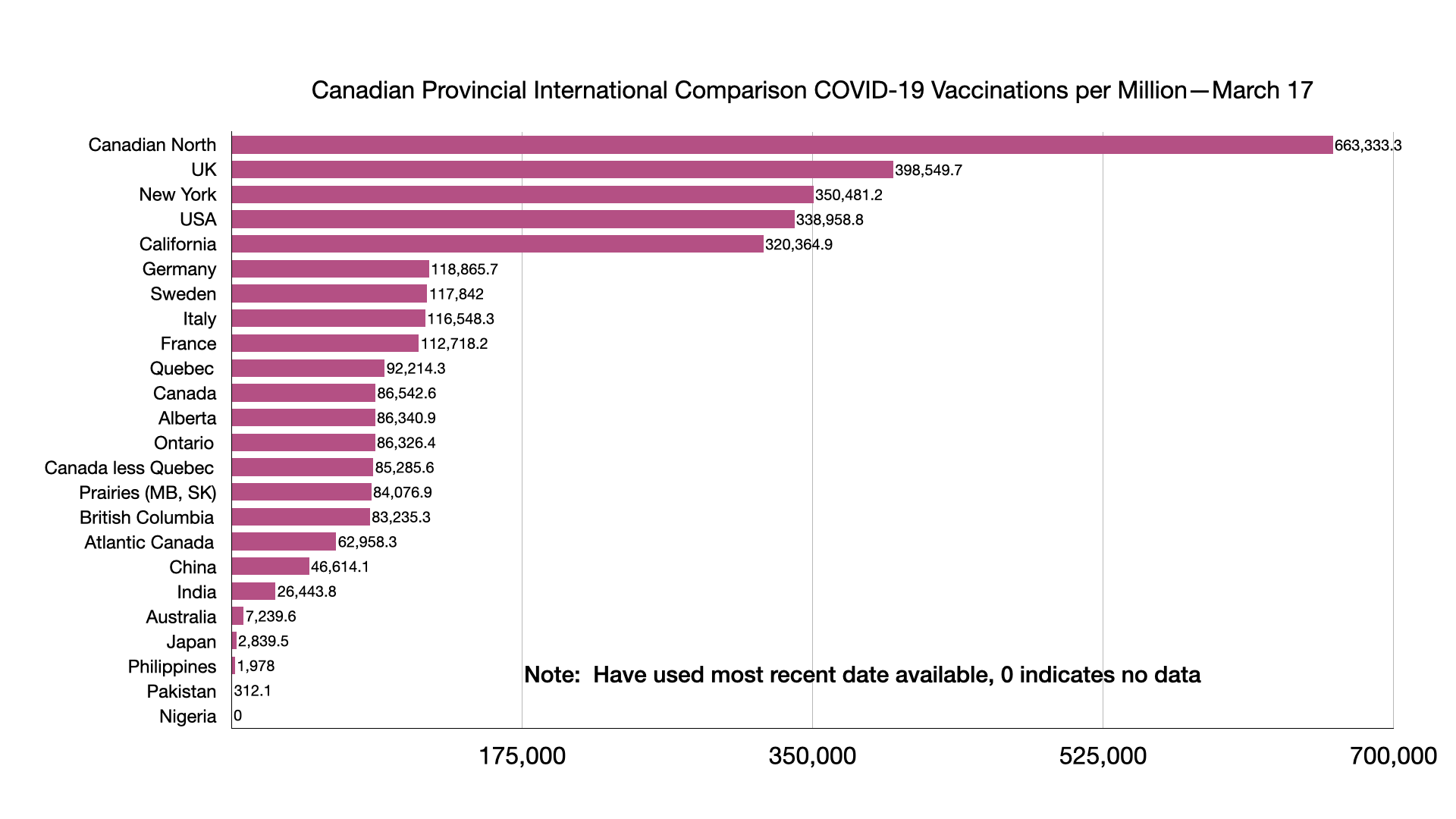
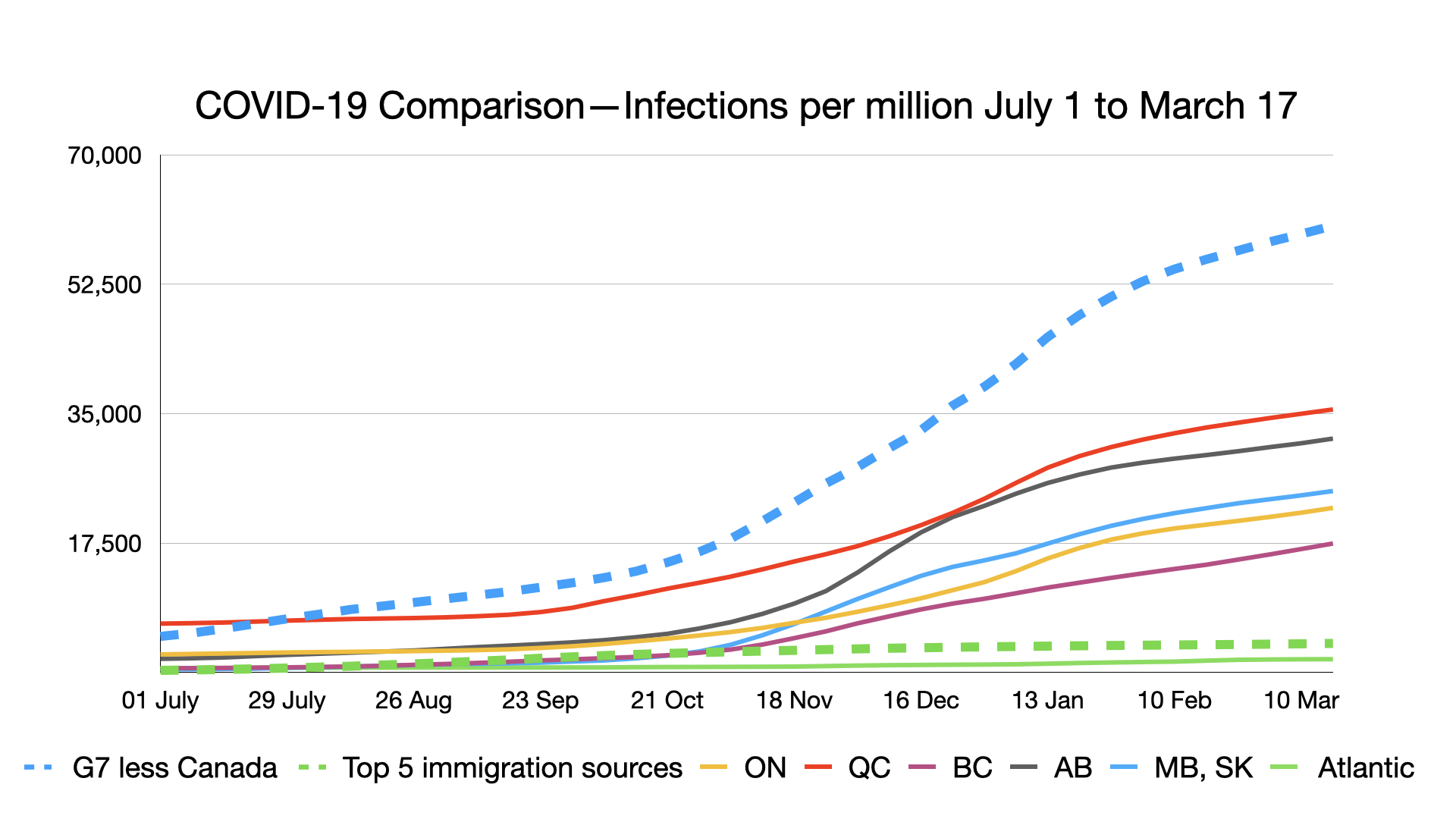
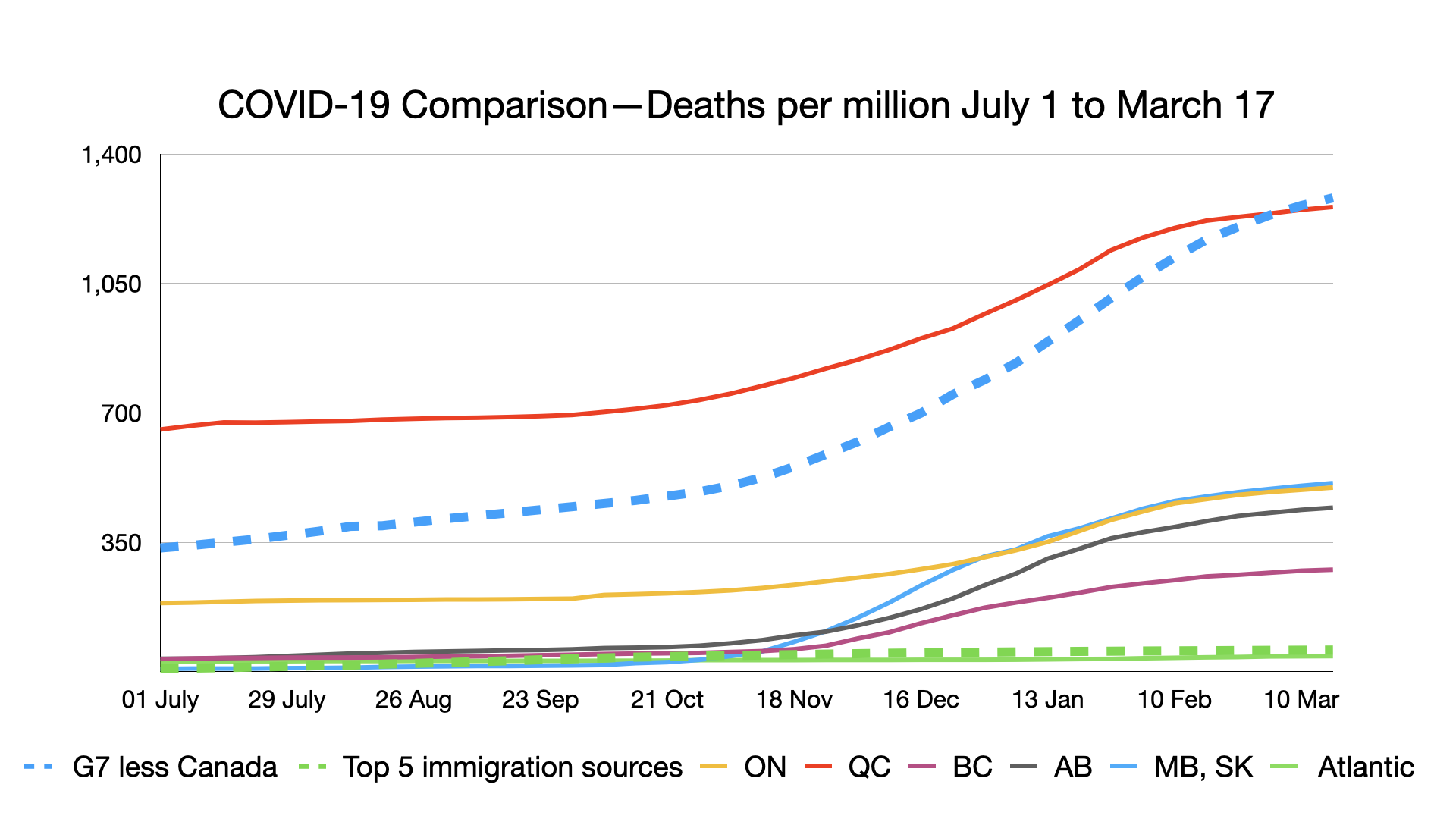
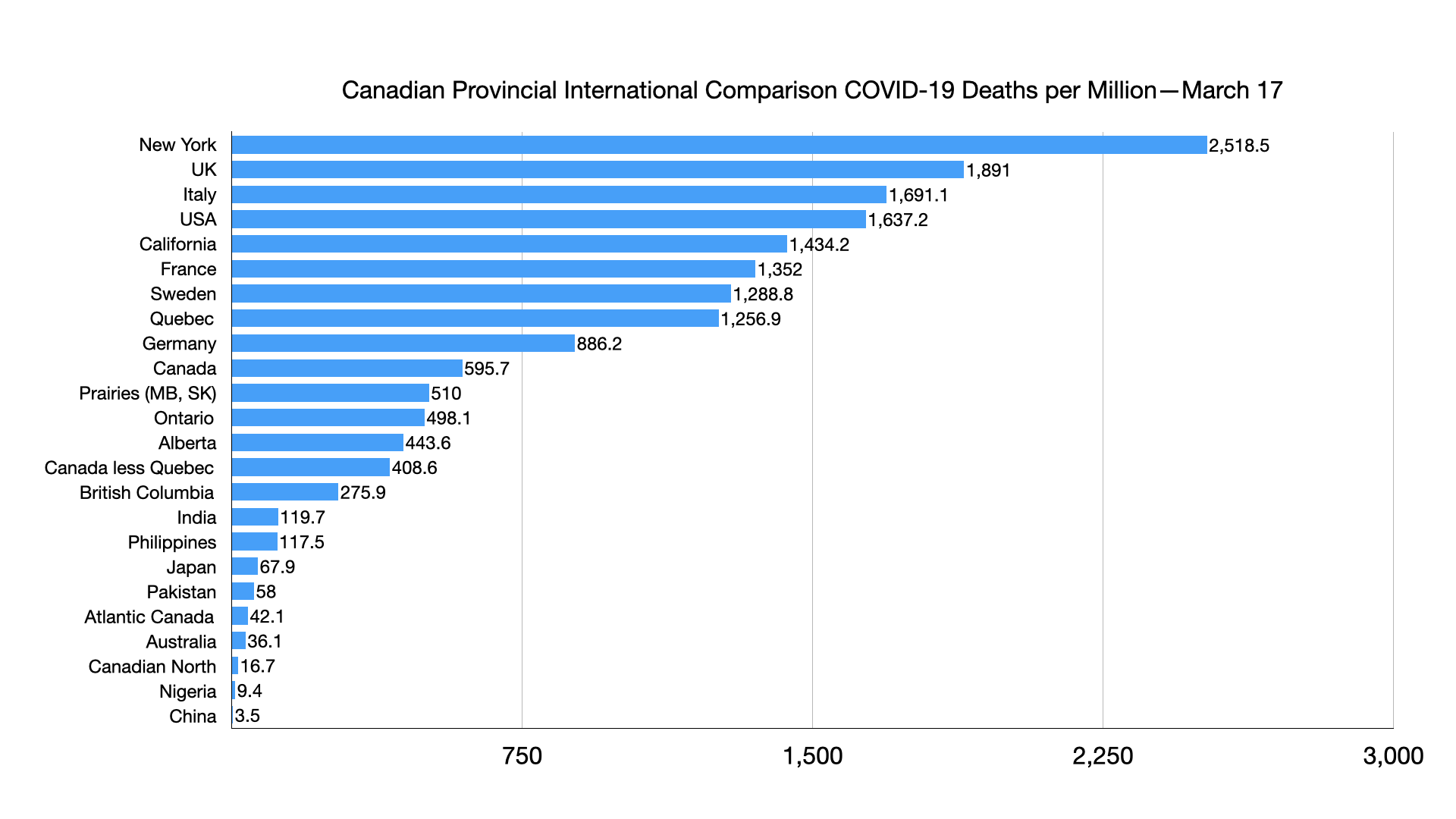
#COVID-19: Comparing provinces with other countries 17 March Update

The latest charts, compiled 17 March.

Vaccinations: The gap between all G7 countries save Japan continues to grow, all European countries ahead of Canada with no narrowing yet of the gap.

Trendline charts

Infections per million: The overall trend of a flattened curve is seen in G7 countries and most provinces.

Deaths per million: Most Canadian provinces continue to flatten the curve, Quebec most dramatically. Overall G7 death rate have surpassed Quebec’s.

Vaccinations per million: Gap between G7 and Canada remains despite the arrival of more vaccines.

Weekly

Infections per million: No relative change.

Deaths per million: No relative change