Equivocating over the existence of rightwing extremism will cost Australia dearly

Given Canadian debates over how to “label” different forms of extremism, interesting take on Australia’s shift towards more neutral but yet clear terminology:

Last week Australia’s spy boss sent ripples through the national security community with the announcement that Asio will shift from using “rightwing extremism” and “Islamic extremism” to using “ideological extremism” and “religious extremism”. In his second annual threat assessment, director general Mike Burgess told a Canberra audience that “words matter”, and the old words were no longer fit for purpose.

Words do matter. Burgess’ words in his first public address in 2020 which took aim at the extreme right wing, were lightning bolts in Australia’s post-Christchurch discourse. The organisation’s disclosure that 30-40% of its caseload was associated with these issues gave invaluable context to a public debate that was severely lacking.

While the quick pivot away from these terms took many by surprise, it has not happened in a vacuum. The change is similar to one undertaken by the Canadian Security Intelligence Service in 2020. Far from signalling the diminishing resolve of the country, Canada took the bold step of listing the Proud Boys on its terror register in February. Likewise, the US Office of the Director of National Intelligence published an unclassified memo dated 1 March 2021 which contained similar rhetorical shifts throughout. The memo, which warns more “racially motivated extremist attacks” will “almost certainly” take place in 2021, was in the process of being released to the public when a gunman shot and killed eight Asian Americans in Atlanta.

Following this year’s address, Burgess told Guardian Australia that political pressure did not factor in the organisation’s decision process. But as the director general acknowledges, the organisation doesn’t control or seek to control the way Australia’s leaders in politics and the media discuss these issues and this is where rhetoric plays its most important role.

Source: Equivocating over the existence of rightwing extremism will cost Australia dearly

Indigenous, Black youth spend more time in Ontario court system, according to report

Yet more evidence of system bias in our court system:

Young people charged with crimes in Ontario are waiting longer for their cases to be resolved, prolonging their time behind bars or extending onerous bail conditions – a situation that disproportionately affects Black and Indigenous youth.

The finding is part of a comprehensive report on youth bail by the John Howard Society of Ontario that is set for release on Tuesday. The research draws on provincial justice data and interviews with people who’ve endured the youth criminal-justice system.

The report, titled Unequal Justice, portrays a system that made huge advances after the passage of the Youth Criminal Justice Act in 2003, but has slipped of late in its treatment of a vulnerable subsection of the population.

Last year, The Globe and Mail found that racial bias pervades the adult correctional system as well. An investigation revealed that risk-assessment scores used to determine parole decisions, treatment plans and security classifications in adult federal prisons discriminated against Black and Indigenous inmates.

“Looking at young people, there’s an opportunity here, early on, to stop a lifetime of involvement with the justice system,” said Safiyah Husein, senior policy analyst with the John Howard Society of Ontario. “So if we are able to connect these children with the resources and supports they need early, then we can prevent them from cycling in and out of the justice system for the remainder of their lives.”

The Youth Criminal Justice Act, which applies to people between 12 and 17 years of age, has largely succeeded in doing just that. In 2000, Canada’s rate of youth incarceration was among the highest in the Western world, at 17.64 per 10,000. Today, it’s 3.79.

But those gains have come with huge racial disparities. The proportion of whites among youth in secure detention, the most restrictive form of youth custody, declined to 28 per cent from 39 per cent between 2006 and 2016. Over the same period, the rate remained flat for Indigenous prisoners, at about 10 per cent, and increased to 21 per cent from 19 per cent for Black inmates.

“The rate of youth detention has decreased overall since the implementation of the Youth Criminal Justice Act, but the question is, are those positive impacts being felt by all? They’re not,” said Fareeda Adam, staff lawyer at the Black Legal Action Centre. “And specifically Black and Indigenous youth are not seeing these benefits.”

John Howard researchers found some heartening news in the court data. For instance, they determined that around 59 per cent of youth cases in 2017 recorded a bail decision at the initial court appearance. However, the number of young people who have to appear before a court five or more times before receiving bail is on the rise, to 9 per cent of cases in 2017 from 5 per cent of cases in 2009.

And those appearances are becoming more spaced out. While five appearances equated to roughly 2½ weeks in custody as of 2006, it stretched out to three weeks by 2017.

While such a stint might seem short from the outside, just a few days in detention can shift a young person’s mindset permanently.

“Whether it’s group care or jail, the system teaches you to run away from people who do anything negative toward you, or physically fight them,” said Liam Smith, a 22-year-old Belleville-based youth peer mentor.

Mr. Smith helps teens navigate the criminal-justice system. He says many of them are encumbered with impossible bail conditions.

“They get these silly conditions like ‘keep a curfew’ and ‘keep peace and good behaviour,’ ” Mr. Smith said. “What happens if the court tells a kid he has to be somewhere at 9 o’clock but due to circumstances he can’t control, he doesn’t have a bed and has to sleep on the streets? That’s a bail breach. He can get arrested for that.”

Those bail breaches come with administration-of-justice charges that can further entrench a young person in the justice system, the report states.

The report calls for an end to such “boilerplate” bail conditions, an increase in funding for programs that divert youth from jail, a renewed focused on expediting release for detained youth and the adoption of a strategy to address the overrepresentation of Black and Indigenous youth in the justice system.

“Once we have a robust system of community-based alternatives to jail, we can fully realize the goals of the Youth Criminal Justice Act,” said Ms. Husein, the John Howard analyst.

Source: https://www.theglobeandmail.com/canada/article-indigenous-black-youth-spend-more-time-in-ontario-court-system/

Physical assaults, spitting on older people and children among soaring number of anti-Asian hate incidents reported in Canada

Of note. Shameful, whether directed against Asian Canadians or other minorities. Still waiting for 2019 police-reported hate crimes data to see what they captured (only have general by motivation and most serious violation, no breakdowns by group or religion):

Avvy Go was walking home from work on a summer day in Toronto last year when a group of young people blocked her route on the sidewalk.

Without a word, one person spat at her, the spittle landing at Go’s feet.

Horrified, Go yelled, “Excuse me!” but the group continued on, laughing among themselves.

“I was just taken aback. I was just stunned,” said Go, director of the Chinese and Southeast Asian Legal Clinic. “For some of us, every time we step out, we have to worry if we will be targeted again.”

Go’s fears are common: anti-Asian racism has been growing across the country, according to a new report released Tuesday by the Chinese Canadian National Council (CCNC) Toronto chapter, which for the first time details the nature of attacks that seem to have intensified during the COVID-19 pandemic. 

From verbal insults to physical assaults, including being spat upon, 643 complaints were submitted to the council’s online platforms from March 10 to Dec. 31, 2020. Overwhelmingly, these incidents were fuelled by false and racist beliefs about the spread of COVID-19, according to the study’s authors.

“In addition to the ways we know COVID transmits, the spitting and coughing symbolizes a revenge, as if an act of ‘Go back where you came from, where the virus came from,’” said Kennes Lin, a social worker and co-chair of the CCNC Toronto chapter, who was one of the report’s authors.

The document’s release comes just days after six Asian women were shot dead at multiple massage parlours in Atlanta, Ga. The March 16 killings prompted protests against anti-Asian racism in major cities in North America, including Montreal.

Canada has also witnessed an increase in anti-Asian racism. Last July, Statistics Canada reported that more than 30 per cent of Chinese Canadians perceive themselves to be at a higher risk of possible violence or harassment. In February, data released by Vancouver police showed a 717 per cent increase in anti-Asian hate crimes in the city last year.

While the majority of incidents in the CCNC report involved verbal harassment, close to 11 per cent of victims reported physical force being used against them and nearly 10 per cent said they were coughed or spat upon.

Notably, youth under 18 and adults age 55 and older were 233 per cent and 250 per cent more likely to be coughed and spat upon during a hate incident. Attacks described in the report range from a young child being thrown off a bicycle to an older woman being punched in the eye on public transit. https://datawrapper.dwcdn.net/M4w0F/1/

Other findings in the report include:

  • About 73 per cent of those who reported incidents said they suffered emotional harm or mental distress from what occurred. About eight per cent reported physical injuries. 
  • Individuals who reported an incident in a Chinese language as opposed to English were 34 per cent more like to suffer emotional distress from the incident and 100 per cent more likely to have experienced a physical assault.
  • Close to 50 per cent of incidents occurred in public spaces (park/street/sidewalk), while another 17 per cent took place in grocery stores or restaurants.

Though Go chose not to report the incident she experienced, as she felt nothing would come of it, hundreds of Asian Canadians have turned to community organizations like the CCNC and their partners to report racist incidents.

The council launched a web portal in March 2020 specifically because it was being inundated with calls about disturbing attacks across Canada in a way it hadn’t seen prior to the pandemic. Many said they were not comfortable reporting to law enforcement as there is a lack of trust or they feel they won’t be heard.

Another 507 hate incidents were logged on the site from Jan. 1 to Feb. 28 this year, but were not included in the analysis.

Go said the prevalence of spitting and coughing toward Asian people in Canada is due to the false, racist belief that Asian people are responsible for bringing COVID-19 to the country. 

“It’s almost like this is the way of saying: You give me the virus, I’m giving it back to you,” she said. Go was one of many individuals who provided an initial review of the CCNC report.

Spitting or coughing on someone deliberately, while a deadly virus continues to devastate the population, is done not only to infect Asian Canadians, but also to follow through on a warped sense of vengeance that feeds into long-standing stereotypes around Asian people and disease, said Lin.

“It means an intense level of dehumanizing, disrespect, scorn and disregard,” said Lin.

Building the railroad in the late 19th century in Canada, Chinese migrants had to live in crowded, substandard housing that led to people falling ill, fuelling stereotypes about Asian people being “diseased.” A head tax was in place from the late 19th to early 20th centuries to deter immigration, throwing migrants into poverty before they even arrived.

Meanwhile, the British had characterized Chinese people as “full of diseases” during the Opium Wars in the mid-19th century and those stereotypes rooted in colonialism show up in the hate incidents Asian Canadians are experiencing during the pandemic, said Josephine Pui-Hing Wong, a professor at the Dalla Lana School of Public Health at the University of Toronto, who specializes in health disparities.

Wong says the Atlanta shootings last week evoked memories of racist incidents she faced growing up in Canada. She recalls classmates comparing her to sexualized Asian women in western movies, or men accosting her, claiming they had an “Asian fetish.” 

“(Racism) is in the Canadian psyche because for hundreds of years, white supremacy has constructed this kind of knowledge that racialized people are inferior,” she said. “But then when COVID-19 comes out, when the United States president says racist things, people feel that they’ve been given a permit to go out and be violent,” she added, referring to statements made by former president Donald Trump.

The fetishizing of Asian women and the targeting of migrant women, specifically sex workers, as some of the more vulnerable groups amid rising anti-Asian hate incidents is an element the CCNC is highlighting as well, said Kate Shao, a lawyer and board member.

The report shows about 60 per cent of the incidents have impacted Asian women. The Atlanta shootings, resulting in the deaths of Asian women, struck a chord on that data point, she said. 

“There’s an additional impact that women feel, and especially women in precarious immigration status. A lot of that is heightened because of the hypersexualization, fetishization that we’ve seen,” she said, referring to the treatment of women during the Vietnam and Korean wars.

Children are also emotionally impacted by the racism they’ve experienced in schools, said Lin. The CCNC had reports of hand sanitizer being sprayed at Asian children, she said. https://datawrapper.dwcdn.net/tVKGS/1/

In the wake of the Atlanta shootings, Ontario Education Minister Stephen Lecce released a statement acknowledging that “anti-Asian racism is on the rise” and said he’s working to curb hate incidents occurring in the school community.

The CCNC report shows that most incidents have occurred in public places. For places like local businesses such as restaurants and grocery stores, their report recommends implementing specific anti-Asian racism policies to protect employees and customers, said Shao.https://datawrapper.dwcdn.net/vuLM7/1/

It’s disheartening that the Atlanta attacks are what has caused some institutions or groups to finally speak out on anti-Asian racism, when groups like the CCNC have been speaking on it for months, she said.

In order to create their data analysis, the CCNC used one-time funding from the Canadian government that ends this month.

“We have over 1,000 reports of racism, and where do we go from there?” she asked. “There’s a lot the government needs to do to step up and fill in these gaps.”

Source: https://www.thestar.com/news/gta/2021/03/23/soaring-number-of-anti-asian-hate-incidents-in-canada-include-assaults-coughing-spitting-on-older-people-and-children-new-report-shows.html

Pakistan’s problem—Dual citizenship

Overly simplistic to blame all problems on dual citizenship. Some other countries that do not formally allow dual citizenship have similar issues although may be more acute in Pakistan:

So much has been written about why Pakistan is fast becoming a basket case but none of what I have read on Pakistan from the world’s greatest analysts have come to the root problem—It is because Pakistan allows dual citizenships. None of the elites have a stake in Pakistan—not the generals; not the politicians nor the big business or feudal families.

Everyone one who can get a Western passport, along with their Pakistani ones has their kids studying and then working abroad and when these elitists retire, they have sent enough money abroad to live a life of luxury but their dollars came from deals they did living in Pakistan.

Tarek Fatah often talks about the mini-Pakistan of ISI and armed officers in Canada where they have been able to buy the best of properties and even have their own fancy club where they can act just like they did the Pakistan. No wonder even the poor try to escape as refugees along with Syrians, Afghans and other failed state migrants to Europe.

India does not allow dual citizenship and as a developing country I think it was the right decision to take. Thus, even our blatantly rich and corrupt politicians who manage to get millions of dollars abroad, round trip it back to India to invest.

While in Pakistan the military who own a whole industrial empire would rather invest their ill- gotten gains in Papa Johns Pizza and malls and real estate in the US. It almost seems that they have no faith in their country or no real stake. Such a mindset robs the country of not only the foreign aid that comes to it but also is not concerned about the ordinary citizens of the country. It almost feels like the elite use the country as a steeping stone to settle abroad.

Indian generals never go abroad to retire. Most Pakistani generals have one foot in Pakistan and another via their dollar wealth, abroad with their children as well as their extended families.

I feel if you do not have a solid stake in your country than all you are working for is robbing it as Pakistani elite have been doing for the last 70 years. I am convinced this is because of the dual nationality the country allows.

How can one possibly owe allegiance to two countries and when it comes to choosing would you live in a failing state where the there are massive power shortages; very high food inflation; water problem; irregular cooking gas; a huge shortage of medicines, vaccines and medical care; and growing poverty, or would you ditch and run to a Western country, in which you have invested and which has the rule of law and much better standard of living?

If Pakistan was to ban dual citizenship as it should than the well-educated army brats and generals and politicians would have to make their country livable and work harder at doing that. Even when they scam the system– as corruption and greed go together– at least they will have to invest it in businesses and factories in Pakistan. It will compel them to bring about policies that make Pakistan a viable place for industry and will force them to have more of a stake in making their nation better. This can only happen if Pakistan bans dual citizenship and I am convinced that if the nation does this it can recover from the malaise it is in.

Source: Pakistan’s problem—Dual citizenship

There Is No Rung on the Ladder That Protects You From Hate

Good overview and reminder of the diversity of Asian Americans and how anti-Asian incidents are increasing fear:

The Asian-American experience is a tale of contrast.

We are immigrants, or descendants of immigrants, from more than 20 countries in East, South and Southeast Asia. We speak different languages and eat different food. Some lead America’s most successful companies, like Google and Zoom. Others run small businesses, like Chinese restaurants and spas, which have been the hardest hit by the pandemic. We also have the nation’s largest wealth gap: While some Asians earn household incomes that far exceed the national average, others consistently have the highest poverty rates.

The endless list of disparities and nuances has made solidarity elusive for Asian-Americans, even as activist groups demand that our issues be recognized. While Asian-Americans are the nation’s fastest-growing racial group — now 6 percent of the population — not everyone’s priorities are the same, far from it in some cases, so increasing numbers haven’t led to increasing power, politically or culturally.

The events of the past year — from the former president’s racial slurs to the series of attacks on Asians, leading up to the Tuesday shootings of eight people, including six women of Asian descent, at massage parlors in Atlanta — could be uniting people for a new reason: fear.

In a country with hate crimes at their highest level in more than a decade, the professional status that many Asian-Americans enjoy, conferred by competing and succeeding in the most elite educational and professional institutions in America, doesn’t help.

Anna Mok, a Chinese-American executive at the consulting firm Deloitte, who lives in San Francisco and acknowledged that she was in a position of privilege, said hate crimes against Asian-Americans over the last year had prompted friends to urge her to not even go outside for a walk.

“I don’t think I’ve ever felt that degree of physical vulnerability,” Ms. Mok said.

She added that many other Asian-Americans working for big companies had described similar magnitudes of stress to her: “There’s no buffer, there’s no isolation. No matter how much money one makes, no matter how successful one is, it’s the reality of being an Asian in the U.S.”

Asian-Americans are also becoming the most economically divided demographic in the country. In 2016, their incomes ranged from about $12,000 at the 10th percentile to roughly $133,500 at the 90th percentile, with a median of about $51,000, according to the Pew Research Center. That compares with about $15,100 and $118,000 for whites.

The income disparity is, in part, driven by immigrants, who accounted for 81 percent of the growth in the Asian adult population over the past five decades. Many who arrived under the Immigration and Nationality Act of 1965, which gave priority to people with family ties, and after the Vietnam War ended in 1975 were relatively low-skilled workers. Later, the Immigration Act of 1990 brought in a new wave of higher-skilled immigrants under the H-1B visa program, which helped American companies hire foreigners with exceptional skills.

Many Asian immigrants have higher levels of education than native-born Americans, which is largely why they settle in at the top of the income ladder. At the same time, Asians at the bottom of the ladder have lower education levels.

In nearly a dozen conversations this past week with scholars, activists and historians, the sadness and grief around this inflection point was clear — as was the recognition of how starkly divided two professional paths for Asian immigrants in this country have been.

The Asian-American story has been a complicated narrative. There are the restaurant workers and massage therapists nested in metropolitan enclaves, but there are also the high achievers attending elite schools who end up in well-compensated careers. Often one generation of immigrants in service jobs raises the next generation of corporate strivers. In this moment, though, as the population grows, the groups are becoming increasingly isolated from one another.

In the aftermath of a summer of protests for racial justice and increasing awareness of the Black Lives Matter movement, corporate employees of color, including Asians, are demanding equity and inclusion, which would put an end to a white-dominated culture. The workers in spas and nail salons don’t have the luxury to even think about that; they are more vulnerable to the whims of their white clientele. In a nation already divided by politics, religion and income, here is a community divided within itself.

But the “kung flu” pandemic — the xenophobic language, fueled by President Donald J. Trump, that added hate crimes to a deadly disease and the rest of the list of things for Asian-Americans to fear this past year — may be gradually bringing people together.

Last year, reported hate crimes against people of Asian descent in New York City jumped 833 percent from 2019. Nearly 3,800 hate incidents, which range from name-calling to assault, against Asian-Americans and Pacific Islanders were reported to Stop AAPI Hate, a group that has collected data for the last year. (The number could be higher because not all incidents were reported.) Sixty-eight percent of those incidents were reported by women.

As the country reeled from the all-too-familiar scenes of mass shootings in Atlanta, especially killings that may have targeted people because of their race and gender, some scholars recalled an earlier death. In 1982, Vincent Chin, a Chinese-American, was beaten to death by two white men at a time of rising tensions over Japanese dominance in the auto market. The killers, who insisted the attack was not racially motivated, were sentenced to three years of probation.

The fact that the men did not serve jail time sent tremors through Asian communities. Activists formed civil rights groups to protest.

We know that the Vincent Chin murder really did help communities across different ethnic groups come together,” said Nancy Yuen, a sociologist at Biola University in California.

Yet for decades, policymakers and government leaders have historically treated Asian-Americans as if they were invisible. That was in part because of the diverse makeup and smaller size of the group, which made it challenging to gain influence and attention. Ellen Wu, a history professor at Indiana University, said Asian-Americans had to compile data just to prove that they were minorities who suffered from issues like discrimination. Being recognized has been an uphill battle ever since.

The shared pain and disrespect could finally be giving Asians grounds for solidarity — and a platform to be visible. On Twitter, the hashtag #stopasianhate went viral, and all over the country, crowds gathered in the streets this past week, lighting candles for the Atlanta victims and holding signs proclaiming “Asian Lives Matter.”

Asian-American professionals in journalism, medicine and technology reflected on a year of swelling anxiety and pain from microaggressions. On my social media feeds and in conversations, fellow Asian-Americans recounted being chastised by a white person at a grocery store to keep a distance, enduring a road-rage encounter that felt ambiguously racist and being ignored by a worker at a store who was happy to help white shoppers. For Asian-American women, the nature of the Atlanta attack sparked a conversation about racism and sexism — times they had heard men yell lines like “Me so horny” while walking down the street.

Doctors who were usually booked full with appointments found that their calendars were empty, which tracks with the broader trends of how discrimination has manifested in the past year like patients refusing medical care from doctors and nurses of Asian descent. Some doctors even reported verbal abuse by their patients.

Stop AAPI Hate, the organization documenting reports of Asian hate incidents, noted sharp upticks in verbal harassment, shunning and physical assaults over the last year.

For those working remotely during the pandemic, who could mostly stay home and felt less vulnerable, their fear began to manifest when they saw photos posted online of Asian elders — people who looked like their parents — beaten to a pulp. Ms. Mok, the Deloitte executive, moved to San Francisco in January from Palo Alto, Calif., to be closer to her father, who is 88 and lives alone there.

“My own sense of helplessness when I told him, ‘Please don’t go out, not even to get your newspaper,’ was very difficult for me to handle,” Ms. Mok said.

Ms. Wu said she had noticed unity in the last year even among Asian activists who usually butted heads. She mentioned groups that have been fighting fiercely over the future of affirmative action in higher education. Both sides published statements condemning Mr. Trump’s racial slurs about Asians spreading the coronavirus.

“There’s something about the Covid issue and the anti-Asian hate issue that presents this common denominator, a point of convergence,” Ms. Wu said. “There is a certain baseline where, across the board, there does seem to be recognition and fear that bad things are happening to people of Asian ancestry, undeniably.”

Jo-Ann Yoo, the executive director of the Asian American Federation, a nonprofit network of community groups, has spent the last year producing videos about small Asian-American businesses hit hard by the pandemic and speaking at rallies and news conferences about hate crimes against Asians.

It has been devastating and infuriating, Ms. Yoo said. But she is hopeful, in a way, that the year of increasing attacks and now the violence in Atlanta will begin to bridge the class divide by creating a dialogue among people of Asian descent. The victims at the spas, like the 16 percent of Asian workers in the service industry, had to leave home to make a living during the pandemic.

When most people are vaccinated and white-collar workers are fully back out in the world — commuting, stopping for coffee and heading to offices — the way the world has changed in the past year could further force solidarity: Any Asian could be targeted.

Source: https://www.nytimes.com/2021/03/20/technology/personaltech/asian-american-wealth-gap.html

How to prioritize diversity, equity and inclusion in the workplace

Some useful suggestions:

In a few weeks, the 2021 list of Canada’s Best Managed Companies will be announced—and that’s something to get excited about. These companies are the high-performance businesses that energize our economy, even in the toughest of times. We’re looking into their DNA and what makes them outstanding in their field, and it is clear that one of those factors is a commitment to diversity, equity and inclusion. This year, for example, 24 per cent of the new winners have a CEO that identifies as a member of a diverse group. But it goes beyond that.

Deloitte’s DE&I Special Advisor to the Best Managed Companies Program, Chinmaya Thakore, explains that, “as a first step, it is critical to understand what diversity, equity and inclusion does not mean—it’s not simply a matter of checking a box or filling a quota. This is about equitable sponsorship of everyone who has an aspiration to lead and progress. Therefore, a successful diversity, equity and inclusion strategy involves accepting and implementing it as a standard practice within the culture, training, policies, skills and every every aspect of running and building a successful business.”

To that end, here’s how some of these companies are prioritizing—and championing—diversity, equity and inclusion in their workspaces:

  • Ensuring that clients are able to be served in their language of choice—meaning hiring staff that speak more than 50 languages
  • Allowing and encouraging uniform modifications for religious purposes and celebrating holidays, festivals and traditions of all cultures
  • Keeping a close eye on the percentage of marginalized and other underrepresented areas in their business and continuously creating opportunities where there are gaps
  • Making an effort to go beyond stereotypical hiring and creating more opportunities for women in traditionally male-dominated roles
  • Going above and beyond traditional hiring by looking globally and providing immigration support, language-skills training and team-integration assistance
  • Committing to inclusion, equity and diversity beyond the workplace by donating to social justice organizations and encouraging employees to follow suit with a donation-matching program

“As leaders, we want our Best Managed companies to feel empowered to act, paving the way for businesses across Canada. If we want to prosper and succeed in these very disruptive times, we will need the full strength of the Canadian demographic and we will need to pivot from the old practices,” adds Thakore.

Though diversity, equity and inclusion is not the only solution to a well-managed company, it is a common success factor among companies on this year’s Best Managed list. The Best Managed community is a platform to strengthen the bonds between like-minded companies and nurture new relationships—driving Canada toward a more prosperous future.

Source: How to prioritize diversity, equity and inclusion in the workplace

Douglas Todd: Slow vaccine rollout threatens Trudeau’s lofty immigration target

Of note:

Canada’s vaccine rollout, which is slower than 41 other countries, threatens Prime Minister Justin Trudeau’s chances of reaching his record target for immigration this year. But that could benefit young Canadians and recent migrants struggling to find work during the pandemic.

University of B.C. geographer Daniel Hiebert has found COVID-19 has elevated the number of “underutilized” workers in Canada to almost four million — many of whom will compete with the 401,000 immigrants Ottawa is welcoming in 2021, in addition to temporary workers.

Saying Canada is only about “halfway” through resolving the pandemic through vaccinations, Hiebert told the influential Affiliation of Multicultural Societies and Service Agencies of B.C. (AMSSA) it will be a “really significant challenge” to “economically integrate 400,000 newcomers into a labour market with nearly four million looking for work — or more work. It’s completely unprecedented.”

Source: Douglas Todd: Slow vaccine rollout threatens Trudeau’s lofty immigration target

Sullivan: When The Narrative Replaces The News

Valid points by Sullivan on the media’s responsibility to provide context and background to hate crimes and incidents, including comparative data between groups and perpetrators:

There’s a reason for this shift. Treating the individual as unique, granting him or her rights, defending the presumption of innocence, relying on provable, objective evidence: these core liberal principles are precisely what critical theory aims to deconstruct. And the elite media is in the vanguard of this war on liberalism. 

This isn’t in any way to deny increasing bias against Asian-Americans. It’s real and it’s awful. Asians are targeted by elite leftists, who actively discriminate against them in higher education, and attempt to dismantle the merit-based schools where Asian-American students succeed — precisely and only because too many Asians are attending. And Asian-Americans are also often targeted by envious or opportunistic criminal non-whites in their neighborhoods. For Trump to give these forces a top-spin with the “China virus” made things even worse, of course. For a firsthand account of a Chinese family’s experience of violence and harassment, check out this piece.

The more Asian-Americans succeed, the deeper the envy and hostility that can be directed toward them. The National Crime Victimization Survey notesthat “the rate of violent crime committed against Asians increased from 8.2 to 16.2 per 1000 persons age 12 or older from 2015 to 2018.” Hate crimes? “Hate crime incidents against Asian Americans had an annual rate of increase of approximately 12% from 2012 to 2014. Although there was a temporary decrease from 2014 to 2015, anti-Asian bias crimes had increased again from 2015 to 2018.” 

Asians are different from other groups in this respect. “Comparing with Black and Hispanic victims, Asian Americans have relatively higher chance to be victimized by non-White offenders (25.5% vs. 1.0% for African Americans and 18.9% for Hispanics). … Asian Americans have higher risk to be persecuted by strangers … are less likely to be offended in their residence … and are more likely to be targeted at school/college.” Of those committing violence against Asians, you discover that 24 percent such attacks are committed by whites; 24 percent are committed by fellow Asians; 7 percent by Hispanics; and 27.5 percent by African-Americans. Do the Kendi math, and you can see why Kendi’s “White Supremacist domestic terror” is not that useful a term for describing anti-Asian violence.

But what about hate crimes specifically? In general, the group disproportionately most likely to commit hate crimes in the US are African-Americans. At 13 percent of the population, African Americans commit 23.9 percent of hate crimes. But hate specifically against Asian-Americans in the era of Trump and Covid? Solid numbers are not yet available for 2020, which is the year that matters here. There’s data, from 1994 to 2014, that finds little racial skew among those committing anti-Asian hate crimes. Hostility comes from every other community pretty equally. 

The best data I’ve found for 2020, the salient period for this discussion, are provisional data on complaints and arrests for hate crimes against Asians in New York City, one of two cities which seem to have been most affected. They record 20 such arrests in 2020. Of those 20 offenders, 11 were African-American, two Black-Hispanic, two white, and five white Hispanics. Of the black offenders, a majority were women. The bulk happened last March, and they petered out soon after. If you drill down on some recent incidents in the news in California, and get past the media gloss to the actual mugshots, you also find as many black as white offenders.

This doesn’t prove much either, of course. Anti-Asian bias, like all biases, can infect anyone of any race, and the sample size is small and in one place. But it sure complicates the “white supremacy” case that the mainstream media simply assert as fact. 

And, given the headlines, the other thing missing is a little perspective. Here’s a word cloud of the victims of hate crimes in NYC in 2020. You can see that anti-Asian hate crimes are dwarfed by those against Jews, and many other minorities. And when you hear about a 150 percent rise in one year, it’s worth noting that this means a total of 122 such incidents in a country of 330 million, of which 19 million are Asian. Even if we bring this number up to more than 3,000 incidents from unreported and far less grave cases, including “shunning”, it’s small in an aggregate sense. A 50 percent increase in San Francisco from 2019 – 2020, for example, means the number of actual crimes went from 6 to 9

Is it worse than ever? No. 2020 saw 122 such hate incidents. In 1996, the number was 350. Many incidents go unreported, of course, and hideous comments, slurs and abuse don’t count as hate “crimes” as such. I’m not discounting the emotional scars of the kind of harassment this report cites. I’m sure they’ve increased. They’re awful. Despicable. Disgusting.

But the theory behind hate crimes law is that these crimes matter more because they terrify so many beyond the actual victim. And so it seems to me that the media’s primary role in cases like these is providing some data and perspective on what’s actually happening, to allay irrational fear. Instead they contribute to the distortion by breathlessly hyping one incident without a single provable link to any go this — and scare the bejeezus out of people unnecessarily. 

The media is supposed to subject easy, convenient rush-to-judgment narratives to ruthless empirical testing. Now, for purely ideological reasons, they are rushing to promote ready-made narratives, which actually point away from the empirical facts. To run sixteen separate pieces on anti-Asian white supremacist misogynist hate based on one possibly completely unrelated incident is not journalism. It’s fanning irrational fear in the cause of ideological indoctrination. And it appears to be where all elite media is headed.

Source: https://andrewsullivan.substack.com/p/when-the-narrative-replaces-the-news-9ea?token=eyJ1c2VyX2lkIjoxMDcxOTUwNywicG9zdF9pZCI6MzM4NTQ3NDcsIl8iOiJ3SVY5SCIsImlhdCI6MTYxNjMyMjg4MiwiZXhwIjoxNjE2MzI2NDgyLCJpc3MiOiJwdWItNjEzNzEiLCJzdWIiOiJwb3N0LXJlYWN0aW9uIn0.p90yZ3tRiph43-8Wq6msRWTYlRMmdY_GZy0T0FrTkOQ&utm_source=substack&utm_medium=email&utm_content=share

Longitudinal Immigration Database: Immigrant children and census metropolitan area tables, 2018

Encouraging analysis showing good economic outcomes for children of immigrants (those who arrived under 15 years of age). Would be interesting to have a breakdown by visible minority group as well:

The most recent 2018 data from the Longitudinal Immigration Database (IMDB) indicate that immigrant children make a significant contribution to Canadian society and the Canadian economy over time. Although immigrant children (32.2%) are more than twice as likely as non-immigrant children (15.4%) to live in low-income households, factors such as the opportunity to be educated in the Canadian system and an increased proficiency in the official languages help immigrant children attain wages in adulthood similar to those of their Canadian-born peers.

This analysis connects the characteristics of immigrants who came to Canada as children with their adulthood socioeconomic outcomes in 2018, such as participation in postsecondary education and median wages. The IMDB provides a long-term perspective on immigrants and their socioeconomic outcomes in Canada, offering details on how immigration is shaping Canada’s future. In addition, these data from 2018 contribute to baseline estimates in preparation for future research on the impact of the COVID-19 pandemic on immigrant children, including immigrant children admitted during the pandemic, their adjustment period and their long-term socioeconomic outcomes in adulthood.

Immigrants who came to Canada as children are more likely to participate in postsecondary education than the overall population

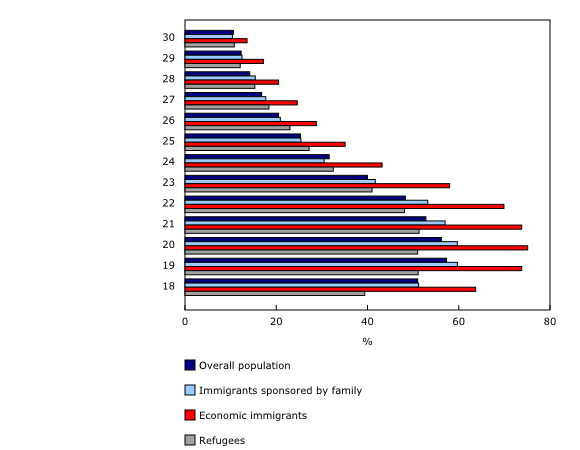
In 2018, 70% of 20-year-old immigrants who were admitted to Canada before the age of 15 participated in postsecondary education, according to tax data. This compares with 56% of the overall population of 20-year-olds in the same year.

Similar to the overall Canadian population, the median wage of immigrants who were admitted as children increased with age. In 2018, 25-year-olds in the overall population had a median wage of $29,710, compared with $30,300 for 25-year-old immigrants admitted as children. For 30-year-olds, the median wage was $41,810, compared with $47,400 for 30-year-old immigrants admitted as children. This represents a 13.4% difference in the median wage between the 30-year-olds in the total population and 30-year-old immigrants admitted as children. 

Children admitted to Canada with economic immigrant families report higher postsecondary education participation than Canadians overall or immigrants admitted under other categories

Many factors influence the socioeconomic outcomes of immigrant children in adulthood, including the conditions under which they were admitted to Canada. Economic immigrants, selected for their potential to contribute to Canada’s economy, tend to have a higher median wage than refugees, who are fleeing persecution or conflict, or immigrants sponsored by family already living in Canada.

Immigrant children who were admitted as dependants of economic immigrants are likely to benefit from the higher median wage of the principal applicant in the economic immigrant category. Among children admitted in economic immigrant families, 75% of those who were 20 years old in 2018 reported postsecondary education participation. This compares with 60% for children admitted in sponsored families, 51% for refugees and 56% for the overall population of the same age, in the same year.

Chart 1  
Postsecondary participation of immigrants admitted to Canada as children and of the overall population, by age and admission category, 2018

Chart 1: Postsecondary participation of immigrants admitted to Canada as children and of the overall population, by age and admission category, 2018

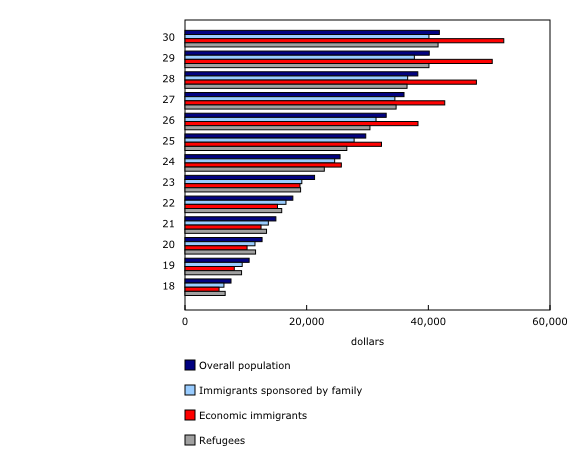
At age 30, immigrants who were admitted to Canada before the age of 15 with economic immigrant families report the highest wages compared with those admitted under other categories

Lower participation in postsecondary education can lead to earlier labour market entry. Until the age of 23, people admitted as children in sponsored families, refugees and the overall population had higher wages than their economic immigrant counterparts. At this age, immigrants admitted as children in sponsored families had median wages of $19,200, compared with $19,000 for immigrants admitted as children in refugee families, $21,300 for the overall population, and $18,900 for people admitted as children in economic immigrant families.

However, beginning at the age of 24, a time when many have completed their postsecondary studies, the wages of people admitted as children in economic immigrant families began to surpass those of their counterparts in other admission categories and the overall population, and they continued to increase at a steeper rate over time compared with the other categories.

At the age of 30, in 2018, people admitted as children in economic immigrant families had median wages of $52,400. This compares with $41,600 for immigrants admitted as children in refugee families, $40,100 for immigrants admitted as children in sponsored families, and $41,810 for the overall population.

Chart 2  
Median wages of immigrants admitted to Canada as children and of the overall population, by age and admission category, 2018

Chart 2: Median wages of immigrants admitted to Canada as children and of the overall population, by age and admission category, 2018

Immigrant women admitted to Canada as children have higher postsecondary education participation than men

In 2018, 74% of 20-year-old immigrant women admitted as children reported participating in postsecondary education. In comparison, participation rates were lower among immigrant men (65%) who also came to Canada as children. At 74%, the participation rate of immigrant women who came as children was also higher than the rate of the overall female population (62%) and the overall male population (50%) of the same age. 

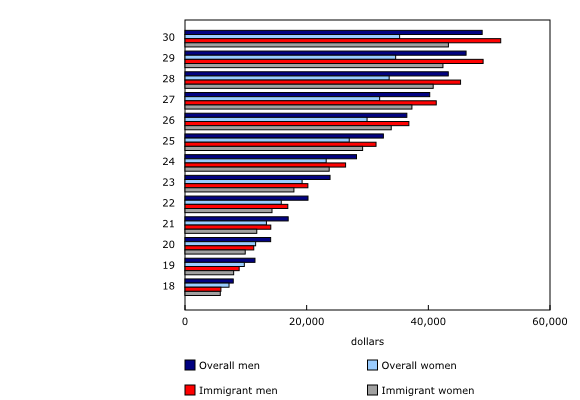
With regard to wages, 30-year-old immigrant women admitted to Canada as children had median wages of $43,300, 48% more than those of 25-year-old immigrant women admitted as children ($29,200). However, their median wages were lower than those of immigrant men who also came as children ($51,900) and of the overall male population ($48,850) of the same age. These gender income differences are in line with those in previous studies that found that women with a similar level of education as men report lower income.

Nonetheless, the median wages of 30-year-old immigrant women admitted as children were higher than those of the overall female population ($35,280), who earned the lowest median wages.

Chart 3  
Median wages of immigrants admitted to Canada as children and of the overall population, by age and sex, 2018

Chart 3: Median wages of immigrants admitted to Canada as children and of the overall population, by age and sex, 2018

These new data will facilitate further analysis of other factors that can affect the future adulthood socioeconomic outcomes of immigrants admitted as children, such as their age at immigration, year of immigration and their incidence of living in a low-income household during childhood.

In addition to the table about the economic outcomes of immigrants admitted to Canada as children used in the analysis above, tables on the income and mobility of immigrants by census metropolitan area are now available. These tables use data from the IMDB.

Source: https://www150.statcan.gc.ca/n1/daily-quotidien/210322/dq210322c-eng.htm?CMP=mstatcan

In a Palace of Colonialism, a ‘Quiet Revolutionary’ Takes Charge

Noteworthy:

It was a monument to the power and glory of colonial France. When the Palais de la Porte Dorée opened in Paris in 1931, every corner of it was designed to extol the colonizing mission: from the bas-reliefs of laborers in faraway lands, to the frescoes of imperial magnificence, to the aquariums swarming with tropical fish.

That institution is now led by a man whose family members were among the colonized peoples of sub-Saharan Africa. Pap Ndiaye, a historian and academic of Senegalese and French descent, was last month appointed to revitalize the Palais de la Porte Dorée — an institution that was born as the Museum of the Colonies in 1931, and that now houses the Tropical Aquarium and the National Museum of the History of Immigration.

Ndiaye knows the issues well. A graduate of the prestigious École Normale Supérieure, he studied for several years in the United States, and is a specialist in African-American history. He recently co-wrote a report on racial diversity for the Paris Opera. The question is whether he can turn around an institution with a problematic legacy and the sensitive mission of telling the story of France’s immigrants.

In an interview at his new workplace, Ndiaye acknowledged that the Palais de la Porte Dorée was “a more difficult environment than a museum with a more straightforward identity, because the issues tackled here, around immigration and colonial history, are among the burning questions in French political life.”

He said that the French had “a hard time picturing their country as a land of immigration.” That’s because immigrants in France were expected to “forget where they came from, and become more French than the French” — speak French, dress French — in a process of assimilation that was the opposite of multiculturalism. “Our role is to make immigration a more essential part of the vision that the French have of their national history,” he added.

The interview began with a grand tour of the premises: the frescoed foyer with its allegorical images of France’s transcontinental reach, from Africa to Indochina and the South Pacific; the circular aquarium with its swimming turtles and patterned stingrays. All are legacies of the Colonial Exhibition of 1931, a sprawling six-month fair for which the Palais de la Porte Dorée was built, that also featured elaborately constructed pavilions representing some of France’s colonies through their native architecture. The idea was to show the grandeur of Imperial France, and the benefits its colonies brought to the mainland.