Canada, dozens of allies, declare arbitrary detentions immoral amid Kovrig, Spavor

Helpful coalition building even if impact may be limited:

Canada and has created a coalition with 57 other countries to support a new international declaration denouncing state-sponsored arbitrary detention of foreign nationals for political purposes.

The new declaration was born out of a year of behind-the-scenes international diplomacy, spearheaded by former foreign affairs minister Francois-Philippe Champagne.

Canada has sought global support to free Michael Kovrig and Michael Spavor, who are spending their 798th day in Chinese prisons today.

“I was inspired by what I was seeing as the plight of all those which have been arbitrarily detained in the world and a desire to do something tangible,” Champagne said in an interview. “It reminded me of a quote from Mandela: it always seems impossible until it’s done.”

While ending Kovrig’s and Spavor’s Chinese imprisonment remains Canada’s top priority, the new declaration is meant to be a broad denunciation to end the coercive practice in other numerous countries, such as Russia, Iran, and North Korea.

“It is fine for two countries to have differences of opinion. But it is totally unacceptable if citizens from our country go to another country either to visit or to work there, that they have to live in fear that they could become a bargaining chip,” Foreign Affairs Minister Marc Garneau said in an interview.

Garneau wouldn’t name specific countries, saying the new declaration is “country-agnostic.” He said he wants to recruit more countries as signatories with the goal of ending the practice everywhere and to discourage other countries from taking it up.

“It’s fine to have diplomatic relations. And it’s fine to have differences of opinion. But it’s not acceptable. It’s illegal. It doesn’t respect human rights. It’s unacceptable to practice arbitrary detention when we feel that things aren’t going our way,” said Garneau.

Kovrig, a former Canadian diplomat working for the non-governmental International Crisis Group, and Spavor, an entrepreneur specializing in exchanges with North Korea, were rounded up by Chinese authorities nine days after the RCMP arrested Chinese high-tech scion Meng Wanzhou at the Vancouver airport in December 2018.

The Mounties were acting on a U.S. extradition warrant that alleged she had committed bank fraud to violate sanctions on Iran.

Canada and its allies view the subsequent national-security charges China laid against Kovrig and Spavor to be bogus. They have denounced the detentions as arbitrary and called for the two to be released — exhortations that have fallen on angry and deaf ears in Beijing.

Canada and its major allies in the G7, the Five Eyes intelligence sharing network, and countries on every continent support the new declaration, which is non-binding but aims to shame countries that engage in targeted detentions of foreign nationals to achieve a political end.

The new declaration — called the Declaration Against Arbitrary Detention in State-to-State Relations — has no actual enforcement provisions. Instead, it aims to stigmatize arbitrary detention in the same vein as the Ottawa Treaty to ban anti-personnel mines.

“It is something that is intended to put pressure on countries that do practise arbitrary detention,” said Garneau, saying it is “very similar to when Canada decided back in the days of Lloyd Axworthy,” Canada’s then foreign minister, to spearhead the landmine treaty.

Champagne said the declaration was also modelled after NATO’s Article 5, which declares that an attack on one of its members constitutes an attack on all 30 member countries.

“The concept behind that is that if you were to take one of our citizens, we will, on a voluntary basis, come together to make sure that these issues do not remain bilateral.”

Champagne, now the industry minister, will join Garneau and foreign ministers from dozens of countries for a three-hour teleconference this morning to launch the new initiative and discuss its implications.

The proceedings are to hear statements from more than 40 foreign ministers; lawyer Amal Clooney, the international human rights activist who has represented imprisoned journalists and other victims of arbitrary political detention; and Kenneth Roth, the head of Human Rights Watch.

Champagne said the concept had its roots in discussions with British officials and won support among the countries in the Five Eyes, G7 and European Union and across the world.

“You start with a few countries, you go to seven, then 10, then 15, then 20, then 25. Then 30,” he said. “My benchmark was 50.”

China became incensed as Canada built the coalition of countries to speak out on behalf of Kovrig and Spavor. China warned Canada of negative consequences if it continued to do that.

Asked whether the declaration was intended as a message to China, Champagne said: “My message is to all those which have been arbitrarily detained in the world: That your liberty has been stolen, but your voice won’t be silenced … We stand by you, and we will fight for you at every step of the way.”

Source: Canada, dozens of allies, declare arbitrary detentions immoral amid Kovrig, Spavor

China’s Crackdown on Muslims Extends to a Resort Island

Relentless pressures and crackdowns…

The call to prayer still echoes through the alleys of Sanya’s nearly 1,000-year-old Muslim neighborhood, where crescent-topped minarets rise above the rooftops. The government’s crackdown on the tiny, deeply pious community in this southern Chinese city has been subtle.

Signs on shops and homes that read “Allahu akbar” — “God is greatest” in Arabic — have been covered with foot-wide stickers promoting the “China Dream,” a nationalistic official slogan. The Chinese characters for halal, meaning permissible under Islam, have been removed from restaurant signs and menus. The authorities have closed two Islamic schools and have twice tried to bar female students from wearing head scarves.

The Utsuls, a community of no more than 10,000 Muslims in Sanya, are among the latest to emerge as targets of the Chinese Communist Party’s campaign against foreign influence and religions. Their troubles show how Beijing is working to erode the religious identity of even its smallest Muslim minorities, in a push for a unified Chinese culture with the Han ethnic majority at its core.

The new restrictions in Sanya, a city on the resort island of Hainan, mark a reversal in government policy. Until several years ago, officials supported the Utsuls’ Islamic identity and their ties with Muslim countries, according to local religious leaders and residents, who spoke on condition of anonymity to avoid government retaliation.

The party has said its restrictions on Islam and Muslim communities are aimed at curbing violent religious extremism. It has used that rationale to justify a clampdown on Muslims in China’s far western region of Xinjiang, following a series of attacksseven years ago. But Sanya has seen little unrest.

The tightening of control over the Utsuls “reveals the real face of the Chinese Communist campaign against local communities,” said Ma Haiyun, an associate professor at Frostburg State University in Maryland who studies Islam in China. “This is about trying to strengthen state control. It’s purely anti-Islam.”

The Chinese government has repeatedly denied that it opposes Islam. But under Xi Jinping, its top leader, the party has torn down mosques, ancient shrines and Islamic domes and minarets in northwestern and central China. Its crackdown has focused heavily on the Uighurs, a Central Asian Muslim minority of 11 million in Xinjiang, many of whom have been held in mass detention camps and forced to renounce Islam.

The effort to “sinicize Islam” accelerated in 2018 after the State Council, China’s cabinet, issued a confidential directive ordering officials to prevent the faith from interfering with secular life and the state’s functions. The directive warned against “Arabization” and the influence of Saudi Arabia, or “Saudi-ization,” in mosques and schools.

In Sanya, the party is going after a group with a significant position in China’s relations with the Islamic world. The Utsuls have played host to Muslims from around the country seeking the balmy climes of Hainan Province, and they have served as a bridge to Muslim communities in Southeast Asia and the Middle East.

The Utsuls’ Islamic identity was celebrated for years by the government as China pushed for stronger links with the Arab world. Such links have been key to Mr. Xi’s Belt and Road Initiative, a program to finance infrastructure projects across the world and increase Beijing’s political sway in the process.

The Utsuls have become “an important base for Muslims who have moved abroad to find their roots and investigate their ancestors,” said a government notice in 2017 hailing the role of Islam in Hainan in the Belt and Road plan. “To date, they have received thousands of scholars and friends from more than a dozen countries and regions, and are an important window for cultural exchanges among peoples around the South China Sea.”

Obscure Musicology Journal Sparks Battles Over Race and Free Speech

Of interest:

A periodical devoted to the study of a long-dead European music theorist is an unlikely suspect to spark an explosive battle over race and free speech.

But the tiny Journal of Schenkerian Studies, with a paid circulation of about 30 copies an issue per year, has ignited a fiery reckoning over race and the limits of academic free speech, along with whiffs of a generational struggle. The battle threatens to consume the career of Timothy Jackson, a 62-year-old music theory professor at the University of North Texas, and led to calls to dissolve the journal.

It also prompted Professor Jackson to file an unusual lawsuitcharging the university with violating his First Amendment rights — while accusing his critics of defamation.

This tale began in the autumn of 2019 when Philip Ewell, a Black music theory professor at Hunter College, addressed the Society for Music Theory in Columbus, Ohio. He described music theory as dominated by white males and beset by racism. He held up the theorist Heinrich Schenker, who died in Austria in 1935, as an exemplar of that flawed world, a “virulent racist” who wrote of “primitive” and “inferior” races — views, he argued, that suffused his theories of music.

“I’ve only scratched the surface in showing out how Schenker’s racism permeates his music theories,” Professor Ewell said, accusing generations of Schenker scholars of trying to “whitewash” the theorist in an act of “colorblind racism.”

The society’s members — its professoriate is 94 percent white — responded with a standing ovation. Many younger faculty members and graduate students embraced his call to dismantle “white mythologies” and study non-European music forms. The tone was of repentance.

“We humbly acknowledge that we have much work to do to dismantle the whiteness and systemic racism that deeply shape our discipline,” the society’s executive board later stated.

At the University of North Texas, however, Professor Jackson, a white musicologist, watched a video of that speech and felt a swell of anger. His fellow scholars stood accused, some by name, of constructing a white “witness protection program” and shrugging off Schenker’s racism. That struck him as unfair and inaccurate, as some had explored Schenker’s oft-hateful views on race and ethnicity.

A tenured music theory professor, Professor Jackson was the grandson of Jewish émigrés and had lost many relatives in the Holocaust. He had a singular passion: He searched out lost works by Jewish composers hounded and killed by the Nazis.

Immigration Hard-Liner Files Reveal 40-Year Bid Behind Trump’s Census Obsession

Good long read of the history behind undercounting the US population in the census:

Even before taking office, former President Donald Trump’s administration obsessed over the U.S. census.

From a failed bid for a citizenship question to a presidential memo about unauthorized immigrants that was fast-tracked to the Supreme Court, its moves over the past four years followed a playbook first drawn up more than four decades ago by the Federation for American Immigration Reform.

In 1979, the hard-line group that became the most influential advocate for extreme restrictions on immigration launched a campaign that has held onto one consistent goal — obtaining an official count of unauthorized immigrants through the census to radically reshape Congress, the Electoral College and public policy.

Starting with a lawsuit filed weeks before the official start of the 1980 census, FAIR documented its strategy in a paper trail that NPR has reviewed in the organization’s archives at the George Washington University, as well as those of FAIR’s founder at the University of Michigan.

“It’s always been on the agenda,” Dan Stein, FAIR’s president, tells NPR, noting that it’s “very possible” that, as early as November 2016, the group discussed with Trump officials the possibility of excluding unauthorized immigrants from a key set of 2020 census results.

To some, it may seem curious that part of Trump’s agenda zeroed in on an often overlooked government tally of every person living in the U.S.

But census numbers hold what Trump has always wanted — power.

That power comes in the form of 435 votes in the House of Representatives and the Electoral College. Once a decade, those votes are up for grabs among the states based on new census numbers. The more residents included in a state’s population count, the more of a say it has for the next 10 years in how federal laws are made and how the next occupant of the White House is chosen.

The Constitution has spelled out specific instructions for the census. Not just citizens or voters, but “persons” who reside in the states are supposed to be counted. Congress eventually codified the 14th Amendment’s language into federal law that calls for the “whole number of persons” living in each state and the “tabulation of total population” to be used when reapportioning House seats and electoral votes.

Census counting does have a thorny history. Before the Civil War, the fifth sentence of the country’s founding document required an enslaved person to be counted as “three fifths” of a free person. And it was just before the 1940 census that the Census Bureau determined the phrase “excluding Indians not taxed” could no longer omit some American Indians from the apportionment counts.

But since the first U.S. head count in 1790, this has been an unwavering truth: No resident has ever been left out because of immigration status.

Trump officials attempted to break with that 230-year precedent. The administration, like FAIR, wanted to subtract unauthorized immigrants from the apportionment counts, taking power away from those residents and the communities where they live.

One of President Biden’s first executive orders officially quashed the Trump memo that called for that extraordinary change.

But during the Trump years, FAIR came closer to getting that count of unauthorized immigrants than it has ever before.

A page out of an old playbook

The start of the Trump administration’s four-year census saga centered around a hotly contested question: Is this person a citizen of the United States?

Trump officials wanted to use the census to directly ask for the citizenship status of every person living in every household in the country for the first time in U.S. history. That proposal has long been considered anathema to best practices for a complete and accurate head count, and the administration was not up front about exactly why it wanted to add the question to the 2020 census.

Many opponents of that citizenship question argued it was originally intended to depress census participation. Under federal law, no government agency or court can use personal information collected by the Census Bureau against anyone. But a long history of distrust of the census has made many noncitizens, Latinos, Asian Americans, and other historically undercounted groups wary of telling the government their household’s citizenship status.

Some of the question’s critics also pointed to a scheme concocted by a GOP redistricting mastermind, Thomas Hofeller, to use the neighborhood block-level citizenship data the question would generate to politically benefit Republicans and “Non-Hispanic Whites” in state and local elections for years to come.

To Roger Conner, who led FAIR until 1988 as the group’s first executive director, it was clear that the Trump administration had another goal in mind — to change how congressional seats and electoral votes are reapportioned in order to curtail the political representation of areas where unauthorized immigrants live.

“I was saying to myself, ‘This is perfectly obvious. Why can’t someone figure out what’s going on?’ ” Conner says, recalling the Trump administration’s push for a citizenship question. “I assume that’s because they thought it was not in their interest to let everybody know what their strategy was.”

That strategy (which the administration never directly connected to apportionment until Trump’s memo was released years later) began percolating through Trump’s world even before he took office.

During the 2016 campaign, former Kansas Secretary of State Kris Kobach — an immigration hard-liner who has worked as a counsel to FAIR’s legal arm and was described by FAIR’s president as an “invaluable asset” to Trump’s immigration team — discussed a census citizenship question with campaign officials.

Shortly after the inauguration in 2017, Kobach talked about the question with Trump, then-chief strategist Steve Bannon and then-chief of staff Reince Priebus, according to Kobach’s testimony to congressional investigators.

Kobach later urged Wilbur Ross, the Trump-appointed commerce secretary overseeing the bureau, to add a specially-worded citizenship question to the census. It should also ask about immigration status, Kobach suggested in an email, so that the responses could address “the problem that aliens who do not actually ‘reside’ in the United States are still counted for congressional apportionment purposes.”

Other internal emails released for the lawsuits over the question show that the reapportionment of congressional seats was top of mind for Ross shortly after taking over the Commerce Department. In a March 2017 message from fellow Trump appointee Earl Comstock with the subject line “Your Question on the Census,” Ross received a link to a Census Bureau webpage that answered: “Are undocumented residents (aliens) in the 50 states included in the apportionment population counts?”

“Yes,” the bureau’s official response said.

But when Ross officially announced a citizenship question in 2018 as a late addition to the 2020 census form, it didn’t come with Kobach’s apportionment reasoning or checkboxes about immigration status. Instead, Ross used the Voting Rights Act to publicly justify the question, claiming the responses would help the Justice Department better enforce the civil rights era-law and protect “minority population voting rights.”

More than a year later, the Supreme Court rejected that justification for appearing to be “contrived” and blocked the question from appearing on the 2020 census.

After threatening to delay the census in the wake of his Supreme Court loss, Trump issued an executive order in July 2019 that directed other federal agencies to share their citizenship records with the Census Bureau, which was already under orders from Ross to use records to produce anonymized, block-level data about the U.S. citizenship status of every adult living in the U.S. that states could use for redistricting.

Buried within Trump’s order about citizenship data was a new policy of developing “complete and accurate” data on “illegal aliens in the country” that did not attract much attention at the time. Existing estimates by the Department of Homeland Security and academic researchers, the order said, are not reliable enough to “evaluate” policy proposals about enforcing immigration laws and changing eligibility rules for public benefits.

“Data tabulating both the overall population and the citizen population could be combined with records of aliens lawfully present in the country to generate an estimate of the aggregate number of aliens unlawfully present in each State,” said Trump’s order, which Biden reversed last month.

At the White House Rose Garden announcement for Trump’s directive, the then-head of the Justice Department, William Barr, made no direct mention of how the DOJ could use the data to enforce the Voting Rights Act. Instead, Barr made sure to highlight how the data “may be relevant” to a lawsuit filed in 2018 by the state of Alabama “over whether illegal aliens can be included for apportionment purposes.”

FAIR’s underground beginnings

These signals from the Trump administration echoed arguments FAIR first made more than 40 years ago.

Toward the end of the 1970s, FAIR was a fledgling advocacy group desperate to emerge from a windowless basement office in Washington, D.C., as a national voice.

The U.S. was more than a decade into major demographic shifts: A greater and greater share of people living inside the U.S. were born elsewhere, and a predominantly white population was becoming less so.

The Immigration and Nationality Act of 1965 had ended an earlier quota system that favored people from Northern and Western Europe, while also imposing the first caps on the number of people allowed to enter from Mexico and other countries in the Western Hemisphere. The landmark law, along with the end of a legal program for temporary farmworkers from Mexico, helped usher in a rise in immigration, both legal and illegal, from Latin America, Asia and other parts of the world.

That led John Tanton — an eye doctor from a mostly white resort town along Lake Michigan who held a particular interest in population control as a form of environmentalism — to start FAIR.

The group’s calls for an end to illegal immigration and fewer legal pathways for newcomers were not met with fanfare.

“We were obviously very small fish in a very big pond, and so got little attention,” Tanton later recalled in an oral history interview that touched on FAIR’s early days working underground with less than a handful of staffers.

To try to make a splash, FAIR went to court in December 1979.

Its federal lawsuit against former President Jimmy Carter’s administration called for a citizenship question to be included on both the long and short versions of the 1980 census form. The responses, FAIR argued, would generate a count of noncitizens that could eventually produce a state-by-state tally of unauthorized immigrants by matching noncitizens with green cards to government records.

Concerned about persistent undercounts, some census advocates at the time focused their energy on encouraging unauthorized immigrants to participate in the count.

Conner, FAIR’s first executive director, recalls reading a 1979 newspaper article about that effort and says FAIR sued partly out of concern that including unauthorized immigrants in the apportionment counts would increase the political power of “institutions that would favor the perpetuation, the expansion of immigration.”

Roger Conner, shown here in 1981, led the Federation for American Immigration Reform as its first executive director until 1988. Now a woodworker in Nashville, Tenn., Conner condemns Trump officials’ efforts to alter census apportionment counts. “I can only understand it as a pure expression of racism and evil,” Conner says. “And yet I have to own I took this same position 40 years ago.”

Still, in a 1980 statement to the House Judiciary subcommittee on immigation, Conner wrote that while FAIR wants unauthorized immigrants excluded from apportionment, it also “supports and encourages a full and accurate counting of illegal immigrants in the 1980 Census.”

“This is a difficult and perhaps impossible undertaking,” Conner added, “but it should nevertheless be worthwhile to attempt to gather more accurate information than we now possess about the number and characteristics of illegal immigrants within the United States.”

Finding lawyers in Washington willing to make FAIR’s arguments in court, though, was not easy.

“I had to explain to them why limiting immigration was the right thing, and FAIR wasn’t a racist group,” Conner explained in a 1989 oral history interview documented in the organization’s archives. “It was a lost cause.”

“The language of the Constitution is not ambiguous”

FAIR’s last-minute lawsuit eventually paid off in terms of media attention. It garnered a radio segment on NPR’s Morning Edition and a front-page, below-the-fold story in The New York Times, among other news coverage.

But the case was tossed out of a lower court, and the Supreme Court refused to hear an appeal. FAIR and the other plaintiffs did not have a right to sue, the three-judge panel of the lower court in D.C. ruled. And their case, the panel noted, appeared “very weak on the merits.”

“The language of the Constitution is not ambiguous,” the judges wrote in their opinion. “It requires the counting of the ‘whole number of persons’ for apportionment purposes, and while illegal aliens were not a component of the population at the time the Constitution was adopted, they are clearly ‘persons.’ ”

Going back to the 1920s, the judges pointed out, there have been multiple attempts to leave unauthorized immigrants and other noncitizens out of the apportionment counts. But with no change to the country’s founding document, they have all failed. Their opinion quotes the remarks of Rep. Emanuel Celler, a Democrat from New York, during a 1940 House debate over whether unauthorized immigrants could be omitted:

“The Constitution says that all persons shall be counted. I cannot quarrel with the founding fathers. They said that all should be counted. We count the convicts who are just as dangerous and just as bad as the Communists or as the Nazis, as those aliens here illegally, and I would not come here and have the temerity to say that the convicts shall be excluded, if the founding fathers say they shall be included. The only way we can exclude them would be to pass a constitutional amendment.”

Sen. David Reed, a Republican from Pennsylvania, came to the same conclusion more than a decade earlier in the 1920s.

After the 1920 census, reapportioning House seats was so heated, in fact, that for the first time in U.S. history the process didn’t happen at all that decade. The Republican majority of a mostly rural Congress stalled on the constitutional mandate, refusing to use numbers that confirmed the U.S. had become a predominantly urban nation.

Weeks before lawmakers passed the 1929 law that turned reapportionment into an automatic process after the 1930 count, Reed took part in a Senate debate over whether “aliens,” including unauthorized immigrants, could be excluded from the counts.

Reed was a namesake and architect of the Johnson-Reed Act, also known as the Immigration Act of 1924 that was designed to suppress people from Eastern and Southern Europe, and completely stop people from Asia, from immigrating to the U.S.

“I disagree to the bottom of my heart,” Reed emphasized on the Senate floor, with the Constitution’s original framers and the 14th Amendment’s drafters choosing to use the term “persons” in their apportionment instructions instead of “citizens” or “voters who actually have cast their votes at the last general election.”

But Reed could not support a bill amendment for excluding unauthorized immigrants and other noncitizens because, the senator said, “the oath which we take to support the Constitution includes the obligation to support it when we dislike its provisions as well as when we are in sympathy with them.”

“It is literally now or never”

Despite losing in the courts, FAIR tried to muster support for more legal action after its 1979 lawsuit.

Tanton, FAIR’s founder, looked for donors to stand up a $50,000 a year litigation program. In a 1980 letter written to a potential funder before FAIR’s appeal ended, Tanton said that if their census lawsuit failed, “illegals will have Representatives beholden to them, effectively foreclosing any chance of stemming their influx. It is literally now or never: the decision rests on those of us who understand the problem.”

The census lawsuit was a tool for getting “middle America” to support FAIR’s work, Tanton later explained in a 1981 letter to an attorney who helped start the group’s litigation program, by showing them that immigration was a “problem” not just for states like Texas, California and Florida.

In the same letter, Tanton floated the possibility of also pushing for the exclusion of green card holders, who are authorized to permanently stay in the U.S., and carrying out “citizen-only reapportionment,” which “would further sweeten FAIR’s prospects by shifting seats away from areas where politicians are compromised by an immigrant constituency.”

According to records in FAIR’s archives, though, the group stayed focused on the exclusion of unauthorized immigrants. One of FAIR’s attorneys tried to persuade the states of Indiana and Missouri, which each lost a vote in the House and Electoral College after the 1980 census, as well as Alabama and Georgia, to sue over the apportionment results, and Conner, FAIR’s first executive director, worked on selling the idea to the organization’s board of directors.

“This lawsuit, with a potential for altering the 1984 Presidential election, will garner an inordinate amount of publicity,” Conner wrote in an internal memo that year, suggesting the attention would be “extremely useful as a device to shift the news media focus” toward “the problems caused by illegal migration” and away from criticism of a FAIR-backed proposal for sanctions against employers who hire unauthorized immigrants.

Even so, it would take four more years before FAIR filed its second lawsuit over census apportionment counts. In 1988, it challenged the administration of former President Ronald Reagan over its plans for the 1990 census. This time, FAIR was joined by the states of Alabama, Kansas and Pennsylvania, as well as a more high-profile lead plaintiff — U.S. Rep. Tom Ridge, the Republican congressman from Pennsylvania who later became the state’s governor and the country’s first homeland security secretary.

In an attempt to recruit lawmakers to their cause, FAIR targeted delegations from states that were projected to lose House seats if the apportionment counts were altered to leave out unauthorized immigrants. FAIR emphasized that if successful, the lawsuit would not hurt states’ bottom lines. Unauthorized immigrants would still be counted in the census numbers used to guide the distribution of federal grants to states, just not in the counts for dividing up House seats and electoral votes.

But the outcome in court turned out the same: The case was dismissed without a trial.

Still, Tanton was not ready to give up. Months after that loss in 1989, Tanton wrote a letter to the head of FAIR’s legal arm, the Immigration Reform Law Institute, about a news report on the likelihood of Michigan losing two House seats after the 1990 census.

“This stirs the pot,” Tanton said, “and again makes me wonder about refiling the census suit[,] say from Michigan, after the results are announced and before apportionment takes place when the actual shift of seats will be known. How complex would this be?”

“Trying to stop” the “browning of America”

The year before FAIR lost its second attempt to exclude unauthorized immigrants through the courts, Tanton came under public scrutiny. A 1988 article in The Arizona Republic revealed that he had denigrated Latinos and warned of a “Latin onslaught” in a memo written for an immigration conference.

“How will we make the transition from a dominant non-Hispanic society with a Spanish influence to a dominant Spanish society with non-Hispanic influence?” asked Tanton, who, until he died in July 2019, was listed on FAIR’s website as a member of its national board of advisers. “As Whites see their power and control over their lives declining, will they simply go quietly into the night? Or will there be an explosion?”

“What they were trying to stop was the browning of America,” says Arnoldo Torres, who was a vocal critic of FAIR’s policies as the executive director of the League of United Latin American Citizens until 1985.

Among FAIR’s policy positions — which over the years have included opposing pathways to citizenship for unauthorized immigrants and ending the 14th Amendment’s guarantee of birthright citizenship — altering the census apportionment counts was “not the issue that they led off with,” but was “always an undercurrent,” Torres recalls. “This was not a passing fancy.”

“They were in for the long haul. They knew they were not going to get it right away,” Torres says. “They knew eventually that the tide would change.”

In the meantime, FAIR developed plans to change the apportionment process and get a count of unauthorized immigrants through the two other branches of government, having so far failed in the courts. An internal report prepared for FAIR’s board of directors in October 1987 called it a “three-pronged approach.”

One strategy included lobbying Congress to require the Census Bureau to “differentiate illegal aliens from citizens and legal residents on its questionnaire” for the head count, Simin Yazdgerdi, FAIR’s then-director of government relations, wrote in the report.

During an August 1987 strategy session, FAIR determined its legislative strategy “should be conducted quietly so that the courts would not be tempted to a) delay making a decision until Congress had acted; or b) use any negative legislative history (i.e., floor statements, testimony) against us,” according to an internal memo by Yazdgerdi.

“Emphasize how Republicans will be hurt most by inclusion of illegal aliens,” the memo specified about how to persuade the Reagan administration’s Justice Department and Office of Management and Budget to “influence” the Census Bureau.

While FAIR may have expected a more receptive audience among GOP members, support for omitting unauthorized immigrants from apportionment did not fall neatly along party lines in the 1980s.

In fact, among the plaintiffs joining Rep. Ridge in FAIR’s lawsuit before the 1990 census were House Democrats from Alabama, Connecticut, Kansas, North Carolina, Pennsylvania and West Virginia. Before the suit was filed, Ridge and Democratic Rep. Barbara Kennelly of Connecticut spearheaded a 1987 House bill that called for excluding unauthorized immigrants and including U.S. military and civilian Defense Department employees stationed abroad, who at the time were not expected to be counted for apportionment.

In 1988, the Justice Department told lawmakers that it opposed the bill because excluding unauthorized immigrants from the apportionment counts, it concluded, is unconstitutional. “If it were passed, we would recommend that the President veto it,” wrote then-Acting Assistant Attorney General Thomas Boyd, a Reagan appointee.

The House bill stayed stuck in committee, but it had bipartisan support, including from Democratic cosponsors from Georgia, Indiana, Maryland, Minnesota, Missouri, New Jersey, Ohio and Texas.

“It’s hard to explain to people. The Democrats were aligned with organized labor [and] didn’t want immigrants,” says Antonia Hernández, who opposed FAIR on immigration policy as president and general counsel of the Mexican American Legal Defense and Educational Fund for close to two decades beginning in 1985. MALDEF tried to intervene in FAIR’s 1988 lawsuit to defend the inclusion of unauthorized immigrants in apportionment counts.

As for the third prong of FAIR’s strategy, the group mapped out the possibility of a “favorable White House decision” that would instruct the Census Bureau to collect information on people’s immigration status, according to the group’s 1987 board report. But that path did not open until Trump became president 30 years later.

“The efforts have been clumsy”

After the 1990 census, FAIR shifted its focus toward Congress given its lack of headway in the courts and with presidential administrations.

“You don’t want to involve yourself in quixotic efforts that are doomed to fail,” says Stein, the group’s president who first joined FAIR in 1982.

But FAIR’s calculations changed after Trump won.

After entering office, the Trump administration put in place many hard-line immigration proposals long championed by FAIR and the network of organizations that grew from it — including cutting the number of refugees allowed to resettle in the U.S. down to historic lows. Former FAIR staffers, including Julie Kirchner, who became the ombudsman at U.S. Citizenship and Immigration Services after running FAIR for nearly a decade as its executive director, also joined the administration’s ranks.

Though Trump’s White House press office did not respond to NPR’s questions about whether the administration consulted with FAIR on its push to exclude unauthorized immigrants from apportionment counts, Stein says: “It was certainly part of our legislative plan for the new administration back in November of 2016.”

Hernández, MALDEF’s former president, says that the lack of comprehensive immigration reform helped thrust the apportionment issue front and center during the Trump administration. “It’s just gained steam and gained steam,” Hernández says.

In the decades since its basement beginnings, FAIR has expanded into a suite of offices near the U.S. Capitol, across the street from the office of the USCIS director. FAIR’s staff, including its legal arm, now totals 36, according to spokesperson Matthew Tragesser.

With the Trump administration in power, FAIR gained an invaluable advantage — a ready and willing partner inside the federal government during the final 2020 census planning stages.

“What they haven’t been yet able to do through the courts, they’ve been able to do through the executive branch,” Hernández says. “And they’ve been in such a hurry to do something, the efforts have been clumsy.”

The administration’s inconsistency was on full display during the citizenship question lawsuits. Public statements about Voting Rights Act enforcement fronted behind-the-scenes discussions about altering census numbers for House seat reapportionment.

A redacted August 2017 email appeared to foreshadow what became the administration’s ultimate strategy — citing a 1992 Supreme Court rulingto argue that the president has the discretion to decide whether to include unauthorized immigrants in the apportionment counts.

“Ultimately, we do not make decisions on how the data should be used for apportionment, that is for Congress (or possibly the President) to decide,” wrote then-Commerce Department attorney James Uthmeier. “I think that’s our hook here.”

Then, while testifying under oath about the citizenship question in 2018, Trump officials could not avoid bringing up apportionment.

John Gore — a Justice Department appointee at the time who testified that adding the citizenship question to census forms was not necessary for enforcing the Voting Rights Act — confirmed that when Jeff Sessions was U.S. attorney general, there was discussion at the highest levels of the DOJ about reapportioning House seats using “some other measure” than the total number of residents in each state.

Trump himself tied the push for a citizenship question to apportionment the same day the White House released the July 2020 presidential memo about excluding unauthorized immigrants. In a written statement, Trump said:

“Last summer in the Rose Garden, I told the American people that I would not back down in my effort to determine the citizenship status of the United States population. Today, I am following through on that commitment by directing the Secretary of Commerce to exclude illegal aliens from the apportionment base following the 2020 census.”

Some career Census Bureau officials suspected that Trump’s memo helped drive the administration to suddenly direct the bureau to rush counting last summer and cut back on quality checks for the 2020 census results, a report by the Commerce inspector general’s officerevealed. The administration appeared desperate to get a hold of census results before the end of Trump’s term in case Biden won the election.

Practical challenges

Despite posing serious threats to the count’s accuracy and the bureau’s credibility as a statistical agency, Trump’s memo, like the administration’s other census efforts, largely flew under the radar, frequently sidelined by other controversies.

At a press conference in July, hours after the release of a memo calling for the unprecedented exclusion of unauthorized immigrants from the apportionment counts, not a single reporter asked Trump a question about the directive.

Weeks later, federal courts began declaring the memo unlawful and in some of the cases, unconstitutional as well. After the Supreme Court agreed to squeeze in a hearing for the Trump administration’s appeal last fall, though, the high court’s conservative majority ruled it was too early to weigh in.

In the end, timing and bureaucracy thwarted Trump’s plans to alter the latest state population counts. The administration tried to pressure the Census Bureau to prematurely end quality checks, which were delayed by the coronavirus pandemic. But career civil servants postponed releasing the first set of census results after unearthing incomplete and duplicate responses.

As the inauguration of President Biden drew closer, another reality was setting in that made Trump’s apportionment plan practically impossible. The Census Bureau could only come up with reliable numbers for a fraction of the unauthorized immigrant population in the U.S.

Still, even during its final days in office, the administration did not give up on trying to get state-by-state figures of unauthorized immigrants and other noncitizens. A last-minute push by the Trump-appointed Census Bureau director, Steven Dillingham — as well as two controversial appointees, Nathaniel Cogley and Benjamin Overholtsparked whistleblower complaints about demands to produce “statistically indefensible” data, and Dillingham ultimately resigned.

Without a citizenship or immigration status question on the 2020 census forms, government records the Trump administration directed the bureau to use could only generate a state-by-state count of unauthorized immigrants in detention centers.

For the rest of the population, the bureau could produce estimates. But the methods it would have to use are saddled with “difficult-to-verify assumptions” and could “introduce substantial imprecision” to the census results, top career officials warned in a March 2020 memo.

“It is our professional judgement that these methods produce estimates of the undocumented foreign-born population at the state level that could inform policy makers,” but they may not be usable when reapportioning House seats because they require the use of statistical sampling, which is not allowed, wrote John Abowd, the bureau’s chief scientist, and Victoria Velkoff, associate director of the bureau’s demographic programs.

The bureau has also warned, for decades, that using the national head count to identify unauthorized immigrants could undermine public trust in the federal statistical agency. That, in turn, could exacerbate historical undercounts of immigrants and people of color and reduce their areas’ share of census-guided federal funding.

“We realize that our job would be made still harder … if we had an image of being an investigative unit,” Leo Estrada, who was serving as a special assistant to the bureau’s deputy director, told NPR in 1980 in response to FAIR’s first apportionment lawsuit.

Producing figures of unauthorized immigrants should be a “job for some other agency,” Estrada said.

The bureau has shelved the Trump administration’s project for creating unauthorized immigrant counts. But that work could play a role in the ongoing lawsuit by the state of Alabama and U.S. Rep. Mo Brooks, a Republican from that state who voted against certifying Biden’s victory in the 2020 election and told crowds at a rally before the Jan. 6 attack on the U.S. Capitol that it was the day for “taking down names and kicking ass.”

Biden’s executive order has restored the longstanding policy of including all residents regardless of immigration status in apportionment counts. But Brooks and the office of Alabama State Attorney General Steve Marshall are still trying to convince U.S. District Judge R. David Proctor to order unauthorized immigrants to be left out.

The future of “we the people”

For Conner, FAIR’s first executive director, it’s long past time to end this fight.

More than four decades after helping to launch FAIR’s campaign, Conner says he has since come to recognize the long ties many unauthorized immigrants have to the U.S.

“When you say ‘we the people of the United States,’ you have to include them,” Conner says.

Now a woodworker based in Nashville, Tenn., Conner condemns the Trump administration’s immigration enforcement for not focusing on deterring employers from hiring unauthorized workers.

“For this administration to take up the census lawsuit after they have subverted any effort to recognize the implicit invitation for immigrants to come undocumented to this country to work, to live,” Conner says, “I can only understand it as a pure expression of racism and evil. And yet I have to own I took this same position 40 years ago.”

FAIR, however, remains committed to changing who is counted in apportionment and obtaining numbers of unauthorized immigrants in the U.S.

“You want to have as much data as possible about the fiscal, environmental and societal impacts of immigration,” says Stein, FAIR’s president.

Stein acknowledges the stakes of bringing this issue before the highest court in the land. If the justices declared that reapportioning House seats and electoral votes without unauthorized immigrants is unconstitutional, FAIR would have to resort to advocating for a constitutional amendment, which Stein calls a “very heavy lift.”

But the Trump administration left office with no definitive Supreme Court ruling on its plan to alter counts that, according to the Constitution, must include the “whole number of persons in each state.”

That leaves the door open for Alabama’s lawsuit and any future legal challenges to test their limits in the courts. And as planning ramps up for the 2030 census, it leaves behind a lingering question: How much further could FAIR’s campaign go if another president in line with its ambitions enters the White House?

Source: Immigration Hard-Liner Files Reveal 40-Year Bid Behind Trump’s Census Obsession

Perception and reality across Canada’s urban-rural divide

This divide also maps neatly with age, percentage of immigrants and visible minorities, and political leanings:

Canadian policy-makers and citizens must be more attuned to the potential for rising political polarization in our democracy. It would be wrong to assume that the country is immune to the forces that are fracturing politics in the United States and elsewhere.

One potential fault line in Canadian society is our urban-rural divide. Voting patterns increasingly point to divergent political preferences along these place-based lines. In the 2019 federal election, the median population density for the 157 Liberal ridings was more than 38 times higher than that of the 121 Conservative ridings.

Yet, notwithstanding these different political outcomes, we don’t know much about the extent to which urban and rural Canadians actually think differently about politics, public policy, the country’s economic prospects or broader social trends. There’s little polling or other forms of empirical analysis to help us understand these questions.

Two new reports from the Public Policy Forum (Perceptions and Polarization and Fault Lines and Common Ground) aim to establish such an evidence base for understanding the urban-rural divide in Canada. The reports use survey data to (1) see how urban, suburban and rural Canadians perceive one another’s circumstances, experiences and perspectives and (2) determine whether there are actual differences in their economic, cultural and political viewpoints.

This exercise in measuring and comparing perception versus reality is highly relevant because research shows that distorted perceptions not only fuel polarization, but that polarization can in turn lead to even more distorted perceptions. The result is a vicious cycle that can contribute to rising political polarization and further social attenuation.

Let’s start with Canadians’ perceptions. Our research used a sliding-scale methodology to produce a “perception score” across 11 specific topics (such as unemployment, immigration and the prevalence of conservative social values). Respondents were presented with a scale ranging from 0 to 100, where 0 was “a lot less than the Canadian average,” 50 was “average,” and 100 was “a lot more than the Canadian average.” Scores of more than 50 indicate that respondents think Canadians in some places are above the average on a particular measure, while scores below 50 indicate that they believe Canadians in some places are below the average.

What did we find? Canadians perceive significant place-based differences in these economic, cultural and political issues.

Take economic growth, for instance. Respondents held broadly similar perceptions that cities have experienced much-higher-than-average economic growth, suburbs have had higher-than-average economic growth, and rural communities are far-below-average growth. The average “perception score” was 63.1 for cities, 57.5 for suburbs, and 44.2 for rural communities. This is 19-point gap conveys that Canadians perceive significant differences in the economic conditions between big cities and small towns.

These perceptions of significant place-based differences are something that policy-makers ought to be cognizant of. The risk is that these perceived differences contribute over time to a lack of common experiences and perspectives, and in turn a diminished sense of cohesion and unity.

What’s interesting, however, is that while respondents perceived significant place-based variations among urban, suburban and rural places, these perceptions were widely held across places. That is to say our perceptions don’t seem affected by where we live. Urban, suburban and rural perceptions of one another’s experiences and perspectives tend to cluster in a narrow range. The economic growth example works here as well. Respondents from all three types of places – urban (66.0), suburban (63.9) and rural (62.3) – perceive economic growth is highest in urban cities. We share a broadly similar understanding of how our fellow citizens think, live, work and vote.

As we observe in the paper, these differences fall broadly along a continuum between optimism and anxiety, openness and closedness, and modernism and tradition.

What about urban and rural Canadians’ actual circumstances, experiences and perspectives?

Our analysis, which draws on data from the Canadian Election Study, finds considerable common ground between urban and rural Canadians on a number of cultural, economic and political issues. Most place-based disagreements on matters of policy and politics are best measured by degree rather than fundamental principle.

Yet there are a handful of issues – including the state of the economy; environmental policy;  immigration and diversity; values and tradition; and trust in government – where consistent and significant place-based differences are evident.

As we observe in the paper, these differences fall broadly along a continuum between optimism and anxiety, openness and closedness, and modernism and tradition. They no doubt reflect to some degree a combination of differing economic circumstances and psychological dispositions rooted in urban and rural experiences and perspectives. The process of self-selection inherent in migration patterns invariably reinforces these differences. The basic idea here is that people with similar backgrounds, interests and economic prospects tend to cluster in the same places. American writer Will Wilkinson has described this tendency and its sociopolitical consequences as the “density divide.” It’s quite possible therefore that we’ll continue to see divergence along these continuums in the future.

There are two reasonable ways to interpret these data: positive and negative.

The positive interpretation is that although Canadians perceive significant place-based differences on matters of economics, culture and politics, these perceptions are commonly held and are generally unaffected by where one lives. More importantly, the evidence suggests that these perceptions may be overstated. Urban and rural views are broadly similar across a wide range of policy and political issues from assisted death to free trade.

The upshot: The evidence tells us that there is more that connects us than separates us — no matter whether we live in a big city or a small town.

The negative interpretation is that Canadians’ perceptions of significant place-based differences on matters of economics, culture and politics are reflected in differing views on key issues including the state of the economy; climate policy; immigration and diversity; values and tradition; and trust in government. These differences are important because (1) they manifest themselves in polarized voting patterns and (2) they represent issues that are associated with the rise of populism and polarization elsewhere.

The risk, of course, is that we experience a growing urban-rural divide driven by a complex relationship between perception and reality on these key hot-button issues. The consequence could be a significant place-based polarization that fractures the country along urban-rural lines.

It’s too early to know which interpretation will ultimately be correct. That answer will depend on whether Canada’s political parties, our policy-makers and citizens are prepared to build bridges across these divides and cultivate a politics of empathy, unity and respect.

The first step is understanding perception and reality across Canada’s urban-rural divide. We hope that these new reports are a useful contribution to such an ongoing effort.

Source: Perception and reality across Canada’s urban-rural divide

In the crosshairs of a crown prince? Canadian hit-squad claim just latest allegation against controversial Saudi royal

Why am I not surprised…:

The two Saudi emissaries who visited Omar Abdulaziz wanted him home.

It was the spring of 2018 and Abdulaziz, a high-profile Saudi dissident and activist living in exile in Montreal, was developing a huge following on social media. While studying at McGill University, he had started a satirical news show on YouTube that took aim at Saudi Arabia’s human rights record. It was getting millions of views.

The two emissaries — one a lawyer, the other a TV host — suggested he could have his own show and become the “voice of the youth” back in Saudi Arabia, he recalls.

But the conversation had clear overtones. One of the men told Abdulaziz, who secretly recorded their conversations, there were two options: Either return home or he “goes to jail.”

Why not at least go to the embassy to get your passport renewed, they implored.

He never went.

Looking back, he says he’s haunted by the thought of what might have happened next. It was only a few months later that Jamal Khashoggi, the Saudi dissident and Washington Post columnist, was killed and dismembered inside the Saudi consulate in Istanbul, Turkey.

“I don’t know what was the plan — killing me, kidnapping me, taking me away from Canada? I don’t know,” he told the Star.

In recent months, the world has been captivated by the story of Saad Aljabri, the former high-ranking Saudi intelligence official exiled in Toronto who has made stunning allegations in a lawsuit that Crown Prince Mohammed bin Salman and his agents have repeatedly tried to lure him out of hiding and even sent a team of hit men to try to kill him in Canada. Lawyers for Aljabri — once a top aide to a key rival to bin Salman in a bid for the throne — allege he was targeted because of his close ties to Western security officials and the confidential information Aljabri holds about the crown prince.

But Aljabri is far from the only person in the world claiming to be a target of the Saudi regime. High-profile dissidents, activists and former royal insiders, from Montreal to Oslo, Norway, to Düsseldorf, Germany, say their outspokenness has put their safety — and that of their loved ones back home — in jeopardy.

Bin Salman was elevated to crown prince in June 2017, making him de facto ruler. Even as he has introduced social reforms, such as lifting the ban on female drivers, and pushed to diversify the economy away from a reliance on oil, he has also engaged in an intense effort to suppress government critics through mass arrests, according to human rights watchers.

This push to consolidate power and sideline those deemed as foes has occurred not only at home but abroad, security observers say.

“It’s foreign interference,” said Alan Treddenick, who spent 32 years with the RCMP and CSIS that included a posting at the Canadian embassy in Riyadh.

“That shouldn’t be happening. That’s why we should be outraged with this sort of thing.”

The crown prince has previously denied personal involvement in the killing of Khashoggi. In response to Aljabri’s lawsuit, bin Salman’s lawyers have said Aljabri’s claims are without merit and an attempt to divert attention from “massive theft” of state funds.

Saudi embassies in Ottawa and Washington, D.C., did not respond to the Star’s requests for comment for this story.

Abdulaziz, who claimed asylum in Canada in 2013 after the Saudis revoked a scholarship to study here and was later granted permanent resident status, had built a close friendship with Khashoggi, whose killing would make headlines around the world.

Abdulaziz had been working with Khashoggi in the months prior to his death on a project to build an army of volunteers to counteract pro-Saudi propaganda online.

In the recently released and critically acclaimed documentary, The Dissident, about the assassination of Khashoggi, Abdulaziz says it was around this time that he was approached out of the blue by two Saudi emissaries.

In a March 2018 phone recording featured in the documentary, one of the men tells Abdulaziz they have a message from the crown prince, who is referred to by his initials.

“Omar,” the man says. “MBS said, ‘First of all, this is Omar’s country, and nobody can stop him from entering his country. Omar is under my protection. Tell him: You are under bin Salman’s protection.’”

When the pair of emissaries travel to Montreal, Khashoggi tells Abdulaziz to make sure their meetings are in public places, such as restaurants or cafes.

During one of the recorded meetups, the emissaries continue to push Abdulaziz to return home.

“There are two scenarios,” one of them says. “A scenario where Omar returns home, and Omar benefits. Now the country has benefited a lot because Omar is working in its media outlets and platforms. The second scenario — Omar goes to jail.”

Abdulaziz stayed put, a decision that resulted, he alleges, in the detention of two brothers and many friends back home.

“They’re blackmailing me. Just to silence me,” Abdulaziz, who boasts more than half a million followers on Twitter, told the Star.

In a lawsuit filed this month in New York Supreme Court, Abdulaziz alleges that a PowerPoint presentation prepared by consulting firm McKinsey & Company in 2016 and shared to bin Salman or his agents identified him and two other men as being the three most influential dissidents using Twitter to criticize bin Salman and his policies.

As a result, Abdulaziz continues to face pressure from Saudi agents to stop his political activities, fears for his life and, at one point, was even “forced into hiding and had to move from hotel to hotel for four months to avoid being kidnapped or harmed,” the lawsuit contends.

In a statement, the company said the claims were meritless and denied it was commissioned by the Saudi government to produce the report. It said there was no evidence the document was misused and that Abdulaziz “was recognized as an influential voice years before the internal McKinsey document was produced.”

Abdulaziz claimed in a separate lawsuit that his phone was hacked in June 2018, exposing his mobile communications to Saudi authorities.

“The spying that was directed against (Abdulaziz) and the disclosure of the content of the conversations and messages between him and Khashoggi through the system contributed significantly to the decision to assassinate Mr. Khashoggi,” the lawsuit states.

The lawsuit was filed in Tel Aviv after members of the Citizen Lab, a digital watchdog group based at the University of Toronto’s Munk School of Global Affairs & Public Policy, published a report in October 2018 outlining how Abdulaziz’s phone came to be infected with spyware sold by an Israeli vendor with links to Saudi Arabia.

That Israeli surveillance company, NSO Group, called the allegations “completely unfounded.”

Meanwhile, the threats to Abdulaziz’s life have persisted, he said.

“I’ve been in touch with the Canadian authorities, the RCMP. They warned me a couple of times about illegal threat, that I might be a potential target,” he said, declining to elaborate.

“We live in a time where some dictators, such as Mohammed bin Salman, they don’t want anyone to criticize them. … So if we’re not going to remain silent, if we’re not going to shut down our work or our projects, that means we put our lives in danger.”

During the filming of the documentary, while walking through a subway station, Abdulaziz scrolls through a text message on his phone.

“I just received this, you know, while we were walking,” he tells the camera. “Just three minutes ago. It’s anonymous and he’s saying that, ‘Just be careful. Move from city to another one. Do not use your phone, try to change your phone number, and there’s a team that’s going to kill you soon.’ It’s from Canada. It’s not from outside the country.”

It is not clear in the film whether this was intended as a threat or a warning from a friendly party.


Five-thousand kilometres away in Oslo, similar concerns have dogged Iyad el-Baghdadi.

The Palestinian human rights activist, blogger and vocal critic of bin Salman has said authorities have warned him of possible threats against him from Saudi Arabia.

In May 2019, Reuters reported that Norwegian security services had whisked him to a secure location the previous month.

“Once I was there and settled down, they told me that … they have received a tip from a partner intelligence agency indicating that I’ve been the target of a threat,” he told the news agency.

The Guardian reported the tip came from the CIA.

This past December, the Norwegian news outlet Dagbladet reported that in the summer of 2018, the Norwegian government received an “unusual” request: The Saudi government wanted to send 10 security guards to work at the embassy in Norway and asked they be registered as diplomats, which would give them immunity status.

This request, Dagbladet reported, coincided with a meeting in Oslo between el-Baghdadi and his friend Khashoggi.

“If they sent a team, I would assume it was to find out what was going on between me and Khashoggi,” el-Baghdadi was quoted as saying. “We talked about meeting again and doing projects together.”

Ultimately, the Norwegian government granted only one of the 10 guards diplomatic status.

In a statement at the time, the Saudi embassy denied any knowledge of el-Baghdadi and said the addition of the guards was in response to threats Saudi embassies in several countries had received.

Martin Bernsen, a spokesperson for the Norwegian Police Security Service, told the Star in an email he could not discuss operational matters but did acknowledge the existence, generally speaking, of foreign targeting of residents in the country.

“In general, the activity that Dagbladet describes is something that is associated with what we call refugee espionage,” he said. “The aim of such activity is to undermine, neutralize or eliminate political opposition.”

Asked if he had learned further details about the security team sent to Norway, el-Baghdadi told the Star in an email he could not discuss his personal security. But he encouraged Canadian citizens to “open their eyes as to the depth of depravity and evil” represented by the crown prince.

“To the ‘layperson,’ the idea that the Saudi government can lure a U.S.-resident journalist to their embassy in Turkey, kill him, dismember his body and burn his remains in a tandoori oven in the nearby ambassador’s residence seems too fantastical even for a movie, but that’s exactly and factually what happened,” he wrote.

“Canada is a kind country and a mature democracy. To those who have only experienced life under a democracy, the actions and incentives of dictatorships may seem rather hard to understand. The sad fact is that like bullies, dictators cannot be appeased, they take silence as permission. If there is no stern response, they will keep doing what they’ve been doing until someone stops them.

“MBS will not stop unless he is stopped.”

That sentiment was echoed in a Vanity Fair investigation published in 2019 that documented how the Saudi regime sent operatives to foreign countries to “silence or neutralize” perceived foes.

In that story, Prince Khaled bin Farhan al-Saud, a rogue royal in exile in Düsseldorf who has publicly called for a constitutional monarchy back home, shared how, in June 2018, the Saudi embassy in Cairo, where his mother lives, contacted her to say that the kingdom was willing to offer him $5.5 million in an effort to mend relations. But the offer had a catch: He needed to come to a Saudi embassy or consulate to collect.

He did not accept.


Back in Canada, Aljabri says threats against him and his family members persist.

In an amended complaint recently filed in U.S. District Court in Washington, D.C., Aljabri alleges that in 2018, an attempt was made to lure his daughter to the same Saudi consulate in Istanbul where, just days later, Khashoggi was killed. She did not go to the consulate.

The amended complaint also alleges that following one botched attempt to send a group of would-be assassins — a “Tiger Squad” — to Canada to kill Aljabri in October 2018, the crown prince convened a meeting in May 2020 with his agents to pursue another mission to kill Aljabri — this time by travelling to the United States and then entering Canada by land.

Two months later, because of a “credible and imminent threat to his life,” RCMP stationed an emergency response team outside Aljabri’s home, the lawsuit says.

RCMP spokesperson Robin Percival said in an email the agency does not generally comment on operations, allegations or investigations.

“Canada has a robust national security regime in place. The RCMP takes seriously and investigates criminal threats to Canada’s national security and works with federal and international partners to keep Canadians safe.”

Experts say Aljabri’s allegations are troubling.

“Of course it’s plausible. The world’s a nasty place, man,” said Daniel Hoffman, who formerly headed the CIA’s Middle East division.

“The way things work in the kingdom of Saudi Arabia is a lot different than other places,” he added, noting that two of Aljabri’s adult children were detained last year and held incommunicado in an apparent bid to lure him out of hiding.

Treddenick agrees that Aljabri and his family have a “legitimate fear” for their safety.

“If foreign governments are coming in and threatening Canadian citizens or residents, shouldn’t we be concerned about that?”

Treddenick says he got to know Aljabri professionally and personally when Aljabri was a top official within the Saudi interior ministry.

“He was very serious, very committed to assisting the West in countering terrorist threats. It was a great relationship. It paid dividends for Canada, the U.S. and the UK.”

Treddenick said he questions the timing of a lawsuit filed last month by a group of Saudi state companies that alleges Aljabri embezzled billions of dollars in state funds and secreted that money in offshore locations — claims that Aljabri has denied.

“What I don’t like is an abuse of the Canadian court system and that’s what, to me, this looks like — abuse by a foreign government,” he said.

With such perceived threats, does Abdulaziz ever get tempted just to quit his activism?

His answer is unequivocal.

“Not at all. Everyday I’m encouraged by what’s happening and I think what we’re doing is something important not only for us, not only for our loved ones, not only for my arrested friends and brothers, but it’s also for thousands of prisoners back there in Saudi,” he said.

“I cannot remain silent. That would betray them. … Thousands of people — our philosophers, scholars, activists, human rights defenders — are jailed in Saudi Arabia. If I’m going to say it’s not my (problem) anymore, this is a betrayal.”

Source: In the crosshairs of a crown prince? Canadian hit-squad claim just latest allegation against controversial Saudi royal
Numbers reveal a ‘diversity deficit’ in boardrooms of the charitable and non-profit sectors

Good and useful survey by Statistics Canada and ongoing work by Senator Omidvar in this area:

There’s a “diversity deficit” in the boardrooms of Canada’s charitable and not-for-profit sector, even though government funding and public donations are their main source of revenues.

A Statistics Canada survey has found 59 per cent of responding board members in the sector were women, but designated groups appeared to be under-represented in the governance of these organizations.

Of the 6,182 people who sat on these boards and responded to the survey, only 14 per cent identified themselves as immigrants; 12 per cent as belonging to a visible minority group; nine per cent as LGBTQ2+; six per cent as persons with a disability; and three per cent as First Nations, Métis or Inuit.

Only 42 per cent of the respondents reported that their organization has a written policy on board diversity, said the report released Thursday.

According to the federal agency, 22 per cent of the Canadian population are immigrants; 19 per cent belong to a visible minority group; 22 per cent of those aged 15 and above have one or more disabilities; and five per cent are First Nations, Métis or Inuit. A 2015 Canadian health report found three per cent of Canadians aged between 18 and 59 self-identified as gay or bisexual, and other estimates have been significantly higher.

Although this survey data was collected through crowdsourcing from professional networks within the sector — and not through probability-based sampling — it provides a glimpse into how well the leadership reflects and includes the voices of diverse communities.

“The numbers tell us that there is a diversity deficit in the governance of the sector. Many charities have challenges in this context,” says Sen. Ratna Omidvar of Ontario, who challenged the sector last summer to start collecting demographic data in the wake of the racial reckoning spearheaded by the Black Lives Matter Movement.

“It’s important for all of the society, particularly for charities and not-for-profit organizations because governors set their missions. They decide how dollars are spent. They make decisions on how an organization will respond to this or that. They are in control of the resources that come both from the government and donors.”

Researchers surveyed almost 9,000 people in total and 6,182 of them reported sitting on a board in the non-profit sector.

Three quarters of these board members belonged to an organization that operates locally; 13 per cent at a provincial level; eight per cent nationally; and three per cent internationally.

Their organizations engaged in a range of activities: social services (23 per cent); arts and culture (16 per cent); education and research (13 per cent); sports and recreation (12 per cent); and health (10 per cent). More than half of the respondents said their organizations served at least one of the designated minority groups.

While the local organizations were more likely to be involved in social services, their provincial and national counterparts tended to engage in education and research or in grants and fundraising, or were business or professional associations or unions. The international organizations reported global activities or arts and culture as their main focus.

Organizations engaged in sports and recreation or in religious non-profits and charities were least likely to have a written policy on board diversity. Respondents belonging to the designated groups were often involved in organizations with an official diversity mandate.

Omidvar said it’s important for the sector to look at governance through a diversity lens and follow a federal reporting system that’s already required of corporations to disclose demographic diversity in their governance.

“We ask nothing of the charitable and non-profit sector. We all think of them as angels and they are, but even angels need evidence to take further actions,” she said. “We need reliable, ongoing surveys and data that’s analyzed to move forward.”

One suggestion, she said, is for the Canada Revenue Agency to require every charitable and not-for-profit organization to submit information pertaining to their governance diversity in order to renew their registration status annually.

“Adding that one question is not going to cost anyone any money, but it will get us the evidence that we need and then we will be able to take it further,” said Omidvar.

“It requires political will. There are candidates who are qualified, willing, ready and able to sit on boards. They did not get that opportunity. It’s time that Canadians woke up to that diversity deficit in our charities and non-profit sector.”

Source: Numbers reveal a ‘diversity deficit’ in boardrooms of the charitable and non-profit sectors

Express Entry: 4346 CEC candidates invited

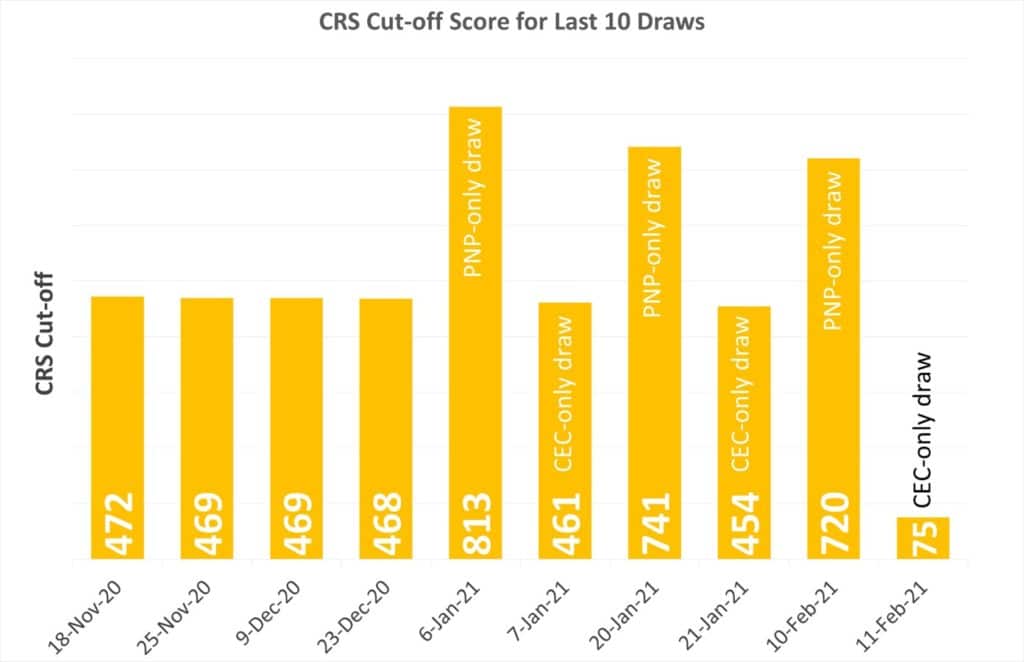
Meeting the levels target at any cost: score of 75 compared to normal average in the high 400s.

To put this into context, essentially any one 18 and 35 or anyone with a one-year degree, diploma or certificate from  a university, college, trade or technical school, or other institute, will obtain a score of 75, irrespective of any other factors.

Hard to see that this represents a merit-based appoach to selecting immigrants but does have the political advantage of helping meeting target immigration levels:

Canada invited 27,332 candidates to apply for permanent residence in its latest Express Entry draw— you read that right.

Immigration, Refugee and Citizenship Canada (IRCC) invited candidates from the Canadian Experience Class (CEC) on February 13. This unprecedented Express Entry invitation round only required candidates to have a Comprehensive Ranking System (CRS) score of at least 75— the lowest CRS requirement ever.

Today’s draw was almost six times larger than the largest Express Entry draws ever (5,000 ITAs were issued in four straight draws between November 18 and December 23 last year). Prior to today, the lowest CRS cut-off requirement ever was 199 points in the May 16, 2017 draw which only invited Federal Skilled Trades Program candidates. Express Entry was launched in January 2015.

On Wednesday, Canada also held an Express Entry draw inviting 654 Provincial Nominee Program (PNP) candidates to apply for permanent residence, that makes a total of 27,986 Invitations to Apply (ITAs) issued this week.

IRCC implemented the tie-break rule, meaning candidates who had the minimum score of 75 were only included if they submitted their Express Entry profile before September 12, 2020 at 15:31 UTC.

Today’s draw goes to show IRCC’s commitment to achieving its target of 401,000 new immigrants in 2021. Of those, IRCC is aiming to welcome 108,500 newcomersthrough Express Entry-managed programs, according to its 2021-2023 Immigration Levels Plan. Next year that target increases to 110,500, and then to 113,750 in 2023. Canada has given Federal High Skilled programs— which are managed by the Express Entry system— the largest share of new immigrant allocations for the next three years. This means the Express Entry system will continue to be Canada’s main source of new immigrants for the foreseeable future.

Canada’s immigration minister, Marco Mendicino, recently said that IRCC will make efforts to achieve the ambitious immigration targets by transitioning more temporary residents to permanent residents during the pandemic.

The unprecedented draw today seems to indicate that IRCC is aiming to issue as many invitations as it can at the beginning of this year so that it can complete the permanent residence landings of successful Express Entry candidates later in 2021. This would provide IRCC with a greater opportunity to achieve its immigration levels target amid ongoing coronavirus disruptions across the world. At the same time IRCC and Mendicino continue to stress that they will also look to global talent including those currently outside of Canada to support the country’s post-pandemic recovery.

Source: Express Entry: 4346 CEC candidates invited

COVID-19 Immigration Effects December 2020

With the release of all December 2020 datasets, I have updated my slides showing the impact of COVID-19 on immigration to Canada. Slides 3 and 4 have the highlights.

The dramatic decrease in immigration and related programs in 2020 helps explain the government’s response, whether reasonable in the case of providing more flexibility in when and how to submit documents, flexibility for international students studying online from their country of origin, shift to online testing for citizenship; some more questionable as having express entry drafts with minimum score of 75 for invitations of apply (compared to the more reasonable scores of mid to high 400s:

Pdf: https://multiculturalmeanderings.com/wp-content/uploads/2021/02/covid-19-immigration-effects-key-slides-december-2020-draft.pdf):

‘I’m Speaking Out:’ Calgary Firefighters Allege Decades of Racism

Of note:

When Chris Coy became Calgary’s first Black firefighter 25 years ago, his heroic vision of the profession was almost immediately upended.

First, he said, during training he was hazed more than his colleagues, strapped to a stretcher against his will and repeatedly doused with a fire hose. Then there were the co-workers who ostracized him at lunch. Throughout his career, he said, fellow firefighters used a racial slur directed at Black people.

For years, Mr. Coy said he suffered in silence as he feared speaking out would mean dismissal, or, worse, other firefighters not shielding him from danger in the field.

But since retiring in December, Mr. Coy has begun speaking publicly about what he said was decades of racially motived physical and verbal abuse, joining a group of current and former firefighters who have been voicing similar grievances. The city’s mayor and fire chief have acknowledged the racism within the department and pledged to address it.

“Here in Canada we are proud and sometimes smug about our commitment to diversity,” Naheed Nenshi, Calgary’s mayor, said in an interview. “I don’t want anyone who gets a paycheck I sign to feel that they aren’t valued because of the color of their skin.”

In Canada, a country that prides itself on its liberal humanism and multiculturalism, Prime Minister Justin Trudeau made reconciling with Indigenous peoples an early priority of his premiership. Now, the country has been undergoing a national reckoning about institutional racism in its city halls, law enforcement and cultural institutions, particularly since the global uprising for Black rights spurred by last year’s police killing of George Floyd in Minneapolis.

Brenda Lucki, the chief of Canada’s storied national police force, the Royal Canadian Mounted Police, was recently forced to walk back her previous denials of systemic racism within the force. Mr. Trudeau was among those arguing that police forces across the country were grappling with systemic racism.

While there have been complaints of discrimination in other fire departments in Canada, Calgary has become a high-profile case. The accusations of racism at the fire department were first reported by the CBC, the national broadcaster.