#COVID-19: Comparing provinces with other countries 13 January Update, including vaccinations

As vaccination data is becoming available, I have started to compile this data (number of vaccinations administered) by province and my standard list of countries. Some countries have yet to publish vaccination data. While Canada is far behind the UK and USA, it is ahead of China and France:

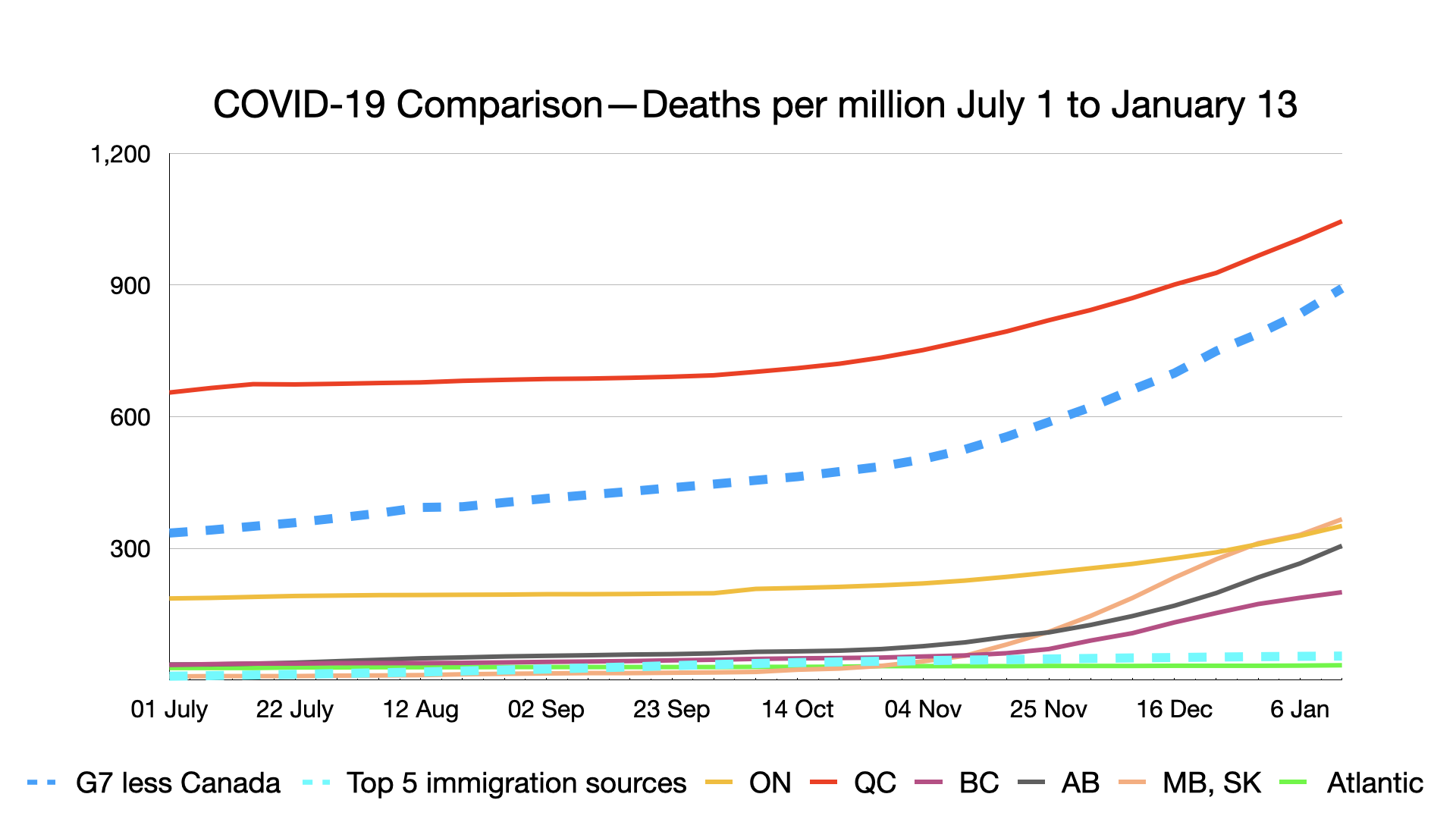
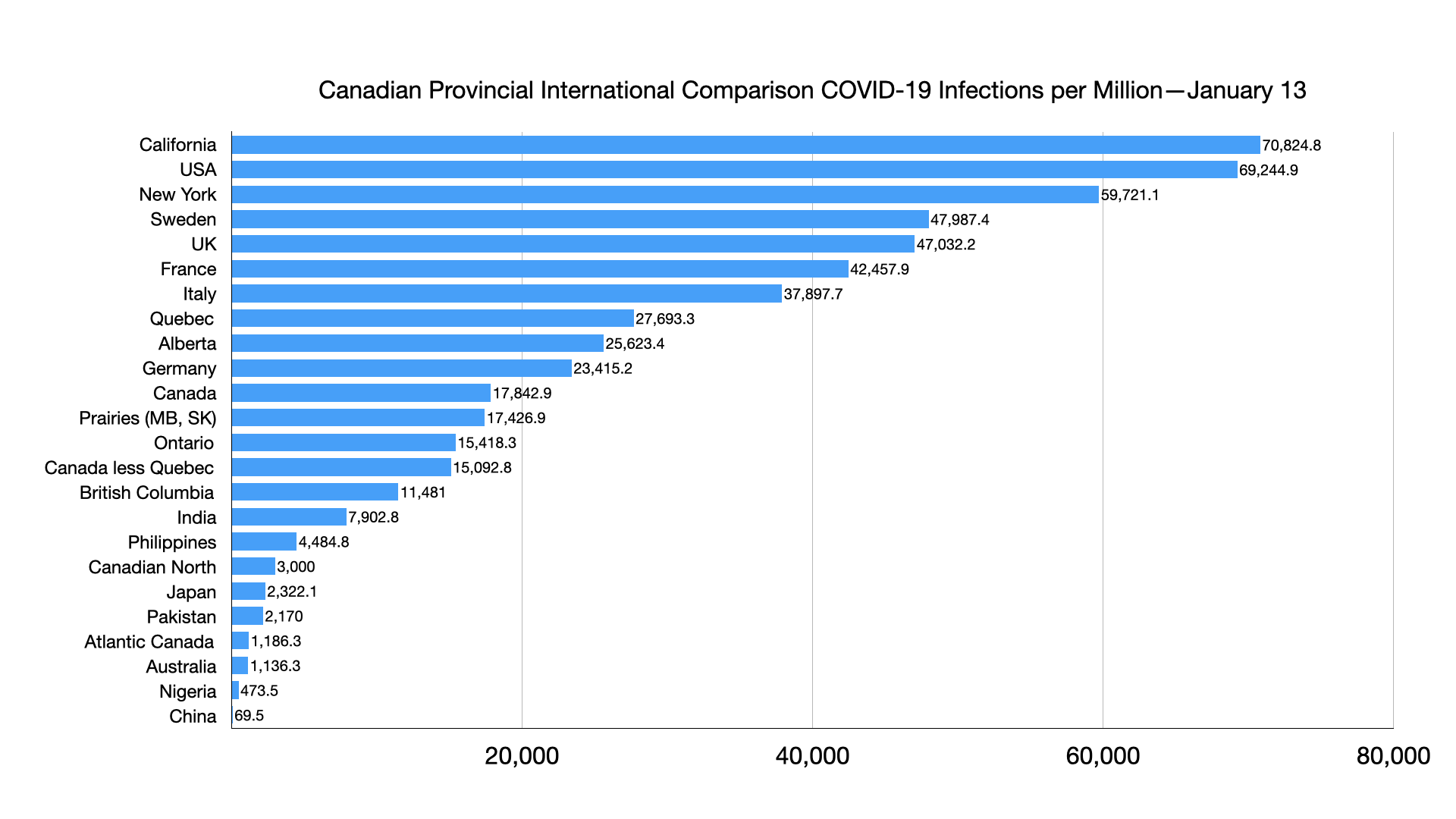
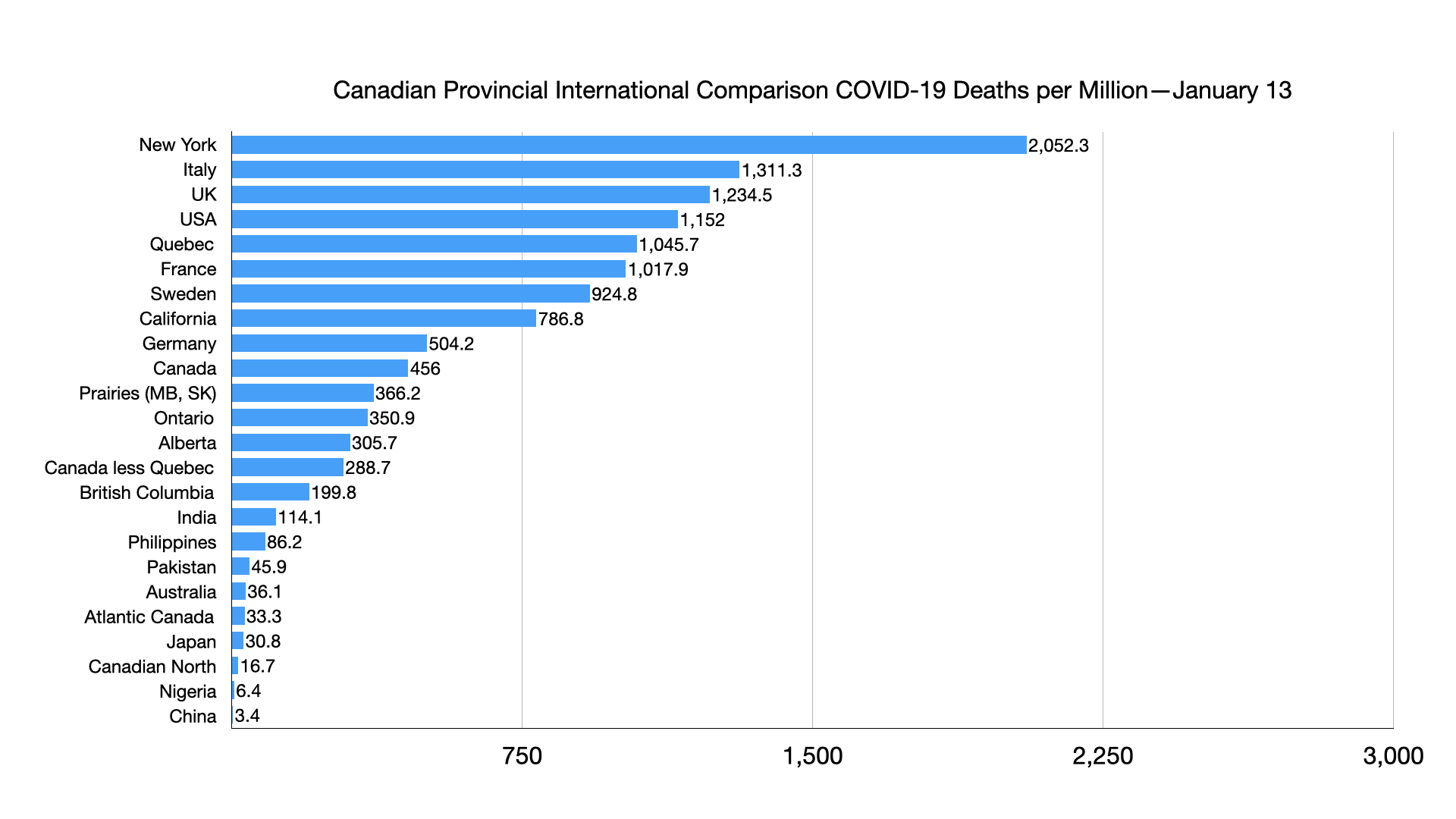
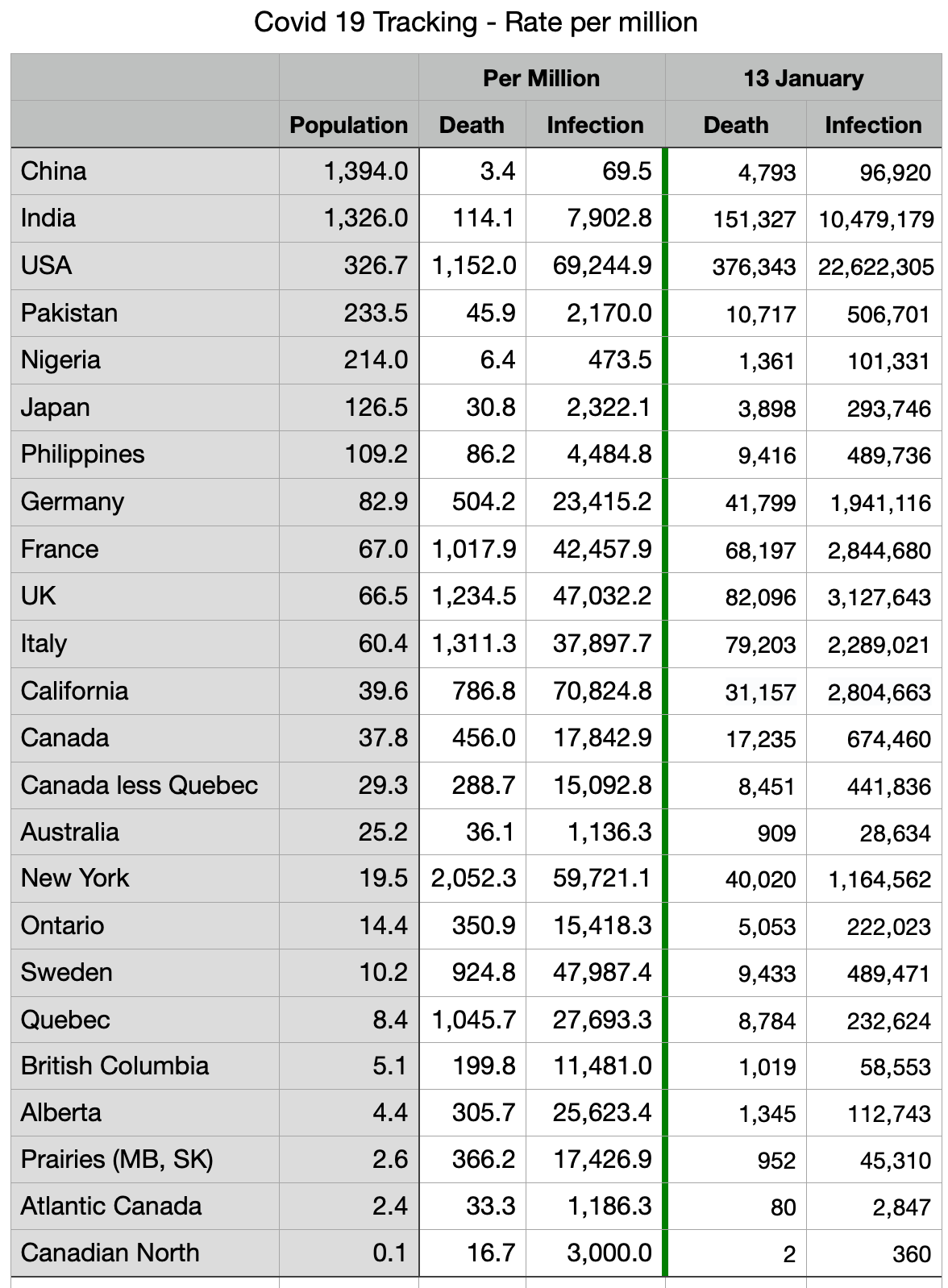
The standard charts can be found below.

Minor week to week changes:

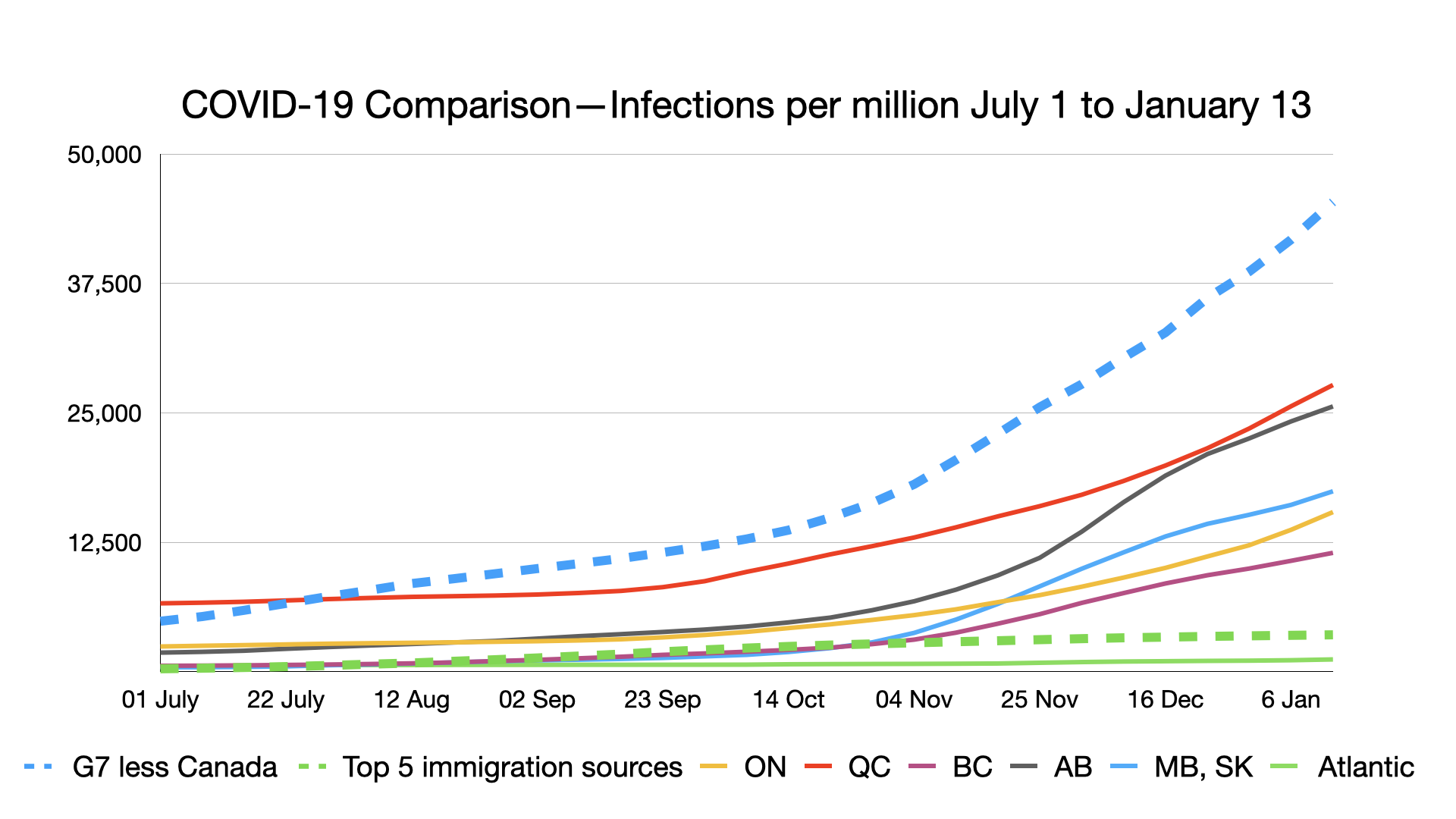
Infections per million: California ahead of USA, Ontario ahead of Canada less Quebec, Japan ahead of Pakistan, Atlantic Canada ahead of Australia 

Deaths per million: Alberta moved ahead of Canada less Quebec

How Executive Action Can Build a More Fair, Humane, and Workable Immigration System

From the Democrat think tank, the Center for American Progress, a likely indicator of what to expect from the Biden administration:

Over the past four years, the Trump administration wreaked havoc on the nation’s immigration and humanitarian protection systems, all without enacting a single law—and often in violation of existing laws. Building on a set of laws that were already outdated, overly inflexible, and poorly suited to meet the country’s realistic wants and needs, the administration made full use of the significant amount of executive authority that Congress has both explicitly and implicitly delegated to the president over many decades. As many commentators observed when looking at the administration’s relentless anti-immigrant agenda, cruelty was often the point. Now, the incoming Biden administration—which recognized early on that “we are living through a battle for the soul of this nation” and centered its presidential campaign around a pledge to “restore the soul of America”—will need to similarly use executive authority to repair much of the damage done over the past four years, as well as in previous years. By doing so, it can help build an immigration system that is more fair, humane, and workable.

Given the substantial task at hand and the nature of both the administrative state and administrative law, some of this will take time. But because the stakes are so great for so many—indeed, for the country as a whole and for its future—the work must begin immediately and it must be sustained for the duration of the administration. By the end of his first week in office, President Donald Trump had already issued three separateexecutive orders pertaining to immigration.

During his first days in office, President-elect Joe Biden should issue a single omnibus executive order that 1) lays out a condemnation of the damaged system that he is inheriting, 2) articulates a vision for the direction in which he will take things over the course of his term in office, and 3) makes initial, urgently needed changes consistent with that vision, including the imposition of a 100-day moratorium on deportations while the administration conducts a comprehensive review of outstanding cases and develops a set of sensible enforcement priorities.

What the first executive order on immigration should include

The executive order should begin with a high-level description of the breadth of damage done by the Trump administration, including but not limited to:

Providing a concise but comprehensive condemnation of the damage done by the Trump administration is necessary to convey to the public and to both political appointees and career staff that the Biden administration recognizes the challenge at hand and will waste no time in beginning to build immigration and humanitarian protection systems that are far better than what exists today.

The executive order should then address issues by category, articulating generally what values and objectives should guide the development of policy in each area. Where possible, it should immediately rescind executive orders and policies that run counter to those values and objectives—for example, various entry bans issued pursuant to section 212(f) of the Immigration and Nationality Act, the nationwide expansion of expedited removal, and the so-called asylum cooperative agreements with Guatemala, Honduras, and El Salvador. The order should also task Cabinet secretaries with the responsibility of studying different aspects of the issues within their jurisdiction and reporting back in fixed periods of time with new plans and policies consistent with the administration’s vision.

For example, the secretary of homeland security should be tasked with establishing new civil immigration enforcement guidelines; developing a range of community-based supervision programs to significantly decrease the country’s overreliance on a punitive detention system; conducting an immediate audit of the current detention population to release those at heightened risk of developing serious health consequences if they were to contract the coronavirus, as well as vulnerable populations and others for whom detention is not strictly necessary; establishing a protocol to promote cooperative enforcement strategies designed to enhance compliance with U.S. immigration laws; and reviewing extant agreements with state and local law enforcement agencies, including all forms of 287(g) agreements, to begin the process of phasing them out entirely.

Similarly, the attorney general should be directed to take steps to significantly reduce the immigration court backlog by removing low-priority cases from the docket and to review immigration decisions issued by prior attorneys general and the Board of Immigration Appeals to identify cases ripe for certification and prompt reissuance to correct inconsistencies with law. In addition, the secretaries of state and health and human services should be ordered to engage stakeholders and review policies and procedures to ensure that a rebuilt U.S. Refugee Admissions Program is more resilient. The secretaries of homeland security and state, meanwhile, should develop a plan to restore an orderly and efficient asylum system that lives up to our highest ideals, including by dismantling the “Remain in Mexico” program.

While this bureaucratic process takes place and the administration studies each of these issues and designs appropriate solutions or harm-mitigation plans, it should issue a moratorium on deportations and associated detentions and arrests for a 100-day period, ensuring that enforcement actions going forward follow sensible enforcement priorities and are aligned with the new administration’s vision and values and not those of its predecessor.

Congressional engagement and steady policy rollouts in furtherance of the administration’s vision

During this time, the administration should work closely with the new Congress to use all necessary legislative tools to enact legislation without delay. This should include permanent protections for Dreamers and TPS holders—such as those covered by the American Dream and Promise Act, H.R. 6, which passed the House in 2019 with bipartisan support—as well as undocumented farm workers, who would have received protection under the Farm Workforce Modernization Act, H.R. 5038, which also passed the House in 2019 with even greater bipartisan support. Both of these bills ultimately died in the Senate under Sen. Mitch McConnell’s (R-KY) leadership, but they should be high priorities for the new-look 117th Congress. In addition, as the Biden administration and Congress work to enact a long overdue national coronavirus relief and recovery package that rises to the significant challenges facing the country today, they should ensure that undocumented essential workers and their families—who continue to play an important role in the nation’s fight against the coronavirus pandemic and will play a similarly critical role in the country’s efforts to rebuild—are placed on a path to citizenship.

Of course, necessary policy changes should be announced when they are ready. For instance, the administration should, without delay, begin the process of identifying and reuniting in the United States parents and children separated under the Trump administration’s family separation policy. Additionally, as part of a broader strategy of constructive reengagement with Central America, the secretary of homeland security should issue new TPS designations for El Salvador, Guatemala, Honduras, and Nicaragua on account of the two unprecedented hurricanes that devastated those countries in November and exacerbated their ongoing public health and food insecurity crises.

At the conclusion of this 100-day period, the administration should be prepared to issue new policies governing future civil immigration enforcement practices. At this time, in the event that Congress does not act, the administration should also take strong executive action consistent with its ample authority under law—for instance, by granting “significant public benefitparole in place to individuals who perform work that Trump’s Department of Homeland Security deemed essential to the critical infrastructure of the country as well as to their spouses and minor children.

Conclusion

The executive actions described above—and even the tailored legalization bills—would not eliminate the need for the significant legislative reforms required to create an immigration system that is more fair, humane, and workable and that restores faith in the rule of law. Core features of such a system would include a generous and well-functioning legal immigration system responsive to the nation’s changing needs; an asylum and refugee system that guarantees humane and efficient processing without sacrificing fairness; a new paradigm for enforcement committed to proportionality, accountability, and due process; and a path to citizenship for undocumented immigrants and others who have long resided in this country. There must also be legal mechanisms, such as a rolling registry date, designed to prevent a recurrence of the current problem.

Collectively, these structural reforms will create an immigration system that lives up to the country’s best values, meets its realistic wants and needs, and is both capable of being followed and deserving of being enforced in a fair and just way. But the fact that legislative reforms are undeniably needed does not obviate the need or the justification for steady and aggressive use of executive authority permitted under law. In fact, the decades of legislative paralysis—and the national nightmare from which we will soon emerge—ultimately demand it.

Source: How Executive Action Can Build a More Fair, Humane, and Workable Immigration System

ICYMI: While millions of Indians seek better lives abroad, India treats its immigrants poorly

As I normally use MIPEX to compare OECD country policies, missed just how low India’s rank is:

India ranked the lowest among 52 countries assessed for key indices of migrant inclusivity in 2020, shows the recently launched Migrant Integration Policy Index.

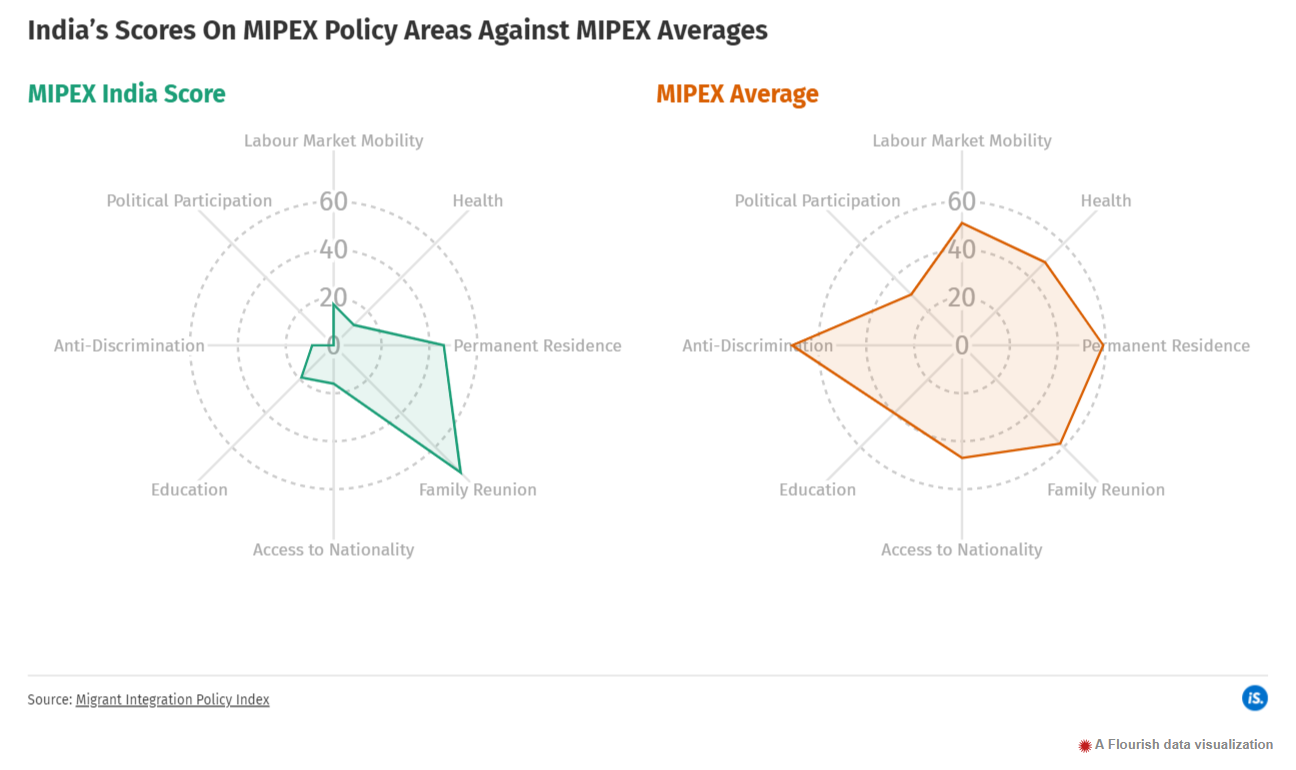
India scored the least, 24 out of 100, far lower than the average of 50, putting it in a category where migrant integration is deemed “denied”.

The index, a policy tool that measures a country’s national policies on international immigrants across eight parameters, is published jointly by two European think-tanks, the Migration Policy Group of Brussels and the Barcelona Centre for International Affairs, and was first released in 2014.

While other Asian countries such as China and Indonesia have improved their integration policies, India’s score has remained unchanged in the last five years. India’s Migrant Integration Policy Index scores fell below 20 in key policy areas including the labour market, education, health, access to nationality and anti-discrimination actions.

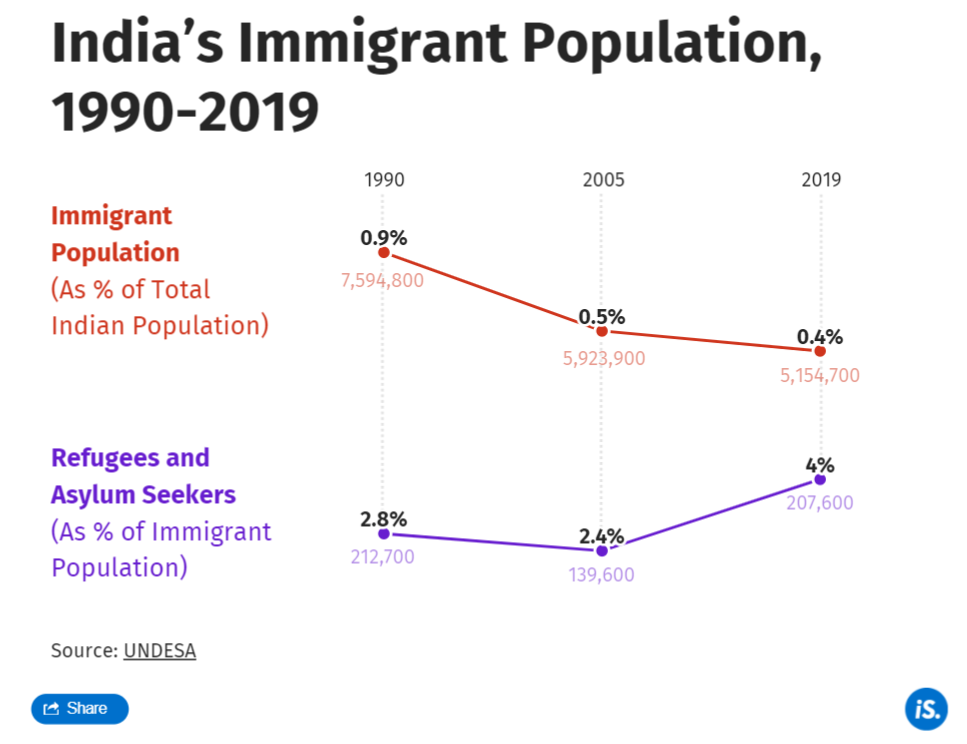
This is significant for two reasons: Although not the world’s most important migrant destination, India is home to 5 million immigrants, according to the Census 2011. Data from 2019 from the Population Division of the United Nations’ Department of Economic and Social Affairs noted a decline in immigrant numbers in India from 7.6 million in 1990 to 5.1 million in 2019.

Although the number of refugees and asylum seekers has gone down between 1990 and 2019 (from 212,700 to 207,600), they constitute an increasing proportion of the total immigrant population in India (2.8% in 1990 to 4% in 2019). Similar estimates from the United Nations High Commission for Refugees suggest that the number of refugees and asylum seekers in 2020 was 210,201, according to their January 2020 India Factsheet.

Further, 95.3% of India’s immigrants in 2019 also originated in the same SDG region (Central and Southern Asia comprising neighbouring countries such as Bangladesh, Pakistan, Nepal, Bhutan, Sri Lanka and Afghanistan) – a number that has not changed significantly from 1990 (96.8%).

This characteristic of immigration to India is also highlighted in a 2017 article by the Pew Research Center. However, the existing immigrant population continues to face integration barriers in various aspects of daily life, which impact their entry into the workplace, access to justice, and educational experiences, concluded the Migrant Integration Policy Index analysis.

India also sends out the world’s largest number of emigrants – 17.5 million as per estimates from the International Organisation for Migration’s (UN-IOM) World Migration Report 2020, and is, therefore, a critical voice in immigrant integration.

Migrants move seeking better livelihoods and education, so an increase in immigration rates is an indicator of a country’s growth and development trajectory. As India develops in the coming decades and takes on a leadership role in the South Asian region, integration of immigrants and their issues will only become more important, experts say.

“There is very little by way of comprehensive immigration policy in India today – access to social security benefits or the labour market is limited and often foreign nationals face discrimination as reported in the media,” said migration policy expert Meera Sethi, formerly of the UN-IOM.

Originally devised to measure the integration of Third Country Nationals – or non-European Union nationals – in the EU, Migrant Integration Policy Index is now a major policy tool to analyse and measure migrant integration in destination countries around the world: in developed countries including the United States, Canada, Australia, Japan and Norway, as well as in developing countries such as Brazil, Indonesia, China, India and Turkey. The assessment for India was conducted by Migration Policy Group’s country partner India Migration Now, a Mumbai-based research non-profit.

Low scores across key indices

India’s overall Migrant Integration Policy Index score is the lowest because of below-average scores in all policy areas except for family reunion (assessing how easy it is for immigrants to reunite with their families) where the score is 75, compared to the Migrant Integration Policy Index average of 58. The country fares worse in certain policy areas such as anti-discrimination, health, labour market mobility and access to nationality.

In the area of labour market mobility, India scored 17 while the Migrant Integration Policy Index average is 51. Accessing an employment visa in India carries certain conditions – only those from highly skilled backgrounds earning more than $25,000 per annum are eligible.

Furthermore, employment visas are not granted for jobs for which qualified Indians are available, according to informationput out by the Ministry of Home Affairs. Foreign residents on business visas have the option of self-employment, but no measures exist to promote access to the labour market or provide support to improve professional skills or opportunities.

In education too, India scored 19, less than half the Migrant Integration Policy Index average of 40. There are no measures in place in the country that recognise the unique requirements of immigrant children. They only benefit from general measures available for all children in India under the Right to Education Act, 2009. This is a lacuna evident for India’s interstate migrants as well, who face exclusion when they move from one state to another, found IMN’s IMPEX analysis of 2020. Typically, states require migrants to furnish proof of residence, which can be in the form of a domicile certificate or a school transfer certificate from the destination state, which migrants often find difficult to produce because they are not domiciles of the destination state and had acquired education in their source states, the IMPEX analysis showed.

These issues are further aggravated for immigrant families and while many have managed to utilise Right to Education provisions, their children often face discrimination and cultural barriers at Indian schools, according to this January 2020 articlein The Wire, which focuses on the Rohingya refugee community. Refugee communities such as the Rohingya are reliant on philanthropic initiatives and the work of NGOs to fill these crucial policy gaps, according to an earlier 2018 field report from The Wire.

In the area of political participation, India scored 0. The right to vote, to stand in elections, and form political parties/associations are limited to the citizens of India. These limitations often also extend to interstate migrants as voter identity is connected to the electoral roll at the place of origin, found IMN’s IMPEX analysis. Although Indian citizens are eligible to transfer to new electoral rolls when they move, the process is not easy, particularly for short-term seasonal migrants who move often.

Poor access to health

In the field of health, immigrants and asylum seekers face additional requirements to access the Indian health system and enjoy little information or support targeted to meet their specific health needs. Schemes such as Ayushman Bharat extend to those families categorised in the lower-income brackets as defined by the socio-economic and caste census of 2011 and therefore exclude immigrants. However, schemes under the Integrated Child Development Services, which provides supplementary nutrition, pre-school and non-formal education, immunisation, and health check-ups to children aged 0 years to 6 years, can usually be availed without proof of identity.

The services of public health facilities like primary healthcare centres are also open to immigrant communities and asylum seekers in India – both of these options are recommended for the communities by the United Nations High Commissioner for Refugees in India as well. These schemes may be utilised by immigrants in the same manner as RTE is.

Schemes of the Delhi government such as the Aam Aadmi Mohalla Clinic serve all residents living in areas deemed eligible (usually slum and jhuggi jhopri areas) and are available to immigrants as well.

Specific health schemes exist for Tibetan and Sri Lankan Tamil refugees as part of central level integration policies for these communities – these include the Tibetan Rehabilitation Policy of 2014 and specific schemes for maternal and child health by the government of Tamil Nadu for Sri Lankan Tamil refugees. However, these communities number approximately 200,000 in total and only form 3%-4% of the estimated legal immigrant population. Covid-19 has aggravated the existing policy gaps for refugee communities, as IndiaSpend reported in April 2020 and as argued by this September 2020 opinion editorial in Migration Policy Institute, a migration research think-tank based out of Washington DC, USA.

India’s score in the policy area of anti-discrimination is 9, compared to the Migrant Integration Policy Index average of 71. There is currently no legislation related to discrimination against immigrant communities. Article 15 of the Constitution of India addresses direct and/or indirect discrimination and/or harassment and/or instruction to discriminate on grounds of race, ethnicity, religion and belief – a provision that only exists for citizens.

It has also been argued that these provisions are, in themselves, inadequate, and India needs a comprehensive internal anti-discrimination law. Discrimination against immigrant communities is an issue and has occurred against various refugee groups as well as student groups from African countries such as Nigeria who have faced racist attacks.

In India, the path to permanent residence is mainly linked to the ability to fulfil certain economic requirements. However, even permanent residents are denied equal treatment with Indian nationals in key areas of life such as social security and assistance. For accessing citizenship in India, a person can apply for citizenship by naturalisation if they meet certain qualifications such as residence in India or service in the central government for a certain period of time: (i) for the 12 months immediately preceding the application for citizenship, and (ii) for 11 of the 14 years preceding the 12-month period, as specified in The Citizenship Act, 1955 Act. The process of accessing citizenship requires more than 10 years of residence and India does not offer dual nationality.

Among the eight policy areas, India has the highest score in family reunion. This policy area assesses if foreign residents can reunite with their families – for instance, whether legally resident foreign citizens can sponsor their entire families. Whether family members need prerequisites such as learning a language before departure for the destination country.

Whether the state protects family members from discretionary procedures (such as in deciding permit durations, considering personal circumstances when allowing or refusing entry, and giving the applicant a chance to appeal) and whether the family members get the same rights as their sponsor. Although India scores 75 in the policy area and many foreign citizens are eligible to apply for their dependent family members, according to information provided by the Ministry of Home Affairs, there are no additional integration measures for these reunited families.

Flawed public perception

The understanding of the impacts and contributions of immigrants to developing countries’ economies is limited. Besides adding to the overall social and cultural diversity, immigrants from neighbouring countries such as Nepal have been contributing to the Indian economy in the informal sector as construction workers, domestic help, cleaners, bar and restaurant workers, and petty traders. Unfortunately, such contributions have not been assessed or measured, found a 2015 paper published in the Economic and Political Weekly.

Cross-border migrants often face harassment, are exploited by brokers, paid irregularly and sometimes substantially less than what they are promised by the employers, and are often ill-treated by the border security forces – as reported in this 2015 research study by the Mahanirban Calcutta Research Group, which conducted fieldwork with cross-border Rohingya and Bangladeshi migrants. India has no formal immigration policy framework but existing policies regulate the entry and exit of people through the border.

The Indian government has also set up special tribunals for the determination of the question of whether a person is an illegal immigrant as per the Illegal Migrants (Determination by Tribunals) Act, 1983. Beyond this, there are ad hoc policies and executive orders for the entry and rehabilitation of Tibetan and Sri Lankan refugees and for religious minorities from neighbouring Muslim majority countries. Even the Citizenship Amendment Act of 2019 – facilitating citizenship for religious minorities from Pakistan, Afghanistan and Bangladesh – is estimated to actually benefit only 31,313 people, as detailed in the joint parliamentary committee report on the Citizenship (Amendment) Bill (then, a Bill) in 2016.

The lack of policy intervention is further aggravated by the public perception and rhetoric around illegal immigration (mostly from Bangladesh), which have often been election issuesin India. The data, however, do not bear this out: Improved developmental outcomes in Bangladesh in recent years have brought the two countries on par, argues this opinion editorial in The Indian Express – as a result, immigrants from Bangladesh may no longer be seeking out India as a destination.

In a fast globalising world, as Indian emigrants in various destination countries benefit from effective integration schemes, policy in India for the country’s over 5 million immigrant population has clearly not kept pace, said experts.

“Countries have already started to invest in ensuring basic rights and a secure future for international migrants. Now, they need to guarantee migrants the same equal opportunities as nationals,” said Giacomo Solano, policy and statistical analyst at MPG, Brussels, where the Migrant Integration Policy Index was formulated.

Source: While millions of Indians seek better lives abroad, India treats its immigrants poorly

Let’s make 2021 the year we eliminate online hate in Canada

Of note, along with contesting Isreal’s non-vaccination of Palestinians, which is a legitimate criticism of the Israeli government, not “a demonstrably false accusation tantamount to a modern-day blood libel.” One can also question the further codification of the IHRA definition, given its sometimes being used more broadly than intended. The other specific recommendations, however, are reasonable:

2020 was challenging. In addition to the horror of disease, the pandemic brought other troubling developments, including a sharp rise in hatred disseminated online. Canadians are clearly immune neither to the pandemic nor to the growing hate it appears to be exacerbating.  

Online hate is not a new phenomenon. At my organization, CIJA, we have been working on the issue since 2013. But, like the coronavirus, online hate has exploited weaknesses in our society to the detriment of all. As our lives continue to migrate online, the very platforms that proved to be a lifeline in so many ways also served as a springboard for spreading vicious hatred.  

Asian Canadians have been wrongfully and absurdly accused of deliberately unleashing COVID-19. 

Indigenous people, subjected to hatred and mistreatment since generations before the invention of the internet, many living in conditions that should embarrass all Canadians, are experiencing vicious online attacks on their culture and identity.    

Muslims, women, and the LGBTQ2+ community are regularly targeted by haters online, where Islamophobia, misogyny and homophobia continue to flourish.   

Good old-fashioned racists seized the opportunity provided by a global discussion about anti-Black hatred to, paradoxically, spread anti-Black hatred.   

And, of course, Jews were accused of this conspiracy or that one, from creating COVID-19 to profiting from the pandemic to claiming that Israel has leveraged the pandemic to oppress Palestinians by denying them the vaccine – a demonstrably false accusation tantamount to a modern-day blood libel, and one that the Palestinians themselves have refuted.   

All deeply offensive, to be sure, but being offensive is the only causes for concern.  

If online hate were simply offensive, it would be easier to dismiss. However, CIJA and the many partners we have worked with over the years – including those who have recently joined us to form the Canadian Coalition to End Online Hate – have increasingly observed, online hate can, and too often does, turn into real-world violence.   

This. Must. Stop.   

The federal government should deliver on its commitments

Following the 2019 election, the Liberals committed to devising a national strategy to end online hate, an issue that was explicitly included in the Prime Minister’s mandate letters to the Ministers of Justice, Public Safety and Emergency Preparedness, Heritage and Diversity and Inclusion and Youth. 

They have a very good blueprint to work from: the June 2019 report on online hate produced by the House of Commons Standing Committee on Justice and Human Rights, then chaired by Montreal-area MP Anthony Housefather. The report followed the murders in Christchurch, Pittsburgh, and Poway, all cases of online hate morphing into real world violence. 

It is now time to take the next steps. We, and the groups we work with through the Canadian Coalition to End Online Hate, a broad-based alliance of close to 40 (and growing) organizations representing a diverse array of communities, are calling for the following concrete actions.  

We propose:   

  • Increasing resources for law enforcement, Crown attorneys, and judges to ensure they receive sufficient training on how to apply existing laws to deal with online hate 
  • Directing Statistics Canada to address the gap in data to help us determine the scope of the problem and monitor progress  
  • Ensuring we achieve balance between combating online hate and protecting freedom of expression, notably by formulating a definition of “hate” and “hatred” that is consistent with Supreme Court of Canada jurisprudence 
  • Creating a civil remedy to address online hate and  
  • Establishing strong and clear regulations for online platforms and Internet service providersabout how they monitor and transparently address incidents of hate spread on their platforms.   

The Role of Social Media Giants  

Platforms and providers do not have the best record when it comes to tracking and eliminating online hate. They must do better. And they will only do so with government pressure.  Canadian law must be strengthened to put the onus on platforms and providers to ensure that hateful content does not get published in their spaces. 

A national strategy to address online hate must include both the development of clear, harmonized, and uniform regulations, which apply to all platforms and providers operating in Canada, and an independent regulator to enforce them. 

These regulations should include a mandatory directive that providers incorporate appropriate definitions of hate and hatred. In the case of the Jewish community, we are advocating for the adoption of the International Holocaust Remembrance Alliance (IHRA) definition of antisemitism to be included in their user codes of conduct, algorithms, moderator policies, and terms of service.  

We also strongly believe that providers must make it easier for users to flag hateful content and be transparent about how complaints are adjudicated.  

COVID-19 has significantly accelerated our migration online, which was already well underway. It is imperative that we collectively do what is necessary to ensure the online space is a safe and hate-free place for everyone. 

Source: https://www.thestar.com/opinion/contributors/2021/01/11/lets-make-2021the-yearweeliminateonline-hatein-canada.html

Syrians in Turkey in precarious situation as citizenship applications indefinitely suspended by authorities

Of note:

Nearly 10 years after the civil war began in Syria, refugees are still struggling with their precarious status in Turkey as most have not been able to acquire Turkish citizenship and their applications have been indefinitely suspended by the authorities, Deutsche Welle Turkish service reported.

Thousands of Syrian refugees who have been in Turkey for more than five years submitted their application documents to obtain citizenship and were interviewed by authorities. However, they have found that their citizenship process was suspended without reason.

“I applied for citizenship and then waited three years, after which they told me that my application had been suspended,” said Fatma Tata, a young Syrian woman. “I will graduate this year, but I won’t be able to work under these conditions.”

Musab Hawsa, 29, who fled to Turkey eight years ago and works as a practitioner at a medical school, said his citizenship application was also abruptly suspended after waiting three years.

“If they had told me earlier, I would have planned accordingly. I would like to get a residency [at the medical school] but was waiting to get my citizenship for that. I think I may need to leave Turkey,” he said.

In some cases, parents have become Turkish citizens while their children were not able to. This has become a problem, especially since most children were born in Turkey and do not have Syrian citizenship, either. “It has become a bureaucratic hassle to prove the children are ours each time the police ask for our documents,” said one Syrian mother whose children were stateless.

According to a report drafted by Solaris, an NGO that words to support vulnerable populations, the law stipulates that if the parents have Turkish citizenship then the children also should be given citizenship. “Giving children of Turkish citizens temporary protection, which is the case for refugees, is against the law,” said the report.

A Syrian parent who gave an interview for the report said their children were stateless. He said they could not plan anything for their future until their children obtained citizenship.

Another parent, Abdurrahman Abdulkerim, 33, said he felt unwanted in Turkey and planned on moving to Europe. He said his three children were stateless and he believed they would not be able to acquire citizenship at this point.

An estimated 3.6 million refugees have been granted temporary protection in Turkey. The majority of them live outside camps, in precarious and challenging circumstances.

Turkish President Recep Tayyip Erdoğan had promised Syrian refugees Turkish citizenship in 2016. However, he did not explain how this would happen or the criteria for applying for citizenship. Dr. Murat Erdoğan, an immigration expert at the Turkish-German University, said granting citizenship to almost 3 million people at once was unheard of.

Source: Syrians in Turkey in precarious situation as citizenship applications indefinitely suspended by authorities

Military medical intelligence warnings gathered dust as public health struggled to define COVID-19

Sigh… Yet another oversight. So PHAC relied exclusively on the WHO which appears to have relied exclusively on the Chinese government, and did not explore other data sources:

Public health officials failed to cite early warnings about the threat of COVID-19 gathered through classified military intelligence as the pandemic crisis emerged a year ago, CBC News has learned — an oversight described as a strategic failure by intelligence and public health experts.

For over seven decades, Canada and some of its closest allies have operated a largely secret formal exchange of military medical intelligence. That relationship regularly produces troves of highly detailed data on emerging health threats.

The small, specialized unit within the Canadian military’s intelligence branch began producing warnings about COVID-19 in early January of last year — assessments based largely on classified allied intelligence. Those warnings generally were three weeks ahead of other open sources, say defence insiders.

But documents show the Public Health Agency of Canada’s (PHAC) COVID-19 rapid risk assessments — which politicians and public servants used to guide their choices in early days of the pandemic — contained no input from the military’s warnings, which remain classified.

Three of the five PHAC risk assessments — obtained under access to information law by one of the country’s leading intelligence experts and CBC News — show federal health officials relying almost exclusively on assessments from the World Health Organization.

Even those writing the risk assessment reports acknowledged the dearth of intelligence.

Confidence level ‘low’

“Due to the limited epidemiologic data from China, and limited virologic information available for the etiologic agent, the confidence level for this assessment is considered as ‘low’ and the algorithm outputs remain uncertain at this time,” said the Feb. 2, 2020 PHAC risk assessment report.

The analysts at PHAC were uncertain because — as the world learned later — China was stonewalling the WHO about the extent of the Wuhan outbreak and assuring international health experts that everything was under control.

Meanwhile, in the military medical community, alarm bells were ringing. In the U.S., the National Center for Medical Intelligence (NCMI), located in Fort Detrick, Maryland, was not only gathering raw intelligence through various classified means — it was producing comprehensive assessments of the trajectory of the virus as of last February.

“This coronavirus pandemic is right in their wheelhouse, which is part of their core mission — to be on the lookout for any early indications of infectious disease,” said Dr. Jonathan Clemente, a physician practicing in Charlotte, North Carolina who has researched and written extensively about the history of medical intelligence.

‘Strategic surprise’

The original purpose of military medical intelligence among the allies was to assess sanitary and health conditions in the places around the globe where their troops were deployed.

But over the years, Clemente said, the mandate evolved to include “preventing strategic surprise” — such as pandemics and deliberate biological attacks.

“So there’s a wide range of reports, from your short-form daily bulletins to long-form assessments,” he said.

“It’s important to know that this is different from, say, the World Health Organization because the NCMI has access to all-source intelligence, meaning they have access to the most secret levels of intelligence, including clandestine human reporting, satellites, signals intelligence and … open  reporting.”

The information gathered through such intelligence channels would be knowledge “that other traditional health care and public health agencies” don’t have, he added. It’s also the kind of knowledge that would have informed the Canadian military’s medical intelligence branch as the pandemic was gathering momentum.

‘A terrible failure’

The fact that PHAC didn’t track what the military medical intelligence branch was seeing, coupled with changes to the federal government’s own Global Pandemic Health Information Network (GPHIN), represent “a terrible failure,” said Wesley Wark, a University of Ottawa professor who studies intelligence services and national security. He requested the documents through the access to information law.

The auditor general is reviewing what went wrong with the country’s early warning system, including the risk assessments. Flaws in those assessments may have affected the introduction of anti-pandemic measures such as border closures and mask mandates.

A second, separate independent review of Canada’s early pandemic response has been ordered by Health Minister Patty Hajdu.

CBC News first reported last spring that the military medical intelligence branch (MEDINT) began writing reports and issuing warnings about COVID-19 in January 2020. At the time, a spokesperson for MEDINT would not comment “on the content of intelligence reports that we receive or share.”

A follow-up investigation by CBC News has shed more light on the long-established secret network the allies use to warn each of health threats.

It’s governed by an obscure forum going by a rather clunky name: the Quadripartite Medical Intelligence Committee (QMIC).

A ‘Five Eyes’ network for pandemics

Originating in the Second World War, the forum allows the American, Canadian, British and Australian militaries to exchange classified global health data and assessments about emerging health threats.

Clemente describes it as the medical equivalent of the better-known Five Eyes intelligence-sharing alliance between Canada, the United States, Great Britain, Australia and New Zealand.

Clemente said that, through U.S. freedom of information law, he has compiled a comprehensive, declassified portrait of the deep health intelligence ties between allies — especially between Canada and the U.S.

He said he also has collected reports and analyses on how NCMI tracked and assessed previous pandemics and disease outbreaks, including SARS, H1N1 and Ebola.

Those assessments — copies of which were obtained by CBC News — are very precise and complete. The U.S. military’s assessments of the novel coronavirus and the disease it causes remain classified, but Clemente said it’s certain that NCMI was doing similar surveillance on COVID-19 which would have been shared with allies.

Wark said Canada’s public health system was redesigned almost two decades ago with the aim of preventing “strategic surprise,” but many of initiatives planned or implemented following the SARS outbreak were allowed to wither away and die.

One 2004 proposal which fell by the wayside was to find a mechanism that would allow PHAC to seamlessly incorporate classified intelligence into its system of reporting.

Greg Fyffe, the former executive director of the Intelligence Assessment Secretariat in the Privy Council Office (which supports the prime minister’s office), said military medical intelligence assessments rarely came across his desk during his tenure a decade ago.

He said that when intelligence reports reach the highest levels of government, they often arrive in summary form and analysts occasionally have to seek out more details.

“There’s so much intelligence information out there that it’s not a matter of saying … ‘I have a little bit of something that you’d like to see,'” said Fyffe. “We’re talking about huge volumes of material which can’t all be shared.”

In a year-end interview with the CBC’s Rosemary Barton, Prime Minister Justin Trudeau dismissed the suggestion that better early warnings could have stopped COVID-19 from spreading to Canada.

“I think we used all the resources that we always have to follow and monitor,” he said. “I don’t know that it would have made a huge difference for us to have extra reporting on top of what we were getting.”

The prime minister said that, in hindsight, there were things “we probably would have wanted to have done sooner in terms of preparing,” such as bolstering stocks of personal protective equipment (PPE) and other medical supplies.

‘We could have been much better prepared’

Defence Minister Harjit Sajjan indicated in a year-end interview that he shared the information he had and there were “many conversations” within the government.

While he cautioned that military intelligence alone can’t cover global disease surveillance, he did acknowledge that Canada’s early warning mechanisms need a serious review “from a whole-of-government perspective … making sure we have the right sensors out.”

Preparation is the whole point of early warning, said Wark, who agreed with Trudeau’s assessment of the volatility of the novel coronavirus’s transmission.

“We wouldn’t have stopped it from coming to Canada,” said Wark. “That would have been impossible. But we could have been much better prepared to meet its onslaught, and we were not. We suffered a terrible failure of early warning, of intelligence, of risk assessment.

“And the main lesson that has to be drawn … from the experience of COVID-19 is that we have to fix all of those things. We have to have a better early warning system.”

Source: Military medical intelligence warnings gathered dust as public health struggled to define COVID-19

Knock down anti-Black racism in medicine, two powerhouse advocates tell health-care sector in new CMAJ article

More on process-type recommendations to identify approaches to address issues, many of which reflect social determinants of health:

When rapper John River went to a hospital emergency room in 2017 with shortness of breath and severe headaches, he was treated like he was faking his symptoms to get drugs. When he turned to social media for help, well-wishers told him how he and his family acted and dressed at the hospital would impact the kind of care he would receive. No hoodies, for instance. His mother tried to button a dress shirt on to him as he lay unconscious on a stretcher. He was eventually diagnosed with a spontaneous cerebrospinal fluid leak from a prior procedure.

For years, Black people have shared, with data scientists, governments, academics, journalists and each other, terrifying stories of not being believed in hospitals, of receiving substandard care, of feeling like they were left to die.

In this COVID-era, race-aggregated data showing Black people disproportionately impacted by the virus has rightly raised awareness and alarm over the impact of racism across systems leading to that outcome.

“The field of medicine can no longer deny or overlook the existence of systemic anti-Black racism in Canada and how it affects the health of Black people and communities,” write OmiSoore Dryden of Dalhousie University and Onye Nnorom from the University of Toronto. 

In a Canadian Medical Association Journal article released Monday, the two powerhouse experts in the field of anti-Black racism in medicine say the health-care system needs to focus on — and redress — not only the reasons that send Black Canadians to hospitals but how they’re treated when they get there. 

Despite protests against anti-Black racism this summer, despite the UN expressing concern in 2017 of the plight of Black Canadians, “the impression that we got is that many Canadian physicians did not think that anti-Black racism is a problem in Canada,” Nnorom told the Star. And that “most physicians do not have an understanding of how racism operates as a system such that some groups are disproportionately disadvantaged.” 

With this article, Dryden said, the authors aimed to “tell practitioners and clinicians that your patients are not just bodies in front of you. They come with experiences. One of the experiences your Black patients come with is anti-Black racism.” 

Dryden is the James R. Johnston (JRJ) Chair in Black Canadian Studies at Dalhousie University’s faculty of medicine. Nnorom is trained as a public health physician and a family physician and has published several articles in medicine.

About a year ago, they set up Canada’s Black Health Education Collaborative by bringing together a group of scholars of Critical Race Theory from across Canada and working on creating curriculum around how anti-Black racism affects health outcomes in medical schools.

The many manifestations of racism in society — being passed over for a job or a promotion, being treated with suspicion in public spaces, being denied homes to rent, being unduly disciplined in school — all boil down to one unspoken assumption: that the person in question is not credible because they are not innocent. An assumption we like to give the innocuous label of “implicit” bias, even though its consequences can be tragically explicit. 

“This article and the conversations many of us have been having is identifying that racism is not an anomaly, it’s an everyday experience,” Dryden said. 

When Black people go to the hospital in pain, they are profiled as drug seeking, she said. Or the assumption is they don’t feel pain at the same level. Or if they are given medication that they’re not compliant and won’t follow guidelines. 

In her many public talks to health and medical professionals, Dryden tells them, “If you have a patient that doesn’t return, instead of thinking they’re not compliant, you might want to start with, ‘Did something racist happen and how do I find out?’

Although modern science conclusively busts the myth that race has biological origins, medical stereotypes rely on the belief that Black people are a different genetic species of humans. 

“Yes, the human genome has been mapped,” Nnorom said. “Yes, we know a person’s postal code has more impact on their health than their genetic code but it is difficult to completely remove that type of thinking. The history of medicine and these genetic biological associations with race dates back centuries.” 

The first program of medical education began in Montreal about 20 years before the end of slavery in Canada, Dryden said. “So it began at a time when Black and Indigenous are enslaved and that becomes the continuing flavour of education in Canada.”

If studies show how African-Americans have higher rates of diabetes or hypertension, the medical approach is there’s something wrong with their genetics or their culture or their practices that needs to be fixed. 

“The way we’ve been traditionally taught in medicine is to pathologize the marginalized group.” Nnorom said. “We’ve been taught to assume there is something wrong with the group that has been marginalized as opposed to thinking there was something wrong with society to create the conditions in which those communities find themselves.

“The process (of learning), you’d almost have consider it an unlearning.”

To address racism, the authors say health-care professionals should acknowledge its existence first. “We can do this by listening to the voices of Black Canadians, patients and health care professionals who have been grappling with anti-Black racism for generations, and by engaging with the many communities that have made recommendations for meaningful change to address the problem,” they write.

What would listening look like? 

“That’s a very good question,” said Nnorom, because while organizations might engage in consultations with focus groups in different communities, “what ends up coming out of that is not what the community has recommended. That is not true listening.”

Hospital leaders, administrators and academics would have to take up hard, uncomfortable work of “actually looking at recommendations by Black communities, to hold town halls start, to have Black community members at the board — and not just with one person because that would be tokenism.” 

Said Dryden: “There’s always an excuse for why something isn’t anti-Black racism as opposed to sitting with it for a moment (and thinking) ‘If this is racism what should I be doing differently?’ And nobody asks themselves that question. That’s the thing we want them to ask themselves.” 

This article is intended as a building block in that journey towards change, Nnorom said. 

“So that we can see a Black patient can come into a hospital and be treated with dignity, where their pain is recognized and they receive respect and empathy and not be treated worse because of the colour of their skin.”

Source: https://www.thestar.com/opinion/star-columnists/2021/01/11/knock-down-anti-black-racism-in-medicine-two-powerhouse-advocates-tell-health-care-sector-in-new-cmaj-article.html

Snyder: The American Abyss: A historian of fascism and political atrocity on Trump, the mob and what comes next.

Good long and sobering read:

When Donald Trump stood before his followers on Jan. 6 and urged them to march on the United States Capitol, he was doing what he had always done. He never took electoral democracy seriously nor accepted the legitimacy of its American version.

Even when he won, in 2016, he insisted that the election was fraudulent — that millions of false votes were cast for his opponent. In 2020, in the knowledge that he was trailing Joseph R. Biden in the polls, he spent months claiming that the presidential election would be rigged and signaling that he would not accept the results if they did not favor him. He wrongly claimed on Election Day that he had won and then steadily hardened his rhetoric: With time, his victory became a historic landslide and the various conspiracies that denied it ever more sophisticated and implausible.

People believed him, which is not at all surprising. It takes a tremendous amount of work to educate citizens to resist the powerful pull of believing what they already believe, or what others around them believe, or what would make sense of their own previous choices. Plato noted a particular risk for tyrants: that they would be surrounded in the end by yes-men and enablers. Aristotle worried that, in a democracy, a wealthy and talented demagogue could all too easily master the minds of the populace. Aware of these risks and others, the framers of the Constitution instituted a system of checks and balances. The point was not simply to ensure that no one branch of government dominated the others but also to anchor in institutions different points of view.

In this sense, the responsibility for Trump’s push to overturn an election must be shared by a very large number of Republican members of Congress. Rather than contradict Trump from the beginning, they allowed his electoral fiction to flourish. They had different reasons for doing so. One group of Republicans is concerned above all with gaming the system to maintain power, taking full advantage of constitutional obscurities, gerrymandering and dark money to win elections with a minority of motivated voters. They have no interest in the collapse of the peculiar form of representation that allows their minority party disproportionate control of government. The most important among them, Mitch McConnell, indulged Trump’s lie while making no comment on its consequences.

Yet other Republicans saw the situation differently: They might actually break the system and have power without democracy. The split between these two groups, the gamers and the breakers, became sharply visible on Dec. 30, when Senator Josh Hawley announced that he would support Trump’s challenge by questioning the validity of the electoral votes on Jan. 6. Ted Cruz then promised his own support, joined by about 10 other senators. More than a hundred Republican representatives took the same position. For many, this seemed like nothing more than a show: challenges to states’ electoral votes would force delays and floor votes but would not affect the outcome.

Yet for Congress to traduce its basic functions had a price. An elected institution that opposes elections is inviting its own overthrow. Members of Congress who sustained the president’s lie, despite the available and unambiguous evidence, betrayed their constitutional mission. Making his fictions the basis of congressional action gave them flesh. Now Trump could demand that senators and congressmen bow to his will. He could place personal responsibility upon Mike Pence, in charge of the formal proceedings, to pervert them. And on Jan. 6, he directed his followers to exert pressure on these elected representatives, which they proceeded to do: storming the Capitol building, searching for people to punish, ransacking the place.

Of course this did make a kind of sense: If the election really had been stolen, as senators and congressmen were themselves suggesting, then how could Congress be allowed to move forward? For some Republicans, the invasion of the Capitol must have been a shock, or even a lesson. For the breakers, however, it may have been a taste of the future. Afterward, eight senators and more than 100 representatives voted for the lie that had forced them to flee their chambers.

Post-truth is pre-fascism, and Trump has been our post-truth president. When we give up on truth, we concede power to those with the wealth and charisma to create spectacle in its place. Without agreement about some basic facts, citizens cannot form the civil society that would allow them to defend themselves. If we lose the institutions that produce facts that are pertinent to us, then we tend to wallow in attractive abstractions and fictions. Truth defends itself particularly poorly when there is not very much of it around, and the era of Trump — like the era of Vladimir Putin in Russia — is one of the decline of local news. Social media is no substitute: It supercharges the mental habits by which we seek emotional stimulation and comfort, which means losing the distinction between what feels true and what actually is true.

Post-truth wears away the rule of law and invites a regime of myth. These last four years, scholars have discussed the legitimacy and value of invoking fascism in reference to Trumpian propaganda. One comfortable position has been to label any such effort as a direct comparison and then to treat such comparisons as taboo. More productively, the philosopher Jason Stanley has treated fascism as a phenomenon, as a series of patterns that can be observed not only in interwar Europe but beyond it.

My own view is that greater knowledge of the past, fascist or otherwise, allows us to notice and conceptualize elements of the present that we might otherwise disregard and to think more broadly about future possibilities. It was clear to me in October that Trump’s behavior presaged a coup, and I said so in print; this is not because the present repeats the past, but because the past enlightens the present.

Like historical fascist leaders, Trump has presented himself as the single source of truth. His use of the term “fake news” echoed the Nazi smear Lügenpresse (“lying press”); like the Nazis, he referred to reporters as “enemies of the people.” Like Adolf Hitler, he came to power at a moment when the conventional press had taken a beating; the financial crisis of 2008 did to American newspapers what the Great Depression did to German ones. The Nazis thought that they could use radio to replace the old pluralism of the newspaper; Trump tried to do the same with Twitter.

Thanks to technological capacity and personal talent, Donald Trump lied at a pace perhaps unmatched by any other leader in history. For the most part these were small lies, and their main effect was cumulative. To believe in all of them was to accept the authority of a single man, because to believe in all of them was to disbelieve everything else. Once such personal authority was established, the president could treat everyone else as the liars; he even had the power to turn someone from a trusted adviser into a dishonest scoundrel with a single tweet. Yet so long as he was unable to enforce some truly big lie, some fantasy that created an alternative reality where people could live and die, his pre-fascism fell short of the thing itself.

Some of his lies were, admittedly, medium-size: that he was a successful businessman; that Russia did not support him in 2016; that Barack Obama was born in Kenya. Such medium-size lies were the standard fare of aspiring authoritarians in the 21st century. In Poland the right-wing party built a martyrdom cult around assigning blame to political rivals for an airplane crash that killed the nation’s president. Hungary’s Viktor Orban blames a vanishingly small number of Muslim refugees for his country’s problems. But such claims were not quite big lies; they stretched but did not rend what Hannah Arendt called “the fabric of factuality.”

One historical big lie discussed by Arendt is Joseph Stalin’s explanation of starvation in Soviet Ukraine in 1932-33. The state had collectivized agriculture, then applied a series of punitive measures to Ukraine that ensured millions would die. Yet the official line was that the starving were provocateurs, agents of Western powers who hated socialism so much they were killing themselves. A still grander fiction, in Arendt’s account, is Hitlerian anti-Semitism: the claims that Jews ran the world, Jews were responsible for ideas that poisoned German minds, Jews stabbed Germany in the back during the First World War. Intriguingly, Arendt thought big lies work only in lonely minds; their coherence substitutes for experience and companionship.

In November 2020, reaching millions of lonely minds through social media, Trump told a lie that was dangerously ambitious: that he had won an election that in fact he had lost. This lie was big in every pertinent respect: not as big as “Jews run the world,” but big enough. The significance of the matter at hand was great: the right to rule the most powerful country in the world and the efficacy and trustworthiness of its succession procedures. The level of mendacity was profound. The claim was not only wrong, but it was also made in bad faith, amid unreliable sources. It challenged not just evidence but logic: Just how could (and why would) an election have been rigged against a Republican president but not against Republican senators and representatives? Trump had to speak, absurdly, of a “Rigged (for President) Election.”

The force of a big lie resides in its demand that many other things must be believed or disbelieved. To make sense of a world in which the 2020 presidential election was stolen requires distrust not only of reporters and of experts but also of local, state and federal government institutions, from poll workers to elected officials, Homeland Security and all the way to the Supreme Court. It brings with it, of necessity, a conspiracy theory: Imagine all the people who must have been in on such a plot and all the people who would have had to work on the cover-up.The Presidential Transition

Trump’s electoral fiction floats free of verifiable reality. It is defended not so much by facts as by claims that someone else has made some claims. The sensibility is that something must be wrong because I feel it to be wrong, and I know others feel the same way. When political leaders such as Ted Cruz or Jim Jordan spoke like this, what they meant was: You believe my lies, which compels me to repeat them. Social media provides an infinity of apparent evidence for any conviction, especially one seemingly held by a president.

On the surface, a conspiracy theory makes its victim look strong: It sees Trump as resisting the Democrats, the Republicans, the Deep State, the pedophiles, the Satanists. More profoundly, however, it inverts the position of the strong and the weak. Trump’s focus on alleged “irregularities” and “contested states” comes down to cities where Black people live and vote. At bottom, the fantasy of fraud is that of a crime committed by Black people against white people.

It’s not just that electoral fraud by African-Americans against Donald Trump never happened. It is that it is the very opposite of what happened, in 2020 and in every American election. As always, Black people waited longer than others to vote and were more likely to have their votes challenged. They were more likely to be suffering or dying from Covid-19, and less likely to be able to take time away from work. The historical protection of their right to vote has been removed by the Supreme Court’s 2013 ruling in Shelby County v. Holder, and states have rushed to pass measures of a kind that historically reduce voting by the poor and communities of color.

The claim that Trump was denied a win by fraud is a big lie not just because it mauls logic, misdescribes the present and demands belief in a conspiracy. It is a big lie, fundamentally, because it reverses the moral field of American politics and the basic structure of American history.

When Senator Ted Cruz announced his intention to challenge the Electoral College vote, he invoked the Compromise of 1877, which resolved the presidential election of 1876. Commentators pointed out that this was no relevant precedent, since back then there really were serious voter irregularities and there really was a stalemate in Congress. For African-Americans, however, the seemingly gratuitous reference led somewhere else. The Compromise of 1877 — in which Rutherford B. Hayes would have the presidency, provided that he withdrew federal power from the South — was the very arrangement whereby African-Americans were driven from voting booths for the better part of a century. It was effectively the end of Reconstruction, the beginning of segregation, legal discrimination and Jim Crow. It is the original sin of American history in the post-slavery era, our closest brush with fascism so far.

If the reference seemed distant when Ted Cruz and 10 senatorial colleagues released their statement on Jan. 2, it was brought very close four days later, when Confederate flags were paraded through the Capitol.

Some things have changed since 1877, of course. Back then, it was the Republicans, or many of them, who supported racial equality; it was the Democrats, the party of the South, who wanted apartheid. It was the Democrats, back then, who called African-Americans’ votes fraudulent, and the Republicans who wanted them counted. This is now reversed. In the past half century, since the Civil Rights Act, Republicans have become a predominantly white party interested — as Trump openly declared — in keeping the number of voters, and particularly the number of Black voters, as low as possible. Yet the common thread remains. Watching white supremacists among the people storming the Capitol, it was easy to yield to the feeling that something pure had been violated. It might be better to see the episode as part of a long American argument about who deserves representation.

The Democrats, today, have become a coalition, one that does better than Republicans with female and nonwhite voters and collects votes from both labor unions and the college-educated. Yet it’s not quite right to contrast this coalition with a monolithic Republican Party. Right now, the Republican Party is a coalition of two types of people: those who would game the system (most of the politicians, some of the voters) and those who dream of breaking it (a few of the politicians, many of the voters). In January 2021, this was visible as the difference between those Republicans who defended the present system on the grounds that it favored them and those who tried to upend it.

In the four decades since the election of Ronald Reagan, Republicans have overcome the tension between the gamers and the breakers by governing in opposition to government, or by calling elections a revolution (the Tea Party), or by claiming to oppose elites. The breakers, in this arrangement, provide cover for the gamers, putting forth an ideology that distracts from the basic reality that government under Republicans is not made smaller but simply diverted to serve a handful of interests.

At first, Trump seemed like a threat to this balance. His lack of experience in politics and his open racism made him a very uncomfortable figure for the party; his habit of continually telling lies was initially found by prominent Republicans to be uncouth. Yet after he won the presidency, his particular skills as a breaker seemed to create a tremendous opportunity for the gamers. Led by the gamer in chief, McConnell, they secured hundreds of federal judges and tax cuts for the rich.Mitch McConnell Got Everything He Wanted. But at What Cost?Jan. 22, 2019

Trump was unlike other breakers in that he seemed to have no ideology. His objection to institutions was that they might constrain him personally. He intended to break the system to serve himself — and this is partly why he has failed. Trump is a charismatic politician and inspires devotion not only among voters but among a surprising number of lawmakers, but he has no vision that is greater than himself or what his admirers project upon him. In this respect his pre-fascism fell short of fascism: His vision never went further than a mirror. He arrived at a truly big lie not from any view of the world but from the reality that he might lose something.

Yet Trump never prepared a decisive blow. He lacked the support of the military, some of whose leaders he had alienated. (No true fascist would have made the mistake he did there, which was to openly love foreign dictators; supporters convinced that the enemy was at home might not mind, but those sworn to protect from enemies abroad did.) Trump’s secret police force, the men carrying out snatch operations in Portland, was violent but also small and ludicrous. Social media proved to be a blunt weapon: Trump could announce his intentions on Twitter, and white supremacists could plan their invasion of the Capitol on Facebook or Gab. But the president, for all his lawsuits and entreaties and threats to public officials, could not engineer a situation that ended with the right people doing the wrong thing. Trump could make some voters believe that he had won the 2020 election, but he was unable to bring institutions along with his big lie. And he could bring his supporters to Washington and send them on a rampage in the Capitol, but none appeared to have any very clear idea of how this was to work or what their presence would accomplish. It is hard to think of a comparable insurrectionary moment, when a building of great significance was seized, that involved so much milling around.

The lie outlasts the liar. The idea that Germany lost the First World War in 1918 because of a Jewish “stab in the back” was 15 years old when Hitler came to power. How will Trump’s myth of victimhood function in American life 15 years from now? And to whose benefit?

On Jan. 7, Trump called for a peaceful transition of power, implicitly conceding that his putsch had failed. Even then, though, he repeated and even amplified his electoral fiction: It was now a sacred cause for which people had sacrificed. Trump’s imagined stab in the back will live on chiefly thanks to its endorsement by members of Congress. In November and December 2020, Republicans repeated it, giving it a life it would not otherwise have had. In retrospect, it now seems as though the last shaky compromise between the gamers and the breakers was the idea that Trump should have every chance to prove that wrong had been done to him. That position implicitly endorsed the big lie for Trump supporters who were inclined to believe it. It failed to restrain Trump, whose big lie only grew bigger.

The breakers and the gamers then saw a different world ahead, where the big lie was either a treasure to be had or a danger to be avoided. The breakers had no choice but to rush to be first to claim to believe in it. Because the breakers Josh Hawley and Ted Cruz must compete to claim the brimstone and bile, the gamers were forced to reveal their own hand, and the division within the Republican coalition became visible on Jan. 6. The invasion of the Capitol only reinforced this division. To be sure, a few senators withdrew their objections, but Cruz and Hawley moved forward anyway, along with six other senators. More than 100 representatives doubled down on the big lie. Some, like Matt Gaetz, even added their own flourishes, such as the claim that the mob was led not by Trump’s supporters but by his opponents.

Trump is, for now, the martyr in chief, the high priest of the big lie. He is the leader of the breakers, at least in the minds of his supporters. By now, the gamers do not want Trump around. Discredited in his last weeks, he is useless; shorn of the obligations of the presidency, he will become embarrassing again, much as he was in 2015. Unable to provide cover for their gamesmanship, he will be irrelevant to their daily purposes. But the breakers have an even stronger reason to see Trump disappear: It is impossible to inherit from someone who is still around. Seizing Trump’s big lie might appear to be a gesture of support. In fact it expresses a wish for his political death. Transforming the myth from one about Trump to one about the nation will be easier when he is out of the way.

As Cruz and Hawley may learn, to tell the big lie is to be owned by it. Just because you have sold your soul does not mean that you have driven a hard bargain. Hawley shies from no level of hypocrisy; the son of a banker, educated at Stanford University and Yale Law School, he denounces elites. Insofar as Cruz was thought to have a principle, it was that of states’ rights, which Trump’s calls to action brazenly violated. A joint statement Cruz issued about the senators’ challenge to the vote nicely captured the post-truth aspect of the whole: It never alleged that there was fraud, only that there were allegations of fraud. Allegations of allegations, allegations all the way down.

The big lie requires commitment. When Republican gamers do not exhibit enough of that, Republican breakers call them “RINOs”: Republicans in name only. This term once suggested a lack of ideological commitment. It now means an unwillingness to throw away an election. The gamers, in response, close ranks around the Constitution and speak of principles and traditions. The breakers must all know (with the possible exception of the Alabama senator Tommy Tuberville) that they are participating in a sham, but they will have an audience of tens of millions who do not.

If Trump remains present in American political life, he will surely repeat his big lie incessantly. Hawley and Cruz and the other breakers share responsibility for where this leads. Cruz and Hawley seem to be running for president. Yet what does it mean to be a candidate for office and denounce voting? If you claim that the other side has cheated, and your supporters believe you, they will expect you to cheat yourself. By defending Trump’s big lie on Jan. 6, they set a precedent: A Republican presidential candidate who loses an election should be appointed anyway by Congress. Republicans in the future, at least breaker candidates for president, will presumably have a Plan A, to win and win, and a Plan B, to lose and win. No fraud is necessary; only allegations that there are allegations of fraud. Truth is to be replaced by spectacle, facts by faith.

Trump’s coup attempt of 2020-21, like other failed coup attempts, is a warning for those who care about the rule of law and a lesson for those who do not. His pre-fascism revealed a possibility for American politics. For a coup to work in 2024, the breakers will require something that Trump never quite had: an angry minority, organized for nationwide violence, ready to add intimidation to an election. Four years of amplifying a big lie just might get them this. To claim that the other side stole an election is to promise to steal one yourself. It is also to claim that the other side deserves to be punished.

Informed observers inside and outside government agree that right-wing white supremacism is the greatest terrorist threat to the United States. Gun sales in 2020 hit an astonishing high. History shows that political violence follows when prominent leaders of major political parties openly embrace paranoia.

Our big lie is typically American, wrapped in our odd electoral system, depending upon our particular traditions of racism. Yet our big lie is also structurally fascist, with its extreme mendacity, its conspiratorial thinking, its reversal of perpetrators and victims and its implication that the world is divided into us and them. To keep it going for four years courts terrorism and assassination.

When that violence comes, the breakers will have to react. If they embrace it, they become the fascist faction. The Republican Party will be divided, at least for a time. One can of course imagine a dismal reunification: A breaker candidate loses a narrow presidential election in November 2024 and cries fraud, the Republicans win both houses of Congress and rioters in the street, educated by four years of the big lie, demand what they see as justice. Would the gamers stand on principle if those were the circumstances of Jan. 6, 2025?

To be sure, this moment is also a chance. It is possible that a divided Republican Party might better serve American democracy; that the gamers, separated from the breakers, might start to think of policy as a way to win elections. It is very likely that the Biden-Harris administration will have an easier first few months than expected; perhaps obstructionism will give way, at least among a few Republicans and for a short time, to a moment of self-questioning. Politicians who want Trumpism to end have a simple way forward: Tell the truth about the election.

America will not survive the big lie just because a liar is separated from power. It will need a thoughtful repluralization of media and a commitment to facts as a public good. The racism structured into every aspect of the coup attempt is a call to heed our own history. Serious attention to the past helps us to see risks but also suggests future possibility. We cannot be a democratic republic if we tell lies about race, big or small. Democracy is not about minimizing the vote nor ignoring it, neither a matter of gaming nor of breaking a system, but of accepting the equality of others, heeding their voices and counting their votes.

Source: https://nuzzel.com/digeststory/01092021/nytimes/the_american_abyss?e=6714311&c=zsH9ZmXNh5eMSaix9Dy7Kr6kBCZkryuqvNwFRsSqZy&utm_campaign=digest&utm_medium=email&utm_source=nuzzel

Pro-establishment figure calls for curbs on Hongkongers obtaining dual citizenship

Further crackdown if reflects Beijing’s view and implemented:

Hong Kong’s former security chief has called on Beijing to effectively forbid obtaining dual nationality by revoking the right to live and vote in the city for any resident who acquired foreign citizenship after a “specified cut-off date”.

Pro-establishment lawmaker Regina Ip Lau Suk-yee’s proposal came as the city government hit back at the foreign ministers of the United States, Canada, Britain and Australia, who had jointly voiced serious concerns over last week’s mass arrest of 55 opposition politicians and activists in Hong Kong under the Beijing-imposed national security law.

Even before the arrests, Hong Kong was already bracing for a surge of emigration after London created a new route to citizenship for locals eligible for British National (Overseas) status. The new visa scheme was envisioned as a lifeboat for Hongkongers in the wake of the imposition of the security law, which Britain has deemed a breach of the Sino-British Joint Declaration.

Describing Britain’s offer as “a slap in the face of Chinese authorities”, Ip said it might be time for Beijing to end its special treatment of Hongkongers and enforce its own nationality law in the city.

“This could be done after a specified cut-off date. Thereafter, Hong Kong Chinese who acquire a foreign nationality of their own free will, will be deemed to have lost Chinese nationality, in strict accordance with Article 9 of the Chinese Nationality Law,” Ip, a government adviser on the Executive Council, the city leader’s de facto cabinet, wrote in an opinion piece in the Post on Sunday.

“If that happens, Hong Kong Chinese who acquire a foreign nationality by emigration or other means voluntarily would automatically lose their right to hold concurrently a Hong Kong Special Administrative Region passport. They could also lose the right of abode in Hong Kong and the attendant right to vote in Hong Kong elections.”

Source: Pro-establishment figure calls for curbs on Hongkongers obtaining dual citizenship

Germany: Anti-Semitism commissioner calls for removal of Nazi law leftovers

Of note:

Germany’s anti-Semitism commissioner called for the removal of 29 Nazi-era paragraphs that remain in the country’s laws in comments published on Sunday.

Felix Klein, appointed two years ago by Chancellor Angela Merkel’s cabinet, said the worst example was a 1938 Nazi remnant in Germany’s present-day law on changing a person’s name.

Jews in Nazi Germany were required under a 1939 regulation stemming from that law to insert a “typical” Jewish forename, Israel for men, and Sara for women, if their first name was not on a “typical” list maintained by the-then Interior Ministry.

Klein, who last year, with Social Democrat Eva Högl and Christian Democrat Thorsten Frei, demanded removal of such wording used to persecute Jews, told the magazine Der Spiegel parliament had already been sent a reformulations catalog.

“The name change law is the most blatant of all,” said Klein, adding that the latest version — dated 2008 and still accessible on the Justice Ministry website — still mentioned the “German Reich” and the “Reich Minister of the Interior,” terminology proscribed by the defeated Hitler regime.

In last year’s appeal, Klein, Högl and Frei wrote that the occupying Allied Control Council had sought to annul that law, but it lingered under Article 125 of Germany’s postwar constitution or Basic Law.

“Anyone who wants to change their first or last name in Germany today is [still] confronted with this anti-Semitic-motivated law from 1938,” they said.

Instead, an amendment should state the “Federal Republic of Germany” and the “Federal Minister of the Interior,” Klein told Spiegel in his latest appeal.

Naturopathy law also tainted

As further lingering examples, Klein cited Nazi-era paragraphs riddling Germany’s current law on naturopathic healing practitioners, its gambling casino ordinance, and a mutual Greek-German law on civil legal assistance.

Klein said the aim of the omnibus legislation before the Bundestag was to review and remove all such leftover Nazi-era passages.

In their 2020 joint appeal, Klein, Hogl and Frei said a further aim was to avoid wording that defined Germany’s postwar federal interior ministers as “successors” of the Nazi-era Reich interior minister and convicted war criminal Wilhelm Frick.

It was Frick, convicted at the Allied Nuremberg trials and executed in 1946, who from 1930 in the-then Thuringia state sought German nationality for the Austrian-born, but stateless, Adolf Hitler, regarded by Prussia as an undesirable alien.

Hitler finally got German nationality in 1932, via the-then-adjacent state of Braunschweig, becoming a year later chancellor and seizing power.

Source: Germany: Anti-Semitism commissioner calls for removal of Nazi law leftovers