Biden bets big on immigration changes in opening move

Good overview:

For the opening salvo of his presidency, few expected Joe Biden to be so far-reaching on immigration.

A raft of executive orders signed Wednesday undoes many of his predecessor’s hallmark initiatives, such as halting work on a border wall with Mexico, lifting a travel ban on people from several predominantly Muslim countries and reversing plans to exclude people in the country illegally from the 2020 census.

Six of Biden’s 17 orders, memorandums and proclamations deal with immigration. He ordered efforts to preserve Deferred Action for Childhood Arrivals, a program known as DACA that has shielded hundreds of thousands of people who came to the U.S. as children from deportation since it was introduced in 2012. He also extended temporary legal status to Liberians who fled civil war and the Ebola outbreak to June 2022.

The Homeland Security Department announced a 100-day moratorium on deportations “for certain noncitizens,” starting Friday, after Biden revoked one of Trump’s earliest executive orders making anyone in the country illegally a priority for deportations.

That’s not it. Biden’s most ambitious proposal, unveiled Wednesday, is an immigration bill that would give legal status and a path to citizenship to anyone in the United States before Jan. 1 — an estimated 11 million people — and reduce the time that family members must wait outside the United States for green cards.

Taken together, Biden’s moves represent a sharp U-turn after four years of relentless strikes against immigration, captured most vividly by the separation of thousands of children from their parents under a “zero tolerance” policy on illegal border crossings. Former President Donald Trump’s administration also took hundreds of other steps to enhance enforcement, limit eligibility for asylum and cut legal immigration.

The new president dispelled any belief that his policies would resemble those of former President Barack Obama, who promised a sweeping bill his first year in office but waited five years while logging more than 2 million deportations.

Eager to avoid a rush on the border, Biden aides signaled that it will take time to unwind some of Trump’s border policies, which include making asylum-seekers wait in Mexico for hearings in U.S. immigration court. Homeland Security said that on Thursday it would stop sending asylum-seekers back to Mexico to wait for hearings but that people already returned should stay put for now.

It “will take months to be fully up and running in terms of being able to do the kind of asylum processing that we want to be able to do,” Jake Sullivan, Biden’s national security advisor, told reporters.

Despite the deliberative pace in some areas, Biden’s moves left pro-immigration advocates overjoyed. Greisa Martinez Rosas, executive director of United We Dream, called the legislation “the most progressive legalization bill in history.”

“We made it,” she said Wednesday on a conference call with reporters. “We made this day happen.”

It is even more striking because immigration got scarce mention during the campaign, and the issue has divided Republicans and Democrats, even within their own parties. Legislative efforts failed in 2007 and 2013.

More favorable attitudes toward immigration — especially among Democrats — may weigh in Biden’s favor. A Gallup survey last year found that 34% of those polled supported more immigration, up from 21% in 2016 and higher than any time since Gallup began asking the question in 1965.

Seven in 10 voters said they preferred offering immigrants in the U.S. illegally a chance to apply for legal status, compared with about 3 in 10 who thought they should be deported to the country they came from, according to AP VoteCast. The survey of more than 110,000 voters in November showed 9 in 10 Biden voters but just about half of Trump voters were in favor of a path to legal status.

Under the bill, most people would wait eight years for citizenship but those enrolled in DACA, those with temporary protective status for fleeing strife-torn countries and farmworkers would wait three years.

The bill also offers development aid to Central America, reduces the 1.2 million-case backlog in immigration courts and provides more visas for underrepresented countries and crime victims.

The proposal would let eligible family members wait in the United States for green cards by granting temporary status until their petitions are processed — a population that Kerri Talbot of advocacy group Immigration Hub estimates at 4 million.

Unmarried adult children of U.S. citizens who have been waiting outside the country for more than six years are just getting their numbers called this month. Waits are even longer for some nationalities. Married sons and daughters of U.S. citizens from Mexico have been waiting outside the United States since August 1996.

The bill faces an enormous test in Congress. Sen. Bob Menendez, a New Jersey Democrat, said Wednesday that he would lead the Senate effort. Skeptics will note that Ronald Regan’s 1986 amnesty for nearly 3 million immigrants preceded large numbers of new arrivals and say to expect more of the same.

In a taste of what’s to come, Sen. Tom Cotton, an Arkansas Republican, described the bill as having “open borders: Total amnesty, no regard for the health and security of Americans, and zero enforcement.”

To be clear, enforcement has expanded exponentially since the mid-1990s and will remain. Biden’s bill calls for more technology at land crossings, airports and seaports and authorizes the Homeland Security secretary to consider other steps.

Biden warned advocates last week that they should not hold him to passage within 100 days, said Domingo Garcia of the League of United Latin American Citizens, who was on a call with the president.

“Today we celebrate,” Carlos Guevara of pro-immigration group UnidosUS said Wednesday. “Tomorrow we roll up our sleeves and get to work.”

Source: Biden bets big on immigration changes in opening move

Japan court upholds ban on dual citizenship

Of note:

A Japanese court upheld a ban on dual citizenship on Thursday, rejecting a suit that challenged the measure’s constitutionality and sought damages for those affected.

Japan is one of around 50 countries internationally, including China and South Korea, that only permits its citizens to hold one nationality.

Under current rules, Japanese people who acquire another passport are asked to relinquish their Japanese citizenship, but in 2018 eight plaintiffs started legal proceedings, arguing the rule was unconstitutional.

One of them, Hitoshi Nogawa, has told reporters that being forced to give up his nationality was a “painful experience.”

“I obtained Swiss nationality because my job requires it, but I’m emotionally attached to Japan and this is the foundation of my identity,” the Asahi Shimbun newspaper quoted him as saying.

The plaintiffs are six men who have already obtained Swiss or Liechtenstein citizenship, and two Japanese men who want to obtain foreign citizenship without losing their Japanese passports, local media said.

They argued that the rule was a violation of the constitution’s right to pursue happiness and protection of equality under the law.

But on Thursday, the Tokyo district court rejected their suit and request for damages, a spokesman said, upholding the constitutionality of the rule.

The government argued there was no national interest in permitting multiple citizenships, Kyodo news agency reported.

The issue was thrust into the spotlight with the rise to fame of tennis star Naomi Osaka, who was born in Japan to a Japanese mother and Haitian father but raised in the United States.

Osaka had dual citizenship but under Japanese law was technically required to choose one nationality when she turned 22, though authorities in Japan have been known to turn a blind eye to dual nationals in some circumstances.

The 23-year-old announced in 2019 that she would be renouncing her US citizenship.

Source: Japan court upholds ban on dual citizenship

Citizenship Is A Myth

While some of the points refer more to to “old-world” countries, where citizenship by bloodline (jus sanguinis) prevails rather than immigration or settler societies where citizenship by birthplace (jus soli] prevails in the Americas, Australia and New Zealand, the article captures how citizenship rights vary and the sometimes arbitrary nature of “who is in” and “who is out.”

It is dysfunctional to think of citizenship as a form of blanket membership in a national club; instead, citizenship has grown to be a measure of modulated access to a cluster of rights.

In the spring of 2019, at least 60 refugees aboard a dinghy bobbing in the Mediterranean near Libya were rescued by a ship deployed by a German organization called Sea-Eye. The ship was named the Alan Kurdi after the boy who, along with his mother and brother, drowned in 2015 trying to make it from Turkey to Greece. After rescuing the refugees, the Alan Kurdi approached Malta, but the authorities there refused to allow them to disembark. After 10 days of negotiation, Joseph Muscat, Malta’s prime minister, finally tweeted that they would be allowed to land and then “redistributed” to other countries in Europe. “None will remain in Malta,” he wrote.

A year later, Malta enlisted a clandestine fleet of private merchant vessels to intercept migrants sailing toward Malta and force them back to a war zone in Libya. This was likely a violation of international law. And just a few months ago, the Maltese authorities asked a passing tanker, the Maersk Etienne, to help a boat in distress nearby. Twenty-seven migrants were on board the boat, including a pregnant woman. Malta then refused to allow the ship to come ashore for weeks. Merchant vessels have long been rescuing boats in the Mediterranean in accordance with the dictates of international maritime laws; usually, anyone rescued is dropped off at the nearest safe port.

No wonder Malta has been accused of heartless anti-migrant policies. But strangely, Malta opens its doors to other new citizens — if they can pay. A scheme launched in 2013 allows anyone to purchase Maltese citizenship for a hefty fee: now about €1.2 million, or about $1.3 million. In 2017, for example, Malta issued 62 passports to two Saudi families, the al-Muhaidib and the al-Agil, many of whose members had yet to set foot on Maltese territory, for a price of around $743,000 each. Both families are among the wealthiest in the world.

A case can be made that Malta’s policies are quite rational: Why shouldn’t the government enrich itself by selling coveted citizenship in a European Union nation? Is that different from countries marketing the majesty of their mountains, the thrills of their cities and the lustrous white sand of their beaches to attract the wealth of foreign tourists?

Some say a person on a tourist visa is not the same as a citizen who makes a long-term commitment to the country. True, a tourist visa offers limited, short-term rights. But it is not clear whether the Saudis who purchased citizenship in 2017 convey a long-term commitment to Malta. There is no requirement for applicants to live in Malta before or after such citizenship approvals. Indeed, those who might be ready to commit to Malta as their primary home are regularly denied entry or moved on to other countries, like the migrants aboard the Alan Kurdi.“Citizenship appears more like a set of rights purchased at a price for a period of time.” FacebookTwitterEmail

Others find it disturbing that Malta is cheapening the meaning of citizenship by selling it for a price. But Malta is not alone. Montenegro’s citizenship by investment costs at least €250,000 and offers visa-free access to 124 countries. The United States has long run the EB-5 visa program that offers permanent residency to foreigners and their families if they invest about a million dollars. Wealthy families from India have bankrolled hotel projects in Milwaukee, just as Chinese families have helped fund some American TV shows like “2 Broke Girls”, “Shameless” and “Pretty Little Liars” in exchange for U.S. residency visas.

The transactional nature of investment-seeking state practices becomes clearer when you look at Bangladesh, which can cancel citizenship if the person removes the investment from the country. Citizenship in such cases seems to lose its permanent immutable character; rather, it appears more like a set of rights purchased at a price for a period of time.

More than 50 countries offer some package of rights for those willing to pay for it. You may receive a full basket of rights in one case and an investor visa in another. And the transaction follows an algorithmic, if-this-then-that, model. If you pay €650,000, plus €25,000 for each spouse and child, invest €150,000 in financial instruments, and purchase real estate for a minimum of €350,000, you get Malta’s certificate of naturalization, which includes EU citizenship, allowing you to settle down in any of the 27 EU countries, plus Switzerland, and travel visa-free to more than 160 countries across the world, including the U.S.

How could citizenship, an apparent sacred bond between person and nation, be offered for purchase? The European Commission is launching infringement procedures against Malta and Cyprus for granting EU citizenship for fixed payments without any genuine link with the member states concerned. I would guess that Malta and Cyprus will have to reduce the size of their offering from full citizenship rights to permanent residency. And they may have to reduce the price. What will not go away, however, is the markedly transactional feel to the whole thing.

It’s tempting to condemn the commodification of citizenship, and to try to strip the rich of their power to purchase global liberties most of us can’t afford to acquire. In order to grapple with the ethics of citizenship sales, however, we need to confront questions largely lost from view: questions about the shifting grounds of citizenship.“There is no non-legal form of modern citizenship.” FacebookTwitterEmail

Modern states have long pretended that citizenship derives from nature: ancestry or territory. That is, by blood or by birth within the territory. But it actually derives from law. Unlike premodern societies, which were able to place the fact of belonging outside human decision-making, a modern polity cannot escape the fact that the status of being a citizen results from laws, a status that in democracies means that citizens both receive the rights conferred by citizenship and can weigh in on the laws themselves through the act of voting. There is no non-legal form of modern citizenship. If we fail to acknowledge this simple fact, we may as well consign citizenship to the realm of rhetoric and mythos.

It is not surprising that old definitions based on premodern forms of belonging are crumbling. By cracking down on Malta and Cyprus, the European Commission may be barking up the wrong tree — wealth is not the only thing that countries seek to attract. Many also hunt for talent. They offer residency to attract human capital. And the ingredients of human capital — skills, education, merit — sound far less dirty than bare money. In fact, one of the three criteria of the EU’s immigration policy is prosperity, which includes skills and economic need.

While capital-seeking policies are decried, ones seeking human capital are lauded, even if they follow the same algorithmic logic. Consider Canada’s Comprehensive Ranking System (CRS). If an applicant scores a sufficient number of points on education, language proficiency, youth, work experience and skill transferability, they become eligible for a big basket of work and residency rights in Canada.

That’s just permanent residency, not citizenship — but a permanent resident has the right to access most social benefits in Canada, from healthcare to legal protections. Permanent residents only lack the right to vote or run for federal office, and they don’t get a Canadian passport. But they do keep full citizenship rights in their country of origin.

It’s not just rich countries that are dangling the treats of residency rights to attract global wealth and talent. Other countries, too, have a trick up their sleeve. They beckon their vast diaspora that left for greener pastures long ago, even generations ago, urging them to come back to the country where they or their ancestors were born. More than 130 countries now extend either full or partial rights to their diaspora.“Some people can claim citizenship rights in more than one country while others lack those rights within their own.” FacebookTwitterEmail

The extension of citizenship rights to the diaspora hits two birds with one stone: It meets the longstanding demands of elite émigrés, and it shores up the political economy of remittances. Allowing members of the diaspora to take an active interest in what’s going on in their ancestral homeland also helps governments tap their purses in pursuit of developmental, technological and foreign exchange goals. Dual citizenships are rising in number. Actually, we shouldn’t really call them dual citizenships because they do not necessarily mean equal memberships in two countries; an individual may have varying packages of rights in numerous nations.

All this raises a question about the meaning of citizenship. Some people can claim citizenship rights in more than one country while others lack those rights within their own. In the U.S., some native-born citizens who have served time in prison lose the right to vote. An estimated 5.1 million voting-age U.S. citizens were disenfranchised for the 2020 presidential election because of a current or previous felony conviction, according to a study from The Sentencing Project. Similarly, some citizens have all rights on paper but lack the means to exercise them, like those experiencing homelessness who have a barely tolerated right to residency on the streets.

We live in a world where being born within a country does not guarantee all citizenship rights, and being born in a foreign country may not necessarily restrict them.

To explain what citizenship means today, there is a widespread tendency to reach for the language of membership. Citizenship is widely believed to mean membership in a polity. This understanding seems to have changed little since ancient Greece, where citizenship presumably referred to membership in the polis or city-state. Indeed, the word citizen appears to have evolved from “citisein,” a 12-century Anglo-Norman French word based on the Latin “civitas” that means “inhabitant of a city or town.”

Membership, let’s admit, is a deeply seductive idea. It promises several things: inclusion, community, solidarity and common enemies who lurk in the vast and unfamiliar outside world. There are two problems with the language of membership: It no longer works, and it is far less inclusive than it seems.“Modern citizenship creates conditions for unnecessary hostility and mistreatment of people who are considered nonmembers.” FacebookTwitterEmail

It may have been useful at a time when it was possible to say that “Every person should have a nationality and one nationality only,” as the 1930 League of Nations convention on nationality law declared. There was a time when one’s loyalty and allegiance could be fastened to a single nation, often sealed with the requirement of military service.

It is much less useful in a world of accelerated migrations and displacements. It is also not practical, because the membership framework cannot tell us about the exact status of immigrants — whether they are partial members or nonmembers who lack a complete set of rights. The complete set of rights is not available to even some full members, like ex-felons.

Membership is also not inclusive. By nature, it is a principle more of exclusion than inclusion. It creates an imagined meadow of togetherness surrounded by an immense forest of dangerous others who must be kept away. By default, it excludes far more people than it includes. The model of membership cannot handle overlapping allegiances, divided loyalties and mobile populations, creating an unhelpful situation of “us” versus “them” in a world where “us” and “them” are becoming inexorably more integrated by transportation and communication.

The political vocabulary of membership produces the dichotomous — member/nonmember — formulation of citizenship. It permits a class of people to lay claim to the entire political-territorial complex, while supporting the rhetoric of stripping others of any claim, even though the so-called members can never know most of their fellow members on a personal basis; it’s a solidarity of strangers against other strangers. More importantly, it creates conditions for unnecessary hostility and mistreatment of people considered nonmembers, and fuels a talk of belonging that casts minorities who do not fit the national frame as outsiders.

Rather than thinking of citizenship in terms of “in or out,” it is more appropriate to capture it in terms of “more or less” — degrees of citizenship rather than the usual citizen-noncitizen framework. It is dysfunctional to think of citizenship as a form of blanket membership in a national club; instead, citizenship has grown to be a measure of modulated access to a cluster of rights.“Rather than thinking of citizenship in terms of ‘in or out,’ it is more appropriate to capture it in terms of ‘more or less.’” FacebookTwitterEmail

Some argue that citizenship is not just a matter of rights; it is also of duties and responsibilities, such as paying taxes or serving in the military. It would be wrong, however, to suggest that only formal citizens pay taxes; in the U.S., for example, permanent residents and immigrants pay taxes at the same rate. In fact, it is estimated that the average tax rate for so-called illegal immigrants is higher than the rate paid by top earners in the U.S., even if their basket of rights remains tiny, just the barest human rights. Illegal immigrants also can’t utilize such welfare rights as social security benefits, despite the fact that their tax withholdings contribute to social security.

Regarding the military, there has been a long history of immigrant participation and service. The U.S. military enlists about 5,000 noncitizen permanent residents each year. More than 700 Medals of Honor have been presented to immigrants, about 20 percent of the revered group, though federal law prohibits immigrants from rising to the rank of an officer.

By leaving out a vast number of undocumented immigrants, non-immigrant visa holders, permanent residents and other presumed nonmembers who are present, working and contributing to a given society, the membership model is increasingly blind to political, civil and social reality.

In an era of overlapping and intersecting institutional ties, citizenship refers to a dynamically changing assemblage of rights that gets activated on one’s entry into a particular setting. Let us call it modular citizenship. The nation-state remains a major player but not as a vessel containing members; rather, the cross-cutting authority of world states implements and distributes highly differentiated clusters of rights across the world.

What’s so modular about citizenship? Modularity and modulation are two compatible ways to think about it. We may consider citizenship as composed of independent units or modules of rights that can be altered or replaced without affecting the remainder of the structure. And governments of the world have the ability to regulate or modulate the quality and quantity of rights available to individuals within their jurisdictions.

Some argue that citizenship is still primarily decided by the accident of birth. What’s the point of harping on rights when most people will never end up leaving their country and their rights will simply be decided by where they happened to have been born? So we have two camps among scholars of citizenship: one contending that a shift from birth-based to rights-based membership has already taken place or ought to take place, and the other arguing that birth-based membership in a sovereign polity remains the primary mode of citizenship.

There is a way to resolve this debate. Birth, quite like wealth or skills, is just another principle that modulates citizenship rights. It is the most-used, pragmatic and hassle-free principle of gaining citizenship rights. But it is no longer the only one.

By assimilating birth as one of the factors, the model of modular citizenship integrates both sides of the debate within a single framework. It can explain both the most liberal citizenship regimes as well as the ones still focused on birthright. It can clarify Malta’s criterion of money to offer the full package of rights to foreigners and Saudi Arabia’s principle of blood to prevent non-national families living in the country for multiple generations from gaining some of the same rights. Instead of thinking of them as nonmembers in a country they call home, it is better to regard their citizenship as smaller in size, keeping open the possibility of expanding its scope.

Unlike the notion of membership, citizenship has never been fixed or static; it shrinks and expands. When the women’s suffrage movement won its battle, it expanded women’s citizenship in the U.S.; the same goes for the civil, gay, disability and various immigrant rights movements that resulted in expanded citizenship.

If we begin to think of rights as the currency by which citizenship is measured, we are better able to perceive the uneven accumulation of citizenship at a national as well as international level. This also allows us to answer a difficult question about one’s global citizenship, which is simply the size and shape of one’s global basket of rights. By purchasing Maltese citizenship, those Saudi families drastically expanded their global basket of rights while the ones aboard the leaky dinghy did so shakily through the political right of asylum. This development may not be emancipatory, but addressing the inequalities of the global age requires a new conception of citizenship.
Source: https://www.noemamag.com/citizenship-is-a-myth/

Immigration Program: IRCC Results Highlights

Further to yesterday’s highlighting of the citizenship program results, reviewed results for the other programs. As always, it is the commitments not met that are more interesting than the ones met (perhaps unfairly).

I have thus focused on those commitments that IRCC did not meet by a margin of five percent or more, with the exception of francophone immigration outside Quebec.

The ones I find most concerning pertain to language skills, adherence to service standards in a number of areas, and earnings of immigrants:

Only 37 percent of settlement clients improved their official language skills compared to the target of 60 percent.

“The November 2017 Evaluation of the Settlement Program showed that higher-need clients progress at a slower pace. The growing number of clients in basic settlement language training classes who have low language and literacy skills is due in part to the Department’s goal to reduce waitlists for priority clients at basic levels and to the increase in admissions of vulnerable newcomers. There are many learners in part-time classes who, compared to those in full-time classes, may not progress as quickly. This could explain why the number of clients who improved one of their skills (listening, speaking, reading, and writing) by one level has declined.”

0 percent of permanent resident business lines that adhered to service standards compared to the target of 100 percent

“Substantial efforts were made to reduce Express entry (EE) applications that took more than 6 months to process. While service standards are being met for a higher number of applications compared to previous years, this was offset by an increase in applications and the processing of older applications. Early results showed progression towards higher admission targets in EE and efforts to encourage higher intake caused slowing in the processing continuum, having an impact on service standards. IRCC remained committed to finalizing the higher number of cases and made adjustments to the production environment, but cases near finalization were older than expected and the time to train employees and adjust the workflow did not produce results as planned. IRCC does not control intake for Provincial Nominee Program (paper applications) and Quebec-selected Skilled Workers (QSW) and inventories remain larger than can be accommodated within standards; and for QSW, IRCC does not control output.”

2.82 percent of permanent residents admitted to Canada, outside Quebec, who identify as French-speaking compared to the target of 4.4 percent

“Recent changes to selection tools, including changes in 2017 to assign additional points to candidates with strong French-language skills under Express Entry, have been increasing French-speaking admissions outside of Quebec. The Department is also pursuing year-round targeted promotion and recruitment support activities to attract a growing number of qualified French-speaking candidates. As of 2019, a more accurate and inclusive definition has been used to count French-speaking immigrants outside Quebec, resulting in a notable impact on admissions data. The new definition moves away from the concept of “mother tongue” and focuses instead on first Canadian official language for which they are most at ease.”

32 percent of asylum claims made in Canada that are referred to the Immigration and Refugee Board of Canada within service standards compared to target of 97 percent

“To provide the Government greater flexibility to manage volumes at the border, the requirement to complete the eligibility assessment within three days was repealed in June 2019 as part of the Budget 2019 Implementation Act. The intent remains to determine claim eligibility as fast as possible. Once a claim is received, an acknowledgement of claim letter is issued to the claimant within three days, which can be provided as proof of Interim Federal Health Program coverage until an eligibility decision is made, and a refugee protection claimant document is issued.”

44 percent of provincial nominee principal applicants with employment earnings at or above the Canadian average, five years after landing, compared to target of 50 percent

“Five years after landing, about 44% of provincial nominee immigrants had employment earnings at or above the Canadian average. This is a drop from almost 48% in 2016 and about 51% in the previous year. While this figure still continues to demonstrate the ability of provincial economic immigrants to earn employment income on par with, or above, the Canadian average, it has been below the target of 50% for the last 2 years. This might be attributed to a number of factors, such as growth in the provincial economic immigration program allowing for greater diversity in the types of occupations (and associated wage levels) being filled by provincial nominees. This indicator is an important factor in assessing an immigrant’s capability to integrate into the economy. Note: The result is subject to change as the Pandemic has affected data reporting capabilities by our partners.”

19 percent of clients who received language training services compared to target of 25 percent

“In 2019–20, approximately 105,000 unique clients accessed language training services, which is relatively the same as in 2018–19. However, the percentage of clients who received language training services, as a proportion of all settlement clients, has declined year over year, decreasing from about 20% in 2018–19, 24% in 2017–18, and 26% in 2016–17. The admission of vulnerable populations with lower language and literacy levels has resulted in a greater number of clients who have complex needs and require additional support which could impact the timing and their ability to appropriately access services. Since there is high demand for language training, the Department has prioritized clients at basic levels who, compared to learners at higher levels, may occupy seats for a longer period of time. The Department also provides other options to newcomers to improve their official language skills, such as employment-related language training and workplace-based communication workshops.”

80 percent of temporary resident business lines that adhere to service standards compared to target of 100 percent

“In the past fiscal year, the Department met targeted service standards for eight out of ten (80%) temporary resident business lines. Service standards were not met for temporary resident visas and work permit applications for International Experience Canada. The Department continues to implement and explore measures to respond to higher volumes, and improve services and processing times.”

Source: https://www.tbs-sct.gc.ca/ems-sgd/edb-bdd/index-eng.html#orgs/dept/123/infograph/results

The ‘Racial Caste System’ At The U.S. Capitol

Of note. May be similar pattern in Canada:

After the Capitol was cleared of insurrectionists on Jan. 6, there was work to be done. You may have seen the video of a group of Capitol workers cleaning up the great halls, trying to restore order and dignity to rooms that had been trashed and defaced.

James R. Jones, an assistant professor of African American studies at Rutgers University, was watching as the mob rioted through the Capitol’s great rooms and hallways. After the tear gas cleared, he knew what was likely coming next: “It wasn’t lost on me that it was going to be Black workers who had to clean up after their mess.”

Jones was an intern at the Capitol during his undergraduate years at George Washington University, and was struck with how racially bifurcated it was back then. “Whites work for whites, Black staffers work for Black lawmakers, Latino staffers work for Latino members, and so on,” he says. And he says there is a largely overlooked community, almost exclusively people of color, who make sure the Capitol complex runs smoothly.

“There’s a whole army,” Jones points out, “workers who are mostly Black and Brown, who really are the custodians of Congress. They are making sure this vast physical complex is up and running for lawmakers, staff and visitors.”

Jones writes about the Capitol’s segregation in his forthcoming book, The Last Plantation: Racism in the Halls of Congress, which will be published later this year by Princeton University Press. I talked to him about the book’s provocative title, the people who work behind-the-scenes, and some of the things Congress could do to balance out its racial inequities. Our conversation has been edited for length and clarity.


If I were to walk through the Capitol Hill complex and randomly pop into various Senate or House offices, what would I see? Do these places look like America?

Well, you’d see that it’s majority white. And part of that is Congress’s own fault. Congress does not collect demographic data on who it employs. So it becomes really hard to see and measure racial representation among senior staffers. I’ve been part of an effort to collect empirical demographic data on congressional staffers, whether they’re senior staffers or interns. What we’ve been able to see is that a lot of the staffers of color are employed by members of Congress who themselves are people of color.

It matters who’s in the room when policy decisions are being made because those decisions will affect everyone. Staffers are instrumental in helping lawmakers think through complicated issues, issues that will confront communities of color. So whether you’re talking about policing or climate change or even economic policy, it matters who’s in the room and it matters what perspectives are being heard and listened to as policy is being made.

You’ve titled your forthcoming book The Last Plantation. Where did that phrase come from?

The idea of Congress as the “last plantation” developed in the 1970s. Lawmakers, staffers and journalists began calling Congress the last plantation to draw attention to how Congress was exempt from federal workplace laws — laws like the Civil Rights Act of 1964, which outlawed racial and gender discrimination in the workplace. This is a law that remade the country’s racial landscape in a really dramatic way, in many ways, catapulting Black men and women into workplaces previously dominated by white men.

Did anyone speak out against this do-as-I-say-not-as-I-do practice back then, or did they all just look away?

There were a few lawmakers who spoke out and understood that this was a problem. One was Senator John Glenn (D-OH). He was famous before he arrived to Congress; he was an astronaut. He was the first lawmaker to go on record calling Congress the last plantation in a Senate hearing in 1978 that aimed to apply federal workplace laws to Congress.

I can imagine some of his peers were pretty offended. How did that go over with them?

Not well! He later mentioned that some of his colleagues did not speak to him for several months after he said that.

But in many ways Glenn was right: Service workers on the Hill received a different set of benefits than the more visible members of Congress. Sometimes unionization gives workers assurances of some protections, like a minimum wage, health care, some kind of pension, due process in the event of a disagreement with a supervisor. Are the current non-legislative Hill workers part of a union? If they are, does that help?

That’s a complicated question. Some congressional workers are allowed to unionize and some aren’t. Those who are directly employed by Congress cannot unionize. Congress, again, has exempted itself from federal workplace laws that allow American workers to unionize. But there are certain workers who are not employed by Congress who are allowed to unionize, like cafeteria workers. This is a group that fought really hard in the 1970s and 1980s for the right to unionize. They had to use “the last plantation” as a metaphor to draw attention to how there was a racial caste system on Capitol Hill.

So in the cafeteria workers’ case, they embarrassed Congress into doing the right thing?

Again, it’s complicated. Members of Congress allowed them to unionize in the 1980s—but because of that, they couldn’t be federal employees anymore. So they became private employees of these third-party contractors who took over the dining services in Congress. As a result, they gained the right to unionize, but they lost their government health and other benefits. Notably as you mentioned, their federal pension.

On January 20, we’ll have a new president, and a number of new people in Congress and in the Senate. What would you ask them to consider, in terms of changing the demographics on Capitol Hill, as they start their terms?

I would ask them to be transparent about their hiring practices so both the Congress and the White House publish and collect demographic data about who they employ. What we know from other work settings is that these data are important for measuring the presence of discrimination. Without these data, we can’t really hold members of Congress or even the president accountable for who they hire—it becomes really complicated to do so in the absence of this data.

The second thing I’d ask is to make sure that the way in which they’re going about hiring and promotion is fair. Often it’s through social networks, and it’s these social networks that in many ways facilitate the hiring of white staffers; it’s just, you know, this insider’s game. So in many ways, we need to push back and have much more transparent and fair hiring and promotion processes, and make sure that people from different backgrounds are able to work in government.

Source: The ‘Racial Caste System’ At The U.S. Capitol

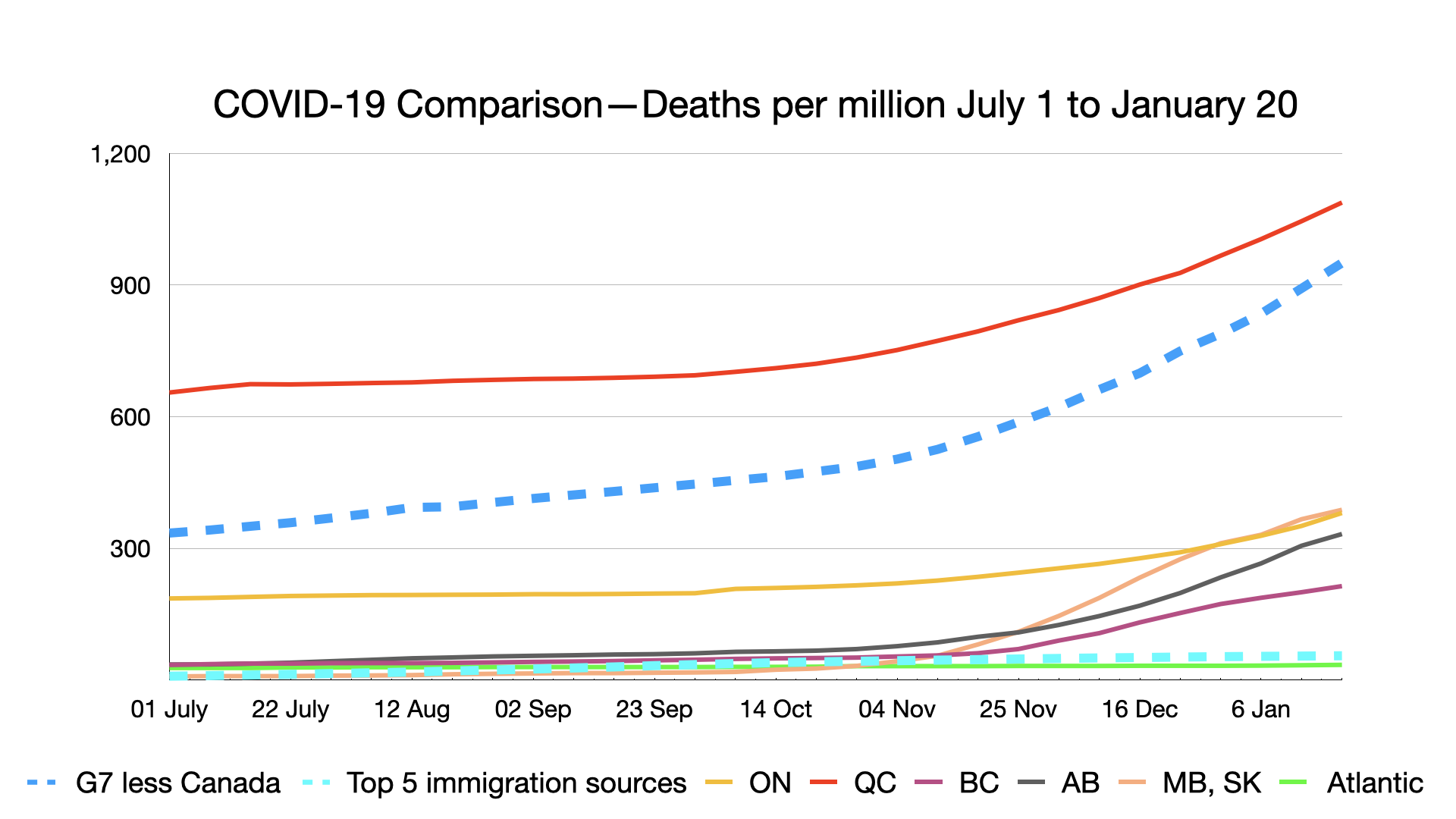
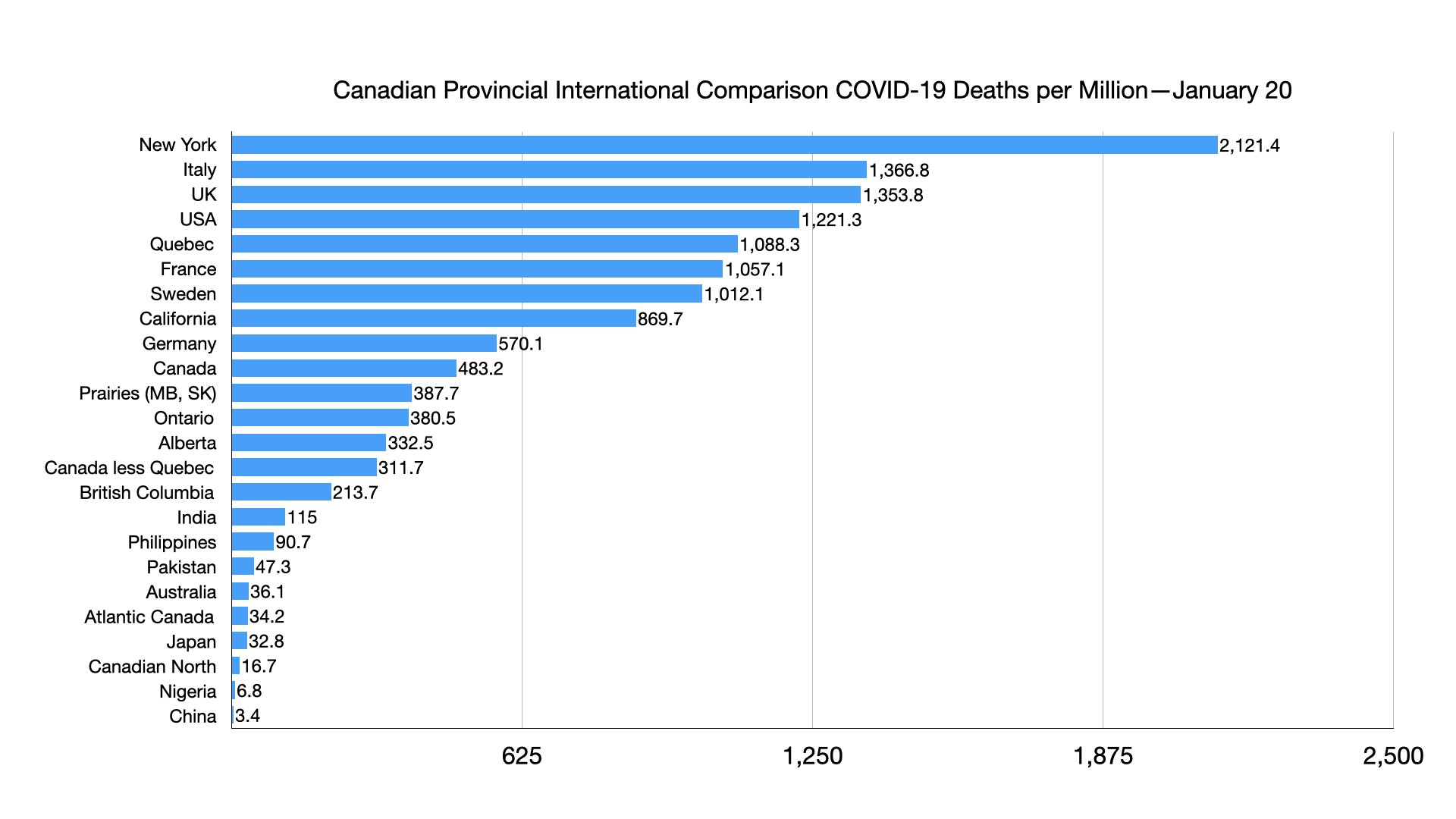
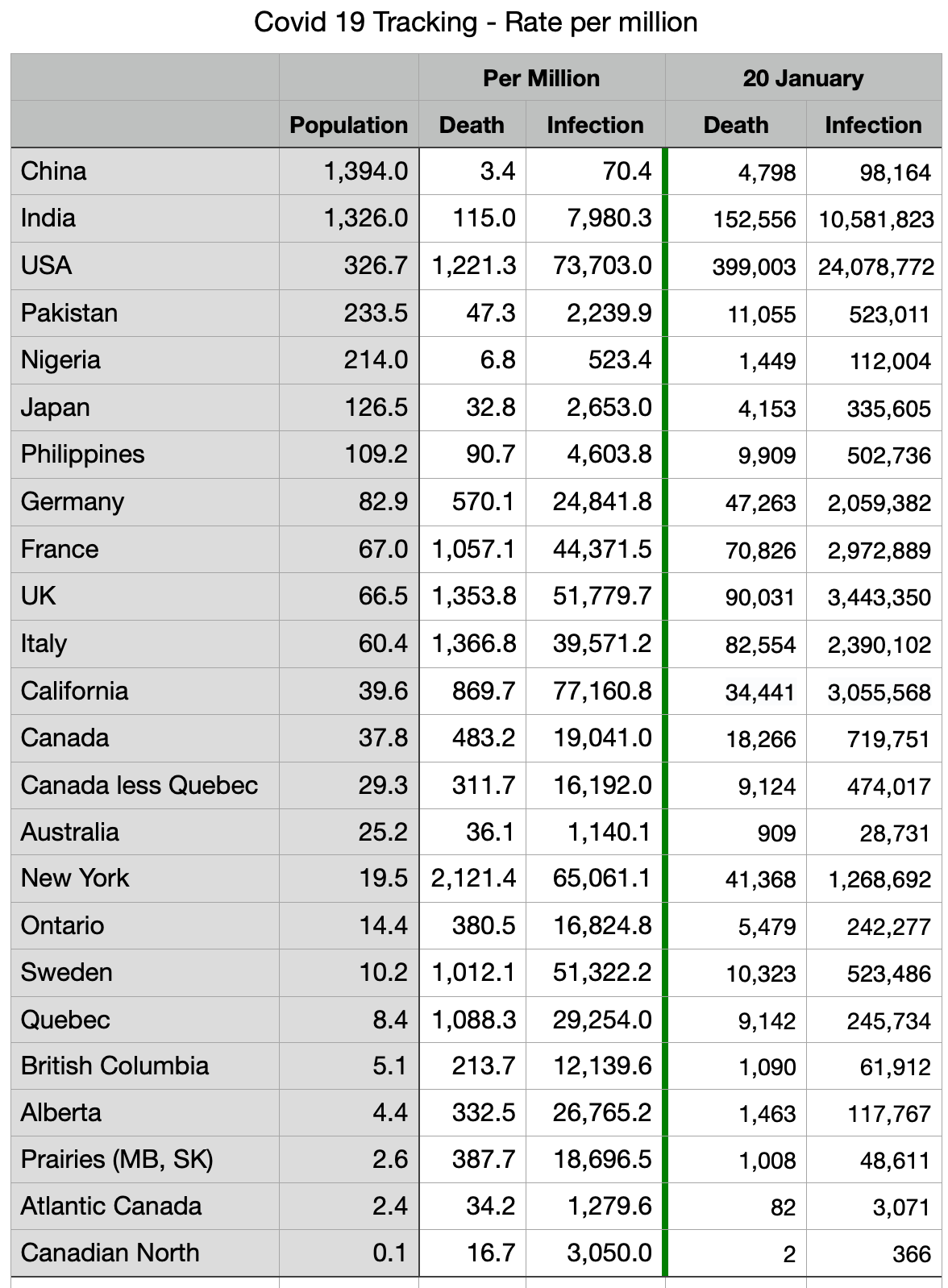
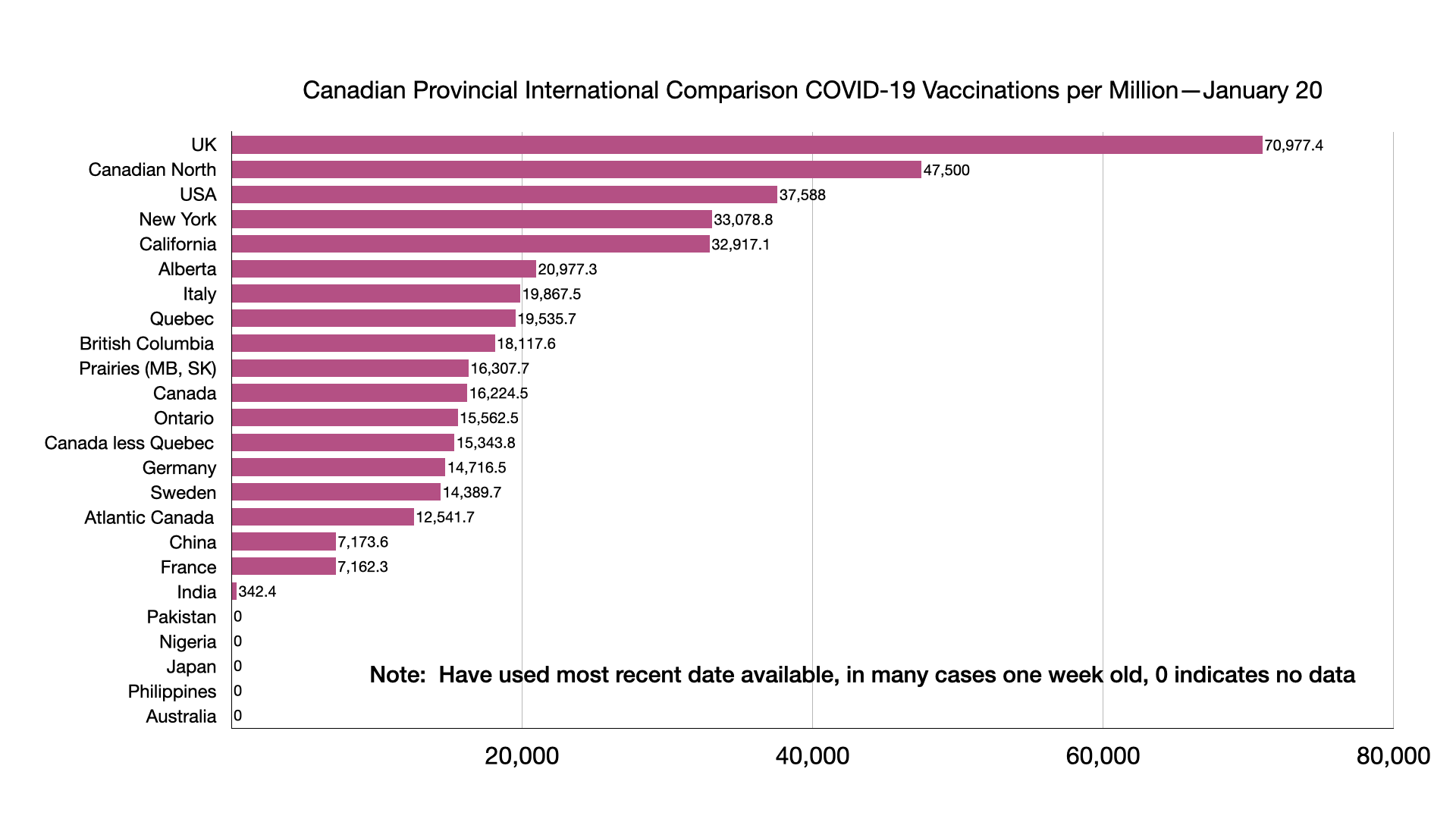
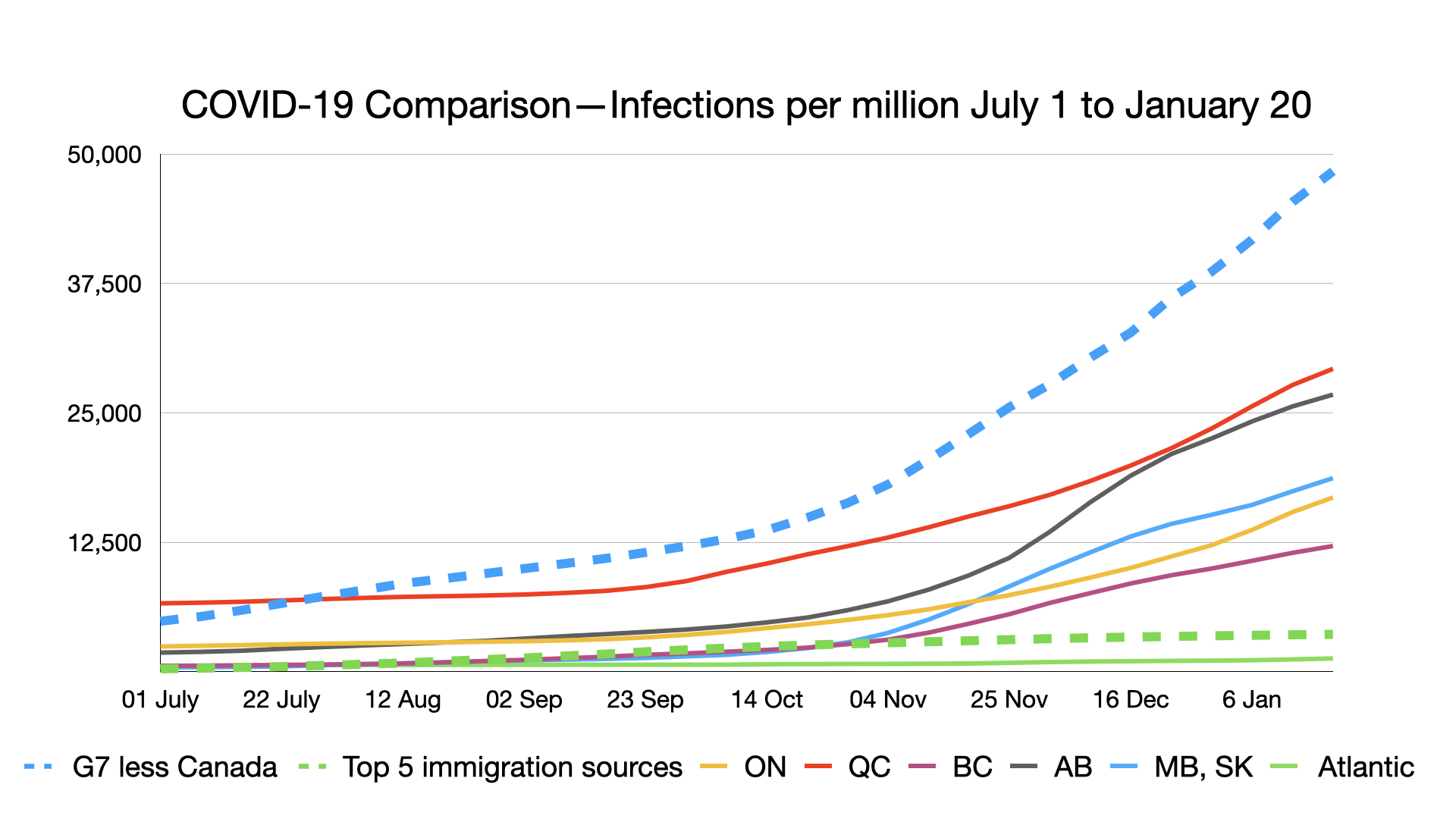
#COVID-19: Comparing provinces with other countries 20 January Update, including vaccinations

The latest charts, compiled 20 January.

Vaccinations: Canada appears to be in the middle of the pack compared to G7 countries save for the UK and USA. Vaccination rates in the Canadian North are relatively high. The change in the Pfizer delivery schedule will be felt in the coming weeks, likely affecting our relative ranking.

Trendline charts:

Infections per million: Alberta no longer appears to be overtaking Quebec but Ontario appears to be approaching Prairie rates.

Deaths per million: Prairies continue to be slightly higher than Ontario with Alberta slightly behind Ontario.

Minor week to week changes:

Infections per million: UK ahead of Sweden

Deaths per million: No change

Citizenship Program: Results Highlights

A quick look at the IRCC citizenship program results posted on the TBS site indicates the following:

  • 95 percent satisfied with the service received;
  • Only 65 percent of applications processed within the 12 month service standard (target is 80 percent). Don’t believe IRCC has ever met this standard, reflecting perennial structural and financial issues with the program.
    • Departmental explanation: “In 2019–20, a total of 65% of citizenship grant applications were processed within the 12-month service standard. The absolute volumes of citizenship applications continue to increase year after year. The number of citizenship applicants who became Canadian citizens has increased by 118%, from 112,969 in 2017–18 to 247,139 in 2019–20. Growing application volumes have strained the operational processing model causing increased processing times. The citizenship applications process is heavily paper-based and relies on manual data entry. The program is also facing a large increase in demand and the current funding levels are outpaced by application volumes. The program is exploring ways to transform the processing model to increase speed and efficiency and develop digital tools for improved client service.”
  • 86 percent of eligible permanent residents have become Canadian citizens. As I have mentioned repeatedly, the performance measure is based upon the total number of immigrants who became citizens, whether they arrive 5 or 50 years ago, and hence is meaningless as a performance indicator. A real performance indicator would use the percentage of recent immigrants who have become citizens, those who immigrated to Canada in the past Census period (5 to 9 years):
    • “Rationale: Canada’s immigration model encourages newcomers to naturalize (become citizens) so that they can benefit from all the rights of citizenship and fully assume their responsibilities, thereby advancing their integration. Take-up rates are considered a proxy that illustrates to what extent permanent residents value Canadian citizenship. Calculation / formula: Numerator: Permanent residents in Canada who are eligible to acquire Canadian citizenship and self-report on the Census that they have acquired Canadian citizenship. Denominator: Permanent residents in Canada who are eligible to acquire Canadian citizenship. Data Source: Statistics Canada’s Census Baseline: 2016: 85.8% Definitions: Naturalization: The Census instructs individuals who have applied for, and have been granted, Canadian citizenship (i.e., persons who have been issued a Canadian citizenship certificate) to self-report their citizenship as “Canada, by naturalization”. Notes: In the performance narrative, IRCC administrative data could be used to tell the story of citizenship from an operational and policy perspective. Information on age, gender, immigration stream, and country of origin of new citizens would be considered in order to explain changing trends. It is also important to note that calculations using IRCC’s administrative data will be based on the number of people admitted as permanent residents who took up citizenship. Figures from Statistics Canada indicate that in 2011, about 6,042,200 foreign-born people in Canada were eligible to acquire citizenship. Of these, just over 5,175,100, or 85.6%, reported that they had acquired Canadian citizenship. This naturalization rate in Canada was higher than in other major immigrant-receiving countries. In telling the story of the naturalization rate, it will be important to explain the reasons why some people choose not to naturalize.”

Source: https://www.tbs-sct.gc.ca/ems-sgd/edb-bdd/index-eng.html#orgs/dept/123/infograph/results

U.S. Census Bureau director to resign amid criticism over citizenship data

Of note (former StatsCan head Munir Sheikh resigned over Conservative government’s replacement of the mandatory census with the less accurate voluntary National Household Survey):

Facing criticism over efforts to produce citizenship data to comply with an order from President Donald Trump, U.S. Census Bureau director Steven Dillingham said Monday that he planned to resign with the change in presidential administrations.

Dillingham said in a statement that he would resign on Wednesday, the day Trump leaves the White House and President-elect Joseph Biden takes office. Dillingham’s term was supposed to be finished at the end of the year.

The Census Bureau director’s departure comes as the statistical agency is crunching the numbers for the 2020 census, which will be used to determine how many congressional seats and Electoral College votes each state gets, as well as the distribution of $1.5 trillion in federal spending each year.

In his statement, Dillingham said he had been considering retiring earlier, but he had been persuaded at the time to stick around.
“But I must do now what I think is best,” said Dillingham, 68. “Let me make it clear that under other circumstances I would be honored to serve President-Elect Biden just as I served the past five presidents.”

A Census Bureau spokesman said the agency’s chief operating officer, Ron Jarmin, will assume the director’s duties. Jarmin served in the same role before Dillingham became director two years ago.

Last week, Democratic lawmakers called on Dillingham to resign after a watchdog agency said he had set a deadline that pressured statisticians to produce a report on the number of people in the U.S. illegally.

A report by the Office of Inspector General last week said bureau workers were under significant pressure from two Trump political appointees to figure out who is in the U.S. illegally using federal and state administrative records, and Dillingham had set a Friday deadline for bureau statisticians to provide him a technical report on the effort.

One whistleblower told the Office of Inspector General that the work was “statistically indefensible.”

After the release of the inspector general’s report, leaders of the National Association of Latino Elected and Appointed Officials, Asian Americans Advancing Justice and The Leadership Conference on Civil and Human Rights called for Dillingham’s resignation, and several Democratic lawmakers followed suit.

Dillingham then ordered an indefinite halt to the efforts to produce data showing the citizenship status of every U.S. resident through administrative records.

During Dillingham’s tenure, the Trump administration unsuccessfully tried to put a citizenship question on the 2020 census questionnaire, and the president issued two directives that advocacy groups said were part of efforts to suppress the participation of minorities and immigrants in the head count of every U.S. resident.

Trump’s first directive, issued in 2019, instructed the Census Bureau to use administrative records to figure out who is in the country illegally after the Supreme Court blocked the citizenship question. In the second directive last year, Trump instructed the Census Bureau to provide data that would allow his administration to exclude people in the U.S. illegally from the numbers used for divvying up congressional seats among the states.

An influential GOP adviser had advocated excluding them from the apportionment process in order to favor Republicans and non-Hispanic whites, even though the Constitution spells out that every person in each state should be counted. Trump’s unprecedented order on apportionment was challenged in more than a half-dozen lawsuits around the U.S., but the Supreme Court ruled last month that any challenge was premature.

Dillingham oftentimes appeared cut out of the loop on these census-related decisions made by the White House and Commerce Department, which oversees the Census Bureau. At a congressional hearing in July, Dillingham said he wasn’t informed ahead of time before Trump issued his directive on the apportionment numbers.

The pandemic and errors found in the data have forced the Census Bureau to delay releasing the numbers used to apportion congressional seats until early March.

Last week, the Department of Justice and municipalities and advocacy groups that had sued the Trump administration over the 2020 census agreed to put the lawsuit on hold for 21 days so the Biden administration can take power and decide how to proceed with the census and the litigation.

“Director Dillingham’s departure will coincide with the inauguration of President-elect Joe Biden and Vice President-elect Kamala Harris, providing the new administration the opportunity to appoint competent, ethical leadership committed to the scientific integrity of the Census Bureau,” Arturo Vargas, CEO of the National Association of Latino Elected and Appointed Officials (NALEO) Educational Fund, said Monday.

Source: Census Bureau director to resign amid criticism over citizenship data

Blanchet’s choice to block critics on Twitter limits free speech: experts

Snowflake?

Dozens of people — including some MPs — say Bloc Québécois Leader Yves-François Blanchet has blocked them on Twitter after they criticized his statements about Transport Minister Omar Alghabra, with some arguing they have a right to be heard.

Nour El Kadri, the president of the Canadian Arab Federation who was among those blocked by Blanchet on the social media platform, said people should be able to respond to accusations made by politicians.

Last week, after Alghabra, born to a Syrian family in Saudi Arabia, was sworn in as federal transport minister, the Bloc issued a release that sought to sow doubt about his association with what it called the “political Islam movement” due to the minister’s former role as head of the Canadian Arab Federation.

El Kadri tweeted at Blanchet to say the Canadian Arab Federation has been a secular organization under its constitution since it was founded in 1967.

“(I told him) it’s secular like Quebec that you’re asking for, then he blocked me,” he said.

“He started to block other people who were voicing opposing opinions.”

On Twitter, Blanchet argued against the idea that he was robbing anyone of their right to free expression.

“When I ‘block’ people, it’s because their posts don’t interest me (fake accounts, political staff, insults …),” he wrote in French last Thursday.

“That does not prevent them from publishing them. I just won’t see them, nor they mine,” he said, adding things are calmer this way.

Richard Moon, a law professor at the University of Windsor, said it is credible to claim that Blanchet infringed the charter-guaranteed right to freedom of expression of those who can no longer see or comment on his tweets.

While Twitter is not itself subject to the charter as a private entity, Moon said, when a politician uses it as a platform to make announcements and discuss political views, the politician’s account becomes a public platform.

“To exclude someone from responding or addressing because of their political views could then be understood as a restriction on their freedom of expression,” he said.

Duff Conacher, co-founder of the pro-transparency group Democracy Watch, said Blanchet’s Twitter account is a public communication channel and he cannot decide arbitrarily to not allow voters to communicate with him there.

“Politicians are public employees, so they can’t just cut people off from seeing what they’re saying through one of their communication channels,” he said.

“The public has a right to see all their communications.”

Ottawa Mayor Jim Watson faced a lawsuit in 2018 from local activists he had blocked on Twitter. The court action was dropped after Watson conceded his account is public and unblocked everyone he had blocked, so no legal precedent was set.

Blanchet has also blocked some fellow members of Parliament, including Quebec Liberal Greg Fergus, Ontario New Democrat Matthew Green and Manitoba New Democrat Leah Gazan.

Green said he found himself blocked when he criticized Blanchet’s statements that defended the right of universities’ professors to use the N-word.

Gazan accused Blanchet last week of racism and Islamophobia over his statement about Alghabra.

“When criticized, he refuses to engage in a conversation, and a conversation he clearly needs to have around his Islamophobia,” she said.

Source: Blanchet’s choice to block critics on Twitter limits free speech: experts

What an Inclusive Recovery from the COVID-19 “Economic Firestorm” Could Look Like: Ethnic and Mainstream Media comparison

Latest overview of ethnic media coverage and mainstream comparison, showing relatively small differences:

Paid sick leave, affordable childcare, reform of the Employment Insurance system, better-quality jobs and higher minimum wage are some of the elements needed to ensure an inclusive recovery from the COVID-19 pandemic, which has hit visible minorities and immigrants the hardest, according to ethnic media coverage of the economic impacts of COVID-19.

Especially early into the pandemic, visible minorities and recent immigrants were more impacted by job losses, inability to meet financial obligations and essential needs than white Canadians and long-term immigrants or Canadian-born population, showed several studies cited in the media, as analyzed from May to December 2020.

The July Labour Force Survey (for the first time based on data disaggregated by race and visible minority status) showed that the unemployment rate was higher for South Asian, Arab, and Black Canadians, which Statistics Canada linked to higher representation of these minorities in hard-hit industries such as food services and retail. Immigrant women were also shown to be disproportionately affected by the pandemic.

Questions around lockdowns

As the second wave of the pandemic brought with it new lockdowns (Toronto and Peel region moved into lockdown on November 23, and a province-wide shutdown in Ontario has been in effect since December 26), the media gave voice to those questioning the effectiveness of such measures in places where most infections happen in industrial and essential workplace settings, like the city of Brampton.

Mayor of Brampton Patrick Brown was one of the most often cited critical voices, who called the forced closure of small businesses “tinkering around the edges.” Multiple outlets cited Brown as saying that the lockdown in Peel Region was not likely to dramatically reduce the number of new COVID-19 infections in Brampton without other supports in place: better sick benefits, an isolation centre, and better access to testing.

He stressed that staff in factories and front-line workers lose their paycheque if they do not come to work, so many are forced to choose between going to work with symptoms and making the rent payment or putting food on the table.

In late November, Brown made headlines with an appeal by a group of Greater Toronto and Hamilton Area (GTHA) mayors to the province of Ontario for sick leave benefits for front-line workers. Brampton mayor called the benefits “a missing link” in the pandemic response. As reported, the mayors also asked the provincial government to sign an agreement with employers, reassuring employees that they would not lose their jobs or their salary if they tested positive for COVID-19.

Pressure for sick days came from many sides. A widely cited September report by the researcher ICES found not only that immigrants, refugees and other newcomers accounted for a whopping 44 per cent of all COVID-19 cases in Ontario in the first half of 2020 but also that many immigrants and refugees faced systemic inequities including lower pay and precarious employment without the right to sick leave.

The systemic inequities like the fact that many essential workers cannot afford to self-isolate away from their families need to be addressed, Regional Councillor in Brampton Rowena Santos said in an interview with one of the outlets in November, calling for better access to healthcare, higher quality jobs, sick days and higher minimum wage.

In late November, the media carried a message from Health Minister Patty Hajdu, who said the federal government was working with provinces and territories on sick leave. She admitted it was necessary to have low-barrier access to Employment Insurance (EI) for those working on the front lines, and that workers can be eligible for EI with 170 hours of work.

Calls for EI reform

Problems with accessing EI, especially by underemployed workers and expectant mothers for whom the pandemic-induced job cuts meant not enough working hours to qualify for benefits, prompted calls for the reform of the outdated EI system early on.

A Workers’ Action Centre activist cited in ethnic media in August pointed to the situation of the underemployed, especially restaurant staff and people in the tourism industry, who did not have working hour guarantees in their contracts and who may not be able to obtain a record of employment to access EI when the Canada Emergency Response Benefits (CERB) end. He also pointed to self-employed workers such as Uber drivers or people working in food delivery services

“She-covery” and the importance of childcare

Women, especially racialized women, are over-represented in precarious, low-paying jobs, so the COVID-19 pandemic has had a disproportionate economic impact on them, as demonstrated by various reports cited in multiple ethnic media outlets. A September report by the Ontario Chamber of Commerce entitled “The She-Covery Project” pointed out that women’s labour participation rate had fallen to its lowest in 30 years.

Reports that female immigrants, especially working in health care, were hit especially hard by the pandemic have prompted calls for policies instituting higher pay, paid sick leave, universal childcare and eldercare, and affordable housing.

Since mothers were usually the ones losing their jobs or staying home to take care of the children during the pandemic, the central role of affordable daycare in the economic recovery plans was stressed by the media and the policymakers alike, including in a slew of December media appearances by the Minister of Families, Children and Social Development, Ahmed Hussen. Hussen promised the federal government would create a nationwide childcare program, with details to come in the spring of 2021.

“Shop local” campaign to support small businesses

The struggles of small businesses, often owned by immigrants or visible minorities, also featured strongly in ethnic media coverage, with the newest lockdowns bringing renewed fears of severe economic impacts, but few solutions in sight.

The media stressed that while small businesses like hair salons were forced to close their doors, big retailers like Amazon were allowed to operate. One of the victims of the pandemic featured in October was a Black owner of a beauty parlour who was ineligible for government support, as she had opened her salon only in 2020.

The prospects for small businesses appeared bleak yet in August. Jon Shell, managing director at Social Capital Partners and a co-founder of the Save Small Business campaign, was cited as saying that “the recovery looks like it will be very weak for local community businesses, making additional cash flow hard to come by over the rest of the year. Many will not survive.”

Patrick Brown admitted back in May that the pandemic was an “economic firestorm,” and the small stores and businesses were especially badly affected. He called on Brampton residents to support them by shopping locally and ordering take-out food from restaurants in their neighbourhoods. A similar appeal by Ontario Premier Doug Ford was aired in October. The media also reported on Ontario’s NDP Leader Andrea Horwath’s Save Main Street plan, supported by the Canadian Black Chamber of Commerce (CBCC).

The government’s commercial rent assistance program was criticized as ineffective: few landlords decided to participate, as that would have forced them to cover 25 per cent of the rent.

Coverage of other government programs addressed to small businesses was rather limited. Apart from announcements of subsequent extensions of the wage subsidy program, the Canada Emergency Business Account was mentioned only once in a collection of around 200 media clippings—in the context of the government’s recovery plan presented in early December by Minister Hussen.

Comparative analysis with mainstream media

The analysis of Toronto Star coverage was focused on the pandemic’s impact on small businesses. More than half of the articles discussing challenges faced by different types of businesses showcased those owned by immigrants and many told their stories of going through the painful process of closing down permanently.

A lot of coverage was also devoted to government measures and how businesses can access them, for example the Canada Emergency Business Account. Different polls and appeals from business advocacy groups and other stakeholders for the government to do more to help small business owners were also featured.

Like ethnic media, the paper discussed the unfair advantage during lockdown of big-box stores over small businesses. Unlike ethnic media, it also covered the spike in insurance premiums as one of the key factors that forced many businesses to shut down.

In terms of navigating the difficulties of the pandemic, the Star also presented various innovations such as ghost kitchens, a business incubator called District Ventures Kitchen, and other new approaches to doing business in food service. 

Insight from MIREMS media monitoring

Ethnic media “can be expected to become an important voice for ethnically inclusive recovery initiatives,” commented Silke Reichrath, Editor-in-Chief at MIREMS.

“The coverage showed time and again how newcomers often work in essential jobs, which makes them more susceptible to virus exposure,” she stressed. Sectors in focus that rely heavily on newcomers included the taxi industry, the hotel and tourism sector, meat processing plants, long-term care and health care.

Overall, ethnic media have kept their audiences informed about the latest public health guidelines about business openings and closures and about benefits and aid programs available from the three levels of government, Reichrath said.

“They have also raised awareness in general about how the pandemic is affecting the national and local economy, have featured charitable initiatives by the community, and have encouraged community members to support local businesses by buying local, particularly from smaller businesses,” she added.

Methodology: This ethnic media analysis is based on a selection of 200 summaries of articles and broadcast segments in radio, TV, print and web sources between May and December, 2020, with special focus on the last six months of last year. These summaries were found in 450 active ethnic media sources monitored by MIREMS. 

For mainstream media analysis, the ProQuest Databases Platform was searched using the keywords “business owners” and “COVID-19.” A total of 181 articles published in Toronto Star from July 1 to Dec. 31, 2020 were included for review.

Source: https://newcanadianmedia.ca/what-an-inclusive-recovery-from-economic-business-firestorm-of-covid-19-could-look-like/#ethnic-m