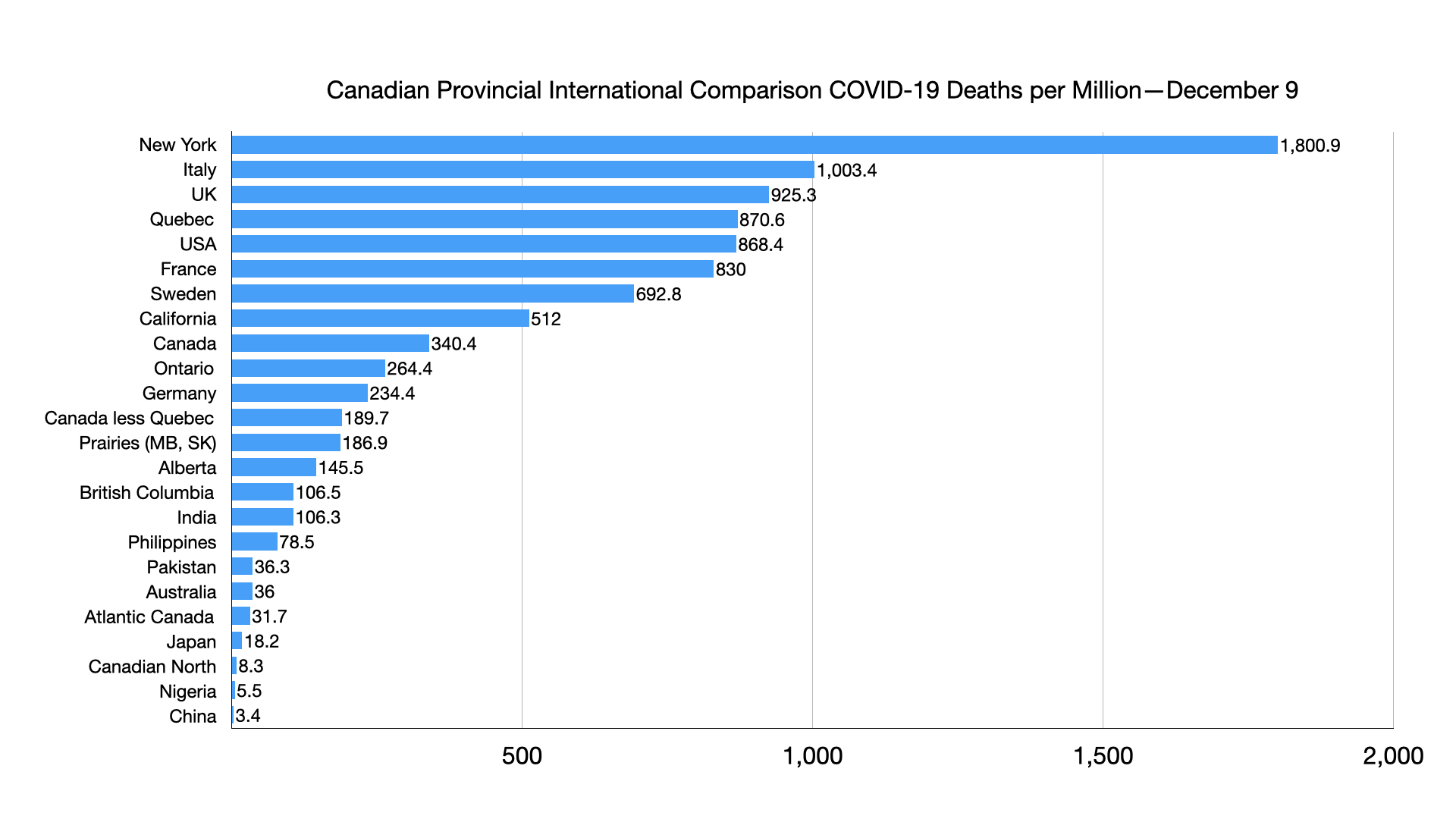
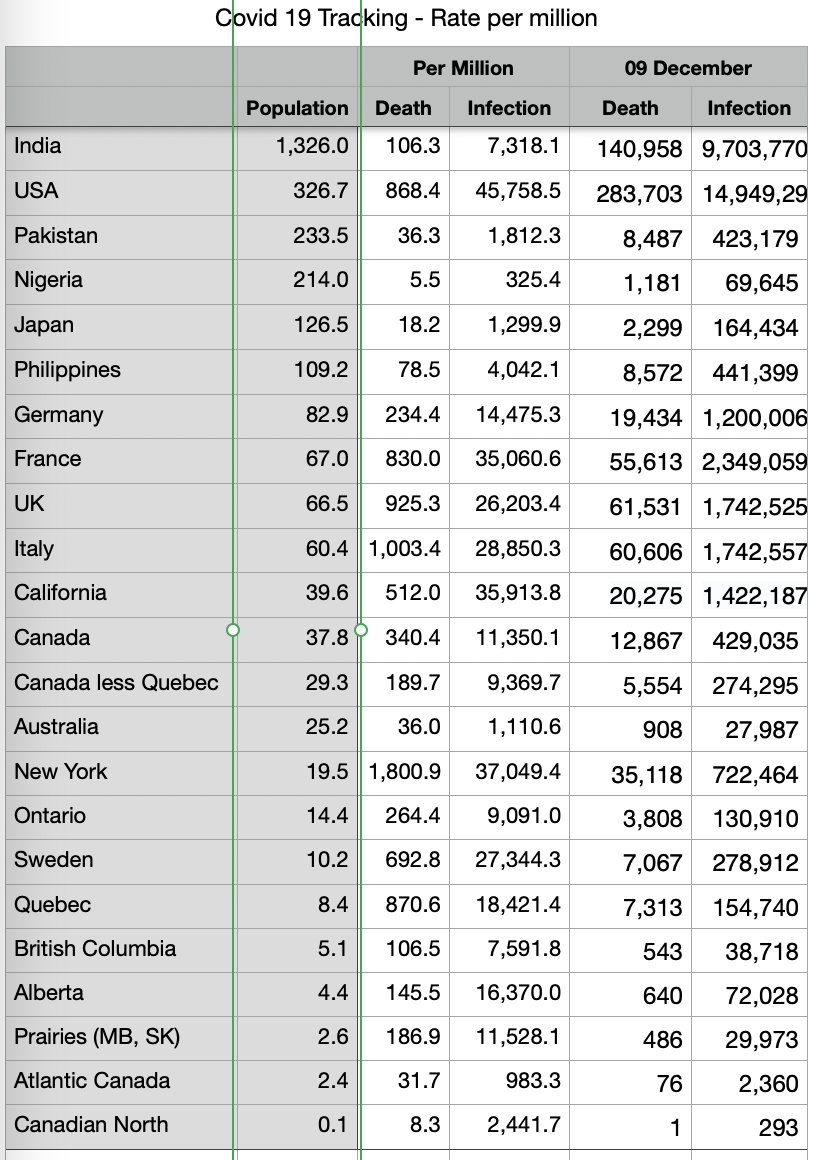
#COVID-19: Comparing provinces with other countries 9 December Update

Main news continues to be with respect ongoing sharp spike in infections along with death rate increases:

 
Weekly:
 
Infections per million: New York and California ahead of France, Sweden ahead of UK, Prairies ahead of Canada, Canada less Quebec ahead of Ontario, British Columbia ahead of India
 
Deaths per million: British Columbia ahead of India, Pakistan ahead of Australia
 
 
COVID Comparison Chart.002COVID Comparison Chart.003

And good commentary on Alberta Premier Kenney’s belated recognition of reality:

After months of pleading with Albertans to take “personal responsibility” to stop the spread of COVID-19, Premier Jason Kenney has finally taken personal responsibility himself.

On Tuesday, he reluctantly announced the kind of sweeping COVID-19 restrictions he had been tersely rejecting for weeks.

He is now ordering everyone to wear a mask in public spaces everywhere in Alberta. And nobody is allowed to hold any social gatherings outside.

You can say “hi” to your neighbour walking the dog but stay two metres apart and don’t dawdle. Starting Sunday, you can only get take-out from restaurants and pubs. No in-person dining. Casinos are closing as are bingo halls, raceways, bowling alleys, pool halls, fitness centres, spas, gym, indoor skating rinks.

Retail stores can stay open but only allow in 15 per cent capacity at a time.

The list goes on. Odds are, if you enjoy doing it, it’s cancelled, postponed or diminished.

As Kenney recited the new restrictions, he must have felt like he was reading the Riot Act to Albertans.

And, in a sense, he was.

As the pandemic grew in the past month from bonfire to wildfire, Kenney had tried to argue his way through the crisis by ignoring pleas from physicians, ridiculing the NDP opposition, and insisting Albertans would bring the crisis under control by taking “personal responsibility.”

In the end he was done in by the might of two factors: freedom-loving Albertans who didn’t take the COVID-19 virus seriously; and the COVID-19 virus that didn’t take freedom-loving Albertans seriously.

Adding those two together gives you the inescapable math of a pandemic.

“The recent surge in COVID-19 hospitalizations will threaten our health-care system and the lives of many vulnerable Albertans unless further action is taken now,” said Kenney.

“With the promise of a vaccine early in 2021, we can see the end of this terrible time. But all Albertans must take this more seriously than ever by staying home whenever possible, and following these new measures.”

Even though Kenney was speaking to all Albertans, he focused particular attention on those who will resent the new measures. They’re more likely to live in rural areas, reject government interference in their lives, and preach self-sufficiency. In other words, United Conservative supporters. By refusing to introduce tougher restrictions for weeks, Kenney was bending over backwards to placate his political base.

But the inexorable math of COVID-19 has forced Kenney to demonstrate he has a spine.

“To many people, these policies, these restrictions seem unjust,” said Kenney. “I’ve made no secret of the fact that Alberta’s government has been reluctant to use extraordinary powers to damage or destroy livelihoods in this way. It is why we have stressed education together with personal and collective responsibility from the very beginning and it’s why we tried to balance the protection of lives and livelihood rather than resorting to damaging measures as a first resort.”

Kenney also announced more money to help small businesses survive the new measures. That is a great idea but it was a great idea when critics suggested it weeks ago, along with the very restrictions Kenney announced Tuesday.

Better late than never?

Understandably, Kenney bristled at questions from journalists about whether he might be responsible for the COVID deaths of Albertans because he didn’t lock down the province sooner. Kenney said it would be a “mistake” to draw simple conclusions during such a complicated time.

But it is a question that will dog him. And NDP MLAs will no doubt be helpfully re-asking the question whenever a microphone or TV camera is within hailing distance.

“The lockdown announced today comes late,” said NDP Leader Rachel Notley after Kenney’s news conference. “We could have acted four weeks ago. Since then, an additional 317 people have died.”

Notley will be wielding this rhetorical knife through the next election.

Kenney might be thinking “better late than never” and while that might be great when talking about filling a pothole or repairing a school roof, it’s not so great when talking about enacting more precautions during a pandemic that’s killing people daily.

Kenney’s new restrictions will last four weeks. That will take us through the Christmas holiday and into the new year.

During Tuesday’s news conference, Doug Schweitzer, the minister of jobs, economy and innovation, happily declared “a vaccine is almost here” as if the pandemic will suddenly end Jan. 5 when Alberta is scheduled to start inoculations against COVID-19.

The reality is that, because of logistics and supply issues, during the first three months of 2021 only about 10 per cent of Albertans will receive vaccinations, mainly health-care workers and the elderly.

The rest of us will have to wait and continue to wear masks, wash our hands, and practise social distancing for many more months. Perhaps by then enough Albertans will know how to practise “personal responsibility” without Kenney having to read us the Riot Act.

Source: https://www.cbc.ca/news/canada/edmonton/opinion-thomson-covid-kenney-blinks-1.5833751?cmp=rss

Diversity of Charity and Non-profit Boards: Statistics Canada Survey

This is a significant and needed survey that Senator Omidvar is championing with Statistics Canada, as she notes below:

I’ve been working closely with Statistics Canada and sector leaders on this important initiative and I am really excited that this will be the first-ever national snapshot of board diversity in the charitable sector. It’s crucial to collect and track this data in order for charities and non-profits to take an intentional approach towards increasing diversity on their boards so that they reflect the diversity of Canada.

Better data helps identify under-representation and opportunities to ensure that charities and non-profit organizations better reflect the communities they serve and I urge those of you on boards to take the time and submit the questionnaire.

A Message from Statistics Canada
The objective of this crowdsourcing initiative is to understand who serves on the boards of charity and non-profit organizations. In addition to collecting information about the diversity of board members, we explore topics such as what organizations do, who they serve, and where they are located. This information will help charities and non-profits better understand how their board compares to those of similar organizations.
Your participation is important: Your voice matters 
We want to hear from you, whether you sit on a board of directors or are involved in the governance of charities or non-profits. Please take a few minutes to complete the questionnaire and feel free to forward this email to your peers—the more people participate, the better the data.
 
Participating is easy and secure 
Click this link to participate:  https://www.statcan.gc.ca/diversity-questionnaire.
 
This data collection is conducted under the authority of the Statistics Act, which ensures that the information you provide will be kept confidential, and used only for statistical and research purposes.
 
For general enquiries and technical assistance 
Contact us Monday to Friday (except holidays), from 8:00 a.m. to 7:00 p.m. (Eastern Time):1-877-949-9492 (TTY: 1-800-363-7629*)infostats@canada.ca*If you use an operator-assisted relay service, you can call us during regular business hours. You do not need to authorize the operator to contact us.
 
For more information about the data collection visit:https://www.statcan.gc.ca/diversity

UK races to deport asylum seekers ahead of Brexit

Of note:

Scores of vulnerable asylum seekers, including suspected victims of trafficking, are scheduled to be deported this week as the home secretary Priti Patel ramps up removal operations ahead of Brexit.

Three flights this week, two to Germany and one to France, with possible transfers to Austria, Poland, Spain and Lithuania, are planned amid opposition from campaigners who say they have evidence that cases are being “rushed” through to avoid Patel’s own published policy on identifying trafficking victims.

The development comes days after Patel branded those calling for last week’s deportation flight to Jamaica to be stopped as “do-gooding celebrities”, a label that prompted victims of the Windrush scandal to describe the home secretary as “deeply insulting and patronising”.

Source: UK races to deport asylum seekers ahead of Brexit

How Canada is fighting the war on talent

Good analysis:

Some might look at Noubar Afeyan’s career as a frustrating example of a talented Canadian scientist who got away. The chairman and co-founder of Boston-based Moderna, one of the leading COVID-19 vaccine makers, was born in Lebanon, immigrated to Canada with his family in the 1970s and did his undergraduate studies at McGill University.

Then we lost him. Mr. Afeyan left to get his PhD at the Massachusetts Institute of Technology, eventually becoming a star scientist and entrepreneur. He has founded several successful U.S. biotech startups and registered more than 100 patents.

The good news is that Canada’s technology landscape has dramatically changed in the past three-plus decades.

Yes, like Mr. Afeyan, many Canadians are still drawn south by the reputations of U.S. colleges and tech giants. But the evidence suggests Canada has largely reversed its brain drain. This country’s fast-growing technology sector is more than holding its own in the global race for talent, even after the deep economic shock of the pandemic, according to an analysis of employment data contained in a new report for the Innovation Economy Council.

Despite the terrible toll of the pandemic, Canada has become more competitive because there are more opportunities here than ever for people to learn, to build companies and to thrive. And that’s making the market for technology jobs remarkably resilient.

Indeed, there are nearly 100,000 more jobs now in so-called STEM disciplines – science, technology, engineering and math – in this country than there were before the pandemic. There is still a gaping hole in Canada’s job market, but not for these people. For the most part, Canadian startups and technology companies absorbed the shock, moved to remote work and in some cases have expanded aggressively.

The resilience of tech employment in these uncertain times is a testament to the Canadian sector’s core strengths – an immigration system that welcomes talented foreigners, a growing crop of promising homegrown STEM graduates and a thriving ecosystem of companies.

It’s a tale of two economies, of course. While there was a net gain of 98,500 STEM jobs, Canada had 431,000 fewer non-STEM jobs in October than it had in February, in sectors such as retail, tourism and airlines.

And there is a cautionary note about the STEM jobs. The number of job postings for these workers is down roughly 50 per cent since February, according to an analysis of data from the Labour Market Information Council. This suggests that companies are still hiring, but perhaps not as enthusiastically as they were before the pandemic.

Another consequence of COVID-19 is that it has accelerated the shift to distributed work forces in the tech industry – teams of employees scattered across different cities and countries. Companies have learned that it’s no longer essential to bring people to them. They can just as easily go where the talent is.

Tech giants – including Google, Facebook and Amazon – have set up large Canadian research and development operations in recent years. A growing number of foreign startups are doing the same. They are moving here to tap our plentiful and affordable supply of programmers, engineers, artificial-intelligence experts and scientists.

Talent flows both ways. Thousands of Canadians continue to pursue careers and education in the U.S. despite four years of anti-immigration rhetoric by outgoing U.S. President Donald Trump. Mr. Trump threatened to tighten H-1B visas, but it turns out Canadian STEM workers are still successfully applying for them – more Canadians were issued H-1Bs in 2019 than in 2018.

Still, that exodus is significantly smaller than the inflow of foreign students, workers and entrepreneurs. Most of our departing STEM workers go to the United States – IEC research shows that more than 10,000 Canadians went south in 2019 with H-1B visas and green cards. But Canada gained nearly 23,000 global STEM workers through permanent residency and temporary foreign worker visas that year.

These newcomers are more likely than Canadians born here to work and study in STEM disciplines. It’s proof that Canada is a place where talented foreigners want to live, work and start companies.

There is also some evidence that the combination of U.S. political strife and China’s democracy crackdown in Hong Kong may be drawing Canadian expats home. As many as 300,000 of the roughly three million Canadian passport holders living outside the country may have returned home since COVID-19 hit, many for good.

But without opportunity, none of that would happen.

Today, it’s tempting to imagine a different a different life story for Moderna’s Noubar Afeyan. Instead of leaving, he stays in Montreal and goes on to found a biotech company that develops a Canadian-made COVID-19 vaccine that the rest of the world desperately wants. His company is worth more than $60-billion and employs thousands of Canadian scientists.

The resilience of Canada’s STEM work force through the pandemic suggests this kind of homegrown-hero story is not so far-fetched.

Canadians will always leave to find their way in the world. This week’s sale of highly touted Montreal startup Element AI to a California software company marked an unfortunate loss of both intellectual property and talent. Canada isn’t the world’s biggest pond and we’ll never retain all of our companies and people. But we’ve shown that we can win the war for talent.

The Trump presidency peddled its anti-immigration messaging, eroding the false narrative that the best and brightest were always welcome in America. Canada countered with policies and public-relations efforts aimed at attracting talent, such as the highly successful Global Talent Stream program and Communitech’s “We Want You” campaign. It has worked.

But the talent war isn’t over. The key is to continue to create – and promote – opportunities and incentives for the best and brightest here in Canada. If we’ve learned anything from the past few years, it’s that narratives matter. And Canada has a good story to tell.

Source: https://www.theglobeandmail.com/business/commentary/article-how-canada-is-fighting-the-war-on-talent/

Surrey imam who misrepresented himself to immigration officials jailed for sexual assault

Of note, particularly how the British Columbia Muslim Association mishandled the complaint and the community’s shunning of the complainant:

The emotional wounds from a sexual assault at the hands of a Lower Mainland imam four years ago continue to affect the daily life of his victim, who says if immigration officials and the B.C. Muslim Association had intervened sooner, the attack may never have happened.

The woman, whose identity is protected by a B.C. Supreme Court order, says she has received no community support for her turmoil and is being shamed as a victim.

“When people see me, they think I am not good woman,” she said. “I got with priest and put him in the jail.”

Pakistani national, 46-year-old Abdur Rehman Khan, is serving a three-year sentence on one count of sexual assault and will remain a registered sex offender for 20 years.

In 2017 he was convicted for assaulting the woman who he came to know through his work in the Muslim community in Surrey.

His story shows the lengths he went to in misleading immigration officials to stay in Canada and the lack of intervention provided by the B.C. Muslim Association, which described his criminal case as a “personal matter.”

The assault happened in July 2016, three months after he had been ordered to leave the country.

‘Nobody support me’

His victim is outraged that Khan continued as an imam at Masjid-Ur-Rahmah after he was charged and granted bail, as well as after he was convicted and awaiting sentence.

She also doesn’t understand how he was able to avoid discovery by immigration officials for years.

She, in the meantime, has had to give up her job and many activities to avoid being ostracized by some people in the Lower Mainland’s Muslim community.”Nobody support me,” said the woman who has no family in the country.

Multiple names and attempts to immigrate

Abdur Rehman Khan’s attempts to live in Canada span almost three decades.

In 1993, he was included as a dependent in an application by his brother Mohammad Tayyab to sponsor their mother to Canada but when Khan’s application for permanent residency was denied, he appealed but didn’t wait for a decision.

During the appeal process, Khan successfully obtained a visitor visa under the name Abdul Rehman and once in Canada, in February 1999, he made a refugee claim under the name Ibuhuraira Khan.

The claim was refused in October 2000. One month later, Khan tried again to stay here through the sponsorship of a wife. At an immigration hearing, Khan conceded the marriage was not genuine and solely for immigration purposes.In September 2001, he was deported from Canada, under the name Ibuhuraira Khan.

It was only after he’d been removed from Canada that in 2003 he was actually accepted for permanent residency to Canada under the original 1993 application.

Misled officials

Upon his arrival, in Vancouver, in April 2003, as Abdur Rehman Khan, he was asked by immigration officials if he had ever been “convicted of a crime or offence, refused admission to Canada or required to leave Canada.”

Khan said no according to transcripts of his immigration hearings.

Officials did not know he’d been to Canada before, used other names, had travel documents in those names, nor that he’d made a previous refugee claim and had been deported.

In 2014, Khan’s past caught up with him when the Canadian Border Services Agency (CBSA) received word that the information he had provided officers was false.In June of that year when asked directly if he’d ever used any other names, including nicknames, he stated “no.” When asked whether he knew the name Ibuhuraira Khan, he said “no.”

In April 2016, the Immigration and Refugee Board issued an exclusion order against Khan but he appealed the order on the basis of humanitarian and compassionate considerations.

A year later, in April 2017, the Immigration Appeal Division dismissed his appeal and at that point it was up to the CBSA to execute his removal order.

Two months later, though, when Khan was arrested and charged with sexual assault the removal process was stalled.

‘Personal matter’

Khan was granted bail on July 6, 2017 and once released, he returned to his position as imam at the mosque Masjid-Ur-Rahmah where he continued to lead prayers, inter-faith meetings, teach youth and officiate at marriages and funerals.

After his trial and conviction in January 2020, he again went back to work until August when he was sentenced to three years in prison.

BCMA president Iftab Sahib says Khan submitted a resignation letter in August 2020.

The association, however, considered Khan’s reasons for quitting as his “personal matter,” he said and asked no questions.

Sahib declined to be interviewed further about why Khan was allowed to stay on the job after he was charged and convicted.

In an email, BCMA spokesperson Tariq Tayyab said, “at no time was BCMA made aware of the serious allegations and criminal charges brought against the individual.”

His employment with the BCMA ended in August of this year and Tayyab directed any other inquiries to the association’s lawyer.A member of the BCMA Women’s Council also reneged on an interview after initially saying it was important to address the issue and to ensure the community knew what had transpired.

Multiple marriages

Khan’s subterfuge with immigration officials also involved multiple marriages aimed at achieving residency in Canada.

The woman Khan married in the fall of 2000 was the divorced spouse of his brother Mohammad Tayyab. The marriage ended when it failed to secure Khan permanent residency in Canada.

The woman later re-united with Tayyab.

Meanwhile, in Pakistan, Khan already had a wife and five children which he never disclosed to immigration officials. At his August 2020 sexual assault sentencing, in B.C. Supreme Court, the judge acknowledged Khan visited his overseas family every other year until 2016. The oldest of those children now lives in B.C.

According to Immigration Appeal Division (IAD) documents, it’s unlikely he ever divorced his wife in Pakistan. As well, he remains married under a different name to his brother’s wife.The IAD also says Khan married and separated a third time, in 2014, in B.C., representing himself as single when he got that marriage certificate.

CBC News has learned that in spring of 2016, Khan married again in the midst of his latest Immigration and Refugee Board removal hearing.

The woman was a Canadian citizen living in B.C. The marriage lasted only a matter of months.

Victim shaming

Other people from the province’s Muslim community say the web of lies and deceits and ultimately Khan’s crime of sexual assault should be better addressed.

Yahya Momla, an imam from Masjid-Al-Salaam, in Burnaby, has often spoken out about victims who come forward with their trauma and are further marginalized.

“It would be untruthful to say victim shaming doesn’t happen in certain communities,” he said. “Why this happens? Partly it is a misconstrued sense of honour.”Momla says some people feel they must not speak openly about victims of domestic or sexual abuse happening in relationships. That attitude though, he says, is not faith-based.

His message to the Muslim community is that victims should never be blamed, but provided with support.

‘Open your eyes’

Khan’s victim says as long she continues to be shunned the matter will never be over.

Her message to the community is to, “open your eyes. Don’t look down on [victims] even if [the attacker] is a priest.”

Vancouver Immigration consultant Divya Bakshi Arya says in cases like this one, removal orders are not acted upon until the person has served their sentence.

At that time though Khan could apply to federal court to have his removal order stayed and that could spin into months or years of additional hearings.

His victim says she is afraid of him still living in the Lower Mainland if he is not sent back to Pakistan

Source: Surrey imam who misrepresented himself to immigration officials jailed for sexual assault

IMC Defends Sovereign and Societal Value Creation of Investment Migration Programs [citizenship-by-investment]

Of note. The international lobby group for citizenship-by-investment programs argues (unconvincingly) its case. No Canadian firms that I recognized:

The two-month deadline set by the European Commission for the governments of Cyprus and Malta to reply to the letters of formal notice regarding their citizenship-by-investment pathways is approaching. In advance of this date, the Investment Migration Council (IMC) wishes to engage with all relevant stakeholders and remind them of a number of salient points.

The legal case

The right to assign citizenship is very clearly the sole competence of a sovereign state. This analysis of the European Commission’s legal case has nothing to do with whether one agrees with the concept of citizenship by investment. The vast majority of EU legal experts argue that the Commission has no legal right to become involved in how sovereign states define citizenship law.

The IMC has sought the opinions of several legal scholars, including Professor Dr Daniel Sarmiento, a leading specialist in EU competence law, and Professor Dr Carl Baudenbacher, the former president of the EFTA court. The conclusion is clear: The EU has no competence in the area of citizenship. Moreover, the concept of ‘genuine link’ that was invoked by the EU is both vague and arbitrary. The European Court of Justice already found in earlier decisions that it is not relevant.

It is therefore unlikely that the European Court of Justice would rule in favour in the matter at hand, as this could have very serious secondary consequences, and could open the way for the EU to encroach on the power of granting nationality, which is reserved, in EU Law, for Member States.

As rightly noted by the European Parliament, “Nationality is defined according to the national laws of that State.”

Strong governance and due diligence

The IMC however understands and shares the concerns of both the EU and wider stakeholders around the question of proper due diligence on applicants to such programs. This is why it has developed, in cooperation with international anti financial crime firms BDO, Exiger and Refinitiv, a common best practice framework and developed a blueprint for good governance through due diligence standards to uphold the highest levels of integrity and transparency. [Download the ‘Due Diligence in Investment Migration: Best Approach and Minimum Standard Recommendations’ Report]

Nevertheless, the IMC suggests that there has been a significant exaggeration of the risks. Working in partnership with Oxford Analytica, the leading geopolitical risk analysis and advisory firm, it has identified that for all the publicly voiced concerns, the due diligence and governance in place already acts as a powerful deterrent. [Download the ‘Due Diligence in Investment Migration: Current Applications and Trends’ Report and the ‘Citizenship by Investment Programmes: An EU Risk Assessment’ Report]

Oxford Analytica found that the operational reality is that investment migration risks are primarily theoretical in nature. This assessment is broadly shared with the intelligence, security, and law enforcement professionals involved in managing investment migration. Potentially nefarious activity is a negligible percentage and compares very favourably to other legal migration pathways.

There are, of course, enhancements that should be made at corporate, sovereign state, and intragovernmental information sharing levels. The IMC and its membership community are committed to the highest of standards. We want to work in partnership with the relevant stakeholders to devise a formal regulatory system that mirrors those of financial and professional services providers and that will ensure the necessary protection. That system should be based on an objective and knowledgeable analysis of the reality of investment migration, not one that is based on scare stories and rumour.

A creator of societal and sovereign value

Investment migration is a vital lever for sovereign nations to raise debt-free capital, attract talented individuals, and deliver benefits to society as a whole. In Malta, to mention but one example, the Individual Investor Programme attracted EUR 1.4 billion directly into the island nation’s economy following the damaging Euro crisis. This liquidity has had profoundly positive consequences. There has been significant employment creation across all levels of society, and the Maltese government has greater autonomy to invest in vital infrastructure projects, some of which involve critical care for cancer patients.

Bruno L’Ecuyer, CEO of the IMC commented: “Investment migration pathways are now a well-established, normalised wealth management advisory practice. As is the case with other established financial and professional services practitioners, we want to work in partnership with all relevant stakeholders to ensure that sovereign and societal value can be maximised through prudent, responsible, and objective regulation.”

For this to happen, all investment migration advisors must run operations to the highest possible standards and be prepared to face the consequences if they are found wanting. Equally, stakeholders must understand that the privilege of granting citizenship and residence rights is solely the domain of a sovereign state, and that significant sovereign and societal value can be created through investment migration, particularly in the Covid era, which moreover in many instances is aligned with the UNs Sustainable Development Goals.

ENDS.

About the Investment Migration Council

The Investment Migration Council (IMC) is the worldwide association for Investment Migration, bringing together the leading stakeholders in the field and giving the industry a voice.

The IMC sets the standards on a global level and interacts with other professional associations, governments, and international organisations in relation to investment migration.

The IMC helps to improve public understanding of the issues faced by clients and governments in this area and promotes education and high professional standards among its members.

The IMC is constituted as a not-for-profit association under Swiss law. Based in Geneva, it has representative offices in New York, London and the Cayman Islands. Managed by a Secretariat under the direction of a Governing Board, the IMC also has a non-executive Advisory Committee, in which the most important industry stakeholders are represented. The IMC is funded by membership fees, donors and income from activities such as events, education, training, and publications.

(Membership list can be found here: https://investmentmigration.org/members-directory/ )

Source: IMC Defends Sovereign and Societal Value Creation of Investment Migration Programs

Our attitudes to race are complex. Our response to racism should be complex too

Indeed. Interesting findings from detailed interviews:

Is a mass-produced jerk chicken burger a symbol of cultural appropriation or a celebration of British multiculturalism? This is an old debate that periodically resurfaces and so it was a couple of weeks ago when McDonald’s launched its latest festive offering.

In this case, a story that got echoed across much of the tabloid press was constructed out of a few random comments criticising McDonald’s on social media; it was journalists who built and amplified this narrative. But occasionally, others who should know better get drawn in, such as the MP who picked a fight with Jamie Oliver over his jerk rice.

I have long thought that reducing debates about racism to flippant questions about fast-food burgers and supermarket curry kits is damaging to the antiracist cause. But new research on public attitudes to racism by the Runnymede Trust and Voice4Change England helps us understand why.

Source: Our attitudes to race are complex. Our response to racism should be complex too

Survey Finds Asian Americans Are Racial Or Ethnic Group Most Willing To Get Vaccine

May have missed it but have not seen any comparable data for Canada:

A wide-ranging survey shows Americans’ willingness to receive a coronavirus vaccine when it becomes publicly available and confidence in its effectiveness are on the rise.

But when broken down by racial or ethnic group, Black respondents show the most reluctance, with less than half saying they will do so.

The survey by the Pew Research Center found that 60% of Americans overall say they would definitely or probably get a vaccine for the coronavirus if it were available today.

While that figure is 9% higher than it was in September, it still lags behind the 72% of Americans who said in May they would get the vaccine, when clinical trials for a vaccine were just getting underway.

Roughly four in 10 respondents overall (39%) say they would definitely not or probably not get a vaccine, according to Pew.

However, about half of that cohort did leave open the possibility they could change their mind once more information is available and once others get vaccinated. The other half said they are “pretty certain” more information will not change their decision.

Pew found quite a bit of variance when responses were broken down by racial or ethnic group on willingness to get a vaccine.

A whopping 83% of “English-speaking Asian Americans…say they would definitely or probably get vaccinated,” outpacing all other racial or ethnic groups, according to Pew.

White and Latinx respondents answered about the same, with 63% and 61% respectively saying they definitely or probably would get the vaccine.

“Black Americans continue to stand out as less inclined to get vaccinated than other racial and ethnic groups,” according to Pew, which found that just 42% of African Americans said they would get one when made publicly available.

This figure may be surprising to some, given that 71% of Black respondents told researchers they knew someone who has died or been hospitalized due to the virus, nearly 20 points higher than Americans overall (54%).

But there is a long history of mistrust on the part of Black Americans toward public health officials, much of it stemming from the notorious Tuskegee experiment of the 1930s, when researchers lied to hundreds of Black men, telling them they were conducting research on treatments for “bad blood.”

In reality the scientists were allowing the Black men to die of untreated syphilis. Those experiments were slated to go on for six months, but they lasted 40 years, according to the Centers for Disease Control and Prevention.

That is perhaps why Barack Obama, the nation’s first Black president, said in an interview this week with SiriusXM’s The Joe Madison Show that he’d be willing to get vaccinated in front of cameras when it becomes available.

“I promise you that when it’s been made for people who are less at risk, I will be taking it,” Obama said. “I may end up taking it on TV or having it filmed, just so that people know that I trust this science.”

Former presidents Bill Clinton and George W. Bush have also said they are willing to get the vaccine in front of a camera.

The Pew study was a national survey conducted between Nov. 18 and Nov. 29 surveying 12,648 U.S. adults.

The margin of sampling error for the survey is plus or minus 1.5 percentage points.

Source: Survey Finds Asian Americans Are Racial Or Ethnic Group Most Willing To Get Vaccine

Is anyone on Earth not an immigrant?

The very long view but one worth reflecting on:

Human beings tend to be fascinated with their beginnings. Origin stories are found across cultures, religions, ethnicities and nationalities — and they are all deeply important. These stories tell people where they come from, how they fit in and how everyone fits together.

One of these stories, of course, is the story of human genes, and it’s a story anyone with human DNA shares.

As scientists find more ancient human DNA, sample more modern DNA and develop more ways to analyze this genetic material, it’s revealing a lot about how early humans moved — and moved and moved — around the world, coming to inhabit nearly every swath of land.

So after thousands and thousands of years of nearly constant migration, are there any people out there who have never left the spot where it’s thought Homo sapiens evolved? Put another way, is there anybody on Earth who isn’t an immigrant?

“From a scientific point of view, maybe the only people that you could consider not to be immigrants would be some Khoe-San-speaking groups in southern Africa,” said Austin Reynolds, an assistant professor of anthropology at Baylor University in Texas who specializes in human population genetics.

The designation Khoe-San (pronounced coy-sawn) refers to certain African communities in the areas of Botswana, Namibia, Angola and South Africa who speak similar languages with distinctive clicking consonants, Reynolds told Live Science.

Reynolds said there are two main factors indicating that Khoe-San groups may be non-migratory descendants of original humans: They live in the place where it’s likely humans first appeared, and they have a high amount of genetic diversity. A good way to understand why high genetic diversity indicates original ancestry is by comparing genes to a bowl of M&Ms, Reynolds said. Handfuls taken out of the bowl — i.e. people who broke off from the original human population — might have only a couple M&Ms colors in them, but the original bowl will have all the colors.

Yet despite the Khoe-San groups’ proximity to the proverbial “cradle of humankind” and their significant genetic diversity, identifying them as the last genetically aboriginal peoples is not cut and dry.

Firstly, researchers don’t know for sure that southern Africa is the cradle of humankind. Some scientists think humans first evolved in East Africa, said Reynolds, and scientists haven’t amassed enough archaeological evidence in either area to be completely certain just where Homo sapiens first came on the scene.

There’s even a possibility people evolved in western Africa, Mark Stoneking, a molecular geneticist at the Max Planck Institute for Evolutionary Anthropology in Leipzig, Germany, told Live Science. Different environments do a worse or better job at preserving fossil remains, Stoneking said, so just because human remains were or were not found in specific places doesn’t mean humans didn’t live there long ago.

Stoneking doesn’t think there are any folks left on Earth who aren’t — scientifically, at least — immigrants.

“People have always been on the move,” Stoneking said. His recent genetic research on populations across Asia has shown that there’s a touch of just about everyone in everyone else. “All human populations have been in contact with others,” including the Khoe-San, he said, denoted by evidence in their genes, their cultures and their languages.

Early humans moved extensively around Africa for more than 100,000 years before leaving, at which point they probably moved out of eastern Africa into the Middle East, Stoneking said. It’s likely that not long afterward, people headed southeastward along the Indian coast, with many more waves of migrants following these original adventurers over a span of tens of thousands of years. Along the way, there would have been a great exchange of DNA, Stoneking said, and these two components — movement and intermixture — is what he sees as a defining characteristic of the human species.

“Humans — what they like to do is migrate, and they like to have sex,” Stoneking said. And so it seems to have been since time immemorial.

Source: Is anyone on Earth not an immigrant?

Feds say increased immigration targets key for economic recovery, but critics wary of ambitious plan’s feasibility

The more fundamental question is not whether the government can manage these levels of immigration but rather whether they are appropriate given the COVID-induced recession and the impact on immigrant economic integration. Nick Nanos’ comments noteworthy:

The government plans to welcome more than 400,000 newcomers to the country next year, but Conservative MP Raquel Dancho is warning that backlogs in Canada’s immigration system could be a problem.

Ambitious immigration targets are part of the Liberal government’s economic recovery plan. The arrival of new permanent residents has plummeted this year as the COVID-19 pandemic has shut borders and restricted travel across the world.

Leading pollster Nik Nanos said the government doesn’t need to defend bringing in more Canadians, but “I think they have to explain what the urgency is to bring more Canadians in now when we’re in the midst of a pandemic—and I think those are two different issues.”

In late October, Immigration Minister Marco Mendicino (Eglinton-Lawrence, Ont.) announced a new government target of 401,000 new permanent residents in 2021 as part of Canada’s economic recovery following the COVID-19 pandemic, the first step in a plan that would see immigration levels increase by a little over one per cent of the Canadian population every year for the next three years.

As part of Finance Minister Chrystia Freeland’s fall economic update on Nov. 30, the government highlighted their commitment to “an immigration system that supports economic growth, diversity, and helps build vibrant, dynamic and inclusive communities.”

“Immigrants play an important role in driving Canada’s economic growth, contributing to half of the average real GDP growth over 2016-2019,” according to the statement.

But Ms. Dancho (Kildonan-St. Paul, Man.), her party’s immigration critic, told The Hill Times that the Conservatives “absolutely believe that economic growth is also tied to immigration, and the family reunification that goes with it,” but she said she was skeptical of how the government would reach such an ambitious goal.

“They won’t even achieve half of their goal this year, and now they’re promising what we understand to be the largest influx of permanent residents ever in any single year in Canadian history next year. But I just don’t see how that’s going to happen,” said Ms. Dancho.

Conservative MP Raquel Dancho, her party’s immigration critic, says she has ‘a lot of concerns’ around the feasibility of bringing in more than 400,000 newcomers given backlogs in the system caused by the pandemic.

“If you look at what’s happening with confirmations of permanent residents, there’s well over 10,000 that we’re aware of abroad that were approved, did everything right—were highly skilled, set to come to Canada, sold their homes, took their kids out of school, quit their jobs—and then the government with their [Order In Council] that closed the border, said that they need the travel authorization form, and they haven’t issued those to most of those 10,000 people,” said Ms. Dancho.

“So if they can’t even get these 10,000 people already approved—real people that are suffering—I’m not sure how they’re going to get 401,000 permanent residents approved next year,” said Ms. Dancho. “I have a lot of concerns about that, even beyond the economic growth opportunity of immigration, just the feasibility of bringing in this many people when they’re frankly mistreating the people that they tried to bring in this year.”

Mr. Nanos’ firm Nanos Research took a poll on the issue in November and found that just under two in five Canadians think that Canada should accept the same amount of immigrants in 2021 as we did in 2019.

“What clearly exists is that when Canadians are asked about their support for immigration, accepting refugees and bringing new Canadians into Canada, when anyone tests on that principle, there’s a significantly high level of support,” said Mr. Nanos.

“Canadians understand that most Canadians have come from another place, that new Canadians contribute to the economy, and that we need new Canadians in order to stay prosperous,” said Mr. Nanos. “What we found, in the specific research that we’ve most recently done on immigration, is that there’s not a lot of appetite to bring in more people at this particular time.”

“There’s support—but we tested on the specific numbers,” said Mr. Nanos. “We tested on the 340,000 number—do people want more, do they want to keep it at the same level, or do they want less, and what was clear was that the appetite to bring in more than 340,000 at this particular point in time is actually quite weak.”

Mr. Nanos said he didn’t believe these findings means that Canadians are xenophobic or that they aren’t accepting of refugees.

“But they do see that the economy is in different levels of shutdown right across the country, that Canadians have uncertainty about their own job prospects because many people are being paid to stay home,” said Mr. Nanos.

Part of the personal brand of the prime minister and the Liberal government is being welcoming of refugees, according to Mr. Nanos, pointing out that one of the dividing lines when Mr. Trudeau won his first election in 2015 was the welcoming of Syrian refugees.

“So I see the welcoming of new Canadians as part of the DNA of the prime minister and the Liberal Party at this point in time, and it’s pretty clear [they] believe that it’s not only the right thing to do, but that it’s good for the Canadian economy in the long run, and is part of the growth strategy for Canada,” said Mr. Nanos.

Number of new permanent residents has ‘plummeted’ in 2020

Immigration Lawyer Colin Singer, who is the managing partner at Immigration.ca, told The Hill Times that the number of permanent resident arrivals has plummeted in 2020 compared to the year prior, with only 143,465 new arrivals in the first nine months of the year compared to 263,945 in 2019.

“With immigration levels set to rise above 400,000 newcomers per year [starting] next year, the federal government first plans to invest $72.1-million in a modern, digital platform for receiving and processing immigration applications,” according to Mr. Singer.

“It will then spend a further $15-million on enhancing foreign credential recognition, aiming to cut the time it takes for newcomers to integrate into Canadian society by finding jobs in their field more quickly,” wrote Mr. Singer in an emailed response to The Hill Times.

Claudia Hepburn, CEO of Windmill Microlending, a charity that offers microloans to help skilled immigrants and refugees to continue their careers in Canada, said the COVID-19 pandemic has shone a spotlight on the labour market shortages that Canada faces in many sectors, including health, IT, engineering and STEM, as well as transportation.

“Skilled immigration is crucial to any plan to solve those shortages, but sometimes they need help to become job ready,” wrote Ms. Hepburn in an emailed response to The Hill Times. “The not-for-profit sector plays a crucial role in helping immigrants become job ready. A successful plan for integrating immigrants into the labour force is as important to solving labour shortages as an ambitious immigration target. We need both.”

Along with increasing the numbers of immigrants, Canada also needs to make the pathways to employment as accessible as possible, according to Ms. Hepburn.

“This means investment in the communication of the resources available to assist in their employment journeys,” said Ms. Hepburn. “Support is also required for those resources and organizations with experience in assisting immigrants on their employment journey in order to enable them [to] scale and facilitate the increase in numbers.”

‘We need newcomers to help our economy bounce back’

Alexander Cohen, Mr. Mendicino’s press secretary, said Canada’s short term recovery and long term prosperity rely on immigration.

“We need newcomers to help our economy bounce back after the pandemic, and address the stark demographic challenges we face with an aging population,” wrote Mr. Cohen in an emailed response to The Hill Times. “Put simply: immigrants create jobs.”

“One in three business owners is an immigrant, and our plan sets out a path for responsible increases to immigration to help the economy recover, with about 60 per cent of admissions in the economic class,” according to Mr. Cohen. “Newcomers also represent about a third of those working on the front lines of the pandemic, like family doctors, pharmacists and nurse’s aides.”

“We’ll continue welcoming the best and brightest from around the world, who have contributed so much throughout the pandemic and bring the skills our businesses need to thrive.”

Bloc Québécois MP Christine Normandin, her party’s immigration critic, told The Hill Times that the province of Quebec is not necessarily looking to raise it’s immigration level moving forward—and that the province has in fact decided in past years to lower the rate of selection in order to deal with backlogs in the system.

Bloc Québécois MP Christine Normandin, her party’s immigration critic, says ‘we can be quicker on our feet to select people that will able to join the job market’ once tens of thousands of open case files for skilled workers are closed.

“There’s still something around 35,000 open case files for skilled workers that we want to have processed, so when it’s done, we can be quicker on our feet to select people that will able to join the job market,” said Ms. Normandin.

But in recent conversations with her constituents, Ms. Normandin said that she’s spoken with many industry representatives and business owners and has found that even in a context of high unemployment, it’s also possible to have workforce shortages.

“It’s possible to have both at the same time, and they’re a bit afraid that at some point, immigration will decide to cut on some streams of immigrations, for example the low wage stream, because of the high rate of unemployment,” said Ms. Normandin. “But it’s still hard to find members of the local workforce in some cases. Or when it comes to skilled workers, even though there’s a high rate of unemployment in Quebec, it doesn’t mean that all of a sudden you’ll find welders with 10 years of experience.”

“So we still need immigration even though there’s a high rate of unemployment, and that’s something we hear a lot,” said Ms. Normandin.

Source: Feds say increased immigration targets key for economic recovery, but critics wary of ambitious plan’s feasibility