More on stigmatization without recognizing the underlying socioeconomic circumstances but with little recognition that culture can also play a role:
Pandemics create fear — this is not new.
The coronavirus disease has highlighted how fear and anxieties have driven racism and xenophobia as countries have dealt with outbreaks. The instinct to blame the unknown or the “outsider” is a pervasive outcome of outbreaks. Unfortunately, the blaming of immigrant communities for the rise in infections is causing more harm.
Anyone can be infected by COVID-19; in this sense the virus does not discriminate. However, it is clear that race and culture are significant factors in who gets scrutinized and who does not. We have seen some political leaders and decision-makers engage in misinformation to escape blame for how they handled the crisis.
Blaming the outsider and “othering” infectious diseases is not a new phenomenon. The “Ebola” virus and the “Spanish” influenza were both named after geographic locations. We even saw the U.S. president unsuccessfully attempt to brand COVID-19 as the “Wuhan virus” or “China virus.” Words from leadership matter — Asian Americans in the United States have reported a surge in racially motivated hate crimes.
The ramifications of villainizing marginalized groups for causing or spreading the infection is significant. Data compiled by a coalition of groups shows over 600 anti-Asian incidents since the pandemic began. A third of these incidents involved assault or physical violence — and so are considered hate crimes. Contrast this with previous StatsCan data from 2016-2018, which show roughly 60 hate incidents annually targeting persons of East and South East Asian backgrounds — the data is clear.
The rise of hate crimes is not the only issue. A study by the World Health Organization noted that the stigmatization is a “hidden burden” of disease and it is costly to patients as well as societies. Studies have shown that the SARS epidemic “generated feelings of extreme vulnerability, uncertainty and threat to life during its initial outbreak phase.” This is why I am so concerned about a recent interview that Alberta Premier Jason Kenney gave where he stated large family gatherings in Calgary’s South Asian community were to blame for the rapid spread of the virus. This type of rhetoric is not helpful, and only instills fear.
Since that interview, South Asians in Calgary have demanded an apology, and brought to light other compounding factors that have increased cases in their community. Many have service jobs and do not have the luxury of working from home. As front-line workers, they are our nurses, taxi drivers, grocery store clerks and warehouse workers.
In contrast to Kenney, when reports were circulating that South Asians in Brampton were holding large gatherings for Diwali and increasing virus case loads, Mayor Patrick Brown — also a Conservative — did not blame the entire South Asian community. Instead, he reminded us that many in the community are in fact our unsung heroes, as essential workers that keeping the local economy going. This is not to discount that some break the rules, but demonizing an entire community is false and harmful.
Our leaders need to be conscious of their impact on public narrative and behaviour, and do better. As we conduct more testing in targeted communities such as Thorncliffe that have a large population of precarious workers, we will see more cases — and we must ensure stigmatization does not occur. In these difficult times it is important to remain vigilant and ensure our leaders do not use their platform to incite hysteria.
How can we do better? Recently the City of Toronto made some recommendations to help address the disparity in COVID-19 cases among racialized and lower-income Torontonians. One of the most important recommendations is to communicate sociodemographic data in non-stigmatizing ways. This needs to be applied by all government officials and health care providers — especially as the city focuses on priority neighbourhoods and potential “hot spots.”
Improving our communication on information and issues related to COVID-19 is vital. As the vaccine is rolled out, we are already seeing misinformation being spread online. By tapping into all forms of communication — including multilingual outreach — and working closely with local community members, we can ensure an inclusive approach in fighting this virus.
On cultural appropriation and the excesses of “cultural protectionism:”
Like most of my generation, I was introduced to Leonard Cohen’s hymn to heartbreak, ‘Hallelujah,’ via its perfected version by Jeff Buckley. Buckley’s incredible voice echoed and shone through the haunting atmospherics of his sparse guitar, like a lonely angel fallen from the heavenly choir. It was the kind of song that would stop a conversation, stop your train of thought—something sacred. Its meditation on the beautiful melancholy of human life was only accentuated by Buckley’s untimely death, and passing into legend, soon after its release.
Like Buckley, the song sat in the subcultural collective consciousness, something those of us at the tail end of Generation X would add to mix-tapes for our crushes, or learn to sing around the fire. Perhaps it was one of us who, having grown up and gone into film, suggested Rufus Wainwright’s version of the song for the soundtrack to Shrek. But however it happened, the song soon exploded into mainstream millennial consciousness. It became a fixture of talent shows and reality TV—not to mention the buskers. Oh, the buskers. Even today (or at least, before the lockdowns), it seems as though every second busker has a version, to the point where even the most talented singer’s first notes are enough to raise groans of contemptuous familiarity. But for those of us who remember Jeff, the sin isn’t merely that it’s overplayed. It feels more like something akin to blasphemy. Buckley’s version was so beautiful, and the soundtrack to so many key moments in our coming-of-age, that the populist’s pale, earnest attempts are like crossing uninvited into sacred space.
I started thinking about Buckley and ‘Hallelujah’ in an attempt to empathise with people who get upset about cultural appropriation. Of course, I recognise the imperfectness of this comparison, not to mention the irony—that Buckley’s version was itself a cover. And—to the extent that a Canadian Jew, a grungy New Yorker, and an international assortment of buskers can—everyone in this story shares the same general culture. Can there be such a thing as sub-cultural appropriation? And in that case, were any die-hard Cohen fans upset when they heard Buckley’s version? (I suspect not.) But reflecting on these questions has brought out some greater nuances in the debates over cultural appropriation that continue to arise with regularity. The mutation of ‘Hallelujah’ from Cohen through Buckley to the X-Factor offers a microcosm of the way that cultures shift, and an important distinction between two types of cultural appropriation—an organic, artistic kind, and a more commercialised kind. This distinction raises important questions over the nature of what a culture actually is, and how meaningful practices get packaged into something that can be bought and sold. By focusing on their discomforts with the second kind, opponents of cultural appropriation risk falling into a narrative of exclusivity and rigid divisions that close us off from creative and cultural development—the very essence of the diversity they claim to protect.
Owning symbols, owning styles
The problem begins when we take a cultural trait or signifier—like a hairstyle or a style of music—and try to restrict it to an abstract group. Because while cultures are continuous, the elements that comprise them are extremely fluid. Cultures are always evolving. Like human individuals, they are processes in constant flux, in dynamic dialogue and interchange with others. Except for the tiniest pockets, there have never been isolated cultures. The history of humanity is the history of the transmission of designs, art, technologies, and especially of ideas and stories. Chaucer’s poetry ultimately owes its structure to the Sanskrit epic, the Mahabharata. The modern song, like ‘Hallelujah’—together with its subject of romantic love—was developed in the Middle Ages by Provençal troubadours, who took inspiration from Sufi poets, who themselves combined Semitic concepts of God with ancient Persian aesthetics.
A common example in contemporary debates is dreadlocks, with the assertion that white Westerners are unfairly appropriating a black or African hairstyle. Yet dreads aren’t a pan-African hairstyle, even if many of that continent’s diverse communities do sport versions of braids or matted hair. But even within the black Jamaican communities most associated with them—and from which they derive their name—their adoption is a recent event, arising with the birth of Rastafarianism in the 1930s. And of course, Rastafarianism—including the dreadlocks—is an appropriation and reinterpretation of ancient Hebrew scripture to fit the needs of an impoverished and long-exploited community. Finding solace in the stories of the ancient Judean ruling caste’s exile from Zion to Babylon, Rastafarians built a spiritual black liberation movement, taking the Ethiopian emperor as its symbolic messiah. Ras Tafari—or Haile Selassie, as he became—represented a self-ruling black community who had never been enslaved, although ironically, he thereby represented perhaps the only black African culture with no connection to the New World (an irony enriched by the fact that Selassie’s half-hearted attempts to abolish Ethiopia’s own ancient institution of slavery were only completed after his overthrow by the colonising Italian fascists).
Nevertheless, Rastafarian ideas and images resonated with many black people around the world, particularly those in touch with the Jamaican diaspora in Britain and the United States, and many adopted dreadlocks along with the religion. But many others adopted them more as an aesthetic, at first associated with the Rasta and reggae-music subculture, but soon spreading beyond. A few white people also came to adopt the style. Some, no doubt, were attracted simply by the look, but many had a sympathy with Rastafarian ideals. Although the Rasta religion was devised by and for black people, in Britain the punk community in particular shared its distrust of the establishment, and there was a lot of overlap in reggae and punk venues, sounds, and aesthetics. As members of different communities came to associate, they naturally adopted elements of each other’s styles.
Similar cultural and aesthetic overlaps marked other cross-pollinations, such as the evolution of sound system into rave culture, both examples of a do-it-yourself attitude that defied the corporatised mainstream of the ’70s and ’80s. One strong current of rave culture was the Goa scene, which in the ’90s began to recreate (often illegally) the outdoor psychedelic dance parties that had developed in the hippy communities of Goa, in India. Dreadlocks also became common in the mostly-white Goa scene, though it’s debatable whether these were imitated from their black compatriots, or from the Shaivite sadhus of India, who had been wearing dreadlocks (and ceremonially using hashish) for thousands of years (indeed, dreadlocks and matted hair have long been symbols of asceticism—and by extension, purity—in many cultures).
It’s a rather blinkered position, then, to say—as many activists do—that people of African descent have a monopoly on dreadlocks, regardless of whether they are practicing Rastafarians or not. The example of dreadlocks, therefore, already throws some uneasy questions in the way of who owns a cultural signifier. But it also shows the short-sightedness of a restrictive attitude. Reggae and punk, jungle and Goa, are just a few of the progressive cultural movements that emerged in the late 20th century, and which flourished through the coming-together of different peoples in a cultural melting pot. Not only were whites who adopted dreadlocks, for example, signalling an appreciation and admiration of black culture, they were also showing their own communities that the new styles were worthy of respect and embrace. Far from exploitation, they marked the beginnings of a cultural fusion—one that established inclusiveness as a core value. Since such inclusiveness was—and is—resisted by a vocal proportion of the mainstream, it seems odd that those most ostensibly committed to challenging that mainstream ask their allies to keep their distance. But asking people to stay strictly within their inherited cultural bounds doesn’t just threaten creative diversity, it’s socially and politically dangerous: that way lies apartheid. And like apartheid, it grows out of a very simplistic view of what race or culture is.
Beyond black and white
Apartheid—“separateness”—between blacks and whites has only ever been a codified, national policy in one country—South Africa—although many, perhaps most, states have practised some form of ethnic segregation over their history. South Africa was and is an incredibly diverse country, comprising dozens of indigenously African tribes alongside immigrants from different parts of Europe, as well as the Indian subcontinent, who have been settling there for over 500 years. But the Apartheid laws brushed over such diversity, creating two broad categories of Black and White, based on whether one’s ancestors were African or European respectively (with smaller categories for people from Asian backgrounds, as well “Coloureds,” which included anyone who didn’t fit into a specific group, such as people of mixed heritage).
A similar simplification of race and culture underwrote the American South’s Jim Crow laws, which also segregated the population into black and white (using the “one-drop” rule to dispense with the need for any third category). Race was viewed as something essential, something physical that (almost always) was obvious from one’s appearance. While there were some cultural differences—such as in dialect, dress, and cuisine—both within and across racial categories, these didn’t form the same basis for discrimination, and in any case were somewhat mutable; both blacks and whites code-switched from context to context, and differences in fashion tended to reflect social class rather than race per se.
This binary division between black and white permeates American consciousness even today. For years, I’ve noted a subtle racism in even the most liberal Americans, a simplistic racism cast in literally black-and-white terms. Americans who consider themselves actively anti-racist throw about phrases like “she dresses like she’s black”—implying that there’s a way for blacks, and only blacks, to dress. While the overt argument is against appropriation by whites, the judgemental tone also seems to imply not only that blacks should only act in their “own” way, but that they couldn’t possibly accept a white person into their scene.
I often encountered this type of white liberal American when I lived in the UK, where, on visiting my little town, they would announce just how open and cosmopolitan they were by asking (loudly): “where are all the brown people?” As well as ignoring the prominent Indian and Pakistani communities, they also overlooked the less obvious but equally real cultural and linguistic diversity. Walking down my street on any given day, I might hear Spanish and Italian, Polish and Lithuanian, Urdu and Punjabi, Greek and Turkish, not to mention several English dialects. And although the outward differences of some of these groups often blur, the cultural differences between them nevertheless result in very different everyday lived experiences, including both positive and negative discrimination.
I sometimes wonder if the American tendency to oversimplification comes not only from its history of segregation, but also from its having an exceptionally uniform dominant linguistic culture. Although the US hosts hundreds of languages, American public life is extremely monolingual for a country of its size, and—with the possible exception of Southern and African-American Vernacular English—even its dialects and accents are in decline. Aside from Spanish, most speakers of a second-language restrict its use to home life or Chinatown-like ghettoes, since there is little expectation or incentive for English-speakers to broaden their linguistic horizons.
But strangely, some woke activists seem to imply it should stay that way. In one of Conor Friedersdorf’s columns, he notes a case where a Hispanic woman accused a white man of cultural appropriation for using the word fútbol in casual conversation. But in true multilingual communities, interspersing one’s speech with foreign words is the way that—in the short term—one learns a new tongue, and—in the longer term—how new languages are born. Meanwhile, languages themselves are undergoing a constant evolution that is nearly impossible to arrest (just ask the Académie Française). The primary driver of such evolution is the naturalisation of loanwords; for example, “football” becomes fútbol.
Much of the fight against cultural appropriation, it seems to me, is an attempt to arrest the absorption or assimilation of a minority culture into a larger one. There are legitimate reasons for this, including the very survival of beliefs and practices that a group deems valuable. Jewish and Sikh communities are two prime examples, combining internal discipline and a focus on tradition to maintain vibrant enclaves in the midst of more populous cultures. Carried to an extreme, this same tendency amounts to an Amish or Hasidic attempt to pause time. These may be no less legitimate forms of life for all that, but—we must ask—is this what critics of cultural appropriation are calling for?
Culture, ownership, and profit
However, the really pressing issue for most critics is when a minority has its culture borrowed—even sympathetically—but its members find they remain segregated, unable to integrate even while their cultural signifiers are mainstreamed. Most enraging, of course, is when the appropriators use those styles or signifiers to make profits that are unachievable by their originators. Some activists have therefore asked whites who “consume black culture” by dancing to blues or R’n’B music to make a donation to funds for “reparations.” And this probably relates to why Buckley and all those X-Factorites would never be accused of appropriating Leonard Cohen—because Cohen got royalties.
So the question becomes, who owns the music? But there’s a crucial difference between ownership of a song and ownership of a style of music. It already becomes problematic if we try to assert that, for example, a proto-hip-hop artist like Gil Scott-Heron has a claim to everything that came after—because what about the funk and blues that influenced him? Someone might counter that all of these styles arose out of black communities, but that takes us back to an essentialist concept of race. Does hip-hop belong to all—and only—black Americans, even those who don’t enact that heritage? What of an artist like Eminem, who came of age in the Detroit hip-hop scene, and was then mentored by Dr. Dre? Does he have less claim to hip-hop than a 60-something black jazz purist in Harlem who detests rap? By falling onto an essentialist understanding of race, we not only erect unnecessary barriers, but overlook how culture is actually lived and created.
Until fairly recently, folks didn’t consume culture so much as make it. People would gather to play the “standards,” adapting them as they went along. Imitation was flattery, and no one owned the songs. To the extent that one had to be initiated into a community in order to learn and therefore perform the music, then to that extent particular tunes and styles were inseparable from linguistic/social/racial groups. But the development of jazz and samba, to name just two, show the positive side of what happens when different groups combine, share, and grow together.
The current mindset, on the other hand, has developed alongside the idea of intellectual property, which brought about the possibility of profit, and therefore, of exploitation. In essence, critics of cultural appropriation are trying to rectify such exploitation by claiming collective ownership of the “intellectual property” associated with a particular community. But if that sounds like a quixotic task in its own right, it makes even less sense in the 21st century, where new technologies of creation and distribution are changing the very way we think about intellectual property, and how creators can collaborate in the arts, as much as in software, business, and more.
Rather than being progressive, critics of cultural appropriation are trapped in a regressive essentialism that commodifies the activities and products of human culture. This is symptomatic of what the German philosopher Martin Heidegger called modernity’s “levelling down” of the world’s richness into a homogeneity of objects. In previous eras, he believed, the world was comprised of lived relationships. A song was not a “thing” that could be bought or sold, but something we did, and that in so doing, not only invoked its history, but created it—and thereby created ourselves. All culture—all arts, crafts, technologies—is like this. By making and sharing it in a specific time and place, we form ourselves and the world around us. But in the present age, we have become mere consumers. Everything—music, hairstyles, clothing patterns—is for sale. Nothing requires an initiation; an Amazon account will do the trick. And as we change our fashions like we change our clothes, we become disconnected from our connection to our time, our place, our community—ourselves.
This much could be an argument against cultural appropriation, and it is—that is, against an unthinking, commodified form. It’s a punch to the gut to see something you grew with and through—be that your dreadlocks, hip-hop, or even ‘Hallelujah’—packaged up and sold back to you. To see something that you came to through a process of initiation or (self-)discovery adopted as a fad and discarded just as quickly. To see people motivated solely by money profiting off something that you freely shared with those you love the most.
But we can’t let this close us off to authentic sharing and cross-pollination. For those upset by the commodification of culture, the answer is not to retreat into rigid categories. We are living in a time where the old models are changing, where the access to new styles and ideas is greater than ever. The demands of so-called progressives for protectionism and segregation misunderstand how culture actually works. To insist on who can and who can’t find a symbol meaningful, or connect to an idea or an aesthetic, is both ignorant and arrogant—and builds dams across the streams that nourish diversity.
Leo Nicolletto is a poet and philosopher, based in the Italian Alps.
In recent months there has been a campaign in Quebec, orchestrated by independentist parties and nationalist movements, and now joined by a bi-partisan group of former Quebec premiers, to induce the Canadian government to subject federally chartered agencies and businesses to Bill 101. These entities account for barely four per cent of the labour force, a minimal proportion. The campaign’s goal is to counter what is held to be a “decline of French” in Montreal that is allegedly raging in downtown businesses.
What is at stake in the situation currently facing Prime Minister Justin Trudeau is the very concept of Canada and the principles upon which it is based.
The federal government’s response seems hesitant. Yet the principles of linguistic equality are clear, and section 16 of the Canadian Charter of Rights and Freedoms is eloquent. Seen through that lens, the fundamental nature of Canada serves francophones most of all.
The subtext of this campaign is pernicious: It implies that federally chartered enterprises contribute to the anglicization of Quebec. It overlooks the fact that some of these companies are also subject to the Official Languages Act, which includes precise measures for the provision of services in French and the right of employees to work in the language of their choice (in Quebec, for the majority, French), and that in addition there is a Commissioner of Official Languages to ensure that the law is obeyed.
Who could argue that Radio-Canada and its TV and radio networks could be a cause of the decline of French? That is ludicrous! The French language spoken on its airwaves has always been a model of quality in French Canada; the same is true of the NFB. French is also upheld in other enterprises with a federal charter, such as COGECO, or on 98.5 FM!
The noisy campaign propagated by a popular tabloid, brandishing the threat of an apprehended decline, creates a false perception and seems to be intimidating the defenders of basic principles.
Letting the idea spread that we should reduce the rights of the minority in Quebec could have fateful consequences for francophone minorities in other provinces. Does the defence of modern Canada not deserve better than a dishonourable capitulation? The country has never progressed when it has abandoned a minority. What signal would we be sending for the future of Canada? This retreat would be a very bad omen.
For many years now, it has been the government of Canada that has most efficiently supported the cultural dynamism of Quebec, at all levels.
If we want to reinforce French, we must focus on innovative policies that address the contemporary situation of French, which is controlled by, among other things, the digital platforms that young people prefer.
For example: Adopt strong measures so that French-language works are properly visible on Big Tech, and not simply determined by algorithms that steer and limit users’ choices.
For example: Ensure that the Commissioner of Official Languages’ powers are efficiently reinforced concerning the adoption of French as a language of work and of service. In other words, give the watchdog better tools, rather than abandon the field to provincial officialdom. The interests of the whole country would be far better served.
What I suggest is not surrender to a narrow vision of linguistic and cultural reality that in practice would separate Quebec from the fundamental principles of Canada, but rather a renewed commitment to meet the societal challenges of today’s world with all the tools of public policy at the Canadian government’s disposal.
I think it is timely to voice these concerns: it seems to me that the current discomfort and silence are becoming deafening.Serge Joyal is a retired senator and former member of the House of Commons and federal cabinet minister. In 1980-81, he served as co-chair of the Special Joint Committee on the Constitution of Canada. This oped is adapted from a letter that he has sent to Prime Minister Justin Trudeau.
Interesting take but not sure how realistic or how high it will be on the priority list compared to more immediate reversals of Trump immigration changes;
Being an immigrant in the United States in the past few years has been difficult, to say the least. The toxic rhetoric against immigration coming out from the White House from day one of the Trump presidency—and the fact that it enjoyed popular support by the Republican base—made many of us rethink whether it was time to simply leave this country for good. Perhaps the most salient feature of Trump’s legacy was that he and his policies put in doubt whether America will continue to hold on to its self-proclaimed title of “a country of immigrants.”
To summarize what the Trump administration’s anti-immigration rhetoric and policies consisted of is: Simply put, there is no place for immigrants in America. Over the past four years, over 400 executive actions directly targeted immigration and immigrants of all backgrounds. It was not only about illegal immigration, and it was not only about unskilled foreign workers. It was a full-fledged attack on immigrants across the board.
One of the most obvious deductions of what we saw in the past four years is that without a robust institutional binding framework in place to administer global migration flows, any future president could do and undo as he or she pleases.
With the election of Joe Biden and Kamala Harris, most of the world can be relieved that this circus of nonsense anti-immigration policies will come to an end. At least for now. To me, one of the most obvious deductions of what we saw in the past four years is that without a robust institutional binding framework in place to administer global migration flows, any future president could do and undo as he or she pleases. The truth is that there is too much at stake to let that happen: not only the livelihoods of about 250 million immigrants in the world—50 millions of them in America—but also the well-being of the global economy that partly relies on the hardworking and entrepreneurial spirit of immigrants wherever they are.
With the likely scenario of a Republican-controlled Senate, a divided government will make it nearly impossible for the incoming Biden-Harris administration to pass comprehensive immigration reform of the sort that the U.S. needs. For instance, offering a practical and a just path to citizenship to millions of undocumented immigrants—including Dreamers—is a win-win policy: By eliminating once and for all the uncertainty of an imminent deportation, these immigrants will be more likely to make long-term investments in their children’s education, their communities, and their businesses. In addition, the government must get rid of the arbitrary yearly limit of 65,000 H-1B visas for high-skilled foreign workers, or at the very least, it must allow for the cap to increase along with the demand for skills. A similar case can be made about limits to refugee admissions. Ongoing unresolved conflicts and climate change will likely continue to push entire communities to flee their homes in search of refuge somewhere else. Furthermore, reforms such as offering permanent residence or a path to citizenship to foreign students who complete graduate school in the U.S. would also be smart policy.
But, realistically, we are unlikely to see an ambitious domestic agenda on comprehensive migration reform in the next four years. Hence, it makes sense for the incoming administration to put efforts into the international arena where, without the need for Congressional involvement, important steps can be made to construct an ambitious and robust global governance apparatus for international migration, which could serve as an important stepping stone for a domestic comprehensive migration reform down the road.
In this context, the very first action item for the Biden-Harris administration is to rejoin the United Nations’ Global Compacts for Migration and for Refugees, which despite being not much more than a multicountry declaration, under the right leadership, it can serve as the basis for establishing a system of global governance with practical policies to administer migration flows. For instance, expanding bilateral or multilateral agreements to include Global Skill Partnerships, so that immigrants can receive training before moving to better satisfy the demand for certain skills in their future destinations, or establishing an international rule system to govern refugee resettlement using market-like mechanisms, to name a couple. These practical global or regional agreements inspired by the Global Compacts should be the basis for a robust and comprehensive institutional framework to govern international migration, such as what we currently have for global trade, for example, embodied in the World Trade Organization.
If there’s something we’ve learned during the global pandemic, it is that in order to better deal with the challenges ahead, we need more—not less—global governance and cooperation. This is even more relevant when it comes to immigration, a global flow that will continue to grow. Thus, if the U.S. cannot fix its immigration system at home, it must again lead the way to bring the world together on designing and putting forward the best policies to let immigrants, wherever they are and wherever they come from, achieve their full potential. And for that, the work begins abroad.
A useful warning against assuming getting back to normal:
How are we to make sense of Canadian immigration policymaking during the COVID-19 pandemic? On the one hand, the Trudeau government has pledged to increase both its already ambitious admissions target for 2020 and its annual immigration levels in the next three years. The government’s expansive immigration strategy has earned the praise of immigration boosters while generating little in the way of skepticism (let alone criticism) from opposition parties. For the most part, public opinion has also fallen into line. Yet, paradoxically, the Government of Canada’s open approach to migration of all kinds has been marked by unprecedented territorial closure.
The same contradiction is evident among Canadians: their ongoing support of official multiculturalism has also coincided with increases in racist discrimination. A frank appraisal of Canada’s immigration policy must acknowledge the juxtaposition of aspirational openness, on the one hand, and de facto closure and growing hostility, on the other. Doing so makes it clear that any hope of returning to business as usual after the pandemic may be misplaced.
Canada has earned a global reputation for administering an expansive immigration policy. Bucking the global trend toward greater restrictiveness in the years following the global economic crisis of 2008-09, annual admissions rose steadily under Conservative Prime Minister Stephen Harper’s right-of-centre governments from 2008 to 2015. Prime Minister Justin Trudeau’s centre-left Liberal Party governments have introduced even more ambitious targets. These significant increases in immigration levels have been supported by all of Canada’s major political parties. Canadian governments, regardless of their partisan orientation, have also stood firm in their support of Canada’s policy of official multiculturalism, even as leaders of other liberal democracies have cast multiculturalism as a failed and dangerous experiment. Recent efforts to strike a more restrictive stance on immigration, notably by the populist People’s Party of Canada in the 2019 federal election, have come to naught.
Any hope of returning to business as usual after the pandemic may be misplaced
Public support appears to have held, despite the challenges raised by the pandemic. The most recent iteration of the Environics Institute for Survey Research’s long-running “Focus Canada” survey (published in October) revealed that,
[S]trong and increasing majorities of Canadians express comfort with current immigration levels, see immigrants as good for the Canadian economy and not threats to other people’s jobs, and believe that immigration is essential to building the country’s population … By a five-to-one margin, the public believes immigration makes Canada a better country, not a worse one, and they are most likely to say this because it makes for a more diverse multicultural place to live.
In their commentary for this series, the Environics Institute’s Andrew Parkin and Keith Neuman note that this increase in support for immigration “may in part be a counter-intuitive response to the pandemic itself: rather than focusing inward, Canadians are expressing a greater sense of social solidarity in recognition that, in the face of the crisis, ‘we are all in this together’.”
As we move into the second wave of the pandemic, the fragility of this solidarity is clear. Spikes in infections have led to new lockdowns, which, in turn, have slowed the summer economic recovery. Although the national unemployment rate has come down from a high of over 13% in April 2020, it remains stuck at about 9%. Employment growth has stalled and long-term unemployment has increased. Canadians find themselves living through a period of profound economic dislocation, unlike any in recent memory.
Moves aimed at containing the pandemic have also transformed Canada’s approach to migration. Canadians live in a country that has effectively shut itself off from the world. Despite the announcement of ambitious immigration targets, actual admissions shrank by 64% in the second quarter of 2020. The admission of resettled refugees and protected persons declined by 83%. Trips by residents of countries other than the United States to Canada fell by almost 96% from September 2019 to September 2020.
The current status quo is one of extraordinary closure, marked by popular support for strict controls and increased racism
A majority of Canadians appear to support strict border controls. According to a Nanos Research poll, 81% of Canadians “believe the Canada-US border should stay closed for the foreseeable future.” A 29 October 2020 report by the Association for Canadian Studies noted that 52% of Canadians would prefer to maintain currently low levels of immigration over the next twelve months. Only 24% supported “gradually [increasing] immigration levels” over the same period. An August 2020 survey by researchers at McMaster University and Dynata Research arrived at similar results.
Canada’s embrace of territorial closure has coincided with a spike in xenophobia and racism. A July 2020 poll by IPSOS Global Public Affairs revealed that nearly 30% of Canadians reported that they had “personally been a victim of racism, up five points since [2019].” A survey by the Angus Reid Institute noted that 50% of 500 respondents of Chinese descent had been “called names or insulted as a direct result of the COVID-19 outbreak … [A] plurality (43%) further say they [had] been threatened or intimidated.” A Statistics Canada report drawing on responses submitted from “more than 43,000 Canadians … to a crowdsourcing data collection [research project] on the impacts of the COVID-19 pandemic on Canadian’s perceptions of safety” found that
The proportion of visible minority participants (18%) who perceived an increase in the frequency of harassment or attacks based on race, ethnicity or skin colour was three times larger than the proportion among the rest of the population (6%) since the start of the COVID-19 pandemic. This difference was most pronounced among Chinese (30%), Korean (27%), and Southeast Asian (19%) participants.
My fear is that aspirational openness may lead to misplaced confidence in a relatively painless return to business as usual once the pandemic has lifted. This is not to say that the reasoning underlying the decision to expand Canada’s immigration program in the coming years is not compelling. It is to draw our attention to the fact that the current status quo is one of extraordinary closure, marked by popular support for strict controls and increased racism. The pandemic has amplified tendencies that have long been present in Canadians’ opinions on immigration: support for mass immigration has depended on the strict policing of irregular flows; and favorable views on multiculturalism have always included demands that immigrants adopt “Canadian values.” This reality needs to be acknowledged and dealt with if Canada is to successfully resume its immigration program in a post-pandemic world.
The latest October numbers for Permanent Residents, asylum seekers and study permits (international students). Unfortunately, the data tables for temporary residents have not been updated since August, and citizenship not since June.
Permanent residents
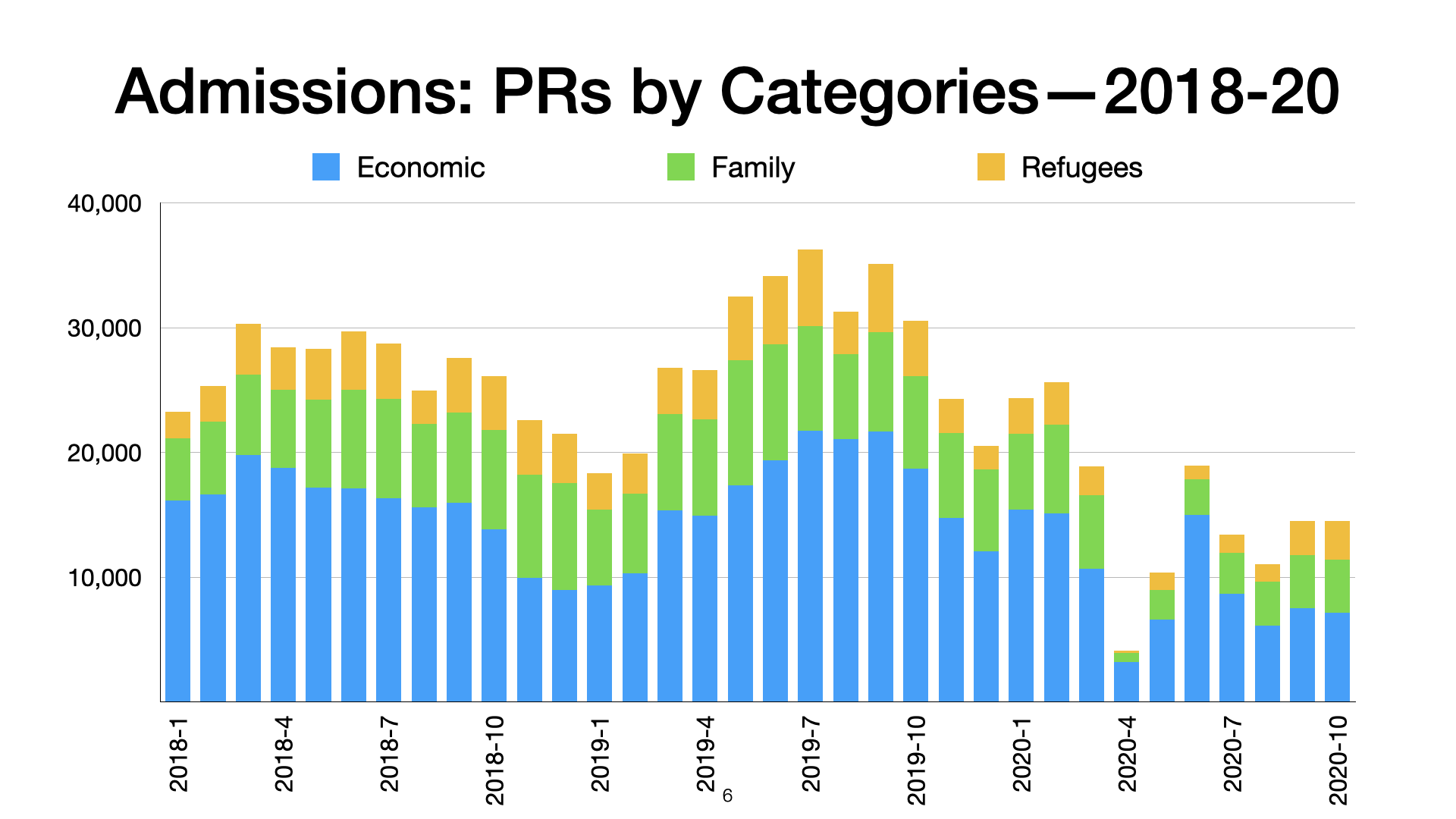
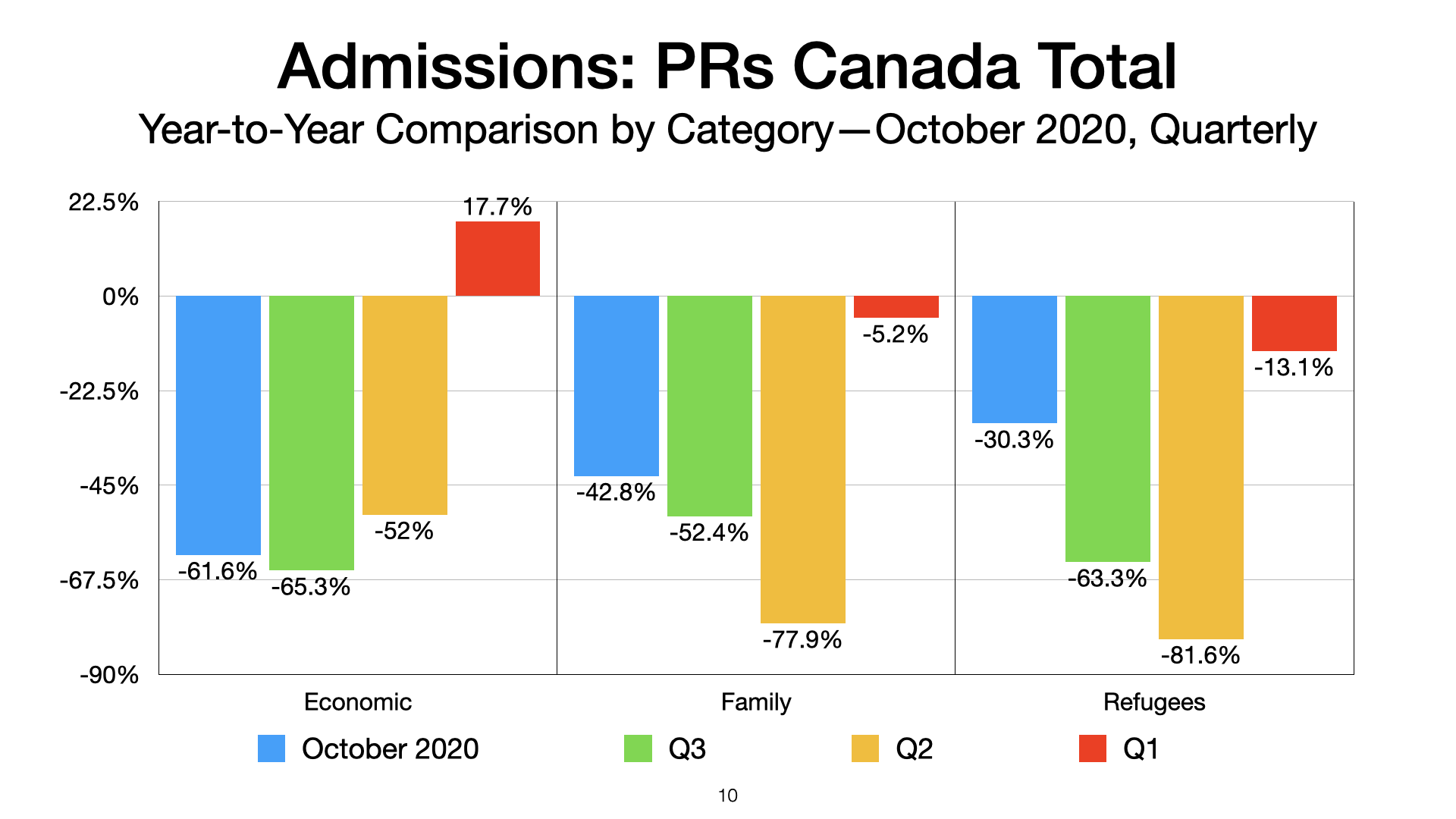
Overall, permanent resident admissions are down by 51.8 percent in October 2020 compared October 2019, and 42.9 percent year to date. Family and refugee categories have declined more than the economic category.
With respect to Provincial Nominee Program, declines have been less in Alberta and British Columbia than other provinces.
Transition from temporary residents to permanent residents account for close to 40 percent of total admissions in 2020 year to date, with the post-graduate work program and the International mobility program being relatively less affected that international students and the temporary foreign worker program (note some double counting between these programs and overlap with the Provincial Nominee Program).
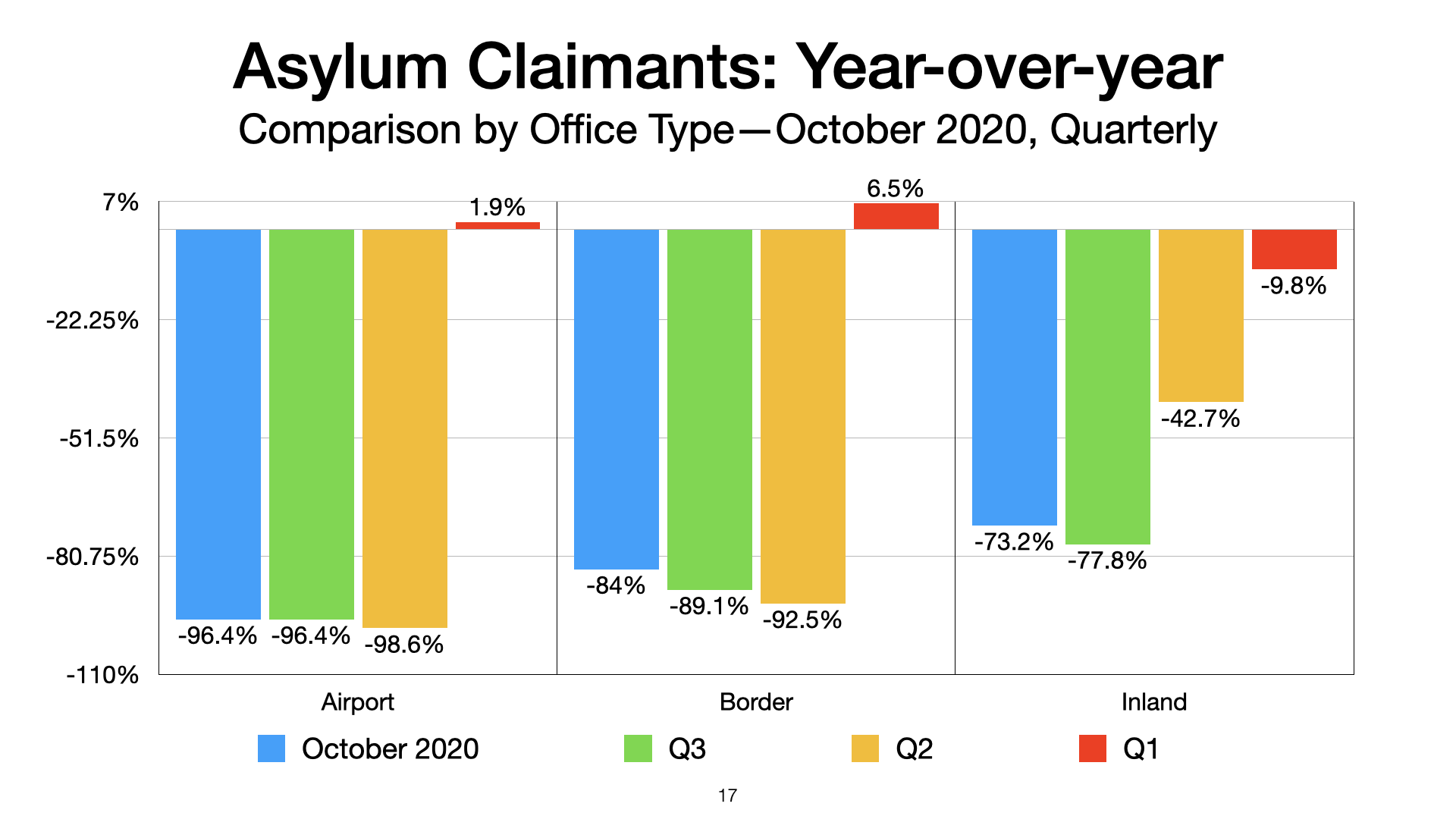
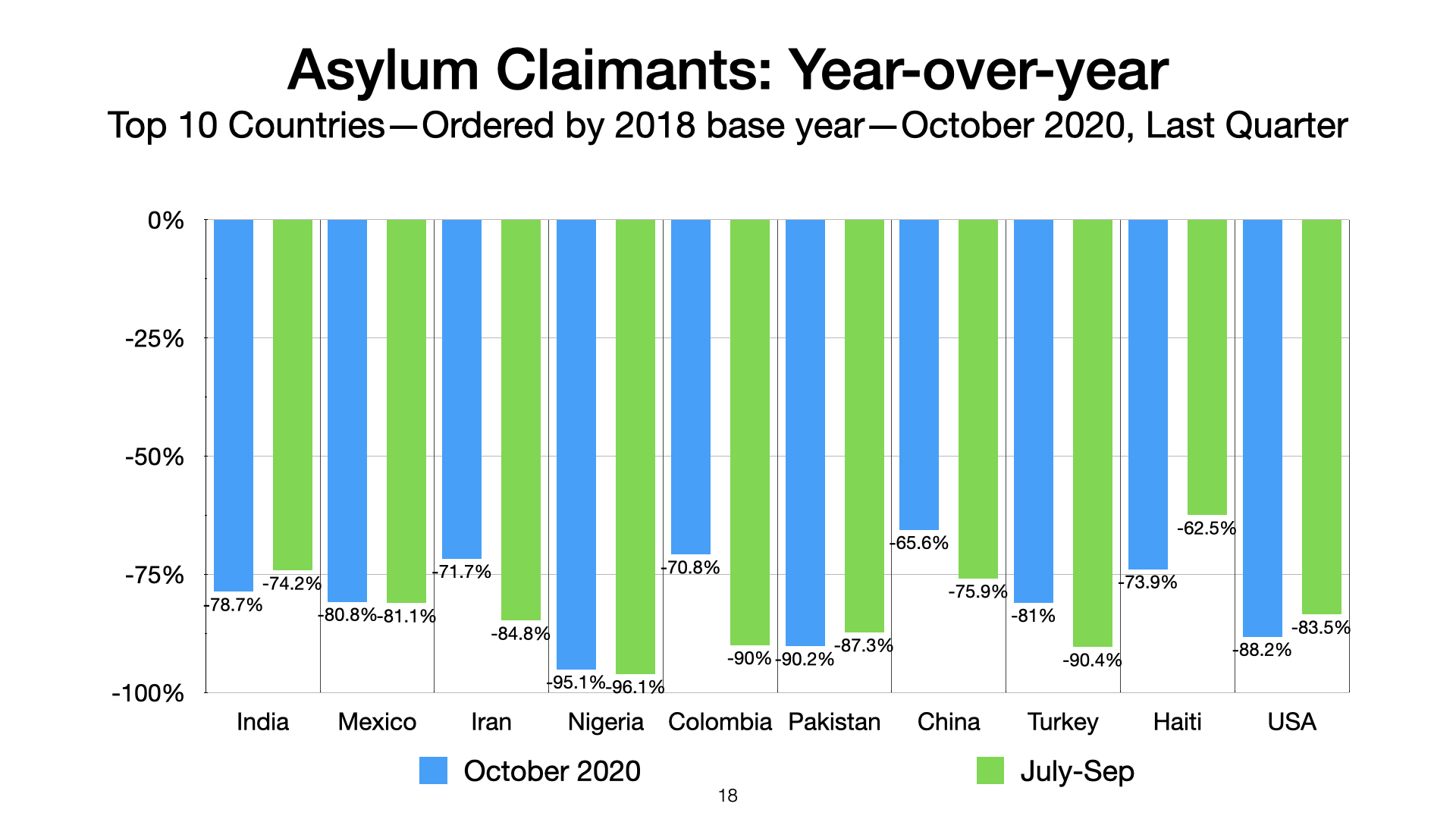
Asylum claimants have declined dramatically given travel and border restrictions (particularly airport arrivals), from an average of over 5,000 a month in 2019 to an average of less than 1,300 April to October 2020. Inland claims accounted for 56 percent of all claims in 2019, and for 81 percent April to October 2020.
International students (study permit holders have declined from an average of 35,000 per month in 2019 (with summer seasonal peaks) to 27,000 April to October 2020, with some variation among countries of origin (citizenship) year to date as well as by province of destination.
Interesting and useful case study, highlighting a strategy of “cultivating ambiguity” and creating space for employees to maintain personal balance between work and religious observation:
We tend to think of business as a secular activity, and workplaces as inappropriate settings for conversations about religious faith or observance. However, given the growing popularity of bringing one’s whole self to work, the trend towards practices such as yoga and mindfulness, and the fact that more than 80% of the world claims some sort of religious affiliation, leaders are increasingly concerned about how best to handle expressions of faith by their employees.
For many religious people, their faith is associated with deeply held values that inform their actions and behaviors at work as well as in their personal lives. In workplaces where employees feel comfortable talking about their religious beliefs, everyone can gain a richer understanding of their colleagues’ personal motivations and of the varied values at play in their organizations.
However, there are complications that come with this openness. Once the range of beliefs of a diverse workforce become more public, employees may disagree with each other about them. Expressions of belief may also conflict with the requirements of the business, forcing employers to walk a fine line between non-discrimination on religious grounds, service to the customer, and fair treatment of all employees.
These concerns are compounded in organizations that are explicitly religious (such as the Salvation Army) and in others whose founders’ religious principles inform the company’s values and practices (such as Chick-fil-A). While some employees share the beliefs at the heart of these organizations, those that do not can feel excluded or discriminated against.
At either type of organization, certain religious beliefs may dictate that employees dress a certain way or avoid eating certain foods, working on holy days, or serving certain types of customer. Pitting these tenets against the demands of business creates tension in the organization, often with negative ramifications. Conflicts over religious dress have resulted in lawsuits, causing people to leave or be fired, damaging the organization’s reputation and making it more difficult to attract or retain staff and customers. At a personal level, people can break under the strain of the conflict: delivering products or engaging in practices they don’t believe in makes them lose confidence in the organization and can become demotivated or quit altogether.
But we believe that actively accommodating highly diverse beliefs and practices within an organization is possible. Specifically, we have seen that a business’s values, customers’ values, and employees’ religious values can coexist even when on the surface they may seem pitted against each other. To explore what this might look like, we conducted a 24-month ethnographic study of the opening of KT Bank, the first Islamic bank in Germany.
The incompatibility of Islamic teaching with much of conventional Western banking practice makes the potential conflicts in this case particularly intense. Islamic banking explicitly bans the payment of interest and also prohibits the kind of speculation and risk trading that is found in conventional derivatives. The bank’s leaders, however — comprising Muslims, members of other faiths, and people without strong religious convictions — adopted a deliberately vague and flexible approach that allows them to accommodate divergent beliefs while maintaining unity.
We found that two deliberate practices involving both leaders and employees can help create what we call an elastic hybrid: an organization that can embrace different and potentially even opposing views, allowing all stakeholders to navigate competing commitments in line with their own convictions and helping the organization to find unity in diversity.
Cultivate Ambiguity
We’re used to hearing calls for ever more clarity from our leaders: precision about their message and the ability to align people behind a single, powerful vision or purpose. But to create an elastic hybrid organization, leaders must instead cultivate vagueness around how the organization’s purpose relates to religious practice.
At KT Bank, leaders deliberately obscured the way that the bank balanced its religious and commercial ambitions. The imagery on calendars or products used subtle religious symbols. People versed in Islam would recognize their religious connotation, but others could enjoy them as artistic or cultural artifacts. The most visible instance of this interpretive flexibility was KT Bank’s logo. It shows a yellow date tree on a green background. For those unfamiliar with the Islamic faith, this may evoke a sense of environmental or economic sustainability. Muslims, by contrast, would likely recognize green as the color of Islam and associate the date with divine nourishment. Campaign slogans played on double meanings that signaled religious commitments not to speculate or trade in improper goods, but could also simply be construed as a distinctive market position. For example: “Now there is a bank that does not speculate, but invests sensibly.”
The bank’s leadership was not aiming to hide anything with this vagueness, but rather to be open to being multiple things to multiple people at the same time.
Create Space — Literally
Moving between different physical places allows employees to separate out their professional work from their religious observance. Giving them the time to do so also helps alleviate this tension.
At KT Bank, we observed how staff found ways to maintain their personal balance between market and religion by use of a prayer room. There, people could temporarily retreat from work and decompress from faith/work conflicts and anxieties in whatever way they saw fit; there were no restrictions on how the room could be used or by whom, or for which faith. Flexible work times allowed people to accommodate religious practices within the working day. Several members of staff told us that it was the first time they had a designated space for prayer at work and reported feeling “deeply content” and “grateful” for the fact that KT Bank had made space for their religious practice.
This flexible approach, which recognizes and includes diverse beliefs, allows individual staff to choose their own level of religious intensity and balance it with the demands of the organization in a dynamic way. For example, at times they may choose to subordinate their religious concerns and prioritize what the company needs them to do. At other times it may be appropriate to question company practices when they seem incompatible with their personal values. A company that is open to the latter may benefit from employees’ increased willingness to do the former. And as it develops through the interplay between the leaders’ making space and the employees’ taking space, the organization is able to bend, but not to break.
This is a new area of research and more work is needed to understand successful ways that organizations have handled different kinds of conflicts between value systems and religious practice. But from what we’ve seen, in a world of volatility, uncertainty, complexity, ambiguity, and paradox, it may be advantageous for an organization to mirror the characteristics demonstrated by KT Bank. A perfectly aligned organization with clarity and focus at every level may not be as adaptable as organizations that make room for, and even celebrate, ambiguity.
Good initiative by Senators Black and Omidvar in commissioning this poll:
Eight in 10 Canadians say temporary foreign workers should be entitled to the same benefits and protection as any other workers in this country, according to a Nanos Research poll.
The survey, commissioned by senators Ratna Omidvar and Rob Black, was released Thursday in the wake of a Star story that highlighted the plight of hundreds of Trinidadian seasonal migrant farm workers, who are stuck in Canada due to COVID-19 travel restrictions and unable to access employment insurance benefits.
The pandemic has shed light on the vulnerability of temporary foreign workers, who pay the same EI premiums as Canadian workers but who have difficulty accessing the benefits due to their precarious immigration status.
Trinidad and Tobago has closed its airports to international flights since March and the estimated 400 stranded workers are on the verge of losing their legal status in Canada as their work permits expire on Dec. 15. Many have been denied EI, with officials saying their “closed” work permit prevents the workers from looking for other employers, resulting in them being declared not “ready or available” for work.
The senators say that in addition to benefits, migrant workers should have “pathways” to obtaining permanent resident status in Canada, something that is currently very limited for these workers.
“The pandemic has highlighted the fact that temporary migrant workers and seasonal agricultural workers are essential to Canada,” said Black. “We are calling on the Government of Canada for pathways to permanency for essential workers, should they so desire.”
The poll of 1,040 Canadians was conducted in late October and independent from the Star story.
It found that 93 per cent of respondents said migrant workers are essential contributors to Canada’s agricultural sector and 81 per cent said they deserved a pathway to permanent residence.
Canada’s agricultural sector depends on the temporary migrant work force, which makes up 17 per cent of the total employment in the sector.
“We need more concrete and equitable improvements to our migrant workers program. Since the workers are essential to our well being and safety, then the safest … and the most human way forward is to provide them with more permanent residency options,” Omidvar said.
Both Black and Omidvar plan to introduce a motion in the Senate on Thursday calling on the Liberal government to create permanent residence pathways for migrant workers.
Legitimate worries. Hopefully no equivalent with Canadian government:
Switzerland gave Chinese security agents free run inside its borders and the rest of Europe for five years as part of a secretive immigration agreement between the two countries, according to human rights watchdog Safeguard Defenders.
While the agreement officially expired this week, Safeguard Defenders warned that it was up for renewal in a report released on Thursday.
The deal allows Chinese officials to visit Switzerland for up to two weeks to interview and remove nationals who have been found to be residing illegally in the European country and take them back to China.
While Switzerland maintains similar agreements with immigration authorities from 52 other countries and territories, including Hong Kong and Macau, its deal with China is unique in that it grants powers to China’s Ministry of Public Security as opposed to immigration officials, according to Safeguard Defenders.
These officials are allowed access to investigate “irregular immigration” as opposed to “illegal immigration” as detailed in agreements with the countries, the organisation said.
“In China, the Ministry of Public Security is the paramount structure of power second only to the Communist Party itself, and it is through the MPS that the Party wields its authority over perceived threats,” said Michael Caster, senior adviser at Safeguard Defenders.
“The real question is why would Switzerland agree to any bilateral partnership with a state agency known for widespread and systematic human rights abuses, including torture, especially when that partnership is about the surveillance, custody, and repatriation of individuals at risk of abuse,” he said.
The deal was signed in 2015 but was not made public, so even Swiss parliamentarians on the country’s Foreign Affairs Committee were unaware of it, according to Swiss news outlet ZZ am Sonntag, which first broke the story in August.
MPs were reportedly not notified because the agreement was considered an “administrative” matter, the newspaper said.
The text of the document is also not available online. The Swiss State Secretariat for Migration (SEM) offers a link to the agreement on its government website, but clicking on the link reveals that no document has been uploaded.
The SEM acknowledged the existence of the agreement to Al Jazeera in a response to written questions, and said it was neither unlisted nor confidential. “The full text has always been transmitted upon request,” spokesman Lukas Rieder said.
Rieder said Swiss migration authorities decide, together with the cantons, which people will be presented to any visiting delegation, and then organise the mission.
The duration of the stay depends on the number of interviews, which take place at the offices of the SEM, and the visiting delegation has no influence over the amount of time they spend in Switzerland, it said.
“Chinese authorities do not receive any information on persons at risk or persecuted,” Rieder said, stressing that the only information provided was for identification purposes. “No sensitive data or information is provided which could endanger the persons concerned” or their relatives.
He added that while a continuation of the agreement was “in Switzerland’s interest” there was “no urgency” for the renewal.
Operation Fox Hunt
ZZ am Sonntag earlier reported that while the arrangement had not been used to deport Uighurs or Tibetans, others might have fallen victim to it.
On the one known occasion that the agreement was activated in 2016, Chinese agents visited Switzerland to remove 13 people, among them four asylum seekers, the newspaper said.
Caster said the agreement could also have been used to conduct influence campaigns in Switzerland and elsewhere in Europe, as the Schengen system allows the security agents unrestricted access across much of the continent.
While Safeguard Defenders said it did not find specific evidence in this case, China had been known to perform similar operations outside its borders, including forcefully repatriating and harassing its own citizens.
Known as Operation Fox Hunt or Operation Sky Net, the campaign has intensified under Chinese President Xi Jinping, who has led an anti-corruption drive across China since he took office in 2012.
Chinese state news agency Xinhua said the operation has brought nearly 6,000 people back to China since 2014, including 1,425 members of the Communist Party.
Some of the most prominent cases include Xiao Jianhua, a Chinese-Canadian billionaire abducted from his Hong Kong hotel room in 2017, and Gui Minhai, a Chinese-Swedish bookseller who was taken from Thailand in 2015. Former Interpol chief Meng Hongwei was picked up when he made a trip back to China from France in 2018.
Security agents have also harassed Chinese citizens and dissidents living abroad. In October, the US Justice Department indicted eight Chinese nationals with charges including stalking and coercion of Chinese abroad to encourage them to return to China.
“We have clearly seen the lengths Chinese security officials have gone to abduct Chinese citizens from other sovereign nations or wage sophisticated surveillance or influence campaigns and where there is a loophole we can be certain that agents of the Chinese state will have sought ways to exploit it,” Caster said.
“As long as secret agreements, like this one with the Swiss Government, allow unfettered access to Chinese security agents, we can never rule out a greater extent of abuse.”
More on the oppression Uyghurs and the need for more forceful policy responses:
As the world somberly marked UN Genocide Commemoration Day this week, Canadians still await their own government’s action after a parliamentary panel found that China’s persecution of Uyghurs is now the largest mass detention of a people in concentration camps since the Holocaust.Last summer, the House of Commons Subcommittee on International Human Rightsheld a series of emergency meetings on the plight of the Uyghur population in China, in response to growing reports of forced labour, forced sterilization and population control.
The subcommittee received briefs and testimony from 23 Canadian and international witnesses, who detailed atrocities in China’s flourishing campaign to eradicate Uyghur culture and identity by engaging two million people in forced labour and mental torture.
The subcommittee heard that in the prison camps, Uyghurs are required to speak only Mandarin Chinese and are denied their human right to practise their religion. Women and girls often face sexual abuse and rape by their captors. The situation for their children consigned to orphanages is one of complete assimilation into Han Chinese language and culture, combined with the desperation of having no information on the fate of their parents.
Family abroad, meantime, have no means to communicate with anyone in the Uyghur regions. The stress on Canadian Uyghurs of not knowing if family members are alive is enormous, and they are subject to menacing threats by Chinese agents in Canada who intimidate them from speaking out on what’s going on. These threats sometimes precede the sudden death of family members in the camps. There was also extensive evidence given of sterilization of Uyghur women and forced marriage to Han Chinese men.
The subcommittee’s report to Parliament this Fall found that China’s policies toward Uyghurs and other Turkic Muslims are worse than imagined. It concurred with testimony by former human rights lawyer and Canadian justice minister Irwin Cotler, who called the Uyghur situation “a classic case study of such war crimes, crimes against humanity and, as I and others have mentioned, acts that are constitutive of genocide.”
Cotler and others implored the Canadian government to take various measures including working with allies and multilateral organizations to condemn China’s use of concentration camps, extending sanctuary for Uyghur refugees trapped in third countries, and refusing to import products of Uyghur forced labour.
The subcommittee is urging the federal government to impose Sergei Magnitsky Actsanctions on all Chinese government officials culpable for perpetrating human rights abuses, and notes that if the international community does not condemn China’s campaign in Xinjiang province, a precedent will be set and such atrocities will be adopted by other regimes.
Besides Wednesday having been Genocide Commemoration Day, Dec. 9 was also the 72nd anniversary of the Genocide Convention, the first human rights treaty adopted by the United Nations General Assembly. The Convention signifies the international community’s commitment to “never again” and establishes a duty for states to prevent and punish the crime of genocide.
But as the months go by, it becomes increasingly apparent the Canadian government will ignore the findings and recommendations of its own parliamentary subcommittee. The federal government will not expel any Chinese diplomats overseeing the harassment of people in Canada, instead advising Uyghur Canadians to contact local police if they are subject to threats. And evidently Beijing has sufficient influence in Canada to put a stop to any talk of Magnitsky sanctions against complicit Communist officials, some of whom have real estate here and children enrolled in Canadian schools.
In the end, it all seems to be about racism and the critical position of Uyghur territory for China’s global “Belt and Road” infrastructure campaign. As Uyghurs call for self-rule in an independent East Turkestan principality, China evidently believes it can solve that problem through its cultural extermination efforts.
The subcommittee’s report aptly quotes Nobel Peace laureate Elie Wiesel: “Silence in the face of evil ends up being complicity with evil itself.” It is time Canada stopped standing idly by and showed some legitimacy for our purported commitment to the rules-based international order.
Mehmet Tohti is Executive Director at Uyghur Rights Advocacy Project. Charles Burton is a senior fellow at the Macdonald-Laurier Institute in Ottawa, and non-resident senior fellow of the European Values Center for Security Policy in Prague. He is a former professor of political science at Brock University, and served as a diplomat at Canada’s Embassy in Beijing.





 Multicultural Meanderings