Immigration is not a cure-all for Canada’s economic woes

A useful and needed reminder that Canada has been relying too much on immigration for overall economic growth rather than addressing some of the fundamental challenges related to productivity:

Jock Finlayson is the executive vice-president and chief policy officer of the Business Council of British Columbia. David Williams, DPhil, is the council’s vice-president of policy.

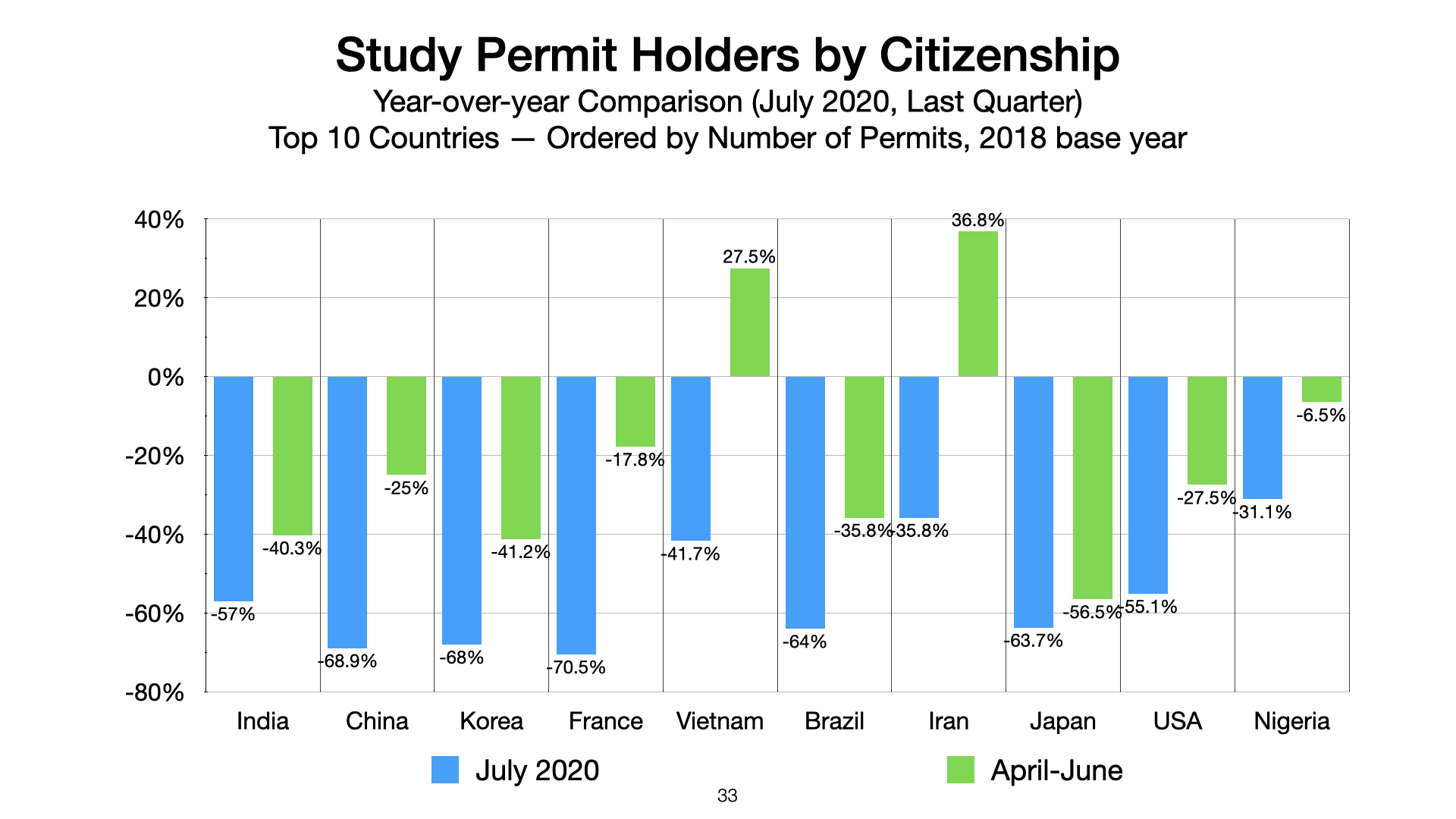
Immigration inflows to Canada have fallen off a cliff since the COVID-19 pandemic. In the second quarter of 2020, permanent resident arrivals were down by two-thirds from a year ago. Temporary work permits issued to foreign workers were down by half. And permits for international students were about 80-per-cent lower.

By contrast, prior to the pandemic, net temporary immigration was a record 191,000 and permanent immigration reached 341,000 last year – the highest since 1911-13. As a result, Canada’s population increased by a record 550,000 people last year, with much of that growth concentrated in the gateway metropolitan areas of Toronto, Vancouver and Montreal.

The immigration slump has set off alarm bells in some quarters. The concern is that without a prompt return to turbocharged immigration levels, Canada’s economy is in jeopardy. In our view, these concerns are exaggerated and overlook the humble arithmetic of economic growth.

Growth in gross domestic product (GDP) comes from two sources: increases in “labour inputs” (more workers and/or more hours of work); and increases in “labour productivity” (more GDP per employee or per hour of work) because of investments in capital, skills, technologies and economies of scale. Canadian policy discussions overwhelmingly focus on boosting labour inputs, while paying scant attention to the drivers of productivity. This is a remarkably unbalanced approach.

Canada’s economy stumbled into 2020 with a national growth strategy that was yielding low unemployment – and flushed gateway city real estate markets – but little or no gains in GDP per capita, productivity and real wages. Canada could scarcely manage topline GDP growth of 2 per cent without overheating and prompting higher interest rates from the Bank of Canada. That’s hardly impressive for an economy operating near full employment.

In the five years to 2019, fully four-fifths of Canada’s GDP growth was because of increases in aggregate working hours as the labour force steadily expanded. During the same period, labour productivity – which largely determines average real wages and living standards in the long run – made its smallest contribution to GDP growth since the 1980s. On a per worker basis, business investment was weaker last year than in 2008. Putting all the pieces together, GDP per capita inched ahead by a paltry 0.3 per cent per annum over the five years to 2019.

In other words, Canada’s economy was growing mostly because it was adding more people (especially in the big cities). But owing to weak investment and feeble productivity growth, the economy wasn’t getting much “better” in terms of making the average Canadian more prosperous.

There are benefits from immigration – a larger pool of workers and skills, more domestic customers and densification of the big cities. But research from leading Canadian economists generally finds that immigration numbers have an overall neutral effect on real wages, employment rates, labour productivity and GDP per capita. In addition, immigration has only a small impact on the age structure of the population. That’s because annual immigration flows are dwarfed by the existing population, and also because newcomers age along with everyone else.

Canada is on a long road to recovery from the COVID-19 recession. In the coming years, policy makers should focus on spurring labour demand, restoring full employment and improving competitiveness. This will require creating better conditions for investment and technology adoption, for Canadian companies to scale up and innovate, and for the work force to upskill and reskill in the face of digital transformation and automation trends. These are the surest paths to economic growth and prosperity – on a per capita basis, for both urban and regional communities, and over the short and the long term.
Source: https://www.theglobeandmail.com/business/commentary/article-immigration-is-not-a-cure-all-for-canadas-economic-woes/

McCuaig-Johnston: Fifty years of Canada-China relations are nothing to celebrate until our citizens are home

Good commentary by McCuaig-Johnston:

Today marks 50 years since the Canadian government formally recognized the government of the People’s Republic of China, but many Canadians feel that there is nothing to celebrate while China is holding innocent Canadians in prison. Michael Kovrig and Michael Spavor were detained in apparent retaliation for Canada’s arrest of Huawei executive Meng Wanzhou for possible extradition to the U.S. Beijing made clear that Canada had to “look first to its own mistake” and send Meng home.

When Meng lost her double criminality challenge in B.C. court, the Michaels were formally charged with unspecified national security allegations. In addition, four Canadians have now been given sentences of execution for drug offences. Robert Schellenberg and Fan Wei were sentenced after Meng’s arrest.  Xu Weihong and Ye Jianhui were sentenced two days apart, less than two weeks before one of Meng’s court hearings. Asked if the cases were connected, a Chinese official said “the Canadian side knows the root cause” of difficulties in Canada-China relations.

During the more than 670 days of Kovrig and Spavor’s incarceration, the Canadian government has worked closely with other liberal democracies that have experienced China’s medieval hostage-taking as retaliation for perceived offences. They, too, have spoken against the detention of our Canadians, both publicly and privately in meetings with Chinese ministers and officials. We know that Beijing does not like this because they have instructed us to stop.

But as recently as Oct. 10, Prime Minister Justin Trudeau thanked President Donald Trump for the ongoing support of the United States in seeking the immediate release of the Canadians. The U.S. is the one nation Beijing refrains from criticizing, knowing the risks it might incur. Instead it targets small and middle powers like Canada.

On the same day as the Trudeau-Trump discussion, Foreign Minister François-Philippe Champagne announced Canada’s intention to join the Support Group of the International Commission against the Death Penalty, led by Spain. This group of 23 countries is working to persuade other nations, including China, to refrain from sentencing people to death.  No doubt the minister had the fate of our four Canadians at the forefront in mind.

During the more than 670 days of Kovrig and Spavor’s incarceration, the Canadian government has worked closely with other liberal democracies that have experienced China’s medieval hostage-taking as retaliation for perceived offences. They, too, have spoken against the detention of our Canadians, both publicly and privately in meetings with Chinese ministers and officials. We know that Beijing does not like this because they have instructed us to stop.

But as recently as Oct. 10, Prime Minister Justin Trudeau thanked President Donald Trump for the ongoing support of the United States in seeking the immediate release of the Canadians. The U.S. is the one nation Beijing refrains from criticizing, knowing the risks it might incur. Instead it targets small and middle powers like Canada.

On the same day as the Trudeau-Trump discussion, Foreign Minister François-Philippe Champagne announced Canada’s intention to join the Support Group of the International Commission against the Death Penalty, led by Spain. This group of 23 countries is working to persuade other nations, including China, to refrain from sentencing people to death.  No doubt the minister had the fate of our four Canadians at the forefront in mind.

Champagne has also noted that he is working with like-minded countries on collectively developing an approach to deal with China’s arbitrary detention of foreign citizens. Canada is also discussing with other nations the possibility of “Magnitsky” sanctions against China for restricting the rights of Hong Kongers as well as the besieged Uyghurs in Xinjiang and elsewhere in China. That would be an excellent initiative – but in the first instance, Canada should impose Magnitsky sanctions on those responsible for incarcerating our citizens.

In addition, the government’s new China Framework being developed under Champagne’s direction should take into account the more aggressive China that Canada and other nations are now seeing. It should diversify away from China to other nations in the Indo-Pacific in trade, investment, population health, cultural exchange, education and security.  We should pass foreign interference laws, revisit our Foreign Investment Protection Agreement with China, review Chinese collaborations in our universities, and ban Chinese companies from our telecommunications infrastructure. The softly-softly strategy clearly has not worked.

According to recent polls, Canadians have lost patience with China. A May 2020 Angus Reid pollshowed that only 14 per cent of Canadians have a positive view of China, and according to a Pew Research Centre survey this month, 73 per cent have an unfavourable view of China, up from 45 per cent in 2018, before our Canadians were detained. This view is shared by the citizens of many other countries, with Australians having an 81 per cent negative view, and negative views increasing by double digits in the past year in the U.K., Germany, the Netherlands, Sweden, the U.S., South Korea and Spain.

It is time for Canada to take stronger action. We should work with other democracies to confront China’s detention of innocent citizens to use as pawns in its geopolitical agenda. Without stronger action, democratic governments themselves are complicit in China’s behaviour.

In the meantime, no Canadian politician, official or business executive should attend a celebration of the 50th, even virtually. There is nothing to celebrate until our citizens come home.

Margaret McCuaig-Johnston is a retired federal Assistant Deputy Minister and is now a Distinguished Fellow at the Asia Pacific Foundation of Canada and Senior Fellow at the China Institute, University of Alberta. She is also Senior Fellow of the Institute for Science, Society and Policy, University of Ottawa.

Source: https://ottawacitizen.com/opinion/mccuaig-johnston-fifty-years-of-canada-china-relations-are-nothing-to-celebrate-until-our-citizens-are-home

Ottawa was told about potential problems at Public Health Agency, top doctors say

This is a much bigger scandal than WE in terms of governance and expertise, reflecting in part the previous Conservative government’s disregard for science and expertise:

The federal government was warned years ago that the Public Health Agency of Canada was destined for serious problems unless changes were made to its oversight, but those concerns were ignored, two of Canada’s top doctors say.

A steady erosion of scientific capacity and a chronic shortage of resources over the past decade have left the agency unable to do its job properly, public-health experts Perry Kendall and Paul Gully told The Globe and Mail.

Recent problems, including the mishandling of the country’s pandemic early warning system, emergency stockpile shortages and allegations that scientists were forced to “dumb down” reports for senior government officials, are all symptoms of a larger ailment afflicting the agency, the doctors said.

“We are of the view that long-term deficiencies of expertise and funding prevent the Public Health Agency of Canada from fully carrying out its intended and necessary role,” Dr. Kendall said.

“A lot of the tools that the Public Health Agency had for influencing policy and programs were removed and budgets were cut.”

They are harsh words from two of Canada’s most respected public-health figures. Dr. Kendall preceded Bonnie Henry as B.C.’s provincial health officer from 1999 to 2018, and has been a leading voice in public-health policy. Dr. Gully spent 14 years in senior roles at Health Canada, and was also the country’s deputy chief public health officer from 2004 to 2006. He later worked on pandemic preparedness for the World Health Organization.

Both Dr. Kendall and Dr. Gully say many of today’s problems can be traced back to serious funding constraints that began in 2011, and a controversial 2015 decision to restructure the management hierarchy.

After the 2003 SARS crisis, the agency was created to act as an independent voice within government. But a move by the Harper government to install a president to run Public Health effectively reduced the Chief Public Health Officer (CPHO) to the role of an adviser, and left the department exposed to competing priorities and political influence.

Dr. Kendall warned during federal hearings five years ago that the change would weaken the agency in ways that were not readily apparent.

By taking oversight of programs and budgets away from the CPHO, whose job was to plan for a pandemic even in times of relative safety, and placing them in the hands of government appointees instead, the agency would be subject to inadequate planning, he warned in 2015. This was particularly risky during the years in between a crisis, Dr. Kendall argued, when resources could be reallocated without thought to the consequences.

That erosion is now on display during the COVID-19 crisis, Dr. Gully and Dr. Kendall said. They argue that current CPHO Dr. Theresa Tam and other public-health doctors have performed their roles well in the face of these constraints, but the agency itself was never intended to operate this way.

Public Health has been beset by numerous problems, including the silencing of the country’s once highly respected pandemic early warning system, known as the Global Public Health Intelligence Network. GPHIN was the focus of a Globe and Mail investigation in late July, which prompted the Auditor-General and the Health Minister to launch separate probes into the the matter.

Doctors and epidemiologists at Public Health told The Globe that the agency experienced an influx of senior government officials in recent years who lacked a sufficient understanding of science. That made it difficult to convey urgent and crucial information up the chain of command, and complex reports had to be oversimplified or “dumbed down.”

Soon after those concerns came to light, management at the agency was shuffled. Public Health president Tina Namiesniowski, who came to the job with no background in science, resigned suddenly last month and was replaced by the former head of the National Research Council, Iain Stewart.

“Certainly, my sense is that there’s been a loss of that scientific capacity,” Dr. Gully said, which impacts how Canada responds to a crisis such as COVID-19.

“If the scientific capacity of PHAC was such that the agency could rapidly analyze and give advice, in real time, on the numerous issues that require policy and political decisions, then the federal role would have been more effective,” Dr. Gully said.

The silencing of GPHIN, which was renowned for its ability to gather intelligence on past outbreaks to help speed government decision-making, is an example of the kinds of breakdowns Dr. Kendall warned could happen in his testimony five years ago. With no threat of a deadly outbreak in years, the department officials believed in 2019 that GPHIN’s analysts and resources could be put to better use on domestic projects that did not involve pandemic preparedness.

Dr. Kendall called that decision “short-sighted,” adding that the warning and surveillance system had once worked effectively. “In the past, as a prime source of intelligence, GPHIN would have been able to provide a more timely alert and analysis.”

However, the concerns are not limited to GPHIN, he said.

“Obviously, rebuilding the Global Public Health Intelligence Network capacity is important, and big data is on everybody’s lips, so maybe there’s some way of using big data to enhance [GPHIN],” he said.

Both Dr. Kendall and Dr. Gully believe the government should now revisit the structure of the Public Health Agency, including how it is funded.

“I would strongly support revisiting and reopening the Act and creating the Chief Public Health Officer as the head of the agency. And then having the necessary administrative and political support underneath,” Dr. Kendall said.

Their comments echo those of another respected public-health doctor, David Butler-Jones, the country’s first CPHO, who warned in February that Canada had, over the years, “replaced public-health managers and analysts with generic public servants.” He added: “Resources, expertise and capacity have been reduced, and expertise positioned further away from where organizational decisions are made.”

In creating the president’s role in early 2015, the government said it wanted to ease the CPHO’s administrative workload. However, the doctors don’t buy that argument, saying the change allowed for greater control over Public Health’s decisions and hindered its ability to handle a crisis.

“We sincerely hope that there is a comprehensive examination of federal public-health capacity,” Dr. Gully said. “And that Public Health will be adequately resourced and empowered to return to its former pre-eminence as a trusted source of independent advice, scientific knowledge, and national and global leadership.”

“That’s why we’re coming forward now – because it’s obvious now,” he said.

Source: https://www.theglobeandmail.com/canada/article-ottawa-was-told-about-potential-problems-at-public-health-agency-top/

If Amy Coney Barrett Were Muslim

Relevant and pertinent thought experiment:

Amy Coney Barrett, President Trump’s nominee for the Supreme Court, has faced immense scrutiny of her religious beliefs, and we need to be vigilant against any religious bias or discrimination.

But I marvel at the hypocrisy of Republicans who are expressing shock and outrage over this, after the way the right has treated Muslims. President Trump responded to the alarm over Judge Barrett’s nomination by accusing Democrats of bias against Catholics and “basically fighting a major religion in our country.” This is rich from the man who is running against Joe Biden, a Catholic; who promoted a Muslim ban; and who told America, “I think Islam hates us.”

On Monday, the first day of the Senate hearings on Judge Barrett’s nomination, Josh Hawley of Missouri accused his Democratic colleagues on the Judiciary Committee of attacking Judge Barrett for being “too Catholic to be on the bench.” He is apparently living in the Twilight Zone, because this didn’t actually happen. Mr. Biden went out of his way to say Judge Barrett’s faith shouldn’t be considered a factor in her hearing.

I can’t help wondering: How would Republicans behave if Judge Barrett were a Democrat whose strongly held religious beliefs came from Islam instead of Catholicism?

We all know how it would go.

Republicans would demand she prove that she was not “working with our enemies.” That’s what Glenn Beck, the conservative radio host and conspiracy theorist, called for when Keith Ellison was elected as the first Muslim to Congress.

They’d probably use her faith to accuse her of hoping to create a “Shariah state” through judicial activism. That what conservative bloggers did in 2011 when Gov. Chris Christie of New Jersey nominated Sohail Mohammed, a Muslim originally from India, for a seat on the Superior Court of Passaic County.

If Judge Barrett wore a hijab, Jeanine Pirro, the Fox News host, would question whether her religious beliefs were in opposition to the Constitution. That’s the ugly accusation Ms. Pirro levied against Representative Ilhan Omar of Minnesota in 2019.

The scrutiny of Judge Barrett’ connections to the People of Praise religious community — which opposes abortion, gay rights and marriage equality, and which believes that men are leaders of their families — has been intense. It’s fair to debate whether that kind of scrutiny is reasonable, and concerns that Judge Barrett has faced bias because of her religious beliefs are understandable.

What is clear, though, is that if a little-known Muslim group made headlines in connection with the nomination of a justice, Republicans wouldn’t have the same concerns about religious bigotry.

For example, former People of Praise members told The Associated Press that women in the group are expected to obey their husbands and provide sex on demand (the group said in a recent statement that “husbands should not be domineering nor should wives be servile”). If Judge Barrett were Muslim, these former members would probably be invited to appear on “Fox & Friends” to give voice to their concerns about the judge’s regressive stances.

Judge Barrett co-wrote a 1998 law review article about the moral and legal “bind” that death penalty cases might present Catholic judges. What if she had been Muslim and had written about Muslim judges instead? Would Ben Carson call her “schizophrenic?” In 2016, that’s how he described Muslims who embrace American values like democracy and the separation of church and state.

Earlier, in 2015, Mr. Carson wrote in a Facebook post, “I could never support a candidate for president of the United States that was Muslim and had not renounced the central tenant of Islam: Shariah law.”

That happens to be the same year Judge Barrett signed an open letter to Catholic bishops saying, “We give witness that the church’s teachings — on the dignity of the human person and the value of human life from conception to natural death; on the meaning of human sexuality, the significance of sexual difference and the complementarity of men and women; on openness to life and the gift of motherhood; and on marriage and family founded on the indissoluble commitment of a man and a woman — provide a sure guide to the Christian life, promote women’s flourishing, and serve to protect the poor and most vulnerable among us.”

If she were Muslim and had made these statements, Republicans would no doubt smear her as a woman oppressed by a barbaric Islamic culture that promotes misogyny.

It’s easy to imagine all of this, because it all comes from the playbook that has been used to attack Muslim elected officials, many of whom are in fact archetypes of moderation and secularism compared with Judge Barrett.

I am not critical of Judge Barrett’s nomination because of her Catholicism. I am deeply sensitive to religious bigotry and stereotypes. I’m a practicing Muslim living through an administration that campaigned for a Muslim ban. My community has endured two decades of hazing after the Sept. 11 attacks, and our loyalty is still deemed suspect. I would never wish that kind of judgment on a person of another faith.

Like most Americans, I am worried that Judge Barrett will use her seat to advance an extreme agenda that will be detrimental to the interests of a majority of people in this country. We fear that, if confirmed, she’ll help the religious right drag equal rights and progress back 50 years.

One thing is certain: If the Notre Dame law professor and darling of the religious right were Muslim, she would have had a much harder time becoming a judge, let alone a Supreme Court justice.

Wajahat Ali is a playwright, a lawyer and a contributing opinion writer.

Source: https://www.nytimes.com/2020/10/13/opinion/amy-coney-barrett-religion.html

Facebook Bans Holocaust Denial, Reversing Earlier Policy

Long overdue. Similar action needs to be take with respect to other forms of racism and hate on Facebook and other platforms:

Facebook is banning all content that “denies or distorts the Holocaust,” in a policy reversal that comes after increased pressure from critics.

Just two years ago, founder and chief executive Mark Zuckerberg said in an interview that even though he finds such posts “deeply offensive,” he did not believe Facebook should take them down. Zuckerberg has said on numerous occasions that Facebook shouldn’t be forced to be the arbiter of truth on its platform, but rather allow a wide range of speech.

In a Facebook post on Monday, Zuckerberg said his thinking has “evolved” because of data showing an increase in anti-Semitic violence. The company said it was also in response to an “alarming” level of ignorance about the Holocaust, especially among young people. It pointed to a recent survey that found almost a quarter of people in US aged 18-39 said they believed the Holocaust was either a myth, had been exaggerated or were not sure about the genocide.

“I’ve struggled with the tension between standing for free expression and the harm caused by minimizing or denying the horror of the Holocaust,” Zuckerberg wrote. “Drawing the right lines between what is and isn’t acceptable speech isn’t straightforward, but with the current state of the world, I believe this is the right balance.”

Facebook has been under increased pressure to act more aggressively on hate speech, misinformation and other harmful content. The company has recently strengthened its rules to prohibit anti-Semitic stereotypes, and banned accounts related to militia groups and QAnon, a baseless conspiracy theory movement.

This summer, a group of Holocaust survivors, organized by the Conference on Jewish Material Claims Against Germany, launched a social media campaign urging Zuckerberg to remove Holocaust denial from Facebook.

On Monday, the group tweeted: “Survivors spoke! Facebook listened.”

In addition to removing Holocaust-denying posts, Facebook will begin directing users who search for terms associated with the Holocaust or its denial to “credible information” off the platform later this year, Monika Bickert, head of content policy, said in a blog post. She said it would take “some time” to train Facebook’s enforcement systems to enact the change.

Critics say how effectively Facebook polices its rules is the big question.

“We are seeing a trend toward Facebook listening to their critics and ultimately doing the right thing. That’s a trend we need to encourage,” Jonathan Greenblatt, CEO of the Anti-Defamation League, which has been pushing Facebook to crack down on Holocaust deniers for years, told NPR.

“Ultimately, Facebook will be judged not on the promises they make, but on how they keep those promises,” he said.

Source: Facebook Bans Holocaust Denial, Reversing Earlier Policy

This group is working behind the scenes to change the stories you see on TV

Of interest and importance:

ICE agents raid a big-box store, racing down the aisles to apprehend an employee. A DACA recipient who’s a doctor frets over her future. And a family separated by deportation struggles to connect on the phone.

These scenes on TV shows aren’t just quick plot twists ripped from the headlines in the age-old tradition of primetime television. They’re part of a deeper effort behind the scenes to shape new immigrant characters and storylines.
And an advocacy group known as Define American is leading the charge.
Their hope: That changing the conversations in Hollywood’s writers’ rooms will pave the way for immigration policy changes in Washington, too.
“This is long-term work,” says Jose Antonio Vargas, Define American’s founder. “This is not like, ‘How do we pass a bill next month?’ This is, ‘How do we create a culture in which we see immigrants as people deserving of dignity?’ These policies don’t make sense if we don’t see immigrants as people.”
Vargas knows the power of TV to shape stories and change minds. After revealing he was an undocumented immigrant in a 2011 New York Times magazine piece, the Pulitzer Prize-winning journalist became a high-profile advocate and filmmaker whose documentaries appeared on MTV and CNN.
When he first arrived in the United States from the Philippines in the 1990s, Vargas says that he — like many immigrants — got to know his new home by watching TV.
“When we get to this country, our most effective teacher is the television screen. … The way that I talk is because of all the TV and all the popular culture that I consumed,” he says. “For me, the most effective way of becoming American was being exposed to the media.”
Now the organization he founded is flipping that idea on its head.
So far, Vargas says, Define American has consulted on 75 film and TV projects across 22 networks.
The organization says stories it’s shaped have appeared on NBC’s “Superstore,” ABC’s “Grey’s Anatomy,” OWN’s “Queen Sugar” and CW’s “Roswell, New Mexico.” And they hope the list will grow.
Just as “Frasier,” “The Golden Girls” and “Will ​& Grace” helped him learn about American slang and society, Vargas says a new generation of TV shows can be a bridge, too — this time helping Americans better understand immigrants’ stories.

The view from inside the writers’ room

The first time she spoke with writers from “Superstore,” Elizabeth Grizzle Voorhees felt like she had to break some difficult news.
A season into the NBC sitcom, which portrays life for workers inside a big-box store, the writers had taken the plot ​arc of one prominent character in a direction they hadn’t anticipated when the show began: Mateo, who’s gay, fiercely competitive and proud of his Filipino heritage, discovered he was undocumented.
And the show’s writers were trying to sort out what to do next.
“They had a ton of questions,” says Voorhees, a former reality TV showrunner who’s now Define American’s ​chief strategy officer. Their top concern: “How do we get him citizenship?”
That day, she says, Define American’s team explained that the writers’ top question may be impossible to answer for Mateo, just as it is for millions of undocumented immigrants in the United States.
“That it might not be possible to resolve that storyline within a season, within a few episodes, or even within multiple seasons,” Voorhees says.
“I wouldn’t want to tell a story where say, Mateo does find this funny way that totally works and makes him a citizen. And none of that is true. I don’t think it’s good for society that we’re spreading a wrong message,” says Spitzer, now an executive producer of the show.
“I think as a viewer, if I’m watching something and even one time, I see them say something is possible that I know is impossible, that show has largely lost me.”
Instead, he says, Define American’s guidance — along with insights from immigration lawyers and even someone who worked at ICE — helped the writers shape stories rooted in reality.
Define American would bring panels of undocumented immigrants into the writers’ room, he says, sparking ideas for entire episodes with each conversation.
“It became this amazing resource for us. … Organizations like this are great. They can answer questions, but by just sitting around and talking, we can come up with stories we never even dreamed of before,” he says.
One example: an episode in the show’s second season when Mateo, desperate for a solution to his immigration woes, tries to get people in the store to assault him so he can be eligible for a visa for crime victims.
​The sixth season of “Superstore” is set to premiere on NBC later this month. Mateo still isn’t a citizen.

Awareness is growing

Today’s TV landscape is dotted with immigrant storylines.
“The Transplant” on NBC features a Syrian doctor who flees his war-torn country and starts over as a medical resident. Shows streaming on Netflix like “Never Have I Ever” and “Kim’s Convenience” portray immigrant parents with comedy and heart. “One Day at a Time,” scheduled to start airing this month on CBS, features Rita Moreno as the immigrant matriarch of a Cuban-American family. On Cinemax, “Warrior” tells tales of Chinese immigrant life in 19th-century San Francisco.
Popular shows that recently ended their run, like “Orange is the New Black” or “Jane the Virgin,” were lauded for the immigrant storylines they incorporated into their final seasons.
And these days, conversations about race and representation once relegated to obscurity are playing a far more prominent role. Lawmakers on the House Judiciary Committee recently grilled experts about diversity in Hollywood.
“There is greater awareness than we’ve probably ever seen before. … People are interested in telling diverse stories. They’re interested in telling stories that haven’t been told before that really can hit home,” Voorhees says.
But shows with more nuanced portrayals of immigrants like “Superstore,” “One Day at a Time” or “Warrior” still aren’t the norm, says Nancy Wang Yuen, a sociologist and author of “Reel Inequality: Hollywood Actors and Racism.”
“We’re not telling good immigrant stories. … There’s groups that we are just not talking about because of our stereotypes of who the undocumented immigrants are,” she says.

How immigrants on TV differ from reality

That’s something Define American’s leaders say they’ve found in their research as well.
In a study released last month with the Norman Lear Center’s ​Media Impact Project at the University of Southern California, researchers found notable gaps between reality and the ways immigrant stories are portrayed in TV shows.
Their analysis of 129 immigrant characters in 59 scripted shows from the 2018-2019 TV season found that half the immigrant characters on TV were Latinx, a figure roughly in line with reality. But they also found that proportionally, Middle Eastern immigrants were over-represented on television, making up around 10% of the immigrant characters on TV while comprising just 4% of the US immigrant population. About 12% of immigrants on TV are Asian and Pacific Islander immigrants, but that group is estimated to make up about 26% of the US immigrant population.
And that season, the study found there were no undocumented Black immigrants on television, even though it’s estimated there are around 600,000 living in the United States.
“The storyline right now, in the last couple years, in the minds of Hollywood — and I think the larger United States — is that undocumented immigrants equals Latinx,” Yuen says. “The reality is there are also Asian and African undocumented migrants who are also vulnerable and need advocacy.”
Correcting imbalances like these, Vargas says, is something Define American tries to do in its work.
“We need different stories,” Vargas says, “so that we can get to a point where the narrative has been created that this is an issue that impacts all races and ethnicities.”
And that, he says, could have an impact far beyond the screen where any show is streaming.

Why the shows we see matter

Do the shows we watch on TV influence what we do in real life?
For Vargas and others at Define American, that’s a key question.
And they say a recent survey they conducted as part of their study revealed promising findings.
“What about people who have no contact with immigrants whatsoever?” Sarah Lowe, Define American’s head of research asked at a recent event presenting the study to writers in Hollywood. “Our findings show that your work can actually make a difference to those people, too.
“Just like the impact that ‘Will & Grace’ had with the LGBT movement, for regular viewers of ‘Superstore,’ Mateo feels like their friend. They feel like they know him, even if they don’t know any other immigrants in their daily life.”
And the study found that the “Superstore” viewers who felt that sense of friendship with Mateo, but had little or no real-life contact with immigrants, were more likely to support an increase in immigrants coming to the U.S.
For Vargas, Define American’s recent analysis of the “Superstore” character’s impact sends an important message.
“The images we see in media are often immigrants crying, immigrants sad, immigrants tragic, as if we have this veil of tragedy all around us, when in reality, the study showed, when you actually present an immigrant in a three-dimensional way as a person, people are moved to action, to tell another friend, to post something on social media,” he says.
And that’s a big reason Define American will keep pushing behind the scenes.

Source: This group is working behind the scenes to change the stories you see on TV

Women in Egypt thronging to social media to reveal sexual assaults, hold abusers to account

Of note:

In Cairo, secrets long suppressed have been rising to the surface — and with them hopes the country may be experiencing a feminist movement capable of challenging the culture of impunity that has long accompanied gender-based violence in Egypt.

Online testimonials over the summer by hundreds of women on social media accounts offering anonymity have led authorities to open investigations into two alleged rape cases involving young men from wealthy and influential families.

“Egypt is on fire,” said Mozn Hassan, head of the women’s rights organization Nazra for Feminist Studies. “On fire for more than three months talking about different incidents in different sections and layers [of society].”

Social media, she said, has offered Egyptian women a safe “public sphere” that lets them know they are not alone.

In July, that space led to the arrest of a former American University in Cairo (AUC) student named Ahmed Bassem Zaki, accused of raping a number of women and blackmailing them for sexual favours. A Cairo court has set Oct. 14 as a trial date for Zaki.

“We at first just wanted him to admit it, that he did these things,” said Sabah Khodir, an Egyptian writer and poet who was one of the first to post online warnings about Zaki when she started to hear about his alleged behaviour from friends.

It set off a tidal wave with another Instagram account called Assault Police, encouraging women to share any information they had on Zaki.

“Then girls kept coming forward from all over parts of the world,” Khodir said. “We realized we actually have a shot at finally getting a serial rapist and predator in jail in Egypt that has money and power.”

Source: Women in Egypt thronging to social media to reveal sexual assaults, hold abusers to account

Virus Hits Foreign Farmhands, Challenging Canadians’ Self-Image

The NYTimes covers seasonal agricultural workers:

Three weeks after they began cutting asparagus in the thawing fields, Luis Gabriel Flores Flores noticed that one of his co-workers was missing. He said he found the man shivering with a fever, in bed — where he would remain for a week.

“I was trying to tell the foremen, ‘He is very ill, he needs a doctor,’” said Mr. Flores, one of thousands of migrant farm workers flown into Ontario in April to secure Canada’s food supply. “They said, ‘Sure, soon, later.’ They never did.”

The sprawling vegetable farm where he worked became the site of one of the country’s largest coronavirus outbreaks. Almost 200 workers, all from Mexico, tested positive, seven were hospitalized and one died: Juan Lopez Chaparro, the one Mr. Flores said he had tried in vain to help.

The farm owner insisted that Mr. Chaparro had been treated promptly and called Mr. Flores a “bad apple” being used by activists to score political points. If that is the case, it has worked: The outbreak and others like it have spurred national protests about the systemic vulnerability of migrant farm laborers, a population unknown to many Canadians until they began to fall ill at a rate 11 times that of health workers.

Canadians pride themselves on a liberal immigration system welcoming to an array of ethnicities and nationalities, contrasting their attitude with what many see as xenophobia in their neighbor to the south. The reality does not always match the rhetoric, but Canada encourages different groups to maintain their cultures, and an embrace of multiculturalism is enshrined in Canada’s charter and self-image. When other world leaders shunned refugees from Syria’s civil war, Prime Minister Justin Trudeau welcomed them in person, handing them winter coats.

But in importing large numbers of seasonal farm laborers from abroad and offering them no path to residence or citizenship, Canada looks disturbingly un-Canadian to many of its people. Canada admits temporary workers who stay for most of a year but requires them to return home when their contracts end (the United States does, as well, but they are outnumbered by farm workers who are undocumented and often do stay year-round).

As in the United States, farm workers live for months on their employers’ property, often in large bunkhouses where disease can spread easily. Those who enter Canada with work permits often return year after year with no prospect of ever legally putting down roots. Canada, at least, guarantees them health care, but on isolated farms, gaining access to that care can be difficult.

“In no other immigration category do you have people who come only from certain countries, are trapped in certain occupations, living only on their work sites and must absolutely leave the country at the end,” said Jenna Hennebry, director of the International Migration Research Center at Wilfrid Laurier University in Waterloo, Ontario.

“It’s not consistent with our ideals of multiculturalism.”

Professor Hennebry was among a group of academics who warned the Canadian government about the heightened risks migrant farm workers faced from Covid-19 before the first planeload of Mexicans arrived in April.

The coronavirus outbreaks prompted the Mexican government to pause sending workers to Canada for a week in June. In response, Mr. Trudeau said: “We should always take advantage of moments of crisis to reflect. Can we change the system to do better?”

Since then, his government has announced 59 million Canadian dollars — about $45 million — for improved farm housing, sanitation and inspections. But it has not offered the cure that advocates for migrant workers demand: a path to citizenship.

“We have a group of people defined as good enough to work in Canada, but not good enough to stay,” said Vic Satzewich, a sociology professor at McMaster University in Hamilton, Ontario. “As a country we have to ask ourselves why that’s the case.”

The seasonal agricultural worker program began in 1966, when 264 Jamaican farm hands arrived in Southern Ontario as a temporary solution to chronic farm labor shortages.

It was designed “to prevent Black settlement,” Mr. Satzewich wrote in his book “Racism and the Incorporation of Foreign Labor.” Unlike earlier agricultural worker programs for Europeans, the Jamaican workers were not permitted to apply for Canadian citizenship or bring their families because of fear that there would be “race relations problems” and that they would not assimilate or be “competitive,” he wrote.

The program has expanded to include more than 56,000 workers from a dozen countries, making up one in five farm workers across Canada. The coronavirus has infected more than 1,600 of them in Ontario alone this year and killed three.

In theory, migrant farm workers are protected by all the laws that shield Canadian farm workers. But their contracts state that any worker fired for cause requires “immediate removal” from the country, which keeps people from complaining about abuses, advocates say.

The federal government introduced an enforcement system in 2015, with a complaint line for migrant workers, but Canada’s auditor general deemed it inadequate: Only 13 of 173 planned inspections were completed in the 2016 fiscal year. This year, no farms have been found noncompliant.

“The employers have too much power over their workers,” said Mr. Flores, 36, at a protest by migrant workers and their supporters in downtown Toronto in August. Around him, masked men and women held up pictures of Mr. Chaparro, his deceased co-worker.

“It could have happened to any of us,” said Mr. Flores, a father of two from the outskirts of Mexico City, who has worked on farms across Canada in four of the past six years.

This year, the program placed him at Scotlynn Sweetpac Growers, a family-run agribusiness with a large trucking fleet and 12,000 acres in Ontario, Florida and Georgia.

He tested positive for the virus, but experienced only mild symptoms. The day after he learned of Mr. Chaparro’s death, he left the farm two hours southwest of Toronto.

He has been supported since then by the advocacy group Migrant Workers Alliance For Change, which helped him file a complaint with the provincial labor board, seeking 40,000 Canadian dollars from Scotlynn for lost wages and suffering. He contends that he was fired for asserting publicly that the company had a role in Mr. Chaparro’s death.

The farm’s owner, Scott Biddle, said his family had hired farm workers from Mexico for more than 30 years and never fired a single one. He said Mr. Flores was one of three workers who asked to be returned to Mexico after the outbreak began.

Mr. Biddle said his farm had strictly followed the district’s coronavirus regulations, putting almost all the workers up in hotel rooms for two rounds of quarantine. He called Mr. Chaparro’s death an unfortunate reflection of the disease’s vagaries, not of systemic failures.

“Every regulation was followed that needed to be,” he said, standing in a parking lot behind his office. “At the end of the day, these gentlemen are living in close contact, they work in close contact, they are frontline workers providing food.”

He invited a New York Times reporter to speak to three of his employees, one of whom had worked for him for 32 years.

Two confirmed that Mr. Chaparro had lain sick in bed for a week. They said that four other workers in the bunkhouse had also had fevers and that one coughed so much, they thought he had pneumonia.

“All of us were 100 percent convinced it was just the change in climate,” said Daniel Hernandez Vargas, a roommate of Mr. Chaparro’s who was working at the farm this spring for the first time.

Workers in another bunkhouse, who were unsure where to turn when one of them became seriously ill, reached out to the assistant to an anthropology professor, whom they had met during a previous growing season. With the help of the two academics nearly 2,000 miles away, at Okanagan College in British Columbia, an ambulance was called.

“It had gotten to the point, one of their co-workers was so ill, he was slipping in and out of consciousness,” said the professor, Amy Cohen, who is an advocate for migrant workers.

Mr. Biddle said he believed a foreman had called the ambulance, but wasn’t sure of the details.

“If anyone showed any symptoms of being ill, they were always taken to the hospital,” he said.

Chinese families shun Western universities as coronavirus, strained ties are ‘scaring middle-class families’

Will have major impact on universities who have counted on this revenue source:

After being inundated with news about the worsening coronavirus pandemic and rising tensions between China and the West for months, Beijinger Joe Gao was compelled to make a difficult decision regarding his six-year-old daughter’s future education.

Rather than pay 300,000 yuan (US$44,000) in annual tuition for her, as he does for her nine-year-old brother who is studying at an international school in the capital, Gao has had to change his plans and is now looking to send his daughter to a public school in mainland China.

“Until this summer, I had been working hard with the aim of earning enough to send both of them abroad for secondary school. But things change so fast, and so we must, too,” he said. “I’m not that rich like a tycoon with strong anti-risk capabilities. I think the economic uncertainty, the pandemic and the growing negative perception of China are actually scaring many middle-class families of my kind.”

Gao, who runs an investment and services start-up, said he is still going to send his son abroad for schooling, but now prefers that be in an Asian country such as Singapore, instead of the United States or Australia, in case China’s relations with the West continue to deteriorate in the coming years.China’s overseas graduates return in record numbers to already crowded domestic job market21 Sep 2020

“If China and the West face a long-term confrontation into the future, trade between China and the [Association of Southeast Asian Nations] will increase, and studying in developed Asian areas would be safer for, and more friendly to, Chinese,” he said.

Gao is not alone in his rationalisation. A large and growing number of Chinese parents are cancelling or at least suspending plans to send their children to study abroad – a strong signal that wealthy and middle-class Chinese families are becoming less interested in sending their kids to study overseas.

About 81 per cent of affluent Chinese families whose children study foreign curriculums and take foreign examinations have decided to postpone plans to send them abroad for undergraduate or graduate studies, according to a survey released last month by Babazhenbang, an education start-up with a database of more than 400 schools preparing Chinese students for overseas high schools and colleges.

Among 838 respondents, the survey found that worries about the pandemic (82.6 per cent) and possible discrimination due to political tensions (60.9 per cent) were the top reasons for the postponements, followed by personal financial difficulties (43.5 per cent) and the fading advantages for overseas-trained talent in the domestic job market (21.7 per cent).

When all is said and done, the pandemic and increasingly rigorous visa checks could end China’s overseas schooling boom end much earlier than expected, according to Cao Huiying, founder of Babazhenbang.

“A lot of parents, especially among those middle-class families in second- and third-tier cities in China, have reconsidered and put their children back into the domestic education system,” she said.

Liu Shengjun, head of the China Financial Reform Institute, a Shanghai-based research firm, also pointed to the combination of factors leading to a rethink about overseas education options for Chinese families.

“Under the impact of the epidemic and the deterioration of Sino-US relations, which may last for years, there is expected to be a decline in both the number of Chinese students studying overseas and Chinese shopping abroad,” Liu said. “But the size of the decline cannot be predicted at this time.

“I think this trend will contribute to China’s domestic education market, but not sufficiently enough to offset weak domestic spending.”

According to a 2017 report by Union Pay International, Chinese students abroad spent more than 380 billion yuan (US$55.7 billion) annually — 80 per cent of which was on tuition and daily expenses.

Public concern among wealthy and middle-class mainland Chinese increased after the US confirmed last month that it had revoked more than 1,000 visas held by Chinese graduate students and research scholars. Escalating tensions between China and Australia have also fuelled concerns.

The two countries had been among the top overseas schooling destinations for Chinese students until recently.

“Last year, more than 90 per cent of our graduates applied only to American universities, while all graduates this year applied to more universities outside of the United States than American ones,” said Lion Deng, a counsellor with the international department of the Affiliated High School of Guangzhou University.

“All parents think the current conflict between China and the US is a direct and intense head-on collision that cannot be resolved in the short-term. Risks such as visa checks, as well as political and diplomatic uncertainties, are very likely to affect [students’] lives in college. It will definitely have a big impact on curbing their desire to educate their children in the United States,” Deng added.

“The number of students from our school applying for admission to high schools in the United States this year has dropped by 75 per cent compared with last year.”https://www.youtube.com/embed/JXH-zllz-Q0

Jade Zheng, who owns several flats in Shenzhen and runs a cafe, originally planned to send her seven-year-old son to Canada for school next year or the year after, and she had hoped he would adapt to the Western environment at an early age.

“In March, we decided to keep him in Shenzhen to study until at least high school, and currently we are going to delay the plan until he is an undergraduate,” she said. “The news is getting worse and worse, and we are feeling increasingly insecure, and [we feel] that things are getting out of control with regard to investing and living outside of China.”

Zheng’s brother and his wife sold their only apartment in 2018 and raised 5 million yuan (US$733,400) to send their son to high school and college in the US. “They were very happy back then but now are very worried about the safety of the 16-year-old boy,” Zheng said. “Additionally, the apartment they sold is now worth 8 million yuan.”

“Even if my son studies abroad, I hope he will return to Shenzhen to live in the future, because in the next 10 or 20 years, Shenzhen will definitely have more vitality and better prospects than any other areas, in terms of economic development,” Zheng added. “Maybe it would be a good idea to just go to college in Shenzhen in the future.”

Similar sentiment was echoed by Alice Chen, whose 18-year-old daughter started this autumn at a US Ivy League university but is studying remotely from Beijing due to the coronavirus.

“Our children born after 2000 are very different from us,” Chen said. “They feel that New York and London are not much different than Beijing and Shanghai. And they are satisfied with China’s economic development with a strong Chinese national identity.”

For many rich Chinese families and their children who have no plans to stay in the US or to visit for an extended period in the future, negative sentiment in the US about China is no longer important to them, Chen said.

“Their generation believes that China’s economy and society are better than most other countries,” she said. “When a company or a country becomes very strong, it will definitely be contained by competitors.”

Source: https://www.scmp.com/economy/china-economy/article/3103722/chinese-shun-western-universities-coronavirus-strained-ties

QAnon Is Thriving in Germany. The Extreme Right Is Delighted.

Metastasizing is the appropriate word:

Early in the pandemic, as thousands of American troops began NATO maneuvers in Germany, Attila Hildmann did a quick YouTube search to see what it was all about. He quickly came across videos posted by German followers of QAnon.

In their telling, this was no NATO exercise. It was a covert operation by President Trump to liberate Germany from Chancellor Angela Merkel’s government — something they applauded.

“The Q movement said these are troops that will free the German people from Merkel,” said Mr. Hildmann, a vegan celebrity cook who had not heard of QAnon before last spring. “I very much hope that Q is real.”

In the United States, QAnon has already evolved from a fringe internet subculture into a mass movement veering into the mainstream. But the pandemic is supercharging conspiracy theories far beyond American shores, and QAnon is metastasizing in Europe as well.

Groups have sprung up from the Netherlands to the Balkans. In Britain, QAnon-themed protests under the banner of “Save Our Children” have taken place in more than 20 cities and towns, attracting a more female and less right-wing demographic.

But it is in Germany that QAnon seems to have made the deepest inroads. With what is regarded as the largest following — an estimated 200,000 people — in the non-English-speaking world, it has quickly built audiences on YouTube, Facebook and the Telegram messenger app. People wave Q flags during protestsagainst coronavirus measures.

And in Germany, like in the United States, far-right activists were the first to latch on, making QAnon an unexpected and volatile new political element when the authorities were already struggling to root out extremist networks.

“There is a very big overlap,” said Josef Holnburger, a data scientist who has been tracking QAnon in Germany. “Far-right influencers and groups were the first ones to aggressively push QAnon.”

Officials are baffled that a seemingly wacky conspiracy theory about Mr. Trump taking on a “deep state” of Satanists and pedophiles has resonated in Germany. Polls show that trust in Ms. Merkel’s government is high, while the far-right Alternative for Germany party, or AfD, has been struggling.

“I was astonished that QAnon is gaining such momentum here,” said Patrick Sensburg, a lawmaker in Ms. Merkel’s conservative party and member of the intelligence oversight committee. “It seemed like such an American thing. But it’s falling on fertile ground.”

The mythology and language QAnon uses — from claims of ritual child murder to revenge fantasies against liberal elites — conjure ancient anti-Semitic tropes and putsch fantasies that have long animated Germany’s far-right fringe. Now those groups are seeking to harness the theory’s viral popularity to reach a wider audience.

QAnon is drawing an ideologically incoherent mixture of vaccine opponents, fringe thinkers and ordinary citizens who say the threat of the pandemic is overstated and government restrictions unwarranted. Not everyone who now aligns with QAnon believes everything the group espouses, or endorses violence.

Until a few months ago, Mr. Hildmann was popularly known merely for his restaurant and cookbooks and as a guest on television cooking shows.

But with 80,000 followers on Telegram, he has since become one of QAnon’s most important amplifiers in Germany. He is a noisy regular at coronavirus protests, which drew more than 40,000 people in Berlin this summer, to bridle against what he considers to be a fake pandemic concocted by the “deep state” to strip away liberties.

He calls Ms. Merkel a “Zionist Jew” and vents against the “new world order” and the Rothschild banking family. He no longer recognizes Germany’s postwar democratic order and darkly predicts civil war.

During a recent interview at his vegan restaurant in an upmarket neighborhood of Berlin, admirer after admirer — a civil servant, a mail carrier, a geography student — approached to thank him, not for his food, but for raising awareness about QAnon.

Experts worry that activists like Mr. Hildmann are providing a new and seemingly more acceptable conduit for far-right ideas.

“QAnon doesn’t openly fly the colors of fascism, it sells it as secret code,” said Stephan Kramer, head of domestic intelligence in the eastern state of Thuringia. “This gives it an access point to broader German society, where everyone thinks of themselves as immune to Nazism because of history.”

“It’s very dangerous,” Mr. Kramer added. “It’s something that has jumped from the virtual world into the real world. And if the U.S. is anything to go by, it’s going to gain speed.”

The QAnon conspiracy theory emerged in the United States in 2017, when a pseudonymous online poster claiming to hold the highest U.S. security clearance — Q — began dropping cryptic messages on the message board 4Chan. Global elites were kidnapping children and keeping them in underground prisons to extract a life-prolonging substance from their blood, Q hinted. A “storm” was coming, followed by a “great awakening.”

For historians and far-right extremism experts, QAnon is both a very new and a very old phenomenon. Made in modern America, it has powerful echoes of the European anti-Semitism of centuries past, which was at the root of the worst violence the continent has known.

The idea of a bloodsucking, rootless elite that abuses and even eats children is reminiscent of medieval propaganda about Jews drinking the blood of Christian babies, said Miro Dittrich, a far-right extremism expert at the Berlin-based Amadeu Antonio Foundation.

“It’s the 21-century version of blood libel,” Mr. Dittrich said. “The idea of a global conspiracy of elites is deeply anti-Semitic. ‘Globalists’ is code for Jews.”

The ignition switch for QAnon’s spread in Germany was “Defender-Europe 2020,” a large-scale NATO exercise, said Mr. Holnburger, the political scientist.

When it was scaled back this spring because of the coronavirus, QAnon followers contended that Ms. Merkel had used a “fake pandemic” to scupper a secret liberation plan.

Then one far-right movement, known as the Reichsbürger, or citizens of the Reich, jumped onto the QAnon traffic online to give greater visibility to its own conspiracy theory.

The Reichsbürger, estimated by the government to have about 19,000 followers, believe that Germany’s postwar republic is not a sovereign country but a corporation set up by the allies after World War II. The QAnon conspiracies dovetailed with their own and offered the prospect of an army led by Mr. Trump restoring the German Reich.

On March 5, the elements of the two movements fused into a common Facebook group, followed a week later by a Telegram channel.

“That’s when QAnon Germany first started taking off,” Mr. Holnburger said.

Two weeks later, in the middle of the lockdown, the German pop star Xavier Naidoo, a former judge on Germany’s equivalent of “American Idol,” joined a QAnon group and posted a tearful YouTube video in which he told his followers about children being liberated from underground prisons. A far-right influencer, Oliver Janich, reposted it to his tens of thousands of Telegram followers.

Since then, the biggest German-language QAnon channel on Telegram, Qlobal Change, has quadrupled its followers to 123,000. On YouTube, it has more than 18 million views. Overall, the number of followers of QAnon-related accounts on all platforms has risen to more than 200,000, estimates Mr. Dittrich of the Amadeu-Antonio Foundation.

On Tuesday, Facebook said it would remove any group, page or Instagram account that openly identified with QAnon.

In the country of the Holocaust, promoting Nazi propaganda or inciting hatred is punishable by up to five years in jail, and two years ago the government passed strict legislation designed to enforce its laws online.

But conspiracy theories and lies are not illegal unless they veer into hate speech and extremist content, and officials admit they have found QAnon’s spread hard to police.

Some QAnon followers are well-known extremists, like Marko Gross, a former police sniper and the leader of a far-right groupthat hoarded weapons and ammunition.

“Trump is fighting the deep state,” he told The New York Times in June. Merkel is part of the deep state, he said. “The deep state is global.”

But many are people who in the early days of the pandemic had nothing in common with the far right, Mr. Dittrich pointed out.

“You could see it in real time in the Telegram channels,” he said. “Those who started in April with worries about the lockdown became more and more radicalized.”

These days you see it on the streets of Germany, too.

Michael Ballweg, a Stuttgart-based software entrepreneur who founded Querdenken-711, the organization that has been at the center of protests against coronavirus restrictions, recently started referencing QAnon.

An eastern youth chapter of the AfD has used “WWG1WGA,” an abbreviation for Q’s motto “Where we go one, we go all,” on its Facebook pages.

Even those on the far right who do not buy into the conspiracy theory have found it useful.

Compact, a magazine classified as extremist by the domestic intelligence agency, has dedicated its last three issues to QAnon, pedophile scandals and the Reichsbürger movement. In August, it had a giant Q on its cover — and had to be reprinted because of high demand.

Jürgen Elsässer, its editor in chief, was at the last big coronavirus protest in Berlin handing out Q stickers and Q flags. He does not believe in a conspiracy of pedophile elites, preferring to look at it as “allegories.”

“Q is a completely novel attempt to structure political opposition in the era of social media,” Mr. Elsässer said in an interview.

After the pandemic, “the far right will reconstitute itself differently,” Mr. Elsässer said. “Q could play a role in this. It’s about elites, not foreigners. That casts the web more widely.”

Asked about the dangers of QAnon, the federal domestic intelligence service replied with an emailed statement saying that “such conspiracy theories can develop into a danger when anti-Semitic violence or violence against political officials is legitimized with a threat from the ‘deep state.’”

The biggest risk, say experts like Mr. Dittrich and Mr. Holnburger, may come when the promised salvation fails to arrive.

“Q always says: ‘Trust the plan. You have to wait. Trump’s people will take care of it,’” Mr. Holnburger said. “If Trump does not invade Germany, then some might say, ‘Let’s take the plan in our own hands.’”

Mr. Hildmann already has some doubts.

“It’s possible that Q is just a psyop of the C.I.A.,” he said.

“In the end, there are no external powers that you can rely on,” Mr. Hildmann said. “Either you deal with it yourself or you don’t bother.”