MPs amend judge sex-assault training bill to add systemic racism training, sparking new concerns

Hard to understand the concerns given that the Canadian Judicial Council will develop the training but I may be missing something:

A bill that requires sexual assault training for federally appointed judges has been amended by MPs to also include training on “systemic racism and systemic discrimination” — a change some see as a troubling sign politicians will keep venturing further into judicial training.

The legislation, which has now gone through three versions in four years, has seen widespread debate in the legal community over its constitutionality. Judges are self-governed through independent bodies to insulate them from political pressure, and already have their own training programs, including on sexual assault.

Supporters of the bill argue this is simply Parliament signalling that more must be done to protect the rights of sexual assault complainants and avoid basic legal errors. They note that judicial organizations are still responsible for creating the actual training content.

But critics worry the bill represents politicians trying to inject their policy preferences into judicial training, and that once the door is opened through this sex-assault training bill, future governments will pile on with their own political priorities, such as national security.

As it turns out, MPs have not even waited for the bill to get through the House of Commons before adding to it.

Liberal MP Greg Fergus told the Commons justice committee on Tuesday that his amendments are in order because the bill already required the training to consider the “social context” around sexual assault. The new language specifies that social context includes “systemic racism and systemic discrimination.” It does not include any other topics, and does not define those terms.

“I found that this offered us a good opportunity to…include other groups into the purpose of the bill,” said Fergus, who chairs the parliamentary Black caucus. “Those are the reasons why I proposed some small modifications,” he said, speaking in French.

The amendments were carried with Liberal, Conservative and NDP support, though they still need to pass in the full House of Commons and the Senate. Only Bloc Québécois MP Rhéal Fortin voted against them, saying they stray too far off track.

“It’s like we’d gone off to buy potatoes at the store, and we returned home with strawberries,” Fortin said in French. “I’m sorry, but that doesn’t work…If we want to work on a different bill than the original one, which was for training on sexual assault, and we want something different on systemic discrimination, that’s fine and well, that can be something we could do. But we’ll have to make another bill completely or reopen the witness list.”

Fortin also argued that the term “systemic racism” is a politically popular phrase right now, but it’s not clear to everyone what it means.

Arif Virani, the parliamentary secretary to the justice minister, responded that there is wide social consensus around the phrase as it applies to institutions, and it “reflects sort of where we are as a nation, as a continent.”

Liberal MP James Maloney said that Fortin’s concerns about judicial independence could also be applied to the original bill, which Fortin supports. “We’ve crossed that threshold, Mr. Fortin,” Maloney said.

The legislation amends the Judge’s Act to require judges “undertake to participate in continuing education” on sexual assault and social context, and requires that the Canadian Judicial Council develop the training “with persons, groups or organizations the Council considers appropriate, such as sexual assault survivors and groups and organizations that support them.” It requires the Council to report to Parliament on when the seminars were given and how many judges attended.

The first version was introduced by former Conservative leader Rona Ambrose in 2017, but it stalled in the Senate in 2019 over concerns of judicial independence. It was largely rewritten in the Senate, mainly by Sen. Pierre Dalphond, a former Quebec judge, who scaled back some of the more intrusive parts of the bill.

However, procedural wrangling kept the bill from advancing and it died on the 2019 election call. Justice Minister David Lametti revived it in February as government legislation, but that bill also died when Prime Minister Justin Trudeau prorogued Parliament in August.

Dalphond told National Post that from what he understands of the amendments, they’re acceptable to him since they only mention systemic racism as one part of the social context, not the whole definition. He also said that in his experience, systemic racism is already an important part of judicial training. But he warned that Parliament must not go too far in attempting to direct the training or influence the content.

“The shorter the better,” Dalphond said about the legislation.

Asked for comment, Ambrose replied with a statement that did not mention the systemic racism amendment. “I know victims of sexual assault are thankful that MPs are working together to get this bill passed,” she said. “I hope it passes without delay.”

Lametti’s office also did not comment directly on the amendment, but said the justice minister “fully agrees with the need to take action to address systemic racism in Canada’s justice system.”

Many in the legal profession are deeply concerned about the precedent the bill sets. Gib van Ert, a lawyer who was executive legal officer at the Supreme Court of Canada from 2015 to 2018, wrote in Maclean’s in February that governments should not be legislating training for judges, because once it starts it might never end.

“Why not put a few more required courses on the judges’ curriculum?” van Ert wrote rhetorically at the time. “Why not train our judges in systemic racism, Indigenous laws and rights, climate change, national security and counterterrorism, border security and unlawful migration?”

His essay turned out to be prescient.

“Of course, judges should learn about sexual assault and systemic racism,” van Ert told the Post on Tuesday. “They already do, through their own judge-led training programs. The problem lies in the training being mandated by politicians. When people go to court they need to feel their judge isn’t just thinking and doing what the government tells them to. They need to believe judges are independent. I continue to think this is a bad precedent.”

Source: MPs amend judge sex-assault training bill to add systemic racism training, sparking new concerns

After Ottawa monument is vandalized, Ontario adopts International Holocaust Remembrance Alliance’s ‘working definition of anti-Semitism’

Of note despite some of the valid concerns that the definition may be interpreted too broadly with respect to legitimate criticism of Israeli government policies:

The Ontario cabinet has adopted the International Holocaust Remembrance Alliance’s “working definition of anti-Semitism” after recent vandalism at the Tomb of the Unknown Soldier in Ottawa.

Government House Leader Paul Calandra said Premier Doug Ford’s ministers “took swift and decisive action” Monday to recognize the definition even before the passage of legislation currently before the house.

“After a heinous act of anti-Semitism at the Tomb of the Unknown Soldier in Ottawa … it is crucial that all governments be clear and united in fighting anti-Semitism and our adoption of the working definition has done just that,” Calandra said Tuesday.

“The government of Ontario is proud to adopt and recognize the working definition of anti-Semitism. We stand with Ontario’s Jewish community in defence of their rights and fundamental freedoms as we always have and always will,” he said.

Four years ago, the IHRA, an intergovernmental organization with 34 member nations, including Canada, adopted the definition that reads: “anti-Semitism is a certain perception of Jews, which may be expressed as hatred toward Jews.”

“Rhetorical and physical manifestations of anti-Semitism are directed toward Jewish or non-Jewish individuals and/or their property, toward Jewish community institutions and religious facilities,” the definition continues.

While MPPs are currently reviewing Bill 168, the proposed Combating anti-Semitism Act, Calandra said the cabinet wanted to move more quickly with a largely symbolic gesture.

Ontario is the first province in Canada to use the working definition.

In a statement, Michael Levitt, president and CEO of the Friends of Simon Wiesenthal Center for Holocaust Studies, said “we applaud the government of Ontario for joining the dozens of other governments around the world in adopting the IHRA definition of anti-Semitism, a vital tool in the ongoing fight against hatred and discrimination targeting the Jewish community in Ontario.”

“Jews continue to be subjected to vile rhetoric and propaganda and still remain the minority group most targeted by hate crime, which is nothing less than an affront to our basic democratic values as Ontarians,” said Levitt, a former Liberal MP.

Not everyone was happy with the move.

While the New Democrats supported Bill 168, they expressed concern that the “government secretly adopted the definition, behind closed doors and passed it by Ford edict instead of by democratic vote.”

“Anti-Semitism and anti-Semitic acts of hate are growing in Ontario, and we need to take concrete actions as a province to stomp out this growing, racist movement,” said NDP MPP Gurratan Singh (Brampton East).

Source: After Ottawa monument is vandalized, Ontario adopts International Holocaust Remembrance Alliance’s ‘working definition of anti-Semitism’

Undocumented immigrants may actually make American communities safer – not more dangerous – new study finds

Similar to other studies:

The big idea

Undocumented immigration does not increase the violent crime rate in U.S. metropolitan areas. In fact, it may reduce property crime rates. These are the key findings from our recently published article in the Journal of Crime and Justice, co-authored by Yulin Yang, James Bachmeier and Mike Maciag.

Research shows that the American communities where immigrants make their homes are more often improved by their presence than harmed by it. Immigrants bring social, cultural and economic activity to the places they live. That makes these places more vital and safer, not more dangerous.

Why it matters

People from all social groups and backgrounds commit crimes. But undocumented immigrants, and immigrants more generally, are often baselessly blamed for increasing crime rates – including, repeatedly, by President Donald Trump. In the second and final presidential debate, Trump again claimed undocumented immigrants are rapists and murderers.

This notion has existed and been studied since the early 20th century, including in a 2005 analysis we conducted with a number of colleagues that concluded immigration did not increase crime rates in U.S. metropolitan areas.

But this research is often dismissed because most empirical studies cannot separate undocumented immigrants from the total immigrant population. That level of analysis is necessary to draw conclusions about the relationship between undocumented immigration and crime.

For example, we found in a 2017 study with colleagues that from 1970 to 2010 metropolitan areas with greater concentrations of immigrants, legal and undocumented combined, have less property crime than areas with fewer immigrants, on average. Critics suggested that our findings would not hold if we looked at only the subset of undocumented individuals.

So we decided to find out if they were right. Our new study is the result of that effort, and it confirms our original findings: Undocumented immigration, on average, has no effect on violent crime across U.S. metropolitan areas.

In statistical models that did identify a significant relationship between undocumented immigration and crime, we found undocumented immigration reduces property crimes, such as burglary.

How we do our work

Using two different estimates of the undocumented immigrant populations for 154 metropolitan areas in our most recent study – one from the Pew Research Center and one from the Migration Population Institute – we examined the effect of undocumented immigration on homicide, aggravated assault, robbery, burglary and larceny crime rates.

Crime rate data came from the FBI’s Uniform Crime Report program. Other data were from the U.S. Census Bureau.

Using a statistical method called regression analysis to examine the data, we found that as the size of the undocumented population increases, the property crime rate decreases, on average. And the size of the undocumented population in a metropolitan area tends to have no impact on the violent crime rate.

These findings build on the conclusions of a large 2018 study in which researchers Graham Ousey and Charis Kubrin examined 51 studies on immigration and crime published from 1994 to 2014.

What still isn’t known

Our analyses looked at broad metropolitan patterns, not the relationship of undocumented immigration and crime rates in distinct, specific places such as New York City and Los Angeles. Nor does our study address the reasons that immigration reduces crime, although there is plenty of other scholarship on that issue.

Source: Undocumented immigrants may actually make American communities safer – not more dangerous – new study finds

U.S. election results one factor that could impact immigration to Canada next year

Will likely be more analysis and commentary once the results are known and how that affects or not the forthcoming immigration levels plan:

After four years of Canada positioning itself as a more welcoming destination than the U.S. for new immigrants, the upcoming presidential election could change that dynamic.

But as the Liberal government prepares to lay out its immigration targets for the coming year, the domestic discourse on the issue appears to be changing as well.

A new poll by Leger and the Association for Canadian Studies suggests Canadians are feeling skittish about any planned increases to immigration next year, after months of low numbers of new arrivals due to the COVID-19 pandemic.

Fifty-two per cent of those polled this week say they want the levels to stay low for the next 12 months, a figure that can be pegged to the pandemic, said Jack Jedwab, the president of the Association for Canadian Studies.

“When health authorities are telling you that one of the principal causes of the virus is migration — they’re not saying international migration, just people moving in general — and they are telling you not to go abroad, you’re going to conclude to some degree that immigration carries a risk right now,” said Jedwab.

The survey polled 1,523 Canadians between Oct. 23 and Oct. 25. It cannot be assigned a margin of error because online surveys are not truly random.

Border closures, civil servants working from home, flight cancellations and vanished job opportunities have all had an impact on the immigration system: estimates suggest that as of August, immigration levels were down 43.5 per cent versus last year and the government’s plan to welcome 341,000 newcomers in 2020 is out the window.

While the Liberal government has maintained a pro-immigration stance throughout and has begun easing restrictions on who is allowed into Canada, what the Liberals think immigration overall could look like next year will be clearer later this week.

Despite some Americans’ “If Trump wins, I’m moving to Canada” line, the U.S. election might not affect the total numbers for new arrivals.

But it could affect the demographics of who arrives.

Upon assuming the presidency in 2017, Donald Trump immediately moved to impose restrictions on immigration, and Canada’s messaging immediately went in the other direction.

The most public response was Prime Minister Justin Trudeau’s #WelcomeRefugees tweet, posted after Trump’s first changes were announced.

Meanwhile, Trump’s travel bans on certain countries, crackdowns on temporary visas issued to citizens of others, and efforts to make it harder for highly skilled workers to get visas would go on to have a trickle-up-to-Canada effect.

How so became tragically clear earlier this year when Ukraine International Airlines Flight PS752 was shot down just after taking off from Tehran.

Upwards of 130 people on the flight were headed to Canada. With Iran on the U.S. blacklist, the Iranian diaspora in Canada had swelled.

The tech sector as well began actively promoting Canada as a place to move as the U.S. made it harder for skilled workers to get visas.

A study earlier this year by the international real estate company CBRE concluded that Toronto had seen the biggest growth in technology jobs in the last five years, outpacing hot spots like Seattle and San Francisco.

Should Democratic presidential nominee Joe Biden win the election, it’s expected that U.S. immigration policy will shift, said Andrew Griffiths, a former director general of citizenship and multiculturalism at the Immigration Department.

How far is hard to know: Trump made a lot of changes, he said.

“It’s going to take a major effort to go through them one by one and make changes and there may not be political will to reverse them all,” he said.

But there is one area where there could be a quick change.

Since 2017, nearly 60,000 people have crossed into Canada from the U.S. at unofficial border points to seek asylum in Canada.

The reason is the Safe Third Country Agreement, which doesn’t allow for asylum claims at land border points, on the grounds that both countries are safe, and someone must ask for refugee status in the first safe country he or she reaches.

Canada has been trying to renegotiate, and if there’s a change in power, the dynamics of those talks could shift as well.

On the other hand, points out Griffiths, it could also result in the number of people seeking to cross into Canada that way declining markedly. One “push factor” sending asylum-claimants north has been a U.S. crackdown on visa renewals by people from certain countries.

The political dynamic in the U.S. will always have a strong and vocal anti-immigrant component that doesn’t exist at the same level in Canada, Griffith said.

If Trump loses, the more “outrageous” aspects of his approach might disappear, he said.

“A Biden administration would reduce the strength of the Canadian advantage that we had in all our messaging, but it won’t completely eliminate it.”

Source: U.S. election results one factor that could impact immigration to Canada next year

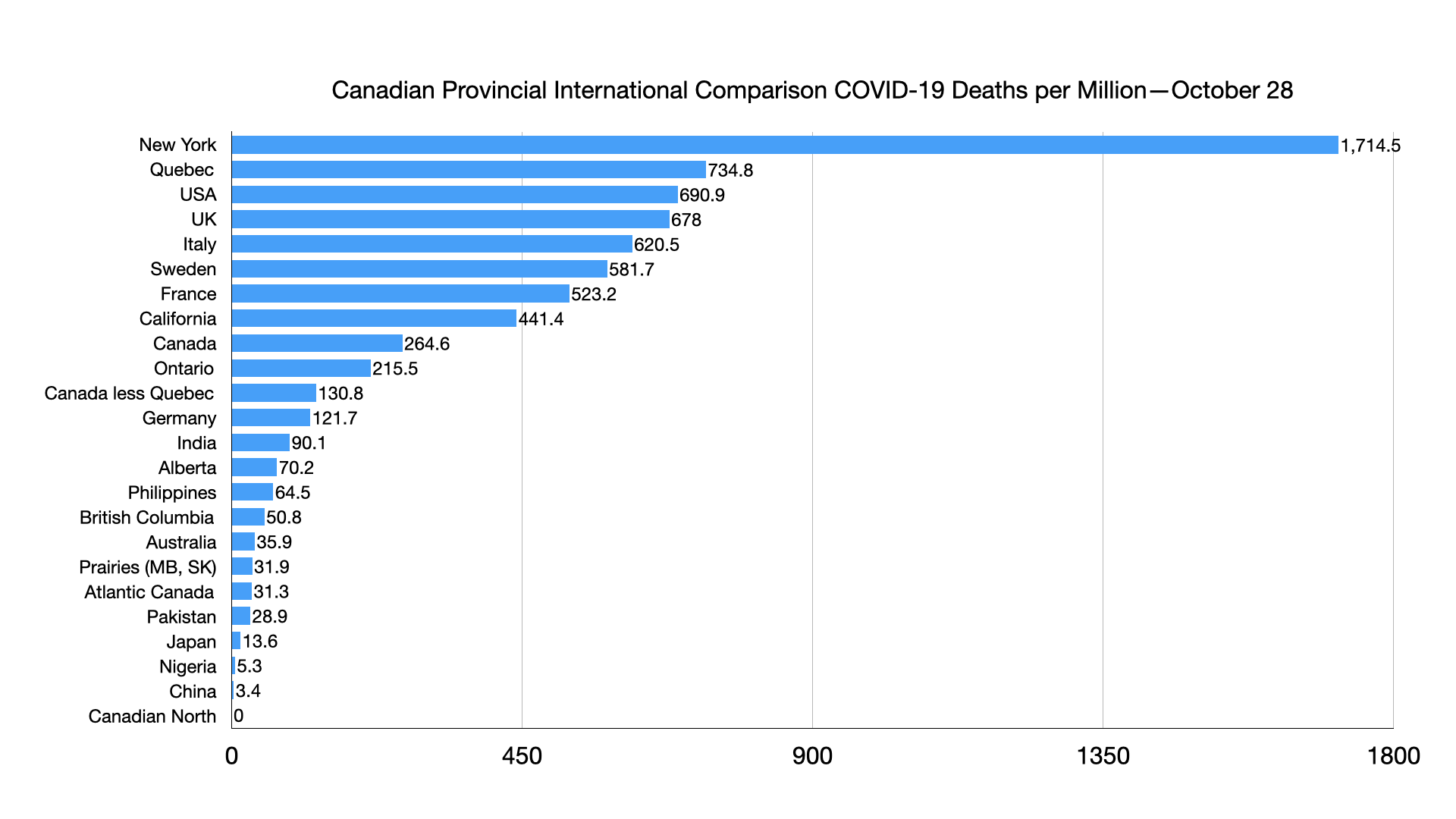
#COVID-19: Comparing provinces with other countries 28 October Update

Main news continues to be with respect to infections:
 
Weekly:
 
Infections per million: UK higher than Quebec, Alberta higher than Canada, Germany higher than Ontario, Prairies higher than British Columbia 
 
Deaths per million: Prairies higher than Atlantic Canada, both higher than Pakistan
 
October 7-28 increase:
 
Infections per million: Prairies (Manitoba, Saskatchewan) join European countries in highest percentage increase
 
Deaths per million: Highest increase in Prairies, particularly Manitoba and Saskatchewan 


John Oliver on Trump immigration policies: ‘Truly disciplined about being truly evil’

One of Oliver’s best:

Over seven seasons, Last Week Tonight has covered numerous aspects of the byzantine US immigration system, from immigration courts, to border patrols, to the Trump administration’s disastrous “zero tolerance” family separation policy. And on Sunday, host John Oliver turned to a narrow slice of America’s legal immigration network: asylum, or the legal process by which people who flee persecution apply to stay in the United States.

Trump has repeatedly denigrated asylum seekers and discredited the process as a scam, although “as you’ve probably guessed”, Oliver said, “the asylum process isn’t a simple recitation of magic words by which all manner of fraudulent claims are let through, nor is it responsible for, as Trump’s official White House website calls it, the ‘biggest loophole to gain entry into our great country’”.

Asylum seekers are like Berta, a woman featured in the Netflix documentary Immigration Nation, who fled Honduras after MS-13 gang members threatened to light her on fire and force her 12-year-old granddaughter into marriage. Berta turned herself into US authorities at the border as she claimed asylum, only to be separated from her granddaughter and held indefinitely in a US detention center.

“That is ridiculous – if you asked the cops for help and responded by throwing you into detention, you’d be absolutely furious,” said Oliver of Berta’s case. “You’d probably also be black, but let’s try to take this one systemic social crisis at a time.”

Berta’s story is not a one-off, Oliver continued, because the Trump administration’s attack on asylum has been “focused, dedicated and deeply resourceful. And I know that those aren’t adjectives you’re used to associating with this administration, but in this one area, they’ve been truly disciplined about being truly evil.”

Typically, Oliver explained, asylum seekers turn themselves into authorities at the border for a “credible fear” screening, and are allowed to stay in the US pending a date in immigration courts. Even before Trump, less than half of those requests were granted; claimants often don’t have a lawyer, and the bar for asylum is high, as you have to prove persecution on the basis of race, religion, nationality, membership in a particular social group or political opinion – criteria the Trump administration has applied narrowly.

Canada should stay the course on immigration

The immigration industry perspective. The overall demographic arguments for staying the course need to take into account that previous recessions and downturns have generally impacted short and longer term economic integration, the expected medium-term impact of COVID-19 on hospitality, travel and retail sectors, along with the longer-term impact of AI and automation on labour force needs.

Will see degree to which it is reflected in the forthcoming immigration plan:

Canada will soon make a major announcement that will shape its economic trajectory for years to come.

By Friday, immigration minister Marco Mendicino will unveil Canada’s new Immigration Levels Plan which will detail the number of newcomers the country seeks to welcome in 2021.

This announcement is usually standard fare.

Since the late-1980s, Liberal and Conservative governments alike have gradually increased Canada’s newcomer intake. The rationale is simple. Newcomers help offset the negative economic and fiscal impacts created by Canada’s aging population and low birth rate.

Nothing about 2020, however, has been standard fare.

The coronavirus pandemic will result in Canada falling well short of the 341,000 newcomer target it had set for 2020.

Intuitively, one may think it no longer makes sense to target a comparable level of immigration next year. Borders have been shut to contain the virus. Canada has a weaker economy and high unemployment.

But reducing the target due to COVID-19 would be a mistake for the following reasons.

The pandemic has not changed the need to welcome newcomers to replenish the over 9 million baby boomers who will be of retirement age by 2030. Our birth rate is too low to replenish the boomers and there is talk that economic uncertainty caused by the pandemic may induce a baby bust.

We will need to rely more on technological advances to meet our future workforce needs but we still need talented Canadians and immigrants to support advances in technology. In addition, Canada’s economy can only grow so much in the absence of the labour force growth that was being fueled by immigration prior to the pandemic.

A case can be made that higher immigration is now even more important.

Economic activity will weaken even further if we have a baby bust.

Government debt is rising to keep the economy afloat during the pandemic, but future generations will eventually need to service the debt.

Hence, welcoming more immigrants will be vital to supporting the growth we will need to turn our post-COVID economic and fiscal fortunes around.

One may legitimately argue that it is unwise to welcome more immigrants during a period of high unemployment.

The rebuttal for this argument is that immigration stimulates job creation in the short run as newcomers spend money to get themselves established in Canada.

Job creation will accelerate once the pandemic is over. We need to begin preparing for the post-COVID economic recovery now. Prior to the pandemic, Canada enjoyed some of its lowest unemployment rates ever in part due to its aging population and low birth rate. We will eventually return to relatively low unemployment and we will need immigrants to fill vacancies.

A new study by Mendicino’s immigration department shows that immigrants who have recently arrived to Canada as skilled workers are performing superbly in the labour market. Given we are attracting the best of the best, we should not be too concerned about the ability of these immigrants to eventually land on their feet in Canada.

Finally, protecting the health and safety of Canadians remains the top priority. We should rest assured this will remain so irrespective of the target that Mendicino announces by Friday. The target does not necessarily mean Canada will welcome this number of newcomers next year if the pandemic lingers. Rather, Canada can enumerate its immigration target but only enable the Canadians of tomorrow to physically enter the country when public health experts deem that this can be achieved safely.

Immigration was important to Canada’s economic prosperity prior to COVID-19 and is set to play an even larger role in our economic and fiscal health after the pandemic. The Canadian government would be wise to stay the course on immigration. The best decision would be to announce immigration targets for 2021 and beyond that are in line with the level of newcomer admissions Canada targeted before the pandemic.

Source: Canada should stay the course on immigration

More agricultural workers should become permanent residents

Naomi Alboim and Karen Cohl make the case. It would have been helpful to have the breakdown between those who are seasonal (growing and harvesting season) and those who are not (e.g., meat packing plants).

Will see if any moves in this direction in the forthcoming immigration plan:

The COVID-19 pandemic has underscored the essential nature of agricultural work in Canada and our reliance on migrant workers to get the job done. Despite restrictions on travel to Canada, work permits continue to be issued for agricultural workers because of the indispensable role they play in ensuring Canadian food security.

The pandemic has also highlighted the vulnerabilities and insecure status of these temporary workers. Inspections of their housing and working conditions have been inadequate in the face of COVID-19, exposing workers to the tragic spread of this deadly virus.

In 2019, temporary foreign workers accounted for 20 percent of employment in the agricultural sector. This amounts to approximately 55,000 jobs in farming, food and fish processing. The majority come to Canada from Mexico and Caribbean countries for up to eight months under the Seasonal Agricultural Workers Program, a longstanding program created in 1966. Others come for up to two years under the Temporary Foreign Worker Agricultural Stream. People with other types of work permits may also choose to work in the agricultural sector, as do undocumented workers, who are the most vulnerable of all.

Shifting to more permanent residency

We propose a major policy shift in which more agricultural workers will be selected as permanent residents. This removes much of the vulnerability associated with temporary status. Workers would have full rights in Canada, with the exception of voting, and would not feel compelled to tolerate unsafe conditions in order to avoid deportation.

An agricultural workforce comprised mostly of permanent residents also makes sense because much of the work – such as animal production, food product processing and manufacturing, greenhouse, nursery, floriculture and mushroom production – takes place on a year-round basis. And it would help employers to maintain a stable workforce without the need for annual expenditures on recruitment, Labour Market Impact Assessments, transportation and training.

An important additional benefit is that families would come to Canada together, aiding integration into their new communities. This would avoid the social isolation and outsider status experienced by many temporary agricultural workers, mostly men, who have to leave their families behind. By selecting experienced and committed agricultural workers to work in welcoming, supportive, rural communities, immigrant families would be motivated to build their futures there, strengthening the vibrancy and viability of communities facing population decline.

Canada’s current economic immigration programs primarily allow only highly skilled people and their spouses and dependants to arrive as permanent residents, which has not included agricultural workers. Canada’s new Agri-Food Pilot and some provincial nominee programs offer a pathway to permanent residency for individuals with relevant work experience and a non-seasonal job offer from a Canadian employer, but the language and education standards are too high for many migrant agricultural workers to meet.

One promising option that we recommend is to build an agricultural stream into the Municipal Nominee Program. This is a new program under development by the Government of Canada where communities can sponsor permanent economic immigrants. Temporary agricultural workers already in Canada are a logical place to start for potential nominees because they have demonstrable skills and work experience, and many may welcome the opportunity to become permanent residents.

A wider search could be undertaken in countries with a significant agricultural base to identify clusters of additional nominees abroad. These workers would come as permanent residents from the start.

Refugees with agricultural experience are another potential source of municipal nominees. This has the added benefit of providing durable solutions for refugees identified by the United Nations Refugee Agency, over and above the levels selected through Canada’s humanitarian refugee resettlement stream. And it is consistent with Canada’s commitment as a signatory to the Global Compact on Refugees. In the compact, participating states agree to provide labour mobility opportunities for refugees with skills that they need.

In designing a mechanism to identify refugees under an agricultural stream of the Municipal Nominee Program, Canada can learn from the Economic Mobility Pathways Project. That project selects highly skilled refugees as permanent residents through provincial nominee and other economic immigration programs.

Ideally, clusters of refugee families with agricultural backgrounds will be selected for the new Municipal Nominee Program, preferably from the same world area. This would improve the integration and retention of families in rural areas, along with providing economies of scale for the provision of targeted settlement services. The selection process will need to involve three levels of government, employers, civil society organizations abroad and in Canada and the UN Refugee Agency.

A bottom-up, community-wide approach should be employed. Employers and the rural municipality identify needs for agricultural workers and population growth. Stakeholders develop and implement plans to welcome and support clusters of nominees and their families. Additional support will likely be necessary for people who come as refugees.

Fortunately, there is growing experience in offering specialized settlement support, for example through the Atlantic Immigration Pilot and the new Rural and Northern Immigration Pilot. Ideally, supports should also be available for temporary foreign agricultural workers who need to know their rights, including how to apply for permanent residency.

An agricultural stream under the municipal program would be meaningful, but it should not be viewed as the sole pathway to permanent residency. We recommend that other ways be explored by reviewing and modifying the criteria of existing programs and pilot projects under the economic and other immigration classes.

Protecting temporary workers

Even if permanent residency becomes more accessible, Canada will need some temporary foreign workers, especially for truly seasonal work and some may prefer a more temporary situation. Changes are urgently needed to better protect these workers as well.

As an example, the employer-specific permits received under the Seasonal Agricultural Workers Program and the Temporary Foreign Worker Agricultural Stream make workers vulnerable. Their status in Canada is dependent on working for the employer who brought them here, leaving them open to potential exploitation, abuse and dangerous work environments with no real recourse. Complaints are rare because of their fear of being fired and deported. We recommend a move to sector-specific permits that allow people to work for any employer within the agricultural sector.

Additional problems arise due to the lack of sufficient accountability and coordination. Multiple federal, provincial and municipal government departments and agencies are involved in different aspects of these programs. And each jurisdiction establishes its own standards and enforcement policies, with little in the way of national standards, coordination or overall accountability.

We propose that the federal government lead a consultative process with provinces, municipal bodies, employers and workers. The purpose would be to develop national standards for health and safety, housing and employment, to establish clear roles and responsibilities and to improve coordination among government bodies for temporary agricultural workers.

Another issue relates to the Labour Market Impact Assessments employers must obtain from the federal government before being allowed to hire a temporary worker from abroad. These assessments include assurances by employers that there are no local residents available to do the job but include little to demonstrate safe conditions and fair compensation for foreign workers. We recommend that national standards be incorporated into these assessments.

Finally, as the recent pandemic has dramatically reminded us, rigorous inspections of worker conditions are essential to ensure safety and fair treatment. Unfortunately, inspections are rarely done proactively without advance notice to the employer. They are often conducted by telephone and may not occur at all in the absence of a formal complaint. Gaps can occur due to different parts and levels of government being responsible for different issues. We recommend the creation of a strategic, coordinated inspection process that would involve collaboration among all relevant departments. The focus would be on proactive monitoring and ensuring compliance with national standards and related requirements of all levels of government.

An opportune time for action

The federal speech from the throne of September 2020 recognizes the value of both migrant and Canadian workers’ contribution to Canada’s food security: “The Canadian and migrant workers who produce, harvest, and process our food – from people picking fruit to packing seafood – have done an outstanding job getting good food on people’s plates. They deserve the government’s full support and protection.”

This level of commitment, along with the government’s objectives for immigration, the economy and rural communities, sets the stage for moving to better protect temporary foreign agricultural workers and to offer more permanent residency options for the people who do this fundamentally important work.

Source: More agricultural workers should become permanent residents

Big gender gap in students attitudes and engagement in global and multicultural issues

New interesting element to the OECD’s PISA assessment. Detailed review on my to do list to see if interesting immigrant/non-immigrant comparisons:

Schools and education systems are failing to give boys and girls across the world the same opportunities to learn and apply their knowledge of global and multicultural issues, according to a new report on the first OECD PISA assessment of the knowledge, skills and attitudes of students to engage with other people and cultures.

Are Students Ready to Thrive in an Interconnected World? focused on students’ knowledge of issues of local and global significance, including public health, economic and environmental issues, as well as their intercultural knowledge, skills and attitudes. Students from 27 countries and economies took the test. Students, teachers, parents and school principals from around 66 countries and economies completed a questionnaire*.

The results reveal a gender gap in access to opportunities to learn global competence as well as in students’ global and intercultural skills and attitudes. On average across OECD countries, boys were more likely than girls to report taking part in activities where they are expected to express and discuss their views, while girls were more likely than boys to report taking part in activities related to intercultural understanding and communication.

Boys, for example, were more likely to learn about the interconnectedness of countries’ economies, look for news on the Internet or watch the news together during class. They were also more likely to be asked by teachers to give their opinion about international news, take part in classroom discussions about world events and analyse global issues with their classmates.

In contrast, girls were more likely than boys to report that they learn how to solve conflicts with their peers in the classroom, learn about different cultures and learn how people from different cultures can have different perspectives on some issues. These gender differences could reflect personal interests and self-efficacy but could also reflect how girls and boys are socialised at home and at school, according to the report.

“Education is key to helping young people navigate today’s increasingly complex and interconnected world,” said Andreas Schleicher, OECD Director for Education and Skills. “The schools and education systems that are most successful in fostering global knowledge, skills and attitudes among young people are those that offer a curriculum that values openness to the world, provide a positive and inclusive learning environment and offer opportunities to relate to people from other cultures.”

The findings reveal the key role teachers play in promoting and integrating intercultural understanding into their classroom practices and lessons. Most teachers reported that they are confident in their ability to teach in multicultural settings. But the lack of adequate professional development opportunities in this field is a major challenge. Few teachers reported having received training on teaching in multicultural or multilingual settings.

More than 90% of students attended schools where principals reported positive multicultural beliefs among their teachers. Yet students who perceive discrimination by their teachers towards immigrants and people from other cultural backgrounds, for example, exhibited similar negative attitudes. This highlights the key role of teachers and school principals in countering or perpetuating discrimination by acting as role models.

The report found a strong link between students learning activities at school and having more positive intercultural attitudes. Also, speaking two or more languages was positively associated with awareness of global issues, interest in learning about other cultures, respect for people from other cultures and positive attitudes towards immigrants.

On average across OECD countries, 50% of students reported learning two or more languages at school, 38% reported learning one foreign language and only 12% reported not learning any foreign language at school. The largest share of students (more than 20%) who reported not learning any foreign language at school were observed in Australia, Brunei Darussalam, Malaysia, New Zealand, the Philippines, Saudi Arabia and Scotland. By contrast, in 42 countries, more than 90% of students reported that they learn at least one foreign language at school.

Source: Big gender gap in students attitudes and engagement in global and multicultural issues

Canada urged to offer safe haven to Hongkongers

Needed:

Conservative Party Leader Erin O’Toole is calling on the Canadian government to urgently adopt special measures that provide a safe haven for Hong Kong residents facing persecution under a harsh national security law imposed by China on the former British colony.

Mr. O’Toole said Canada must also be prepared to support the 300,000 Canadians living in Hong Kong. This would include evacuation assistance if it becomes necessary for Canadian citizens to flee the Asian financial hub as Chinese security forces continue their crackdown on civil rights.

Special immigration and refugee measures are also needed to provide a “lifeboat” for non-Canadian Hongkongers who are being harassed by Chinese security forces and Hong Kong police, he said in an interview with The Globe and Mail.

“We have to have special provisions,” Mr. O’Toole said. “There is a need for us to provide a refugee route for pro-democracy activists who are now living in a police state and cannot access the process of satisfying the requirements, when dealing with Canadian consular services, to use Express Entry or any other way they can visit Canada.”

It’s been more than three months since Beijing enacted the Law of the People’s Republic of China on Safeguarding National Security, which criminalizes opposition and dissent in Hong Kong. Western countries including Canada have accused the Chinese government of breaking a treaty with Britain that pledged to leave human and civil rights in Hong Kong untouched for 50 years after the former British colony was handed over to China in 1997.

This new law spells trouble for the multitude of Hongkongers who have opposed Beijing’s efforts to erode rights in the Asian city, including the more than 7,000 charged in connection with past protests or those under surveillance by Hong Kong police.

Canada’s arm’s-length Immigration and Refugee Board recently granted asylum to two Hong Kong activists, as The Globe first reported, but their case was unusual in that they came to Canada in late 2019, and neither face charges back home for taking part in pro-democracy protests. More than 45 other activists who arrived before the coronavirus pandemic have also applied to be accepted as refugees.

Mr. O’Toole’s call for immediate action to help Hongkongers comes days after the House of Commons committee on citizenship and immigration voted unanimously to investigate measures to provide a haven for them.

NDP immigration critic Jenny Kwan, who put forward the motion, said the Trudeau government is doing nothing, and Hongkongers are growing desperate.

“It’s been all talk and no action,” she said. “The Liberals always find the right words to say but they never follow up with action.”

There are several hundred thousand Canadians of Hong Kong origin living in Canada and 300,000 Canadian citizens living there now.

Mr. O’Toole said action is needed especially after China’s ambassador to Canada, Cong Peiwu, recently warned Ottawa against granting asylum to pro-democracy dissidents from Hong Kong. Mr. Cong said last week that such action could jeopardize the “health and safety” of 300,000 Canadians living there.

“I have actually met a few people in Canada who cannot return to Hong Kong because they fear for their lives, and knowing what we know about the situation there, I think we have to offer them safe haven,” Mr. O’Toole said.

One problem facing Hongkongers trying to flee now is pandemic travel restrictions that prevent them from boarding an aircraft bound for Canada. Before COVID-19, they could travel to Canada as a tourist and ask for asylum upon arrival – but not any more. They are fearful of declaring their intention to seek asylum while in Hong Kong, where they could be monitored, or are being watched by police, or already face charges for pro-democracy demonstrations.

Another option is for them to apply as economic immigrants through Ottawa’s Express Entry program, but that is a difficult route. Express Entry is for high-talent immigrants and it also requires a certificate from Hong Kong’s police, who are under the thumb of Beijing’s Ministry of Security.

The NDP’s Ms. Kwan hopes Ottawa could set up a system similar to that established by successive governments to help persecuted gay Iranians and Chechens reach Canada. Such a process would allow designate non-governmental organizations to play a role in helping arrange documents for Hongkongers’ passage out of the Asian city, perhaps via a third country.

She also recommends that Ottawa loosen family reunification rules so that a greater number of family relations in Canada could easily sponsor arrivals from Hong Kong. It’s harder for Canadians to sponsor relatives to immigrate to Canada if they are not a spouse, partner or children.

Canadian supporters of Hong Kong dissidents say the problem with using programs such as Express Entry is that applicants from Hong Kong do not generate sufficient points to merit acceptance.

Robert Falconer, a research associate at the University of Calgary School of Public Policy and an external adviser to Alliance Canada Hong Kong, said there could be a solution. If Canada is concerned about China seeing it grant asylum to many dissidents from Hong Kong, and would prefer to bring them in as economic migrants, he said, perhaps there could be a special code that applicants can add to their Express Entry applications. The code would artificially raise the point total so they can be accepted.

Mr. Falconer said groups such as Alliance Canada Hong Kong could be empowered to distribute these codes to dissidents in Hong Kong.

“For all appearance, they would come in as economic-stream immigrants,” he said.

Source: https://www.theglobeandmail.com/politics/article-canada-urged-to-offer-safe-haven-to-hongkongers/