ICYMI: Professor Criticizes Book, ‘White Fragility,’ As Dehumanizing To Black People

Valid criticism regarding over simplification and categorization:

Robin DiAngelo’s book White Fragility, published in 2018, has shot up bestseller lists after protests over the death of George Floyd reignited discussions about racism in America.

DiAngelo is white and regards racism as “the foundation of the society we are in.” She says white people become defensive and exhibit “fragility” when challenged on their underlying and, often unconscious, racism.

White people will never be rid of their biases, DiAngelo has told NPR, saying their necessary work “will be lifelong: really thinking deeply about what it means to be white, how your race shapes your life.”

But as DiAngelo’s corporate lecture requests and book sales have grown, so too has criticism of her work.

The Washington Post‘s Carlos Lozada said the book employs “circular logic.” Lozada writes that White Fragility views people of color as “almost entirely powerless, and the few with influence do not wield it in the service of racial justice.”

Columbia University professor and linguist John McWhorter, who is Black, echoes that criticism, writing in The Atlantic that the book “openly infantilized Black people” and “simply dehumanized us.”

He argues that for “DiAngelo, the whole point is the suffering” of white people, who are “taught that pretty much anything they say or think is racist and thus antithetical to the good.”

McWhorter spoke with Morning Edition‘s Steve Inskeep about his criticism of the book and what he thinks is needed to change racist institutions.

Here are excerpts of the interview:

What are some examples of the way that she talks in the book and also talks in her seminars that you think miss the mark?

Well, I understand where she’s coming from. I don’t think she’s a hustler. I know that she’s sincere. But my question is, is it necessary for every good white person to walk around feeling uncomfortable about themselves as abstractly complicit in a racist system before we see political change?

And so a white person is supposed to learn that there are all sorts of things that they can’t say. You can’t say, “I marched in the civil rights movement,” because that would make you too comfortable. You can’t say, “I don’t see race,” because you almost certainly do. You can’t say, “it’s about class,” because it’s about race.

And she’s got about 25 proscriptions that make it so that any good white person is essentially muzzled. You just have to be quiet.

If you think about human history, there have been great and wrenching changes not only in this country, but in a great many others, but especially in this one, — say, a few things that happened about 50 years ago — without there needing to be this rather Orwellian indoctrination program. So the question is, why do we need this now?

She’s trying to, you argue, fix white people’s souls when in reality the place that people should look is at institutions. What are the rules for police? What are the rules for fair housing? That sort of thing.

You have said exactly what I believe. I think that what Robin DiAngelo is doing is well-intentioned, but I think ultimately, it’s idle. Ultimately, the result of what she would create is a certain educated class of white person feeling better about themselves. And frankly, that’s antithetical to her goal, because no matter how she wants it to go, people are going to think that they’ve done some kind of work. It’s going to be hard to get people to truly feel as endlessly culpable as she’s seeking.

And in the meantime, what’s the connection between that and forging change? You can say that all of this is a prelude to changing structures. But the question will always be, why don’t you just go out and change the structures? And why do you think that you couldn’t until doing this?

You say this book that is dedicated to eliminating racism in white people is racist. Why do you say it’s racist?

It is racist, and I don’t mean that Robin DiAngelo is a racist. I’m not calling her that. But I’m saying that if you write a book that teaches that Black people’s feelings must be stepped around to an exquisitely sensitive degree that hasn’t been required of any human beings, you’re condescending to Black people. In supposing that Black people have no resilience, you are saying that Black people are unusually weak. You’re saying that we are lesser. You’re saying that we, because of the circumstances of American social history, cannot be treated as adults. And in the technical sense, that’s discriminatory.

I also want people to know that you’re a linguist. And here we are using this word racist. What is a proper definition of racist?

Well, racism is a very confusing word these days. But when I say that White Fragility is a racist book, what I mean is it does not allow Black people to be full human beings, because full human beings deal with the imperfections of life.

This is important: by the imperfections of life, I do not mean somebody stepping on your neck until you’re dead. I’m not talking about actual abuse. I’m talking about the more abstract sorts of things that we’re familiar with, especially over the past several decades as part of our racial landscape, where I think that the solutions are going to be more subtle than the kind of mental and spiritual straitjacketing that DiAngelo seems to think are necessary. It’s an interesting proposal, but it’s by no means as self-evidently wise as she implies, and that many people tragically seem to be agreeing with her about.

Source: Professor Criticizes Book, ‘White Fragility,’ As Dehumanizing To Black People

Pakistan: Ancient statue of Buddha destroyed as un-Islamic

Sigh:

Last Friday, an ancient statue of Buddha was vandalised in Takht Bahi, Mardan district (Khyber Pakhtunkhwa).

The statue was destroyed as “un-Islamic” by the workers who found it (pictured) whilst digging to lay the foundations of a house.

The ancient artefact belongs to the historic Gandhara civilisation which encompassed the region of modern-day north-western Pakistan, more or less Peshawar valley and the lower valleys of the Kabul and Swat rivers.

Gandhara is the old name for the Pakistani province of Khyber Pakhtunkhwa. It is highly revered by Buddhists and is deemed an important regional site of Buddhist civilisation.

On Saturday, videos of the destruction went viral on social media. They show a man breaking the statue with a big hammer, with other men expressing their approval and some taping the whole thing.

Pakistani media have reported that four people involved in the incident were arrested.

In 2017, two rare and ancient Buddha statues were found in Bhamala, an archaeological site in Hariput district. The largest statue ever found on the site depicts Buddha’s death whilst the second statue was a Buddha with a double halo.

According to Abdus Samad Khan, head of the province’s archaeology department, the vandalised Buddha statue was 1,700 years old; the broken pieces were recovered to assess their archaeological value.

Following the incident, various news channels and social media discussed the protection of others’ beliefs in the country.

Whilst the Pakistani constitution respects all religions and all faiths are sacred for their followers, many activists and leaders have come out against the destruction of the statue of Buddha. For Samad Khan, it was a “crime” and showed “disrespect for religion”.

Later, police arrested a local contractor and five other people suspected of breaking antiquity regulations.

Two rare and ancient Buddha statues were unearthed in Hariput district in 2017, noted Mansha Noor, executive secretary of Caritas Pakistan in Karachi,

“Breaking this ancient statue of lord Buddha shows ignorance of history and a lack of education,” Mansha said. “Our country is filled with minerals and hidden history. We need to educate our nation about other owners of this land.”

In ancient times, Gandhara was a trading and cultural crossroads linking India, Central Asia and the Middle East.

Source: PAKISTAN Ancient statue of Buddha destroyed as un-Islamic

Brain Waste among U.S. Immigrants with Health Degrees: A Multi-State Profile

Good in depth study by MPI. Suspect similar patterns in Canada:

The coronavirus pandemic that swept into communities across the United States beginning in Spring 2020 has placed enormous strain on health-care systems and highlighted the work of both U.S.- and foreign-born health professionals. But even as the need for testing, treatment, and care is high, an estimated 263,000 immigrants and refugees with at least a four-year degree in a health field have largely been sidelined, either employed in jobs that require no more than a high school diploma or out of work.

U.S. and State Data

This spreadsheet offers estimates of immigrants and refugees with health-related undergraduate degrees who are underemployed or unemployed, both nationwide and in selected states. It includes details on their race/ethnicity, legal status, degree majors, origin countries, and the languages other than English that they speak. Click here.

This fact sheet offers the first state-level profile of this untapped pool of immigrant health professionals. Using data from the U.S. Census Bureau and U.S. Department of Labor, it provides estimates of the number and key characteristics of underutilized immigrants with health degrees, including their English proficiency, the other languages they speak, their top fields of study, and the legal statuses they hold.

Among the key findings of this analysis are that these immigrants are widely distributed across the United States, not concentrated in traditional immigrant-gateway states. There is also considerable overlap between the languages other than English that they speak and those spoken by Limited English Proficient populations in the states where they live, making them a potentially valuable resource in providing linguistically and culturally competent care.

Source: https://www.migrationpolicy.org/research/brain-waste-immigrants-health-degrees-multi-state-profile

‘Canada cannot turn a blind eye’: Federal court says Safe Third Country Agreement with U.S. violates charter

The big news this week, with the question will the government accept or appeal this decision given that defending the STCA with the Trump administration would be different under a possible Biden administration:

In a ruling that lambastes the American government’s detention of asylum-seekers and chastises Canadian officials as complicit, this country’s Federal Court has ruled the so-called Safe Third Country Agreement is unconstitutional.

The ruling is being hailed as a major victory for refugee rights — and drawing calls from advocates for Ottawa to immediately and unilaterally suspend the agreement with the United States.

“Security of the person encompasses freedom from the threat of physical punishment or suffering,” Justice Ann Marie McDonald wrote in her 62-page decision, which was released Wednesday.

“The accounts of the detainees (in the U.S.) demonstrate both physical and psychological suffering because of detention, and a real risk that they will not be able to assert asylum claims.”

Under the bilateral pact, Canada and the U.S. each recognize the other country as a safe place to seek protection.

That means Canada can turn back potential refugees who arrive at land ports of entry along the Canada-U.S. border on the basis they should pursue their claims in the States, the country where they first arrived.

The agreement, which took effect in 2004, was originally touted by officials in both countries as a way to curb “asylum shopping.” However, critics have long argued that the U.S. asylum system is cruel and inhumane — critiques that have grown louder and more pronounced during the Trump administration.

In its judgment, the court found it unconstitutional to ban would-be claimants from attempting to enter either country at official border crossings. The court gave Ottawa six months to respond and fix the policy to make sure it complies with the Canadian charter before declaring the accord invalid.

“The evidence demonstrates that the immediate consequence to ineligible STCA claimants is that they will be imprisoned solely for having attempted to make a refugee claim in Canada,” McDonald said. “The ‘sharing of responsibility’ objective of the STCA should entail some guarantee of access to a fair refugee process.”

Refugee advocates urged the Liberal government to move quickly to suspend the agreement, which the terms allow.

“Refugee claimants turned away at the Canada-U.S. border face grave human rights violations in the United States, notably atrocious conditions in immigration detention,” said Alex Neve, Secretary General of Amnesty International Canada, one of the parties.

“Under no circumstances should the government consider appealing this ruling. It is time to stop pretending that all is right when it comes to protecting the rights of refugees in the U.S. Not one more refugee claimant should be turned away at the Canada-U.S. border.”

Mary-Liz Power, spokesperson for Public Safety Minister Bill Blair, would not say whether the government planned to appeal the court decision.

“We are aware of the Federal Court’s decision and are currently reviewing it. Although the Federal Court has made its ruling, that decision does not come in effect until January 22, 2021. The Safe Third Country Agreement remains in effect,” Power said in an email.

U.S. President Donald Trump’s anti-migrant policies have spurred an influx of so-called irregular migrants skirting asylum restrictions by crossing outside of Canada’s official ports of entry, where restrictions have applied.

More than 50,000 asylum seekers have come here that way via the U.S. over the past two years. Once here, after passing initial medical and security screenings, refugees can work and access health-care pending a decision on their asylum claims.

“When the Trump administration attempted to impose their travel ban in January 2017, it was obvious that the Liberal government could no longer count on the United States to live up to its international and humanitarian obligations,” said NDP immigration critic Jenny Kwan.

“Contrary to what Minister Blair has said in the past, this (ruling) proves that refugees are not simply ‘asylum shopping.’”

After Trump’s election in November 2016 with an anti-immigration agenda, Canadian and U.S. non-governmental organizations and refugee lawyers started their effort to challenge the legality of the asylum restrictions.

In 2017, they connected with a Salvadoran woman in the U.S. who sought asylum after she was raped and threatened by the notorious Mara Salvatrucha gang in El Salvador, and agreed to be the lead litigant. The other litigants included a Syrian family of four and a young Ethiopian woman, all of whom were denied access to asylum in Canada. The three Canadian rights groups, including the Canadian Council for Refugees and the Canadian Council of Churches, also enlisted nine other witnesses

During the hearing in November, the court reviewed evidence that showed detainees in the U.S. had no access to phone calls and legal counsel or translators; have been lost due to transfers between detention centres; and sometimes were held in solitary confinement.

“The court could hardly fail to be moved by the testimonies of the appalling experiences of people in the U.S. immigration detention system, after Canada closed the doors on them,” said Dorota Blumczynska, president of the Canadian Council for Refugees.

“Their experiences show us and convinced the court that the U.S. cannot be considered a safe country for refugees.”

The court decision also called out Canadian officials’ responsibility.

“Canada cannot turn a blind eye to the consequences … in its efforts to adhere to the STCA. The evidence clearly demonstrates that those returned to the U.S. by Canadian officials are detained as a penalty,” Justice McDonald wrote.

Queen’s University immigration law professor Sharry Aiken said it’s “reasonable” to expect an influx of refugee claimants at official ports of entry from south of border in light of the ruling, though it may not happen immediately due to the COVID-19 border restrictions.

“The court ruling itself does not address the current (pandemic) context but the implications of the ruling signal that Canada should step up immediately to protect the rights of claimants approaching Canada for asylum,” Aiken said.

“Canada has proven itself more than capable of adequately addressing spikes in the numbers of asylum seekers. Constitutional rights are not about the numbers, in any event.”

Source: https://www.thestar.com/news/canada/2020/07/22/canadian-court-says-safe-third-country-agreement-with-us-violates-charter.html

Canada tells most international students not to come until travel ban is lifted

Effect on economy will be significant:

International students have been told not to make travel plans to Canada until after Ottawa’s border restrictions are lifted.

In the latest update of its program guidelines, the federal immigration department said Tuesday that international students will not be allowed to enter Canada if they have received a student visa after the country’s border lockdown on March 18.

Even those who have a valid study permit from that date or earlier will be denied entry unless they can prove their travel is “non-discretionary or non-optional.”

“While many Canadian college and university campus locations are closed, classes are generally continuing online. Travel will be deemed discretionary or non-discretionary depending on individual circumstances,” said the advisory.

In 2019, more than 650,000 international students studied in Canada at the post-secondary level. The sector contributed more than $21 billion to the Canadian economy through students’ spending and tuition fees, which are two to three times higher than their domestic peers. The largest cohort of the students usually arrives in the fall.

To ensure Canada remains a competitive destination of choice for international education during the pandemic, the federal government is allowing students to count the time spent pursuing their studies online abroad toward their eligibility for a post-graduation work permit.

If they have submitted a study permit application and if at least half of their program is completed in Canada when the border reopens, they will be eligible for the work permit, which many international students count on as an ultimate pathway for permanent residence.

“The pandemic has had a significant impact on international students and the Canadian institutions and communities that host them. This is why we have implemented a series of measures to support them,” Immigration Minister Marco Mendicino said earlier.

“We value the contribution of young people seeking a high-quality education in Canada, and we’re making every effort to minimize how current challenges affect their plans and dreams for the future.”

Despite the special COVID-19 measures, international students have complained that schools still require the same hefty tuition fees for online programs, which present other challenges regarding time-zone differences. Some students may have to stay up for their class in the wee hours from their home countries.

Sarom Rho, a migrant student worker organizer, said Ottawa has been tone-deaf to the needs of international students, who have been asking for a tuition freeze and work permit extension, among other things that could help them through the pandemic.

“International students are disappointed with these announcements,” said Rho of Migrant Students United. “The government’s response is geared towards maintaining international enrolment and fees as a source of revenue to keep schools operating. It’s disavowing its responsibility to the quality of education for these students.”

According to the immigration department’s updated guidelines, border agents have the final say in admitting arriving students.

Students must prove their presence in Canada is necessary for their continued participation in their program, such as in labs and workshops, or prove that pursuing online studies is not an option for their school or program or not possible from their home country, for example, due to internet restrictions or bandwidth limitation.

Like all travellers, international students who enter Canada must undergo the necessary health checks and self-quarantine for 14 days upon arrival.

Some universities and colleges have issued support letters to incoming international students advising them to take extra precautions before travelling to Canada because students are responsible for the costs of returning to their home countries.

At the University of Saskatchewan, for example, students are recommended to provide border agents support letters from the administration saying that “your studies cannot be completed online and you are expected to to start on-site.”

Home Office urged to correct false slavery information in citizenship test

Citizenship guides are tricky matters to navigate.

Despite promising a revised guide in 2016, the Canadian government has yet to release what I understand to be a largely complete revision to Discover Canada (which despite some flaws, is a vast improvement of the fluffy A Look at Canada):

More than 175 historians have called on the Home Office to remove the history element of the UK citizenship test because of its “misleading and false” representation of slavery and empire.

The signatories say the official handbook, which the Life in the UK test is based on, creates a distorted version of history, which directly counters the values of tolerance and fairness it purports to promote.

In an open letter, the signatories, including 13 fellows of the British Academy, two past presidents of the Royal Historical Society and the director of the Stephen Lawrence Research Centre, write: “The official handbook published by the Home Office is fundamentally misleading and in places demonstrably false … People in the colonies and people of colour in the UK are nowhere actors in this official history. The handbook promotes the misleading view that the empire came to an end simply because the British decided it was the right thing to do. Similarly, the abolition of slavery is treated as a British achievement, in which enslaved people themselves played no part. The book is equally silent about colonial protests, uprisings and independence movements.”

Source: Home Office urged to correct false slavery information in citizenship test

Trump gives away the game on his census citizenship gambit

Indeed:

The Supreme Court was confronted with a difficult question in the past year. The Trump administration wanted to put a citizenship question on the 2020 Census, and its stated reason was to enforce the Voting Rights Act. But opponents argued this was, in fact, a thinly veiled partisan gambit to draw more GOP-friendly districts.

The court issued a remarkable rebuke of the Trump administration’s stated reason. And now, the Trump administration is pretty much acknowledging its motivation was precisely what its critics claimed.

President Trump on Tuesday signed a memorandum stating that undocumented immigrants should not be included as part of the next process of apportionment — i.e., the doling out of congressional districts that follows every census. Such a move would reduce the representation of states (many of them blue) with higher undocumented populations.

Apportionment has never been handled like this, and there are major questions about both the legality and practicality of the memorandum.

The Constitution states that congressional districts must be drawn according to “the whole number of persons.” And federal courts have long ruled that congressional districts must be drawn according to total population. But there has been some ambiguity in how the Supreme Court has decided this question. And Justice Samuel A. Alito Jr. has indicatedthat perhaps states might be allowed to draw their legislative districts according to citizen voting-age population. At the least, the Trump administration is putting all of that to the test.

Beyond that, it’s not clear how this will be executed. Given that the Supreme Court struck down the citizenship question, how is the federal government to even determine which people are citizens? Even if the idea passes constitutional and legal muster, actually doing what the memorandum says is another matter entirely.

But those two very important questions aside, there’s the matter of what this says about the Trump administration’s true intent. The Supreme Court ruled in the past year that the Trump administration’s stated reason — the Voting Rights Act — “seems to have been contrived” and that officials such as Commerce Secretary Wilbur Ross seemed to invent a justification for something they planned to do very early in the Trump presidency.

Chief Justice John G. Roberts Jr. strongly rebuked Ross and the administration, saying, “What was provided here [as a justification] was more of a distraction.”

Absent from the Trump administration’s legal defense was any indication that this was part of an effort geared toward apportionment or redistricting — the latter being the decennial drawing of new districts to reflect population shifts.

But it was part of the opposition’s case. Critics in the past year pointed to a previously unpublished 2015 presentation from the late GOP redistricting expert Tom Hofeller, which stated that using citizenship data in a state such as Texas “would be advantageous to Republicans and non-Hispanic whites” by diluting the influence of Democratic-leaning Hispanics. The critics argued that the Justice Department’s case for a census citizenship question closely mirrored Hofeller’s 2015 study, reinforcing the political motivations of the move.

And Trump himself seemed to affirm that aim. As the case was progressing, the president blurted out that, “Number one, you need it for Congress — you need it for Congress for districting.”

This ran afoul of the Supreme Court defense offered by the Trump administration, led by then-Solicitor General Noel Francisco. Francisco said at the time that Ross “did not rely on that rationale in his decisional memorandum.” Francisco added: “Instead, he relied on DOJ’s explanation … that citizenship data from the [American Community Survey] has substantial limitations.”

In other words, the defense was that we needed the citizenship question because the more-frequent but less-robust American Community Survey couldn’t provide totally accurate citizenship data — not because of a need for apportionment or redistricting data.

Both before and since then, the administration hasn’t done much of anything to reinforce its claimed desire to enforce or bolster the Voting Rights Act. But it has now confirmed that it would very much like to use citizenship data to award congressional districts — just as its critics claimed (and it denied) was its true aim.

Trump’s move Tuesday suggests his comments were more than just a coincidence — and that his administration’s disavowals of this alleged goal were dishonest, at best.

Source: Trump gives away the game on his census citizenship gambit

Hongkongers lose taste for overseas property elsewhere amid BN(O) offer

Interesting given possible impact on Canada for those with BNO passports (those without will, of course, continue to have interest in Canada as the implementation of the law continues):
Interest in overseas property in other countries has plunged among Hongkongers looking to emigrate, after the United Kingdom unveiled its path to citizenship for residents eligible for British National (Overseas) passports, immigration consultants said.

Applications for emigration to Canada and Taiwan, which had recorded the most interest following the introduction of the national security law, were the most affected by the UK’s announcement, said Raymond Chong, managing director at StarPro Immigration Consultancy. The company had received “several hundred enquiries per month” following the passage of the law by Beijing, but “some had withheld” their applications to other countries once the BN(O) option was revealed, Chong said.

“After the BN(O) [policy] was revealed, enquiries for properties outside the UK plummeted by more than half. Enquiries about BN(O) passports and the UK have skyrocketed, rising by four to five times,” he said.

British Prime Minister Boris Johnson announced the plan on July 1, paving the way for three million Hong Kong residents who are eligible for BN(O) passports to live and eventually settle in the UK. The BN(O) path is a much cheaper and faster way to emigrate and involves fewer procedures than other immigration programmes, StarPro’s Chong added.

An online survey of 300 Hong Kong residents conducted this month by Midland Immigration Consultancy found that about three in five BN(O) passport holders now had a greater desire to emigrate.

An increase in emigration from Hong Kong is also likely to drive up home prices in the UK, said Jan Hong, senior principal director at Centaline Immigration Consultants. He added that a recent stamp duty relaxation in the UK until the end of March 2021 would also boost the market.

The increase in transactions involving UK property would come at the expense of property deals elsewhere, where prices would see less upwards pressure, said StarPro’s Chong. “Hong Kong funds will shift to the UK,” he said. “But foreign property purchases [by Hongkongers] do not usually account for a large portion of housing transactions in these countries, so the impact will be limited.”

Portugal, a favourite destination among Hong Kong residents looking to invest in property abroad because of its golden visa scheme, has seen fewer enquiries of late. Overseas buyers are believed to have contributed to a surge in housing prices, which, however, fell by about 14 per cent in March because of the coronavirus outbreak, according to the country’s National Statistics Institute. Its property market has recovered gradually over the past three months, according to property data company Confidencial Imobiliario.

And a minority of Hong Kong residents – especially those without BN(O) passports – is still expected to choose Portugal, because they are not required to live there and can get passports through the country’s golden visa scheme. These passports will allow them to remain in Hong Kong, while their children can study in primary and secondary schools in the UK for free after getting Irish residency, thanks to a European Union and UK policy.

Elsewhere, interest in property in Cyprus and Greece has sustained despite the UK’s BN(O) policy. The absence of a requirement to live in Cyprus, another former British colony, and the promise of good weather add to its appeal, said Pantelis Leptos, director of The Leptos Group.

Investors qualify for Cypriot citizenship through the Cyprus Investment Programme, on purchase of property worth €2 million. They can sell the property after five years.

Another option is permanent residency, which is available to investors who purchase property worth 300,000 in Cyprus, and 250,000 in Greece. But owners need to keep the property as long as they want to keep their residency.

Source: Hongkongers lose taste for overseas property elsewhere amid BN(O) offer

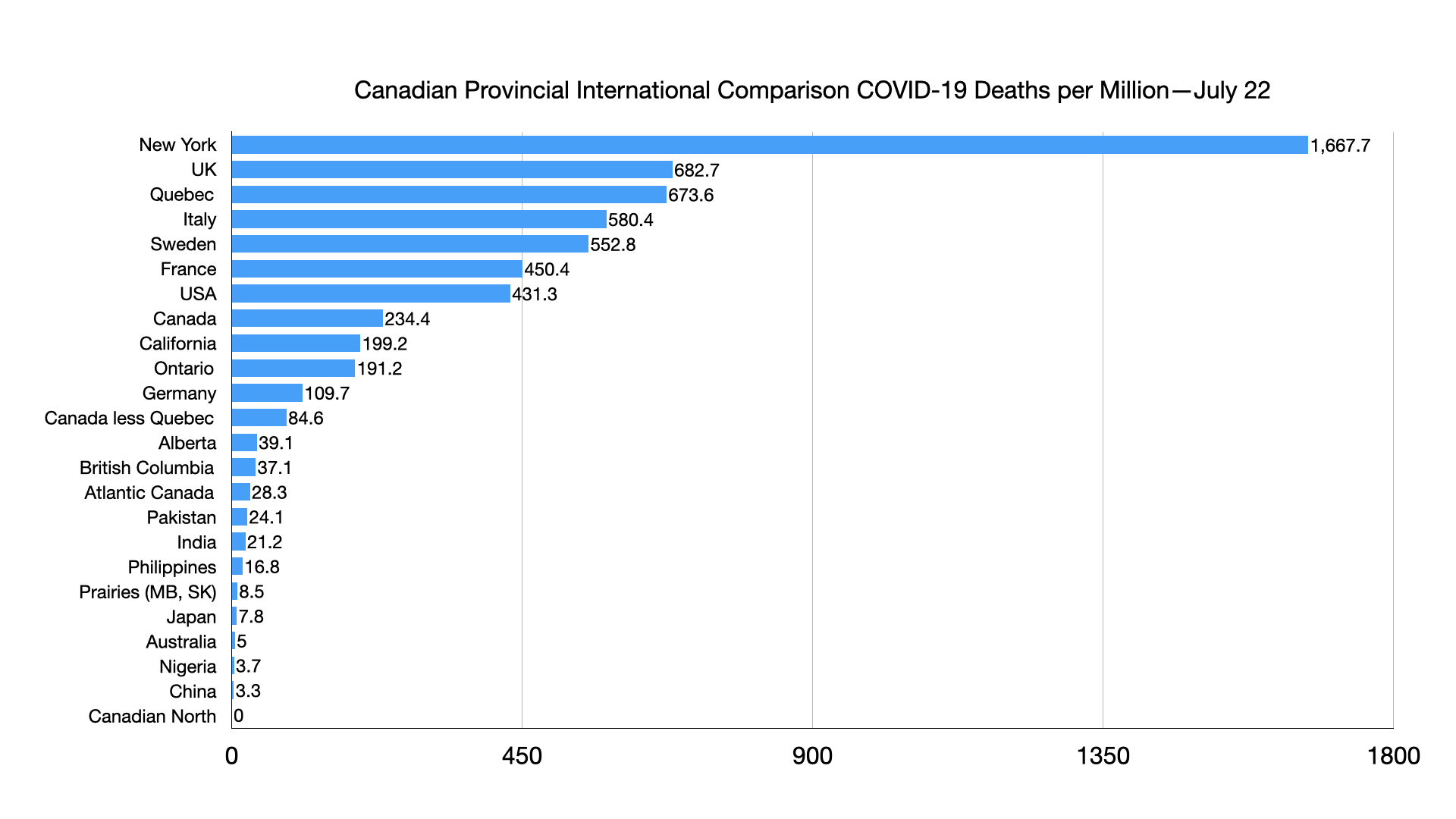
#COVID-19: Comparing provinces with other countries 22 July Update

The latest weekly stats showing no major changes from last week in terms of relative ranking, although the USA can be expected to surpass the harder hit European countries in deaths per million over the next few weeks given current trends. The recent spike in infections in British Columbia, Alberta and Quebec continues to become more apparent (but not, fortunately to date, in the death statistics).California edged over Ontario this week:

Immigration Policy and the Global Competition for AI Talent

Some really interesting cross-country comparisons, highlighting the gap between the current US approach and other countries:

This paper analyzes policies relevant to four categories of immigrants: students in AI-related fields of study, workers in AI-related industries, distinguished AI workers (that is, individuals internationally renowned for their achievements in AI), and AI entrepreneurs. These groups represent the range of backgrounds and experience levels that nations need to compete in AI. We explore trends that, taken together, may be making the U.S. immigration system less attractive to these groups relative to other countries’ systems:

  • Within the last five years, the UK, Canada, France, and Australia have adopted major immigration reforms to attract talent in AI and other technical fields. The United States has not.
  • Despite growing job opportunities, recent graduates and others may be restrained from contributing to the U.S. AI workforce to their full potential—partly due to current caps, backlogs, and sponsorship processes at the expense of the employer for temporary work visas and permanent residency. In contrast, Canada’s new immigration policies quickly bring in skilled migrants and integrate graduates into the workforce. The UK is proposing similar changes to ease and expedite the immigration process for technically skilled migrants.
  • The United States’ per-country quotas on permanent residency—which remain unchanged for decades—have created a significant bottleneck, especially for Indian nationals who make up the 25 percent of Silicon Valley’s technical workforce. The other countries in this analysis forego quotas on permanent residency status and allow immigrants who meet permanent residency requirements to apply.
  • Although data is scarce and important trends are in nascent stages, empirical indicators suggest that some new AI-focused immigration policies in other countries are successful.
  • The United States has long attracted immigrant entrepreneurs with its innovative culture, but does not offer an entrepreneur visa. Entrepreneur visas offered by other countries in this analysis have largely failed due to unrealistic and vague metrics for business success or long processing times. The United States could learn from the mistakes of competitor countries and design its own visa to increase its immigrant entrepreneur population and create jobs for Americans.

The United States historically and presently benefits from a strong baseline of technological innovation through existing institutions. Immigration trends alone are unlikely to eliminate the U.S. advantage in the near term. However, the global landscape is shifting, and restrictive immigration policies threaten to undermine U.S. AI progress in the long term. To ensure America remains competitive for AI talent in the coming years, U.S. policymakers should consider reforms to current immigration statutes, regulations, and agency guidance. Other countries’ immigration reforms suggest three main lessons:

  • Improve temporary visa options for skilled workers. The structure of the H-1B temporary work visa prevents AI talent from contributing to the United States to their full potential. In particular, workers seeking permanent residency while on H-1B status—a process that could take years or decades—would need another sponsorship if they wished to switch positions or employers. Further, the H-1B lottery occurs only once a year, forcing employers to wait until the annual draw on April 1 to learn whether critical employees have been selected. In contrast, Canada has no cap on the number of work permits that can be provided year-round and issues these permits in as little as two weeks.

  • Expand opportunities for permanent residency. Allocating permanent residency status based on decades-old caps and immigrants’ countries of origin, rather than the skills they bring to the United States, has created a bottleneck for highly skilled AI workers who wish to contribute to the U.S. AI workforce in the long term. Specifically, the employment-based green card wait time for Indian nationals, who make up 25 percent of Silicon Valley’s technical work force, is 89 years. There are no formal caps or quotas on permanent residency in the UK, France, Australia, and Canada. Instead, immigrants are eligible to apply once they have lived or worked in the country for a set number of years.

  • Expand opportunities for entrepreneurs. While each of the other four countries in this analysis offers some form of an entrepreneur visa, initial results suggest they have been relatively unsuccessful. The United States should strengthen AI innovation by adopting an entrepreneur visa informed by the flaws of competitor nations to better attract and retain AI entrepreneurs.