Ontario is starting to collect race-based COVID-19 data. Some worry it could do more harm than good

Sigh. Yes, groups should be consulted, yes, the data should be made public, but hard to see that minorities will be worse off with data than without.

Having better data facilitates discussion of current realities and possible policy options to address disparities:

With Ontario’s race-based COVID-19 data collection beginning “imminently,” health experts say crucial unresolved questions will determine whether those efforts help alleviate the pandemic’s brutal disparities, or cause more harm.

Regulatory changes came into effect last Friday that mandate the collection of information on race for all newly reported COVID-19 cases province-wide, along with data on income, household size and languages spoken. Data collection is beginning once training for public health units and changes to data entry systems are complete, according to a health ministry spokesperson.

Community organizations, researchers, doctors and public health experts have called for the collection of this data, pointing to the disproportionate burden of COVID-19 in areas with more racialized, low-income and newly immigrated residents.

But health researchers said the question of how this data is managed and used is even more important than whether it is collected.

“The collection of race-based data is not the outcome,” said Camille Orridge, a senior fellow at the Wellesley Institute and longtime advocate for health equity data collection. “The outcome is to have the information and use the information to reduce disparities. That’s the goal.

“We need to be clear with people who are collecting the data — government, etc. — that there are a number of things that must be answered before we come to the table to give up the data,” she said.

Orridge cited a list of questions, including whether the data will stay in Canada, whether it will be sold in any form to the private sector, how artificial intelligence will be used with the resulting databases. And most importantly, for her: whether the racialized communities most affected will have oversight and input on whether the data is being used to answer questions and create policies that counter the pandemic’s unequal toll.

She cited a phrase often used in the world of Indigenous policy: “Nothing about us, without us.”

Alexandra Hilkene, the health ministry spokesperson, said “We’re currently in the process of finalizing the terms of reference for the working group that will report to the ministry and help ensure we interpret the data accurately. The group will include policy experts from racialized communities.”

In Toronto, some of the neighbourhoods most affected by COVID-19 have case rates 14 times higher than the least affected neighbourhoods. Those hard-hit neighbourhoods are all clustered in the northwest of the city, an area that has been historically underserviced and has higher rates of poverty, inadequate housing, and other symptoms of systemic disadvantage.

The city’s most affected areas also have significantly higher percentages of Black residents than the least-affected areas, and higher percentages of Southeast Asian and other racialized groups. But health experts say these area-based analyses, which rely on matching the postal codes of known cases to census data, are less revealing than collecting the data directly from individuals.

Toronto, Peel Region and some other health units have already begun collecting this data, but officials argued that it should be mandated province-wide to provide a complete picture. After weeks of urging, the province made regulatory changes to the Health Protection and Promotion Act to mandate the collection of race and sociodemographic information for COVID-19.

But now that the government is about to begin collecting that data, it shouldn’t be exclusively available to them, said Arjumand Siddiqi.

“I would worry that if the data stays in the domain of the government, or if they handpick a small group of people to use it and no one else sees it, we have to rely on what those people tell us,” said Siddiqi, Canada Research Chair in population health equity and a professor at the University of Toronto’s Dalla Lana School of Public Health.

Making the data available more broadly ensures that independent researchers can check the work of others, rebut flawed analyses and conclusions, and ask different kinds of questions.

But Orridge said it’s also important to ensure that the researchers who do get access to race-based COVID-19 data have real relationships in and accountability to the communities that are most affected.

“We have researchers who have no connection to the communities having access to the data, and making their careers on the use of that data,” said Orridge.

“We’ve got to make sure that the data, when it’s being used and published, always has a context, so that we don’t further stigmatize communities.”

LLana James, a doctoral candidate at the University of Toronto Faculty of Medicine who researches race-ethnicity, health data, privacy, AI and the law, noted that Ontario and Canada collect health data in a legal framework that has failed to catch up to the massive technological changes that have occurred, especially in the last decade with the rise of machine learning.

“We have one of the lowest thresholds for legal use of data in the developed world,” said James, noting that technology companies see Ontario as an attractive market for lucrative health-care data, and contrasting Canada’s poor data privacy protections with Europe’s robust framework.

James provided critical comments on the province’s proposed regulatory changes to begin collected race-based COVID-19 data, and believes the current, government-driven data efforts will not help Black, Indigenous and other racialized communities.

Race-based data assumes that “we need to know the race of the person, not how racism is functioning. Those are two completely different scientific questions,” James said.

“We have 400 years of data about what happens to Black people during pandemics,” said James. “We have hundreds of years of race-based data, and it’s changed very little. It’s the will to act (that’s missing), not the will to collect more stuff.”

Like Orridge, however, she believes that any data collection that avoids harm must be centred in and directed by communities. James is the co-lead of REDE4BlackLives, a research and data collection protocol that provides a framework for the ethical engagement of Black communities in Canada.

“Black communities, like Indigenous communities, know exactly what they need,” says James. “They know who advocates for them. They know who shows up for them. And they know who to trust, because they see it with their own eyes.”
Britain offers millions of Hongkongers path to citizenship

The historic change to the rights of Hongkongers born during the colonial era was announced hours after China officially imposed a sweeping national security law on Hong Kong.

“The enactment and imposition of this national security law constitutes a clear and serious breach of the Sino British Joint Declaration,” Johnson told Parliament.

Raab added: “There will be no quotas on numbers.”

“This is a special, bespoke set of arrangements developed for the unique circumstances we face and in light of our historic commitment to the people of Hong Kong,” Raab said.

Crucially, the two did not repeat previous references to “extendable periods of 12 months” during the five-year period.

Whether that means BN(O) holders will be relieved of the need for annual renewals, as previously suggested, remains to be seen in detailed proposals to be outlined by Home Secretary Priti Patel.

The Foreign Office said the new policy would be implemented in the coming months, with the exact date and further details to be announced in due course.

It added: “In the meantime, we will ensure BN(O) citizens who wish to come to the UK will be able to do so, subject to standard immigration checks.”

Also on Wednesday, China’s ambassador to the UK was summoned to the Foreign Office over the imposition of the security law.

Liu Xiaoming was called to a meeting with the Foreign Office’s permanent undersecretary, Simon McDonald, on the same day as hundreds of people defying a protest ban in Hong Kong were arrested, some under the new law.

McDonald made clear the Britain’s “deep concern” over the new law, reiterating that it breached the Sino-British Joint Declaration that was signed in 1984 and gave Hong Kong nearly full autonomy for 50 years after Britain handed the territory back to China in 1997.

It was only the second time a Chinese ambassador has been called to the Foreign Office about Hong Kong since 1984.

Liu did not comment about the meeting in his tweet that said: “#NationalSecurityLaw will bring the order&stability to the HKSAR and get its economy back on track. We have every confidence in the better&brighter future of #HongKong!”

He also did not mention if he raised any objection to Britain’s change to the BN(O) policy.

As of February, there were 349,881 holders of BN(O) passports and the British government estimates that around 2.5 million people who used to hold the passports are eligible to apply for them.

The policy change was announced on the first full day of the law, with Hong Kong police using it against those who waved flags they considered secessionist.

“It’s heartbreaking to see the scenes in Hong Kong just hours after the enactment of this national security legislation,” Raab said.

“We are counselling the Hong Kong authorities and Beijing to step back, but it’s clear having enacted this legislation that they wish to proceed.”

The Sino-British Joint Declaration, signed in 1984 by prime minister Margaret Thatcher and premier Zhao Ziyang, laid out the terms of the handover after a century and a half of British colonial rule.

It also guarantees the city’s rights and freedoms under the “one country, two systems” formula.

China previously said Britain’s move to change the status of BN(O)s would breach the Joint Declaration – even though Beijing has repeatedly described it as a historical document that no longer has any practical significance.

“All Chinese compatriots residing in Hong Kong are Chinese nationals, whether or not they are holders of the British Dependent Territories Citizens passport or the British National (Overseas) passport,” foreign ministry spokesman Zhao Lijian in May.

But Johnson said the new plan honoured Britain’s commitments.

“We made clear … if China continued down this path, we would introduce a new route for those with [BN(O)] status to enter the UK, granting them limited leave to remain, with the ability to live and work in the UK, and thereafter to apply for citizenship” Johnson said. “And this is precisely what we will do now.”

What is a BN(O) passport and who in Hong Kong is eligible?

Their dependents, including spouses and children under 18, will also be allowed to go with them. It remains to be clarified what rights to work or study in Britain they have.

The Foreign Office spent the night going over the legal text released by Beijing – which was only available in Chinese – before Raab attended the parliamentary session.

The foreign secretary outlined four areas in which Britain believed the Joint Declaration had been breached.

The imposition of the legislation by Beijing, he said, was “in direct conflict” with Article 23 of Hong Kong’s Basic Law, which affirms that Hong Kong should bring forward its own national security legislation.

The new law also “contains a slew of measures that directly threaten the freedoms and rights protected” by the 1984 declaration, he said, citing the “potentially wide-ranging ability of the mainland authorities to take jurisdiction over certain cases, without any independent oversight, and to try those cases in the [mainland] Chinese courts”.

The power of the Hong Kong chief executive, rather than the chief justice, to appoint judges to hear national security cases “clearly risks undermining the independence of Hong Kong’s judiciary”, Raab said.

Finally, he said, it was “particularly worrying” that the Chinese government was going to set up a new office for safeguarding national security in Hong Kong “run by and reporting to the mainland authorities”.

Source: Britain offers millions of Hongkongers path to citizenship

India; ‘Hard to predict when immigration companies will start functioning’

The view from the “immigration industry” in India, similar to the spoken or unspoken fears of the “immigration industry” in Canada:

The dreams of thousands of youngsters of the region to study abroad will take time to take wings as uncertainty, caused by the rising number of Covid-19 cases throughout the world, prevails everywhere. With high commissions dysfunctional and restrictions imposed by almost all countries in the world and international air services suspended due to the Covid pandemic, the companies providing overseas solutions and consultations to people are suffering huge losses. In an interview with Ajay Joshi, Sumit Jain, Director of Jain Overseas, shares how the visa consultants are struggling to sustain in the market these days. Excerpts:

How has the lockdown impacted your business?

The lockdown has greatly affected the IELTS and immigration businesses. Till last year, the growth in the number of visa applicants from Punjab had outpaced throughout the country, but owing to the Covid pandemic, the business of the immigration industry has been reduced to nearly 10 per cent. Even if students aspiring to study abroad want to appear for their IELTS exams to improve their score, the IELTS coaching is not possible as such coaching centres have shut down their shops for some time.

Do you expect your business to pick up in the near future?

Looking at the situation, it’s really hard to predict when our businesses would resume or start gathering pace. Immigration business is primarily dependent on IELTS, so until immigration companies start functioning again, consultancy services would barely give any profit. Besides, we are also dependent on resumption of VFS centres and high commissions for approval. Online documentation wouldn’t be possible due to the uncertainty over the promotion of Class XII and graduation students.

Have you paid salaries to workers during the lockdown period?

Jain Overseas has its head office in Jalandhar and regional offices in Chandigarh, Himachal Pradesh, Haryana and other cities. To survive in the market, salaries were paid every month to our staff. Staff of around 120 people work in Jalandhar but there were no lay-offs, however, their salaries were deducted to 10-20 per cent.

What are the lessons you have learnt from the lockdown as a businessman?

Undoubtedly, the lockdown has taught many things. We have become more tech-savvy. We realised the value of digitalization and how it can be a saviour in any crisis situation. For the expansion of our business, we utilised the lockdown period to upgrade our Enterprise Resource System (ERP). Also, my team and I observed that with the help of digital media we can get more productivity in lesser time. Workforce can be used in multiple tasks for making deals or client engagement. Through online conferencing we reached out to our clients sitting miles away. In future also, travelling could be reduced through virtual session and meetings.

What is the share of online trading in your profession?

Our share of online trading is limited. We reach out to clients or gain profits through social media and websites. We increase budget for that and get a good response.

Do you consider the current crisis as a challenge or an opportunity?

Definitely, the pandemic situation is more of a challenge. Instead of wasting our time in pondering over it, we worked on how to bring out the best from it. We are devising new plans and strategies and drawing out plans on how we can approach our target audience in future.

What are your expectations from the government?

Considering immigration as the growing industry, the government needs to support it. Amid financial loss, tax benefits should be given to us. As we have to take care of our staff, rents should be waived. We are losing money every day.

Belgian King Conveys ‘Deepest Regrets’ For Brutal Colonial Past In Congo

Long overdue:

The policies of Belgian King Leopold II left millions of people dead more than a century ago in the region that is now the Democratic Republic of the Congo. Now, in a first for the Belgian monarchy, King Philippe has expressed his “deepest regrets” for a colonization campaign that remains notorious for its brutality.

“Our history is made of common achievements but also of painful episodes,” Philippe wrote in a letter to Congolese President Félix Tshisekedi that was published Tuesday in Belgian media. The note commemorated the 60th anniversary of the Central African state gaining its independence from Belgium.

Philippe acknowledged “acts of violence and cruelty” under the colonial administration spearheaded by his ancestor.

The decades straddling the turn of the 20th century saw vast swaths of the region’s population die of disease, famine or violence under Leopold’s rule. He plundered rubber, ivory and other raw materials.

In Philippe’s letter, which did not explicitly name Leopold, he wrote that the regime’s violent practices sowed “suffering and humiliation” among the people of Congo.

“I would like to express my deepest regrets for those wounds of the past,” the king added, “the pain of which is today revived by the discrimination that is still all too present in our societies. I will continue to fight all forms of racism.”

Tshisekedi did not offer an immediate public response to the letter on what has been a relatively subdued holiday for the country as it battles the coronavirus.

The country’s colonial past has been thrust into headlines in recent weeks with protests seething worldwide over racial injustice.

Catalyzed by a string of police killings of Black people in the U.S., protests have erupted beyond American borders as well. Across the Atlantic — in the U.K. and Belgium, in particular — statues with racist, colonial legacies have been vandalized and have seen widespread calls for removal.

And statues of King Leopold II have attracted particular vitriol.

The long-reigning monarch claimed the region as his own private property, calling it — unironically — the Congo Free State. Shortly before his death, he was forced to cede the territory to the Belgian state, which maintained formal ownership of the colony until 1960.

Leopold, his successors and the Belgian government drew riches from a system that featured the widespread abduction, mutilation and forced labor of natives.

Several statues of Leopold across Belgium have been the targets of arson and dashes of paint recently, and at least one has been removed by authorities. A petition demanding that Brussels, the Belgian capital, remove all of its Leopold statues has also garnered tens of thousands of signatures.

Meanwhile, a commission approved earlier this month in the Belgian parliament has pledged to investigate and more broadly acknowledge the country’s colonial past. It’s an effort that Belgian Prime Minister Sophie Wilmès heralded in a speech Tuesday marking Congo’s independence day.

“The point is not to rewrite history, but to better understand it,” she said in Ixelles, where she dedicated a commemorative plaque for the Belgian city’s Congolese residents. “After all, we cannot start a new chapter without knowing all the previous ones. This is necessary to build the future.”

Source: Belgian King Conveys ‘Deepest Regrets’ For Brutal Colonial Past In Congo

US: Trying to Correct Banking’s Racial Imbalance

Of note. Anyone have comparable Canadian data?

Wole Coaxum was a managing director at JPMorgan Chase in business banking when a police officer fatally shot the unarmed Michael Brown in Ferguson, Mo., in 2014.

The killing caused Mr. Coaxum to rethink his career goals.

“Everyone needs the opportunity to effectively participate fully in the economy, and I wanted to be part of the conversation,” he said. “The issues, including the lack of access to banking and financial tools, were hiding in plain sight. But for a community to have a social justice plan without an economic plan is like one hand clapping.”

Within the year Mr. Coaxum left JPMorgan to create Mobility Capital Finance, known as MoCaFi, a start-up focused on providing free or less expensive financial services to those with low-to-moderate incomes, “people like home health care workers, bus drivers and municipal employees,” he said, who frequently were underserved, discriminated against or shut out from traditional banks.

Now, the deaths of George Floyd, Rayshard Brooks and Breonna Taylor, coupled with the racial disparity in Covid-19 outcomes, have magnified the deep fault lines nationwide. Additionally, black-owned businesses have been more affected by the economic fallout from the pandemic. The confluence of these crises have laid bare another underlying issue: income inequality and a resulting loss of access to the financial system among communities of color.

At the time Mr. Coaxum left traditional banking to become an entrepreneur, close to 30 percent of households in the United States had no bank accounts or, even if they had them, still resorted to significantly more expensive alternative systems like check cashing centers or payday loan businesses.

While those numbers have improved incrementally since then — as of 2017, roughly 25 percent of U.S. households had limited or no access to the traditional financial system, a racial divide remains. Most of those who are the so-called un-or-under-banked live either in communities of color or rural areas. Close to 17 percent of black households and 14 percent of Hispanic families lack basic financial services, compared with 3 percent of white households in 2017, the last year for which statistics are available from the F.D.I.C.

The loss of access means that “black and Hispanic people are spending 50 to 100 percent more per month for basic banking services, which, over a lifetime, can cost $40,000 in fees,” Mr. Coaxum said.

While the technology sector has been criticized for its lack of diversity, Mr. Coaxum and a handful of other founders are hoping that fintech — the frequently used term for financial technology — can lead to successful business models that can help correct the imbalance in the financial system.

Marla Blow had worked in start-ups and financial institutions after graduating from the Stanford Graduate School of Business. But it was through her experiences at the Treasury Department and the Consumer Financial Protection Bureau that she thought about focusing on those without access to banks and credit cards.

“Financial services companies have a long history of redlining and declining to serve communities of color,” she said.

While the economy recovered from the financial crisis, she said, the subprime market — often the only credit available to households with low-to-moderate income — lagged behind.

As a result, she started FS Card, a company that provided the Build credit card with a $500 spending limit, offering a lower-cost alternative to a payday loan. To get this done, FS partnered with Republic Bank to gain access to the credit-card system. She had traction: At the time she sold the company to Continental Financein late 2018, FS Card had issued more than 100,000 cards and extended $50 million in credit, she said.

Ms. Blow joined Mastercard as the senior vice president for social impact, North America, at the company’s Center for Inclusive Growth last October, where she focuses on closing economic disparities.

Mr. Coaxum and Ms. Blow were also aware of another problem facing people with low-to-moderate income: the inability to get personal or small business loans. Traditionally, banks use three credit rating bureaus — Equifax, Experian and TransUnion, which rely on indicators like checking-account performance and mortgage payments, among others, to compute the important FICO scores.

But that often leads to a dilemma for those who have had overdrafts or pay rent. These people may have very low scores, or sometimes none at all. About 20 percent of consumers have insufficient credit history to secure loans from traditional means.

James Gutierrez, the chief executive and co-founder of Aura Financial and the grandson of immigrants, was driven by this imbalance, which, he said, left “customers with only two options — payday loans or auto title loans.” His first company, Progreso Financiero, opened in 2005 before smartphones became widespread.

It offered loans through supermarkets and storefronts. Both companies, Mr. Gutierrez said, took a risk on people who were “sometimes invisible but make the economy go round. And they paid us back.”

After he left in 2012, he began Aura, which offered loans to people often unbanked and underbanked, but this time through smartphones and in locations like supermarkets. To determine credit risk — and the interest rate for the loans — Aura “uses proprietary data, in addition to credit bureau data, that include income and expenses, bank account information” and whether the borrower gives money to relatives in other countries, he said.

Progreso was renamed Oportun after Mr. Gutierrez left. Under the current chief executive, Raul Vazquez, Oportun has an “omnichannel approach” of mobile, branded storefronts and grocery store availability and is now publicly traded on Nasdaq. Mr. Vazquez, the son of Mexican immigrants, said Oportun was not only providing financing, but was also trying to provide “relationship banking services” to customers who often worked multiple jobs with little time to spare.

All the founders emphasize that while they focus on low-to-moderate-income households, they are for-profit companies that can succeed as they scale.

MoCaFi, for example, which offers Mastercard debit cards, relies on the fees merchants pay credit-card processors for revenue. MoCaFi recently announced that it would expand significantly this summer by offering free deposit accounts at 55,000 A.T.M.s in five countries, 40,000 of which will be in the United States, in stores like CVS and Rite Aid, Mr. Coaxum said.At those A.T.M.s, customers can deposit checks or cash into their accounts and, as a result, avoid checking-cashing businesses.

For companies like Oportun and Aura that focus on lending, the revenue source is from the interest rates on loans that often hover around 36 percent (when including origination fees, the annual percentage rate, or APR, can exceed 50 percent). While that seems high when compared to bank loans or even credit-card financing, it is far lower than the effective rates for small payday loans — those that offer money to be repaid with the next paycheck — which can exceed 400 percent.

Mr. Vazquez said that the higher rates applied to first-time loans from borrowers with no credit history; he estimated that half of Oportun’s customers lacked credit scores. If they repay on time, a second loan might be offered at a lower rate, and ultimately, the borrower could establish a credit rating that would enable even better rates.

Leonard Chanin, the deputy to the chairman of the F.D.I.C., said that those short-term rates should be viewed as just that. An annual interest rate of 36 percent on a $100 loan could amount to about $3 if repaid in a month, he said, while in comparison a bank could charge a flat fee of $30 for an overdrawn $100 check.

He said that if online lenders and banks were prohibited from charging those interest rates, then lending could dry up, leaving some borrowers with no recourse apart from payday or auto-title loans.

While these companies are expanding, there is room for more, said Linda Lacewell, superintendent of New York State Department of Financial Services.

“Many are not participating in the financial system the way middle class and rich understand,” she said. “We want to help generate the opportunity to participate in a way that is efficient, but not discriminatory.”

Source: Trying to Correct Banking’s Racial ImbalanceEntrepreneurs are working on new business models to address income inequality and a resulting lack of access to the financial system for communities of color.By Ellen Rosen

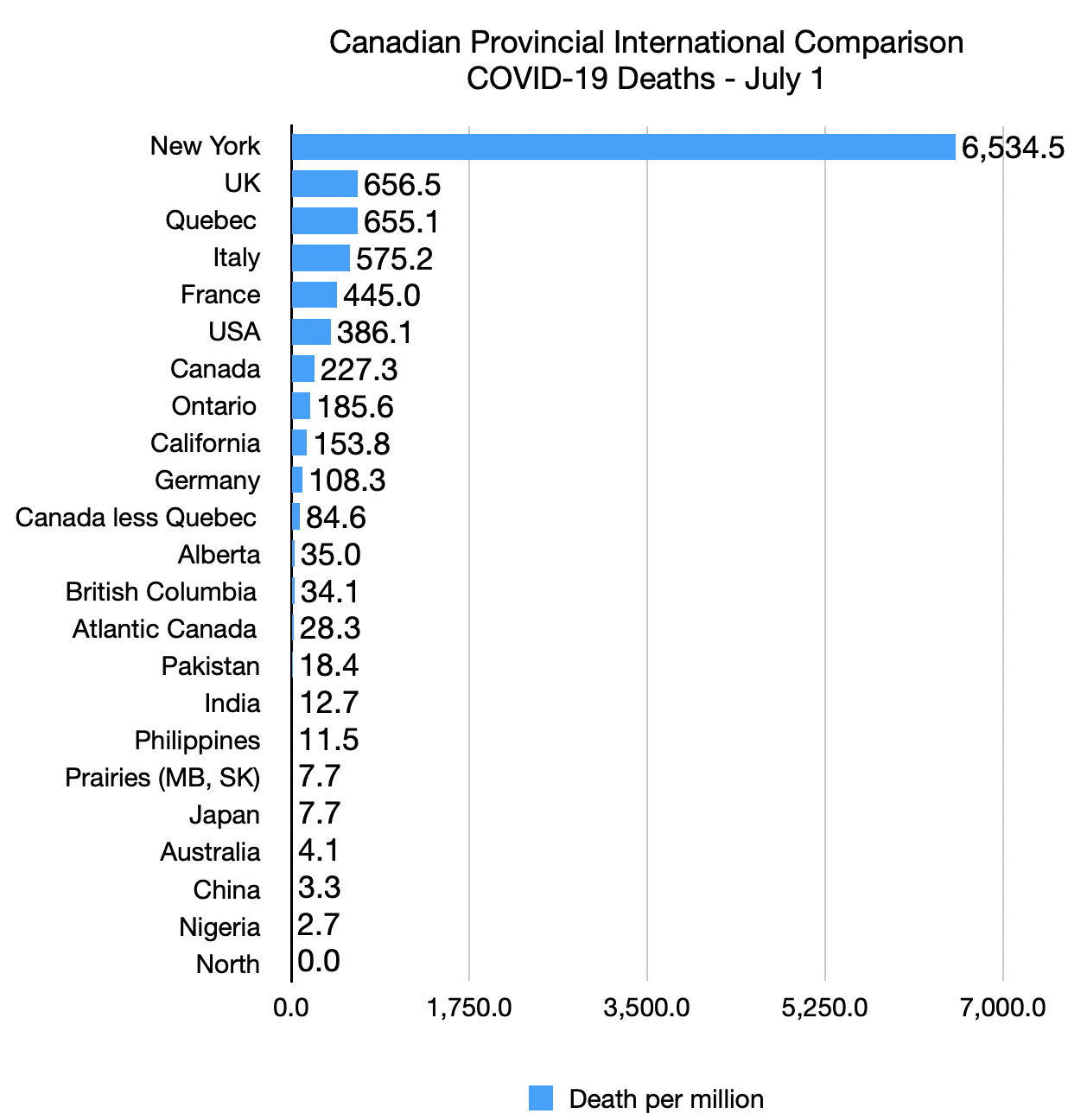
#COVID-19: Comparing provinces with other countries 1 July Update – Adding major immigration source countries

While the data from major source countries reflects large undercounting compared to G7 countries, nevertheless of interest given that perceptions of relative rates of COVID-19 infections and deaths may affect interest in immigrating to Canada:


Open Letter to Directors, Executive Senator Omidvar: Directors, and CEOs of Canadian Charities and Non-Profits

A pointed reminder that charities and non-profits have work to do to improve their board diversity by Senator Omidvar, starting with better data and voluntary disclosure. Any initiative by the big players should report on the four employment equity groups and ideally be synchronized on a fiscal or calendar year basis to facilitate comparisons:

Dear colleagues,

First, let me thank you for the work that you, your staff, and volunteers have done to keep Canadians safe during the pandemic.  Your heroic efforts have not gone unnoticed or unappreciated. I also know that Canadians will rely on you to help them stride slowly, yet confidently, into the recovery stage of this crisis.

But our country also needs to wake up to another crisis. The scourge of racism holds back prospects for security, safety, and opportunity for all its victims. But it has a particularly malignant effect on Black Canadians and Indigenous Peoples in Canada. Canadians recognize this; they have taken to the streets with vociferous demands to address it. Governments, corporations, the media, and other institutions are all taking a hard look at themselves to ask the question: what have we done to recognize and address all kinds of racism?

But what about charities and non-profits?

In June 2019, the Senate Charities Committee tabled its final report. Buried in the 42 recommendations is one that deserves re-examination given the context of the day. In the report we took note of the size, scope, and influence of the sector. We noted that it touches all aspects of our lives, from religion to sports, from seniors to young people. It also wields sizeable heft in other aspects: it contributes 8% to the GDP and employs close to two million Canadians. But what about its diversity?

Sadly, the absence of data gets in the way of answering these questions with any real reliability.  An e-consultation conducted in connection to the Senate study, although not statistically significant, found that more than half of the organizations which responded to the survey did not collect data on diversity of employees or directors.

Further, studies by academic institutions like the Diversity Institute at Ryerson University paint a picture of a sector that may talk the talk but appears to be unwilling to walk the walk. The evidence that is available is not encouraging. Racialized minorities made up 54% of the Greater Toronto Area’s total population in 2017. However, their representation in leadership roles in the voluntary sector falls short. Only 38% of boards analyzed had at least 20% racialized minority leaders, and 19% had none. Equally notable, 38% of senior management teams had at least 20% racialized minority representation, while 52% had none.

The Senate recommended a reasonable start to get data on diversity in the charitable sector. It recommended that the CRA include questions on both the T1044 and the T3010 forms on diversity representation on boards of directors as per the existing employment equity definitions.

In this way, the data could be aggregated to present a picture of diversity in the sector on an annual basis. Based on clear evidence, the country and the sector could see if progress is being made, how and where.

Since the Senate tabled the report, events have overtaken it. Parliament has not met on a regular basis and the Senate Charities report has not yet been debated or approved. However, the need to ensure that leaders reflect the diversity of our country’s population has heightened. The sector does not have the time to wait for the report’s recommendations to be implemented. It must take action now. That action is now in the hands of its leaders.

Each charity or non-profit can undertake such a review voluntarily on an annual basis. More importantly, large sector membership-based organizations, like Imagine Canada, Community Foundations of Canada, the Ontario Nonprofit Network, and the Philanthropic Foundations of Canada can request that their members disclose this data on a voluntary basis. Given that the membership of these organizations is large, it would create a significant evidence base from which to draw conclusions. Collected annually, it would give impetus to provide a national picture of diversity in the sector. Because the sector would be in the driver’s seat, it could choose to disaggregate the data to further understand issues of race and intersectionality. Most importantly, evidence could lead to action: the opportunity to compare successes and challenges and share best practices. All without legislation.

The sector could go one step further. It could make disclosure of such information a criterion for all members, thus making it mandatory within their associations. This would send a powerful signal of leadership to the rest of Canada.

Charities and non-profits are often frustrated and hamstrung by the federal government in their efforts to achieve their missions. The sector has urged the government to take it more seriously, as it should. Yet, here is an opportunity to state exactly how serious the charitable sector is on a matter of national urgency. It is time for the sector to lead, to show the way for others, so that others may follow.

I am calling on the sector to take up this call and be a leader and a champion for diversity and inclusion. In the fight against racism, this is not the only step. But it is the first that will bring evidence-based reflections and changes.

I have often been asked if the sector is ready for this change. My observations to date are summed up as follows: the sector’s spirit is willing, but its flesh is weak.

I sincerely hope that you will prove me wrong.

Sincerely,

The Honourable Ratna Omidvar, C.M., O.Ont.

Independent Senator for Ontario

Senate of Canada

Source: https://thephilanthropist.ca/2020/06/open-letter-to-directors-executive-directors-and-ceos-of-canadian-charities-and-non-profits/

Happy Canada Day!

1982, 14" x 20"

STORMY SKY, ON THE “CHURCH PROPERTY”, MONO TWP, 1982

A field near Orangeville, where my family used to spend summers, watercolour by my father.