New Zealand: #Immigration “was never a sustainable source of growth”

Canadian immigration policy makers should also take note on the difference of overall GDP growth and the more important measure, per capita GDP growth:

ANZ economists believe there is a “slim” prospect of a population-driven recovery for the New Zealand economy given the weak outlook for migration. They also claimed that immigration “was never a sustainable source of growth”anyway:

This crisis has turned New Zealand’s recent model of migration-driven growth on its head… Once borders reopen, we expect net inflows to rebound, but to lower levels than before the crisis (figure 1)…

Migration-induced population growth has been one of the most dominant drivers of economic activity in recent years, with per capita GDP growth trailing well below the headline measure (figure 4). This was never a sustainable source of growth.

Overall, the weaker outlook for migration means that the prospect of a population-led recovery is slim. That will put the burden on domestic stimulus and productivity. So far, we’ve seen nothing on the policy front to convince us that productivity is about to take the reins, so expect a pretty ho-hum performance on the other side.

Meanwhile, a new report for the New Zealand Productivity Commission claims that mass immigration has distorted the economy and wrecked productivity:

The substantial net migration inflows that New Zealand has received over the past 25 years has been a strong source of support for headline GDP growth, but has created a series of distortions and pressures in the New Zealand economy: infrastructure and cost pressures, greater residential real estate demand (with implications for allocation of investment capital), downward wage pressure that deters business investment, as well as upward exchange rate pressure. An explicit immigration policy that was focused on quality and filling skills gaps, with lower gross inflows, would create a more supportive environment for higher levels of international engagement by New Zealand firms.

Given the similarities between the New Zealand and Australian economies and immigration systems, these findings can be equally applied to Australia.

Source: ANZ: Immigration “was never a sustainable source of growth”

The Impact of Disparities on Children’s Health

Significant:

You might not have noticed it (there’s a lot going on) but there was some good news last week in a study in JAMA that suggested that racial disparities in extremely premature infants were shrinking. The study looked at more than 20,000 extremely preterm infants (22 to 27 weeks gestation) born from 2002 to 2016. Mortality rates dropped over the course of the study, and though serious infections were more frequent in black and Hispanic infants early on, the rates converged with those of white infants as time went on.

This is striking because the racial disparities around maternal mortality, premature birth and infant mortality have been so persistent. Black women and American Indian and Alaskan Native women are two to three times more likely than white women to die of pregnancy-related causes — about a third of these deaths take place during pregnancy, a third are specifically related to delivery, and a third happen in the year after delivery, but from causes related to pregnancy.

This came up last week, when I wrote about late preterm infants, and Dr. Wanda Barfield, the director of the division of reproductive health at the Centers for Disease Control and Prevention, pointed to rising rates of premature birth, which disproportionately affect black and Hispanic women.

These stark disparities at the very beginning of life have received a fair amount of public health attention, as have the racial and ethnic disparities in infant mortality: In the United States in 2017, 5.8 of every 1,000 infants born alive died before reaching their first birthday. Black infants died at more than twice the rate of white infants (11.9 versus 4.9 per 1,000). And this in turn is tied closely to those issues of maternal health and length of gestation; two of the leading causes of deaths before the first birthday are prematurity and the complications of pregnancy.

Often the public discussion of health disparities then jumps to adult health, where we track inequities in chronic diseases, in heart disease, cancer, diabetes and, of course, in life expectancy.

But the disparities in how children grow, how they get sick and how they get taken care of may all play into those chronic diseases, and are essential to understand.

“We focus on these chronic diseases of older age as results of racism, continuing discrimination,” said Dr. Nia Heard-Garris, a pediatrician and researcher at Lurie Children’s Hospital in Chicago, and the chair of the American Academy of Pediatrics Section on Minority Health, Equity and Inclusion.

“We do see the impact of racism on health in childhood, though it’s harder to see physical health changes immediately.”

Eating habits and behavioral patterns, which contribute to the health disparities in adults, have roots in childhood, Dr. Heard-Garris said, as does distrust of the health care system that can lead to gaps in care.

Boris Johnson appoints aide who said institutional racism was a myth and railed against multiculturalism

Sigh….

Boris Johnson has appointed a Downing Street aide who railed against multiculturalism and said institutional racism was a myth to lead a commission on racial equality.

Munira Mirza, director of the Downing Street policy unit who also worked for Mr Johnson while he was Mayor of London, said it was not racism but “anti-racist lobby groups” to blame for some of the problems ethnic minorities faced.

She has also called for the government to “dismantle the countless diversity policies that encourage people to see everything through the prism of racial difference”.

The prime minister this week announced a “cross-governmental commission” to look at all aspects of racial inequality in the UK in the wake of global Black Lives Matter protests.

Mr Johnson said there was “much more that we need to do” to combat racism, though he also urged ethnic minorities to consider the progress that had been made.

But the commission will reportedly be led by Ms Mirza, who has written dozens of controversial articles for fringe right-wing website Spiked Online, in some of which she lays out her views on race.

In one piece from September 2017 the aide attacks the findings of a previous racial equality review by Labour MP David Lammy and argued that it was wrong to point the finger at institutional racism.

In the article she suggested that “the current accusations of institutional racism by lobbyists and activists” were “a perception more than a reality” and that the accusations of racism themselves led to worse outcomes for people from ethnic minorities, particularly in the justice system.

“When anti-racist lobby groups criticise the authorities for their racism, it is not surprising that BAME communities start to believe they cannot trust their own professional solicitors,” she argued. “They then make decisions that might harm their chances in the justice system.”

In another 2017 article, this time for the Spectator, she claimed that “anti-racism is becoming weaponised across the political spectrum”.

Source: Boris Johnson appoints aide who said institutional racism was a myth and railed against multiculturalism

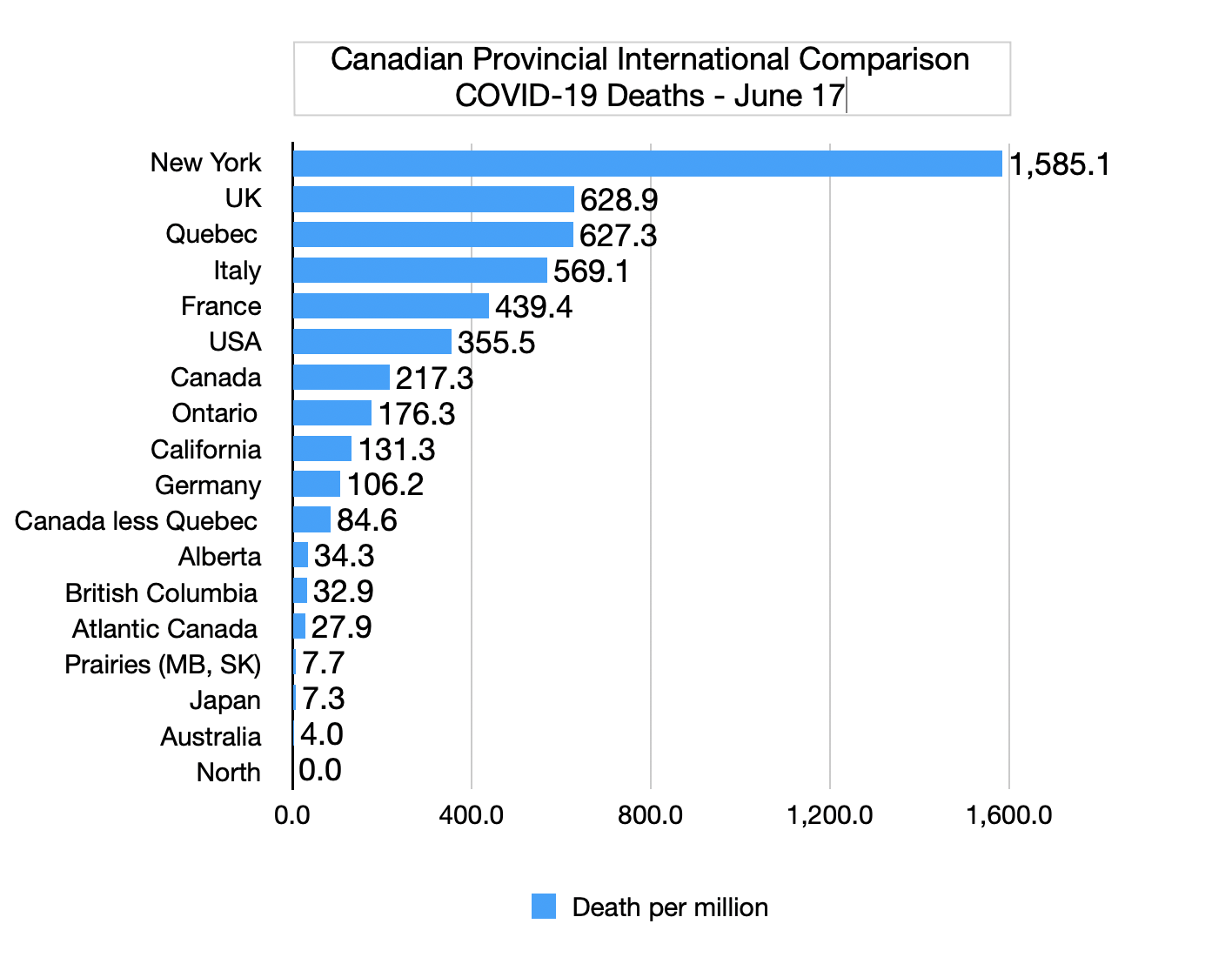
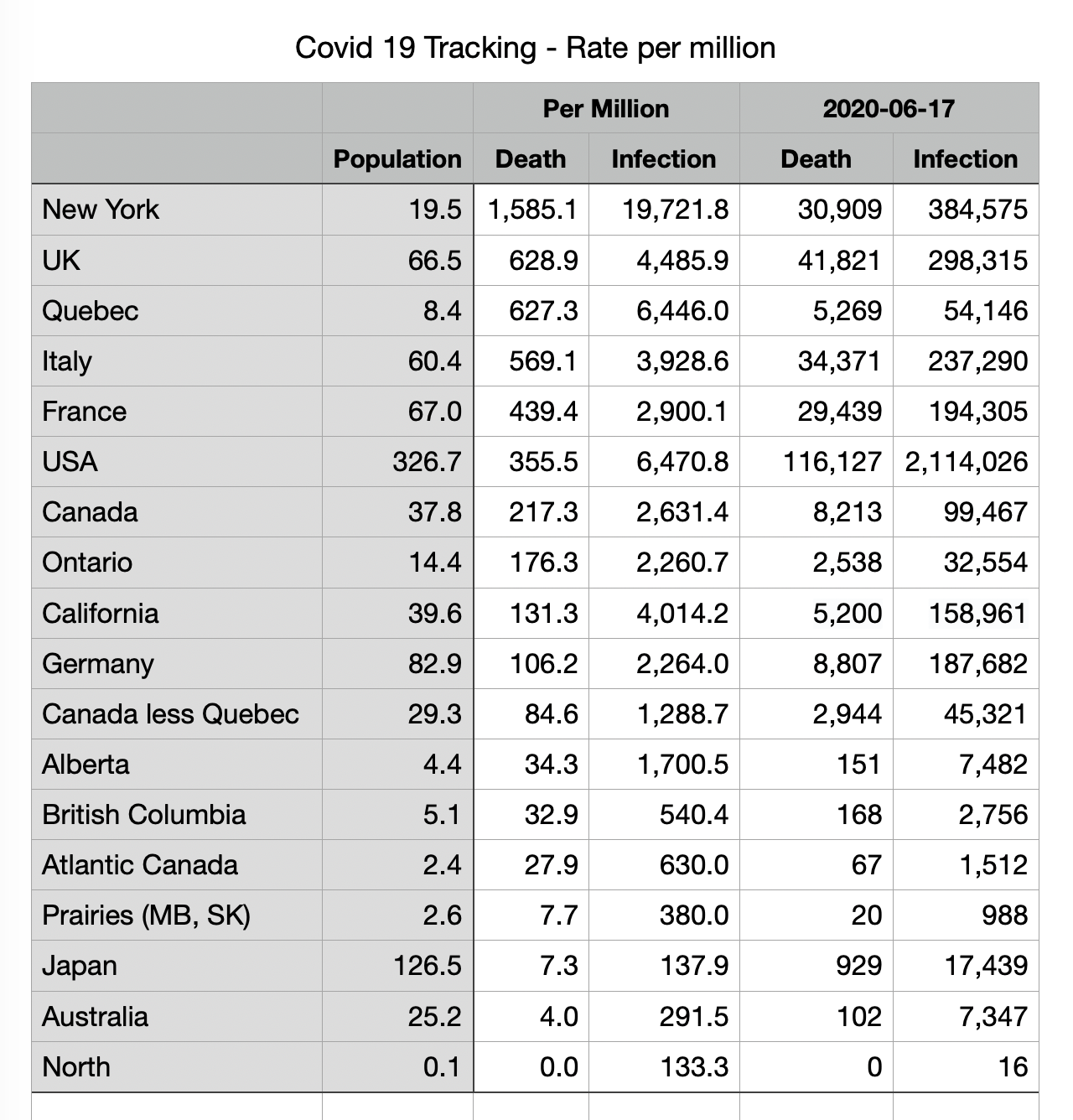
#COVID-19: Comparing provinces with other countries 17 June Update – No major change

Latest update:


Essential but expendable: How Canada failed migrant farm workers

Good investigative reporting on the policy and enforcement failures after the quarantine period:

When the novel coronavirus pandemic hit in March, the annual flow of farm labour into Canada hung in the balance.

Farmers feared that border closings and grounded planes would prevent agricultural workers, coming from countries such as Mexico, Guatemala and Jamaica, from reaching their fields and greenhouses in time for the seeding season. Knowing this, Ottawa allowed entry of temporary foreign workers critical to the food system.

Conditions – including a mandatory 14-day quarantine upon arrival – were put in place to protect Canadians. But advocates and health officials say not enough was done to protect the workers themselves.

In interviews, farm workers detailed the myriad reasons that COVID-19 has infiltrated farms with such success: a lack of personal protective equipment (PPE), an information vacuum and pressure to work, despite symptoms. In one instance, a feverish worker developed chest pains and a nosebleed that dripped on the vegetables he tended; he said his supervisors refused to take him home until the shift was over. Photos, videos and interviews portrayed overrun bunkhouses with broken toilets and stoves, cockroach and bed-bug infestations, and holes in the ceiling.

Rules were rolled out, but they weren’t adequately enforced and failed to consider what life on a farm is actually like for a migrant worker. Ottawa requires that farms, which generally provide housing under the Temporary Foreign Worker (TFW) program, ensure that accommodations allow physical distancing during the initial quarantine period.

But what happened after those 14 days was a massive blind spot. After isolating, workers often move into the bunkhouses, where they share bathrooms and kitchens and climb atop one another to get into bed. As former migrant worker Gabriel Allahdua put it, conditions in farm accommodations are a “recipe for COVID-19 to spread like wildfire.”

In Ontario alone, more than 600 foreign farm workers have tested positive for COVID-19, according to a Globe and Mail count; health officials have stressed that, for the most part, the workers came to Canada healthy and contracted the virus locally. British Columbia, Alberta and Quebec have also recorded outbreaks among migrant agri-food workers.

The situation is most dire in Southwestern Ontario, home to the continent’s highest concentration of greenhouses. Ontario’s largest outbreak is at Scotlynn Group, where at least 167 of 216 migrant workers have tested positive. Mexico has become so concerned by the outbreaks that Ambassador Juan Jose Gomez Camacho told The Globe that his country has “put a pause” on sending more workers – 5,000 more are still due to make the trip – until Canadian officials ramp up monitoring of health and safety rules, and ensure workers are paid while in isolation.

Two of Mr. Gomez Camacho’s countrymen have already died. Bonifacio Eugenio Romero, 31, and Rogelio Munoz Santos, 24, left their loved ones in Mexico to earn a better living. Their families are now planning the young men’s funerals. Mr. Eugenio Romero and Mr. Munoz Santos died – on May 30 and June 5, respectively – after testing positive for COVID-19. Their final days were spent mostly in hotel rooms, mostly alone.

“For a 24-year-old to die of this is beyond tragic,” said David Musyj, president and chief executive of Windsor Regional Hospital, where Mr. Munoz Santos died. “It should not happen. Just because he was from Mexico, I don’t give a damn. He was my son’s age. He was in Canada. And we should be taking care of him.” Mr. Munoz Santos is one of the youngest people in Canada to die from COVID-19-related causes. Ontario’s Office of the Chief Coroner is investigating both deaths and will decide whether to launch the province’s first inquest into a migrant worker fatality.

The federal government has the power to conduct pro-active inspections of farm accommodations, but during a six-week period at the height of the pandemic, these audits stopped. They are now being done virtually. The provinces are responsible for occupational health and safety, but in Ontario at least, the Ministry of Labour does not inspect employer-provided accommodations. Local public-health units in the province typically inspect farm bunkhouses once or twice a year, but this is done before workers arrive; an empty space looks markedly different from one with dozens of occupants.

In Canada, advocates and community health care workers for months warned federal and provincial politicians, as well as local public-health officials, that migrant workers were at a heightened risk. In letters, e-mails and conference calls, they asked for a number of measures, including increased funding for public-health units to ensure adequate housing inspections and limits on the number of people using each bathroom in bunkhouses. While some action was taken, many people say help came too little, too late. And advocates worry that unless enforcement and public-health outreach kick into high gear, there are lives and livelihoods at stake, along with the potential for disruption to the food system.

To understand what went so wrong, The Globe interviewed seven migrant workers across four farm operations, at times through a translator, as well as employers, advocates, academics, hospital executives, former migrant workers, doctors, lawyers and industry associations. The Globe reviewed four immigration files detailing allegations of employers who did little or nothing to protect workers. Migrant workers’ identities are being concealed because of privacy concerns and fears of reprisals.

The investigation revealed that problems in an already broken system have only been exacerbated by the pandemic. The experiences of workers varied, with some describing decent housing and respectful bosses who have worked hard to keep them healthy. Others spoke of racism and recounted threats of termination or deportation if they didn’t meet stringent productivity quotas.

Syed Hussan, executive director of Migrant Workers Alliance for Change (MWAC), said there is a massive disconnect at play. “Migrant workers,” he said, “have been treated as expendable and exploitable – and essential, all at the same time.”

….

The agriculture sector employs approximately 60,000 temporary foreign workers each year, with upward of 10,000 of them in Windsor-Essex county, which includes Leamington. Under the TFW program, foreign nationals are allowed to work for a particular employer for a set amount of time. Some stay for several months, others are here year-round. There are also foreigners who work in the country unauthorized; according to some estimates, Canada is home to hundreds of thousands of undocumented migrants.

Source: Investigation: Essential but expendable: How Canada failed migrant farm workers

Damning report points finger at Montreal city, police for failure to address systemic racism

Of note:

Montreal police operate with a culture of impunity fuelled by indifference in the city administration to complaints of racial profiling, violence and other forms of discrimination, according to a new report on systemic racism in the city.

The police force also works without data and concrete objectives for diversifying its work force, a vacuum that has made it unrepresentative of the community, much like other Montreal city departments, the report by the city’s independent public consultation office says.

Public consultations with a broad mandate to study systemic racism in the administration of the city of Montreal began two years ago. The Office de consultation publique de Montréal (OCPM) heard from 7,000 people who recounted stories of profiling, hiring and promotion roadblocks, and both overt and subtle discrimination.

The report landed as systemic racism and police discrimination have been pushed to the top of the public agenda. A series of violent incidents involving police in the United States and Canada have triggered protests and challenged leaders to act.

Long-standing denial that systemic racism is a problem is entrenched in Montreal’s city administration while the police hierarchy flip-flops on the existence of racial profiling and other forms of discrimination, said the report. It issued 38 recommendations including better data collection, enforcement of hiring targets, improved training and more responsive oversight mechanisms for the police and the city.

“How can you effectively and efficiently fight against racism if you don’t acknowledge it exists and don’t have data on what to change?” Dominique Ollivier, head of the OCPM, said in an interview. “There is no culture of evaluation in the city. They give themselves broad goals so any little thing can be called success.”

About 35 per cent of Montrealers identify as racialized or Indigenous people. About 19 per cent of the city’s work force are from those groups, an increase from 12.3 per cent 10 years earlier. For Montreal police, the figure was 7.7 per cent in 2019. Less than 2 per cent of city’s senior managers are racialized people. “They haven’t hired a single manager in three years from visible minorities or Indigenous groups,” Ms. Ollivier said.

Montreal Mayor Valérie Plante responded Monday by formally acknowledging at City Hall that systemic racism exists and vowing to appoint a commissioner to fight discrimination. However she offered no new steps to increase work-force or management diversity. “The city must be an exemplary employer,” she said. “We have to hit the accelerator to meet our targets. We can and must do better.”

A spokesman for the Montreal police said Chief Sylvain Caron would not comment on the report Monday. The police force sent out a statement Monday evening acknowledging the existence of systemic racism and vowing to fight it. In July, Chief Caron is set to release a new policy on street identification checks, known in some jurisdictions as carding.

Quebec Premier François Legault announced Monday he is creating a provincial task force to draft an anti-racism action plan by Christmas. Mr. Legault does not recognize systemic racism exists in Quebec but said the task force will address racism in public security, the justice system, the workplace, education and housing.

Mr. Legault said that, in order to expedite action on a long-studied issue, the task force will consist only of cabinet ministers and government MNAs. Mr. Legault put two Black ministers in charge of the task force: Nadine Girault, a former executive in the financial industry, and Lionel Carmant, a physician.

“I am not going to spend my time trying to find a definition of systemic racism that will be acceptable to everyone,” Ms. Girault said. “To recognize the problem is part of the solution, but we must go forward and create a clear obligation for results.”

Montreal’s racism report was the product of provisions in the city’s charter that allow citizens to petition for such consultations. Balarama Holness, one of the organizers who gathered 22,000 signatures to force the study, was pleased with its concrete recommendations but split on the political reaction.

“François Legault doesn’t recognize systemic racism but seems to be taking concrete steps to do something about it. Valérie Plante recognizes systemic racism on a symbolic level and is doing nothing about it,” said Mr. Holness, who is a McGill law student and founder of Montreal in Action, a human-rights advocacy group.

Mr. Holness, like Ms. Ollivier, expressed some optimism that protest and public attention might lead to action. “Let’s hope this is a step to creating a new legacy of equality,” he said, “even if we all know equality is a pursuit, not a destination.”

Source: Damning report points finger at Montreal city, police for failure to address systemic racism

Coronavirus Is Hitting Black and Hispanic Americans Harder. CDC Data Shows How Much.

Yet more evidence (and waiting for Canada to catch up with such data):

In a new, massive federal survey of novel coronavirus cases in the United States, a report by the Centers for Disease Control and Prevention offers an in-depth breakdown by gender, race, ethnicity, and health factors.

Among 1,320,488 laboratory-confirmed COVID-19 cases considered by the CDC between January 22 and May 30, 2020—of which only 45 percent had race or ethnicity data—33 percent were Hispanic or Latino of any race and 22 percent of infections were among Black Americans, the Morbidity and Mortality Weekly Report released Monday found. For context, those communities account for about 18 percent and 13 percent of the U.S. population, respectively.

The numbers amount to the best evidence yet that the deadly pandemic has had an outsized impact on communities of color.

“These findings suggest that persons in these groups … are disproportionately affected by the COVID-19 pandemic,” the report said, calling them consistent with previously reported data “that found higher proportions of Black and Hispanic persons among hospitalized COVID-19 patients.”

Of the 287,320 cases with data on underlying health conditions, the most common were cardiovascular disease at 32 percent, diabetes at 30 percent, and chronic lung disease at 18 percent.

Even as officials nationwide have forged ahead with re-openings, more than a dozen states—including Arizona, Arkansas, Oklahoma, North Carolina, South Carolina, California, Florida, and Texas—hit new daily COVID-19 case tally records in recent weeks. As the CDC put it in Monday’s report: “The COVID-19 pandemic is an ongoing public health crisis in the United States that continues to affect all populations and result in severe outcomes, including death.”

And as ProPublica previously reported, environmental, economic, and political factors have for years put Black Americans at higher risk of chronic conditions that overlap with COVID-19 risks, including asthma, heart disease, and diabetes.

Communities of color in every state have had a unique experience of the contagion, and these numbers suggest the outbreak is reflecting glaring health-care inequalities that no vaccine or treatment can cure.

Source: Coronavirus Is Hitting Black and Hispanic Americans Harder. CDC Data Shows How Much.

Visible minorities vastly underrepresented in the boardroom, new disclosures suggest

Early and incomplete data but dispiriting:

Canadian companies may be making progress on gender diversity, but a Financial Post analysis suggests that the boardrooms of some of the biggest businesses in the country have much further to go when it comes to including members of visible minorities, Indigenous peoples and people with disabilities.

That analysis is based on a relatively new source of data. Starting this year, publicly traded companies incorporated under the Canada Business Corporations Act (CBCA) are required to report, among other things, the number of women, Indigenous people, persons with disabilities and members of visible minorities on their boards and in their senior-management ranks. The disclosures must be made for their annual shareholder meetings.

The Post looked at companies on the S&P/TSX 60 stock-market index that were both incorporated under the CBCA and had filed management information so far in 2020 — a total of 23 companies — to gather a preliminary picture of the state of corporate diversity. Disclosure was not entirely consistent from company to company and the findings and assessments presented here are based on self-reported information about proposed or current slates of directors, at the time the filings were made.

Combined, however, the Post found that, out of the 23 boards and 255 director positions total, only 14 directors — or approximately 5.5 per cent — identified as belonging to a visible minority. The Post also found only three Indigenous directors (or about one per cent of all directors in the sample) and two directors with disabilities (less than one per cent) among the 23 boards.

Fourteen of the companies reported they did not have a member of a visible minority on the board, while 20 companies reported no Indigenous peoples and 21 reported no persons with disabilities as directors. Eleven companies had no representation from any of those three groups on their board.

By comparison, 22.3 per cent of Canada’s population identified as a visible minority and 4.9 per cent as an Aboriginal person during the 2016 census. And according to Statistics Canada, as of 2017, 22 per cent of Canadians aged 15 and older had one or more disabilities.

All 23 firms included in the Post’s analysis had at least one director who identified as a woman, and 31 per cent of all directors on the Post’s list of companies were women.

Representation of the federal government’s four diversity groups in senior management varied, but were not much better for the 23 companies as a whole.

Discount retailer Dollarama Inc. reported two of its six executive officers (33 per cent) and two of its nine directors were women (22 per cent), but that members of the federal government’s other three designated groups were in zero of those positions. It was similar for e-commerce company Shopify Inc., which reported two of its seven executive officers and two of its six directors were women, but that no other groups were represented.

“We recognize our areas for improvement and are actively working with our Diversity & Belonging team to ensure stronger representation across our senior leadership and Board by hiring and retaining diverse talent,” a Shopify spokesperson said in an email.

Big banks and insurers in the S&P/TSX 60 index were excluded from the Post’s analysis [banks covered under the Federally Regulated Sectors EE reporting]. While some report diversity information (Royal Bank of Canada had said, among other things, that 46 per cent of its executives in Canada were women and 19 per cent were visible minorities), they are incorporated under financial legislation and not subject to the recent CBCA changes. Companies that are incorporated provincially were likewise excluded.

Ratna Omidvar, an independent senator from Ontario, said she was not surprised by the Post’s findings. Omidvar, who was a well-known diversity expert before being appointed to the Senate in 2016, was previously among lawmakers backing an ultimately unsuccessful push to force public companies to set internal diversity targets.

“Certainly I recognize the government has to not over-regulate corporations, because we want them to survive and thrive and make money and lift all our boats, et cetera,” Omidvar said. “But the lifting of all boats is clearly not happening, so we need something else.”

The recent changes to the CBCA also put companies in a position to “comply or explain” in reporting on their diversity policies and targets, the latter of which most of the companies looked at by the Post did not have for members of visible minorities, Indigenous people or persons with disabilities.

For example, the Desmarais-family-controlled Power Corp. of Canada (which reported two of its 13 directors were women, but zero were from any of the other three groups) said in its 2020 management circular that it had not adopted a target regarding the representation of the four groups on the board “as the Board believes that such arbitrary targets are not in the best interests of the Corporation.”

Still, there is a “prevailing view” in the corporate world that diversity is a good thing, which helps create momentum for efforts such as the recent CBCA amendments, according to Rahul Bhardwaj, the president and CEO of the Institute of Corporate Directors.

“It’s a journey for organizations to enhance their diversity,” he added.

While it is the first year for the new federal disclosure requirements, securities regulators were already requiring companies to report figures and targets regarding the number of women on boards and in executive positions. A recent report on the approximately 230-company S&P/TSX Composite Index found the percentage of women on its boards had increased to 27.6 per cent in 2019 from 18.3 per cent in 2015.

Corporate Canada’s latest disclosure requirements, intended to further improve corporate transparency and diversity, are also now in place at a time when firms are pledging to do their part to fight racism following the death of George Floyd, a Black man who was killed while in police custody in Minnesota. Four officers are now facing charges in connection with the killing.

Directors should be aware of the narrative of the day, what people living in the communities in which they operate are thinking, and what customers are feeling, because those directors are setting strategy, according to Omidvar.

“So I would say those are competencies that should be even more hotly searched for and located when corporate directors are appointed to boards,” she added.

Some companies are now redoubling their diversity efforts. On Wednesday, the formation of the new Canadian Council of Business Leaders Against Anti-Black Systemic Racism was announced, as well as the launch of the BlackNorth Initiative, which is aimed at increasing the representation of Black people in Canadian corporate boardrooms and executive offices.

Wes Hall, the founder and chair of the council, and the executive chairman and founder of shareholder services firm Kingsdale Advisors, noted companies were fine when they began actively trying to solve their gender-diversity issues.

“We believe that if you now add another segment of the population to your board, it’s probably going to make your business even better,” Hall said. “So why not do it?”

Source:  Visible minorities vastly underrepresented in the boardroom, new disclosures suggest

Canada has a long, documented history of racism and racial discrimination. Don’t look away

Good reminder by Mark O’Neill, president and chief executive of the Canadian Museum of History and the Canadian War Museum.

In the 1980s, as a young program officer in what was then called the Department of the Secretary of State of Canada, I worked in the race-relations unit of the department’s multiculturalism program. Several events, in particular, were formative in my understanding of the state of social cohesion and the institutional response to the diversity of Canadian society at that time. These included the fatal shootings of young Black men in Mississauga (Michael Wade Lawson, in 1988) and Montreal (Anthony Griffin, in 1987) by police officers, and the final report of the Marshall Inquiry, released in 1990, which concluded that Donald Marshall Jr., a Mi’kmaq man in Nova Scotia, had been wrongly prosecuted and convicted of murder in 1971.

A critical milestone during this period was the Japanese Canadian Redress Agreement of 1988, the first time a Canadian government had formally acknowledged and apologized for a historic injustice against a group of Canadians – in this case, the internment of Japanese Canadians during the Second World War.

Collectively, these experiences formed the beginning of what has essentially been my lifelong learning of Canada’s history of systemic and institutional racism and racial discrimination.

The entire concept of Canada as a racist society is antithetical to the mainstream notion of Canadian identity and values (as expressed, most fundamentally, in the Charter of Rights and Freedoms). In an interview with the Canadian Press, journalist and activist Desmond Cole talks about the need to overcome Canada’s self-mythology as a country that doesn’t have the same forms of racism as the United States.

Recently, and in previous decades, Canadian politicians have quipped that a point of distinction between our country and the United States is Canada’s lack of a history of slavery, which has exposed an unawareness of, or unwillingness to acknowledge, the brutality of the transatlantic slave trade that benefited pre-Confederation Canada.

The late Gord Downie was inspired to create his Secret Path multimedia project when, as an adult, he learned of Chanie Wenjack, a 12-year-old Anishinaabe boy who died of hunger and exposure in 1966 after fleeing a residential school in Ontario. Mr. Downie made it his purpose to bring the story to Canadians because, like him, there were so many people in Canada who didn’t know the dark history of the schools.

Academic and author Lubomyr Luciuk, instrumental in the long campaign for redress for Ukrainian-Canadians interned as enemy aliens during the First World War, was initially told by government officials, “That never happened.”

Canada’s racism, both past and present, is a well-documented and undeniable fact. But many Canadians, sadly, do not know their history, so it stands to reason that they don’t know the darker chapters of it. It is profoundly important that we learn our history – and be acutely aware of our individual and collective wrongs – if we are to move ahead as a society, let alone judge others.

The Canadian History Hall, unveiled at the Canadian Museum of History in 2017 and developed by content experts in collaboration with community representatives, aims to bring Canadian history to life in a comprehensive, artifact-rich visitor experience grounded in the historical record of the events and people that comprise our history. In many respects, it lays bare our history. Not surprisingly, not everyone approves.

Examples of Canada’s history of racism abound. Our first prime minister, John A. Macdonald, when presented in his complex entirety, is the architect of both Confederation and the Indian Act (the two historical realities are inextricably bound – and critical to understanding both him and our country).

McGill University, one of Canada’s most respected postsecondary institutions, has a history of anti-Semitic admissions policies that were not lifted until after the Second World War. The historically Black town of Africville, N.S., was expropriated in the 1960s; homes were torn down without warning or process, and the community was displaced. The Chinese head tax, first introduced in 1885 and increased several times thereafter, discouraged and penalized Chinese immigration to Canada. It was superseded by the Chinese Exclusion Act of 1923, which forbade Chinese immigration altogether.

The persistence of systemic racism and racial discrimination in Canada is a part of our contemporary history. As recently as 2017, the UN Working Group of Experts on People of African Descent released a report on its mission to Canada. The Working Group found that “Canada’s history of enslavement, racial segregation and marginalization of African Canadians has left a legacy of anti-Black racism and had a deleterious impact on people of African descent, which must be addressed in partnership with the affected communities. Across Canada, many people of African descent continue to live in poverty and poor health, have low educational attainment and are overrepresented at all levels of the criminal justice system.”

Both the Truth and Reconciliation Commission and the National Inquiry into Missing and Murdered Indigenous Women and Girls have painstakingly documented Canada’s long and devastating legacy of racist policies and practices against Indigenous people.

In April, an article by poet and columnist El Jones in the Halifax Examinerexplored the serious impact COVID-19 will have on Black communities, noting that “racism and structural inequality shape who is affected by this illness and its economic fallout. Systematically ignoring that reality makes Black people even more vulnerable.” The article goes on to describe the disappearance of “Blackness” from the reporting of the pandemic, despite the fact that many Black people are on the front lines and that, like the U.S., Canada is not keeping race-based data on testing or infection rates.

It has been a long time for me, personally, since the shootings of Mr. Lawson and Mr. Griffin, the Marshall Inquiry’s report and the Japanese Canadian Redress Agreement. But along the arc of the moral universe, they are recent events in Canadian history.

The Department of Justice reports that although Indigenous adults represent just 4 per cent of the adult population in Canada, they account for 26 per centof admissions to correctional services.

Political leaders at all levels have acknowledged the existence of anti-Black racism in Canada. In 2016, Abdirahman Abdi died during his arrest in Ottawa, and Dafonte Miller lost an eye after an alleged assault by an off-duty police officer in Toronto. Andrew Loku was killed by Toronto police in 2015 in what was deemed a homicide.

Canadians have much to be proud of in their quest for social justice, including the creation of the Canadian Charter of Rights and Freedoms; the introduction of the Employment Equity Act to guarantee every Canadian equal access to work; the Government of Canada’s apology for the Chinese head tax; and many other stories of leadership on human rights and international aid and development. In 2019, the federal government unveiled its anti-racism strategy, a key pillar of which is the establishment of an Anti-Racism Secretariat that will lead a “whole-of-government” approach in addressing racism and racial discrimination. This is a welcome approach, but there is still much work to be done.

The final panel in the Canadian History Hall at the Canadian Museum of History reminds visitors that “Canadians have inherited a contested past. Like their forebears, they face conflict, struggle and loss alongside success, accomplishment and hope. They steward an acclaimed but imperfect democracy, a beautiful but threatened environment, a revered but relative civility. Their vision and generosity, wisdom and compromise will be their own legacy – for Canada, and the world.”

Source: Canada has a long, documented history of racism and racial discrimination. Don’t look away

Douglas Todd: Number of Chinese students in Canada plunges 44 per cent

Latest from Douglas Todd on the decline in international students as a result of COVID-19 travel and related restrictions.

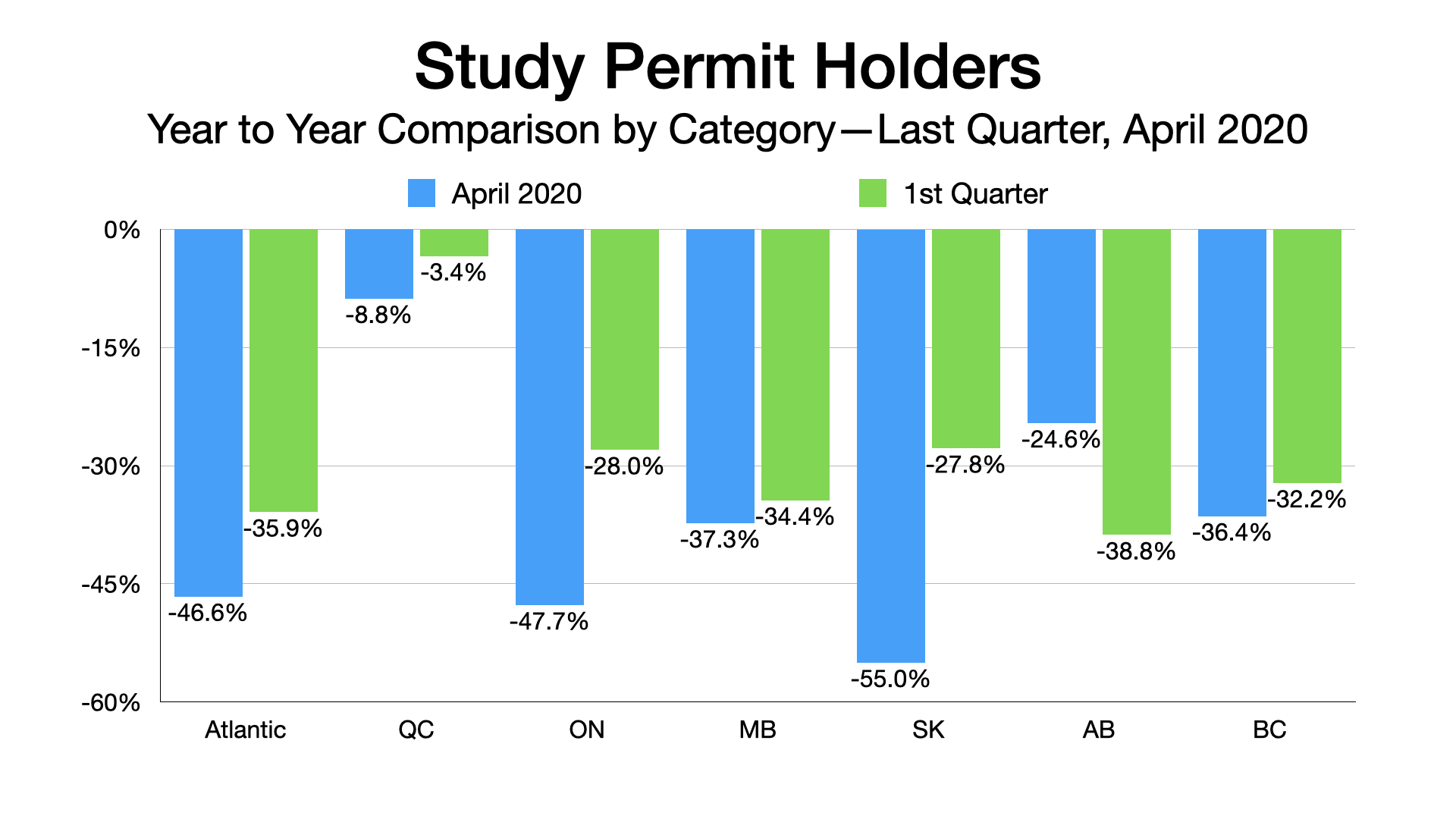
The three charts below highlight the extent of the decline starting in late 2019, along with the impact of the largest 10 source countries (2018 basis) contrasting the April 2020 change with the the first quarter of 2020.

The extent to which COVID-19 will impact the third quarter, when most students arrive, is of course the big question facing universities and colleges and the related economic impact:

The number of people from China obtaining Canadian study permits nosedived 44 per cent in the first four months of this year as COVID-19 restrictions and diplomatic battles took their toll.

Australia is experiencing an even more precipitous slump in what has been its largest foreign-student contingent — as China’s leaders this week warned against studying in Australia, which it said discriminates against Asians.

In addition, Canada has in the past two months come up with several incentives designed to limit the drop in study visas and woo high-fee-paying international students, who numbered 642,000 in Canada at the end of 2019, making up one in five of all those in higher education.

More than 150,000 Mainland Chinese citizens studied and worked in Canada in 2019, the second largest foreign-student group after India. Greater Toronto last year was the temporary home to 53,000 students from China, while Metro Vancouver had 34,000 and Victoria hosted 4,000.

This year, however, a Chinese study visa downturn appears to be coming in response to COVID-19 lockdowns, diplomatic tensions, border restrictions, a switch to online teaching and massive job losses in labour sectors that often get filled by foreign students.

The latest Immigration Department figures show just 12,065 citizens of the People’s Republic of China obtained study visas in Canada in the first four months of 2020. That’s down 44 per cent from the same period last year.

It’s more severe than the 31 per cent overall decline in study visas from all foreign students. Of the four other largest source countries sending students to Canada, the number of Indians has dropped by 29 per cent this year, South Koreans are down 35 per cent, French have declined 29 per cent and Vietnamese dipped 15 per cent.

When it comes to China’s 640,000 foreign students, almost all have chosen to study in five English-language countries, including the U.S., Britain and New Zealand. But Australia and Canada have welcomed by far the highest number per capita.

While specialists say the international-student market will struggle over the next few years because of coronavirus restrictions, students from China, who have arguably flocked the most to foreign institutions, appear now to be among those most reluctant to head abroad.

When the pandemic hit and Australian politicians urged all foreign nationals who couldn’t financially support themselves to go home, the country’s leaders in effect began saying goodbye to many of the nation’s 720,000 international students, including 212,000 from China.

Australia’s plunge is coming at the same time China has singled out the country, telling citizens “by no means travel to Australia,” and citing “racist incidents targeting Asians.” It also brought up health risks from COVID-19, even though Australia has a much lower rate of coronavirus deaths than the U.S. and Canada. Some reports say only a tiny trickle of Chinese students have obtained study visas in Australia this year.

For his part, Australian Prime Minister Scott Morrison on Thursday told China, which has also cut its Australia beef imports, that he wouldn’t be bullied by offshore “coercion.”

The reaction from Canadian Prime Minister Justin Trudeau has been almost the opposite, even while China has unfairly placed two Canadians in solitary confinement and drastically cut Canadian canola imports.

In addition to speaking softly about China, Canada’s Liberal government has recently offered unprecedented incentives to international students, which it says bring $21 billion annually into higher education and the economy.

In an effort to head off more drastic drops, Ottawa recently removed the cap on how many hours most foreign students can work while studying.

In addition, the Liberals changed policy so that up to a million foreign students, refugees and guest workers already in Canada could apply for the government’s Canada Emergency Response Benefit of $2,000 a month without providing proof of a work permit.

In late May, the Liberals also announced that foreign students will be permitted to complete 50 per cent of their studies outside Canada. Perhaps most importantly, Ottawa also said such students will still be able to get a postgraduate work permit for up to three years.

How far should Ottawa continue to go to lure international-student dollars and workers, including from China? Clearly, a lot of transnational money is at stake.

Last year, students from China made up 40 per cent of the 153,000 foreign students in B.C. The University of B.C. recently enrolled 6,281 students with Chinese citizenship, taking in $184 million a year from their fees. Almost half of Simon Fraser University’s foreign students have been from China, paying $126 million in fees in the 2018-19 school year. They also typically fill low-wage jobs and pay rent.

There is no doubt Canada has built a significant reliance on China and its students. Now, dealing with COVID-19 and country-to-country tensions, that dependence is being put to the test.

Source: Douglas Todd: Number of Chinese students in Canada plunges 44 per cent