Up to a quarter of Russian immigrants to Israel may have left after receiving passports

“Citizens of convenience:”

Thousands of immigrants to Israel from the former Soviet Union may have come only to receive an Israeli passport before moving back abroad.

The Hebrew weekly Makor Rishon reported that a cottage industry of companies promising expedited Israeli citizenship, and the passport that comes with it, have sprung up in Russia since the passage of a law allowing new immigrants to receive the travel document within the first three months of their aliyah.

For many in the post-Soviet world, an Israeli passport is considered as desirable as a European Union passport is to Israelis. Russian fixers have started advertising that they can help prospective “olim” obtain “Israeli citizenship within two days” for a cost of thousands of euros.

Under certain circumstances, the paper reported, the three-month period can be shortened to as little as a day, and some immigrants have even been able to receive their passports without having to leave Ben Gurion International Airport.

Based on data from Israel’s Ministry of Immigrant Absorption, Makor Rishon estimated that approximately 8,500 emigres from the former FSU have come just for the passport before immediately leaving the country. One Jewish Agency official estimated that about 25 percent of the immigrants came for a passport and “left the country immediately after receiving it.”

Approximately 10,500 Russians and 6,400 Ukrainians made aliyah in 2018, which was the first year that the majority of new immigrants were not considered Jewish under halacha, or Jewish religious law.

Source: Up to a quarter of Russian immigrants to Israel may have left after receiving passports

Ethnic media 2019 Election Coverage: Commonalities and Differences

My analysis of ethnic media coverage undertaken as part of diversityvotes.ca. Abstract:

Winning visible minority and ethnic group votes is critical to electoral success in urban Canada. Ethnic media is one of the means that parties and candidates pursue to reach these voters. How significant is ethnic media in reaching these groups? Which groups have stronger ethnic media and how does that affect coverage? Is coverage similar to “mainstream” media or how does it differ and does issue coverage vary by group? This presentation analyses over 2,500 ethnic media 2019 election articles (print and broadcast) from 20 July to 4 November, breaking down coverage by language group, issue and party coverage. The overall conclusion is that voters relying on ethnic media would have had a reasonably comparable understanding of the major election issues as those who relied on “mainstream” media.

Analysis: Ethnic media 2019 Election Coverage: Commonalities and Differences

ICYMI: Trump’s Racist Ban on Anti-Semitism | by Ian Buruma

Good commentary:

US President Donald Trump thinks that anti-Semitism is a serious problem in America. But Trump is not so much concerned about neo-Nazis who scream that Jews and other minorities “will not replace us,” for he thinks that many white supremacists are “very fine people.” No, Trump is more worried about US college campuses, where students call for boycotts of Israel in support of the Palestinians.

Trump just signed an executive order requiring that federal money be withheld from educational institutions that fail to combat anti-Semitism. Since Jews are identified in this order as a discriminated group on the grounds of ethnic, racial, or national characteristics, an attack on Israel would be anti-Semitic by definition. This is indeed the position of Jared Kushner, Trump’s Jewish son-in-law, who believes that “anti-Zionism is anti-Semitism.”

There are, of course, as many forms of anti-Semitism as there are interpretations of what it means to be Jewish. When Trump and his supporters rant in campaign rallies about shadowy cabals of international financiers who undermine the interests of “ordinary, decent people,” some might interpret that as a common anti-Semitic trope, especially when an image of George Soros is brandished to underline this message. Trump even hinted at the possibility that the liberal Jewish human rights promoter and philanthropist was deliberately funding “caravans” of refugees and illegal aliens so that they could spread mayhem in the US. In Soros’s native Hungary, attacks on him as a cosmopolitan enemy of the people are unmistakably anti-Semitic.

Conspiracy theories about sinister Jewish power have a long history. The Protocols of the Elders of Zion, a Russian forgery published in 1903, popularized the notion that Jewish bankers and financiers were secretly pulling the strings to dominate the world. Henry Ford was one of the more prominent people who believed this nonsense.

The history of extreme anti-Zionism is not so long. In the first years of the Jewish state, Israel was popular among many leftists, because it was built on socialist ideas. Left-wing opinion in Europe and the United States began to turn against Israel after the Six-Day War in 1967, when Arab territories were occupied by Israeli troops. More and more, Israel came to be seen as a colonial power, or an apartheid state.

One may or may not agree with that view of Israel. But few would deny that occupation, as is usually the case when civilians are under the thumb of a foreign military power, has led to oppression. So, to be a strong advocate for Palestinian rights and a critic of Israeli policies, on college campuses or anywhere else, does not automatically make one an anti-Semite. But there are extreme forms of anti-Zionism that do. The question is when that line is crossed.

Some would claim that it is anti-Semitic to deny Jews the right to have their own homeland. This is indeed one of the premises of Trump’s presidential order. There are also elements on the radical left, certainly represented in educational institutions, who are so obsessed by the oppression of Palestinians that they see Israel as the world’s greatest evil. Just as anti-Semites in the past often linked Jews with the US, as the twin sources of rootless capitalist malevolence, some modern anti-Zionists combine their anti-Americanism with a loathing for Israel.

In the minds of certain leftists, Israel and its American big brother are not just the last bastions of racist Western imperialism. The idea of a hidden Jewish capitalist cabal can also enter left-wing demonology as readily as it infects the far right. This noxious prejudice has haunted the British Labour Party, something its leader, Jeremy Corbyn, has consistently failed to recognize.1

In short, anti-Zionism can veer into anti-Semitism, but not all critics of Israel are anti-Zionist, and not all anti-Zionists are prejudiced against Jews.

Quite where people stand on this issue depends heavily on how they define a Jew – a source of endless vagueness and confusion. According to Halakha, or Jewish law, anyone with a Jewish mother, or who has converted to Judaism, is Jewish. That is the general Orthodox view. But more liberal Reform Jews allow Jewish identity to pass through the father as well.

On the other hand, while most Orthodox Jews consider a person to be Jewish even if they convert to another religion, Reform Jews do not. Israel’s Law of Return grants “every Jew” the right to immigrate, but refrains from defining Jewishness. Since 1970, even people with one Jewish grandparent have been eligible to become Israeli citizens. In the infamous Nuremberg laws, promulgated by the Nazis in 1935, people with only one Jewish parent could retain German citizenship, while “full” Jews could not.

The whole thing is so complicated that Amos Oz, the Israeli novelist, once sought to simplify the matter as follows: “Who is a Jew? Everyone who is mad enough to call himself or herself a Jew, is a Jew.”

There is, in any case, something ill-conceived about the stress on race and nationhood in Trump’s order on combating anti-Semitism. Israel is the only state claiming to represent all Jews, but not all Jews necessarily identify with Israel. Some even actively dislike it. Trump’s order might suggest that such people are renegades, or even traitors. This idea might please Israel’s current government, but it is far from the spirit of the Halakha, or even from the liberal idea of citizenship.

Defining Jews as a “race” is just as much of a problem. Jews come from many ethnic backgrounds: Yemenite, Ethiopian, Russian, Moroccan, and Swedish Jews are hard to pin down as a distinctive ethnic group. Hitler saw Jews as a race, but that is no reason to follow his example.

To combat racism, wherever it occurs, is a laudable aim. But singling out anti-Semitism in an executive order, especially when the concept is so intimately linked to views on the state of Israel, is a mistake. Extreme anti-Zionists may be a menace; all extremists are. But they should be tolerated, as long as their views are peacefully expressed. To stifle opinions on campuses by threatening to withhold funds runs counter to the freedom of speech guaranteed by the US Constitution. This is, alas, not the only sign that upholding the constitution is not the main basis of the current US administration’s claim to legitimacy.

Source: Trump’s Racist Ban on Anti-Semitism | by Ian Buruma

The Liberal government’s foreign policy cop out

The has been a continuing refrain over the last 20 to 30 years that Canada needs a  “muscular” foreign service and an infusion of funding to strengthen the foreign service. Yet no government, Liberal or Conservative, has done so given domestic priorities (including trade).

So while it is valid to make these arguments, it would be far better to be more focussed on specific areas where the current foreign service should focus on than pining for something that no government is likely to consider.

And of course, a major factor behind the success and public support for our immigration system is precisely due to it focussed on economic class immigrants, where self-interest comes most into play:

Every October, Canada invades Istanbul in a way that might seem downright crass to Canadian sensibilities. The city’s historic Beyoglu district, one of its richest and most liberal, home to hundreds of bars, restaurants, galleries, clubs and, at one time, the Canadian consulate, transforms into a red and white extravaganza, its cobblestoned alleyways adorned with posters announcing the yearly Canada Edu Days fair.

Now, if the fair feted Canada’s contributions to the world—multiculturalism, cooperation, tolerance—there would be no need for this column. Canada would be, finally, touting all those things that are increasingly, in a world infected by authoritarianism and self-interest, disappearing.

Instead, the fair does what Canada seems to do best in the world: poaching talent. As the name implies, Canada Edu Days is about studying in Canada. Every year, it pairs up Canadian colleges with thousands of young dreamers eyeing a way out of Turkey’s deteriorating economy and its socio-political morass.

That’s great; Canada needs talent, and Turkey’s remarkably talented youth are in desperate need of opportunities. But in and of itself, it’s also a feature of Canada’s failure to act responsibly at a historically critical moment: Rather than bringing what makes Canada great to the world when the world needs leadership, it is capitalizing on the chaos, siphoning off valuable human resources like a war profiteer.

This is the dark side of Canada’s pollyannaish self-image. We are great in large part because we have an immigration system that prioritizes talent over desperation. We can retreat at times of global uncertainty because we have valuable resources and a relatively small population.

But retreat should not be an option in a world where men like Donald Trump, Xi Jinping and Jair Bolsonaro are ascendant. Nor should waiting and hoping that these agents of self-interest will magically disappear and the world will go back to normal. Experts warn that is simply not going to happen. Canada should not be trying to save the world order as it was but helping to shape the world order as it will bewhen the dust finally does settle.

The Liberal government, like past governments, appears unwilling to take on that task.  If the Throne Speech was any indication, Canada’s role in the world will figure even less prominently than it has in the recent past. All the pretty words reinforced what has become the defining feature of the Liberal government on the world stage: It talks in the modernist voice about grand narratives—global peace and harmony, equality and justice—but fails to appreciate the postmodern reality of fragmentation and discord.

What we need is boldness. Canada’s foreign service is in shambles; it needs urgent reform and an infusion of funding. The Liberals may not have created the problem, but they have failed to address it and that failure has had consequences. As Jennifer Welsh, the Canada 150 research chair in Global Governance and Security and director of the Centre for International Peace and Security Studies at McGill University, told me in July, the Liberal government’s foreign policy has been “ineffective” in many cases because it lacks the “deep relationships” needed in a world where traditional alliances are unravelling.

“An operating principle of our foreign policy should be that we have to form relationships around particular issues with countries where we believe we have enough common ground to advance things together,” she said. “In the current environment, that is going to require not necessarily the usual suspects.”

Without a muscular foreign service, there is no developing those relationships. Foreign policy becomes what Daniel Livermore, senior fellow at the University of Ottawa’s Graduate School of Public and International Affairs, calls “government by PMO directive”.

“That was very much the case under Harper,” he says. ” The PMO decides something and then says to Global Affairs here’s what we’re going to do. There has been a lot more pushback from Global Affairs under Trudeau but it hasn’t been nearly strong enough.”

The problem, Livermore adds, is fundamental to the department. It lacks the “bench strength” to “offer an entirely different vision of how to do foreign policy.”

For a country like Canada, a middle power with limited heft in the world, knowledge is essential. Middle powers have to carefully pick and choose their moments and identify issues where they feel they can have a measurable impact. But instead of taking up the challenge, the Liberals have retreated into a defensive posture.

Canada should prioritize more engagement with the world at every level, from leadership to the grassroots. Here in Istanbul, it seemed a few years ago that something was about change after the Canadian consulate was shifted to a shiny new office tower in the Levent business district. It was an improvement from the dingy apartment Canada used occupy in Beyoglu, where one woman and her cat would greet visitors with listless stares. It felt as if the new consulate would be more active, more dynamic, more forward leaning.

But the early signs were there of a different kind of shift. Heavy security greeted visitors to the office tower. The C-suite feel also portended the growing Canadian dependence on trade-based diplomacy. Canada would engage with CEOs and business leaders from its perch high above Istanbul’s frenetic streets but at the expense of understanding the mood of the people.

Wouldn’t it be great if instead of a student recruitment fair, Istanbul was painted red red and white with posters announcing the opening of a Canadian cultural centre? Or a multiculturalism festival? Or an art exhibition? Wouldn’t it be great if Canada’s engagement with the world included talking to young people on the streets, the same young people who are now protesting in Hong Kong, Chile and Iraq?

That kind of engagement would mean beefing up our foreign service with people who can speak local languages, who are comfortable leaving the confines of our cozy diplomatic missions and getting their hands dirty. It would mean being bold.

Source: The Liberal government’s foreign policy cop out

Egypt Opens Citizenship By Investment Scheme

Given visa restrictions on Egyptian passport holders, not sure how attractive this will be as the article notes:

Egypt cabinet has approved new citizenship law paving way for foreign investors to seek fast track citizenship for investments in the country. The move is part of Egypt’s bid to boost its finances. Under the new citizenship by investment scheme, there are five paths to becoming an Egyptian national:

  1. Donation: $250,000 (donation to state treasury, non-refundable)
  2. Real Estate Investment: $500,000 (individuals or legal entities)
  3. Investment project: $400,000 (foreigner’s share in the project cannot be less than 40%)
  4. Bank Deposit: $750,000 (refundable after 5 years in the local currency, without interest)
  5. Bank Deposit: $1 million (refundable after 3 years in the local currency, without interest)

The amounts stipulated in the 4th and 5th items have to be deposited into a special account under the Central Bank of Egypt (CBE) treasury.

Prior to the latest rules, foreigners had to live in Egypt for ten consecutive years before applying for naturalization and citizenship, in general, was transferable through a father or mother.

Dual Citizenship: Persons who become naturalized Egyptian citizens may keep their original nationality if the other country permits it.

Egypt Passport Mobility: Egypt ranked No. 168 in the CEOWORLD magazine’s Global Passport Ranking for 2019, with 49 visa-free countries– but not, notably, the United States or the UK.

  • Asia: Cambodia, Hong Kong, Indonesia, Laos, Macao, Malaysia, Maldives, Nepal, Tajikistan, and Timor-Leste.
  • Africa: Benin, Burkina Faso, Cape Verde Islands, Comores Islands, Ethiopia, Ghana, Guinea, Guinea-Bissau Kenya, Madagascar, Mauritania, Mauritius, Mozambique, Rwanda, Senegal, Seychelles, Somalia, Tanzania, Togo, Uganda, Zimbabwe.
  • Oceania: Cook Islands, Marshall Islands, Micronesia, Niue, Palau Islands, Samoa, and Tuvalu.
  • Caribbean: Dominica, Haiti, St. Kitts and Nevis, St. Vincent and the Grenadines.
  • Americas: Bolivia, Ecuador, and Nicaragua.
  • Middle east: Iran, Jordan, Lebanon, and Yemen.

Egypt has no visa-free treaty with any major economic powers, such as the United States, China, Japan, Germany, United Kingdom, India, France, Italy, Brazil, and Canada. Citizenship by investment is a practice and a choice offered for many seeking a second nationality in the countries where they often travel to or have a business in.

Egypt’s economy: Egypt’s economy is projected to grow by 5.8% of GDP in 2020 and to see a growth rate of 5.7% in 2021, according to study. The annual inflation rate is predicted to fall from 13.9 percent in 2019 to 5.9 percent in 2020. Egypt’s tourism is projected to hit a record of $15.1 billion in 2020 and $17.3 billion in 2021.

It also expected an increase in the volume of foreign direct investments to register $6.3 billion in 2020 and $7.3 billion in 2021. It expected that the country’s tax revenues will rise from $43.5 billion in 2019 to $53 billion in 2020 and to $58.6 billion in 2021.

The primary budget surplus will go up by 2.1% of GDP in 2020 and 2.2% in 2021, while the fiscal balance is projected to hit $26.8 billion in 2020 and $27.3 billion in 2021.

It suggested that the foreign debt will recede to 17.2% of GDP in 2020 and to 16.7% in 2021, the country’s foreign reserves will register $43.5 billion in 2020 and $41.7 billion in 2021.

Source: Egypt Opens Citizenship By Investment Scheme

[Herald Interview] ‘Multiculturalism is inevitable in Korea’s future’

More on the changing nature of Korean society:

Over 2 million residents now live in Korea, according to government data. This is more than double the figure in 2007 when the number hit 1 million for the first time.

“Multiculturalism is inevitable in Korea’s future,” Kim Do-gyun, president of the Korea Immigration Service Foundation, told The Korea Herald on Tuesday, a day before International Migrants Day.

When the foundation was established in 2004, its chief aim was to provide administrative assistance to the immigration office. But as the immigrant population grew, the foundation broadened its role to supporting foreign immigrants in adapting to and settling in Korean society.

“We have run integration programs for nearly 10 years now with the goal of helping immigrants prepare for their lives here,” he said.

The program includes introduction to language and cultural characteristics, as well as immigrant rights.

Allowing immigrants to make a smooth transition to their new homes is beneficial not only to the immigrants as individuals but to society as a whole, according to Kim.

“Most immigrants are here through marriage or on employment permit,” Kim said.

“They are often at a disadvantage, and unfortunately subject to discrimination at times,” he said. “Support is needed for healthy adaptation and acculturation.”

“If we fail them as a society in helping them settle in Korea or assimilate — should they want to — into our culture, that is one more person isolated from being able to function as a member of our community.”

Kim also spoke against prejudices immigrants face.

“Some 7.5 million Koreans live overseas. That is three times the number of immigrants — 2.5 million — living here,” he said, pointing out that migration was a natural occurrence in a globalized world.

“We have to stop thinking of immigrants in the third person. Because we may well be in their shoes someday.”

Moreover, Korea will have to rely on immigrants for its future labor force, Kim said, given the aging population.

“Politicians refrain from talking about immigrants because the subject is not exactly a vote-winner,” he said. “But what alternative is there for the aging crisis (than immigration)?”

“Our future is multicultural,” he said. “No culture is independent from outside influences. Homogeneity is a myth.”

As for undocumented immigrants, Kim said there should be legal channels through which they could be allowed entry.

“For instance, there are vacancies in jobs unwanted by locals that these illegal immigrants are willing to fill,” he said.

Since assuming office in March, Kim said he has worked on reaching out to immigrant communities and raising awareness about the foundation.

Kim said from his decades of experience in immigration services that immigrants were the ones more eager to learn about Korea and Koreans.

“But Koreans are not as ready to learn about immigrants or understand them,” he said. “This has to be a two-way street. If we are welcoming and open-minded, our new neighbors will find their way soon enough.”

Source: [Herald Interview] ‘Multiculturalism is inevitable in Korea’s future’

Alberta government drops anti-racism focus of community grant

Similar shift as that occurred 2010-11 under then Minister Kenney, when multiculturalism program was reoriented towards integration among all groups with greater emphasis on antisemitism than other forms of racism or discrimination:

Some community organizations are breathing a sigh of relief after a popular anti-racism grant has been saved from provincial budget cuts.

The Alberta government announced on Monday that the Anti-Racism Community Grant will be offered under the new banner of the Multiculturalism, Indigenous and Inclusion Grant program.

The new grant “revitalizes the Anti-Racism Community Grant to support a broader range of projects,” Ministry of Culture, Multiculturalism and Status of Women spokesperson Danielle Murray said.

“By promoting understanding and appreciation of our Indigenous and multicultural society, we will reduce discrimination and create welcoming and inclusive communities so that all Albertans feel their culture is valued.”But the replacement is not quite apples to apples, said Irfan Chaudhry, director of MacEwan University’s office of human rights, diversity and equity, in an interview on CBC Edmonton’s Radio Active on Wednesday.

“I think it’s good to see that there still is funding available around these programs, so I think that’s really promising to see,” Chaudhry said, noting that the funding could be a boost for cultural awareness and harmony.

The coalescing of the specific anti-racism scope of the previous grant — which addressed more systemic issues — with the broader program, is a disappointment, Chaudhry said.

“What made it powerful is it addressed a specific issue. You’re naming racial discrimination as the issue that wants to be addressed from a provincial level — that’s fairly powerful.”

‘Smaller pot’

“Something like this kind of combines everything together and doesn’t really get at some of those critical issues as well,” Chaudhry said.

“And I think this pool of funding which includes multiculturalism, Indigenous programming and inclusion programming — which can address discrimination —  I think the pot’s a little bit smaller. So this is going to be a very competitive grant to get to begin with.”The government has earmarked $1.5 million for the grant program in 2019-20, Murray said, noting that the previous Anti-Racism Community Grant distributed similar funding of approximately $1.56 million in 2018-19.

After the provincial budget was released in October, questions swirled about the future of the anti-racism grant, which was thought to be axed.

Jean Claude Munyezamu, founder and executive director of Soccer Without Boundaries —one of the organizations who received funding from the previous grant — was worried the government was going to discontinue the grant completely.

“I thought it was a really bad idea,” said Munyezamu.

“Anyone who works with newcomers knows that [racism] is becoming worse and worse.”

Munyezamu said the decision to drop the word ‘racism’ from the name of the new grant will bring participants of his organization — which includes Canadian-born-and-raised families as well as newcomers — together.

“I think that this is the better wording,” Munyezamu said. “Sometimes when you tell people ‘racism’ people are afraid. However when you use the word ‘inclusion,’ or something else, then you can come to that word later, once you have the people together.”

The deadline for the Alberta government’s first intake of the Muliticulturalism, Indigenous and Inclusion Grant Program is Jan. 7.

Community organizations that address racism will still be able to apply for projects under the new grant, Murray said.

Source: Alberta government drops anti-racism focus of community grant

UN Rights Official Urges India to Scrap New Citizenship Law

Of note:

The Office of the U.N.’s top human rights official is urging India to scrap its new Citizenship (Amendment) Act, which it says discriminates against Muslims.

Violent protests erupted in the Indian states of Assam and Tripura in the wake of last week’s passage of India’s new citizenship law, killing three people and Injuring many others, including police officers.

The U.N. human rights office says it deplores the government’s brutal crackdown on those protesting the enactment of the law, which it calls fundamentally discriminatory.  The amended legislation grants citizenship rights to six religious minorities fleeing persecution in Afghanistan, Bangladesh and Pakistan.

But human rights spokesman, Jeremy Laurence, says the law does not extend the same protection to Muslims.

“The amended law would appear to undermine the commitment to equality before the law enshrined in India’s constitution and India’s obligations under the International Covenant on Civil and Political Rights and the Convention for the elimination of Racial Discrimination, to which India is a state party,” he said.

Laurence says India’s Citizenship Act could violate these international covenants, which prohibit racial, ethnic or religious discrimination.

“Although India’s broader naturalization laws remain in place, these amendments will have a discriminatory effect on people’s access to nationality.  All migrants, regardless of their migration status, are entitled to respect, protection and fulfillment of their human rights,”  he said.

A Muslim political party along with lawyers and rights groups have challenged the law in India’s Supreme Court, arguing that it violates the country’s secular constitution. The U.N. human rights office says it hopes the justices will consider whether the law is compatible with India’s international human rights obligations.

Source: UN Rights Official Urges India to Scrap New Citizenship Law

Meanwhile, riots and demonstrations continue in parts of India:

Furious protests against a new citizenship bill continued to erupt across India on Monday, provoking a harsh security response and presenting the most widespread challenge to Prime Minister Narendra Modi since he came to power five years ago.

On Sunday, police officers stormed a predominantly Muslim university in New Delhi, the capital, beating up dozens of students and firing tear gas into a library where young people had sought refuge.

The protests have gripped many major Indian cities and are a reaction to the Indian Parliament’s decision last week to pass a contentious measure that would give special treatment to Hindu and other non-Muslim migrants in India. Critics have called the measure blatantly discriminatory and a blow to India’s foundation as a secular democracy.

The legislation is a core piece of a Hindu-centric agenda pursued by Mr. Modi and his Bharatiya Janata Party, and many analysts predicted trouble. India’s large Muslim minority, around 200 million people, has become increasingly fearful, certain that many of Mr. Modi’s recent initiatives are intended to marginalize them.

Inside the federal bureaucracy, Clarke digs up a ‘creeping culture of excessive silos, hierarchies’ in digital attitudes

Reflects basic accountability at both the political and official levels, and that governments, by their very size and broad impact, have to be more cautious given their stewardship role:

What happens when the risk-averse organizational culture of the Government of Canada confronts the freewheeling style of digital culture? A purposeful slow reaction, finds a new book on the topic.

Amanda Clarke is a public administration scholar at Carleton University who specializes in digital government. Opening the Government of Canada: The Federal Bureaucracy in the Digital Age is a result of years of work documenting the Government of Canada’s transition to a digital world. The findings reveal how an organization that is prone to resist change is compelled to deal with global forces propelling innovation.

Opening the Government of Canada documents the digital responsiveness of the federal bureaucracy in the later stages of Stephen Harper’s Conservative government. Clarke consults an abundance of what academics call grey literature, namely media coverage, government tweets and blogs, and completed access to information requests. She gains original insights through interviews with 32 Canadian public servants and a special adviser. Those are buttressed by conversations with seven public servants in the United Kingdom. They narrate a consistent theme: that the Canadian government is cautious and hesitant about digital reform.

Provocative questions are asked at various junctures in the book. On page 69: What happens when closed government gets a Twitter account? On page 95: Who should speak for the government? These jarringly simple questions belie the author’s natural curiosity about how government works. The inquisitiveness is an excellent framing device to generate interest in figuring out the answers.

The book begins by summarizing some statistics about digital media. Among the observations are that managerial philosophies shift as digital disruption grows. Conflict ensues, which at its core is an ideological battle about notions of democratic government. On one side of the philosophical divide are valid reasons for government to operate in silos with a centralized hierarchy. On the other side are those advocating for government transparency and accountability. Readers are encouraged to consider a variety of perspectives in the closed doors versus crowd-sourcing debate.

For my part, whenever I think of digital politics scholarship in Canada, one of the subject experts who immediately comes to mind is political scientist Tamara Small of the University of Guelph. Small’s work barely factors into Opening the Government of Canada, likely because she mostly studies political parties. Yet she has repeatedly shown that most Canadian politicians use social media as a broadcasting medium. That is, instead of two-way engagement, they use social media as a digital megaphone. Politicians and their staff are more likely to raise awareness of content from news releases than they are to get into a digital conversation. Clarke discovers the same tendency in the Government of Canada, where tweets are informational one-way broadcasting (pages 82-83). Moreover, Clarke finds that government departments routinely amplify other government departments’ posts, much like MPs from the same party retweet each other. This example shows that studying how politicians behave (political science) can help inform our analysis of what happens in government (public administration). A key difference is that communicating digitally has become a fundamental aspect of what MPs do whereas it is still a work in progress for the government.

The comparison between politics and public administration is a useful reminder about drawing parallels. In government, there is safety in following what other entities are doing. It is much easier for organizations to transpose existing behaviour to new platforms than it is for them to do something radical. Thus we have the creation of GCTools, which is the government’s own social media platform.

This innovation caused Canada to be a global leader in digital government. Despite spotty uptake, public servants could avail of this safe space to discover skilled experts across government (page 131). GCTools is loosely reminiscent of the government seeking to exert control over other forms of communications, such as the Canada Gazette newspaper or any number of public relations activities. A key difference is that GCTools connects people.

GCTools was developed under the Conservative government, which had a well-deserved reputation for top-down communications management. Chapter 3 documents how the government adapted to changing digital norms earlier in this decade. The developments were slow, reserved, measured, and cautious. In society, the Twitterverse came alive with people busily posting about everything from serious questions about government, to the banalities of their personal lives. Meanwhile, within the Government of Canada, a web of policy frameworks and multi-stage workflow processes were implemented to generate social media content. It is clear that the public service struggled to react to changing societal norms.

The command and control approach of the Harper government seems to have aligned well with government’s natural ethos to run a closed shop. Clarke evokes the environment of permanent campaigning that injected a further dose of caution. Permanent campaigning refers to non-stop electioneering—that is, the official election campaign may be over, but many of the same politicized communications activities persist. A non-stop communications mentality is especially evident during periods of minority government and when the dissolution of Parliament is on the horizon. On page 86, we are informed that communications centralization becomes a virtue to avoid the “nightmare” of public servants freelancing on government social media accounts.

There are other challenges with digital government. Striving for public service neutrality in digital communications is a complex proposition (pages 92-94). Questions about who is running public-facing accounts are warranted, given that many public servants have personal social media profiles. Open data is fine in principle, but releasing datasets as PDFs that inhibit running calculations is unhelpful (page 98). Many public servants are not digital natives. This requires re-training and a conscious effort to recruit digital talent (page 158). Ultimately, fewer barriers to public interaction is less about technology than it is about attitude (page 186).

Reading about public administration can be fraught with information that gets lost in a blur of acronyms, dates, and technical writing. Thankfully, Clarke largely spares her readers from those trappings. The more I read, the more I learned and the more I enjoyed going on a journey inside the public service as it responded to digital demands. That said, for her next book I would encourage less quoting of passages from literature in order to free up more room to quote her interview participants. Another pedantic criticism is the inclusion of the U.K. interviews, which was an unusual decision. As well, the book was published in 2019, and it would be interesting to know how the analysis of 2012 Twitter data stands the test of time. We are told that e-government has become flatter, more nimble and responsive (page 157). There is some brief mention of happenings under the Liberal government, however it is unclear how the e-government trend has permeated post-Harper.

What has changed under Prime Minister Justin Trudeau? In some ways quite a lot. Since 2018, Trudeau has churned through three ministers of digital government. The creation of the portfolio is a telling development. The first two, Scott Brison and Jane Philpott, resigned from cabinet for unrelated reasons not long after taking on the portfolio. When Philpott took the helm, Amanda Clarke published some advice in Policy Options (Feb. 8, 2019) about managing the digital file. She and co-author Jonathan Craft of the University of Toronto recommended courageous leadership, more training, and a willingness to embrace experimental approaches. They urged the minister to integrate digital thinking earlier on in the public policy process. Joyce Murray became the latest minister of digital government in March 2019.

The position was secondary to Brison, Philpott, and Murray serving in their primary role of president of the Treasury Board. The post-election cabinet unveiled in November expanded the number of ministers. A lot of the attention has gone to the unusual title of minister of middle class prosperity—a good example of permanent campaigning at work. Digital government was hived off. Jean-Yves Duclos is now exclusively overseeing the Treasury Board while Murray is exclusively minister of digital government. This is mostly about the prime minister spreading political rewards around. But make no mistake: digital government is a much bigger entity than it was even a few years ago. For evidence, one need look only at how the Government of Canada has upended where its advertising dollars go, with an unequivocal preference for digital.

Yet is it unclear whether anything has changed in other areas. For instance, some internet access was blocked in some government departments in 2015 (page 103). To what extent is that the case today? Smartphones seem to present an obvious workaround. Details like this seem fundamental to assessing whether the Government of Canada is fostering a digital culture.

Looking deeper, digital optimists have reason to be frustrated. The Trudeau Liberals imported a spirit of openness into government in 2015. Part of this was to present a contrast with the Harper Conservatives. The longer the Liberals have been in power, the more the have adopted the characteristics of risk-aversion and information secrecy. The Office of the Information Commissioner of Canada has vocalized frustrations with the government’s lack of commitment to access to information. Digital communications creates efficiencies whereas open government creates headaches. It seems likely that it is “corner of the desk work” (page 112) under the Liberals as it was under the Conservatives.

The concluding chapter makes a number of recommendations best left for readers to discover. Suffice it to say, Clarke finishes off by commenting on what her research about digital attitudes in the Government of Canada has found: “a creeping culture of excessive silos, hierarchies, and risk aversion.” Here’s hoping that Minister Murray and her team find time to read Opening the Government of Canada over the holidays.

Source: Inside the federal bureaucracy, Clarke digs up a ‘creeping culture of excessive silos, hierarchies’ in digital attitudes

Changes in outcomes of immigrants and non-permanent residents, 2017 Text – Selected

The latest. Some encouraging trends:

Immigrants admitted to Canada in 2016 reported a median entry wage of $25,900 in 2017, the highest recorded among immigrants admitted since 1981. Although the entry wages of recent immigrants have increased over the past few years, their income remains lower than that of the overall Canadian population. The Canadian Income Survey estimated the Canadian population’s median wage at $36,100 in 2017.

When immigrants arrive in Canada, they face a number of challenges, such as getting their credentials recognized, being able to speak one of the official languages and acquiring Canadian work experience. However, the longer immigrants live in Canada, the more their income increases and, for some, their income reaches the level of the overall Canadian population.

This analysis uses new data from the Longitudinal Immigration Database (IMDB), which comprises information on permanent and non-permanent (temporary) residents, including asylum claimants. It presents the type of information that can be extracted from the IMDB and its outputs to better understand how the socioeconomic situation of these individuals has evolved.

Recent immigrants have higher entry wages and more work experience prior to admission than before

Over the past 10 years, the median entry wage of immigrants, one year after admission, in 2017 constant dollars, has increased from $20,400 for the 2007 admission year to $25,900 for the 2016 admission year (+27%).

Not all immigrants face the same challenges after admission. Those who had work experience in Canada upon admission reported the highest median entry wages. For the 2016 admission year, income one year after arrival was $39,800 for study and work permit holders, and $38,100 for work permit holders only. These wages are comparable with those of the entire Canadian population. For immigrants who had no experience prior to admission, or who had a study permit only, incomes were $19,900 and $12,500, respectively.

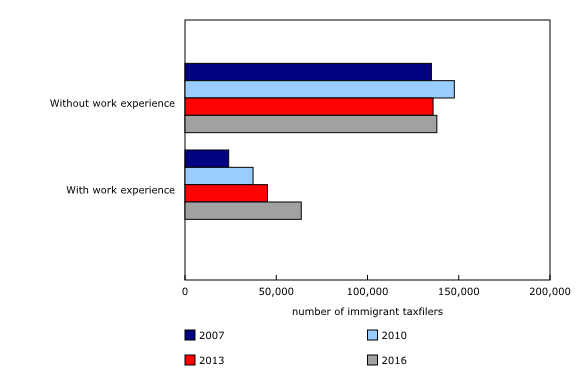
In recent years, an increasing number of non-permanent resident permit holders are transitioning to permanent residence. The observed growth in entry wages can be partly accounted for by differences in income between immigrants with pre-admission work experience in Canada and immigrants without such work experience. From the 2007 admission year to the 2016 admission year, the number of immigrant taxfilers one year after arrival who had work experience in Canada increased by 166%, while the number of immigrants without work experience rose 2%.

Chart 1  Chart 1: Number of immigrant taxfilers one year after admission, by admission year and work experience in Canada prior to admission
Number of immigrant taxfilers one year after admission, by admission year and work experience in Canada prior to admission

Chart 1: Number of immigrant taxfilers one year after admission, by admission year and work experience in Canada prior to admission

Immigrants who hold at least a pre-admission study permit have stronger wage catch-up in the 10 years after admission

Overall, immigrants’ wages increase with the number of years since admission and, for some, their wages eventually reach that of the overall Canadian population ($36,100). For example, the median wage for immigrants admitted in 2007 increased from $20,400 in 2008 to $33,500 in 2017, an increase of 64%.

Wage catch-up factors include pre-admission work experience, which facilitates integration through increased knowledge of official languages and the development of professional networks in Canada, among other things. In 2017, immigrants admitted in 2007 who had held both a study permit and a work permit prior to admission had the highest median wage (up 81% to $63,800), and their wage exceeded that of immigrants who held only a work permit (up 36% to $48,100) and that of Canadians as a whole. The median wage of immigrants admitted in 2007 who held only a pre-admission study permit increased significantly over 10 years (up 163% to $37,600) and now exceeds the median wage of immigrants without pre-admission experience (up 72% to $30,700).

Chart 2  Chart 2: Median wage of immigrants admitted in 2007, 1 year and 10 years after admission, by pre-admission experience
Median wage of immigrants admitted in 2007, 1 year and 10 years after admission, by pre-admission experience

Chart 2: Median wage of immigrants admitted in 2007, 1 year and 10 years after admission, by pre-admission experience

The median wage for asylum claimants increases with length of residence in country

Asylum claimants are individuals who request refugee protection in Canada. Because of their situation, they face many challenges in terms of economic integration. Even after their refugee claim is accepted, asylum claimants have lower median wages than other immigrants with pre-admission experience.

According to a Statistics Canada article on asylum claimants published earlier this year, the number of claimants fluctuated from 2000 to 2018 and reached over 50,000 in 2017 and 2018. Asylum claimants are relatively young. Of those who arrived in 2017, 39% were younger than 25 years of age, while 14% were aged 45 or older.

The median entry wage for asylum claimant taxfilers refers to their income one year after they submitted their refugee claim. Among those who claimed refugee status from 2006 to 2016, the median wage fluctuated between $10,900 and $16,000. As with immigrants, the median wage of asylum claimants increases with each additional year spent in the country. Therefore, the median wage for those who submitted a refugee claim in 2006 was $14,100 in 2007 and $28,600 in 2017.

There are significant differences in income among the top 15 countries of origin for asylum claimants. Among asylum claimants in 2012 who filed taxes in 2017, the highest median wages were reported by claimants from Sri Lanka ($31,600), Somalia ($30,700) and Nigeria ($30,700). Claimants from Afghanistan ($18,200), Iraq ($17,300) and China ($14,300) reported the lowest median wages.

Economic immigrants and their dependants stay more frequently in their province of admission when they have pre-admission work experience

Reasons for immigrating to Canada can influence the likelihood of immigrants to remain in their province of admission over time. For example, family class immigrants come to Canada to be closer to their loved ones, while economic immigrants are selected based on their ability to contribute to the Canadian economy.

In 2017, 86% of immigrant taxfilers admitted in 2012 filed a tax return in their province of admission. The provincial retention rate was highest among family-sponsored immigrants (93%) and slightly lower among refugees (87%). For economic immigrants and their dependants, the retention rate was 82%. However, for these immigrants, the rate was higher among those with a pre-admission work permit only (90%) than among those with no pre-admission experience (81%).