Study: Diversity is Shaping Pet Owner Population

Part of integration may be getting a pet:

Pets live in 67 million U.S. households, a statistic that is being driven by the increase in multicultural pet owners, according to a new report by market research firm Packaged Facts. Compared to a decade ago, pet owners are now more likely to be a member of a multicultural population segment, 28 percent in 2018 versus 22 percent in 2008, the report further noted.

“Between 2008 and 2018 the increase in the number of Hispanic, African American, Asian and other multicultural pet owners was five times higher than the increase in the number of non-Hispanic white pet owners,” said David Sprinkle, research director of Packaged Facts, which is headquartered in Rockville, Md.

Pet Population and Ownership Trends in the U.S: Dogs, Cats and Other Pets, 3rd Edition also revealed the following findings:

  • The number of Latinos owning pets increased 44 percent from 15 million in 2008 to 22 million in 2018, a growth rate vastly greater than that experienced among non-Hispanic white pet owners, according to the researchers.
  • Although a much smaller population, the number of Asian pet owners grew at the same rate (45 percent), between 2008 and 2018.
  • During the same period, the number of African American pet owners increased 24 percent.

The impact of Latinos on dog or cat ownership has been especially pronounced, the researchers also noted. Over the past decade, the number of Hispanic dog owners increased 59 percent. Likewise, the number of Latino cat owners increased 50 percent.

Overall, the report found that out of the more than half (54 percent) of American households that have a pet, dogs and cats are the most popular, coming in at 39 percent and 24 percent, respectively. One in eight households has other pets, including fish, birds, reptiles or small animals such as rabbits, hamsters or gerbils.

Source: Study: Diversity is Shaping Pet Owner Population

A.I. Systems Echo Biases They’re Fed, Putting Scientists on Guard

Yet another article emphasizing the risks:

Last fall, Google unveiled a breakthrough artificial intelligence technology called BERT that changed the way scientists build systems that learn how people write and talk.

But BERT, which is now being deployed in services like Google’s internet search engine, has a problem: It could be picking up on biases in the way a child mimics the bad behavior of his parents.

BERT is one of a number of A.I. systems that learn from lots and lots of digitized information, as varied as old books, Wikipedia entries and news articles. Decades and even centuries of biases — along with a few new ones — are probably baked into all that material.

BERT and its peers are more likely to associate men with computer programming, for example, and generally don’t give women enough credit. One program decided almost everything written about President Trump was negative, even if the actual content was flattering.

Feminist Senators are critical actors in women’s representation

Interesting take. Would also benefit from possible impact of visible minority and Indigenous senators:

The results of the federal election have produced much scrutiny over the number of women in Canadian Parliament. The Senate is nearing gender parity, with 60 percent of Prime Minister Trudeau’s appointments being women. Gender and politics scholarship has shown that meaningful representation of women’s interests is likely to occur not just because of a critical mass of women, but because of the presence of critical actors. It seems that a group of independent feminist senators have the potential to be critical actors in the representation of Canadian women’s policy interests. Their efforts will be ones to watch in the next Parliament.

The new Parliament will start in the coming weeks, and politicians will descend on Parliament Hill ready to get to work. They certainly haven’t forgotten the near-constitutional crisis at the end of the last Parliament. The Liberal government pushed many pieces of legislation through the House of Commons only to have them stall in the Senate. While some bills were passed, a few significant pieces of legislation died on the Senate’s Order Paper. Amidst the intensity of the last legislative session, a cadre of feminist independent senators worked hard to ensure that the interests of Canadian women were represented. When Parliament starts up again, these senators will surely continue to work together to pursue feminist initiatives in policy-making.

For decades, the Senate has had a better balance of men and women than the House of Commons has. However, we have no studies that show whether the presence of women senators has led to the effective representation of Canadian women’s policy interests.

In recent years, research on women’s representation has shifted focus. Rather than looking just at the number of women in Parliament, researchers are looking at the critical actors who represent women’s interests. We know that increasing the number of women in a legislature is likely to improve the representation of women’s policy interests. However, researchers have found the most important factor is that there are actually people in Parliament who are willing to stand up for women. The group of feminist Canadian senators could be those critical actors.

The new Senate appointment process allows individuals to nominate others or apply directly, and it emphasizes proficiency over partisanship. As a result, many feminists with specific expertise have been appointed as independent senators with free rein to form their own alliances.

Under the new appointment system, a number of Canadian feminist powerhouses have been introduced to Parliament. They bring with them a myriad of experience advocating for women’s interests. Donna Dasko helped found Equal Voice, which is a nonpartisan organization that supports women running for office in Canada. Kim Pate was formerly the director of the Canadian Association of Elizabeth Fry Societies, which advocates for women in the criminal justice system. Another senator who has fought for women’s rights is Marilou McPhedran, who was instrumental in getting section 15 equality rights into the CanadianCharter of Rights and Freedoms, and who helped to found the Women’s Legal Education and Action Fund. Mary Coyle has also promoted the rights of women and Indigenous peoples, setting up the First Peoples Fund to provide microfinancing to First Nations and Métis communities in Canada. Before entering politics, Frances Lankin was an active member of the Ontario Public Service Employees Union, where she acted as the provincial spokesperson for the Equal Pay Coalition. Rosemary Moodie comes from a career in maternal medicine, where she advocated for the expansion of quality health care to marginalized populations. The specific expertise that these senators bring to Parliament informs their work in the Senate.

There are also senators who have particular experience with advising governments on women’s issues. Wanda Thomas Bernard was the chair of the Nova Scotia Advisory Council on the Status of Women. Nancy Hartling cochaired the New Brunswick Minister’s Working Group on Violence Against Women. Julie Miville-Dechêne was the chair of the Quebec government’s Conseil du statut de la femme. These formidable women represent a few of the feminist senators who, along with many other senators, are working hard to represent women’s interests in the chamber as well.

With this influx of wide-ranging expertise, there have been questions about whether ad hoc Senate caucuses will form on different issues, especially because Liberal senators were removed from the party’s national caucus. Former senator Hugh Segal has been a supporter of that change. With the removal of party discipline, he says, “you could have a caucus on women’s issues, you could have a caucus on defence, you could have a caucus on First Nations issues, you could have regional caucuses.” The efforts of feminist senators seem to be an example of that prediction at work.

In fact, Pate, McPhedran and Coyle allied with NDP MP Christine Moore to found the Canadian Association of Feminist Parliamentarians in late 2018. It already has more than 60 members, and it is working on getting parliamentary approval. The association demonstrates the drive for collaboration and support among Canadian feminist senators.

In an illustration of collaboration between feminist senators, Senator Dasko has worked with her colleagues on oversight of Bill C-78, an Act to Amend the Divorce Act, which she identifies as a bill with vast importance for women: “I took on the responsibility for delving into it. A responsibility on behalf of a small group of senators, feminists as we were, who wanted to make sure that we understood the bill and made changes where we felt necessary.” She recounts a time when the group strategized that she would take the lead. Another senator gave her seat on the Legal and Constitutional Affairs Committee to Senator Dasko as a replacement, to ensure that she could deliberate and vote on the Divorce Act at the committee stage (since she had studied the bill’s subject matter and its weaknesses). This access to expertise is an example of the benefits of a cooperative feminist group.

Senator Dasko says she finds that “with the ISG senators, there are a lot of women…it really is a quite congenial work environment. I think we try to get along and we get along very well. I think we work very collaboratively.”

Before the Senate reform, senators’ memberships in party caucuses meant that they did a lot of collaborating behind closed doors, in caucus meetings. We cannot know the specifics of what feminist alliances might have been formed there, or the effects that they had. Now, a group of openly feminist senators operates within the context of a more independent Senate. This provides evidence that some members of the Senate are working in the interests of Canadian women.

Source: Feminist Senators are critical actors in women’s representation

Newsrooms not keeping up with changing demographics, study suggests

Likely not but not sure that focussing on columnists is the best measure of whether or not diversity is improving or not.

The analysis would also benefit from examining diversity in J-schools to see how that has changed over time:

Over the past two decades, as Canada’s demographics have shifted, news organizations have failed to reflect the country’s increasing diversity in both content and staffing.

Research on media coverage of race-related stories on politics from scholars like University of Toronto professor Erin Tolleyhas highlighted how far newsrooms have still to go.

But in Canada, most print and digital news organizations have resisted processes to examine their staffing. The conversation on the impact of industry job losses on newsroom diversity cannot advance until fundamental questions about staffing numbers are answered.

Our new study aims to fill in important information about newsroom staffing by showing how the demographics of national newspaper columnists compare to the increasing diversity of the Canadian population.

When it comes to news, who makes the decisions behind the scenes is just as important as whose byline is on the front page.

While Canadian broadcasters are federally mandated to report on their workforce demographics, newspapers and digital publications have no such requirement. In the United States, several national news organizations, including the New York Timesand BuzzFeed, have begun self-reporting the race and gender make-up of their newsrooms.

The American Society of News Editors (ASNE) has been conducting annual diversity studies of major newsrooms since 1978, allowing for the mapping of meaningful trends in how newsrooms hire, retain and promote journalists from diverse backgrounds.

“Counting gives us a starting point,” said Linda Shockley of the Dow Jones News Fund, which uses such demographic data to design training for U.S. journalists, in a recent interview with Poynter.

Racialized journalists drive diversity conversations

Recent conversations around diversity in media have been largely driven by racialized journalists, including the Toronto Star’s Shree Paradkar. Former Globe and Mail reporter Sunny Dhillon wrote about his decision to leave the paper after 10 years, frustrated by a continued editorial pattern of approaching complex stories through a “colour-blind lens.”

Columnist Desmond Cole stopped writing his twice-monthly freelance column for the Toronto Star after the paper’s editorial board editor barred him from his civic activism.

“If I must choose between a newspaper column and the actions I must take to liberate myself and my community, I choose activism in the service of Black liberation,” Cole wrote in a blog post.

There is little data on the breakdown of Black, Indigenous and people of colour (BIPOC) journalists in Canadian newsrooms. In 2004, Ryerson School of Journalism professor emeritus and former Toronto Star editor John Miller relied on voluntary participation for a survey on the demographic makeup of Canadian news organizations.

Some editors returned the survey empty; one scribbled across the page, “I find these questions insulting.” A few years later, Miller and Wendy Cukier, a professor at Ryerson University’s Ted Rogers School of Management, examined visible minority leadership at Toronto media organizations by using publicly available information and having it reviewed by researchers trained in employment equity.

Publications such as Canadaland (in 2016) and J-Source (in 2014and 2017) have also sought voluntary co-operation from news organizations and individual journalists with limited results.

‘Self-reporting’ offers window into staffing

To address the failure to engage in self-reporting by many Canadian news organizations, our study looks at the section of the newspaper where journalists often self-identify: the op-ed pages. In the process of expressing their perspectives on the issues of our time, columnists often disclose their identities.

We focused on news, city, opinion page and political columnists as they are most likely to shape social and political discussions.

For our 21-year study, we looked at Canada’s three largest publications, the Globe and Mail, the Toronto Star and the National Post, narrowing the scope of our research to include only those who wrote weekly columns or a minimum of 40 columns a year. In the end, we analyzed the work of 89 columnists, beginning in 1998 with the birth of the Post and ending in 2018.

Using terms of self-identification found in the columnists’ own words, in their published work and on their social media posts, we categorized their race and gender by census category.

Examples of self-identification that we found include phrases from columns such as “I, for one (old WASP),” “I, middle-class white lady” and “(as an) affluent white woman.” We then compared the numbers with corresponding census blocks over the 21-year period to chart how closely, along the lines of race and gender, columnists at Canadian newsrooms reflect Canada’s demographics.

In the 1996-2000 census period, white people comprised 88.8per cent of all Canadians, with two per cent Black, 2.8 per centIndigenous, 2.4 per cent South Asian and 3.5 per cent East Asian. By 2016, the numbers changed significantly: white, 77.7 per cent; Black 3.5 per cent; Indigenous 4.9 per cent; South Asian 5.6 per cent; and East Asian 5.4 per cent.

Our preliminary research shows that this demographic shift was not reflected in the makeup of Canadian columnists. Over the 21 years, as the proportion of white people in Canada’s population declined, the representation of white columnists increased.

Between 1998 and 2000, 92.8 per cent of columnists at the Globe and Mail, the Toronto Star and the National Post were white, over-representing corresponding census statistics by four per cent. And during the 2016-18 comparative period, while overall representation of white columnists dropped to 88.7 per cent of the columns pool, those numbers over-represented against the census numbers by 11 per cent.

Over the period of our study, not one of the publications had an Indigenous columnist who appeared regularly. Only three Black men and no Black women met our criteria for columnists.

Upholding trust and accountability

Our preliminary findings are concerning. For more than two decades, the voices that these publications chose to give prominence to did not reflect the perspectives and interests of a large segment of Canada’s population.

Self-reporting on newsroom diversity would encourage a culture of trust and accountability, one that the journalism profession upholds in its role as a watchdog of public institutions.

We are working on the development of a self-reporting tool for Canadian newsrooms, with the hope that such a strategy will be seen by media outlets as an invitation for redress.

After all, it’s impossible for Canada’s newsrooms to address a problem they can’t see. We are concerned that for the many who refuse to co-operate, that just may be the point.
Source: Newsrooms not keeping up with changing demographics, study suggests

New Trump Administration Proposal Would Charge Asylum Seekers an Application Fee

More fulsome article and information than posted previously. Not to improve service but to pay for ICE. Clear intent to reduce immigration and citizenship uptake:

The Trump administration on Friday proposed hiking a range of fees assessed on those pursuing legal immigration and citizenship, as well as for the first time charging those fleeing persecution for seeking protection in the United States.

The rule, which will be published on Thursday and will have a monthlong comment period, would increase citizenship fees more than 60 percent, to $1,170 from $725, for most applicants. For some, the increase would reach 83 percent. The government would also begin charging asylum seekers $50 for applications and $490 for work permits, a move that would make the United States one of four countries to charge people for asylum.

It would also increase renewal fees for hundreds of thousands of participants of the Deferred Action for Childhood Arrivals program, also known as DACA. That group, known as “Dreamers,”would need to pay $765, rather than $495, for a renewal request. The fee hike comes days before the Supreme Court is scheduled to hear arguments on the validity of President Trump’s justification to terminate DACA.

“Once again, this administration is attempting to use every tool at its disposal to restrict legal immigration and even U.S. citizenship,” said Doug Rand, a founder of Boundless Immigration, a technology company in Seattle that helps immigrants obtain green cards and citizenship. “It’s an unprecedented weaponization of government fees.”

The World’s Changing: England Favourite Jofra Archer Warns Racists, Says Multiculturalism Will Win

Of note:

England’s fast-bowling sensation Jofra Archer says cricket fans who resort to racist abuse should realise times have moved on and the world is a much more multicultural place. (More Cricket News)

The 24-year-old Barbados-born bowler has quickly become a favourite with the England fans since he became eligible to play for his adopted country earlier this year.

The Sussex star benefited from the England and Wales Cricket Board reducing the eligibility period from seven years to three so he did not have to wait till 2022.

He quickly showed his worth by bowling the decisive Super Over in the thrilling World Cup final win over New Zealand.

He then marked his test debut by flooring Australia’s star batsman Steve Smith in the second Ashes Test at Lord’s which saw him miss the following match at Headingley with a concussion and in his absence England won to level the series.

It was in the fourth Test at Old Trafford — which Australia won to ensure they retained the Ashes — that Archer was barracked by a couple of fans.

“I was aware what the guys were saying — something about my passport — but I blanked them,” he told The Daily Mail in an interview conducted in New Zealand where England are touring.

“It was only later that Rooty (Joe Root the England captain) said the guys got ejected.

“It was the first time I’d seen someone get ejected from a ground, because there were some abusive fans when we played Pakistan at Trent Bridge (heckling Ben Stokes).

More Multicultural

Archer, who says an elderly spectator at a county game with Kent had once queried how was he playing for Sussex, said racist incidents occurred far less in cricket than football.

“The world’s changing,” he said.

“It’s becoming more multicultural. A lot of people have accepted it for what it is.

“Look at the England cricket team — there’s huge diversity.

“It’s the same with any football club in the world.

“I think people have to accept it. Times have changed, it’s not 2007 any more.”

Archer says he sees himself as a role model to young British West Indians who have aspirations to play cricket for England.

“Yeah, to let them know it’s possible,” said Archer.

“It doesn’t really matter where you’re born.

“If you know that cricket’s what you want to do, you never know where you’ll end up.

“I didn’t know my dreams would come true and I’d end up playing cricket for England.

“If it happens for me, it can happen for anyone.”

Archer says being the man who bowled the decisive Super Over in the World Cup did not alter his profile.

“Not many England fans knew who I was anyway, so if they saw me in the street they probably thought I was a footballer, or something,” he said.

“I guess that was the beauty of it, being able to go under the radar.”

Source: The World’s Changing: England Favourite Jofra Archer Warns Racists, Says Multiculturalism Will Win

Federal judiciary edges closer to gender parity, but numbers of minorities drop


Hmm. Effect of change in Minister?:

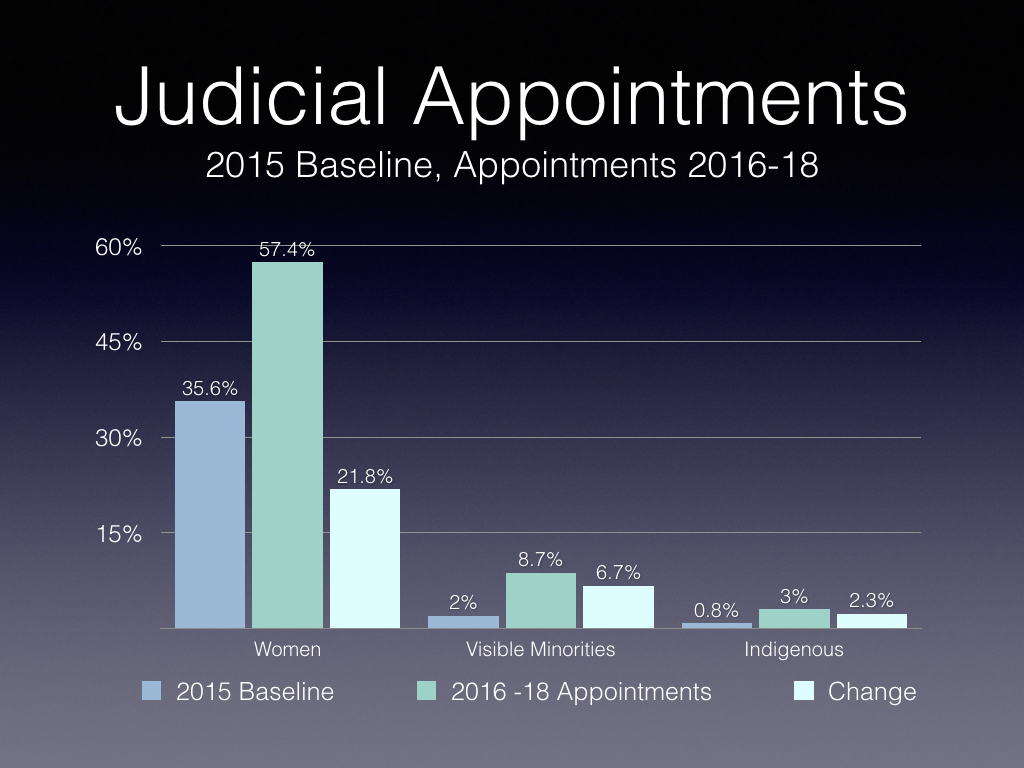
The federal judiciary is edging closer to gender parity after the second consecutive year in which more women than men were appointed judges, new data show. Women now make up 43 per cent of the 905 full-time judges.

But the numbers of minorities dropped, also for the second year in a row. There were just four members of visible-minority groups chosen, and two Indigenous persons, out of 86 new judges.

In the wake of the new statistics, some members of the legal community are urging the government to do more to appoint minorities to the bench.

“I think it is time now to redefine what we mean by merit,” said Daphne Dumont, a former president of the Canadian Bar Association who practises law in Charlottetown.

“I think you can be highly meritorious for all sorts of reasons that aren’t necessarily the reasons given in the application form that you have to fill in.” For instance, Indigenous lawyers who have returned to their home communities to bring them access to justice have shown merit. The process, she and others said, typically rewards those who are perceived as leaders through volunteering, teaching and participating on boards of legal associations.

The Liberal government revised the appointment process in 2016, with a stated emphasis on diversity. For the first time, the government asked judicial applicants whether they are disabled, a member of a visible minority or an ethnic/cultural minority, LGBTQ2 or Indigenous.

Each year, the Office of the Commissioner for Federal Judicial Affairs reports on the numbers of applicants and appointments from each of the groups. The numbers cover federally appointed courts such as the superior courts of provinces, the Federal Court of Canada and the Tax Court.

From October, 2016, to October, 2017, an equal number of men and women – 37 – were appointed to these courts, although men far outnumbered women among applicants. The following year, female applicants for the first time outnumbered males, and the numbers appointed also exceeded those of males – 46 to 33. This year, appointments were 47 women, 39 men.

By contrast, the numbers went down among the minority groups. This year (from October, 2018, to October, 2019), there were 20 appointees – 14 from ethnic/cultural groups; four visible minorities; two Indigenous; and zero categorized as LGBTQ2 or disabled. (There were 19 LGBTQ2 applicants and six disabled ones. Applicants can stay in the pool for two years.) The previous year, there were seven visible minorities, three Indigenous and 29 overall. The first year of the reports, in 2017, there were 32 – including nine visible minorities.

Rachel Rappaport, a spokeswoman for Justice Minister David Lametti, said the minister has met with legal organizations since his appointment early this year to encourage applicants from visible-minority, Indigenous, linguistic-minority and LGBTQ2 communities. The meetings were also a chance to identify barriers and work together on solutions to further expand the pool of candidates, she said.

Lori Anne Thomas, president of the Canadian Association of Black Lawyers, said the appointments of black and Indigenous judges have been “woefully lacking.” She said she was singling out those two groups because they are overrepresented in the criminal-justice system, and among families in the child-protection system.

“The women who are appointed are white women. It shows there have been a lot of efforts in the legal community to create fairness and equality when it comes to gender, but it’s still not there in terms of race, or Indigenous persons,” she said in an interview.

Ms. Thomas said she would like to see “more consideration” given to members of overrepresented communities – for instance, for overcoming obstacles.

“Those who are racialized won’t be given the same kind of opportunities to speak on panels, to lead cases in the same way that especially their white male counterparts would be given.”

On that point, Scott Maidment, president of the Advocates’ Society, a lawyers’ group, said change needs to come from within the legal profession, too. To become a judge, “You need opportunities for leadership within the profession.” The Advocates’ Society has revised its leadership principles to stress inclusivity, he said.

Source: 43 per cent of federal judges

The only way around the Home Office’s cruelty is to get your story in the news

Cutting. Bureaucratic systems can fail common sense:

There are eight words in the English language that, read together, trigger a unique combination of fury, despair and laughter familiar to anybody with experience of the UK border and its gatekeepers at the Home Office: “Each application is considered on its individual merits.”

Like a caterer talking about its commitment to hygiene the day after a front-page splash about some photogenic couple’s wedding-day E coli disaster, you usually only find these words stuck to the end of a press release in which the Home Office is admitting that it’s been caught out, having not done its job very well. Instead, it has upended somebody’s life for no good reason, ignoring or misjudging the facts of their case or the basic requirements of the law, bowing to the political goal of saying no wherever possible. And now, after an intervention from the press has drawn attention to somebody’s shocking mistreatment, the Home Office has miraculously conceded.

We have all read the stories. In the past few weeks alone, we’ve read about the academic who was told her children couldn’t live here with her. The NHS doctor threatened with removal because of a small mistake on her application form. The singer told to leave the countrydespite being born here. Each decision lacked basic common sense and respect for the individual. Each and every one was overturned after it hit the headlines.

It’s a great outcome for those who are able to get their story in front of a journalist, but I worry every day about the thousands of people who have the same right to justice but will never have that kind of luck. People who don’t have the wherewithal or the networks to demand justice. Or those who are vulnerable and therefore fearful of media attention. People forced to submit to the whims of a system that has been designed to break them. No system can ever be considered fair if your access to justice within it is based on your ability to win a popularity contest.

And despite mounting evidence that the department responsible for the Windrush scandal needs to be rebuilt from the ground up, this well-documented sticking-plaster strategy of quickly responding to high-profile cases serves to shield the Home Office from the kind of scrutiny that will lead to deeper reforms; reforms that have been called for in the leaked Windrush Lessons Learned review that the government is yet to publish. Reforms that even the staff of the Home Office believe are necessary for the system to be able to genuinely respond to and respect the merits and dignity of every applicant. But the fish rots from the head. And as long as it is politically convenient to mistreat those who were not born here, one of the great offices of state will remain synonymous with scandal and cruelty.

So, in this particular episode of Black Mirror, if you are one of the thousands of people unlucky enough to be served with a poorly worded rejection letter on the basis of what you are certain is an incorrect decision, unless you can get your story to go viral within 28 days, your journey to justice will be long and fraught. It doesn’t matter if the decision maker has made clear and obvious mistakes, such as telling you that Iran is a safe place for a lesbian to live or that you aren’t in a genuine relationship with the father of your children. Your only way out of this bureaucratic nightmare now is to tunnel your way through it by hand. You must file an appeal within 28 days. And with no legal aid available for most immigration cases, you either have to do this on your own or find a way to shell out for a lawyer to protect you from an army of suits on the government’s payroll. This is after paying thousands in Home Office fees for the pleasure of having your application thrown on a pile for weeks before being rejected in error.

The average wait for an appeal to be heard is now at least a year. And that period of limbo, during which your rights are limited while you wait for a judge to decide your fate can be incredibly painful. It is not uncommon for people to be driven deep into depression. Just like the tens of thousands forced to undergo personal independence payment assessments, or appealing against flawed welfare decisions, it’s dehumanising by design, the hope being that you will simply give up. It’s why so many members of the Windrush generation had, so tragically, given up altogether, hounded into submission or “self-deportation”.

Ultimately, in most cases that do make it to appeal, courts find that the Home Office was wrong. That equates to months and years of unnecessary suffering that could have so easily been avoided if the Home Office just committed to making quick, fair and correct decisions the first time around. There’s no publicly available data on how much money the Home Office spends defending decisions it knows are flawed but it is likely in the tens of millions of pounds. That’s money that could be spent on training and support for Home Office decision makers and caseworkers, or on legal aid.

For every person who manages to make it through the appeals process, there are many more who can’t afford it and give up, leaving an unwelcoming Britain behind, or staying here and becoming undocumented because, whatever the law says, they equally cannot be expected to leave their families and their homes. We see the cost of this ever-growing scandal every day, in lost lives and lost potential, and in the acceptance that it’s OK to treat people like this. And with the rollout of artificial intelligence and racial profiling algorithms into decisions that must, by their nature, be focused on the complexities of the human, this crisis will only get worse.

A lot will be said about immigration in this election campaign: about points-based this and Australian-style that. But a year and a half after the lid was blown on the Windrush scandal, the “hostile environment” policy and the deep failings of the Home Office, no party and no candidate should be allowed to get away without answering the question: how are we going to fix this? How are we going to ensure that justice is afforded to everybody, not just those who catch the spotlight?

Source: The only way around the Home Office’s cruelty is to get your story in the news

The diversity racket

While over-blown, including her claims about misleading data, the call for more meaningful and open conversations around what diversity means, and confronting one’s internal biases, whether right or left, is valid:

People of all stripes are undergoing an identity crisis. Although identity crises have long existed as part of the human condition, today’s crisis has emerged in tandem with, and in part as a reaction to, the diversity movement — or as proponents call it, diversity and inclusion (D&I).

Industry experts and D&I leaders comprise primarily of educated and ideologically homogeneous Westerners who dictate social norms, policies and the correct usage of language. Everyone else is forced to agree, or else be labelled an oppressor. Ironically, these experts are able to agree on a consistent ideology, precisely because diversity of thought is so lacking. Real diversity would mean inviting everyone to the conversation, not reaching a moral conclusion in an invite-only group and then forcing everyone else to adopt it because ‘that’s just the way it is now’.

D&I has created an immense pressure to use only socially approved language. A fear of offence runs so deep that censorship of speech is an inevitable outcome, both within and outside these circles. Language is changing so quickly – what was acceptable yesterday is racist today. For instance, in the consultation process to develop Canada’s latest anti-racism strategy, some of the participants said that once neutral words like ‘multiculturalism’ and ‘visible minority’ could be contributing to racism. For everyday people who don’t keep a pulse on these trends, this high turnover of acceptable language can be overwhelming and alienating. Unsurprisingly, this can also lead to further resistance and can tempt people towards the right, where there is less concern about being politically correct.

Big business and academia have jumped on the diversity train. ‘Inclusion strategists’ and ‘equity experts’ are highly sought after by multinational companies who want to inject diversity into their workplaces. Irshad Manji describes the emptiness of this phenomenon in her book, Don’t Label Me:

‘In America’s transactional culture, diversity amounts to slapping labels on individuals. People wind up packaged like products – crammed into prefabricated molds, presumed indistinguishable from others in the same category, handy for a momentary purpose and destined to be disposed of afterward.’

Governments follow closely behind industry, pouring millions of dollars into the diversity cause.

While the outpouring of support for marginalised groups is an important step towards equality and fair representation, these programmes continue to mask the structural cracks growing in society. These fault lines ready to slip at a moment’s notice. Government creates programmes to combat racism, but doesn’t make any attempts to understand the root causes of racism and discrimination in late capitalism in the first place.

Not only are social norms, language, and policy dictated by a few people at the table, but the structure and implementation of these D&I programmes is largely based on subjective individual accounts and self-reported questionnaires. These non-quantifiable assessments have been used to fund entire D&I departments in academia, business and government, where D&I experts are paid generously by unwitting taxpayers and students.

At one diversity and inclusion workshop I attended, the white female facilitator spoke at length about her white privilege and her internalised guilt as a white person. Through her own guilt, the certified D&I practitioner made the other white participants in the room feel ashamed and guilty on the basis of their whiteness alone. By the end of the training, I also felt culturally insignificant and ashamed of my own ‘whiteness’ – despite being an immigrant.

When the woke wonder why diversity rubs so many people up the wrong way, I want to point them to the above incident. I have heard variations of this time and again. Some people may feel guilty, while others may react defensively when they are told that their very existence is oppressive. ‘These days’, Irshad Manji writes, ‘to be labelled “white” is to learn that you’re a cultural non-entity’. What’s more, D&I advocates are eager to admonish white privilege while conveniently ignoring an entire group of underprivileged white people: the working class.

If we want to move beyond labels and have deeper conversations about diversity, we have to be willing to make mistakes and forgive each other when we do. To risk giving offence is the most concrete way we can bridge gaps together.

In 2017, the German newspaper Die Zeit organised a day of mass conversation. Hundreds of strangers were paired with people who held completely opposing political views. A total of 1,200 people showed up to have a simple conversation. The experiment was an overwhelming success. It has since inspired a global initiative called ‘My Country Talks’. The programme has provided a critical opportunity for people to re-learn how to talk to each other. Participants overwhelmingly reported having a better understanding of the ‘Other.’ They said that having a simple face-to-face conversation was enough for them to reconsider their own beliefs and be more understanding of those with opposing views. The experiment proved that an open conversation can pave the way towards greater understanding and empathy with each other.

Perhaps this is the most effective way diversity can be implemented – by the active participation of everyday people in real life circumstances. It’s a simple, but powerful starting point, and offers an opportunity for real exchange and insight.

At present, we funnel so much money into diversity while continuing to fail at it, despite good intentions. In my circles, where terms like ‘diversity,’ ‘oppression’ and ‘privilege’ are uttered on a daily basis, it is our responsibility to reflect on how our own biases and actions may be harmful to others – like preaching our dogmatic ideologies and expecting others to follow, or silencing others who disagree by using dangerous labels (no, not everyone to the right of you is racist).

As someone who genuinely believes in diversity, I’m often disappointed with both its advocates and critics for refusing to work together to bridge divides. For diversity to have any meaning at all, it needs to include people of all ideological stripes. Yet, here we are, excluding many of the people that need to be included in this global conversation. The diversity cause has turned into another excuse to engage with others who already fit into our own tightly sealed ideological bubbles and do away with everyone else.

Diversity and inclusion advocates are right to say that diversity is critical to a healthy democracy. But if we are going to continue selectively handpicking which types of diversity matter the most, and ignore the most significant inequalities and differences, then we really won’t progress much at all.

Source: The diversity racket

What Don Cherry forgets about Remembrance Day, hockey and what unites Canada

Great column by Shireen Ahmed, one of the best on Cherry, and appropriate call-out. To my surprise, Rogers and Sportsnet fired him – because it’s 2019?:

Arguably the most joyous day for my parents was not their kids’ university graduations nor the birth of their grandchildren (sorry, kids.) It was the day my mother met her sports hero, Guy Lafleur. She had purchased a brand new red hijab to match her Habs jersey. My father, a white-bearded Muslim man took dozens of photos, and met Elise Beliveau, the wife of Canadian legend Jean Beliveau. Later, I could hear the lump in his throat as he recalled the moment. My parents, immigrants to Canada, were received with happiness and pride that day at the Bell Centre.

In my world, that defined what hockey should be. On Saturday night in a segment for Hockey Night in Canada, Don Cherry showed precisely what hockey isn’t.

The NHL coach turned Coach’s Corner commentator went on a rant about why, in his opinion, there are fewer poppies worn. He targeted those living in downtown Toronto – who he once dismissed at “left-wing Pinkos”- and newcomers specifically.

“You people … you love our way of life, you love our milk and honey, at least you can pay a couple bucks for a poppy or something like that,” Mr. Cherry said. “These guys paid for your way of life that you enjoy in Canada, these guys paid the biggest price.” Any sentence that starts with “you people” should immediately raise red flags – but not for co-host Ron MacLean, who nodded along.

My maternal grandfather was in Burma fighting in the trenches with the Royal Indian Army. My paternal grandfather was in the Royal Indian Air Force. They sacrificed a tremendous amount, with the other allied nations. For Mr. Cherry to point at immigrant communities and blame them for a perceived lack of respect is disgusting and unacceptable. This, too, from a man who has never served a day in his life.

And how, precisely, does Mr. Cherry know there are fewer poppies being worn this year? And that immigrants aren’t donning them? Did he go out and survey the tin cans of donations from youth and community members selling poppies? Has he checked the lapels of people’s coats?

Further still, has Don Cherry ever acknowledged the many vets who are suffering from homelessness, substance abuse, mental health issues who get so little support? Has he commented on the Indigenous peoples who fought on the front lines only to come back to Canada and not be allowed to vote? Or the black men who served and were not welcomed in the sport he claims to love?

Does he know who has or has not supported the vets and their families with kindness, monetary gifts, and social supports? Is he familiar of the histories of black and brown bodies who were made to serve in wars created by rich, powerful white men?

If he is going to use a hockey platform, Mr. Cherry better get his facts straight.

Mr. Cherry is using his own politicized agenda to vilify people of colour and claim we are uncaring and disrespectful. His claims are not only untrue but disingenuous and unpatriotic. His sidekick, Ron MacLean, sat there nodding quietly affirming Cherry’s comments. Mr. MacLean allows his co-host to spew bigotry and is therefore complicit. I would be satisfied with Mr. Cherry being fired, but even happier with both being replaced. Perhaps with one of the amazing CWHL players – who are intelligent and talented athletes but without a league. If not them, then the fantastic team of Hockey Night Punjabi who do a fantastic job of sharing important stories and joy through hockey, in a manner that is desperately needed.

Sportsnet issued a lame apology Sunday morning, claiming that Mr. Cherry’s views are discriminatory and do “not reflect their values,” yet they continue to pay Mr. Cherry huge sums of money to share such views. If that doesn’t represent who they are as a media outlet, I’m not sure what does. Sunday evening, Ron MacLean also issued an apology and stated “I wished I had handled myself differently.” But he spoke for himself and on behalf of Mr. Cherry- and underlined that they “love hockey,” which made me uncomfortable. He called Mr. Cherry’s comments “divisive.” He spoke about making amends and in order to make amends, the mic needs to be passed. And for once, these men need to sit down, and just listen. A way to move forward is to simply get out of the way of progress.

Mr. MacLean also expressed that “our diversity is one of our country’s greatest strengths.” I agree with that; that diversity needs to be reflected in hockey media, and on Hockey Night in Canada.

It is time for Sportsnet to cut ties with Mr. Cherry unless they are keen on bankrolling the intolerant, unacceptable systems of discrimination that ruin sport. Fighting for justice and equality is what hockey needs. Don Cherry is the enemy of this fight. He needs to be muted – permanently.

For many Canadians, Remembrance Day is a time of solemn reflection, and on how to make this country better. I will honour my late grandfathers by fighting against bigotry.

We don’t need to be lectured on how to respect veterans and remember sacrifices – and certainly not by Don Cherry. Hockey deserves far more. Hockey is for everyone.