Anti-racism council unsure if it will continue its work under UCP government

More a rhetorical than a real question. Unlikely:

A government-led council dedicated to combat racism in Alberta appears to be in limbo, with its members saying they haven’t received any concrete direction on the future of their mandate from the new United Conservative government.

The Anti-Racism Advisory Council was put together under the NDP government in February, shortly before April’s provincial election that ended with a change in government. Spearheaded by then-education minister David Eggen, the council was the first of its kind in Alberta, and advised the government on the development of anti-racism and anti-discrimination programs.

The council has since been shifted to Multiculturalism and Status of Women Minister Leela Aheer, her ministry has confirmed. But since the change of government, the 24-member council hasn’t been active and hasn’t received any direction from Aheer on their mandate.

Heather Campbell and Lucenia Ortiz, the co-chairs of the advisory council, said they were introduced briefly to Aheer in a phone conversation May 24.

“We have not heard from minister Aheer or from any of her staff since then,” the co-chairs said in an email. They added they worry about the future of the council, as the new fiscal plan for the ministry makes no mention of funding allocated specifically to the council.

“It would be difficult for the council to hold meetings when there are no resources to cover travel and accommodation for many out-of-town members,” the co-chairs said. The council was intended to do the bulk of its work with the government in Edmonton, they added.

Aheer’s spokesperson Danielle Murray said in a statement that continuing to support diversity and inclusion is a priority of the government. Murray, however, did not answer questions about whether funding has been specifically allocated for the council to continue its work.

The Anti-Racism Advisory Council is part of a larger initiative that began under the previous government to take more bold action on addressing racism in the province, following the Quebec mosque shooting that killed six people and injured 19 in early 2017. Following the announcement of the council, the province received more than 300 applicants for its 24 seats.

Source: Anti-racism council unsure if it will continue its work under UCP government

Is It Time To Revive Canada’s Federal Immigrant Investor Program? – Immigration – Canada

Short answer: no it is not. And Singer conveniently omits the major reason for the program’s termination: no real benefits to Canada (see the IRCC evaluation Evaluation of the Federal Business Immigration Programhttps://www.canada.ca › ircc › ircc › english › pdf › pub › e2-2013_fbip):

As the US hikes investment limits for the EB-5, Canada should consider reviving the suspended Canada Immigrant Investor Program.

As the US implements a massive 80 percent hike in minimum investments for the EB-5 program, it is an appropriate time to question the rationale behind Canada’s decision to completely ignore investment immigration. 

The Canada Immigrant Investor Program was one of the most sought-after investment immigration programs in the world when it was terminated in June 2014. 

Reasons for its termination included:

  • High demand from wealthy investors.

  • Spiraling real estate prices due to the influx of foreign funds into the sector. 

  • Lack of real benefits to the Canadian economy, and 

  • Disquiet over sale of permanent residence status and, indirectly, Canadian citizenship.

Source: Is It Time To Revive Canada’s Federal Immigrant Investor Program? – Immigration – Canada

Researchers urge boycott of migration conference slated for China

The Star on our petition:

As Canada struggles to thaw its frosty relationship with China, academics and researchers are boycotting the world’s largest conference on migration, settlement and diversity to be held in Beijing.

The group has launched an online petition urging that the 2020 International Metropolis migration conference be relocated to a country other than China, due to its poor human rights record: the repression of the Muslim Uighur and Tibetan minorities, threats to Hong Kong’s legal and judicial independence, and the detention of foreign nationals, including Canadian businessman Michael Spavor and former diplomat Michael Kovrig.

Canada currently has a travel advisory for China urging people to exercise a high degree of caution due to “the risk of arbitrary enforcement of local laws” as well as one for Hong Kong because of the ongoing massive anti-government protests. So far, more than 150 academic researchers and other migration experts have signed the petition.

“If Canadian academics and policy-makers, as well as those from other countries, do not participate, it sends a signal that the regime cannot credibly claim to promote academic freedom or have inclusive policies around multiculturalism, immigration or diversity,” said Dalhousie University sociology professor Howard Ramos, who learned that Beijing would be the venue for next year’s conference in an email in late summer.

“Countries that host events on immigration and refugees should be ones that respect academic freedom and the rights of minorities,” he said. “Canada is a leading immigration country and Canadian experts are among the top in the field. A conference on immigration and refugees without them misses cutting-edge policy and scholarship.”

The conference is organized by the International Metropolis Network, made up of experts from around the world in migration and settlement policies as a platform where state officials, non-government organizations and researchers share ideas and discuss best policies to manage migration and integration.

A world leader in global migration, Canada was instrumental in the establishment of the international network of experts, with one of the organization’s three secretariats located at Carleton University. The event attracts as many as 1,000 participants and presenters a year and has been held around the world, including in Nagoya, Japan in 2016, the only time it was held in Asia.

Jan Rath, co-chair of the Metropolis International Steering Committee, said Metropolis has always been an “apolitical” body that believes in engagement and dialogue over isolation, and stands by the selection of the Beijing-based think tank, the Centre for China and Globalization, as the host of the 2020 conference.

Rath said they were aware of the “tense” relationship between Canada and China, adding that Beijing was picked after Berlin and Istanbul withdrew their bids.

“Canada is a free country and people are free to raise their concerns, but we want to make our points clear that we are not endorsing Chinese policies,” said Rath, a sociology professor at the University of Amsterdam. “The steering committee is co-hosting the conference with the think tank, which has no direct involvement of the Chinese government.”

However, Andrew Griffith, a former director-general with the Canadian immigration department, said the Centre for China and Globalization is effectively part of the Chinese government and he fears the conference will be used to legitimize Beijing’s policies and practices.

“It is highly likely that Chinese authorities will not permit a free and open exchange of ideas on relevant Chinese policy or practice. Foreign speakers will be discouraged from raising issues that might ‘offend’ the government,” said Griffith, who is among the initiators of the petition.

He said “minders” will be present to “monitor and intervene in the event of any real or perceived criticism.”

Source: Researchers urge boycott of migration conference slated for China

Immigrants’ occupational segregation in France: “brown-collar” jobs or a Sub-Saharan African disadvantage?

Unfortunately behind a paywall but looks interesting:

Large-scale labour migration is considered a recent phenomenon in most European countries; however, immigrants have been an integral part of the French labour-force nearly as long as in the United States. Numerous studies document Sub-Saharan African immigrants’ employment and wage disadvantages in France; however, few investigate an important aspect of Sub-Saharan African immigrants’ integration – occupational segregation. Using 2011 French census data, I examine Sub-Saharan African immigrants’ occupational segregation. I find that all immigrants are concentrated, but only Sub-Saharan Africans are concentrated in low-skilled work regardless of citizenship. Department-level regression analyses measuring occupational segregation show that after controlling for socioeconomic characteristics, Sub-Saharan Africans are most segregated. Control variables explain less of Sub-Saharan African women’s segregation than any other group indicating that they experience more discrimination in the labour market than even Sub-Saharan African men. Future research using longitudinal data is needed to determine if these results reflect a persistent disadvantage.

Source: https://www.tandfonline.com/doi/abs/10.1080/01419870.2019.1686162?journalCode=rers20

Canada expects a 40 per cent increase in citizenship among immigrants by 2024

Good overview by Kareem El-Assal, who included the need for a more meaningful performance standard:

A new Statistics Canada study that shows fewer recent immigrants are gaining Canadian citizenship is cause for concern, but improvements are on the horizon. 

Becoming a citizen is one of the defining life moments of Canada’s immigrants. It marks the end of their newcomer journey and the beginning of their journey as a Canadian with the same rights as those born in Canada. These include the right to vote, to run for political office, to gain preferential treatment when applying to government jobs, to travel with a Canadian passport, and to travel outside of Canada indefinitely.

Canada takes pride in supporting the citizenship journey of immigrants as the country’s high rate of citizenship acquisition is an important indicator that Canada does a good job of facilitating integration. A 2018 study by the Organisation for Economic Co-operation and Development (OECD) reported that 91 per cent of immigrants who had lived in Canada for at least 10 years held citizenship, compared with the OECD average of 63 per cent. Other top destinations for immigrants such as Australia (81 per cent) and the United States (62 per cent) lag behind Canada by a wide margin.

Citizenship acquisition is down

Statistics Canada’s new study finds that citizenship acquisition stood at 86 per cent at the time of the 2016 Census compared with 82 per cent during the 1991 Census.

This promising finding, however, is overshadowed by the significant decline in citizenship acquisition among more recent immigrant cohorts.

In 1996, for example, 68 per cent of eligible immigrants who had been in Canada for five years were citizens, but this figure fell to 43 per cent in 2016. In fact, Statistics Canada’s analysis found that the citizenship rate for most immigrant cohorts fell in 2016 compared with the 2006 Census. Immigrants with low income, official language proficiency, and education have experienced the sharpest drop in naturalization.

Why has naturalization fallen among recent immigrants?

Statistics Canada’s analysis strongly suggests that citizenship policy changes made by Canada over the past decade have hurt naturalization rates.

In 2010, Canada introduced new language requirements and a new citizenship exam. Immigrants between the ages of 14 and 64 had to demonstrate a minimum language proficiency and obtain a pass mark of at least 75 per cent on their citizenship exam (the previous pass mark was 60 per cent). In 2017, these requirements were reversed to only apply to those aged between 18 and 54.

The rationale for these changes was to ensure immigrants were integrating into Canadian society by demonstrating their language proficiency and understanding of Canada’s history, geography, politics, laws, and economy. The government also introduced multiple versions of the citizenship test to reduce cheating and ensure immigrants had a strong knowledge of the topics that it covered.

In addition, the federal government increased the citizenship application fee from $100 to $300 for adults in February 2014 and then raised it again to $530 in January 2015. The fee for children remained the same at $100. Both adult and child applicants also had to pay an extra $100 “right of citizenship fee.”

The fee hikes were justified on the basis they helped the government recover the costs of processing citizenship applications.

Stricter language proficiency and citizenship test requirements have made it more difficult for immigrants with weak language skills and low education to become citizens.

Moreover, the increase in citizenship fees made it less affordable for low-income immigrants to apply for citizenship. Consider that it currently costs a total of $630 per person to apply for citizenship. A family of four needs to pay $1,500, which may be difficult if they are barely making ends meet.

Citizenship rates should increase

Recent policy shifts could improve naturalization rates in the coming years.

For instance, Canada has increased its economic class selection standards over the past decade, which means more immigrants are arriving with higher levels of language proficiency. Family class immigrants tend to have similar socio-economic characteristics as the Canadian citizens and permanent residents sponsoring them, which means that higher economic class selection standards should result in more family class immigrants arriving with higher human capital.

Reducing language test and citizenship exam requirements for only those between the ages of 18 and 54 will likely also improve citizenship rates since older immigrants tend to have weaker English or French skills than younger ones.

The cost will also no longer be a prohibitive factor in applying for citizenship if the Liberals enact their 2019 federal election campaign promise to waive citizenship fees entirely.

Set better performance standards

One major area for improvement, according to Andrew Griffith, a Canadian citizenship policy researcher, is the introduction of better performance standards that enable the federal government to track how quickly recent immigrants are becoming citizens.

In a recent column, Griffith observes that the federal government tends to measure success based on the total number of eligible immigrants who become citizens, irrespective of when they moved to Canada.

A limitation of this approach is it fails to capture how immigration and citizenship policy reforms and socioeconomic conditions are affecting citizenship uptake of recent immigrant arrivals.

Griffith argues that a more prudent approach to measuring Canada’s effectiveness in supporting integration and citizenship acquisition is by setting performance standards that formally measure the citizenship rates of recent immigrants (those in Canada 5-9 years).

This would enable Canada to make policy adjustments as required to promote higher citizenship rates among this cohort.

40 per cent increase by 2024?

The Liberal campaign platform forecasted they will spend $110 million in 2023-2024 to process citizenship applications compared with the $75 million to be spent over the coming federal government fiscal year.

This 40 per cent increase in spending suggests the government expects a 40 per cent increase in new citizens by 2024.

If this is the case, Canada will reverse its declining rate of naturalization among recent immigrants in the coming years — and that would further cement Canada’s leadership among its OECD peers in facilitating integration.

Source: https://www.cicnews.com/2019/11/canada-expects-a-40-per-cent-increase-in-citizenship-among-immigrants-by-2024-1113203.html

New data to show that Ottawa police continue to disproportionately pull over Middle Eastern and black drivers

And so it continues. To its credit, the OPS continues to collect this data after the period mandated by the settlement:

Data from the continued collection of race data from all traffic stops conducted by Ottawa police continues to show disproportionate numbers of Middle Eastern and black drivers being stopped by police, according to an email sent to all officers by Chief Peter Sloly in advance of Wednesday’s public release of two studies.

Police were to hold a “technical briefing” for media Wednesday morning detailing the findings of the second set of race data collection during traffic stops. The original project was mandated as a result of a human rights settlement with the police service after a young black man alleged he was racially profiled when he was pulled over while driving a luxury vehicle. Though Ottawa police were only required to collect data on the perceived race of drivers that officers pulled over from 2013 to 2015, the force opted to continue the project.

The report details the second set of that data and “shows that while there are modest decreases in disproportionate rates, we continue to see high disproportionate rates of Black and Middle Eastern males being stopped,” Sloly told officers. In 2016, the findings from the first set of data was largely the same.

The service was also to release the results of a “diversity audit” on Wednesday that surveyed the state of the service’s own diversity. That audit “shows that, while we are making progress in many areas such as outreach recruitment and the new neighbourhood resource teams, we still have work to do on leadership and governance, policy, human resource management, promotional processes, and community policing and engagement,” Sloly wrote.

“These are not easy issues to face in any profession and I know that community comments and criticism are felt by front-line police officers first,” he said.

Sloly said the reports contain “difficult findings” but that he vows that the service will not blame officers and instead will work with them and the community to “improve our systems.”

The reports, too, contain “opportunities to address systemic barriers and make policing better for everyone.”

Sloly wrote that “bias, racial profiling and other forms of discrimination” can exist in policing as they do in the rest of society but that the documents are proof that there have been efforts to address both the community’s and officers’ concerns.

“We are going to continue to strive for professional and equitable policing,” the chief said. “We have to work together to move from reports and recommendations to greater action.”

Source: New data to show that Ottawa police continue to disproportionately pull over Middle Eastern and black drivers

Marco Mendicino appointed new Canadian immigration minister: Backstory?

A possible backstory for this appointment is that there has been considerable discontent among some Italian Canadians over their relative under-representation in key posts (see the Saint-Léonard Saint-Michel Liberal nomination where a non-Italian, Hassan Guillet, won what was viewed as an Italian Canadian seat before his candidacy being revoked by the LPC and being replaced by Patricia Lattanzio).

More notably, former Liberal immigration minister in the Martin government and current editor of Corriere Canadese, Joe Volpe, has been particularly strident in his critique of Ahmed Hussen:

“Corriere publisher Joe Volpe exhorts Anne McLellan, advisor to Justin Trudeau, to tell the Prime Minister to get rid of those federal ministers who never should have been called to government, first among them Ahmed Hussen. As Immigration Minister, Hussen has been a complete disaster. Nonetheless, approximately 300,000 new entrants, as well as international student visa holders, refugees, and the more than one million undocumented workers (and their families), are at his mercy. Closer to home, he has not lifted a finger to make use of the human resources potential of Italian emigrants ‘young, educated and skilled’ who are leaving Italy each year, going everywhere except Canada. Dismiss him before he causes more damage to the country’s demographic fabric and the Liberal brand, Volpe says.” (1 November, Italian, Corriere Canadese)

—-

Prime Minister Justin Trudeau has named Marco Mendicino as Canada’s next Minister of Immigration Refugee and Citizenship Canada.

Mendicino has an extensive background in law. For nearly 10 years he worked as a federal prosecutor, during which time he put members of the “Toronto 18” terror group behind bars. He also worked at the Law Society of Upper Canada, and was the President of the Association of Justice Counsel, where he served for two terms. Mendicino has also advocated for better laws on organized crime and access to justice before the House of Commons and the Senate.

At the time of swearing-in on November 20, he was serving as the parliamentary secretary to the Minister of Infrastructure and Communities. He was involved in advancing government green infrastructure and social infrastructure in Toronto and across Canada.

He was re-elected as the Member of Parliament in the Eglinton-Lawrence riding on October 21, 2019 with 53 per cent of voter support. Before being elected in 2015 he developed a lunch program for families with children going into kindergarten or the installation of a new turf field at John Wanless Public School.

In 2017 he served as the Parliamentary Secretary to the Minister of Justice and Attorney General of Canada, where he helped to advance federal priorities such as Criminal Justice Reform, Reconciliation with Indigenous peoples and Restorative Justice.

The new Minister of Immigration also sat on a number of boards and has been involved with the John Wanless Childcare Centre, John Wanless Public School, North Toronto Soccer Club, COSTI Immigration Services, the Toronto Symphony Volunteer Committee and Heart & Stroke Canada.

Mendicino will be replacing Ahmed Hussen who lead Immigration, Refugee and Citizenship Canada (IRCC) since 2017. Hussen will be taking over the role of Minister of Families Children and Social Development.

Source: https://www.cicnews.com/2019/11/marco-mendicino-appointed-new-canadian-immigration-minister-1113215.html#gs.hcxcwg

THE XINJIANG PAPERS ‘Absolutely No Mercy’: Leaked Files Expose How China Organized Mass Detentions of Muslims

Incredibly detailed reporting on the extensive and highly organized efforts by the Chinese government to repress knowledge of its repression of its Uighur muslim minority, and the chilling nature of the Chinese bureaucracy at work.

Of note to those who preach engagement at any cost and no matter the interlocutor and subject:

The students booked their tickets home at the end of the semester, hoping for a relaxing break after exams and a summer of happy reunions with family in China’s far west.

Instead, they would soon be told that their parents were gone, relatives had vanished and neighbors were missing — all of them locked up in an expanding network of detention camps built to hold Muslim ethnic minorities.

The authorities in the Xinjiang region worried the situation was a powder keg. And so they prepared.

The leadership distributed a classified directive advising local officials to corner returning students as soon as they arrived and keep them quiet. It included a chillingly bureaucratic guide for how to handle their anguished questions, beginning with the most obvious: Where is my family?

They’re in a training school set up by the government,” the prescribed answer began. If pressed, officials were to tell students that their relatives were not criminals — yet could not leave these “schools.”
The question-and-answer script also included a barely concealed threat: Students were to be told that their behavior could either shorten or extend the detention of their relatives.
I’m sure that you will support them, because this is for their own good,” officials were advised to say, “and also for your own good.

The directive was among 403 pages of internal documents that have been shared with The New York Times in one of the most significant leaks of government papers from inside China’s ruling Communist Party in decades. They provide an unprecedented inside view of the continuing clampdown in Xinjiang, in which the authorities have corralled as many as a million ethnic Uighurs, Kazakhs and others into internment camps and prisons over the past three years.

Read the Full Document: What Chinese Officials Told Children Whose Families Were Put in Camps

The party has rejected international criticism of the camps and described them as job-training centers that use mild methods to fight Islamic extremism. But the documents confirm the coercive nature of the crackdown in the words and orders of the very officials who conceived and orchestrated it.

Even as the government presented its efforts in Xinjiang to the public as benevolent and unexceptional, it discussed and organized a ruthless and extraordinary campaign in these internal communications. Senior party leaders are recorded ordering drastic and urgent action against extremist violence, including the mass detentions, and discussing the consequences with cool detachment.

Children saw their parents taken away, students wondered who would pay their tuition and crops could not be planted or harvested for lack of manpower, the reports noted. Yet officials were directed to tell people who complained to be grateful for the Communist Party’s help and stay quiet.

The leaked papers offer a striking picture of how the hidden machinery of the Chinese state carried out the country’s most far-reaching internment campaign since the Mao era. The key disclosures in the documents include:

President Xi Jinping, the party chief, laid the groundwork for the crackdown in a series of speeches delivered in private to officials during and after a visit to Xinjiang in April 2014, just weeks after Uighur militants stabbed more than 150 people at a train station, killing 31. Mr. Xi called for an all-out “struggle against terrorism, infiltration and separatism” using the “organs of dictatorship,” and showing “absolutely no mercy.”

Terrorist attacks abroad and the drawdown of American troops in Afghanistan heightened the leadership’s fears and helped shape the crackdown. Officials argued that attacks in Britain resulted from policies that put “human rights above security,” and Mr. Xi urged the party to emulate aspects of America’s “war on terror” after the Sept. 11 attacks.

The internment camps in Xinjiang expanded rapidly after the appointment in August 2016 of Chen Quanguo, a zealous new party boss for the region. He distributed Mr. Xi’s speeches to justify the campaign and exhorted officials to “round up everyone who should be rounded up.”

The crackdown encountered doubts and resistance from local officials who feared it would exacerbate ethnic tensions and stifle economic growth. Mr. Chen responded by purging officials suspected of standing in his way, including one county leader who was jailed after quietly releasing thousands of inmates from the camps.

The leaked papers consist of 24 documents, some of which contain duplicated material. They include nearly 200 pages of internal speeches by Mr. Xi and other leaders, and more than 150 pages of directives and reports on the surveillance and control of the Uighur population in Xinjiang. There are also references to plans to extend restrictions on Islam to other parts of China.

The documents include 96 pages of internal speeches by Mr. Xi, 102 pages of internal speeches by other officials, 161 pages of directives and reports on the surveillance and control of the Uighur population in Xinjiang and 44 pages of material from internal investigations into local officials.

Though it is unclear how the documents were gathered and selected, the leak suggests greater discontent inside the party apparatus over the crackdown than previously known. The papers were brought to light by a member of the Chinese political establishment who requested anonymity and expressed hope that their disclosure would prevent party leaders, including Mr. Xi, from escaping culpability for the mass detentions.

The Chinese leadership wraps policymaking in secrecy, especially when it comes to Xinjiang, a resource-rich territory located on the sensitive frontier with Pakistan, Afghanistan and Central Asia. Predominantly Muslim ethnic minority groups make up more than half the region’s population of 25 million. The largest of these groups are the Uighurs, who speak a Turkic language and have long faced discrimination and restrictions on cultural and religious activities.

Beijing has sought for decades to suppress Uighur resistance to Chinese rule in Xinjiang. The current crackdown began after a surge of antigovernment and anti-Chinese violence, including ethnic riots in 2009 in Urumqi, the regional capital, and a May 2014 attack on an outdoor market that killed 39 people just days before Mr. Xi convened a leadership conference in Beijing to set a new policy course for Xinjiang.

Since 2017, the authorities in Xinjiang have detained many hundreds of thousands of Uighurs, Kazakhs and other Muslims in internment camps. Inmates undergo months or years of indoctrination and interrogation aimed at transforming them into secular and loyal supporters of the party.

Of the 24 documents, the directive on how to handle minority students returning home to Xinjiang in the summer of 2017 offers the most detailed discussion of the indoctrination camps — and the clearest illustration of the regimented way the party told the public one story while mobilizing around a much harsher narrative internally.

Even as the document advises officials to inform students that their relatives are receiving “treatment” for exposure to radical Islam, its title refers to family members who are being “dealt with,” or chuzhi, a euphemism used in party documents to mean punishment.

Officials in Turpan, a city in eastern Xinjiang, drafted the question-and-answer script after the regional government warned local officials to prepare for the returning students. The agency coordinating efforts to “maintain stability” across Xinjiang then distributed the guide across the region and urged officials to use it as a model.

The government sends Xinjiang’s brightest young Uighurs to universities across China, with the goal of training a new generation of Uighur civil servants and teachers loyal to the party.

The crackdown has been so extensive that it affected even these elite students, the directive shows. And that made the authorities nervous.

“Returning students from other parts of China have widespread social ties across the entire country,” the directive noted. “The moment they issue incorrect opinions on WeChat, Weibo and other social media platforms, the impact is widespread and difficult to eradicate.”

The document warned that there was a “serious possibility” students might sink into “turmoil” after learning what had happened to their relatives. It recommended that police officers in plain clothes and experienced local officials meet them as soon as they returned “to show humane concern and stress the rules.”
The directive’s question-and-answer guide begins gently, with officials advised to tell the students that they have “absolutely no need to worry” about relatives who have disappeared.
Tuition for their period of study is free and so are food and living costs, and the standards are quite high,” officials were told to say, before adding that the authorities were spending more than $3 per day on meals for each detainee, “even better than the living standards that some students have back home.
If you want to see them,” the answer concluded, “we can arrange for you to have a video meeting.

The authorities anticipated, however, that this was unlikely to mollify students and provided replies to a series of other questions: When will my relatives be released? If this is for training, why can’t they come home? Can they request a leave? How will I afford school if my parents are studying and there is no one to work on the farm?

The guide recommended increasingly firm replies telling the students that their relatives had been “infected” by the “virus” of Islamic radicalism and must be quarantined and cured. Even grandparents and family members who seemed too old to carry out violence could not be spared, officials were directed to say.

“If they don’t undergo study and training, they’ll never thoroughly and fully understand the dangers of religious extremism,” one answer said, citing the civil war in Syria and the rise of the Islamic State. “No matter what age, anyone who has been infected by religious extremism must undergo study.”

Students should be grateful that the authorities had taken their relatives away, the document said.

“Treasure this chance for free education that the party and government has provided to thoroughly eradicate erroneous thinking, and also learn Chinese and job skills,” one answer said. “This offers a great foundation for a happy life for your family.”

The authorities appear to be using a scoring system to determine who can be released from the camps: The document instructed officials to tell the students that their behavior could hurt their relatives’ scores, and to assess the daily behavior of the students and record their attendance at training sessions, meetings and other activities.

Family members, including you, must abide by the state’s laws and rules, and not believe or spread rumors,” officials were told to say. “Only then can you add points for your family member, and after a period of assessment they can leave the school if they meet course completion standards.
If asked about the impact of the detentions on family finances, officials were advised to assure students that “the party and the government will do everything possible to ease your hardships.
The line that stands out most in the script, however, may be the model answer for how to respond to students who ask of their detained relatives, “Did they commit a crime?
The document instructed officials to acknowledge that they had not. “It is just that their thinking has been infected by unhealthy thoughts,” the script said.
Freedom is only possible when this ‘virus’ in their thinking is eradicated and they are in good health.

Secret Speeches

The ideas driving the mass detentions can be traced back to Xi Jinping’s first and only visit to Xinjiang as China’s leader, a tour shadowed by violence.

In 2014, little more than a year after becoming president, he spent four days in the region, and on the last day of the trip, two Uighur militants staged a suicide bombing outside a train station in Urumqi that injured nearly 80 people, one fatally.

Weeks earlier, militants with knives had gone on a rampage at another railway station, in southwest China, killing 31 people and injuring more than 140. And less than a month after Mr. Xi’s visit, assailants tossed explosives into a vegetable market in Urumqi, wounding 94 people and killing at least 39.

Against this backdrop of bloodshed, Mr. Xi delivered a series of secret speeches setting the hard-line course that culminated in the security offensive now underway in Xinjiang. While state media have alluded to these speeches, none were made public.

The text of four of them, though, were among the leaked documents — and they provide a rare, unfiltered look at the origins of the crackdown and the beliefs of the man who set it in motion.

“The methods that our comrades have at hand are too primitive,” Mr. Xi said in one talk, after inspecting a counterterrorism police squad in Urumqi. “None of these weapons is any answer for their big machete blades, ax heads and cold steel weapons.”

“We must be as harsh as them,” he added, “and show absolutely no mercy.”

In free-flowing monologues in Xinjiang and at a subsequent leadership conference on Xinjiang policy in Beijing, Mr. Xi is recorded thinking through what he called a crucial national security issue and laying out his ideas for a “people’s war” in the region.

Although he did not order mass detentions in these speeches, he called on the party to unleash the tools of “dictatorship” to eradicate radical Islam in Xinjiang.

Mr. Xi displayed a fixation with the issue that seemed to go well beyond his public remarks on the subject. He likened Islamic extremism alternately to a virus-like contagion and a dangerously addictive drug, and declared that addressing it would require “a period of painful, interventionary treatment.”

“The psychological impact of extremist religious thought on people must never be underestimated,” Mr. Xi told officials in Urumqi on April 30, 2014, the final day of his trip to Xinjiang. “People who are captured by religious extremism — male or female, old or young — have their consciences destroyed, lose their humanity and murder without blinking an eye.”

In another speech, at the leadership conclave in Beijing a month later, he warned of “the toxicity of religious extremism.”

“As soon as you believe in it,” he said, “it’s like taking a drug, and you lose your sense, go crazy and will do anything.”

In several surprising passages, given the crackdown that followed, Mr. Xi also told officials to not discriminate against Uighurs and to respect their right to worship. He warned against overreacting to natural friction between Uighurs and Han Chinese, the nation’s dominant ethnic group, and rejected proposals to try to eliminate Islam entirely in China.

“In light of separatist and terrorist forces under the banner of Islam, some people have argued that Islam should be restricted or even eradicated,” he said during the Beijing conference. He called that view “biased, even wrong.”

But Mr. Xi’s main point was unmistakable: He was leading the party in a sharp turn toward greater repression in Xinjiang.

Before Mr. Xi, the party had often described attacks in Xinjiang as the work of a few fanatics inspired and orchestrated by shadowy separatist groups abroad. But Mr. Xi argued that Islamic extremism had taken root across swaths of Uighur society.

In fact, the vast majority of Uighurs adhere to moderate traditions, though some began embracing more conservative and more public religious practices in the 1990s, despite state controls on Islam. Mr. Xi’s remarks suggest he was alarmed by the revival of public piety. He blamed lax controls on religion, suggesting that his predecessors had let down their guard.

While previous Chinese leaders emphasized economic development to stifle unrest in Xinjiang, Mr. Xi said that was not enough. He demanded an ideological cure, an effort to rewire the thinking of the region’s Muslim minorities.

“The weapons of the people’s democratic dictatorship must be wielded without any hesitation or wavering,” Mr. Xi told the leadership conference on Xinjiang policy, which convened six days after the deadly attack on the vegetable market.

The Soviet Prism

Mr. Xi is the son of an early Communist Party leader who in the 1980s supported more relaxed policies toward ethnic minority groups, and some analysts had expected he might follow his father’s milder ways when he assumed leadership of the party in November 2012.

But the speeches underscore how Mr. Xi sees risks to China through the prism of the collapse of the Soviet Union, which he blamed on ideological laxity and spineless leadership.

Across China, he set about eliminating challenges to party rule; dissidents and human rights lawyers disappeared in waves of arrests. In Xinjiang, he pointed to examples from the former Soviet bloc to argue that economic growth would not immunize a society against ethnic separatism.

The Baltic republics were among the most developed in the Soviet Union but also the first to leave when the country broke up, he told the leadership conference. Yugoslavia’s relative prosperity did not prevent its disintegration either, he added.

“We say that development is the top priority and the basis for achieving lasting security, and that’s right,” Mr. Xi said. “But it would be wrong to believe that with development every problem solves itself.”

In the speeches, Mr. Xi showed a deep familiarity with the history of Uighur resistance to Chinese rule, or at least Beijing’s official version of it, and discussed episodes rarely if ever mentioned by Chinese leaders in public, including brief periods of Uighur self-rule in the first half of the 20th century.

Violence by Uighur militants has never threatened Communist control of the region. Though attacks grew deadlier after 2009, when nearly 200 people died in ethnic riots in Urumqi, they remained relatively small, scattered and unsophisticated.

Even so, Mr. Xi warned that the violence was spilling from Xinjiang into other parts of China and could taint the party’s image of strength. Unless the threat was extinguished, Mr. Xi told the leadership conference, “social stability will suffer shocks, the general unity of people of every ethnicity will be damaged, and the broad outlook for reform, development and stability will be affected.”

Setting aside diplomatic niceties, he traced the origins of Islamic extremism in Xinjiang to the Middle East, and warned that turmoil in Syria and Afghanistan would magnify the risks for China. Uighurs had traveled to both countries, he said, and could return to China as seasoned fighters seeking an independent homeland, which they called East Turkestan.

“After the United States pulls troops out of Afghanistan, terrorist organizations positioned on the frontiers of Afghanistan and Pakistan may quickly infiltrate into Central Asia,” Mr. Xi said. “East Turkestan’s terrorists who have received real-war training in Syria and Afghanistan could at any time launch terrorist attacks in Xinjiang.”

Mr. Xi’s predecessor, Hu Jintao, responded to the 2009 riots in Urumqi with a clampdown but he also stressed economic development as a cure for ethnic discontent — longstanding party policy. But Mr. Xi signaled a break with Mr. Hu’s approach in the speeches.

“In recent years, Xinjiang has grown very quickly and the standard of living has consistently risen, but even so ethnic separatism and terrorist violence have still been on the rise,” he said. “This goes to show that economic development does not automatically bring lasting order and security.”

Ensuring stability in Xinjiang would require a sweeping campaign of surveillance and intelligence gathering to root out resistance in Uighur society, Mr. Xi argued.

He said new technology must be part of the solution, foreshadowing the party’s deployment of facial recognition, genetic testing and big data in Xinjiang. But he also emphasized old-fashioned methods, such as neighborhood informants, and urged officials to study how Americans responded to the Sept. 11 attacks.

Like the United States, he said, China “must make the public an important resource in protecting national security.”

“We Communists should be naturals at fighting a people’s war,” he said. “We’re the best at organizing for a task.”

The only suggestion in these speeches that Mr. Xi envisioned the internment camps now at the heart of the crackdown was an endorsement of more intense indoctrination programs in Xinjiang’s prisons.

“There must be effective educational remolding and transformation of criminals,” he told officials in southern Xinjiang on the second day of his trip. “And even after these people are released, their education and transformation must continue.”

Within months, indoctrination sites began opening across Xinjiang — mostly small facilities at first, which held dozens or hundreds of Uighurs at a time for sessions intended to pressure them into disavowing devotion to Islam and professing gratitude for the party.

Then in August 2016, a hard-liner named Chen Quanguo was transferred from Tibet to govern Xinjiang. Within weeks, he called on local officials to “remobilize” around Mr. Xi’s goals and declared that Mr. Xi’s speeches “set the direction for making a success of Xinjiang.”

New security controls and a drastic expansion of the indoctrination camps followed.

The struggle against terror and to safeguard stability is a protracted war, and also a war of offense,” Mr. Chen said in a speech to the regional leadership in October 2017 that was among the leaked papers.
In another document, a record of his remarks in a video conference in August 2017, he cited “vocational skills, education training and transformation centers” as an example of “good practices” for achieving Mr. Xi’s goals for Xinjiang.

The crackdown appears to have smothered violent unrest in Xinjiang, but many experts have warned that the extreme security measures and mass detentions are likely to breed resentment that could eventually inspire worse ethnic clashes.

The camps have been condemned in Washington and other foreign capitals. As early as the May 2014 leadership conference, though, Mr. Xi anticipated international criticism and urged officials behind closed doors to ignore it.

“Don’t be afraid if hostile forces whine, or if hostile forces malign the image of Xinjiang,” he said.

‘Round Up Everyone’

The documents show there was more resistance to the crackdown inside the party than previously known — and highlight the key role that the new party boss in Xinjiang played in overcoming it.

Mr. Chen led a campaign akin to one of Mao’s turbulent political crusades, in which top-down pressure on local officials encouraged overreach and any expression of doubt was treated as a crime.

In February 2017, he told thousands of police officers and troops standing at attention in a vast square in Urumqi to prepare for a “smashing, obliterating offensive.” In the following weeks, the documents indicate, the leadership settled on plans to detain Uighurs in large numbers.

Mr. Chen issued a sweeping order: “Round up everyone who should be rounded up.” The vague phrase appears repeatedly in internal documents from 2017.

The party had previously used the phrase — “ying shou jin shou” in Chinese — when demanding that officials be vigilant and comprehensive in collecting taxes or measuring harvests. Now it was being applied to humans in directives that ordered, with no mention of judicial procedures, the detention of anyone who displayed “symptoms” of religious radicalism or antigovernment views.

The authorities laid out dozens of such signs, including common behavior among devout Uighurs such as wearing long beards, giving up smoking or drinking, studying Arabic and praying outside mosques.

Party leaders reinforced the orders with warnings about terrorism abroad and potential copycat attacks in China.

For example, a 10-page directive in June 2017 signed by Zhu Hailun, then Xinjiang’s top security official, called recent terrorist attacks in Britain “a warning and a lesson for us.” It blamed the British government’s “excessive emphasis on ‘human rights above security,’ and inadequate controls on the propagation of extremism on the internet and in society.”
It also complained of security lapses in Xinjiang, including sloppy investigations, malfunctions in surveillance equipment and the failure to hold people accused of suspicious behavior.
Keep up the detentions, it ordered. “Stick to rounding up everyone who should be rounded up,” it said. “If they’re there, round them up.

The number of people swept into the camps remains a closely guarded secret. But one of the leaked documents offers a hint of the scale of the campaign: It instructed officials to prevent the spread of infectious diseases in crowded facilities.

‘I Broke the Rules’

The orders were especially urgent and contentious in Yarkand County, a collection of rural towns and villages in southern Xinjiang where nearly all of the 900,000 residents are Uighur.

In the 2014 speeches, Mr. Xi had singled out southern Xinjiang as the front line in his fight against religious extremism. Uighurs make up close to 90 percent of the population in the south, compared to just under half in Xinjiang over all, and Mr. Xi set a long-term goal of attracting more Han Chinese settlers.

He and other party leaders ordered a quasi-military organization, the Xinjiang Production and Construction Corps, to accelerate efforts to settle the area with more Han Chinese, the documents show.

A few months later, more than 100 Uighur militants armed with axes and knives attacked a government office and police station in Yarkand, killing 37 people, according to government reports. In the battle, the security forces shot dead 59 assailants, the reports said.

An official named Wang Yongzhi was appointed to run Yarkand soon afterward. With his glasses and crew cut, he looked the picture of a party technocrat. He had grown up and spent his career in southern Xinjiang and was seen as a deft, seasoned official who could deliver on the party’s top priorities in the area: economic development and firm control of the Uighurs.

But among the most revealing documents in the leaked papers are two that describe Mr. Wang’s downfall — an 11-page report summarizing the party’s internal investigation into his actions, and the text of a 15-page confession that he may have given under duress. Both were distributed inside the party as a warning to officials to fall in line behind the crackdown.

Han officials like Mr. Wang serve as the party’s anchors in southern Xinjiang, watching over Uighur officials in more junior positions, and he seemed to enjoy the blessing of top leaders, including Yu Zhengsheng, then China’s most senior official for ethnic issues, who visited the county in 2015.

Mr. Wang set about beefing up security in Yarkand but he also pushed economic development to address ethnic discontent. And he sought to soften the party’s religious policies, declaring that there was nothing wrong with having a Quran at home and encouraging party officials to read it to better understand Uighur traditions.

When the mass detentions began, Mr. Wang did as he was told at first and appeared to embrace the task with zeal.

He built two sprawling new detention facilities, including one as big as 50 basketball courts, and herded 20,000 people into them.

He sharply increased funding for the security forces in 2017, more than doubling spending on outlays such as checkpoints and surveillance to 1.37 billion renminbi, or about $180 million.

And he lined up party members for a rally in a public square and urged them to press the fight against terrorists. “Wipe them out completely,” he said. “Destroy them root and branch.”

But privately, Mr. Wang had misgivings, according to the confession that he later signed, which would have been carefully vetted by the party.

He was under intense pressure to prevent an outburst of violence in Yarkand, and worried the crackdown would provoke a backlash.

The authorities set numeric targets for Uighur detentions in parts of Xinjiang, and while it is unclear if they did so in Yarkand, Mr. Wang felt the orders left no room for moderation and would poison ethnic relations in the county.

He also worried that the mass detentions would make it impossible to record the economic progress he needed to earn a promotion.

The leadership had set goals to reduce poverty in Xinjiang. But with so many working-age residents being sent to the camps, Mr. Wang was afraid the targets would be out of reach, along with his hopes for a better job.

His superiors, he wrote, were “overly ambitious and unrealistic.”

“The policies and measures taken by higher levels were at gaping odds with realities on the ground and could not be implemented in full,” he added.

To help enforce the crackdown in southern Xinjiang, Mr. Chen transferred in hundreds of officials from the north. Publicly, Mr. Wang welcomed the 62 assigned to Yarkand. Privately, he seethed that they did not understand how to work with local officials and residents.

The pressure on officials in Xinjiang to detain Uighurs and prevent fresh violence was relentless, and Mr. Wang said in the confession — presumably signed under pressure — that he drank on the job. He described one episode in which he collapsed drunk during a meeting on security.

“While reporting on my work in the afternoon meeting, I rambled incoherently,” he said. “I’d just spoken a few sentences and my head collapsed on the table. It became the biggest joke across the whole prefecture.”

Thousands of officials in Xinjiang were punished for resisting or failing to carry out the crackdown with sufficient zeal. Uighur officials were accused of protecting fellow Uighurs, and Gu Wensheng, the Han leader of another southern county, was jailed for trying to slow the detentions and shield Uighur officials, according to the documents.

Secret teams of investigators traveled across the region identifying those who were not doing enough. In 2017, the party opened more than 12,000 investigations into party members in Xinjiang for infractions in the “fight against separatism,” more than 20 times the figure in the previous year, according to official statistics.

Mr. Wang may have gone further than any other official.

Quietly, he ordered the release of more than 7,000 camp inmates — an act of defiance for which he would be detained, stripped of power and prosecuted.

I undercut, acted selectively and made my own adjustments, believing that rounding up so many people would knowingly fan conflict and deepen resentment,” Mr. Wang wrote.
Without approval and on my own initiative,” he added, “I broke the rules.

Brazen Defiance

Mr. Wang quietly disappeared from public view after September 2017.

About six months later, the party made an example of him, announcing that he was being investigated for “gravely disobeying the party central leadership’s strategy for governing Xinjiang.”

The internal report on the investigation was more direct. “He should have given his all to serving the party,” it said. “Instead, he ignored the party central leadership’s strategy for Xinjiang, and he went as far as brazen defiance.”

Both the report and Mr. Wang’s confession were read aloud to officials across Xinjiang. The message was plain: The party would not tolerate any hesitation in carrying out the mass detentions.

Propaganda outlets described Mr. Wang as irredeemably corrupt, and the internal report accused him of taking bribes on construction and mining deals and paying off superiors to win promotions.

The authorities also emphasized he was no friend of Uighurs. To hit poverty-reduction targets, he was said to have forced 1,500 families to move into unheated apartments in the middle of the winter. Some villagers burned wood indoors to keep warm, leading to injuries and deaths, his confession said.

But Mr. Wang’s greatest political sin was not revealed to the public. Instead, the authorities hid it in the internal report.

“He refused,” it said, “to round up everyone who should be rounded up.”

Source: ‘Absolutely No Mercy’: Leaked Files Expose How China Organized Mass Detentions of MuslimsMore than 400 pages of internal Chinese documents provide an unprecedented inside look at the crackdown on ethnic minorities in the Xinjiang region.By Austin Ramzy and Chris BuckleyPRINT EDITION‘Show Absolutely No Mercy’: Inside China’s Mass Detentions|November 17, 2019, Page A1

The fight to get citizenship for descendants of German Jews

Good long read largely recounting one case:

A British lawyer is accusing the German government of violating the country’s constitution by refusing to restore the citizenship of thousands of people descended from victims of the Nazis. He argues that the law began to be misapplied under the lingering influence of former Nazis in the 1950s and 60s, and that it’s still being misapplied today.

James Strauss has lived all his life in New York but in the 1930s his family ran an inn and butcher’s business in the town of Gunzenhausen, south of Nuremburg. It was here that an event known as the Bloody Palm Sunday pogrom took place in March 1934, with the inn at its epicentre. As Nazis rioted in the town, two Jews were murdered and Julius Strauss, James’s father, was beaten unconscious and locked up in the town’s jail.

The pogrom is recognised by historians as one of the worst anti-Semitic incidents in Germany prior to the Kristallnacht attacks in November 1938.

The ringleader, Kurt Baer, a member of a Nazi paramilitary force known as the SA, was tried and jailed – but soon released by a Nazi-sympathising judge.

He then returned to the inn to take revenge, shooting and seriously wounding the 27-year-old Julius and murdering his father Simon. (Baer was later sentenced to life imprisonment, but pardoned after four years.)

As soon as he was able to, Julius fled Germany in fear of his life and settled in New York, where he met and married another German Jewish refugee. But he never fully recovered from the attack as the lead bullets could not be removed from his body, and he died as a result of his injuries in 1956, on his son James’s ninth birthday.

Almost 60 years later, in 2015, James Strauss decided to make a trip to Gunzenhausen. “There I met lovely young people from the junior high school and local officials who had worked hard to commemorate this terrible incident,” he says. “I was blown away by their knowledge.”

Strauss returned to the USA with “good feelings” about modern Germany and decided that “in honour of his father and the positive work that had been done in Gunzenhausen,” he would claim his right to have the family’s German citizenship restored.

He thought he had a watertight case when he made his application in 2017. “But when I arrived with the papers at the New York consulate, I was advised there was a problem,” he says. Strauss was told he was not eligible because his father became an American in 1940 – before he had been officially stripped of his German nationality.

While legislation was passed as early as 1933 allowing for German Jews to be stripped of their citizenship – simply by publishing their names in a newspaper – in many cases it only happened in the mass denaturalisation of all Jews who had fled the country, in November 1941.

Article 116 of Germany’s post-war constitution says descendants of people deprived of their citizenship during the Nazi era “shall on application have their citizenship restored”, but the German authorities are refusing the descendants of people like Julius Strauss on the grounds that they left “voluntarily”. It’s an argument that flies in the face of historical realities. Had Julius Strauss stayed in Germany he would have perished in the Dachau concentration camp, along with the other Jewish residents of Gunzenhausen.

Strauss is furious and is determined to challenge the rejection. “This is a betrayal of not only my family but the new Germany and the school kids who have worked so hard,” he says.

For the past year, London lawyer Felix Couchman has been working overtime, flying back and forth to Germany and putting together a case to persuade – or force – the German government to stop excluding various categories of Jewish people from Article 116.

James Strauss is one of more than 100 descendants of Nazi victims who have had their applications rejected and have sought Couchman’s help. Scattered across the globe in the UK, Australia, Canada, Colombia, Israel and the USA, they have come to together in Couchman’s pressure group, the Article 116 Exclusions Group, in order to fight their case, if necessary, all the way to Germany’s constitutional court.

While Strauss’s application was spurred on by an admiration for the new Germany, in the UK the 2016 EU Referendum prompted a sharp rise in applications.

In 2018 1,506 applications for German citizenship were made in the UK, compared to 43 in 2015. But Couchman says that while Brexit was the catalyst in galvanising collective action, it is not simply a Brexit issue. Brexit has served only to reveal a practice that is “morally and ethically wrong”, he says.

The way Article 116 has been interpreted has gone against the spirit of the constitution, he argues, and ignores “how much these people suffered under the Third Reich”.

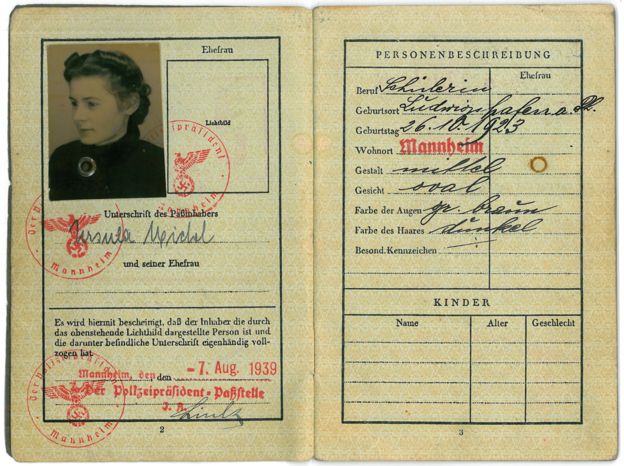
Judith Rhodes’s mother, Ursula Michel, came to the UK in 1939 on the Kindertransport, an operation that brought thousands of Jewish children to safety while their parents remained behind. “Her life was fractured and she never got over the guilt of surviving,” Rhodes says. Her family all perished in the Holocaust.

Rhodes, who lives in Yorkshire, is now active in Holocaust education in her mother’s home town of Ludwigshafen am Rhein – she shows pupils the little suitcase that her mother was allowed to bring with her.

To make it easier to continue doing this after Brexit, Rhodes decided to apply for German citizenship. But she was refused.

Rhodes’s application was rejected on the grounds that she was born before 1 April 1953, to a German mother married to an Englishman. If it had been the other way round and her father had been German it’s likely that her application would have been granted.

“I am furious because I think the ruling discriminates against women. This is the 21st Century and this sort of sex discrimination should not be allowed,” she says.

“I think the attitude of the German government is that Jews should have stayed in the Third Reich and not fled to safety. It is like an insurance company saying to a homeowner they would not pay up as they did not stay in their house as it burnt to the ground, fighting the fire.”

Ursula Michel's kindertransport passportImage copyrightJUDITH RHODES
Image captionUrsula Michel’s Kindertransport passport

Felix Couchman’s mother also came to the UK on the Kindertransport. He set up the Article 116 Exclusions Group when, like Judith Rhodes, one of his brothers was advised by the German Consulate in London that he would not be eligible to apply for German citizenship. Even though Article 116 says that descendants of Germans deprived of citizenship “shall… have their citizenship restored”, the consulate argued that under German naturalisation law citizenship could only be passed on through the father, up until the 1970s.

Although Couchman had not considered applying for German citizenship himself, and had never been involved in campaigning before, this spurred him into action.

“Although my mother died in 2001, I was acutely aware of what she would have expected me to do,” he says.

“I think the German government started off thinking we were a bunch of little old ladies drinking tea,” he laughs, “but the moral backbone of our campaign means we are not going away. They have been surprised by our determination.”


How the German government interprets Article 116

Automatic right to citizenship is denied to people:

  • Born out of wedlock, before 1993, to a formerly German father with a foreign mother
  • Adopted by formerly German parents before 1977
  • Whose ancestor acquired foreign citizenship before being stripped of German citizenship
  • Born before 1 April 1953 to a formerly German woman (and a non-German man) who fled Germany before being stripped of citizenship
  • Born after 31 December 1999
  • Whose ancestors were Jewish members of German communities annexed by the Nazis during their military expansion, such as Danzig and Czechoslovakia (non-Jewish Germans in these areas were naturalised en masse, but Jews were not)

Interest in the campaign has snowballed. Couchman’s wife, Isabelle, deals with the hundreds of people who have contacted the group. “Some are very elderly and have suffered a great deal,” she says. “Some of them lost their entire families in the Holocaust.”

While Couchman and a Cambridge University PhD student, Nic Courtman, lobby political parties in Germany, Isabelle runs a support network. “People are very emotional and they often cry on the phone when they contact me,” she says. “It can take months for them to decide if they want to pursue their battle.” Some are elderly Holocaust survivors, for example Kindertransport children, who are still traumatised by their experiences.

Central to Couchman’s case against the German government is the atmosphere in which Article 116 was implemented. “We have been told from varying sources of Nazi influence on the way the law was interpreted in the 1950s and 1960s,” he says.

The head of the Interior Ministry department that dealt with residence and asylum was at that time Kurt Breull, a former Nazi who had made his anti-Semitic views clear during the 1930s.

It was in this period that people like Julius Strauss, who had fled the country and taken another nationality before they were stripped of their German citizenship, were deemed ineligible – and also Jews who had lived in eastern territories occupied by Germany, such as Danzig (now Gdansk, in Poland).

“We have to understand how these exclusions arose in order to fix them,” says Couchman.

Nic Courtman has studied the German government’s own investigations into the failure of de-Nazification, finding documents that show the Interior Ministry was aware of controversy surrounding Article 116 in the 1950s, when a commission was set up to examine possible reforms.

That commission was led by Prof Ulrich Scheuner, a former Nazi supporter who, the documents reveal, supported the practice of trying to exclude certain groups. “That influence still filters down and affects decisions today as it set precedents,” Couchman says.

In August, the Article 116 Exclusions Group won their first battle. Two decrees issued by the German government, after pressure from the group, permit some of the descendants of Hitler’s victims to apply for discretionary naturalisation under the Nationality Act.

The German government says the decrees facilitate the acquisition of German citizenship “for those claimants who suffered similar historical injustices to those set out in [Article 116] but are not entitled to restoration under that Article due to legal reasons”.

A statement provided to the BBC, says that the government “highly appreciates” the fact that descendants of victims of National Socialist persecution now wish to acquire German citizenship, and states that the new decrees “provide a swift, directly applicable rule… reducing citizenship requirements for eligible persons to a minimum”.

Judith Rhodes is one of those who might meet the requirements, but only if she takes a series of language and citizenship tests. She says this is still discriminatory and resents “being asked to jump through hoops”.

For Couchman the concessions are “a partial resolution but do not cover all the exclusions”. Adopted children, for example, are still not considered eligible.

“This is a discretionary act that you have to go in begging for,” he says. “What we want is our constitutional right under Article 116.”

Short presentational grey line

Couchman’s group has some powerful allies and has managed to gain the support of opposition parties – the Greens, Die Linke and the FDP – who are leading a parliamentary investigation into the issue. It is still seeking the support of the partners in Germany’s governing coalition, the CDU and the SPD.

Couchman points out that in September Austria’s parliament unanimously ratified a law that extends citizenship to the descendants of Nazi victims who fled Hitler’s Third Reich.

“If Austria is able to pass legislation to rectify the issues over the restitution of citizenship on cross-party lines, I do not see why this cannot be done in Germany,” he says.

The fight has taken over the Couchmans’ lives. The couple work weekends and late into the night. Their two teenage children make sure there is dinner on the table in between studying for their exams.

It is the family’s personal story that drives them forward. Couchman’s grandfather, Fritz Beckhardt, was a German flying ace and World War One hero, but after the Nazis came to power his war record was wiped from the history books.

Couchman’s mother, Suse Beckhardt, was born in 1930 in Wiesbaden. When she was seven, her father had an affair with an Aryan woman, which was a crime under the Nazis, and he was sent to the Buchenwald concentration camp.

“An Air Force chum, a prominent Jewish lawyer, Berthold Guthmann, decided to appeal to Herman Goering, one of the most powerful Nazi leaders, who was one of their wartime colleagues,” says Couchman.

Extraordinarily, Fritz was released from Buchenwald in 1940 and told to leave the country. Before he left, he promised his sister and parents-in-law that he would return. None of them survived the Holocaust. Nor his did his friend, Guthmann, who was sent to Auschwitz.

Beckhardt and his wife arrived in the UK in 1940 but were interned with other German nationals on the Isle of Man. It was not until 1943 that they were eventually reunited with their children, who had fled on the Kindertransport before the war.

Suse Beckhardt's Kindertransport paperImage copyrightFELIX COUCHMAN
Image captionSuse Beckhardt’s Kindertransport paper (she disliked her first name, Hilda)

Determined to keep his promise to his family, Fritz Beckhardt returned to Germany in the 1950s to fight for the restitution of the family property and their business.

“He fought and fought,” says his grandson, Couchman, whose mother remained in the UK. “The shop was not profitable because people still did not like to shop in Jewish shops in the 1950s but he did not close the business. You fight for what you believe is right.”

Source: The fight to get citizenship for descendants of German Jews

The Rohingya might be one step closer to justice

Interesting column by Erna Paris:

Gambia, mainland Africa’s smallest country, took an unprecedented step this week. To everyone’s surprise, it opened a lawsuit against Myanmar at the International Court of Justice (ICJ) in The Hague – the tribunal that adjudicates disputes among states – accusing Myanmar of genocide against the Rohingya Muslims.

Gambia is operating within the larger auspices of the Organization of Islamic Cooperation, but as is often the case, the impetus came from one individual. Abubacarr M. Tambadou, Gambia’s justice minister, visited a Rohingya refugee camp where he saw a parallel with the violent past of his own country. Importantly, he had been a judge on the International Criminal Tribunal for Rwanda in the 1990s and recognized genocide when he saw it. That court was the first to convict an individual of ordering mass rape as a tool of war. Significantly, the Myanmar perpetrators have also been accused of this crime.

Although they had lived in Burma/Myanmar for centuries, the Rohingya were incrementally dispossessed of their rights by the Buddhist majority and an authoritarian regime. Eventually, in 1982, they were deprived of full citizenship. In August, 2017, some Rohingya pushed back, giving the military an excuse to force them from the country. It is estimated that the military and their Buddhist allies killed at least 60,000 people and committed sexual violence against 18,000 women. Today, most of the survivors are in Bangladesh refugee camps, but Bangladesh is one of the poorest countries on earth and is complaining about the burden. Something had to give.

One remedy may be international justice. Push back against those who believe they can commit major crimes with impunity.

It’s not as though the world hadn’t noticed their plight. Rights groups have expressed outrage. In 2017, Archbishop Desmond Tutu called on State Counsellor Aung San Suu Kyi, the country’s civilian leader, to respond appropriately. (She didn’t.) The parliaments of several countries, including Canada, have called the situation a genocide. In 2018, an independent United Nations fact-finding mission concluded that Myanmar’s military acted with “genocidal intent” and recommended that six individuals be prosecuted. Reports of risk assessment have concluded that genocide remains a risk for those Rohingya who remain in Myanmar. But if too little happened until Gambia decided to act, it is because reality – and realpolitik – got in the way.

First, reality. Last year, a ruling from the International Criminal Court said that tribunal could investigate the case of Myanmar – but in a limited way only. The problem was the court’s statutory jurisdiction: Myanmar is not an ICC member country. Bangladesh, however, is a member, which makes it possible for the tribunal to investigate the cross-border ethnic expulsions as a crime against humanity. Not perfect, but a start.

Second, realpolitik. Had the UN Security Council decided to refer the Myanmar case to the ICC for investigation, the tribunal would, according to its statute, have had full jurisdiction. China and Russia did not prevent a Security Council briefing on the UN inquiry accusing Myanmar’s military of genocide, but their subsequent obstruction meant no referral. Still in the realm of realpolitik, there might have been pressure from the Association of Southeast Asian Nations (ASEAN), but Myanmar is a member of that organization, complicating matters. So, although it can prosecute only states, not individuals, the ICJ looked like the best route.

Support from other countries will be critical and Canada is already engaged. Along with the European Union, this country has imposed sanctions on individuals linked to the military operations of August, 2017, and has since stepped up its involvement. The legal case will need funding; the refugees need more help, as does Bangladesh; and Canada is well positioned to intervene in the case, should it decide to do so.

Given worries over diminishing respect for international institutions and the rules-based global order, it is important that the world’s liberal democracies buttress the case against Myanmar. There is already encouraging momentum. In the aftermath of the Gambia lawsuit, Rohingya and Latin American human-rights groups opened litigation in Argentina under the principle of “universal jurisdiction,” a legal concept based on the premise that horrific crimes, such as genocide, can be tried anywhere.

The Gambia case has rightly revived the doctrine called “The Responsibility to Protect”. To demand accountability for the world’s worst crimes is in everyone’s self-interest.

Source: The Rohingya might be one step closer to justice Erna Paris