Immigrant underemployment has been a longstanding challenge in Canada, but recent evidence runs in contrast to the negativity that often surrounds this subject.
While it is true that many immigrants are working below their paygrade, which according to a recent report by the Royal Bank of Canada costs the economy an estimated $50 billion in annual GDP, Statistic Canada data shows considerable progress is being made on this front.
A Perfect Scorecard
When assessing various immigrant labour force metrics, everything that we want to be happening is actually occurring: More immigrants are in the labour market and are employed, fewer of them are underemployed, and their wages are on the rise.
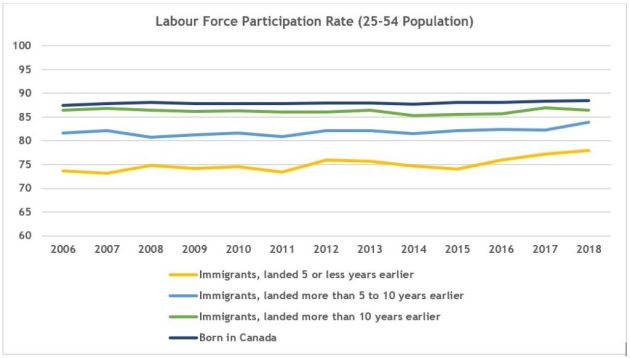
Among core-aged workers (those between the ages of 25-54), the participation rate of Canada’s newcomers (those in Canada for five years or less) stood at 78 per cent in 2018 compared with 74 per cent in 2006.
This is a positive finding because it suggests that newcomers today are integrating into the labour market more quickly than their predecessors (the participation rate represents the percentage of people within a specific cohort that are working or are looking for a job).
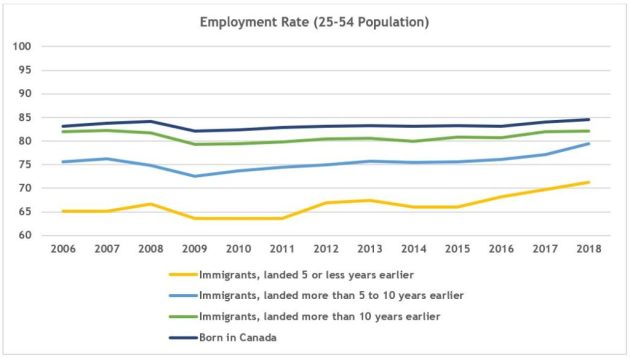
The newcomer employment rate (the share of a worker cohort with a job) has also improved — it was 71.3 per cent in 2018 compared with 65.2 per cent in 2006.
Similarly, immigrants who have been in Canada between 5 and 10 years have seen their employment rates rise significantly to 79.5 per cent in 2018 compared with 75.6 per cent in 2006.
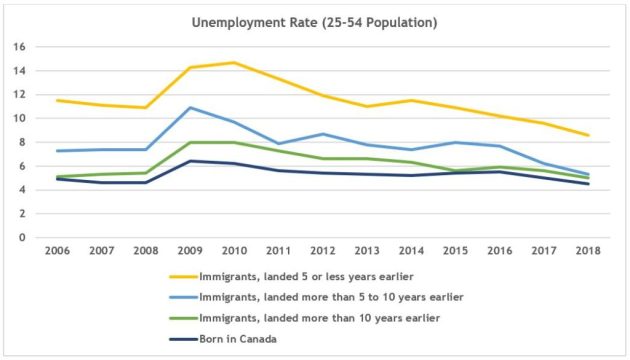
The unemployment rate (the share of a worker cohort looking for a job) has declined. Among newcomers, it stood at 8.6 per cent in 2018, which may seem high, but is a marked improvement compared with what it stood at after the 2008-09 recession (14.7 per cent) and back in 2006 (11.5 per cent). It has also dropped among other immigrant cohorts—it stood at just 5.3 per cent in 2018 for immigrants that have been in Canada between 5 and 10 years compared with 7.3 per cent in 2006.
Immigrant wages are also rising. A 2018 Statistics Canada report noted that “immigrants admitted to Canada in 2015 earned the highest entry wages of any cohort admitted since 1981.”
Moreover, core-aged immigrants with a university degree saw their wages increase by 3.5 per cent in 2017 compared with the previous year (the Canadian-born cohort saw a 0.9 per cent increase).
Two Factors at Play
The first major factor that can explain the better performance of immigrants is Canada’s tightening labour market.
With more baby boomers retiring, Canadian employers are increasingly counting on immigrants to fill the void. According to a Conference Board of Canada study, all 9.2 million baby boomers will retire over the next decade, which means that employers will need to become even more reliant on immigrants.
Reforms to Canada’s immigration policy are the second factor. These include reforms to selection policies as well as expanded efforts to support newcomer settlement and integration.
Expression of interest systems launched by the federal government (Express Entry) and provinces across Canada are likely contributing to improved immigrant outcomes. By ranking applicants against one another based on human capital factors such as age, work experience, education, and language ability, the federal government and provinces are now giving preference to the highest-scoring immigrants.
This marks a departure from Canada’s previous system where immigrants were selected so long as they met a certain points threshold, even if there were other candidates waiting behind them who had higher scores.
Canada’s Provincial Nominee Program (PNP) is also likely contributing to the improvements. An evaluation by Immigration, Refugee, and Citizenship Canada (IRCC) noted that the vast majority of PNP arrivals become established economically, with high employment rates, and earnings that increase over time.
More temporary residents are now transitioning to permanent residents under Express Entry and the PNP (“two-step migration”). This is sound policy as Statistics Canada research has shown that immigrants who previously worked or studied in Canada initially have a large earnings advantage over those without prior experience living in Canada.
Settlement Services
The federal government and provinces and territories fund settlement supports for immigrants such as language training, employment services, among others. IRCC is the largest funder of such services and has increased its annual settlement budget fivefold over the past two decades to $1.5 billion today.
It is likely that this increased investment is contributing to the labour market improvements immigrants have recently enjoyed.
Room for improvement and reasons to be optimistic
As noted by a recent CIC News article, immigrants continue to face labour market barriers that undermine their ability to make even more significant contributions to Canada’s economy.
At the same time, they are doing better in the labour market, which is probably due to baby boomer retirements and refinements to immigration policy.
These two factors will continue, which should leave us feeling optimistic that immigrants will continue to enjoy stronger labour market outcomes.
Of the many files landing on the next government’s desk following this month’s election, at least two may give it an immigration headache. Both come from decisions made by our neighbour to the south: President Donald Trump’s reversal of his country’s post-Reagan refugee policy and his rewriting of “safe third country” rules. Addressing each will involve a difficult balance of humanitarian principles, foreign policy interests and our relationship with the U.S.
The first headache has to do with Canada’s unexpected surpassing of the United States in resettling the world’s greatest number of refugees. Resettlement is the organized transfer of refugees to countries like Canada, relocating them away from countries like Turkey and Lebanon that often host millions of refugees inside their borders. Canada’s newfound leadership has less to do with our natural benevolence, however, than with an unprecedented reduction in American refugee admissions under the Trump administration. In both Canada and the U.S., resettlement has generally enjoyed support from both conservatives and liberals. Since 1980, America has led the world both in resettling refugees and also in successfully encouraging other countries to increase their refugee intake, trends that continued until 2018. In that year, Canada resettled 28,000 refugees, up from an average of 11,000 annually in the years prior to 2015. By contrast, U.S. admissions dropped to a record low of just 23,000 in 2018, down from a 20-year average of 66,000 and a one-year record high of 96,000 in 2016.
Our Canadian moment, even if it is a moment by default, has global implications as the U.S. announces further cuts to refugee admissions in the coming year. Resettlement has acted as a fiscal and social pressure valve for countries hosting millions of refugees, some of them Canadian friends or allies, like Bangladesh and Turkey. It is also a foreign policy and national security instrument, facilitating the recruitment of translators in war zones and embarrassing strategic foes via the admission of citizens fleeing their countries. Canada must weigh these considerations, as well as humanitarian ones, against rising pressure on Canadian funds and a recent drop in public confidence in Canada’s overall immigration system. Nor do we have the same clout as the Americans in helping redistribute the refugee load more fairly throughout the world, especially now that, following the U.S. lead, more countries are reducing their resettlement programs than are expanding them.
In addition to formal resettlement, Canada faces a growing number of asylum claims. Over 170,000 asylum-seekers have sought protection here since the past federal election, 50,000 of whom crossed the border to do so — either “illegally” or “irregularly” depending on who you talk to. Both the Liberals and Conservatives have promised to staunch the flow of border crossings by renegotiating the Canada-U.S. Safe Third Country Agreement and to return asylum-seekers walking across our southern border to the U.S. for processing. The current agreement applies only to official border crossings, however. A strengthened agreement could apply this arrangement to claimants crossing the border elsewhere, as well. Unfortunately, a strengthened agreement may not be in the cards. In fact, recent changes in U.S. asylum policy may hand the next prime minister a completely suspended agreement, rather than a renegotiated one, which will be bad news both for relations with the U.S. and for an already backed-up Canadian asylum system.
Under a new policy, the Americans will deport asylum-seekers if they passed through another country on their way to the U.S., even if they face a demonstrated risk of torture or persecution in their home country. This violates one of the founding principles of the Safe Third Country Agreement — namely, that countries not return asylum-seekers with credible fears to their home country. It also strengthens the possibility of a successful challenge of the agreement in a current case before the Federal Court of Canada. If the case were to result in the agreement’s suspension, asylum-seekers could make their claims directly at official border crossings without the risk of being turned back to the U.S. This would eliminate the incentive to cross the border to claim protection but it might also invite a correspondingly greater number of claims than before, as prospective claimants would have a more direct route into Canada from the U.S. Canada would not be obligated to approve their claims, but we would have to assess them, further impacting an already backlogged and beleaguered process. It would also risk offending the U.S. by in effect labelling it an unsafe country for refugees. That is not an outcome we want in a time of already tense trade relations.
The potential impact of these changes is hard to overstate. Canada has a proven track record when it comes to processing and integrating refugees. The next federal government may want to leverage our new position as the world’s number one resettlement destination to introduce its own model sponsorship program among like-minded partners on the international stage. It should also consider investing in a more rapid and flexible claim assessment system, one able to respond to large and sometimes unpredictable flows of claimants whatever agreements we do or don’t have with other countries and whatever choice they do or don’t make about re-electing mercurial leaders.
Workplace changes both reflect and influence changes in attitudes:
It’s a pivotal time for LGBTQ people in the workplace. Last week, the Supreme Court heard arguments in cases testing whether people in that community are protected by the country’s workplace anti-discrimination laws.
That’s happening at a time when more workplaces are adapting to an increasing number of people openly identifying as gender nonbinary — that is, they don’t consider themselves categorically male or female, and favor gender-neutral pronouns like “them,” instead of “he” or “she.”
Some employers are including those preferences on email signatures and name tags. But workers and employers are also navigating changing social norms around gender that can be confusing, and shifting workplace culture away from traditional gender identifiers can also be tricky.
This is something Joshua Byron has thought about a great deal. As a child, Byron realized dressing up as Princess Leia was unconventional for a boy. It wasn’t until young adulthood that Byron first encountered the concept that someone could identify as something other than male or female. For Byron, the idea of being gender neutral — or part one, part the other — felt like it fit.
Byron, 24, came out as such to his inner circle of friends three years ago, requesting to be referred to as “they,” not as “he.” But they didn’t feel comfortable doing so at work.
“I had a very supportive friend group, and then I would go to work and not think about that part of myself,” Byron says.
That changed two years ago, after Byron applied for a teaching job in New York, and a reference outed them as nonbinary.
The new employer had no problem with it and hired Byron. But being out at work meant fielding endless questions from colleagues: Is this really a thing? How can a plural pronoun refer to one person? Byron feels caught in the middle of a culture war.
“I think people feel really intense about it … like this is breaking some rule,” Byron says.
This kind of scenario is playing out in many workplaces, especially as surveys show more people are identifying as gender nonbinary.
“Employers are going to be faced with an increasing percentage of employees over time who have nonbinary identities,” because there is greater prevalence of gender ambiguity among young people, says Jody Herman, a public policy scholar at the Williams Institute at UCLA law school, which researches sexual orientation and gender identity.
There is still not a lot of research quantifying this population, especially since there are so many diverse terms around gender identity. Two years ago, Herman’s study found 27% of youth in California aged 12 to 17 said their peers would identify them as gender nonconforming. Other studiesshow a much smaller prevalence of people who identify themselves as transgender or gender nonbinary.
Some employers are already shifting policies. United Airlines gives customers the option to identify as nonbinary when booking tickets. Retirement company TIAA instructed employees to introduce themselves to clients with their preferred pronouns.
The law firm Baker McKenzie earlier this year set its staffing targets to 40% men, 40% women and 20% flexible — including nonbinary people.
Anna Brown, the firm’s director of global diversity and inclusion, says the policy was designed to reflect the shifting demographics. “These are prospective policies. And as we go forward, we know we have nonbinary colleagues,” she says.
New York psychotherapist Laura Jacobs says most employers don’t know how to deal with the issue of gender-nonbinary identity in the workplace.
But New York psychotherapist Laura Jacobs, who counsels many transgender and nonbinary individuals, says that kind of openness is still new and somewhat rare. “How to handle nonbinary people is still something that I don’t think most employers really have a sense for how to handle,” Jacobs says.
Employment forms, for example, often include only male or female options. References from old jobs might have known someone before the person assumed a different name or identity. And often, employer health insurance requires a person to choose.
“You had to be binary in order to get care and that that was enforced by the medical community, the legal community and so on,” says Jacobs, who identifies as both transgender and nonbinary.
But on a day-to-day basis, some of the persistent challenge comes from coworker questions: “Everybody wonders what’s in our pants,” Jacobs says.
Nowhere does this feel more personal than the bathroom.
For transgender populations, bathrooms are places associated with uncomfortable staring, harassment and even violence. They’ve also been at the center of political controversy. Three years ago, North Carolina passed a law requiring people to use bathrooms corresponding to their assigned gender at birth. That law was struck down.
But Mark Marsen says bathrooms remain a hot-button issue for employers and for coworkers who don’t feel comfortable sharing bathrooms with transgender people. Marsen is director of human resources at Allies For Health + Wellbeing, a community health clinic. He recently participated in an online discussion with other HR executives about making the workplace gender neutral.
“A good 60% — at least — of the conversation was about bathrooms,” Marsen says.
At the time, Marsen says, he was re-thinking his company’s restroom policies. Marsen realized a bathroom is just a bathroom. He ended up re-labeling them simply, “restroom” and “restroom with urinals.”
For Joshua Byron, bathrooms are a central emotional issue.
For Byron, things like restrooms and dress codes become litmus tests for how their manager might react — how strictly masculinity might be enforced. It makes Byron wonder: “Will it be a thing that there is argument or stress over?”
But changing long-held gender paradigms isn’t easy. The terms used by nonbinary people can be difficult to understand.
In fact, it can still be confusing even for people who identify as nonbinary, like Mich Dopiro. Dopiro recently stumbled over pronouns for someone they just met.
“I don’t think they took offense, but it was an embarrassing moment for myself,” says Dopiro, 25, who works as a teacher in Seattle. Among middle school students, gender norms have already changed . One student recently called Dopiro by the wrong pronoun, then apologized.
“They felt like, ‘Oh this is something that I grew up with that I should know not to mess up,’ ” Dopiro says.
Another analysis of party positions on immigration-related issues;
In the months leading up to the federal election, many political observers in Ottawa thought immigration issues would figure prominently in the campaign.
The Conservative opposition had spent months between 2017 and 2019 hammering the Liberal government on their handling of a spike in asylum claimants crossing into Canada, mostly at a single point on Quebec’s southern border.
The Liberals, for their part, continued to trumpet Canada’s openness to immigrants and refugees — something Justin Trudeau had highlighted since the 2015 campaign with his party’s commitment to take in more refugees fleeing war-torn Syria.
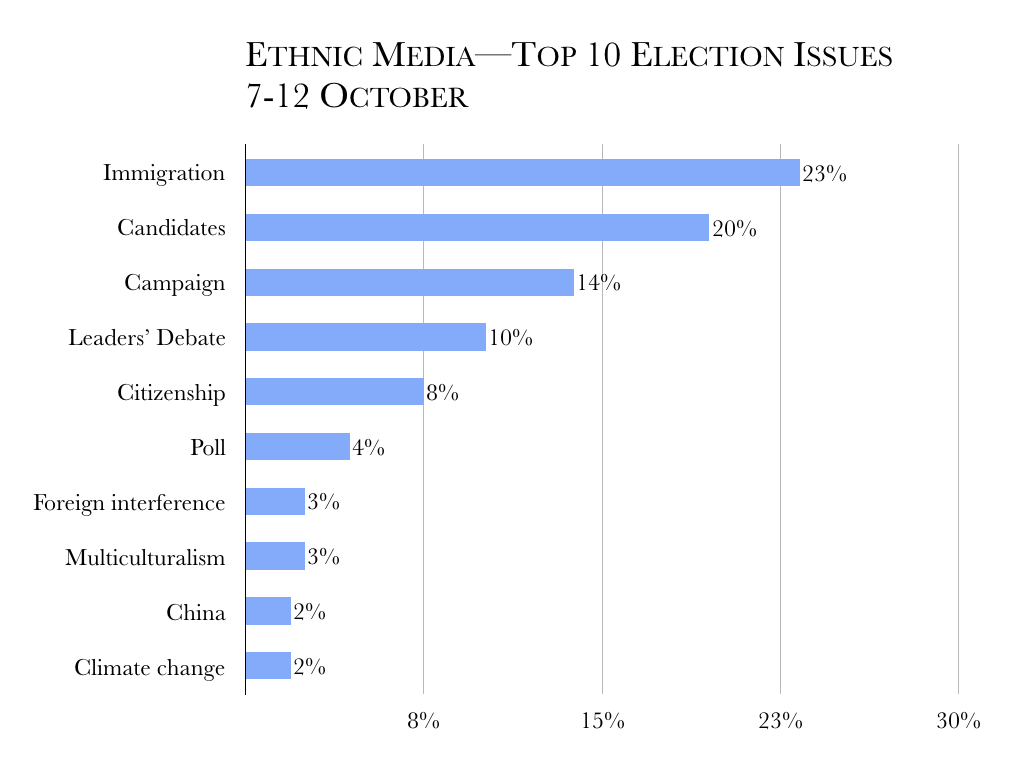
But over the course of the campaign, including the two official leaders’ debates last week, immigration has taken a back seat to issues like climate change, or how the various leaders would save you a buck if they formed government.
That might be because, in spite of the rhetoric and the politicking, Canada’s mainstream political parties have a broad consensus on immigration being key to the country’s continued economic and social well-being.
But there are important differences in both tone and policy between the Liberals and the Conservatives — the two parties which have the most realistic shot of governing. How would the first six months of a Conservative or a Liberal government differ?
The Star looks ahead at what this election could mean for Canada’s immigration policies — and for people hoping to make it to Canadian shores.
Liberal majority
Naturally, a Liberal majority would represent the least change from Canada’s current immigration levels. The Liberals have been steadily increasing planned immigration levels since taking office in 2015, and would continue to do so if they were re-elected.
According to the federal government’s immigration levels plan, Canada would aim to grow the number of immigrants from 330,800 in 2019, to 350,000 in 2021. Most of these, around 60 per cent, come through Canada’s economic stream for immigration — skilled workers to fill needs in the economy.
The Liberal party says it will enact “modest and responsible” increases in immigration, with a focus on attracting “highly skilled workers.”
A Liberal government would introduce a municipal nominee program that would allow local communities to directly sponsor permanent immigrants and it would make permanent a separate program to encourage immigration to Atlantic Canada. A minimum of 5,000 spaces would be earmarked for each program. The Liberals say they would also waive citizenship fees for permanent residents.
The number of refugees admitted into Canada fluctuates year-to-year, although irregular migration at the Canada-U.S. border — where asylum claimants have been crossing outside recognized ports of entry in hopes of securing refugee status — decreased in 2019 compared to previous years.
Conservative majority
Conservative Leader Andrew Scheer largely agrees with the Liberal government’s proposed immigration targets of 350,000 newcomers in 2021. Scheer told the CBC this month that immigration levels should not be “politicized.”
“This should be a number that Statistics Canada and experts in various fields say ‘we need this many people to come’ to fill the gaps in the workplace, or to ensure we have a growing population, combined with a humanitarian component for family reunification and refugees,” Scheer said.
So don’t expect a new Conservative government to drastically change course on the top-level numbers. The Conservatives main point of difference with the Liberals is the situation at Roxham Road in Quebec.
Since 2017, more than 50,000 people have crossed the Canada-U.S. border outside of a border services checkpoint. Once they reach Canadian soil, Canada has an obligation — under both domestic and international law — to give their asylum claims a fair hearing.
While the numbers have decreased year-over-year since 2017, when U.S. President Donald Trump’s administration started threatening specific groups with deportation, the Conservatives have continued to heap criticism on the Liberals’ handling of the file.
Last week, Scheer announced that a Conservative government would attempt to “renegotiate” the Safe Third Country Agreement with the Trump administration. The bilateral agreement requires those seeking asylum to make their claim in either the U.S. or Canada, whichever they arrive in first. But convincing the hardline Trump administration to take in more refugees would be an uphill battle — particularly as Trump seeks re-election.
Scheer said there are “other options” if the U.S. is unwilling to renegotiate the agreement — although declined in his news conference to say what those options were. A Scheer government would also hire an additional 250 officers for the Canada Border Services Agency, a significant increase in the agency’s inland enforcement workforce.
The Conservatives would also prioritize funding to immigration services like language training and credential recognition, in addition to emphasizing services to vulnerable newcomers.
Minority government
All the parties recognize the importance of immigration to Canada’s economy at a time when the country’s workforce is aging and concerns mount about labour shortages. This could open the door to more economic immigration as well as increased efforts to recognize the credentials of professionals trained abroad. And three parties want changes to Canada’s Safe Third Country Agreement with the United States — although in very different ways.
The Green party wants it terminated, the NDP says suspend it and the Conservatives want changes, to prevent asylum seekers from the U.S. from making claims when they arrive at unofficial border crossings. The Liberals said only that it would work with the U.S. to “modernize” the agreement.
But a Liberal minority government could come under opposition pressure for more drastic changes.
The NDP say that Canada has an important role to play taking in refugees. New Democrats and Green party members want to speed family reunification. Both want to crack down on “unscrupulous” immigration consultants.
The Green party wants the accreditation of foreign professionals expedited to speed their entry into the workforce. It would eliminate the temporary foreign workers program by increasing immigration levels and working with employers to assist with permanent residency. And it says that Canada must be ready to take in “environmental” refugees, those who have been displaced by the impacts of climate change.
Sometimes, literally following the rules makes governments miss the bigger picture:
Waseem Ramli, the notorious Montreal businessman whose diplomatic status as honorary consul for the blood-drenched Baathist regime in Syria was revoked by Foreign Affairs Minister Chrystia Freeland last month, is being officially heralded in Damascus these days as a selfless and patriotic national hero.
But it’s not because he’d managed to secure diplomatic credentials from Global Affairs Canada this summer, despite being feared and loathed by the Syrian refugee community in Montreal—he’s often seen driving around in a fire-engine-red Humvee with a portrait of Syrian tyrant Bashar al-Assad on a side window. It’s because he pulled off an altogether different and equally dramatic Canadian caper, right under everybody’s noses, in the weeks before the Assad regime appointed him to serve as a diplomat in Canada. And no law was broken.
In broad daylight, Ramli walked out of the Montreal Museum of Fine Arts with a priceless 1,820-kilogram late 5th century Byzantine Christian mosaic. Measuring roughly 3.5 meters by 2.8 meters, the mosaic, originally from the vicinity of Hama on the Orontes River, was unveiled at a glamorous ceremony in Damascus on Monday. At the celebration, Ramli was praised to the skies for having secured the Hama mosaic’s acquisition over the repeated objections of Canadian officials.
But Canadian officials raised no objections at all to surrendering the Early Christian artwork to the Syrian Arab Republic, Maclean’s has learned. The process that led to the ceremonial unveiling of the Hama mosaic in Damascus on Monday was a lot like the cavalcade of official and inadvertent Global Affairs sign-offs that led to Ramli’s authorization to act as the Syrian regime’s honorary consul in Montreal.
Freeland pulled Ramli’s credentials after she learned from a Sept. 23 report in Maclean’s that her own department’s Office of Protocol had authorized and registered Ramli to act on the Assad regime’s behalf. But it’s too late for the Hama mosaic. It’s now at the Syrian National Museum in Damascus.
The massive mosaic came from a shipment of 82 mosaic fragments that the Syrian regime exported illegally in the late 1990s, likely in connivance with the smugglers themselves. The collection was intercepted by the RCMP and Canada Customs officials, and the artifacts were eventually returned to Syria, except for the Hama mosaic. Although it had been cut into two pieces, apparently for ease in transport, the mosaic was so magnificent that McGill University professor John Fossey, the Montreal museum’s curator of Greek art at the time, managed to arrange a loan of the work for display at the museum.
The loan was extended several times, starting in 2004. Assad plunged Syria into a nightmare of mass death and jihadist mayhem in 2011, and after 500,000 dead and more than six million refugees, he’s been winning. On Dec. 29 last year, Ramli walked into the museum, presented a letter from the Syrian government, and demanded that the museum surrender the Hama mosaic to him.
“When he first came in to us in December, I think he expected that overnight we could just take it down and hand it to him,” Hilliard Goldfarb, senior collections curator and curator of old masters at the Montreal museum, told me. But there were forms to be filled out, and proper authorizations to be obtained. Still, last April, Ramli was on hand at the museum to observe the mosaic being carefully taken down from its display mounting and placed in a special crate.
On May 13, the Hama mosaic was placed on an Air France flight to Paris. From Paris it was shipped to Beirut, and then transferred to the National Museum of Damascus where it was unveiled on Monday at a posh gathering of regime officials and diplomats from the few countries that haven’t severed relations with Assad’s rogue regime. At Monday’s unveiling ceremony, according to coverage by Syria’s state news agency, Mahmoud Hammou, the country’s director general of antiquities and museums, praised Ramli as a Syrian patriot who’d managed to acquire the Hama mosaic and arrange for its return to Damascus “at his own expense,” despite successive objections from Canadian authorities “under the pretext of the war on Syria.”
That’s not even close to what actually happened. Between Dec. 29 and May 13, Ramli’s efforts to get the Hama mosaic back into the hands of the Assad regime were dutifully stickhandled by a variety of helpful and perfectly friendly Canadian officials. “We were in touch with both the Ministry of Foreign Affairs and Cultural Heritage in this matter, and we were told, yes, this work can be returned,” Goldfarb said. “We had contact by phone and by email with various parties. Canada was well aware of what was going on.”
There was a bit of a rigmarole, but Ramli’s demands were all met within six months.
“I’m not a politician. I’m an art historian. I don’t for a minute want to be seen as defending the Syrian regime, which I find absolutely horrible, but that’s not the issue we were handling,” Goldfarb said. “We were fully in touch with all the authorities. Really, to my mind, we didn’t have much choice.”
And that’s because Global Affairs Canada didn’t give the museum a choice. Nobody said no. Nobody even said, hold on, maybe we should just say no, this belongs to the Syrian people, not to the criminal regime in Damascus. So Goldfarb and his colleagues had little option but to comply with Ramli’s demands and hand over the Hama mosaic.
“Global Affairs Canada had no role in facilitating its return,” Adam Austen, speaking for Foreign Affairs Minister Chrystia Freeland, told me.
This is, arguably, not untrue. The Cultural Property Export and Import Act requires that property lent to Canadian institutions be returned as the loan contract stipulates, and export permits to return loaned property are automatically approved. Ordinarily, ministerial discretion doesn’t enter into it.
But Syria is no ordinary country.
The reopening of the National Museum of Damascus last year has afforded the Baathist regime several propaganda opportunities in its push to rehabilitate its global reputation and persuade the international community that Assad has won the scorched-earth war he has been waging on the Syrian people. Last Monday’s unveiling of the Hama mosaic at the National Museum was a propaganda victory for the regime. And quite a few Canadian officials, at the highest level, either signed off on the file or just let the transfer proceed without objection.
That is how Ramli ended up registered by Global Affairs Canada as an officially authorized diplomat, too. A Liberal Party donor and proprietor of the Cocktail Hawaii restaurant on Rue Maisonneuve, Ramli calls the heroic first responders of Syria’s White Helmets organization “terrorists” and al-Qaeda operatives. This was a bit much for Freeland, because last year, she led an international rescue operation that brought about 250 White Helmets and their families to settle as refugees in Canada.
Ramli obtained his honorary-consul credentials from Ottawa in August after travelling to Damascus in June, where he obtained his diplomatic appointment from the Assad regime only days after posing for photographs with Justin Trudeau at a Liberal Party fundraiser. He was all set to open a consular office in Montreal on Oct. 1, and he would have been the most senior Baathist official in North America, if Freeland hadn’t furiously intervened and revoked his credentials.
Ramli would have ended up with consular-services power over tens of thousands of Syrian immigrants and refugees across Eastern Canada and throughout much of the United States. That’s because Syrian diplomats were expelled from North America in 2012 in response to Assad’s crimes against humanity, and since then, honorary consulates have operated only in Vancouver and Montreal, and only intermittently. All requests for birth certificates, diplomas, remittance arrangments and so on would have had to run through Ramli.
Canada and the U.S. are among dozens of countries that have cut diplomatic ties with the Assad regime. Suspended from the Arab League in 2011 and the Organization of Islamic Cooperation in 2012, Syria is a pariah state, subjected to United Nations sanctions, European Union sanctions, and U.S. and Canadian sanctions. But in dealing with the Assad regime’s application for diplomatic credentials on Ramli’s behalf, the “vetting” process fell apart. Everybody did their jobs, but nobody noticed the Office of Protocol standards stipulating that honorary consuls should be individuals of standing in the community, and shouldn’t be politically active. Syria was treated as though it were a normal country, like Costa Rica, or South Korea.
And in the matter of Ramli’s determination to retrieve the Hama mosaic on the Assad regime’s behalf, the Cultural Property Export and Import Act was followed as though Syria was France, or India, or Ireland.
Since 2011, when Assad first put the torch to his country, Syria’s cultural patrimony has been looted and traded on the black market by ISIS, pro-democracy rebels, and by the regime itself. The collection of artifacts containing the Hama mosaic had been spirited out of Syria in 1996, apparently by individuals close to the dictatorship of Bashar Assad’s father, Hafez Assad.
After he showed up out of the blue last Dec. 29 at the Montreal Museum of Fine Arts demanding the mosaic’s return, Ramli was politely received, and advised of the proper documentation he’d need to provide. Despite the Assad regime’s claim that the Canadian authorities had refused to return the mosaic “despite successive official demands,” Ramli was treated with every courtesy.
In January, Ramli returned to the museum with a letter from the Syria’s Ministry of Culture. On Feb. 4, Bashar Jaafari, the permanent representative of the Syrian Arab Republic at the United Nations, passed along Ramli’s power-of-attorney documents to Marc-André Blanchard, the former McCarthy-Tetrault chief executive officer and president of the Quebec Liberal Party that Trudeau had appointed Canada’s head of mission at the UN.
The unveiling of the 1,800-kilogram, late 5th Century Byzantine Christian mosaic at the National Museum on Damascus, as seen on the website of Syria’s state news agency. The mosaic had previously been at the Montreal Museum of Fine Arts. (SANA)
Blanchard handed it up, and on Feb. 12, Freeland’s office was formally advised of the proceedings. Andrew Leslie, the retired general and Orleans MP who served as Freeland’s parliamentary secretary, was brought into the loop in March. Rory Raudsepp-Hearne, Global Affairs’ team lead for Syria and Lebanon, signed off on it. So did senior cultural affairs officials with the Department of Canadian Heritage.
No sanctions lines were crossed because no money changed hands, and Canada’s custody of the mosaic ended in Lebanon. In Beirut. The Canadian embassy there formally handed custody off to Syrian officials for transport to Damascus.
The Hama mosaic is a thing of great beauty. It was excavated from the floor of a church or a convent that was built in the days before the arrival of the conquerer Abu Ubaidah ibn al-Jarrah, when Hama was known in Byzantium as Emathoùs. It is adorned with Christian iconography—the tree of life, a chalice, sheep, fish and birds.
There’s little left of the beauty of Hama. In 1982, Bashar’s father, Hafez, laid siege to the city to quell a rebellion. The Syrian Human Rights Committee reckons 40,000 people died in the slaughter. Since 2011, when Bashar took up his father’s penchant for atrocity, Hama has been bombed, its people massacred over and over and over again.
As for the Hama mosaic: “Everything was done by the book,” a senior official close to Freeland explained to me. “Thank you for bringing this to our attention. This kind of situation repeating itself is highly unlikely.”
Congress envisioned a white, Protestant and culturally homogeneous America when it declared in 1790 that only “free white persons, who have, or shall migrate into the United States” were eligible to become naturalized citizens. The calculus of racism underwent swift revision when waves of culturally diverse immigrants from the far corners of Europe changed the face of the country.
As the historian Matthew Frye Jacobson shows in his immigrant history “Whiteness of a Different Color,” the surge of newcomers engendered a national panic and led Americans to adopt a more restrictive, politicized view of how whiteness was to be allocated. Journalists, politicians, social scientists and immigration officials embraced the habit, separating ostensibly white Europeans into “races.” Some were designated “whiter” — and more worthy of citizenship — than others, while some were ranked as too close to blackness to be socially redeemable. The story of how Italian immigrants went from racialized pariah status in the 19th century to white Americans in good standing in the 20th offers a window onto the alchemy through which race is constructed in the United States, and how racial hierarchies can sometimes change.
Darker skinned southern Italians endured the penalties of blackness on both sides of the Atlantic. In Italy, Northerners had long held that Southerners — particularly Sicilians — were an “uncivilized” and racially inferior people, too obviously African to be part of Europe.
Racist dogma about Southern Italians found fertile soil in the United States. As the historian Jennifer Guglielmo writes, the newcomers encountered waves of books, magazines and newspapers that “bombarded Americans with images of Italians as racially suspect.” They were sometimes shut out of schools, movie houses and labor unions, or consigned to church pews set aside for black people. They were described in the press as “swarthy,” “kinky haired” members of a criminal race and derided in the streets with epithets like “dago,” “guinea” — a term of derision applied to enslaved Africans and their descendants — and more familiarly racist insults like “white nigger” and “nigger wop.”
Italian-Americans were often used as cheap labor on
the docks of New Orleans at the turn of the last century.Library of Congress
Mulberry Street in the Little Italy
section of New York around 1900.Library of Congress
The penalties of blackness went well beyond name-calling in the apartheid South. Italians who had come to the country as “free white persons” were often marked as black because they accepted “black” jobs in the Louisiana sugar fields or because they chose to live among African-Americans. This left them vulnerable to marauding mobs like the ones that hanged, shot, dismembered or burned alive thousands of black men, women and children across the South.
The federal holiday honoring the Italian explorer Christopher Columbus — celebrated on Monday — was central to the process through which Italian-Americans were fully ratified as white during the 20th century. The rationale for the holiday was steeped in myth, and allowed Italian-Americans to write a laudatory portrait of themselves into the civic record.
Few who march in Columbus Day parades or recount the tale of Columbus’s voyage from Europe to the New World are aware of how the holiday came about or that President Benjamin Harrisonproclaimed it as a one-time national celebration in 1892 — in the wake of a bloody New Orleans lynching that took the lives of 11 Italian immigrants. The proclamation was part of a broader attempt to quiet outrage among Italian-Americans, and a diplomatic blowup over the murders that brought Italy and the United States to the brink of war.
Historians have recently showed that America’s dishonorable response to this barbaric event was partly conditioned by racist stereotypes about Italians promulgated in Northern newspapers like The Times. A striking analysis by Charles Seguin, a sociologist at Pennsylvania State University, and Sabrina Nardin, a doctoral student at the University of Arizona, shows that the protests lodged by the Italian government inspired something that had failed to coalesce around the brave African-American newspaper editor and anti-lynching campaigner Ida B. Wells — a broad anti-lynching effort.
A Black ‘Brute’ Lynched
The lynchings of Italians came at a time when newspapers in the South had established the gory convention of advertising the far more numerous public murders of African-Americans in advance — to attract large crowds — and justifying the killings by labeling the victims “brutes,” “fiends,” “ravishers,” “born criminals” or “troublesome Negroes.” Even high-minded news organizations that claimed to abhor the practice legitimized lynching by trafficking in racist stereotypes about its victims.
As Mr. Seguin recently showed, many Northern newspapers were “just as complicit” in justifying mob violence as their Southern counterparts. For its part, The Times made repeated use of the headline “A Brutal Negro Lynched,” presuming the victims’ guilt and branding them as congenital criminals. Lynchings of black men in the South were often based on fabricated accusations of sexual assault. As the Equal Justice Initiative explained in its 2015 report on lynching in America, a rape charge could occur in the absence of an actual victim and might arise from minor violations of the social code — like complimenting a white woman on her appearance or even bumping into her on the street.
The Times was not owned by the family that controls it today when it dismissed Ida B. Wells as a “slanderous and nasty-minded mulattress” for rightly describing rape allegations as “a thread bare lie” that Southerners used against black men who had consensual sexual relationships with white women. Nevertheless, as a Times editorialist of nearly 30 years standing — and a student of the institution’s history — I am outraged and appalled by the nakedly racist treatment my 19th-century predecessors displayed in writing about African-Americans and Italian immigrants.
When Wells took her anti-lynching campaign to England in the 1890s, Times editors rebuked her for representing “black brutes” abroad in an editorial that joked about what they described as “the practice of roasting Negro ravishers alive and boring out their eyes with red-hot pokers.” The editorial slandered African-Americans generally, referring to rape as “a crime to which Negroes are particularly prone.” The Times editors may have lodged objections to lynching — but they did so in a rhetoric firmly rooted in white supremacy.
‘Assassins by Nature’
Italian immigrants were welcomed into Louisiana after the Civil War, when the planter class was in desperate need of cheap labor to replace newly emancipated black people, who were leaving backbreaking jobs in the fields for more gainful employment.
These Italians seemed at first to be the answer to both the labor shortage and the increasingly pressing quest for settlers who would support white domination in the emerging Jim Crow state. Louisiana’s romance with Italian labor began to sour when the new immigrants balked at low wages and dismal working conditions.
The newcomers also chose to live together in Italian neighborhoods, where they spoke their native tongue, preserved Italian customs and developed successful businesses that catered to African-Americans, with whom they fraternized and intermarried. In time, this proximity to blackness would lead white Southerners to view Sicilians, in particular, as not fully white and to see them as eligible for persecution — including lynching — that had customarily been imposed on African-Americans.
Clams being sold from a cart in Little Italy.Library of Congress
Many Italian-Americans lived in a section of New
Orleans that became known as Little Palermo.Library of Congress
Nevertheless, as the historian Jessica Barbata Jackson showed recently in the journal Louisiana History, Italian newcomers were still well thought of in New Orleans in the 1870s when negative stereotypes were being established in the Northern press.
The Times, for instance, described them as bandits and members of the criminal classes who were “wretchedly poor and unskilled,” “starving and wholly destitute.” The stereotype about inborn criminality is plainly evident in an 1874 story about Italian immigrants seeking vaccinations that refers to one immigrant as a “burly fellow, whose appearance was like that of the traditional brigand of the Abruzzi.”
A Times story in 1880 described immigrants, including Italians, as “links in a descending chain of evolution.” These characterizations reached a defamatory crescendo in an 1882 editorial that appeared under the headline “Our Future Citizens.” The editors wrote:
“There has never been since New York was founded so low and ignorant a class among the immigrants who poured in here as the Southern Italians who have been crowding our docks during the past year.”
The editors reserved their worst invective for Italian immigrant children, whom they described as “utterly unfit — ragged, filthy, and verminous as they were — to be placed in the public primary schools among the decent children of American mechanics.”
The racist myth that African-Americans and Sicilians were both innately criminal drove an 1887 Times story about a lynching victim in Mississippi whose name was given as “Dago Joe” — “dago” being a slur directed at Italian and Spanish-speaking immigrants. The victim was described as a “half breed” who “was the son of a Sicilian father and a mulatto mother, and had the worst characteristics of both races in his makeup. He was cunning, treacherous and cruel, and was regarded in the community where he lived as an assassin by nature.”
Sicilians as ‘Rattlesnakes’
The carnage in New Orleans was set in motion in the fall of 1890, when the city’s popular police chief, David Hennessy, was assassinated on his way home one evening. Hennessy had no shortage of enemies. The historian John V. Baiamonte Jr. writes that he had once been tried for murder in connection with the killing of a professional rival. He is also said to have been involved in a feud between two Italian businessmen. On the strength of a clearly suspect witness who claimed to hear Mr. Hennessy say that “dagoes” had shot him, the city charged 19 Italians with complicity in the chief’s murder.
The monument to David Hennessy rises above nearly all
the other tombs in Metairie Cemetery in New Orleans.William Widmer for The New York Times
That the evidence was distressingly weak was evident from the verdicts that were swiftly handed down: Of the first nine to be tried, six were acquitted; three others were granted mistrials. The leaders of the mob that then went after them advertised their plans in advance, knowing full well that the city’s elites — who coveted the businesses the Italians had built or hated the Italians for fraternizing with African-Americans — would never seek justice for the dead. After the lynching, a grand jury investigation pronounced the killings praiseworthy, turning that inquiry into what the historian Barbara Botein describes as “possibly one of the greatest whitewashes in American history.”
The blood of the New Orleans victims was scarcely dry when The Times published a cheerleading news story — “Chief Hennessy Avenged: Eleven of his Italian Assassins Lynched by a Mob” — that reveled in the bloody details. It reported that the mob had consisted “mostly of the best element” of New Orleans society. The following day, a scabrous Times editorial justified the lynching — and dehumanized the dead, with by-now-familiar racist stereotypes.
“These sneaking and cowardly Sicilians,” the editors wrote, “the descendants of bandits and assassins, who have transported to this country the lawless passions, the cutthroat practices … are to us a pest without mitigations. Our own rattlesnakes are as good citizens as they. Our own murderers are men of feeling and nobility compared to them.” The editors concluded of the lynching that it would be difficult to find “one individual who would confess that privately he deplores it very much.”
Lynchers in 1891 storming the New Orleans city jail, where they killed 11 Italian-Americans accused in the fatal shooting of Chief Hennessy.Italian Tribune
President Harrison would have ignored the New Orleans carnage had the victims been black. But the Italian government made that impossible. It broke off diplomatic relations and demanded an indemnity that the Harrison administration paid. Harrison even called on Congress in his 1891 State of the Union to protect foreign nationals — though not black Americans — from mob violence.
Harrison’s Columbus Day proclamation in 1892 opened the door for Italian-Americans to write themselves into the American origin story, in a fashion that piled myth upon myth. As the historian Danielle Battisti shows in “Whom We Shall Welcome,” they rewrote history by casting Columbus as “the first immigrant” — even though he never set foot in North America and never immigrated anywhere (except possibly to Spain), and even though the United States did not exist as a nation during his 15th-century voyage. The mythologizing, carried out over many decades, granted Italian-Americans “a formative role in the nation-building narrative.” It also tied Italian-Americans closely to the paternalistic assertion, still heard today, that Columbus “discovered” a continent that was already inhabited by Native Americans.
The “Monument to the Immigrant,” commissioned by the Italian American Marching Club of New Orleans, stands along the Mississippi River in Woldenberg Park.William Widmer for The New York Times
But in the late 19th century, the full-blown Columbus myth was yet to come. The New Orleans lynching solidified a defamatory view of Italians generally, and Sicilians in particular, as irredeemable criminals who represented a danger to the nation. The influential anti-immigrant racist Representative Henry Cabot Lodge of Massachusetts, soon to join the United States Senate, quickly appropriated the event. He argued that a lack of confidence in juries, not mob violence, had been the real problem in New Orleans. “Lawlessness and lynching are evil things,” he wrote, “but a popular belief that juries cannot be trusted is even worse.”
Facts aside, Lodge argued, beliefs about immigrants were in themselves sufficient to warrant higher barriers to immigration. Congress ratified that notion during the 1920s, curtailing Italian immigration on racial grounds, even though Italians were legally white, with all of the rights whiteness entailed.
The Italian-Americans who labored in the campaign that overturned racist immigration restrictions in 1965 used the romantic fictions built up around Columbus to political advantage. This shows yet again how racial categories that people mistakenly view as matters of biology grow out of highly politicized myth making.
Quite striking that none of the people cited make any reference to the party platforms (Election 2019: Party Platform Immigration Comparison), where there are differences with respect to multiculturalism and anti-racism issues:
Although racism has been a prominent and recurring theme in this federal campaign, there’s little evidence that the real issues facing racial minorities in Canada are on the election agenda.
It’s a paradox, given key elements of this campaign. Liberal leader Justin Trudeau was exposed for wearing blackface or brownface three times in his adult life. NDP leader Jagmeet Singh is the first person of colour in Canadian history to run for prime minister.
A new Quebec law bans people from wearing a hijab, turban or any other religious symbol while working in the province’s public sector. People’s Party of Canada leader Maxime Bernier is campaigning on an end to what he calls “mass immigration.” And some of the most hotly-contested ridings in this election are among the most ethnically diverse in the country.
Yet to people who work on improving the lives of Canadians in racialized communities, the debate remains superficial. They’re calling for a much deeper look at what needs to be done to tackle the effects of racism on poverty, employment and the justice system.”When I’m looking at the campaign and across the parties’ platforms, I have to say I’m very disappointed the issues around racial justice [and] racial equity have not been addressed by any party in any substantive way,” said Avvy Go, director of the Chinese and Southeast Asian Legal Clinic in Toronto.Even after Trudeau’s repeated use of blackface exploded into the spotlight early in the campaign, little changed, said Go.
“The focus with respect to that incident was whether Trudeau apologized for his racist act, as opposed to looking at the day-to-day systemic challenges and systemic racism faced by communities of colour and Indigenous people,” Go said in an interview.
She wants political parties to move on from the blackface incidents — “however repugnant and appalling” — to focus on policy discussions and concrete actions to deal with discrimination and its impacts.
So why didn’t that happen?
“Conversation about race is often difficult in Canada,” said Go. “A lot of Canadians still are not able to come to grips with the idea that there’s a lot of racism in our country.”Debbie Douglas, director of the Ontario Council of Agencies Serving Immigrants, agrees that the campaign has failed to address issues of racism. Her theory is it’s rooted in what she describes as a “polite Canadian” tendency to pretend that racism doesn’t exist, and a misguided belief that talking about it would conjure racism into being.Anti-racism groups have been trying to get the issues on the campaign agenda.
The Toronto-based Colour of Poverty Campaign issued a “racial justice report card” last week. The report card examined the Liberal, Conservative, New Democratic and Green parties’ platforms and rated their positions on such issues as criminal justice, employment, immigration and poverty reduction.
It declared that the leading federal political parties are not addressing the concern that “racial inequities are growing and deepening in Canada.”
In a pre-election nationwide survey of Muslims, a group called The Canadian Muslim Vote found that 79 per cent named Islamophobia as an important issue.
“This election was an opportunity for our party leaders and all parties to address this and I don’t think that it’s been done in a way that’s been satisfactory,” said Ali Manek, the group’s executive director. “Overall, I’ve been disappointed.”
He’s also critical that no leader has taken a strong stance against Quebec’s religious symbols law, Bill 21.
“I think all parties have let down the Muslim community and ethnic communities tremendously by not addressing it more head on,” said Manek.
He said he believes minority communities must get out and vote next Monday at a better-than-average turnout rate to put pressure on the parties for change.
“I think that’s a real message that we would be sending to the future prime minister of this country that we want a seat at the table and we want our issues to be addressed,” he said.
So how have race and racism been addressed in the campaign? “Laughably bad, just an all-around disaster from my point of view,” said Andray Domise, a contributing editor for Macleans’ magazine and a black community activist in the Toronto area.
Domise says the parties and most media coverage have been too focused what he calls “spectacle” over substance.
“The purpose of the campaign has been defeated because we’re not talking about people’s lives, we’re talking about how much we like or dislike certain candidates,” said Domise. “I’m a lot more interested in structural matters, what is it that policy can affect, that can improve people’s material lives.”
There’s a palpable sense of frustration and missed opportunity coming from everyone interviewed here. There’s also a clear call for the parties to propose ideas to tackle the disproportionate rates of unemployment, poverty and incarceration on people of colour. But with just a week left in the campaign, there’s little optimism that’s going to happen.
Valid arguments but less relevant now with court decision:
With a week left until election day, I want to let the various contending parties know that my vote is still up for grabs. How can they win it? Easy. By promising that I will no longer be able to vote for them. In other words: Take my vote! Please!
I am an expat Canadian, and I haven’t lived in my home country for well over a decade. Under the previous voting regulations, I lost my franchise after five years of living outside of the country. That changed with legislation passed under the Trudeau government, a move affirmedby the Supreme Court in a 5-2 decision.
I am the kind of voter the Supreme Court described in that decision as “non-resident citizens [who] maintain deep and abiding connections to Canada through family, online media and visits home.” It was for people like me that they invalidated the premise of the previous law, which was enacted in 1993. By doing so, they enshrined as a right what the Trudeau government had allowed by law when they re-enfranchised myself and legions of other expatriate Canadians.
Investment in outcomes
In my view, both decisions were wrong, and anti-democratic. The notion that every citizen should have the right to vote in all circumstances is intuitively appealing. That said, true democracy depends on its participants being equally subject to its outcomes.
Citizenship requires investment. Democracy is people together deciding how they, within the boundaries a mari usque ad mare, should govern ourselves. Giving non-residents the vote is roughly akin to giving people the right to tell their former roommates how to set their thermostats. It is the difference between deciding with and deciding for.
To be clear, the few thousand expatriates who might vote in the upcoming election are unlikely to change the results in any riding. Election outcomes will not be tainted by the participation of non-residents.
What suffers is the fundamentals of the system itself. What good is a right to vote, when the vote bears no connection to the system that gives the right its meaning?
In their decision, the judges wrote a great deal about fairness and proportionality, but nothing about what the vote in Canada actually is: citizens within a specified geographic area choosing who their representative in the Canadian House of Commons will be.
Whatever might be in voters’ minds when they vote — be it for a specific party or policy — the actual act of voting is choosing a person to represent a place in parliament. Whether that person takes his or her seat in the opposition, in the cabinet or in the backbenches does not change his or her primary appellation.
It is not for nothing that even Prime Minister Justin Trudeau is addressed in parliament as the Honorable Member for Papineau. That is the role to which he was elected: it happened to be him, but it could equally have been any one of his neighbours.
Many Canadians still prefer their representatives to have personal stakes in the riding they represent. Time spent living in a community is often the measure of a prospective office-holder’s authenticity (one exception is party leaders in search of a safe riding in order to earn a seat in the House of Commons, as was the case with NDP leader Jagmeet Singh; voters are not immune to having their sense of importance flattered).
It’s fundamental to the legitimacy of the Commons: every man and woman in it was chosen by and from their equals, and that equality extends to the degree to which they are qualified to speak for their respective communities. It’s a fraternity borne from navigating the same potholes, jostling one another on the same sidewalks, breathing in the scent from the same trees.
Politicians who show up without paying those dues are dogged by questions about if they are really here for Canadians, as we saw with then-Liberal leader Michael Ignatieff in the 2011 campaign, and reality TV star Kevin O’Leary in the Conservative leadership campaign in 2017.
I want the best for my former riding of Dartmouth-Cole Harbour in Nova Scotia. I miss Shubie Park, Sullivan’s Pond and the lovely old houses of Dartmouth’s downtown. But the people that live there aren’t my neighbours.
To have respect for one’s fellow citizens is to refuse the exercise of unreciprocated power over them. This remains true even if that power only comes in the form of a consequence-free vote.
Once the communities are removed from the Commons, the legitimacy of parliament will drift away from the citizens, and there will be no end of party operatives willing to grasp it for themselves.
When I was arguing (unsuccessfully) against expansion of expatriate voting rights, I used a number of measures to estimate the degree of connection to Canada, the and the experience of other jurisdictions to estimate the likely percentage of expatriates that would vote (see What should expatriates’ voting rights be? – Policy Options).
I was clearly wrong in my estimate of between 200 to 300,000 based upon Australian and US experience:
Elections Canada figures show 44,843 Canadians living abroad are on its International Register of Electors as of Oct. 6. In the 2015 election, 15,603 Canadians living outside of the country registered to vote.
While not all Canadians residing abroad will cast ballots, chief electoral officer Stéphane Perrault estimated last month that 30,000 citizens outside of Canada would vote in the coming election, up from almost 11,000 in the 2015 election.
When he offered that estimate on Sept. 17, he said about 20,000 Canadians living abroad were signed up to vote.
“At this point, it seems the numbers are what we thought they would be, but it may of course change,” he said.
This election will be the first where all Canadians residing abroad will be eligible to vote, regardless of how long they have been away.
In January, the Supreme Court ruled on a case brought by two Canadians residing in the United States who were barred from voting in the 2011 election because of legislation passed in 1993.
That legislation had been only loosely enforced up to that point, and barred Canadians who had lived outside the country for more than five years from voting in Canadian elections.
The country’s top court ruled the restriction unconstitutional and the Canada Elections Act was subsequently amended to adjust for the change in Bill C-76.
The international register of electors show 19,094 Canadians living in the U.S. are signed up to vote, making up almost 43 per cent of all registered abroad.
The second jurisdiction with the highest number of registered voters was the United Kingdom, with 5,176 Canadians. Hong Kong is third with 2,389 Canadians signed up to vote.
Australia, Germany, France, Switzerland, the Netherlands, Japan and mainland China capped off the top 10 list.
Elections Canada spokesperson Matthew McKenna said it’s important to note that the international register is a permanent database.
“Once a name is added, it remains there year over year, unless the elector requests that it be removed, or passes away,” he said.
Canadians living abroad can vote by mail-in ballot. The deadline to apply to vote by mail is Tuesday, Oct. 15, 6 p.m. E.T.
Perrault cautioned that voters living abroad must also account for the time it takes for an application to be mailed, processed, and for the ballot to be sent back to Canada. On Sept. 17, he said those Canadians should register within the next week to 10 days.
Elections Canada is not accepting ballots it receives later than 6 p.m. on Oct. 21.
Votes from abroad will be counted in ridings of their last permanent address.





 Multicultural Meanderings