Douglas Todd: Over-reliance on students from India and China sparks Ottawa reaction

More on the government’s efforts to diversity source country of students (Trudeau government outlines five-year, $148-million plan to attract more foreign students to Canadian universities):

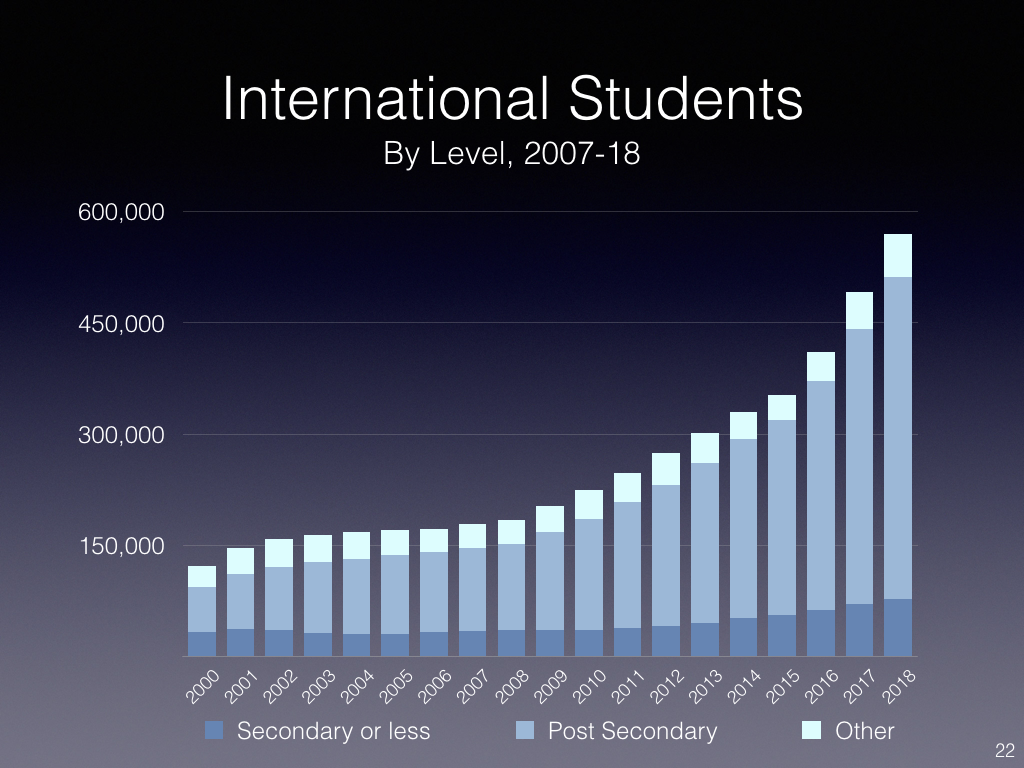
Amid warnings that universities are relying too much on the high tuition fees paid by foreign students, Justin Trudeau’s government has promised to do something about how more than half of the 572,000 international students in Canada hail from China and India.

The Liberal government has announced a new international-student strategy two months before the October election, amidst rising diplomatic tensions and opinion polls showing 90 per cent of Canadians have negative impressions of the government of the People’s Republic of China.

The federal Liberals, who have roughly doubled the number of foreign students in Canada since being elected in 2015, are pledging in carefully worded announcements they intend to adjust the current international demographic ratio, which sees more than half of offshore students coming from China (143,000) and increasingly India (173,000).

A University of Sydney, Australia, professor warned this month that post-secondary institutions in his country and elsewhere risk “catastrophic” financial shortfalls by relying so heavily on students from China, who make up about 40 per cent of the total in that country. One-fifth of the University of Sydney’s budget, for instance, depends on the cohort from China, says Salvatore Babones.

Since Canada and Australia are two of the world’s most sought-after destinations for international students from China, Babones is not surprised the Trudeau government is promising to change the foreign-student ratio by spending $30 million to recruit more young people from countries such as Mexico, Colombia, Brazil, Vietnam, the Philippines, Indonesia, Ukraine, France and Turkey.

“As in Australia, these marketing plans are part of a ‘diversification strategy’ intended to dilute the risk that an adverse event — for example, a suspension in the convertibility of the yuan or a major recession in India — that might suddenly result in a revenue shortfall at universities,” Babones said by email.

“When universities and governments think of international students as a revenue source, these kinds of perverse policies start to seem natural. The proper role of international students is to diversify and enrich campus culture, not to support universities with their tuition money.”

Babones’s report, titled The China Student Boom and the Risk it Poses to Australian Universities, does not focus on how various political tensions could also reduce the number of students from mostly well-off Chinese families who head to English-language schools.

However, an overwhelming majority of Canadians, according to recent polls by Nanos and others, increasingly don’t trust China’s leaders, who in turn, in the midst of a trade war with the U.S. and Canada, are issuing various warnings against their citizens travelling to North America. Some politicians in India, in addition, are also worrying about a student brain drain to Canada.

Stresses are also escalating on some North American campuses because of a flurry of news reports maintaining that some students from China are attempting to intimidate people with roots in either Tibet or protest-filled Hong Kong.

In B.C., Chinese nationals comprise about 40 per cent of the 153,000 foreign students at all levels in the province, most of whom are in Metro Vancouver.

University of B.C. officials confirmed Friday that students from China make up by far their largest international cohort. In the recent school year, UBC enrolled 6,281 students with Chinese citizenship, taking in $184 million from their fees, which are three to four times higher than that of domestic students.

That adds up to 44 per cent of the $414 million collected from all of the 17,200 foreign students at UBC, which has annual revenues of $2.7 billion. Asked if the number of applicants from China is declining, a UBC official said there was sharp growth up to 2019, but that “according to global forecasting trends, it’s possible this growth will slow in future years for a variety of reasons.”

Across the city at Simon Fraser University, officials provided data showing the institution’s 3,078 students from China make up 46 per cent of all international students — who in total paid $126 million in fees in the 2018-19 school year. That is 16 per cent of SFU’s annual revenues.

“We are not over-reliant on international tuition, but we do carefully monitor the situation,” said a senior director of student services at SFU, Leanne Dalton.

Despite the financial vulnerabilities associated with Canadian educational institutions leaning on offshore nationals from China, India and elsewhere, the federal Liberal government has made welcoming more foreign students a major theme in its election campaign.

In addition to saying it intends to recruit more students from beyond India and China, Liberal cabinet ministers toured the country in August to expound on a series of news announcements that foreign students pump $21.6 billion into the economy and “support almost 170,000 jobs for Canada’s middle class.”

Immigration Minister Ahmed Hussen upped the emphasis on the issue by maintaining the total number of foreign students is even higher than 572,000, the figure most often cited in government documents.

“In 2018, more than 721,000 international students studied in Canada,” Hussen claimed in August. The immigration minister’s much larger foreign-student totals surprised and perplexed educational officials contacted by Postmedia, including specialists at the Canadian Bureau for International Education.

If Hussen’s announced new total is accurate, it means that since 2014, when 330,000 international students were in the country, the number has jumped by 391,000. And he is looking beyond China and India to bring in more to boost the GDP.

Source: Douglas Todd: Over-reliance on students from India and China sparks Ottawa reaction

‘Good rednecks’: PPC candidates to decide who attends debate by holding a shootout

One way to attract media attention:

Two People’s Party of Canada candidates in Saskatchewan are solving an impasse with a shootout at a gun range.

The Greater Saskatoon Chamber of Commerce has invited one candidate from each party to a pre-election debate on Sept. 10 but when it came time to decide who would represent the PPC, Guto Penteado and Mark Friesen both thought they would represent the party well.

Penteado is PPC candidate for Saskatoon-University and Friesen is the candidate for Saskatoon-Grasswood.

Friesen said he and Penteado also considered a bean bag toss or a potato sack race but they got excited about the idea of a shootout at the range because it speaks to the PPC’s pro-gun policies.

“We’re both pro-gun advocates,” Friesen said. “We believe in responsible gun ownership and rightful gun ownership and we’re both hunters and we both have our own guns and we both have our licences.”

The shootout will take place on Tuesday at 4 p.m. CT and will be streamed live on Facebook.

Whoever has the better score will be declared the winner and attend the debate.

Some commenters online joked about putting the faces of rival political party leaders on the targets, but Friesen said the gun range has strict rules about such behaviour. It’s not allowed.

“We’re responsible gun owners and with that comes responsibility at the gun range,” Friesen said.

‘Guns don’t kill people’

Penteado said his views are “totally aligned” with the PPC in terms of gun control.

“We want to simplify gun policies,” he said. “We also want more safety courses available around Saskatchewan, around Canada, and more promotion about the good side of guns as a sport because all we see is very bad news about mass shootings, and this is a very bad image for gun owners and the guns themselves.”

Penteado said the PPC is “totally against” gun violence. He firmly believes mass shootings are not about the guns.

“Guns don’t kill people; what kills people is people. We need somebody to pull the trigger,” he said.

“It’s just like cars. When we have a car accident, we never blame the car, we blame the driver. Why are we blaming the gun, the object, when we have a mass shooting?”

But Charles Smith, an associate professor of political studies at St. Thomas More College at the University of Saskatchewan, doesn’t find that argument persuasive.

“All the evidence and research would suggest that having guns available and accessible leads to more violence,” Smith said.

‘False divide between rural and urban’

Smith said he thinks the event is insensitive, especially in light of the recent mass shooting in Texas.

“Bringing it into the political realm and suggesting this is a way to settle disputes reinforces the message that guns and violence are normal,” he said. “That’s not a message that political parties should be sending in 2019 given all the gun violence we’re witnessing in our society.”

Smith also thinks the event is gendered and racialized, and creates a false divide between rural and urban people.

“It plays to a stereotype in a very reactionary way,” Smith said. “It’s very male . It doesn’t speak for the entire rural population.”

‘We’re proud to be rednecks’

Overall, Penteado said the reaction online has been positive, though there have been some people who have been mean-spirited and called them “rednecks.”

“We are rednecks, and we’re proud to be rednecks,” he said.

Penteado was born in Brazil and came to Canada 17 years ago. In Brazil, he was raised on a farm and learned hunting and target practice from his dad.

He found a similar culture in Saskatchewan.

“We live in the countryside, we love the nature, we love the interaction with animals and everything like that,” he said. “I’m referring to the good connotations about rednecks. We’re not stupid. We’re good rednecks.”

While Penteado said both he and Friesen would represent the party well at the debate, at the gun range, Friesen has the advantage.

Penteado had surgery on his right eye last month — the eye he uses for shooting — and while he does go hunting, he generally doesn’t do target practice. But he’s still looking forward to it.

“I think we’re going to have fun, and we’re going to decide in a very healthy way.”

Source: ‘Good rednecks’: PPC candidates to decide who attends debate by holding a shootout

Identity politics in the West: Islam – no longer the bogeyman

Not sure that this is the case but interesting read:

When the head of the economic wing of Germanyʹs CDU party, Carsten Linnemann, publishes a book titled “Political Islam does not belong in Germany”, SPD party member Thilo Sarrazin interprets the Koran under the title “Hostile takeover”, and Germany’s new defence minister Annegret Kramp-Karrenbauer, chairwoman of the CDU party, explains on her first trip to the Orient how the Bundeswehr’s Tornado reconnaissance planes are stopping the caliphate of the “Islamic State” from rearing its ugly head again, we may get the feeling that we’ve hit rock bottom.

We are scraping at the last vestiges of some already quite solidified dregs. All that talk about the Islamic menace, the Islamic challenge, the Islamic threat so keenly cultivated in the West over the past thirty or forty years has now run dry.

Not long ago German policymakers were still busy planning hundreds of new positions in the police forces and intelligence services to observe and track down political Islam. But in the meantime it seems to be dawning on the more alert minds among us that Islam is not (or no longer) an appropriate spectre to be combatting.

This trend is somewhat linked to the situation on the ground. Political Islam has lost its inner credibility, across all the forms in which it appears.

The failure of political Islam

The authoritarian regime of the Islamist Erdogan is wobbling: Turkey is weaker now than it was ten or fifteen years ago, when Recep Tayyip Erdogan was “only” a democratically elected prime minister and could present Islam as a source of inspiration for modern governance. The radiance of his early days has faded.

The AKPʹs political swan song: “the authoritarian regime of the Islamist Erdogan is wobbling: Turkey is weaker now than it was ten or fifteen years ago, when Recep Tayyip Erdogan was ʹonlyʹ a democratically elected prime minister and could present Islam as a source of inspiration for modern governance. The radiance of his early days has faded,” writes Buchen

The Sunni Muslim Brotherhood was not able to rise to power anywhere, with the exception of its brief interlude with Mohammed Morsi in Egypt. The fact that the latter collapsed and died while acting as a defendant in court resonates with its own symbolic power.

The heir to the throne of the “Keeper of the Holy Places” of Islam, Mohammad bin Salman of Saudi Arabia, has been exposed to the whole world as a cowardly murderer.

The caliphate of the “Islamic State” has foundered, vanished from the map. Who would have thought that possible? Talk shows aired in 2015 made mention of the name “Islamic State” a dozen times at least. Coming from the mouths of academic and non-academic experts, it had a ring of permanence, of a lasting challenge.

That talk has turned to ashes. Even criminal organisations have to abide by certain rules in their internal relations and forms of provocation against the general social norm if they are to survive for long. This is ancient knowledge, recorded for posterity by the Jewish-Arab philosopher Bahya ibn Paquda, who lived in Zaragoza in the 11th century.

Fragile existence

Al-Qaida and its competitor, the “Islamic State”, continue to exist in the supra-national underground; this cannot be denied. But they are fragmented, and the rivalry between the two groups vying for leadership in the violent spectrum of Islamism is now leading to some curious phenomena.

In Yemen, Al-Qaida got its hands on an unreleased propaganda video made by its rival and used it to expose the “Islamic State” to public ridicule. And here we are in the midst of a satire, which the British film “Four Lions” presented as early as 2010 as a suitable form for portraying the Islamic menace, long before the current CDU leadership took up the subject in all seriousness and without any black humour.

It is of course intellectually risky to name Erdogan, the Muslim Brotherhood, Mohammad bin Salman and al-Qaida in one breath. But it’s a risk that those warning of the threat of political Islam are only too glad to take. It is after all part of their raison d’etre. If we want to be realistic, though, we have to look this construct or – to put it in ultramodern terms – “frame” squarely in the eye.

The French scholar Olivier Roy was perhaps the first to recognise the pitfalls of this way of looking at the world and to discern the real weaknesses of “political Islam”. His book – “L’echec de l’Islam politique” (The failure of political Islam) – was published way back in 1992.

Roy warned against trying to explain modern Islamism, particularly its most radical manifestations, based on Islam alone. Trying to derive the current phenomena mainly from the nature, history and culture of Islam runs the risk of constructing something that does not stand up to a realistic and enlightened diagnosis of the present.

Roy pointed out that contemporary Islamism is instead a by-product of the globalised world, of its unshakeable belief in progress and its forms of communication. These forms and thought patterns are so pervasive that Islamism must be understood more as a reflection of modernism (or post-modernism) than as a new edition of classical, original Islam. Simply believing everything the Islamists claim about themselves makes things too easy.

Olivier Roy met with a great deal of resistance to his insights. 11 September 2001 then seemed to furnish incontrovertible proof of the Islamic threat and its overwhelming importance.

But what has happened since then? Wars have been waged to eradicate this threat. Military interventions in Islamic countries have come one after the other. Thanks to the immense resources thrown at the project, several advances in military technology have been made in the process, the perfecting of remote-controlled drone war, for example.

But wiser minds agree today that no progress has been made in resolving any problems. While a partial problem like Osama bin Laden was “solved”, many new ones have been created. What is the situation like today in Afghanistan, in Gaza, in Yemen, in Libya, in Mali, in Syria and in Iraq? An error seems to have been made in the analysis of the underlying issue. Olivier Roy was right from the start.

Islamic states in dissolution

The dire new problems do not consist of ever-new Islamist movements that throw themselves in the paths of the invaders and their helpers and strike with steadily growing brutality in the countries of the West. They consist of the disintegration of entire societies, the dissolution of regional structures and the collapse of what were once quite sovereign states.

Successfully allied against the USA and its partners in the Middle East: it would be a mistake to attribute the regional successes of the Islamic Republic to the power of Shia fundamentalism, i.e. to a further manifestation of “political Islam”. In the chaos that prevails, Iran appears to some – despite or because of its anti-American rulers – to be a force for order whose claim to regional leadership is accepted as being the lesser evil

In the resulting chaos, those who have somehow survived to this point can appear to be strong. They include – besides Israel – the Islamic Republic of Iran.

Although the mullahs are skating on thin ice in their domestic policies, they are succeeding in their foreign and regional efforts in exploiting the weaknesses of their main opponent, the USA, and its alliances. Iran has mobilised Shia allies on a large scale. The conflict between Shias and Sunnis is indeed a major factor in the Middle East today.

But here as well it would be a mistake to attribute the regional successes of the Islamic Republic to the power of Shia fundamentalism, i.e. to a further manifestation of “political Islam”. In the chaos that prevails, Iran appears to some – despite or because of its anti-American rulers – to be a force for order whose claim to regional leadership is accepted as being the lesser evil.

Islam is breaking up on its own and no longer fits the image of a major enemy. Donald Trump has been quicker to grasp this than the leaders of the CDU and those who oppose the “Islamisation of the West”. At the beginning of his presidency, his identity policy still focussed on imposing entry restrictions on citizens of certain Islamic countries. In the meantime, however, he has begun directing his rage more at blacks who live in cities he describes as “rat and rodent infested messes” and “Hispanics” who want to cross the border from Mexico or live “illegally” in the USA and who should be deported.

Giving way to old-fashioned racism

Islamophobia is segueing into old-fashioned racism. The new enemy in Western identity politics are people of colour, those who speak a different language and those who are judged to be somehow or other inferior. Racism has the advantage of being more comprehensive. Of course, Muslims are also included.

The trend has long since washed up on Europe’s shores. Arab clan criminality, the frightening reproductive power of Africans, uninhibited by civilisation, or their genetic predisposition to pushing children in front of ICE trains: it is impossible to overlook the shift in the discourse on the question of identity.

The hairdresser Alaa S. from Chemnitz was not sentenced to nine and a half years in prison for an alleged but unproven knife attack because he is a Muslim, but because he is an asylum seeker and refugee. Without thorough indoctrination in racist dehumanisation, it would not be possible to let refugees drown in the Mediterranean, or to turn away those who are rescued from Europe’s coasts for days and weeks on end. The duplicity of events taking place at America’s and Europe’s southern borders has already been noted, and rightly so.

Demonstrators in front of Berlinʹs Brandenburg Gate, “#indivisible” against racism and right-wing populism: of course this new racism is provoking resistance. Those affected are raising their voices. Many citizens reject such identity politics, partly on the basis of the historical experiences in America and Europe. They are aware of the fact that the prosperity of our middle classes is bought on the backs of people in other parts of the world. Climate change threatens to make this truth even more evident

Of course this new racism is provoking resistance. Those affected are raising their voices. Many citizens reject such identity politics, partly on the basis of the historical experiences in America and Europe. They are aware of the fact that the prosperity of our middle classes is bought on the backs of people in other parts of the world. Climate change threatens to make this truth even more evident.

In time, one could cynically say, there will come a further intensification of the discourse. The American journalist James Kirchick tells the tale of a “race war of the left”. He sees “white men” as victims of a new racism practiced by progressive forces. Kirchick turns perpetrator into victim and victim into perpetrator. This follows exactly the same line as Donald Trump, who set out at the beginning of his term to put an end to the “carnage” his white followers were allegedly suffering from and to restore their rights.

Kirchick’s essay on “the leftʹs race war” was published on 15 August under exactly that title on the website of the Frankfurter Allgemeine Zeitung. That’s not a good sign. “Race war” was a key term in Adolf Hitler’s vocabulary. He already used it early on to describe the political programme of the Nazis. What do Kirchick and the F.A.Z. insinuate as being the intentions of “the left”?

When asked, the F.A.Z. responded that the author had addressed the “political debate in the United States, which is being carried out partly with racist arguments”. The newspaper deemed the text to be “an important contribution to the debate.”

The victory of global capitalism and liberal democracy are apparently the end of the story. To some, it would appear, any means are justified to enable this culmination – something of an eternal coronation – to continue as undisturbed as possible under “white supremacy”.

Source: Identity politics in the West: Islam – no longer the bogeyman

Germany eases citizenship rules, but Jewish roadblocks remain – Monash Lens

One of the more lengthy and comprehensive analyses:

Germany’s constitution contains a provision that permits citizenship to be granted to descendants of persons stripped of their German citizenship by the former Nazi regime for political, racial or religious reasons.

In practice, this provision, Article 116(2), is mostly – although not exclusively – directed at descendants of Jewish refugees from Germany. Approximately 7000 German Jews fled to Australia before World War II, due to the policies of the Nazi regime, and there are many descendants in Australia who now wish to become German citizens.

However, the German parliament has not properly implemented Article 116(2) in its citizenship law. German legislation precludes the granting of citizenship to various groups of descendants of Jewish refugees.

Many applicants have been denied citizenship on the basis that the affected family member was female, because citizenship passed only through the father at the time the German constitution was enacted.

Other applications are denied because German authorities contend that the applicant’s female ancestor willingly gave up German citizenship by marrying a non-German man after escaping Germany.

In other cases, the authorities have denied applications to the descendants of those who the authorities argue left Germany “voluntarily” during the Nazi reign and willingly relinquished their German citizenship — a position that flies in the face of historical realities. And some applicants have been denied citizenship on the basis that their parents were unmarried, or that the applicant was adopted.

We can see no rational reason why these groups of descendants are excluded for eligibility for German citizenship. As Article 116(2) of the constitution seeks to provide a form of restitution for past injustices, it’s imperative that this provision is interpreted in a generous fashion, without drawing arbitrary distinctions between descendants.

An inconsistent law

A very strong argument can be made that the law is inconsistent with the right to equality under the German constitution, not to mention Germany’s obligations of non-discrimination and the right to private and family life under the European Convention on Human Rights, to which Germany is a party.

On 30 August, the German government issued a decree that attempts to rectify some of the discriminatory aspects of the law. The decree addresses some aspects of the gender discrimination in the current law, and extends citizenship rights to those born before 1949, who were until now precluded from eligibility by a 2012 decree.

However, the decree does not completely remedy the discrimination in the law.

For example, children born out of wedlock to a German mother would be excluded, whereas children born out of wedlock to a German father would be eligible. Moreover, citizenship won’t be granted unconditionally to those who become eligible. Rather, applicants will need to demonstrate German language competence and knowledge of Germany’s legal and social order.

The determination of whether these criteria are satisfied in an individual case is to a large degree discretionary, based on a subjective assessment made by German consular officials. In light of Germany’s track record in relation to granting citizenship under Article 116(2) of the constitution, there’s a need for greater transparency and more objective decision-making criteria to ensure the decree is given effect to in the manner it was intended.

Another issue is that by requiring certain groups to pass the above tests but not others, the law perpetuates gender discrimination. For example, descendants of female ancestors need to demonstrate German language skills, but descendants of male ancestors do not.

Moreover, the generation born after 31 December, 1999, would be the last generation to be eligible under this decree to obtain German citizenship. Although an argument can be made that the rationale for restitution lessens with the passage of time, we can see no justification for limiting eligibility to this timeframe.

There are also serious questions as to whether this type of rule-making by decree is appropriate, not to mention constitutionally valid.

The difference between a decree and legislation isn’t merely symbolic. A future government could revoke the decree with the stroke of a pen, whereas changing legislation requires that the proposed law be debated by parliament.

A law, properly debated and enacted through Germany’s parliamentary procedures, faces much higher hurdles for reversal.

Another provision of Germany’s constitution requires that certain “essential” decisions must be made by parliament, rather than by the executive branch of government in the form of a decree.

In our view, there’s a strong argument that this issue is one that can only be dealt with by parliament.

Germany has a largely commendable track record in confronting its Nazi past. It should do right by the descendants of those who had to flee to save their lives.

Germany has a largely commendable track record in confronting its Nazi past. It should do right by the descendants of those who had to flee to save their lives – end decades of protracted, unjustifiable and arbitrary discrimination by enacting a law that provides for a simple path to citizenship for all descendants.

Requiring descendants to fight for their rights in the courts would add insult to injury, and would be particularly difficult for descendants in countries on the other side of the globe such as Australia.

Source: Germany eases citizenship rules, but Jewish roadblocks remain – Monash Lens

Ethnic media election coverage 25-31 August

Latest weekly analysis of ethnic media coverage. For the analytical narrative, go to Ethnic media election coverage 25-31 August

Immigration lawyers report Canadian Muslims being denied entry to U.S.

Of note:

A number of Canadian Muslims have been turned away at the Canada-U.S. border in recent weeks, immigration lawyers say.

Those denied entry include a prominent Guyana-born Toronto imam who serves as a chaplain with the Peel Regional Police and an Iraqi Turkmen community leader who has family members fighting ISIS in the Middle East.

The two men — who were denied entry at different border crossings and were not travelling together — are among at least six Canadian Muslim men who have been denied entry at the U.S. border over the last two weeks.

The men and their families, all of whom are Canadian citizens, were given little in the way of explanation by border officials for the decision to deem them inadmissible.

Neither Guyana nor Iraq are among the seven Muslim-majority countries subject to U.S. President Donald Trump’s “Muslim ban” executive order, which essentially blocks refugees and visitors from those countries from entering the U.S.

Both men were told to apply for visas at the U.S. consulate in Toronto before returning to the border to seek entry — an unusual process for people who hold Canadian passports.

The six men are represented by the Toronto-area immigration firm CILF — Caruso Guberman Appleby. Lawyers there say that if they’re seeing this level of activity at their law firm, there may be many other Canadian nationals facing similar problems at the border.

“We’ve seen a lot more in the last few weeks and we don’t know what to attribute it to. We know the climate there in the U.S. has changed, it’s a bit different, but at the same time there are processes and procedures and people should be afforded opportunities to challenge a case,” Daud Ali, a lawyer at CILF, told CBC News.

“But it’s hard to know what you’re going up against when you’re not told why you’re denied entry. The fact that they’re all Muslims, that raises some concerns about whether these people are being targeted or if this is a new form of some sort of ban …”

“Having worked as an immigration lawyer for over 40 years nothing surprises me anymore but, in all my years, I have never seen such a Kafkaesque scenario,” said Joel Guberman, a partner at the firm.

When asked if there has been a new directive in recent weeks with respect to Muslim travellers from Canada, a spokesperson for U.S. Customs and Border Protection (CBP) said the agency “has not had any new policy changes.”

While unable to speak to specific cases because of privacy laws, the CBP spokesperson said “applicants for admission bear the burden of proof to establish that they are clearly eligible to enter the United States. In order to demonstrate that they are admissible, the applicant must overcome all grounds of inadmissibility.”

No Canadian citizen has a “right” to enter the U.S.; entry happens at the sole discretion of the U.S. customs officers on duty — and they have a lot of latitude to ask questions to determine the admissibility of a foreign national.

CBP lists more than 60 grounds for inadmissibility divided into several major categories, including health-related reasons, criminality, security reasons, illegal entry and immigration violations, and documentation requirements.

Two of the six men denied entry have agreed to share their stories with CBC News to warn other Muslim Canadians about the complications that may arise when travelling to the U.S.

Imran Ally, a resident imam at the Toronto and Regional Islamic Congregation (TARIC) mosque for the last 20 years and a chaplain with Peel Regional Police, was travelling with his wife and three children to attend his best friend’s daughter’s wedding in the New York City borough of Queens. He was set to officiate.

Ally and his wheelchair-bound, special-needs son were held at the Peace Bridge crossing near Fort Erie, Ont., for more than five hours. They faced three separate rounds of questioning by plainclothes and uniformed officers. Some of the questions centred on his charitable endeavours related to resettling Syrian refugees.

Ally, a native of the South American nation of Guyana, was questioned about his work as a religious leader, photographed and fingerprinted and ultimately denied entry because he was told his name “matches that of a bad guy.”

He was driven back to the Canadian border by a police cruiser, cancelling his long-planned wedding role.

“I knew going to the U.S. for the first time wouldn’t be a red carpet welcome, I (knew) that I’d probably have to answer questions, I might even have to spend a long time. We were prepared for all of this, but never in my wildest dreams did I think they’d say I’m inadmissible because of my name,” Ally said.

“The way it was done — they really at the end made me feel like I’m a criminal.”

Nejmettin Vali, the vice-president of the Iraqi Turkmen community group in Toronto, was also denied entry at the Windsor-Detroit crossing in early August when he and his family were on vacation celebrating Eid al-Adha, one of the holiest of Islamic holidays.

Vali was travelling to Detroit for some cross-border shopping with his wife and children when he was pulled aside by American officials for a secondary inspection that went on for more than four hours.

Vali said he felt violated by the officers, who seized not only his cellphone but those of his wife and Canadian-born children. While being questioned, Vali said the officers refused to let him fetch food and medicine for his autistic daughter.

“I looked like a terrorist or something,” Vali said. “I have no criminal record, no jail, nothing. I’ve been a Canadian for twenty years and no problem, so I want to figure out what’s going on. I want to fight it — I feel like I have a bad name now because they didn’t let me inside.

“It’s sad. Everybody was just happy to go to the U.S. for, like, two hours for the shopping. That didn’t happen.”

Vali said the border guards didn’t tell him why he was denied entry but he said the officers were concerned about his semi-regular trips to Iraq, the country where he was born.

Vali said he travels to his native land often because he’s been supporting his three grandchildren there since his son — a former Iraqi police offer — was killed by ISIS forces.

Source: Immigration lawyers report Canadian Muslims being denied entry to U.S.

Liberals dump Quebec candidate after B’nai Brith, Conservatives allege anti-Semitic comments

Embarrassing that the candidate vetting process did not discover these earlier statements.

Suspect an Italian-Canadian may now be the Liberal candidate given the complaints by some Italian-Canadians in the riding that a non-Italian-Canadian won the nomination:

The Liberals have dumped a candidate in Quebec after B’nai Brith Canada accused Hassan Guillet of making a number of anti-Semitic and anti-Israel statements.

“The insensitive comments made by Hassan Guillet are not aligned with the values of the Liberal Party of Canada,” the party said in a media statement.

“Following a thorough internal review process that has been ongoing for a few weeks, the Liberal Party of Canada has made the decision to revoke the candidacy of Mr. Guillet for the riding of  Saint—Léonard Saint—Michel in this fall’s election.”

Guillet, a member of the Council of Quebec Imams, gained national attention after delivering a speech in Quebec City honouring victims of the Quebec mosque shooting.

In a statement on its website, B’nai Brith Canada said Guillett praised a Hamas-aligned activist, Raed Salah, and had a history of making anti-Semitic comments on social media. The group said it reached out to the Liberal Party more than a week ago to make it aware of their allegations against him.

In a post on his Facebook account earlier today, Conservative Leader Andrew Scheer called on Prime Minister Justin Trudeau to “do the right thing, immediately condemn these anti-Semitic comments, and fire this candidate.

“Anti-Semitism is unfortunately all too real in Canada and threatens the safety and security of Jewish Canadians. As political leaders, we need to speak out and condemn it at every opportunity.”

In a statement issued Thursday — before being dropped as a candidate — Guillet apologized for some of his past comments regarding the Middle East, without repeating the comments or detailing what they were.

“If these statements could be considered offensive to some of my fellow citizens of Jewish faith, I apologize. My intention was not to offend anyone. The lack of sensitivity of these statements does not reflect my personality or my way of being,” he said in French.

Source: Liberals dump Quebec candidate after B’nai Brith, Conservatives allege anti-Semitic comments

World War II and the Ingredients of Slaughter

Some uncomfortable parallels:

World War II began 80 years ago this Sunday after Nazi Germany and the Soviet Union signed a “nonaggression” pact that was, in fact, a mutual aggression pact. Adolf Hitler invaded Poland on Sept. 1, 1939. Russia’s invasion of Poland, no less murderous, followed two weeks later.

On Nov. 3 of that year, Joseph Goebbels, the propaganda minister, gave Hitler a report of his trip to Poland. “Above all, my description of the Jewish problem gets [Hitler’s] full approval,” he wrote in his diary. “The Jew is a waste product. It is a clinical issue more than a social one.”

For several years many commentators, including me, have written about the parallels between the prewar era and the present.

There’s the rise of dictatorial regimes intent on avenging past geopolitical humiliations and redrawing borders: Germany, Italy, Japan and Russia then; China, Iran and Russia now.

Citizenship list in Indian state leaves out almost 2 million

Increased sectarianism, weaponized:

On Saturday morning, Farid Ali, a farmer dressed in his best sky-blue kurta and a white prayer cap, walked quietly into his village headquarters and received devastating news.

His name wasn’t on the list.

He looked, he waited, his legs began to shake, his dry lips began to move and he prayed there had been a mistake. But his name wasn’t anywhere.

Mr. Ali’s citizenship in India, where he has lived all his life, was now in question, and he could soon be separated from his family and hauled off to a prison camp.

He is one of nearly two million people in northeast India who were told Saturday that they could soon be declared stateless in a mass citizenship check that critics say is anti-Muslim. The news arrived in small, sunlit offices across the state of Assam, where citizenship lists were posted that drew huge crowds. Many walked away shocked and demoralized; others were joyous.

Source: Citizenship list in Indian state leaves out almost 2 million