Can Trump’s Hard-Core Fans Be Deradicalized?

Interesting question and framing:

President Donald Trump’s rally in Greenville, North Carolina, this week made scholars of fascism sit bolt upright. Trump spouted racist conspiracy theories about Somali-American Rep. Ilhan Omar to his fans, who chanted “Send her back!”

Trump has long stoked bigoted grievances among his followers, but the Greenville rally saw him act as a more overt radicalizer than ever before. And with a portion of Trump’s fanbase now openly clamoring for the physical removal of several prominent Democrats of color, experts are questioning whether the country can repair the damage—even if Trump loses in 2020.

“He’s always embodied these sentiments,” Zoé Samudzi, author of As Black As Resistance and a scholar studying genocide said. “But I do feel like there’s a feedback loop: he’s both animated by and responsive to the base that is eager to discipline a black Muslim immigrant woman. His long held racial animus fuels his supporters (who never need permission for their virulent racism but are emboldened by him all the same), and their enthusiasm energizes the president who in turn keeps ratcheting up his rhetoric.”

While extreme actions like the “send her back!” chant, and the presence of fringe conspiracy theorists have drawn attention to his rallies, it’s unclear how many of his supporters subscribe to those individual beliefs.

“Some people might be there because they genuinely believe in this ideology,” said Mary Beth Altier, an assistant professor at New York University specializing in radicalization. “Some may be questioning those beliefs. They’re toying with them, and they go because a friend brought them or they think it’d be cool to go. They go and get swept up. People start chanting, are you going to be the only one standing there not chanting?”

Wednesday night’s “send her back!” chant followed similar rhetoric by Trump directed at Omar and fellow lawmakers Alexandria Ocasio-Cortez, Ayanna Pressley and Rashida Tlaib. All four are freshman congresswomen of color, who have broken with Democratic House leadership to promote a more progressive agenda, in part over wanting to confront Trump more aggressively.

In a series of Monday tweets, Trump laid the groundwork for Wednesday’s “send her back!” chant.

“So interesting to see ‘Progressive’ Democrat Congresswomen, who originally came from countries whose governments are a complete and total catastrophe, the worst, most corrupt and inept anywhere in the world (if they even have a functioning government at all), now loudly and viciously telling the people of the United States, the greatest and most powerful Nation on earth, how our government is to be run,” Trump tweeted of the four congresswomen. “Why don’t they go back and help fix the totally broken and crime infested places from which they came. Then come back and show us how it is done. These places need your help badly, you can’t leave fast enough.”

Though the tweets were indistinguishable from white nationalist talking points (and all but one of the congresswomen were born in the U.S.), Trump’s popularity with Republicans spiked after his racist tweets, a Reuters poll this week showed. It’s possible very little will bother his most devoted fans, Janja Lalich, a professor studying cults and totalitarian leadership, said.

“There’s this intense devotion and the inability to question or criticize or doubt,” Lalich told The Daily Beast.

“They seem to be in a state of what we call cognitive dissonance, where what they believe doesn’t match reality,” she said. “People in that state tend to cling to their beliefs over reality. They dig themselves even deeper. I think the things we see at the rallies, where people get into these cheers and adore everything he says, is very typical of what we see in run-of-the-mill cults. There’s what we might call blind obedience or blind followership.”

Trump’s rallies offer a strong sense of community for fans. That’s critical to the people chanting for Omar’s removal, said David Neiwert, author of Eliminationists: How Hate Talk Radicalized the American Right.

Neiwert defines eliminationism as a community-based mentality that promotes “purity” by demonizing its opponents and demanding they be purged from society.

“What they’re doing is participating in a community of hate. This is actually key to a lot of its power and its attraction. It’s almost ritualized,” he told The Daily Beast. “This is how hate crimes work. Hate crimes are always message crimes directed at targets who are seen as corrupting influences and bad for the community. Hate-crime perpetrators see themselves as defending their communities while doing it. There’s always a communal aspect to this. It’s very much the mob.”

Lalich offered a similar perspective.

“Having an us-versus-them mentality is what keeps people strong in their beliefs,” she said. “It creates paranoia, it creates a kind of fighting atmosphere. That kind of mentality is one we typically see. By feeding into that, the leader creates a separation. It also creates a sense of elitism and specialness.”

Trump’s rhetoric has already inspired violent attacks. During a March 2016 rally, Trump asked fans to eject protesters, calling on them to “get ‘em out of here.” Matt Heimbach, a neo-Nazi who was later instrumental in 2017’s deadly white supremacist rally in Charlotteville, complied, assaulting a black protester. In October, a Florida man sent 16 pipe bombs to politicians, news outlets, and public figures who have been critical of Trump. The bomber had attended Trump rallies and described them as “like a new found drug.” Trump’s election has coincided with a marked spike in hate crimes, and a rise in overt white supremacist action.

Trump’s attacks on the four congresswomen are an extension of the racist appeals he made to voters during his first campaign.

“The language about the congresswomen fits into nativist language around a racial purity of citizenship, and inherent to that is an idea of ethnic cleansing either through deportation policies, restrictions on entry, or violence against racialized communities,” Samudzi said.

“The problem isn’t simply that three of the four women are US-born: the problem is the insinuation that there is an idea of birthright citizenship that could be revoked (as well as the de-naturalization of citizenship) in an attempt to actualize a vision of a white America.”

Experts who help people escape intense groups like cults or hate movements say dialogue with people outside the movement can help deradicalize adherents.

Christian Picciolini, a former white supremacist who now helps extremists leave hate groups, said his method involves talking and identifying sources of grief and trauma that might underlay hate.

“I listen for those potholes that detoured their life’s journey and then try to fill (repair) them,” he told The Daily Beast via email.

Lalich cited the case of Derek Black, the son of a prominent white nationalist, as an example of how deradicalization can sometimes works.

“What seems to have worked is really just engaging in dialogue, individual by individual,” she said. Black renounced white supremacy after going to college and meeting people of differing viewpoints.

But some of Trump’s most die-hard fans might be removed from dissenting opinions, Altier said.

“Establishing alternative social bonds and networks where they can interact with people with other views” could help, she said, but “we’re not seeing that on social media. We’re seeing more polarization in society on both sides.”

Instead, dedicated fans might turn inward, engaging with more pro-Trump communities.

“I don’t listen to Fox, I don’t listen to CNN. I don’t listen to any of ’em,” Allicyn Steverson, a Florida teacher told HuffPost at the Wednesday rally. “I listen to Trump’s tweets and his QAnons.” (QAnon is a deranged online conspiracy theory that accuses Trump’s opponents of sexually abusing and sometimes eating children.)

A choose-your-own reality media environment might keep people from challenging their beliefs, Lalich said.

“Because people are so divided right now, those folks are mainly watching Fox and listening to Alex Jones,” she said. “They’re not going to get any kind of education that might tap into their critical thinking. That’s what works when we try to do exit intervention: we try to reawaken the person’s critical thinking and get them to see the reality of who their leader is and what their beliefs are. In this case, because this is on a national level, we’ve never quite experienced this before in our country. I think any kind of public education would be very difficult.”

Picciolini stressed that outright confrontation over bigoted beliefs might not help a person abandon them.

“Ideology is usually formed, or led to, by trauma or grievance. If we continue to confront ideology by trying to change it, we will fail,” Picciolini said. “We must instead focus on repairing the motivations that lead to hate-and they are seldom someone else’s skin color or religion. Self-hatred or uncertainty lead to hate. Let’s fix that.”

Altier also cautioned that some Trump supporters might act out should his rallies stop.

“While people saying these things is awful and they may radicalize other people, if we quash their ability to say them, my research shows they may become more violent because they can’t express those grievances. It’s a catch-22,” she said.

And even if Trump leaves office, it’s no guarantee that Trumpism will end. “I think it’s only going to intensify,” Neiwert said, citing fears that Trump would not lead a peaceful transition.

It’s a concern Lalich shares. “I think he can still remain their leader. He doesn’t need to have office,” she said.

“He’s already threatened that it’s going to be rigged and that his people will rise up. I think that’s not going to change very much because he has reawakened such hatred in this country.”
Source: Can Trump’s Hard-Core Fans Be Deradicalized?

Driven to distraction by racism, we mourn the people we could be

A reminder that all is not sweetness and light in Canada with respect to acceptance of our diversity, even if most indicators confirm that we are doing a relatively better job than elsewhere:

A particular Toni Morrison quote springs to mind as the world continues to engage with Donald Trump’s latest cruelty.

“The function, the very serious function of racism, is distraction. It keeps you from doing your work. It keeps you explaining, over and over again, your reason for being. Somebody says you have no language and you spend 20 years proving that you do. Somebody says your head isn’t shaped properly so you have scientists working on the fact that it is. Somebody says you have no art, so you dredge that up. Somebody says you have no kingdoms, so you dredge that up. None of this is necessary. There will always be one more thing.”

Through a tweet aimed at four freshmen Democrats – Alexandria Ocasio-Cortez, Ilhan Omar, Rashida Tlaib and Ayanna Pressley – the U.S. President mused: “Why don’t they go back and help fix the totally broken and crime-infested places from which they came.”

All four racialized women are U.S. citizens, and with the exception of Ms. Omar, were born in the United States.

Although the tweet is consistent with his specific brand of racism and xenophobia – a Muslim ban, you’ll recall, was a top priority for him after he was elected – Mr. Trump somehow lowered the bar on how you can counter criticism from your opponents, and it is worrying what kind of precedent this will set for other people in power. But focusing on the women he views as extreme can also be seen as an attempt to distract from the larger issues.

So we must not lose sight of these facts, as his tweets draw the ire of a stunned audience: U.S. Immigration and Customs Enforcement (ICE) began raids last weekend in an effort to round up about 2,000 undocumented immigrants ordered by the courts to be removed from the country. Mr. Trump’s Labor Secretary Alex Acosta resigned last week, as criticism grew over a 2008 plea deal he gave to convicted sex offender Jeffrey Epstein. Both stories were dominating the news before Mr. Trump unleashed his latest racist tirade.

And while we watch the more explicit outbursts of racism in the United States, Canadians risk being distracted from what’s happening here in our own country. We are not immune to people being singled out because of their race and religion.

Random ID checks by immigration officers in the past week in Toronto have alarmed migrant advocates. The number of hate crimes in Canada reached an all-time high in 2017, largely driven by incidents against Muslim, Jewish and black people, according to Statistics Canada.

Then there’s the other noxious way in which we are distracted: Racism and xenophobia slowly chip away at one’s self-confidence and sense of self-worth. When you are made to feel like you don’t belong enough times, it adds an additional layer of weight of fear, self-doubt and paranoia as you try to make your way through your daily life interactions: as police officers walk by you, as you pray at your mosque, while you are in meetings, and as you take public transit.

“Go back to where you came from” is a phrase as intensely familiar to immigrants as the open blue sky. It was directed at me as I walked down the hallway of my school when I came to Canada at the age of 10, as I strolled home on a beautiful spring day wearing a hijab as a teen. Instead of enjoying the lovely breeze, my mind would wander to scary thoughts, such as whether or not I would be attacked. Its impact, as potent as being called a Paki, has been ingrained on my psyche and tints the lens through which I see the world today.

Targeting people based on their race has real consequences on their livelihood, their ability to contribute to the public discourse and their sense of connection to their immediate surroundings, resulting in a lack of social cohesion. In a study conducted by the University of Arizona, 18.2 per cent of black participants reported emotional stress from perceived racism while 9.8 per cent reported physical stress. The numbers were significantly lower among white participants of the study; 3.5 per cent reported emotional stress, while 1.6 per cent reported physical stress.

Racism disempowers the people it’s directed at; it’s a distraction, as Toni Morrison said, a soul-sucking threat to our collective progress. And there is simply too much work to be done, too many policies to change and too many laws to be challenged to afford to sacrifice any person who is forced instead to spend any amount of time or energy defending their right to belong.

Sometimes I wonder what it might be like to not get distracted by the racism and microaggressions I experience. Would I be bolder and braver? Would it increase my sense of belonging? How does it feel to go about your daily life without carrying all these experiences?

I wonder if even these four powerful women, feeling obliged to respond to the remarks at a news conference, on social media, and likely for longer than the life of this controversy on its own, felt that way too.

Source: Driven to distraction by racism, we mourn the people we could be: Samra Habib

Could populism take root in Canada? Too late – it already has

Two slightly different takes on populism in Canada, starting with Andrew Potter who notes that the Canadian variant as seen in the provinces is largely not anti-immigration (save for Quebec with its Bill 21):

Ever since Donald Trump won the American presidency in 2016 with a toxic combination of sexism, vulgarity and the brazen courting of white nationalists, Canadian academics, pundits and pollsters have been obsessed with the question: “Could it happen here?”

By “it,” they mean the rumblings of discontent that have propelled right-wing populists to power across the West. Mr. Trump and Brexit are the most widely cited examples of the phenomenon, but almost every country has been implicated to some extent. Except, apparently, Canada, where the answer to the question of whether it could happen here is typically “yes, but.…”

That is, what we get is some dire reading of the tea leaves (it could happen here!) countered by a renewed faith in Canada’s continuing exceptionalism, thanks in large part to our healthier institutions and superior values.

But the truth is, not only can populism happen here – it already has. The reason most observers miss this is that they are working with a conception of populism that doesn’t really apply to the Canadian context.

The standard academic take is that populism is an ideological empty vessel, capable of taking left-wing or right-wing forms depending on the particular national context. But regardless of its shape, at the core of the populist instinct is the idea of a pure or authentic people being exploited or humiliated by a corrupt elite. As a consequence, populists typically deny the legitimacy of mainstream political and legal institutions, reject the value of experts such as academics and scientists, and demonize immigrants and refugees.

This last characteristic is the one most people have in mind when they worry about populism. And there are good reasons to be worried, especially in an immigrant-heavy country such as Canada. But while it is worth keeping an eye on changes in our usual welcoming approach, when it comes to populism, it’s not clear how relevant it is to the Canadian context.

That’s because populism in Canada isn’t, and probably never will be, about an authentic original people being diluted by an immigrant tide or debased by a class of globalist elites. Yes, there’s some of that to be found here, but it will never go anywhere, precisely because there never has been a single overriding dominant settler culture. From Canada’s earliest days there were always two or three distinct cultures striving for control. There simply is no “authentic” Canadian identity to serve as the focus for resentful nostalgists.

But that doesn’t mean there’s no populism here. There’s plenty of it – in many ways, Canada is the most populist-ridden country going. It just takes a form where we don’t recognize it as populism. Instead, we call it regionalism.

We usually talk about Canada’s regional identities as a point of pride, the sort of thing that spurs singalong tunes by Stompin’ Tom Connors or the Tragically Hip. But there is a dark side to it, part of which was brought to light earlier this year in a major survey done by Angus Reid on Western alienation and the state of the federation.

The striking thing the survey revealed is how much Canadians don’t particularly like one another, with British Columbia and Quebec particularly isolated. To the extent that there is any interprovincial amity, it’s completely local. Saskatchewan and Alberta currently have a little bromance going, and the people in the Maritimes all seem to like one another well enough. But after that, it’s pretty much either resentment or indifference across the board, and a sharp reminder of how weak Canadian nationalism is. Forget the two solitudes – we’ve got like seven of them.

What motivates this regionalism is a complicated mix of history, demographic shifts and economic fortunes. What is remarkable, though, is how often it manifests as a hatred of elites, especially the “Laurentian elite” in the Toronto/Ottawa/Montreal triangle and the institutions they control. On this view, the “authentic” Canadians are the regional peoples – the Québécois or the Maritimers or the Albertans or the Cascadians, all of whom are lorded over in their own way by the cosmopolitan elites in Ottawa.

This is populism of a highly regionalist sort. But whereas the current Quebec version, as practised by François Legault and his Coalition Avenir Québec, is strongly anti-immigrant, in general regionalist populism is highly congenial to being on good terms with newcomers. This is something that Alberta Premier Jason Kenney and Ontario Premier Doug Ford have proven more than willing to exploit, with a considerable amount of success.

The upshot is that all the worrying over whether the right-wing populists will take power in Canada misses the fact that they already have. They’ve merely taken to the provincial level of politics to air their grievances and accomplish their goals.

Source: Could populism take root in Canada? Too late – it already has: Andrew Potter

Canada has so far managed to avoid the populist disruptions seen in other Western democracies, but the social fabric tying the country together may be starting to fray, a leading expert on the issue said.

In his book Whiteshift, political scientist Eric Kaufmann described Canada as a possible exception to the populist wave in the West, but in a recent interview with economist Tyler Cowen, Kaufmann said the precarious status quo is now under threat.

“The idea that English Canada is immune to this is actually wrong and I do think we’re going to see more of it going forward,” Kaufmann said. “The electorate is now more polarized on cultural issues than it’s ever been in Canada. We’ll have to see where that goes, but I don’t think Canada will be the great exception that it has been for much longer.”

As evidence of this, Kaufmann pointed to the newly founded People’s Party of Canada, which advocates for reduced immigration levels; and Doug Ford’s Progressive Conservative government in Ontario, which he said “has elements of this populism.” Ford’s government, though, has mainly steered clear of the immigration issue, except for a brief spat with the federal government over funding for resettling asylum seekers who had crossed the border illegally.

Neither the federal Conservatives or Ford’s PC government have called for a reduction in the amount of legal immigrants that Canada accepts each year. Maxime Bernier, the leader of the People’s Party of Canada, has called for a reduction in the number of immigrants allowed into Canada from 310,000 to 250,000. The current Liberal government hopes to boost the number to 350,000 by 2021.

On Cowen’s podcast, Kaufmann said he’d also noticed recent polling that shows support for immigration isn’t changing much in Canada, but that it is hardening along partisan lines.

“Immigration attitudes are now very different depending if you’re a Conservative or Liberal voter. That didn’t used to be the case even five years ago, so there’s more of a politicization of that issue now,” he said.

A recent poll by EKOS found that nearly 70 per cent of Conservatives surveyed believed that there are too many visible minorities among immigrants, while only 15 per cent of Liberals agreed with that sentiment. Just five years ago, the same poll showed 47 per cent of Conservatives in agreement, alongside 34 per cent of Liberals.

In his book, which grapples with the end of white majorities in Western societies, Kaufmann devotes a chapter to “Canadian exceptionalism,” trying to explain why the country has managed to avoid a populist backlash despite high levels of immigration.

Kaufmann argues that there is an elite consensus in Canada about multiculturalism and anti-racism that makes many populist ideas taboo. For example, when Kellie Leitch ran for leader of the Conservative Party on a plan to screen immigrants for “Canadian values,” she was overtly branded a racist by pundits and rivals.

People will start to resent this suppression “only when there is a breach of etiquette by a successful populist politician, which pulls the centre-right across a norm boundary,” wrote Kaufmann.

In English Canada, the poll by EKOS found about 40 per cent of people think there are too many visible minorities in their communities but “the difference is there are no political vehicles channeling this at the federal level,” Kaufmann wrote.

Taboos are particularly effective at enforcing moral norms because “people act not only on their own beliefs, but from perceptions of what others think is correct,” he wrote. That helps explain why anonymous polling on immigration tends to show more negative results and why norm-breaking politicians like Donald Trump can sometimes inspire what seems like a spontaneous wave of support.

Kaufmann takes care to differentiate between Quebec and English Canada and argues that François Legault’s Coalition Avenir Québec, which was elected on an immigration reduction platform, fits the profile of a populist-right party. The difference, Kaufmann argues, is that English Canada’s historical lack of identity has been replaced with multiculturalism, while Quebec has always maintained a distinct culture.

“Where Quebec identity is territorial, historical and cultural, the contemporary Anglo-defined Canadian identity is futuristic: a missionary nationalism centred on the left-modernist ideology of multiculturalism,” wrote Kaufmann.

Although English-speaking Canadians and Quebecers share similar sentiments on issues that have traditionally been embraced by populist parties — for example, on banning the burka — Kaufmann argued that “the distinct elite norms of English Canada” account for the difference in mainstream support.

“As long as there is no system breach, English Canada may be able to repress criticism of multiculturalism and mass immigration indefinitely,” Kaufmann wrote in his book, published in late 2018. Since then, he fears the system may already have been breached.

Source: ‘I don’t think Canada will be the great exception’ to populist disruption, expert says

Media Coverage of Anti-Semitism, Racism Rise in Trump Era

Interesting media analysis, particularly the differences and absence of differences between coverage under the Obama and Trump administrations:

President Trump generated an uproar this week with his widely condemned comments regarding four Democratic lawmakers of color, coupled with a campaign rally in which attendees chanted “Send her back!” in reference to Rep. Ilhan Omar. A closer look at media coverage of the congresswoman’s own anti-Semitic comments earlier this year raises the question of whether the current uproar will pass with as little long-term impact. Answering that may hinge on whether the media finds a new Trump angle to focus on.

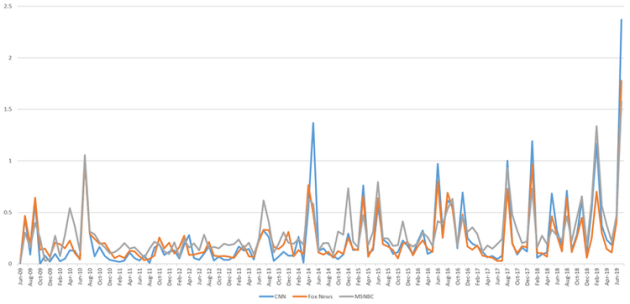
Looking back over the past decade, the timeline below shows the percentage of airtime by month on CNN, MSNBC and Fox News that mentioned “racism” or “racist” using data from the Internet Archive’s Television News Archiveprocessed by the GDELT Project.

From September 2010 to May 2013 there was a marked silent period in which mentions of racism largely disappeared from all three news channels. The acquittal of George Zimmerman in the killing of Trayvon Martin in July 2013 appears to have restarted the national conversation around race. This week’s remarks by Trump appear to have sparked the most attention to the topic of the past decade.

Notably, there does not appear to be any meaningful change in mentions of racism between Obama and Trump’s presidencies.

In contrast, coverage of anti-Semitism does appear to have increased sharply during Trump’s term. The timeline below shows coverage over the past decade that mentioned the words “anti-Semitism” or “anti-Semitic” or “antisemitism” or “antisemitic.”

The topic attracted almost no attention during Obama’s presidency, but has received several bursts of coverage since Trump’s July 2016 “Star of David” Clinton tweet first prompted accusations of anti-Semitism. Interestingly, Rep. Omar’s anti-Semitic tweets in March 2019 received far less attention, with Fox News covering them more than CNN and MSNBC combined.

In each case, the story faded within a week. Looking at the broader topic of discrimination, the timeline below shows coverage mentioning “discrimination” or “discriminatory” or “discriminated” or “discriminating.”

Beginning July 2015, the month after Trump declared his candidacy, coverage of discrimination largely disappeared from all three channels and has remained far below Obama-era levels through the present. It is unclear what may be driving this shift, since anti-Semitism coverage has increased, but coverage of racism remains unchanged.

One possibility is that the stations have devoted so much of their airtime to Trump over the past four years, with just over 9% of their total airtime mentioning his name thus far this month.

Looking more closely at the timeline above, the fact that Trump’s media profile has been steadily shrinking could also help explain his attack on the four Democrats. Trump has a long history of adopting controversial and media-genic stances in periods of declining media coverage as a way to boost attention.

Putting this all together, it is likely that just as Omar’s anti-Semitic remarks this past March faded from interest within a week, so too will the media move on from Trump’s remarks this week.

RealClear Media Fellow Kalev Leetaru is a senior fellow at the George Washington University Center for Cyber & Homeland Security. His past roles include fellow in residence at Georgetown University’s Edmund A. Walsh School of Foreign Service and member of the World Economic Forum’s Global Agenda Council on the Future of Government.

Source: Media Coverage of Anti-Semitism, Racism Rise in Trump Era

More Immigrants Know Their Rights Thanks to Trump’s Threats

Ironic. But rights become more important when under threat:

Over the last month, President Donald Trump’s publicizing of large-scale immigration enforcement operations seemed to have the intended result: wall-to-wall media coverage that indicated he was moving to fulfill his signature campaign promise to deport “millions of illegal aliens” from the United States.

But the threat of massive raids has also had a significant, unintended side effect. For the first time, many undocumented immigrants are finding out that when Immigration and Customs Enforcement come to their door, they have rights.

Immigration attorneys, advocates, and organizers in 10 cities across the country told TIME that the highly public threat of ICE raids, communicated directly from the White House, has gotten out the “Know Your Rights” information and prepared immigrant communities in a way that years of previous outreach had not.

“We are now seeing the ‘Know your Rights’ information really working to save people’s lives and teaching them that they have agency,” said Shannon Camacho, who coordinates a rapid response network for immigrants in Los Angeles.

When more than a dozen ICE agents knocked on the door of a family with two children in her community early in the morning last week, the father remained “calm and confident” because he knew what to do, she said. He refused to open the door unless agents presented a warrant signed by a judge and, speaking through the window, declined to give their names. He had video footage from the security camera, and knew to contact the rapid response network for legal help.

“Fifteen ICE agents, for one family,” said Camacho. “They were shaken up from the experience, but we told them ‘You did everything great, you understood your rights as a person here in the U.S. regardless of whether you’re undocumented or not.’’’

Like all legal and immigrants rights organizations who spoke to TIME, Camacho’s group has seen skyrocketing requests for information and “Know Your Rights” trainings. While these efforts existed long before Trump, his rhetoric and the unprecedented media attention to ICE operations has managed to help it break through in ways it hadn’t before.

Before Trump first threatened the raids in a June 17 tweet, the hotline for the Illinois Coalition for Immigrant and Refugee Rights averaged roughly 40 calls a week. In the past week, that jumped to 250 calls a day, the group told TIME, with people requesting information on what to do if agents come to the door and reporting ICE activity in their communities. The group has also seen a “massive increase” in requests to have “Know Your Rights” trainings and workshops, as well as a flood of volunteers, said spokeswoman Cara Yi.

“There’s been such a spotlight put on this, and our elected officials have come out so strong, it’s going to be very difficult at least in the city of Chicago to reach any massive sweep,” said Lawrence Benito, the group’s executive director. “I mean, the Chicago mayor [Lori Lightfoot] was out in the community passing out our ‘Know Your Rights’ and hotline information.”

A few years ago, it would have been unusual to see government officials distributing information on how to evade immigration enforcement officials. Now it has not only become acceptable but expected for Democratic politicians and presidential candidates to share the “Know Your Rights” information on their platforms. Vermont Sen. Bernie Sanders, California Sen. Kamala Harris, Massachusetts Sen. Elizabeth Warren, New Jersey Sen. Cory Booker, former Texas Congressman Beto O’Rourke and New York Sen. Kirsten Gillibrand all shared the American Civil Liberties Union’s “Know Your Rights” page in recent days. The organization’s thread on Twitter laying out the information in multiple languages reached almost 3 million people.

“There’s definitely an energy that’s different now. People are saying ‘We marched, we’re done marching, and now we need to stand up and do something,’” Benito said.

Organizers across the country told TIME that unlike other inflection points — Trump’s election, the travel ban and the family separation crisis last summer — they are seeing people go beyond protest marches to taking action in the face of imminent ICE sweeps, which are meant to target undocumented families who have been issued final removal orders.

Volunteers ran out of “Know Your Rights” pamphlets as they canvassed homes, supermarkets, restaurants, churches and laundromats handing out fliers and providing on-the-spot preparation. Trainings have been bursting at capacity, forcing some to find larger venues. Immigration attorneys said families that previously would have felt helpless in the face of ICE agents at their door now know that they don’t need to follow their orders if they don’t have a warrant signed by a judge. Many have pasted the bilingual fliers to their door, instructing their children on what to do, organizers said.

News stories about attempted ICE arrests increasingly reflected that — for example the New Jersey teenager who refused to open the door to agents when they knocked at 1 am after having seen a “Know Your Rights” post on Instagram.

“We’re seeing a lot of these (attempts) thwarted because no one was opening the door,” said Thomas Kennedy, the political director of the Florida Immigrant Coalition. “It’s encouraging to see that people are taking these lessons and applying them to protect themselves.”

Unlike in the past, in many of the 10 counties in Florida his group canvassed they found people already seemed well prepared in how to handle ICE raids, he said. Kennedy attributes much of that to the shift in local media coverage of these raids, which are targeting families.

“There’s been a lot of sensationalizing of the issue, which spreads fear and anxiety — I mean four or five years ago the headline would have been straight-up ‘widespread immigration raids target illegal immigrants,’” he said. “But now most local news — in English, Spanish, and Creole — also includes ‘Know Your Rights’ information, not just the fear element.”

Americans who oppose Trump’s immigration actions have also been flooding workshops and training sessions on how to support their immigrant neighbors.

“When the initial tweet came out, we organized a training on 48 hours notice and had 200 people show up — more than double the usual turnout,” said Brandon Wu, an organizer with the D.C.-based group Sanctuary DMV. “People are not just outraged but they’re willing to step up and do what it takes in proactive solidarity.” For his group in the Washington, D.C. area, this includes everything from documenting ICE raids they may witness in their neighborhood to accompanying immigrants to court appointments for moral support.

While the Trump Administration’s public threats do “galvanize allies in a way we find really useful, on the other hand it’s hard to overstate the level of fear it puts in the immigrant community,” Wu said. “They’re saying ‘If I leave my house to go to the grocery store I might never see my kids again.’ But if this is what it takes to galvanize people then that’s what it takes, we’re here now.”

Activists say another side effect of the Trump Administration’s constant publicizing of immigration enforcement is that many Americans are, for the first time, taking a close look at the system.

“We are witnessing a surge of support because I think the virulent anti-immigrant rhetoric of this administration is opening many people’s eyes to the horrors of the US immigration system,” said Andrea Mercado, the executive director of New Florida Majority, a progressive grassroots group. “Many people who weren’t aware of the deportation crisis in our country under previous administrations are now motivated and committed to do something.”

The same “Know Your Rights” information has been around for decades, but the way it has broken to the surface over the last two years – and especially in the last month – is giving some advocates whiplash, they say.

“We were having ‘Know Your Rights” trainings 10 years ago,” Madhuri Grewal, federal immigration policy counsel with the ACLU, told TIME. “So it’s amazing that now, as a result of this new level of interest, the U.S. is in this moment where people are really starting to understand our immigration enforcement.”

While there is no consolidated data from across all of the ACLU’s local offices, the significant surge in interest has clearly helped disseminate information more effectively than ever before, and “undocumented communities are much more aware of their rights,” she said, pointing to social media as a main factor. “Teenagers with access to social media are seeing this and sharing it with their parents.”

Source: More Immigrants Know Their Rights Thanks to Trump’s Threats

Are there still NDP voters in a province that just passed a religious symbols law? Singh looks to find out

Hard to see him squaring the circle on this one.

Will see during the campaign how much time he spends in Quebec compared to other provinces as possible barometer of prospects:

Quebec’s new law on religious symbols makes minorities feel like they don’t belong in the province, says Jagmeet Singh, and he wants to be the one to lead opposition to the legislation in Ottawa.

The leader of the federal New Democrats says this as he is standing in the food court of a mall in Drummondville, Que., surrounded by locals who support the law and think it’s about time immigrants adapted to Quebec’s culture.

If Singh is to hold on to his party’s 15 seats in Quebec, it will mean connecting with voters in places like Drummondville. That won’t be easy.

“Why do you wear that?” one elderly woman asks, pointing to Singh’s yellow turban. She asks him if he’s been in Canada for a long time.

Another man, Réal Lamott, admits it bothered him to see a politician wearing such a visible religious symbol.

“No, I definitely won’t vote for him,” says Lamott, who backed the Liberals in 2015.

Of the NDP’s 15 seats in Quebec, only three are in Montreal. The bulk of them are in the province’s manufacturing heartland, which stretches between Montreal and Quebec City. Drummondville is right in the middle.

The NDP swept the heartland during the Orange Wave of 2011, when the party won 58 of Quebec’s 75 ridings, but since then political affiliations have drifted toward the right, at least at the provincial level.

This region, its economy driven by mid-sized businesses, was critical to the Coalition Avenir Québec’s sweeping victory in October.

The CAQ’s so-called secularism law, which bars public schoolteachers and other authority figures from wearing religious symbols while at work, hasn’t dented its popularity here. Quite the opposite: According to some polls, the party’s popularity has grown since October’s provincial election.

Striding into these headwinds, Singh campaigned this week, visiting ridings in and around Sherbrooke, Trois-Rivières and Drummondville.

He’s tried to tailor the party’s message to local concerns on this tour.

The NDP’s immigration policy, Singh said, will help businesses deal with the labour shortage, which is particularly acute in Drummondville. Its mass transit plan will bring upgrades to the local train service.

And its proposals for the environment will help smaller municipalities prepare for the more variable weather brought on by climate change.

“That’s what people are talking about,” said Drummondville MP François Choquette, who hung onto his seat for the NDP after he was first elected in 2011.

The religious symbols law is a provincial issue, said Choquette: “I’m concentrating on federal issues.”

Critics of the law, known as Bill 21, have been hoping for more vocal opposition from the federal parties.

The NDP, like the Liberals and the Conservatives, has avoided making any commitments to directly back legal challenges of the law.

Singh, though, went one step further this week, pitching himself as the spokesperson for those Quebecers angered by Bill 21.

“There are a lot of people in Quebec who don’t feel this is the right way to go, and I can be their champion,” he said.

The law, he says, is telling young people from religious minorities that the province where they grew up “is now rejecting you.”

Talk of turban ‘an opportunity’

Political observers are skeptical of Singh’s ability to reconcile that aspiration to lead the anti-Bill 21 vote while holding onto seats in the heartland.

The conventional wisdom among pollsters is that the federal leaders have little to gain in Quebec by being vocal about the issue.

But it would be nigh impossible for Singh to avoid addressing the law head on. Aside from his boldly coloured turban, his kirpan — the small dagger that religious Sikhs carry at all times — was visible as he shook hands in the Drummondville mall.

“Instead of a challenge, I find it’s an opportunity,” he said. “I find it’s the opening of a conversation.”

He offers the woman who was wondering about his turban a quick overview of Sikh history, focusing on the turban’s egalitarian symbolism.

“Well, I think you look quite nice,” she said.

Singh responded by giving her a high-five.

Source: Are there still NDP voters in a province that just passed a religious symbols law? Singh looks to find out

Le Canada ouvre ses portes au mouvement Gülen

Of note. Not without potential longer-term implications:

Il y a maintenant plus de 1000 personnes [ayant des liens avec le mouvement Gülen] au Canada. Les gens sont venus de Turquie, mais aussi d’ailleurs dans le monde », a confirmé à La Presse Halil, de l’Institut du dialogue interculturel de Toronto, organisation liée au mouvement Gülen. Pour des raisons de sécurité, il nous a demandé de taire son nom de famille.

Les statistiques de la Commission de l’immigration et du statut de réfugié (CISR) confirment ses dires. Si, avant 2016, le Canada accordait en moyenne l’asile à moins de 500 personnes originaires de Turquie par année, leur nombre a bondi depuis le coup d’État raté de 2016.

En 2017, sur quelque 13 500 demandes d’asile qui ont été accueillies favorablement par le Canada, 1247 ont été accordées à des individus fuyant la Turquie. Ce chiffre a grimpé à 1407 en 2018 et atteignait 852 au cours des premiers mois de l’année 2019.

La Fondation Horizon, mise sur pied par des supporteurs du mouvement Gülen, vient en aide aux nouveaux réfugiés issus de la confrérie musulmane.

M. Salimoglu, qui a des liens avec le mouvement Gülen depuis les années 80, a lui-même obtenu l’asile en 2017 (voir l’onglet suivant). « À Montréal, il y a de 30 à 40 familles qui sont venues depuis le coup d’État. Il y a plus de gens en Ontario, notamment à Toronto et à Kitchener », précise-t-il.

La Turquie au premier rang

Au cours des trois dernières années, la Turquie est ainsi passée au premier rang pour le nombre de demandeurs d’asile qui obtiennent le statut de réfugié au Canada, se hissant devant l’Afghanistan et la Syrie.

Actuellement, les personnes ayant des liens avec le mouvement Gülen qui se présentent devant la CISR font l’objet d’une procédure accélérée. En vertu de cette procédure, les commissaires évaluent les demandes d’asile à partir de dossiers écrits et n’ont pas nécessairement à convoquer les demandeurs en audience, apprend-on dans les documents de la Commission de l’immigration et du statut de réfugié (CISR). Les Syriens, les Irakiens, les Afghans, les Coptes d’Égypte, les opposants politiques du Venezuela et du Soudan, notamment, sont aussi visés par cette procédure rapide.

Quand on l’interroge sur les raisons ayant mené à cette décision, la CISR se borne à fournir un lien internet décrivant la procédure accélérée, mais n’explique pas pourquoi la confrérie musulmane a été mise sur la liste. Au bureau du ministre de l’Immigration, même discrétion. On renvoie les journalistes aux communications de la CISR.

Interrogé par La Presse, l’ambassadeur de Turquie à Ottawa, Kerim Uras, estime que le Canada fait fausse route.

« Le mouvement Gülen est un mouvement très organisé qui sait utiliser les failles du système. La politique canadienne est malavisée. Un jour, le Canada pourrait la regretter. »

– Kerim Uras, ambassadeur de Turquie à Ottawa

Un mouvement décimé

Depuis le coup raté qui a eu lieu dans la nuit du 15 au 16 juillet en Turquie, le mouvement Gülen est l’ennemi juré du président Recep Tayyip Erdoğan. Ce grand réseau, qui comptait au début de la décennie près de 2 millions de membres actifs et 10 millions de sympathisants en Turquie, est disséminé à travers le monde.

Selon les experts, le mouvement Gülen peut être comparé à une franc-maçonnerie musulmane, très présente dans le milieu de l’éducation, des affaires et des médias. Pendant plus d’une décennie, ce réseau tentaculaire qui disposait de nombreux médias, d’institutions bancaires, de milliers d’écoles et de représentants à l’étranger était un allié du gouvernement islamo-conservateur de M. Erdoğan, mais les choses se sont gâtées en 2013.

Soupçonnés d’avoir fomenté le putsch contre le gouvernement turc, au cours duquel le parlement d’Ankara et le palais présidentiel ont été attaqués, des militaires associés au mouvement Gülen ont été arrêtés au lendemain du coup raté et accusés de terrorisme par la justice turque. Fethullah Gülen, le prédicateur et leader spirituel du mouvement, a affirmé à partir de la Pennsylvanie, où il vit en exil depuis 20 ans, que ses sympathisants n’avaient rien à voir avec le coup d’État.

Auteur d’un livre sur le mouvement Gülen et experte des études islamiques de l’Université de Chester en Grande-Bretagne, Caroline Tee ne partage pas le point de vue du leader musulman. « Il est pas mal clair, à partir des preuves journalistiques mises de l’avant en Turquie, que des sympathisants du mouvement Gülen ont participé au coup d’État », dit-elle.

Trois ans après les événements, il reste cependant beaucoup de zones d’ombre entourant l’événement, ajoute-t-elle. « C’est vraiment étrange qu’il y ait aussi peu d’informations rendues publiques sur les résultats des enquêtes policières », dit Mme Tee.

Rafles massives

Ces zones d’ombre n’ont cependant pas empêché le gouvernement Erdoğan d’arrêter des dizaines de milliers de citoyens – militaires, professeurs, journalistes, gens d’affaires – dans les semaines et les mois qui ont suivi le putsch avorté. Selon Human Rights Watch, plus de 77 000 personnes ont été arrêtées en lien avec le coup d’État de 2016. De ce nombre, plus de 45 000 l’ont été pour leur lien avec le mouvement Gülen, rebaptisé FETO par le gouvernement, soit l’« organisation terroriste de Fethullah ».

Au cours des trois dernières années, les organisations Human Rights Watch et Amnistie internationale ont dénoncé maintes fois l’aspect arbitraire des arrestations massives et des accusations de terrorisme qui touchent les membres du mouvement Gülen, mais aussi des Kurdes, des opposants politiques et des journalistes. « Il est normal que le gouvernement turc arrête et traduise en justice les organisateurs de la tentative de coup d’État qui a fait beaucoup de morts et de blessés dans la population civile, mais comment peut-on accuser de terrorisme des dizaines de milliers de personnes ? », a dit à La Presse Emma Sinclair-Webb, directrice de HRW en Turquie.

Fuyant cette répression tous azimuts de l’État, des dizaines de milliers de sympathisants du mouvement Gülen ont fui le pays. Le Canada n’est pas le seul pays à les accueillir. La France, l’Allemagne, les Pays-Bas, le Royaume-Uni ont notamment ouvert leurs portes aux membres de la confrérie musulmane.

Réfugiés ou menaces ?

Professeur d’économie à Harvard connu pour son blogue sur la politique turque, Dani Rodrik est convaincu que la majorité des membres du mouvement Gülen qui trouvent refuge à l’étranger ont de bonnes raisons de le faire. « Ça ne fait aucun doute : les gülenistes sont persécutés par le gouvernement turc, qu’ils aient pris part ou non à certaines des activités illégales du réseau. Je crois que la majorité des gülenistes sont des citoyens honnêtes qui n’avaient rien à voir avec les activités clandestines de certains membres du mouvement », dit M. Rodrik.

Selon l’expert de Harvard, les gouvernements qui accueillent des gülenistes doivent rester vigilants puisque les visées politiques du groupe restent obscures. « Je m’assurerais que mes services secrets gardent un oeil sur les activités des gülenistes. Sans l’ombre d’un doute », fait valoir le professeur.

…..

Une présence montréalaise

Le mouvement Gülen est présent à Montréal depuis plus d’une décennie et organise fréquemment des événements publics. Au début de la décennie, l’Institut du dialogue interculturel, lié au mouvement, organisait chaque année des soupers auxquels étaient conviés politiciens, professeurs d’université, journalistes et représentants des forces de l’ordre. Des membres des cercles de pouvoir québécois ont aussi participé à des voyages en Turquie financés par le mouvement Gülen.

Depuis le coup d’État, le mouvement s’est fait beaucoup plus discret, mais n’a pas cessé ses activités. En public, le mouvement prône la tolérance, le service à la communauté et le dialogue interreligieux, mais dans ses rangs, il impose un mode de vie très strict à ses membres – pas d’alcool, pas de tabac, pas de sexe avant le mariage.

« En Turquie, les gens sont très sceptiques à l’égard de ce groupe entouré de secret, dit Caroline Tee, professeure à l’Université de Chester, qui a passé de longues années à étudier ce mouvement. Par contre, en Occident, le mouvement est bien reçu. Les gens veulent croire que c’est un mouvement musulman modéré. »

Source: Le Canada ouvre ses portes au mouvement Gülen

Laïcité: le Manitoba veut recruter des employés du secteur public québécois

Not surprising. Premier Pallister has been the most outspoken premier against Bill 21:

Le gouvernement du Manitoba veut recruter des employés du secteur public québécois préoccupés par la Loi sur la laïcité de l’État, qui interdit les signes religieux dans l’exercice de certaines fonctions.

Alors même que la Cour supérieure du Québec rejetait, jeudi, la requête de groupes de défense des libertés civiles et religieuses, qui réclamaient la suspension de la loi, le premier ministre Brian Pallister indiquait que le Manitoba avait besoin de fonctionnaires bilingues.

M. Pallister a promis de s’adresser aux employés de l’État québécois pour les assurer que sa province n’avait pas, elle, de « police du vêtement ». Il a indiqué que des lettres seraient bientôt envoyées aux associations professionnelles du Québec ainsi qu’aux cégeps et autres institutions d’enseignement afin de recruter des Québécois.

La Loi sur la laïcité de l’État, adoptée en juin à l’Assemblée nationale, interdit aux employés de l’État en position d’autorité coercitive, comme les juges, les policiers et les gardiens de prison, de porter des signes religieux dans l’exercice de leurs fonctions ; cette interdiction s’étend aussi aux enseignants du réseau public. Les opposants à la loi affirment qu’elle cible injustement les musulmanes, les sikhs et les autres minorités religieuses.

Le premier ministre Pallister, qui cherche à se faire réélire au Manitoba le 10 septembre, avait déjà affirmé son opposition à la loi québécoise lors de la rencontre estivale des premiers ministres des provinces et territoires, le 11 juillet. Le premier ministre François Legault a rappelé au Conseil de la fédération que la loi est appuyée par une majorité de Québécois et que son parti respectait une promesse électorale.

Jeudi, le juge Michel Yergeau, de la Cour supérieure du Québec, a déclaré que la loi continuerait de s’appliquer jusqu’à ce qu’un tribunal se prononce sur le fond de l’affaire.

En avril, le maire d’Edmundston, Cyrille Simard, invitait dans sa municipalité du nord-ouest du Nouveau-Brunswick les Québécois « qui pourraient rencontrer des obstacles » dans certaines catégories d’emplois. Alex LeBlanc, directeur général du Conseil multiculturel du Nouveau-Brunswick, rappelait alors que le Nouveau-Brunswick vivait notamment une pénurie d’enseignants francophones et bilingues qualifiés, et que de nombreux Québécois pourraient pourvoir ces postes.

Source: Laïcité: le Manitoba veut recruter des employés du secteur public québécois

The Surprising Way Republicans Used to Use Immigration to Boost the Economy

Nice historical reminder. Never thought when Reagan was in power that he would be viewed as progressive a generation later:

There was a time when a Republican president formed immigration policy for its economic impact, rather than its rhetorical value as a campaign issue. In 1980, Ronald Reagan recognized soaring unemployment in Mexico as the driving force behind the increased flow of illegal immigrants into the United States. Then-candidate Reagan said he wanted to “make it possible for them to come here legally with a work permit, then while they’re working, and earning here, they pay taxes here. And when they want to go back, they go back.”

While nobody would say Reagan, as president, solved the problem of illegal immigration—amnesty for 2.9 million illegals and increased employer responsibilities rubbed some the wrong way—his focus was on the needs of employers to find affordable labor, and the needs of immigrants to find jobs.

In fact, “there was a time in the 80s and 90s, under both Republican and Democratic presidents, when border patrol agents along the Texas border would regulate employment levels,” says Professor Gordon Hanson of the University of California, San Diego. “The border agents would keep track of the labor needs of employers in the Rio Grande Valley. The higher the need for workers, the weaker the enforcement would be.”

Fast forward to last week’s testimony by Fed Chief Jerome Powell on Capitol Hill. Powell addressed the pressures on homebuilders, who are trying to continue building affordable homes. “You have a shortage of skilled labor,” Powell said, “so it’s hard to get people on the job—electricians, plumbers, carpenters and other people…just to get the people, no matter what you pay them, just finding people who can do that work.”

“Would you say our immigration policy has something to do with that?” asked Democratic Senator Tina Smith of Minnesota.

“That’s what we hear from home builders,” Powell replied.

Depressing the housing industry

“The lack of labor force is one of the main concerns for U.S. business,” says Selma Hepp, Chief Economist at Compass, an independent real estate brokerage. Hepp cites a survey from John Burns Consulting indicating that 82% of builders report a labor shortage. And since the housing industry contributes roughly 15% to the economy, that’s significant potential growth not being realized.

“The current level of single-family construction,” Hepp says, “while improving, it is still at about 50 percent below the levels of housing starts we had during the housing boom in early 2000s.”

The issue of illegal immigration is a touchy political topic, but let’s look at economic space that illegal immigrants fill. They tend to arrive when the U.S. economy is booming, provide low cost labor that is flexible enough to go where it’s needed, when it’s needed, and fill many jobs that Americans are not willing to do, especially in housing, food service, hospitality services, and agriculture. (Legal immigrants, on the other hand, many of them sponsored by companies or families, tend to be more highly educated, demand higher wages, and are not as flexible in moving to where the jobs are—partially because they may be legally obligated to a sponsoring employer.)

That potential increase in the labor force could come in handy right now, with an estimated 10,000 baby boomers turning 65 every day, and when there are more job openings than there are people looking for work.

Perhaps sensing that the full story was not being told last week, Republican Senator John Neely Kennedy of Louisiana asked Powell, “What is the economic impact of illegal immigration on America’s economy?”

“I haven’t tried to quantify that, but people who come in legally or illegally, they add to our workforce,” Powell said, “and they contribute to GDP, certainly, so that’s part of it. You can really boil down growth into labor force growth and productivity increases, and immigration—total immigration—has contributed more than half of the growth in our workforce in the last few years.”

In fact, one of the ways that the economy could grow faster is if there were more workers, who are also tax payers and consumers, who supported other workers, who were also tax payers and consumers, and so on, and so on.

End to an unwritten policy

“But the shortage in the labor force isn’t just because of Trump’s policies,” says Professor Hanson. “That unwritten policy of border enforcement, following the ups and downs of the economy, ended with the border enforcement crackdown in 2005 under the George W. Bush administration.” Ironically, this was done by the former Texas governor to appease conservatives in Congress as a step toward comprehensive immigration reform. But reform never happened, even as tighter immigration policies continued, including under President Obama.

Then came the Great Recession, which took away the incentive for many foreign citizens to seek unfilled jobs in the United States. It was what Professor Hanson calls the end of the “Great Mexican Emigration.”

Kennedy clarified his focus for Powell: “What about illegal immigration? Does it have an impact on wages?”

“You know, there’s been a lot of research on that and it has really not reached a clear conclusion on that,” Powell said. “There is research that finds there is no visible impact, and there’s research that finds there’s a modest impact.”

Senator Kennedy was likely suggesting that illegal immigrants drive down the wages of Americans, which is a big part of the political argument Republicans have used against illegals coming into the country. And according to several sources, the argument is correct, especially when it comes to lower income, lower educated Americans who might find themselves competing with immigrants who are also looking for low-skilled work.

But the real drain on the economy from illegal immigrants comes when the resources they take from our economy exceed their contributions to it, which tends to happen, according to Professor Hanson, in the early years, just after they’ve arrived.

We’ll assume that the illegal immigrant worker IS paying certain taxes, including sales tax, property taxes (indirectly as renters), and possibly payroll taxes, under false social security numbers. But if a family comes into the U.S. illegally, sends their kids to publicly funded schools, and then has more children—who as natives are entitled to all American benefits such as Medicaid—will they be taking more from the economy than they are paying into it?

That’s the much-disputed question, politically as well as economically. Since illegal immigrants operate largely in the shadows, and are not eligible for most public benefits, a certain number is hard to determine, at least one that both parties will accept.

The problem for the administration is that with unemployment at 3.7%, it’s hard to say there’s a clear and direct impact being felt by many Americans economically. Most Americans who want a job, can find a job. That doesn’t take away the political argument, which will presumably still resonate—again, not without some validity—with a part of the voting public.

But as this expanding economy gets historically long in the tooth—the recession ended in June of 2009—a cooling housing industry may also put a chill on an economy that the president is hoping will carry him to reelection next year. That is surely not what he intended

Source: The Surprising Way Republicans Used to Use Immigration to Boost the Economy

Analysis: Why the 2020 census doesn’t need a citizenship question to count the undocumented

Good in depth analysis for data nerds:

It is now clear that there will be no question about citizenship on the 2020 U.S. Census.

After the Supreme Court ruled against the Trump administration, President Trump vowed to find a way to include the question. But with no legal path forward and time running out, the administration ultimately backed down.

Opponents of the citizenship question remain concerned about the census, though hopeful that more immigrant households will respond to the census now that the question has been removed.

But others worry that it will be much harder to keep track of undocumented immigrants. President Trump argued that a citizenship question was needed, saying: “I think it is very important to find out if somebody is a citizen as opposed to an illegal.”

However, a citizenship question wouldn’t actually help the government distinguish between who is an undocumented immigrant and who is not. The question distinguishes only between citizens and noncitizens, and noncitizens are not the same as undocumented immigrants. For example, three out of five noncitizens are in the country legally.

Even more importantly, demographers have figured out a simple and effective way to estimate the number of unauthorized immigrants – even without information on citizenship. In the last five years, my colleagues Frank D. Bean, James D. Bachmeier and I have conducted a series of studies that evaluate this method and its assumptions.

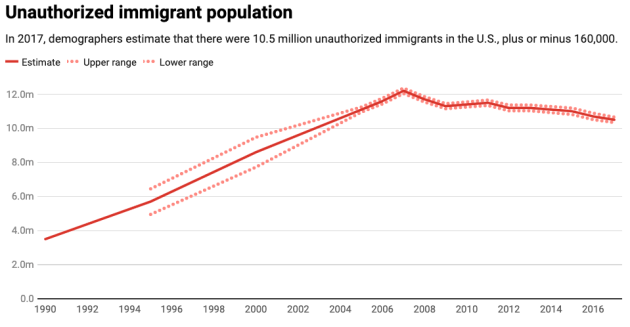
Our research on the methods used to estimate the size of the group indicates that existing estimates – putting the undocumented population at about 11 million – are reasonably accurate.

Here’s how it works.

What’s the formula?

Beginning in the late 1970s, a group of demographers consisting primarily of Jeffrey Passel, Robert Warren, Jacob Siegel, Gregory Robinson and Karen Woodrow introduced the “residual method” for estimating the number of unauthorized immigrants living in the country.

At the time, Passel and his collaborators were affiliated with the U.S. Bureau of the Census and Warren with the Office of Immigration Statistics of the Immigration and Naturalization Service. Much of this work was published in the form of internal reports, but some of it appeared in major journals.

The residual method uses an estimate of the total foreign-born population in the country, based on U.S. Census data. Researchers then subtract from it the number of legal immigrants residing here, estimated from government records of legal immigrants who receive “green cards” minus the number that died or left the country. The result is an estimate of the unauthorized population.

Various adjustments are typically made to this formula. Most adjustments are minor, but a particularly important one adjusts for what researchers call “coverage error” among the unauthorized foreign-born. Coverage error occurs when the census data underestimate the size of a group. This can occur when people live in nonresidential or unconventional locations – such as on the streets or in a neighbor’s basement – or when they fail to respond to the census.

Coverage error could be particularly high among unauthorized immigrants because they may be trying to avoid detection. The Census Bureau’s own research suggests that asking about citizenship would likely aggravate this issue.

Currently, the Department of Homeland Security, the Pew Hispanic Center and the Center for Migration Studies are the major producers of estimates of the unauthorized foreign-born population.

Chart by The Conversation, CC-BY-ND. Data source: <a href="https://www.pewhispanic.org/2019/06/03/facts-on-u-s-immigrants/" rel="nofollow noopener noreferrer" target="_blank" >Pew Research Center</a>

Chart by The Conversation, CC-BY-ND. Data source: Pew Research Center

How accurate are the estimates?

The residual method has been widely used and accepted since the late 1970s. Within a reasonable margin of error, it predicted the number of unauthorized immigrants to legalize under the Immigration Reform and Control Act of 1986, which, among other things, granted permanent residency status to unauthorized immigrants who had been living in the country since 1982. The residual method predicted that about 2.2 millionmet the residency requirement; the actual number to come forward was about 1.7 million.

Both Department of Homeland Security and Pew have used the residual method to estimate the unauthorized population since 2005. Despite using slightly different data and assumptions, Pew’s, Department of Homeland Security’s, and the Center for Migration Studies’s estimates have never differed by more than 1 million people, less than 10% of the total unauthorized population.

Nevertheless, skeptics question a key assumption of the residual method, which is that unauthorized immigrants participate in census surveys. All three organizations listed above inflate their estimates to account for the possibility that some unauthorized immigrants are missing from census data. For example, Pew inflates by about 13%. But is this enough?

My colleagues and I estimated coverage error among Mexican immigrants, a group that composes 60% of all unauthorized immigrants.

Even if they are not counted in a census, populations leave “footprints” of their presence in the form of deaths and births. Because people give birth and die with known regularity, regardless of their legal status, we were able to use birth and death records of all Mexican-born persons to determine the number of Mexican-born persons living in the U.S. We also looked at changes in Mexican census data between 1990 and 2010 to gauge the size of Mexico’s “missing” population, most of whom moved to the U.S.

We then compared these estimates with the estimated number of Mexican immigrants in census data. We found that the census missed as many as 26% of unauthorized immigrants in the early 2000s.

We speculated that this could have been due to the large numbers of temporary Mexican labor migrants who were living in the U.S. at the time. Because many worked in construction during the housing boom and lived in temporary housing arrangements, it may have been particularly difficult to accurately account for them in census surveys.

However, when the Great Recession and housing crisis hit, many of these temporary workers went home or stopped coming to the U.S. in the first place, and coverage error declined. By 2010, the coverage error may have been as low as 6% and does not appear to have changed much since then.

If current levels of coverage error for all unauthorized immigrants were as high as 26%, then the number living in the country could be as high as 13 million. But if coverage error were as low as 6%, then the figure could be as low as 10.3 million. The true number likely falls within that narrow range.

What this boils down to is that demographers already have a pretty good idea of the number of unauthorized immigrants living in the U.S., even without relying on citizenship data. If coverage error has declined as much as we think it has, then the truth is at the lower end of this range.

Will administrative records improve the estimates?

Looking ahead, methods could change as new data become available.

In the wake of its Supreme Court loss, the Trump administration issued an executive order directing government agencies to share administrative data on citizenship.

They want to link information on citizenship and immigration status in administrative records to everyone’s census responses. For example, the executive order requests the Department of Homeland Security’s records on refugee and asylum visas, as well as Master Beneficiary Records from the Social Security Administration. They want to use this information to estimate the undocumented population at very detailed levels of geography for purposes of redistricting, reapportionment and the allocation of public funds.

(It is worth noting that the Census Bureau is a fortress when it comes to protecting your data. Under federal law, the Census Bureau cannot share your personal information with anyone, including other government agencies such as ICE.)

Regardless of how anyone feels about these policy proposals, administrative data may not be up to the task. In my view, administrative records are complicated to use. They can provide inconsistent information about the same person depending on which agency’s records are used.

Additionally, the records will be of limited value for describing those who fall outside of the administrative records system, which can happen for all kinds of reasons. Even if the Trump administration uses administrative records to estimate the undocumented population, researchers will still need to make assumptions about coverage error, just like they do for the residual method.

Overall, I suspect that administrative records could help answer some narrowly defined questions about immigrants and improve national estimates. The jury is still out about their ability to provide definitive answers about the precise numbers of undocumented immigrants, particularly at detailed levels of geography.

Source: Analysis: Why the 2020 census doesn’t need a citizenship question to count the undocumented