Immigrants are moving to smaller U.S. cities
Also happening in Canada to a certain extent:
As young Americans stream to coastal cities, immigrants are seizing opportunities in the midwest and south where mid-sized cities are struggling to maintain a younger, working-age population.
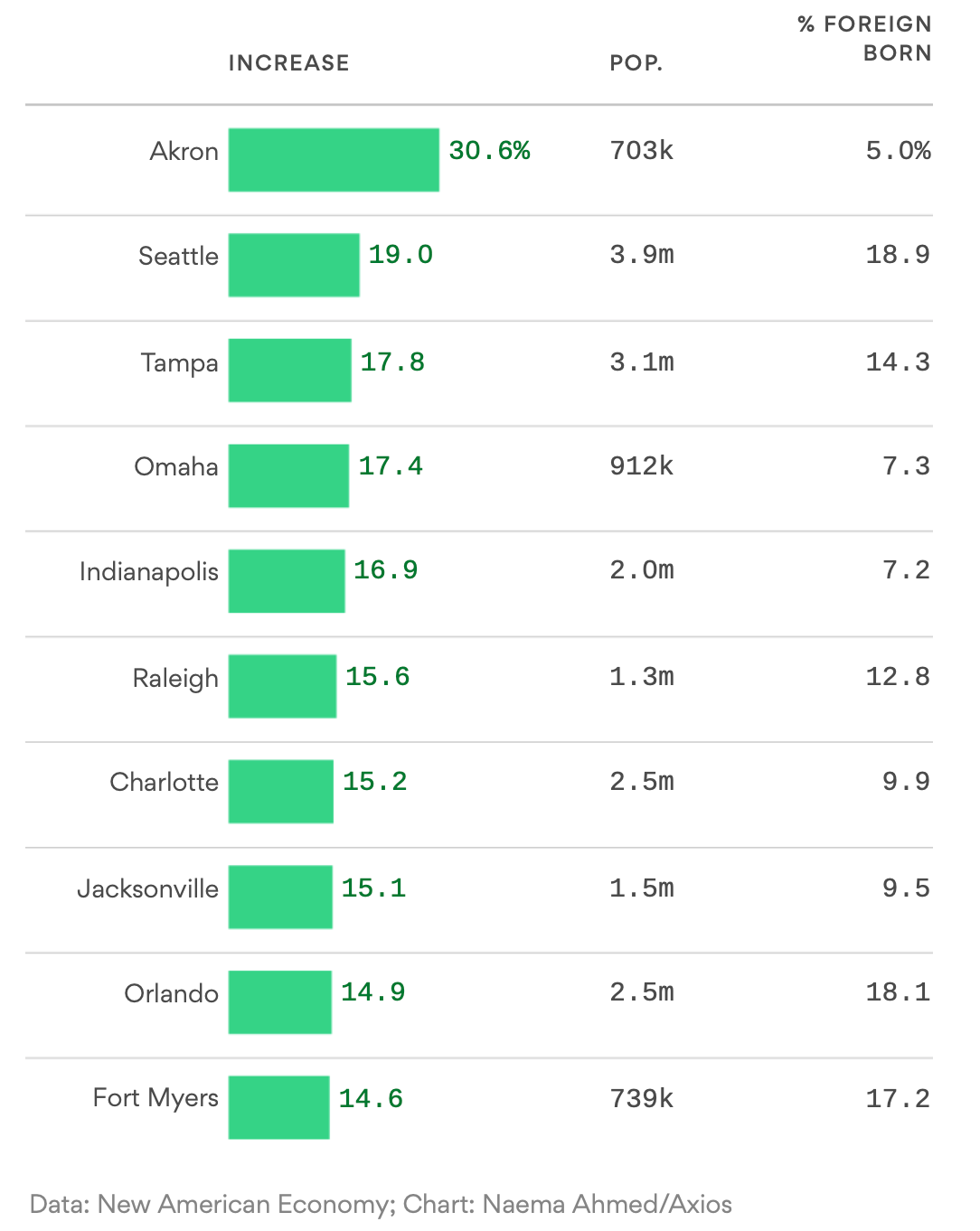
Why it matters: From 2014-2017, immigrants contributed nearly 33% of the total population growth in the top 100 U.S. metro areas — and they’re settling in smaller cities that aren’t typically considered immigration hubs, according to new research from New American Economy.
“Immigrants — very similar to other Americans — are looking for less crowded, more affordable cities that have dynamic job markets,” said Andrew Lim, research director at the bipartisan research and advocacy organization.
Details: Foreign-born migration helped reverse population decline in several metros, such as Detroit, Memphis, Dayton and St. Louis.
- In 2017, immigrants were responsible for 98% of the population growth in metro Cincinnati, 88% of the growth in metro Birmingham, and 87% of growth in metro Miami.
- Four of the top 10 cities seeing the most population growth from immigrants are in Florida — a state seeing a disproportionate growth of aging residents.
What’s happening: Many of the top destinations are grappling with a demographic double whammy: a growing aging population on one hand, and a dwindling young population on the other.
- Immigrants to the U.S. are more likely to be of working age — between 25 and 64 — than the native-born population. Meanwhile, 98 of the top 100 metros saw an increase in population above the age of 65 between 2014 and 2017.
- Healthcare is a popular job area as demands grow in caring for aging residents. In El Paso, for example, immigrants made up a third of healthcare workers in 2017. In the Minneapolis-St. Paul area, that number was 20%.
The big picture: Immigration is a national flashpoint right now, with controversies around poor conditions in detention centers along the Mexico border and political fights over whether the 2020 Census will include a citizenship question.
The research highlights the economic upsides of immigration.
- Immigrant entrepreneurs grew by 7.7% in the top 100 metro areas between 2014 and 2017. The number more than doubled in Baton Rouge, and grew by more than 60% in Tulsa.
- Immigrant homeownership increased by 9.5%, with Nashville, Oklahoma City and Charlotte seeing the fastest growth.
- Despite growth in smaller cities, the more traditional metros (New York, Los Angeles, San Francisco) still saw the highest levels of spending power and taxes paid by immigrants.
Go deeper:
Source: Immigrants are moving to smaller U.S. cities
 About Andrew
Andrew blogs and tweets public policy issues, particularly the relationship between the political and bureaucratic levels, citizenship and multiculturalism. His latest book, Policy Arrogance or Innocent Bias, recounts his experience as a senior public servant in this area.

 Multicultural Meanderings