Citizenship policy challenges the next government will face – My latest

Citizenship is the neglected child of immigration-related policies. It attracts less attention, and it has a lower profile and fewer resources than other areas. This is evidenced by wide swings in the number of new citizens, periodic funding shortfalls and the paucity of data, compared with that for immigration.

….

Full text: Citizenship policy challenges the next government will face

Whatever happened to the ‘Australian values’ citizenship bill?

Spoiler – Identity politics and the election:

Nothing seemed as urgent as the protection of Australian values when journalists were called to the Prime Minister’s courtyard two years ago to hear of new laws that would make it harder for migrants to gain citizenship.

Malcolm Turnbull and Peter Dutton stood side by side in Parliament House to announce a bill that would require newcomers to pass stricter English tests and sign a “values statement” before they could become Australians.

This sounded absolutely imperative. The law would be put to Parliament “as soon as possible” to not only apply the new tests but also require permanent residents to wait at least four years, rather than just one, before they could apply for citizenship.

There would even be a change to the preamble in the citizenship law so that new citizens would accept the obligation to “pledge their allegiance” to Australia and its people.

But an election victory changes everything. The new law is no longer as urgent as it seemed in April 2017. The Australian Citizenship Legislation Amendment (Strengthening the Requirements for Australian Citizenship and Other Measures) Bill 2017 has been dropped into a filing cabinet and may never be seen again.

The quiet demise of this proposal is a curious shift from years of government warnings about the need for citizens to speak better English and respect Australian laws.

“We want them to demonstrate that they’re adhering to Australian values and that is why it’s incredibly important on all of those levels to get this change through the Parliament,” Dutton told Ray Hadley on 2GB in the middle of 2017.

The proposal was the product of its time. Turnbull stood alongside Dutton at a point when Tony Abbott was mounting a conservative offensive from the backbench. One year into his tenure as Prime Minister, Turnbull was at risk of looking too “progressive” for his own side.

And the political objective of the bill was never in doubt.

“We’re standing up for Australian values and the Parliament should do so too,” said Turnbull in the courtyard.

“So if Labor doesn’t sign up they don’t respect Australian values?” asked a journalist. Turnbull did not have to answer the question directly for the implication to be obvious.

Bill Shorten and his shadow ministers, including citizenship spokesman Tony Burke, resisted the pressure to wave the bill through. Burke said the language test was “ridiculous” because it required university-level standards.

The uproar ran for months. The current citizenship test, put in place by the Howard government, is described as a de facto English test because it asks 20 questions about Australian history and culture. The new test would have required “competent” English to Level 6 of the general training stream of the International English Language Testing System.

Of course new citizens should be encouraged to speak English, but this was not the principle at stake in the government plan. At issue were the scale of the change and the difficulty of the test. The Federation of Ethnic Communities’ Councils of Australia called the proposed standard “punitive” and unnecessary.

The result, a political stand-off, raised the usual question when politicians thunder about values. What did they want more: an outcome or a fight? It was easy to see the bill as an example of conservative virtue signalling.

Eager to hear the roar of the “values” debate, the government revved the engine so hard the parts glowed red and the radiator ran dry. Was it worth it? Turnbull certainly did not prosper from his appeal to the right. The bill was hardly front-and-centre in the election campaign. It is a footnote on the long list of reasons for Shorten’s defeat.

The Immigration Minister, David Coleman, now has carriage of the citizenship bill and some of the pressing issues around the settlement of new migrants, not least the way Australia looks after new refugees. One item on his agenda is a review of settlement services.

Coleman has no history of starting culture wars. He knows multicultural Australia better than many politicians, given his seat of Banks in southern Sydney is considered one of the country’s most diverse. His focus appears to be on the practical.

The final status of the plan is uncertain. The bill will not come back to Parliament but none of the proposals has been formally rejected – not the English standard, the four-year wait, the values statement, the “pledge of allegiance” or anything else.

Some sections of the bill gave the immigration minister more discretion to reject citizenship applications, a feature that troubled experts but did not gain as much attention as the language test. There may be a natural tendency in any government to bring these sorts of changes back to Parliament.

Yet the fact remains that the government chooses to let the bill fall by the wayside even when the new Parliament seems to give it a stronger chance of getting its way. The Coalition would only need the support of Pauline Hanson’s One Nation, the Australian Conservatives’ Cory Bernardi and Tasmanian independent Jacqui Lambie to pass the bill.

A spokeswoman for Coleman says the government “continues to monitor” the citizenship requirements and the broader citizenship program.

Morrison has extraordinary authority from his election victory. How he uses his power remains to be seen. Perhaps his approach to the citizenship bill is a sign that he feels no obligation to pander to the right.

On population and migration, Morrison set out his goals in March in a 44-page statement that made no mention of citizenship tests and spoke about urban congestion far more than values.

In any case, the government would prefer to fight on the refugee medical transfer bill. All its firepower in this portfolio will be focused on the medevac debate when the new Parliament meets.

This means the citizenship bill has served its purpose. The government was able to flex its muscle, pick a fight with Labor and appeal to a group of conservative voters it feared losing during the Turnbull years.

The argument was entirely shaped by the weaknesses of the government, riven as it was by the divisions between left and right, and the result was years of hot air. No law was changed. No wonder Australians are so cynical about the empty posturing in Canberra.

Like an old car with a burnt-out engine, the “Australian values” bill may now be left to rust in a field.

Source: Whatever happened to the ‘Australian values’ citizenship bill?

Higher Asylum Grant Rates Predict Higher Family Appearance Rates in Top Immigration Courts

Interesting study. Similar findings to those of Sean Rehaag, with high variance among judges (thestar.com/…/getting-refugee-decisions-appealed-in-court-the-luck-of-the-draw-study-shows):

TRAC Immigration, a project of Syracuse University, published a report this week, showing that 81 percent of recently released families apprehended at the border showed up for all of their hearings. Some immigration court locations did much better than others in obtaining compliance from immigrant families. San Francisco’s court had almost zero no-shows, while two and five skipped out in Atlanta.

TRAC’s report hypothesized that it was possible that “the lowered appearance rates in some courts arose from particular deficiencies in the recording, scheduling or notification systems there.” While this could be, there is no way to test for such variation. Another strong hypothesis, suggested by Aaron Reichlin-Melnik of American Immigration Council, is that immigrants are much more likely to fail to appear in courts where they have a lower probability of receiving asylum.

Fortunately, TRAC also reports asylum grant rates by immigration court, allowing us to test this.

Figure 1 shows the relationship between asylum grant rates in FY 2019 and family appearance rates in the ten immigration courts that received the most family docket cases (in order of the courts with most cases). These ten court were initially designated to track “family unit” cases in November 2018, and while this practice has expanded to several other courts, 87 percent of the family cases tracked by the government are still in these ten courts.

The five courts with the highest appearance rates had asylum grant rates on average 55 percent higher than the five courts with the lowest appearance rates (37 percent to 23 percent). The five most successful courts had 89 percent of their immigrant families appear at all hearings compared to 75 percent at the other five courts.

The asylum grant rate in 2019 predicted a very significant portion of the variance in appearance rates between courts—42 percent to be precise—that year, and a 10 percentage point increase in the asylum grant rate in a court is associated with almost a 3 percentage point increase in the appearance rate for that court. There are other ways to measure the asylum grant rate. The immigration courts include asylum cases that were closed without a decision being made on the merits. But using that metric doesn’t change the association.

Higher failure to appear rates do not explain the higher denial rates, as just 1.4 percent of asylum denials are a result of a failure of the immigrant to appear. People who skip almost always do so before they officially file for asylum. It could be that immigrants who go to certain courts like Atlanta have worse asylum claims to begin with, but as TRAC notes, “there seems little reason for families with different strengths of asylum claims to migrate to some parts of the country and avoid others.”

Ultimately, the identity of the judge seems like the most important factor in winning asylum. The Government Accountability Office in 2016 found that even controlling for other relevant factors, “the defensive asylum grant would vary by 57 percentage points if different immigration judges heard the case of a representative applicant with the same average characteristics we measured.” It would be very useful if TRAC published data on the appearance rates by judge to determine if it’s the location or the judge that matters the most.

Obviously, because we only have data for a few courts in 1 year, it is impossible to nail down this relationship with certainty, but it appears that if every court had the same asylum grant rate as San Francisco (68 percent), the appearance rate for families would have increased to 90 percent. It may seem obvious that the likelihood of success in court makes people more likely to follow the legal process. But many people’s impression is that every asylum applicant has no case, so they have no reason to show up. That’s false, but unfortunately, some courts are turning this theory into a self-fulling prophecy.

Source: Higher Asylum Grant Rates Predict Higher Family Appearance Rates in Top Immigration Courts

What Dropping 17,000 Wallets Around The Globe Can Teach Us About Honesty

Interesting:

So picture this: You’re a receptionist at, say, a hotel. Someone walks in and says they found a lost wallet but they’re in a hurry. They hand it to you. What would you do?

And would that answer be different if it was empty or full of cash?

Those are questions researchers have been exploring; Thursday, they published their findings in the journal Science.

The experiment started small, with a research assistant in Finland turning in a few wallets with different amounts of money. He would walk up to the counter of a big public place, like a bank or a post office.

“Acting as a tourist, he mentioned that he found the wallet outside around the corner, and then he asked the employees to take care of it,” says Alain Cohn from the University of Michigan, the study’s lead author.

The researchers assumed that putting money in the wallet would make people less likely to return it, because the payoff would be bigger. A poll of 279 “top-performing academic economists” agreed.

But researchers saw the opposite.

“People were more likely to return a wallet when it contained a higher amount of money,” Cohn says. “At first we almost couldn’t believe it and told him to triple the amount of money in the wallet. But yet again we found the same puzzling finding.”

The researchers decided to do the experiment on a much larger scale. They put together a team that dropped off more than 17,000 “lost” wallets in 40 countries over the course of more than two years.

All the wallets were about the same — a small clear case holding a few business cards, a grocery list in the local language, and a key. Some contained no money and some held the equivalent of about $13. Research assistants turned them in at the kinds of places people would typically bring a wallet they found on the ground — police stations, hotels, post offices and theaters.

Such a large operation came with a few headaches, Cohn says. One of the researchers was detained in Kenya for suspicious behavior. And researchers worried that a backpack full of wallets might raise eyebrows when crossing borders.

It’s also worth noting that for logistical reasons, most of the wallets were not literally returned to the researchers. After people reported a wallet to its supposed owner over email, they were told that the owner had left town and didn’t need the wallet anymore.

As results rolled in from around the world, the researchers kept finding the same result. In 38 out of 40 countries, people were more likely to report receiving wallets with money than those without. And in the other two, the decrease in reporting rates for the wallets with money were not statistically significant.

What if the wallets contained far more money? The researchers did a “big money” test in the U.S., the U.K. and Poland. In that phase of the experiment, the staff dropped wallets containing nearly $100, instead of $13.

Cohn says the results there were even more dramatic. “The highest reporting rate was found in the condition where the wallet included $100,” he says. Forty-six percent of wallets with no money were reported, compared with 61% of those with about $13 and 72% of those with nearly $100.

What’s behind all this honesty? The researchers suggest two explanations.

First, just basic altruism — the person who reports receiving a lost wallet might care about the feelings of the stranger who lost it.

There’s some evidence for that. The same team ran a test where some wallets contained only a key — a thing valuable only to the person who lost it. Those wallets were about 10% more likely to be reported than those with no key.

Caring about strangers doesn’t explain everything, though. The researchers think their findings also have a lot to do with how people see themselves — and most people don’t want to see themselves as a thief. Cohn says they polled people who said that if there’s cash in the wallet, it just feels more like stealing.

And, he says, “the more money wallet contains, the more people say that it would feel like stealing if they do not return the wallet.”

Duke University economist Dan Ariely, who studies dishonesty, says this shows material benefits do not necessarily drive people’s decisions about whether to be honest.

The study “shows in a very natural, experimental way our decisions about dishonesty are not about a rational cost-benefit analysis but about what we feel comfortable with from a social norm perspective and how much we can rationalize our decisions,” Ariely says.

The rates at which people tried to return the wallets varied a lot by country, even though the presence of money in the wallet almost always increased the chances. In Denmark, for example, researchers saw more than 80% of wallets with money reported. Peru saw a little over 10%.

The researchers think wealth could be a factor, but there’s a lot more research needed to explain the differences. “Now the problem is that we don’t really know whether wealth affects honesty or it’s the other way around” — whether honesty contributes to a country’s relative wealth, says Cohn.

Countries with higher rates of primary education were also more likely to see high rates of lost wallets being reported.

“What this suggests is that what you learn in school is not just math and reading but also social skills, or just more generally how you treat each other,” Cohn adds.

The study’s results could help policymakers and businesses that want to figure out what motivates people to act for the good of others, rather than for their own enrichment.

“What our study suggests is that there might be a potential to promote honest behavior, first, by making the harm that your behavior can impose on other people more salient,” Cohn says.

Cohn says the results also suggest that to promote honest behavior, businesses or policymakers should make it more difficult for people to deceive themselves that they’re being honest when they are actually doing the opposite. For example, by having people sign a statement promising truthfulness before they report their car mileage, rather than after.

And sometimes, honesty does pay. Almost all of the people who reported a lost wallet got to keep the cash.

Source: What Dropping 17,000 Wallets Around The Globe Can Teach Us About Honesty

Loi 21: Trudeau dénonce, sans plus

Of note (see Andrew Coyne: Will leaders tolerate religious segregation just because it’s Quebec?):

La loi québécoise sur la laïcité a rattrapé Justin Trudeau sur le toit de l’ambassade canadienne à Washington, jeudi.

Mais le premier ministre s’est, une fois de plus, contenté de dénoncer la loi du gouvernement Legault, sans dire ce qu’il ferait pour la contrer.

La question est venue en toute fin de point de presse, après une journée à rencontrer le président Donald Trump et des politiciens américains pour discuter de la ratification du nouvel ALENA.

Pourquoi M. Trudeau n’a rien dit depuis l’adoption à Québec du projet de loi 21 ?

« Ma perspective et mes opinions là-dessus ont toujours été très claires », s’est défendu le premier ministre.

« Je suis évidemment préoccupé par une atteinte aux droits fondamentaux des Canadiens », a-t-il ajouté.

Mais pas plus que ses ministres, cette semaine à Ottawa, n’a-t-il voulu dire ce que son gouvernement ferait concrètement pour répondre à cette « atteinte aux droits fondamentaux ».

Lorsque le projet de loi était débattu à Québec, on refusait à Ottawa de dire si on songeait à se joindre à un recours devant les tribunaux pour l’attaquer. On disait attendre de voir le contenu final de la loi une fois adoptée.

Au lendemain de l’adoption de la loi, le ministre fédéral de la Justice, David Lametti, n’avait toujours rien à dire de plus.

« On va regarder ce qui se passe sur le terrain. Aussi on va prendre le temps pour étudier les amendements qui ont été ajoutés à la loi. Et on va agir d’une façon prudente », disait le ministre Lametti lundi.

Il refusait toutefois d’exclure une intervention éventuelle de son gouvernement devant les tribunaux.

« Nous allons sûrement nous assurer que nos opinions soient bien connues et nous continuerons à défendre les droits des Canadiens », a répété, de son côté, M. Trudeau à Washington, jeudi.

Le journaliste lui a alors demandé s’il était temps de faire disparaître la clause dérogatoire.

Le premier ministre a préféré ne pas répondre à cette question.

Source: Loi 21: Trudeau dénonce, sans plus

Chris Selley: Evidence of a nationwide immigrant backlash is flimsy at best

Good piece by Selley on the narrative.

I tend to place more weight on the Focus Canada long-term polling on attitudes towards immigration (key findings above), given their methodological soundness (not just because I am a fellow of the Environics Institute):

When Canadian media get hold of a bone, it can be awfully difficult to pry our jaws loose. The ongoing narrative that Canada is in the midst of a historic turn of public opinion against immigration, driven by malign political forces both at home and abroad, is a perfect example.

Readers likely caught wind of an Ekos poll released in April, which featured one genuinely remarkable finding: that 69 per cent of Conservative-supporting respondents felt too many visible minorities were immigrating to Canada. That was up from 47 per cent in 2013, whereas among Liberal supporters the number had fallen from 34 to 15 per cent.

Most reports included at least some of the important caveats: The total sample size of this poll was 507; the 2013 sample was six times larger. The number of Conservative supporters polled was just 180, with an attached margin of error of 7.3 per cent. But it certainly suggested public opinion may be polarizing on a specific immigration-related question.

Many reports went further, though. Huffington Post noted that as many respondents felt there were too many visible minority immigrants as felt there were too many immigrants overall. “That is something new,” it reported — “a pretty clear measure of racial discrimination,” Ekos pollster Frank Graves suggested, and perhaps evidence of “some contagion effect from the Trump show.”

Except it’s not new at all. The gap between “too many immigrants” and “too many visible-minority immigrants” in 2013 was all of three per cent, with a margin of error of 1.8 per cent; six years later it was one percent, with a margin of error of 4.2 per cent.

The Canadian Press, meanwhile, reported that “the share of people who think there are too many visible minorities in Canada is up ‘significantly.’” The poll showed nothing of the kind. The percentage expressing that opinion was actually down a point from a 2015 survey, long before Donald Trump threw American politics into chaos. Moreover, according to the Ekos data, the number of people who think there are too many immigrants, and the number who think there are too many visible-minority immigrants specifically, have plummeted in tandem since the pollster began reporting in the mid-90s.

In short, to the extent there’s anything historically new and negative here when it comes to tolerance for visible minorities, it seems to be confined within Conservative supporters and based on a single poll with a small sample size. And it’s certainly not unprecedented in recent times: An Angus Reid analysis released last year notes that the current public opinion environment looks much like it did in 1995, “the year that Jean Chrétien announced a ‘landing fee’ for new immigrants and a plan from the federal government to reduce in immigration overall.” No federal party leader save Maxime Bernier is promising anything of the sort.

There was nothing wrong with Graves’ poll; people were just overenthusiastic in interpreting it. Over the weekend, though, Léger Marketing and Canadian Press teamed up for a master class in how not to report public opinion. The headline finding, per CP: “63 per cent of respondents … said the government should prioritize limiting immigration levels because the country might be reaching a limit in its ability to integrate them. Just 37 per cent said the priority should be on growing immigration to meet the demands of Canada’s expanding economy.”

Bernier and other anti-immigration types turned cartwheels on social media. Immigration Minister Ahmed Hussen blamed Conservative leader Andrew Scheer for “taking a stance that is rooted in misinformation and conspiracy theories” — one that risked “a corrosive effect on our social fabric.”

A few problems, though: Léger’s respondents weren’t offered a chance to say they think immigration levels are just about right, which is always the most or second-most popular option. Nor were they allowed to support hiking immigration for reasons other than economic, or to support lowering it for reasons other than integration concerns. And anyway, it’s hardly controversial to “limit immigration” lest it exceed Canadian communities’ capacities. There’s a housing crisis on, in case you hadn’t noticed. Indeed, presumably that’s one of the reasons Hussen himself is “limiting immigration,” just like every other immigration minister does.

None of this is meant to rubbish the idea that an immigrant backlash could take hold in Canada. It certainly could. In recent years the Conservatives have pushed some new rhetorical boundaries, notably on “barbaric cultural practices” and the UN Global Migration Compact — and Bernier is miles further out there than that. Canadians have stayed remarkably calm while watching tens of thousands of people stream unchallenged across the U.S. border, and being called racist for expressing misgivings, but that mightn’t last forever. Anti-immigrant sentiment often correlates with economic downturns, and Alberta is in the midst of a whopper. Quebec has been on a nativist bender for more than a decade.

As yet, though, there simply isn’t the data to back up the claim of a backlash. And the last thing Canada needs, as Hussen and his fellow Liberal Cabinet ministers will ever-so-earnestly tell you, is a fact-free discussion about immigration.

Source: Chris Selley: Evidence of a nationwide immigrant backlash is flimsy at best

There’s a gaping hole in our democracy

Former Conservative Senator Oliver on the under-representation of Black Canadians.

His solutions are not as easy as he states, and certainly the current government has a good overall record in its appointments in terms of increased numbers of women, visible minorities and Indigenous peoples:

Canada was once the envy of the world with our legislation on multiculturalism, tolerance, and ethnic fairness. But our democracy, indeed all our democratic institutions, have failed us because, as Prime Minister Justin Trudeau said,” our House of Commons, the heart of our democracy, should look more like the composition of Canadian society”— including more Black MPs, but, sadly it doesn’t. However, the good news is that we are capable of reaching that pinnacle of democratic excellence once again if we could just learn how to accept diversity.

Some things never seem to change. In nature, virtually all plant and animal life change and adapt with time. But attitudinal change is difficult, particularly as it relates to our Canadian democratic demographics. They seem strangled by decades, indeed centuries, of insidious, often painful, and subtle racism that prevents minorities, specifically African Canadians, from participating, in a meaningful way, in the framework of Canadian society. And that includes being elected or appointed to Canada’s parliamentary institutions. In February, during Black History Month, Prime Minister Trudeau stated that he wants to do more to “recruit and elect Black Members of Parliament.”

Last year, our prime minister also announced that Canada officially recognized the UN International Decade for People of African Descent. But so far, that recognition, like the recruitment promise, has not made its way into the heart of our parliamentary institutions. It seems that everything, from gerrymandering, certain racially biased laws and regulations, to some blatant mainstream political party racial insensitivity, have kept our political and bureaucratic institutions virtually white. Of 338 members of the House of Commons, there are fewer than 10 African Canadians. Is that representative of the Canadian mosaic? Hardly. Where are they? Why aren’t more nominated and elected?

As the United Nations puts it, for far too many Canadians, anti-Black racism, discrimination and inequality are part of their daily lives. It reaches into our democratic institutions. It’s unacceptable and, frankly, it’s time our government took some concrete, positive steps to change and correct it.

What, you may ask, is so wrong if people in the seats of power in our democratic institutions do not reflect the face of Canada? What if they are all from the white majority? So, what? Well, for one thing, anti-Black racism is a fact and a reality in Canada today. It exists. Equality of opportunity for all is non-existent. So if African Canadians are not represented, their issues, concerns, aspirations, and needs can easily be unconsciously overlooked and ignored. That constitutes a fundamental failure of our democracy.

There are answers and there are solutions. But it will not be cured with one token appointment of a lone Black person delegated to the back corner. It requires critical mass to ensure a viable result.

All of this can be easily and quickly rectified starting with executive action in Ottawa. For instance, the next 10 appointments to the Senate of Canada could be African Canadians. More eminently qualified Black lawyers and judges could be immediately appointed by cabinet to our Supreme and Superior Courts throughout the land. The next three deputy ministers appointed in the public service could easily be African Canadians. There is a huge pool of bilingual, highly skilled senior EX managers awaiting a call. The prime minister could also act on another UN recommendation because we desperately need a new Department of Diversity headed by a seasoned and qualified Black Canadian deputy minister. The next 15 order-in-council executive appointments to our largest and most powerful Crown corporations could easily be African Canadians, and all of that can be done with the stroke of a pen. It simply takes executive will. Prime Minister Trudeau could implement all of the above before the next federal election.

That’s how easy it would be to implement, throughout Canada, the directives and wishes of the United Nations for this International Decade for People of African Descent. Once implemented, Canadians could observe these talented and qualified Black men and women perform with competence and integrity in these senior positions. At the same time, the remnants of this latent anti-Black racism would slowly dissipate and disappear. These exceptional Black leaders would be part of our cultural mosaic, which makes Canada so great. And Canada would once again return to its position of envy around the globe because of the strength of our democratic institutions.

Let’s fill that gaping hole in our democracy. Now is the time for all Canadians to call on their parliamentary representatives to force the executive to carry out these changes. What a better place Canada would then be for all of us.

Source: There’s a gaping hole in our democracy

UK accused of profiteering on Syrians’ child citizenship fees

Not quite a weekly event, yet another example of hard to justify UK citizenship and immigration policies and practices (when Canada raised its adult fees in 2014-15, it maintained the low fee for children):

The UK government could profit by more than £5m by charging children who have fled war-torn Syria to apply for British citizenship, according to research.

The revelation, based on the Home Office’s own data, has sparked accusations that the government is profiteering from vulnerable children and making a windfall profit by driving vulnerable families into debt.

Campaigners point out that the government will profit whether the Syrian children’s applications are successful or not: if they are refused, applicants are not refunded. If children reapply for citizenship, the fee must be paid again.

Valerie Peay, the director of the International Observatory of Human Rights, has called on the next prime minister to end the “practice of profiteering from vulnerable children”.

The UK charges 10 times more than any other European country for child citizenship fees, at £1,012 per child, plus £19.20 to provide biometric information. They are charged an extra £80 if they turn 18 during the application process. The cost of processing the application is £372.

The charges have increased 51% in the last five years, during the period when Theresa May’s Home Office instigated a “hostile environment” policy to reduce immigration numbers.

Source: UK accused of profiteering on Syrians’ child citizenship fees

Want more diversity in politics? Start by looking at political parties: Tolley

Good piece by Tolley. The only other point I would add is that visible minority candidates tend to run in ridings with significant numbers of visible minorities and immigrants, where likely the local riding party memberships reflect that diversity:

The 2015 federal election saw a record number of women, Indigenous peoples, and racialized Canadians elected to the House of Commons. When he selected his ministry, Justin Trudeau lauded it as “a cabinet that looks like Canada.” These gains are notable, but they should not be taken for granted. There are still representational gaps: women, Indigenous peoples, and racialized Canadians all occupy proportionately fewer seats in the House of Commons than their share of the Canadian population.

To get at the root of electoral under-representation, forget the electoral system. You need to look no further than Canada’s political parties. Parties control access to the House of Commons because they select nearly all of the candidates who appear on the ballot. Even so, the processes that parties use to recruit and select candidates are so opaque that the nomination stage has been referred to as the “black box” of Canadian politics. One thing is clear: if there is a representational deficit in the House of Commons, it’s because when parties nominate candidates, the ones they choose are still disproportionately white and male.

The problem isn’t voter bias. Of course voters harbour prejudice, but on election day, their preference for a particular party or leader tends to override whatever reservations they might have about a candidate’s race, gender, or demographic background. As a result, researchers have largely concluded that when women and minorities run, they win. What this means is that if parties nominated more diverse candidate slates, there would be more diversity in Parliament. The representational gap begins with parties, and the demographic mismatch between Parliament and the population only widens as prospective candidates move through each stage of recruitment, beginning with the decision to run for office and continuing until the ballots are counted.

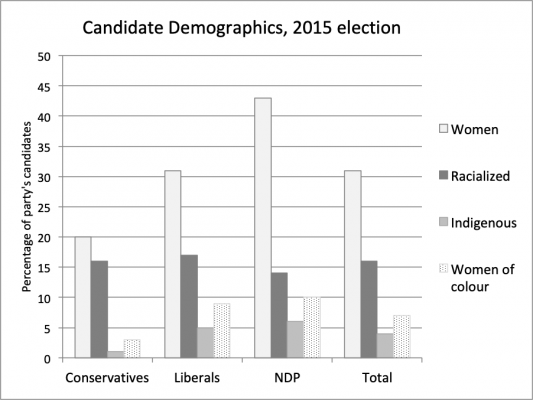
Parties are not obligated to release data on the diversity of their candidate slates, so researchers and journalists are left to tally the statistics. They do this by consulting candidate biographies and other publicly available information, but even then, it’s hard to compile a full picture beyond the three main parties. In 2015, our best estimates suggest that at least 80 per cent of candidates were white, and 70 per cent were men.

Data compiled by the author, using candidate biographies and other publicly available sources. Women of colour includes both Indigenous and racialized women.

So, why don’t parties nominate more women and minorities? In some cases, political parties underestimate the electoral prospects of candidates who don’t fit the profile of the prototypical politician. There is also evidence that they filter women into unwinnable ridings and pigeonhole racialized candidates into only the most diverse districts. Gatekeeping matters.

My research shows that racialized candidates are more likely to emerge when the party’s riding association president is also racialized; otherstudies confirm that women riding association presidents are positively related to the selection of women candidates. Perhaps it’s because women and racialized gatekeepers have more diverse networks and can draw on these resources when identifying potential candidates, but it also appears that under-represented groups respond more positively to recruitment from gatekeepers with backgrounds like their own. Diverse local party leadership might also signal the party’s openness to a variety of candidates.

Despite this, my own research suggests that at least three-quarters of riding association presidents—the most prominent local party gatekeepers—are white and male. Candidate search committees typically assist riding association presidents, but the face of local recruitment efforts is still relatively homogenous. Parties might have more success in their efforts to recruit candidates with a wider range of characteristics and life experiences if the executives of their local riding associations were themselves more diverse.

The NDP has tried to tackle the challenge through an equity policy that commits to running women candidates in at least 50 per cent of all districts, and members of other equity groups in a further 30 per cent; “equity groups” is a catch-all for racialized minorities, Indigenous peoples, persons with disabilities, individuals who are LGBTQ, and youth. Although in 2015, the party nominated more women candidates than either the Liberals or the Conservatives, they nominated the fewest racialized minorities. This suggests that even an explicit commitment to more diversity is not enough. In 2017, the Liberals and Conservatives defeated a private member’s bill that would financially penalize parties for not running more women candidates

Other less formal means have also been tried. For example, prior to the last election, the federal Liberals launched an initiative called #AskHer. The idea was simple and grounded in research that shows women candidates need far more encouragement to run for office than men do. The Liberal Party asked Canadians to identify qualified women candidates whom they thought the party should approach to run. From these submitted names, just one woman—Celina Caesar-Chavannes— was ultimately elected as a Member of Parliament.

Parties have long been the gatekeepers to elected office, but apart from requiring them to disclose the names of their donors and abide by some basic electoral rules, there is little—aside from public pressure—to hold them to account. The 2019 election is an opportunity to do so. How many candidates from equity-seeking groups did parties approach and encourage to run for office? What measures are they putting in place to recruit diverse candidates to office? And how are parties supporting new candidates, whether that’s through training, a financial contribution, or volunteers? Last election, parties told voters to #AskHer. This time, we need to ask more of parties.

Source: Want more diversity in politics? Start by looking at political parties

Journalists inherit ‘institutional blindspots’ that cloud coverage of race in politics, says media expert

From the Hill Times, Erin Tolley on blindspots, myself on diversityvotes.ca and others:

Increasing the diversity of newsrooms isn’t a cure-all for improving political coverage of racialized people, says a media expert, who argues that journalists often end up inheriting the institutional blindspots of the outlets they work for. 

“Even journalists of colour sometimes will produce coverage that differentiates and treats white and racialized subjects differently,” said Erin Tolley, political science professor at University of Toronto, in a phone interview. “Journalists are a product of the institutions that see whiteness as a norm. It’s not a problem of individual journalists.” 

Prof. Tolley spent four years surveying the mainstream media’s coverage of race in politics with data from the 2008 federal election, including how its depiction of non-incumbent, visible-minority candidates’ viability compared to non-incumbent, white candidates. 

“White, straight men are still seen as people who deserve to be in institutions of power, who naturally fit into those roles. … [Journalists] come at stories about racialized subjects with a different standard,” she said. “They present the white, non-incumbent candidates as more politically viable, more qualified to win, than racialized non-incumbents.” 

These unconscious biases towards visible-minority candidates tend to disappear from coverage, she said, when they occupy political office. 

Andrew Griffith, former director general at Citizenship and Immigration Canada during the Harper era, echoed Prof. Tolley’s assertion that improving diversity within one’s ranks doesn’t necessarily translate into a diversity of thought, particularly when the culture of the institution in question might promote conformity. “You had management teams that had a degree of diversity, but the corporate culture is about conforming. Did those diverse people bring a diverse perspective? You didn’t necessarily see that,” Mr. Griffith said of his own experience in government. 

Since retiring from public service, Mr. Griffith has now developed a tool with Mirems—a company that monitors and translates coverage from ethnic media sources—aimed at providing context about how issues are being covered in diaspora communities. The online tool is at Diversityvotes.ca. For journalists, he said, it can serve as a resource to deepen their understanding of the complexity of ethnic communities and to demystify perceptions that there’s a monolithic ethnic vote. “There’s a diversity with the diversity, and simply labelling or assuming people within a community are representative of an entire community is dangerous,” Mr. Griffith said. 

When confronted with their biases, Prof. Tolley said, journalists she interviewed—who spoke on the condition of confidentiality—tried to explain away differences in their framing of a candidate’s electability. For example, she observed that non-white candidates were more seen as long-shot candidates compared to their white counterparts. They insisted that any differences stemmed from a candidate’s level of experience, not stereotypes, even as she pointed out that those factors had been controlled for in the research. (The findings were published in her book, Framed: Media and the Coverage of Race in Canadian Politics.)

The Canadian Press style guide’s—the definitive handbook that many reporters have copies of handy—section on race illustrates how journalists are instructed to think about the subject of racial stereotypes, Prof. Tolley said. In both the previous and latest editions of the guide, one measure for determining whether it’s “pertinent” to mention a person’s race is if one is reporting on an “accomplishment unusual in a particular race.” Thinking of issues of race in those terms, she said, shows “some outdated thinking about race and racial characteristics. In defending CP’s standards, the guide’s editor, James McCarten, told her in an interview for the book that the word “unusual” may not be the right word, but he stood by the guideline, saying, “journalism oftentimes is all about firsts” and “historically relevant” events. 

Efforts to deepen coverage of race, politics 

Ryan McMahon, the host of Canadaland’s Thunder Bay podcast series, said that his Anishinaabe identity, coupled with the privilege of not immediately being seen as Indigenous because of his skin colour, informs his approach to reporting on issues of race. 

In setting out to tell the story of why Thunder Bay has the highest hate-crime rates in Canada and why there’s deep distrust in the city’s institutions, Mr. McMahon said, the “one thing” the podcast got right was getting someone like him to report on the city. Having firsthand exposure to the subtle ways that racism manifests itself, he said, helps in identifying and effectively naming racism. In his hometown of Fort Frances, Ont., for example, it was “rare” to see a “brown face” behind the cash register. 

“The way I experience racism is very different than someone who is visibly native. I can walk down the street and not be identified as Indigenous, so my experience is very different,” Mr. McMahon said. “[Racism in Canada] is often quiet, but aggressive, unspoken. … The kind of racism we’re talking about isn’t necessarily a Nazi skinhead, KKK apologist. It can often be an unconscious ignorance, with deeply held misperceptions. People hold on really tightly to stereotypes.” 

The groundwork laid by journalists such as Mr. McMahon and Toronto Star’s Tanya Talaga in chronicling the systemic racism in Thunder Bay that underpins its public institutions—and the national conversation that followed—helped open up the space for The Globe and Mail to establish a temporary presence in the northwestern Ontario city earlier this year. The paper had also done extensive coverage of Adam Capay, the Lac Seul First Nation man who spent about four years in solitary confinement. 

David Walmsley, The Globe’s editor-in-chief, explained in a staff memo that temporarily setting up shop in Thunder Bay, in an election year, presents this country a “chance to look inward and to encourage improvement in areas where we all know improvement needs to be made.”

Having spent more than a decade reporting on Indigenous issues, veteran Hill reporter Gloria Galloway was among the first reporters assigned to live for a couple of months in Thunder Bay, as part of the paper’s effort to deepen its coverage of the systemic racism in the city. The Globe does not have an Indigenous reporter on its staff, so it had a “limited pool” to choose from for the first stint, Ms. Galloway said. 

That The Globe, the country’s national newspaper, still doesn’t have an Indigenous columnist or staff reporter is a reflection of how the “markers” for improving diversity don’t appear to have moved much in Canadian media, said Mr. McMahon, who added that there are a bunch of journalists who are closer to the story. He said he’s been disappointed by The Globe’s coverage of Thunder Bay, pointing to the first piece released that gave an extensive overview, in interactive form, of the issue, with interviews from a cast of characters in the city. “So far, we’ve seen a Thunder Bay 101 piece. I understand why they had to do that, but it was a surface-level piece, a collection of stories that other journalists have already told,” Mr. McMahon said.

Ms. Galloway acknowledged that there’s a “huge learning curve” that comes with reporting on Indigenous issues, as a white woman. But, over time, through her reporting, she said, she’s developed a “sensitivity” to covering issues of race and has developed friendships and earned the respect of Indigenous peoples: “Every year, I’ve learned how much more I don’t know.”

Ms. Galloway said The Globe’s decision to dedicate resources to cover Thunder Bay was not an “insignificant financial commitment” for the paper, particularly in an election year. “I was pulled out of the Ottawa bureau for months. Losing a body in Ottawa for us is very difficult,” she said.

But there was an acknowledgment that shining a light on the situation could help elevate the issue to become part of the election discussion. “We’re not activist journalists, but certainly, there’s a sense in The Globe culture that shining a light on things that are wrong and having corrective action is [important],” Ms. Galloway said. 

Though Ms. Galloway is retiring next week, having decided to take a voluntary buyout, she said, the paper is committed to having a presence in Thunder Bay through the summer and fall. 

Source: Journalists inherit ‘institutional blindspots’ that cloud coverage of race in politics, says media expert