The perilous stakes of immigration law by executive fiat

Valid questions:

American presidents long have exercised broad powers over immigration policy. But what are the limits? Since his first days in office, President Trump has forced a national conversation around that question. One of his enduring legacies, for better or worse, may be to compel some hard answers.

In recent weeks alone, President Trump has claimed the authority to end birthright citizenship, issued an executive proclamation to drastically limit asylum eligibility, and deployed thousands of U.S. military troops to enforce immigration law. In each instance, Trump has claimed the inherent presidential authority to do so, with or without congressional approval, and perhaps even despite its disapproval.

Meanwhile, in a recent Supreme Court filing, the Trump administration rigorously defended its decision to terminate President Obama’s Deferred Action for Childhood Arrivals (DACA) program for undocumented youth. In that ongoing litigation, the Trump administration argues that rescinding DACA is justified because the Obama administration exceeded executive authority when it first created the program.

More than ironic, this duality is telling. Trump’s arguments simultaneously posit the need for limits on presidential immigration authority and shine light on the absence of a principled answer to what those limits should be. If nothing else, when sentiments about constitutional power suddenly change when the president does, that should sound an alarm that political preferences are substituting for what the Constitution requires.

Trump’s claim to sweeping executive authority no doubt is emboldened by the Supreme Court’s majority opinion in Trump v. Hawaii, which upheld his so-called travel ban against constitutional challenge. Emphasizing the breadth of presidential power in immigration matters, the five-justice majority declined to scrutinize Trump’s words and actions, as it might have in other regulatory contexts. Instead, the court explained, “[F]or more than a century, [it] has recognized that the admission and exclusion of foreign nationals is a fundamental sovereign attribute exercised by the government’s political departments largely immune from judicial control.”

The court’s extreme judicial deference in immigration traces to the Chinese Exclusion Cases, decided by the Supreme Court in the late 19th century. There, the court determined that the federal political branches had complete authority to exclude and expel immigrants on any basis, including race or nationality.

When those foundational immigration cases were decided, the court’s jurisprudence on constitutional rights was undeveloped, as were the nation’s social norms regarding discrimination. As that jurisprudence and our cultural understandings evolved over time, however, immigration law lagged behind.

The result is a modern-day immigration regime where the normal constitutional rules do not always apply. More concretely, it has allowed presidents across the political spectrum to wield governmental power that would be patently unconstitutional in other regulatory contexts.

The travel-ban case tested the currency of the court’s anachronistic immigration jurisprudence. By declining to modernize it, the court missed an opportunity to bring immigration law — and this president — in line with generally applicable constitutional limits. Now, with his recent directives, Trump is doubling-down on the idea of creating immigration law through executive fiat.

But make no mistake: The stakes transcend immigration law and our sitting president.

Lurking behind the controversies over DACA, “sanctuary cities,” asylum and citizenship, are a set of constitutional values on which those cases turn — from individual rights to separation of powers to state autonomy. The fact that these core concerns arise in situations with an immigration component should not give presidents a free pass on any of these constitutional dimensions. Otherwise, it becomes all too easy for presidents to invoke catchphrases such as “national security” or “alien invasion” to paper over our written Constitution.

Nor should questions about presidential power be confused or replaced with questions about whether we like or dislike a president’s policies. The Constitution was crafted to keep certain values safe from the political whims of any one institution of government — including the president. Constitutional structures do not grind to a halt when Congress does. If anything, congressional inaction is a telltale sign of a nation divided, not a justification for a president to go it alone.

Looking ahead, there is no reason to think future presidents will forfeit power once obtained. Indeed, Trump’s invocations of executive power are perhaps the extreme, but predictable, result of the steady accretion of presidential power over time. This one-way ratcheting of presidential power must be stopped by judicial and congressional intervention, or it will not be stopped at all.

It has become a cliché to invoke America’s status as a “nation of laws.” Less appreciated is that our laws reflect who we are and wish to be as a nation. No president should be able to unilaterally decide our national complexion. Any compromise on that point compromises our constitutional democracy.

Source: The perilous stakes of immigration law by executive fiat

Anti-Immigration Laws Have Negative Health Effects on Undocumented Youth

Not too surprising:

Anti-immigration laws, coupled with the repeal of Deferred Action for Childhood Arrivals (DACA), have negative public health implications for undocumented Latino immigrant youth, according to results presented at the American Public Health Association 2018 Annual Meeting and Expo, held November 10 to 14 in San Diego, California.

These negative effects on public health stem from limited access to education and include higher percentages of tobacco and alcohol use, higher rates of stress-induced chronic disease, and a decrease in the use of health and human services.

The researchers conducted 5 focus groups in San Mateo County, with 3 objectives: to better understand undocumented immigrants’ feelings around the fear of deportation, to identify strategies that can lessen negative effects, and to develop recommendations to help support undocumented immigrants. The researchers also conducted interviews with 6 key informants and 8 healthcare providers.

The researchers found that participants noted signs of depression and anxiety in children and young adults. Particularly, participants expressed concern for older children who once qualified for DACA: these children now reported feelings of hopelessness and lower self-esteem.

The results of the study indicated that undocumented immigrant children sometimes refuse to continue seeking an education, fearing deportation and threats against the Latino community.

To mitigate the negative effects of the political climate on this community, participants expressed a need to increase awareness about health implications, offer practical support systems, and pass local policies that protect all residents, including undocumented immigrants.

“The research highlights the need to study the impact of DACA and immigration enforcement in relation to stress levels, including mental health and chronic disease,” lead study author Mayra Diaz, MPH, from the San Mateo County Health System, Belmont, California, said. “It will be critical to look into areas of outreach for access to public, health, and social services.”

Source: Anti-Immigration Laws Have Negative Health Effects on Undocumented Youth

An Excel error could delay Japan’s massive immigration overhaul

As someone who works a lot with data, this can happen. But it shouldn’t, given government validation and checking processes:

Japan’s government seems to be in need of some tech support.

Its plans to pass a crucial immigration bill that could open the country’s doors further to as many as 340,000 foreign workers from next year might be stymied due to data input errors.

Japan’s government had given lawmakers an analysis of why foreign workers in the country are dropping out of an existing work training program, as it argues for the country to create create two new categories of work visas. The justice ministry admitted last week that the data on those workers was incorrect, and blamed the problems on the handling of an Excel spreadsheet, Japan Times reported yesterday (Nov. 19). For example, the analysis exaggerated the number of foreign workers who left their jobs because they wanted higher-paying positions, rather than to escape poor wages or working conditions.

There are some 1.3 million foreign workers in Japan as of 2017, a 17% increase from the previous year, as businesses try and fill positions in industries ranging from construction to food preparation to nursing amid a shrinkage in Japan’s working population. Right now, foreign workers filling run-of-the-mill jobs are often in the country on temporary “trainee” visas that lock them into employers.

The proposed work-visa categories, approved this month by prime minister Shinzo Abe’s cabinet, would allow those with “specified skills” in the most labor-starved industries to live and work in Japan under for up to five years. The new visa status would also allow such workers more flexibility in changing jobs, which would make them less vulnerable, proponents of greater immigration to Japan say.

Though Japan’s justice ministry has said that the errors were the result of mistakes in data processing—the latest IT mishap after Japan’s newly appointed cybersecurity minister admitted that he had never used a computer—opposition lawmakers have accused the government of glossing over the problems with the current trainee program in order to rush the bill through.

In the revised data, the government said for example that 12.6% of trainees said that they left their jobs because of harsh working conditions, up from the previous 5.4% presented by the ministry. Opposition legislators boycotted a debate over the immigration overhaul in the Diet last week in protest, but deliberations could resume this week.Many of those currently working as trainees are expected to switch over to the new visa status once the bill becomes law.

Calling foreign workers technical trainees or interns was a workaround for the government to keep it from having to admit that more people from overseas are living in Japan—a country where many remain deeply apprehensive about immigration, even as it struggles with a severe labor shortage. But it’s also a workaround that has left thousands of workers vulnerable to exploitation by employers and the brokers who bring them over, as many of these trainees told lawmakers earlier this month.

Source: An Excel error could delay Japan’s massive immigration overhaul

And public opinion appears sceptical regarding the proposed changes:

Sixty-four percent of respondents said there is no rush to revise the immigration control law to expand the acceptance of foreign workers from next spring, according to an Asahi Shimbun poll released on Nov. 20.

They said it is not necessary to pass the revisions in the current extraordinary Diet session, while 22 percent of respondents believe it should be.

The nationwide poll was conducted Nov. 17 and 18.

The government and the ruling parties are seeking to pass the revisions to the immigration control law in the current Diet session.

However, even among supporters of the Liberal Democratic Party, the main force of the ruling coalition, 57 percent said that it is not necessary to do so. Only 31 percent replied that the revisions should be passed in the current session.

The survey also asked respondents about whether they support the expansion of acceptance of foreign workers. Forty-five percent, down from 49 percent in the previous survey in October, said they support it. Forty-three percent, up from 37 percent, expressed opposition.

Prime Minister Shinzo Abe has said that accepting more foreign workers into Japan is not a policy of accepting immigrants. As for Abe’s comment, 52 percent of respondents said that they don’t accept the explanation while 29 percent replied that they agree with it.

In the latest poll, the support rate for the Abe Cabinet stood at 43 percent, up from 40 percent of the previous survey, while the nonsupport rate was 34 percent, down from 40 percent.

The latest number means that the support rate for the Abe Cabinet recovered to the levels recorded in January and February polls, which were taken prior to the revelation of the alteration of Finance Ministry documents.

Respondents also were asked about the four islands off eastern Hokkaido that were occupied by the Soviet Union at the end of World War II in 1945. The islands, called the Northern Territories in Japan, are Etorofu, Kunashiri, Shikotan and Habomai.

Abe agreed with Russian President Vladimir Putin in their summit on Nov. 14 to accelerate peace treaty negotiations based on the 1956 Japan-Soviet joint declaration that stipulates the return of two islands, Shikotan and Habomai, to Japan after concluding a peace treaty.

The survey asked respondents if they expect an agreement to lead to a resolution of the long stalemate over the Northern Territories issue.

A total of 60 percent replied that they don’t expect that at all or very much. Thirty-eight percent responded that they very much expect it or at least to some degree.

The survey also asked about how Japan should deal with the Northern Territories issue.

Fifty-one percent replied that the government should first seek the return of Shikotan and Habomai and continue to hold negotiations on the return of the remaining two islands.

Meanwhile, 25 percent said Russia should return the four islands at the same time, and 11 percent said that Japan should conclude the Northern Territories issue with the return of the two islands. Six percent replied that Japan should not seek the return of any of the four islands.

The Asahi Shimbun conducted the survey through land-line telephones and mobile phones of eligible voters chosen randomly by computer.

Of 2,048 households contacted with land-line telephones, 991 people, or 48 percent, gave valid responses. As for mobile phone users, 949 of 2,022 people, or 47 percent, gave valid responses.

Land-line telephones do not include those located in a part of Fukushima Prefecture.

Source:  Poll: 64% say not necessary to rush revisions to immigration law November 20, 2018 Sixty-four percent of respondents said there is no rush to revise the 


Kuwait may grant citizenship to non-Muslims

Small opening of the very restrictive citizenship laws (common to all Gulf countries):

Non-Muslims could be granted the Kuwaiti citizenship if two proposals approved by the parliamentary legal and legislative committee is supported by the parliament and the government.

The proposals submitted separately by MP Safa Al Hashem and by MPs Ahmad Fadhl and Khalid Al Shatti called for amending the 1959 citizenship law to allow the granting the Kuwaiti citizenship to applicants who are not Muslim.

Current law

The law currently stipulates under Item 5 of Article 4 that the Kuwaiti nationality may be granted by decree upon the recommendation of the Minister of Interior to any person who is an original Muslim by birth, or that he has converted to Islam according to the prescribed rules and procedures. It also stipulates that a period of at least five years has passed since he embraced Islam before the grant of naturalisation.

“Nationality thus acquired is ipso facto lost and the Decree of naturalisation rendered void ab initio if the naturalised person expressly renounces Islam or if he behaves in such a manner as clearly indicates his intention to abandon Islam.

In any such case, the nationality of any dependent of the apostate who had acquired it upon the naturalisation of the apostate is also rendered void.”

Other requirements

The other four requirements are residing in Kuwait for at least 20 consecutive years or for at least 15 consecutive years if he is an Arab belonging to an Arab country, has lawful means of earning his living, is of good character and has not been convicted of an honour-related crime or of an honesty-related crime, has knowledge of the Arabic language and possesses qualifications or renders services needed in Kuwait.

The parliamentary committee had long opposed amending the law to drop the religion requirement, but endorsed it this time after three of its members had resigned.

However, the proposal, promoted as achieving fairness and equal chances for all, may not pass the parliament currently dominated by conservatives.

Challenging the current law

In December 2014, the late independent lawmaker Nabil Al Fadhl challenged the constitutionality of Article 4 in the Citizenship Law.

“This is a Christmas gift for our Christian brothers,” Al Fadhl, the father of Ahmad who submitted the proposal this time, said after filing his petition to the Constitutional Court, the highest court in the northern Arabian Gulf country.

Al Fadhl said that the condition was a constitutional and legal stigma.

“Those who added this condition to the Citizenship Law in 1981 are lawmakers who did not rise to the significance of their oath as they were sworn in as members of parliament,” he said.

“Such an article is a disgrace to the law and does not in any way reflect the values of the Kuwaiti people.”

The Muslim-only restriction was reportedly introduced in 1981 by MPs Ahmad Al Saadoon, Mohammad Al Marshad and Mohammad Al Rasheed.

Al Fadhl attributed his decision to seek an amendment to the Citizenship Law at the Constitutional Court and not at the parliament to his wish to avoid splitting conservative lawmakers.

“I wanted to avoid any form of embarrassment to the lawmakers and to keep away from differences in viewpoints in the parliament,” he said.

When in January 2014, MP Al Hashem suggested cancelling the condition that restricted naturalisation to Muslims, saying that it was not in line with the text and spirit of the constitution.

She was, however, opposed by several lawmakers who said that the focus should be on granting the Kuwaiti citizenship to the Muslim Bidoons, stateless people, living in Kuwait.

Al Fadhl died in December 2015 during a session of the parliament.

250 Kuwaiti Christians

The overwhelming majority of Kuwaiti citizens are Muslims.

Around 250 Kuwaitis are Christians who were granted the citizenship before the article restricting naturalisation to Muslims was introduced.

They are mainly from Lebanon, Iraq and Palestine.

Source: Kuwait may grant citizenship to non-Muslims

Why immigration could be a high-risk, low-reward issue in the 2019 election

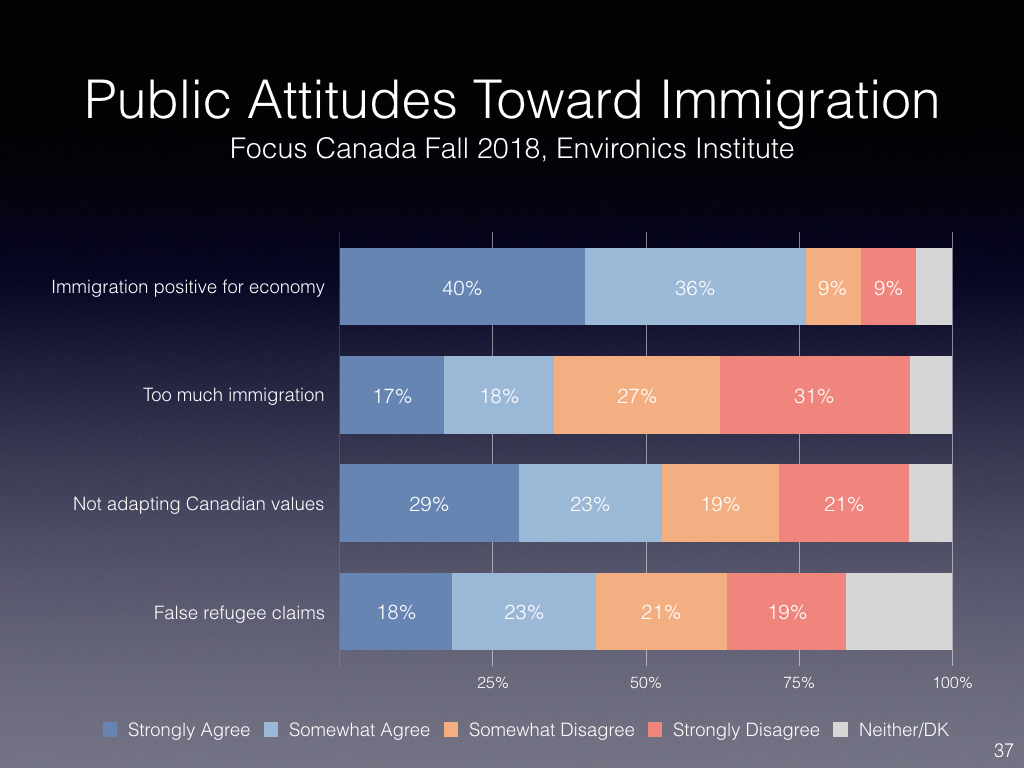
Eric Grenier’s take on the political implications of the latest Focus 2018 survey (Focus Canada Fall 2018 – FINAL REPORTFocus Canada Fall 2018 – DETAILED DATA TABLES)

Though the political debate over immigration and border security has made a lot of noise in recent months, it might turn out to be a dud in the 2019 federal election — or it could blow up in the face of the party leader who risks making an issue of it.

A new survey by the Environics Institute shows that Canadians’ opinions on immigration and refugees have hardly budged from the generally upbeat views recorded by the polling firm over the last few years. A majority of Canadians (58 per cent) say they do not believe that immigration levels are too high, while 76 per cent say that the overall impact of immigration on the Canadian economy has been positive.

But the numbers suggest there’s still an audience for a political party demanding a reduction in immigration and greater efforts to ensure immigrants adopt “Canadian values” — both policies embraced by the new People’s Party launched by former Conservative leadership contender Maxime Bernier.

This could prove to be a point of vulnerability for Andrew Scheer’s Conservatives.

The Conservatives have been sharply critical of Prime Minister Justin Trudeau’s immigration policies since the beginning of a surge in the number of asylum seekers crossing Canada’s borders illegally. But those criticisms have been limited to questions of fairness regarding those asylum seekers who try to enter Canada illegally, and claims that the government has no plans in place to adequately house, employ and integrate immigrants.

The Conservatives have been careful to state that they are pro-immigration and are not asking for a reduction in the annual intake.

But that puts the party at odds with many of its own supporters — who appear to be more in line with where Bernier’s party is positioning itself on the issue.

Overall, immigration isn’t a top-of-mind issue for voters, according to the Environics Institute poll. Only five per cent of Canadians — and just six per cent of Conservative voters — cite immigration and refugees as the most important issues facing Canadians today. That’s up only one point since April 2017.

Over the same time, the percentage of Canadians who list the environment and climate change as the most important issue has jumped five points to 10 per cent, second only to economic issues.

Health care, the government’s record, social issues and unemployment also scored higher than immigration in the Environics Institute’s research.

Few votes to win in Quebec on immigration

Immigration ranked low on the priority list in Quebec, where the bulk of asylum seekers have crossed into Canada and where a provincial election was just waged, in part, over the issue of immigration.

Only seven per cent of Quebecers listed it as their top issue. On immigration levels, the legitimacy of refugee claims and immigrants’ impacts on the economy, opinions in Quebec were in line with those in the country as a whole.

This suggests those seeing a hard line on immigration as a winning formula in Quebec are drawing the wrong lessons from the Coalition Avenir Québec’s win in the October provincial election. The CAQ promised to reduce the province’s immigration intake and do more to integrate those who arrive. But the Liberal government of Philippe Couillard was unpopular long before immigration popped up as an issue in the campaign — and CAQ Leader François Legault’s clumsy handling of the file nearly cost him his victory.

Conservative, PPC voters on the same page

The starkest divisions in Canadians’ views on immigration are found not between regions, age groups or education levels, but between supporters of the major parties themselves. While Liberals and New Democrats generally view immigration in the same positive light, Conservative voters see things very differently — though they are no longer alone on that side of the spectrum.

The Environics Institute poll surveyed a small sample of just 63 People’s Party of Canada supporters, so the margin of error on the PPC numbers is high. But the difference between Liberal and NDP supporters on the one hand and Conservative and PPC supporters on the other (and the strong similarity between the views expressed by the last two groups) is so marked that the results are still meaningful.

Just 22 per cent of Liberals and 24 per cent of New Democrats think Canada takes in too many immigrants. But 52 per cent of Conservatives and 47 per cent of PPC supporters think so.

Meanwhile, 58 per cent of Conservatives and 55 per cent of Bernier’s supporters think most refugee claims are illegitimate. Just 30 per cent of Liberals and 32 per cent of New Democrats agree.

And 73 per cent of PPC voters and 70 per cent of Conservatives think too many immigrants are failing to adopt “Canadian values,” compared to 38 per cent of Liberals and 40 per cent of New Democrats.

Perhaps most stark are the responses Environics heard when it asked whether immigrants make the country better or worse. While 62 per cent of Liberals say immigrants make the country better and just six per cent think they make it worse, Conservatives and People’s Party supporters were split three ways.

Among Conservatives, 28 per cent said immigrants make the country better, 31 per cent said worse and 32 per cent said they make no difference. For the People’s Party, those numbers were 32, 34 and 31 per cent, respectively.

This suggests Scheer could be vulnerable on immigration if it flares up as an issue during the 2019 federal election campaign. The Conservative Party might find itself out of step with its own supporters. Normally, that wouldn’t be a problem — these voters were not going to head over to the Liberals or NDP — but Bernier’s People’s Party will be an option on the ballot that didn’t exist before.

One thing that does separate Conservative voters from People’s Party supporters is U.S. President Donald Trump. Only 13 per cent of Canadians approve of the president and Conservatives say they disapprove of Trump by a margin of two-to-one. PPC voters are split down the middle on Trump — which perhaps explains why Bernier hasn’t shied away from adopting a “Canada first” message in recent speeches.

Immigrants key to a Liberal victory in 2019

But while immigration might not turn out to be the central issue of the next federal election, immigrants themselves could play a key role.

The poll suggests that if the Liberals win next year, immigrants could be an important factor in that victory. Among voters born in Canada, the Conservatives led the Liberals by two points in the poll. But among voters born elsewhere, the Liberals held a 16-point lead. That’s what makes the difference between a neck-and-neck race and an environment that favours the re-election of Trudeau’s government.

But the poll also suggests that there’s very little difference between how Canadians born in this country and those born outside of it see immigration. In other words, however a party drafts its immigration platform, the degree to which that platform appeals to voters won’t depend on how long those voters and their families have been living here.

One noticeable difference in opinion emerged on the question of whether immigrants make Canada better or worse. By a margin of 54 to 15 per cent, immigrants said that immigration made Canada a better place. Among people who were at least third-generation Canadians, however, the margin was 40 to 19 per cent.

That suggests immigrants are (understandably) sensitive to questions about the value they bring to their new home. Policies that advocate for better integration, or lower intake targets, may not repel immigrants any more than they would non-immigrants. But the perception that a party is anti-immigrant could cause it some real trouble.

In short, immigration looks like delicate balancing act for any party wading into the debate without a positive story to tell.

Source: Why immigration could be a high-risk, low-reward issue in the 2019 election

Australians divided on immigration from Muslim countries, new polling shows

Haven’t seen comparable data from Canada but the “values” question generally – but not exclusively – refers to worries about integration of Muslims:

Australians believe there are six times as many Muslims in the country than the number who actually live here, a new poll shows.

The latest Fairfax-Ipsos poll found Australians “often overestimate the proportion of the population that is Muslim” with respondents “believing it is 17 per cent when the reality is [around] 3 per cent”, Fairfax reported on Monday.

According to the 2016 Census, the size of the Muslim population in this country is 604,200 people, or 2.6 per cent of the total population.

This compares to 30.1 per cent of Australians who have no religion, 22.6 per cent who are Catholic and 13.3 per cent who are Anglican.

The poll of 1200 voters found that 45 per cent of voters believe the number of immigrants coming to Australia should be reduced, with 23 per cent arguing for a rise and 29 per cent happy with the status quo.

When asked about the number of immigrants from Muslim countries, 46 per cent supported a cut while 35 per cent were happy with current levels and 14 per cent wanted an increase.

The poll comes as Prime Minister Scott Morrison considers possible changes to Australia’s immigration system.

Mr Morrison in September signalled plans to slow the intake of some temporary migrants and to encourage new arrivals to settle outside of congested major cities.

On Monday, Defence Minister Christopher Pyne said the government will be sticking to its non-discriminatory immigration policy.

“We have a non-discriminatory policy, that must remain in place … we need to manage our population growth sensibly in a country which quite frankly can take a lot more than 25 million people,” Mr Pyne told Sky News.

Last month, NSW Premier Gladys Berejiklian has called for a return to Howard-era immigration levels of about 45,000 a year.

Meanwhile, the poll also revealed that Mr Morrison’s coalition government trails Labor by 48 per cent to 52 per cent on a two-party preferred basis.

But Mr Morrision remains the preferred prime minister, with a 47 per cent to 35 per cent lead over Opposition Leader Bill Shorten.

On energy policy, the poll found that voters want the government to focus on reducing household bills (47 per cent), followed by reducing carbon emissions (39 per cent).

The National Energy Guarantee was declared “dead” by Mr Morrison after becoming prime minister, but the government has recently floated the idea of underwriting a new power generation project to help s to drive prices down and increase competition.

Source: Australians divided on immigration from Muslim countries, new polling shows

Norway: Critics try to block dual citizenship

Will see whether Norway joins the other Nordics in allowing dual citizenship:

The Center- and Labour parties are scrambling to block looming passage of a new law that would finally remove a long-standing ban on dual citizenship in Norway. Trygve Slagsvold Vedum, the protectionist, anti-EU leader of the Center Party, is among those launching a last-ditch effort to prevent Norway from allowing dual citizenship, and thus falling in line with most of the rest of the world.


“In this case, children of diplomats and foreign students are more important for the government than women and children who are dumped abroad,” Vedum told Norwegian Broadcasting (NRK) over the weekend. Vedum, whose small party has always opposed dual citizenship, now claims dual citizenship will make it more difficult to bring children who’ve been kidnapped and taken to another country by a foreign parent back to Norway.

“That’s a very drastic and completely biased commentary from Vedum, who only shows that he hasn’t understood this (the dual citizenship) issue,” retorted Kristin Holm Jensen, a state secretary for the Conservative Party in the education ministry.  She noted that many women who are subjected to forced marriages or whose children are kidnapped by a foreign spouse come from countries where Norway already has made exceptions that will allow dual citizenship.

“The Center Party’s opposition (to dual citizenship) won’t help them,” Jensen said. “We have many other measures to help protect them, both in Norway and through assistance from Norway’s embassies.” Children of parents from different countries, meanwhile, have long been granted citizenship in each and allowed to retain it at least until the age of 18.

Almost alone with current ban
Norway remains the only Nordic country that still has a general ban on dual citizenship, and one of the very few in Europe and elsewhere in the world. Momentum has been growing for years to end the ban, which is widely viewed as old-fashioned and isolationist in a global society where many people have moved internationally and have allegiances to both their country of birth and their country of residence.

In Norway, the ban has meant that thousands of long-term expatriates living in Norway have been denied the right to vote in national elections, because they’ve been unable to gain Norwegian citizenship unless they give up their citizenship from birth. Thousands of Norwegians who have moved abroad, meanwhile, have also been forced to give up their Norwegian citizenship if they’ve obtained citizenship in their country of residence, for example for job reasons.

The proposed law to finally allow dual citizenship in Norway has received majority support throughout its hearing process earlier this year. The government coalition thus sent the proposal to Parliament this autumn, even though it includes the immigration-skeptical Progress Party. Progress, however, now supports dual citizenship on the grounds it will make it easier for Norway to deport criminals or terror suspects who came to Norway from other countries but now only possess Norwegian citizenship. That citizenship can’t be revoked, but it could be if they’d been allowed to retain their original citizenship.

NRK reported that the dual citizenship proposal has sparked warnings from the Norwegian Bar Association, the police and the children’s ombud that it could have a negative effect in cases of forced marriage, kidnapping and cases of Norwegian citizens being held abroad against their will. Others claim, however, that the very fact they could no longer be stripped of their Norwegian citizenship offsets such risk.

While the Center Party has always opposed dual citizenship, it’s more surprising that the Labour Party is going along with arguments against it. Labour has long been an advocate of internationalism and multilateralism, and is currently led by former Foreign Minister Jonas Gahr Støre.

Debate due in December
Center and Labour are allied, however, in an attempt to seize government power away from the current Conservatives-led coalition. That likely helped Labour’s integration spokesperson Siri Gåsemyr Staalesen join forces with Vedum, also after two women from an organization that helps imigrant women fight social control and forced marriages sought their help. They fear dual citizenship’s consequences on women whose children have been taken back to their homelands against their will.

“It will nearly be impossible to get their children back if they (the children) have become citizens of the country to which they’ve been taken,” Laial Ayoub of the organization Nok (Enough) told NRK. The government, however, stresses that the children would no longer risk losing their Norwegian citizenship, and denies Vedum’s claims that removing the dual citizenship ban will hurt vulnerable groups.

The dual citizenship issue, which has faced lengthy delays in coming up in Parliament, is currently due to be debated in Parliament sometime in December.

Source: Critics try to block dual citizenship

How Plato Foresaw Facebook’s Folly Technology promises to make easy things that, by their intrinsic nature, have to be hard

Good reminder that technology reflects both the people who develop it and use it, and that informed and meaningful conversation and dialogue are hard:

In ancient Egypt there lived a wise king named Thamus. One day he was visited by a clever god called Theuth.

Theuth was an inventor of many useful things: arithmetic and geometry; astronomy and dice. But his greatest discovery, so he believed, “was the use of letters.” And it was this invention that Theuth was most eager to share with King Thamus.

The art of writing, Theuth said, “will make the Egyptians wiser and give them better memories; it is a specific both for the memory and for the wit.”

But Thamus rebuffed him. “O most ingenious Theuth,” he said, “the parent or inventor of an art is not always the best judge of the utility or inutility of his own inventions to the users of them.”

The king continued: “For this discovery of yours will create forgetfulness in the learners’ souls, because they will not use their memories; they will trust to the external written characters and not remember themselves.”

Written words, Thamus concluded, “give your disciples not truth, but only the semblance of truth; they will be hearers of many things but will have learned nothing; they will appear to be omniscient and will generally know nothing; they will be tiresome company, having the show of wisdom without the reality.”

Welcome to Facebook.

The tale I’m citing here comes from Plato’s “Phaedrus”; the words, attributed to Socrates, are about 2,400 years old. They are apposite again this week thanks to a lengthy investigation by The Times into Facebook’s cynical and self-serving calculations as it tried to brazen its way through a year of serial P.R. disasters: Russian dezinformatsiya, Cambridge Analytica, and a gargantuan security breach.

Now we learn that the company also sought to cover up the extent of Russian meddling on its platform — while quietly seeding invidious stories against its business rivals and critics like George Soros. Facebook disputes some of the claims made by The Times, but it’s fair to say the company’s reputation currently stands somewhere between that of Philip Morris and Purdue Pharma in the public toxicity department.

To which one can only say: About time.

The story of the wildly exaggerated promises and damaging unintended consequences of technology isn’t exactly a new one. The real marvel is that it constantly seems to surprise us. Why?

Part of the reason is that we tend to forget that technology is only as good as the people who use it. We want it to elevate us; we tend to degrade it. In a better world, Twitter might have been a digital billboard of ideas and conversation ennobling the public square. We’ve turned it into the open cesspool of the American mind. Facebook was supposed to serve as a platform for enhanced human interaction, not atool for the lonely to burrow more deeply into their own isolation.

It’s also true that Facebook and other Silicon Valley giants have sold themselves not so much as profit-seeking companies but as ideal-pursuing movements. Facebook’s mission is “to make the world more open and connected.” Tesla’s goal is “to accelerate the world’s transition to sustainable energy.” Google’s mantra was “Don’t Be Evil,” at least until it quietly dropped the slogan earlier this year.

But the deeper reason that technology so often disappoints and betrays us is that it promises to make easy things that, by their intrinsic nature, have to be hard.

Tweeting and trolling are easy. Mastering the arts of conversation and measured debate is hard. Texting is easy. Writing a proper letter is hard. Looking stuff up on Google is easy. Knowing what to search for in the first place is hard. Having a thousand friends on Facebook is easy. Maintaining six or seven close adult friendships over the space of many years is hard. Swiping right on Tinder is easy. Finding love — and staying in it — is hard.

That’s what Socrates (or Thamus) means when he deprecates the written word: It gives us an out. It creates the illusion that we can remain informed, and connected, even as we are spared the burdens of attentiveness, presence of mind and memory. That may seem quaint today. But how many of our personal, professional or national problems might be solved if we desisted from depending on shortcuts?

To read The Times’s account of how Facebook dealt with its problems is to be struck by how desperately Mark Zuckerberg and Sheryl Sandberg sought to massage and finesse — with consultants, lobbyists and technological patches — what amounted to a daunting if simple crisis of trust. As with love and grammar, acquiring and maintaining trust is hard. There are no workarounds.

Start over, Facebook. Do the basics. Stop pretending that you’re about transforming the state of the world. Work harder to operate ethically, openly and responsibly. Accept that the work will take time. Log off Facebook for a weekend. Read an ancient book instead.

Deborah Lipstadt wrote a new book on anti-Semitism. Then Pittsburgh happened

Good long and thoughtful interview, particularly on the enablers and the need to think outside one’s bubble:

The advance copies of Deborah Lipstadt’s new book, “Antisemitism Here and Now,” display a cover photo of a white supremacist carrying a tiki torch.

But that iconic image of the August 2017 white power rally in Charlottesville, Virginia, could now be replaced by another one: Police tape cordoning off the Tree of Life Congregation in Pittsburgh. Or perhaps the row of cut-out stars displaying the names of that massacre’s 11 victims.

“Antisemitism,” written earlier this year and due out in February, offers a concise and comprehensive overview of the various forms of Jew-hatred that have reappeared or intensified during the past few years. And before Pittsburgh, there already was plenty to write about: anti-Semitic attacks in Europe; the “alt-right” in the US; the persistence of Holocaust revisionism and denial; whether and when criticism of Israel qualifies as anti-Semitic; and of course Charlottesville.

Then the shooting happened. For Lipstadt, the renowned Holocaust historian and Emory University professor, the tragedy in Pittsburgh was both a surprise and a reaffirmation of her warnings.

Lipstadt, 71, spoke with JTA in New York City this week about what the Pittsburgh shooting means for American Jews and how Jews should fight anti-Semitism. The interview has been edited for length and clarity.

JTA: What are your thoughts about the book following Pittsburgh?

Lipstadt: I wasn’t surprised by Pittsburgh, but I was shocked. I wasn’t surprised because I kept saying something’s going to happen in our country, and had been happening.

It would be easy to say everything changes after Pittsburgh, and I do think everything changed for Jews, for synagogues. Any synagogue board that in the past 10 days hasn’t met to discuss security operations is crazy. That’s the new normal.

We had one incident, a horrible incident — it doesn’t characterize our whole country — but it is disturbing. I tell the story, the one I end the book with, of walking into shul with a little friend who’s now 6 1/2, and her mother said, “Say thank you to the police officer for keeping us safe.”

She’s going to figure it out soon enough. She’ll look across the street at the church dead opposite our shul and there are no police officers there. How do you recognize a shul now if you don’t know exactly what the number is or what the cross street is? Look for the police officers. Kids recognize that.

There will be kids who say what do I want to go to Hillel for? There will be parents who will say, you know what? Why should I take my kid to a place where there’s danger?

In your book, you focus largely on people who enable or minimize anti-Semitism, as opposed to hardcore anti-Semites themselves. Why is that?

It’s “farfaln” [Yiddish, roughly, for “a lost cause”] to try to change those people. I could write about David Duke from here until the cows come. I’m not going to change David Duke’s mind. We all know David Duke is a lowlife of the first order, but it’s the people who might be influenced by David Duke who I want to reach.

Farrakhan, he’s a disgusting excuse for a human being. But it’s the people around him, Linda Sarsour, [Women’s March co-chair] Tamika Mallory, who have the voice of the press, who are listened to. They’re enablers. The enablers are much more dangerous to me than the people we recognize.

On some level, it’s the non-Hitlerian kind of anti-Semite, the one who doesn’t quite present as an anti-Semite, who’s much more dangerous because that’s the person who’s going to have access to the public.

How do you view Linda Sarsour’s activism and fundraising on behalf of Jewish causes, and her collaborations with progressive Jewish groups?

There are lots of people who proclaim they’re against anti-Semitism — “Pittsburgh? Terrible!” Linda Sarsour, you know. At the same time, on the other side of her mouth, she’s talking about don’t humanize Israel and when you wear a Jewish star it makes me feel unsafe. She’s talking out of two sides of her mouth.

[At an event in September, after criticizing Israel, Sarsour said, “If you’re on the side of the oppressor, or you’re defending the oppressor, or you’re actually trying to humanize the oppressor, then that’s a problem…” In 2017, speaking at a march protesting racism, Sarsour said, “I’m going to be honest, there are instances of things that happened to me at this space that made me feel unsafe.” Some people took that as a reference to Zionist signs.]

I don’t trust people like that. One of the reasons I’m particularly not trusting of someone like that is that there are so many Jews on the left who come so cheap. They wrote me, “Look, Linda Sarsour criticized Pittsburgh, look, she’s helped to rebuild a cemetery,” etc. Give me a break. Anyone who’s not going to criticize what happened in Pittsburgh … someone gets credit? OK, so she’s raising money to help rebuild a cemetery, that’s very nice. But at the same time she’s making awful statements about Jews. Not just about Zionists but about Jews.

Farrakhan, he called Jews termites, and Linda Sarsour and Tamika Mallory and leaders of the Women’s March are embracing him and praising him. He called us termites. How much more do you need?

On the right, is a person with 50 Twitter followers who sends a meme something we really need to be concerned about?

If it were one person with 50 followers I’d say let’s get a life. But it’s not one person with 50 followers. It’s 500 people with 50 followers and one of them with a thousand and another, like a Richard Spencer, who figures out how to take those 50 and 50 and 50 and turn them into something more acceptable and more mainstream.

It’s a ripple effect. The internet can be a weapon or it can be a great tool for connecting people. Given that we now have the internet, given that these right-wingers have learned how to use it, they have a tool they didn’t have before.

The thing that really galvanized it was, of course, having a president who — I don’t know if Donald Trump is an anti-Semite, I doubt that he’s an anti-Semite. But that’s the wrong question to ask. The question to ask is, does he enable anti-Semites?

[Lipstadt then refers to anti-Semitic abuse from Trump supporters directed toward reporter Julia Ioffe, who wrote a critical profile of Melania Trump in 2016.]

That would have been the moment for him to look straight into the camera and say, “Listen, this is not how I want to win the presidency. This is not what America is about.” Instead he said “I have no message for them.” [Trump told CNN, “I don’t have a message to the fans.”]

You have a president who glorifies violence. You have this violence, this glorification of violence. You put it together with white nationalism, white supremacy. At the heart of that white nationalism is a deep-seated anti-Semitism.

You criticize activists who lead the Boycott, Divestment and Sanctions movement, or BDS, against Israel. But could you explain why you also have harsh words for Israeli Prime Minister Netanyahu, who they oppose?

Bibi has done a number of things. First of all, his welcoming and embrace of [Hungarian prime minister] Viktor Orban, who has been pushing this Soros imagery [billboards criticizing the liberal Jewish philanthropist George Soros] and cracking down on the Jewish community of Budapest in a horrible, horrible way.

No. 2, what happened with the critics of BDS and that policy of keeping them out [of Israel]. Not only is it antithetical to Israel being a democracy, but it steals us of our best argument against BDS. BDS says “shut down the conversation, don’t bring anybody who might disagree with you,” and we say “no, open up the conversation.”

Most of all, the Polish law [criminalizing blaming Poles for collaborating with the Holocaust]. When the Polish law came out, Israel was appalled and was absolutely critical of Poland for this law. But then they announced with great fanfare, with Bibi at the table, we’ve worked things out with Poland, and Poland is changing the law so that it’s not as offensive.

What they had done is essentially changed the punishment from criminal to civil, but at the same time taken away protections for professors and artists.

This bending to Poland on this law was realpolitik. Bibi did it because he wants Orban in Hungary and whoever’s leading the Polish government at the moment, and Austria, to be his friends. Now you can say that’s realpolitik, but don’t do that and then claim Israel is the primary spokesperson and the address for fighting world anti-Semitism when you have coddled an anti-Semite like Orban, when you have made room for a soft-core Holocaust denial law like the Polish law. When you’re talking about anti-Semitism, there’s a red line.

You criticize people on both left and right, anti-Israel activists and the Israeli prime minister. Do you feel like you’re fighting a losing battle trying to carve out space in the middle?

I call it as I see it. If I thought it was a losing battle I probably wouldn’t do it.

I think there are a lot of Jews who feel like I do. I think there are a lot of Jews who will read half the book and remember half the book, who will be appalled when I’m putting down the right and love it when I’m putting down the left and be appalled when I’m putting down the left and love it when I’m putting down the [right].

I’m not out to win a popularity contest. I hope I’m not a voice crying out into the dark. I didn’t write the book to convince people who already know what they think. If the book makes people a little bit uncomfortable, and makes them reassess where they are and what they’re doing and where they see things, that’s good, too.

So what should we do to fight anti-Semitism?

I compare anti-Semitism to herpes. For most of the time we’ve had herpes, it couldn’t be cured. And if you were suddenly under stress, boom, up would come a herpes infection. Anti-Semitism is like herpes. When a society is under stress, it appears.

I would say the following things: They won’t cure it, but at least it might help alleviate it.

Don’t see anti-Semitism only on the other side of the political transom from which you are located. All these Jews on the left who suddenly, when Trump was running, saw anti-Semitism on the right and began to get all upset about that. And they weren’t wrong. But they had a patch on.

All those people on the right who are now saying Pittsburgh was a one-off, but we really should be worried about BDS. Of course we should be worried about BDS, but if you’re on the right you can have a conversation with those people. If you’re on the left you can try to have a conversation with those people.

If you’re only seeing it on the opposite side of the transom, you’re instrumentalizing this for political purposes.

I call for civil society. It used to be we could take our lead from government and leadership. We can’t. So it becomes incumbent on civil society to take a role.

A healthy democratic society cannot tolerate anti-Semitism and racism. If that is festering in its midst, it says something is unhealthy about the society. It’s not just Jews for whom this is dangerous. This should terrify you. Because if this is happening to Jews, it may start with the Jews but it doesn’t end with the Jews.
Source: Deborah Lipstadt wrote a new book on anti-Semitism. Then Pittsburgh happened

Immigration can change gut bacteria, recent UMN study finds

The impact of American (and likely Canadian) food on health:

A recent study by University of Minnesota researchers discovered immigration to the U.S. can rapidly change the bacteria found in a person’s gut — findings that may shed light on the causes of high obesity rates in immigrant communities.

The study, published on Nov. 1, looked at Southeast Asian immigrant communities in Minnesota, including Hmong and Karen communities from Thailand. The researchers were aided by the Somali, Latino and Hmong Partnership for Health and Wellness and advisors from in the community.

“The Hmong community and Karen community don’t get enough attention to study what is impacting our health and what’s causing obesity, which leads to diabetes,” said Houa Vue-Her, a diabetes initiative program director at Blue Cross and Blue Shield of Minnesota, who served as a community advisor to researchers.

The results of the study show a rapid Westernization of immigrants’ gut microbiomes — the environment of microbes like bacteria and fungi in an individual’s stomach — when they migrated to the U.S.

“The strains of bacteria that used to dominate their gut were going missing and they were acquiring American strains,” said Dan Knights, an author of the study and a computational microbiologist at the University. “When they lost those native strains, they were losing genes that seemed to be involved in digesting certain foods that are more commonly eaten in Southeast Asia.”

Stool samples were taken and analyzed from over 500 Hmong and Karen individuals, including those who immigrated to the U.S., as well as children born in the U.S., people still living in Thailand and Caucasians, which served as the control group. Six individuals were also sampled before and after immigrating to the U.S, said Pajau Vangay, a research specialist in the University’s Biomedical Informatics and Computational Biology program and a co-author of the study.

Vangay worked with community members to recruit individuals who would take part in the study and traveled to Thailand to collect samples from native Hmong and Karen people.

The research could help to explain health issues affecting immigrant communities, including obesity and diabetes.

“We realized that obesity was a really big concern,” Vangay said. “From a scientific perspective, there are a lot of associations with, and some causal inferences between, the gut microbiome and obesity.”

But researchers cautioned that the correlation between a Westernized microbiome in the gut and rates of obesity in the immigrant community does not necessarily reflect a cause-and-effect relationship.

“This is really the first chapter in the story,” Knights said. “The next step is finding out which of these changes are actually bad for you and, if they are, how we can use the microbiome to treat or prevent obesity.”

Source: Immigration can change gut bacteria, recent UMN study finds