The Problem With Wokeness: David Brooks

Valid, and good recognition that this is an issue for both the right and left, as are labels such as snowflake and virtue signalling:

A few weeks ago, I mentioned on “Meet the Press” that for all the horror of the recent school shootings, we shouldn’t be scaremongering. There’s much less gun violence over all in schools today than in the early 1990s. Four times as many students were killed per year back then than in recent years.

This comment elicited a lot of hatred on social media, of a very interesting kind. The general diagnosis was that I was doing something wrong by not maximizing the size of the problem. I was draining moral urgency and providing comfort to the status quo.

This mental habit is closely related to what we now call “wokeness.” In an older frame of mind, you try to perceive the size of a problem objectively, and then you propose a solution, which might either be radical or moderate, conservative or liberal. You were judged primarily by the nature of your proposal.

But wokeness jams together the perceiving and the proposing. In fact, wokeness puts more emphasis on how you perceive a situation — how woke you are to what is wrong — than what exactly you plan to do about it. To be woke is to understand the full injustice.

There is no measure or moderation to wokeness. It’s always good to be more woke. It’s always good to see injustice in maximalist terms. To point to any mitigating factors in the environment is to be naïve, childish, a co-opted part of the status quo.

The word wokeness is new, but the mental habits it describes are old. A few decades ago, there was a small strain of Jewish radicals who believed that rabid anti-Semitism was at the core of Christian culture. Any attempt to live in mixed societies would always lead to Auschwitz. Segregation and moving to Israel was the only safe strategy, and anybody who didn’t see this reality was, in today’s language, insufficiently woke.

This attitude led to Meir Kahane and a very ugly strain of militancy.

In 1952 Reinhold Niebuhr complained that many of his fellow anti-communists were constantly requiring “that the foe is hated with sufficient vigor.” This led to “apoplectic rigidity.” Screaming about the imminent communist menace became a sort of display art for politicians.

These days we think of wokeness as a left-wing phenomenon. But it is an iron law of politics that every mental habit conservatives fault in liberals is one they also practice themselves.

The modern right has its own trigger words (diversity, dialogue, social justice, community organizer), its own safe spaces (Fox News) and its own wokeness. Michael Anton’s essay “The Flight 93 Election” is only one example of the common apocalyptic view: Modern liberals are hate-filled nihilists who will destroy the nation if given power. Anybody who doesn’t understand this reality is not conservatively woke.

The problem with wokeness is that it doesn’t inspire action; it freezes it. To be woke is first and foremost to put yourself on display. To make a problem seem massively intractable is to inspire separation — building a wall between you and the problem — not a solution.

There’s a debate on precisely this point now surrounding the writer Ta-Nehisi Coates. Coates is, of course, well known for seeing the problem of racism in maximalist terms. The entire American story was and continues to be based on “plunder,” the violent crushing of minority bodies. Even today, “Gentrification is white supremacy.”

Coates is very honest about his pessimism and his hopeless view of the situation. But a number of writers have criticized his stance. Cornel West has argued that it’s all words; it doesn’t lead to collective action. In The New York Review of Books, Darryl Pinckney argues, “Afro-pessimism threatens no one, and white audiences confuse having been chastised with learning.”

I’d add that it’s a blunt fact that most great social reforms have happened in moments of optimism, not moments of pessimism, in moments of encouraging progress, not in moments of perceived threat.

The greatest danger of extreme wokeness is that it makes it harder to practice the necessary skill of public life, the ability to see two contradictory truths at the same time. For example, it is certainly true that racism is the great sin of American history, that it is an ongoing sin and the sin from which many of our other sins flow. It is also true that throughout history and today, millions of people have tried to combat that sin and have made progress against it.

The confrontation with this sin or any sin is not just a protest but a struggle. Generalship in that or any struggle is seeing where the forces of progress are swelling and where the forces of reaction are marching. It is seeing opportunities as well as threats. It is being dispassionate in one’s perception of the situation and then passionate in one’s assault on it.

Indignation is often deserved and always makes for a great media strategy. But in its extreme form, whether on left or right, wokeness leads to a one-sided depiction of the present and an unsophisticated strategy for a future offensive.

via Opinion | The Problem With Wokeness – The New York Times

Finally, a sign of national unity: racial profiling in policing: Balkissoon

Sad to say there is a national pattern here:

Indigenous and black people are more likely to be considered suspicious by Vancouver police than people of other races. That’s the takeaway from data released by the city’s police department about how it conducts street checks, the practice of stopping someone to gather information even though they aren’t suspected of a specific crime.

As reported in The Globe and Mail, Indigenous people make up 16 per cent of those stopped and asked for their identification without cause in the city, though they’re only 2 per cent of the population. The 1 per cent of its residents who are black make up 5 per cent of those street checked by police.

These stats are dismal – and the trend is repeated across the country. Also known as “carding,” street checks are practised by police forces from coast to coast, and are a regular point of contention.

That’s mainly because every time someone digs into the data, it turns out that racialized people are more likely to be stopped than white people, meaning more likely to have their identification noted and recorded. This makes them (in Toronto cop parlance) more likely to be “known to police,” despite not actually being involved with a crime.

Specifics do differ from city to city – while black and Indigenous people are most often targeted, those who police consider “brown” show up in the stats for Toronto. Some places like to pick on “Arabs” or “West Asians,” which I think means Muslims who look like the bad guys in Aladdin.

But while individual shades may not match up exactly, the same picture can be seen from Medicine Hat to Ottawa to Halifax. When tasked with trying to keep communities safe, police forces across the country target those who aren’t white.

“I feel a little demoralized,” said Bashir Mohamed, a member of Black Lives Matter (BLM) Edmonton, about learning Vancouver’s carding data. “It makes me wonder if anything will actually be done there. At the end of the day, we weren’t able to do much here.”

Last June, BLM Edmonton released that city’s data on street checks, after obtaining it through a Freedom of Information request. Mr. Mohamed said he was gratified to have proof of his suspicions that his black friends were stopped more often than their white acquaintances.

He was also shocked at one particular statistic: that Indigenous women in Edmonton were almost 10 times more likely to be stopped and to have their identification recorded than anyone else. BLM Edmonton shared the information with the Institute for Advancement of Aboriginal Women and Stolen Sisters, which focus on Indigenous women’s issues.

The three groups put together a number of policy suggestions, some of which echo rules put into place in Ontario around the practice of carding. Since January, 2017, officers in that province must inform people that they have a right not to talk to police or to produce identification unless they’re being arrested or detained.

This is far from perfect – Ontario’s data excludes traffic stops, a rather big exception – but informing people of their rights is a basic place to start.

Mr. Mohamed says he was promised action in person by Alberta Justice Minister Kathleen Ganley last fall. Edmonton’s police commission also vowed to review its carding practices and put together a research group to do so in December. Advocacy groups were told to expect the next steps by early 2018, but halfway through the year, nothing has happened yet.

And neither Edmonton, Ontario, nor any other jurisdiction has promised to change how it stores carding data, which is usually kept indefinitely. While there have been calls in some cities to destroy the information entirely, Mr. Mohamed is willing to let it be used by researchers and academics. He just wants it removed from databases meant to list criminals.

After all, police haven’t shown that they need it. Even as forces across Canada insist that personal information about innocent-until-proven-guilty citizens is useful, none have released data to show how street checks help reduce crime. Yet, despite this lack of proof, the constant, unjustified surveillance continues.

This country famously resists being tied together by a common string, with regular hand-wringing about whether anyone cares about maple syrup or hockey anymore. It’s time to claim our actual national past-time – making sure Indigenous, black and other racialized people know they’re being watched with suspicion.

via Finally, a sign of national unity: racial profiling in policing – The Globe and Mail

The Phoenix disaster was predictable – and preventable: Hutton

Problems go deeper than ineffective whistle blower legislation:

Federal Auditor-General Michael Ferguson’s scathing report on the Phoenix pay project reveals that, far from being an accident, this disaster was manufactured: The project was set up for failure from the start.

This process began in 2012 with a big lie – that the project could be completed successfully with about half the budget that the contractor estimated to be necessary. This magic was to be achieved by removing 100 functions from the product (including many that proved later to be vital), slashing the development staff, reducing the testing and compressing the schedule. IT professionals have a saying for this approach: “If the product doesn’t have to work, we can meet any budget and any schedule.”

Once told, this big lie had to be sustained, and the executives in charge of Phoenix boldly and successfully kept this up for years – until the truth couldn’t be hidden any more. They achieved this by seizing control of all the supposedly mandatory oversight mechanisms, such as independent reviews and audits, and keeping their superiors in the dark. Mr. Ferguson’s report states categorically that there was no oversight – zero.

In 2015, shortly before the fateful decision to launch the rollouts, the Phoenix executives received an independent report commissioned by the Treasury Board, which raised a number of serious concerns, including incomplete testing and uncorrected errors, the likelihood of high call volumes, the short timelines and lack of contingency plans.

This report was not even shown to the minister responsible. So the massive rollout went ahead – with only partial function, incomplete test results, no fallback and no contingency plan. The result was entirely predictable.

Although Phoenix executives managed to hobble the normal oversight mechanisms, there was one more mechanism outside of their control that could have prevented this disaster, even though everything else had failed – the federal whistle-blowing system.

In other countries, this type of system has proven highly effective at exposing even massive frauds that powerful vested interests were desperate to conceal.

But the Phoenix executives didn’t have to hobble the whistle-blowing system – the government had already done this for them.

Created in 2007, the system is supposed to work as follows: Honest employees who see evidence of misconduct go to the Integrity Commissioner (who is an officer of Parliament, like the Auditor-General), confident that they will be protected from reprisals; the Integrity Commissioner conducts an independent investigation into these allegations, with all the considerable powers of the Inquiries Act at his disposal; if wrongdoing is found, the Commissioner reports his findings – which are public – directly to Parliament. One can only imagine what such a report would have done to the big lie, and how quickly the axe would have fallen on this troubled project and its perpetrators.

Unfortunately, this could not happen because our federal whistle-blower-protection system simply doesn’t work – and everybody in Ottawa knows it. We have a deeply flawed law, unchanged for 11 years, and a succession of integrity commissioners who, far from being protectors, have proven to be a whistle-blower’s worst nightmare since they rarely investigate anything. And no whistle-blower has ever prevailed at the tribunal that is supposed to compensate them for reprisals they have suffered.

In 2017, the government asked a parliamentary committee to review this system. Shocked at the dysfunction they found, the members unanimously recommended sweeping changes. But government’s response was to give the committee the brush-off – none of the recommendations were implemented.

In general, there’s no lack of honest public servants willing to come forward and expose fiascos such as we just experienced with Phoenix. But under the current system, they would never have a chance.

Since the government seems determined not to help whistle-blowers – even after this debacle – Ryerson’s Centre for Free Expression is doing what civil society has done in other countries: We are going help them ourselves. We are setting up a free confidential advice centre that they can go to for help, which we expect to be staffed and operational by the fall.

We have also decided to conduct our own investigation of the Phoenix project – to find out what happened to those honest employees who tried to blow the whistle, and to learn how others were deterred from speaking out at all.

via The Phoenix disaster was predictable – and preventable – The Globe and Mail

Douglas Todd: Canadian sovereignty faces challenge over foreign-buyers tax

Todd on the British Columbia foreign buyer tax:

Canadian sovereignty is on trial in a lawsuit against B.C.’s 20-per cent tax on foreign buyers of residential homes.

Jing Li — a Chinese citizen and international student who launched her case after using her family’s money to buy a townhouse in Langley in 2016 — is in effect challenging what some believe is Canada’s sovereign right to impose a targeted tax on foreign nationals, a B.C. surtax that is similar to many in other provinces and countries.

Arguing the tax illegally discriminates against people on the basis of their national origin, Li maintains in her claim it makes her feel “I am not wanted in Canada. … I feel that this anger has been directed toward people like me and other Asian nationals, due to unfair biases and stereotypes which the tax has further reinforced.”

In this era of globalization and free trade, in which trans-national corporations and libertarians often call for “open borders,” it is not fashionable to stand up for national sovereignty. Cultural liberals and even business leaders often characterize the concept as thinly disguised racism.

But some Canadians maintain it is ethical to discriminate against people who are not citizens or permanent residents (that is people who Canada have formally allowed to begin the immigration process). UBC law professor Joel Bakan, creator of the documentary The Corporation, says “in the past 30 years of economic globalization there has been an attack on the idea of the nation state.” But the sovereign nation, he says, remains the key structure through which a people can create a democratic community.

A B.C. Supreme Court judge will hear Li’s lawsuit in open court beginning June 25. In the meantime UBC professors Nathanael Lauster and Henry Yu are among those providing affidavits on behalf of Li, whose lawyer is Luciana Brasil, a specialist in class-action suits.

The B.C. government, in response to being sued, has obtained affidavits from, among others, UBC geography professor David Ley and SFU’s Andy Yan.

Should foreign nationals have the same rights and privileges as Canadian citizens and permanent residents, especially in regards to property?

In support of Li’s lawsuit against the B.C. government, Lauster claims the foreign-buyers tax reflects the kind of anti-Chinese sentiment that has become a “moral panic,” leading to “blaming the foreigner.”

British Columbians have scapegoated Chinese buyers, Lauster says. “There are clear indications that the inception and implementation of the foreign-buyer tax has reflected and invoked xenophobic, racist and specifically Sinophobic tendencies and sentiments.”

Lauster, an American who writes about his process of immigrating to Canada, maintains foreign students, temporary workers and other non-permanent residents are unfairly impeded by the foreign-buyers tax, particularly because many eventually apply to become immigrants.

The foreign-buyers tax has evoked a “Yellow Peril” discourse, Lauster says, with modern-day “folk devils.” The “social epidemic” manifests itself in anonymous comments about media articles and on Twitter. “Chinese immigrants and home buyers have been the primary targets of rhetoric. A variety of historically rooted stereotypes and biases have been perpetuated targeting Chinese home buyers and immigrants.”

For some reason the affidavit of Henry Yu, a UBC historian who specializes in documenting discrimination against ethnic Chinese, is not available to the public. Li’s lawyer did not reply to questions about it. Judging from the responses to Yu’s affidavit, however, it is similar to Lauster’s in arguing the tax demonstrates Canadians’ racism.

Andy Yan, who heads SFU’s City Program, counters in his affidavit that Yu and Lauster ignore “the globalization and hyper-commodification of housing,” which has hammered cities such as London, New York and Sydney and led to, for instance, 23 per cent of Coquitlam’s new condos being bought by foreign nationals.

Yan maintains Yu and Lauster are also blind to the “agency” of minority groups in B.C., where Chinese-Canadians have been leading activists supporting the tax on foreign buyers. There are now 470,000 ethnic Chinese in Metro Vancouver. Asians make up two of three immigrants to Canada.

An Angus Reid poll found 89 per cent of the city’s ethnic Chinese support the foreign-buyers tax. Even the then-Chinese consul general in Vancouver, Liu Fei, said, “The Chinese government would have no hesitation in stepping in and regulating (house) price increases like this, unlike governments here.”

Indeed, China has a range of restrictions on foreign buyers. And Yan’s affidavit makes it clear that jurisdictions throughout the world limit the purchasing power of foreign nationals. Yan says Yu and Lauster should not have ignored curbs on foreign buyers in Prince Edward Island, Ontario, Manitoba, Singapore, Hong Kong, Britain, Australia and the U.S. He could have added Denmark, Mexico, France, Switzerland and others.

In his affidavit, David Ley, author of Millionaire Migrants, says a key tactic of pro-growth real-estate advocates has been to claim that opponents of rapid expansion are xenophobic.

Developers first began playing the racism card in Vancouver and Los Angeles in the 1990s, Ley says. He notes Bob Rennie, a famed condo marketer and former chief of fundraising for the B.C. Liberal party, has alleged racism is “a huge undercurrent” in the housing debate.

Ley accepts Lauster and Yu’s analyses of B.C.’s discriminatory history up to the repeal of the immigration act in 1947. But he laments neither acknowledge how attitudes have changed. “Unlike in the colonial period, there is no ethno-racial divide that neatly separates, homogenizes and penalizes people of East Asian origin,” Ley says.

“There is significant resistance within Vancouver’s Chinese‐Canadian community to inflationary pressures in the property market primed by foreign capital, dispelling innuendoes that such resistance is inherited from old racist attitudes held by white Canadians.”

We will find out later this month where this case goes. If the judge declares the foreign-buyers tax is illegal, a massive class-action suit is sure to follow. Li’s lawyer did not reply to questions about who has so far been paying for the lawsuit’s substantial costs.

Meanwhile, those of us who continue to value national sovereignty will think of people like Bakan. Even though the liberal-left is often distracted by identity politics related to ethnicity, Bakan says the nation-state remains the key structure to protect the common good of passport holders and permanent residents.

Defenders of sovereignty may also consider Nobel Prize economist Joseph Stiglitz, who says globalization will only benefit most members of a nation if it puts strong social-protection measures in place. That includes rules to protect Canadians from out-of-control housing costs.

Source: Douglas Todd: Canadian sovereignty faces challenge over foreign-buyers tax

Gary Mason provides an effective riposte to those house-rich opposing the tax:

…But, hey, let’s not worry about them. They’ll figure it out, I’m sure. Let’s turn our attention to the homeowners in Vancouver whose $3-million-plus abodes face a minor tax hike. Although they can defer it until after they sell, many don’t want to. So, let’s everyone get together and figure out how we can help these poor, poor multimillionaires.

Source: Opinion What about the poor multimillionaire homeowners?


On First Nations issues, there’s a giant gap between Trudeau’s rhetoric and what Canadians really think: exclusive poll

While the wording of the questions appears to prompt this kind of response, nevertheless of interest:

From the front steps of her home in Brantford, Ont., Linda Johns looks down the street toward the Mohawk Institute, one of Canada’s oldest residential schools, and says she wishes they’d simply “torn the damn thing down.” The building is currently under renovation to “save the evidence,” as the fundraising campaign for repairs puts it.

Linda has visited the grounds as a tourist with her family, years ago, and says it was awful what happened to Indigenous youth there over the decades, “but now that we’re adults, I don’t care to hear about it. What they’re trying to do is blame other people for the problems they have now.”

She says Indigenous Canadians should have unique status in this country, but equally feels that, through our government, we are “almost climbing over ourselves to apologize” for past transgressions. As for federal spending on First Nations issues, Johns accepts that Indigenous people in northern areas need the money, but she says: “Around here, I think they could get off their butts and work.”

Her husband of 38 years disagrees. For starters, he wants the Mohawk Institute restored: it will serve as a reminder to Canadians of what the residential school did to him when he went there. “The food was terrible. You never got enough to eat. When it came for roll call to make sure everyone was still there, it went by number, not by name,” Doug Johns recalls. “It was almost like being in a prison.”

The front steps of the institute—where Doug was forced to relocate at the age of 10, away from his family on the nearby Six Nations of the Grand River; where he saw classmates beaten for speaking their native tongue; which he first ran away from when he was 12, by way of country fields on a winter night to avoid police detection; where an abusive schoolmaster with a riding crop was more than willing to issue Doug lashings to his rear after every failed escape—are about 100 m from his front porch.

Linda says she doesn’t understand why her husband would want a building where he was so poorly treated to still stand. “She’s not Native,” Doug says of his wife. “We don’t see eye to eye on all these issues.”

Neither does the rest of the country. The most comprehensive public opinion survey on Indigenous issues since the Trudeau Liberals took office has uncovered deep fractures over key questions facing First Nations and the rest of Canada, suggesting the current government’s promises of reconciliation may be as hard to deliver as ever. The findings of the nationwide survey from the non-profit Angus Reid Institute point to divergent yet entrenched attitudes on both symbolic and existential questions.

Fully 53 per cent surveyed said the country spends too much time apologizing for residential schools and it’s time to move on (compared to 47 per cent who believe harm done by the schools continues and cannot be ignored); more than half of respondents said Indigenous people should have no special status that other Canadians don’t; the same proportion said Indigenous peoples would be better off if they integrated more into broader Canadian society, even if the cost is losing more of their traditions and culture. Such ideas are, to put it mildly, anathema to the future many First Nations people—and the politicians who advocate on their behalf—envisage.

The wide-ranging survey, provided exclusively to Maclean’s, polled nearly 2,500 Canadians, and deliberately oversampled in regions with high Indigenous populations, only to uncover solitudes that the Johns household neatly encapsulates: sympathetic yet resolved; divided yet finding ways to co-exist. “This country is split down the middle on many of these questions,” says pollster Angus Reid in an interview. “It tells me the perspective of Justin Trudeau and [Minister of Crown-Indigenous Relations and Northern Affairs] Carolyn Bennett on some of these issues is certainly not shared by a lot of Canadians.”

Sheryl Lightfoot isn’t surprised to see a divided public opinion at this point regarding Indigenous issues. “Given the heightened attention to them since 2015, with the shift in government to the Liberals, I could see it enhancing that polarization because people will view it—depending on their perspectives—as either too much or too little,” says Lightfoot, who holds a Canada Research Chair in global Indigenous rights and politics at the University of British Columbia. “What we’ve got is a country that’s woefully uneducated on Indigenous history and issues. Or they are living it every day and are close to it. There isn’t a lot in the middle.”

A lack of contact, familiarity and exposure defines Canadian relations with First Nations issues in many ways—most importantly by relegating them to the bottom of the political agenda. For decades, politicians have shied away from debating Indigenous matters regarding public policy, says Ken Coates, senior fellow in Aboriginal and northern Canadian issues at the Macdonald-Laurier Institute. “There’s been an implicit assumption in the Canadian political process for decades that if you had parties say we should do more [for Indigenous people], you’re not going to win many votes, so stay away from it.”

As such, the Trudeau government deserves credit for “moving ahead with something they feel is important,” Coates adds. But the fact that fully a third of Canadians polled feel Trudeau gives too much attention to Indigenous issues, compared to 17 per cent who feel he gives too little, highlights a gap in how the country prioritizes this relationship. (The rest are divided, saying either Trudeau gives them the right amount of attention, or they’re unsure.) “So long as you have a public that doesn’t believe Indigenous issues are a big deal, or doesn’t understand their context, then those issues are going to persist,” says Tunchai Redvers, co-founder of We Matter, a national support campaign for Indigenous youth. “Look at the Colten Boushie case.”When a Saskatchewan jury acquitted farmer Gerald Stanley for the 2016 shooting death of Red Pheasant First Nation resident Colten Boushie, the Prime Minister said, “There are systemic issues in our criminal justice system that we must address.” Trudeau’s words of support for the family of the deceased 22-year-old drew support from advocates, but scorn from others who felt he’d undermined the court’s authority and independence. In what has become a common avenue to express public support, a GoFundMe page set up for the Stanley family “to recoup some of their lost time, property and vehicles that were damaged, harvest income, and sanity” garnered more than $220,000 in donations in three months—surpassing the $200,000 in GoFundMe donations for Boushie’s family over a nine-month span.

The Boushie case points to one of the survey’s most puzzling findings: that non-Indigenous Canadians with regular exposure to reserves were more likely to take a rigid stance on Indigenous issues.

The institute found that Canadians are divided into four groups of roughly the same size on most questions: those who advocate for First Nations self-determination; those sympathetic to Indigenous people; those wary of Indigenous people asserting their priorities; and full-on hardliners who oppose special status and accommodation. “Western Canadians tend to be more hardliners,” Reid says. “Quebec has very liberal attitudes, but it’s also where we have the least likelihood of contact.”

Hardliners—a group that encompasses nearly a quarter of the sample—unanimously said Canada spends too much time apologizing for residential schools, and almost unanimously felt Indigenous Canadians should have no special status, while 85 per cent of them said Indigenous people would be better off if they integrated into broader Canadian society. “The hardliners are not racist, but they don’t buy the idea of separate status,” Reid says. “I think what the hardliners are saying is they don’t think the answer to the issues confronting Indigenous communities is going to come through more spending, but it’s going to come through improved leadership in Indigenous communities and through a heavier emphasis on integration.”

If there’s one thing respondents to the Angus Reid Institute survey agreed on, it’s that tax dollars meant to help First Nations people are generally failing to do so. Two out of three said government funds going toward Indigenous issues are generally ineffective—and a new report from the auditor general’s office will hardly quell that pessimism. Among other things, it found that data on high school graduation rates on reserves left out students who dropped out prior to Grade 12, meaning the department overstated the graduation rate by 22 percentage points.

Similarly, Employment and Social Development Canada—despite 30 years of supporting Indigenous employment—didn’t collect data or measure whether its key skills development fund resulted in Indigenous people getting steady meaningful work. Back at Six Nations, Doug Johns credits Trudeau with good intentions, but asks, “How many terms will he get to serve before he gets any of that accomplished? It would take two or three terms to see anything really done.”

Canadians might not have that kind of patience. Indeed, the survey results raise the question of whether a politician might succeed by taking a hardline stance on Indigenous issues. No mainstream leader is running on an explicitly integrationist platform, or argues the government should stop apologizing for residential schools. But Sen. Lynn Beyak published on her website letters of support from Canadians on these exact issues after she commented about the positive outcomes of residential schools. Her actions prompted Conservative Leader Andrew Scheer to call some of the letters “simply racist” and booted Beyak from caucus for refusing to remove them. But other letters voiced opinions that, while taboo, have a discernible market.

As it stands, only a third of Canadians believe Indigenous communities should move toward greater independence and control over their own affairs, according to the survey, compared to two-thirds who feel First Nations communities should be governed by the same rules and systems as all Canadians. Kim Baird, former chief of the Tsawwassen First Nation in B.C., wonders whether Canada has attained a critical mass of people who grasp basic truths about residential schools and the foundation of the country. “There needs to be more knowledge about the systemic reasons why reserves don’t look like other places, why they’re trapped in poverty, why there’s a lack of resources and infrastructure. It’s such a complex story to unpack. I think the residential school story is a good starting point.”

The Mohawk Institute, alas, will remain closed for a while, though visitors can take a virtual tour of the grounds. Before the work began, Doug Johns took his own kids through the school’s deserted corridors. He showed them where he ate, where he slept and the visitors’ room, where he got the whip for his attempted escapes.

He recalls new students getting beaten for not speaking English; because of the language barrier, they couldn’t understand why they were being punished. He remembers it being a “terrible place,” with fights often erupting on the grounds. “The whole idea of residential schools was to kill the Indian and save the child,” he says. “A lot of non-Native people aren’t aware of that, so I want them to restore the institute so people can see it.”

Source: On First Nations issues, there’s a giant gap between Trudeau’s rhetoric and what Canadians really think: exclusive poll

IRCC Departmental Plan 2018-19: Citizenship

The new framing of citizenship places citizenship outside of integration in the 2018-19 Departmental plan, viewing citizenship as more operational in nature rather than key to integration.

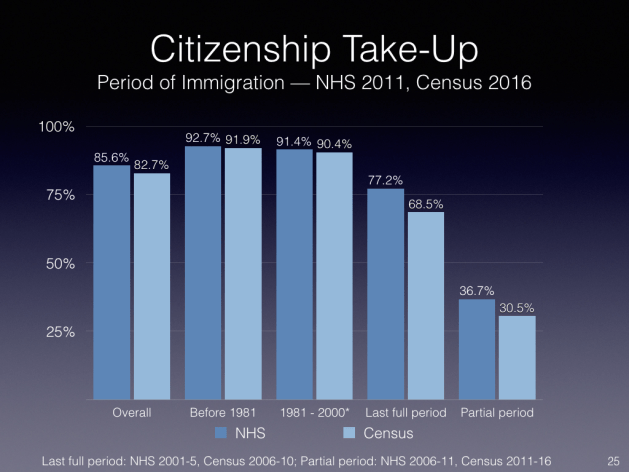
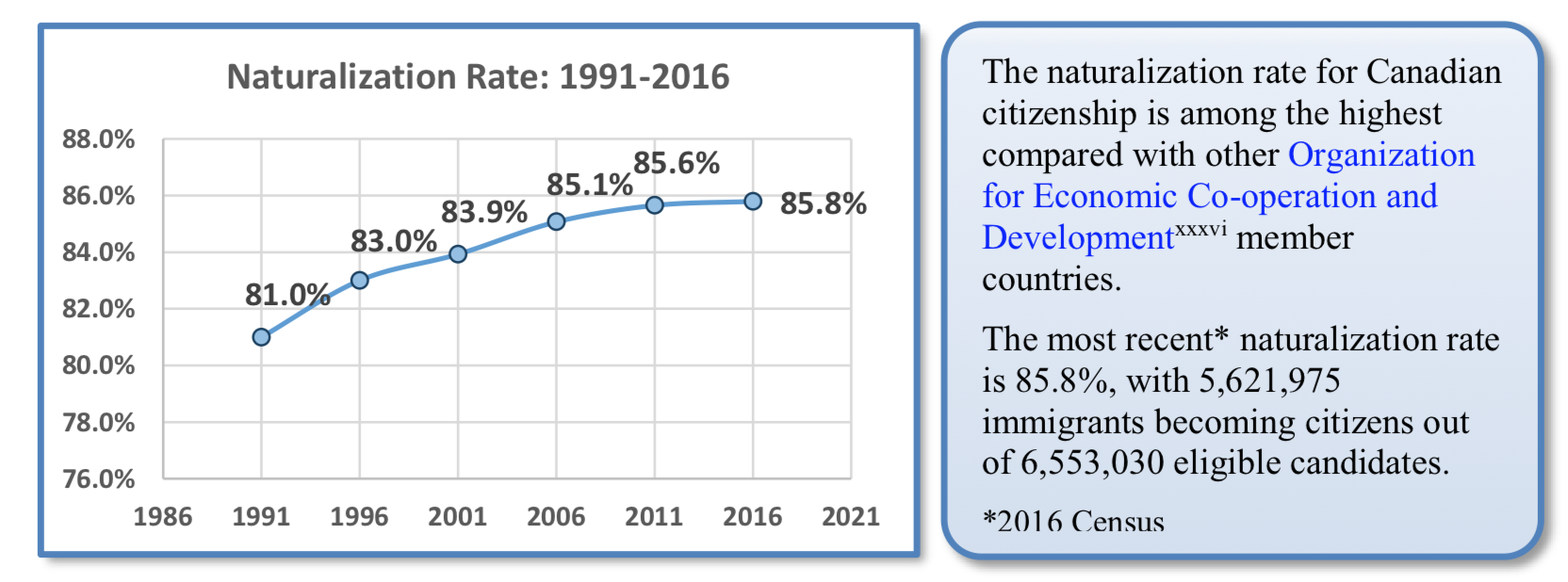
Moreover, the plan includes an incorrect naturalization rate of 85.8 percent for the 2016 Census rather than a more accurate rate of 30.5 percent, given their methodology using the four-year residency requirement for the full 2011-16 period without accounting for the fact that the three-year residency requirement was in effect  until May 28, 2015 (my detailed analysis in my article, What the census tells us about citizenship).

This will likely come back to haunt IRCC and StatsCan in 2021 as using the same methodology would mean assuming a three-year residency period for the entire 2016-20 period, despite the four-year period being in effect for 649 days, or about 35 percent of the time.

And of course by overstating naturalization rate now, and understating in 2021 (assuming they are consistent in their methodology), the decline will appear larger.

I look forward to doing the analysis then!

Summary chart below:

Metropolis 2018 - Citizenship.025.png

Core Responsibility 3: Citizenship and Passports

IRCC promotes the rights and responsibilities of Canadian citizenship, and issues secure and internationally recognized Canadian citizenship and travel documents so that Canadians can participate fully in civic society and so that travel is facilitated across borders while contributing to international and domestic security.

 The Department is consulting with Indigenous organizations and Crown-Indigenous Relations and Northern Affairs Canada to update in 2018–2019, through a legislative amendment, the Oath of Citizenship to include reference to respecting treaties with Canada’s Indigenouspeoples. This is also in response to the Truth and Reconciliation Commission’s Calls to Action.

To improve the client experience, the Department is also working in collaboration with the Canadian Digital Service to improve flexibility in accessing citizenship tests and ceremonies. Furthermore, the Department is considering additional enhancements in 2018–2019 which could allow more electronic accessibility options.

Planned result: Eligible permanent residents become Canadian citizens

Departmental Result Indicators

Targets

Date to achieve targets

2014–15 Actual results

2015–16 Actual results

2016–17 Actual results

Percentage of permanent residents who become Canadian citizens

≥ 85%

2021 (every five years)

85.6% (2011)

85.6% (2011)

85.8% (2016)

Percentage of citizenship applications that are processed within service standards18

≥ 80%

End of each FY

N/A

N/A

90%

Percentage of citizenship applicants who report they were satisfied overall with the services they received19

≥ 90%

page23image2913264

End of each CY

page23image2908672

What Silicon Valley Could Use More of: Inefficiency – The New York Times

Worth reflecting upon:

Hypocrisy thrives at the Waldorf School of the Peninsula in the heart of Silicon Valley. This is where Google executives send their children to learn how to knit, write with chalk on blackboards, practice new words by playing catch with a beanbag and fractions by cutting up quesadillas and apples. There are no screens — not a single piece of interactive, multimedia, educational content. The kids don’t even take standardized tests.

While Silicon Valley’s raison d’être is making platforms, apps and algorithms to create maximum efficiency in life and work (a “friction-free” world, as Bill Gates once put it), when it comes to their own families (and developing their own businesses, too), the new masters of the universe have a different sense of what it takes to learn and innovate — it’s a slow, indirect process, meandering not running, allowing for failure and serendipity, even boredom.

Back in 1911, the English philosopher Alfred North Whitehead said that “civilization advances by extending the number of important operations which we can perform without thinking about them.” By that metric, Uber and Google and Amazon Prime have given us a whole lot of civilization. And there’s no doubt our lives are better for it. (Ordering Chinese takeout in 30 seconds on an app might not be up there with Shakespeare or the incandescent light bulb, but it’s pretty great.) This unrelenting drive for efficiency has, however, blotted out a few things we all know intuitively but seem to be forgetting.

To create a product or service that is truly efficient often involves a lot of inefficiency — more like learning to knit than pressing a button. Likewise, gadgets built with a single-minded focus on efficiency can often backfire, subverting their purpose. Algorithms designed to dish up the news and information we most prefer end up blinkering us to all but a narrow slice of political and social reality. Our smartphones untether us from the office, saving us energy on travel, but also allow our lives to be interrupted nearly 24 hours a day, chewing up any productive idle time.

This all seems fairly obvious. But, as Edward Tenner writes in “The Efficiency Paradox,” “we sometimes need to be reminded of the obvious.” Tenner has made a career worrying about unintended consequences. His 1996 book, “Why Things Bite Back,” dealt with phenomena like the overuse of antibiotics leading to resistant bacteria and the introduction of football helmets causing an increase of neck and spine injuries. In 2003, he published “Our Own Devices,” in which he turned to what he called body technologies — sandals, office chairs, computer keyboards — and how they had impaired as much as enhanced us. In short, for every three steps forward, he sees the two steps back.

With the internet now a dominant social force, Tenner is ready with his wet blanket. But he is not a cyber-pessimist or a fetishizer of the analog. He is, instead, a staunch moderate: “Silicon Valley’s mistake is not in developing efficient algorithms from which we all benefit, but in encouraging the illusion that algorithms can and should function in the absence of human skills.”

The dehumanizing effects of big data are well known and Tenner adds no groundbreaking insight here. (Books like Cathy O’Neil’s “Weapons of Math Destruction” and Evgeny Morozov’s “To Save Everything, Click Here” were more pioneering on this front.) But what Tenner brings is a new frame. Unlike critiquing the denizens of Silicon Valley for deepening social and economic inequality, destroying our brains or helping to undermine democratic norms (issues that seem to matter to us more than them), questioning efficiency is truly kicking the geeks where it hurts.

Image

Drawing on an eclectic bunch of anecdotes and studies, Tenner makes his way through four sectors in which “intuition, skill and experience” have been effectively crushed by “big data, algorithms and efficiency”: media and culture, education, transportation and medicine.

A few of his examples:

Search algorithms have extended the ability to find scientific journal articles and books dating to the 19th century. In principle, this means scholars may encounter a broad range of research and discovery, dredge up forgotten work and possibly connect important dots. But in reality, as one sociologist found after studying citations in 35 million scientific journal articles from before and after the invention of the internet, researchers, beholden to search algorithms’ tendency to generate self-reinforcing feedback loops, are now paying more attention to fewer papers, and in general to the more recent and popular ones — actually strengthening rather than bucking prevailing trends.

GPS is great for getting from one point to another, but if you need more context for understanding your surroundings, it’s fairly useless. We’ve all had experiences in which the shortest distance, as calculated by the app, can also be the most dangerous or traffic-clogged. Compare the efficiency of GPS with the three years aspiring London cabdrivers typically spend preparing for the arduous examination they must pass in order to receive their license. They learn to build a mental map of the entire city, to navigate under any circumstance, to find shortcuts and avoid risky situations — all without any external, possibly fallible, help. Which is the more efficient, ultimately, the cabby or Google Maps?

In the early 2000s, electronic medical records and electronic prescribing appeared to solve the lethal problem of sloppy handwriting. The United States Institute of Medicine estimated in 1999 that 7,000 patients in the United States were dying annually because of errors in reading prescriptions. But the electronic record that has emerged to answer this problem, and to help insurers manage payments, is full of detailed codes and seemingly endless categories and subcategories. Doctors now have to spend an inordinate amount of time on data entry. One 2016 study found that for every hour doctors spent with patients, two hours were given over to filling out paperwork, leaving much less time to listen to patients, arguably the best way to avoid misdiagnoses.

Faced with all these “inefficiently efficient” technologies, what should we do? Tenner wants more balance. Let’s not put the brakes on the drive for efficiency. These tools are good. But they should give way a bit to human sensibility, to our own instincts and insights, which could help them work even better. “Analog experience can enhance digital efficacy,” he writes. “Digital tools can improve analog access. We don’t have to choose between the two.”

His recommendations are sensible, if hard to imagine actually coming to pass. He wants us to spend more time in the physical world, in the “terrain” of our cities or between the paragraphs of a printed book. We need to get a little lost, pursue “productive and instructive disorientation, distraction, wild-goose chases, dead ends.” He likes the idea of systematically educating high school students in the skill of online searching, so they can make the algorithms work for them rather than slavishly accepting their results. He wouldn’t mind if we returned to the days of the dial-up modem, when we waited patiently for the pixels to materialize on the screen one by one. Instant gratification has dulled our senses. He’d put us all in Waldorf schools if he could.

If this sounds like Tenner is a man impassioned, I should be clearer: This is no manifesto. There is not much blood flowing through this book, which reads more like a report issued by a concerned think tank. Maybe it’s just that preaching moderation doesn’t lend itself to writing that pulls your face to the page.

But it would be unfortunate if Tenner were dismissed as just a cranky man in his 70s who thinks we spend too much time on our phones. What he is asserting is something we all know to be true. It’s bigger than the tyranny of efficiency. What he’s really asking is that we remember that the tools we’ve invented to improve our lives are just that, tools, to be picked up and put down. We wield them.

via What Silicon Valley Could Use More of: Inefficiency – The New York Times

ICYMI – Emma Teitel: Formal apologies may be most useful not for the oppressed, but for the clueless

Valid argument:

Since its release in 1970, many people (married ones especially) have taken issue with the signature line from the hit movie Love Story: “Love means never having to say you’re sorry.” But I imagine the person most constitutionally averse to this notion is Prime Minister Justin Trudeau, a man who says sorry more often than a Canadian tourist in a crowded airport.

Where his Prime Minister father, the late Pierre Trudeau, wasn’t a fan of state-issued apologies, our rueful leader appears quite comfortable doling them out.

The PM has made a series of official apologies addressing various historical wrongs since he took office in 2015. Two years ago, for example, he issued an apology for the 1914 Komagata Maru incident, in which hundreds of Sikh, Muslim and Hindu passengers were unjustly turned away at the Canadian border. Their Japanese steamship returned to India, where 19 passengers were shot and killed upon arrival and many others imprisoned.

Last year, the PM issued an apology to survivors of Canada’s residential schools. He also asked the Pope himself to apologize for the church’s role in operating the notoriously exploitative, abusive institutions. (Unfortunately, the pope declined).

And just this week the PM announced plans to formally apologize on behalf of the Canadian government, in the House of Commons, for the tragic incident of the MS St. Louis in 1939, when Canada refused asylum to the more than 900 Jewish German refugees on board. The MS St. Louis was forced to return to Europe, where 254 of its passengers were later murdered in the Holocaust.

“When Canada denied asylum to the 907 German Jews on board the MS St. Louis,” Trudeau said in a recent statement, “we failed not only those passengers, but also their descendants and community. It is our collective responsibility to acknowledge this difficult truth, learn from this story, and continue to fight against anti-Semitism every day, as we give meaning to the solemn vow: ‘Never again.’ I look forward to offering this apology on the floor of the House.”

Unfortunately, not everybody is looking forward to hearing it.

Many critics of the Prime Minister, some of them Jewish, are a little annoyed by the prospect of a staged mea culpa that will address a tragic event whose victims are, by and large, not around to receive it. Some of these formal apologies are, after all, rather bizarre, because the people saying “I’m sorry” are so rarely the wrongdoers and the people saying “I forgive you” are rarely the wronged. As a result, they can come off as cheap and hollow, even to the ears of the people you think might appreciate them most.

Here’s Sally Zerker, whose Jewish, Polish ancestors were denied visas to Canada in the 1930’s, writing about the prospect of a government apology for the MS. St. Louis tragedy in the Canadian Jewish News last year:

“It will not bring back my relatives, or offer me any solace. Instead, it will whitewash a government that did nothing to help the Jews who were fleeing the Nazis and ignored the type of anti-Semitism that was endemic in Canada until the 1970s. Ultimately, it is nothing but a shallow, empty, meaningless act. An apology can’t right this wrong.”

But it can publicize it. And this is where I disagree with Zerker and other critics of government apologies. We’re living in a world where the United States government appears allergic to facts and routinely winks at white supremacists. A world where the leaders of the women’s march, arguably the largest feminist movement on the continent, can pal around with horrendous anti-Semite Louis Farrakhan and retain their status as heroines of an intersectional movement.

A world where, according to the Anti Defamation League, anti-Semitic hate crimes — from violent assaults, to Jewish kids being harassed at school, to vandalism of synagogues — surged 57 per cent last year. Meanwhile, according to a survey released on Holocaust Remembrance Day (Jan. 27) this year, 22 per cent of American millennials haven’t heard of the Holocaust or are unsure of what it is, and two-thirds do not know what Auschwitz is.

All of this is to say that while I agree with Trudeau’s critics that formal apologies are sometimes silly and performative — and perhaps lacking in meaning for some victims and their families — they are also factual and newsworthy. They breathe new life into old wrongs and in doing so they bring awareness to those wrongs.

It’s for this reason that I find it difficult to object to a perfectly harmless government statement that might, even if it doesn’t heal any wounds, inspire an uninformed Canadian to Google “MS St. Louis.”

It’s a sorry thing to say, but formal apologies may be most useful not for the oppressed, but for the clueless.

Source: Emma Teitel: Formal apologies may be most useful not for the oppressed, but for the clueless

Why Brands Must Get Cross-Cultural Marketing Right

Always relevant to appreciate marketing strategies and approaches:

In the last few years, top brands like Pepsi, H&M and Dove have faced backlash for their tone-deaf advertisements that offended multicultural communities across the world. With many racial and ethnic minority groups in the United States growing faster than whites, brands must be cognizant of the messages targeting various demographics. Recognizing that “multiculturalism” is here to stay, brands should think of cross-cultural marketing not as an option but as a must.

Brands that wish to survive and thrive for years to come should consider cross-cultural marketing as fundamental to a successful marketing campaign. Brands like H&M and Pepsi that don’t fully understand cross-cultural marketing can face backlash. The truth lies in the numbers: the combined buying power of Hispanics, African-Americans and Asians is in the trillions.

According to Nielsen, 21 of the 25 most populated counties in the United States are already majority multicultural, meaning that they include “numerically significant pluralities of traditionally minority populations, or are already majority-minority.”

So how do brands tap into this spending power and reach multicultural communities?

Brands need to shift their focus from multicultural marketing to cross-cultural marketing. We define cross-cultural marketing as “the ability for one brand to cross over from one culture to another.” Essentially, brands are moving away from traditional, siloed multicultural marketing to “marketing that simulates across ethnic groups, leveraging ethnic insights to reach across multiple ethnic markets, including the general market.”

Here are two brands that got cross cultural marketing right:

Fenty Beauty

Rihanna is a cross-cultural icon. The Barbadian pop star embraces her Caribbean roots while successfully crossing over and embracing American culture. With the release of her “Beauty for All” collection, Rihanna offered products for every skin tone with a range of 40 foundation shades, even including a shade for people with albinism.

The release of the brand was well received by consumers who previously felt ignored by major beauty brands. The marketing for the launch included a variety of models of every ethnicity. Fenty Beauty embraced the differences of various ethnicities but recognized that all women want quality beauty products. It avoided siloed multicultural marketing and created an inclusive beauty line that considered beauty preferences across cultures.

Coca-Cola

Coca-Cola’s “Share A Coke” campaign was one of the most successful campaigns of the decade. The campaign has made its way to over 70 countries, and its bottles are still on shelves today. The “Share A Coke” campaign enticed customers to search for their names on bottles and share on social media.

Coke made sure the campaign was inclusive, including names that ranged from Jose to Laura to Maya. And if someone’s name could not be found in stores, customers could personalize their own bottle online. Instead of doing siloed multicultural campaigns, Coke was able to target myriad cultures with one campaign.

What other brands have successfully utilized cross-cultural marketing? Let’s continue the conversation in the comments.

via Why Brands Must Get Cross-Cultural Marketing Right 06/06/2018

Maryam’s daughters: Is Berkeley mosque changing the face of contemporary Islam or eroding the faith?

Interesting:

This story originally appeared in the June 2018 issue of San Francisco magazine. Read the rest of the issue’s content as it becomes available.

Inside Berkeley’s Qal’bu Maryam, Tuli Bennett-Bose was preparing for jummah, the Friday prayer service. At 18, Bennett-Bose was a recent convert to Islam, and still working out the intricacies of dress and ritual that come with being an observant Muslim. “I’m a half-jabi,” she joked as she rewrapped her rust-colored hijab to frame her face. Sometimes she prefers to let her head covering reveal some of her silver pixie cut. On this afternoon, she was covering all of her hair because of the service, and also because it was raining.

Qal’bu Maryam — Arabic for “Maryam’s heart” — opened in Berkeley in April 2017. The mosque represents a stark departure from orthodox Muslim tradition, welcoming LGBTQ congregants, allowing women to lead prayers and deliver sermons (called khutbahs), and encouraging all genders to pray shoulder to shoulder. Bennett-Bose stumbled upon the congregation online and was drawn to its inclusivity. “I know that I was meant to be Muslim,” she says. “But I also knew that I was gay before I converted.” Although many mainstream strains of Islam shun homosexuality, Bennett-Bose took the shahada, the Muslim declaration of faith. Soon after, she visited Qal’bu Maryam.

Neither Qal’bu Maryam nor its founder, Rabia Keeble, who converted to Islam 15 years ago, have been universally welcomed within the East Bay’s Muslim community. Some faith leaders criticize the congregation for its deviation from traditions that have been in place for millennia. Abdullah Ali, an assistant professor at nearby Zaytuna College, the first accredited Muslim undergraduate university in the country, has little love for Keeble’s “particular project.” Men and women praying side by side “is definitely not the instruction given by our prophet,” he says, referring to the hadith, or the sayings of Prophet Muhammad. “The instruction was very clear, and we know what prayer looked like at this time: Women pray behind men.”

More important, Ali says, Qal’bu Maryam was founded with the explicit intention of being “provocative” and, in particular, of antagonizing people who are committed to traditional Islamic teachings. “They want to challenge what they consider to be orthodoxy,” he says.

On that point, he won’t get much argument from Keeble. An Ohio-raised woman (she declines to share her age), Keeble came to the faith in 2003 and lives by a “no tolerance for bullshit” policy, doling out grand, confrontational statements that often rankle whomever she’s debating. “What I did started a conversation,” she tells me of Qal’bu Maryam’s founding. “Men and women need to learn together. This will end misogyny within the religious sphere.”

Keeble is a self-proclaimed “third-wave black feminist and womanist” whose daily getup includes hijab, eyeliner, and bright lipstick. Central to her mission is to reconcile Islam with contemporary feminism; it’s on this point that she encounters the most resistance. Both she and Ali believe the two worldviews can and do coexist. How they achieve it, however, is very much a point of contention.

Feminist Islam is not a new concept. While Europe suffered through the Dark Ages, women in Arabia benefited from inheritance, consent as a requirement for marriage, and education. Muslims frequently cite the Prophet’s wife, Khadija, an independent businesswoman, as evidence of the faith’s feminist principles in action.

“Feminists are not anti-Islam. We want the fulfillment of what the Prophet, peace be upon him, started before his death,” Keeble says. Ali agrees that Islam can be consistent with feminist ideology, but he points to liberation feminism, which “accepts that men and women are fundamentally different and that men have often belittled the importance of women.” “Equality feminism” of the type practiced by “people like Rabia Keeble” is not compatible with Islam, he says. “Equality feminism is focused on attempting to equalize the degree of influence and level of authority between men and women to the extent that we completely ignore biological differences.”

For Ali, the hadith was never to be taken as a sign of women’s inferiority, “just as leading the prayer was never taken as a sign of political power.” Instead, he says, the practice is rooted in principle: “The Prophet told the people, ‘Pray as you see me pray.’ And we know that the norm is that he was always leading prayer during his lifetime.” For that reason and others — for instance, the fact that Keeble thinks women can pray while on their periods, a practice considered taboo by Ali and others—he looks upon Qal’bu Maryam as a prayer space, not a mosque. It lacks the sanctity, he says, that a mosque deserves.

It’s exactly that inequality, in Keeble’s eyes, that has hurt Muslim women and caused them to have shallower relationships with their faith. Because of male dominance in mosques, “it is very difficult for women to approach the imam after sermons to ask questions,” she explains.

Fighting for her congregation has been draining for Keeble. Earlier this year, she took a month-long leave from the mosque to regroup; aside from dealing with “so-called volunteers who were all talk and no show,” she was “physically worn out” from handling outreach and logistics alone. She was also attending speaking engagements, creating and distributing weekly advertisements, and scheduling Friday speakers. During her period of reflection, she refocused on Qal’bu Maryam’s mission, paying particular attention to the sermons being delivered there. “I wanted to focus on the use of gendered language specifically. I have to ask myself, Is this language that honors women?”

….

Source: Maryam’s daughters: Is Berkeley mosque changing the face of contemporary Islam or eroding the faith?