How to tell when criticism of Israel is actually anti-Semitism – The Washington Post

A narrower and more focussed definition than the one adopted by IHRA (Working Definition of Antisemitism) and a number of governments:

So how can you tell the difference between anti-Semitism and anti-Zionism? Here are five useful markers.

Seeing Jews as insidious influencers behind the scenes of world events

On the left and the right, anti-Semitism often manifests in a nefarious belief in a worldwide Jewish conspiracy that wields outsize power. On the right, it’s “globalists” and “elites” who manipulate events. On the left, it’s “Zionists.” The terms may differ, but the fundamental conspiracy theory is the same. For example, after news broke that a private investigative firm made up of former Mossad officers had been digging up dirt on Obama administration officials who helped broker the U.S. nuclear deal with Iran, Columbia University professor Hamid Dabashi tweeted, “Every dirty treacherous ugly and pernicious act happening in the world just wait for a few days and the ugly name of ‘Israel’ will [pop up].” This language parallels the last ad of Donald Trump’s 2016 campaign, which flashed pictures of George Soros, Lloyd Blankfein and Janet Yellen while warning of a “global power structure” that had damaged the U.S. economy. In another case, when professor Steven Salaita was denied a tenured position at the University of Illinois after a series of anti-Israel tweets, he wrote: “Support for Israel . . . exists in sites of authority, often an omnipresent but invisible accoutrement to swivel chairs, mineral water, and mahogany tables.”

Also in this category is the theory, popular on the left, that Israeli trainers are to blame for racism and violence against people of color by U.S. police. (Durham, N.C., for instance, recently barred its police department from partnering with the Israeli police or military for training, citing this notion.) This includes insinuationsthat American Jewish organizations that help send U.S. police officers to Israel for counterterrorism training should be held responsible for the shootings of unarmed people of color. American police have used violence against marginalized people since long before Israel existed. White people have never needed Jews to teach them how to brutalize people of color on American soil. There are reasonable questions to ask about the content of training programs in Israel, but the suggestion — absent supporting evidence — that Jews bear guilt for U.S. police killings merely updates the old anti-Semitic trope that falsely accused Jews of managing the global slave trade .

Using the word “Zionist” as code for “Jew” or “Israeli”

“Zionism” denotes a movement, forged in the late 19th century and evolving ever since, for the existence of a modern Jewish state in the land of Israel. A Zionist, as I define myself, supports one or more of the many variations on this vision, which differ wildly in their political, religious and cultural emphases.

Critics of Israel sometimes use “Zionist” to assert a global power structure without specifically calling out Jews as its masterminds. After Salaita, the Illinois professor, also lost a position at the American University of Beirut, he wrote, “I was shocked that Zionist pressure could succeed in the Arab World.” The Nation of Islam’s Final Call newspaper asserts that “Zionist pressure ” will not stop Louis Farrakhan from continuing his anti-Semitic pronouncements, which have included calling Jews the “synagogue of Satan.”

The “Zionist” label attempts to reduce a state full of living, breathing humans to a simplistic political notion. It’s common for Palestinians and their supporters to refer to “Zionist occupation forces” instead of the “Israeli army,” or to the “Zionist entity” instead of “Israel.” At a demonstration I walked by this past week, protesters held signs mourning 70 years of “Israel,” in quotes.

One may disagree with the decision of the United Nations to recognize Israel decades ago, wish that the state had never come to be or aspire to the establishment of a binational state in its place without necessarily stepping into anti-Semitism. But refusing to call Israel or Israelis by their internationally accepted names denies the very existence of the state and its people’s identities. These coy linguistic tricks are as unacceptable as the right-wing penchant for denying the existence of Palestinians and Palestinian identity.

Denying Jewish history

As a means of rejecting the legitimacy of Israel, some stoop to asserting that Jews have no national history there — that they are, in other words, nothing more than European colonizers. For instance, the website Middle East Monitor referred recently to the “alleged Temple” in ancient Jerusalem (the ruins are still there). Palestinian President Mahmoud Abbas, likewise, resurrected the old canard that today’s Jews descend from Khazar converts in arecent and much-criticized speech.

The Jewish connection to Israel goes back millennia. After their expulsion by the Romans in 70 A.D., Jews continued to pray for a return to the land and to observe four fast days each year to mourn the exile. Zionism’s revolution came not in creating a new connection between Jews and the land of Israel, but in suggesting that a return to the land could be achieved through modern political means, rather than by waiting for the messiah.

Some critics also reduce Judaism to religion, in the mold of Western Christianity, rather than acknowledging our more complex sense of ourselves as a people with a history and an ancestral land, as well as religious and cultural practices. This includes dismissing Zionism as “white supremacy,” as the Chicago Dyke March did last year when its organizers argued that Zionism had no place in an anti-racist movement and that it “represents an ideology that uses legacies of Jewish struggle to justify violence.” Statements like these ignore the fact that, unlike most white people here and elsewhere, Jews have been subject to racially based discrimination — and that more than half of Israeli Jews are not Ashkenazi, meaning their families did not come from Europe.

Finally, disregard for Jewish history may take the form of using Nazi imagery to depict Israel or its army. This tactic cynically manipulates the greatest modern trauma of Jewish history to attack us, while minimizing the genocide of 6 million Jews. Israel may be violating its human rights obligations, but is not carrying out a Nazi-style extermination operation.

Dismissing the humanity of Israelis

In a conversation about terrorist attacks by Palestinians, one young activist told me, “I can’t judge how other people carry out their liberation movements.” Such lack of concern for Israeli lives is evident in failures to condemn rocket attacks against civilians, in the rejection of the term “terrorist” for anyone who acts against Israelis and in statements blaming Israelis for their own deaths. A movement motivated by concern for human rights requires caring about the dignity, well-being, concerns and self-determination of all people.

This means opposing the military occupation of the Palestinians, with its attending violence, as well as rejecting terrorism or rocket fire against Israelis. Human Rights Watch, which right-leaning groups often accuse of being anti-Israel, has modeled such an approach by regularly condemning Hamas for launching rockets at Israeli civilians. This approach also means standing with Israeli human rights leaders, who increasingly find themselves the targets of dangerous incitement by the country’s political leaders.

Assuming that the Israeli government speaks for all Jews

Rabbis who speak at rallies on domestic issues (the Trump travel ban, police killings, etc.) regularly tell me that audience members shout at them, “What about Palestine?” An explicit disavowal of a connection to Israel shouldn’t be a prerequisite for Jewish involvement in broader social justice issues, as has become the norm on college campuses and in many progressive spaces.

Imagine assuming that all Americans support President Trump’s policies, or asking Americans to expressly disown their own country before engaging in any international human rights campaigns. Reasonable people may disagree about Israeli policy, about nationalism or about whether the solution to the conflict should involve one state or two. But Jews who care about Israel — many of whom revile Netanyahu and his politics — should not be excluded from progressive spaces based on their answers to such questions.

Jews, along with other groups, must fight for human rights, in the United States and abroad. This work means insisting that Israel, like other countries, live up to its human rights commitments. The case can be made without bigotry and hate speech.

via How to tell when criticism of Israel is actually anti-Semitism – The Washington Post

Trump’s ‘Animals’ Remark Is Threatening to Immigrants – The Atlantic

Good article with its conclusion on the longer-term implications:

The true peril of Trump’s comments on Wednesday is this: that the state will be further empowered to suspend human rights. Dehumanization is not just a buzzword, but a descriptor of a specific and well-known psychological and sociological process, by which people are conditioned to accept inflicting increasingly inhumane conditions and punishments on other people. Taking from the well-worn lessons of American racism, dehumanization means both a broadening of what’s acceptable and just who is unacceptable.

The dangers of that broadening were evident in another recent viral moment. In a video clip that made the rounds on social media, 42-year-old New York lawyer Aaron Schlossberg was seen ranting to a restaurant employee and customer for speaking Spanish to each other. With no evidence that anyone present was an unauthorized immigrant—or that a crime was taking place—Schlossberg threatened to call ICE against the employees and the restaurant. Given what is known about the routine processes of ICE arrest and detention, this was at best a threat of disruption, and at worst a threat of violence.

The most likely outcome of Trump’s “animals” rhetoric isn’t a return to some mythological Pax Americana, as his supporters might suggest. Quite the opposite: It could fuel more informing on neighbors, more regular harassment for people of color, a deeper and wider dragnet, and an increased acceptance of brutality and extralegal practices. That’s what happens when people stop being people.

via Trump’s ‘Animals’ Remark Is Threatening to Immigrants – The Atlantic

Animation: Visualizing Two Centuries of U.S. Immigration

Great animation and charts:

https://youtu.be/fiPq7C06zjQ

America is a nation of immigrants, and though the country has seen a lot of new arrivals over the past two centuries, the rate of immigration has been far from steady.

War, famine, economic boom and bust, religious persecution, and government intervention have all caused wild swings in the rate of immigration from countries around the world.

Today’s striking animation, by Max Galka, is a great way to see changes in immigration over time. Inflows from specific countries rise and fall, and the top three countries of origin change numerous times over the years.

Below, is another way to look at the ebb and flow of American immigration since the early 1800s.

U.S. Immigration Charts
An important note. This data excludes forced migration (slavery) and illegal immigration.

Let’s look at the “waves” in more detail.

WAVE ONE: THE OLD IMMIGRATION

From 1820 to 1870, over 7.5 million immigrants made their way over to the United States, effectively doubling the young country’s population in only half a decade.

Ireland, which was in the throes of the Potato Famine, saw half its population set sail for the U.S. during that time. This wave of immigration can still be seen in today’s demographics. There are now more Irish-Americans than there are Irish nationals.

The magnetic pull of the New World was profoundly felt in Germany as well. Growing public unrest in the region, caused by heavy taxation and political censorship, culminated in the German revolutions of 1848-49. Faced with severe hardship at home, millions of Germans made their way to America over the 1800s. It’s estimated that one-third of the total ethnic German population in the world now lives in the United States.

WAVE TWO: GOLD RUSH

Much of America’s early immigration was from various points in Europe, but there was one prominent exception: China.

The discovery of gold in California inspired Chinese workers to seek their fortune in America. After a crop failure in Southern China in 1852, tens of thousands of Chinese immigrants flooded into San Francisco.

Although the State of California was making millions of dollars off its Foreign Miners Tax, sentiment towards Chinese workers began to sour. Gold mines were being tapped out and white Californians blamed the Chinese for driving wages down.

Chinamen are getting to be altogether too plentiful in this country.

– John Bigler, Governor of California (1852-1856)

By 1882, the newly enacted the Chinese Exclusion Act had a chilling effect on Chinese immigration. The Exclusion Act has the dubious distinction of being the only American law barring a specific group from immigrating to the United States.

WAVE THREE: THE NEW IMMIGRATION

The wave of immigration leading into the 20th century is referred to as The New Immigration.

In 1890, Ellis Island was designated as the main point of entry for newcomers entering the United States. In 1907 alone, Ellis Island processed a staggering 1,285,349 immigrants. To put this number in perspective, if all of those people settled in one place, they would’ve formed America’s fourth largest city almost overnight.

This massive influx of people into New York had profound implications on the city itself. In 1910, Manhattan’s population density was an astronomical 101,548 humans per square mile.

The immigrants arriving during this period – heavily represented by Italians, Hungarians, and Russians – were seeking religious freedom and economic opportunity. Certain industries, such as steel, meat-packing, and mining, were staffed by many new arrivals to the country.

During this time, one in four American workers were foreign-born.

THE GREAT DEPRESSION

The National Origins Act’s quota system, which took effect in 1929, essentially slammed the door on most immigrants from Southern and Eastern Europe. Shortly after, the Great Depression further put a damper on immigration that would last well into the 20th century.

WAVE FOUR: MEXICO

After decades of sluggish immigration, the United States’ percentage of foreign-born citizens reached a low of 4.7% in 1970. But that was all about to change.

During the next decade, the number of states where Mexico was the top country of origin doubled in a single decade, and Mexicans became the dominant foreign-born population in the country. This migration was fueled by the Latin American debt crisis and later by NAFTA. The influx of cheap corn into Mexico caused hundreds of thousands of Mexicans from rural areas to search for more favorable economic opportunities. America was the obvious choice, particularly during the economic expansion of the 1990s.

U.S. Hispanic Population Map

This wave of immigration has shifted the country’s demographics considerably. Today, nearly one in five people in the United States are Hispanic.

CURRENT TRENDS

Immigration trends are continually evolving, and America’s newest immigrants are often more likely to come from China or India. In fact, both countries surpassed Mexico as countries of origin for immigrants arriving in the U.S. in 2013. Today, the trend is even more pronounced.

us immigration top 5

Recent immigration numbers indicate that Asian immigrants will continue to shift America’s demographics in a new direction. Perhaps a new wave in the making?

via Animation: Visualizing Two Centuries of U.S. Immigration

Black Britons and belonging: Meghan Markle versus the Windrush generation: Balkissoon

Appropriate and sharp contrast:

There are two big stories right now about black migrants in Britain, but only one is fun to pay attention to.

That would be that Meghan Markle, an American with a black mother and white father, is marrying Prince Harry. A beautiful, biracial commoner starring in a royal wedding is a fairy tale about race and Britishness the Crown can get behind. It’s a much better image than half a million black and brown citizens facing possible deportation.

But that, too, is currently happening: In fact, the Windrush scandal, as it’s known, became public around the same time as the Royal engagement, last November. That’s when The Guardian began publishing stories about people losing their health benefits, being put into immigration detention or being deported even though they had been citizens since birth.

These Britons were born in pre-independence Commonwealth countries, once considered far-flung parts of Britain itself. After the Second World War, when the U.K. was hit with a serious labour shortage, it appealed to the Queen’s global subjects to fill the void. Among the thousands that answered the call were the passengers of the MV Empire Windrush, which landed in June 1948 full of British citizens from Jamaica, Trinidad and Tobago and other Caribbean islands.

That ship’s name has become a rallying cry for a generation: West Indians, South Asians and others who were told that arriving before the early 1970s gave them “the right to remain” in their supposed mother country. The problem is that now, decades later, much of the Windrush generation don’t have the paperwork to prove when they got there.

Many were children when they arrived, travelling on their parents’ passports. Few knew that the government was in possession of ship landing cards that could prove their arrival date – or that in 2010, the U.K. Border Agency began destroying them.

Two years after legal proof that thousands of mostly non-white people had a right to be in the U.K. disappeared, then-Home Secretary (or immigration minister) Theresa May introduced “hostile environment” policies meant to deter unwanted migrants. At least 50,000 of the over 500,000 Commonwealth citizens who moved to the U.K. in the Windrush period don’t have British passports: thousands of lives have been disrupted.

Sylvester Marshall, for example, learned he was an “illegal immigrant” when he went to replace a lost driver’s license. Mr. Marshall, who has worked and paid taxes in the U.K. for 44 years, had his cancer treatment delayed when he suddenly became ineligible for health-care.

Most of these people are senior citizens now, and many have lost their jobs or their rental homes or been put into immigration detention. At least 63 people seem to have been wrongfully deported, dark-skinned collateral damage in Ms. May’s anti-immigration offensive.

Meanwhile, Kensington Palace has bravely embraced its first openly non-white family member (rumours swirl about the possible African ancestry of Queen Charlotte, born in 1744). Prince Harry told the tabloids to stop being mean to his girlfriend, Princess Michael of Kent was made to apologize for wearing racist jewellery and the rest of us are supposed to be impressed.

Many are accepting these crumbs from the royal table, such as young Tshego Lengolo, who lives in working-class southeast London. The 11-year-old told the New York Times that she knows what it’s like to move to a new country, and that she’s ready to be Ms. Markle’s friend. My heart hurts for children fooled by such sad scraps of belonging, but I have no time for adult women penning paeans to the first “black princess.”

First of all, Ms. Markle will likely be given the title of duchess, which is a yawn. More importantly, like Kate Middleton and Diana Spencer before her, she’ll be giving up her career to be a wife. None of the bridesmaids in her wedding party will be little black girls like Tshego, and any children she bears will never reach the throne.

As far as updating the monarchy as a symbol for the modern world, these nuptials are fairly surface level − especially in a country coping with a scandal like Windrush.

Ms. Markle isn’t jumping the citizenship queue: becoming officially British will take her about three years. Perhaps that’s enough time for the Windrush generation to achieve fairness. There’s been a flurry of apologies and resignations, and talk of compensation is growing louder.

Will those who lost their jobs be given back pay? Will Mr. Marshall survive his cancer? By 2021, Ms. Markle will officially be a black Briton and, maybe, the Windrushers who were sent away will have made it back home.

via Black Britons and belonging: Meghan Markle versus the Windrush generation – The Globe and Mail

The Complicated History Of The U.S. Census Asking About Citizenship : NPR

Nice summary history (spoiler alert: squeezed out given concerns over Census length with addition of consumer and other questions):

Lawmakers are set to question the Justice Department Friday about why it requested the 2020 census to ask about citizenship. The history of using the U.S. census to ask about citizenship has many twists and turns.

MARY LOUISE KELLY, HOST:

The Justice Department point person on civil rights heads to Capitol Hill tomorrow for what may be a tough hearing. It is about the 2020 census. The department has requested that the census form include a question about U.S. citizenship. The federal government has used the census to ask people about their citizenship before. NPR’s Hansi Lo Wang explains the surprising history.

HANSI LO WANG, BYLINE: This is a story with lots of stops and starts, so we’ll need a tour guide.

MARGO ANDERSON: My name is Margo Anderson.

WANG: She’s a history professor at the University of Wisconsin in Milwaukee.

ANDERSON: Right. And I’m the author of “The American Census: A Social History.”

WANG: And she traces the first time all U.S. households were asked about citizenship all the way back to the census of 1820.

Was this still done on horseback at that time?

ANDERSON: Oh, certainly (laughter) – or walking.

WANG: That was the country’s fourth headcount. And census takers asked…

ANDERSON: Are there any foreigners not naturalized in your household? And if so, how many?

WANG: Anderson says she’s not sure why these questions were included.

ANDERSON: I haven’t found yet any evidence of the use of that information in terms of policies, which I think is why it simply disappeared.

WANG: By 1840, the government stops asking about foreigners who are not citizens. Fifty years pass before the topic comes up again in 1890. By this point, the federal government had been asking for decades about where people were born and where their parents were born. Anderson explains why.

ANDERSON: Well, we have lots of immigrants in the country right now. How are they doing?

WANG: So for the 1890 census, people born outside the U.S. were asked how long they’ve been in the country and whether they’ve become citizens. And census takers kept asking similar questions well into the 20th century.

(SOUNDBITE OF FILM, “IN THE SUBURBS”)

WANG: We’re going to skip ahead to the years just before the 1960 headcount.

ANDERSON: The census officials and Congress begin to sort of say do we really still need to ask this?

WANG: The number of immigrants in the U.S. had been dropping. The list of census questions was long. And as this 1957 short film by Redbook magazine puts it…

(SOUNDBITE OF FILM, “IN THE SUBURBS”)

UNIDENTIFIED ACTOR: (As character) It’s a happy go-spending world reflected in the windows of the suburban shopping centers where they go to buy.

WANG: Business leaders and researchers pushed the government to ask about a different set of topics.

ANDERSON: Particularly a lot of questions about consumer goods. Do people have televisions and washing machines?

WANG: This is what squeezes out the citizenship question.

ANDERSON: Yes.

WANG: In 1970, the government starts asking about citizenship on a small survey for a sample of households. Fast-forward to today. The Trump administration has approved a new citizenship question for all households in 2020. The Justice Department says it needs data from it to better enforce the Voting Rights Act. But Anderson says this citizenship question may confuse a lot of people.

ANDERSON: It’s like, why are you asking me this? Of course I’m a citizen. I was born here.

WANG: Critics say those born outside the U.S. may stay away from the census because of the question. More than two dozen states and cities are suing to remove it. Anderson sees this debate as part of the complicated census history of asking about citizenship. It’s been a series of twists and turns over 200 years. Hansi Lo Wang, NPR News, Washington.

via The Complicated History Of The U.S. Census Asking About Citizenship : NPR

Canadian government comes to the defence of Nazi SS and Nazi collaborators but why?

Good question:

In late April more than 50 members of the U.S. Congress condemned the government of Ukraine’s ongoing efforts to glorify “Nazi collaborators.”

The letter, signed by both Republicans and Democrats, outlined concerns about ongoing ceremonies to glorify leaders of the Ukrainian Insurgent Army as well as 14th SS Galizien Division (aka 1stGalician/Galizien or the 1st Ukrainian Division). “It’s particularly troubling that much of the Nazi glorification in Ukraine is government-supported,” noted the letter to U.S. Deputy Secretary of State John Sullivan. The letter was initiated by Democratic Reps. Ro Khanna of California and David Cicilline of Rhode Island.

Contrast that to how the Canadian government handled a related issue last year when the Russian Embassy in Ottawa tweeted out that, “There are monumets (sic) to Nazi collaborators in Canada and nobody is doing anything about it.”

A monument in Oakville commemorates those who served with the 14th SS Galizien Division. Another monument in Edmonton honors Roman Shukhevych, the leader of the Ukrainian Insurgent Army.

As my Postmedia colleague Marie-Danielle Smith discovered, the Russian tweet sent bureaucrats at Global Affairs Canada into overdrive as they tried to defend the SS unit and Ukrainian Nazi collaborators. Documents she received through the Access to Information law show government officials were under a lot of pressure from the “Centre” (the Privy Council Office and the Prime Minister’s Office) to counter the news about the monuments to Nazi collaborators. The bureaucrats came up with a strategy. The would label the tweet as “disinformation” and they came up with a plan to spread the word to the news media as part of their efforts to defend Ukraine’s Nazi collaborators.

Now as I have written before, the Russians are more than happy to try to embarrass the Canadian government, which has steadfastly stood behind the Ukrainian government in the ongoing conflict in the region. Suggesting that Canada allows monuments to Nazi collaborators seems to fit that bill.

But in this case the Russian tweets aren’t “fake news” or “disinformation.” They are accurate.

As those members of the U.S. Congress have pointed out, the Ukrainians who served in the SS Galizien Division were indeed Nazi collaborators.

So too was Roman Shukhevych.

Before going to the Ukrainian Insurgent Army, Shukhevych was commander of the Ukrainian battalion called Nachtigall. The men of Nachtigall rounded up Jews in Lviv in June 1941, massacring men, women and children. The Simon Wiesenthal Center estimates that the Nachtigall Battalion, along with their German military counterparts, managed to murder around 4,000 Jews in Lviv. Other historians put the estimate at around 6,000.

Shukhevych was later assigned to a new unit whose role in Germany’s war, according to one Holocaust expert, was “fighting partisans and killing Jews.” Shukhevych later turned against the Nazis.

Then there is the SS Galizien Division. They were eager Nazi collaborators. Some 80,000 Ukrainians volunteered to join the SS but only those who could meet the strict requirements were selected.

The SS used some of its most seasoned killers to oversee the development of its new division. SS Gen. Jurgen Stroop, who would later be executed as a war criminal for his brutal destruction of the Jews in the Warsaw Ghetto, was brought on as an advisor.

Other commanders of the division were all versed in the murder of Jews throughout occupied territories in eastern Europe. “Many of the Ukrainian officers, like SS- Haupsturmfuhrer Michael Brygidryr, had previously served in SS Schuma battalions, routinely used to kill partisans, burn down villages and, when the opportunity arose, murder Jews,” wrote award-winning author Christopher Hale in his 2011 ground-breaking book, Hitler’s Foreign Executioners.

SS Galizien Division was used by the Nazis in a variety of operations, one of the most controversial being the 1944 destruction of the village of Huta Pieniacka. Huta Pieniacka was considered a “Polish” village that just months before had been the shelter for several hundred Jews, Hale noted. The SS units surrounded the village. Men, women and children, who had taken refuge in the village church, were taken outside in groups and murdered. Kids were executed in front of their parents, their heads smashed against tree trunks, one witness testified. Others were burned alive in houses. Around 850 people were murdered.

Some Ukrainians dispute that the SS Galizien Division took part in the killings or they argue that only small elements from the unit – and under Nazi command – were involved.

A Ukrainian military board heard testimony in 1944 that members of the Galizien Division did take part in the attack. But that action was justified, the board was told since the inhabitants of Huta Pieniacka had been killing Ukrainian peasants. “By the way, the Jews were hiding in the village,” a Ukrainian officer added in his testimony describing the destruction of the village inhabitants.

Some Ukrainians see Shukhevych and SS Galizien Division members as heroes. They argue that those individuals served the Nazis because they saw them as liberators from the Russians. Their ultimate goal was an independent Ukraine.

But to claim that these individuals were not Nazi collaborators is something else. They served Hitler.

In May 1944, SS leader Heinrich Himmler addressed the Ukrainian SS recruits in a speech.  “Your homeland has become more beautiful since you have lost – on our initiative, I must say – the residents who were so often a dirty blemish on Galicia’s good name – namely the Jews,” said Himmler. “I know that if I ordered you to liquidate the Poles, I would be giving you permission to do what you are eager to do anyway.”

Himmler speech was greeted with cheers from the Ukrainian recruits.

Equally disturbing are the details contained in the book, The Holocaust Chronicle, published in 2003 and written by 7 top scholars in the field of Holocaust studies. They noted that Ukrainian SS were also sent to help kill Jews during the Warsaw Ghetto uprising. The Chronicle published a photo of two of Ukrainian SS members standing over the bodies of Jews murdered during that uprising. See the photo below:

But this issue of Ukrainian collaboration with the Nazis is not new. Since 1986 the Nazi-hunters with The Simon Wiesenthal Center have warned about efforts from those in Ukraine and in the Ukrainian community in Canada who want to deny involvement of the SS Galizien Division with the Nazis.

The Latvian government is also trying to use the “fake news” label to whitewash the reality of Latvian collaboration with the Nazis.

My colleague Scott Taylor has recently written several articles about the Latvian Legion (15th Waffen Grenadier Division of the SS (1st Latvian) et al) and Latvian killers like war criminal Herberts Cukurs as well as the members of the Arajs Kommando, who murdered an estimated 26,000 Jews.

According to Karlis Eihenbaums, Latvia’s Ambassador to Canada, Taylor is spreading “fake news” and “disinformation.” Eihenbaums has also tried to smear Taylor by suggesting that he is under the “influence” of the Russian government.

Taylor’s research into the Latvian SS Legion and the Latvian murderers of Jewish men, women and children is solid.  It is a well-documented historical fact that many of the killers from the Arajs Kommando went to the Latvian Legion. These Latvians served Hitler. No number of claims of “fake news” can change that fact.

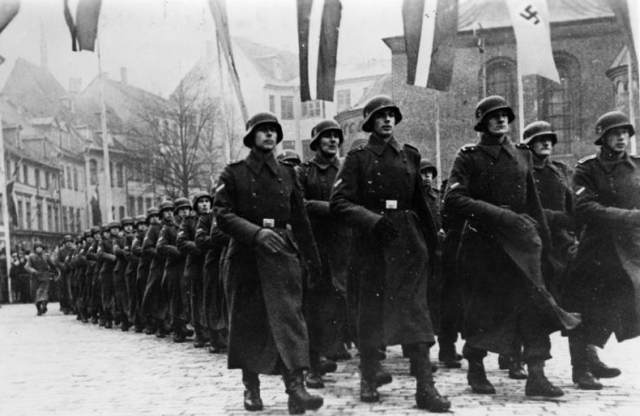
Photo below shows Latvian SS:

The controversy over the Latvian Legion and the annual parade held in Riga to celebrate these Nazi collaborators is well known and has been going on for two decades, long before the term “fake news” was even coined. In 1998 the parade caused a storm of protests around the world, particularly in Israel, where Holocaust survivors couldn’t understand Latvia’s desire to celebrate such ruthless killers. German Chancellor Helmut Kohl and French President Jacques Chirac were among those that year to protest the Latvian parade. The Times of Israel reported on this year’s Latvian SS parade in Riga, which took place mid-March.

So much for “fake news.” Did Helmut Kohl and Jacques Chirac spread “disinformation” when they denounced the SS parade in Latvia? Of course not.

This whole issue isn’t about “fake news” or Russian “disinformation.” It is about nations trying to whitewash their Nazi collaboration and rewrite history, while attacking journalists who don’t want to let that happen.

It is a positive development that members of the U.S. Congress could see through these efforts to glorify members of the SS. They are speaking out.

But in Canada, the federal government is more than happy to play along with defending Himmler’s SS divisions and Nazi collaborators.

What would our soldiers who fought during the Second World War to help rid the world of this scourge think about that?

Source: Canadian government comes to the defence of Nazi SS and Nazi collaborators but why?

Countering the rise of radicalism in private Islamic schools in Indonesia – Opinion – The Jakarta Post

More on increased radicalization in Indonesia and the influence of Islamic schools, with a useful breakdown of the different types:

A series of terrorist acts has rocked Indonesia in the past week. Starting from a clash in a detention centre at the Police Mobile Brigade headquarters in Depok, West Java, last week, attackers then bombed three churches in Surabaya, East Java, last Sunday, followed by another terrorist bombing at Surabaya Police Headquarters. Dozens were killed and wounded.

In response, President Joko “Jokowi” Widodo has reiterated the government’s commitment to exterminate terrorism down to its roots.

We must appreciate Jokowi’s statement. However, terrorism is a complex issue because there is no single factor that can explain why a person becomes a terrorist.

The importance of schools to prevent radicalism

One of the strategies that the government can use to stop terrorism in Indonesia is to take preventive steps using educational institutions to promote tolerance, which can eventually stop the spread of radical thoughts.

But what is happening in Indonesia is the opposite. Many schools in Indonesia have become fertile ground for radicalism.

The latest surveys from the Wahid Institute, Pusat Pengkajian Islam Masyarakat and the Centre for Study of Islam and Society (PPIM) and Setara Institute have indicated the spread of intolerance and radical values in educational institutions in Indonesia.

A student tolerance survey from Setara Institute in 2016 revealed that 35.7% of the students showed a tendency to intolerance in their minds, 2.4% were involved in acts of intolerance, and 0.3% had the potential to become terrorists. The survey was based on 760 respondents who enrolled in public high schools in Jakarta and Bandung, West Java.

Surveys from the Wahid Institute and PPIM have shown the same worrying trend.

The characteristics of schools prone to radicalism

In 2017, I was involved in research on efforts to respond to radicalism at 20 private Islamic schools in Central Java. The research involved academics from Monash University in Australia, Walisongo State Islamic University in Semarang, Central Java, and Gadjah Mada University in Yogyakarta with funding support from the Australia-Indonesia Centre.

We managed to identify three types of schools that are prone to radicalism. In accordance with confidentiality principles, we will not publish the schools’ names in this article.

These three types of schools are:

1. Closed schools

Instead of embracing changes, this type of school offers students a narrow perspective and tends to shut them off from foreign ideas.

We interviewed one of the headmasters from these schools. He explained the importance of Islamic civilisation to protect students against Western values.

Aside from see Islam and the West as being in conflict, closed schools also stress the importance of practising their version of Islamic teachings and reject the moderate Islam that most Muslims adhere to in Indonesia.

2. Separated schools

These schools can be identified from their teacher recruitment system and their limited participation in social activities.

The teacher recruitment process in these schools is very strict, especially the recruitment of religion teachers. In addition, these schools do not want to participate in social activities that they deem to be against their values.

This type of school is very different from other Islamic schools that are affiliated with the country’s more traditional Muslim organisations such as Nahdlatul Ulama (NU) or Muhammadiyah. Whereas separated schools recruit religion teachers from their own groups only and will use their networks to recruit alumni who share the same Islamic values, NU and Muhammadiyah schools will not consider differences in their teachings as an issue. For example, one of the headmasters from a NU-affiliated school stated that his school also recruited teachers from Muhammadiyah.

NU and Muhammadiyah schools are also active in social activities, including interfaith activities. Separated schools are not.

3. Schools with pure Islamic identity

The third type can be identified by the way they create students’ Islamic identity. The schools that are prone to radicalism tend to build in a student a single Islamic identity, refusing other identities.

This understanding is different from other Islamic schools, which tend to consider that a person’s identity as a Muslim is not against his/her other identity. Moderate Islamic schools do not see a conflict between their students’ identity as Muslims and as Indonesian citizens.

When a school builds this single Muslim identity, that school will also foster radical attitudes among students as they only believe in a single Islamic interpretation that is in line with their values.

Headmasters from this type of school usually order their students to follow all religious rituals at schools, despite the students’ different religious background.

A headmaster told us that his students with a NU background must abandon their prayer ritual in the morning called qunut when they are enrolled in his schools.

This policy is different from other schools that allow flexibility for their students in their religious practices.

In addition, the rejection of other identities creates a “we versus them” attitude not only between different religions but also within the larger Islamic community itself.

What we can do

These three types of schools contribute to the growth of intolerance as well as radicalism at schools, which can lead to terrorist acts.

Therefore, we believe that the recent terrorist attacks should give momentum to the government to plan preventive measures to promote diversity, social integrity and diverse identities in various schools across the country.

The government’s campaign on tolerance should reach different educational institutions via the Culture and Education Ministry as well as Religious Affairs Ministry.

The government must also provide platforms and programs to promote tolerance. Apart from that, related government institutions in the regions must develop the capacity to identify schools that are prone to radicalism and apply persuasive approaches to prevent the spread of radicalism in those schools.

via Countering the rise of radicalism in private Islamic schools in Indonesia – Opinion – The Jakarta Post

Hungarian PM Accused George Soros of Fueling Anti-Semitism, MTI Reports – Bloomberg

Might be time for former PM Harper to reconsider his congratulatory message in his capacity as head of the International Democrat Union (IDU):

Hungarian Prime Minister Viktor Orban accused George Soros, the Jewish billionaire philanthropist who survived Nazi persecution, of fomenting anti-Semitism by helping immigrants come to Europe, MTI state news service reported.

Soros and his Open Society Foundations, which funds dozens of NGOs in Hungary, “bear responsibility for the increase in anti-Semitism in Europe,” Orban said in a letter to Ronald S. Lauder, the president of the World Jewish Congress, MTI reported Friday. Soros, 87, who eventually emigrated to the U.S. after World War II, said last year that Orban used Nazi-era propaganda methods to try to discredit him in a national billboard campaign.

Orban has built a border fence to keep immigrants out in a vow to protect Hungary from people he’s called “Muslim invaders.” In the letter, he said immigrants to Europe included those whose “political and religious views markedly increased the sense of insecurity in Jewish communities.”

Orban won a fourth term as prime minister last month and has become a ringleader for anti-immigrant populist forces in Europe. Open Society Foundations said this week that it was moving its staff from Budapest to Berlin, citing a government crackdown on NGOs.

via Hungarian PM Accused George Soros of Fueling Anti-Semitism, MTI Reports – Bloomberg

Andrew Coyne: It’s that time again, when Conservatives say anything to woo Quebecers

Typical acerbic Coyne commentary on CPC flirting with the Quebec nationalist vote:

Certain things recur eternally, in time with the rhythm of the seasons. Flowers bloom in spring. The swallows return to Capistrano. And the federal Conservatives prostitute themselves for the Quebec-nationalist vote.

Well, that’s a bit strong. Prostitutes, after all, expect to be paid. Whereas the Conservatives’ periodic efforts to sell themselves, their principles and their country to people with a proven lack of interest in all three are as notable for their unremunerativeness as they are for their self-abasement.

The Conservatives have been trying this same act now for several decades, most notably — and destructively, to both country and party — under Brian Mulroney, but in their different ways under Robert Stanfield (“deux nations”), Joe Clark (“community of communities”) and even Stephen Harper (“the Québécois nation” resolution).

Occasionally, they manage to attract some attention in the province that has remained largely indifferent to them since 1891. If they are particularly extravagant in their offerings, as under Mulroney, they may even win their votes — but only for as long as it takes to sink in that there is no support in the rest of Canada for what they are proposing, and no possibility of their being implemented.

At which point the whole exercise sinks in a heap of dashed expectations and accusations of bad faith, leaving the country divided and the Tories in ashes. Until, inevitably, some genius gets it into his head to launch the whole routine again.

As, indeed, some genius now has. There were early warning signs during the leadership campaign, with Andrew Scheer’s efforts to prostrate himself before the dairy lobby on the issue of supply management — a policy that is not explicitly about Quebec nationalism, but which only exists because it has been incorporated into the “Quebec consensus,” and is as such, like others of its kind, untouchable.

There were further hints in Scheer’s expressions of interest, as leader, in the Couillard government’s ruinous plan to leap again into the constitutional bog, this time with a set of demands that include entrenching “the Quebec nation” — not the Québécois, as in the Harper resolution, but the province entier, as national proto-state.

But it wasn’t until last weekend’s gathering of the party in Saint-Hyacinthe that we began to see just how far the Scheer Conservatives are prepared to go down this road. We now learn that among the proposals Scheer is considering including in the platform for 2019 is a federal retreat from responsibility for culture and immigration in Quebec, in favour of the provincial government: a longstanding nationalist demand, and another brick in the wall dividing Quebec from the rest of Canada.

As in a growing list of other fields, MPs from Quebec would be setting rules for the rest of Canada that did not apply to themselves, legislating for other provinces in areas over which Quebec reserved all power to itself. To now we’ve been able to paper over the inequities this implies: the levies Quebec MPs voted to impose on other Canadians under the Canada Pension Plan were until lately the same as those imposed under the Quebec Pension Plan. (They are now slightly lower.) But the principles of federalism can only be stretched so far. At some point they’re bound to break.

And there was this gem. In the name of preserving its autonomy, Quebec has long been the only province to force its long-suffering citizens to file their taxes twice: once to Ottawa and a second, entirely separate return to the province, with a separate set of deductions and credits. The Tories now propose to end this silliness — not, as you might expect, by the province agreeing to use the federal tax base in return for the feds collecting its taxes for it, as in the rest of Canada, but by the province collecting both sets of taxes, then remitting the federal portion to Ottawa.

Wonderful: henceforth, the federal government would be dependent on the grace and favour of the government of Quebec for a fifth of its income — even as the government of Quebec depends on federal transfers for about a fifth of its income. (Would it just subtract its share? Or would the two governments send each other cheques?)

And should there arise some dispute between them? That’s a nice little revenue source you have there. Pity if anything should happen to it.

There’s no actual need for any of this, you understand. There never is. The reason Quebec has its own pension plan is not because Quebecers age at different speeds, but because the government of Quebec fancied the cash — and because the Pearson government, with the Quiet Revolution then at its peak, was too unnerved to say no.

So it is with immigration and culture. Believe it or not, the federal government employs many francophone Quebecers. To the extent Quebec has special needs in these areas, they are quite capable of understanding and addressing them. Meanwhile, the province continues to enjoy the greatest degree of latitude in a country whose provinces generally have more powers than many sovereign states.

But then, the interest of Quebec’s political class in protecting the province’s jurisdictional turf seems to ebb and flow. At times, they are only too happy to have the feds intervene — for example, when it comes to covering the costs of the current influx of asylum seekers. Or, in perhaps the most brazen recent example of have-it-both-ways federalism, in the Coalition Avenir Québec’s suggestion that, should it form a government, it would exclude immigrants who did not pass its “values” test — but stick Ottawa with the job of kicking them out of the country.

I get why provincial politicians behave this way. I have no idea why their federal cousins are so eager to enable them. Or rather no, I know exactly why. Certain things recur eternally, after all.

Immigration has been good for Britain. It’s time to bust the myths

Revealing media and other analysis underlying the opinions:

Cut the niceties. Skip the jargon. Let us speak the plain truth, however ugly. What is driving this country headlong into a chaotic and punishing Brexit is a blind desire to cut immigration. That’s why people voted to leave the EU, politicians and pundits tell us. That’s what makes a Norway-style deal impossible, since it would almost certainly allow freedom of movement with mainland Europe – and any prime minister accepting that would be strung up by the press for treachery.

As long as Brexit is a synonym for keeping out foreigners, there can be no hope for meaningful compromise with the rest of the EU. The Lords can inflict endless defeats on Theresa May. An entire dinosaur gallery of has-been politicians can clamber on rice sacks to issue grave warnings. All will be drowned out by this one guttural roar.

Yet the anti-migrant arguments are a toxic alloy of barefaced lies and naked bigotry. None are new. But they were feverishly circulated in the days before the 2016 referendum. This time, crucially, migrants were made scapegoats for the misery caused by the government’s own drastic spending cuts – for a buckling NHS, a cash-starved school system and falling wages.

The definitive guide to how that happened is a study from King’s College London, which analyses almost 15,000 articles published online during the Brexit campaign by 20 news outlets, including the BBC and all the national papers. Despite its thoroughness, the media has barely covered it – perhaps unsurprisingly given what it implies about the state of our press.

Researchers found immigration to be the most prominent issue in the 10 weeks running up to the vote, leading 99 front pages. Of those, more than three-quarters were from the four most virulently leave newspapers: the Sun, the Mail, the Express and the Telegraph. Brexiteers fed their papers’ scare stories about immigration – no matter how scurrilous. Recall how Penny Mordaunt and the Vote Leave campaign claimed that Turkish murderers and terrorists were queueing up to come to the UK. Never mind that David Cameron immediately decried the lie. Never mind that this is the same country for whose tyrant leader Mordaunt, Theresa May and the rest rolled out the red carpet this week. Anything to fling some mud and get a headline.

“When not associated with rape, murder or violence, migrants were often characterised as job stealers or benefit tourists,” observes the academics’ report. So grab-handedly abhorrent were these newcomers that they were simultaneously taking our jobs and stealing our dole money. Or else they were jostling British mothers out of maternity wards and cramming their kids into British classrooms.

Such poisonous stories were happily ventriloquised by Boris Johnson, Liam Fox, Chris Grayling and Michael Gove. Their reward for helping to generate the hatred that will scar this country for years was, naturally, a big job in government. Their targets, on the other hand, have to live in a society in which racial prejudice is not just normalised but tacitly encouraged by cabinet ministers.

Yet time and time again, the politicians’ claims were false. The men and women who have come here from Budapest or Prague are like previous generations of arrivals: young, educated at someone else’s expense and here to work. They aren’t low-skilled labour but what former government economist Jonathan Portes describes as “ordinary, productive, middle income, middle-skilled – the sort of people our economy actually needs”. Study after study has failed to find any evidence of significant undercutting of wages. Far from jumping the queue, analysis published by the Institute for Fiscal Studies shows they are much less likely to be on benefits or in social housing than their UK-born counterparts.

Migrants from eastern Europe pay billions more in taxes to Britain than they take out in public spending. Far from squeezing hospitals and schools, they subsidise and even staff them. Rather than take jobs, they help create them. What has drained money from our public services and held down our wages is the banking crash, and the Tories’ spending cuts. As former Bank of England rate-setter David Blanchflower concludes in a forthcoming book on Brexit and Trump: “Government-imposed austerity has meant their money [migrants’ taxes] has not been used to finance the services they are entitled to, hence the overcrowding.” In one of the most breathtakingly cynical moves of our time, the very same ministers making the cuts looked at the fallout they created – and blamed migrants.

The Tories haven’t created this climate alone, of course. From Tony Blair to Ed Miliband, Labour leaders have marched alongside, muttering about “legitimate concerns” and handing out anti-immigration mugs. Forget about the evidence or leadership or having a backbone. Never mind the surveys showing that however much people dislike immigration in the abstract, they appreciate migrants.

Imagine Labour repealing gay marriage to placate misguided voters, or restricting women from working in order to boost wages for men. You cannot. But torching non-British workers in order to score political points is still deemed acceptable.

As shadow home secretary Diane Abbott observed , the point about pandering to racism – or whatever euphemistic camouflage you want to stick on it – is that it’s a beast whose appetite is never satisfied. One day the target is immigrants without documents; the next it’s a “swarm” of Poles and 100 Indian doctors blocked from taking up their hospital jobs; and by the end of the week it’s 63 of the Windrush generation deported, and countless more plunged into poverty and homelessness.

Having spoken up for migrants during the referendum, Jeremy Corbynthankfully does not share this same soft racism. But neither is he doing enough to challenge it. Among the six tests Labour’s Keir Starmer has set for Brexit is the familiar dog-whistle about “fair management of migration”.

Labour frontbenchers evidently believe they have to promise a Brexit that is sufficiently racist for the press and the hard right. In the old Blairite days, we’d have called this triangulation – take minority-ethnic support for granted, while wooing leave voters. Whatever it’s called, it’s a tawdry tactic that soon gets rumbled.

The point about opinions is that they can be shifted. Just see what Corbyn’s team has achieved on austerity in two years. What was once an economic orthodoxy is now recognised as a failure – because Labour stood up for both the evidence and its own better instincts. There are plenty of parallels here: a policy dreamed up by the Tory right, to which the left shamefacedly paid lip service; a mounting body of evidence that it was wrong; and at ground level a lasting legacy of stunted and broken lives. Austerity was urgent in 2010, essential in 2015 and is a relic in 2018. Much of the credit for that should go to Corbyn’s party. Now it should do the same with immigration.

Or else, as one Corbynite frontbencher admits: “You can’t keep telling West Yorkshire one thing, and Islington another.” And you won’t avert a hard Brexit until you face down the intolerance that is driving it.

Source: Immigration has been good for Britain. It’s time to bust the myths