Aeroplan member offended by survey asking provocative questions on immigration, male dominance | CBC News

What is more surprising in this story is that CROP, the pollster in questions, had such a blind spot with respect to these questions in a customer survey.

In a values or politics survey, these or more subtle variants are normal and uncontroversial but for a loyalty program that aims to attract as many possible members?:

Aeroplan is deleting all data collected from a recent online survey and offering an apology to anyone who found it offensive, after it sparked a complaint from one of its members.

The survey included controversial questions that asserted immigration was harmful, suggested males were superior and that traditional marriage was the only way to form a family.

Aeroplan’s owner, Aimia, hired a market research company to create the survey intended to help the company improve its loyalty program. However, Aimia says it failed to properly review the questionnaire before distributing it to members this month.

Some of the more than 80 questions probed members’ thoughts on shopping and brands. But others asked their level of agreement or disagreement on provocative statements such as:

  • Overall, there is too much immigration. It threatens the purity of the country.
  • Getting married and having children is the only real way of having a family.
  • The father of the family must be master in his own house.
  • Whatever people say, men have a certain natural superiority over women, and nothing can change this.

The contentious questions offended Lacey Willmott, who complained to Aeroplan after taking the survey last week.

“I was alarmed and extremely concerned,” said the PhD geography student at the University of Waterloo in Waterloo, Ont.

In an email, Aeroplan offered her 100 bonus miles to take a “shopping and life habits” survey. It said the results would only be used to help enhance the program.

So she was shocked when she encountered questions on hot-button topics such as gay marriage, government’s role in society and family values.

“I thought, ‘Wow, this is really problematic,'” said Willmott, who wondered what the questions had to do with Aeroplan’s rewards program.

She could opt to “totally disagree” to any statement she didn’t like. But that didn’t appease Willmott, who felt some of the questions had sexist or racist undertones, such as the one on whether immigration threatens the “purity” of Canada.

“I was horrified when I saw that,” she said. “That implants the idea in my mind that immigration could somehow affect the purity of the country.”

Where’s my data going?

She also worried about how the data collected for these sensitive topics would be used.

Her concerns were heightened due to the recent scandal involving Cambridge Analytica. The consulting firm was reported to have harvested Facebook data of 50 million Americans to develop ways to influence potential Trump supporters in the last U.S. election.

“Is this actually for Aeroplan, or is Aeroplan collecting this data for someone else?” said Willmott.

Turns out, all the data was collected solely for Aeroplan by Montreal-based market research firm, CROP.  The company says it was gauging the attitudes and values of Aeroplan members, so that the rewards program could better serve them.

Aeroplan members collect rewards they can redeem for travel and other products. (Aeroplan)
CROP’s president Alain Giguere says he asked some bold questions simply to help Aeroplan better understand its members’ points of view.

“Are we dealing with modern people or are we dealing with very traditional people?” he said. “The goal of it is really to understand all the sensitivities of your audience.”

Giguere says, like it or not, many Canadians have conservative views on some issues.

According to his own research, in August 2017, when Canada was experiencing an influx of asylum seekers, 45 per cent of the 6,000 Canadians CROP surveyed agreed with the statement: “Overall, there is too much immigration. It threatens the purity of the country.”

Giguere says he’s been asking these contentious questions in market research surveys for decades, and that people are free to oppose any statements they find offensive.

“You just have to disagree and we will know that you are a modern person,” he said. “This is a very scientific process.”

Wiping the data

Aeroplan’s owner, however, has a different viewpoint. Aimia pledged to delete the data collected and offered an apology after being contacted by CBC News about Willmott’s complaint.

The Toronto-based company said it should have taken a closer look at the questionnaire before distributing it.

“I was surprised by the questions myself,” said spokesperson Cheryl Kim in an email. “After looking into it, there are aspects of the survey that don’t meet the standards we hold ourselves to in terms of the kind of information we gather.”

The news was welcomed by Willmott, who contemplated cutting ties with Aeroplan if it didn’t take action.

“Hopefully, they are more careful with that in the future,” she said.

CROP isn’t happy with the outcome. Giguere says he still doesn’t understand what all the ruckus is about.

“I think it’s a big drama for nothing.”
via Aeroplan member offended by survey asking provocative questions on immigration, male dominance | CBC News

Canadian exceptionalism in attitudes toward immigration

More on Focus Canada 2018 findings from Michael Adams and Keith Neuman:

Xenophobic retrenchment has been evident in many societies lately. Anti-immigrant parties have made or consolidated gains in countries such as Hungary, Germany, the Netherlands and, most recently, Italy. Resentment of immigration helped to motivate at least some British voters who supported Brexit. And of course, President Donald Trump’s rhetoric about immigrants to his country has been hostile — whether they come from Mexico, Muslim-majority countries or African countries.

Many commentators have speculated that Canada may take a similar turn. Certainly, Canada is not immune to bigotry. In addition to forms of discrimination that reveal themselves in economic data and survey findings, this country experienced a singularly violent attack on Canadian Muslims last year: a hate-motivated mass shooting at a Quebec City mosque that killed six people.

Are Canadians souring on their country’s traditionally high levels of immigration? Are they becoming more likely to support political candidates who channel ethnic and nationalist resentments? Are immigrants themselves souring on life in Canada?

Remarkably, recent survey findings suggest the opposite. New research by the Environics Instituteindicates two important and hopeful findings. First, Canadian attitudes toward immigrants remain open and positive. This pattern, which has been in evidence since the early 1990s, has not reversed in recent years. Second, Canada stands out internationally in the happiness that immigrants themselves report, and in the general public’s positive attitudes toward their foreign-born compatriots. (One driver of these mutually positive feelings may be that around 4 in 10 Canadians are themselves immigrants or the children of immigrants — meaning that immigrants’ attitudes are public attitudes to a significant extent.)

In spite of high and growing levels of immigration into Canada (around 300,000 in 2017), 6 in 10 Canadians recently  surveyed by Environics disagree that immigration levels are too high, compared with 35 percent who agree. Eighty percent believe the economic impact of immigration is positive, a conviction that goes a long way in explaining the success of the Canadian model.

Attitudes toward the legitimacy of refugee claims has grown more positive than they have been in the past three decades. More Canadians disagree (45 percent) than agree (38 percent) with the statement: “Most people claiming to be refugees and not real refugees” — and that disagreement has more than tripled since 1987.

Canadians do express concern about the speed with which they think immigrants adopt “Canadian values.” Today half of us (51 percent) do not think immigrants adopt Canadian values quickly enough, but rather than surging in recent years, the proportion of Canadians who hold this attitude has actually declined from 72 percent in 1993. Such concern is now at the lowest level in the 25 years over which this survey question has been put to Canadians.

Canadians stand out internationally in the way they think about immigration and diversity in their society.

Gallup’s Migrant Acceptance Index is a composite score for a society’s openness toward immigrants, made up of responses to three questions about whether it is a good thing or a bad thing that immigrants live in their country, become their neighbours, and marry a close relative. The survey covered 140 countries, and Canada ranked fourth overall in its acceptance of migrants. Among those in the OECD, Canada ranks third and the United States ranks tenth, while major European countries like Germany, the UK, Italy and France are farther down the list, followed by those in Eastern Europe.

What about immigrants themselves? Do they feel at ease in Canada? The just-released 2018 World Happiness Report finds Canadian immigrants’ assessment of their “subjective well-being” is among the most positive in the world: ranking seventh out of those of 156 countries. Immigrants’ happiness in Canada is fairly consistent regardless of where they’ve come from and where they’ve settled in Canada. Their self-reported well-being is also more similar to that of other Canadians than it is to people in their countries of origin.

The World Happiness Report’s authors note that newcomers tend to arrive in their new societies full of optimism, but in societies that prove unwelcoming, happiness declines over time, meaning that settled migrants end up less happy than new arrivals. Among more accepting countries, newcomers’ optimism is affirmed by experience, and happiness remains high among settled migrants. The data show this is clearly the case in Canada.

It’s not unreasonable to think that an accepting society and happy, optimistic immigrants create a virtuous cycle over time — with most people doing their best to be fair and friendly and to give others the benefit of the doubt. It’s worth noting that, as immigrants become more numerous — and, increasingly, spread beyond the traditional catchment areas of Toronto, Vancouver and Montreal — the proportions of Canadians who report direct experiences with immigrants and various groups different from their own is on the rise. Generally speaking, personal experience with difference breeds good feeling (and probably helps to inoculate people against fear-mongering in the media or online).

Still, large majorities of Canadians acknowledge the reality of racism and discrimination. For instance, 84 percent of Canadians believe Canadian Muslims face discrimination often (50 percent) or occasionally (34 percent). Large majorities also believe immigrants from the Middle East, Indigenous people and Black people face discrimination at least occasionally. These findings indicate that most of us recognize there’s still much work to be done to live up to some of our rhetoric about diversity and inclusion, but acknowledgement of society’s shortcomings is a better place to start from than denial.

For now, it’s worth bearing in mind that, even amid gloomy headlines from both here and abroad, millions of people are quietly getting along in Canadian communities every day. Moreover, things can and do change for the better; people have a record of changing their minds in our imperfect country. According to a 2016 Environics survey, little more than 20 years ago only 35 percent of Canadians felt that two people of the same sex who live together should be regarded as being the same as a married couple. In 2016, the proportion was 73 percent.  (Some of this change is intergenerational: tolerant young people replacing older traditionalists. But many Canadians (including many older people) have changed their minds on same-sex marriage.

As some other societies retrench, Canadians — those born here and those born elsewhere — appear to be continuing their evolution toward greater mutual acceptance and greater acknowledgement of where their society falls short on equity. These recent findings suggest that Canada has a strong foundation from which to work toward a country where even more of us can report happiness, well-being and optimism for the future.

via Canadian exceptionalism in attitudes toward immigration

Are You a U.S. Citizen? How a 2020 Census Question Could Affect States – The New York Times

Good data rich analysis:

The Trump administration on Tuesday announced that it would add a citizenship question to the decennial census in 2020, citing the need for more granular data for determining Voting Rights Act violations. Critics say that adding the question could cause some immigrants — particularly those who are not citizens — not to respond, resulting in an undercount.

There is no reliable data to estimate how many people would opt out of the census, but a panel of experts from inside the United States Census Bureau still expressed opposition to the move, in part because of concerns about accuracy.

“Just because there is not clear evidence that adding the question would harm the census accuracy, this is not evidence that it will not,” they wrote in a memo.

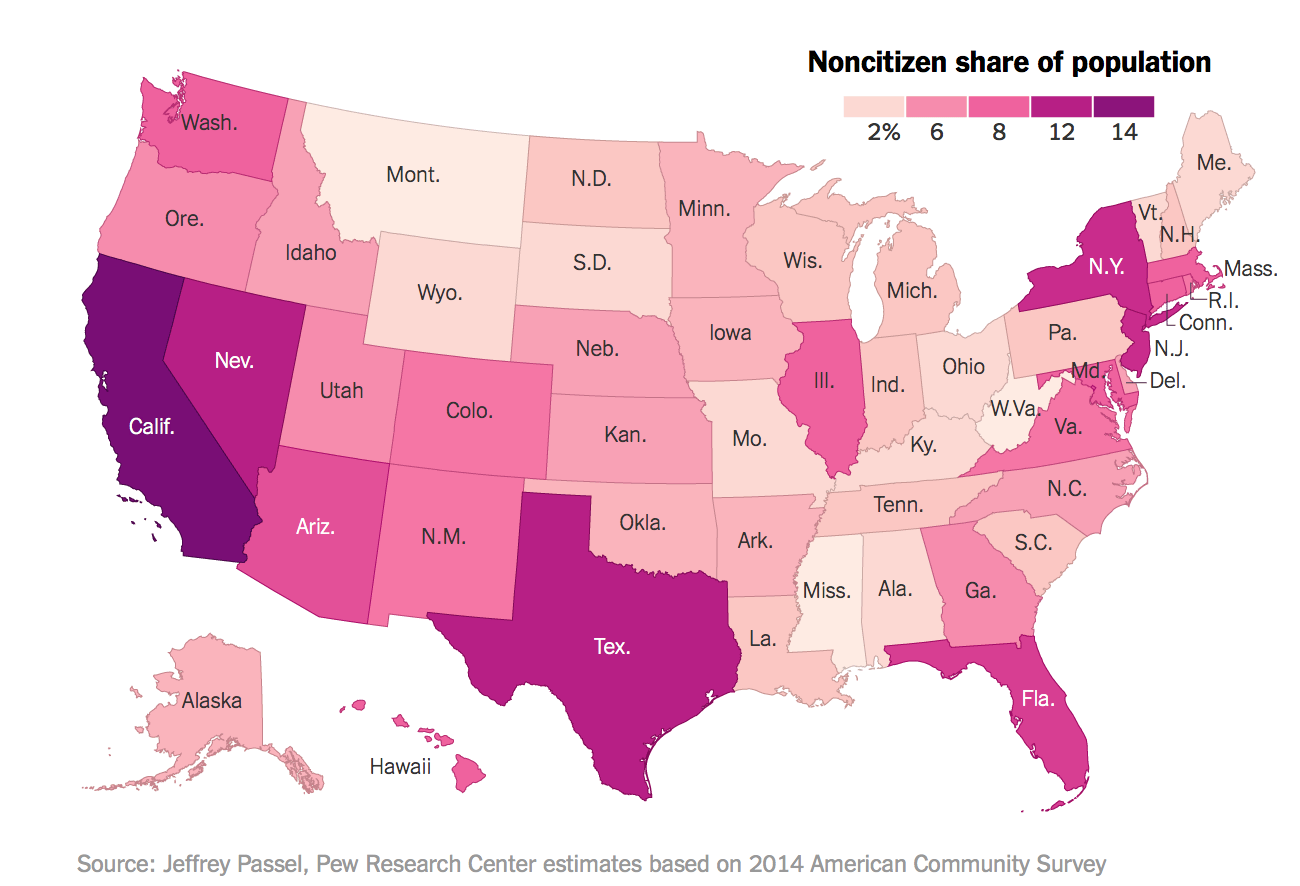
About 56 percent of the nation’s 44 million immigrants are not United States citizens, and an estimated 45 percent of noncitizens are undocumented. Among those who are not citizens, undocumented immigrants have the lowest rates of participation in census surveys in general, experts say.

Accurate census counts are critical for many functions, including the disbursement of billions in federal and state dollars and the distribution of congressional seats and representation in state and local governments. At least 12 states, including New York and California, have filed lawsuits or have said they plan to sue the administration over the change.

An undercount of population could affect federal funding to states.

A recent Census Bureau report found that 132 programs used decennial census or related data to distribute more than $675 billion to states in 2015. Most of the money was related to health care, education and assistance for the poor.

Top federal assistance programs distributed using census data


A significant level of nonparticipation could affect congressional seats.

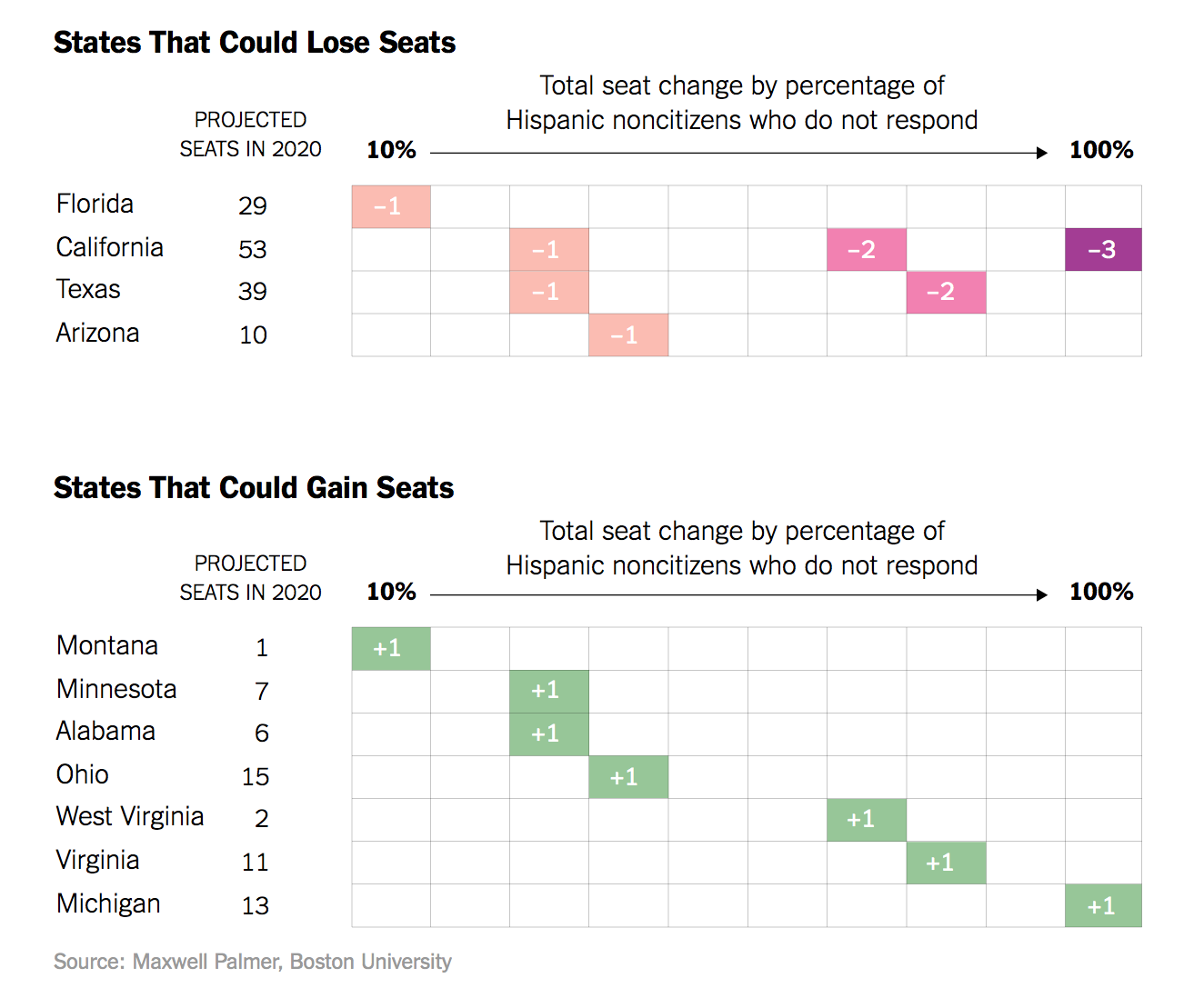
Some academics have created hypothetical scenarios to show how a reduction in participation could affect the distribution of congressional seats among states, which are determined by total residents, not just citizens.


According to Maxwell Palmer, an assistant professor of political science at Boston University, if 10 percent of Hispanic noncitizens opted out, Florida could lose one congressional seat, and Montana could gain one. In an extreme case, in which 100 percent of Hispanic noncitizens did not participate, a total of seven congressional seats could be reshuffled, with three lost by California and two by Texas, Dr. Palmer said.

Andrew A. Beveridge, a Queens College sociologist, warned against overstating the potential effects of the citizenship question. He said that the maximum share of noncitizens who do not respond would be 20 percent, which is not enough to trigger a huge change.

“This, as the analysis shows, would only move a couple of seats,” said Dr. Beveridge, who is also president of Social Explorer, a research site that analyzes census data.

via Are You a U.S. Citizen? How a 2020 Census Question Could Affect States – The New York Times

Andray Domise: Why I’m #HereForCelina

Valid and needed perspective:

The first thing to know about Black political involvement in Canada is that, until very recently, its success or failure has mostly revolved around managing white perceptions.

This isn’t hyperbole, or even a gripe, but the simple reality of getting elected and keeping one’s seat in a country where Black people make up less than three per cent of the population. For far longer than I’ve been alive, there has been an unspoken understanding in the community that, while the Black politician knows firsthand the frustration, pain, and anger of living in a society that abides our unequal treatment, there is a certain decibel level above which a politician cannot speak. Better to do the work quietly and accomplish what they can for the community, than risk offending the white Canadian who, while benefitting from the systemic racism that keeps him perched atop the social hierarchy, feels unfairly indicted for having his position explained to him.

This is what makes Celina Caesar-Chavannes unique among Canada’s Black political class. The Liberal MP for Whitby not only carries the work outside of Parliament Hill to the broader community, often speaking at events and encouraging organizers to demand more from their elected representatives, but publicly names white supremacy for what it is. Whether speaking to systemic and institutional violence, or individualized racism (e.g. discrimination against Black women’s natural hair, a topic for which she became known internationally), Caesar-Chavannes has, like Rosemary Brown before her, defied the accepted wisdom that Black politicians must face down racism with resolute silence.

And for that, she was named a racist.

In the last few weeks, Caesar-Chavannes has made headlines repeatedly for using Twitter to call out Canadian politicians and media figures who, having no firsthand experience with racism, have attempted to define the terms of its discussion. First, there was her suggestion that Conservative MP Maxime Bernier “be quiet” when Bernier criticized Immigration Minister Ahmed Hussen’s language in cheering a budget set-aside of $19 million for programs that serve racialized Canadians. She later apologized for her comment, and Bernier rejected the apology via Twitter, responding that it’s “time we Conservatives stop being afraid to defend our vision of a just society made up of free and equal individuals and push back against those who want to silence any opinion that differs from theirs.”

And then there was her response to Robert Fife, the Globe and Mail’s Ottawa bureau chief, who questioned the existence of “systematic racism” in a CPAC interview. Fife was discussing the Liberal government’s announcement of a strategy to counter systemicracism, and flippantly dismissed the announcement as a “wedge issue,” given that schoolchildren seemed to be integrating well with one another. Caesar-Chavannes tweetedthat Fife’s comments made her question his “ability to investigate stories of the Canadian experience without bias.”

In response, former Rebel Media co-founder Brian Lilley wrote a blog post accusing Caesar-Chavannes of “seeing racism everywhere,” following an earlier claim by Rebel Media owner Ezra Levant that she is “a racist,” and “a disgrace.” In a 20-minute video, Levant claimed that “Canada has been good to her,” implying that Caesar-Chavannes could not have achieved similar success in the “very poor” and “very small” Grenada, her country of birth. He later compared Caesar-Chavannes’s description of her skin colour—“Black, no sugar, no cream”—to Malcolm X’s anti-integrationist coffee allegory, solidifying the assertion that her extremism made her unfit for office. This, of course, triggered a wave of harassment by the Canadian alt-right, with several Twitter users calling her a “racist,” and others descending into racial slurs.

In the messy business of combating racism at the political level, too often the burden of white anger falls on the shoulders of outspoken Black women. In the UK, Labour MP and shadow home secretary Diane Abbott has spoken at length about the harassment and racial abuse she’s faced as a result of her Black skin and high profile. In the United States, Congressional representative and Donald Trump critic Maxine Waters has faced racism not only from the President’s alt-right supporters, but from the President himself. It seems that, whenever a Black woman in office uses her platform to denounce the systemic oppression of Black people, the immediate and overwhelming response is to tear that woman down, paint her as an extremist, and break her will to continue.

For transparency’s sake, Celina Caesar-Chavannes is a friend of mine; the social circles that comprise Toronto’s Black political, business, and media class overlap heavily, and most of us are at least passingly familiar with one another. So it would be disingenuous of me to pretend I have no interest in seeing her succeed, or that I didn’t have a personal stake in promoting the #HereForCelina hashtag on Twitter (which was started by fellow Liberal MP Adam Vaughan, and joined by thousands of Canadians including the Prime Minister) in response to the harassment she faced.

But the backlash that she has faced over the last few weeks is more than an unfair attack on a friend. It has been an instructive guide to the way we deal with racism in this country. We avoid naming the issue for as long as possible (witness Justin Trudeau’s acknowledgment of the UN’s International Decade for People of African Descent almost three years after he took office), and when it is named, we stand by and watch as the whistle-blower is attacked by aggrieved white people who demand gratitude for merely tolerating our existence.

The right-wing attack on Caesar-Chavannes is the scenario that many Black politicians before her have avoided by keeping their heads down in public, while discussing matters of race within the confines of the community. And it demonstrates the importance of discussing these issues frequently and in the open. If, as other writers have suggested, we keep a low profile on discussing matters of race, we inevitably surrender the power to shape the conversation to those least equipped to handle it.

Levant isn’t fit to discuss Caesar-Chavannes’s racial politics when he missed that her proud “no sugar, no cream” description wasn’t lifted from a Malcolm X speech, but rather a Heavy D song that praises dark-skinned Black women in a culture that has, for centuries, elevated lighter skin. Bernier isn’t fit to discuss racism when he lacks awareness that the white moderate’s mantra of “colour-blindness” is its own pernicious form of racism. And Fife isn’t fit to criticize systemic racism when it seems he isn’t even clear as to its definition.

Eliminating racism means much more than a personal distaste for neo-Nazis and other unrepentant bigots. It means supporting Black women who’ve spoken up about the soft bigotry of Bay Street, written about Canada’s history of policing the Black body, and called attention to the violence of forcibly placing Black children in the care of the state. It means showing up for Black women, like Celina Caesar-Chavannes, who use their political platform to advocate fiercely for an equal society. And it means facing the uncomfortable truth that our institutions—schools, social services, the justice system—were not designed for the protection and equal treatment of racialized Canadians. We’ve long passed the time when white perceptions about our language and our politics ought to be considered when advocating for our lives.

Source: Andray Domise: Why I’m #HereForCelina

ICYMI – Immigration: how much is too much? – BBC News

Some of the British debates:

Maybe it was intrusive use of big data. A mistrust of Eurocracy and foreign judges.

Maybe it depended on undeliverable promises and the big red bus. Perhaps it was the complacency of the remainers, and of intransigence in Brussels.

But there’s little doubt that none of these factors would have made much difference to the Brexit vote without the big issue that people on all sides tend to speak about nervously – immigration.

So when the Migration Advisory Committee (MAC) speaks, it needs close attention. Amid all the claims, counter-claims, petty prejudices about Johnny Foreigner and justifiable concerns about jobs and wages, this is the outfit that feeds real hard evidence into government thinking – or so you would hope.

It was commissioned last July by the Home Secretary, Amber Rudd, to take an in-depth and wide-ranging look at the UK’s continuing economic and demographic requirement to attract a continued flow of European Union immigrants after Brexiting.

This is to help shape the UK’s new immigration policy from 2021, though being commissioned by Ms Rudd it could also be seen as a helpful source of evidence to back up the soft Brexit end of Cabinet divisions on Brexit.

Hard-nosed

The interim report, published on Tuesday, is big on the opinion of business, acknowledging that the final report will have to balance that with other voices.

“What is best for an employer is not necessarily what is best for the resident population, which is the criterion the MAC uses when evaluating migration policy,” it states.

In general, but particularly in London and Scotland, business told the MAC that it likes to recruit from the biggest possible pool of labour. No surprise there.

They shared with the MAC employer concerns, with which we are becoming familiar, of being unable to staff businesses after the Brexit portcullis falls. Without access to migrant labour, firms may not grow, and some may disappear.

The committee seems to have listened carefully, agreeing that growth will be slowed, but without much sympathy for UK plc. The hard-nosed response is: if you’ve built your business model on migrant labour, you need to be prepared for when it isn’t there.

This is not just about Brexit, goes the argument: this is about trends towards migrant workers choosing to go elsewhere, if for instance, sterling isn’t so valuable to them.

Earnings in their home countries can be expected to rise over time, so they will eventually choose to make their money in their more prosperous homelands. What does migrant-dependent British business do then?

Reliable and flexible

The interim report also dips a toe into the controversial question of whether migrant workers depress wages.

They’ve got more work to do on that, says the MAC. But for now, they note very different stories for those born in older EU members (such as France and Germany), who on average earn 12% above the British-born average. They tend to do more highly skilled jobs.

Those born in the newer EU members (from the Baltic states to Bulgaria) are typically in lower skilled, lower-paid roles and paid 27% less than the British-born average (note: that is not for the same work).

The evidence is patchy, but suggests that average pay has not been much depressed by migrant workers. It may even have been enhanced among higher earners.

But among lower-paid workers, the financial crisis and long haul back to recovery offer a more compelling explanation for poor wage growth than competition from foreign workers.

What they’re clearer about is that employers are getting a higher level of skill and qualification for the same money that will buy an hour of native British worker’s time.

And that might help explain one of the headline findings – that employers like the work ethic, reliability and flexibility that they get from migrants. That’s hard to prove with hard evidence, but plausible.

When employers say they simply can’t get home-grown Brits to come and work at some jobs, the Committee has another unsympathetic response: of course they will – you just have to offer them enough pay to make it worthwhile. Employers seem unwilling to use wages as a lever to solve their labour and skill shortages.

Dependency

A lot of this interim report is dedicated to examining the case for migration being encouraged into some parts of the UK more than others.

It highlights the huge differences between most of the country and London. The capital’s population is 37% foreign-born. Some 11% of the total are from EU countries.

The West Midlands has the next highest share, at one in eight, and for Scotland, it’s one in 12. For north-east England and Wales, it is one in 18.

The sector where Scotland has a relatively high reliance on foreign workers is in hospitality – that’s apart from London, which at 33% foreign, is three times as reliant..

This is where the Scottish government weighs in. It set out for the MAC a case that will be familiar to those who follow Holyrood’s rhetoric:

  • Scotland has more need of immigrants because its population would fall otherwise. All its recent population growth has come from immigration.
  • Scotland has a special long-term problem with having enough working age, tax-paying people to fund pensions and services for retirees (‘the dependency ratio’), and
  • Scotland has a particular need for migrants to counter the outflow of people from remoter communities.

Again, the hard evidence is examined, and the response is far from sympathetic. The Scottish government’s sense of exceptionalism takes a battering.

Work longer

It is concluded that:

  • Scotland doesn’t have more need of migrants to stop population decline. Other parts of the UK have similar challenges, including north-east England and Wales.
  • Following the trajectory of the dependency ratio for the next two decades, it rises for Scotland, but it doesn’t look significantly different to other parts of the UK. In Northern Ireland, it rises fastest. A much more effective way of addressing the problem, it is argued, is raising the pension age and having people work longer.
  • And the rural question? Why look to migrants to fill the gaps as people leave these areas? Why not address the reasons why people leave, and find ways to encourage residents to stay? (There’s no suggestion what these might be.)

“Migration is rarely the only policy available to deal with a problem and always needs to be compared with alternatives,” writes the MAC chairman, Sir Alan Manning.

The final report will have more to say on those alternative. It is set to have a very significant influence on the future shape of the British economy and of British society.

via Immigration: how much is too much? – BBC News

Canada 150 research chairs draw scientists fleeing Trump, guns and Brexit – The Globe and Mail

Continues a series of anecdotes regarding the relative attractiveness of Canada:

The day after Donald Trump won the U.S. presidential election, Alan Aspuru-Guzik, a prominent professor of chemistry at Harvard University, picked up the phone and called Canada.

For Dr. Aspuru-Guzik, who specializes in developing advanced materials for energy generation, the 2016 result was a signal to close up shop. Born in the United States and raised in Mexico, Dr. Aspuru-Guzik has family roots that trace back to Spain, Poland and Ukraine. It’s the kind of varied background, he said, that instills a predisposed wariness of political authoritarianism and economic instability. And the Trump presidency has put his instincts on high alert.

“Many of my colleagues have told me that they will leave the United States if things get worse,” Dr. Aspuru-Guzik said. “The difference is that I already think it’s worse.”

On Thursday, Dr. Aspuru-Guzik is set to be named one of 20 newly hired Canada 150 research chairs at a briefing in Ottawa. He plans to leave his position at Harvard this summer to take up a new role at the University of Toronto, where he will continue his research and aim to spin off startup companies from his scientific work.

“Great science is all about great people. So being able to attract someone of Alan’s calibre is a coup for this country,” said Alan Bernstein, director of the Canadian Institute for Advanced Research in Toronto. It was Dr. Bernstein who was on the other end of the line when Dr. Aspuru-Guzik made his postelection call, setting the wheels in motion for his eventual move.

A total of 25 Canada 150 research chairs will be established at Canadian universities under the one-off program, supported with $117.6-million in federal funding. Four chairholders were already named late last year, including computer scientist Margo Seltzer who, like Dr. Aspuru-Guzik, is leaving a faculty post at Harvard to come to Canada.

“I think it speaks to what Canada is doing here in science,” federal Science Minister Kirsty Duncan said. “We’re in a global competition for talent.”

Several of the appointees who spoke to The Globe and Mail before Thursday’s announcement were enthusiastic about what they perceive to be a collaborative, pro-research culture in Canada. But many also expressed a sense of relief when speaking about what they were coming from.

The haul of prominent scientists attracted to the new chairs suggests that a predicted brain gain for Canada owing to reactionary politics in the United States and elsewhere is having an impact and that scientists are indeed voting with their feet.

For example, when asked what she would be giving up by leaving North Carolina’s Duke University to come to the University of Waterloo in Ontario, Anita Layton, a biomathematician whose work relates to kidney function, summed it up in two words: gun violence.

Dr. Layton, who did her graduate work in Canada and whose parents live in Toronto, explained that her children, ages 14 and 10, have recently been in lockdown exercises at school to practise for an armed assault.

“This is their world … It’s normal life for them and I find it really sad,” she said.

Family considerations played a role in her move, but she added that Waterloo’s strong mathematics department offers just as many professional advantages as Duke, with the added benefit of $350,000 in funding tied to her research chair which ensures years of continuing support.

Funding stability was a key factor for Judith Mank, an expert in the genomics of diversity, who will be moving her laboratory from University College London to the University of British Columbia in Vancouver.

Like that of a number of British-based researchers, Dr. Mank was thrown into turmoil by the outcome of the 2016 Brexit vote.

“I got really worried because all of our funding is from the European Union and we’re not sure if we’ll be able to access that,” she said.

At UBC, Dr. Mank will be supported by a $1-million funding tranche that goes with her top-tier Canada 150 chair.

The same amount has been allocated to the University of Saskatchewan for James Famiglietti, a hydrologist currently with NASA’s Jet Propulsion Laboratory in California who will become the director of the university’s highly regarded Global Institute for Water Security.

Dr. Famiglietti is well known for his public appearances in the United States, particularly during California’s recent, prolonged drought and testimony before Congress. A specialist in remote sensing, he has expertise in gauging water resources from space, and the impact of climate change on those resources.

He said the real advantage he anticipates in coming to Canada is in being able to access parts of the world that are undergoing water stress but where U.S. federal employees are typically prohibited from visiting.

“The goal is to begin reaching out to the hottest of the hot spots for water scarcity around the world,” Dr. Famiglietti said.

Among the newly selected chairs are several Canadian researchers, including Katherine O’Brien, a global health vaccinologist who is heading to Dalhousie University after her 30 years at premier research facilities in the United States and around the world.

“It was the right time for me to come back,” she said, avoiding any discussion of U.S. politics.

But for Dr. Aspuru-Guzik, the motivation for his move is clear: “I believe that life is short and that I should live in a place that is consistent with my values.”

via Canada 150 research chairs draw scientists fleeing Trump, guns and Brexit – The Globe and Mail

Opinion | The Wrong Way for Germany to Debate Islam – The New York Times

Thoughtful commentary:

It was a warm June day in a northern German village, and I was talking to a Syrian friend outside a local shop. I had just bought some ice cream and offered to share it, but my friend refused. He was observing Ramadan: no food or drink until after sunset.

“If you had found asylum at the Arctic Circle instead of Germany,” I asked, “would you have starved by now?” It wasn’t an entirely academic question. In our village on Germany’s Baltic shore, the sun doesn’t set in summer until around 11 p.m.

My Syrian friend chuckled at the question about the Arctic Circle — where the summer sun never fully vanishes — but insisted: The law is the law; it’s what the Prophet Muhammad commands.

But wouldn’t the prophet be content if you observed, say, Damascus time? I wondered.

He chuckled again: No, this wouldn’t be what he had said.

The exchange left me with mixed feelings. I felt great respect for my friend’s willpower and the idea of Ramadan: to experience deprivation in order to stir empathy with the poor. What startled me, though, was his refusal to question religious commands and at least try to align them with reason without reducing their moral purpose.

This is an anodyne example, but it relates to a conundrum facing Germany as a country. To many non-Muslim Germans, the comparatively high significance that many Muslims attach to divine laws raises the question of to whom all the immigrants and refugees who have come to us in recent years would rather pledge allegiance and loyalty: the state that took them in, or Allah? Are the newcomers really convinced of the blessings of an open, liberal society, or are they just happy to seize its advantages?

The new German minister for the interior, Horst Seehofer, recently addressed this fear with a sentence that was meant as a reassurance to voters: “Islam does not belong to Germany.” With this Mr. Seehofer, who is also the chairman of the conservative Christian Social Union party, is rejecting an opposite claim made back in 2010 by Christian Wulff, then the president, and subsequently by Chancellor Angela Merkel. One of Mr. Seehofer’s party colleagues, Alexander Dobrindt, went even further: “Islam, no matter the form, does not belong to Germany.”

Their provocation is calculated to create a backlash against the naïveté and carelessness of those who have tried to make space for Islam as a part of German culture — a position conservatives think has been dominating public discourse for too long.

What a splendid idea: Counter leftist simplification with rightist crudeness! If there is one thing that doesn’t belong to a enlightened nation like Germany, it is a deliberate coarsening of a debate where a maximum of nuance is needed.

On the surface, of course, there’s an obvious tension between the largely secular, liberal traditions of German culture and those forms of Islam that, for example, place religious law over secular law. But that’s also a moot point: Muslims have been living here in large numbers since the 1960s, and now Germany’s six million Muslims make up roughly 6 percent of the population. The problem is that the way Germany has dealt with them is a history of mistakes.

The first mistake, the one conservatives made, was to believe that the early “guest workers” brought from Turkey in the 1960s, to make up for a labor shortage, would eventually go home again. The second mistake, the one the left made, was to embrace all foreigners, whatever their values. After Sept. 11, more or less all sides have made a third mistake, the failure to ask painful questions about how to reconcile Islam with an pluralist, secular democracy.

Apathy, illusions and false tolerance have left important issues unaddressed for half a century. That has now turned to hostility: Many Germans just don’t believe that Islam is compatible with Western values.

And yet the fact that there are many liberal observant Muslims living in Germany suggests the opposite. These are the people who speak out against false dogma, the overly literal reading of the Quran, and anti-Western teachings. The problem is their small number and the hostility they encounter from fellow Muslims here in Germany.

In a representative survey conducted by the University of Münster in 2016, 47 percent of Turkish immigrants and their descendants said that it was more important for them “to abide by religious commands than by the laws of the country I live in.” Some 32 percent said that Muslims should try to re-erect a social order like the one during the lifetime of the Prophet Muhammad. And 50 percent said there was “only one true religion.”

These are troubling figures. While giving divine laws priority over worldly laws does not necessarily mean rejecting democracy (many Christians and Jews would subscribe to the same statement), the apparent longing of so many Muslims for an authoritarian rather than an open society is shocking. Their intolerance for those of other beliefs matches a political attitude that surprised this country one year ago: Of the roughly 700,000 Turkish Muslims in Germany who participated in the constitutional referendum in Turkey last April, 63 percent voted in favor of granting President Recep Tayyip Erdogan unilateral powers.

This contempt for liberalism is a real problem, but rhetoric like Mr. Seehofer’s will only make things worse. It will compound a feeling, already widespread among Muslims, of not belonging to Germany anyway. The sentence “Islam does not belong to Germany” is a gift to radicals who hold an obsessive, binary, West versus Islam worldview.

So how do we move on? Instead of prolonging the mistakes of the past, the secular majority in Germany should make clear two things to their fellow Muslim citizens. Yes, Muslims belong here — but belonging brings with it expectations. Being a citizen means, first and foremost, upholding the values and laws that make this country so attractive. The secular majority must learn how to convey this expectation in a clear yet civil manner.

Germans struggle with this because they are uncomfortable, for historical reasons, with making such demands of religious minorities. The problem, in other words, is not just politicians who wield stupid slogans. It is also the majority of nonpopulist Germans who are shy about expressing the terms of participation in a pluralist society.

via Opinion | The Wrong Way for Germany to Debate Islam – The New York Times

The shame of antisemitism on the left has a long, malign history: Philip Spencer

Good historical context:

So, we’re back to the “Jewish Question”? The current antisemitism crisis on the left has not come out of nowhere. Instead, it has its roots in a tradition on the left itself, which, at best, has always had difficulty in responding swiftly to antisemitism and, at worst, excused or condoned, even promoted it. It is not, of course, the only tradition on the left, but unless we understand this history, we won’t get very far in resolving today’s crisis.

We need, above all, to think about why some on the left have always seen Jews as a problem and why they have helped the idea of a “Jewish Question” to re-emerge with such potency. At root is the thought that if antisemitism exists, it must have something to do with how Jews supposedly behave. That supposed behaviour may be described in different ways – sometimes it has an economic character, sometimes a social one, sometimes a political one. But what is common is the idea that Jews are to blame for antisemitism and that to protest against them is understandable, or even necessary.

This first became a serious problem on the left in the late 19th century, as antisemitism first became a political force in the modern world. Some on the left flirted with the response that there might be something progressive about antisemitism: that it was a kind of anti-capitalism, however crude, which could be harnessed to the socialist cause. They also thought that philosemitism was more of a problem, because it supposedly encouraged Jews to make too much of (or even fabricate) antisemitism and to resist assimilation. One criticism of this approach at the time was to call it the “socialism of fools”, a problematic formulation because it suggested that antisemitism was still some kind of socialism.

As antisemitism was radicalised by the Nazis – it no longer being enough to exclude Jews when they should be wiped off the face of the Earth – this way of thinking made it difficult for too many on the left to prioritise solidarity with Jews. Neither the Social Democrats nor the Communists in Germany made opposition to antisemitism a major issue, nor did the Resistance across Europe. The fear was that to highlight the fight against antisemitism would alienate potential supporters. This is not to ignore some wonderful examples of solidarity, though the repeated invocations of Cable Street can give a misleading picture. The Communist party soon switched to loyally supporting the Hitler-Stalin pact, which effectively delivered large numbers of Jews up to the Nazis.

When the Soviet Union was finally forced to fight the Nazis, the suffering of Jews was deliberately and repeatedly downplayed. But after the war, things got much worse. The Soviet Union not only suppressed knowledge of what had been done to Jews but launched its own vicious antisemitic project, one that would have culminated in another genocide had Stalin not died.

This campaign matters because it was around this time that some key elements of today’s antisemitism on the left were first formulated. The charge laid against Jews then was that they were cosmopolitans and Zionists. This may seem like a bizarre contradiction: how can one, after all, be both a cosmopolitan and a Zionist? But what connected them is the idea that Jews are a problem, that as cosmopolitans they are more loyal to each other across national borders and, as Zionists, are loyal to another, foreign state. The charge of cosmopolitanism is heard less frequently these days, though one finds echoes of it in the idea that Jews are responsible for the evils of globalisation. The charge of Zionism, though, has now become absolutely central to today’s version of the “Jewish Question”. What began as a Stalinist cry was taken up in some on the New Left, which helped shape the world view of Jeremy Corbyn and many of his supporters.

For both Stalinists and that part of the New Left, Zionism is a racist ideology that pits the interests of Jews against the interests of everyone else. Furthermore, the state of Israel is an integral part of the western imperialist power structure that exploits and oppresses the rest of the world and the Palestinians in particular, whose land Jews have plundered and colonised and whom they keep in a state of permanent subjugation.

The Soviet Union formulated its approach within the context of the cold war, when it often appeared to support anti-colonial, national liberation struggles, although only for strategic reasons. Those on the left who (rightly if often too uncritically) supported those struggles, especially in Vietnam, where the Americans were so clearly the enemy, slipped fatally, however, into embracing this anti-Zionism into their world view, even though the Israel-Palestine conflict had such clearly different roots.

At the same time, they found it unbearable to acknowledge what was glaringly obvious – that the establishment of the state of Israel was profoundly connected to the Holocaust, which had changed everything for Jews. To integrate anti-Zionism into an anti-imperialist, anti-western, anti-American world view therefore also meant either denying or (better) reinterpreting the Holocaust. Holocaust denial is not an accidental feature of today’s antisemitism, but it is more common to downplay what happened to Jews as Jews. So the Holocaust has to be thought about only in universal terms, as only one genocide among many and one that supposedly excludes the others. (Actually, of course, it is the other way around: thinking about the Holocaust helps people think about other genocides.) Indeed, some have gone further. Not content with accusing Israel of being like apartheid South Africa, it is supposedly guilty of genocide itself… against the Palestinians.

If such purported behaviour makes people antisemitic, it is understandable and part of a fundamentally progressive view of the world, which can be harnessed to the cause. We are back then to where we started, with Jews as the problem, only with this difference: what was previously attributed to Jews inside nation states is now attributed to the Jewish state on the international stage.

There has always been, though, another tradition on the left, which has never accepted the very idea of a “Jewish Question”. What it understands is that there is a question of antisemitism; that Jews are not responsible for antisemitism but antisemites are; that Jews are not a problem but antisemites are. Antisemitism is not something that should be excused or condoned. It has to be fought wherever it shows its face, even – and sadly now more than ever – when that face is on the left.