Maxime Bernier et la couleur: Fabrice Vil

Fabrice Vil of Le Devoir on Maxime Bernier’s blindness to structural and systemic barriers:

Il y a quelques jours, j’ai lu de sages paroles sur Twitter : « Nous devrions certainement faire tout notre possible pour redresser les injustices et donner à tous des chances égales de s’épanouir. Et nous devrions reconnaître que le Canada est assez grand pour contenir plusieurs identités. Comme Québécois francophone, je peux comprendre ça. » Je suis en tous points d’accord avec ces propos éloquents. Écrits par qui ? Nul autre que Maxime Bernier, député conservateur.

La plupart d’entre nous veulent une société où tous les humains jouissent des mêmes droits. C’est ce que suggère aussi M. Bernier. Pour y arriver, il est nécessaire de reconnaître les différences entre nous qui provoquent des désavantages pour certains, et de traiter les gens différemment afin de pallier ces désavantages. C’est là où M. Bernier se méprend et se contredit.

À la fin du mois dernier, Ahmed Hussen, ministre de l’Immigration, des Réfugiés et de la Citoyenneté, saluait sur Twitter certaines des mesures que prévoit le dernier budget fédéral afin de lutter contre le racisme. « Un #budget2018 historique pour les Canadiens racisés », a-t-il écrit.

Le 6 mars, M. Bernier a répondu : « Je pensais que le but ultime de la lutte contre la discrimination était de créer une société aveugle aux couleurs où tout le monde est traité de la même façon […]. » Erreur, M. Bernier.

Dans un monde idéal, la couleur de la peau serait en effet aussi anodine que, disons, la couleur des yeux. On juge la couleur des yeux sur une base esthétique, mais personne n’est vraiment lésé strictement sur la base du teint de son iris. Imaginez un monde où les gens aux yeux verts ont plus de chances d’êtres pauvres, moins de chances d’obtenir un emploi et plus de chances d’être emprisonnés. Bizarre, non ? En ce sens, il est vrai que la lutte contre la discrimination devrait mener à ce que la couleur de la peau ne soit plus utilisée pour brimer les droits d’un individu.

Toutefois, la lutte contre la discrimination elle-même n’implique pas qu’on traite tout le monde de la même façon. Pour garantir les mêmes droits fondamentaux à tous, il ne faut pas traiter tout le monde également. Agir de cette manière perpétue les inégalités. Il faut plutôt agir différemment pour rétablir les déséquilibres qui défavorisent certains individus. C’est ce qu’on appelle agir équitablement.

Connaissez-vous l’analogie des trois gamins qui regardent un match de baseball, debout derrière une clôture en bois ? Le premier est assez grand pour voir le match sans aucun soutien. Le second, de taille moyenne, a besoin de se tenir sur une caisse afin que sa tête dépasse la clôture. Le troisième, plus petit, a besoin de deux caisses pour pouvoir regarder le match.

En donnant une caisse à chaque gamin, on les traiterait tous également. On offrirait toutefois du soutien à un gamin qui n’en a pas besoin, et l’un d’entre eux ne serait pas en mesure de voir le match.

Dans cet exemple, afin que la taille ne soit plus une cause d’inégalité, il faut justement constater les différences de taille et en tenir compte dans la distribution des caisses. Dans cet ordre d’idées, contrairement à ce que suggère M. Bernier, la poursuite de l’égalité des chances implique de voir la couleur de peau et de reconnaître qu’elle constitue un motif de discrimination.

En 2018, un enfant de 10 ans disparu qui se trouve à être noir ne peut pleinement bénéficier du soutien élémentaire que mérite un enfant de 10 ans disparu. Il doit subir les foudres d’internautes qui formulent à son égard des remarques racistes beaucoup trop violentes pour que je les reproduise ici.

Quelques remarques isolées ? Soit. Mais la discrimination est bien réelle et plus répandue qu’on veut parfois le reconnaître. Je m’évertue à relater que la population carcérale d’origine autochtone a augmenté de 46 % de 2003 à 2013 au Canada. Et de 80 % chez les Noirs. Ces statistiques, qui illustrent une inégalité systémique majeure, demande que nos politiques publiques tiennent compte des déséquilibres qui portent préjudice aux personnes de couleur.

C’est pourquoi nos politiciens ont la responsabilité de voir la couleur. Mais pas seulement la couleur. Tout attribut qui représente un motif de discrimination. Il ne s’agit pas d’accorder des droits et privilèges différents à certains groupes, mais d’aménager des traitements différents pour que tous bénéficient des mêmes droits. Si M. Bernier veut faire, comme il le dit, « tout [son] possible pour redresser les injustices », comment peut-il agir avec clairvoyance tout en étant aveugle ? Croit-il sérieusement que traiter tout le monde également va redresser les injustices ?
via Maxime Bernier et la couleur | Le Devoir

Islam doesn’t belong to Germany, new interior minister says

The remarks are slightly more nuanced than the header but still unfortunate. The same remark, “live with us, not next to us or against us” applies to all groups:

New Interior Minister Horst Seehofer said Islam did not belong to Germany, in an interview published on Friday, setting him on a collision course with Chancellor Angela Merkel who has stressed the need to integrate Muslims.

Seehofer also set out a range of hardline policies on immigration, as the new coalition prepares to see off the rising challenge of the far-right Alternative for Germany (AfD) party, which entered the national parliament in last year’s elections.

“Islam does not belong to Germany,” Seehofer told mass-selling Bild newspaper, contradicting former German president Christian Wulff who fuelled a debate over immigration in 2010 by saying Islam was part of Germany.

In 2015 Merkel echoed Wulff’s words at a time when anti-immigration campaign group PEGIDA – or Patriotic Europeans Against the Islamisation of the West – was holding marches.

The German government estimates between 4.4 and 4.7 million Muslims are living in Germany. Many of them have a Turkish background and many of the more than a million migrants who have arrived in the country from the Middle East and elsewhere after Merkel adopted an open-door policy in mid-2015 are also Muslims.

Seehofer – a member of Merkel’s CSU Bavarian allies who are further to the right than her own Christian Democrats (CDU) – said he would implement a “master plan for quicker deportations”.

He also promised to do more to tackle the reasons people flee and classify more states as ‘safe’ countries of origin, which would make it easier to deport failed asylum seekers.

“Of course the Muslims living here do belong to Germany,” Seehofer said before going on to say Germany should not give up its own traditions or customs, which had Christianity at their heart.

“My message is: Muslims need to live with us, not next to us or against us,” said Seehofer, who was sworn in as interior minister on Wednesday.

Seehofer is keen to show his party is tackling immigration ahead of Bavaria’s October regional election, when the AfD is expected to enter that state assembly.

In a coalition agreement, Merkel’s CDU/CSU conservative bloc and the Social Democrats (SPD) agreed they would manage and limit migration to Germany and Europe to avoid a re-run of the 2015 refugee crisis.

They also said they did not expect migration (excluding labour migration) to rise above the range of 180,000 to 220,000 per year.

via Islam doesn’t belong to Germany, new interior minister says

Les libéraux évitent le terme «nationalisme ethnique»

Hard to deny Leitao’s point given ongoing identity politics. Meets the definition of a gaffe being speaking the truth too frankly:

Les libéraux n’ont pas voulu répéter les mots « nationalisme ethnique » utilisés par le ministre des Finances Carlos Leitão pour dénoncer la Coalition avenir Québec (CAQ), jeudi.

À leur arrivée à l’Assemblée nationale, des ministres du gouvernement Couillard se sont portés à la défense de leur collègue. Mais ils se sont gardés de reprendre l’expression qu’il a utilisée pour critiquer le parti de François Legault dans une entrevue à The Gazette.

Dans un article paru mercredi, M. Leitão a déclaré au quotidien que la CAQ propose un « nationalisme ethnique ».

« Ce à quoi nous nous opposons fondamentalement, ce à quoi le Parti libéral du Québec s’opposera toujours, c’est de la division, a affirmé le ministre de l’Immigration, David Heurtel. C’est de tenter d’antagoniser les Québécois. »

Pressé de répéter les propos son collègue, M. Heurtel a tourné les talons et fait dos aux journalistes pour ensuite répondre à des questions en anglais.

Son collègue à l’Éducation, Sébastien Proulx, a affirmé : « Je n’ai pas à répéter une affirmation dans un contexte où je ne l’ai pas entendue. »

« Je connais M. Leitão, a ajouté M. Proulx. Je sais pour quelles raisons il fait de la politique, je sais pourquoi il est motivé à faire de la politique, je sais qu’il accorde beaucoup d’importance à la place de gens comme lui dans notre société, qui se sont bâtis et qui sont aujourd’hui ministre des Finances. »

La déclaration de M. Leitão a fait bondir le chef caquiste François Legault, mercredi. Il a exigé des excuses et demandé au premier ministre Philippe Couillard de le rappeler à l’ordre.

La CAQ est revenue à la charge jeudi matin. Elle a présenté une motion pour que les parlementaires reconnaissent « qu’aucune formation politique représentée à l’Assemblée nationale du Québec ne prône le nationalisme ethnique ». Une initiative que le Parti libéral a refusé d’appuyer.

Au Salon bleu, le leader parlementaire caquiste, François Bonnardel, a souligné à gros traits le refus des ministres libéraux de répéter les propos de M. Leitão.

« Ce qui alimente le cynisme, ce sont les double-discours, a dénoncé M. Bonnardel. Pourquoi refuse-t-il de dire en français ce qu’il a dit en anglais ? Pourquoi ce double-discours ? Qu’il assume ou qu’il s’excuse. »

M. Leitão avait refusé de s’excuser mercredi.

« J’ai dit ce que j’avais à dire », a-t-il simplement déclaré jeudi matin.

via Les libéraux évitent le terme «nationalisme ethnique» | Martin Croteau | Politique québécoise

Father of British-Canadian accused of joining ISIS hopes to plead son’s case in Canada next week

An example of how inheriting Canadian citizenship (first generation) leads to consular demands even in cases where a person has never lived in Canada:

John Letts, the father of a young British-Canadian man accused of belonging to ISIS and being held in a Kurdish jail in Syria, is hoping to lobby the Canadian government in person next week for help securing his son’s transfer to Canada.

Letts and his wife, Sally Lane, insist the allegations against their son Jack are false but say he has the right to answer any charges against him in a British or Canadian court.

Letts say he would have travelled to Canada long before now had he been allowed.

He and Lane have been subject to a travel ban since being charged in 2016 under British terrorism legislation for trying to send money to their son, who they say was desperate to leave ISIS-held territory in the Middle East.

On Thursday, a British judge eased the restrictions on Letts, giving him permission to travel abroad with the court’s prior approval.

“We were just given the ruling this morning, so we haven’t had really much of a chance to digest it,” Letts said in an interview after the hearing.

“But I’m hoping that next week, I’d like to think I could be in Canada having meetings with appropriate people.”

Family holds dual citizenship

Jack Letts was 18 when he left his family’s home in Oxford to travel to Jordan and then Syria in 2014.

Last spring, Kurdish militias controlling parts of northern Syria stopped him as he was trying to leave ISIS-held territory and jailed him in the town of Qamishli.

Canadian consular officials spoke with him by telephone in January. In audio recordings of the call obtained by CBC News, Jack Letts said he had tried to commit suicide and asked to be sent to Canada.

The British media have dubbed him Jihadi Jack, a label his parents say has made their ordeal all the more difficult. Public opinion in the U.K. tends not to favour allowing people suspected of fighting for ISIS to return.

The parents turned to Ottawa for help, they say, in the face of an indifferent response from the British Foreign Office. Letts, Lane and their two children, including Jack, hold dual citizenship. When asked about the Letts case in the past, U.K. authorities have said they cannot help British citizens in places where the U.K. has no consular support.

Letts, seen in Facebook photo at age 20, went to Syria and Iraq in 2014, and is now in a Kurdish jail in northern Syria. He was dubbed Jihadi Jack in British media, a label his parents feel has hurt his case. (Facebook)

Lane is optimistic that Canada will help see her son extricated from the Kurdish prison.

“I think we’re in a different time frame now,” she said. “Jack’s in detention. There’s an opportunity to get him out of detention, and those questions about what he was doing can now be answered in a trial.”

Parents could face 14 years in prison

Lane says she has been focused on how to help her son rather than on the charges laid against her in Britain, with a trial set to begin in September.

But if found guilty, she and her husband could face up to 14 years in prison, an outcome supporters say would be ludicrous for parents trying to help a child.

John Letts says living under bail conditions and being blackballed by some in the community has been an ordeal, harming the couple’s ability to make a living.

“We’ve been living like this for three and a half years, waiting under this sword of Damocles and under this view that we’re somehow terrorists and aiding and abetting ISIS, and it just makes you very angry and upset. And here’s a breakthrough.”

In his decision Thursday at the Central Criminal Court in London, known as the Old Bailey, Judge Nicholas Hilliard did not lift the travel ban on Lane.

Source: Father of British-Canadian accused of joining ISIS hopes to plead son’s case in Canada next week

Multiculturalism in Canada What Census 2016 and Other Data Tell Us

My presentation at next week’s Metropolis Conference, looking at what the data tells us with respect to visible minority economic, social and political outcomes.

Black Cancer Matters – Susan Gubar, The New York Times

I started following Susan Gubar’s columns during my cancer journey and continue to find them interesting. This column is no exception with its focus on how African Americans are disproportionately affected by cancer with higher mortality rates:

Like many people, I attribute my cancer to bad luck. So the feature-length documentary “Company Town” shocked me. It contends that the economic consequences of racial discrimination increase cancer risk. Watching the movie led me to realize that wretched statistics on cancer mortalities are also linked to racial inequalities. Black cancer should matter, but has it mattered in the past and will it matter in the future?

Company Town,” released in 2016 and available March 20 on iTunes, was co-directed by Natalie Kottke-Masocco and Erica Sardarian. It opens with gospel vocalists singing the words “run down to the river,” a deeply ironic injunction in Crossett, Ark., a setting where a Georgia-Pacific paper and chemical plant — owned by the billionaire Koch brothers — stands accused of polluting local waters. The movie depicts rural people dependent for a livelihood on an industry that they believe is sickening them by contaminating their environment. Most of the men and women dealing with cancer in the area are African-Americans.

We see David Bouie, a Baptist minister who worked in the facility for 10 years, pointing out the houses on his lane. “It’s all around us … cancer, cancer,” he says. “Door-to-door cancer.”

It is difficult to establish a causal connection between hazardous wastes and cancer; however, “Company Town” presents a formidable case. The air, earth and water of Crossett, with its population of about 5,500 people, have been spoiled by harmful fumes and vapors, by chemicals discharged into unlined basins, by fiber products and ash hidden in fields beneath a few inches of dirt and behind fences that do not solve the problem of carcinogens leaching into creeks and wells. Congregants in Pastor Bouie’s church speak as or about the children and adults dying in what amounts to a lethal cancer cluster.

Pastor Bouie organizes his neighbors with the help of a woman who serves as the Ouachita Riverkeeper and a whistle-blower who had been a safety coordinator in the mill. Together, they gain the attention of representatives of the Environmental Protection Agency and the Arkansas Department of Environmental Quality. At hearings, a number of these officials proffer placating but prevaricating reassurances.

Somehow a few days before the arrival of one set of bureaucrats, the smoke from the Georgia-Pacific facility decreases and the air smells better. After the meeting, the noxious plumes reappear.

Government spokespeople, the Koch brothers and the supervisors of Georgia-Pacific dispute the directors’ argument and evidence. Yet “Company Town” mounts a passionate protest on behalf of overlooked victims of corporate negligence and greed.

By putting into play the words “race” and “cancer,” the film motivated me to ponder the impact of race on cancer outcomes nationally — and therefore disentangled from local ecological factors. The big picture is grim.

A 2016 report of the American Cancer Society states that the “five-year relative survival is lower for blacks than whites for most cancers at each stage of diagnosis.” African-American men, for example, are twice as likely to die from prostate cancer. Experts continue to debate why, even as many ascribe this scandalous phenomenon to inequalities in access to screening and treatment.

In women’s cancer, the mortality gap has widened. According to the 2016-18 report on Cancer Facts and Figures for African-Americans, “despite lower incidence rates for breast and uterine cancers, black women have death rates for these cancers that are 42 percent and 92 percent higher, respectively, than white women.” Investigators connect the ghastly numbers to the usual socioeconomic discrepancies but also to biological differences in the malignancies of black women.

With regard to breast cancer, is the mortality gap related to a greater percentage of black women than white women contending with an aggressive form of the disease that lacks estrogen receptors?

Dr. Otis Webb Brawley, the chief medical officer of the American Cancer Society, rejects an explanation based on “biological difference,” pointing instead to dietary disparities.

Disadvantaged Americans consume more calories and carbohydrates, “the sort of food that is available in poor areas of inner cities,” Dr. Brawley writes in his book “How We Do Harm.” Greater body weight means African-American girls menstruate earlier and the number of uninterrupted menstrual cycles increases the risk of breast cancer: “The black-white gap in the onset of menstruation and body weight has dramatically widened, which means that the disease disparities will widen also.”

Dr. Brawley quotes an all-white study in Scotland that “found evidence pointing to a correlation between social deprivation and incidence of breast cancer that lacks estrogen receptors.” In addition, he cites the insight of his friend Dr. Samuel Broder, a former director of the National Cancer Institute: “Poverty is a carcinogen.”

Given the mortality discrepancies, it is disturbing that African-Americans are underrepresented as subjects in cancer research, as are other minorities. According to research by Dr. Narjust Duma of the Mayo Clinic, only 6 percent of participants in clinical trials are black, although African-Americans make up approximately 12 percent of the population; Hispanics amount to 3 percent of participants, although they make up about 15 percent of the population.

“If our government doesn’t fix this,” one protester in “Company Town” says, “then I don’t know what kind of government they are.” If we don’t fix this, I chime in, what sort of people are we?

via Black Cancer Matters – The New York Times

How to apologize, the National Geographic way: Denise Balkissoon

Good commentary:

Everybody’s saying sorry these days, for transgressions old and new, big and small. Earlier this month, Canadian singer Jacob Hoggard, of the band Hedley, joined the list of high-profile men issuing apologies for their past treatment of women after an accusation of sexual assault.

The President of Poland apologized for the 1968 expulsion of Jewish people from the country, and The Chronicle-Journal newspaper in Thunder Bay apologized for a headline that made fun of a wave of assaults on Indigenous people.

None of this went over well.

In every case, observers accused the apologizers of acting insincerely: of being more sorry that they got caught than of their hurtful actions, of offering hollow mea culpas without committing to meaningful change. There was, though, one admission of guilt widely considered sincere and it was made by National Geographic.

This week, the 130-year-old magazine published its April issue, on the topic of race. Alongside stories about twins born with different skin tones and a lengthy, genetics-based explanation of why race doesn’t really exist, it included an editor’s letter with a headline that made a stark admission: For Decades, Our Coverage Was Racist. To Rise Above Our Past, We Must Acknowledge It.

Identifying herself as the magazine’s first female, Jewish editor-in-chief, Susan Goldberg details the findings of historian John Edwin Mason, whom she enlisted to parse how the magazine’s historical coverage has presented race and ethnicity. He found that it often ignored the voices and movements of African-Americans and other communities of colour in the United States, while presenting non-white people around the world as exotic, primitive creatures with inferior intellect.

“National Geographic comes into existence at the height of colonialism and the world was divided into the colonizers and the colonized,” Mr. Mason said. “That was a colour line and National Geographic was reflecting that view of the world.”

After unashamedly dissecting the past, Ms. Goldberg promised a future full of writing, photograph and videos made by a true diversity of creators. This month’s contributors’ masthead is encouraging.

The issue is meant to commemorate, on April 4, the 50th anniversary of the assassination of civil-rights icon Martin Luther King Jr. It’s a fitting occasion to look at the realities, rather than the ideals, of racial justice. Since his death, Dr. King has often been, well, white-washed: depicted as a kind, hand-holding teddy bear willing to spend his lifetime coaxing white Americans into sharing.

It’s common for people uncomfortable with discussions of race to simplify Dr. King’s work. Too often, his dream that “people … not be judged by the colour of their skin, but by the content of their character” is invoked as a way to avoid grappling with the privileges and responsibilities of whiteness.

But Dr. King was very clear that he didn’t find good intentions to be of much use in the fight for civil rights. When criticized by white clergy for direct-action tactics, such as sit-ins, the Baptist minister sharply condemned their unwillingness to disturb their own comfort, which he saw as complicity in black oppression.

“I have almost reached the regrettable conclusion that the Negro’s great stumbling block is not … the Ku Klux Klanner, but the white moderate,” he wrote in his 1963 Letter From a Birmingham Jail, published the same year as his more famous Nobel acceptance speech. “Shallow understanding by people of goodwill is more frustrating than absolute misunderstanding by people of ill will,” he added.

It seemed fairly shallow this week when actor-producers Ben Affleck and Matt Damon announced future projects by their production company Pearl Street will have an “inclusion rider.” A concept introduced to the wider world by Frances McDormand when she picked up her Oscar, an inclusion rider is a requirement by the biggest players on a movie that various types of diversity be represented among cast and crew.

Such targets are a great idea, but these BFF-bros have multiple failings on the diversity front to atone for – such as when Mr. Damon mansplained diversity to black producer Effie Brown; or when Mr. Affleck coerced Henry Louis Gates Jr. into concealing the movie star’s relatives’ slave-owning past, leading to questions about the integrity of Prof. Gates’s geneological TV show, Finding Your Roots. Before attempting to change the system, they need to admit their place in it.

As National Geographic has shown, change begins at home. The magazine’s broad approach to rectifying its past is promising because it recognizes both individual actions and a larger system. As the age of apologies rolls on, it’s a good example to follow.

via How to apologize, the National Geographic way – The Globe and Mail

Has Ontario’s anti-Semitism subcommittee accomplished anything?

These processes take time. A more interesting article would compare the progress of the four subcommittees:

A year ago, Ontario’s Liberal government unveiled its three-year anti-racism strategy. A Better Way Forward included initiatives “to combat systemic racism and create equitable outcomes for indigenous and racialized communities.”

Anti-racism, the 60-page plan stated, “actively confronts the unequal power dynamic between groups and the structures that sustain it.”

Four subcommittees were set up last March under the province’s Anti-Racism Directorate, which was established in February 2016 by Premier Kathleen Wynne and Michael Coteau, the minister responsible for anti-racism. The subcommittees are tasked with studying racism directed at blacks, indigenous people, Muslims and Jews respectively.

The directorate’s goal is “to eliminate systemic racism in government policies, decisions and programs,” and to boost public education and awareness of racism.

On June 1, Ontario passed its sweeping Anti-Racism Act. Among other things, the law mandates a review of anti-racism strategies at least every five years.

The subcommittee examining anti-Semitism has been toiling in relative obscurity ever since. Its unpaid members, which were chosen on the basis of their expertise in the area, were confirmed last spring. The first meeting was held in October, with two more in December and February. A fourth meeting has not yet been scheduled.

The committee is co-chaired by Bernie Farber, formerly of Canadian Jewish Congress and the Mosaic Institute, and Andrea Freedman, president and CEO of the Jewish Federation of Ottawa and the Ottawa Jewish Community Foundation.

Its members are: Karen Mock, chair of the progressive Zionist group JSpace Canada; Len Rudner, formerly of the Canadian Jewish Congress and the Centre for Israel and Jewish Affairs (CIJA); Zach Potashner of the Friends of Simon Wiesenthal Centre; Pamela Divinsky, director of the Mosaic Institute; Madi Murariu from CIJA; Tom Henheffer, a journalist and media consultant; Hersh Perlis, director of the Legal Innovation Zone at Ryerson University and a former adviser at Queen’s Park; Nikki Holland, director of public affairs for the Carpenters’ District Council of Ontario; Brianna Ames, a volunteer with the Canadian Jewish Political Affairs Committee; and Amanda Hohmann, who at first represented B’nai Brith Canada, but now represents La’ad Canada, a new group focused on the next generation of Jewish Canadians. (B’nai Brith says it’s in the process of naming a new envoy to the committee).

In an email to The CJN, the anti-racism directorate explained that all four subcommittees are tasked with providing “population-specific and community perspectives on supporting and implementing … anti-racism initiatives” and providing input on “ongoing public awareness and education initiatives related to systemic racism.”

Asked what it has achieved, Farber said that even establishing an anti-racism directorate is an accomplishment, because it recognizes that within issues around racism, anti-Semitism “is seen individually and separately as a very impactful issue of discrimination that has to be dealt with on its own basis. That recognition has never been there before, officially.”

And “there’s a lot more to be done. We are just scratching the surface,” he added.

One hope is for the committee to reach out to FAST (Fighting Anti-Semitism Together), an activist group that opposes anti-Semitism, and Facing History and Ourselves, an educational organization that aims to engage students in issues of racism and genocide, Farber said.

Freedman told The CJN that the committee has narrowed its focus to education initiatives.

“One of our main areas is education and raising public awareness on anti-Semitism to ensure there’s a multi-faceted approach to the issue that involves all levels of government,” she said.

As for a definition of anti-Semitism, Freedman said that she and Farber will recommend that the committee adopt the one used by the International Holocaust Remembrance Alliance, which has also been adopted by the government of Canada. It says that anti-Semitism “is a certain perception of Jews, which may be expressed as hatred toward Jews. Rhetorical and physical manifestations of anti-Semitism are directed toward Jewish or non-Jewish individuals and/or their property, toward Jewish community institutions and religious facilities.”

The only times the anti-Semitism subcommittee has been in the news was when two groups, Independent Jewish Voices Canada (IJV) and the United Jewish People’s Order (UJPO), complained that they were deliberately excluded because they are openly critical of Israel and support Palestinian rights.

The organizations launched a petition on change.org, saying the directorate would “increase its credibility and effectiveness” by including “a greater range of Jewish voices, including those who are critical of Israel.” To date, it has nearly 900 signatures.

On Feb. 20, Teresa Armstrong, an NDP MPP from London, tabled the petition in the legislature.

Criticism of Israel’s government or policies “is not inherently anti-Semitic,” she said, quoting the petition, and confusing criticism of Israel’s government or policies with anti-Semitism “can have the adverse effect of silencing critical voices.”

Farber said that the two groups were not deliberately excluded, but that they focused on including “those Jewish organizations which deal specifically with anti-Semitism.” The focus of UJPO and IJV is not anti-Semitism, he said.

via Has Ontario’s anti-Semitism subcommittee accomplished anything? – The Canadian Jewish News

‘White judge, white lawyer’: Quebec inquiry into discrimination lacks Indigenous voices, critics say

It does appear that the inquiry did make serious efforts to include Indigenous voices:

The Quebec inquiry tasked with investigating discrimination is being criticized for its own lack of representation, as it examines how Indigenous people are treated by provincial services.

The Viens commission — named after its chair, Jacques Viens — was created by the Quebec government in 2016  in response to public pressure after prosecutors decided not to lay charges against six provincial police officers accused of sexually abusing Indigenous women in Val-d’Or, a city about 525 kilometres northwest of Montreal.

When Premier Philippe Couillard announced the inquiry, he said there was a “need to act rapidly to restore the relationship of trust broken since the events in Val-d’Or.”

The inquiry, which is wrapping up its 16th week of hearings, has been mandated to look into treatment of Indigenous people by six specific government institutions: police services, corrections, legal services, the health system, social services and youth protection.

One Indigenous advocate who testified before the commission last month said she was struck by the absence of Indigenous people heading up the inquiry.

“You’re walking into this sterile environment that is not welcoming,” said Nakuset, director of the Native Women’s Shelter of Montreal who goes by just the one name. “You have this white judge and then you have a white lawyer on your side who’s proceeding.”

“There are some people [with the commission] that are Indigenous. [But] I don’t remember seeing them there. They’re not sitting in front.”

There are 18 Indigenous staffers — roughly 21 per cent of the commission’s members — who serve on various teams, including Aboriginal relations, research, pscyhosocial support, wellness and communications.

None of them are part of the legal department.

Indigenous lawyers were sought

Inquiry head Viens is also not Indigenous, though the retired Quebec Superior Court judge spent 25 years of his career in the judiciary district of Abitibi, which encompasses Val-d’Or, and also practised law in Cree and Inuit communities.

Commission chief counsel Christian Leblanc said attempts were made to recruit Indigenous lawyers, but many were not willing to relocate to Val-d’Or, the base of operations for the commission.

Nakuset, a vocal Indigenous advocate in Quebec and the director of the Native Women’s Shelter of Montreal, testified before the commission in February. (Commission on relations between Indigenous peoples and specific public services in Quebec)

He said it was difficult to find experienced lawyers — Indigenous or non-Indigenous — who were willing to interrupt their lives and careers for the duration of the inquiry.

“You have to understand, to know that we did offer jobs and opportunities to Indigenous lawyers to come work with us,” he said.

Leblanc said he had serious conversations with at least four Indigenous lawyers about joining the inquiry, but they all declined.

He said his team was careful to only hire legal counsel with experience working in Indigenous communities or on Indigenous issues.

Leblanc also underscored the role that Indigenous commission staff play in decision-making.

“In the best world, if we could have had 50 per cent, it would have been a good statistic. But what’s important is not the quantity, it’s the quality. It’s the role those people play in the work we do.”

He said the inquiry also makes every effort to ensure the hearings are held in a welcoming and culturally sensitive atmosphere.

“We try to have an audience room that is as different as it can be from a court hearing room,” he said. “We set the table in a circle. Everybody sits.

Quebec premier announces 2-year inquiry into treatment of Indigenous people
‘Betrayed, humiliated’ Val-d’Or women speak out after no charges against police accused of abuse
No charges in Val-d’Or abuse scandal will breed further mistrust, Indigenous leaders say
“We have the decor. We try to make it Aboriginal.”

That’s not good enough for Nakuset. She said she can’t understand why the Quebec government wouldn’t name an Indigenous judge to head the commission.

“They have a connection and an understanding of our realities,” she said. “It’s always easier to see someone in power who has lived a similar experience.”

via ‘White judge, white lawyer’: Quebec inquiry into discrimination lacks Indigenous voices, critics say – Montreal – CBC News

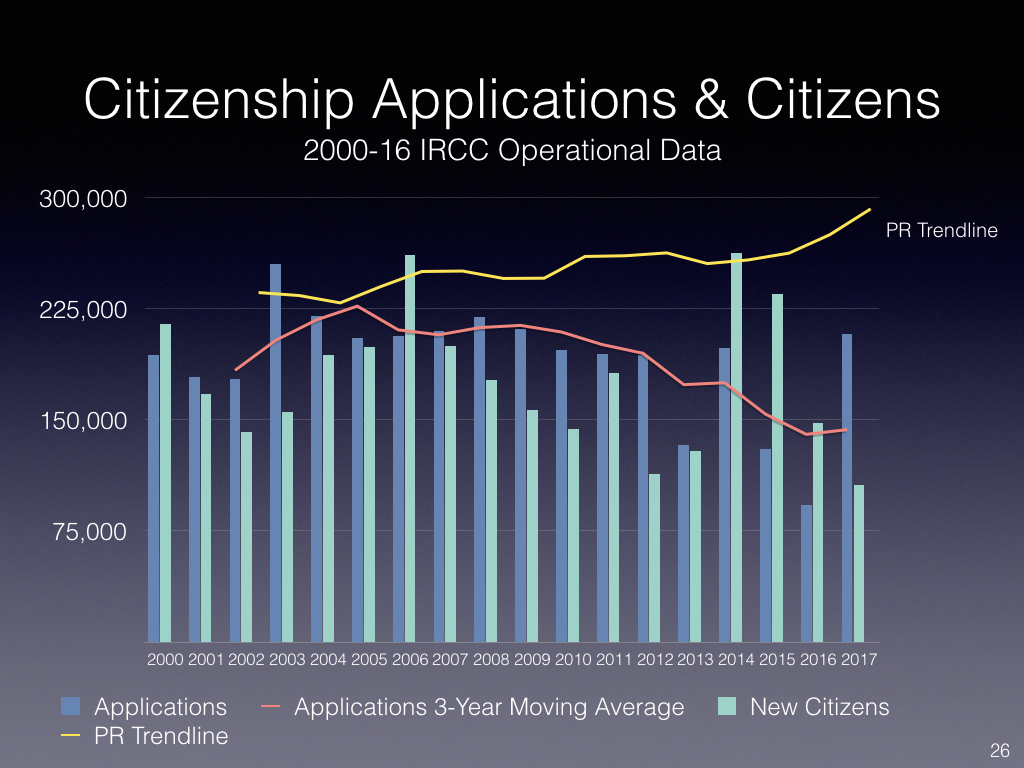
Citizenship Applications Dramatic Increase Post-C-6 Residency and Testing Changes


The above chart includes full 2017 citizenship IRCC operational data (preliminary).

Following the coming into force of C-6 reduced residency requirements (from 4 to 3 year minimum) and exemption from knowledge and language assessment for 55-64 year olds, there was clearly pent-up demand. From January to September, 108,001 applications were submitted (monthly average 12,000), from October to December, 99,562 (monthly average 33,187: the changes came into force on October 11).

As I have noted before, the reduced residency requirement will have a one-year impact on all applicants that will work its way through until October 2019; the 55-64 year old exemption will have an ongoing impact on a sub-set of applicants (2009-13 data showed about six percent of all applications were from this age cohort).

Given current end-to-end processing times, one should start seeing the impact of this increase mid-2019.

The 14-17 year old exemption will have a minimal impact given that this cohort will have been in the Canadian school system.