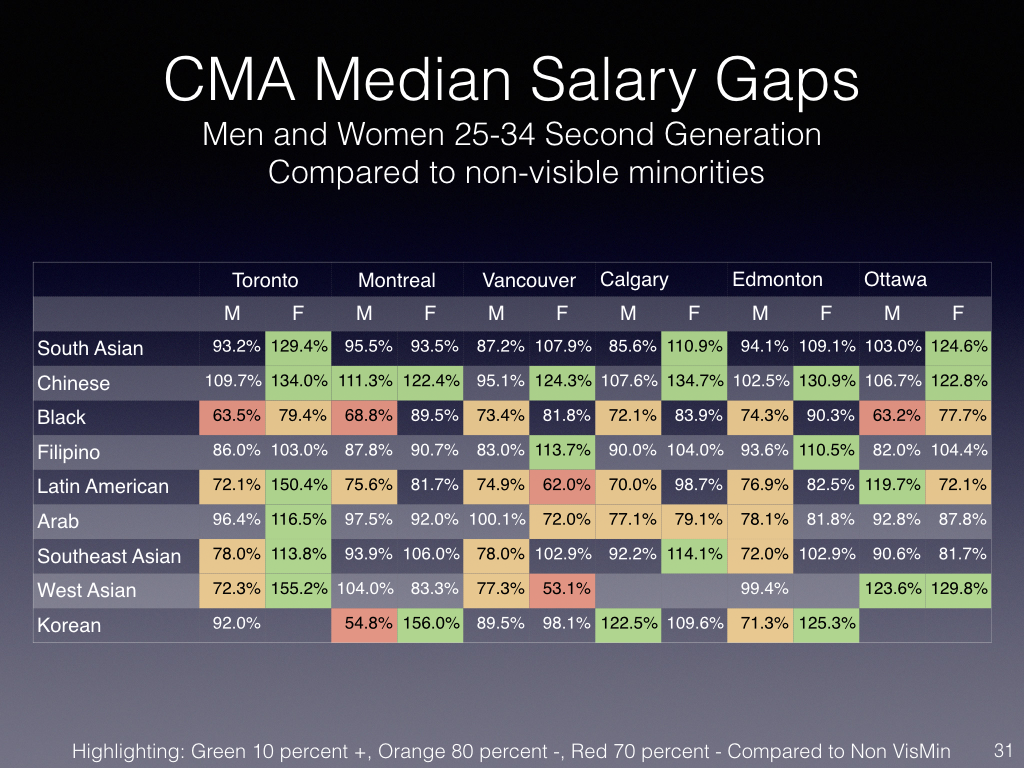
Have been working through some of the Census data and the gender gap works both ways depending on the group as the above chart indicates.
Given Williams’ focus on the Black community, which the data supports, her perspective is understandable but the data shows a more complex reality among the different minority groups and gender:
The gender wage gap remains a pertinent issue in Canada, despite how long women have been lending their labour to the workforce. And we often hear statistics that contrast two categories: men and women. On this, the numbers are stark.
But that data doesn’t incorporate filters around identity and background of women, an omission that effectively erases the compounding discrimination faced by non-white women in Canada. A lens that compares only men and women sets up women’s rights as a replica of patriarchy, where one group is favoured over everyone else; in doing so it reinforces the rigid power structures that have brought us to this point. But including race in the analysis reveals a different kind of gender gap that’s perhaps even more alarming than the broader issue.
In a 2011 Canadian Centre for Policy Alternatives report examining census data from 2006, Sheila Block and Grace-Edward Galabuzi found dire income disparities for racialized Canadians. They earn 81.4 cents for each dollar white Canadians make, and the jobs are typically less desirable: low wages, precarious, non-permanent. Add the filter of gender, though, and a much wider, more worrisome gulf appears: “Racialized women earned 55.6 cents for every dollar non-racialized men earned in 2005 . . . Racialized men made 77.9 cents for every dollar non-racialized men earned,” wrote Block and Galabuzi. “The gap narrows even further when comparing racialized and non-racialized women. Racialized women earned 88.2 cents for every dollar that non-racialized women earned.”
Research has been done to identify the core issues and advance solutions around the position of Indigenous and Canadian women of colour in the work market. “Inequality, discrimination and a segmented labour market have left women of colour with earnings at just 64 per cent of men’s, and Aboriginal women’s earnings at just 46 per cent of men’s,” wrote Lisa Lambert in a 2010 paper titled “Gender wage gap even more pronounced for Aboriginal women.” For women of colour and Indigenous women in Canada, she writes, “the earnings situation is inexcusable.”
How are we closer to gender parity in Canada when the gender gap we often think about ignores the unique struggles of women of colour and Indigenous women? If white men are still making more money than white women, can this be acknowledged while addressing the fact that women of colour fall far below both? If we actually believe in the principles of equality with which Canada so proudly associates itself, we must acknowledge both crises: the gap between men and women, and that between racialized women and everyone else.
President Trump’s proposal to cut legal immigration rates would delay the date that white Americans become a minority of the population by as few as one or as many as five additional years, according to an analysis by The Washington Post.
The plan, released by the White House last month, would scale back a program that allows people residing in America to sponsor family members living abroad for green cards, and would eliminate the “diversity visa program” that benefits immigrants in countries with historically low levels of migration to the U.S. Together, the changes would disproportionately affect immigrants from Latin America and Africa.
Currently, the Census Bureau projects that minority groups will outnumber non-Hispanic whites in America in 2044. The Post’s analysis projects that, were Trump’s plan to be implemented, the date would now be between 2045 and 2049, depending on how parts of it are implemented.
(The Post’s methodology for estimating the annual impact of Trump’s proposed cuts is explained in more detail at the bottom of this story. Projecting this far into the future based entails certain assumptions that could alter the range, but demographic experts said The Post’s approach was reasonable.)
All told, the proposal could cut off entry for more than 20 million legal immigrants over the next four decades. The change could have profound effects on the size of the American population and its composition, altering projections for economic growth and the age of the nation’s workforce, as well as shaping its politics and culture, demographers and immigration experts say.
“By greatly slashing the number of Hispanic and black African immigrants entering America, this proposal would reshape the future United States. Decades ahead, many fewer of us would be nonwhite, or have nonwhite people in our families,” said Michael Clemens, an economist at the Center for Global Development (CGD), a think tank that has been critical of the proposal. “Selectively blocking immigrant groups changes who America is. This is the biggest attempt in a century to do that.”
Trump’s plan calls for eliminating all family-based visa programs that are not used for sponsoring either minor children or spouses. That means several current family-based visa programs – including those that allow sponsorship for siblings, adult parents and adult children – would be canceled. It also calls for the elimination of the diversity visa lottery, and the reallocation of its 50,000 visas to reduce the number of immigrants already on a backlog and to go to a new visa based on “merit.”
The Post analyzed a low-end and high-end estimate for cuts to legal immigration under the Trump plan. The low-end estimate, provided by Numbers USA, a group that favors limiting immigration, suggests that about 300,000 fewer immigrants will be admitted legally on an annual basis. A high-end estimate from the Cato Institute, which favors immigration, suggests as many 500,000 fewer immigrants would be admitted. Cato bases its number, in part, on assumptions that more family visa categories will be cut.
Last August, Trump endorsed a Senate bill written by Sens. Tom Cotton , R-Ark., and David Perdue, R-Ga., that would cut legal immigration levels by close to 500,000 people annually, according to estimates by the bill’s authors. The White House has not released any estimates of its own plan.
If Trump’s plan is not implemented, the white share of the population is expected to fall from above 60 percent in 2018 to below 45 percent in 2060. The Post’s lower estimates of the impact of Trump’s proposal show whites staying the majority group until 2046.
To its defenders, the White House proposal offers a reasonable compromise. Trump would move America to an immigration system based less on bringing families together or encouraging diversity and more on bringing in those with skills proven to the economy. (He also proposes protecting about 1.8 million young immigrants known as “dreamers” in exchange for a significant boost to funding for border enforcement and a border wall.)
“It is time to begin moving toward a merit-based immigration system – one that admits people who are skilled, who want to work, who will contribute to our society, and who will love and respect our country,” Trump said in his State of the Union address last week.
But by reducing the country’s overall population, the plan would eventually reduce the overall growth rate of the American economy. Under Trump’s plan, the American economy could be more than $1 trillion smaller than it would have been two decades from now. That’s largely because the economy would have fewer workers.
The plan could also raise the median age of the American worker. About four of every five immigrants is projected to be under the age of 40, while only half of the country’s overall population is that young, according to Census Bureau data. A demographic crunch is already expected due to millions of upcoming retirements from the aging “baby boomer” generation, raising concerns about the long-term solvency of programs such as Social Security and Medicare that rely on worker contributions.
The plans could have long-term ramifications for America’s political system, given that about 54 percent of all immigrants are naturalized within 10 years and thus able to vote, although naturalization rates vary widely based on immigrants’ country of origin, according to the latest data from U.S. Citizenship and Immigration Services.
Hispanic immigrants who are registered voters favor Democrats over Republicans by a 70 to 18 margin, and registered voters who are Asian immigrants favor Democrats by a 50 to 33 margin, according to the most recent data available from the Pew Research Center. (Similar data was not available for African immigrants.) Approximately 78 percent of immigrants from Africa and 65 percent of immigrants from Asia were naturalized within 10 years.
But while these effects of delaying America’s diversification would be significant, they would not fundamentally change the country’s demographic destiny. Experts say the main driver of diversification in America is the native-born Hispanic population, which grew by about five million from 2010 to 2016, just as the native-born white population shrank by about 400,000 over the same time period, according to Census Bureau data.
Among young Americans, the share of the non-Hispanic white population is already under 60 percent – a number that falls close to 50 percent among newborns and toddlers.
“You can shut the door to everyone in the world and that won’t change,” said Roberto Suro, an immigration and demography expert at the University of Southern California. “The president can’t do anything about that. If your primary concern is that the American population is becoming less white, it’s already too late.”
But if Trump’s plan were put in place, many of the family immigrants who would eventually be exposed to the cuts come from Latin America. In fiscal year 2017, about 28,000 Mexicans received family-based visas, with immigrants from Asia receiving almost 90,000 and immigrants from Central America and the Caribbean receiving more than 60,000, according to State Department data.
The changes to legal immigration could vary widely depending on unforeseeable events, including increased economic development in Asian and African countries, dislocation caused by climate change or decisions made by future administrations.
William Frey, a demographer at the Brookings Institution , produced a separate estimate of the impact of Trump’s proposed cut to legal immigration. He found that the plan would delay the arrival of a “minority-majority” nation by three years, to 2047, and stressed his projections were the best possible with the publicly available information.
Another big factor is what happens to the population of roughly 11 million undocumented immigrants, including the “dreamers,” currently in the country. The Post’s calculations (like the Census Bureau’s) currently assume they will stay. But their future status is unresolved, and if any significant number of them are forced to leave the country, it could push back the minority-majority date as well.
“The President has laid out a reasonable framework that addresses the key security issues identified by the frontline men and women” of the Department of Homeland Security, said Tyler Houlton, an agency spokesman, in a statement. “It secures the borders and ensures we can remove those we apprehend, including criminal aliens. It also seeks to protect nuclear family migration while ending two problematic visa programs that do not meet the economic or security needs of the country.”
Trump’s proposal is unlikely to be implemented in its current form. It requires congressional approval, and Democratic leadership opposes it.
“These historically high levels of legal immigration only date back a few decades,” said Chris Chmielenski, director of content and activism at NumbersUSA. “The numbers we’ve seen recently are abnormal, and Trump’s proposal would eventually return us closer to historical levels.”
Immigration advocates say the percentage of the foreign-born population has been higher at several points in American history, even if the overall number of incoming immigrants has increased. Looking at the share of the population, which accounts for overall population growth, recent levels of legal immigration appear roughly in line with historical averages, with a decrease after World War II an outlier, according to Migration Policy Institute statistics.
“Recent immigration flows have been a small fraction of historical levels,” said Clemens of CGD.
Others who favor immigration restrictions have pointed to the necessity of reducing what they call the social disruption of high levels of immigration, which strikes some liberal critics as code for keeping America’s white population in the majority.
“We can’t restore our civilization with somebody else’s babies,” Rep. Steve King, R-Iowa, an immigration restrictionist in Congress, said on Twitter last year.
One of the biggest unknowns is how long new immigrants will identify as racial minorities.
Some academics, as Duke Professor William Darity Jr. wrote in The American Prospect, argue that many Latino immigrants “identify less as Hispanic and more as non-Hispanic white” the longer they stay in America – a phenomenon similar to the absorption of Irish and Italian immigrants into the idea of “whiteness.”
Other demographers say a real and important shift is underway, with important consequences for American politics. They note that many Hispanics already identify as white and yet still vote like a minority group. “The contention that [Hispanics] will think of themselves as white in the future is unsettled,” said Ruy Teixeira, a senior fellow at the Center for American Progress and author of a book about how demographic changes will affect American politics. “It definitely seems like they’re a different breed of cat.”
But perhaps the most lasting impact of Trump’s policies would be not to America, but to the millions of immigrants from poor and developing countries that the United States would be denying entry to, said Angélica Cházaro, a law professor at the University of Washington who specializes in questions of immigration.
“We’re talking about susceptibility to pain and violence and economic and social instability for millions of black and brown people,” Cházaro said. “People have organized their lives around the possibility of legal immigration, and this forecloses that route.”
Methodology
In 2014, the Census Bureau projected the U.S. population by race, ethnicity, sex, age and nativity. Those projections, the most recent available, are the basis for the prediction that the country will become “majority minority” in 2044.
To adjust those forecasts, we assumed cuts of between 300,000 and 500,000 per year and we assumed the cuts would be applied proportionally to each race and ethnicity based on their forecast representation in the immigrant population. The 300,000 estimate from NumbersUSA comes from projections of the Trump administration’s plan to cut several kinds of family-based immigration visas – those for siblings (65,000 visas annually), those for adult children (another 50,000) and those for adult parents of immigrants (another 125,000). NumbersUSA also projects a 55,000 reduction in annual visas awarded from the elimination of the diversity visa lottery.
The high estimate of Trump’s proposal found by the Cato Institute starts with all of the cuts found by NumbersUSA. But Cato also says other family-based visa programs are likely to be cut under Trump’s plan. For instance, Cato says a program for visas for children of non-citizens will be cut, because a Senate proposal similar to the White House framework eliminates it. That accounts for an additional 95,000 fewer visas annually between the groups’ projections. Cato also projects the annual impact of cutting visas for adult parents will be far greater than NumbersUSA does, because Cato looked at the number of these visas awarded in 2016, whereas NumbersUSA took a 10-year average of these visas. That accounts for an additional difference of 50,000.
We projected children that the lost immigrants would have had based on Census Bureau estimates of their female population of childbearing age, plus Pew Research projections of first-generation immigrant fertility by race and origin. In some cases, when it was the only data available, we used Census Bureau figures for “black only” and “Asian only” as a rough analog for “black, non-Hispanic” and “Asian, non-Hispanic.” Other groups were treated similarly.
The Census Bureau made no distinction between documented and undocumented immigrants. Our estimates only include the policy’s direct effect on legal immigration, but our models of the race, age and sex of immigrants are based on the full immigrant population. We found that more complicated models produced similar results.
We arrived at rough estimates of GDP growth by comparing our predictions for the country’s entire population under various scenarios with forecasts of per-person economic output by PwC , a global consulting firm. The estimates don’t account for how the exclusion of certain groups of immigrants would change the overall age, education and skill level of the labor force.
Noah Smith provides a detailed analysis of Asian “chain migration,” nicely contrasting the negative narrative with respect to Mexico and Central Americans with the strong economic outcomes of Asian immigrants admitted under the US equivalents to family class:
“Chain migration.” It’s a term that’s on the lips of lots of people in the immigration debate. Stephen Miller, the Trump aide who has been the most forceful proponent of immigration restriction, uses the term constantly. Originally, “chain migration” referred to the repeated use of family-reunification immigration — a man brings in his wife, who brings in her sister, who brings in her husband, who brings in his brother, and so on. Now, though, restrictionists have begun to use the term to refer to any and all family-reunification immigration.
Reducing legal family-based immigration is such a huge priority for the Trump administration that President Donald Trump offered to give unauthorized immigrants a path to citizenship — something Republicans have long opposed — in exchange for cuts to family reunification. Restrictionists’ primary target is shifting from those who enter illegally to those who enter to be with their families.
Family reunification has been one of the main ways to enter the U.S. since the reforms of 1965. Whether you want to label it “chain migration” or not, there’s no doubt that it has changed the face of the country. One of those big changes has been the creation of an important new group — Asian Americans.
In 1960, before the immigration reform, there were fewer than 1 million people of Asian descent in the U.S. — less than half a percent of the population. As of 2016, there were more than 21 million, representing almost 7 percent of the population. That’s about three times the number of Jewish Americans, and about half the number of black Americans. In states such as California and Hawaii, the Asian percentage is even larger.
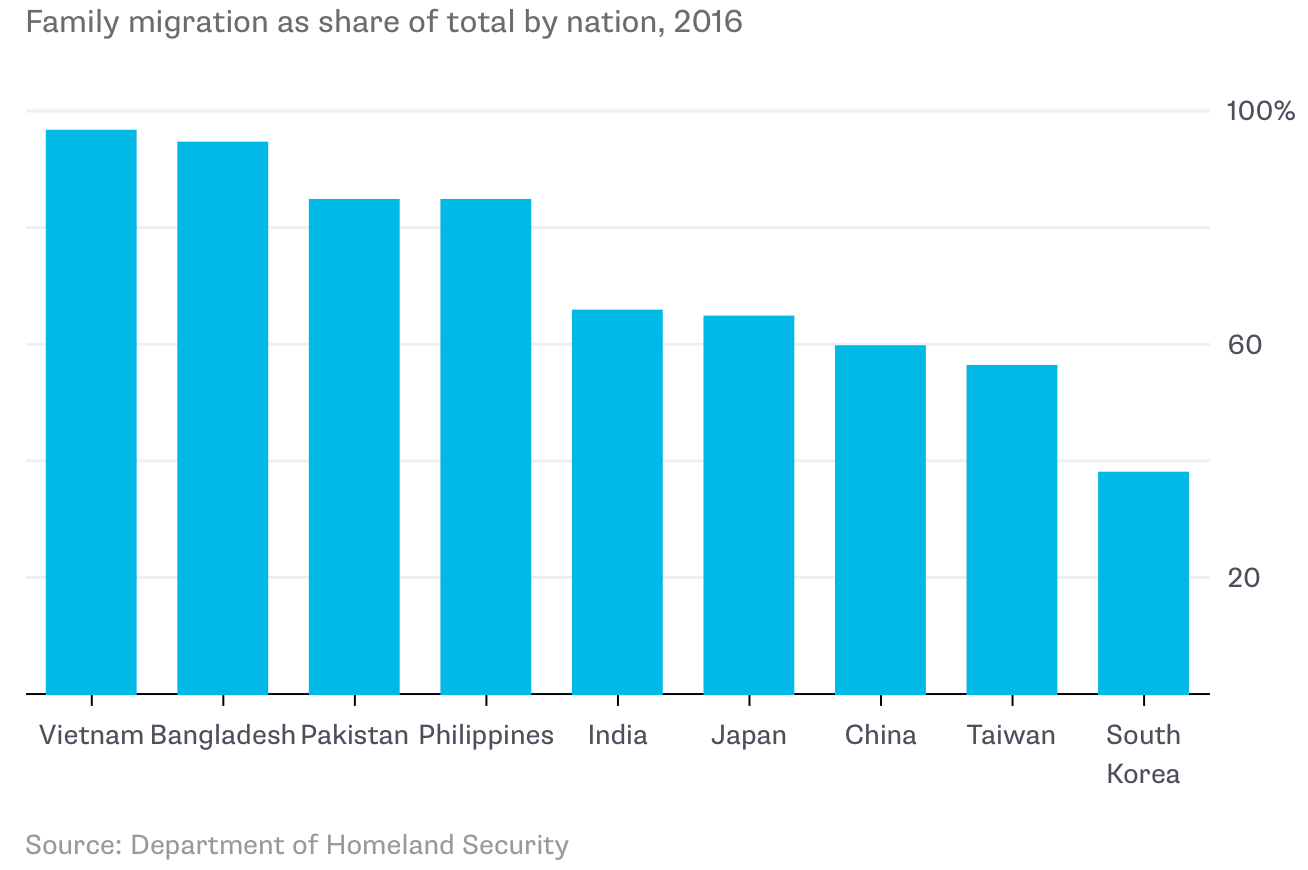
Unlike Mexico, Asian countries don’t share a land border with the U.S. This means that there are two main ways for Asians to move to the country — employer-sponsored visas like the H-1B, or family reunification. In 2016, Asians were the biggest users of family preference immigration — one kind of legal immigration that Trump would mostly do away with:
Family Planning
Without family-reunification immigration, there would still be many Hispanic Americans and black Americans, but there wouldn’t be nearly so many Asian Americans. Combined, family preference and immediate family immigration (which includes spouses, minor children, and parents) accounts for a very large percent of the growth of Asian minorities:
Almost All in the Family
If adult children, parents and siblings of U.S. citizens were barred from immigrating, as under Trump’s plan, the growth of Asian America would slow dramatically. The slowdown would be even worse than these graphs show, because some highly skilled employer-sponsored immigrants would refuse to come work in the country if they couldn’t bring their elderly parents with them.
That would certainly be a slap in the face to Asian Americans, since many would take the restriction as a declaration that they are undesirable as a group. What’s more, to repudiate family-based immigration is tantamount to wishing that Asian America as we now know it had never come into existence.
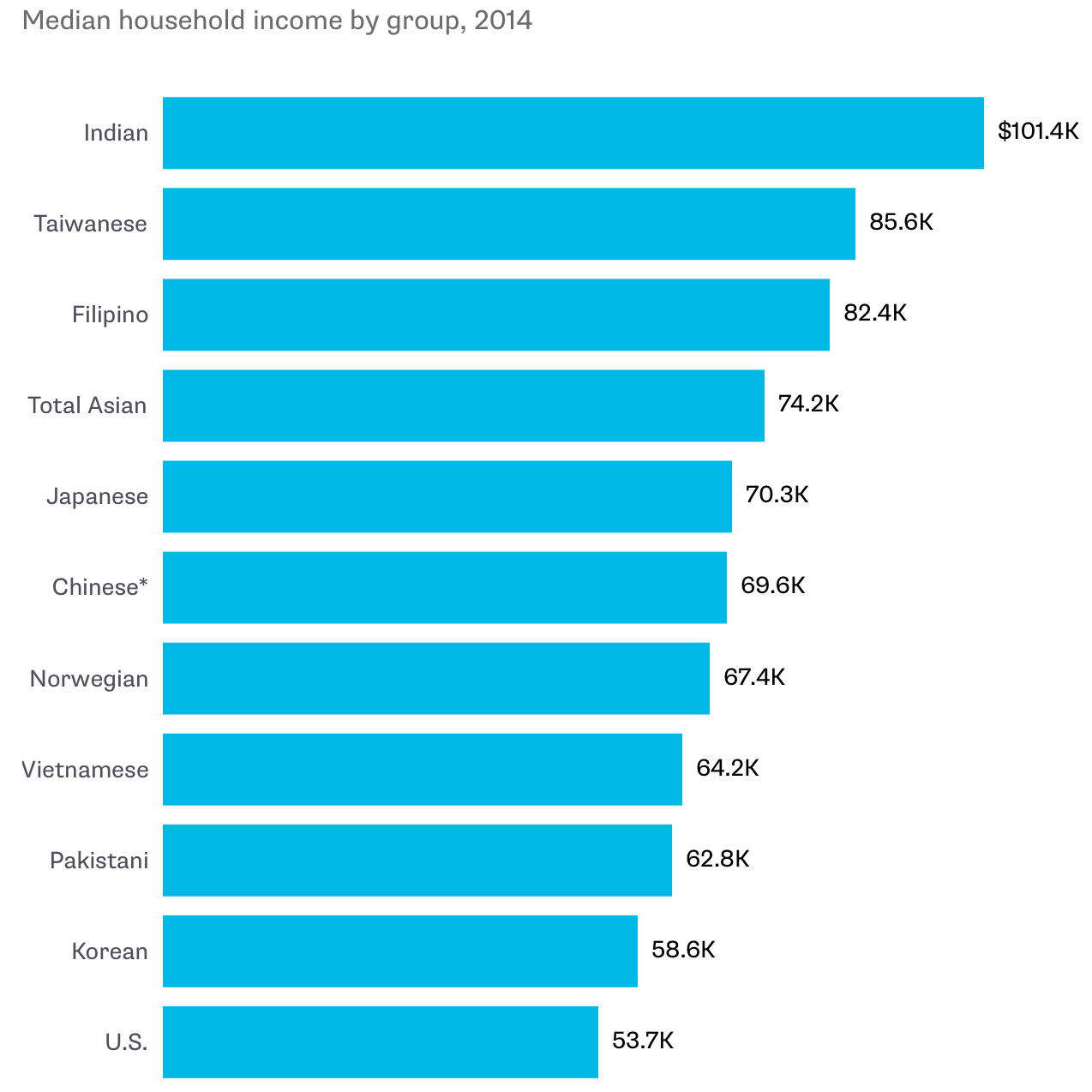
Though high-skilled immigrants come from all regions of the globe, and all have been successful in the U.S., the achievements of Asian Americans are particularly well-known. Despite language barriers and lack of local ties, Asian Americans tend to be economically successful, comparing favorably to the Norwegian immigrants Trump declared he wanted:
*Excludes Taiwanese
Asian Americans also have persistently lower unemployment rates than white Americans, and their average wealth has been increasing rapidly. Beyond these blunt economic statistics, Asian Americans have contributed to the fabric of American society in countless key ways — starting companies such as YouTube, Yahoo and NVIDIA; inventing the birth control pill and AIDS treatment; directing Hollywood movies; serving in the U.S. Senate; and helping defeat the country’s enemies on the battlefield. And those are only a few famous individuals — there are many more, in addition to the countless less famous Asian Americans who have added in a million small positive ways to the fabric of the country. Meanwhile, this new group of people been integrating rapidly and deeply into American society — 46 percent of U.S.-born Asian Americans intermarry with Americans of other backgrounds.
The point here is not to glorify Asian Americans over other immigrant groups, or to imply that only famous or high-earning individuals contribute to America. The point here is merely to illustrate one clear example of a case where “chain migration” added something special to the U.S. that wouldn’t even exist otherwise.
When Miller and Trump say the words “chain migration,” you shouldn’t imagine a faceless horde of invaders coming to claim welfare benefits and live off of the largesse of the native-born. Instead, you should imagine all the good and noble human beings who have made America what it is today — the mothers and fathers, the workers and inventors, the good neighbors and friends. Before changing the country’s immigration system, we should stop and reflect on all the real benefits we wouldn’t have without it.
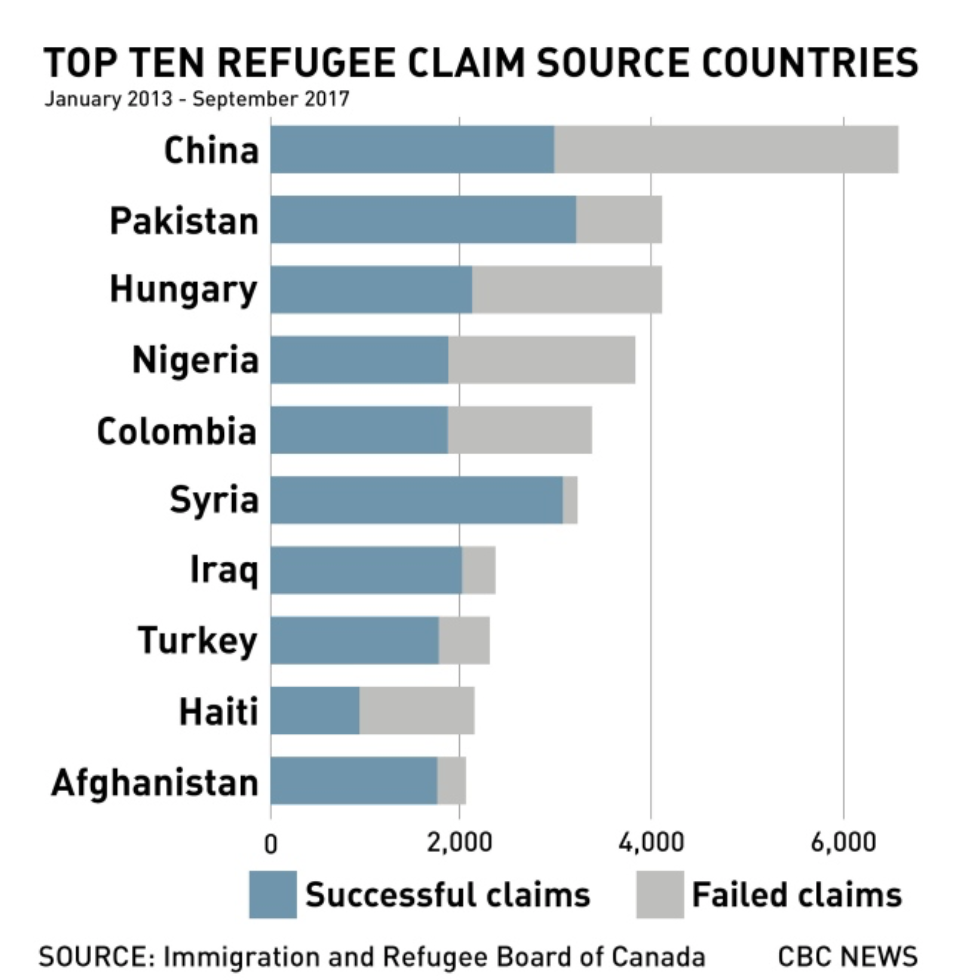
Canada is accepting a higher proportion of asylum seekers than it has at any time in nearly three decades, a CBC News investigation has found.
CBC obtained almost 90,000 asylum claim decisions made by the Immigration and Refugee Board of Canada between January 2013 and September 2017.
The decisions indicate where each asylum seeker comes from, why they said they had to flee their homeland and whether their bid to stay in Canada was successful.
The acceptance rate increased significantly in the past five years, to 70 per cent in the first nine months of 2017, up from 44 per cent in 2013.
The last time acceptance rates were this high was in 1991.
When asked what’s behind the increase, IRB spokeswoman Melissa Anderson said each refugee claim is reviewed on its own merits and decided on the basis of the facts and evidence presented.
Many asylum seekers say they were forced to flee criminals or gangs.
Most immigration experts who spoke with CBC News agree an important factor was likely changes to the IRB system introduced at the end of 2012.
The result was that, in most cases, a claim had to be heard within 60 days of being accepted by the IRB. Before that, cases wouldn’t be heard for about 18 months, said Vancouver refugee lawyer Douglas Cannon.
Because lawyers had so much lead time, board members expected to see considerable evidence in order to approve a claim, he said.
But with the drastically shortened timelines, those expectations became unreasonable, he said, and board members had to make a call based on the evidence that could be gathered within two months.
Before the changes, for example, it may have been possible to get a police statement from Colombia documenting a reported assault, but likely not within 60 days.
Because refugee law requires board members to give the claimant the benefit of the doubt, acceptance rates went up, Cannon said.
“It’s not a judgment of the board lowering its expectations in order to render a positive. It’s a board doing the job that it needs to do in a much more efficient manner. And that is a good thing.”
Catherine Dauvergne, dean of the University of British Columbia’s Allard Law School, said it’s also possible a new training program for board members introduced in 2013 contributed to the bump in approvals.
The more comprehensive program gave board members a better understanding of all the factors that go into deciding a refugee claim and the obstacles the claimants face, she said.
Dauvergne said another factor could be an infusion of new board members replacing old ones who may have been suffering from “compassion fatigue.” A rule change in late 2012 scrapped the appointment system to allow any qualified federal civil servant the opportunity to apply for a spot with the IRB.
Reasons for fleeing
The data obtained by CBC also showed the top reason for seeking asylum was to flee criminals or gangs, but individuals who made such claims were among the least likely to be approved by the IRB.
One of the criteria for a successful refugee claim is to what degree a claimant fits the United Nations definition of a convention refugee: Having a well-founded fear of persecution for reasons of race, religion, nationality, political opinion or membership in a particular social group.
Those fleeing criminals or gangs often do not meet these criteria.
Political and religious refugees were the most likely to be accepted.
Source countries
Another key finding was that asylum seekers from China had the highest number of refugee claim decisions over the five-year period, but that number began dropping significantly in 2015.
The drop was attributable to two factors unique to that country: fewer claims from the Falun Gong spiritual group and the end of the one-child policy in 2016.
Decisions on claims from Hungary also dropped from almost 2,000 in 2013 to about 400 in the first nine months of 2017. This was due to substantially fewer claims from members of the Roma ethnic group.
Meanwhile, Nigeria surpassed China as the country with the most refugee claim decisions in Canada last year. Many of the claims from Nigerians relate to sexual orientation and gender persecution.
Claims from Turkey have also increased significantly, making that country Canada’s second-largest source of asylum seekers. These claims were mostly political in nature, or from members of the Kurdish ethnic group.
The complexities of identity, “peoplehood” and rights:
The 2016 census revealed explosive growth in the self-identified Métis population in Canada. The 51.2 percent growth of self-identified Métis from 2006 to 2016 easily surpassed the growth of First Nations and Inuit populations.
The growth is spread unevenly across Canada. Notably, the Métis population skyrocketed in areas where no historic Métis communities were located. Recently published research by scholars Adam Gaudry and Darryl Leroux reveals that the self-identified Métis populations in Nova Scotia and New Brunswick surged by 900 and 450 percent, respectively.
Clearly, demography alone cannot explain the trend. According to Gaudry and Leroux, people in eastern Canada are claiming Métis identity based on Indigenous ancestry revealed through genealogy. They call the practice of reimagining racial identity based on the existence of long-ago Indigenous ancestors as “white settler revisionism.” Many of those claiming to be Métis base their revisionist identity on the mistaken assumption that a mix of European and Indigenous ancestors is a sufficient basis to claim a Métis identity.
Far from being a harmless phenomenon, white settler revisionism systematically devalues Métis peoplehood by disregarding the process that led to the ethnogenesis of the Métis Nation.
The Métis Nation arose in the specific period after European contact and prior to European control of the specific geographical area referred to as the Métis homeland. The Métis homeland is a vast area now covered by the provinces of Manitoba, Saskatchewan and Alberta, and stretches into portions of Ontario, British Columbia and the Northwest Territories, as well as the northernmost plains of the United States.
The mass usurpation of Métis identity also has the potential to derail efforts at reconciliation between Indigenous people and the federal government.
Indeed, widespread assertion of Métis identity has the potential to stymie future policy frameworks. The Daniels decision, which held that Métis people are to be considered “Indians” for the purposes of section 91(24) of the Constitution Act, 1867, raises the possibility that the federal government will be required to provide more programs and services to Métis people.
Policy-makers must have a clear idea of the scope and distribution of a population requiring government support and engagement. The proliferation of dubious claims of Métis identity in disparate geographic areas poses serious obstacles to policy objectives.
The unscrupulous practices of organizations claiming to represent Métis people cannot be ignored. The Métis Federation of Canada, for example, does not require their members to prove Métis ancestry. Neither does the Bras d’Or Lake Métis Nation. To join these organizations, prospective members must simply demonstrate that they have an Indigenous ancestor. This ancestor can be Métis, Inuit or First Nations.
But the Métis Nation is not a simple conglomeration of ancestors with mixed ancestry. These organizations are creating chaos by convincing millions of Canadians that they are Métis, regardless of a lack of ancestral connection to the Métis Nation.
The Métis National Council and its provincial organizations, on the other hand, have meticulously crafted citizenship criteria that require concrete proof of Métis ancestry. In short, applicants must self-identify as Métis and demonstrate that they have an ancestral connection to the Métis Nation that arose in the historic Métis homeland.
Canada must intervene to ensure that the Métis National Council is not lost among an avalanche of illegitimate organizations. The federal government has begun this process by providing funding in its 2017 budget to the Métis National Council and its affiliated organizations. The money is going toward governance capacity and to support the council’s membership registry.
But more action is needed. Ottawa must affirm the Métis National Council’s resolution declaring that “there is only one Métis Nation, and that the geographic homeland of the Métis Nation is the historic Northwest which entered into Confederation in 1870 through the negotiations of the Métis Provisional Government led by President Louis Riel.” Only a clear and unequivocal statement will have the intended effect of silencing specious claims to Métis identity.
Additionally, policy-makers in Ottawa must understand that enabling the federal incorporation of dubious organizations like the Métis Federation of Canada could be harmful to reconciliation efforts with the Métis people.
Finally, Canada should provide funding to the Métis National Council so it can judicially intervene in response to illegitimate legal claims to Métis rights. A number of these claims have arisen in recent decades. Most recently, unsuccessful Métis rights claimants in New Brunswick sought leave to appeal to the Supreme Court of Canada a decision by the New Brunswick Court of Appeal that upheld the lower-court ruling that no historic Métis community existed in the province.
The Métis Nation and the federal government are on the cusp of achieving lasting agreements that will facilitate reconciliation and a just resolution to generations of conflict. But the proliferation of white settler revisionism and the mass usurpation of Métis identity threaten those prospects. The federal government must take seriously the threat posed to the Métis Nation by white settler revisionism, and continue to enact policy reforms to support the Métis National Council.
History could be in the making in Saudi Arabia after the Shura Council cleared the first hurdle by approving a study of two proposals to amend the citizenship law and allow women to pass on the Saudi citizenship to their children.
The proposals were initially submitted by three members in the previous term — Haya Al Manee’, Thuraya Abaid and Wafa Teeba — and taken up by two current members — Latifa Al Shaalan and Atta Al Subaiti.
Following a heated debate at the council on Tuesday, 63 members voted in favour of the amendments, ensuring that they are passed. They now go to the security committee that will present a final report to be discussed by the council at a later stage.
During the discussion on Tuesday, Shura member Fahd Al Enezi, a legal expert, said he vehemently opposed the amendments, resorting to religion to highlight his argument.
“Children must be attributed to their fathers, not to their mothers as is clearly stated in our religion,” he said. “A Saudi woman has the option to marry a non-Saudi. It is her choice. However, the citizenship is not her option and she is aware that her children will not obtain the Saudi citizenship.”
However, Faisal Al Fadil, also a legal expert, said that citizenship is a human right within the religion and is part of the fight against discrimination.
Mohammad Al Ali used economic arguments to call for defeating the proposals.
“Saudi Arabia is basically a desert nation and the quantity of water is limited,” he said as he presented virtual statistics about the high population in case Saudi women passed on their citizenship to their children, Saudi daily Okaz reported on Wednesday.
Abdullah Al Harbi warned of a waste of resources.
“Most of those born to Saudi mothers are competent and not giving them the Saudi citizenship is a loss to an efficient segment in the Saudi society, especially that they grew up in the kingdom and were educated here,” he said.
“Most countries allow women to pass on their citizenship, including in some Arab countries that have high population figures but whose economic development standards do not keep up with those of Saudi Arabia.”
He said that granting the citizenship would alleviate economic burdens for families and ensure promises of a brighter future for the children.
The issue of residency permits and entry visas required from non-Saudis living in the kingdom hampers the academic progress of the sons and daughters studying abroad since they have to go back to Saudi Arabia before their expiry, he said.
“The sons and daughters who are born in Saudi Arabia and grow up here develop strong links to their family and the Saudi society. Such attributes instill in them a sense of allegiance and belonging. However, if they are treated after graduation from colleges as foreigners, they are bound to face a multitude of hurdles even if they are top of their classes,” Al Harbi said.
Iqbal Darandari said she fully supported the amendment proposals.
“True faith is to be fair to all people,” she said. “There are children born here in Saudi Arabia to Saudi mothers. They grew up here and they know no other land. Where will they go if they do not have the citizenship?”
Darandari said that everyone should feel they are accountable before God for not assisting people.
In her argument, Noora Al Musaad said there was a deep need for endorsing the amendments.
“Most countries across the world allow mothers to pass on their citizenship to their children,” she said. “What we now have is a form of discrimination.”
For those interested, a good analysis of how Australia ended up in this mess regarding dual citizenship and political qualifications by Hal Colebatch of University of New South Wales:
The final session of the constitutional convention was held in Melbourne early in 1898. There was no further discussion of what became the now-infamous section 44, and a drafting committee took over to prepare a final draft.
Edmund Barton – soon to become Australia’s first prime minister – was the chair and dominant figure. He insisted on working till 4 or 5am, even though the other two members of the committee had gone to bed and only Robert Garran, the secretary, was left to maintain the illusion of a committee.
After four days of drafting, Barton presented the convention, on its second-last day, with 400 amendments. He proposed a three-hour break for the delegates to study them, after which they could be put to the vote en bloc.
Barton assured the convention that there was only one amendment of substance – to section 44(ii). What he did not say was that section 44(i) had been completely rewritten, changing it from an active voice (“done any act whereby”) to a passive voice (“is a subject or citizen … or is entitled to”).
No attention was drawn to this change, there was no explanation of it, and there was no time for debate on any clause unless someone objected to it. The constitutional text that proved so significant more than a century later was a last-minute change, drafted in private and accepted out of weariness.
In his history of the convention, J.A. La Nauze points out that, by this stage, the delegates “had had enough”, but muses:
it may one day interest a curious lawyer to inquire whether judicial review has lingered with significant consequences on new words approved on trust and intended … merely ‘to put the wishes of the convention in more complete and concise form’.
As it turned out, it interested more than the curious lawyer, and created a problem which has yet to be adequately managed.
Appealing to the umpire?
The constitution was rather unclear about how these provisions would be enforced. It said both that questions about qualification could be settled by each house, but also that “any person” who believed that an elected representative was disqualified by section 44 could sue them in “any court of competent jurisdiction”.
In any case, there was little call for either until the High Court decided in 1999 that the UK was a foreign power.
Even then it refused to hear a case calling for Tony Abbott and Julia Gillard to produce evidence they had renounced their UK citizenship, on the basis that they had declared that they were qualified, and so the court should presume that they were. To do otherwise would be a vexation and an abuse of the court’s time.
But when the court did deign to interest itself in the matter, it took the traditional High Court view that it was not interested in the problem, or what the writers of the constitution were trying to do, but only with the possible meaning that a black-letter lawyer could squeeze from these words, irrespective of its impact on the governing of Australia.
Where does this leave us?
The situation now is that the qualifications for candidature for the Australian parliament are set by the parliament, but the disqualifications are largely set by foreign governments via the High Court. This diminishes the ability of electorates to choose the representative they want (though, when given the chance, electorates show what they think of the High Court’s action by returning the ousted members in the ensuing byelection).
And the High Court’s escapade in the china shop is not yet over, for it has yet to rule on the disqualification of those who are “entitled to” foreign citizenship, even if they have not applied for it. If the court applied the same logic that it has used in the cases already decided, this would disqualify not only any Jew, but also anyone with a Jewish parent, grandparent or spouse, all of whom are entitled to Israeli citizenship under the Israeli Law of Return.
The best course would be to start with recognising the problem, rather than searching for a preferred solution. In contemporary Australia, identities are often complex, and citizenship entitlements may be multiple and overlapping. How these are to be recognised in the qualifications for candidature demands a period of public discussion culminating in political action.
The only way we could get this is to take the matter out of the hands of the High Court and foreign governments and return the task of defining qualifications and disqualifications for candidature to parliament. This could be done by adding to section 44 the phrase “until the parliament otherwise provides”, which is used in section 30 on qualifications, and at a number of other points in the constitution.
This would be a logical and constitutional response to the political problem that has landed on us. If the five main parties in the parliament (all of which have had their parliamentary representation threatened by the High Court’s actions) supported a referendum to achieve this change, it would probably be carried.
The voters, too, as they showed in New England and Bennelong, have had enough. They want the political leaders to lead.
I agree with the government on this one. And the brothers have lived abroad most of their lives with the main connection to Canada being their passport:
A judge has ordered the Trudeau government to issue citizenship documents—and a passport—to the Toronto-born son of elite Russian spies, ruling that the 23-year-old should be allowed to return to Canada even though the Supreme Court is still pondering whether to hear one last appeal in his controversial case.
Alexander Vavilov was stripped of his Canadian citizenship “through no fault of his own,” the judge ruled, and after winning it back last summer at the Federal Court of Appeal, he should not be forced to wait in limbo while Ottawa tries to convince the country’s top court to overturn that decision. Instead, the Liberals should reinstate Vavilov’s revoked citizenship—and allow him to come home—pending any potential ruling from the Supreme Court.
“It is difficult to accept that issuing these documents to this one person will cause significant and irreparable harm to the public interest,” wrote Justice Wyman Webb of the Federal Court of Appeal, in his Jan. 19 decision. “There is no allegation that Mr. Vavilov did anything wrong.”
Ottawa has fought for years to keep Vavilov from re-entering his country of birth, and despite this latest ruling the government is still doing all it can to keep him out. Instead of conceding defeat, Justice Department lawyers filed yet another motion last week, asking the Federal Court of Appeal to reconsider. The feds remain adamant that nothing should happen on the contentious file until the Supreme Court decides, once and for all, whether Vavilov is indeed a Canadian.
The high court has yet to announce whether it will weigh in on the matter, and is under no deadline to do so.
Vavilov was born in Toronto in 1994 as Alexander Philip Anthony Foley, the second son of a husband-and-wife team of deep-cover KGB agents who slipped into Canada during the Cold War and stole the identities of two dead babies from Montreal: Donald Howard Heathfield and Tracey Lee Ann Foley. Alex and his older brother, Timothy, spent their childhood oblivious to the fact that their parents’ real names were Andrey Bezrukov and Elena Vavilova, or that their mom and dad were prized assets of Russia’s foreign intelligence service. The boys were still young when the family moved to France, then Massachusetts—where, in 2010, the couple was arrested in a high-profile FBI raid that later inspired the hit TV series The Americans. Tim was 20 when his parents were exposed; Alex was 16.
After the bust made headlines around the world, immigration officials in Ottawa concluded that both brothers were never Canadian to begin with, despite being born here, because their parents were “employees in Canada of a foreign government,” a rare exception to the birthright rule under the Citizenship Act. Now Russian citizens who changed their last name to Vavilov, Alex and Tim have been battling in court to regain their Canadian status, arguing, among many other things, that they should not be punished for their parents’ espionage.
Though they lived abroad most of their lives, the brothers always travelled with Canadian passports and identified themselves as Canadians. “It is an integral part of my identity, the way others recognize me and is a recognition of certain values,” Alex told Maclean’slast year. “It is unacceptable that that the government may strip me of my rights just because it wants to.”
The feds appear especially eager to keep Tim, the eldest brother, from coming back. According to a report prepared by a senior immigration official, the Canadian Security Intelligence Service (CSIS) has told the government that Tim not only knew the truth about his parents’ double lives, but had pledged to join them—having been “sworn in” by the SVR, the KGB’s post-Soviet successor, before his mother and father were arrested.
Specific evidence to support that claim has never been revealed, and Tim, now 27, denies the accusation. “I am aware that there have been some media reports that my parents were ‘grooming’ me for espionage,” he wrote in one sworn affidavit. “These allegations are not true. It has been stated by the FBI that for over 10 years my home was bugged, however no evidence of my involvement has ever been presented.”…
As the banned substance begins to burgeon into a multi-billion-dollar industry, the once-petty crooks, many of them Black, with the grassroots know-how of how to run the business and who could become contributing members of society, are once again being shut out because they have criminal records.
The government has talked about amnesty for past marijuana crimes that would mean erasure of those records. But it is unlikely to take any action until after legalization — and already, others with money have plunked their grubby fingers in this pie to make more money.
This includes, of course, that shameless hypocrite and former chief of multiple police forces Julian Fantino, who helped passed into law Bill C-10 that included mandatory minimum sentences on people for having as few as six plants.
On Friday, The Canadian Press reported that a group of frustrated lawyers in Toronto is considering a class-action lawsuit against the government to push it into granting cannabis amnesty.
They should just do it.
Some advocates are also seeking an apology.
A reckoning of the unfairness with which anything related to marijuana has been treated is a long time coming.
Even the usage of the word marijuana — which comes from Mexico—came into being during the Prohibition Era to warn off Americans by appealing to their xenophobic sensibilities with the suggestion that it could lead to the intermingling of races.
In Canada, too, marijuana has proven handy as a system of racial control. In July last year, the Star published an analysis of 10 years of Toronto police data — including two years when Fantino was police chief — to show that Black people with no history of criminal convictions were three times more likely to be arrested for possession of small amounts of marijuana than white people.
The users are Black and white at about equal rates, but the people behind bars are disproportionately Black.
More recently, the American experience shows that even in states where the plant is legalized, while overall numbers of arrests have plummeted, Black people are still arrested at higher rates.
Four times higher in Washington, D.C., 10 times higher in Alaska.
From Richard Nixon’s so-called “war on drugs” to Ronald Reagan’s drug war to Bill Clinton’s “tough on crime” laws, the crackdown on drugs has always been an assault on race.
The scholar Michelle Alexander points out in her seminal book The New Jim Crow that Nixon’s White House Chief of Staff H.R. Haldeman recalled that Nixon “emphasized that you have to face the fact that the whole problem is really the Blacks. The key is to devise a system that recognizes this while not appearing to.”
The Reagan administration created an indelible link between drug abuse and Black people, she wrote in HuffPost. It hired staff whose responsibility it was “to publicize inner-city crack babies, crack mothers, crack whores, and drug-related violence.”
Clinton’s policies wrought the highest increase in number of people imprisoned.
But a change was coming. The face of drug users in the public imagination was getting lighter-skinned. Think Breaking Bad. Ozark.
“Changing attitudes and policies became possible in large part because the media was no longer saturated with images of Black and brown drug dealers,” Alexander said at a Drug Policy Reform conference in 2017. “The colour of drug users and dealers got whiter in the public imagination, and so we, as a nation, got nicer.”
Nicer in Canada would mean erasing criminal records without a fight, the flawed structure of the RCMP’s national criminal record database notwithstanding. That database can show whether someone has a record for possessing an illegal drug, but not necessarily which one, according to a report in Global News.
“That means that erasing marijuana possession (or trafficking) records could turn into a painstaking, manual process, involving searches in court and police archives across the country.”
No reason why people imprisoned for petty crimes should pay for the carelessness of those trafficking in power.
Will be interesting to see the results of the review and any subsequent changes:
Foreign caregivers will not be eligible for permanent residence if they have not accrued two years of employment by Nov. 29, 2019, according to a notice posted by the Immigration Department.
The federal government is currently reviewing Canada’s two programs for foreign caregivers — one for those caring for children and the other for those caring for adults with high medical needs — and has yet to decide whether to do away with them completely, renew them or come up with replacements.
“Both programs were launched as five-year pilots, including a date that they expire. With a launch date of November 29, 2014, this means they will expire on November 29, 2019,” said Immigration Canada spokesperson Faith St. John.
“An assessment is underway on both of these pilots. This assessment will help determine what pathway to permanent residence should be in place after that date. Options to replace the two pilots or make them permanent will be reviewed and announced before they expire in 2019.”
Caregivers and their advocates said they were caught off-guard by the announcement posted online over the weekend, prompting fear that this could mark the end of the special pathway to permanent residency for foreign caregivers.
“Many caregivers are confused and frustrated because of the turnaround from the government,” said University of Toronto social work professor Rupaleem Bhuyan, who leads the Migrant Mothers Project, a community-university research initiative to study the effect of immigration policies.
Bhuyan noted that the government has continued to process and issue caregiver applications since last November without telling them until now that they would not be eligible for permanent residence.
The government announcement has already created a buzz among the caregiver community here and abroad.
“A lot of people, even those in the Philippines, are talking about it. There is so much anxiety out there,” said Marilyn Battad, who came to Canada from the Philippines in June 2016 as a caregiver.
“We leave our family to come and work in Canada with the hope that we could bring our family here and have a better life. Some have lost hope now.”
Not only does the 2019 cut-off affect the caregivers arriving now, many like Battad could also be affected if they fail to meet the two-year employment requirement by the deadline for reasons beyond their control.
Battad, 37, was released from her first caregiver job just six weeks after she arrived in the Northwest Territories. It took her 10 months to find another job in Nobleton, Ont., and secure a new work permit, which expires next April.
Bhuyan said it typically takes caregivers at least eight months to secure a new job and obtain a new work permit
Canada’s unique program is believed to be the only one in the world that provides access to permanent status for foreign caregivers after two years of full-time employment as a caregiver. The access to permanent residency is an incentive to make up for the job’s relative low pay and sometimes unpleasant work conditions.
In 2014, the previous Conservative government overhauled the program by capping the number of caregivers who can access permanent residency at 5,500 a year and imposing new requirements for language and post-secondary education.
“This is another underhanded way for the government to quietly take away the pathway for permanent residency for caregivers. This is not OK,” said Anna Malla of the Caregivers Action Centre in Toronto.
“The need for caregivers for child care and home care is permanent and we need permanent solutions. Caregivers need stable immigration status to do the job well. They provide a very important service to make it possible for Canadians to go to work.”
Manuela Gruber Hersch, president of the Association of Caregiver & Nanny Agencies Canada, said she believes foreign caregivers will continue to come and work in Canada even without the bait of permanent residency.
“Ideally, they would like to become permanent residents, but the wage is much higher in Canada (and) they are not going to stop coming,” said Gruber Hersch.



 Multicultural Meanderings