How a broken jury list makes Ontario justice whiter, richer and less like your community

Good in-depth analysis and reporting:

A two-year Toronto Star/Ryerson School of Journalism investigation documenting the racial makeup of jurors in 52 criminal trials since 2016 in Toronto and Brampton reveals flaws in the jury selection process that skews towards property owners, fails to reflect the GTA’s growing diversity and excludes potentially millions of Ontarians from serving their civic duty.

The jury selection list is based on the province’s property assessment rolls, excluding many renters, boarders, students, seniors, spouses who are not named on property titles, transient and low-income people, Indigenous people and those unable to afford property in a red-hot real estate market.

What remains is a prospective juror list disproportionately comprised of white Ontarians able to afford the significant costs of serving in a system that often pays jurors less than minimum wage and does not cover expenses such as travel, parking, meals and child care. It is a particular hardship for hourly workers — Ontario has no law compelling companies to compensate employees for jury duty — the self-employed or those in temporary or contract jobs.

Seventy-one per cent of the 632 documented jurors were white in cities where more than half the population identifies as non-white (In Toronto, 51.4 per cent of residents identify as visible minorities; in Brampton, the figure is 73.3 per cent).

People who identify as Indigenous are not counted as visible minorities by Statistics Canada.

The finding of innocence or guilt by a jury of our peers is a pillar of Canada’s justice system that has been shaken by the recent verdict — delivered by an all-white jury — acquitting white Saskatchewan farmer George Stanley in the second-degree murder of a slain Cree man named Colten Boushie.

Following Stanley’s acquittal, Prime Minister Justin Trudeau said, “as a country we can and must do better,” and justice minister Jody Wilson-Raybould said the government is looking at peremptory challenges, which are used by the defence and prosecution to reject potential jurors without stating a reason. Reports say Stanley’s defence rejected five potential jurors who appeared to be Indigenous.

The Star/Ryerson investigation reporters did not watch jury selection in all 52 trials. The data in this story is based on sitting juries after the selection process, including peremptory challenges.

Beginning in February 2016, reporters attended GTA trials to document juries’ racial composition.

Because the Ministry of the Attorney General does not keep this data, and observers are denied contact with individual jurors, reporters decided upon a visual survey as the most complete possible method to gauge the racial makeup of juries.

Reporters noted jurors’ race based on their physical appearance, using the same categories as police: white, Black, Indigenous and brown, which includes South Asian people. Reporters added the categories Asian and other, which included Latin American, Middle Eastern or mixed-race jurors.

Of the juries documented, only three were composed of 50 per cent visible minority and 50 per cent white jurors. In most cases, white jurors represented the majority with as many as 11 of the 12 positions.

Of the 632 jurors surveyed by reporters, 451 (71 per cent) were white; 45 (7 per cent) were Black; 42 (7 per cent) were brown; 89 (14 per cent) were Asian; and 5 (less than 1 per cent) were listed as other. Reporters were unable to identify a single Indigenous juror.

Across the aisle, the visible ethnicity of the accused presented a very different picture: Of the 59 documented accused (some trials had more than one), 27 (46 per cent) were Black; 13 (22 per cent) were white; 11 (19 per cent) were brown; five (8 per cent) were Asian and three were counted as other.

Over the past decade, as the province’s cities grew increasingly diverse, the Ministry of the Attorney General has fielded many complaints and concerns about the Ontario jury system.

In 2013, Former Supreme Court judge Frank Iacobucci, who authored a report on the lack of Indigenous representationon jury rolls on First Nations reserves, recommended that the Ministry of the Attorney General “undertake a prompt and urgent review” of “using the OHIP database.”

That database, which better reflects Ontario’s population, is still not being used.

“There’s obviously a problem here,” says Ottawa defence lawyer Michael J. Spratt. “Trial by jury is a cold comfort when you’re told that you will be tried by a jury of your peers and no one on that jury looks like a peer. We’re unable to drag our courts into the 21st century and perhaps that explains why our jury system is still stuck in the 19th century.”

The first step in jury selection begins with a notice to Canadian citizens 18 years old and over from a database that generates property ownership and enumeration lists. It is managed by the Municipal Property Assessment Corporation (MPAC) and contains 9.5 million names of both property owners and non-owners.

The database is incomplete. But it has been used as the source for the jury pool for decades.

In a written statement, the Ministry of the Attorney General acknowledged the database used for jury selection, “does not capture everyone in the province” and that it is “committed to improving the provincial jury process.”

MPAC officials also concede shortcomings in the database including large groups of Ontarians who don’t own property.

Creating lists of prospective jurors is “not our core business,” said Syd Howes, manager of information services at MPAC. “This is a property assessment database, this is not a people database.”

Among the blind spots: “We don’t have very many resident students in our database,” says Howes. “And you have fairly large populations in nursing homes and retirement homes and again, we wouldn’t have a lot of those names in our system.”

MPAC doesn’t attempt to assess properties on First Nations reserves, since they are not subject to taxation. The Ministry of the Attorney General says those living on First Nations are entered into the pool from “other lists, like Band lists.”

It is unclear how those who don’t own property, such as renters, are captured. MPAC has mailed occupancy questionnaires to residential properties asking for information for non-owners but only about 20 per cent of the forms are returned, says Howes.

“We have no means of identifying when people move. People aren’t required to tell us … We don’t have access to good tenant information.”

The existing data on non-owners can be plagued with errors. After the 2014 election, MPAC reported 1.2 million revisions to the voter’s list, including changes to 20 per cent of its tenant list, according to a 2015 review obtained by the Star.

The faces that do make it into jury boxes across Toronto and Brampton often have one thing in common: they’re white.

In February 2016, reporters recorded a jury of 11 white people and one brown man hearing the case of a 25-year-old Black male. In March 2016, 10 white jurors, one brown and one Asian heard the case of a 40-year-old brown female. In January 2018, 10 white people and two Asians heard evidence in the trial of a 30-year-old Black male.

Harpreet Saini, a criminal lawyer who has been practising in the GTA for more than a decade, is not surprised.

“There is still a disparity between the communities that we serve and the different types of people who are represented in the criminal justice system.”

For Saini, a jury of peers is one that reflects “the place where you live.” That does not mean a jury must be “exactly like you,” but reflects “the diverse interest of your community.”

Anthony Morgan, a Toronto lawyer with Falconers LLP, says it’s time for the government to name the problem and take action.

“We’re never going to get to a place where we can fix this until we outwardly say, yes, there is an underrepresentation of Black people on juries but there is a dramatic overrepresentation of Black folks who stand charged of crimes,” he says.

In a Toronto jury selection pool of 119 people on Wednesday, reporters counted only three Black prospective jurors. The accused is a Black man in his 20s.

In 2016, Toronto lawyer Steven Hinkson represented a 36-year-old Black man charged with drug and weapons offences. Eleven of the 12 jurors were white.

His client had a question: How come there aren’t any Black people on the jury?

“I tried to explain to him, that’s all we had to choose from,” says Hinkson. “Justice has to appear to be fair and equal. If persons who are in the system don’t see themselves reflected in the system they aren’t going to have much faith in the system.”

Hinkson, who rarely sees more than one or two non-whites on a jury, says that jurors, who are not “culturally sensitive to a racialized person’s experience,” are likely to look upon defence witnesses with “undue scrutiny.”

Jurors unfamiliar with a dialect or accent, for example, “may not look upon the testimony as being equal to somebody who doesn’t have an accent or have a negative perception of them as a consequence.”

The trial of Hinkson’s Black client ended in a hung jury.

Hinkson suspects the majority of the jury was aligned against his client with the exception of the lone non-white member who he says was of East or West Indian descent.

“I think the person of colour was the one that saved us. I think that’s because he could relate more to what the defence was saying. The jury was coming back saying there was one member of the jury that was problematic. And you can see dynamics, the body language. It’s clear to my observation that he was the problem in this jury because his views were not what they wanted.”

In the second trial, his client entered into a deal to reduce the charges in exchange for a guilty plea on lesser charges.

Vanessa MacDonnell, a University of Ottawa law professor, says lawyers have a “professional responsibility, and I would say a constitutional obligation, to ensure that they don’t discriminate against people as part of jury selection process.”

She supports a switch to the more comprehensive OHIP database which could be done “without too much difficulty because these are lists (the government) compiled anyway.”

Former Ontario chief justice Patrick Lesage, retired after serving for nearly three decades on the bench, agrees property ownership is an inappropriate starting point for jury selection.

“If that is the case, it should not be the case,” he said. “It should be (representative of) a cross section of the community at large.”

Provincial health cards, he says, “may be the most universal list that exists. I can’t think of anything that each of us is more certain to have than a health card.”

Ottawa defence lawyer Michael Spratt sees the same jury faces all the time — white, middle class and older.

“I don’t care who makes (the juror list) as long as it is complete and as long as it is a full and accurate representation of the community, and that all individuals — whether you are poor, rich, white, Black, homeless or a homeowner — have an equal probability of forming that list,” he says.

Toronto lawyer Brian Eberdt, who is with Lockyer Campbell Posner, predicts 90 per cent of those involved with the criminal justice system would agree jury selection is a problem.

“I think it’s something that all members of the justice system — from defence, Crown, the court, the judges, and the ministry — I think it’s incumbent on all of us to make sure that the impact of race in distorting a jury’s deliberations is kept to a minimum … We’ve got a long way to go.”

Eberdt points to a jury selection in Brampton last year for a trial involving allegations against his Black client.

“In the entire room of several hundred jurors, I think I saw maybe half a dozen Black people. I know for sure that’s not entirely representative of the cultural mix of Brampton. There’s an unfairness to my client in that.”

Tale of two wards

The Toronto Star compared City of Toronto ward demographics for voting-age adults with ward data provided by the Municipal Property Assessment Corporation from its list of eligible voters — the same list that serves as a starting point for the selection of jurors.

Of the 17 wards examined, most in the old city of Toronto, two stand out.

In Ward 32, which includes the tony Beach neighbourhood, a Star analysis found the difference between the number of voting-age adults living there and the total on MPAC’s list was the smallest, with a 13 per cent variation.

In Ward 11, which includes the neighbourhoods of Weston and Mount Dennis and is among the poorest areas of the city, the difference was the largest, with a variation of nearly 95 per cent.

via How a broken jury list makes Ontario justice whiter, richer and less like your community | Toronto Star

Ontario puts moratorium on suspending racialized public servants

Strong step:

The province has put a moratorium on suspending racialized public servants while it reviews how it processes complaints on racial discrimination.

The announcement came a day after more than 20 Black employees, mostly women, brought their concerns directly to Michael Coteau, Ontario’s minister of children and youth services, who is also in charge of the province’s anti-racism initiatives.

At a meeting Jan. 18, past and present public servants said they suffered racial harassment and faced reprisal when making complaints.

Coteau heard stories from Black employees who said their roles were steadily diminished despite years of positive reviews. Others had trained new staff, only to see those new employees be given higher, more lucrative positions. Some said their complaints about racial discrimination were mishandled. A majority of the participants said they had been suspended, demoted or fired while the staffers they had complained about faced no repercussions.

“When I started at the ministry, I was confused for the hired help,” Hentrose Nelson, who has worked in the public service since 2004, told Coteau. Nelson was one of the organizers of the meeting and she spoke about her experience with the complaints and suspension process.

Nelson is also a plaintiff in a lawsuit against provincial Citizenship and Immigration Minister Laura Albanese, alleging systemic racism in the department.

None of the accusations has been tested in court.

Boafoa Kwamena, a spokesperson for the Ontario Public Service — which encompasses over 60,000 employees in the province’s ministries, agencies and Crown corporations — would not comment on specific complaints. She also declined to answer Metro’s questions about what prompted the moratorium or how long it will last, saying in an email this week only that it is in place pending the review of existing policies and procedures.

Where there is a clear case of wrongdoing such as theft or violence against another staff member, the moratorium does not apply as those cases are reviewed by the province’s Public Service Commission.

“Creating a safe, inclusive and respectful environment for everyone in the OPS is a top priority,” Kwamena wrote in an email.

She added that officials are working with the Black OPS Network, an internal employee network, on a three-point plan. It includes an independent third-party review of complex cases; an independent review of the Workplace Discrimination and Harassment Prevention policy with an anti-racism methodology; and developing an anti-racism policy. Attendees of the January meeting also called for these actions.

The review of the complaints process is intended to start by this March. A private sector lawyer will manage the review of complex cases. The OPS has declined to name the lawyer until a contract has been finalized.

“This is really something that we wanted to do for other Black women,” explained Jean-Marie Dixon, who has worked as a lawyer in the civil service.

Dixon says the action employees are taking now is for future generations. She wants to see people who have engaged in racism and discrimination fired as well as more funding and support for Black women going through a grievance, complaint or lawsuit.

Nelson welcomes the news of the moratorium and echoes the hope for more change to come.

“It’s not about our struggle only,” she said in an interview following the announcement. “It’s a systemic beast which we are trying to fight. It’s a huge win.”

via Ontario puts moratorium on suspending racialized public servants | Toronto Star

x

The Effect of Trump’s Immigration Crackdown, In 3 Maps – CityLab

Impressive detailed analysis:

As soon Donald Trump took office, his administration started on his primary promise: A crackdown on undocumented immigrants.

On his command, the Department of Homeland Security (DHS) widened the dragnet—targeting, essentially, anyone without papers, even if they had not committed serious crimes. The emphasis shifted beyond the border region, with federal immigration authorities using workplace and other raids to round up undocumented immigrants. Young people who were previously exempt from deportation through Deferred Action for Childhood Arrivals (DACA) also became vulnerable, after the Trump administration announced the end of the Obama-era program.

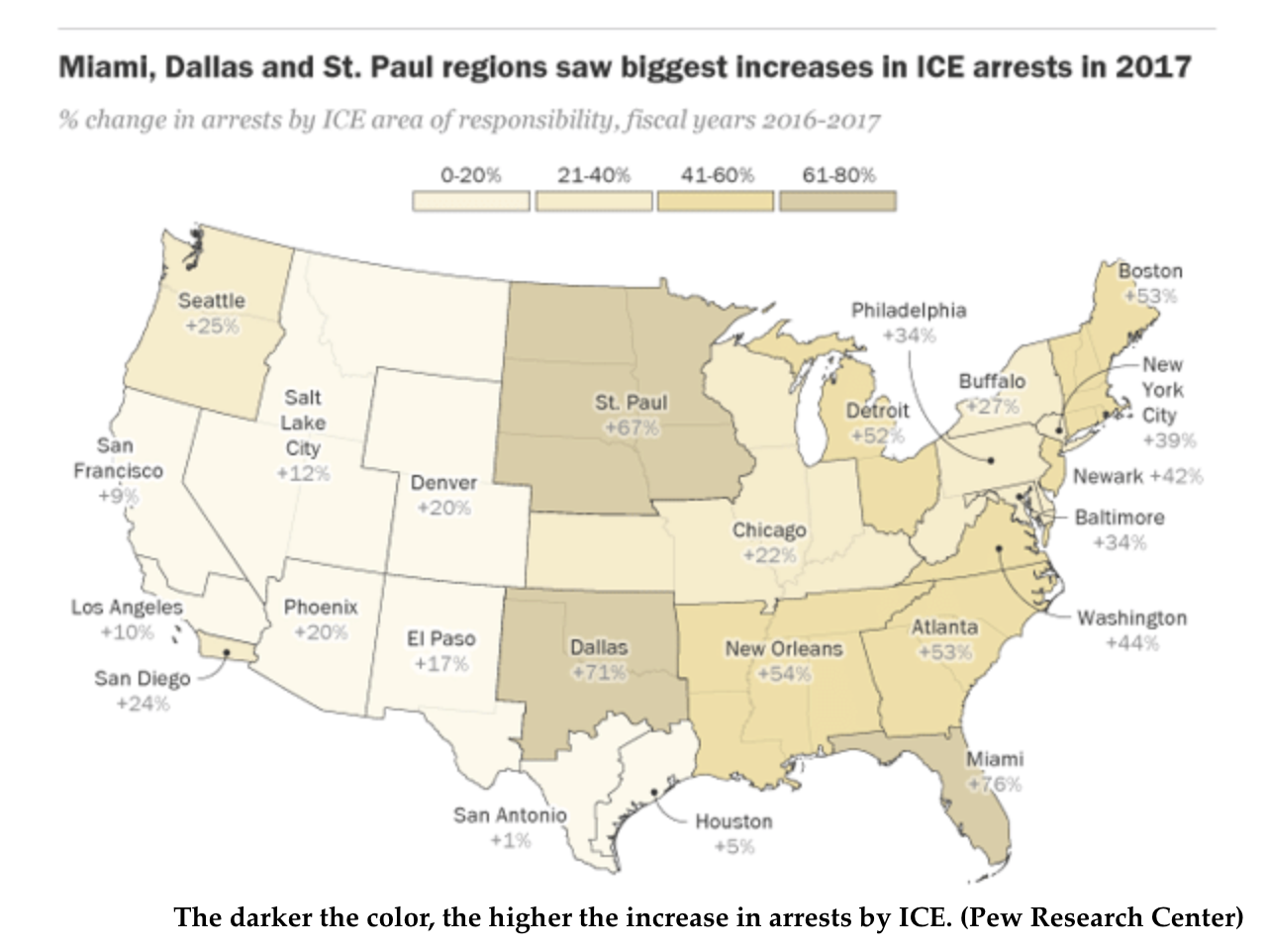
So, what has the impact of this aggressive approach been so far? Below are three maps that provide answers. The common theme: Local sanctuary policies that limit cooperation with federal authorities seem to be blunting the force of the administration’s actions. Areas with greater local limitations on federal immigration cooperation have seen, in general, smaller increases in arrests—even if they have large immigrant populations.

The first map comes from a recent Pew Research Center report, which analyzed the change in immigration arrests between 2016 and 2017. It finds that between January 20, when Trump took office, and September 30, when the fiscal year ended, Immigration and Customs Enforcement (ICE) arrests went up by 42 percent compared to the same period in 2016. The total arrests in 2017 were also 30 percent higher than the previous year.

While these numbers represent significant increases from recent years, they are not nearly as high as in 2009, when twice as many people were arrested. That initial high number in Barack Obama’s first year in office declined over the duration of his presidency, after he shifted policy to focus on deporting particular categories of undocumented immigrants. It’s also important to note that while the Trump administration is arresting more people, it has not yet been able to deport them at Obama-era levels because of immigration court backlog.

Pew’s report breaks down 2017’s increases in arrests by geography, showing where ICE has been most effective. The agency operates out of field offices in some major cities that cover not just that particular city, but wider “areas of responsibility” that sometimes span multiple states. All of these areas saw increases in arrests in 2017, but the Miami field office, which covers all of Florida, saw the most—a striking 76 percent increase compared to 2016. Dallas and St. Paul were next on the list, with 71 and 61 percent increases, respectively. (Dallas had the highest absolute number of arrests of all field offices.) New Orleans, Atlanta, Boston, and Detroit followed with more than 50 percent increases.

Here’s Pew’s map that colors the areas of responsibility based on the increase in arrests between 2016 and 2017:

The darker the color, the higher the increase in arrests by ICE. (Pew Research Center)

While the concentration of undocumented immigrants certainly drives arrest numbers, it doesn’t completely explain why some areas have had much higher jumps in arrests than others. If it did, immigrant-rich areas near the border, like El Paso and Phoenix, and traditional immigration hubs like New York and Los Angeles, would have all seen much higher increases.

What this map suggests is that local policies matter.

Take Miami, for example. The city renounced its sanctuary city statusafter the Trump administration threatened to withdraw federal funding. (Courts have since blocked that threat.) Attorney General Jeff Sessions praised that decision in a visit last year. Via USA Today:

“We cannot continue giving taxpayer money to cities that actively undermine the safety and efficacy of federal law enforcement efforts,” Sessions said during the appearance at PortMiami. “So to all sanctuary jurisdictions across the country, I say: Miami-Dade is doing it, other cities are doing it, and so can you.”

Miami’s decision to get local law enforcement involved likely helped boost arrests in and around that area, which already has a high concentration of immigrants.

The Atlanta metro area has also seen high increases in 2017 for the same reason. Despite former Mayor Kasim Reed’s defense of sanctuary cities, Georgia state law requires cooperation with ICE—and some of the counties around Atlanta have been quite eager to help. The state also has high penalties for driving without a license, which make it more likely for folks without papers to enter the criminal justice system, and then, the deportation pipeline.There is at least some indication that the Trump administration is trying to have the opposite effect, instead targeting those jurisdictions that have more protective local laws. In September 2017, ICE, focused their raids in localities and cities that have sanctuary policies, saying that the agency was “forced to dedicate more resources to conduct at-large arrests in these communities,” because of these policies. Later, ICE’s director also suggested that the politicians from these cities should face criminal charges for harboring undocumented immigrants. But so far, the effect of that laser focus is unclear—it’s certainly not visible in the aggregate data used for the Pew map.

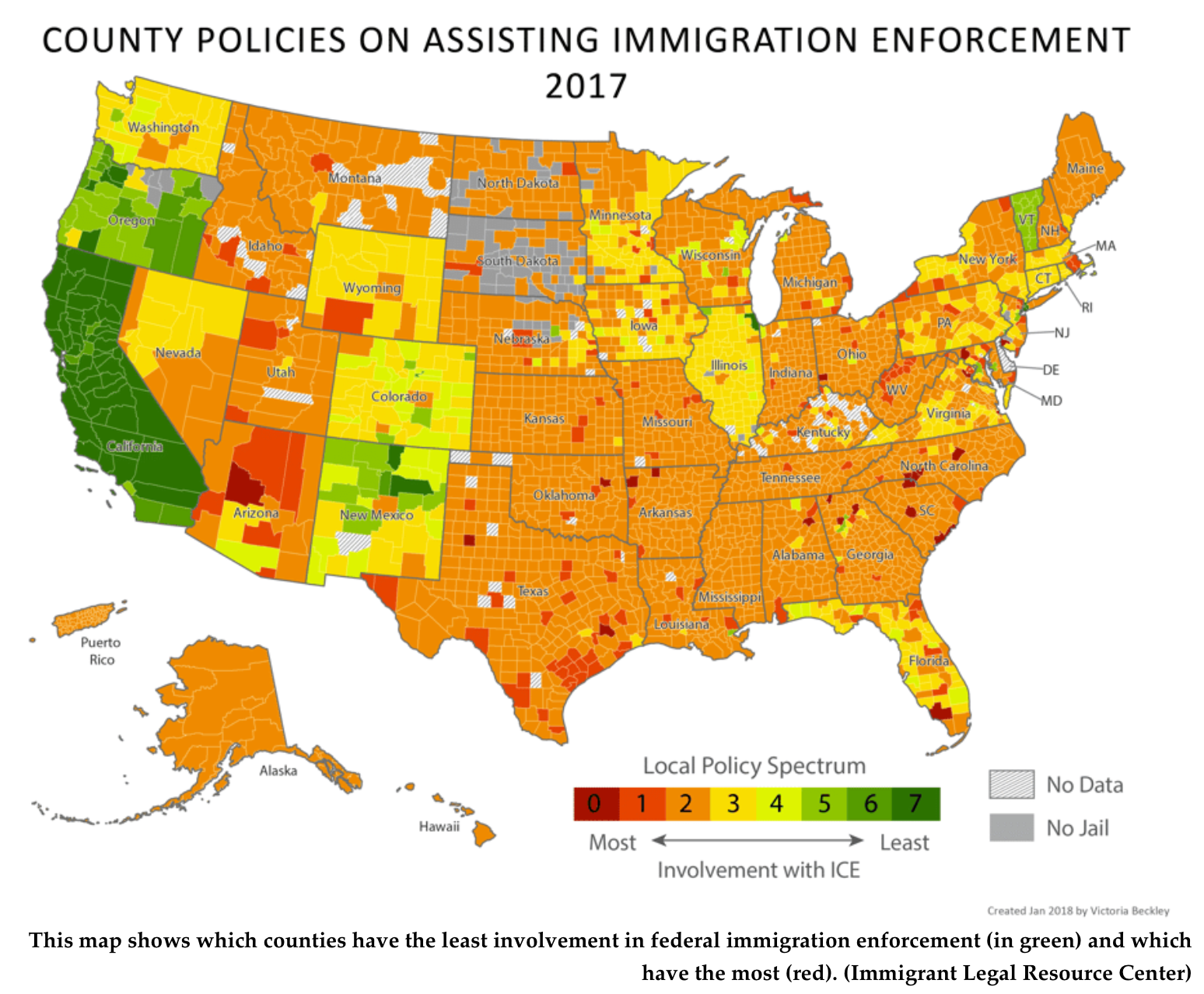
Local politics have also shifted in the last year, in response to the national immigration agenda. The second and third maps show the current county-level sanctuary policies—and how they have changed since Trump took office. Both come from a new report by the Immigrant Legal Resource Center (ILRC), an immigrants’ rights organization that has been tracking how involved localities have been in immigration enforcement.

The below map shows the strength of the sanctuary policies in 2017. The places in green are most protective of local immigrant populations—they disentangle policing from federal enforcement. In red are the places that provide the most assistance to federal efforts:
This map shows which counties have the least involvement in federal immigration enforcement (in green) and which have the most (red). (Immigrant Legal Resource Center)
ILRC legal researchers created these rankings based on a seven-point rubric that reflects the spectrum of existing sanctuary policies in 3,000-plus counties. They included policies that limit the use of municipal resources for immigration enforcement, that forbid police from collecting information about immigration status, that ask police to decline ICE’s warrantless requests to detain individuals for extra time, and others. They also looked at whether these localities had agreements with ICE (called 287(g) agreements) to deputize their police officers to do various immigration enforcement duties.ILRC also traced the changes in these policies. And what they noticed was that as the Trump administration doubled down on curbing illegal immigration, some local governments started joining the effort, while others started mounting resistance. According to ILRC’s analysis, 410 localities strengthened sanctuary policies in 2017 (in blue below). Many did so in more than one way. Denver County, Colorado, for example, enacted a law in 2017 that forbids city funds or resources going towards investigation or detention of undocumented immigrants—in the absence of a judicial warrant. It also rules out 287(g) contracts. A quarter of the counties have now put limits on how their police respond to ICE’s “detainer” requests, up from just a handful in 2013. These demands to detain individuals that the federal agency suspects are undocumented for longer than their sentence have been ruled illegal by severalcourts.

Fewer counties went the other way, the report notes (warm colors below). Only around 244 devoted more resources to helping out ICE in 2017. (Note: Local governments with 287(g) agreements have been increasing in the last two years, but in some cases, this move may have been balanced in some other way—by a stop in responding to detainer requests in fear of lawsuits. So counties that entered into new 287(g) agreements on this map below could appear as any color, depending on how weak or strong their original policies were in totality.)

Overall, though, around 74 percent of the counties continue to help ICE out in whatever way it asks, “often without even analyzing whether it is legal to do so,” the report notes.

“There is a great opportunity in 2018 to strengthen and establish new policies that actively protect our immigrant neighbors,” said LenaGraber, staff attorney at the Immigrant Legal Resource Center, in a statement. “And to not spend local resources detaining and deporting our community members.”

via The Effect of Trump’s Immigration Crackdown, In 3 Maps – CityLab

Businesses are floundering while Whitehall dithers on immigration

Interesting commentary from Adam Marshall, director general of the British Chambers of Commerce:

You might not know it, but a crisis is looming on the business parks, industrial estates, construction projects and farms of Britain. As the Brexit process dominates politics – and diverts Westminster’s energy away from virtually every other issue – businesses are struggling to fill vacancies and to find the people they need in order to grow.

In some sectors firms report that labour shortages have reached critical levels. A combination of record employment levels for UK-born people, significant falls in immigration following the devaluation of sterling in 2016, and the total absence of job candidates in some areas is biting hard. British Chambers of Commerce surveys show nearly three-quarters of firms trying to recruit are experiencing difficulties – this is at or near the highest levels since our records began more than 25 years ago.

Pragmatic solutions are needed to this acute and immediate problem. Job vacancies at all levels in the workforce are being left unfilled, damaging not only individual businesses and their growth prospects but also supply chains and the wider economy. While many firms report they are investing long term in the training and development of their workforce, this will take years to have the desired impact, particularly for very highly skilled roles. We cannot afford any gap in the supply of skills and labour. Businesses that have not planned ahead for their future needs will be wishing they had.

Yet, with few exceptions, businesses tell us that breezy Whitehall assumptions about artificial intelligence and automation remain years away from fruition. While some jobs may change or disappear in future, businesses will always need people because they are more flexible and adaptable than robots to the fast pace of change in the workplace. There’s no doubt, in the here and now, that UK firms require continuing access to labour, from Europe and farther afield, to plug the gaps.

Amid all the uncertainty our businesses and communities face, the UK government must act swiftly to define an open and responsive immigration policy. Businesses accept that, in future, there will be some form of registration for European workers, but they are equally clear that they must be able to access skills and talent from the European mainland with minimal costs, barriers and delay after Brexit – irrespective of the final settlement between the UK and the EU.

Taking back control of immigration should not mean pulling up the drawbridge. It means knowing who’s coming in and out, and ensuring that only those who are entitled to work in the UK can do so. Tighter enforcement of the law, with individuals and with rogue employers, alike, is much more important to addressing legitimate public concerns over immigration levels than an expensive, draconian and damaging visa or work permit regime. At the same time, firms across the country must demonstrate, day in and day out, real civic commitment to train and invest in staff here at home. We in business must hold up our side of the deal, too.

Civic-minded businesses aren’t making the case for immigration because they’re seeking cheap labour from abroad. Despite the oft-repeated myths, our research clearly shows that a tiny percentage of businesses consciously recruit outside the UK for reasons of cost. Businesses in the communities I represent are far more likely to try to address skills shortages locally, by investing in their workforce or seeking new employees through word-of-mouth advertising or UK recruitment agencies. Firms in a small number of areas, such as agriculture and personal care, do advertise overseas – but only because they fail to recruit local workers to do the jobs on offer.

These skills gaps won’t disappear after Brexit, but many firms’ production targets will be scaled back, and expansion plans shelved, if the loathed and expensive system used for non-EU recruiting is expanded across the board. The current rationing of non-EU work permits is already a clear and present threat to investment in our business communities, and extending that cumbersome system to European workers would make a difficult situation even worse.

A brave government would either unilaterally keep a preferential approach, or adopt a level playing field that radically reduces costs and administrative burdens across the board, rather than put them up.

In recent months, the Home Office under Amber Rudd has made welcome efforts to open up after years of defensiveness, and talk more to businesses about the UK’s future immigration rules. The migration advisory committee is also taking a clear-eyed look around the country at different communities’ future workforce needs. This enhanced engagement, rather than dictation, is a major step forward. Ministers must now avoid an unwelcome and untimely step backwards to an expensive and bureaucratic immigration system – and make a bold commitment to meet the needs of the economy.

The simple fact is that many businesses can’t afford to wait much longer for a clear UK immigration policy to emerge. This makes it all the more troubling that the planned immigration white paper, meant to cover the short to medium term, is now delayed. As the prime minister herself has repeatedly noted, workers of all skill levels from Europe play a huge role in the success of British businesses and communities. Now it is up to the cabinet as a whole – including Theresa May – to send a clear and swift signal that businesses can access the people and skills needed to remain competitive in a global market.

A failure to act swiftly would hamstring UK firms’ competitiveness, and even send some to the wall. It’s not just about “the best and the brightest” coming to work in the City, our universities and the creative industries. If ministers wish to avoid the sight of unfinished urban buildings, fruit rotting in Herefordshire fields, and care homes and hotels from Bournemouth to Inverness shutting their doors, as well as manufacturers investing in their overseas operations instead of here at home, the time to act is now.

Source: Businesses are floundering while Whitehall dithers on immigration

As Abdoul Abdi’s parent, Canada is guilty of child neglect: Balkissoon

One of the better articles on the failures involved in looking after Abdi:

Before last year, an immigrant child could not apply for Canadian citizenship. Their legal guardian had to do it for them. Abdoul Abdi has been here since 2000, but his citizenship paperwork was never filled out by his parents. Since he was 7, that role has been filled by the Nova Scotia government.

In January, Mr. Abdi, now 24, completed a five-year sentence on multiple charges including aggravated assault. As a non-citizen convicted of serious crimes, he’s facing deportation. Having forcibly assumed the responsibility of raising him, the government is now trying to shrug off the repercussions of its own negligence.

Mr. Abdi fled Somalia at the age of 3 along with his five-year-old-sister, his two aunts and his mother. They spent three years in Saudi Arabia where Mr. Abdi’s mother died while waiting to see if they would be accepted as refugees to Canada. The children’s aunt, Asha Ali, became their legal guardian.

The family arrived in Nova Scotia as survivors of a brutal war; all had witnessed family members being killed. They didn’t speak English, and Ms. Abdi says she and her brother experienced harsh, racist bullying. So Ms. Ali – who grew up in a country where only 30 per cent of children are enrolled in primary school – took them out of class.

Soon, instead of providing the vulnerable refugee family with assistance getting settled, the Department of Community Services put both children in foster care.

At first, the Abdi children were kept together, in a home both say was emotionally and physically abusive. Ms. Abdi was eventually moved after her teachers saw her bruises, but her little brother stayed. He spent his youth moving between 31 different foster and group homes.

Mr. Abdi experienced the worst of Canadian foster care. Though the importance of schooling was given as the reason for his apprehension, in the province’s care, he only achieved a grade six education. He was first arrested as a teenager, which is unsurprising. Interacting with the criminal justice system is twice as likely for foster kids as other youth, which is particularly upsetting since black and Indigenous children are also overrepresented in the system throughout Canada.

“Once in state care, instead of mediating issues, black children see police called in for typical conflict situations,” says Robyn Maynard, author of Policing Black Lives: State Violence in Canada from Slavery to the Present. She says that normal stuff that other adolescents get parental guidance on – like being intoxicated, or petty theft – become a reason black foster children interact with police.

On Twitter, social work professor Idil Abdillahi used the hashtag #PoliceAsParent to discuss Mr. Abdi’s case and the care-to-prison pipeline. “A young person is late for curfew – call the police. A young person doesn’t do chores – call the police,” wrote Ms. Abdillahi, who works at Ryerson University.”The police were his co-parents, how could he not have involvement with them?”

Her hashtag brought to mind the Toronto police officer who, last August, bought a shirt and tie for a teen caught stealing one before an interview. The teen then got the job. Imagine if Mr. Abdi’s state-appointed parents had been loving, not punitive.

Foster children without citizenship are not uncommon. Mr. Abdi’s lawyer, Benjamin Perryman, says that Nova Scotia doesn’t attempt to make its children Canadian until they turn 18. And since a finding of guilt on a youth criminal charge makes them ineligible for citizenship, convicted children endure a double punishment – first their sentence, then being kicked out of the country that pledged to take care of them.

Mr. Abdi’s aunt, Ms. Ali, tried to apply for the children’s citizenship when she got her own, but couldn’t since she was no longer their legal parent. So, while in prison, 16 years after he got to Canada, Mr. Abdi was deemed inadmissible to the country by the Canadian Border Services Agency, ordered “back” to a place he hasn’t been since he was a toddler, one so dangerous Canada advises its citizens not to travel there.

Last fall, a federal court overturned the original deportation order, but another soon followed. On Thursday, a federal judge presided over an emergency hearing to temporarily halt the current order. Mr. Perryman hopes a ruling in his favour will come before Mr. Abdi’s Immigration and Refugee Board hearing on March 7.

Otherwise, he’s certain to receive an official deportation order, stripping him of his landed immigrant status. That would mean Mr. Abdi won’t be allowed to work, a condition of his release: he’s currently in a halfway house in Toronto, where his family now lives, but CBSA first put him in solitary confinement, and he might have to return there.

Mr. Perryman is also attempting to launch a full constitutional challenge, arguing that denying Mr. Abdi his citizenship while he was in government care was a violation of his human rights.

That’s clearly true, and just one of many ways Canada has mistreated this prodigal son.

via As Abdoul Abdi’s parent, Canada is guilty of child neglect – The Globe and Mail

The race for these seats in Italy’s parliament is likely to run through Toronto

Never been convinced of the merits of overseas constituencies as it raises issues of dual loyalties:

Mario Cortellucci is a real estate magnate in Vaughan, Ont., part the Italian cultural centre north of Toronto. He makes prosciutto and raw milk cheese and owns so many Norval Morrisseau originals he’s considering opening a museum dedicated to the late Indigenous artist. In his office, three of the paintings are on the floor, propped up against a wall among other hallmarks of a seemingly full life: a model of a suburb he’s been working to build for decades, photos of his children. But Mario Cortellucci is now, at 68, embarking on a second act. He, along with several other Italian-Canadians, is campaigning to enter the turbulent world of Italian politics in Rome.

Italy’s election next month will include races around the world, since Italy’s parliament has seats for politicians representing the diaspora in North America-Central America, Europe, South America and Asia-Africa-Oceania. Italian citizens living in the North and Central America region elect two members of the chamber of deputies (the lower house) and one for the senate. And while the number may seem insignificant among nearly 1,000 seats in both houses, tight elections in the past have seen some in Italy question why ex-pats in far-flung parts of the word should have any influence, said Western University political scientist Pietro Pirani.

A good amount of that influence comes from Canada, he said, particularly in Toronto. Canadian residents make up a quarter of the more than 400,000 constituents in the North American riding. Not everyone votes, however. And Toronto’s heavily-organized Italian community means local candidates have a better shot.

“If you want to be elected in North America, you have to come from Toronto,” Pirani said. “The largest and most organized community in North America is from Toronto.”

Not always, however. The outgoing senator is from Chicago. And the preceding one, Basilio Giordano, was from Montreal. Among the Canadians running for spots this year, there’s a sense that past politicians from the region were more concerned with the prestige and pomp than actually assisting Italians abroad.

“Just warm up the seat and they don’t do much,” Toronto-born senate candidate Tony D’Aversa said. “This isn’t about status, this is about doing your job.”

“A lot of them went to beautiful Rome and forgot about the people,” Cortellucci, a senate candidate with Silvio Berlusconi’s centre-right coalition, said on Wednesday. Cortellucci says he doesn’t need the salary – he’s donating it if he wins. Instead, he said, he’s running because he was asked at Italian community functions and feels an obligation to the Italian immigrants who he’s worked with through his over 50-year career in Canada.

But his affiliation with Berlusconi’s coalition somewhat muddles the message, since the group has seen much criticism for having staunchly anti-immigrant factions. For his part, Cortellucci says he’s more concerned with the politics of Italians in North and Central America. Plus, his campaign manager Giacomo Parisi said, “He comes from an immigration family.”

“Mr. Cortellucci is a strong believer in immigration.”

Italian-born parliamentarians are skeptical of their ex-pat colleagues.

Italian candidates abroad often are only nominally affiliated with their party, Pirani said, though it’s unavoidable that voters will usually be more familiar with party brand than the name.

“Their role is mostly narrowed to the ways they can improve the lives of Italians abroad,” he said.

Toronto-born Francesca La Marca, with Italy’s Democratic party, has served as one of two North American representatives in the chamber of deputies since 2013. She’s running again in the March election and fully denies the idea that the five-year term was nothing more than a pleasant Roman sojourn. She said she encountered suspicion and scepticism from her Italian-born colleagues and even some of her younger constituents who emigrated more recently from Italy.

It took spending 70 percent of her time in Rome rather than North America, showing up to votes and introducing a bill to earn respect, she said, to the point that colleagues in the lower house began to consider her as the “Canadian ambassador” – turning their heads in her direction whenever debate landed on Canada, or Prime Minister Justin Trudeau.

“It would be easy to say you get a nice fat paycheque and you’re always travelling around,” she said. But in reality she has to pay out of pocket for hotels and meals on trips around her riding, spanning from Panama to Canada.

“Again,” she said, “I’m not complaining.”

Source: The race for these seats in Italy’s parliament is likely to run through Toronto

DIA suggested tightening of the rules after Peter Thiel citizenship | Stuff.co.nz

More background on the advice involved and the way the government was played:

The Department of Internal Affairs suggested a tightening of the rules around ministerial grants of citizenship after the case of tech billionaire Peter Thiel came to light.

Then-minister Peter Dunne was interested in the proposed reforms, which included an open citizenship register, but did not manage to enact them before leaving Government.

It emerged in early 2017 that Thiel, a controversial backer of US President Donald Trump, had gained New Zealand citizenship despite spending only 12 days in the country as a resident. Potential citizens usually have to spend at least 1350 days in the country over a period of five years.

In 2011 then-Internal Affairs Minister Nathan Guy had granted him the citizenship using a special clause in the law giving ministers discretion to waive the rules in “exceptional circumstances” that were in the public interest.

Guy was advised to grant the citizenship under the clause as Thiel was a skilled and philanthropic investor.

Peter Dunne was receptive to the advice, saying ministers should be comfortable with their citizenship decisions making it to the front page of a newspaper.

Thiel had offered to assist with the establishment of an Auckland-based technology company and a “landing pad” in San Francisco to help New Zealand technology companies break into the US market. His lawyers pointed to his large investments in New Zealand technology companies and donation to the Canterbury earthquake recovery.

Guy said it had been in New Zealand’s economic interest to provide the citizenship and that Thiel had been a “great ambassador” for the country – despite Thiel keeping his citizenship secret for six years.

Soon after the citizenship came to light the Department of Internal Affairs (DIA) briefed then-minister Dunne on steps he could take to tighten up the process and make it more transparent.

“There is an opportunity to make changes that will help address possible perceptions of undue influence, and better ensure public confidence in the citizenship process,” officials wrote to Dunne.

Suggested changes included an “open citizenship register,” a writing into law of which factors could be used when considering “exceptional circumstances,” and even setting out specific exception for activities such as vast financial investment.

Another option would be a periodic independent assessment of all of these decisions, which are relatively rare, by the Auditor General.

Speaking on Thursday, Dunne said he was interested in some of the changes but decided to wait until a planned review of citizenship laws after the election.

“The chances of getting any legislation prepared and passed before the election were practically zero,” Dunne said.

Asked if said changes would have gotten assent from the National Party, who led the Government, Dunne said he hadn’t gotten to the stage of asking them yet.

“I was certainly not opposed to it…the circumstances of the case do give us a wake up call be absolutely transparent and as upfront as we can be,” Dunne said.

“In the wake of the Thiel debacle a lot of stuff arose not so much about the exercise of ministerial discretion, but frankly how his case got so far advanced. This is someone who spent 12 days in the country.”

Dunne thought independent assessment of the decisions was a good idea but suggested the Ombudsman vet the decisions rather than the Auditor General. He also had concerns about the implications of an open citizenship register for those fleeing persecution.

He said any minister should be able to give reasons for their decision and should be comfortable with it possibly ending up on the front page of a newspaper.

New Internal Affairs minister Tracey Martin said she too was keen on tightening up the process and making sure it was transparent.

“I think there is a conversation that needs to be had around transparency. Particularly when the rules are so clearly altered by the minister or ignored by the minister,” Martin said.

She said public confidence in the system had been “rocked” by the Thiel case but she hoped the public would have confidence in her as a new minister.​

via DIA suggested tightening of the rules after Peter Thiel citizenship | Stuff.co.nz

Andy Yan, the analyst who exposed Vancouver’s real estate disaster: Terry Glavin

Nowadays he’s the director of the City Program at Simon Fraser University, and while he’s too modest to boast about it, along the way he’s picked up a couple of exceedingly rare civic distinctions.

The first is the enduring enmity of all the politicians, real estate speculators, white-collar currency pirates and money launderers who have turned Vancouver into a global swindler’s paradise for real estate racketeering, a city that is now also one of the world’s most hopelessly pathetic urban landscapes of housing affordability. The second thing Yan has earned is an unfettered and unimpeachable right to say “I told you so.”

Three years ago, Yan was anxious to get a handle on the role foreign capital was playing in Vancouver’s weirdly convulsing real estate market. At the time, Yan’s main gig was his work as an urban planner with Bing Thom Architects, on contract as an urban planner. When Yan published the results of his research in November, 2015, it came as a shock, for two main reasons. It seemed to conclusively prove what everybody knew but nobody was supposed to say out loud. And it broke a taboo that was enforced so absurdly that Vancouver mayor Gregor Robertson resorted to dismissing Yan’s research as racist.

Yan found that buyers with “non-Anglicised Chinese names” had picked up two-thirds of 172 houses sold over a six-month period beginning in September 2014 in Vancouver’s posh west side neighbourhoods. Contrary to public perception, however, the buyers weren’t just showing up with “bags of cash” to make their buys. Some of Canada’s biggest banks were in on it. Roughly 80 per cent of the deals involved a mortgage, and half of the mortgages were held by two banks – CIBC and HSBC.

Canada’s banks have mastered the manipulation of clandestine back channels around China’s currency control regulations—the same routes that well-connected Chinese multi-millionaires have been using to shift up to a trillion dollars’ worth of yuan out of China every year. What wasn’t clear about what was happening on Vancouver’ s west side, however, was who the real buyers were, exactly. The new homeowners’ most commonly stated occupation: housewife or homemaker.

Fast forward three years. The weirdness that Yan documented in Point Grey, Dunbar, Kerrisdale and Shaughnessy has rapidly spread southward and eastward, decoupling the bonds linking incomes with housing values across Burnaby, Richmond, Coquitlam, all the way out to Surrey and White Rock on the Canada-U.S. border. Metro Vancouver’s real estate market is now a dystopian tableau of panic buying, tax fraud, property flipping, overseas pre-construction condominium sales, stone cold speculation and elaborate, multiple-account money transfer rigmaroles that are the conduit of choice for drug cartel tycoons. Not even the heaviest regulatory hands at the controls of the Chinese Communist Party’s surveillance state seem capable of shutting the networks down.

It’s not just about shady Chinese money—not by a long shot. Vancouver’s old establishment property developers and real-estate companies fed the frenzies and made a killing. Along the way, they greased the skids by pouring buckets of money into Gregor Robertson’s now-dying Vision Vancouver civic party and Christy Clark’s Liberal Party. Robertson is now a sad figure, his legacy a shambles, his term up in October, and even his celebrated relationship with his glamorous girlfriend, the Chinese pop star Wanting Qu, fell apart last year. Qu’s mother, a Communist Party official in Harbin, remains on trial on charges of embezzling $70 million in a land swindle. Christy Clark is history, too. Her government was toppled last year by John Horgan’s New Democrats. With at least 60,000 Chinese immigrant investors sloshing their money around Metro Vancouver real estate over the past few years, federal politicians, too—Liberals, mainly—have been more than happy to rake it in at cash-for-access soirees and in generous donations to election campaign war chests.

In these ways, in Vancouver’s political circles, and in polite company, one simply didn’t mention the way the city’s housing market was being restructured to serve as an offshore investment bolthole for billions of dollars’ worth of shadow currency being spirited out of China, Iran, Russia and other such kleptocracies. But back in 2015, when the profoundly caucasian Mayor Robertson attempted to dismiss Yan’s findings—“I’m very concerned with the racist tones that are implied here,” Robertson said—it was a smear too far.

Yan’s great-grandfather was allowed into Canada only after being obliged to pay the infamously racist head tax Ottawa put in effect to keep out working-class Chinese immigrants. Students, merchants and diplomats were exempt. The head tax was in place until 1923. Yan wasn’t going to put up with Robertson’s backchat, and by that time, Vancouver’s ethnic Chinese community leaders had similarly lost their patience. White real estate moguls and politicians like Robertson persisted in proclaiming their anti-racist bona fides and purporting to be the champions of Vancouver’s Chinese community by shutting down public debates about the region’s housing catastrophe. Brandon Yan, a civic activist and volunteer on Vancouver’s planning commission, put it best: “Let’s leave it to the rich white dudes to decide what’s racist, right?”

Vancouver’s “condo king” Bob Rennie—a primary financial backer of Robertson’s NDP-tilting Vision Vancouver team and also the chief fundraiser for the NDP’s adversaries in Christy Clark’s Liberals—had cultivated a particularly brazen habit of it. “So you had these whispers about racism being used to shut down a dialogue about affordability and the kind of city we want to build here,” Andy Yan explained. “It’s a kind of moral signalling to camouflage immoral actions. It’s opportunism, and it’s a cover for the tremendous injustices that are emerging in the City of Vancouver and across the region. It’s a weird Vancouver thing. It’s very annoying. It’s kale in the smoothies or something.”

While the politicians and their friends in the property industry were making speeches about diversity and the importance of having sensitive feelings, foreign ownership grew to account for more than $45 billion dollars’ worth of Metro Vancouver residential property. Within Vancouver city limits, 7.6 per cent of all residential properties are now owned directly by individuals “whose principal residence is outside of Canada,” by the definition of the Canada Mortgage and Housing Corporation. Roughly one in ten Vancouver condos are owned by non-residents. And that’s just the owners we know about.

Transparency International reckons that perhaps half of Vancouver’s most expensive properties are owned by shell companies or trusts, with the nominal owners commonly listed as student, housewife, or homemaker. Roughly 99 per cent of the single detached houses within Vancouver’s city limits are now valued in excess of $1 million. More than 20,000 Vancouver homes are vacant, year round. Vancouver’s rental vacancy rate is hovering just below one per cent.

“I’m always careful about using biomedical analogies,” Yan told me the other day, “but what was like a little skin ailment, if you will, over the last 10 or 15 years, has become a full fledged cancer.” Over just the past four years, throughout Metro Vancouver, homes worth $1 million or more have risen from 23 per cent of the housing market in 2014 to 73 per cent of the market now. Yan has been putting together a series of maps that show how the $1 million “red line” has been moving inexorably across the region, deep into the suburbs. “But what those maps don’t do is they don’t factor in transportation costs,” Yan said. “The top two expenditures of any Canadian household is shelter and transportation. God help you if you factor in child care. The whole map might as well be red. A number of factors have all come together to produce this catastrophic situation, but what was a small concentrated pattern in the west side of Vancouver has now metastasized to hit every single part of the region, and it’s similarly metastasized into the rest of the economy.”

As for where things are headed, Horgan’s NDP government has raised expectations, mainly because of Attorney-General David Eby’s avowed determination to chase dirty money out of Vancouver’s housing market and bust up the gangland playground B.C.’s provincially-licenced casinos have become—money laundered through casinos has also been pouring into residential property acquisitions. In Tuesday’s throne speech,  delivered by Lt.-Gov. Judith Guichon, Horgan’s government directly addressed tax fraud, tax evasion and money laundering in the real estate market, hinting that a speculation tax is in the works. Next week, the New Democrats release their first full budget. The housing file, however, falls mainly to the more timid Carole James, former NDP leader and now deputy premier and finance minister. Preliminary indications aren’t particularly promising.

With short-term AirBnB rentals swallowing up long-term rental inventory, Yan was less than impressed with James’ solution, announced last week: short-term rental outfits will now pay the eight per cent provincial sales tax, and two or three per cent in municipal taxes. “That’s like taxing cigarettes to pay for lung cancer treatments,” Yan said.

Developing appropriately punitive taxes to discourage property-flipping and offshore pre-construction sales – those are obvious fixes. But knowing how to fix things requires a clear understanding of what’s wrong, Yan says, and closing the “bare trust loophole” that allows property owners to hide their holdings is a must-do. Ontario closed the loophole back in the 1980s. Clark’s Liberals promised to close it, but they never did.

In the meantime, Yan is focusing on converting hidden-away data into publicly comprehensible information. Some key information Yan has drawn from a trove recently released by Statistics Canada’s Canadian Housing Statistics Program, for instance, shows that simply building more condominiums won’t do. A condo building boom in Metro Vancouver has kept the property developers happy, but there’s no evidence that the boost in supply has lessened demand or beaten back prices. Nearly one in five condos built in Vancouver since 2016 were snapped up by non-residents.

To a certain extent, there’s nothing new here,” Yan said, pointing to the Guinness family’s financing of the Lion’s Gate Bridge in the 1920s, and the opening up of the British Properties on Burrard Inlet’s north shore. “But what is new is the hyper-commodification of residential real estate, mixed in with an intensification of global flows of people and capital. It’s just a statement in fact. We’re talking about the globalization of the Chinese economy and its impacts.”

Yan says there may be some solution—a mix of remedies, new laws, purpose-built rental housing, tax adjustments and so on—that does not mean a collapse in Metro Vancouver’s real estate prices. Channelling foreign investment in such a way as to serve the public interest might be possible. “But whether this comes out as a bubble-popping isn’t the point. That’s a secondary concern to the kind of society we want to build. “We need to go back to civic virtues.

“We need to talk about the sacrifices we are willing and we need to make for the greater good of the community. We need to have a discussion about what the public good is, and what we are willing to sacrifice to make it happen.”

Source: Andy Yan, the analyst who exposed Vancouver’s real estate disaster

Federal stand in Russian spy case would breed citizenship ‘uncertainty’: lawyers

Interesting but unconvincing argument:

The federal government’s rationale for trying to deny Canadian citizenship to the Toronto-born son of Russian spies leads down an “absurd and purposeless” path, the young man’s lawyers argue.

They’re asking the Supreme Court of Canada to dismiss the government’s application for a hearing of the legal issues at the heart of the strange espionage saga that has left Alexander Vavilov, 23, in limbo.

Accepting the federal position “would result in uncertainty about an individual’s fundamental right to citizenship,” Vavilov’s counsel say in a brief filed with the high court.

The Supreme Court will announce in coming weeks whether it’s going to hear the case, though no date has been set for the decision.

The government is appealing a ruling that returned Canadian citizenship to Vavilov after it was revoked by Ottawa.

Vavilov, 23, was born in 1994 as Alexander Philip Anthony Foley to Donald Heathfield and Tracey Ann Foley. The following year the family — including an older boy, Timothy — left Canada for France, where they spent four years before moving to the United States.

The FBI turned up at the family’s Boston-area home eight years ago. In all, 11 people — four of whom claimed to be Canadian — were indicted on charges of conspiring to act as secret agents on behalf of the SVR, the Russian Federation’s successor to the notorious KGB.

Heathfield and Foley admitted to being Andrey Bezrukov and Elena Vavilova.

The FBI said Bezrukov had based his cover identity on the birth record of a baby with the surname Heathfield who died in Montreal at the age of six weeks in early 1963.

Bezrukov and Vavilova were among those sent back to Moscow — part of a swap for prisoners in Russia.

Alexander finished high school in Russia, studying in English.

He changed his surname to Vavilov on the advice of Canadian officials in a bid to obtain a Canadian passport. But he ran into trouble at the passport office and in August 2014 the citizenship registrar informed Vavilov the government no longer recognized him as a citizen of Canada.

The registrar said his parents were employees of a foreign government at the time of his birth, making him ineligible for citizenship. The Federal Court upheld the decision two years ago.

Last June the Federal Court of Appeal set aside the ruling and threw out the registrar’s decision. It said the provisions of the Citizenship Act cited by the registrar shouldn’t apply because Vavilov’s parents did not have diplomatic privileges or immunities while in Canada.

In its application to the Supreme Court, the federal government says the registrar’s original decision was “rational and defensible.”

The appeal court’s interpretation, on the other hand, means the legislative provisions in question deny citizenship to children of foreign intelligence agents posted to an embassy and benefiting from diplomatic privileges, while allowing citizenship for children of undercover intelligence agents engaged in surreptitious espionage.

In their filing with the Supreme Court, Vavilov’s lawyers say the government’s view of the Citizenship Act is unreasonable and would lead to absurd outcomes.

Aside from diplomatic or consular officers, many foreign governments employ people in Canada through a wide range of state-owned enterprises including banks, airlines, energy companies and other national ventures, they point out. The government’s stance would expand the exception to citizenship by birth to encompass all children born to parents working for such employers.

“This would mean, for example, that children born to employees of foreign private oil companies operating in Alberta would be Canadian, while those born to employees of state-owned oil companies would not,” the submission reads.

“Similarly, children born to employees of foreign private airlines working at Canadian airports would be Canadian, while children born to employees of state-owned airlines working in those same airports would not.

“These results are absurd and purposeless.”

Limiting the exception to citizenship to children born to foreign officials or employees who enjoy diplomatic immunities and privileges provides far greater certainty, Vavilov’s lawyers conclude.

In a reply, the government characterizes the examples as “hypothetical scenarios” that “would undoubtedly be more complex and benefit from this court’s guidance in the present case.”

Timothy Vavilov, 27, also went to Federal Court after being stripped of Canadian citizenship, and the outcome of his case could ultimately hinge on the result of his brother’s proceedings.

Source: Federal stand in Russian spy case would breed citizenship ‘uncertainty’: lawyers

Get ready: A massive automation shift is coming for your job

Still waiting for some of the entities proposing increased immigration (e.g., Barton Commission, Century Initiative) to factor this into their thinking. The Conference Board has at least acknowledged the issue:

The robots are coming to take our jobs and Canada must do a lot more to deal with it.

That’s not the prediction of a doomsday prophet, but of the world’s leading business consultant, the managing director of global firm McKinsey & Co. and chair of the Canadian government’s Advisory Council on Economic Growth, Dominic Barton.

Okay, admittedly Mr. Barton didn’t exactly say the robots are taking over the planet. But he is warning that automation – robots, driverless cars, artificial intelligence, technological transformation – will disrupt millions of Canadian jobs, not far in the future, but in the next dozen years.

Put another way: If you are 30 or 35 now, there’s a good chance that not just your job, but the kind of job you do, will be eliminated – at the most inopportune time of life, when you are 40 to 55, perhaps with a mortgage and kids.

The council that Mr. Barton heads is calling for a national “re-skilling” effort that would cost $15-billion a year – per year – to help Canadians cope. He doesn’t think all that money can come from government, but he thinks it’s going to have to come from somewhere.

“The scale of the change is so significant. What are we doing to really get at that?” Mr. Barton said over the phone from Melbourne, Australia. “We’re talking a really big issue.”

This issue is a massive sleeper test for the government. It’s a test for all governments, really, but in this country it’s a test of ambition for Justin Trudeau’s Liberal government. It could well be the biggest societal issue of our time. Finance Minister Bill Morneau’s next budget will be delivered in less than two weeks. Will it even begin to reflect the scope of the issue?

To be fair, Mr. Morneau’s last budget talked a lot about job training, and it put some modest sums into it. Mr. Morneau, who ran a human-resources firm, was talking about these issues before he was elected as an MP. But there isn’t yet a government response from Ottawa that hints at the scale of Mr. Barton’s warning.

He is talking about vast change, soon. There are driverless cars now, he noted. That makes it easy to see the prospect of truck drivers thrown out of work en masse. (The courier firm FedEx has hinted its driverless vehicle plans aren’t so far away; the company has 400,000 employees.)

It’s not just truck drivers or factory workers who could see their jobs washed away by technological change. It includes knowledge workers, such as well-paid wealth managers who could find their current jobs automated. The Advisory Council estimated 10 to 12 per cent of Canadian workers could see their jobs disrupted by technology by 2030. “That’s two million people,” he noted. Mr. Barton thinks the estimate is conservative.

That’s different from when a company goes bankrupt or a plant closes, and laid-off workers go look for the same job at another company. Technological change will wipe out occupations. People will need to do new kinds of work, and they will need new skills. Technology might also create millions of jobs, but if Canadians don’t have the skills, a lot of those jobs might go to the United States or China or Sweden.

If you’ve watched the way voters in the United States and elsewhere have responded to disruptions of well-paying manufacturing jobs and good job opportunities, how it has fuelled divisive politics, an anti-trade backlash, and anti-immigrant nativism, just imagine how society could be roiled by two million middle-aged Canadians looking for work without much idea how they’re going to start over.

The Advisory Council argued that it has to be met with a major revamp of job training and lifelong education and a $15-billion injection of resources.

It’s an enormous sum, about three-quarters of the cost of the military. It’s too much for federal and provincial governments to pay alone, he argues, but business will have to be given incentives to do more education and training. Individuals, even those who feel squeezed saving for retirement, will have to save for lifelong learning, perhaps with tax-sheltered learning accounts. They won’t have a choice, he believes, “because it’s coming.”

The advisory council was appointed by the Liberals, and Mr. Barton has the ear of Mr. Trudeau and his inner circle. The Liberal government has adopted a lot of the council’s recommendations, to varying degrees, in its strategy to foster economic growth. But Mr. Barton noted the one with the biggest estimate impact is that massive re-skilling initiative. So far, governments are working on the same scale to face up to the impact of automation, but they will have to face it sooner or later. It’s coming.

via Get ready: A massive automation shift is coming for your job – The Globe and Mail