While I generally favour more respectful dialogue, in some cases a more direct response is appropriate:
The New South Wales education minister, Rob Stokes, has urged school principals to throw anti-Islamic letters from One Nation in the nearest recycling bin, saying “perhaps then some good may still come from it”.
Stokes is the latest to denounce One Nation senator Brian Burston for letters he sent to NSW schools last week, warning principals their children risked becoming “terror-endorsing Islamists” whose religion required the killing of westerners.
The letters, obtained by Guardian Australia, drew immediate condemnation for their wild inaccuracies, divisiveness and tendency to incite hatred against Muslims.
Stokes condemned Burston’s letter as “hate mail”. He said it ran contrary to two hallmarks of western liberal civilisation Burston purported to protect: tolerance and inclusion.
“I strongly suggest to principals that they place all correspondence from the One Nation senator in the nearest recycling bin when it arrives,” Stokes said. “Perhaps then, some good may still come from it.”
Burston’s letter claims Islam is incompatible with the Australian way of life, and attaches a brochure titled Islam Exposed.
The security and intelligence expert John Blaxland warned the letter would simply serve to fuel the messages of Islamic State and help the terror group’s recruitment efforts.
The letter came to the attention of the NSW Greens MP Mehreen Faruqi last week. She has now written to the Australian Human Rights Commission requesting an investigation.
“The letter is divisive and offensive and has no place in our communities and schools,” Faruqi wrote.
“I am referring this letter to you and would be grateful for your advice as to whether or not the letter breaches any federal human rights laws.”
The letter used the Senate letterhead. No reference to One Nation was made.
Stokes said the letter was a waste of taxpayer funds, and would not help to deradicalise students.
“The best way to suppress the potential for extremism is not to divide us, but to promote the Australian values we all share,” he said.
“By celebrating our history and the culture of our country, we want to focus our young minds on values such as upholding democracy, the rule of law, individual liberty, equality and mutual respect and tolerance of those with different faiths and beliefs.”
Sensible suggestion on greater awareness and appropriate framing by Mitu Sengupta of Ryerson University. But students also need to learn how to speak up; if not in the class, then after with the instructor, prior to filing a complaint:
The panel convened to respond to this complaint shouldn’t have rebuked Ms. Shepherd for failing to voice disagreement with Jordan Peterson, the professor in the controversial video. She was under no obligation to do so. What the panel might have done was to simply advise her to show more regard in the future for students who might feel distressed by any aspect of a difficult class discussion. This might involve nothing more than uttering a few short sentences at the start of the session, such as, “For some of you, our discussion today might feel very personal. If you feel upset by the conversation, please come speak to me after class.”
I do this quite often, taking my cue from the eminent Canadian philosopher, Charles Taylor, who was my favourite undergraduate professor at McGill University more than 20 years ago. I remember we were discussing colonialism, and Prof. Taylor read out the following excerpt from British historian Thomas Macaulay’s Minute on Indian Education: “A single shelf of a good European library [is] worth the whole native literature of India.” Prior to doing so, however, Mr. Taylor went red in the face and said, “This is embarrassing and a horrible thing to repeat.”
I was the only Indian in the room. I remember feeling acknowledged, grateful. It wasn’t much, but Prof. Taylor had given me relief from the weight of Macaulay’s scathing, racist remarks. I felt better able to listen and more willing to engage.
We are taught to have the highest regard for free speech, the cornerstone of our liberal democracy. We receive less instruction, however, in understanding that free speech is still an ideal, not a reality.
We should recognize speech is usually more “free” for some people than for others. This may not be due to any tangible constraint, and may even occur despite our best efforts. In my classes, for example, I try to provide a supportive environment for everyone, but find that men consistently speak up more often than women. This is unsurprising. People who command social power – derived from their class, race or gender – tend to have more confidence while speaking, and are better at getting themselves heard. While I’m not recommending that anyone be shut down, we do need to be wary of how the ideal of free speech plays out in practice, in our very non-ideal world that is rife with deeply rooted inequalities.
We have a problem when the ideal of free speech imposes a heavier burden on some more than others – women, people of colour, sexual minorities – who constantly find themselves on the defensive in discussions about class, race and gender. This can be an extraordinarily taxing, alienating experience, and sometimes the safest option for the person involved is to mentally exit the conversation. This, of course, is terrible for the “debate” in progress, not least because you do not, in fact, get to hear “the other side.”
To me, the power and privilege of being an educator comes with the special responsibility of keeping an eye on the well-being of students who are likely to find certain conversations especially stressful, and taking a few extra steps to ensure that they feel recognized and included. Far from snuffing out debate, doing so enriches the conversations that follow.
I think that our younger generations actually have a better grasp of the complexities and challenges surrounding free speech than do our older generations. I remain astounded by the compassion with which my students treat each other. They are creating a kinder and more open learning environment than the one that was thrust upon me during my undergraduate years. And, if students are pushing back against any perceived insensitivity on part of their instructors, I applaud them for taking ownership of their education, and for having the courage to actively protect their self-esteem.
Tend to agree that more studies needed with respect to visible minorities and religion (some obvious links, Canadian Sikhs, evangelical or more fundamentalist Christians among Chinese Canadians), and the political impacts:
Did Christy Clark increase her popularity by 10 percentage points when she stopped attending Vancouver’s giant Pride parade?
That’s one of the more spicy possibilities raised in a new book that delves into how religion makes a big difference in politics in Canada, even in unusually secular B.C.
The authors of Religion and Canadian Party Politics, from UBC Press, devote a chapter to the ways conservative Christians have been a crucial factor in B.C.’s political dogfights, with a glance also at Sikh influences.
The University of Toronto’s David Rayside and Carleton’s Jerald Sabin and Paul Thomas explain how Clark, who had been happily attending Pride parades, abruptly stopped doing so in 2012.
With Clark painting herself as more socially conservative, her polling numbers went up and those of the then-robust B.C. Conservative party plummeted by 10 percentage points.
The ex-premier did more than snub Vancouver’s Pride parade to cement the “religious vote” in the pivotal 2013 B.C. election, however.
Clark’s advisers obtained an endorsement from Stockwell Day, a preacher and former Conservative cabinet minister. Clark also appeared on the evangelical TV show of David Mainse, host of 100 Huntley St. In addition, the book cites my report on her speech to the Christian organization, City in Focus, in which she said it’s “tragic” more people don’t worship God.
Religion and Canadian Party Politics cites how B.C.’s private schools, which are mostly conservative Christian, with some Sikh and Muslim, are growing to the point they now educate 13 per cent of all the province’s young students.
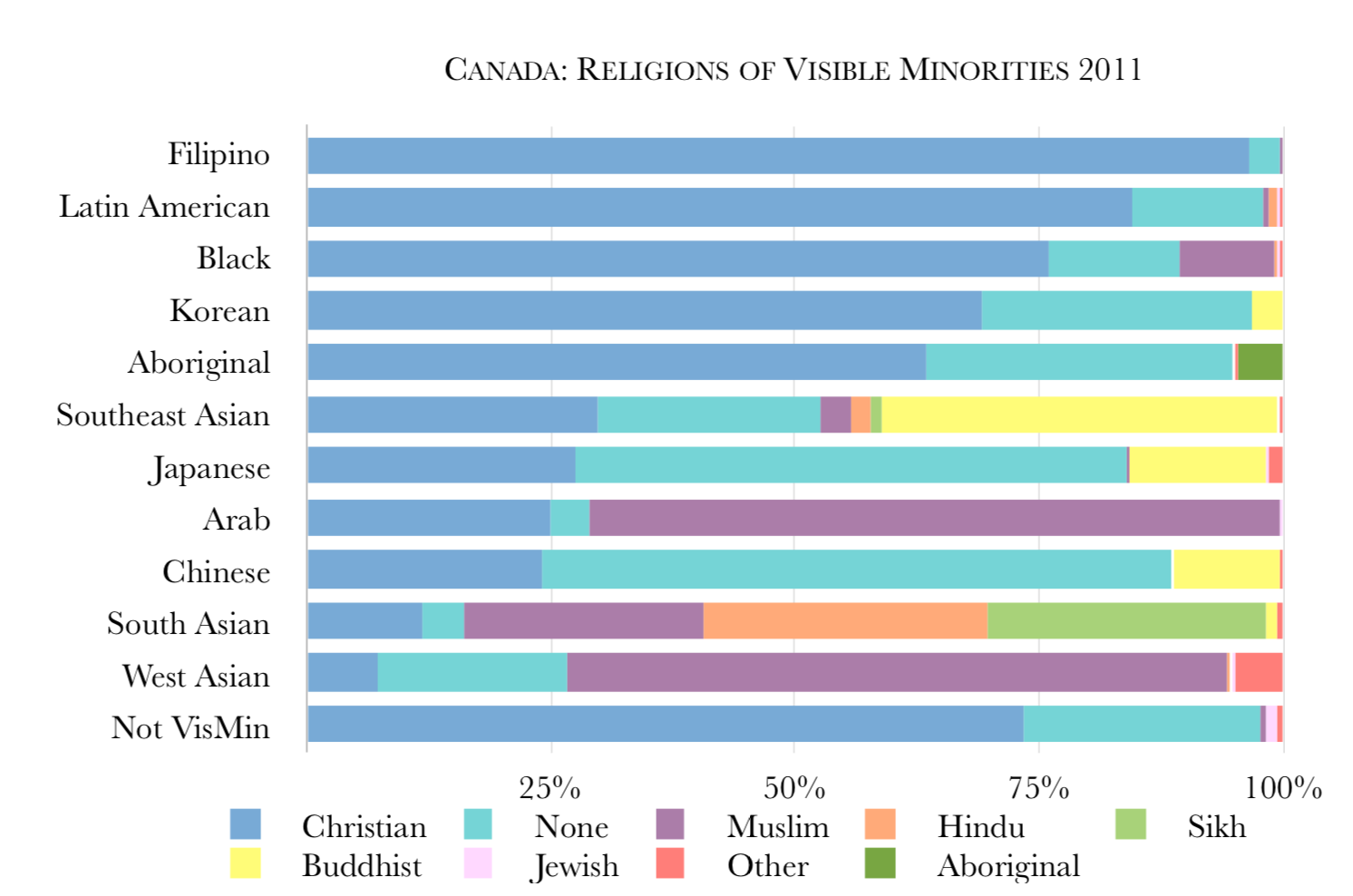
The tactics of Clark, an Anglican, were not only aimed at white Christians, but also B.C. Filipinos (95 per cent of whom are Christian), Koreans (64 per cent Christian) and ethnic Chinese (22 per cent Christian, 59 per cent not religious).
As for the B.C. NDP, Religion and Canadian Party Politics points to polls suggesting they appear to disproportionally rely on non-religious voters.
That is significant since the portion of British Columbians who are atheists, or unaffiliated, is arguably the highest of anywhere in North America, at 44 per cent.
It should be noted, though, that despite the tendency of B.C. Liberals to attract religious voters and the NDP to do the opposite, polls suggest all the province’s parties are capable at different times of drawing support from across the ethnic and faith spectrum.
It’s too bad, in an era when almost all politicians are going out of their way to court minority religious and ethnic groups, the book touches only briefly on Clark’s early success with Sikhs.
It quotes a source saying 30 per cent of the B.C. Liberal party’s membership was made up of Sikhs, even though they comprise just five per cent of the B.C. population. Metro Vancouver’s Sikhs number almost 200,000 and their large gurdwaras often host political gatherings.
Unfortunately, since Religion and Canadian Party Politics was published in 2017, it was not able to report on the way many Sikhs seemed to feel betrayed by Clark during this year’s B.C. election.
The NDP this May won all eight Metro Vancouver ridings with significant Sikh/South Asian populations.
An even more recent overlap of Sikhism and politics in B.C. occurred with the October election of Jagmeet Singh, an orthodox Sikh, as leader of the federal NDP. Singh won in part because he signed up 10,000 new members in B.C., many of them Sikhs.
It’s paradoxical that Singh is now leading a progressive, morally liberal party, even while he’s a baptized Sikh loyal to a faith devoted to conservative sexual ethics.
Even though Singh, 38, is unmarried, the Sikh religion emphasizes orthodox males are expected to be married, emphasizing they should not have sex until then.
Homosexuality is also not accepted in Sikh teaching, and abortion is seen as generally wrong. Nevertheless, Singh appears to express the kind of tolerance promoted by Sikh teachings about not hating anyone based on their race or sexuality.
How do Canadian Muslims vote?
That question may not be quite as significant in Metro Vancouver, where the Muslim population is three per cent, as it is in places such as Montreal and Toronto, where Muslims make up eight per cent of the population.
Even though Religion and Canadian Party Politics doesn’t delve into it, polls suggest many Canadian Muslims support patriarchy, reject homosexuality and discourage mixed unions.
The paradox is partly explained by Stephen Harper’s campaign, however. The federal Conservative party took a stand against the face-covering niqab worn by some Muslim women and, as Rayside said in an interview, showed “very one-sided support for Israel.”
Such is the complicated world of religion and politics in Canada.
While Religion and Canadian Party Politics is strong in critically assessing the influence of conservative white Christians on politics, sometimes by stealth, it’s not as useful on the impact of minority ethnic and religious groups.
Rayside acknowledged many scholars are reluctant to appear to criticize ethnic-based faiths.
But whites are now a minority in Metro Toronto and Vancouver. And about 17 per cent of Metro Vancouver residents, and 22 per cent of Torontonians, follow a non-Christian religion.
As scholar Reginald Bibby points out in his new book, Resilient Gods (UBC Press), in the decade leading up to 2011 more than 478,000 immigrants arrived who were Catholic (mostly Filipino and Chinese), 442,000 had no religion (mostly Chinese and Europeans), 388,000 were Muslims (mostly Iranians and Pakistanis), 154,000 were Hindus (from India) and 107,000 were Sikhs (India).
Scholars may have to overcome their cautiousness and more seriously study the impact of such fast-growing ethnic and religious groups.
It’s not just conservative Christians who have been quietly changing the face of Canadian partisan politics. So have Sikhs and Muslims: Many would expect they would be the hot new thing in political research.
Columbus is one of the year’s very best films—and, in all likelihood, one you haven’t yet seen. Premiering in August to critical acclaim (and earning just over $1 million at the limited-release box-office), writer/director Kogonada’s indie debut is a work of meticulous formal beauty and subtle emotional power, so assured and graceful that it immediately marks its creator as a legitimate auteur in the making. It’s a small, heartfelt, aesthetically remarkable gem that announces itself with little fanfare but strikes a lasting chord, digging deeply into a thicket of personal issues that are at once timely and universal. Now available on VOD, Kogonada’s drama is primed for discovery, especially as it gets set to appear on various critics’ top 10 lists.
Among its many virtues, Columbus boasts the most accomplished big-screen performance yet by John Cho, known to most as Harold in the Harold and Kumar movies and Sulu in the J.J. Abrams-rebooted Star Trek franchise. In the role of a Korean-American book translator named Jin who is compelled to visit Columbus, Indiana, after his esteemed architect father falls ill—a trip that leads to an unlikely friendship, and long chats at some of the city’s striking buildings, with local architecture-loving Casey (Haley Lu Richardson)—Cho is a marvel of understatement. As a man grappling with tumultuous feelings about his dad, his Korean-American heritage, and the tension between individual desire and familial/cultural obligation, Cho delivers a turn that’s as unaffected as it is multilayered, and which accomplishes what few others do: It treats race as a natural—if far from defining—aspect of a complex identity.
“In America, we’re so obsessed with race, and as it relates to the way characters are written, generally characters of color fall into two categories,” Cho says shortly after Columbus’ digital bow. “One is a character who’s very expressly whatever—black, or Asian, or Latino—and they’re The Latino Character, or The Black Character. And the other way is to completely ignore race, and have a character who’s essentially white, but then cast with a person of color. Neither of those feels particularly true to life.
“This character [Jin], who’s Korean-American—obviously his culture affects who he is. However, it’s maybe not one of the top five adjectives that describe him. I think that’s how I feel. I know I’m Asian, and Korean, and I know that these things are an important part of me. And yet I don’t go around feeling it. It’s just a fact about me. If anything, I would say I’m a father first. I’m a husband second. I’m a man, third. Maybe I’m an actor, fourth. All these things kind of rank above race, and yet our national hang-ups about race always vault race to the top. That’s always felt false to me.”
Still, Cho—who recently joined the second season of Fox’s TV series The Exorcist—acknowledges that, when choosing roles, he does carefully consider issues of representation. “I’m very sensitive to that. I think I’ll give more consideration to a part that has a full character history than a character that doesn’t have a specific character history. That is to say, most of my career has been parts that are not written for Asian-Americans, and then I was cast. So I have made an effort to be open to parts that were written specifically Korean. That is a tough thing to find, so when this came along, it was that much more special.”
According to Cho, it was clear from the get-go that Columbus was a project he had to do. “I knew it as soon as I read it. And it was confirmed by some very brief research into the director. I was like, this guy is a person of intelligence and feeling, and someone I want to know, and someone I want to work with. Then, when I met him, I was doubly convinced I had to do the movie. And even more than that, I think the greatest compliment I can pay to a filmmaker is, not only do I want to work with them but, beyond that, I just want to see them do their film, with or without me. This was one of those scripts, I was like, if he wants me, great. And if not, hats off and best wishes, and I’m going to see it when it comes out.”
Sunil Johal of the Mowat Centre on the challenges to government with the coming IT/AI/Automation transformation.
With the government’s poor record in recent large scale IT projects (e.g., Shared Services Canada, Phoenix pay system), hard to be optimistic:
A 2016 study by Deloitte and Oxford University found that up to 850,000 jobs in the United Kingdom’s public sector could be lost as a result of automation by 2030, in administrative roles as well as jobs for teachers and police officers.
Merely applying these same projections to the Canadian public sector would mean over 500,000 jobs at risk out of 3.6 million public sector roles. But collective agreements could impede any attempts to pivot away from employees performing routine administrative tasks and towards workers with digital skills.
If the economy at large continues to wring efficiencies out of human labour and substitute technological approaches where possible, it becomes hard to imagine the public sector trundling along as it always has.
Quite simply, the public sector will need to develop a more efficient workforce and adopt more agile structures and strategies in order to maintain relevance in a digital world.
So, what’s the right path forward? While it’s promising to see governments and other public sector organizations move forward with digital service agendas, we can’t expect them to simply overlay digital solutions onto existing processes and reap the real benefits of technology.
Blockchain, AI, virtual government
The public sector, ranging from the core civil service to health care to education, must fundamentally transform how it operates.
Do we need countless contribution agreements, contracts and reimbursements to be physically vetted by clerks in multiple offices when blockchain technology could instantly verify all of those same transactions?
Do policy units need 30 advisers to prepare advice for government ministers, or can much of their work be done automatically with a select few adding high-value insights? Can we employ telepresence to reach students in remote communities with high-quality teachers? Will medical diagnostics be transformed by neural networks that can more accurately detect cancers and other diseases?
Countries like Estonia, widely regarded as the most advanced digital society in the world, demonstrate that it’s possible to rethink government as a digital platform.
Whether and how quickly Canada’s public sector can leverage technological advancements to radically increase the efficiency and effectiveness of programs and services will be perhaps its greatest challenge in the years to come.
Delays and missteps will only continue to put the public service further behind mainstream business and consumer trends, and risk a continued decline in relevance for our public institutions.
Impact on labour force needs and immigration levels needs to be considered (most advocates for immigration increases are silent on the issue):
A coming wave of job automation could force between 400 million and 800 million people worldwide out of a job in the next 13 years, according to a new study.
A report released this week from the research arm of the consulting firm McKinsey & Company forecasts scenarios in which 3 percent to 14 percent of workers around the world — in 75 million to 375 million jobs — will have to acquire new skills and switch occupations by 2030.
“There are few precedents” to the challenge of retraining hundreds of millions of workers in the middle of their careers, the report’s authors say.
The impact will vary between countries, depending on their wealth and types of jobs that currently exist in each. In 60 percent of jobs worldwide, “at least one-third of the constituent activities could be automated,” McKinsey says, which would mean a big change in what people do day-to-day.
McKinsey looked at 46 countries and more than 800 different jobs in its research.
In the year 2030 in countries with “advanced economies,” a greater proportion of workers will need to learn new skills than in developing economies, researchers say. As many as a third of workers in the U.S. and Germany could need to learn new skills. For Japan, the number is almost 50 percent of the workforce, while in China it’s 12 percent.
Jobs that involve predictable, repetitive tasks are more easily automated, “such as operating machinery and preparing fast food,” and data processing, like paralegal work and accounting. However, McKinsey estimates less than 5 percent of jobs can be fully automated.
Jobs that pay “relatively lower wages” and aren’t as predictable are less likely to face full automation, because businesses don’t have as much incentive to spend on the technology. This applies to jobs like gardening, plumbing and child care, according to the authors.
Occupations that pay more but involve managing people and social interactions face less risk of automation due to the inherent difficulty in programming machines to do those types of tasks.
In the short term, automation and new technology could mean “significant” displacement of workers, the report says. But the authors argue that in the long term as technology has changed, “it creates a multitude of new jobs, more than offsetting” the number of those lost.
They note, however, those new jobs don’t always pay as much as the old ones.
A rising middle class in countries like China and India, and with it more consumption, will have a big impact on the direction of economies. “As incomes rise, consumers spend more on all categories,” the report says. “But their spending patterns also shift, creating more jobs in areas such as consumer durables, leisure activities, financial and telecommunication services, housing, health care, and education.”
Many countries are getting older as well — Japan is a notable example. And McKinsey researchers expect aging populations to need more medical care — more doctors, nurses, home health workers and aides — while demand goes down for children’s teachers and doctors.
Tech jobs will be needed as technology advances, like “computer scientists, engineers and IT administrators,” who could see job growth as companies spend more in this area, the report says.
Jobs gained “could more than offset the jobs lost to automation,” the researchers say. But, they say, “it will require businesses and governments to seize opportunities to boost job creation and for labor markets to function well.”
The McKinsey researchers recommend “an initiative on the scale of the Marshall Plan involving sustained investment, new training models, programs to ease worker transitions, income support and collaboration between the public and private sectors” to help economies and employment grow in the future.
Sheema Khan challenges the patriarchy (and the Friedman puff piece on MBS):
In a wide-ranging interview with Thomas Friedman of the New York Times, Saudi Arabia’s Prince Mohammed bin Salman (a.k.a. “MBS”) discussed, among other topics, the recent anti-corruption drive and liberalization of Saudi society. Call it a kinder, gentler form of authoritarianism – with a progressive touch. Notably, MBS refused to address his country’s interference in Lebanese politics or its unconscionable scorched-earth policy in Yemen.
Nonetheless, Mr. Friedman was effusive of MBS’s plans to veer Saudi Islam to a “moderate, balanced Islam that is open to the world and to all religions and all traditions and peoples.” The Prince calls it a “restoration” of the faith to its origins – namely the Prophetic period in the early 7th century. This has the potential to reverse the puritanical strain (Wahhabism) currently at the heart of Saudi society, where, for example, a woman is under male guardianship from cradle to grave.
The late Sunni scholar Abdul Halim Abu Shaqqa chronicled in his comprehensive study of the Koran and authentic traditions of Prophet Muhammad, Muslim women were far more engaged in society during the Prophetic era. They had more rights and opportunities to build a vibrant society, in partnership with men, than many contemporary Muslim cultures (including Saudi Arabia).
Mr. Friedman believes this “restoration” project “would drive moderation across the Muslim world.” In fact, most of the Muslim world has soundly rejected Wahhabism. Yet, the deeply entrenched patriarchy of Saudi society finds parallels in many Muslim countries.
While MBS has promised to grant Saudi women more liberty, his top-down approach towards “restoration” of Islam raises a number of questions.
Will the man who allowed women to drive, allow them a place to drive the “restoration” as well? Or will it be a vehicle steered exclusively by men, with women seated as passengers, while men alone navigate women’s role in society?
Women’s voices and perspectives will be essential if there is to be any meaningful reform of contemporary Muslim cultural practices.
In her groundbreaking book “Domestic Violence and the Islamic Tradition,” UBC Professor Ayesha Chaudhry makes it abundantly clear that the “Islamic tradition” – beginning a few centuries after the Prophetic era to the precolonial era – reflected worldwide patriarchy of the times. The hierarchical paradigm was unambiguous: God (or Allah) at the top, followed by men below, then by women subordinate to men and finally slaves below women. This view shaped pretty much all religious discourse – from Koranic exegesis to Islamic jurisprudence.
Ismail ibn Kathir, a 14th-century Sunni scholar whose works still carry great influence, was unequivocal. “The man is better than the woman,” he wrote in his authoritative commentary of the Quran. By no means was he alone. Prof. Chaudry’s meticulous research shows how devastating this paradigm was in relation to domestic violence. All Sunni scholars and jurists advocated beating a “recalcitrant” wife – specifying when, how often, where on her body, with either one’s fists or a sturdy object, and so on. The Hanafi school of jurisprudence was the harshest, allowing a husband the leeway to beat his wife as he saw fit, so long as he didn’t kill her. The book is a painful read, but should be read by those interested in reform.
The problem is that much of this patriarchal Islamic tradition – developed by male medieval scholars – is still taught uncritically in many Muslim seminaries and reflected in a number of Muslim cultures, where male privilege reigns.
Muslims must take a critical look at this tradition in light of contemporary norms. Like Abo Shaqqa, Prof. Chaudhry points out the obvious: Domestic violence advocates were/are unable to reconcile the fact that the model for all Muslims, Prophet Muhammad, never once raised his hand. He rebuked those who did.
The postcolonial period had ushered in a more egalitarian view, in which men and women are on the same moral plane before God. However, this approach has had uneven acceptance. Very rarely will men give up their privileged position to be on equal footing with women.
Yet Muslim women still insist on gender justice. Contemporary female Muslim scholars, such as Prof. Chaudhry, Amina Wadud, Asma Barlas, Ziba Mir-Hosseini and Asma Lamrabet, have challenged patriarchal interpretations of the Koran, thereby providing women with exegetical tools to confront male privilege rooted in theology.
Elsewhere, Muslim women in India are challenging the patriarchy entrenched in Muslim institutions, through education and legal reform. There are now female judges to solemnize marriages and adjudicate divorces, thereby restoring balance to proceedings which were exclusively presided by men.
If MBS really wants to return to a “moderate, balanced” Islam, he must include the perspectives of women on equal footing.
Canada has collected ethnic origin/ancestry data for over 30 years:
“White” has been a constant of the U.S. census.
Other racial categories for the national headcount have come and gone over the centuries. But “white” has stuck ever since U.S. Marshals went door-to-door by horseback for the first census in 1790, tallying up the numbers of “free white males” and “free white females,” plus “all other free persons” and “slaves.”
Census takers determined who counted as “white” or any other race. That changed in 1960, when U.S. residents were first allowed to self-report their race. Since then, just answering “white” has been enough to respond to the race question.
But the upcoming census in 2020 may ask those who identify as white to explore their family tree to share their ethnic background as well. Anyone who checks off the “white” box could also mark boxes for groups such as “German,” “Irish” and “Polish” or write in another option.
That change depends partly on whether the White House approves proposals to modify how the federal government collects race and ethnicity data. They originated when President Obama was still in office, and now it’s up to the Trump administration to approve or reject them. If approved, the Census Bureau may move forward with this new way of asking people of all races about their identities on the 2020 questionnaire.
Friday is the deadline for the White House’s Office of Management and Budget, which sets standards for this kind of data for all federal agencies, to announce its decisions on the proposals. Any policy changes would come at a time of heightened awareness of white nationalist calls against multiculturalism and growing partisan divides over issues about race in the U.S.
Research by the Census Bureau suggests the proposals could produce a more accurate count in 2020. In a report released in February, the bureau’s researchers write that the suggested changes are responding to a public “call for more detailed, disaggregated data for our diverse American experiences as German, Mexican, Korean, Jamaican, and myriad other identities.”
‘It could change the discussion’
Asking white people about their ethnic background is not a new concept for the census. Recent census forms, including the questionnaire used in 2010, have asked all recipients about their ethnicity specifically in terms of “Hispanic, Latino, or Spanish origin.” A question about a person’s ancestry or ethnic origin was first included in the 1980 Census and remained on some forms as recently as 2000. Past forms have asked for a person’s place of birth, the countries where the person’s mother and father were born and languages spoken other than English.
Facebook Inc said on Wednesday it was temporarily disabling the ability of advertisers on its social network to exclude racial groups from the intended audience of ads while it studies how the feature could be used to discriminate.
Facebook’s chief operating officer, Sheryl Sandberg, told African-American U.S. lawmakers in a letter that the company was determined to do better after a news report said Facebook had failed to block discriminatory ads.
The U.S.-based news organization ProPublica reported last week that, as part of an investigation, it had purchased discriminatory housing ads on Facebook and slipped them past the company’s review process, despite claims by Facebook months earlier that it was able to detect and block such ads.
“Until we can better ensure that our tools will not be used inappropriately, we are disabling the option that permits advertisers to exclude multicultural affinity segments from the audience for their ads,” Sandberg wrote in the letter to the Congressional Black Caucus, according to a copy posted online by ProPublica.
It is unlawful under U.S. law to publish certain types of ads if they indicate a preference based on race, religion, sex or certain classifications.
Malta’s due diligence of people applying to buy citizenship has been held up as “a textbook example” of effectiveness and reliability by Thomson Reuters.
Peter Vincent, general counsel at the Canadian company that provides intelligence services, said Malta’s Individual Investor Programme provided a high standard of due diligence.
“Malta has a reputation for having a very solid programme for citizenship and residency that has very secure due diligence processes in place and transparency. It’s by no means perfect but there is no completely secure system in the world but if you are looking for a model, not just for the EU but for the entire world, I would look to a country like Malta,” Vincent said in an interview with Investment Migration Insider, an industry journal.
Thomson Reuters is one of the companies used by Identity Malta to help it in the screening of prospective clients.
Vincent was speaking on the price war in the Caribbean over citizenship programmes, which was affecting due diligence standards in the region.
“Malta is a textbook example of how to conduct effective and reliable due diligence,” he said, adding that Identity Malta should look beyond its remit and mentor other countries still trying to develop their programmes.
The IIP was introduced amid much controversy in 2014 with the aim of attracting rich foreign nationals interested in buying Maltese citizenship. The scheme has enabled the country to create a multi-million euro fund administered separately from government accounts.
The programme last year raised some €165 million and is capped at 1,800 applications, a number likely to be reached some time next year.
The government has been criticised by the European Parliament because the names of those who obtain citizenship through the IIP are not published separately. Instead, the names are included without any specific identifier with those of others who obtain citizenship through naturalisation.
At a recent citizenship forum organised by Henley and Partners, the company entrusted to manage and market Malta’s scheme, Prime Minister Joseph Muscat said Malta will be extending its citizenship by investment programme.
He told his audience in Hong Kong the second IIP programme would be “even more exclusive” than the current version, without elaborating further.


 Multicultural Meanderings